
Captain Billy's Whiz Bang, April 1921 · page 12 of 68
Captain Billy's Whiz Bang #19 — page 12: what you’re looking at
What you’re looking at
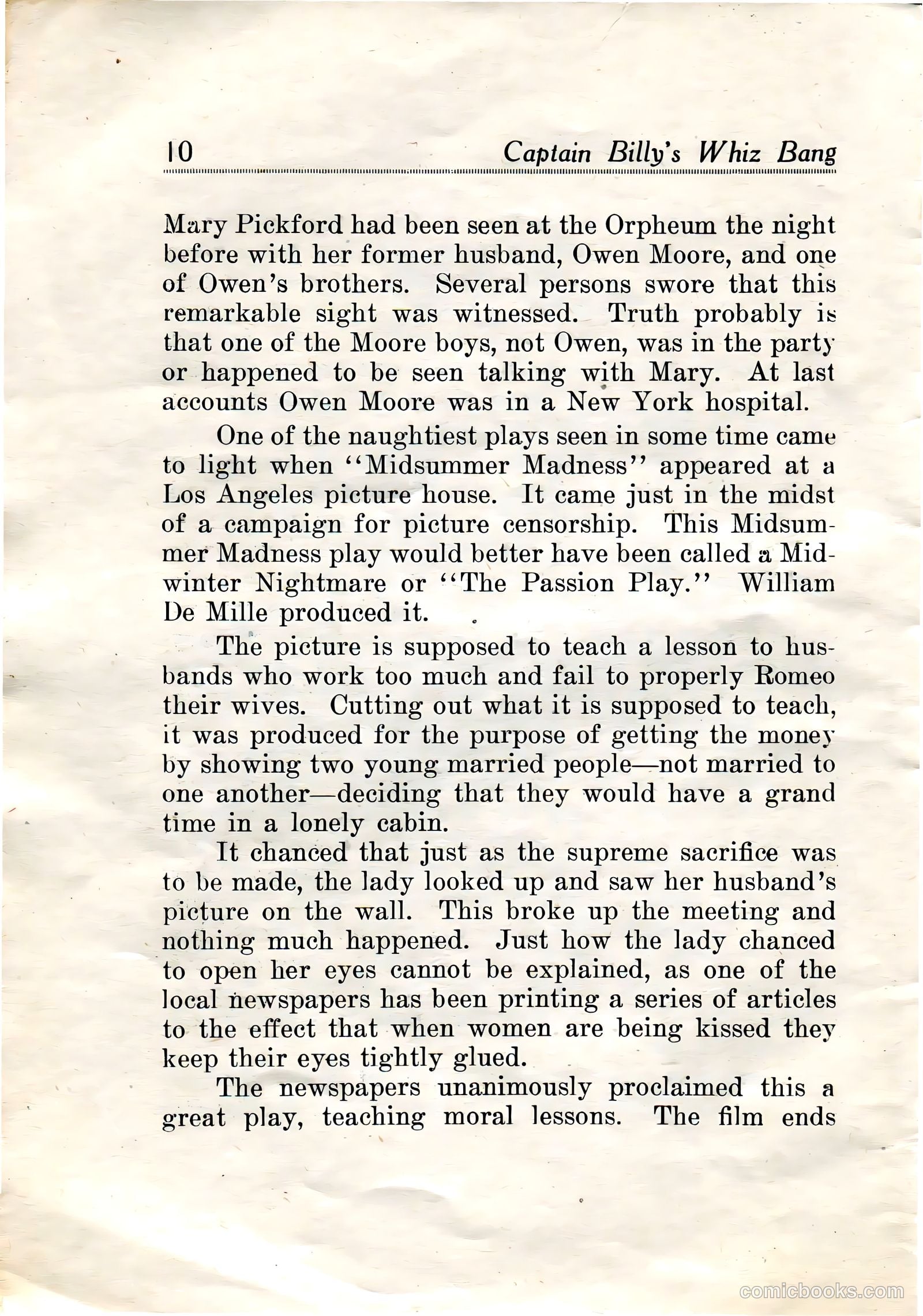
This page satirizes both a scandalous silent film and the hypocrisy of film censorship in early 1920s America. **The targets:** Producer William De Mille's *Midsummer Madness*, which depicted infidelity (two married people—not to each other—in a cabin), and the newspapers that praised it as "moral" despite its salacious content. **The joke:** The author mocks the film's contrived "moral lesson" (a wife sees her husband's portrait and resists temptation) and the newspapers' double standards—simultaneously campaigning for film censorship while endorsing this risqué picture. The sarcastic dig about women keeping their eyes "tightly glued" while kissing further ridicules the absurdity of both the film's plot and the press's pretended moral outrage. **Celebrity gossip included:** A brief item about actress Mary Pickford being spotted with her ex-husband Owen Moore, presented as likely tabloid fabrication. The piece exemplifies *Whiz Bang*'s irreverent critique of Hollywood hypocrisy.
📄 Transcribed text from this page (OCR, searchable)
Machine-transcribed from the original scan — historical spelling and the odd misread are preserved.
10 Captain Billy's Whiz Bang Mary Pickford had been seen at the Orpheum the night before with her former husband, Owen Moore, and one of Owen's brothers. Several persons swore that this remarkable sight was witnessed. Truth probably is that one of the Moore boys, not Owen, was in the party or happened to be seen talking with Mary. At last accounts Owen Moore was in a New York hospital. One of the naughtiest plays seen in some time came to light when “Midsummer Madness” appeared at a Los Angeles picture house. It came just in the midst of a campaign for picture censorship. This Midsummer Madness play would better have been called a Midwinter Nightmare or “The Passion Play.” William De Mille produced it. The picture is supposed to teach a lesson to husbands who work too much and fail to properly Romeo their wives. Cutting out what it is supposed to teach, it was produced for the purpose of getting the money by showing two young married people—not married to one another—deciding that they would have a grand time in a lonely cabin. It chanced that just as the supreme sacrifice was to be made, the lady looked up and saw her husband's picture on the wall. This broke up the meeting and nothing much happened. Just how the lady chanced to open her eyes cannot be explained, as one of the local newspapers has been printing a series of articles to the effect that when women are being kissed they keep their eyes tightly glued. The newspapers unanimously proclaimed this a great play, teaching moral lessons. The film ends