
A complete issue · 16 pages · 1889
Puck — January 23, 1889
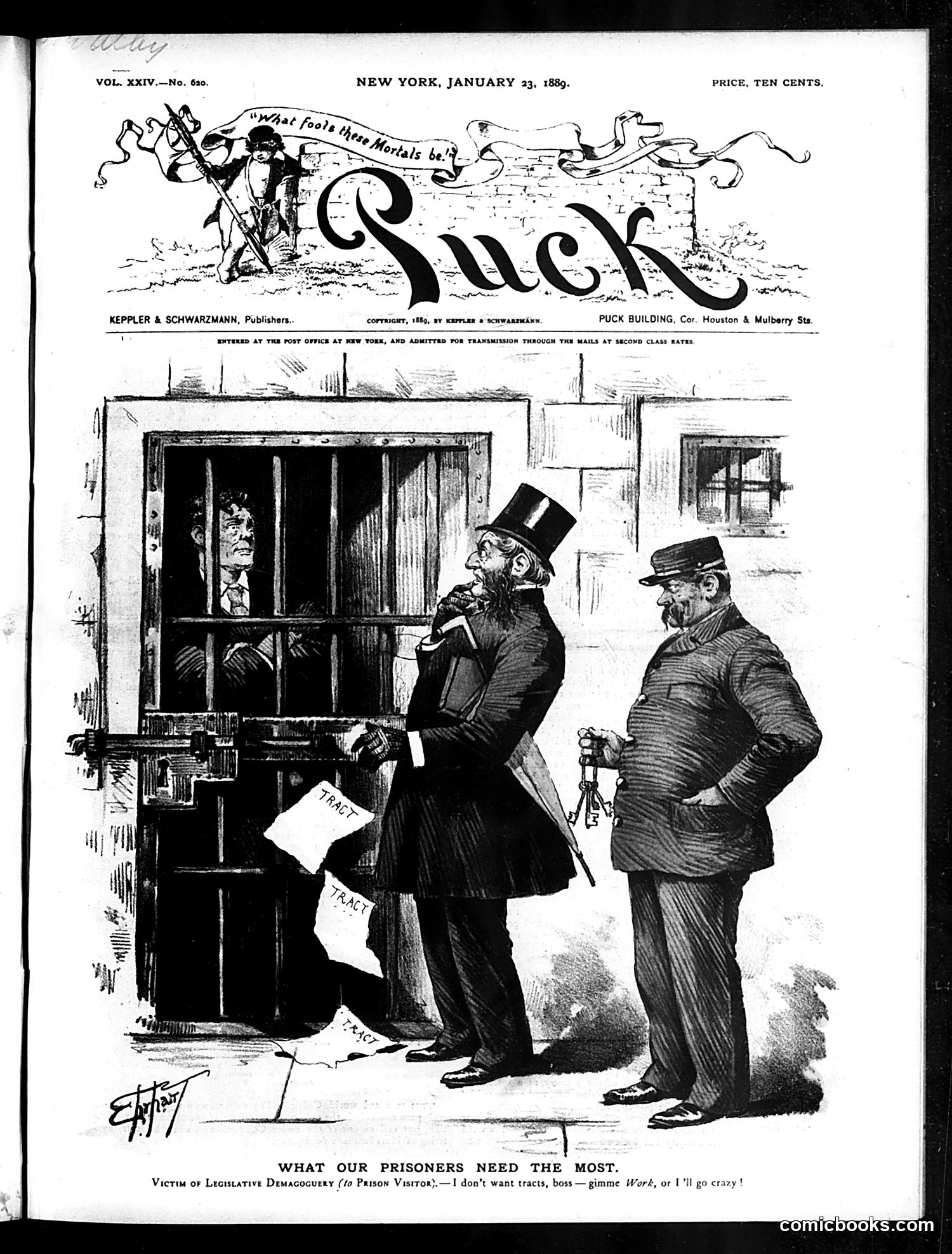
This Puck cartoon from January 23, 1889, satirizes prison conditions and legislative neglect. Two well-dressed officials with top hats stand outside a prison cell where an inmate is visible behind bars. Papers labeled "TRACT" litter the ground. The caption quotes a prison visitor claiming inmates don't need "tracks, boss—gimme Word, or I'll go crazy!"—suggesting prisoners receive religious tracts instead of practical necessities. The satire targets what appears to be **legislative demagoguery**: officials distribute moralistic literature to prisoners while ignoring their actual material needs. The cartoon critiques both the hypocrisy of this approach and the failure of lawmakers to address real prison reform. The inmate's desperation underscores the gap between charitable gestures and genuine humanitarian needs.
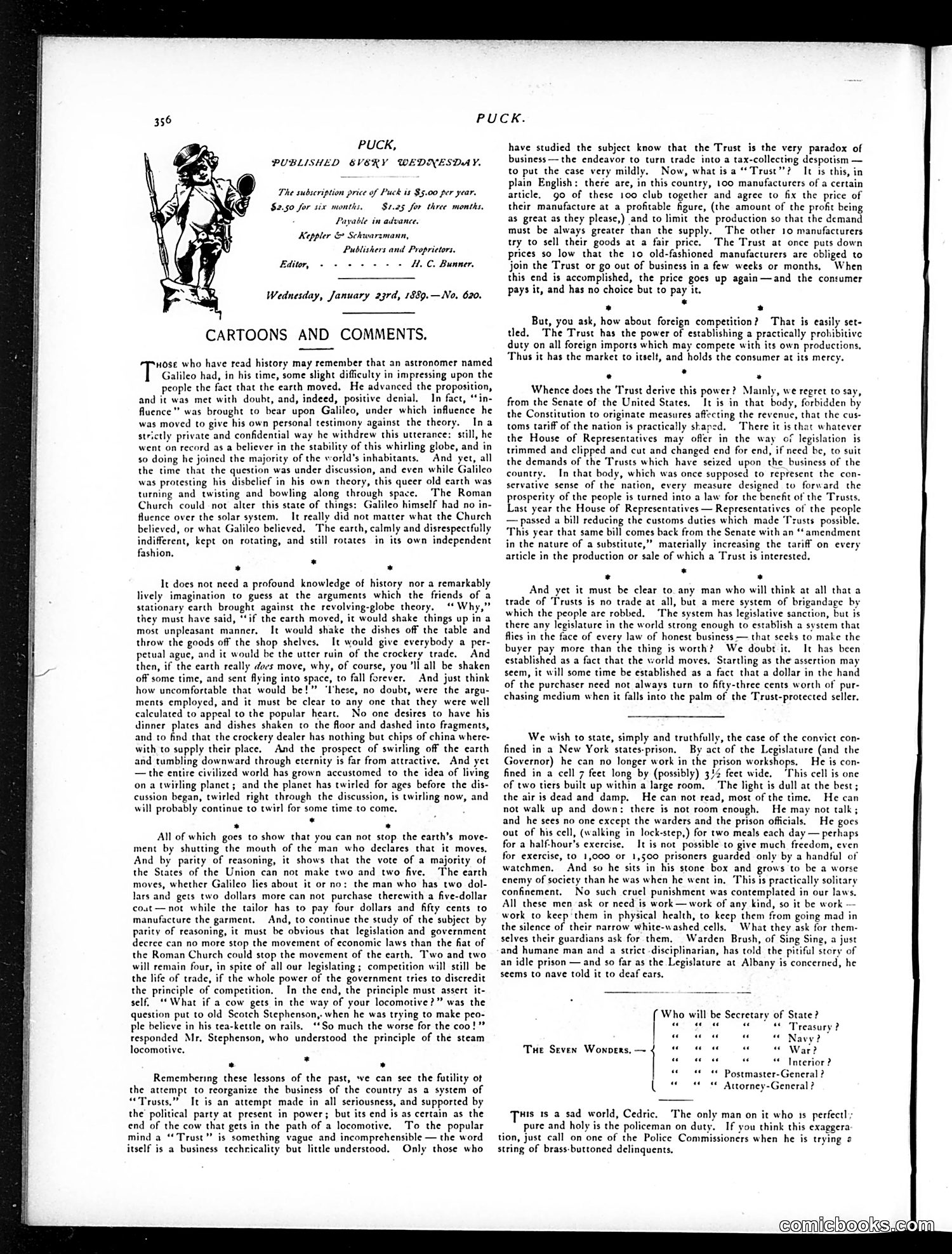
This page from Puck (January 22, 1879) contains editorial commentary about "Trusts"—business monopolies that were emerging as a major political issue. The text critiques how trusts manipulate markets: they artificially limit production to raise prices, then use protective tariffs to exclude foreign competition and control consumers. The editorial argues that trusts represent a dangerous concentration of economic power, comparing them unfavorably to free-market competition. It also discusses a New York convict whose imprisonment conditions are inhumane—confined to a small cell with minimal light and exercise. The header cartoon (a Puck mascot figure) is decorative. The page's main content is satirical political commentary on monopolistic business practices and government corruption, central concerns of the Gilded Age.
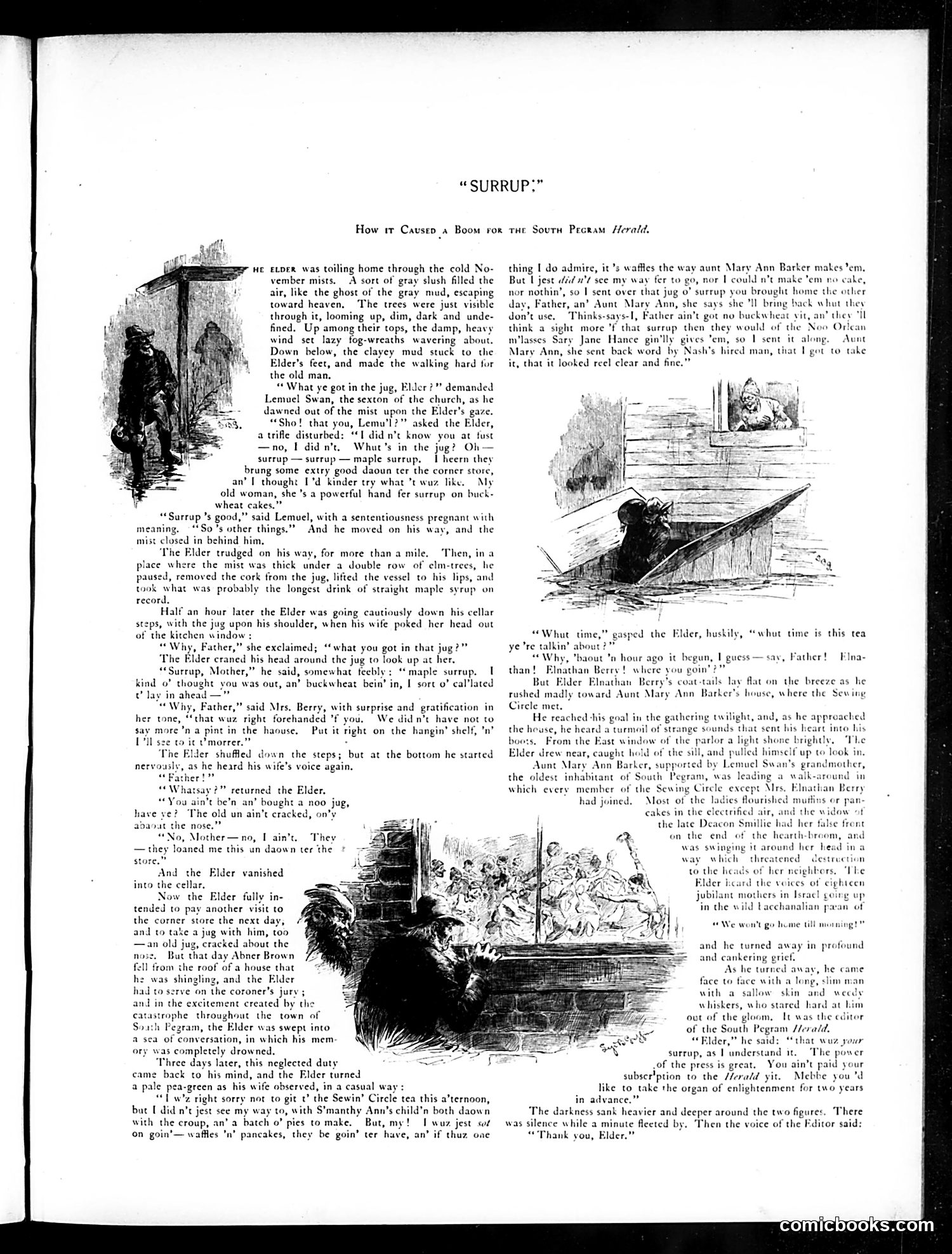
This is a humorous dialect story illustrated with sketches. The narrative depicts a rural scene where an Elder discusses "surrup" (syrup) with characters including Lemuel Swan and various family members. The dialogue uses exaggerated phonetic spelling to represent rural/dialect speech patterns typical of late-19th-century American humor. The illustrations show rustic domestic scenes: an elderly man in winter conditions, a landscape with water, and what appears to be a gathering of people. The story seems to mock rural Southern life and speech through comedic misunderstandings about syrup production and commerce. This reflects Puck's tradition of satirizing rural America and regional dialects, though the specific "South Pegram Herald" reference and its satirical target remain unclear from the page alone.
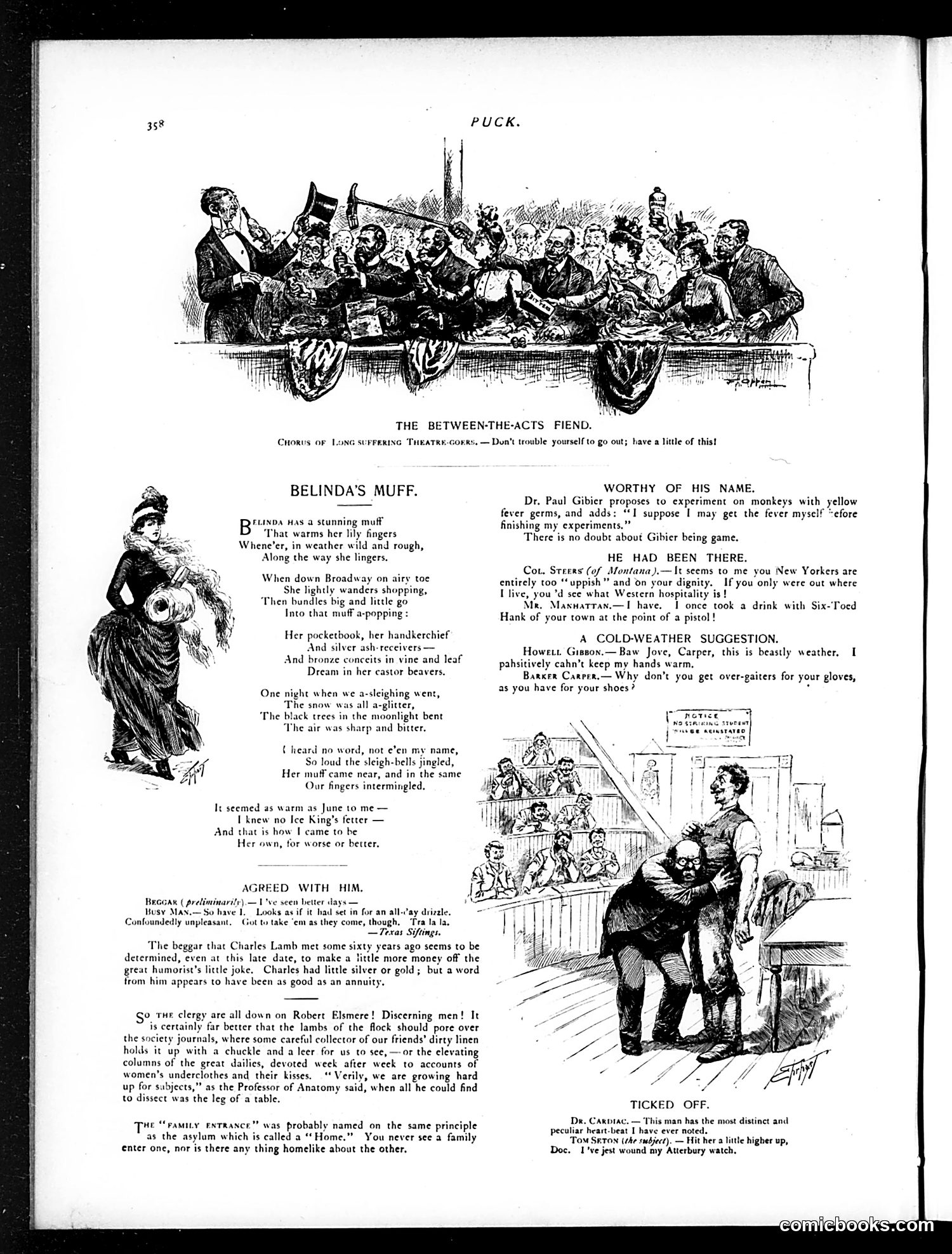
**Top Illustration ("The Between-the-Acts Fiend"):** Shows theater-goers at a box during intermission. The caption warns against chattering loudly during theatrical breaks—a common annoyance in 19th-century theaters where audiences were notoriously talkative. **Three Poems/Pieces Below:** - **"Belinda's Muff"**: A sentimental poem about a woman's winter accessory and romantic memories - **"Worthy of His Name"**: Mocks Dr. Paul Gibier's dubious experiments on monkeys regarding fever - **"A Cold-Weather Suggestion"** and **"Ticked Off"**: Brief humorous social commentary **Bottom Cartoon ("Ticked Off"):** Shows what appears to be theater-goers or patrons in a crowded venue—likely satirizing theater etiquette or audience behavior. The page primarily addresses **19th-century social irritations**—particularly poor theater manners—through humor and light satire.
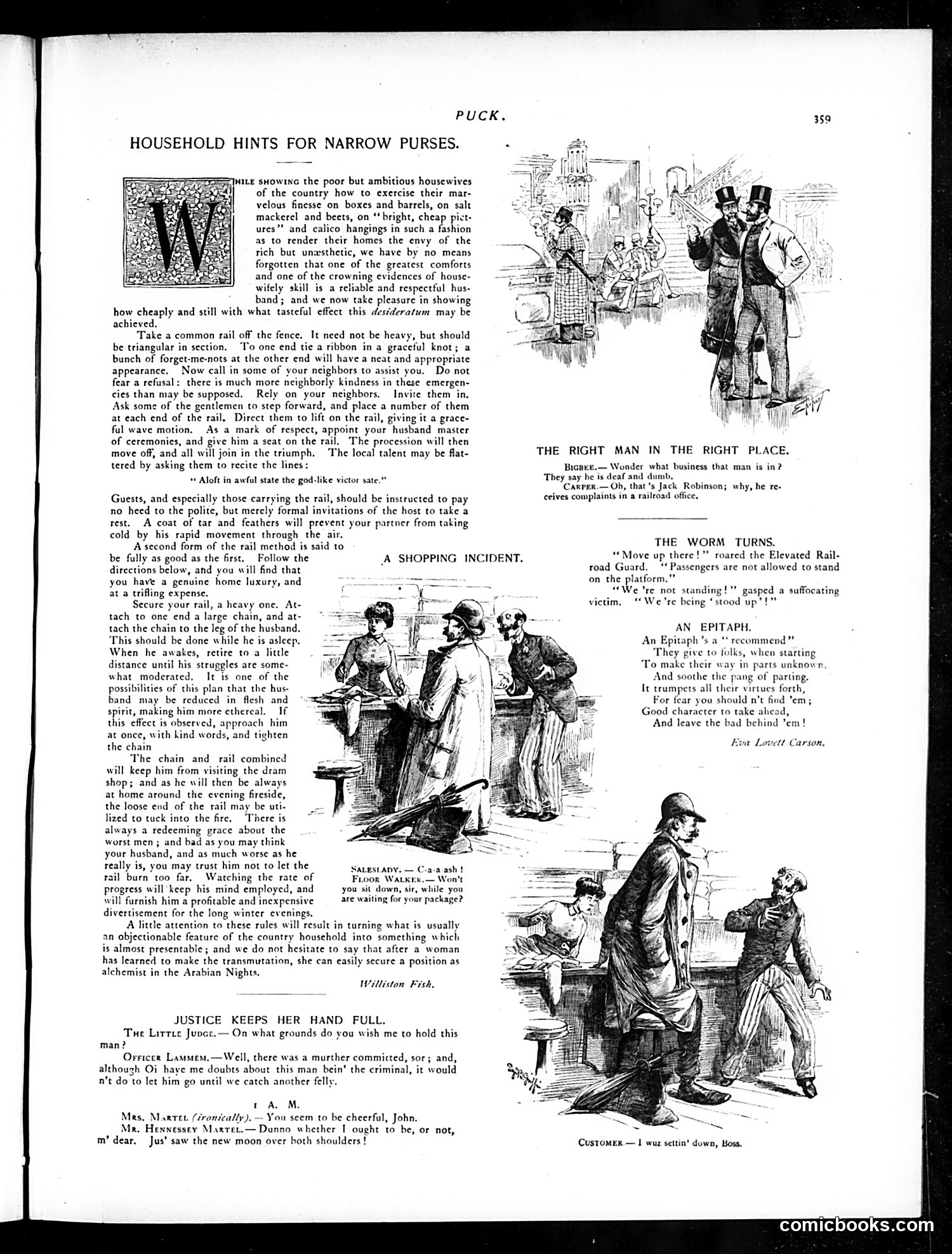
This page contains household advice and several brief satirical sketches rather than a single political cartoon. **"The Right Man in the Right Place"** depicts a railroad office scene where a man named Jack Robinson complains about his job—likely satirizing workplace dissatisfaction or incompetent bureaucracy. **"A Shopping Incident"** shows women at what appears to be a market or shop, with a humorous caption about a purchase. **"The Worm Turns"** mocks an elevator guard's overzealous enforcement of rules against standing on the platform. The remaining items are short comic dialogues and an epitaph, all employing gentle humor about everyday social situations—domestic management, shopping, transit etiquette, and marital relations. The satire targets minor social absurdities rather than major political issues.
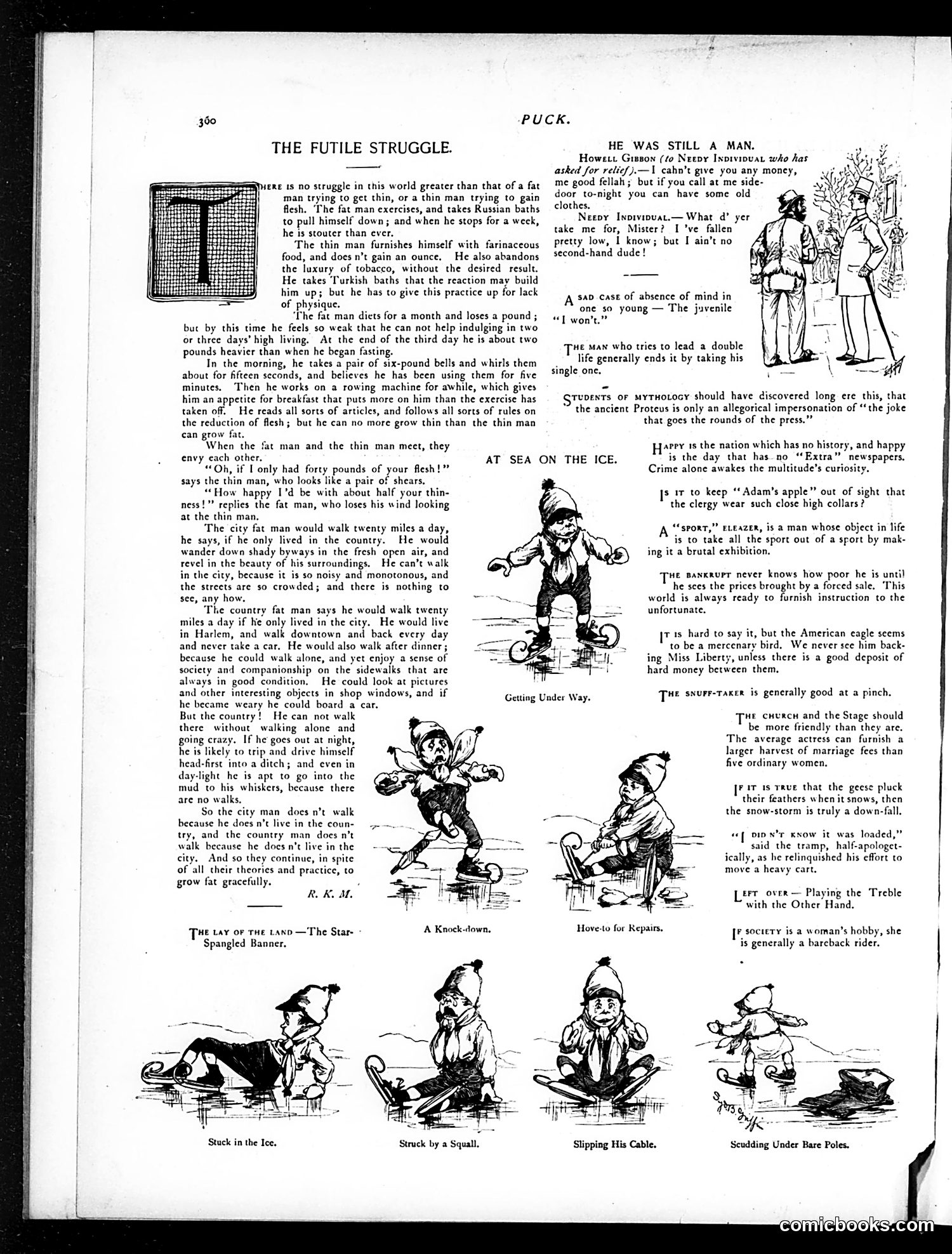
This page contains satirical commentary and humorous illustrated vignettes about winter ice skating. The main article "The Futile Struggle" critiques the challenges of ice skating—particularly mocking the contrast between fat and thin men attempting the sport, with the fat man struggling unsuccessfully while the thin man performs better. The illustrations below labeled "At Sea on the Ice" show various comic skating mishaps: people falling, getting knocked down, struggling to maintain balance, and generally floundering on frozen surfaces. The captions ("A Knock-down," "Getting Under Way," "Stuck in the Ice," etc.) humorously describe each predicament. The scattered witticisms on the right appear to be unrelated social commentary. Overall, this is light satire mocking the physical comedy and mishaps of recreational ice skating.
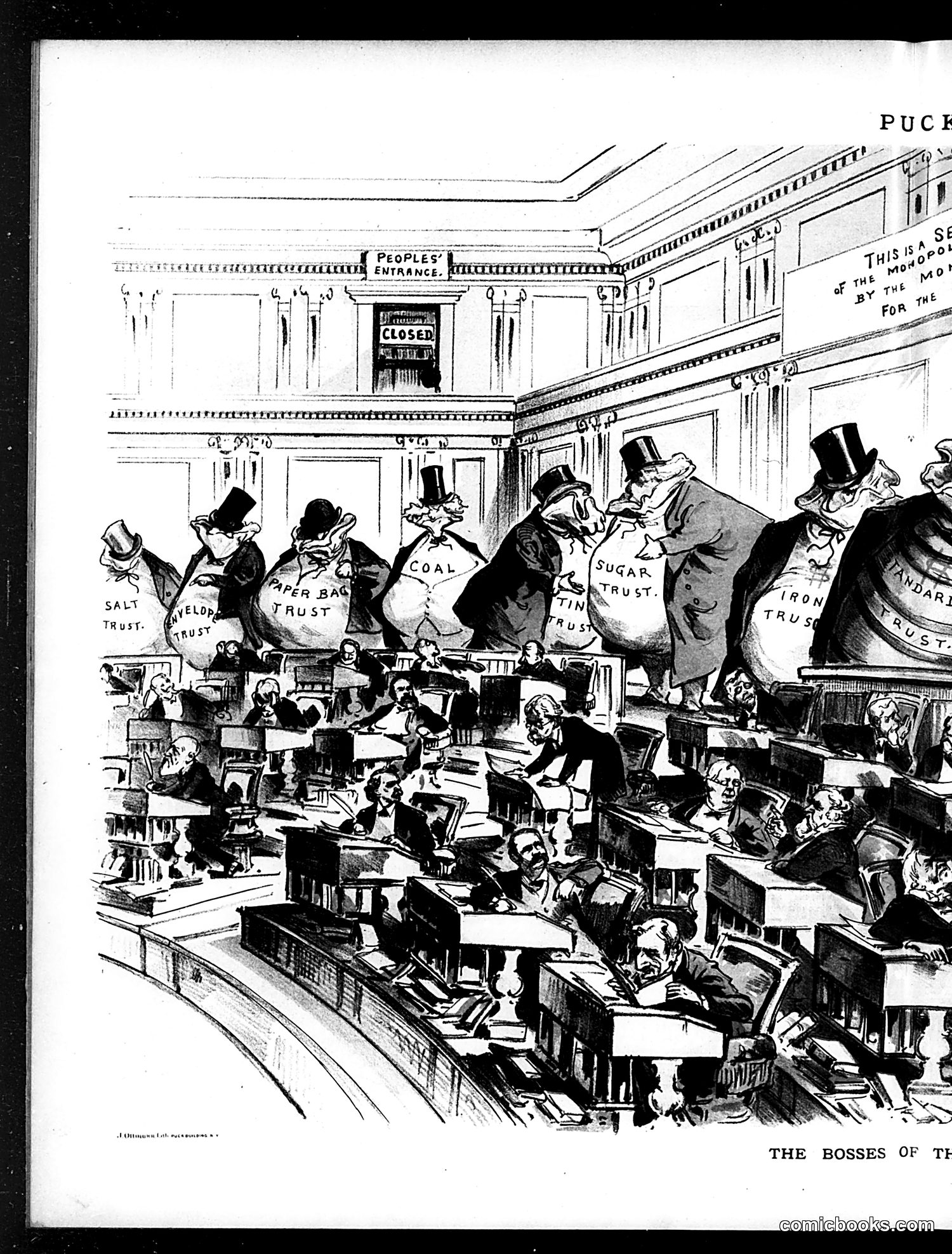
This Puck cartoon satirizes **monopolistic business trusts** that dominated American commerce in the late 19th/early 20th century. The giant figures looming over a legislative chamber represent major industrial trusts—labeled **Salt Trust, Veldt Trust, Paper Bag Trust, Coal Trust, Sugar Trust, Tin Trust, Iron Trust, and Andarko Trust** (among others, partially visible). They literally overshadow the small congressmen below, who sit at desks conducting government business. The satire's point: these massive corporate monopolies wielded such enormous economic power they effectively controlled politicians and legislation. The "People's Entrance" marked "CLOSED" at the top reinforces that ordinary citizens' voices were shut out—only big business had real influence over government. This reflects Progressive Era anxieties about trusts threatening democratic representation.
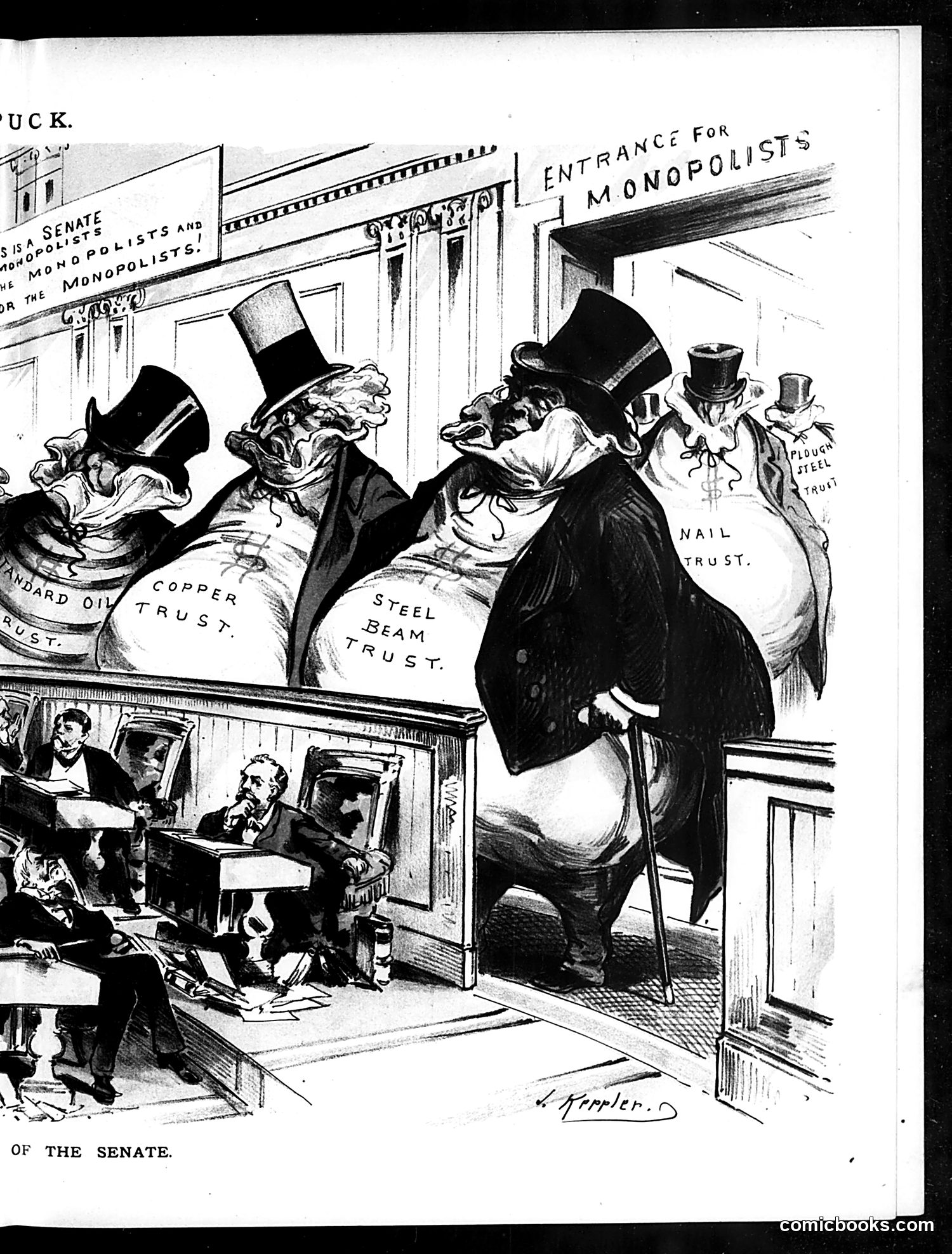
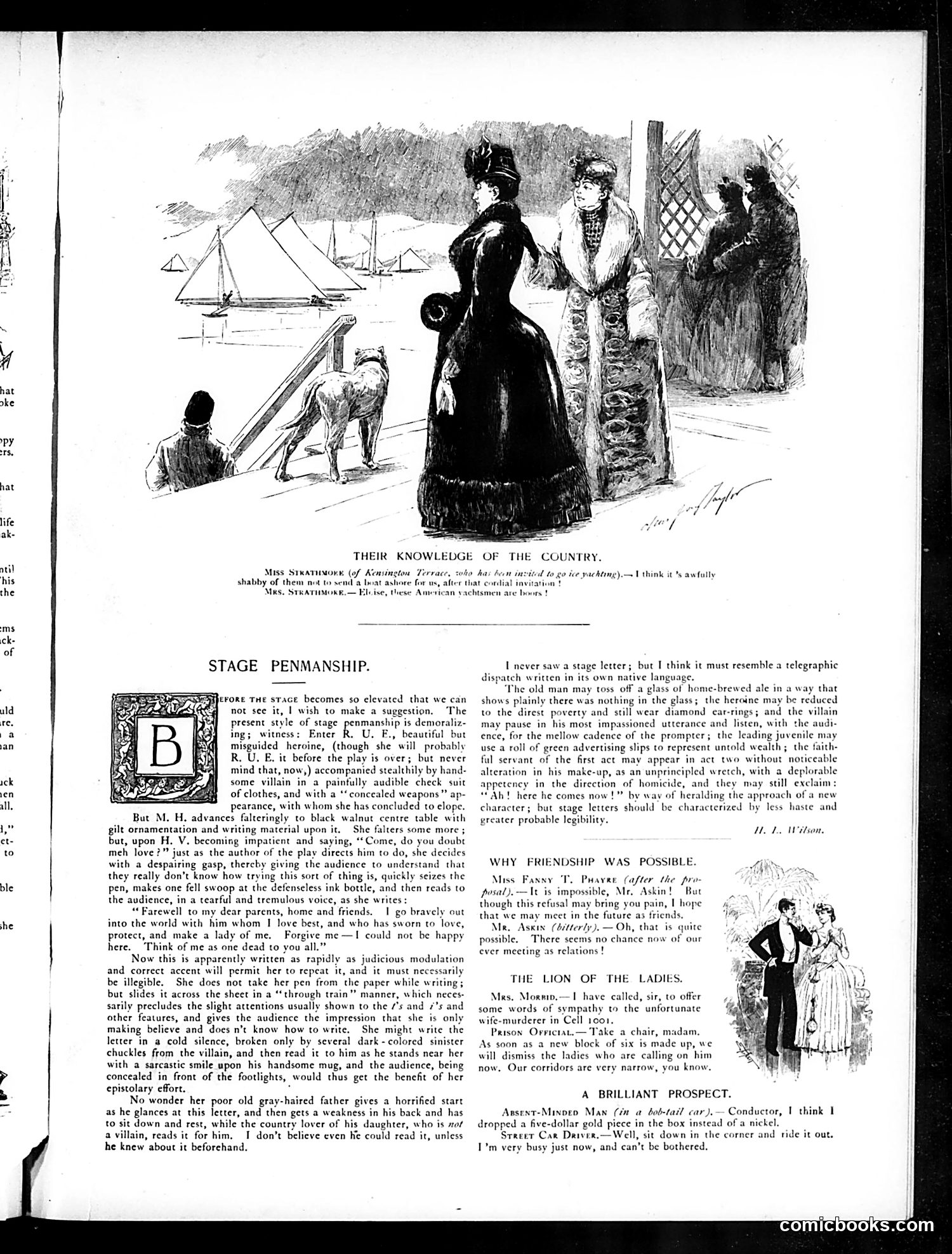
This Puck cartoon satirizes **monopolies and trusts** attempting to gain access to the U.S. Senate. The large figures labeled "Standard Oil Trust," "Copper Trust," "Steel Beam Trust," and "Nail Trust" are personified as wealthy industrialists in top hats, trying to enter a door marked "Entrance for Monopolists." Inside the Senate chamber below, legislators appear indifferent or complicit. The cartoon criticizes how corporate monopolies sought political influence and favorable legislation in Congress. By depicting trusts as enormous, bloated figures literally trying to squeeze through the Senate entrance, the artist mocks both the brazenness of industrial monopolies and the perceived weakness or corruption of senators who might accommodate them. This reflects Progressive Era concerns about unchecked corporate power threatening democratic governance.
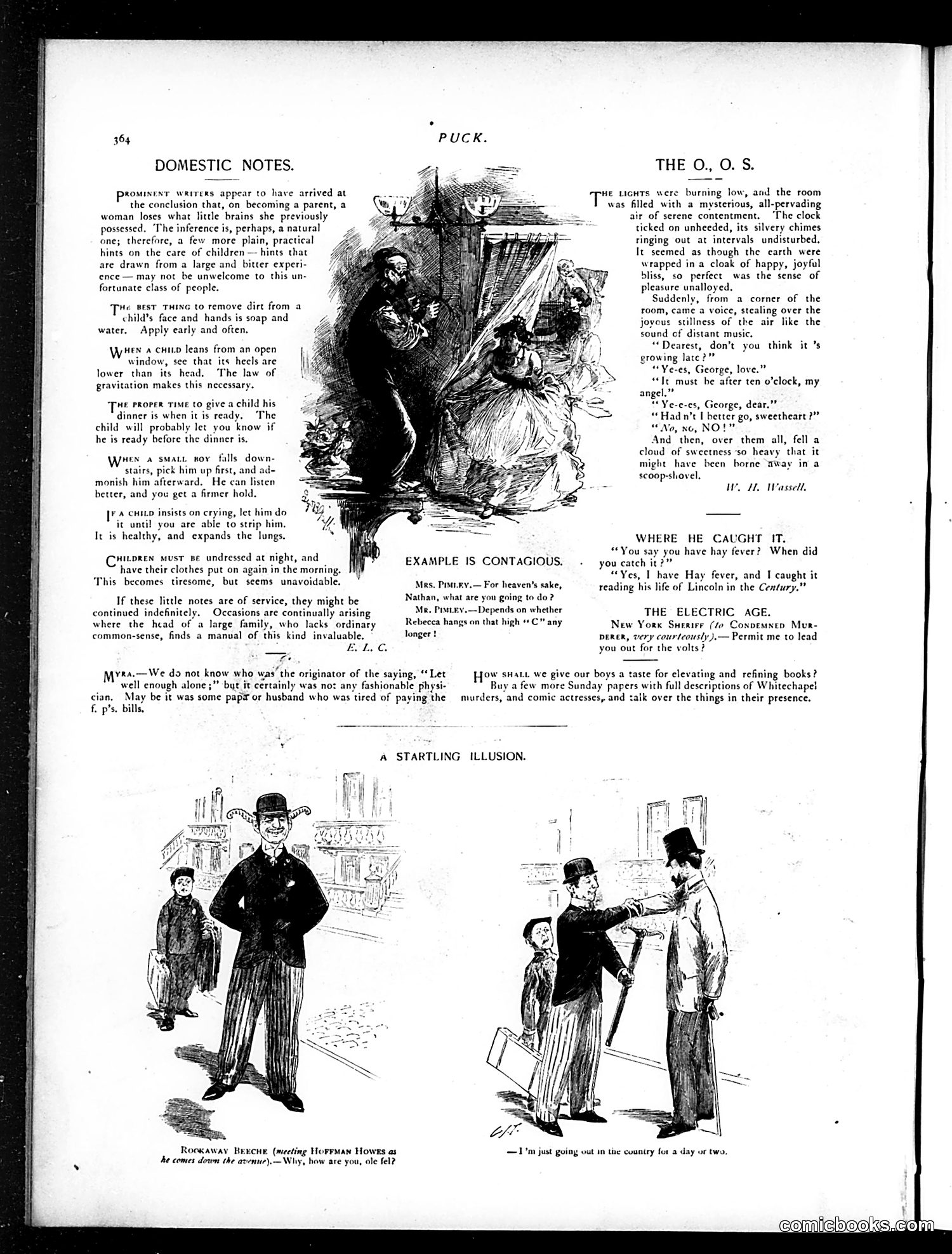
This cartoon satirizes urban homelessness and deception during the Gilded Age. The left panel shows a well-dressed man with children, positioned near what appears to be tenement housing. The caption reads: "Runaway Hecker (exciting Hoffman Hoovels as cross down the avenue)—Why, how are you, de lord!" The right panel depicts the same figure approaching another man, saying: "I'm just going out in the country for a day or two." The satire targets affluent New Yorkers who disguise their actual circumstances or intentions. "Hecker" appears to be a known wealthy person publicly claiming poverty or hardship while maintaining a fashionable appearance. The "illusion" is the gap between appearance and reality—a common Puck theme mocking hypocrisy among the privileged classes who pretend to struggle while living comfortably.
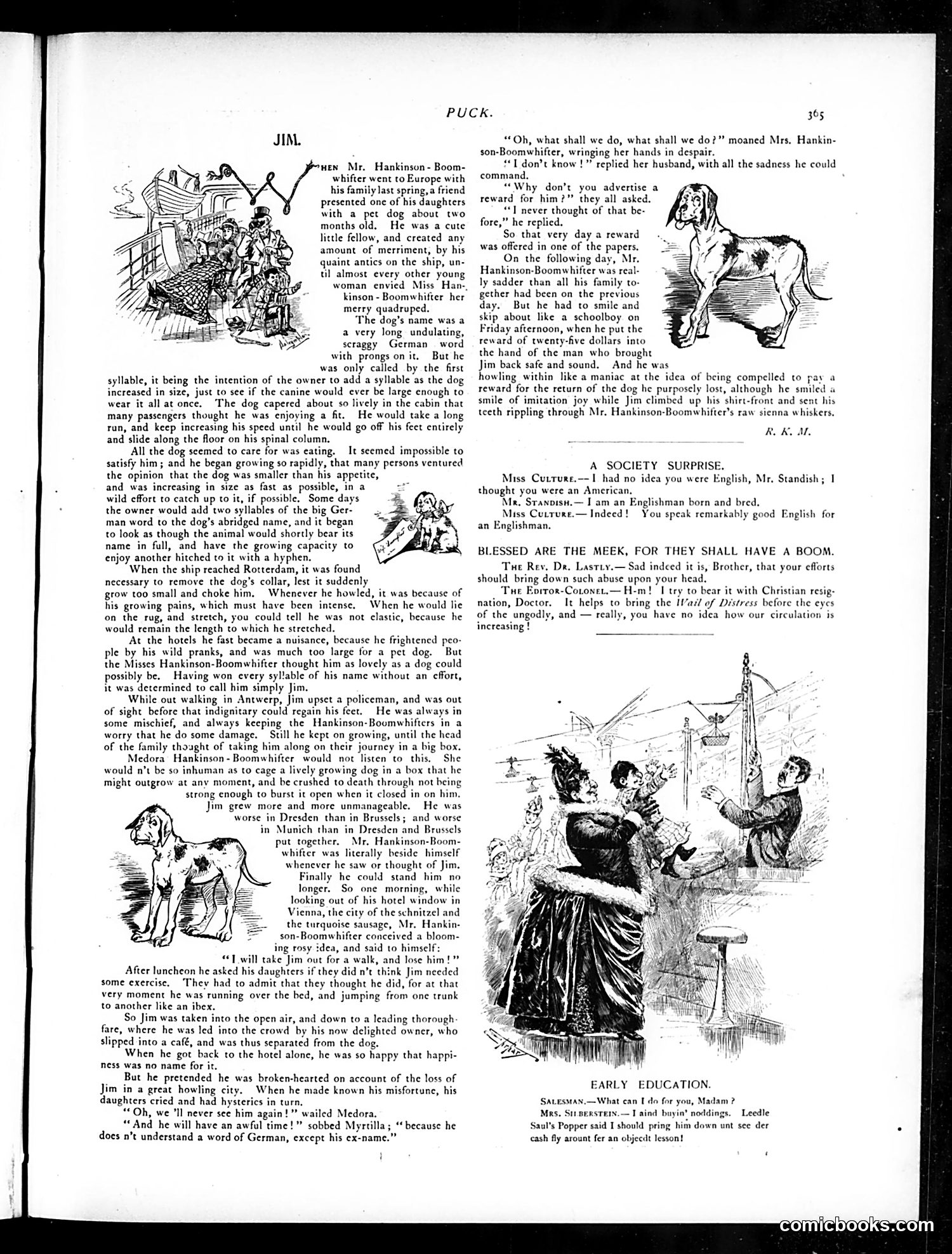
This page contains a short story titled "Jim" about a dog rather than political satire. The narrative follows a German dog acquired by a seafaring family named Hankinson-Boomwhiffler. The dog grows excessively large and becomes unmanageable, eventually causing such disruption that the father abandons it in Vienna. The page also includes separate satirical sections: "A Society Surprise" (a brief dialogue about English identity) and "Early Education" (a humorous exchange about child discipline). The illustrations show the large dog and a scene of people with a flagpole, likely depicting the story's comedic climax. Rather than political commentary, this issue focuses on domestic humor and animal anecdotes typical of Puck's lighter satirical content.
This page is **primarily advertising**, featuring prominent ads for typewriters (Remington, Sohmer pianos), shoes (W.L. Douglas), Kodak cameras, and various consumer goods typical of early 20th-century commerce. The only narrative content is a brief comedic sketch titled "Teaching Her a Lesson," depicting an exchange between Uncle Rastus and a woman over money. The dialogue uses dialect and racial stereotyping common to the era, portraying a comedic scenario about financial disputes. The page lacks political cartoons or sophisticated satire. Instead, it reflects Puck's mixed format of light humor, advertisements, and commercial messaging aimed at middle-class readers, with dated racial humor that would be considered offensive today.
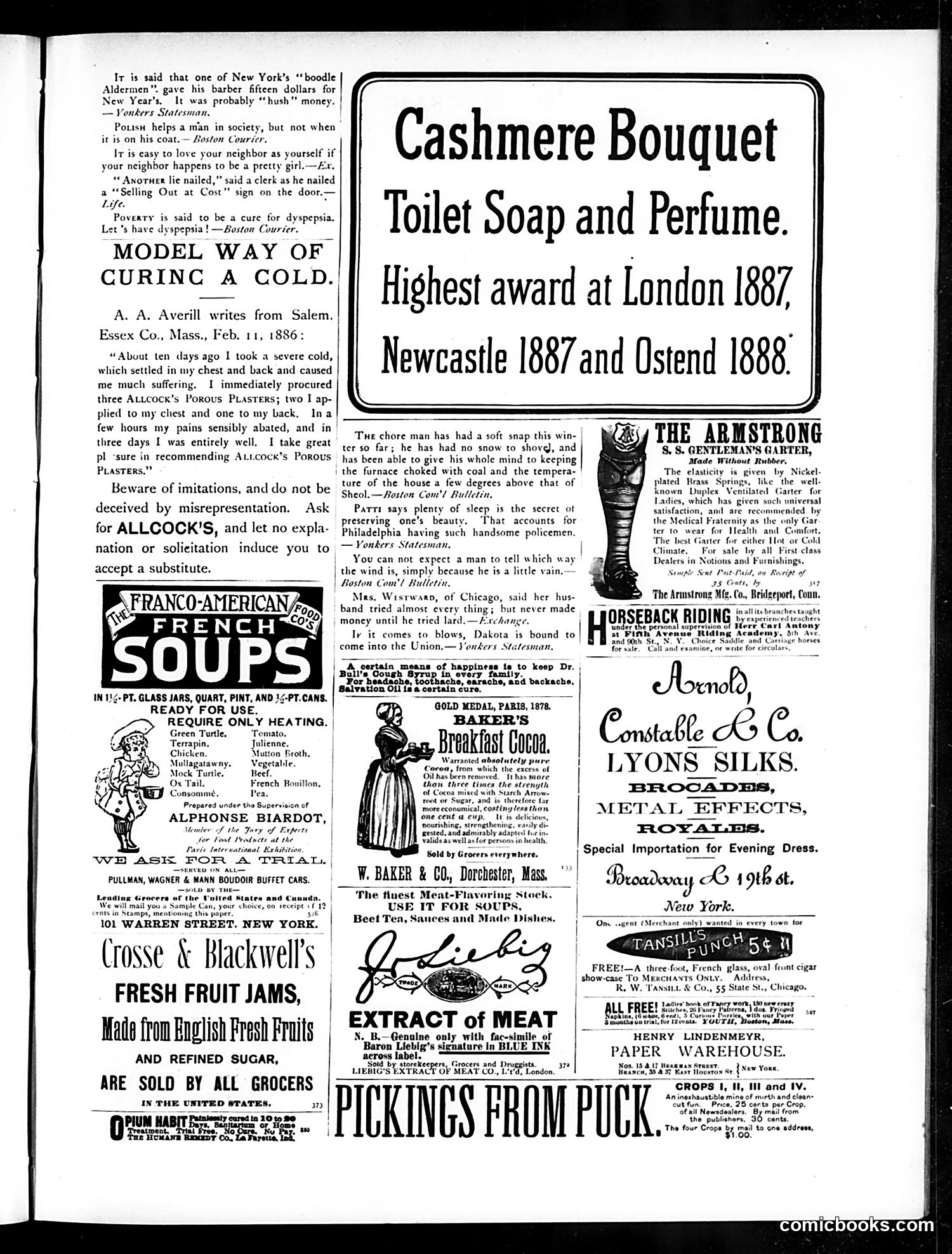
This page is **primarily advertising**, not satirical content. It contains multiple product advertisements typical of an 1880s magazine, including: - **Cashmere Bouquet Toilet Soap** (top, highlighting awards from London, Newcastle, and Ostend) - **Franco-American French Soups** (ready-to-use canned soups) - **Allcock's Porous Plasters** (medical pain relief) - **Baker's Breakfast Cocoa** - **Crosse & Blackwell's Fresh Fruit Jams** - Various other goods (Armstrong garters, Arnold silks, Liebig's Extract of Meat, etc.) The page also includes brief **humorous quotes and anecdotes** in the left margin—typical Puck filler content about courtship, colds, and social observations—but these are not part of a coherent cartoon narrative. This appears to be a standard Puck page mixing advertising revenue with light editorial humor rather than focused political or social satire.
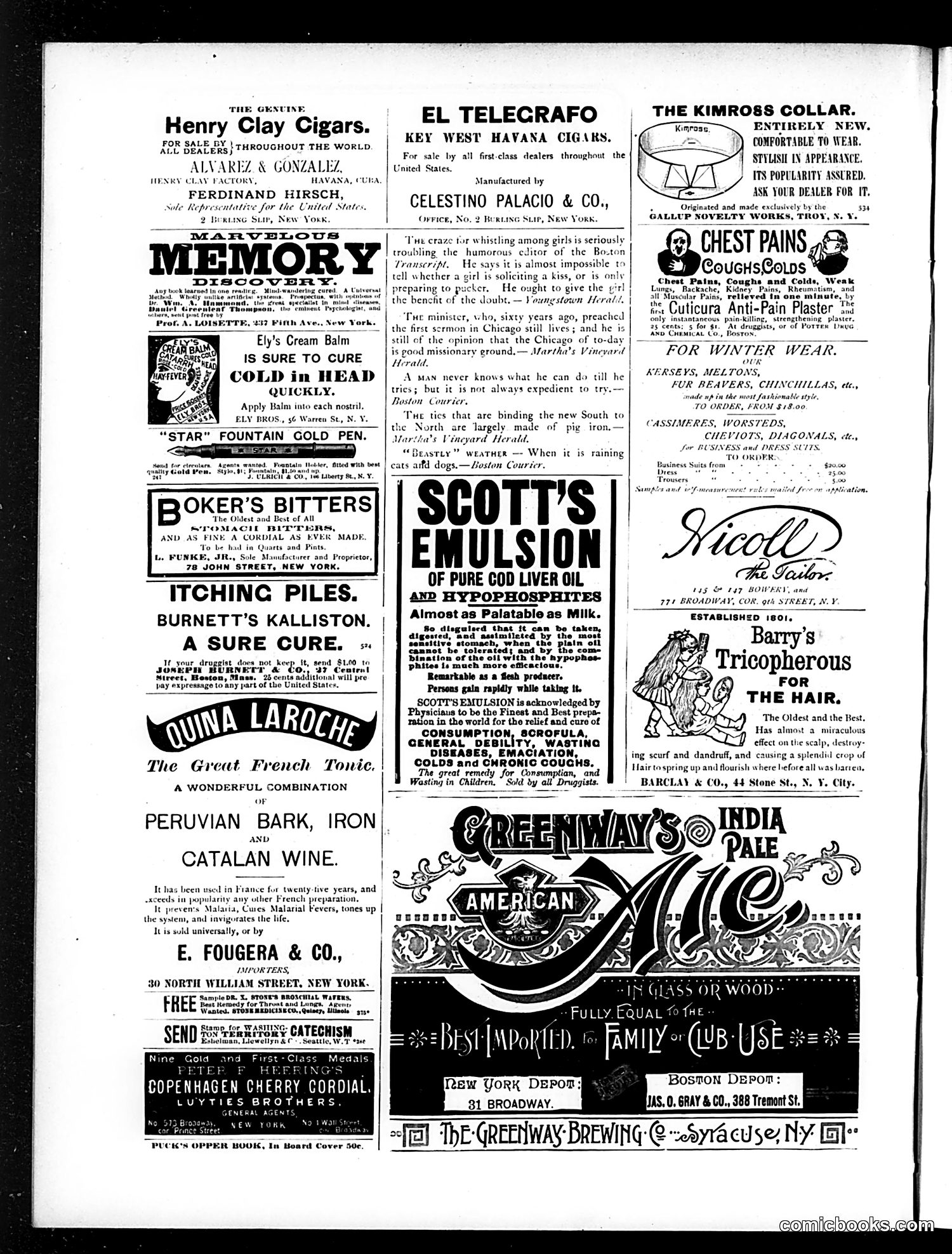
This appears to be primarily a **late-19th or early-20th century advertising page** from Puck magazine, not a political cartoon page. The content consists almost entirely of patent medicine and consumer product advertisements—cigars, tonics, emulsions, hair treatments, bitters, and ale. The only text-based humor is a brief editorial snippet mocking a Boston newspaper editor's concerns about "whistling among girls" and Chicago's missionary character. This represents typical Puck-style light social commentary, poking fun at moral anxieties and regional pretensions. **No identified political figures or substantive satire appears on this page.** It's essentially a commercial page showing what products were marketed during this era, often making dubious health claims that would be illegal today.
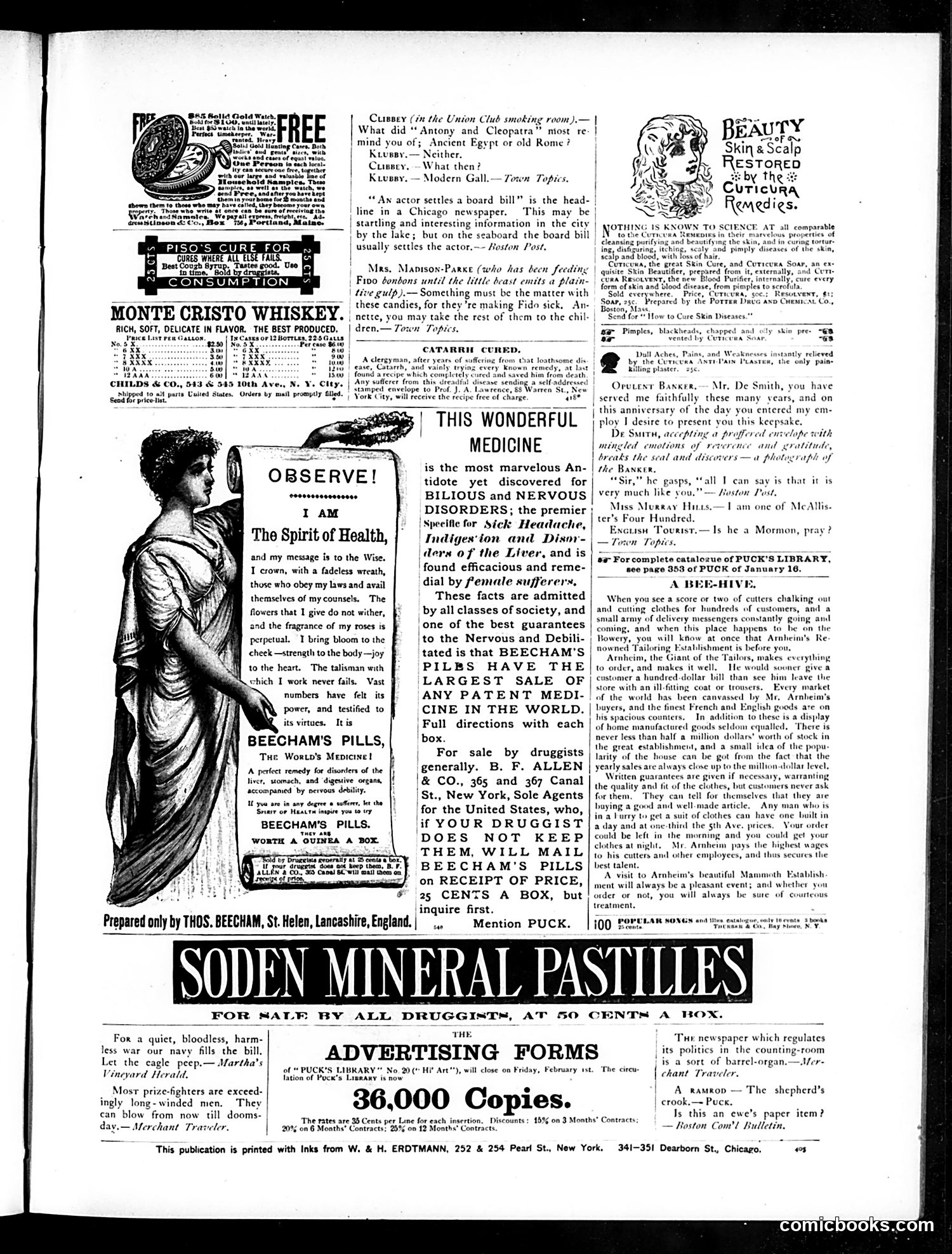
This page is primarily **advertising and advice columns** rather than political satire. The main content includes: - Patent medicine ads (Beecham's Pills, Soden Mineral Pastilles, Monte Cristo Whiskey) typical of late 19th/early 20th-century magazines - A "Beauty" column offering skin remedies via Cuticura products - A "Curiosities" section with reader Q&A about Ancient Egypt and theater terminology - An "Arnheim" department store advertisement highlighting their massive inventory and low prices The only satirical element appears to be brief humorous reader questions—one asking if a Mormon is involved, another making a joke about a navy bill. The page reflects **Puck's format**: mixing sharp social commentary with contemporary advertisements for dubious remedies and consumer goods aimed at middle-class readers.
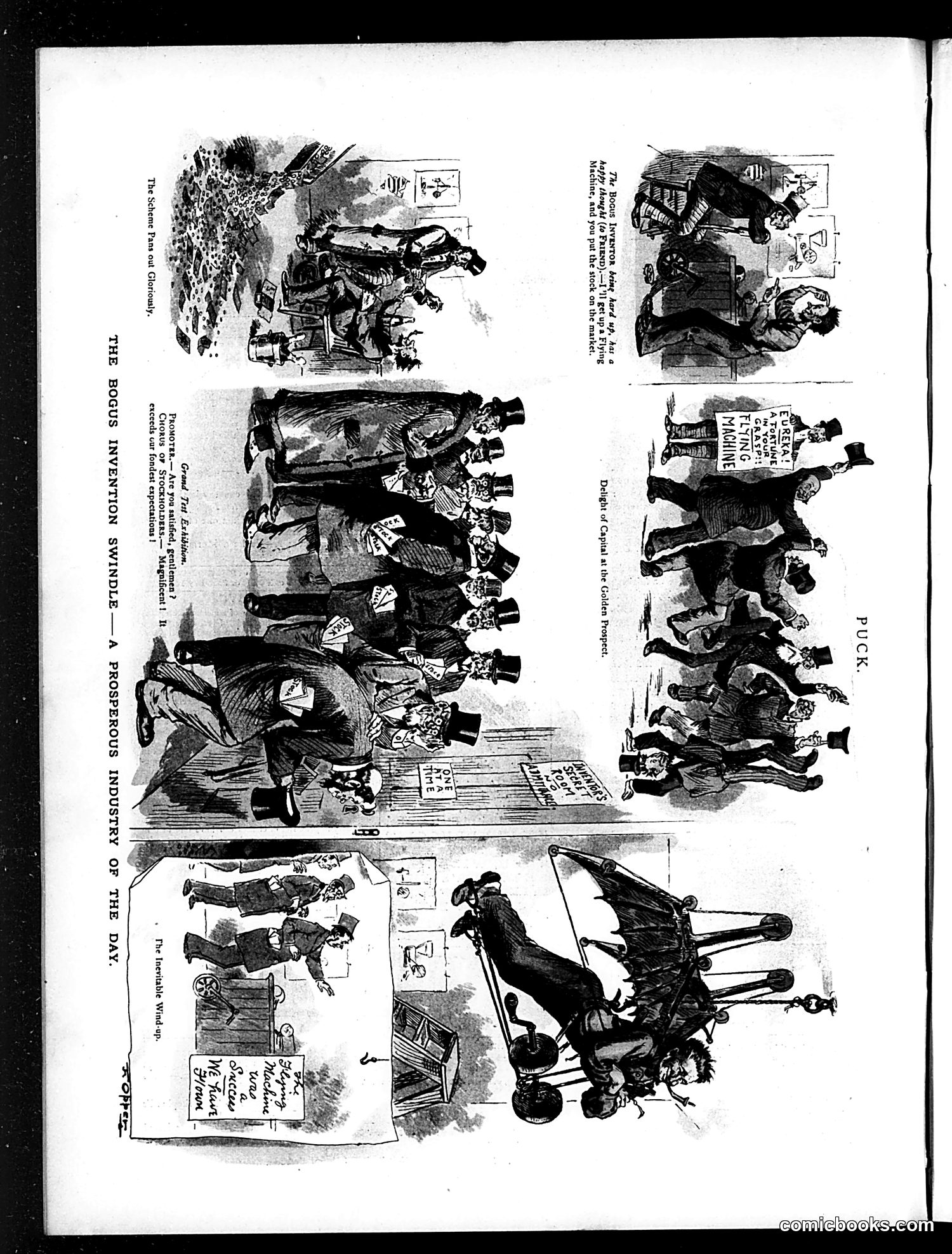
This page contains multiple satirical illustrations titled "The Boobies' Insolent a Prosperous Monkery of the Day" (text partially unclear due to OCR). The cartoons appear to mock various social types or political figures of the era through exaggerated caricature. The central large illustration depicts what appears to be a crowded scene with multiple figures in period dress, suggesting commentary on contemporary social gatherings or political assemblies. Smaller vignettes surround it showing individual character types. Without clearer OCR or visible date information, I cannot definitively identify the specific political figures or events referenced. The style and format indicate this is typical Puck satire targeting recognizable public personalities or social pretensions of its era, but the specific targets remain unclear from this reproduction.