
A complete issue · 16 pages · 1879
Puck — September 24, 1879
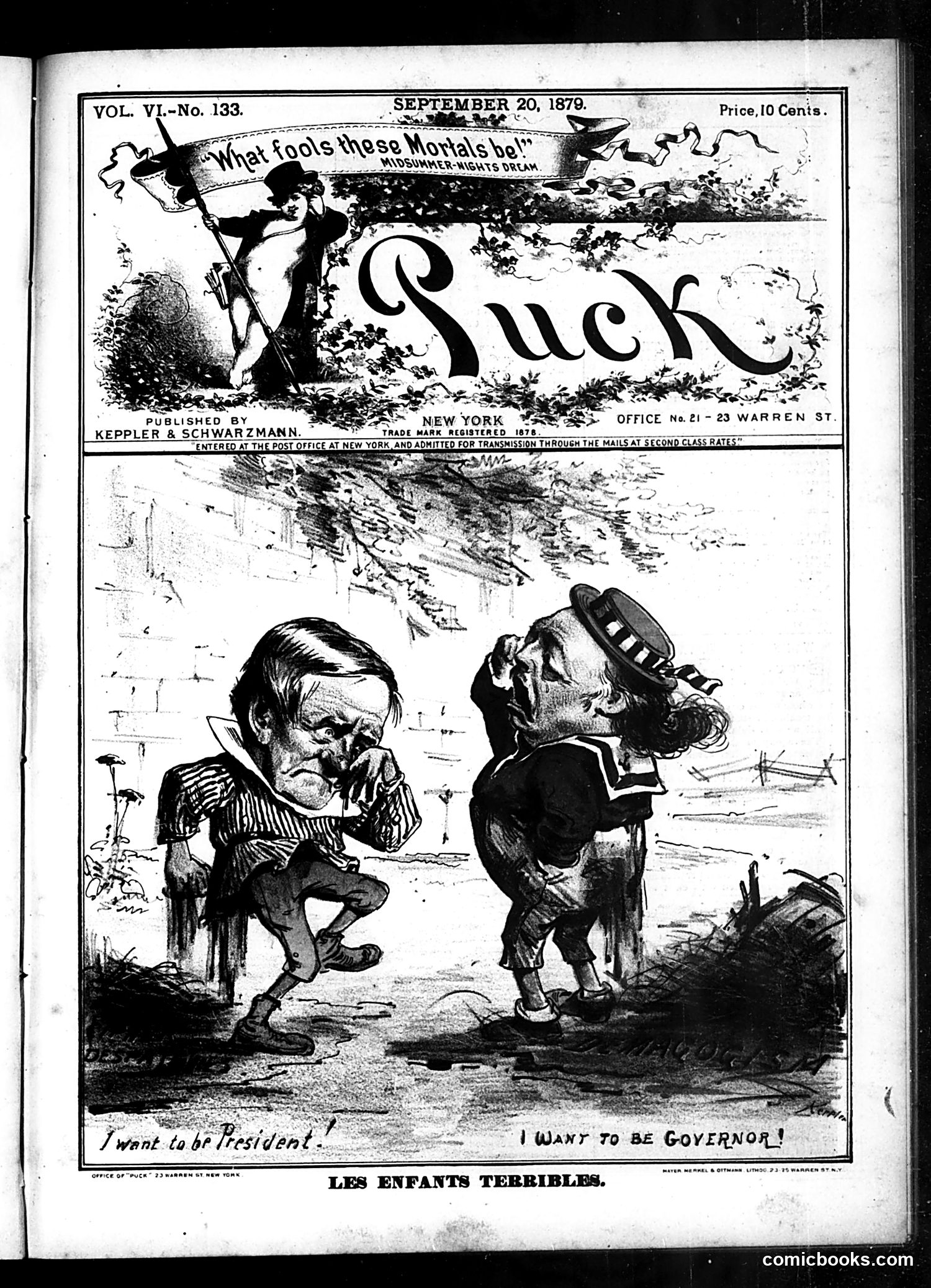
This September 1879 *Puck* cartoon satirizes two ambitious political figures as childish competitors. The caption "I want to be President!" and "I Want to be Governor!" depicts them as squabbling children rather than serious statesmen. The title "Les Enfants Terribles" (French for "terrible children") reinforces the mockery—suggesting these politicians are behaving immaturely and petulantly over offices they desire. The caricatured figures appear exaggerated and grotesque, a common *Puck* technique to demean political rivals. Without additional context, the specific identities remain unclear, but the satire's point is evident: the magazine criticized these aspirants as insufficiently serious or dignified for high office, reducing their ambitions to childish squabbling over toys or positions.
This page is primarily **text content rather than cartoons**—it contains editorial commentary, brief satirical items ("Puckerings"), and advertisements for back issues. The main satirical pieces mock contemporary targets: - **"Strong Meat for Babes"** criticizes penny dreadfuls and cheap literature corrupting children, arguing such content makes boys want to "hunt Indians, wreck rail-roads" and girls become "foolishly 'fast.'" - **"Wages on the Elevated Roads"** attacks the lack of wage increases for railroad workers despite company profits. - Several **brief political jabs** reference election candidates (Robinson, Kelly) and Republican party positions. The tone throughout is **reformist social satire**—attacking labor exploitation, corrupt business practices, and commercial exploitation of youth. Without visible caricatures or illustrations on this particular page, the satire relies entirely on written wit and editorial argument rather than visual humor.
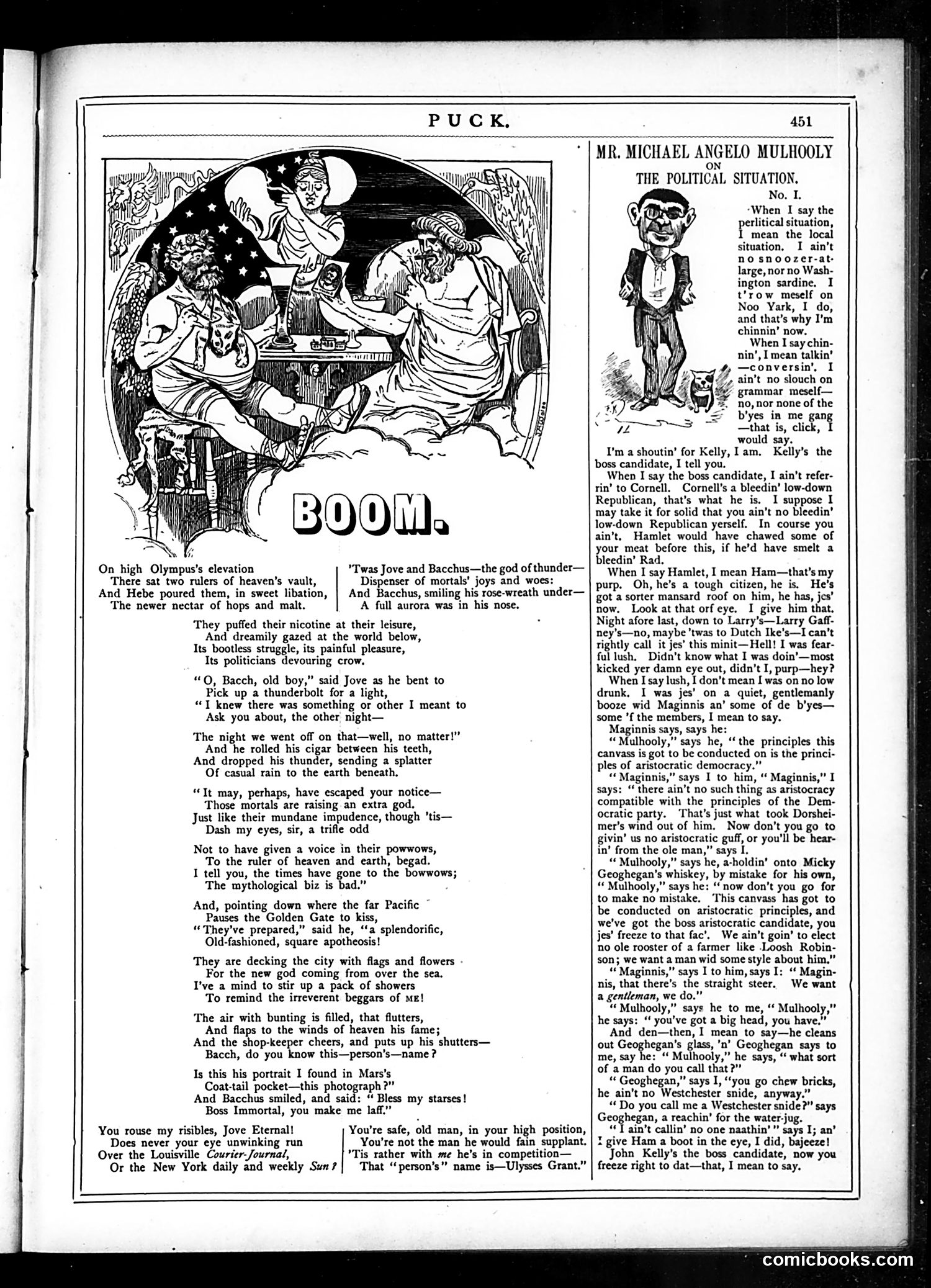
The main cartoon depicts classical gods (Jupiter, Hebe, and Bacchus) in heaven discussing American politics, titled "BOOM." The deities represent established order responding to political turbulence on Earth below. The right column features "Mr. Michael Angelo Mulhooly on the Political Situation," a satirical character commentary on contemporary politics. Mulhooly discusses various political figures and candidates—notably Kelly (a "boss candidate"), references to Cornell, and critiques of both Democratic and Republican establishments. The satire mocks Irish-American political patronage systems and questions about aristocratic versus democratic principles. The piece ridicules machine politics, political corruption, and the gap between democratic ideals and actual practice. Without specific dates or named candidates visible, the exact election remains unclear, though it appears to critique Gilded Age urban political machines.
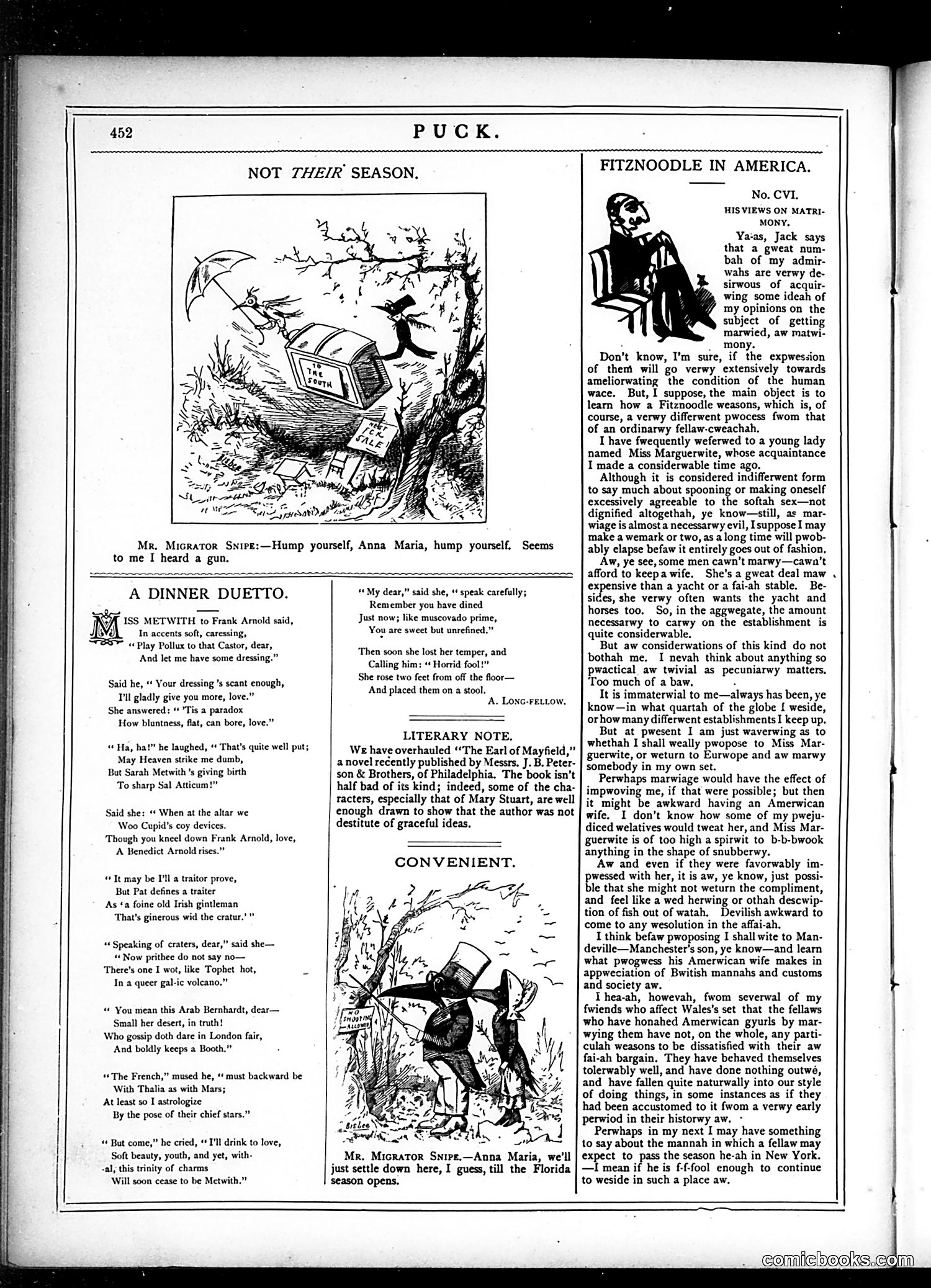
This cartoon depicts a man struggling in heavy rain with an umbrella and what appears to be a traveling trunk, captioned "Mr. Migrator Snipe." The satire targets someone (likely a public figure or type) attempting to migrate or travel during obviously unsuitable weather conditions. The accompanying text references "Miss Marguerite" and discusses matrimonial matters, spooning, and social courtship customs among the wealthy. The joke appears to criticize either premature travel plans or someone's mistaken timing in personal affairs. The title "Not Their Season" suggests the subjects are acting outside appropriate timing or circumstances. Without additional historical context, the specific public figures referenced remain unclear, though this appears to mock social pretension and poor judgment regarding both travel and romantic pursuits.
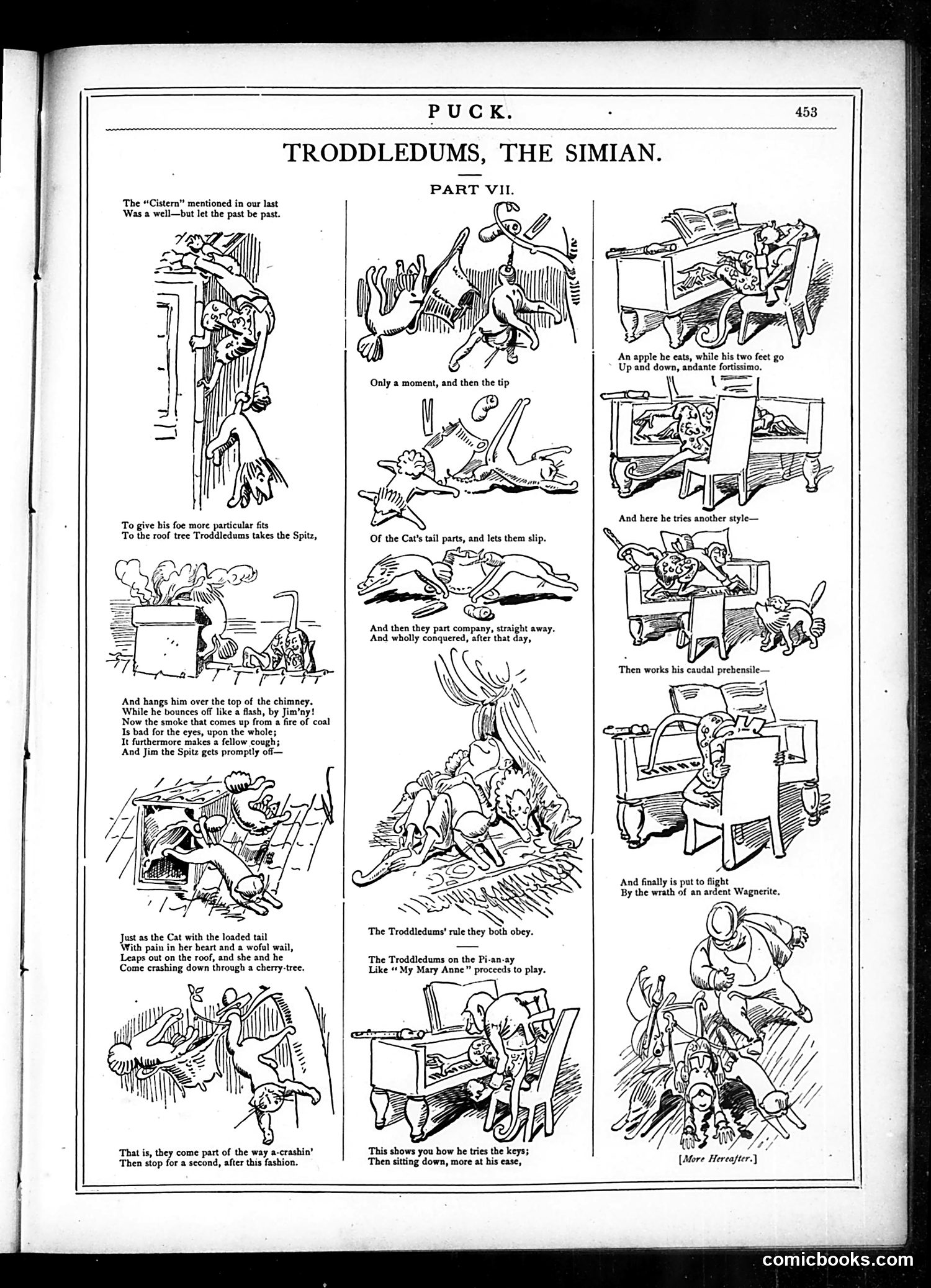
This is a satirical comic strip depicting the misadventures of "Troddledums," an ape-like creature engaging in increasingly chaotic domestic activities. The humor relies on visual slapstick: the character attempts mundane household tasks—eating apples, sitting in chairs, working at desks—but comically fails at each, destroying furniture and creating mayhem. The strip's title suggests social satire through the "simian" reference, likely mocking someone's intelligence or behavior by comparing them to an ape. Without additional context about which public figure or political opponent "Troddledums" represents, the specific target remains unclear, though the pattern suggests ridicule of incompetence or foolishness. The domestic setting emphasizes the absurdity of placing this creature in civilized situations.
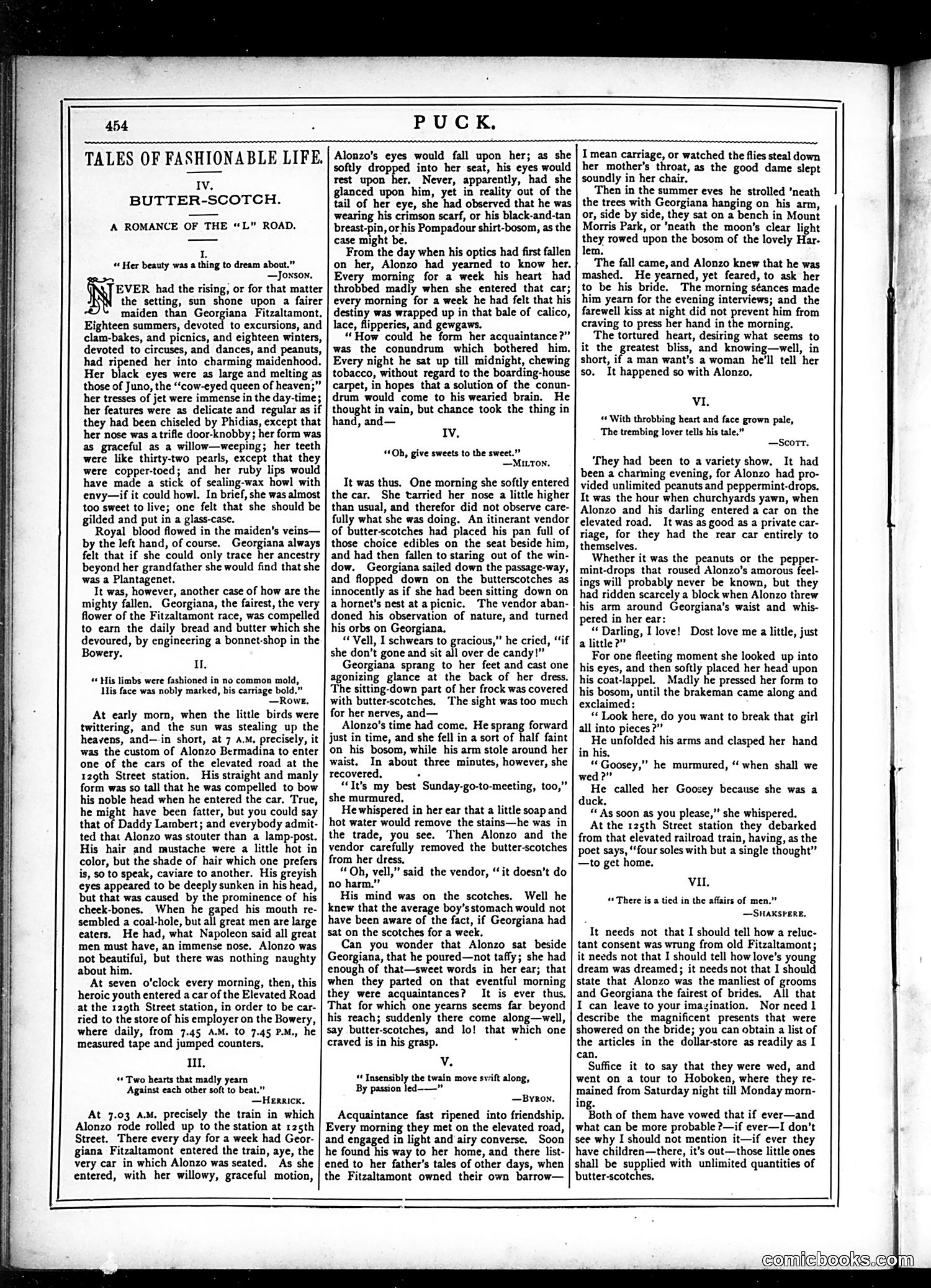
This page contains **no political cartoon or satire**. Instead, it's a serialized short story titled "Butter-Scotch: A Romance of the 'L' Road," continuing from a previous installment. The narrative follows Alonzo and Georgiana Fitzalmont, whose romance develops on Chicago's elevated railway (the "L"). The story describes their courtship, chance encounters, and romantic developments—including an incident where Georgiana spills butter-scotch candies on herself, creating a humorous meet-cute moment with Alonzo. This is **fiction/entertainment content**, not satirical commentary. Puck magazine, while primarily known for political cartoons, also published literary and humorous stories for readers' amusement.
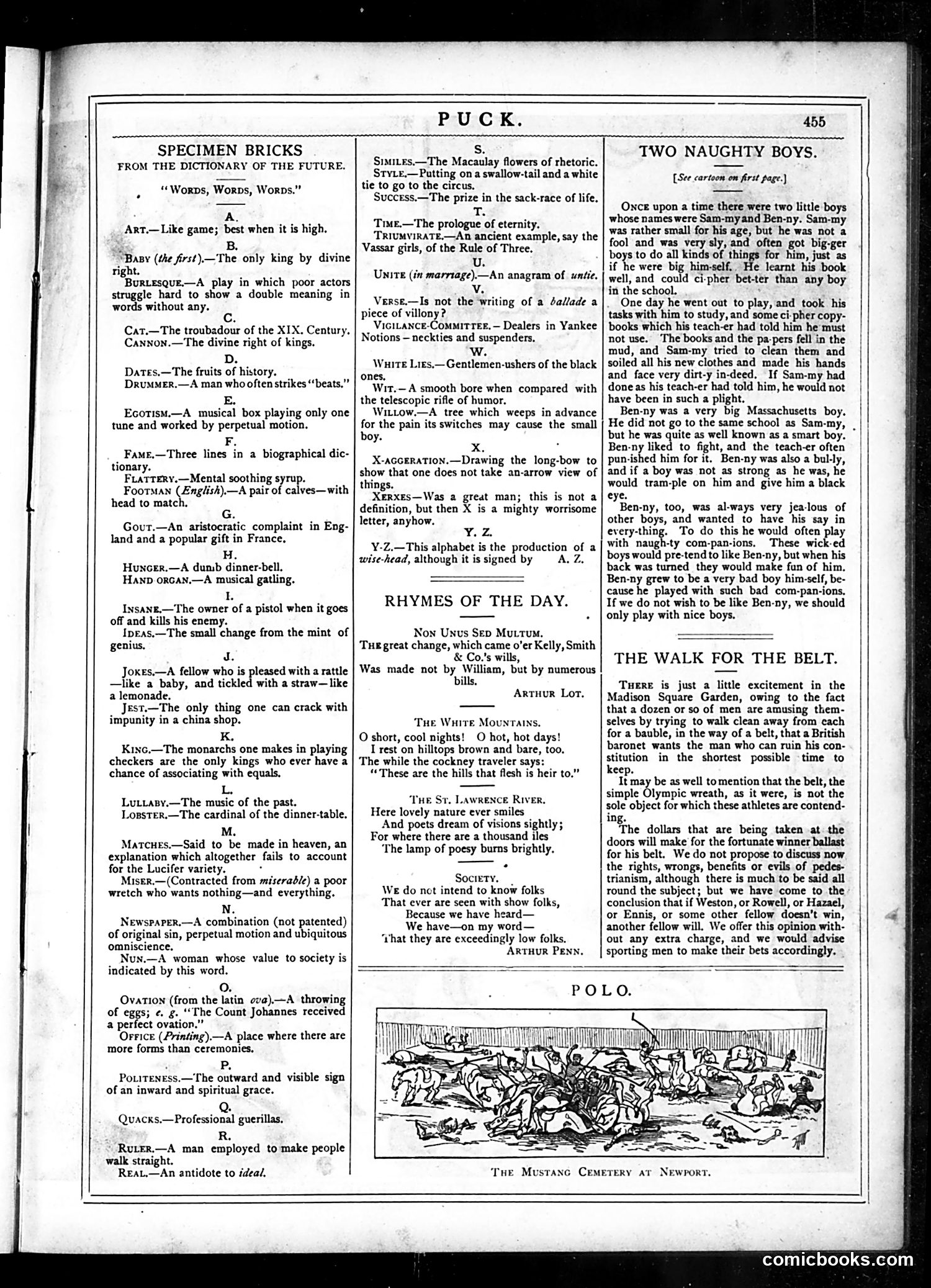
This page contains primarily **dictionary definitions and humor** rather than political cartoons. The left column offers mock definitions ("Specimen Bricks from the Dictionary of the Future"), while the center and right sections include: - **"Two Naughty Boys"**: A story about Sam-my and Ben-ny, two mischievous schoolboys who play pranks on their classmates and teachers - **"The Walk for the Belt"**: A brief article about men competing in a walking race for a belt prize - **"Rhymes of the Day"**: Several short poems by Arthur Lot and Arthur Penn - **"Polo"**: An illustration showing polo players in action The only substantial visual element is the polo engraving at page bottom ("The Mustang Cemetery at Newport"). This is primarily a **text-and-humor-heavy page** rather than satirical cartooning.
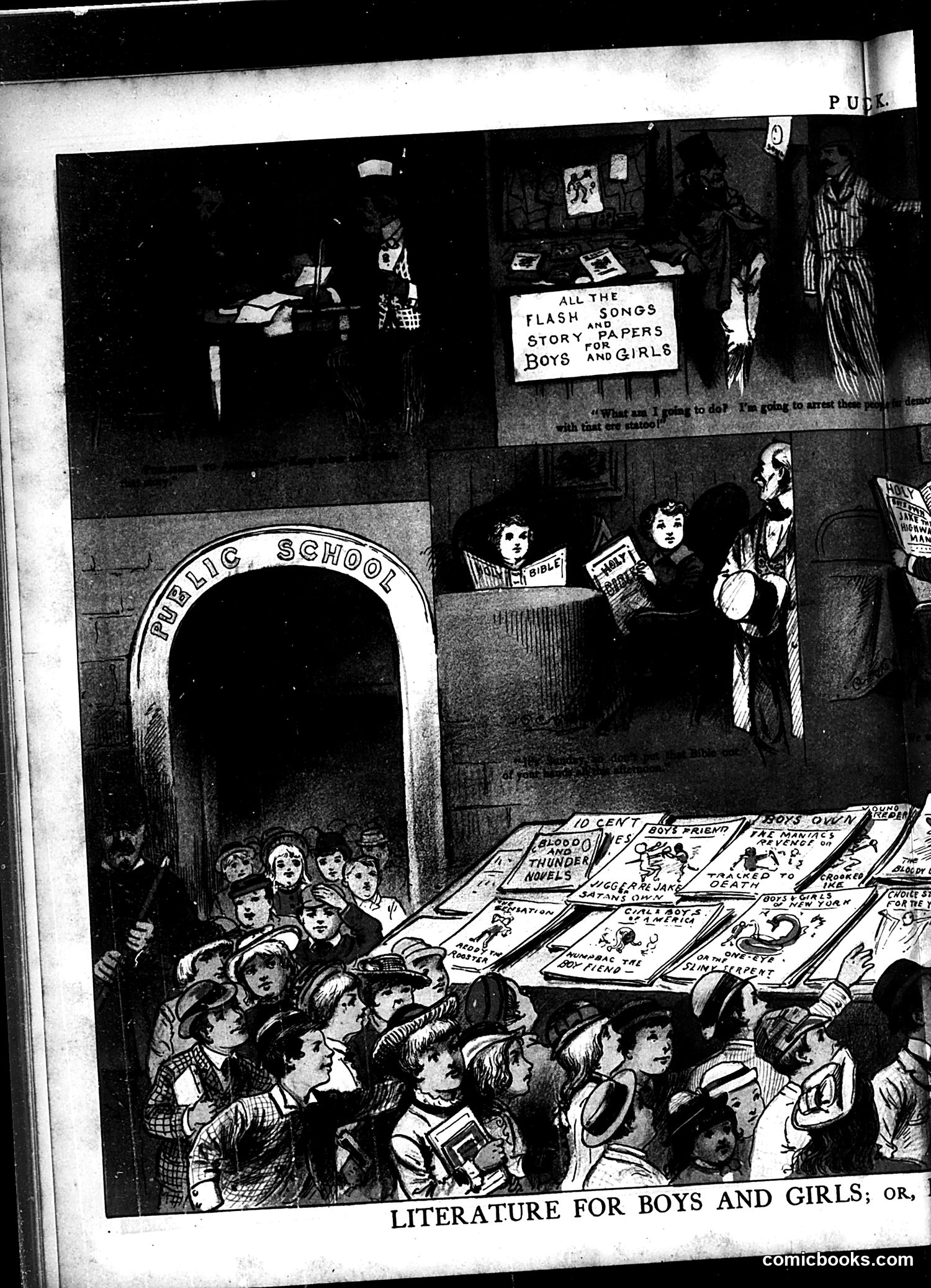
This Puck cartoon satirizes the commercialization of children's reading materials through sensationalism. The image shows a crowd of young people eagerly purchasing lurid pulp novels displayed on tables outside a public school. The sign advertising "All the Flash, Songs, Story Papers for Boys and Girls" highlights the contrast between educational institutions and commercial exploitation. The titles visible on the novels appear to emphasize violent or sensational content ("Blood," "Thunder," "Novel," etc.), suggesting these cheap publications prioritized excitement over literary merit or moral instruction. The satire critiques how commercial publishers capitalized on children's appetite for thrilling stories, potentially corrupting young minds with unsuitable material—a concern that preoccupied Progressive Era reformers and educators who worried about pulp fiction's influence on youth.
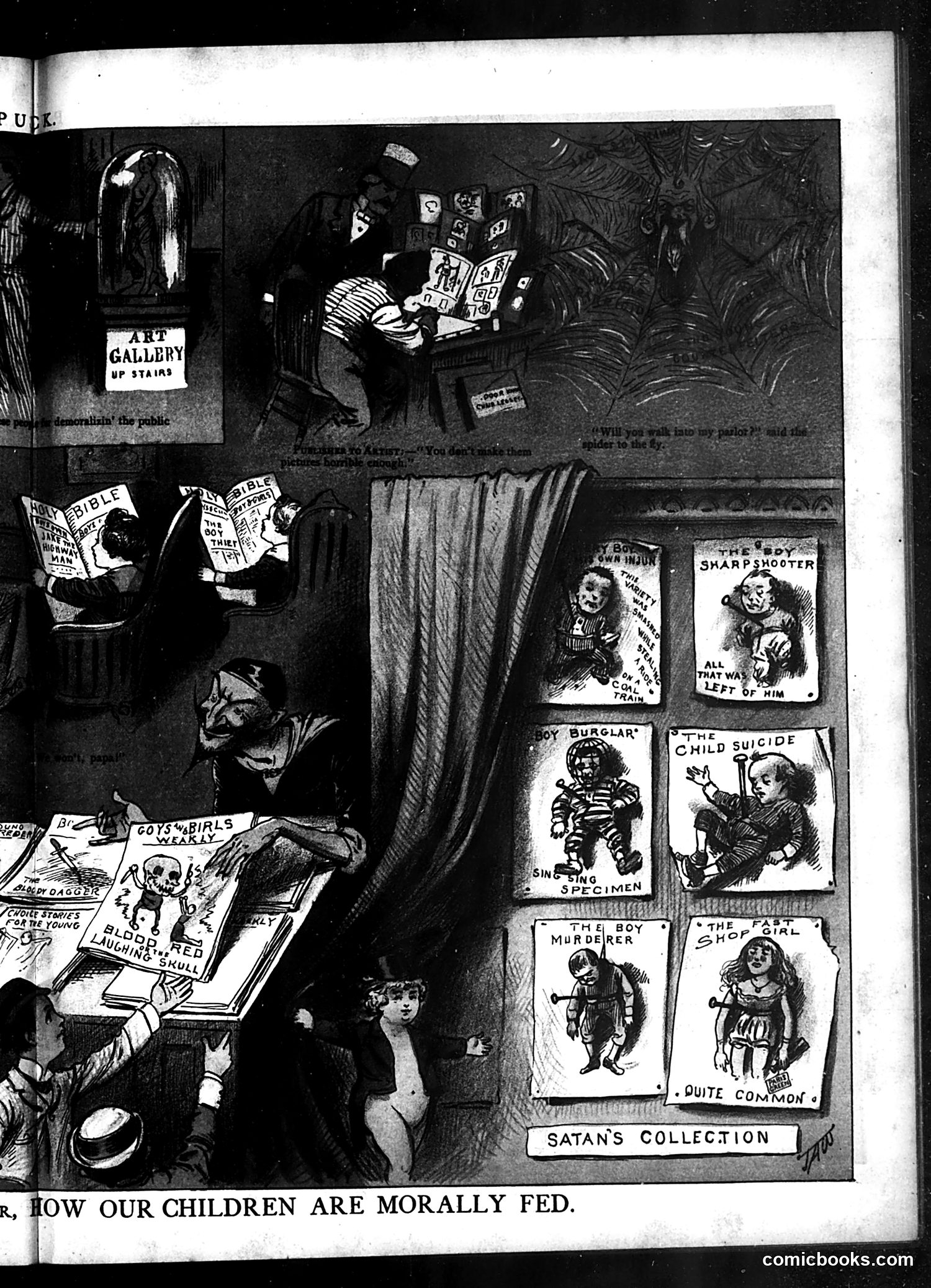
This Puck cartoon satirizes the influence of sensational literature on children. The main panel shows an "Art Gallery Upstairs" displaying what's labeled "Satan's Collection"—lurid dime novel covers with titles like "The Boy Sharpshooter," "Boy Burglar," "The Child Suicide," and "The Murder" (appearing to reference crime and violence). Below, lower-class children and adults eagerly consume these publications. The satire critiques how cheap, sensationalistic literature—widely available and affordable to working-class families—was corrupting youth morality. This reflects genuine late-19th/early-20th-century concerns about "penny dreadfuls" and pulp fiction's moral impact on vulnerable young readers.
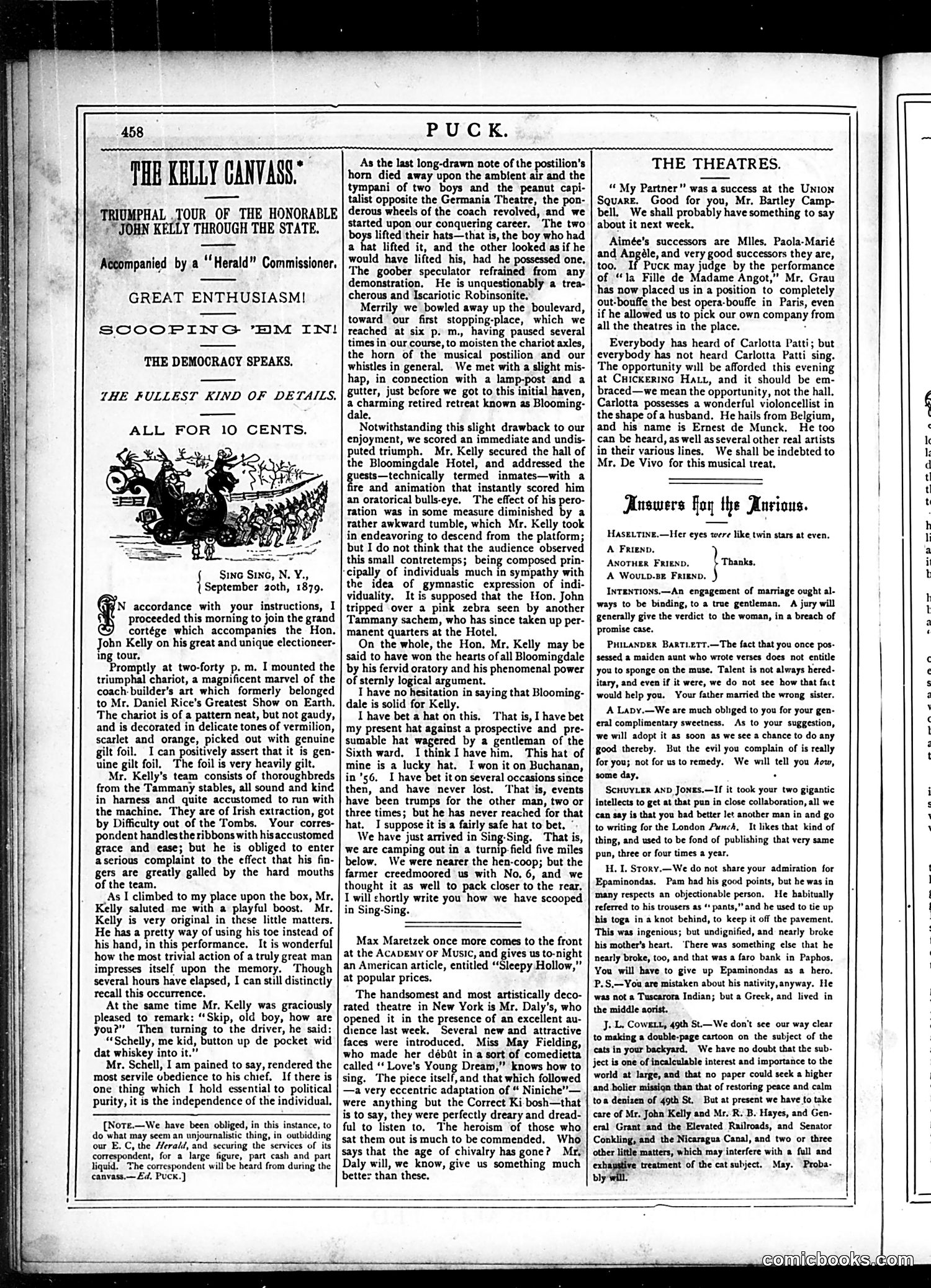
This page satirizes **John Kelly's political tour through New York State** in September 1879, accompanied by a "Herald" Commissioner. The accompanying cartoon (visible at bottom left) depicts Kelly in an exaggerated chariot, suggesting grandiosity. The article mocks Kelly's campaign as theatrical spectacle rather than substance—describing it as "triumphant" with "great enthusiasm" while detailing mishaps: a lamp-post collision, platform tumbles, and audience indifference. The satire suggests Kelly was performing empty showmanship, with the "canvas" referring to both his campaign tent and the dishonest nature of political theater. The phrase "scooping 'em in!" implies deceptive campaign tactics. Puck presents Kelly's tour as absurdly bumbling despite its claimed success.
This page from *Puck* magazine contains the beginning of "Archie Gascoyne: A Romance of Skye," a serialized romance story written by John Fraser. The page is primarily **literary content rather than political satire or cartooning**. The story, presented in Chapter XXIV, depicts a romantic scene between two characters—Archie and a woman he loves—set in Scotland. The narrative describes their emotional reunion and includes dramatic elements (a nightmare, a mysterious sound at the cabin door). This represents *Puck*'s practice of publishing fiction alongside its satirical cartoons. The page contains **no political commentary, caricatures, or social satire**—it is straightforward serialized romantic fiction aimed at entertaining the magazine's readers.
This page is predominantly **advertising and miscellaneous notices** rather than political cartoons. The visible content includes: - **"Puck's Jestings"**: A small illustrated section containing brief humorous anecdotes and observations about contemporary life (New York police, Memphis girls, Bible stories, etc.) - **Multiple advertisements**: Hotel Brighton (Coney Island), Nicoll the Tailor, various patent medicines (Angostura Bitters, Sozodont toothpaste), jewelry, piano stools, and tobacco products - **Announcements**: Diamond merchant ads, notices about teeth preservation and eye care products The page reflects late 19th/early 20th-century consumer culture and patent medicine marketing practices. There are **no significant political cartoons or satirical illustrations** visible—just the standard commercial content filling satirical magazines of this era.
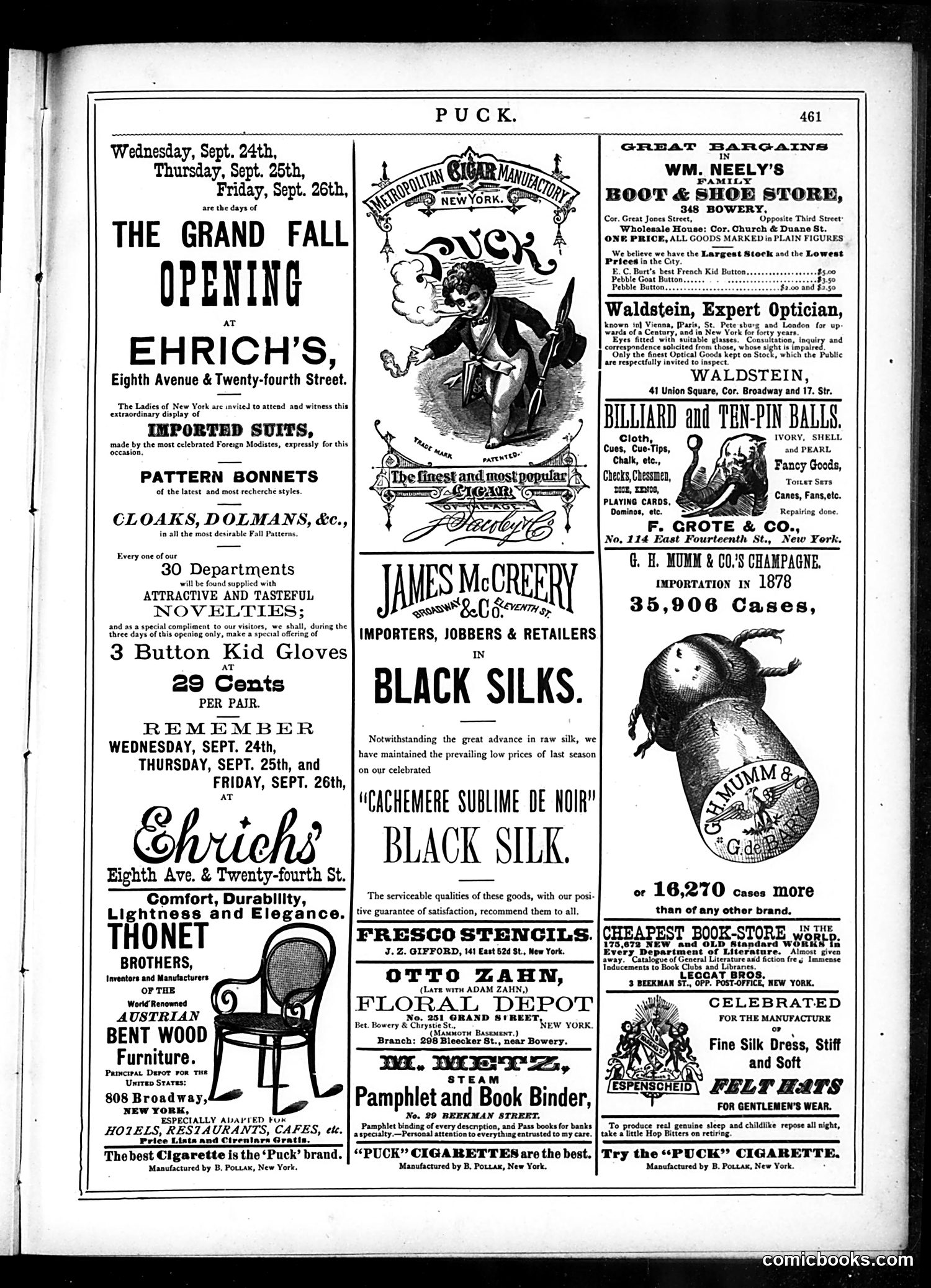
This page is primarily **advertising** rather than political satire. The dominant content consists of commercial advertisements for late 19th-century New York businesses: Ehrich's department store (announcing a "Grand Fall Opening"), boots and shoes, optical services, billiards equipment, champagne, books, furniture, and cigarettes. The only illustrated cartoon appears to be a **cigar advertisement** in the center-top, showing a cherubic figure ("Puck") with tobacco products—referencing the magazine's own mascot/brand. This is self-promotional rather than satirical commentary. The page's masthead indicates this is from **Puck magazine** (dated September 24-26), but the content here reflects the publication's revenue model: mixing editorial space with paid advertisements that subsidized the satirical content found elsewhere in the issue.
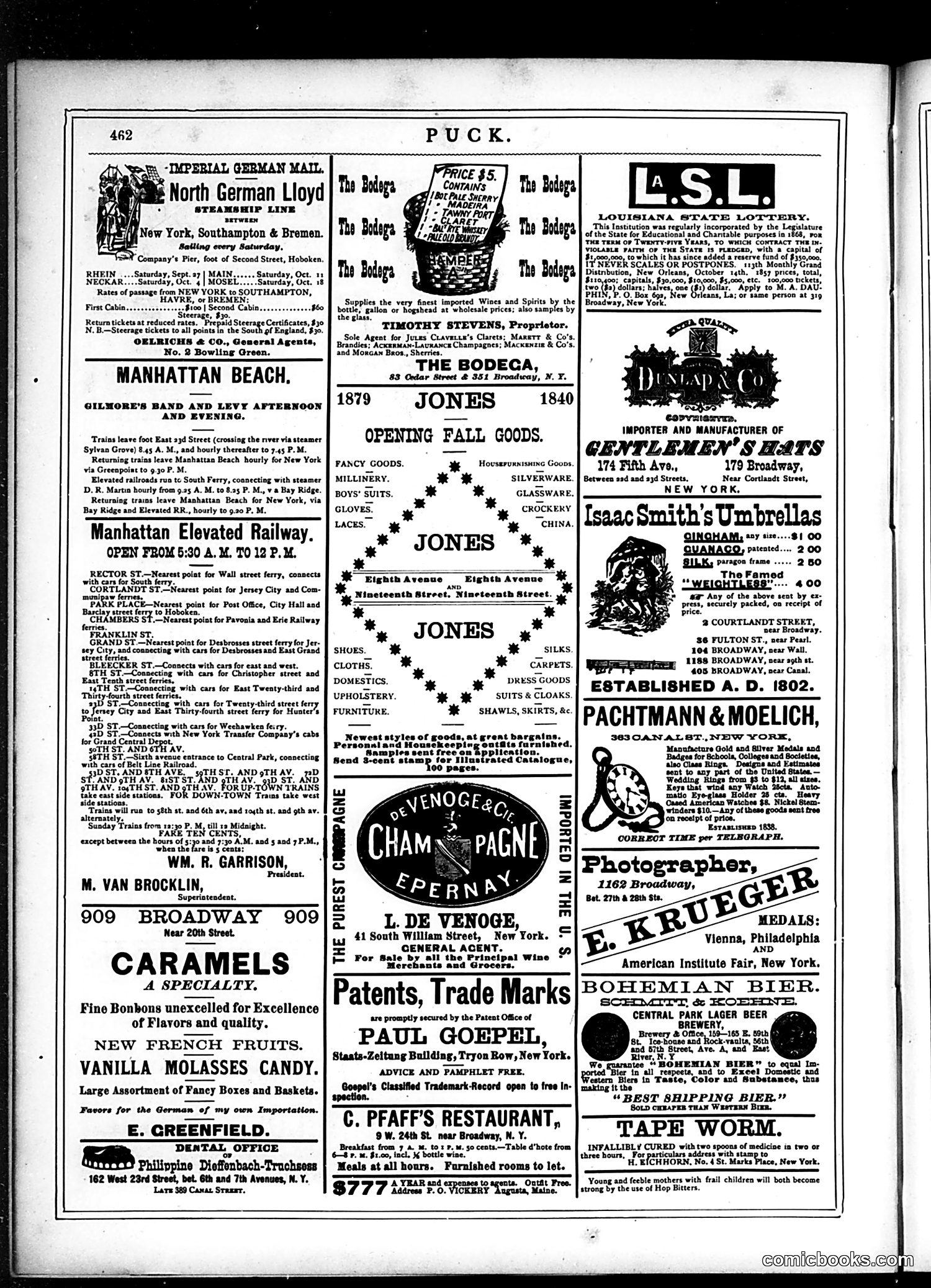
This page is predominantly **advertising**, not political satire. It contains commercial notices for various 1879-era businesses including: German shipping lines, Manhattan elevated railways, caramels and candy, champagne, restaurants, umbrellas, hats, photography services, beer, and patent services. The only illustrated content visible is a **diamond-shaped advertisement for Jones department store** (opening fall goods), and what appears to be **product logos and company emblems** for items like Pachtmann & Moelich timepieces and Bohemian Bier. There is **no apparent political cartoon or satirical content** on this page. It represents Puck magazine's revenue model: using advertising to support publication costs while satirical content appeared elsewhere in the magazine.
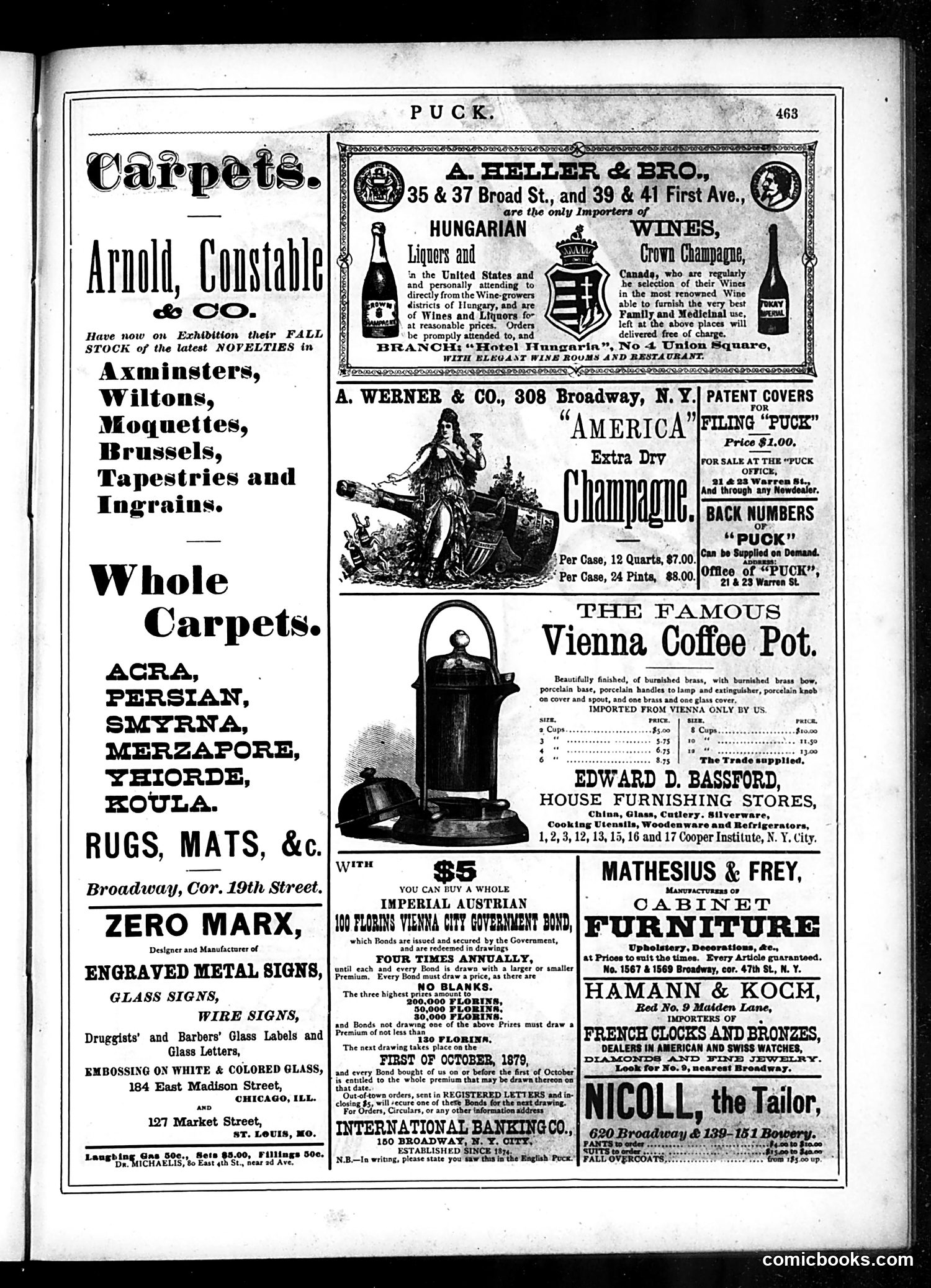
This page is primarily **advertising content** rather than editorial cartoons or political satire. It features multiple commercial advertisements from late 19th-century New York businesses, including: - Carpet and furniture dealers (Arnold, Constable & Co.) - Wine and champagne importers (A. Heller & Bro., A. Wehner & Co.) - Household goods retailers (Vienna Coffee Pot, Edward D. Bassford) - Metal sign engravers (Zero Marx) - Banking services (International Banking Co.) - Cabinet furniture and clock makers The page header reads "PUCK" (page 463), confirming this is from the satirical magazine, but this particular page serves as a revenue-generating advertisement section rather than containing satirical editorial content. The ads target upper-class consumers interested in imported goods and quality home furnishings.
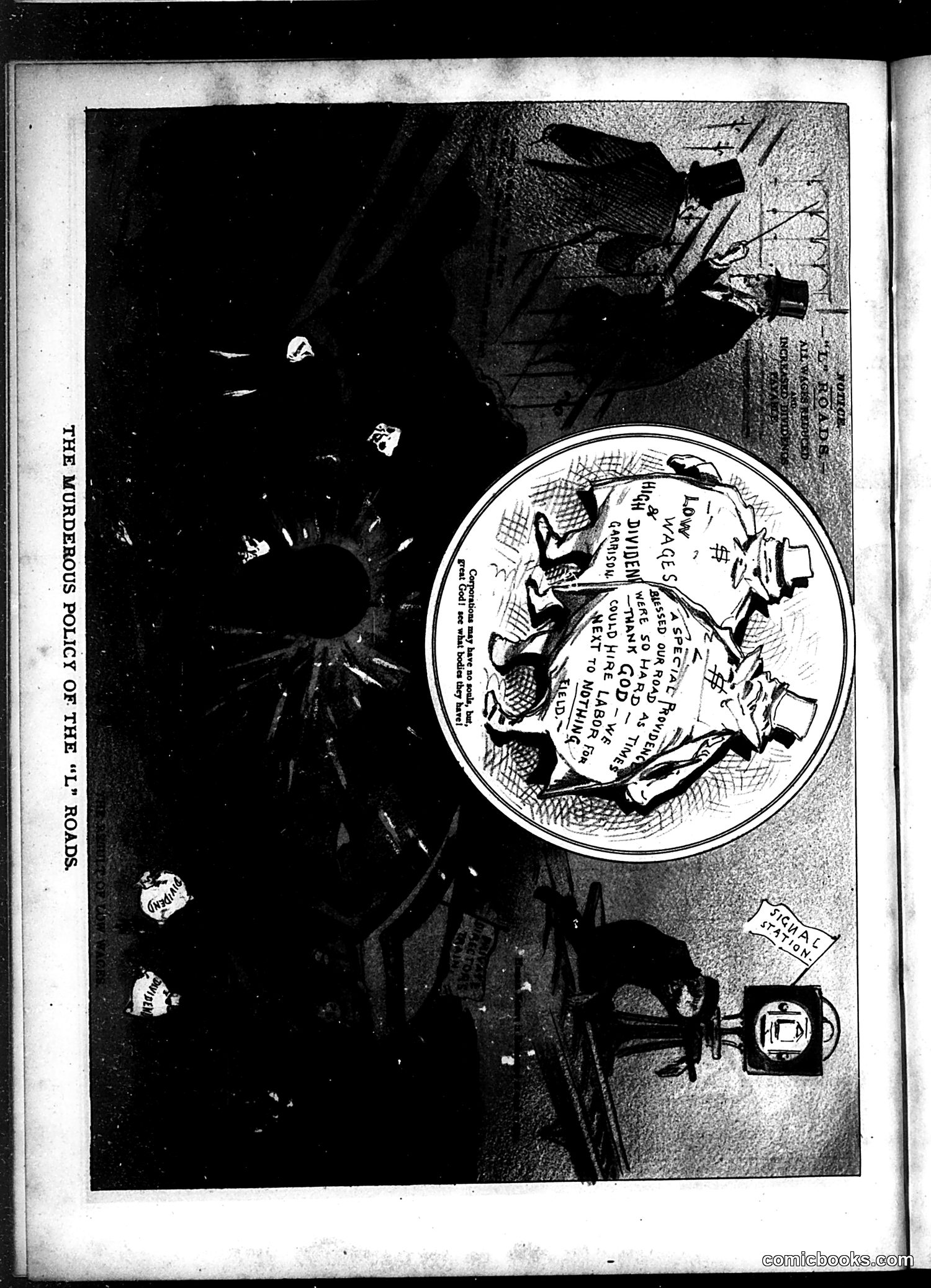
This Puck cartoon satirizes police conduct and corruption, likely from the early 20th century. The circular mirror illustration at center shows caricatured police officers examining their own reflections—a visual pun on "mirror" and self-examination. The text within the mirror appears to critique various police practices and misconduct. The left side depicts what appears to be confrontational street scenes, possibly showing police interactions with citizens. The overall message suggests Puck is holding up a "mirror" to expose police behavior and hypocrisy—comparing officers' public image to their actual conduct. The satire criticizes law enforcement accountability and suggests police should examine their own actions critically, using the mirror metaphor to demand transparency and self-reflection from authorities.