
Puck, 1879-09-24 · page 7 of 16
Puck — September 24, 1879 — page 7: what you’re looking at
What you’re looking at
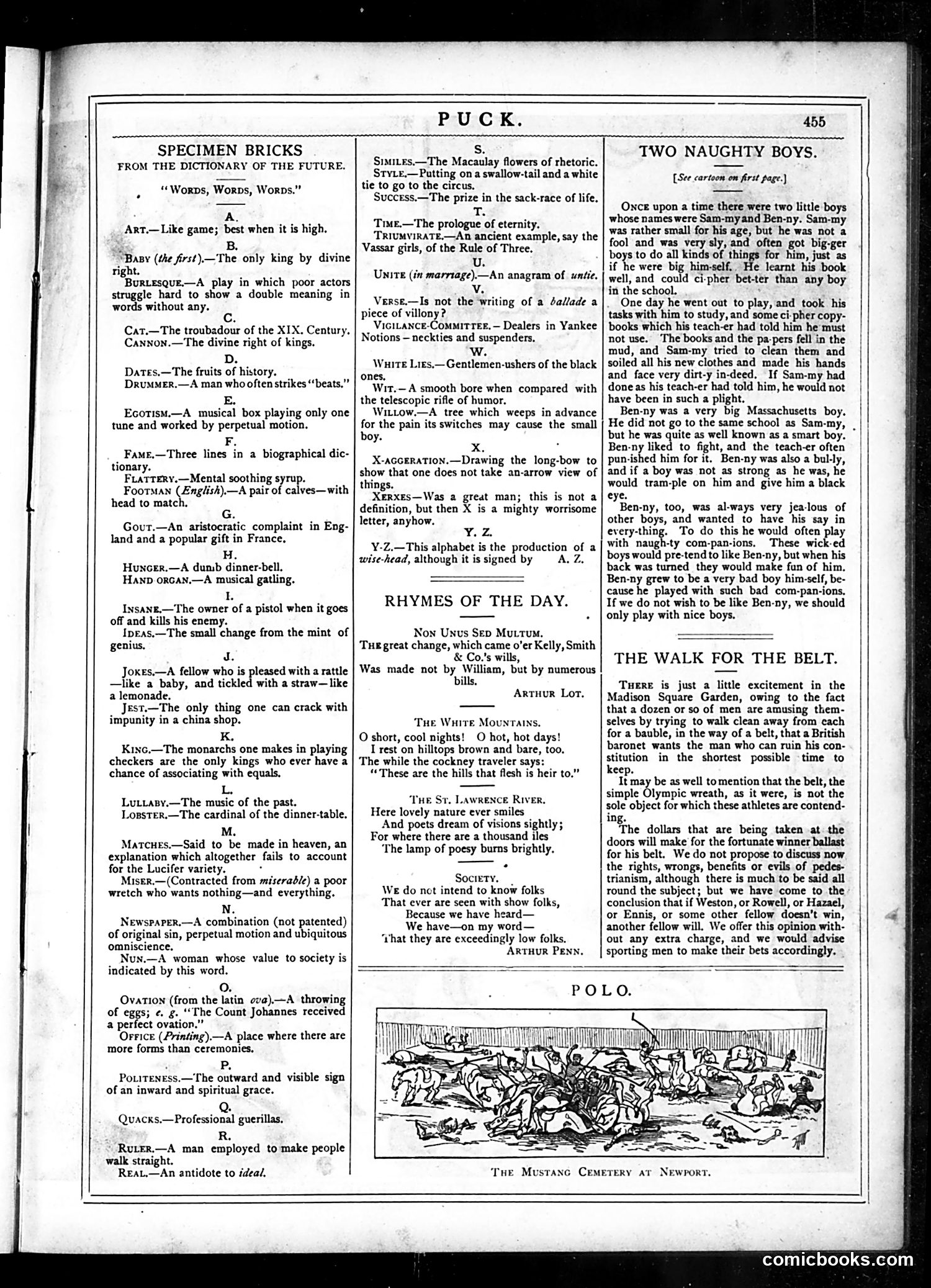
This page contains primarily **dictionary definitions and humor** rather than political cartoons. The left column offers mock definitions ("Specimen Bricks from the Dictionary of the Future"), while the center and right sections include: - **"Two Naughty Boys"**: A story about Sam-my and Ben-ny, two mischievous schoolboys who play pranks on their classmates and teachers - **"The Walk for the Belt"**: A brief article about men competing in a walking race for a belt prize - **"Rhymes of the Day"**: Several short poems by Arthur Lot and Arthur Penn - **"Polo"**: An illustration showing polo players in action The only substantial visual element is the polo engraving at page bottom ("The Mustang Cemetery at Newport"). This is primarily a **text-and-humor-heavy page** rather than satirical cartooning.
📄 Transcribed text from this page (OCR, searchable)
Machine-transcribed from the original scan — historical spelling and the odd misread are preserved.
le PUCK. 455 SPECIMEN BRICKS FROM THE DICTIONARY OF THE FUTURE. “Worps, Worps, Worps.”” A. Art.—Like game; best when it is high. B. “Basy (the first)—The only king by divine right. Burvesque.—A play in which poor actors struggle hard to show a double meaning in words without any. Cat.—The troubadour of the XIX. Century, Cannon.—The divine right of kings. D. Dates.—The fruits of history. Drummer.—A man who often strikes “‘beats,”” E. Ecotism.—A musical box playing only one tune and worked by perpetual motion. F. Fame.—Three lines in a biographical dic- tionary. FLATTERY.—Mental soothing syrup. Footman (English).—A pair of calves—with head to match, a Gout.—An aristocratic complaint in Eng- land and a popular gift in France, H. Huncer.—A dumb dinner-bell. Hanp orcan.—A musical gatling. IL Insang.—The owner of a pistol when it goes off and kills his enemy. Ipeas.—The small change from the mint of genius. rn Joxes.—A fellow who is pleased with a rattle —like a baby, and tickled with a straw—like a lemonade, Jest.—The only thing one can crack with impunity in a china shop. K, Kinc.—The monarchs one makes in playing checkers are the only kings who ever have a chance of associating with equals. L. Luttasy.—The music of the past. Losster.—The cardinal of the dinner-table, M. Matcues.—Said to be made in heaven, an explanation which altogether fails to account for the Lucifer variety. . Miser.—(Contracted from miserable) a poor wretch who wants nothing—and everything. N. SPAPER.—A combination (not patented) inal sin, perpetual motion and ubiquitous omniscience, Nun.—A woman whose value to society is indicated by this word. oO. Ovation (from the latin ova)—A throwing of cogs ¢. g ‘The Count Johannes received a perfect ovation,” Orrice (Printing).—A place where there are more forms than ceremonies. Pp Pour .—The outward and visible sign of an inward and spiritual grace. Q. Quacks.—Professional guerillas, R Ruter.—A man employed to make people walk straight. Reat,—An antidote to ideal, Ss. SimuLes.—The Macaulay flowers of rhetoric. Sryte.— Putting on a swallow-tail and a white tie to go to the circus, Success,—The prize in the sack-race of life. T. Tre,—The prologue of eternity. ‘TRIUMVIRATE.—An ancient example, say the Vassar girls, of the Rule of Three. U. Unite (in marriage).—An anagram of untie, Vv. Verse.—Is not the writing of a dallade a piece of villony? Vicitance-Commit ree, — Dealers in Yankee Notions — neckties and suspenders, Ww. Wuite Lies,—Gentlemen-ushers of the black ones, Wit.—A smooth bore when compared with the telescopic rifle of humor. Wittow.—A tree which weeps in advance for the pain its switches may cause the small boy. x. . X-aGGERATION.—Drawing the long-bow to show that one does not take an-arrow view of things. XeERxes—Was a great man; this is not a definition, but then X is a mighty worrisome letter, anyhow. Y. Z. Y-Z.—This alphabet is the production of wise-head, although it is signed by A. Z. RHYMES OF THE DAY. Non Unus Sep Muttum, ‘Tue great change, which came o'er Kelly, Smith & Co.'s wills, Was made not by William, but by numerous bills. ARTHUR Lot. Tue Waite Mountains. O short, cool nights! O hot, hot days! I rest on hilltops brown and bare, too. ‘The while the cockney traveler says: “These are the hills that flesh is heir to.” Here lovely nature ever smiles And poets dream of visions sightly; For where there are a thousand iles ‘The lamp of poesy burns brightly, Society. | We do nct intend to know folks That ever are seen with show folks, Because we have heard— We have—on my word— “rhat they are exceedingly low folks. ARTHUR Penn, TWO NAUGHTY BOYS. [See cartoon om first page.) Once upon a time there were two little boys whose names were Sam-my and Ben-ny. Sam-my was rather small for his age, but he was not a fool and was very sly, and often got big-ger boys to do all kinds of things for him, just as if he were big him-self.. He learnt his book well, and could ci-pher bet-ter than any boy in the school, One day he went out to play, and took his tasks with him to study, and some cipher copy- books which his teach-er had told him he must not use. The books and the pa-pers fell in the mud, and Sam-my tried to clean them and soiled all his new clothes and made his hands and face very dirt-y in-deed. If Sam-my had done as his teach-er had told him, he would not have been in such a plight. Ben-ny was a very big Massachusetts boy. He did not go to the same school as Sam-my, | but he was quite as well known as a smart boy. Ben-ny liked to fight, and the teach-er often pun-ished him for it. Ben-ny was also a bul-ly, and if a boy was not as strong as he was, he would tram-ple on him and give him a black eye. Ben-ny, too, was al-ways very jea-lous of other boys, and wanted to have his say in every-thing. To do this he would often play with naugh-ty com-pan-ions. These wick-ed boys would pre-tend to like Ben-ny, but when his back was turned they would make fun of him. Ben-ny grew to be a very bad boy him-self, be- cause he played with such bad com-pan-ions, If we do not wish to be like Ben-ny, we should only play with nice boys. THE WALK FOR THE BELT. Tuere is just a little excitement in the Madison Square Garden, owing to the fact that a dozen or so of men are amusing them- selves by trying to walk clean away from cach for a bauble, in the way of a belt, that a British baronet wants the man who can ruin his con- stitution in the shortest possible time to keep. It may be as well tomention that the belt, the simple Olympic wreath, as it were, is not the sole object for which these athletes are contend- ing. The dollars that are being taken at the doors will make for the fortunate winner ballast for his belt. We do not propose to discuss now, the rights, wrongs, benefits or evils of pedes- trianism, although there is much to be said all round the subject; but we have come to the conclusion that if Weston, or Rowell, or Hazael, or Ennis, or some other fellow doesn’t win, another fellow will. We offer this opinion with- out any extra charge, and we would advise sporting men to make their bets accordingly. ‘THe Mustanc Cemerery at Newport. comicbooks.com