
A complete issue · 40 pages · 1929
Life — August 2, 1929
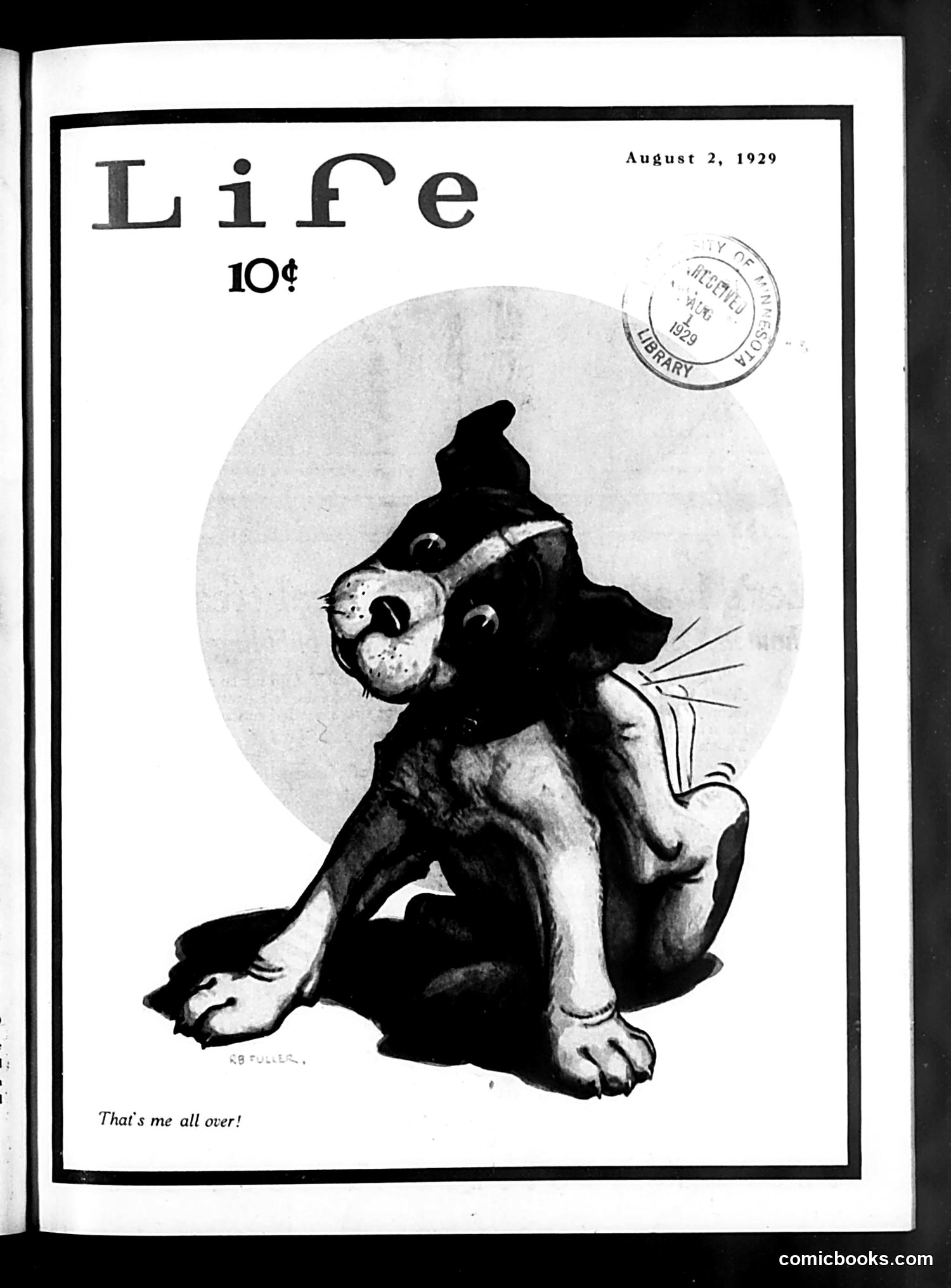
This cover features a disheveled dog wearing a hat and formal jacket, captioned "That's me all over!" The cartoon likely reflects the period's economic anxiety just before the Stock Market Crash of October 1929. The dog's rumpled appearance and somewhat bewildered expression suggest personal disarray or loss of composure—a common visual metaphor in satirical cartoons for societal disorder or individual misfortune. The dressed-up animal appearing undone may mock the contrast between outward respectability and inner chaos, or perhaps comment on Americans' precarious social standing during the pre-Depression era. Without additional context from the magazine's text, the specific target remains somewhat unclear, though the timing suggests broader commentary on contemporary American life and anxieties.
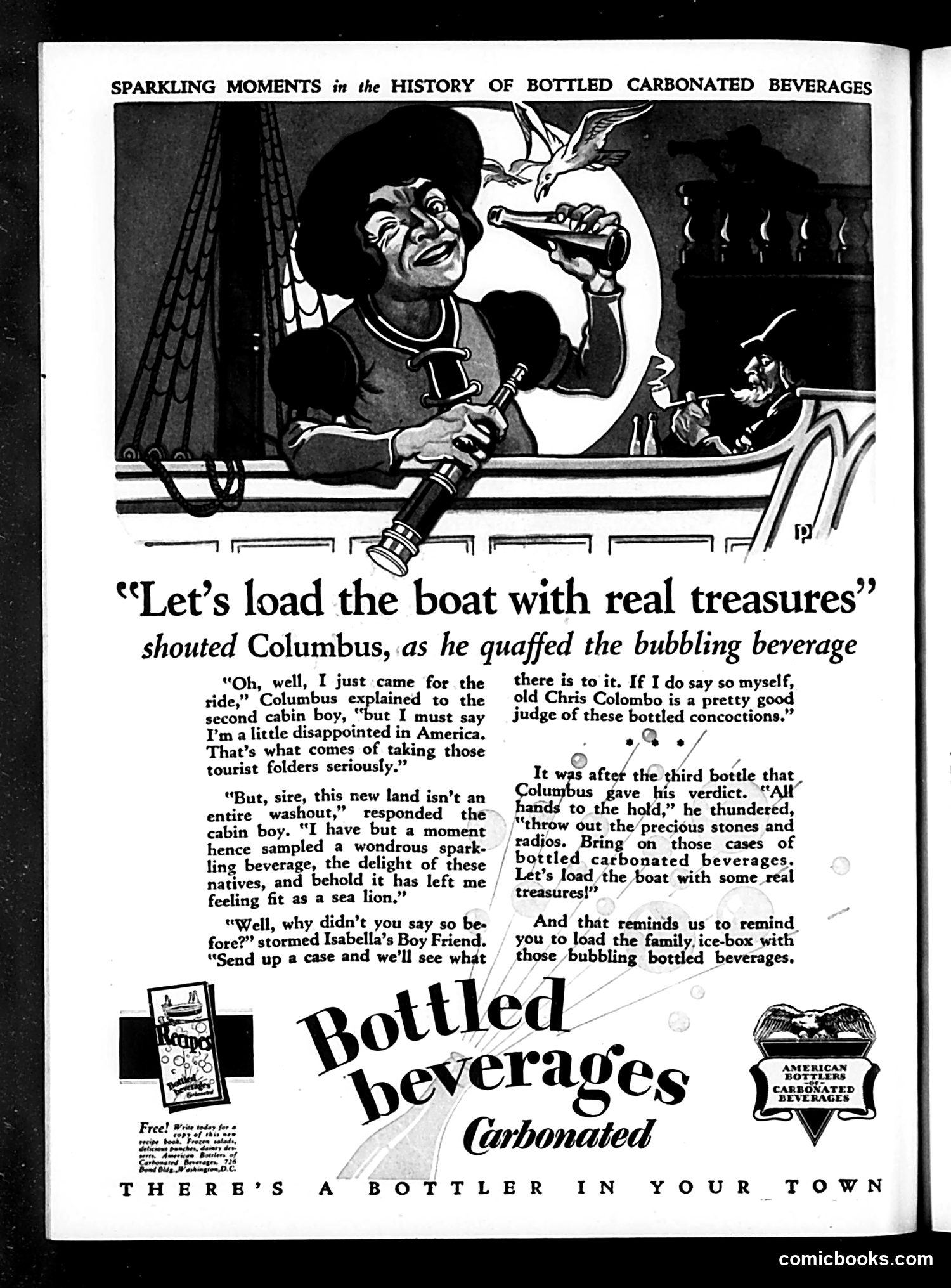
This is primarily a **carbonated beverage advertisement** disguised as humorous editorial content, a common early-20th-century marketing technique. The illustrated narrative features **Columbus** as the central figure, discussing his voyage and New World discoveries with a cabin boy. Columbus dismisses America as a "washout," but after sampling "a wondrous sparkling beverage," he declares it a genuine treasure—endorsing bottled carbonated drinks as superior to the landscape itself. The satire mocks **nationalist pride** and **tourism** by suggesting fizzy drinks are more valuable than actual geographic discoveries. The joke plays on the absurdity of prioritizing commercial products over exploration achievements. The ad concludes by encouraging readers to stock their homes with "bottling carbonated beverages," framing them as family luxuries worth collecting, similar to the "precious stones and radios" mentioned in Columbus's final declaration.
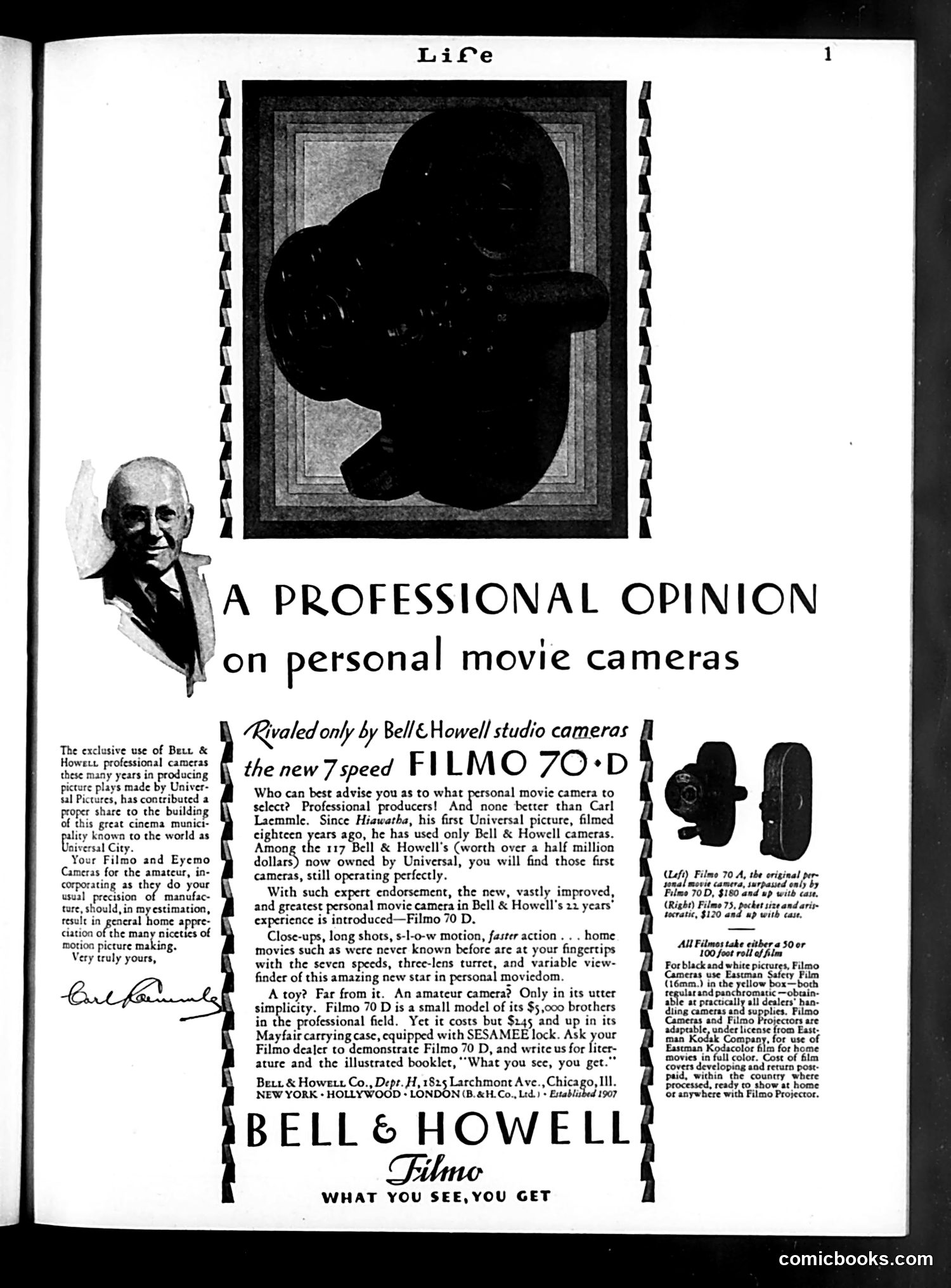
This page is primarily **advertising, not satire or political commentary**. It promotes Bell & Howell's Filmo 70-D movie camera for amateur filmmakers. The small portrait on the left appears to be **Carl Laemmle**, founder of Universal Pictures, providing a celebrity endorsement. The advertisement emphasizes that professional filmmakers use Bell & Howell cameras—Laemmle allegedly used only their equipment across 117 films worth over half a million dollars. The large silhouetted image at top is a **movie camera**, not a political caricature. The ad targets amateur cinematography enthusiasts, highlighting the Filmo 70-D's features (close-ups, slow-motion, faster action) and affordable price ($145 and up), positioning it as a professional-quality tool for home moviemakers. This reflects 1920s-30s consumer culture around new film technology.
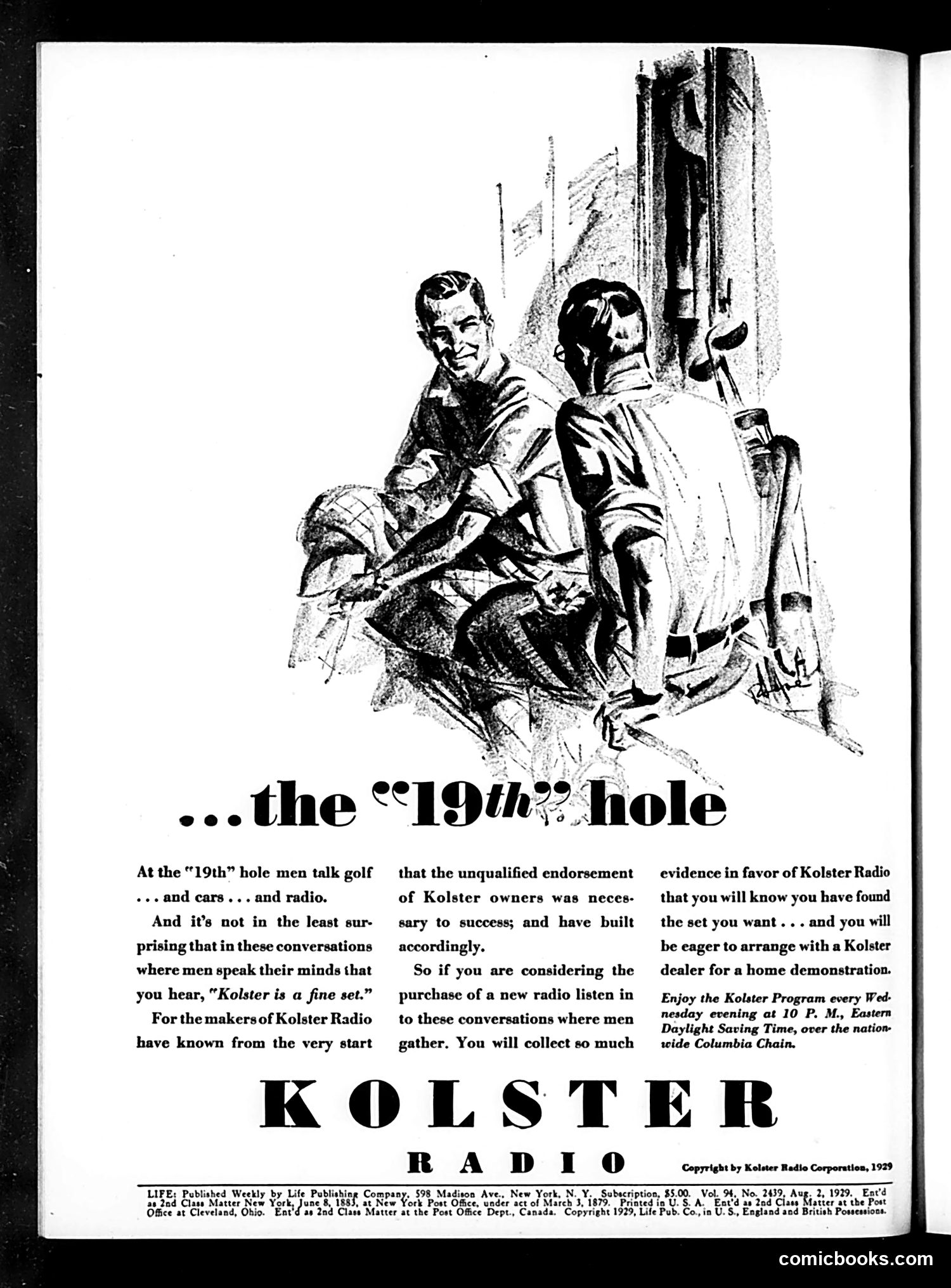
This is a **Kolster Radio advertisement**, not political satire. The illustration shows three men in casual attire at a golf course—the "19th hole" being the clubhouse bar where golfers socialize after playing. The ad's premise is that men discuss radios during these informal gatherings, and they specifically praise Kolster as "a fine set." The advertiser argues this word-of-mouth endorsement from respected peers (golfers, business associates) is more valuable than formal advertising. The ad targets affluent male consumers who golfed—a leisure activity signaling disposable income—and positions Kolster Radio as the choice of discerning gentlemen. It's a straightforward commercial appeal using social proof and aspirational imagery typical of 1920s advertising.
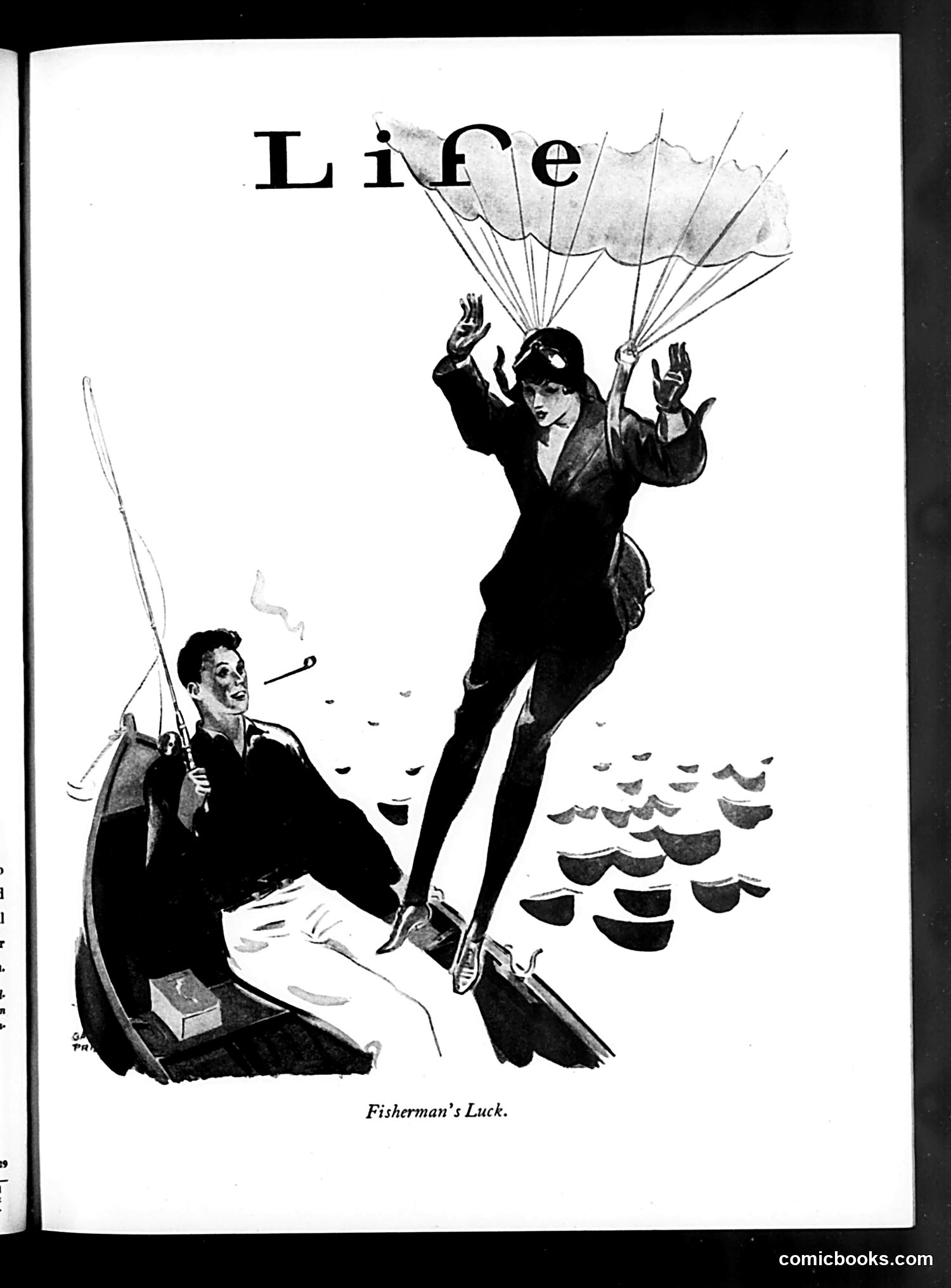
This cartoon illustrates the common expression "fisherman's luck"—the notion that fishing success is largely a matter of chance rather than skill. The image shows two men: one seated in a boat holding a fishing rod with a modest catch, while another figure floats above, apparently lifted by a parachute, descending with an enormous haul of fish falling around him. The contrast is absurd—the standing figure has achieved spectacular success through sheer luck or accident, while the fisherman using proper technique remains relatively unsuccessful. The satire mocks how fortune often favors the unprepared or unexpected, rather than rewarding skill and effort. It's a humorous commentary on the unpredictability of outcomes in fishing—and by extension, life itself.
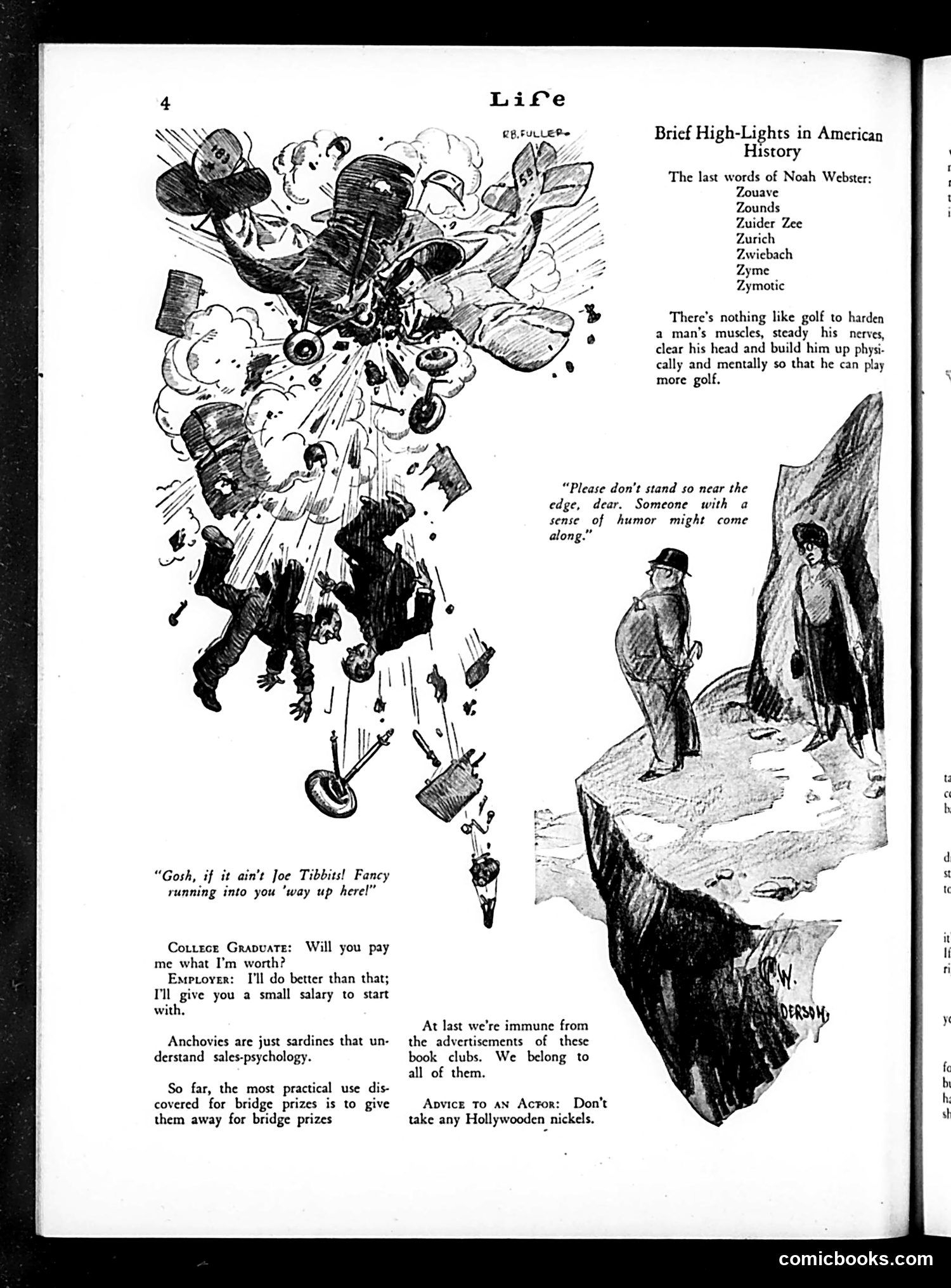
This page contains multiple satirical items typical of early-20th-century Life magazine: **Left cartoon**: A chaotic explosion labeled "Gosh, if it ain't Joe Tibbitts! Fancy running into you way up here!" depicts someone literally blown upward by an explosion—satire about unexpected encounters or fate. **Dialogue exchanges**: Include jokes about college graduates' salary expectations versus employer offers, and commentary on anchovies in sales psychology—typical workplace humor. **Right cartoon**: Two figures at a cliff edge, with one warning about "someone with a sense of humor might come along"—dark humor about suicide or dangerous situations. **Bottom notes**: References to book club advertisements and Hollywood actors accepting cheap coins—contemporary consumer culture satire. The page reflects 1920s-era concerns about employment, advertising, and social expectations.
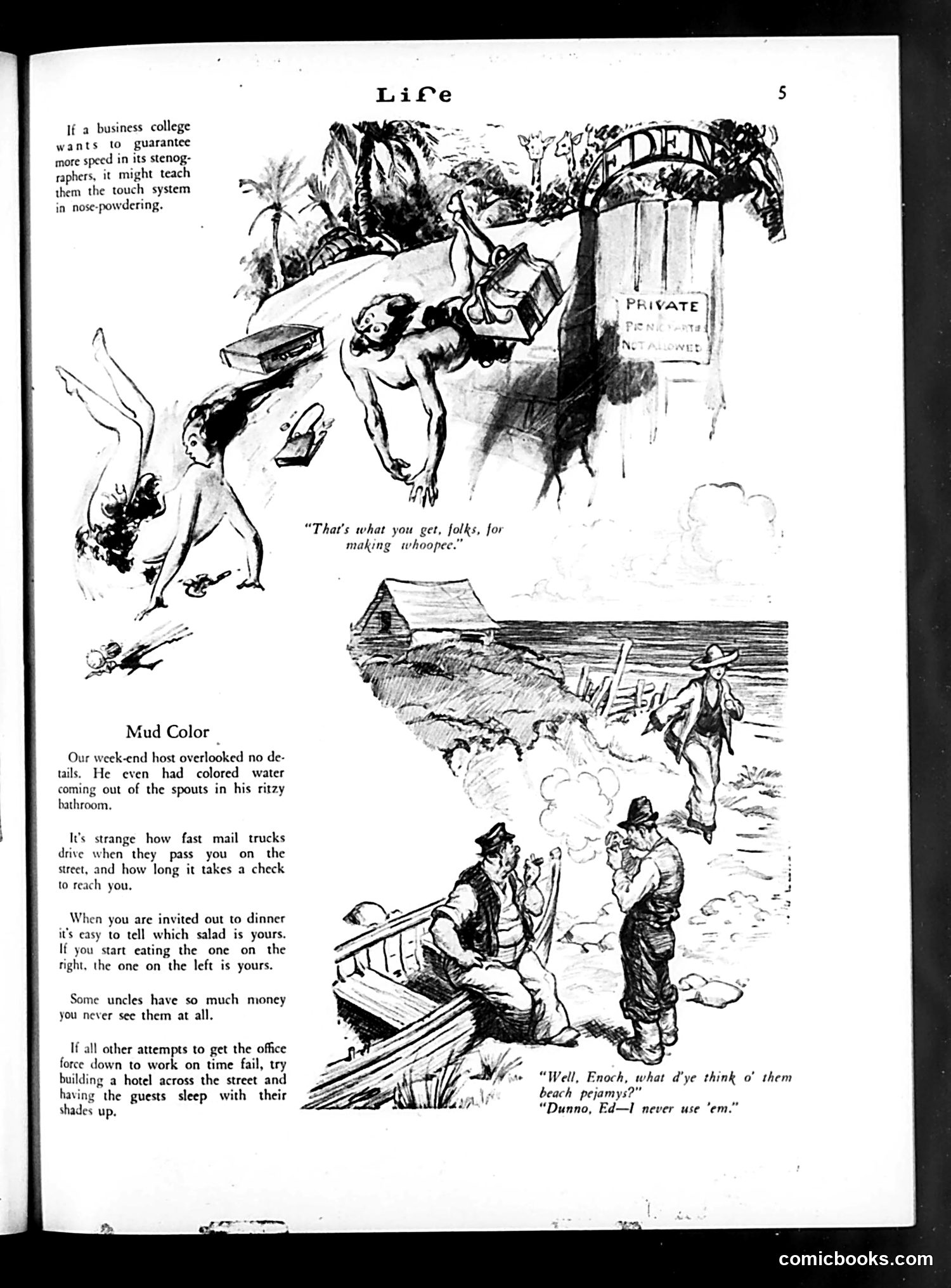
This page contains humor columns and illustrations satirizing everyday social observations rather than political content. **Top cartoon:** Shows people in tropical/vacation setting with a "Private Property" sign. The caption "That's what you get, folks, for making whoopee" suggests mockery of couples seeking romantic getaways, implying their private moments are being disrupted or discovered. **"Mud Color" section:** A collection of witty one-liners about middle-class life—mail delivery delays, identifying salads at dinner parties, wealthy relatives, and getting office workers to arrive punctually. The humor relies on recognizable social inconveniences of the era. **Bottom illustration:** Depicts what appears to be fishermen discussing "beach pajamas," a 1920s-30s casual beachwear fashion item. The joke plays on their rustic unfamiliarity with modern urban fashion trends. The page represents typical Life magazine humor: gentle satirization of contemporary manners and social customs.
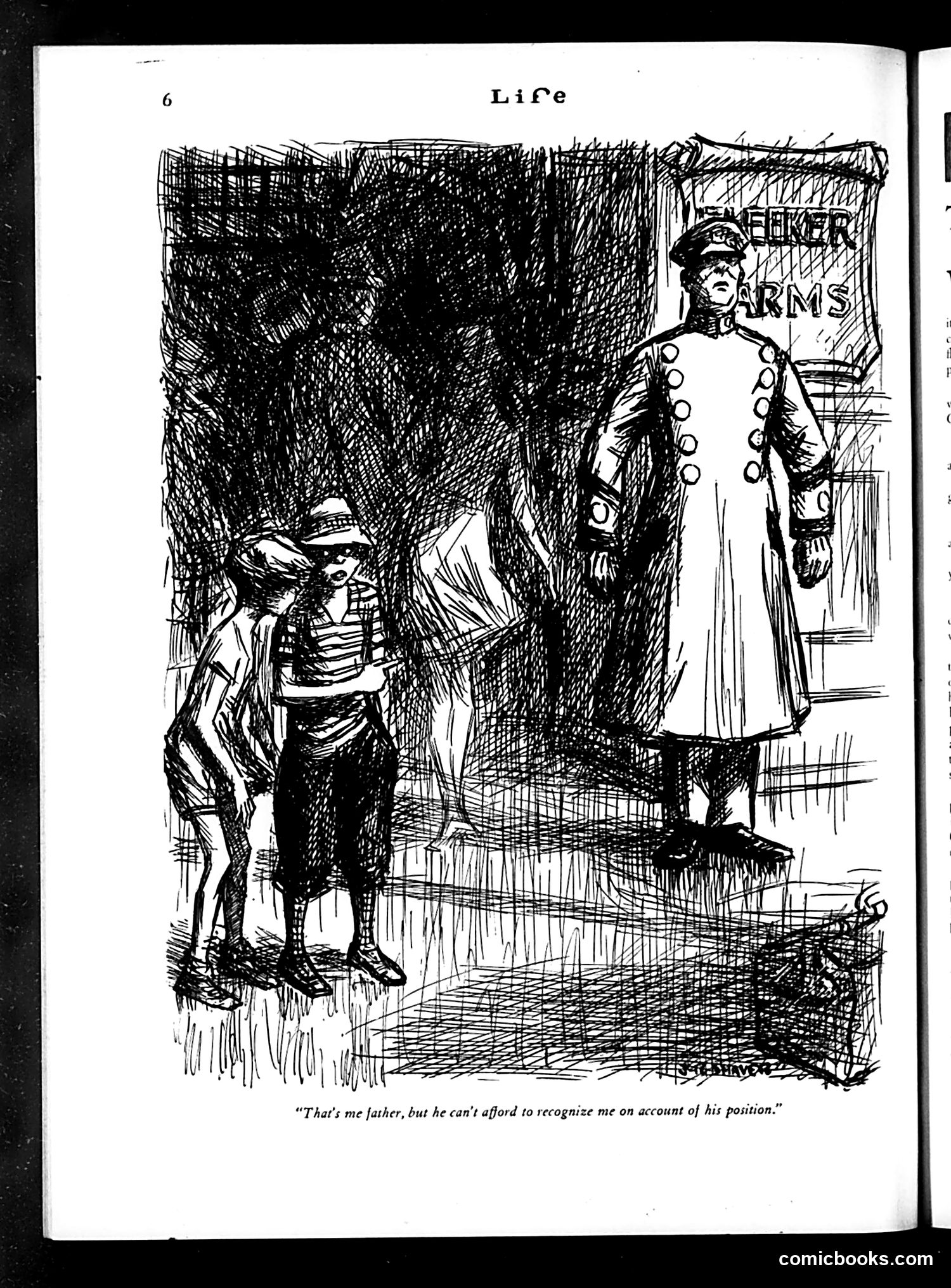
This cartoon depicts a social commentary on class and military hierarchy. A small figure in civilian clothes (appearing to be a child or working-class person) stands before a tall military officer in dress uniform bearing insignia. The caption reads: "That's me father, but he can't afford to recognize me on account of his position." The satire targets the rigid class distinctions and social pretense of the era, where military rank or elevated social position required men to disown or publicly distance themselves from family members of lower status. The joke critiques both the absurdity of such social conventions and the human cost—a father unable to acknowledge his own child due to concern for maintaining respectability. This reflects broader early-20th-century anxieties about social mobility and institutional pressure.
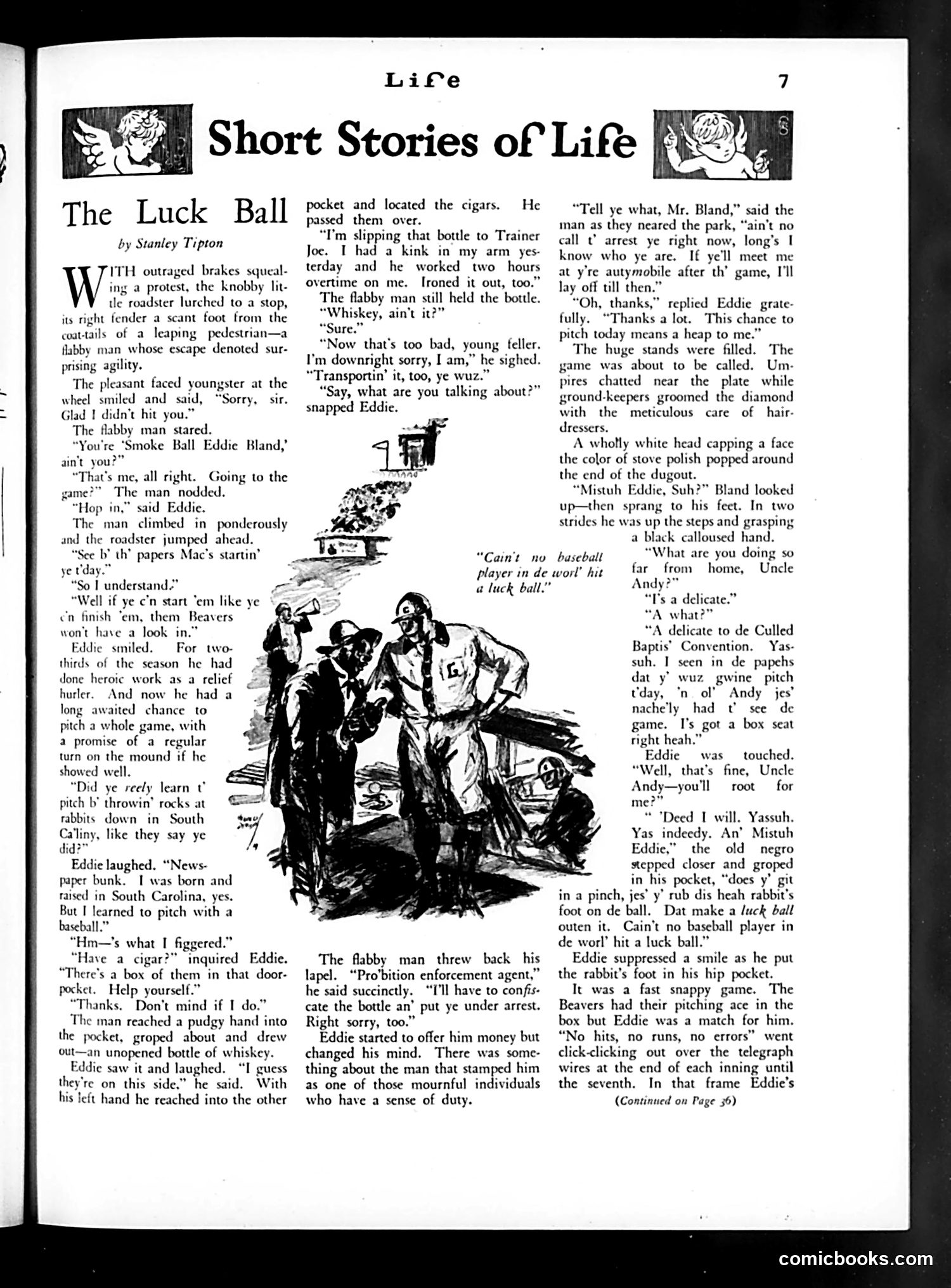
This short story concerns Eddie Bland, a young Black baseball player who encounters a racist white man on the street. The man insults Eddie's name and mocks his aspirations to pitch in a major league game. Eddie responds with dignity and humor rather than anger. The central joke involves a "luck ball"—a superstitious baseball charm. When a Prohibition enforcement agent arrests the racist man for carrying whiskey, Eddie cryptically suggests the man's misfortune stems from the "luck ball," implying that doing the right thing (not retaliating against racism) brings good fortune. The story uses baseball as a metaphor for American opportunity and social progress during the segregated era.
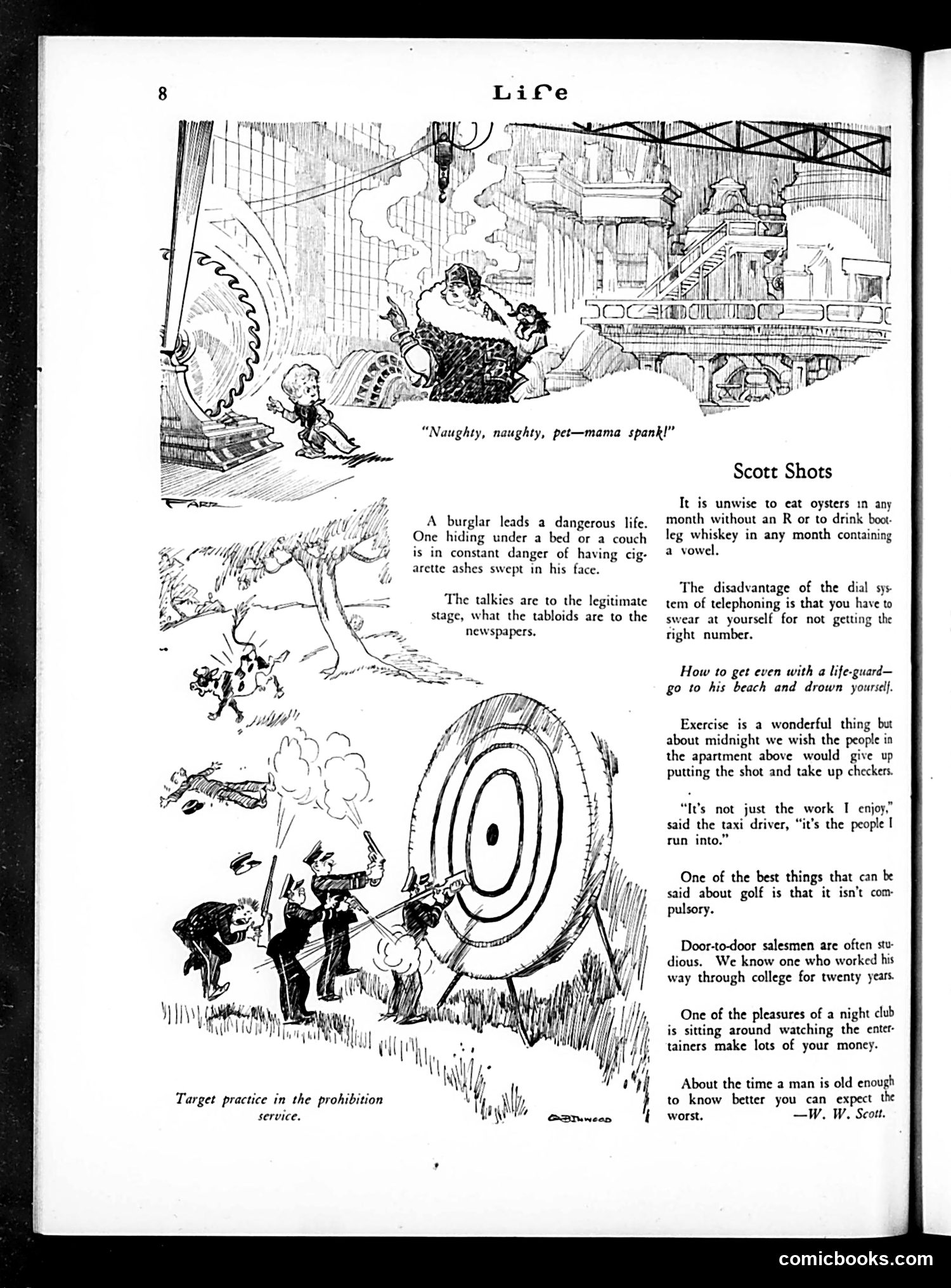
This page from *Life* magazine presents several cartoons and brief satirical observations by W.W. Scott. The top cartoon shows a child being spanked by a mother, captioned "Naughty, naughty, pet—mama spank!" The lower cartoon depicts men target-shooting at a large bullseye labeled "Target practice in the prohibition service." The "Scott Shots" section offers dry social humor about various topics: oyster superstitions, telephone mishaps, apartment noise complaints, taxi drivers, golf, door-to-door salesmen, nightclub expenses, and aging. The prohibition-era cartoon appears to mock ineffective law enforcement efforts against illegal alcohol, while the surrounding observations capture everyday urban frustrations and class commentary typical of 1920s satirical magazines.
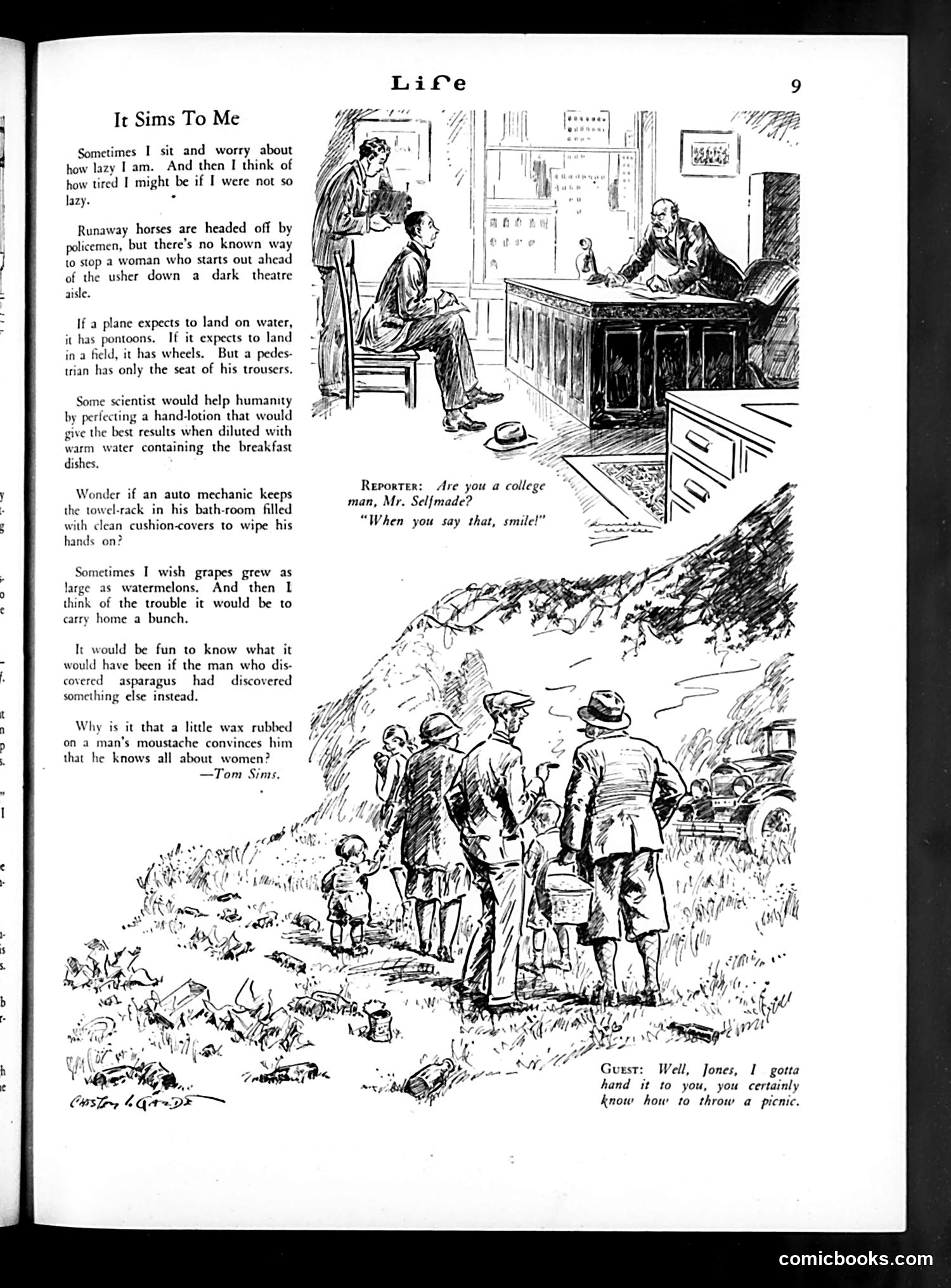
This is a humor column featuring observations about everyday life and two cartoon illustrations. **Top cartoon:** A reporter interviews a man named Mr. Selfmade at an office desk, asking "Are you a college man, Mr. Selfmade?" The punchline: "When you say that, smile!" — mocking self-made men who are defensive or falsely proud about lacking formal education. **Bottom cartoon:** A family picnic scene where a guest tells the host (Jones), "Well, Jones, I gotta hand it to you, you certainly know how to throw a picnic." The humor appears to reference messiness or chaos at the gathering, though details are unclear from the image alone. The left column contains brief satirical observations about laziness, runaway horses, airplane design, and other mundane topics, typical of Life's lighthearted social commentary style.
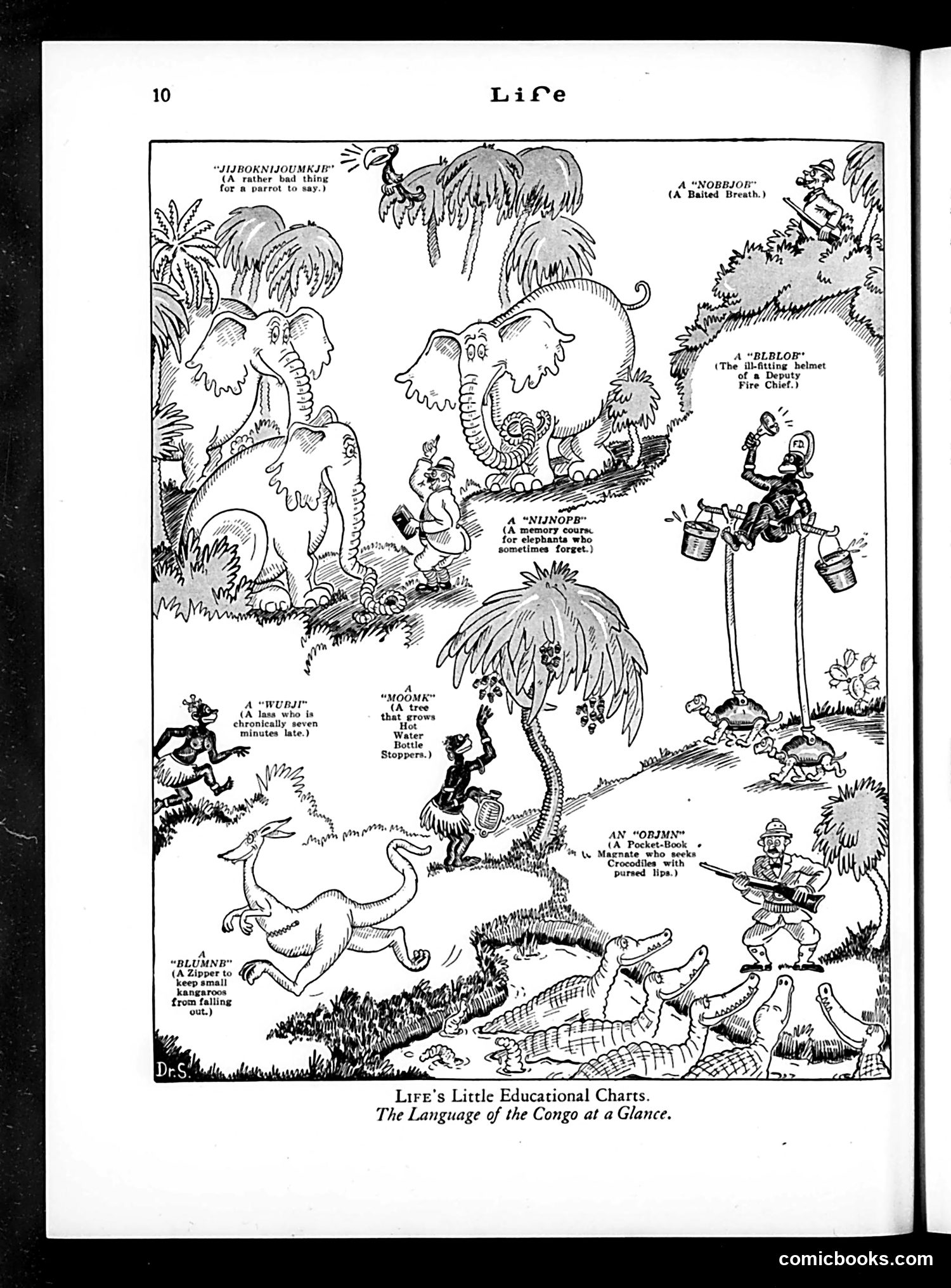
This is a satirical educational chart depicting various African animals and human figures with invented "Congo language" terms. Each animal or activity is labeled with a made-up word paired with a humorous English definition—for example, "JIBORKIJOUMKJE" (described as a "Greeting"), "NILNOPE" (for forgetful elephants), and "WEBBI" (someone always late). The satire mocks both pseudo-scientific racial hierarchies of the era and the Western fascination with exoticizing Africa. By presenting "the Congo" as a place where animals and humans intermingle with invented language, the cartoon reflects early 20th-century attitudes that stereotyped African people and culture as primitive or comical. The playful tone disguises what is ultimately dehumanizing content typical of period satire.
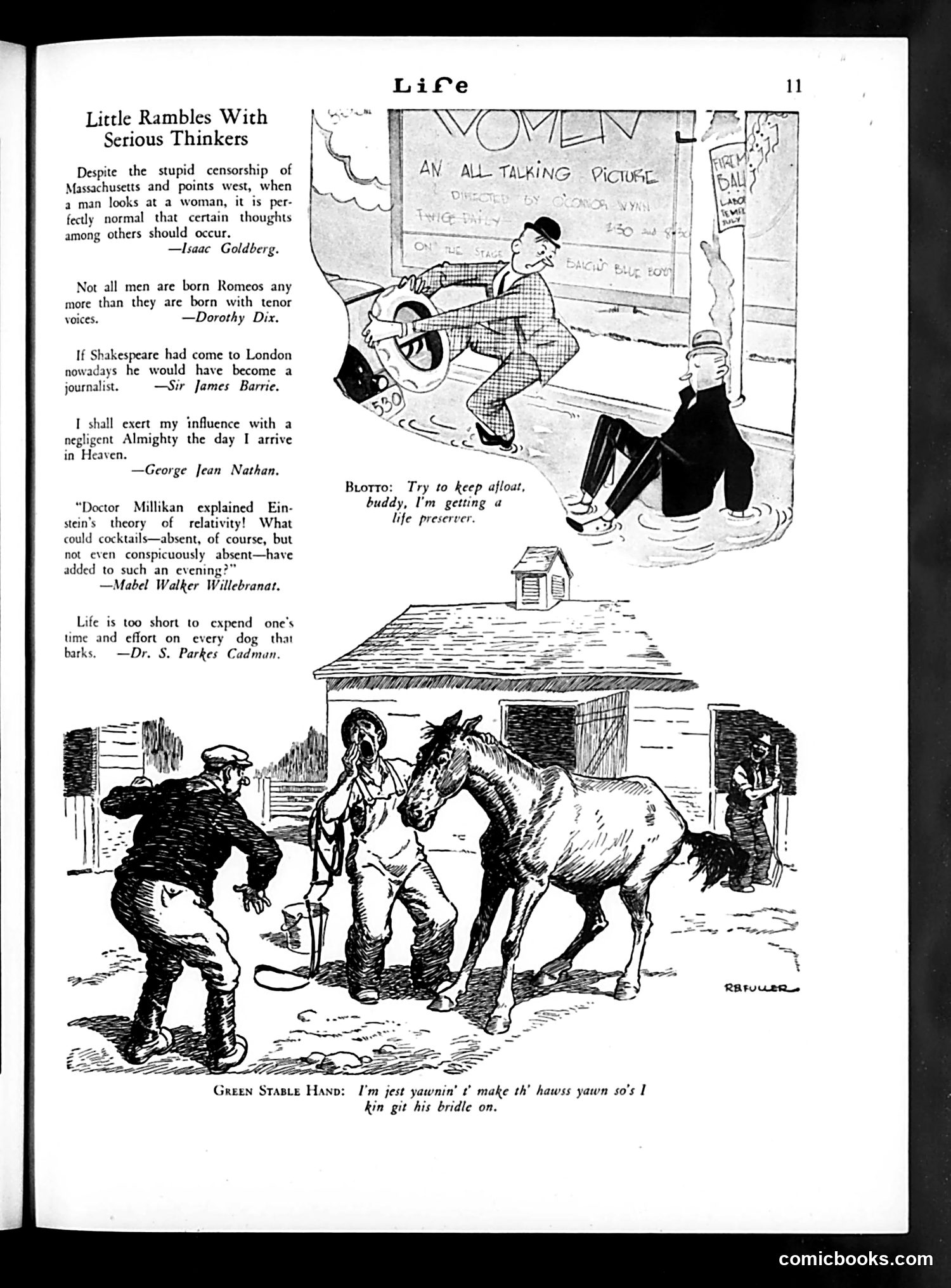
This page contains a section titled "Little Rambles With Serious Thinkers" featuring quotations from various public figures (Isaac Goldberg, Dorothy Dix, James Barrie, and others) on life philosophy. Below are two cartoon illustrations: 1. **Top cartoon**: A man in a suit and bowler hat plays guitar while trying to stay afloat in water, explaining to another man that he's "getting a life preserver." This appears to be a visual pun playing on the phrase "getting a life." 2. **Bottom cartoon**: A stable hand addresses his employer about a horse, using dialect humor. The joke appears to rely on the character's working-class speech patterns and the double meaning of "hawss" (horse) for comedic effect—typical of early 20th-century humorous cartoons using caricatured dialect for laughs.
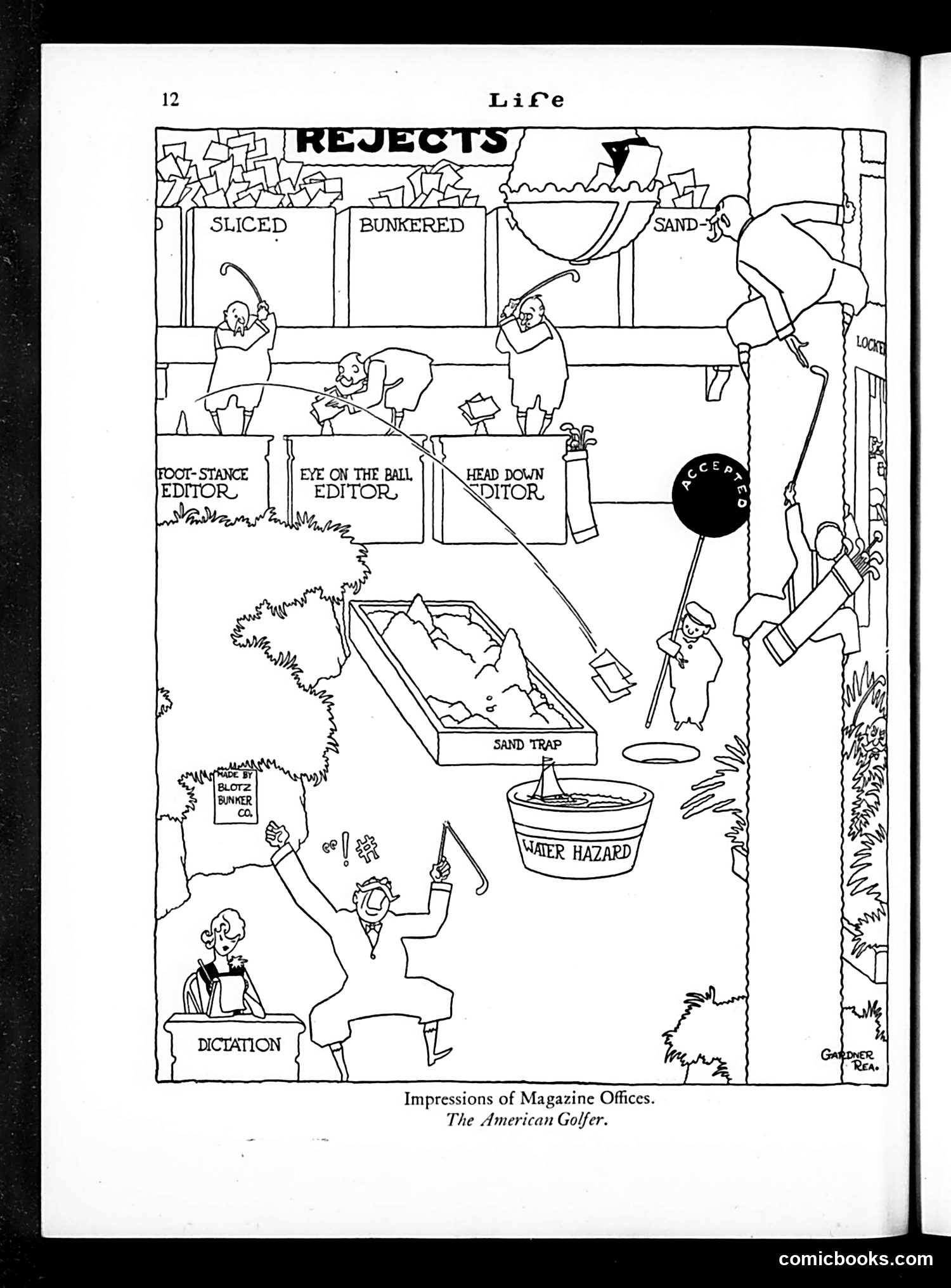
This satirical cartoon depicts a golf course designed as a magazine office layout, mocking rejected manuscript submissions. Each hazard represents an editorial department or rejection type: - **"Sliced," "Bunkered," "Sand-ed"** (top): Different rejection outcomes - **"Foot-Stance Editor," "Eye on the Ball Editor," "Head Down Editor"** (middle): Editorial positions with mixed metaphors - **"Sand Trap" and "Water Hazard"** (lower section): Obstacles representing rejections - **"Dictation"** (bottom left): Shows a writer being directed The joke equates submitting manuscripts to playing golf—both involve navigating hazards and repeated failures. Writers must traverse this treacherous "course" of editorial departments, facing rejection at every turn. The cartoon satirizes the difficulty of getting published and the numerous editorial gatekeepers writers must pass.
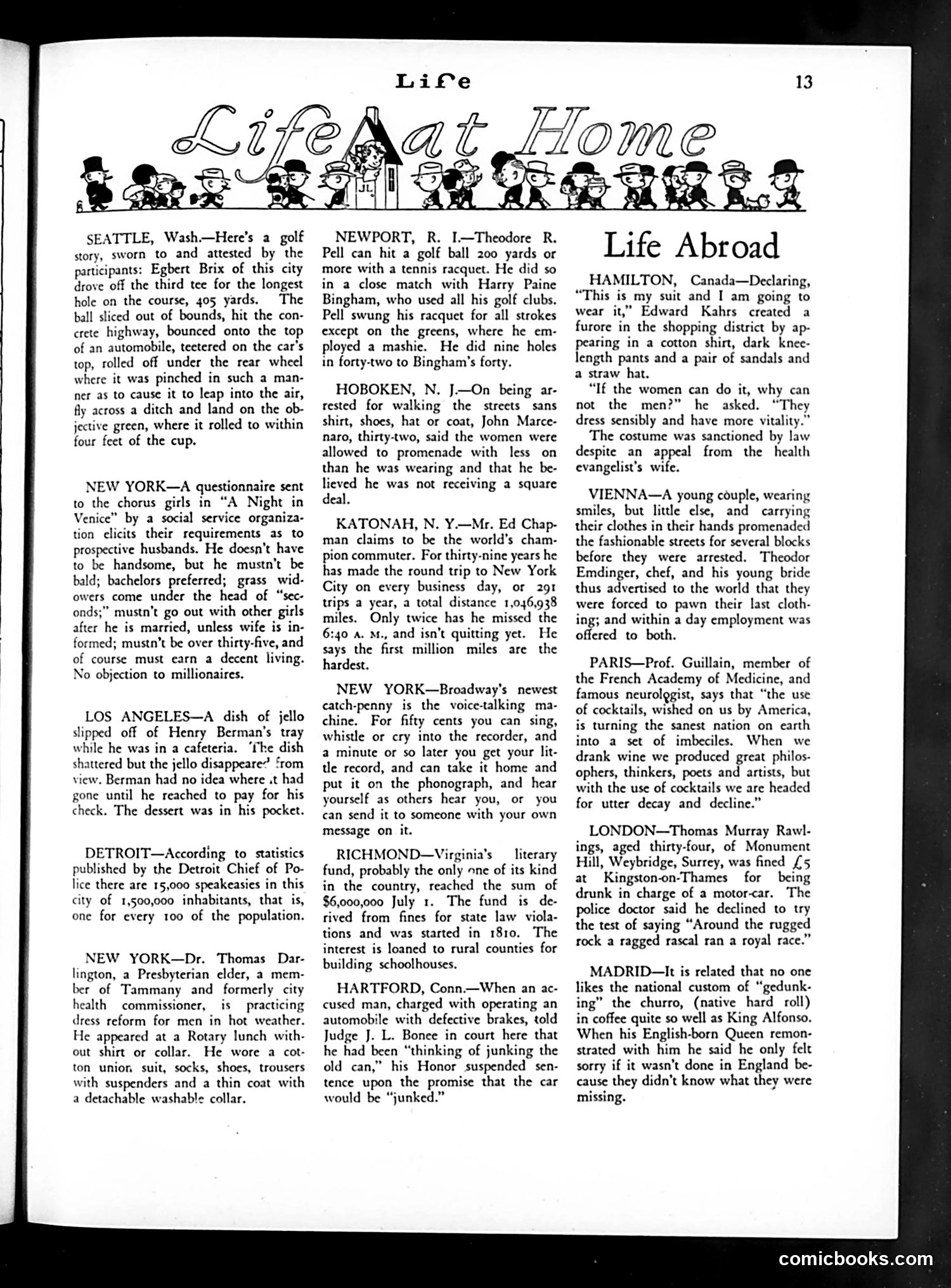
This page consists of two sections: a decorative header illustration and two columns of brief anecdotes. **The Header:** "Life at Home" features a silhouette border of children and adults in various poses around a house—a typical domestic scene meant to frame the content below as lighthearted domestic humor. **The Content:** Two columns—"Life at Home" (left) and "Life Abroad" (right)—contain short humorous anecdotes from various cities. These are brief, satirical observations about everyday life: a golf mishap in Seattle, a woman's dress code debate in Canada, a couple's pawned clothes in Vienna, and commentary on French drinking habits and English customs. The humor relies on gentle social observation rather than political commentary—poking fun at regional behaviors, fashion conventions, and cultural differences in an accessible, conversational style typical of Life's satirical approach.
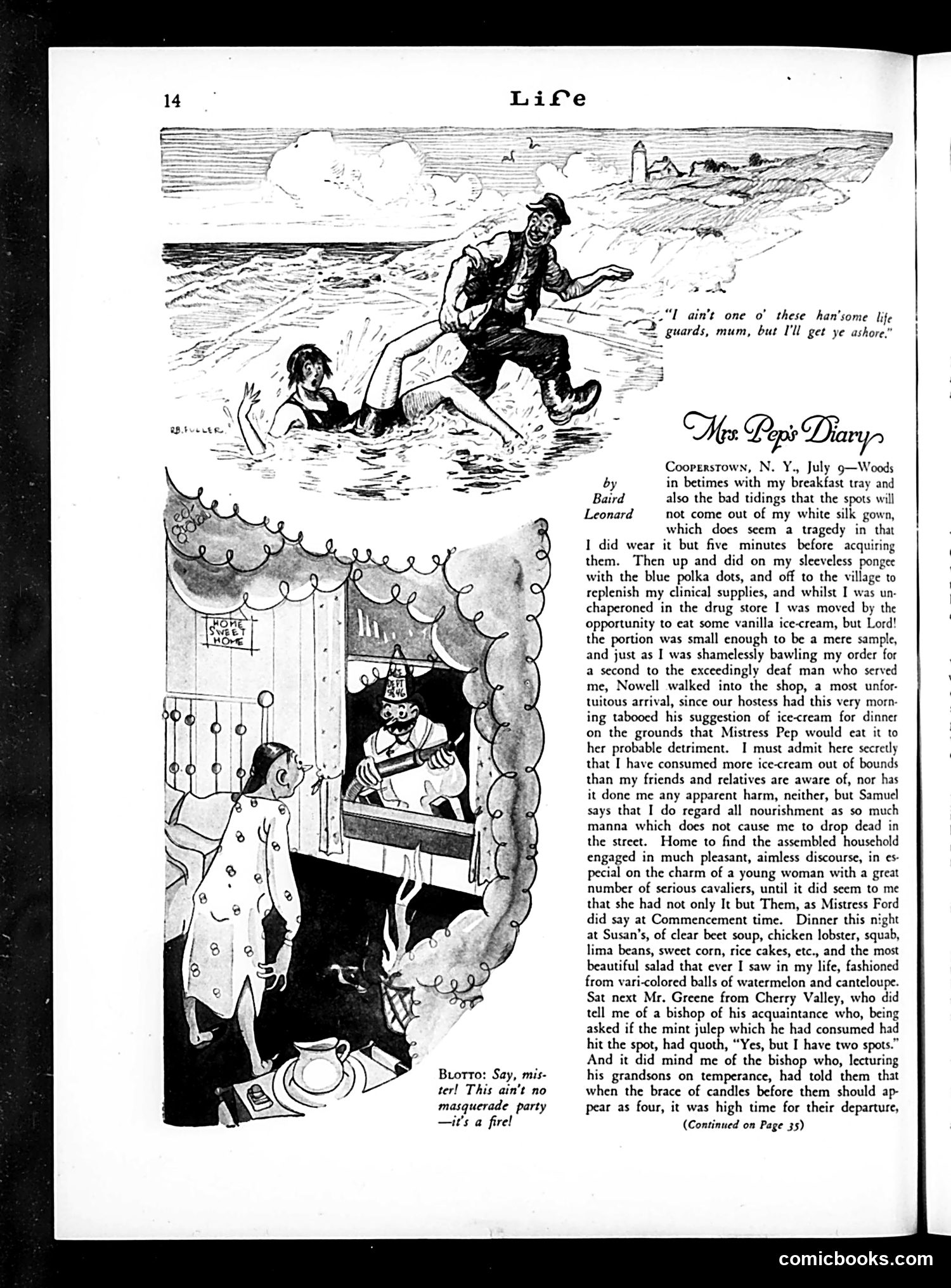
This page contains **"Miss Pep's Diary,"** a fictional column presented as an upper-class woman's account of summer activities in Cooperstown, N.Y. (dated July 9). **The top cartoon** by Baird Leonard shows a man in a bathing suit assuring a drowning child he'll "get ye ashore"—a humorous beach rescue scene. **The lower illustration** depicts an ornate shop interior where a woman purchases ice cream while a man (labeled "Blotto") makes a drunken comment: "Say, mister! This ain't no masquerade party—it's a fire!" The joke appears to reference either her elaborate dress or the shop's decorative lights, which he mistakes for festive party attire while intoxicated. The diary section satirizes upper-class leisure culture and social pretension through gossipy anecdotes about dinners, servants, and summer socializing.
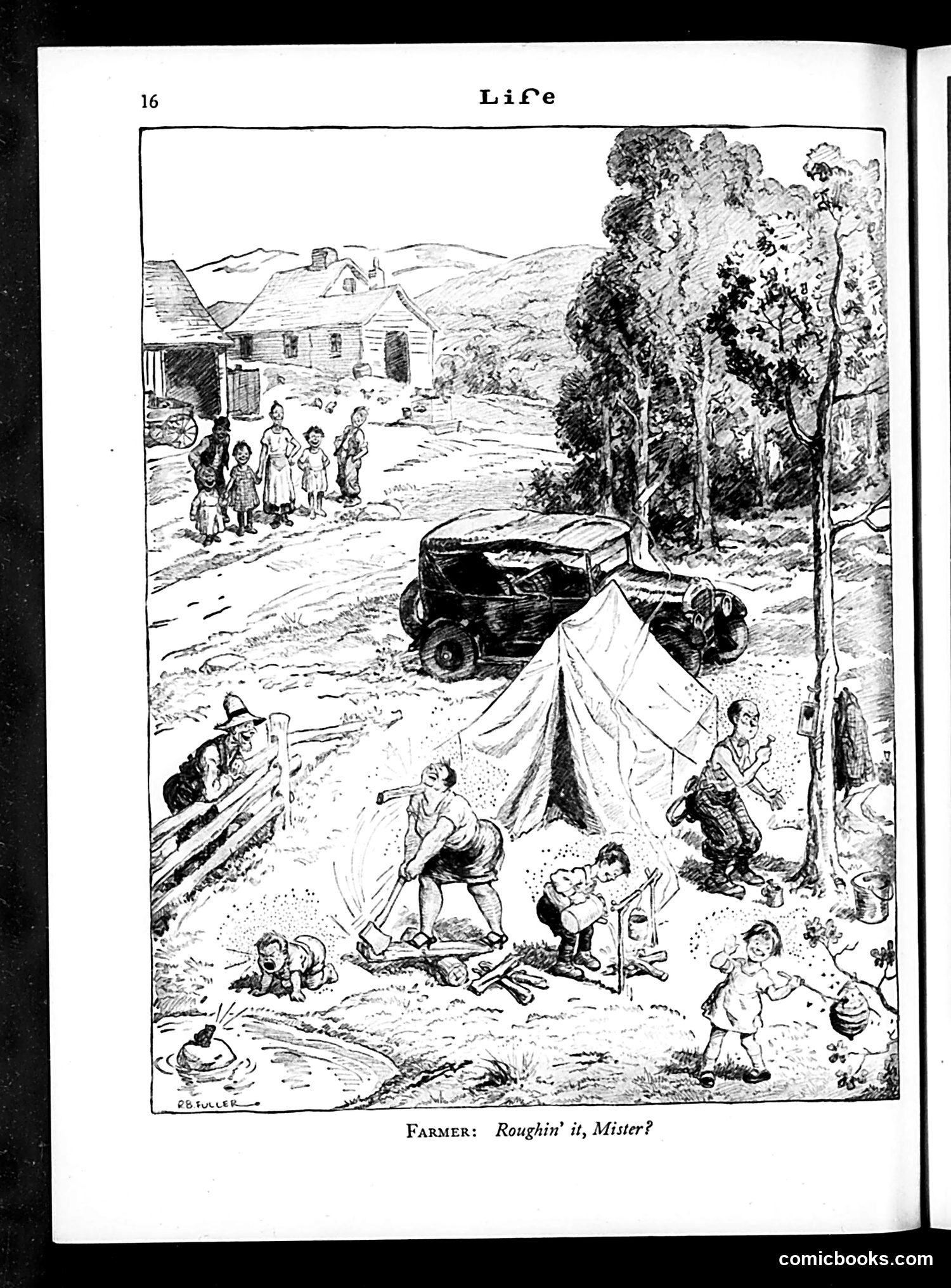
This cartoon depicts a camping scene with a family of migrants or traveling workers. The caption's phrase "Roughin' it, Mister?" appears sarcastic—the figure asking seems to be commenting on the contrast between leisure camping and the harsh reality of the family's situation. The scene shows a makeshift tent, a broken-down automobile, children playing in dirt, and adults engaged in basic survival activities. The rural farm setting with a house and other families visible in the background suggests this depicts Depression-era migrant workers rather than recreational campers. The satire likely critiques the euphemistic language used to describe the desperate conditions faced by displaced agricultural workers during this period, treating survival hardship as casual "roughing it."

This is an advertisement for "The Ruxton," an automobile brand. The visual presents twelve stylized male figures arranged in a circle, each rendered as simplified, geometric silhouettes wearing hats. They appear to be discussing motor cars, as indicated by the text: "TWELVE MEN WERE DISCUSSING THEIR MOTOR CARS AND OUT OF THEIR COMMENTS CAME—" The design uses modernist Art Deco styling popular in early 20th-century advertising. The twelve men likely represent diverse perspectives or demographics, suggesting broad consensus about the vehicle's quality. This advertising approach—gathering multiple voices to build credibility—was common in automotive marketing of this era, implying that the Ruxton appealed to various discerning buyers across social classes.
This page is primarily **advertising copy**, not political satire. It promotes "America's First Front-Wheel-Drive Motor Car"—the Ruxton automobile. The text describes how a group of prominent men (from art, letters, commerce, and finance) discussed cars over dinner and decided to build an innovative vehicle with front-wheel drive. The ad claims this design offers superior "body silence, riding comfort, flowing motion" and individual styling. The image shows a stylized side-view sketch of the car's profile, emphasizing its low stance. The bottom tagline—"A car so low that you can look over it! A car so smart none can overlook it!"—plays on the vehicle's design innovation. This is **product marketing**, not political commentary.
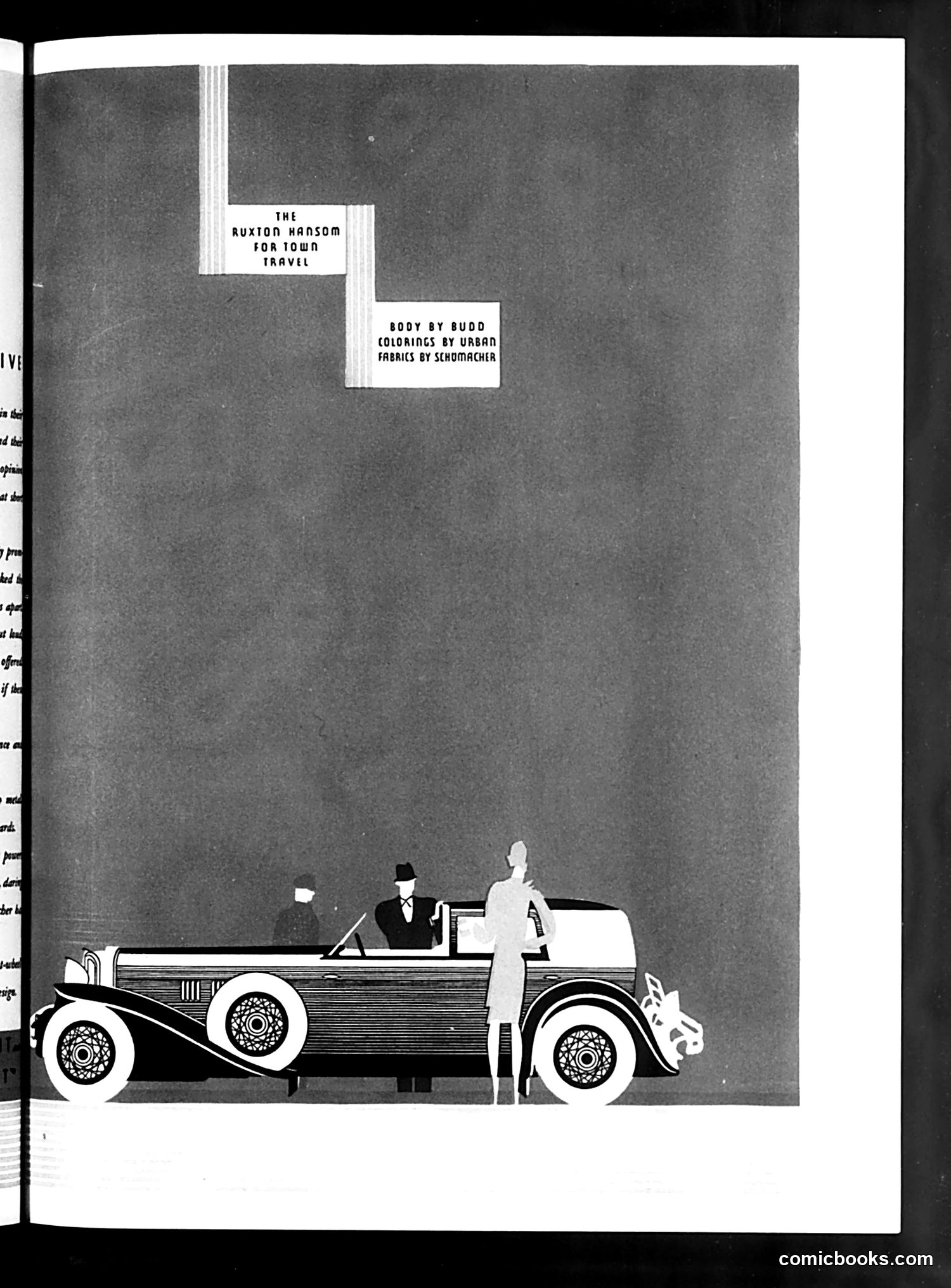
This page is primarily an advertisement for the Ruxton automobile, specifically their "Hansom" model designed for town travel. The illustration showcases a stylized 1930s luxury car with an elegantly dressed woman and a formally dressed man (driver) posed beside it. The ad credits the car's construction to three manufacturers: Budd (body), Urban (colorings/paint), and Schomacher (fabrics/interior). This was common practice in early automotive advertising, highlighting quality components from different specialized makers. The "Hansom" name references the hansom cab, a two-wheeled horse-drawn carriage historically used for urban transportation—suggesting this automobile modernizes that traditional conveyance for wealthy clients. The minimalist design and emphasis on style over specifications reflects period advertising aesthetics.
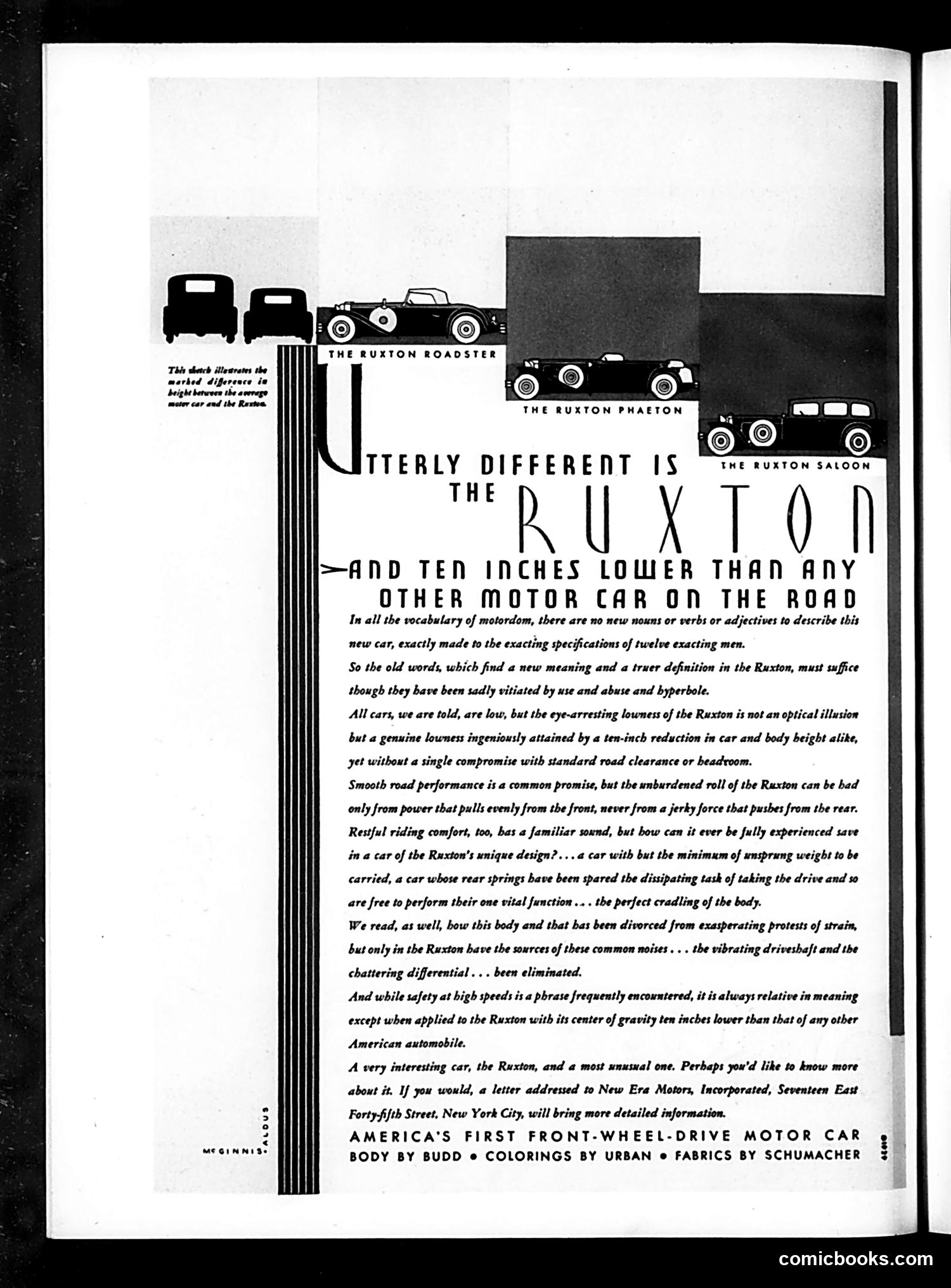
This is not a satirical cartoon but a **product advertisement** for the Ruxton automobile, claiming it as "America's first front-wheel-drive motor car." The page showcases three Ruxton models (Roadster, Phaeton, Saloon) alongside competitors' silhouettes to emphasize the Ruxton's distinctive low profile—ten inches lower than other cars. The lengthy text employs hyperbolic marketing language, ironically acknowledging that automotive advertising typically overpromises ("smooth performance," "restful comfort") while insisting the Ruxton alone delivers on these claims through engineering innovations: front-wheel drive, low center of gravity, and reduced vibration. The advertisement targets wealthy buyers interested in luxury automobiles and technical specifications, directing inquiries to New Era Motors in New York City. The design credits (Budd body, Urban colorings, Schumacher fabrics) emphasize premium craftsmanship.
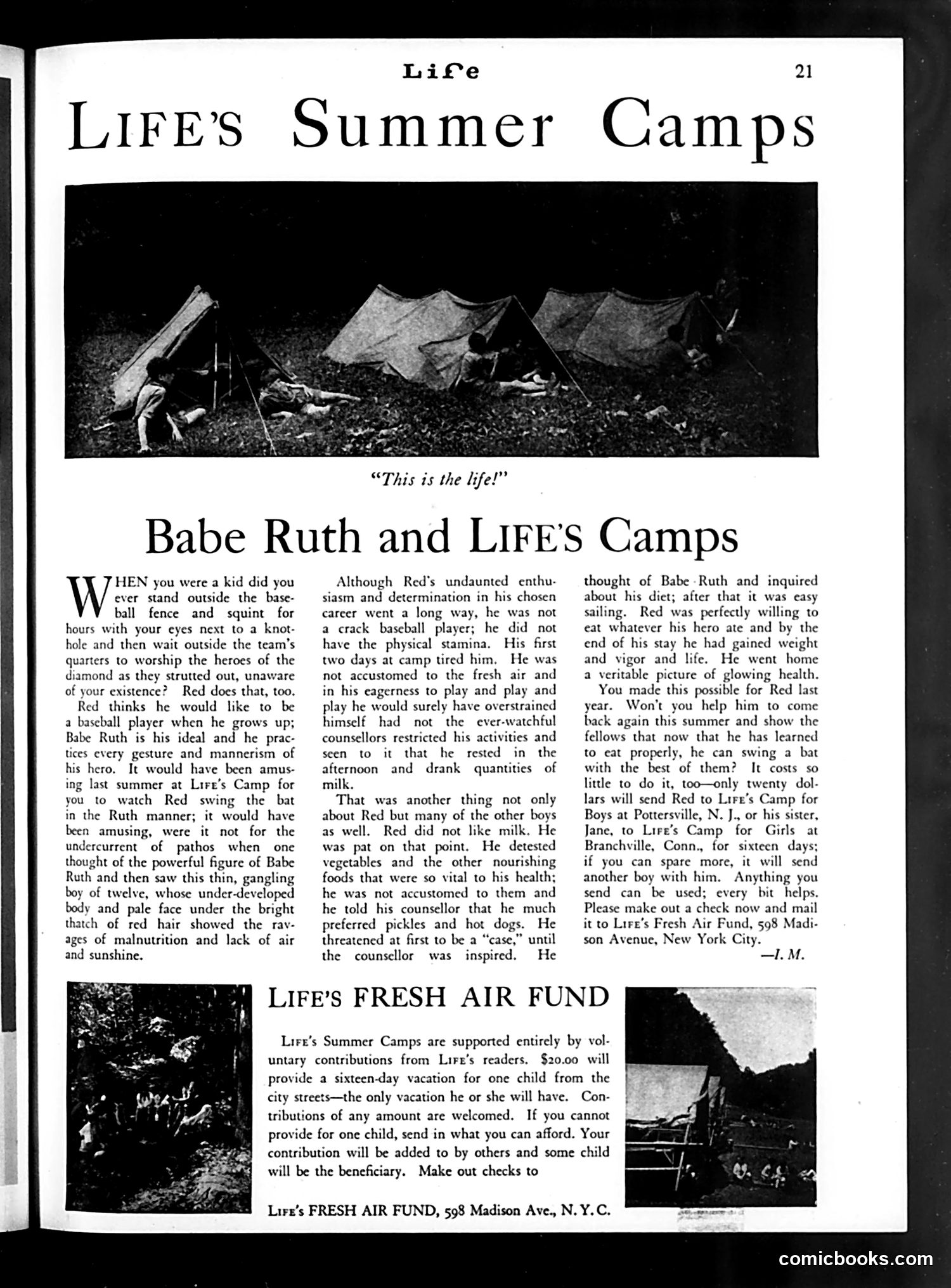
This is a **fundraising article**, not satire. Life magazine promoted its "Fresh Air Fund"—a charitable program sending malnourished urban children to summer camps. The article uses "Red," a fictional twelve-year-old Babe Ruth fan, as an emotional case study. Red is depicted as an underfed, pale city boy who idolizes the famous baseball player. The piece contrasts Ruth's robust health with Red's malnutrition caused by poverty and poor diet (he preferred hot dogs to vegetables and milk). The narrative arc shows redemption: after two weeks at Life's camp with proper nutrition and rest, Red gains weight and vigor. The implicit message to wealthy readers: $20 will provide this life-changing experience for a city child. This represents early 20th-century Progressive Era charity work, combining celebrity endorsement (Ruth's example) with guilt-inducing before-and-after narrative to solicit donations. The "fresh air" concept reflected then-popular beliefs that rural/camp environments and nutrition could cure urban poverty's physical effects.
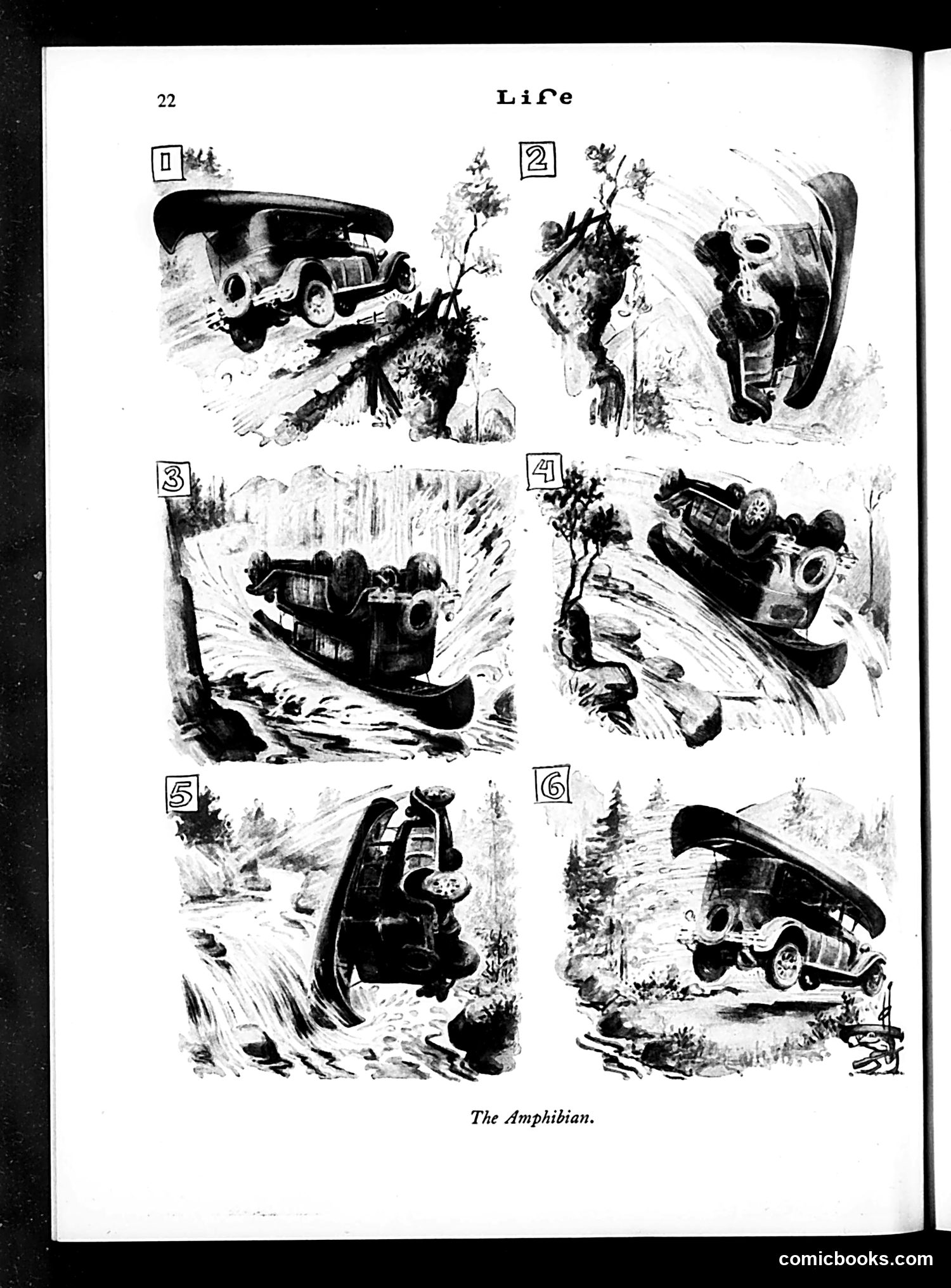
This page from *Life* magazine presents a six-panel satirical sequence titled "The Amphibian," depicting an automobile's journey from road to water and back. The panels show a car progressively entering a body of water, becoming submerged, and eventually emerging—illustrating the vehicle's ability to function both on land and in water, hence "amphibian." This appears to be early automotive satire, likely from the 1920s-1930s based on the vehicle style. The humor derives from the absurdity of treating a car as if it possessed amphibious capabilities like an animal, mocking either over-engineered vehicles, dubious advertising claims, or drivers' reckless behavior. The exaggerated consequences (complete submersion) underscore the satirical point that cars belong on roads, not in water.
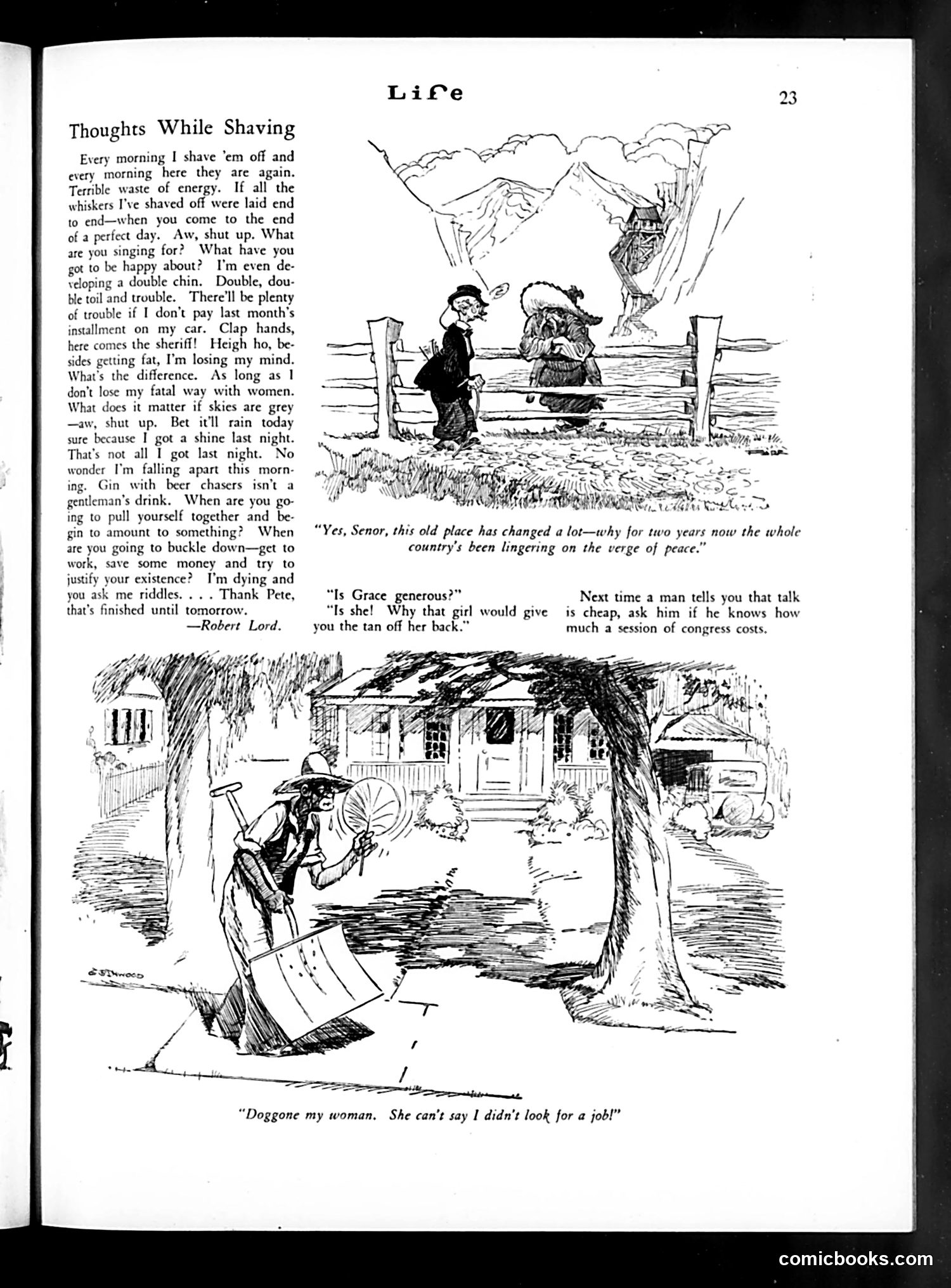
This page contains a satirical essay and two cartoons from *Life* magazine's humor section. **"Thoughts While Shaving"** is a stream-of-consciousness monologue by Robert Lord capturing a man's anxious morning—worrying about his appearance, car payments, financial instability, and romantic failures. The humor lies in the self-deprecating rambling and the contrast between trivial concerns (whiskers, a double chin) and serious ones (debt, unemployment). The **top cartoon** depicts two men conversing near a rural cabin, likely discussing economic hardship. The caption references the country "lingering on the verge of peace"—likely referencing post-WWI or Depression-era uncertainty. The **bottom cartoon** shows a man with tools near his house, defending himself to his wife that he *did* look for work. The satire critiques both unemployment and marital discord, suggesting the economic crisis made finding jobs difficult while straining home life. Overall, the page satirizes 1920s-30s economic anxiety, male inadequacy, and domestic tension during uncertain times.
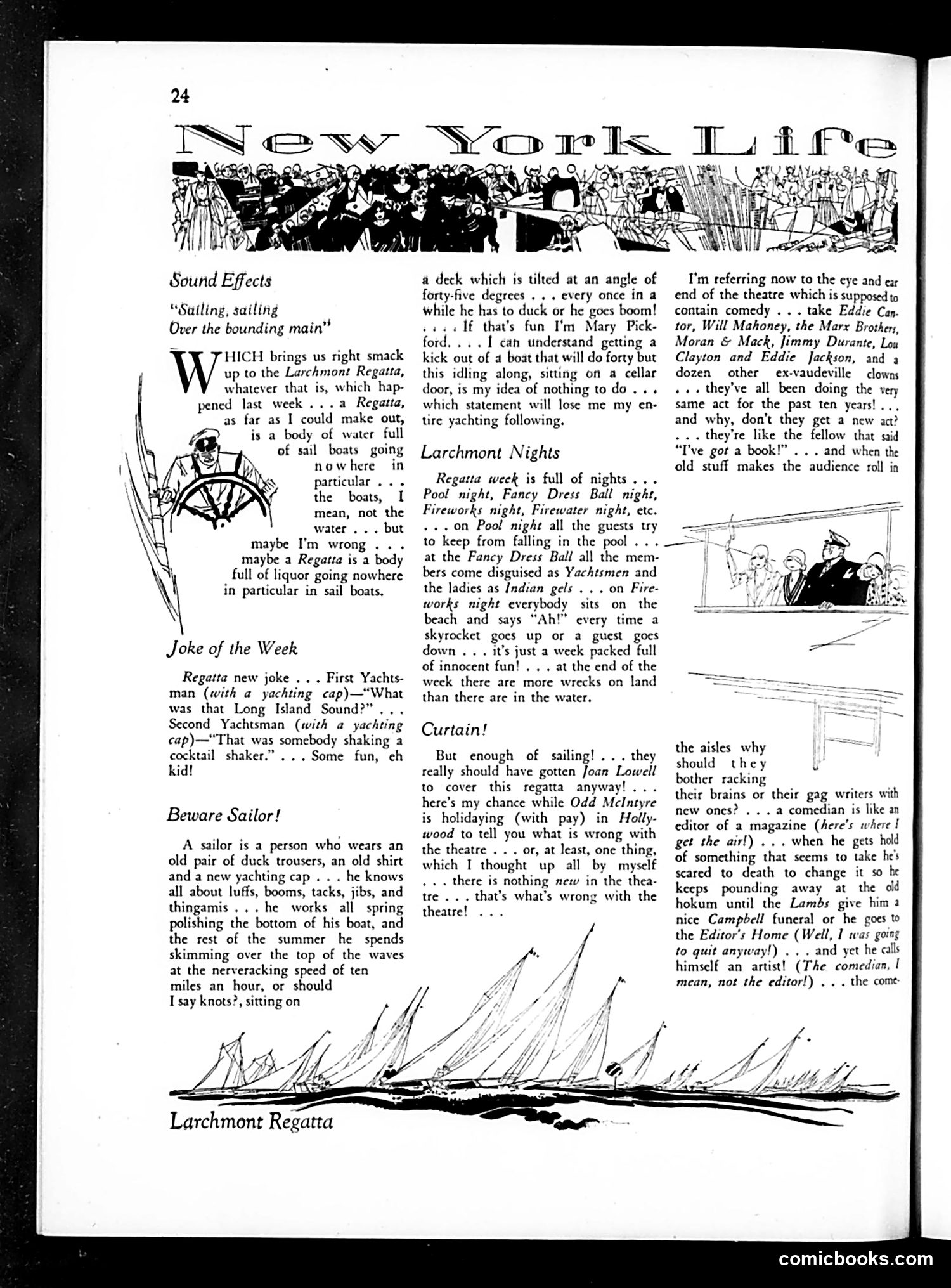
This page satirizes wealthy yacht club culture and Broadway entertainment through humorous commentary. The author mocks the Larchmont Regatta—an actual Long Island yacht racing event—depicting sailors as pretentious dilettantes who wear new yachting caps while performing tedious maneuvers at glacial speeds. The joke equates a "Regatta" with "a body full of liquor going nowhere," suggesting wealthy participants are primarily drinking rather than genuinely racing. The second section attacks theatrical comedians (Eddie Cantor, Marx Brothers, Jimmy Durante, and others—all vaudeville stars famous in the 1920s) for endlessly recycling the same tired acts rather than innovating. The author argues comedians fear changing successful material, so they "pound away at old hokum" until death, calling themselves "artists" while lacking genuine creativity. The satire targets both leisure-class pretension and entertainment industry stagnation—critiquing those too comfortable or cowardly to evolve.
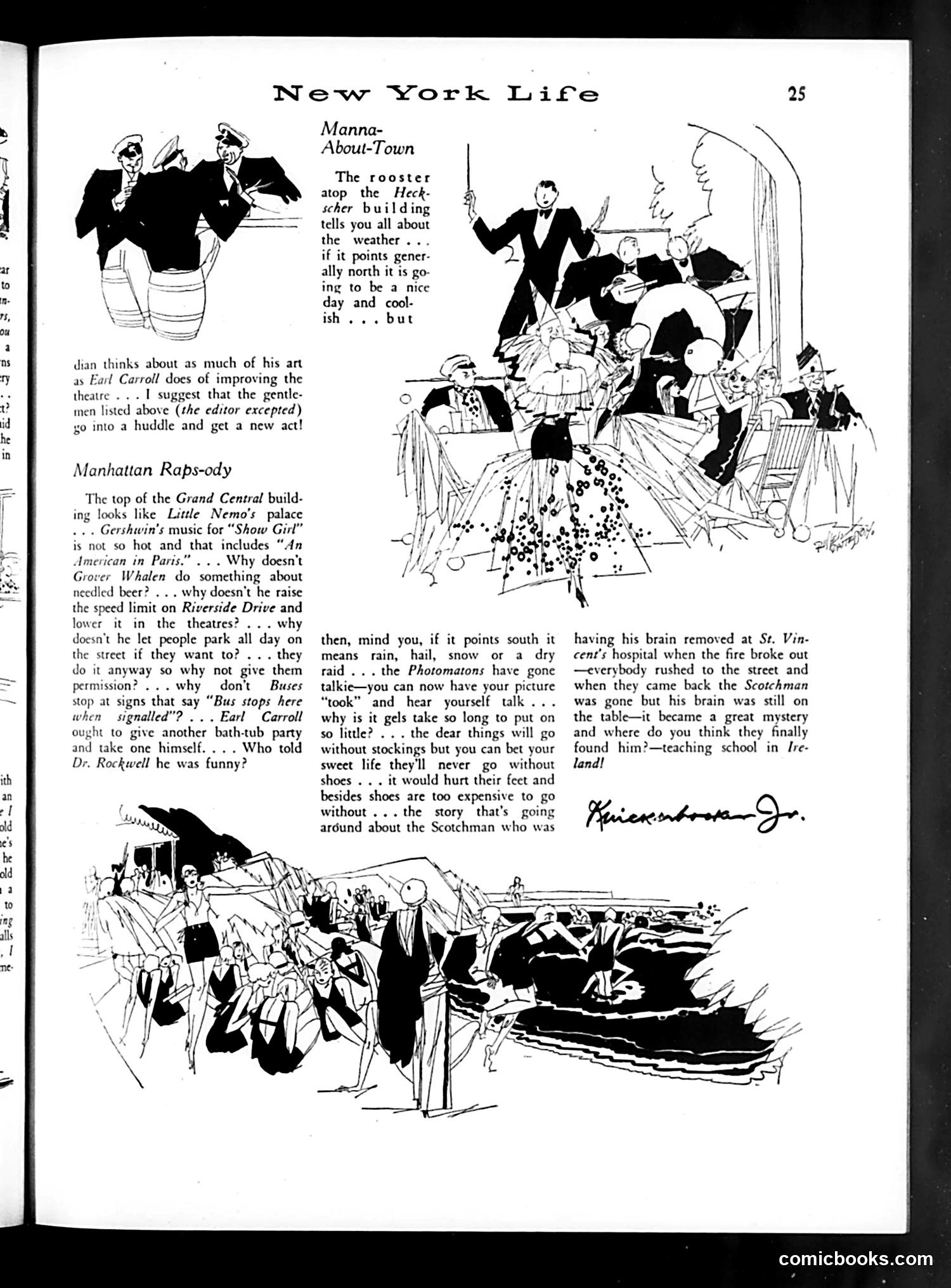
This page from Life magazine contains two satirical sections mocking Manhattan's cultural and civic life. **"Manna-About-Town"** opens with a joke about the Heckcher building's rooster weathervane, then delivers rapid-fire quips about contemporary New York: talkie photo booths (Photomatons), women's fashion choices, and a ethnic joke about a Scottish man whose brain is removed at St. Vincent's hospital during a fire—the punchline being he ends up teaching school in Ireland. **"Manhattan Raps-ody"** critiques specific figures and venues: Earl Carroll (a theatrical impresario), Grand Central Terminal's architecture, Gershwin's music, civic leader Grover Whalen's management of the city, and Dr. Rockwell. The humor targets pretension in theater, questionable civic policies, and public figures' competence. The cartoons illustrate these complaints with sketched social scenes. The satire assumes readers' familiarity with these local personalities and venues, critiquing both high culture and urban governance through exaggerated complaint and ethnic humor typical of 1920s-30s American magazines.
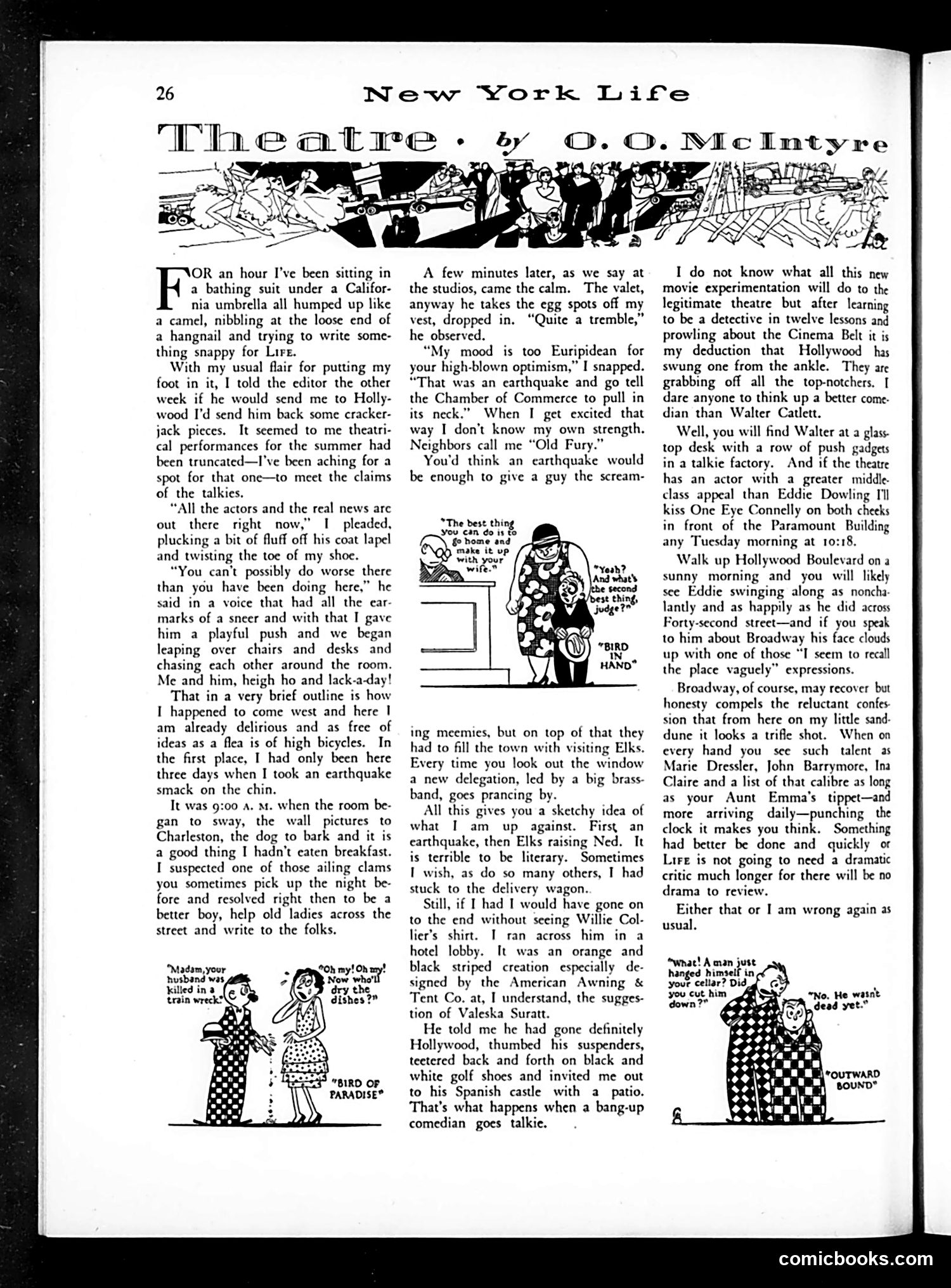
This is a humorous essay about the author's assignment to Hollywood to cover the entertainment industry during the **transition from silent to talking pictures** (talkies). The piece satirizes early 1920s Hollywood culture: McIntyre experiences an earthquake, endures visiting Elks' parades, and encounters comedian **Willie Collier**, who has abandoned legitimate theater for movies and now wears a flamboyant orange-and-black striped shirt designed by actress **Valeska Suratt**. The embedded cartoons mock social pretension ("Bird of Paradise," "Bird of a Hand," "Outward Bound")—likely referencing theatrical productions of that era. McIntyre's central complaint: Hollywood is poaching top theatrical talent with lucrative contracts, draining Broadway of its best performers like **Walter Catlett**. The tone balances affection for old-fashioned theater with resignation that the entertainment industry's center of gravity is shifting westward toward the new movie industry.
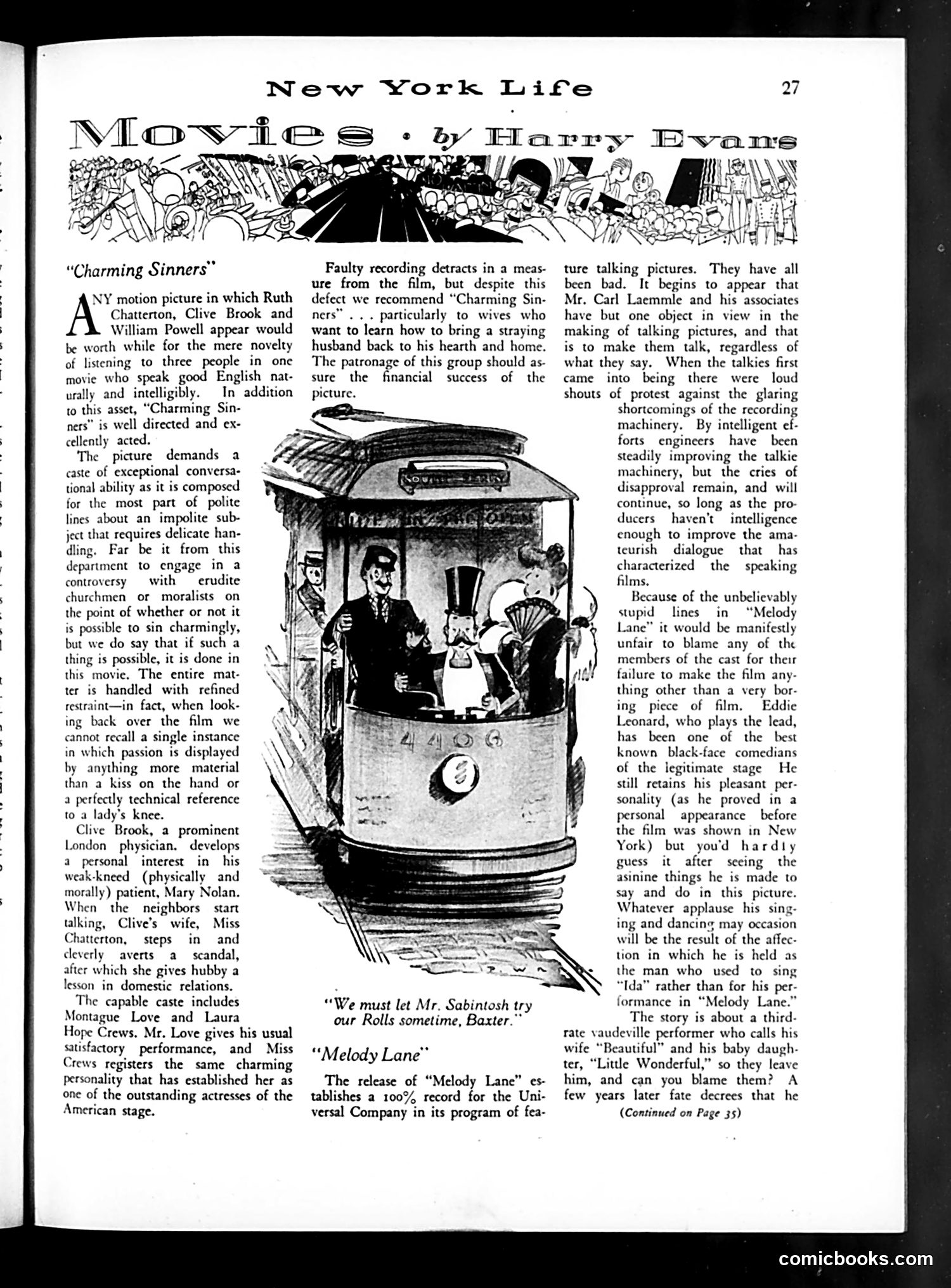
This page contains two film reviews from the silent-to-talking picture transition era. The main critique targets early sound film technology and writing quality. **"Charming Sinners"** receives praise for its cast (Ruth Chatterton, Clive Brook, William Powell)—specifically their ability to speak proper English naturally. The review sarcastically recommends it to wives seeking lessons in managing unfaithful husbands, treating marital infidelity as the film's instructional value. **"Melody Lane"** is brutally dismissed. The reviewer excoriates Universal Studios for prioritizing dialogue quantity over quality, claiming all their talking pictures have been "bad." Eddie Leonard, a famous blackface vaudeville performer, is pitied for having to deliver "asinine" lines—the script's failure, not the actor's. The critic notes Leonard retains his stage charm in person but this doesn't survive the terrible film material. The satire targets both early talkies' poor sound recording and, more pointedly, producers' assumption that audiences want *any* dialogue regardless of quality.
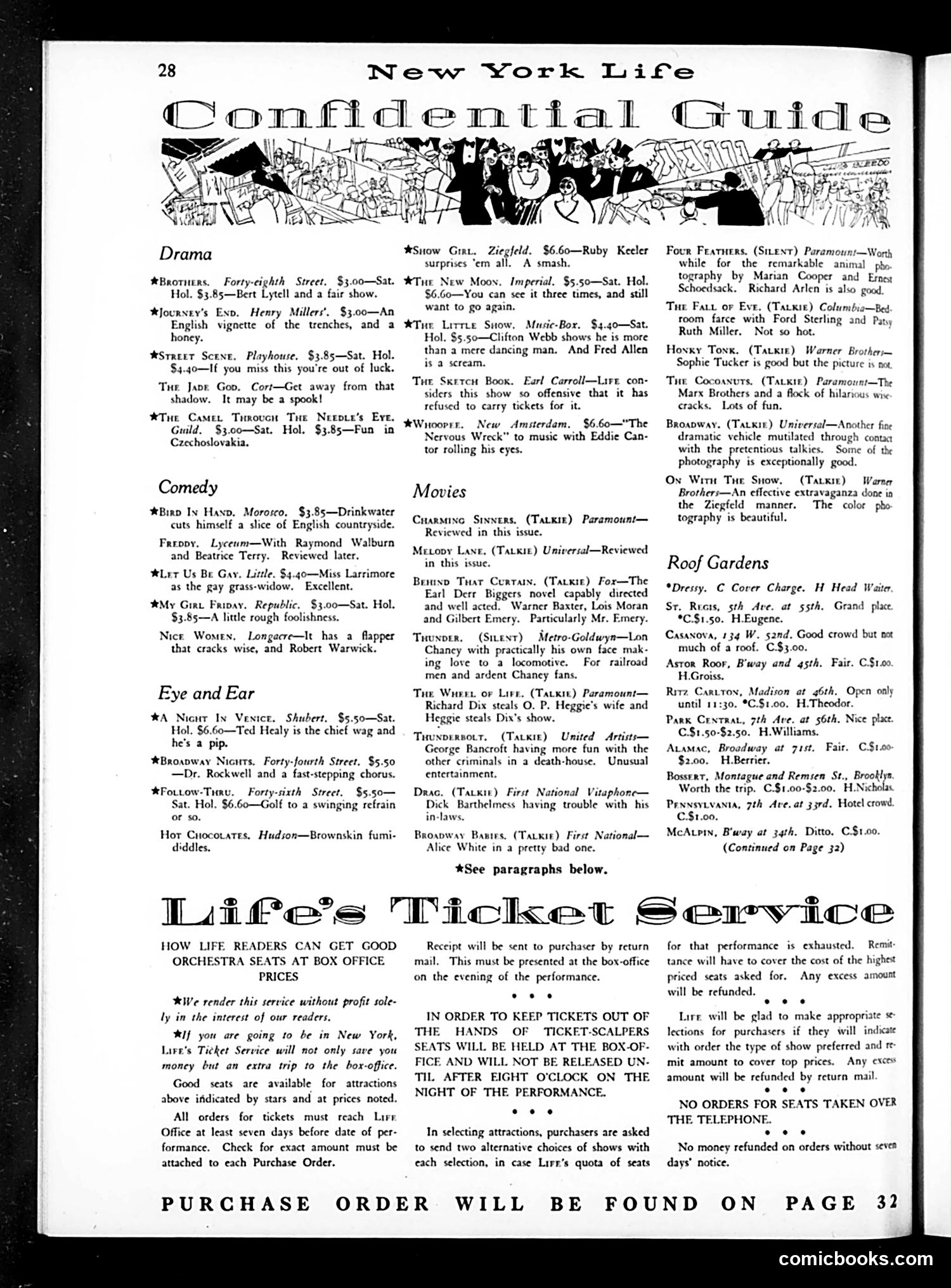
This page is primarily a **theater and entertainment guide** for New York City audiences, not a political cartoon. It lists Broadway shows, movies, and nightlife venues with brief, witty reviews—the magazine's signature irreverent style. The header illustration depicts a crowded, energetic street scene typical of theatrical districts, reflecting the bustling entertainment culture being reviewed. **Key content includes:** - Drama, comedy, and vaudeville theater listings with prices and sardonic commentary (e.g., "If you miss this you're out of luck") - "Talkie" (sound film) reviews, a technology still relatively new and noted specifically - References to contemporary entertainers: Eddie Cantor, Lon Chaney, Sophie Tucker, the Marx Brothers - A **ticket service notice** explaining how Life readers could purchase orchestra seats at box-office prices without markup The tone throughout is playfully dismissive of pretension while celebrating popular entertainment. This serves as a snapshot of 1920s New York nightlife rather than political satire.
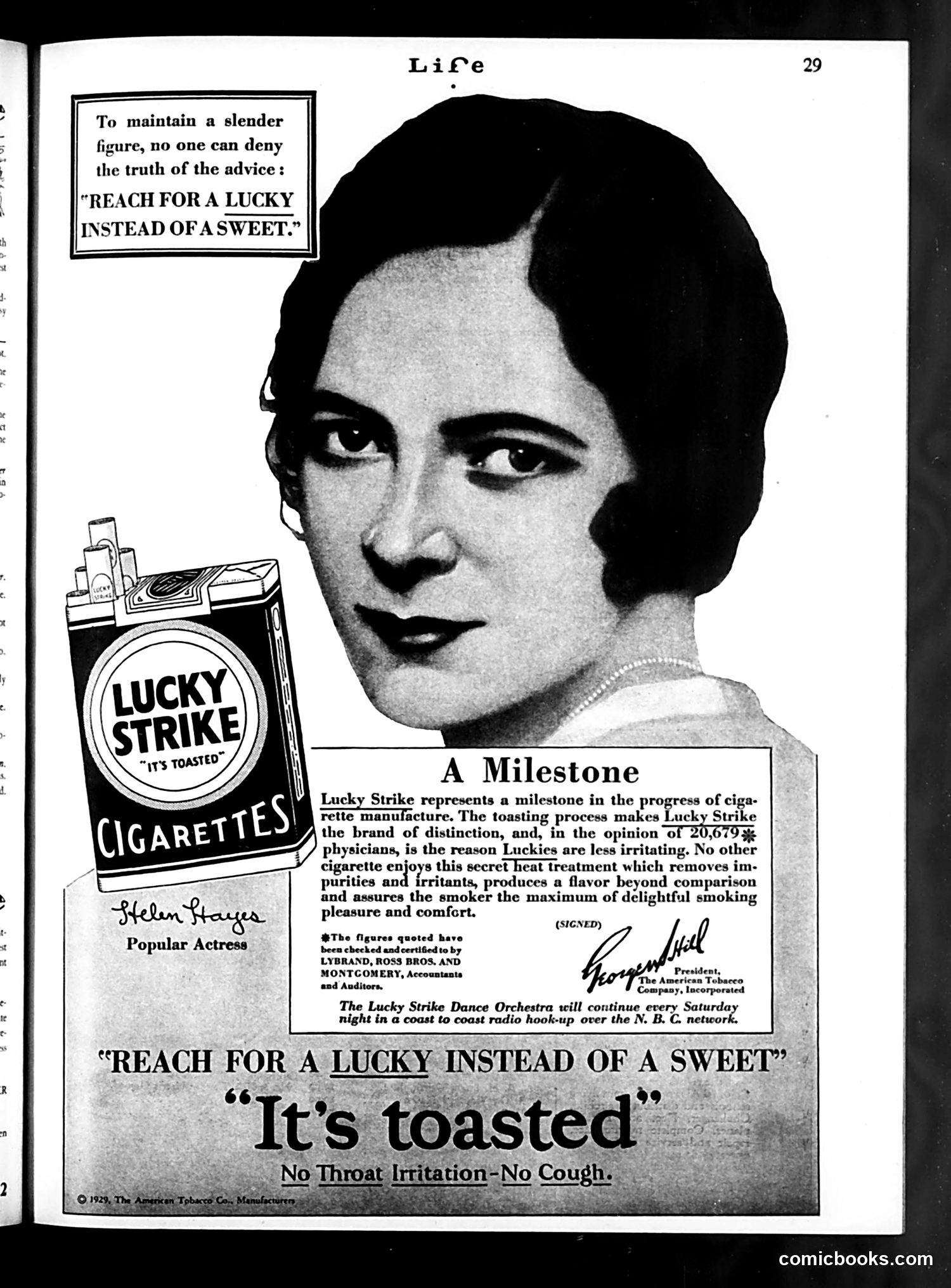
This is a **cigarette advertisement**, not satire—though it reads as darkly ironic today. The page features "Popular Actress" Helen Hayes endorsing Lucky Strike cigarettes with the slogan "Reach for a Lucky instead of a sweet." **The pitch:** Smoking suppresses appetite and maintains slenderness (a major selling point for women in the 1920s). The ad claims Lucky Strikes are "less irritating" due to a "toasting process" that removes impurities—pseudo-scientific marketing designed to address health concerns about smoking. **What's missing:** No warning labels, no mention of genuine health risks. The testimonial from "20,679 physicians" is unverified and almost certainly fabricated. **Context:** This represents early tobacco industry marketing directly targeting women's anxieties about appearance, predating later explicit health warnings by decades. The celebrity endorsement adds social prestige to the product.
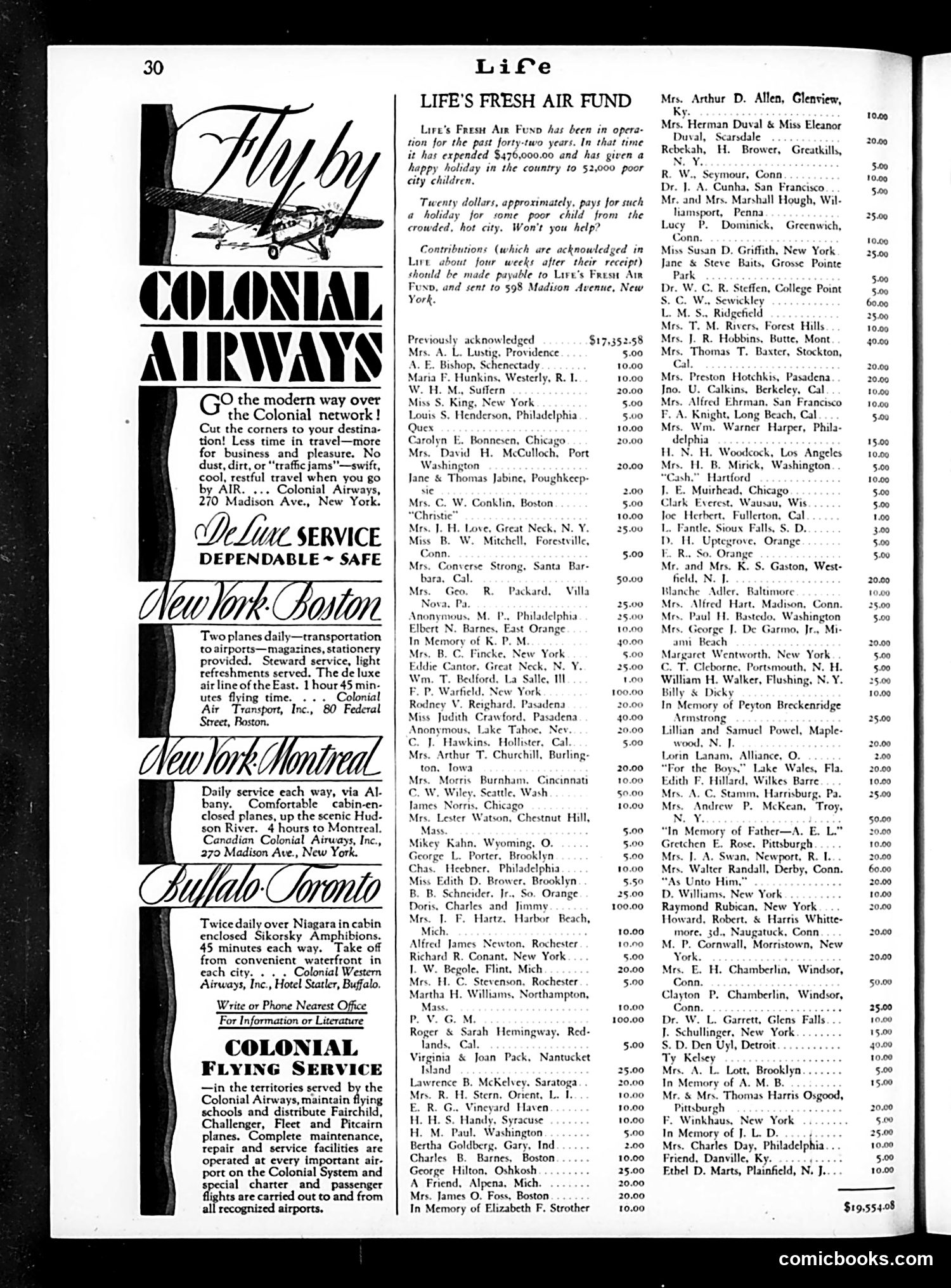
This is primarily a **magazine advertisement and donation acknowledgment page**, not political satire. The left side features advertisements for **Colonial Airways**, an early commercial airline service operating in the northeastern United States. The ads promote air travel as modern, efficient, and superior to ground transportation—cutting travel time and avoiding "dust, dirt, or traffic jams." This reflects 1920s-30s enthusiasm for aviation as a transformative technology. The right side lists donors to **Life's Fresh Air Fund**, a forty-two-year-old charitable program that gave poor city children vacations in the countryside (approximately $20 per child). The extensive donor list—ranging from Eddie Cantor (a famous entertainer) to anonymous contributors—demonstrates the magazine's charitable mission and appeal to wealthy readers. There is **no political cartoon or satire here**. The page documents commercial aviation promotion and philanthropic fundraising typical of Life magazine's era.
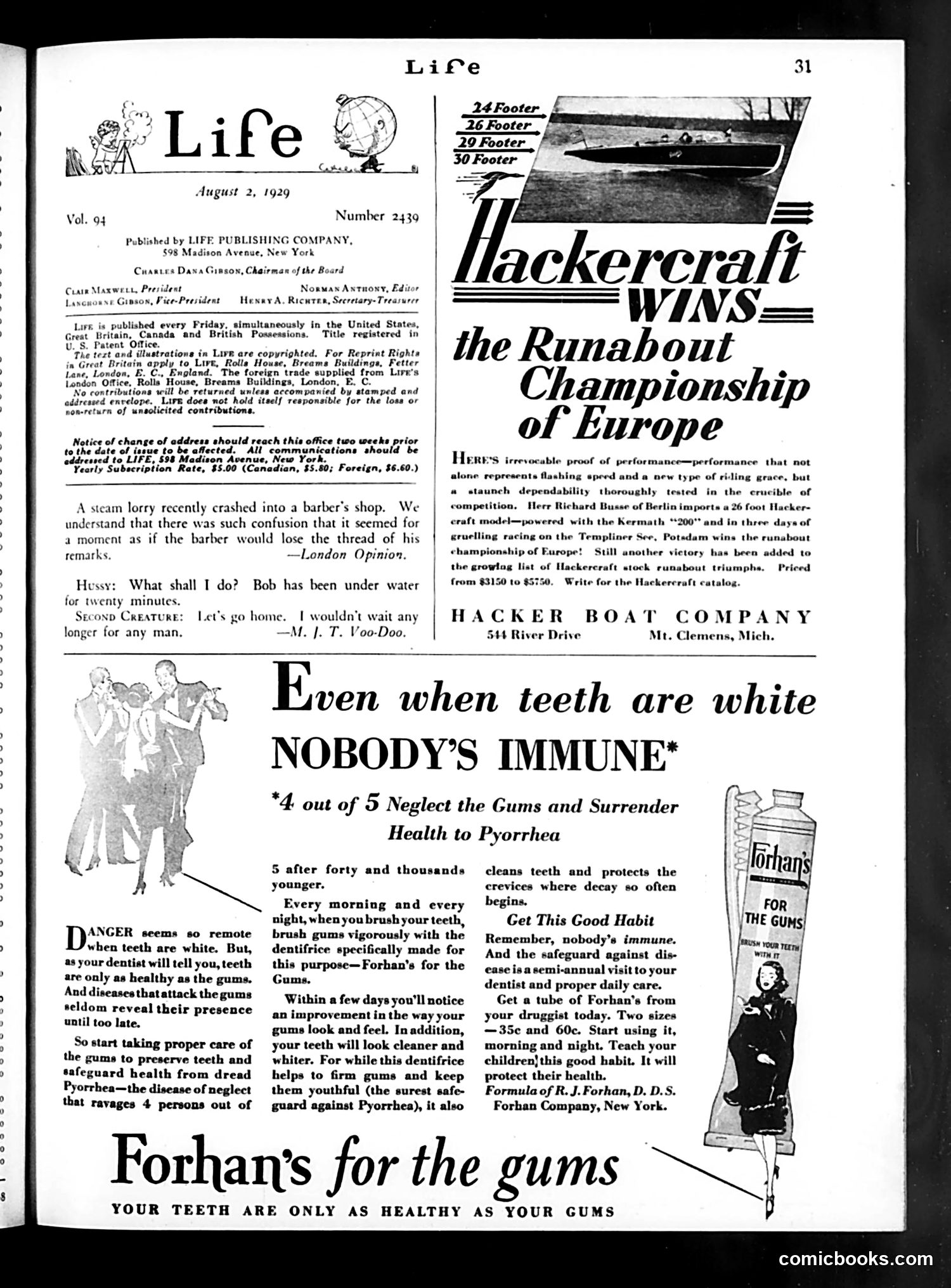
This page contains **two brief satirical jokes** and **advertisements**—no political cartoons. **The Jokes:** 1. A barber loses his train of thought when a lorry crashes through his shop, playing on the phrase "lose the thread of his remarks." 2. Someone underwater for twenty minutes; a companion suggests leaving rather than waiting longer—dark humor about impatience. **Advertisements:** The page features major ads for **Hackercraft speedboats** (celebrating a European racing championship victory) and **Forhan's gum toothpaste**, which emphasizes that even with white teeth, gums require care to prevent pyorrhea (gum disease). The Forhan's ad claims "4 out of 5 neglect the gums." The page reflects 1929 consumer culture: motorboat racing as leisure spectacle and emerging dental-health awareness as a marketing category. Nothing here requires historical context beyond understanding the products themselves.
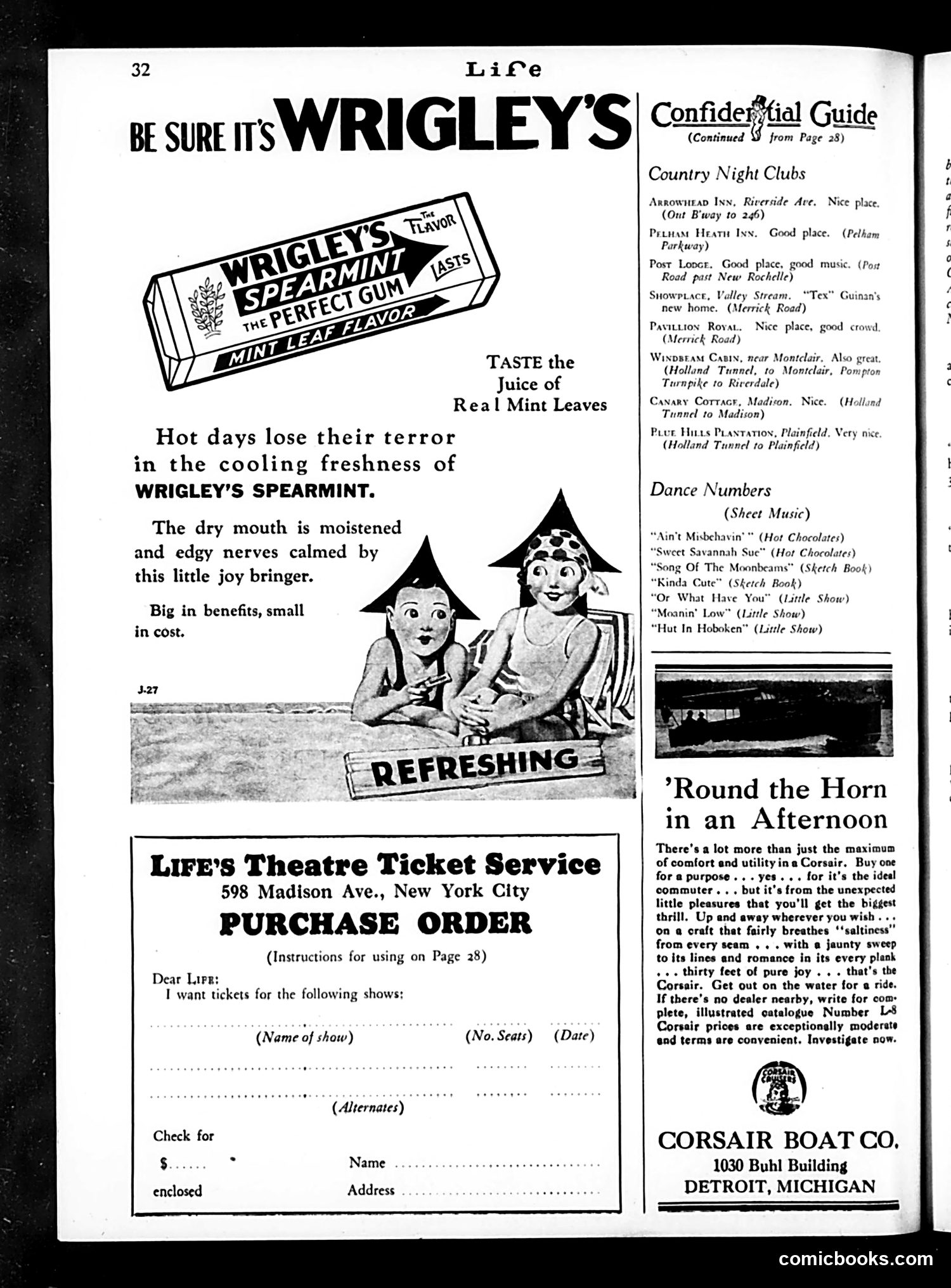
This page is primarily **advertising and service content** rather than satirical editorial material. The main content consists of: 1. **Wrigley's Spearmint Gum Advertisement** — A straightforward commercial promoting the product's cooling, refreshing qualities on hot days. The illustration shows two cartoon children enjoying the gum's benefits. 2. **Life's Theatre Ticket Service** — A mail-order form allowing readers to purchase Broadway show tickets through Life magazine's service at their Madison Avenue office. 3. **Confidential Guide** — A sidebar listing upscale country night clubs near New York City (Arrowhead Inn, Pelham Heath Inn, etc.) and popular sheet music from contemporary shows like *Hot Chocolates* and *Little Show*. 4. **Corsair Boat Company Advertisement** — Promoting pleasure boats built in Detroit, emphasizing leisure and romance. The page reflects 1920s commercial culture: consumer goods marketing, entertainment access, and leisure activities for affluent readers. There is no political satire or social commentary visible on this particular page.
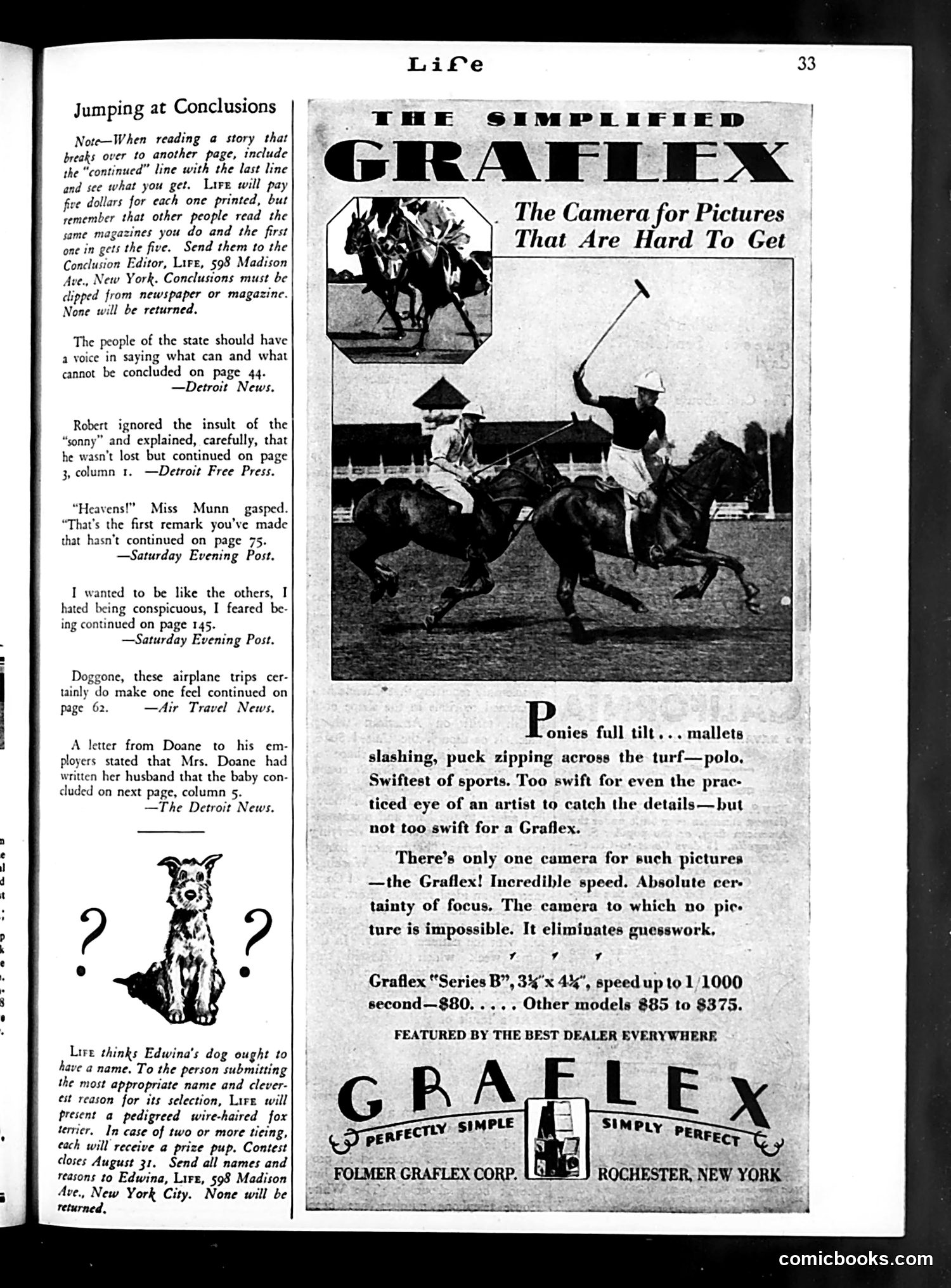
This page contains two distinct elements: **Left side: "Jumping at Conclusions"** — A satirical humor feature where Life magazine invites readers to submit funny results from reading magazine story continuations across pages. The submitted examples mock the absurdity of accidentally juxtaposing unrelated text from different articles—creating unintended nonsensical or darkly comic meanings. For instance, a news story about a baby "concluded on next page" when placed against an unrelated article creates accidental innuendo. This is gentle satire of magazine publishing's physical format. **Right side: Graflex Camera Advertisement** — A full-page ad for a professional high-speed camera, emphasizing its ability to photograph fast-moving subjects like polo matches. The ad uses dramatic action photography and technical specifications (1/1000 second speed) to appeal to serious photographers and publications needing fast film. The page is primarily **advertising-driven commercial content** with a minor humor feature. No political commentary or social satire appears on this page—it reflects 1920s-30s magazine culture and consumer marketing.
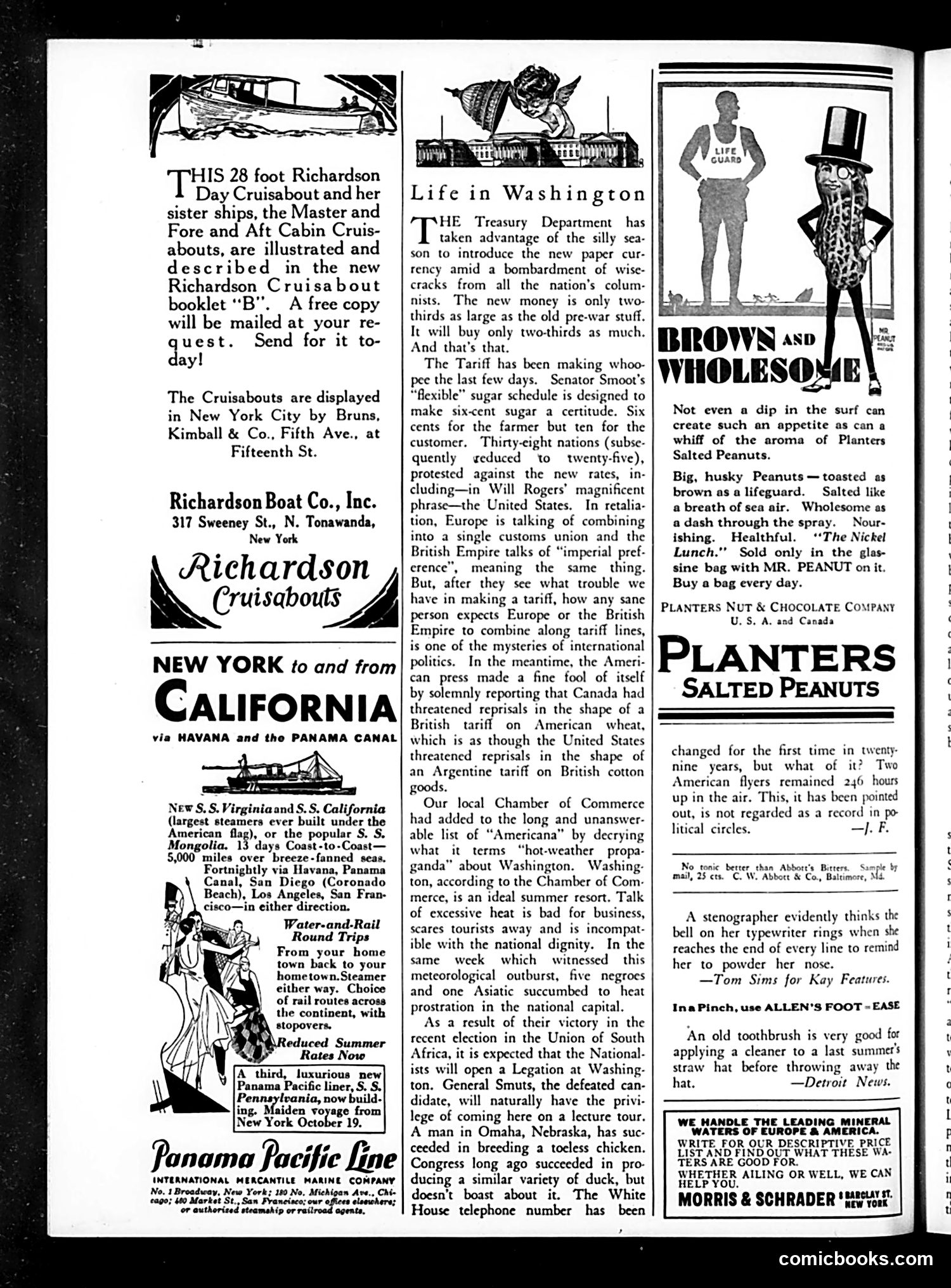
This page is primarily **advertisements and articles**, not political cartoons. The main content includes: **"Life in Washington"** satirizes contemporary 1920s politics: the Treasury Department's new, smaller paper currency (two-thirds the old size, worth proportionally less); Senator Smoot's "flexible" tariff on sugar (benefiting farmers at consumers' expense); international trade tensions with Europe and Canada over American tariffs; and Washington D.C.'s Chamber of Commerce denying the city's notorious summer heat while people literally died from heat prostration that same week. The final joke compares Congress to a "tocless chicken"—a breeding experiment mentioned in the article—implying Congress is equally useless or absurd. The remainder of the page consists of period advertisements for Richardson boats, Panama Pacific shipping lines, and Planters Salted Peanuts.
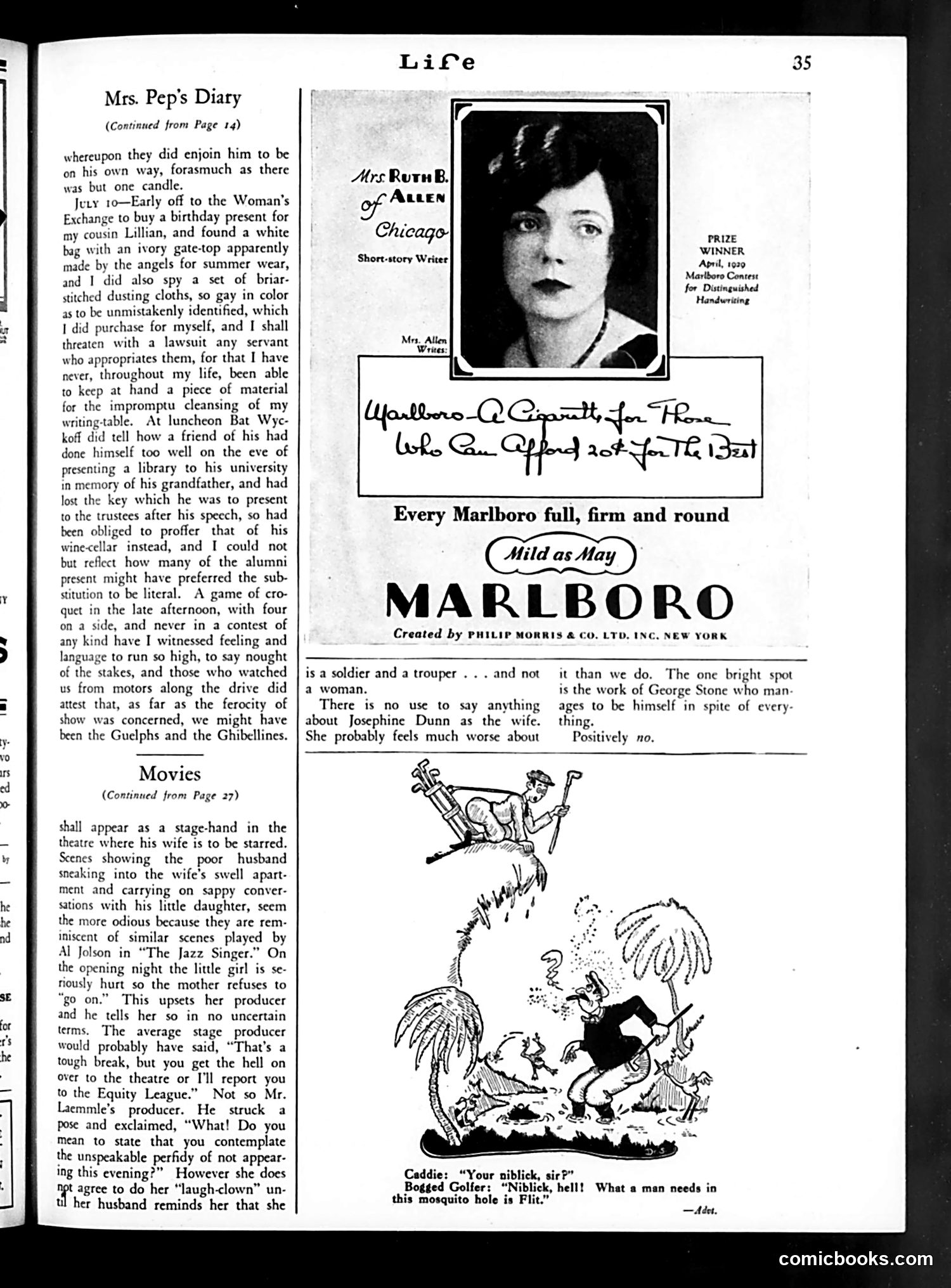
This page contains three distinct pieces: **Mrs. Pep's Diary** (top left): A satirical society column mocking upper-class leisure and pretension. The diary entries describe trivial social activities—shopping, croquet, library donations—written in exaggerated formal language. The joke is that wealthy people obsess over minor matters (dusting cloths, croquet stakes) with the intensity of medieval feuding families ("Guelphs and Ghibellines"). **Movies section** (bottom left): A film review critiquing sentimental melodrama, particularly comparing a recent film to Al Jolson's "The Jazz Singer." The satire targets producers who use overwrought language ("unspeakable perfidy") and manipulative emotional scenes instead of treating actors professionally. **The cartoon** (bottom right): A golfer stuck in a mosquito-infested bog complains that he needs "Flit" (an insecticide spray) rather than a golf club—a joke advertisement for the pest-control product. The page is primarily satirical commentary on 1920s American culture: wealth, entertainment, and consumer products.
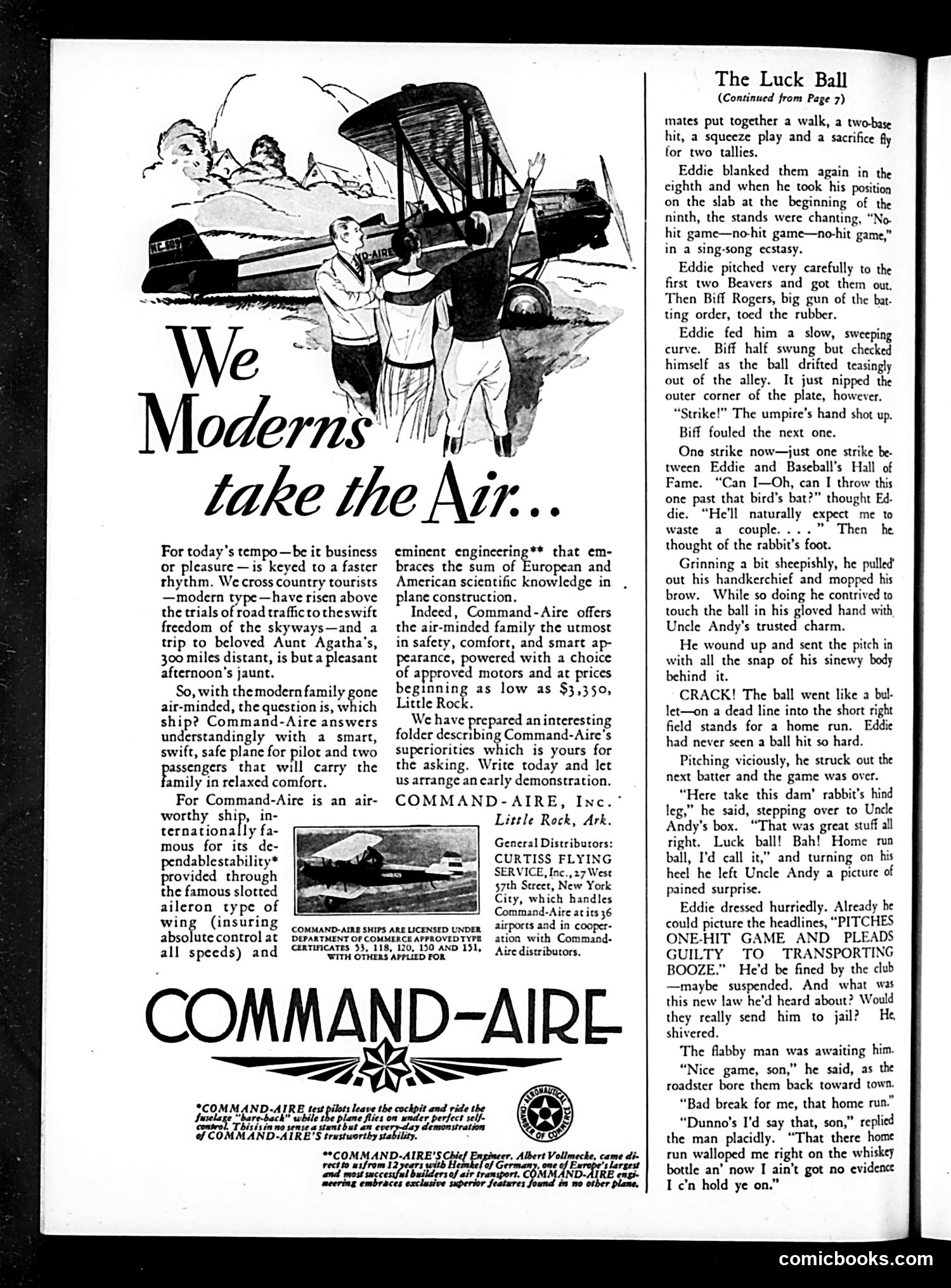
This page combines a serialized fiction story with a full-page aircraft advertisement. **"The Luck Ball" (right column):** A baseball narrative where pitcher Eddie attempts a no-hitter in the ninth inning. The climax involves Eddie touching a rabbit's foot charm (Uncle Andy's "luck ball") before pitching to batter Biff Rogers. Ironically, the pitch results in a home run—Eddie loses the no-hitter. The story's moral appears skeptical of superstition: Eddie initially credits the rabbit's foot but then dismisses it, attributing his pitching ability to his own skill rather than luck. **Command-Aire Advertisement (left):** Promotes a small aircraft as modern family transportation. The illustration shows people boarding a Command-Aire plane. The ad emphasizes speed, safety, and accessibility for the "air-minded family"—positioning aviation as accessible leisure travel rather than novelty. Prices starting at $3,350 suggest affordability for upper-middle-class readers. This reflects 1920s-30s optimism about commercial aviation's future.
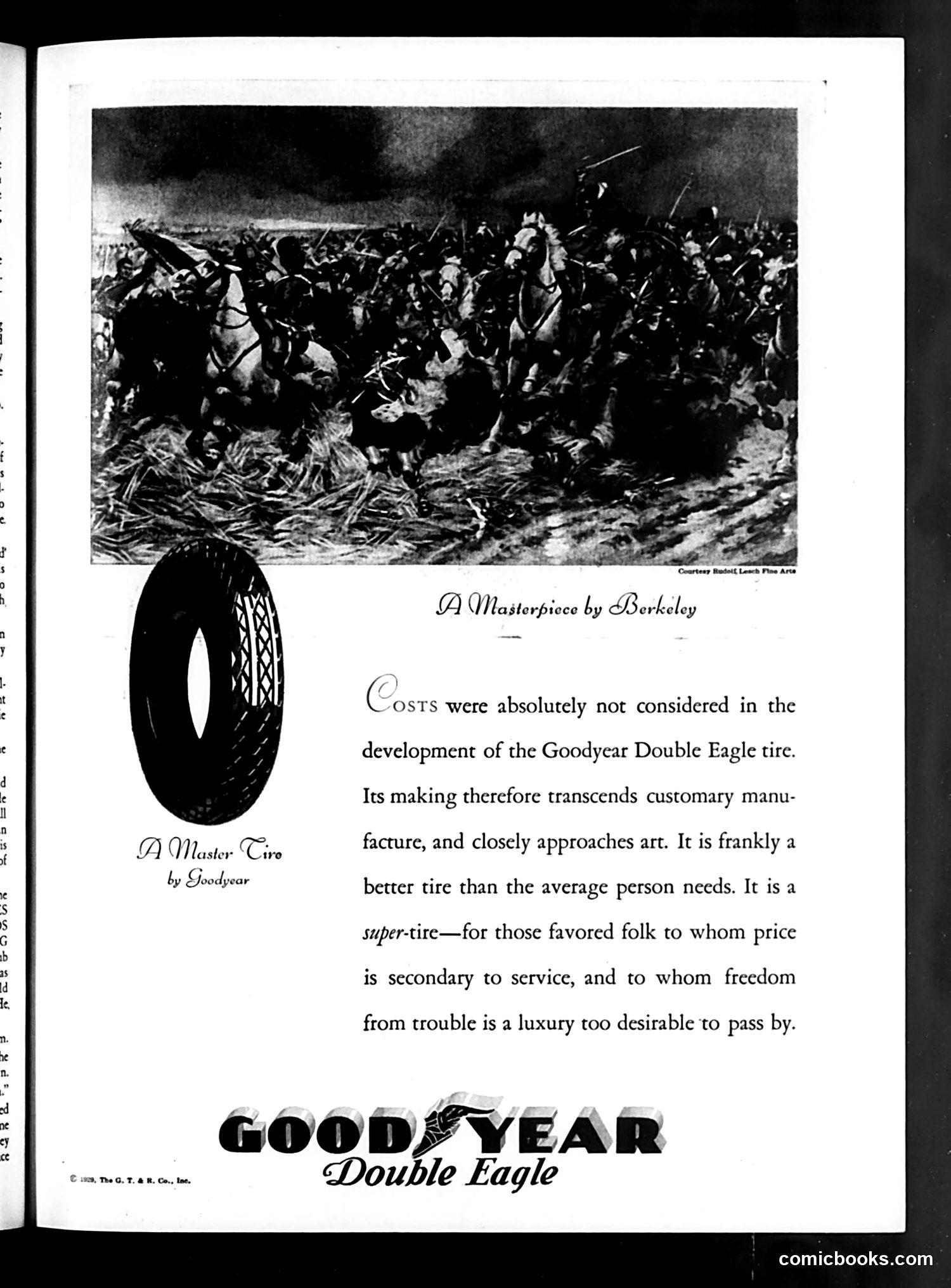
This is primarily a **Goodyear tire advertisement**, not political satire. The page features: **Image:** A dramatic black-and-white illustration (credited to Berkeley) depicting a cavalry charge—horses and riders in combat or military action, labeled "A Masterpiece by Berkeley." **Advertisement Strategy:** The ad uses artistic prestige to market the Goodyear Double Eagle tire as a luxury product. It compares tire manufacturing to art, claiming cost was irrelevant to its development. The tire is positioned as a "super-tire" for wealthy consumers who prioritize quality over price. **Social Context:** This reflects 1920s-30s marketing that appealed to affluent Americans by emphasizing exclusivity and craftsmanship. The cavalry imagery suggests power, excellence, and tradition—qualities the advertiser associates with the product. **The Satire (if any):** The juxtaposition of a military battle with tire advertising is somewhat absurd, though this appears earnest marketing rather than intentional humor.
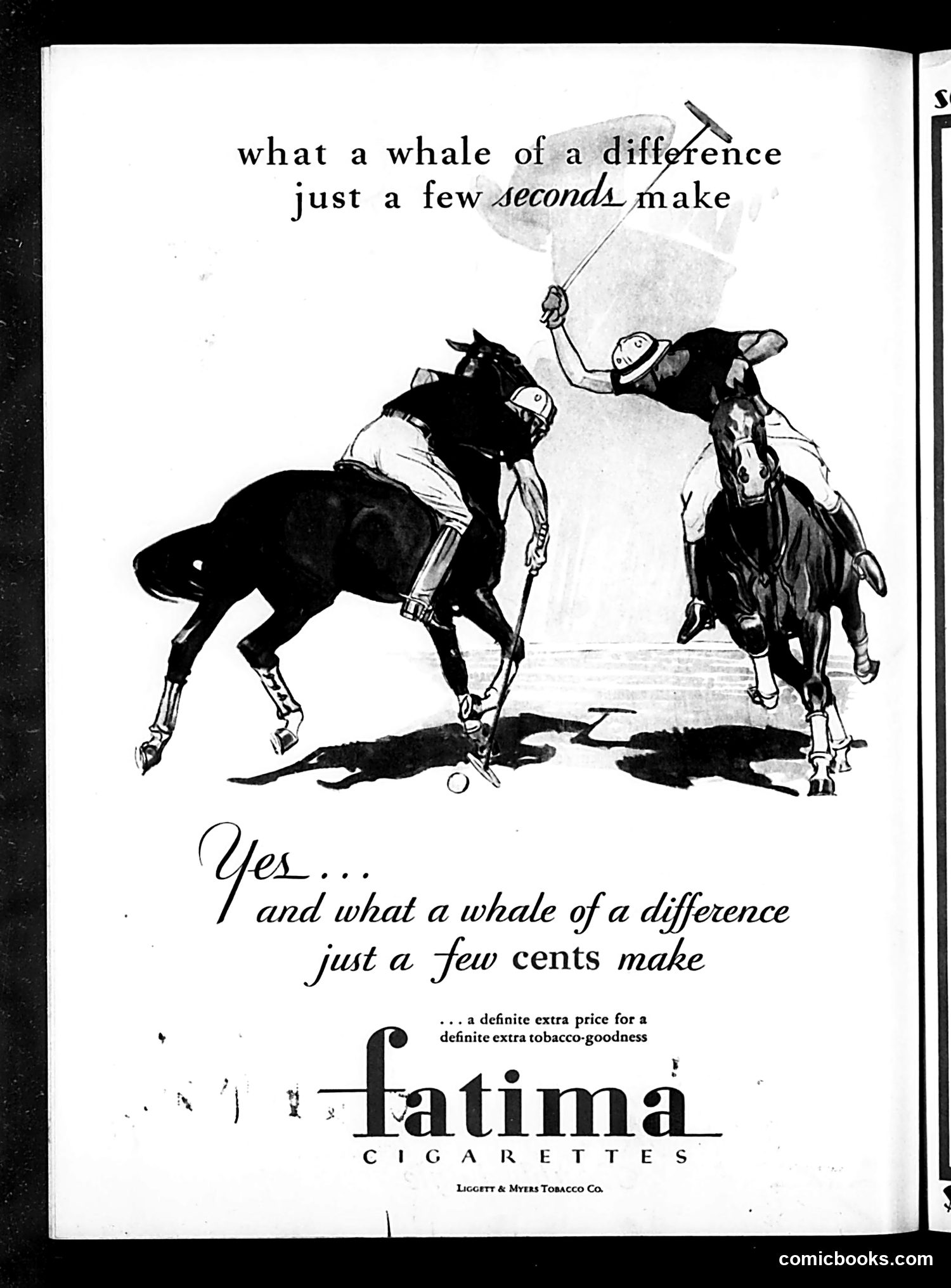
This is a cigarette advertisement, not political satire. The image shows two polo players on horseback—one missing the ball (left), one successfully striking it (right)—illustrating the tagline's wordplay: "what a whale of a difference just a few seconds make" (top) and "what a whale of a difference just a few cents make" (bottom). The ad argues that Fatima cigarettes' modest price premium over competitors delivers superior "tobacco-goodness." The polo match metaphor suggests that small differences in timing or investment yield significant results in both sports and consumer products. This is straightforward product advertising using an aspirational, athletic context to appeal to male smokers of the era.