
Life, 1929-08-02 · page 29 of 40
Life — August 2, 1929 — page 29: what you’re looking at
What you’re looking at
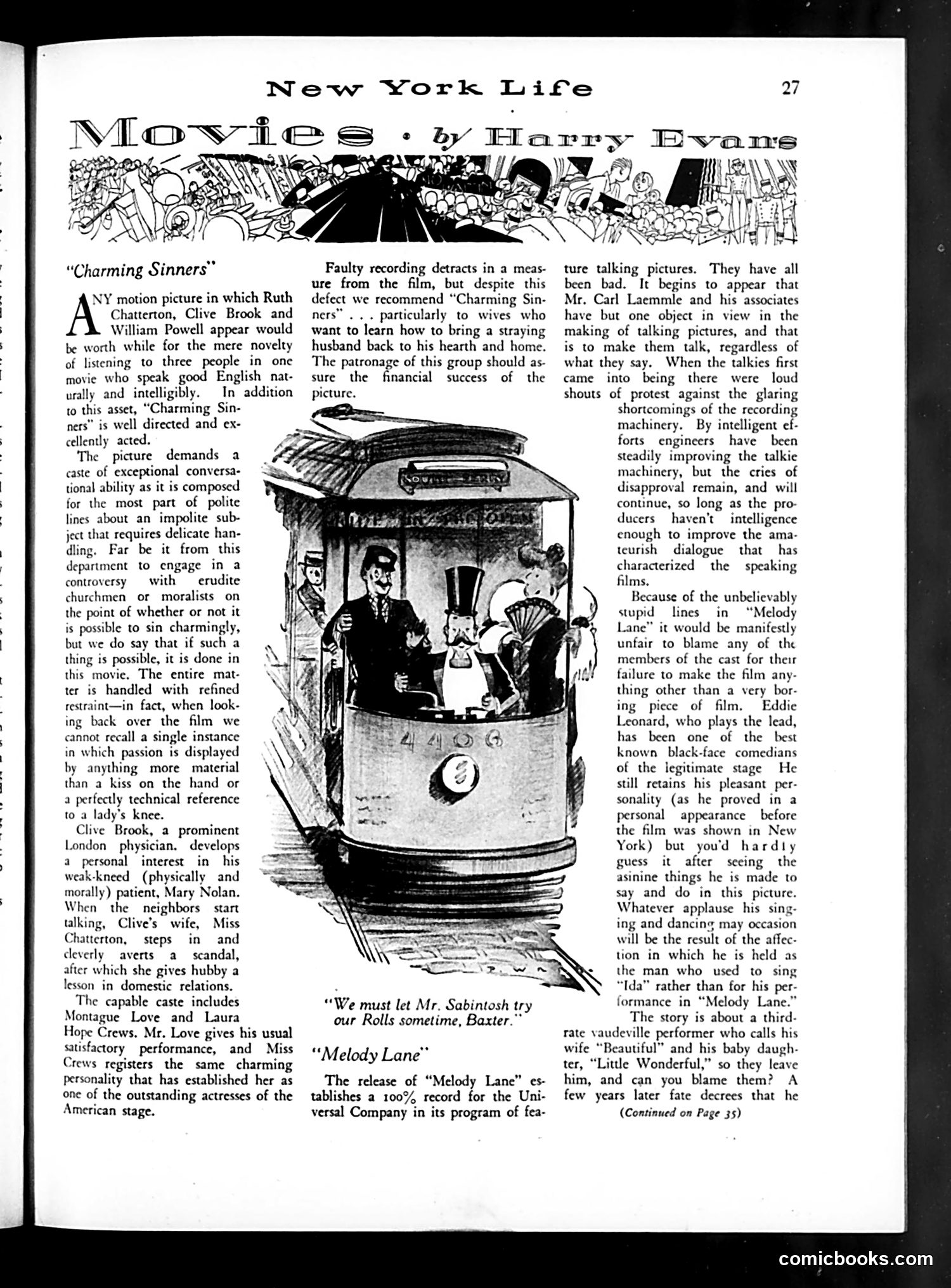
This page contains two film reviews from the silent-to-talking picture transition era. The main critique targets early sound film technology and writing quality. **"Charming Sinners"** receives praise for its cast (Ruth Chatterton, Clive Brook, William Powell)—specifically their ability to speak proper English naturally. The review sarcastically recommends it to wives seeking lessons in managing unfaithful husbands, treating marital infidelity as the film's instructional value. **"Melody Lane"** is brutally dismissed. The reviewer excoriates Universal Studios for prioritizing dialogue quantity over quality, claiming all their talking pictures have been "bad." Eddie Leonard, a famous blackface vaudeville performer, is pitied for having to deliver "asinine" lines—the script's failure, not the actor's. The critic notes Leonard retains his stage charm in person but this doesn't survive the terrible film material. The satire targets both early talkies' poor sound recording and, more pointedly, producers' assumption that audiences want *any* dialogue regardless of quality.
📄 Transcribed text from this page (OCR, searchable)
Machine-transcribed from the original scan — historical spelling and the odd misread are preserved.
New York Life NIo Ww ic s ° by Flarry Evans “Charming Sinners” NY motion picture in which Ruth A Chatterton, Clive Brook and William Powell appear would be worth while for the mere novelty of listening to three people in one movie who speak good English nat- urally and intelligibly. In addition to this asset, “Charming Sin- ners” is well directed and ex- cellently acted. The picture demands a caste of exceptional conversa- tional ability as it is composed for the most part of polite lines about an impolite sub- ject that requires delicate han- dling. Far be it from this department to engage in a controversy with — erudite churchmen or moralists on the point of whether or not it is possible to sin charmingly, but we do say that if such a thing is possible, it is done in this movie, The entire mat- ter is handled with refined restraint—in fact, when look- ing back over the film we cannot recall a single instance in which passion is displayed by anything more material than a kiss on the hand or a perfectly technical reference to a lady's knee. Clive Brook, a prominent London physician. develops a personal interest in his weak-kneed (physically and morally) patient, Mary Nolan. When the neighbors start talking, Clive’s wife, Miss Chatterton, steps. in and cleverly averts a scandal, after which she gives hubby a lesson in domestic relations. The capable caste includes Montague Love and Laura Hope Crews. Mr. Love gives his usual satisfactory performance, and Miss Crews registers the same charming personality that has established her as one of the outstanding actresses of the American stage. Faulty recording detracts in a meas- ure from the film, but despite this defect we recommend “Charming Sin- ners”... particularly to wives who want to learn how to bring a straying husband back to his hearth and home. The patronage of this group should as- sure the financial success of the picture. “We must let Mr. Sabintosh try our Rolls sometime, Baxter.” “‘Melody Lane” The release of “Melody Lane” es- tablishes a 100% record for the Uni- versal Company in its program of fea- ture talking pictures. They have all been bad. It begins to appear that Mr. Carl Laemmle and his associates have but one object in view in the making of talking pictures, and that is to make them talk, regardless of what they say. When the talkies first came into being there were loud shouts of protest against the glaring shortcomings of the recording machinery. By intelligent ef- forts engineers have been steadily improving the talkie machinery, but the cries of disapproval remain, and will continue, so long as the pro- ducers haven't _ intelligence enough to improve the ama- teurish dialogue that _ has characterized the speaking films, Because of the unbelievably stupid lines in “Melody Lane” it would be manifestly unfair to blame any of the members of the cast for their failure to make the film any- thing other than a very bor- ing piece of film, Eddie Leonard, who plays the lead, has been one of the best known black-face comedians of the legitimate stage He still retains his pleasant per- sonality (as he proved in a personal appearance _ before the film was shown in New York) but you'd hardly guess it after seeing the asinine things he is made to say and do in this picture. Whatever applause his sing- ing and dancing may occasion will be the result of the affec- tion in which he is held as the man who used to sing “Ida” rather than for his per- formance in “Melody Lane.” The story is about a third- rate vaudeville performer who calls his wife “Beautiful” and his baby daugh- ter, “Little Wonderful,” so they leave him, and can you blame them? A few years later fate decrees that he (Continued on Page 35) comicbooks.com