
Life, 1929-08-02 · page 15 of 40
Life — August 2, 1929 — page 15: what you’re looking at
What you’re looking at
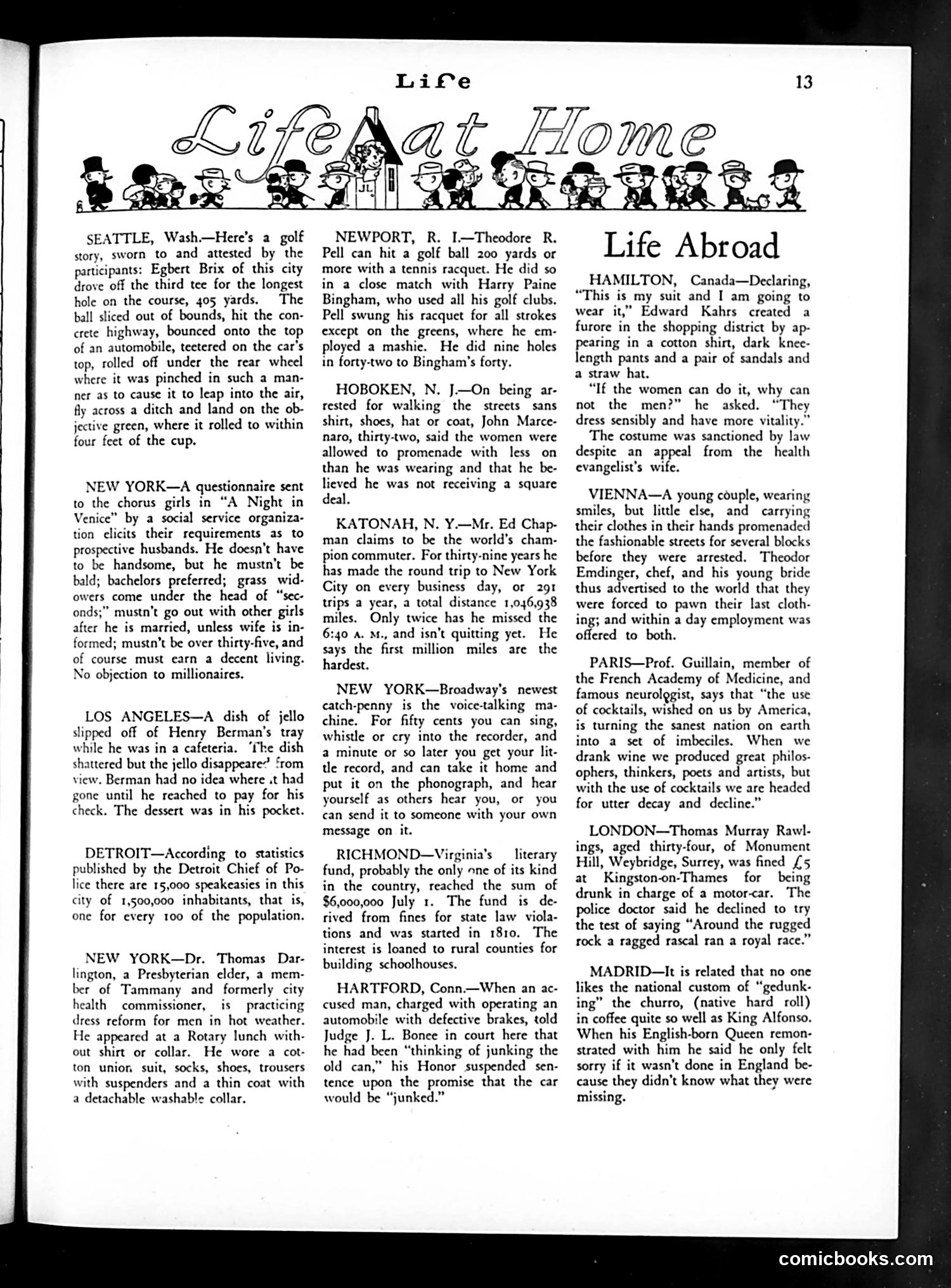
This page consists of two sections: a decorative header illustration and two columns of brief anecdotes. **The Header:** "Life at Home" features a silhouette border of children and adults in various poses around a house—a typical domestic scene meant to frame the content below as lighthearted domestic humor. **The Content:** Two columns—"Life at Home" (left) and "Life Abroad" (right)—contain short humorous anecdotes from various cities. These are brief, satirical observations about everyday life: a golf mishap in Seattle, a woman's dress code debate in Canada, a couple's pawned clothes in Vienna, and commentary on French drinking habits and English customs. The humor relies on gentle social observation rather than political commentary—poking fun at regional behaviors, fashion conventions, and cultural differences in an accessible, conversational style typical of Life's satirical approach.
📄 Transcribed text from this page (OCR, searchable)
Machine-transcribed from the original scan — historical spelling and the odd misread are preserved.
SEATTLE, Wash.—Here’s a golf story, sworn to and attested by the participants: Egbert Brix of this city drove off the third tee for the longest hole on the course, 405 yards. The ball sliced out of bounds, hit the con- crete highway, bounced onto the top of an automobile, teetered on the car’s top, rolled off under the rear wheel where it was pinched in such a man- ner as to cause it to leap into the air, fly across a ditch and land on the ob- jective green, where it rolled to within four feet of the cup. NEW YORK—A questionnaire sent to the chorus girls in “A Night in Venice” by a social service organiza- tion elicits their requirements as to prospective husbands. He doesn’t have to be handsome, but he mustn't be bald; bachelors preferred; grass wid- owers come under the head of “sec- onds;” mustn't go out with other girls after he is married, unless wife is in- formed; mustn’t be over thirty-five, and of course must earn a decent living. No objection to millionaires. LOS ANGELES—A dish of jello slipped off of Henry Berman’s tray while he was in a cafeteria. ‘The dish shattered but the jello disappeare? from view. Berman had no idea where .t had gone until he reached to pay for his check. The dessert was in his pocket. DETROIT—According to statistics published by the Detroit Chief of Po- lice there are 15,000 speakeasies in this city of 1,500,000 inhabitants, that is, one for every 100 of the population. NEW YORK—Dr. Thomas Dar- lington, a Presbyterian elder, a mem- ber of Tammany and formerly city health commissioner, is _ practicing dress reform for men in hot weather. He appeared at a Rotary lunch with- out shirt or collar. He wore a cot- ton union suit, socks, shoes, trousers with suspenders and a thin coat with a detachable washable collar. NEWPORT, R. I.—Theodore R. Pell can hit a golf ball 200 yards or more with a tennis racquet. He did so in a close match with Harry Paine Bingham, who used all his golf clubs. Pell swung his racquet for all strokes except on the greens, where he em- ployed a mashie. He did nine holes in forty-two to Bingham’s forty. HOBOKEN, N. J.—On being ar- rested for walking the streets sans shirt, shoes, hat or coat, John Marce- naro, thirty-two, said the women were allowed to promenade with less on than he was wearing and that he be- lieved he was not receiving a square deal. KATONAH, N. Y.—Mr. Ed Chap- man claims to be the world’s cham- pion commuter. For thirty-nine years he has made the round trip to New York City on every business day, or 291 trips a year, a total distance 1,046,938 miles. Only twice has he missed the 6:40 a. M., and isn’t quitting yet. He says the first million miles are the hardest. NEW YORK—Broadway’s newest catch-penny is the voice-talking ma- chine. For fifty cents you can sing, whistle or cry into the recorder, and a minute or so later you get your lit- tle record, and can take it home and put it on the phonograph, and hear yourself as others hear you, or you can send it to someone with your own message on it. RICHMOND—Virginia’s literary fund, probably the only one of its kind in the country, reached the sum of $6,000,000 July 1. The fund is de- rived from fines for state law viola- tions and was started in 1810. The interest is loaned to rural counties for building schoolhouses. HARTFORD, Conn.—When an ac- cused man, charged with operating an automobile with defective brakes, told Judge J. L. Bonee in court here that he had been “thinking of junking the old can,” his Honor suspended sen- tence upon the promise that the car would be “junked.” Life Abroad HAMILTON, Canada—Declaring, “This is my suit and I am going to wear it,” Edward Kahrs created a furore in the shopping district by ap- pearing in a cotton shirt, dark knee- length pants and a pair of sandals and a straw hat. “If the women can do it, why can not the men?” he asked. “They dress sensibly and have more vitality.” The costume was sanctioned by law despite an appeal from the health evangelist’s wife. VIENNA—A young couple, wearing smiles, but little else, and carrying their clothes in their hands promenaded the fashionable streets for several blocks before they were arrested. Theodor Emdinger, chef, and his young bride thus advertised to the world that they were forced to pawn their last cloth- ing; and within a day employment was offered to both. PARIS—Prof. Guillain, member of the French Academy of Medicine, and famous neurolegist, says that “the use of cocktails, wished on us by America, is turning the sanest nation on earth into a set of imbeciles. When we drank wine we produced great philos- ophers, thinkers, poets and artists, but with the use of cocktails we are headed for utter decay and decline.” LONDON—Thomas Murray Rawl- ings, aged thirty-four, of Monument Hill, Weybridge, Surrey, was fined £5 at Kingston-on-Thames for being drunk in charge of a motor-car. The police doctor said he declined to try the test of saying “Around the rugged rock a ragged rascal ran a royal race.” MADRID—It is related that no one likes the national custom of “gedunk- ing” the churro, (native hard roll) in coffee quite so well as King Alfonso. When his English-born Queen remon- strated with him he said he only felt sorry if it wasn’t done in England be- cause they didn’t know what they were missing. comicbooks.com