
A complete issue · 44 pages · 1929
Life — June 14, 1929
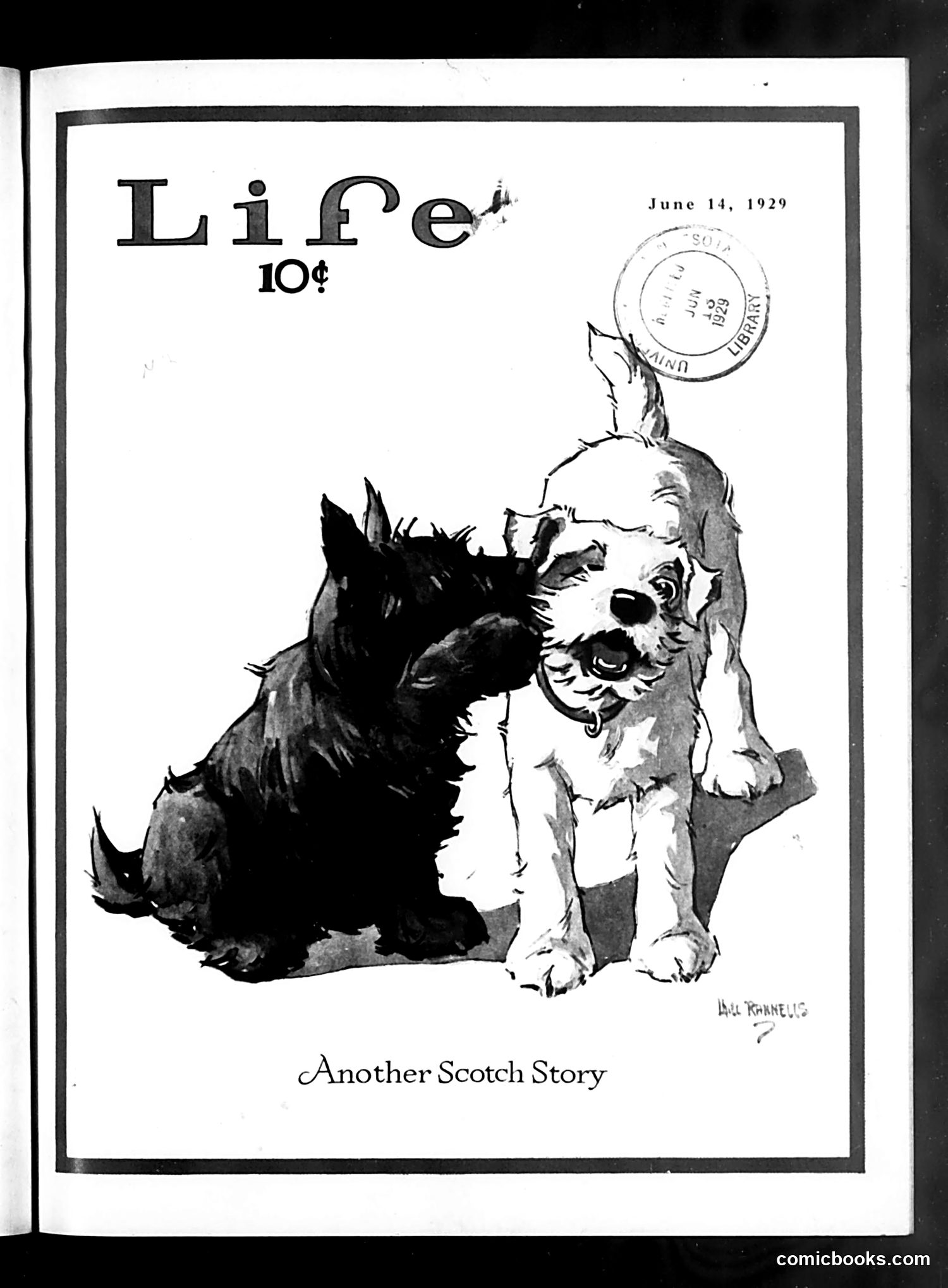
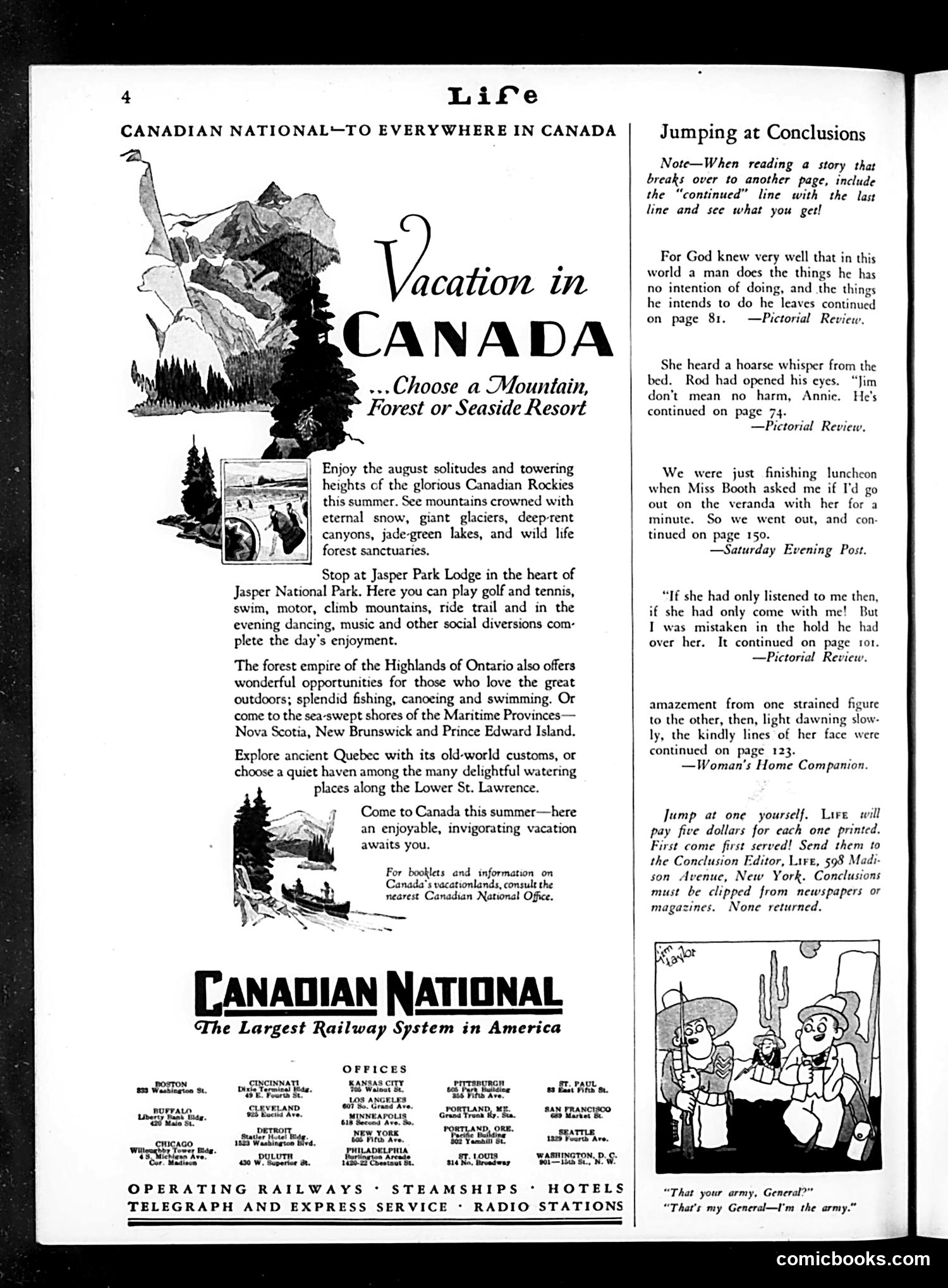
This cover illustrates a lighthearted play on "Scotch" — referring both to Scottish heritage and Prohibition-era illegal whisky. Two Scottish terriers (literally "Scotch" dogs) appear to be sharing a drink, with one offering the other what looks like a small glass or bottle. The joke operates on a visual pun: instead of depicting humans illegally consuming alcohol during Prohibition (1920-1933), the magazine substitutes Scottish dogs engaged in the same behavior. The humor derives from the double meaning of "Scotch" and the absurdity of anthropomorphized dogs participating in illegal drinking. The library stamp and date confirm this is genuine period ephemera reflecting American popular culture during the Prohibition era.
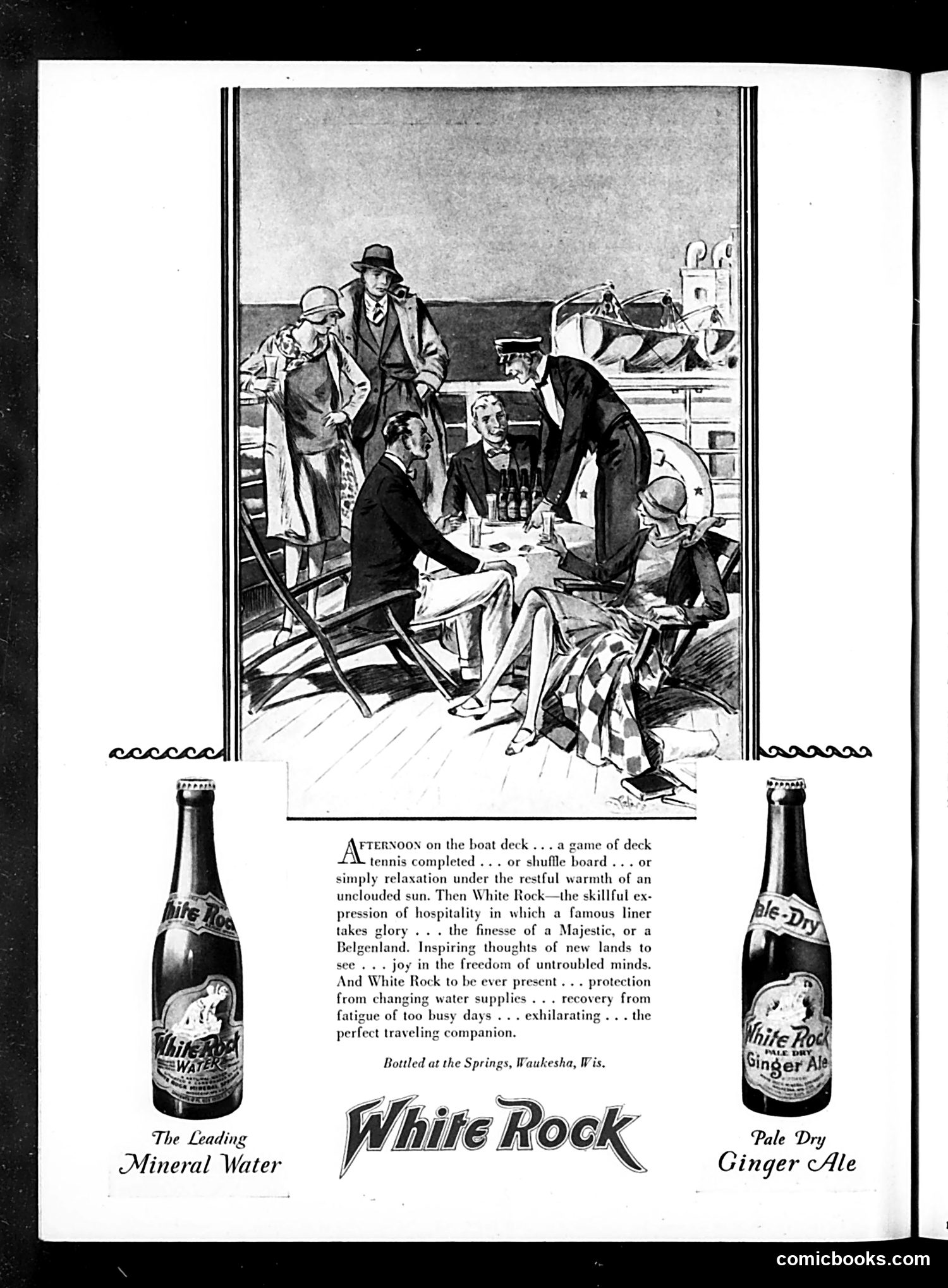
This is a **commercial advertisement**, not political satire. It promotes White Rock mineral water and ginger ale, bottled in Waukesha, Wisconsin. The illustration depicts affluent passengers relaxing on a ship's deck—playing deck tennis, shuffling, and socializing. The ad uses this leisure scene to associate White Rock beverages with luxury travel and upper-class recreation. The marketing copy emphasizes White Rock as an ideal "traveling companion" providing "protection from changing water supplies" and "recovery from fatigue"—key concerns for early 20th-century ocean travelers who faced genuine health risks from contaminated water in different ports. The two product bottles frame the scene, presenting these beverages as essential for comfortable, civilized travel during the era of luxury liner voyages.
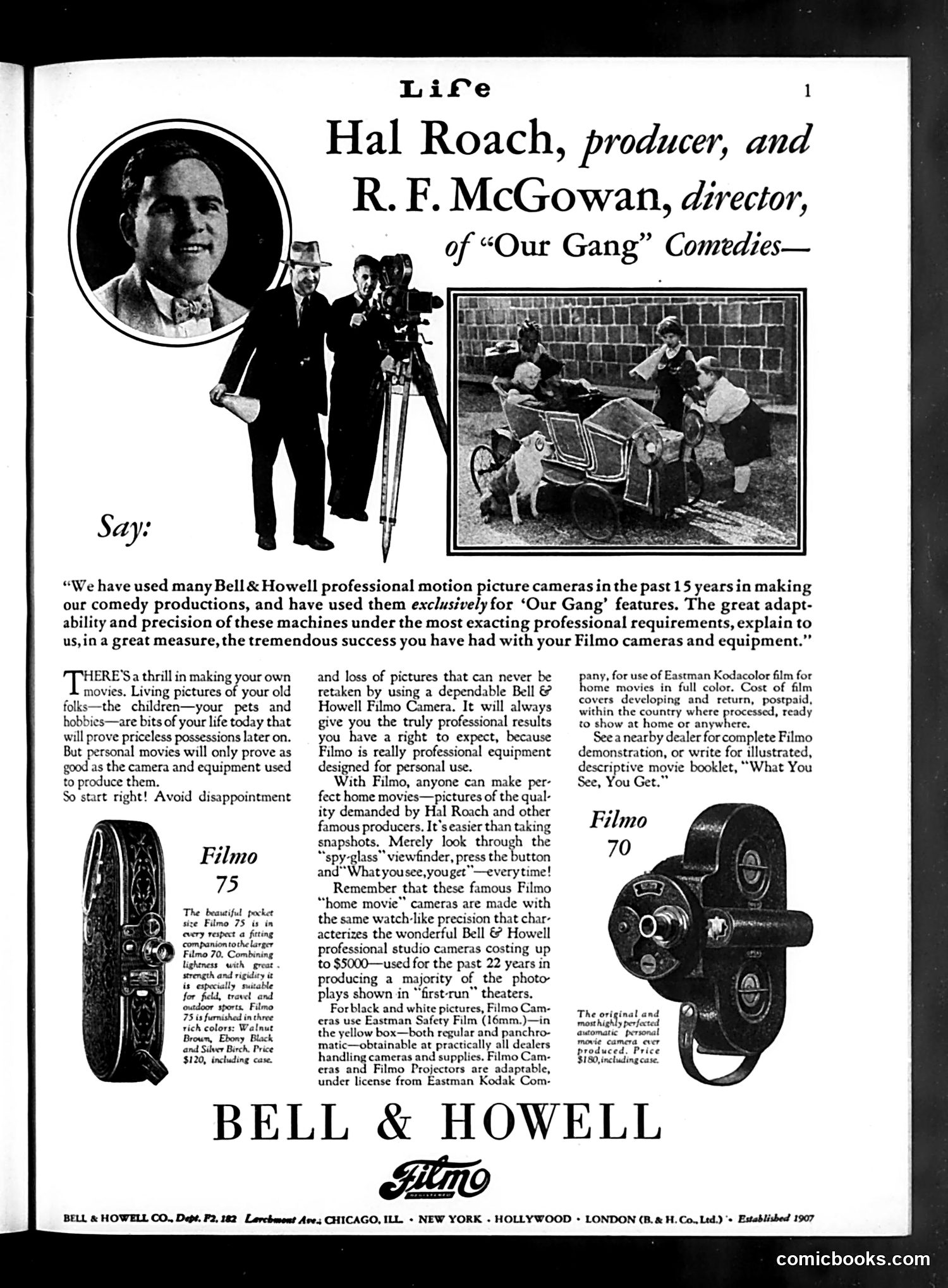
This is primarily an **advertisement for Bell & Howell Filmo cameras**, not satire or political content. The page endorses home movie equipment by featuring testimonials from Hal Roach (producer) and R.F. McGowan (director) of the "Our Gang" comedies—a popular film series featuring child actors. The pitch emphasizes that Filmo cameras deliver "professional results" for amateur users, using the credibility of famous film producers to market the technology. The "Our Gang" image shows children with a toy car, illustrating the appeal: families could now film their own children at home with equipment previously reserved for studio professionals. This reflects 1920s enthusiasm for making home movie-making accessible to middle-class consumers.
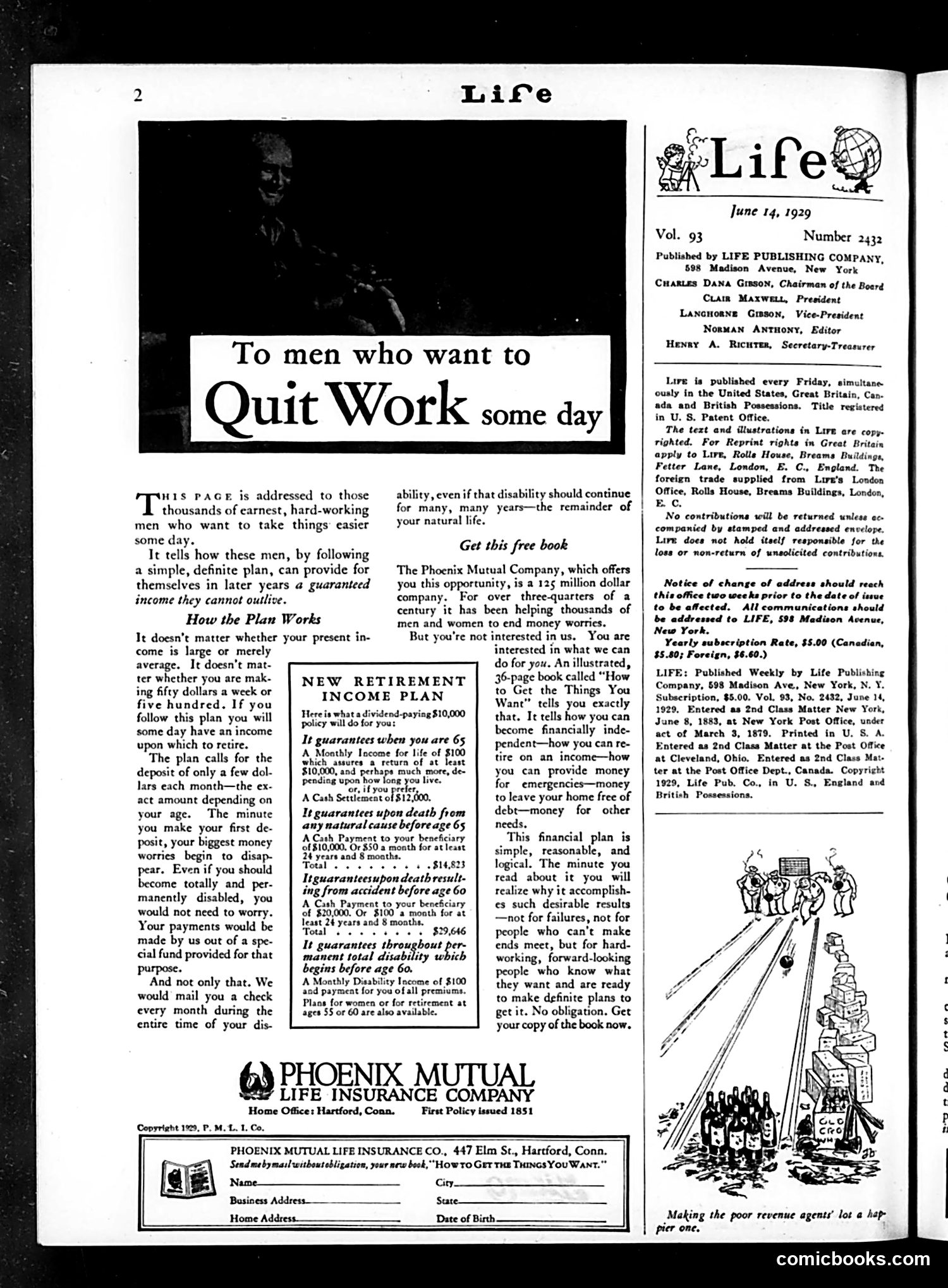
This page is primarily **advertising**, not satire or political commentary. The Phoenix Mutual Life Insurance Company dominates with a retirement income plan advertisement addressing working men anxious about financial security. The headline "To men who want to Quit Work some day" targets anxiety about aging and disability—concerns acute in 1929, just before the stock market crash. The advertisement promises guaranteed monthly income at age 65 through insurance plans. The small cartoon in the lower right (captioned "Making the poor revenue agents' lot a happier one") appears unrelated editorial content, but is too small and unclear to interpret definitively. Overall, this reflects pre-Depression anxieties about retirement security and the insurance industry's commercial response.
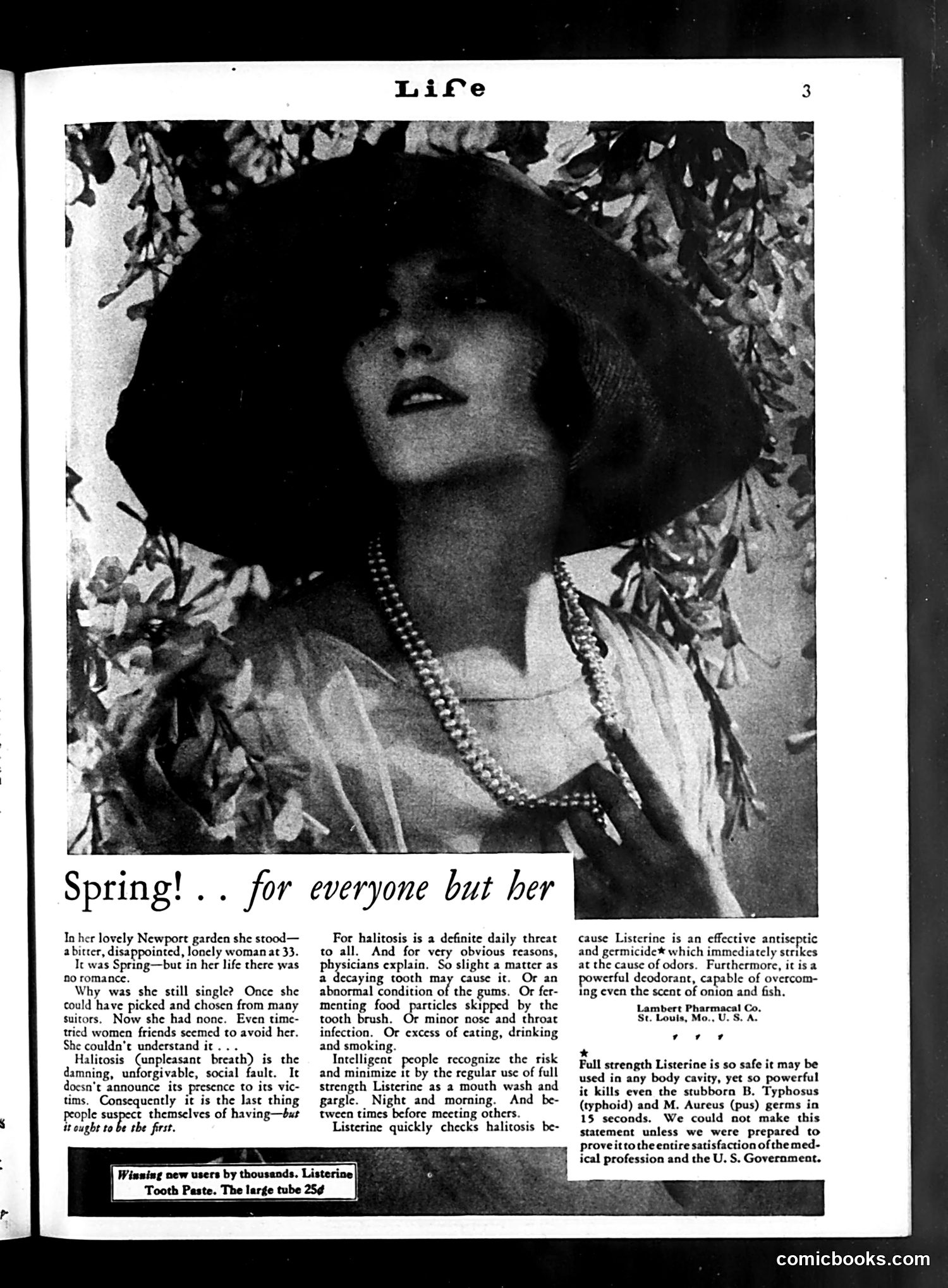
This is primarily a **Listerine advertisement** disguised as editorial content—a common practice in early 20th-century magazines. The headline "Spring!...for everyone but her" uses a woman's romantic disappointment as the hook. The accompanying narrative describes a "lovely Newport garden" where a 33-year-old unmarried woman stands isolated, implying she's undesirable due to **halitosis** (bad breath). The advertisement then pivots to selling Listerine mouthwash as the solution, claiming it "checks halitosis" through antiseptic action and recommending regular use as a mouth wash and gargle. This represents classic fear-based advertising that exploited social anxieties—particularly women's marriageability concerns—to market hygiene products. The "Spring" framing suggests romantic season desperation.
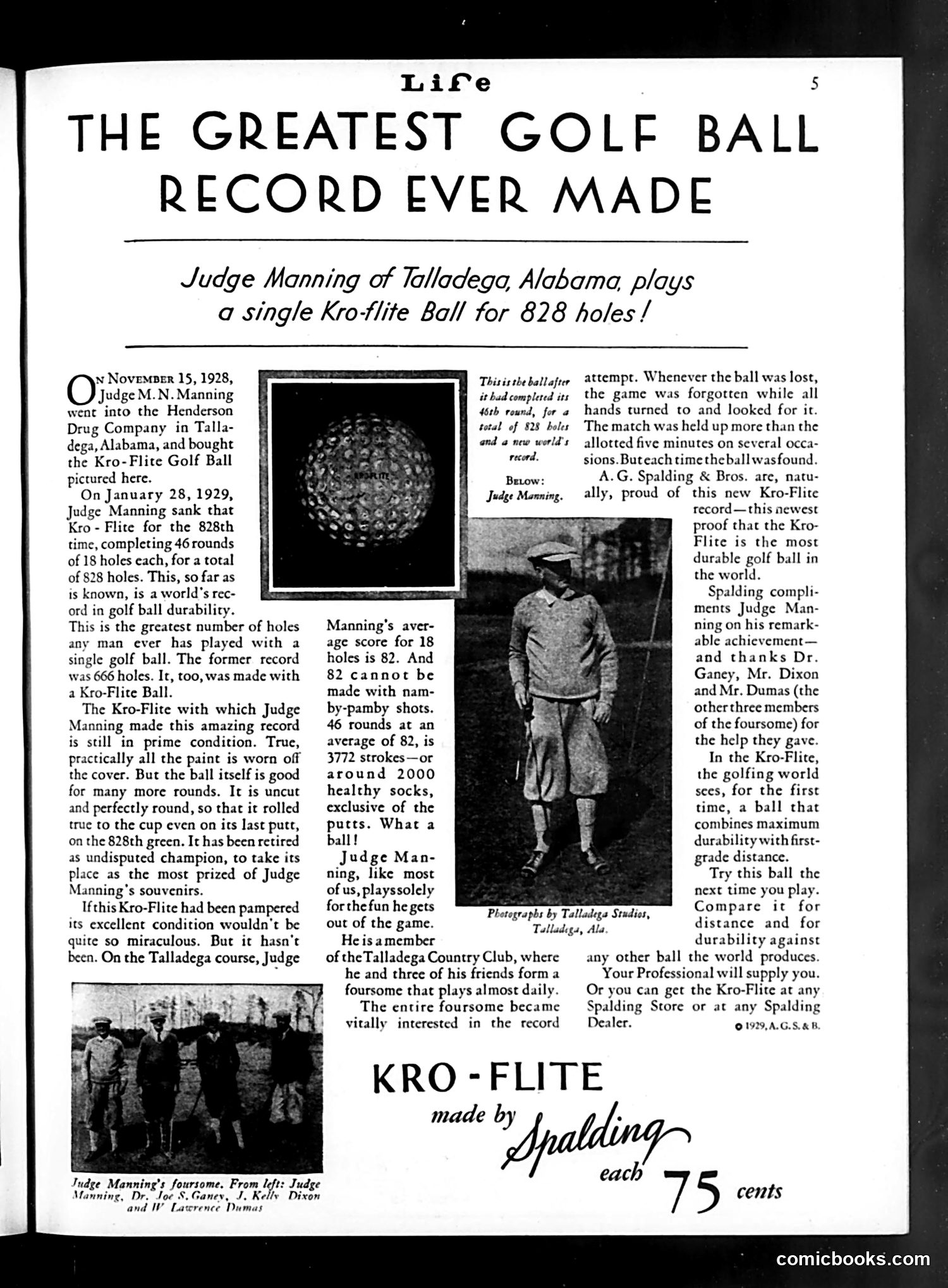
This is not a political cartoon or satire. It's a straightforward **advertisement and human interest story** from Life magazine (page 5). The article describes Judge M.N. Manning of Talladega, Alabama, who set a golf durability record by playing a single Kro-Flite golf ball for 828 holes (46 rounds of 18 holes each) between November 1928 and January 1929. The ball remained in playable condition throughout. The page includes: - A photograph of the worn but intact Kro-Flite ball - A portrait photo of Judge Manning - A group photo of his foursome at Talladega Country Club - Advertisement copy promoting the Kro-Flite ball's durability and value (75 cents) This is a genuine marketing piece leveraging an authentic sports achievement to advertise golf equipment.
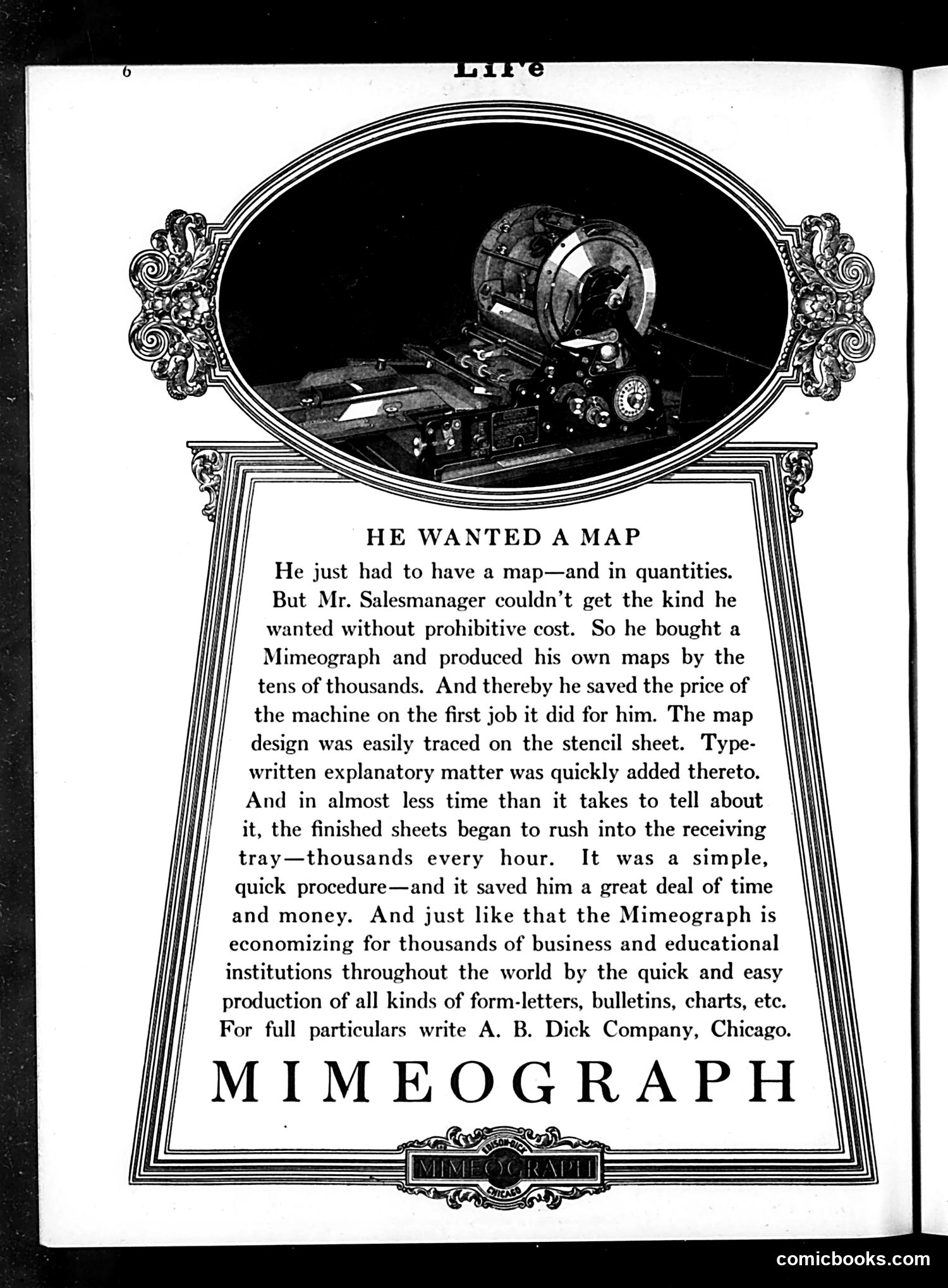
This is an **advertisement for the Mimeograph machine**, not political satire. The page features a photograph of the device at the top and text below titled "HE WANTED A MAP." The ad tells a narrative: a sales manager needed many maps but couldn't afford them through normal means. He purchased a Mimeograph and produced thousands of copies himself, saving money on the first job alone. The technology allowed quick, economical reproduction of maps, form letters, bulletins, and charts. The "joke" or sales pitch is that this device democratized document production—what previously required expensive commercial printing could now be done in-house by businesses and educational institutions. The advertiser (A.B. Dick Company, Chicago) is selling efficiency and cost-savings to early 20th-century organizations.
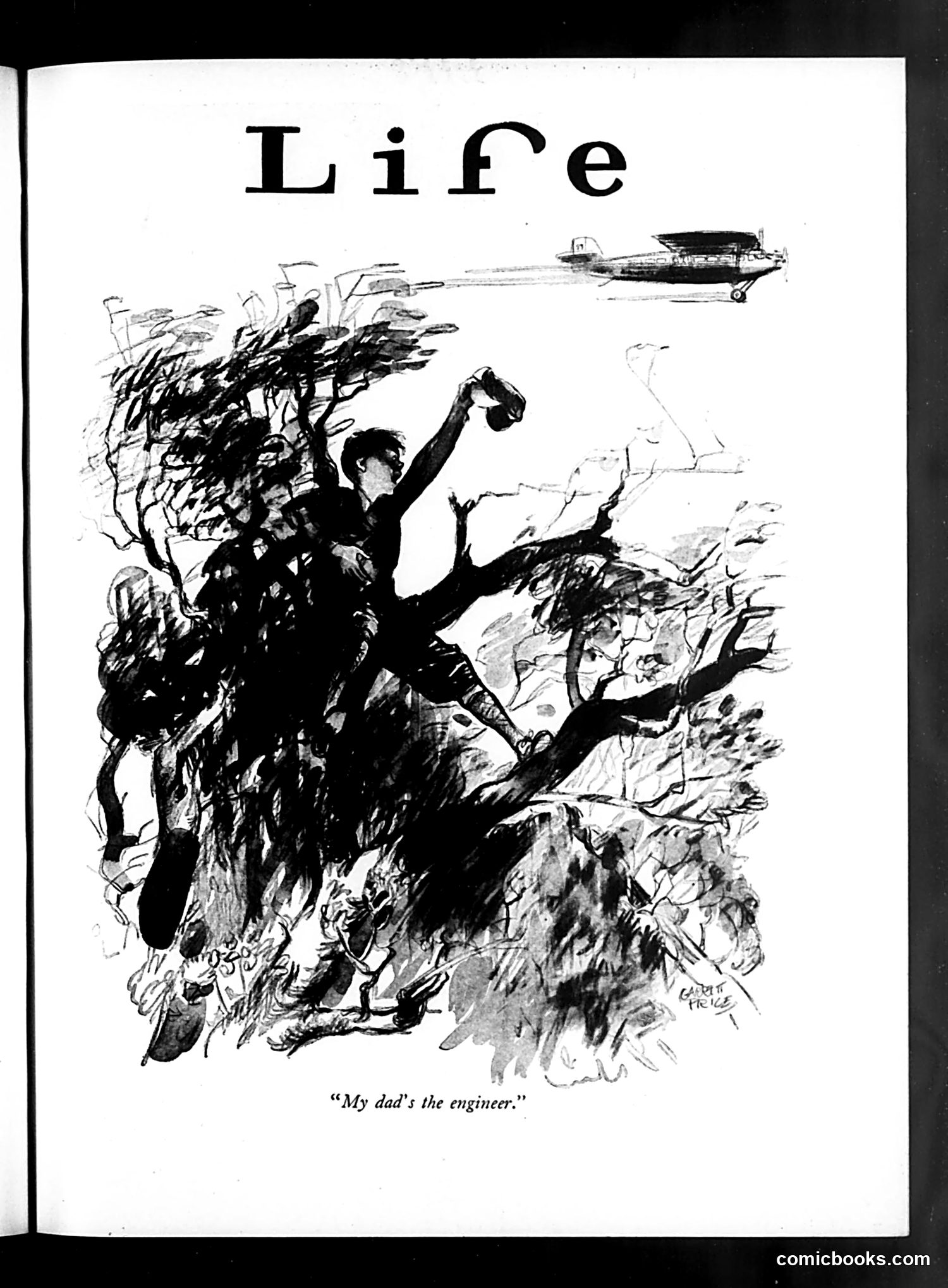
This is a Life magazine cover page titled "Life" featuring a dramatic illustration of a man and woman on a rocky outcrop, with the man pointing triumphantly skyward while aircraft fly overhead. The caption reads "My dad's the engineer." The satire appears to celebrate engineering prowess and industrial/military capability during what seems to be the early-to-mid 20th century (likely WWI or WWII era, based on the aircraft style). The man's boastful gesture and the woman's admiring pose suggest pride in paternal engineering achievement—likely related to aircraft or military technology production. The joke implies that an engineer's son has elevated social status through his father's technical accomplishment. This reflects period attitudes valorizing industrial and military engineering as markers of national strength and personal prestige.
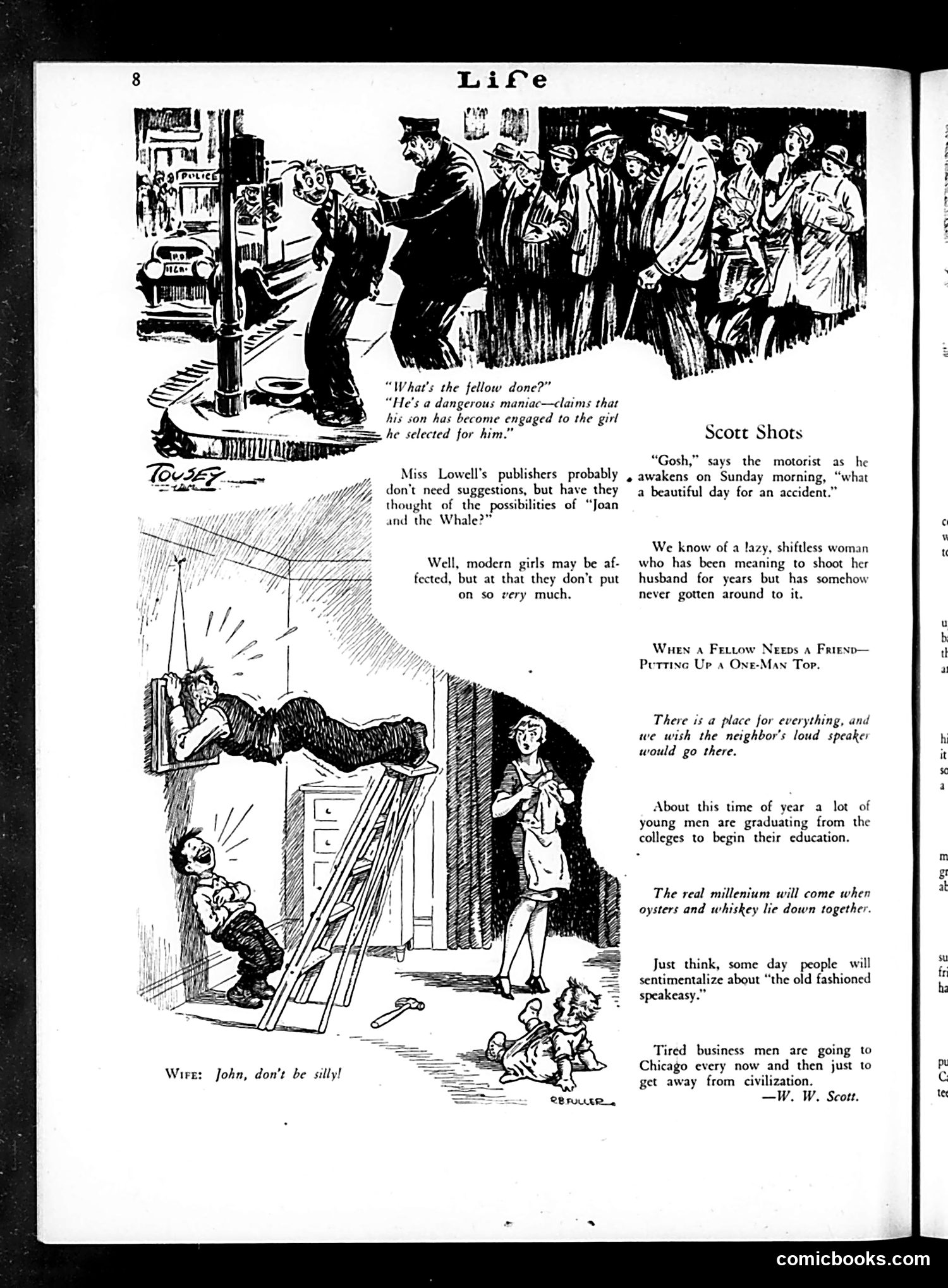
**Top Cartoon:** A police officer addresses a crowd about a "dangerous maniac" whose son has become engaged to an "unselected" girl. The satire mocks overwrought parental concern—treating a son's romantic choice as a criminal matter worthy of police involvement. It critiques rigid social expectations about whom young people should marry. **Bottom Cartoon:** Titled "Wife: John, don't be silly!" depicts a man hanging from a window ledge while his wife and children watch below. The caption's contrast between the woman's dismissive response and the man's apparent desperation satirizes domestic discord and marital indifference, suggesting the wife is callously unconcerned about her husband's distress. Both cartoons use dark humor to critique family relationships and social rigidity of the era.
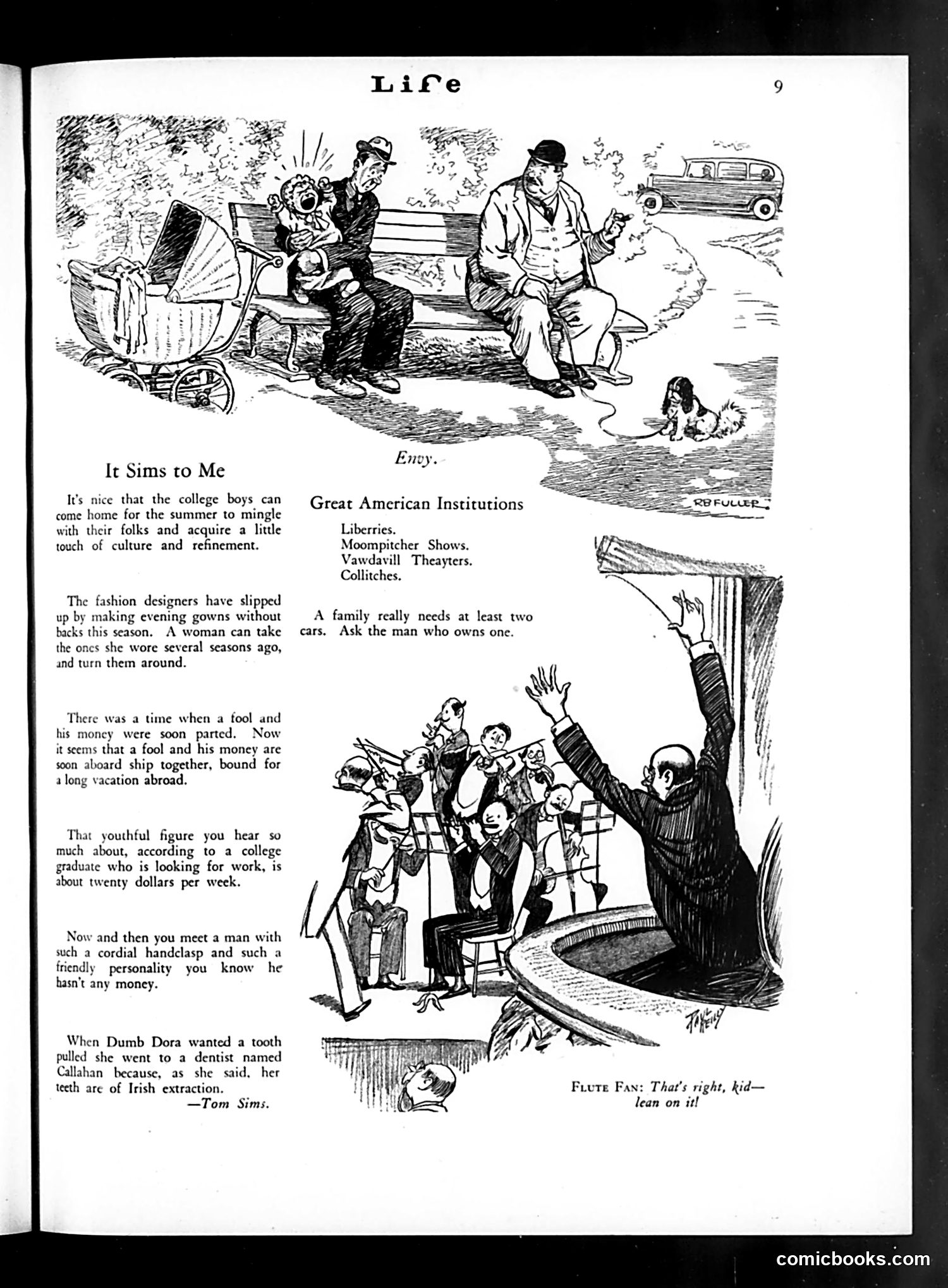
This page contains satirical commentary on American social customs and institutions, circa early 20th century. **Top cartoon** ("It Sims to Me"): Shows two men on a park bench discussing summer culture. The humor targets college boys returning home and social pretension—fashion designers removing backs from evening gowns, foolish spending habits, and the irony that a cordial man without money is preferable to a wealthy fool. **Lower cartoon** ("Flute Fan"): Depicts a street musician playing to an enthusiastic crowd of children, with an adult conductor-like figure energetically directing them. The caption "lean on it!" suggests satire about either musical passion or perhaps class commentary on public performances. The overall tone mocks American social aspirations and economic contradictions of the era.
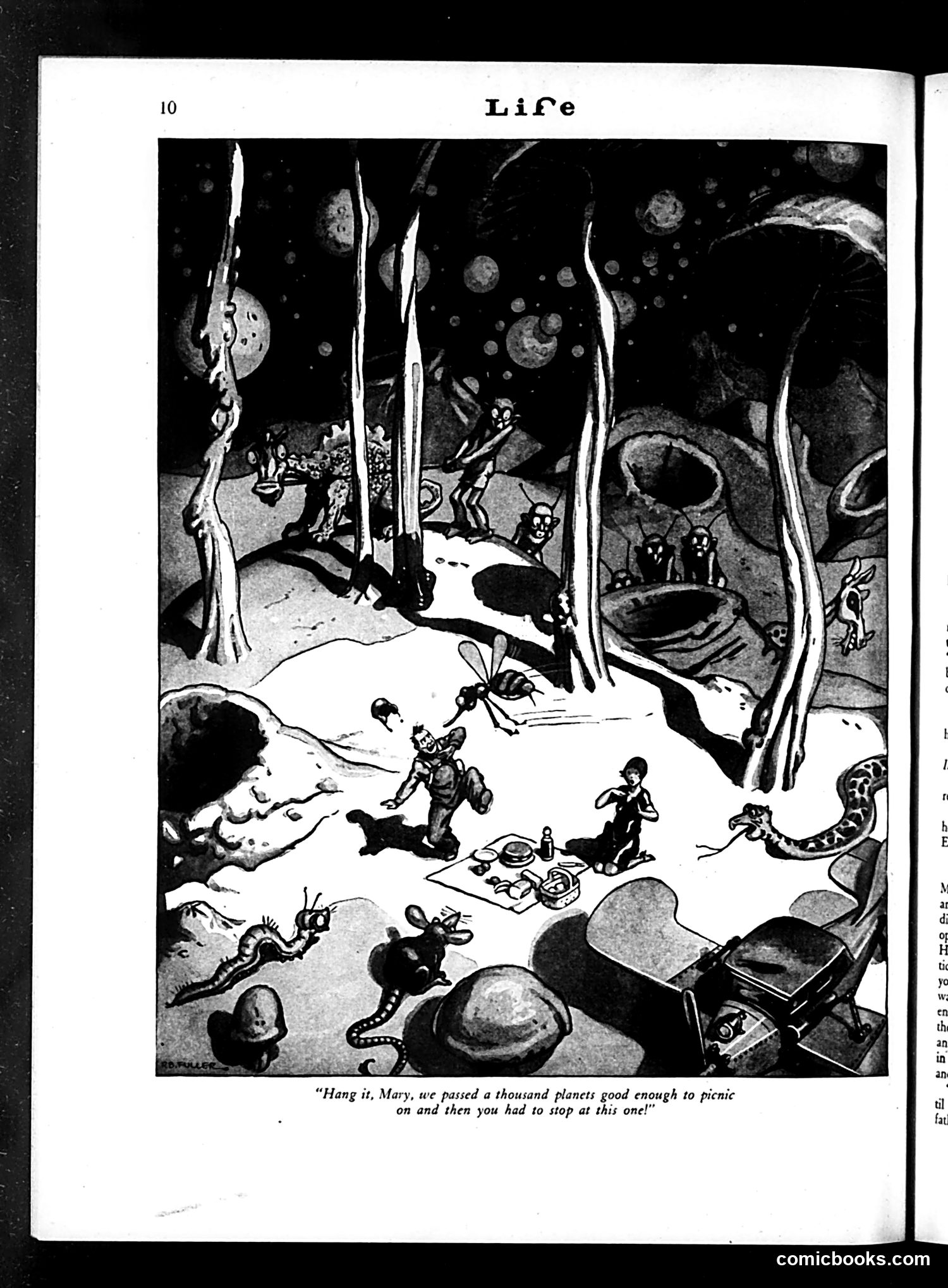
This is a science fiction illustration depicting an alien picnic scene. The caption reads: "Hang it, Mary, we passed a thousand planets good enough to picnic on and then you had to stop at this one!" The cartoon satirizes the human tendency to complain and find fault, even in extraordinary circumstances. The joke works by inverting expectations: instead of marveling at the miraculous experience of visiting alien worlds, the male character is irritated about his companion's choice of picnic location—a relatable domestic complaint transplanted to an impossible setting. The illustration shows humanoid figures in what appears to be a cavern or alien landscape with strange flora, fauna, and geological formations. The satire suggests that human nature—specifically marital discord and petty grievances—would persist unchanged even in interplanetary travel, a common theme in early 20th-century science fiction humor.
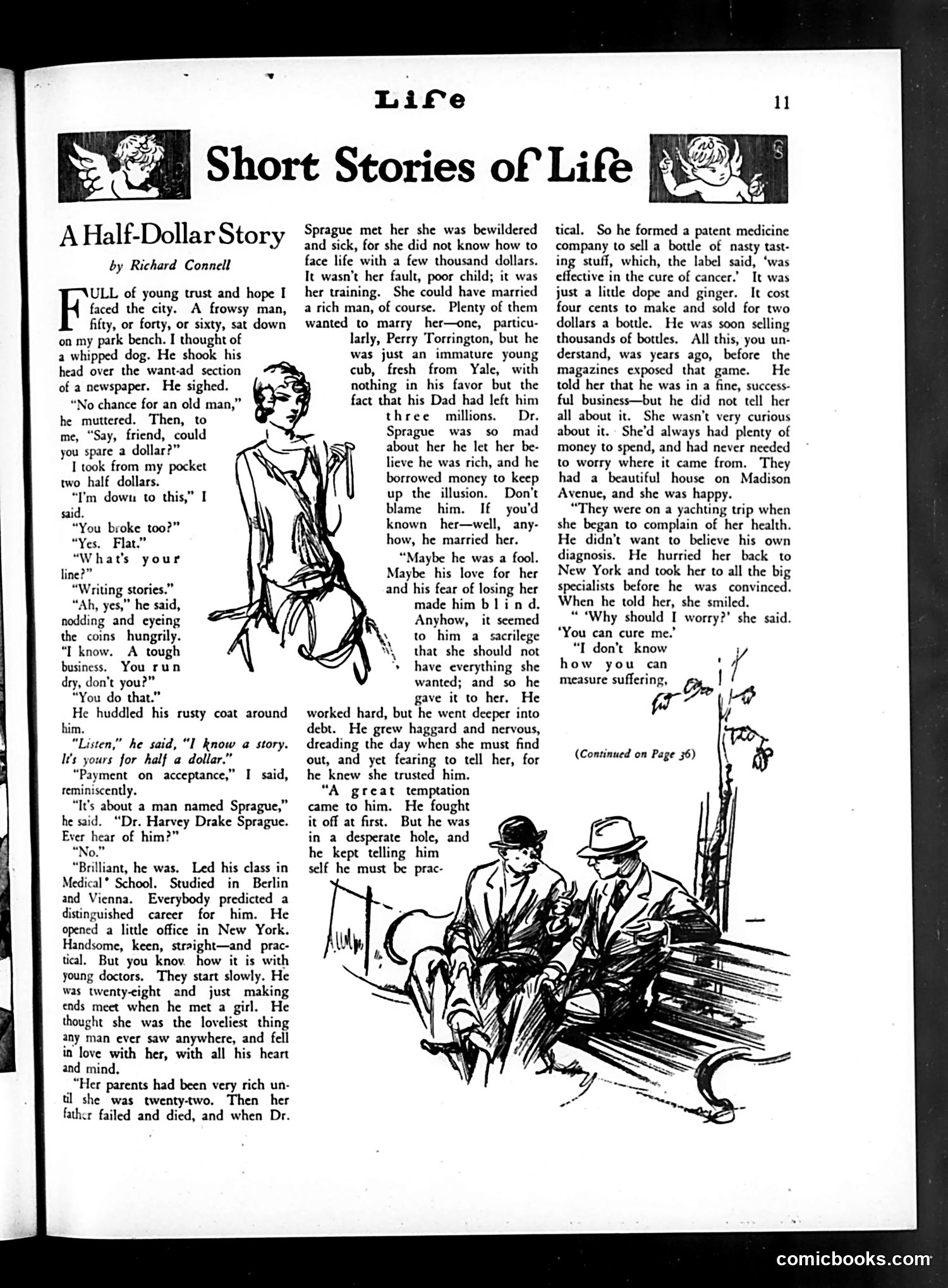
This page presents a short story rather than political satire. The narrative, illustrated with sketch-style drawings, tells of a young, idealistic man who meets a street hustler offering to share a story for fifty cents. The hustler then recounts the tale of Dr. Sprague, a brilliant medical student who fell in love with a wealthy woman, married her despite his modest circumstances, and subsequently struggled financially while she suffered health issues. The story explores themes of love, ambition, poverty, and sacrifice common to early 20th-century American fiction. There is no apparent political cartoon or satirical commentary visible—this is purely a serialized short story (noted as "Continued on Page 36"), typical of *Life* magazine's regular literary content alongside its famous humor and social commentary.
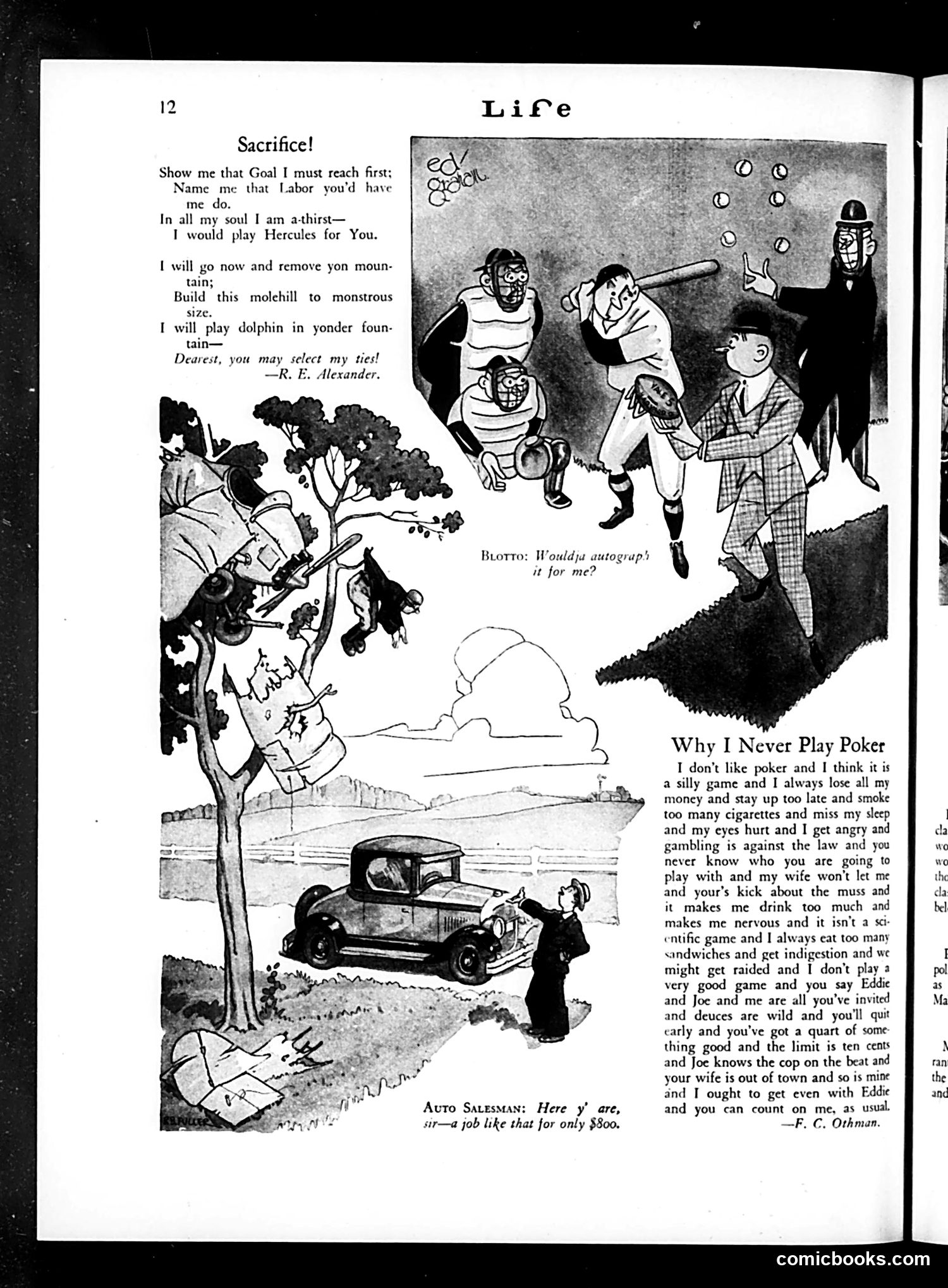
This page contains two distinct pieces: **"Sacrifice!" (upper left):** A poem by R.E. Alexander offering exaggerated labor sacrifices to reach an unspecified "Goal," using classical references (Hercules, dolphin) for comedic effect. The accompanying illustration shows a man attacking a large tree with determination—likely satirizing misguided effort or absurd dedication to a vague objective. **"Why I Never Play Poker" (right):** A humorous personal essay by F.C. Otkman explaining his aversion to poker through domestic and legal consequences: gambling debts, marital conflict, police trouble, and health problems from stress and indigestion. The cartoon above depicts a baseball game, possibly illustrating an alternative leisure activity. **"Auto Salesman" (lower left):** A brief exchange where a salesman offers a car job for $300—likely satirizing questionable employment schemes.
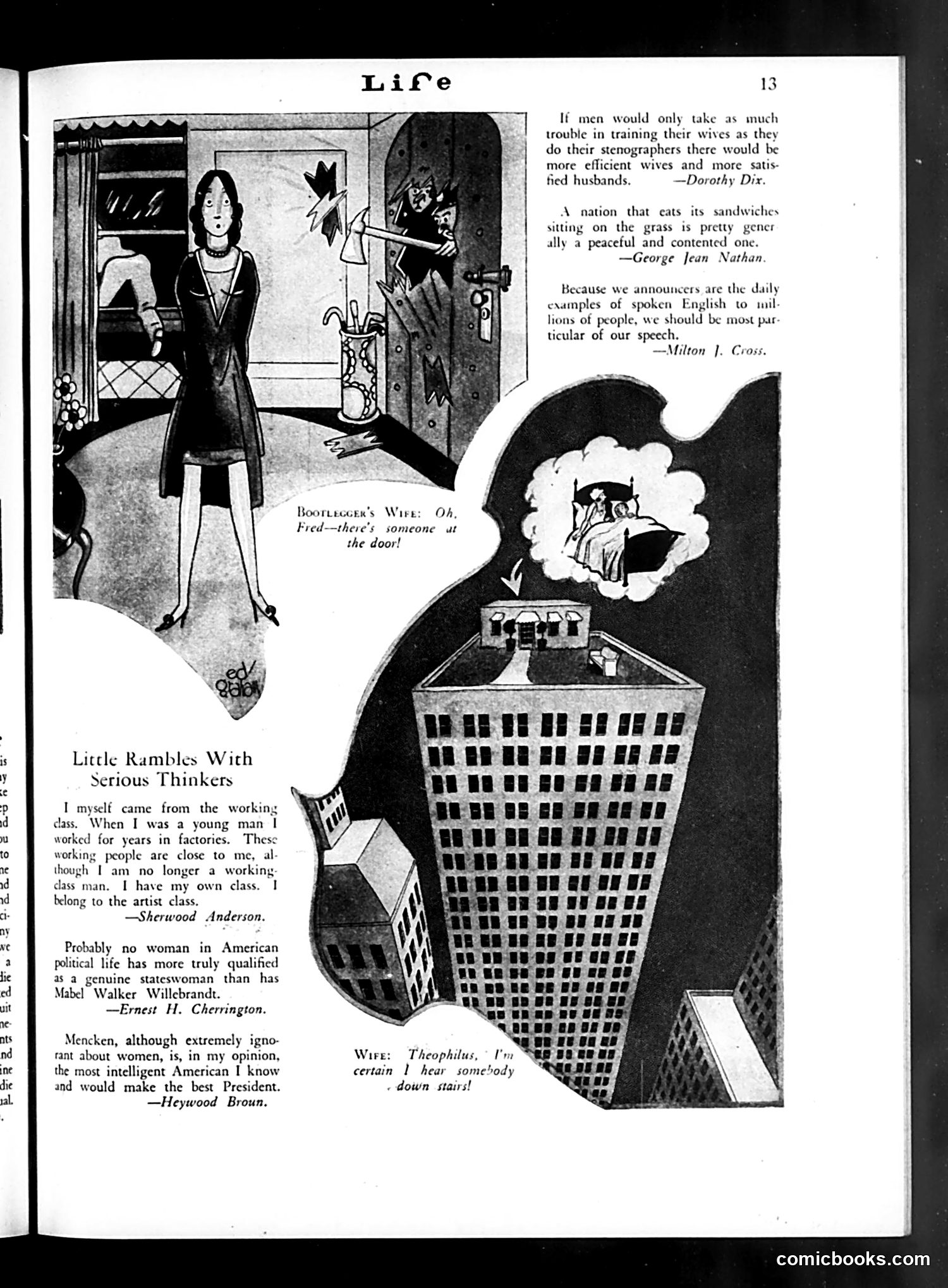
This page contains two distinct satirical pieces from *Life* magazine: **Top cartoon**: A domestic scene mocking a "bootlegger's wife" who answers the door. The humor references Prohibition-era illegal alcohol smuggling—bootleggers were criminals who produced/sold illicit liquor. The satire targets the wives of these criminals. **Bottom cartoon ("Little Rambles With Serious Thinkers")**: A wife in a tall apartment building tells her husband "Theophilus, I'm certain I hear somebody down stairs!" This satirizes urban anxiety and paranoia, likely mocking both the claustrophobia of apartment living and exaggerated domestic fears. The thought bubble shows chaotic activity below. The page also includes several quotations attributed to public figures (Dorothy Dix, George Jean Nathan, Milton Cross, etc.) offering social commentary on wives, speech, and class—typical of *Life*'s satirical format mixing visual jokes with pithy observations.
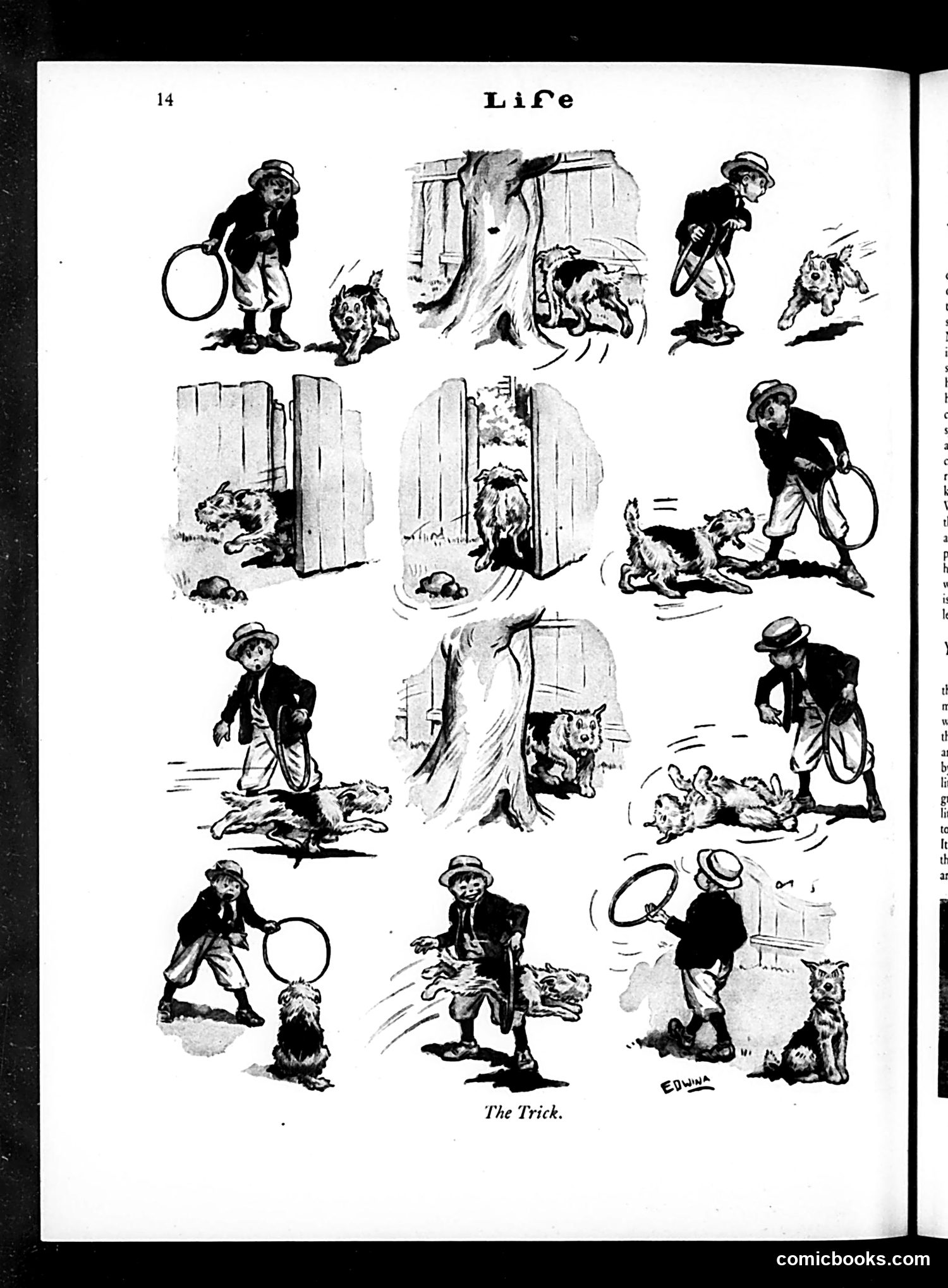
This appears to be a multi-panel comic sequence titled "The Trick," signed by artist Edwina. The strip depicts a slapstick scenario involving a man with a hoop/ring, a dog, and what appears to be a gate or fence. The narrative seems to show the man attempting to trick or manipulate the dog using the hoop as a prop—possibly trying to make the dog jump through it or perform tricks. The sequence progresses through various comedic moments of interaction between the man and dog, with physical comedy and exaggerated expressions typical of early 20th-century Life magazine humor. Without additional context or clearer OCR text, the specific satirical or political point remains unclear, though it may simply be observational humor about pet training or human-animal interactions common to that era.
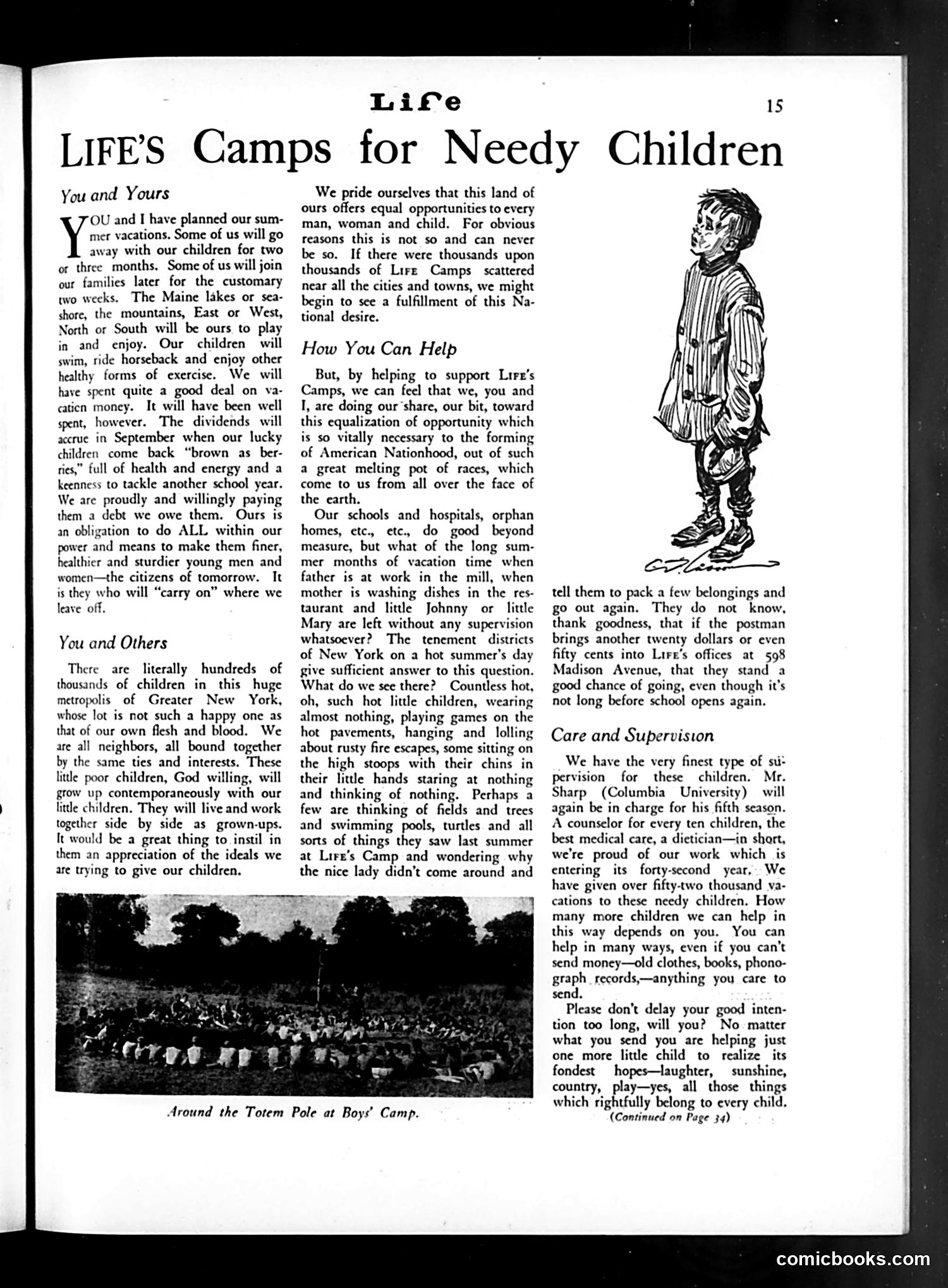
This page promotes **Life magazine's charitable initiative** providing summer camps for poor children in New York City and other urban areas. The illustration shows a **ragged, poorly-clothed child**—representing the target population: impoverished kids from tenement districts who lack resources for healthy recreation. The article argues that American ideals of "equal opportunity" demand intervention. It highlights the contrast: while middle-class families vacation at lakes and mountains, poor children remain unsupervised in dangerous urban conditions (fire escapes, streets). The photograph shows children gathered "Around the Totem Pole at Boys' Camp," documenting the program's reality. **The satire is gentle**: Life magazine positions itself as facilitating national unity through charitable work, appealing to readers' sense of civic duty and American meritocratic values.
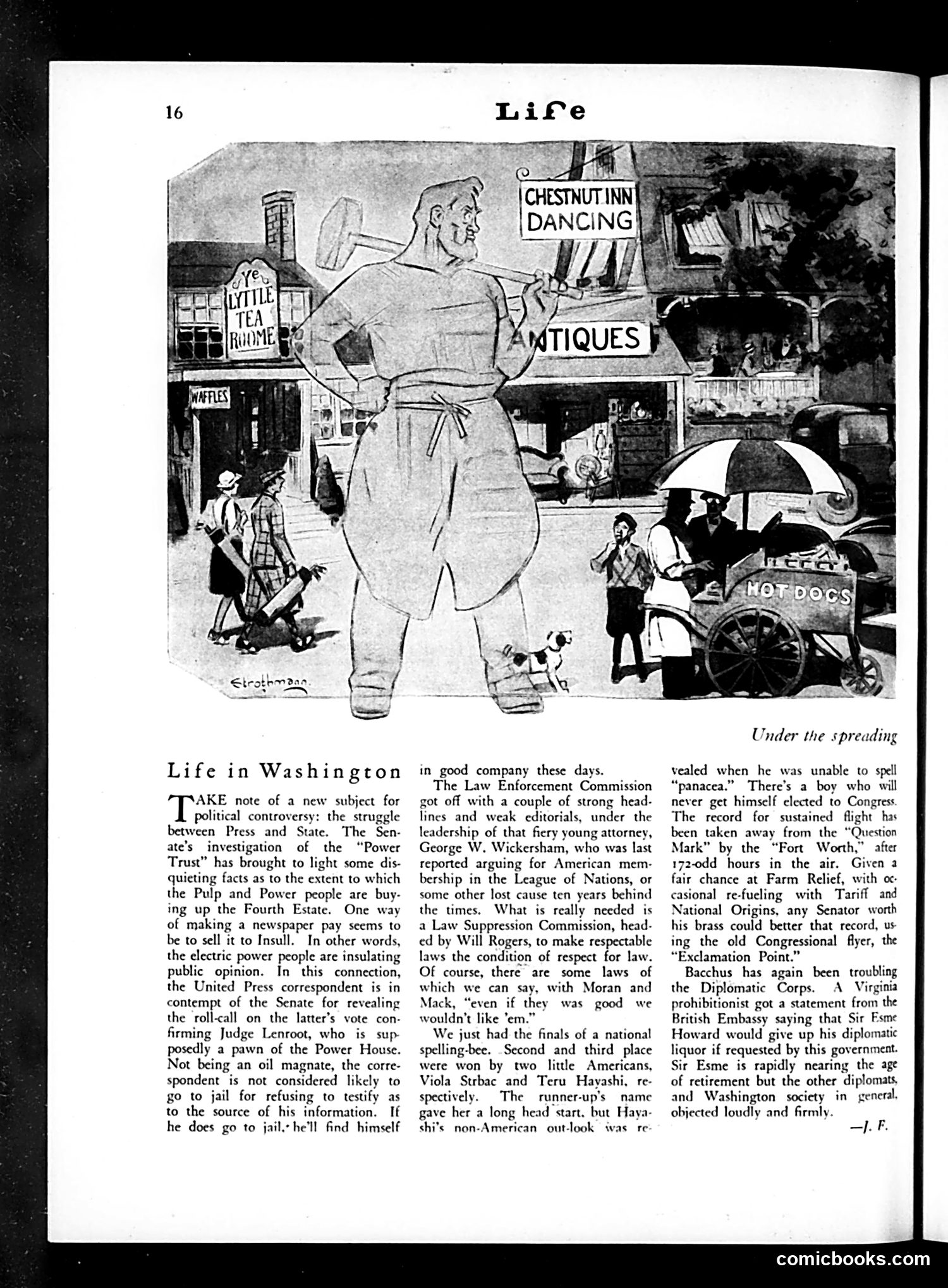
This satirical cartoon depicts a giant figure towering over Washington D.C., representing the outsized influence of the "Power Trust"—a monopolistic electric power industry that was a major political controversy of the era. The text explains the Senate is investigating this corporate power's influence on journalism and politics. The tiny figures below (including a hot dog vendor and pedestrians with an umbrella) emphasize the scale of corporate dominance over ordinary citizens. Visible storefronts reference leisure activities, contrasting everyday life against institutional corruption. The article critiques how the power companies suppress unfavorable press coverage and manipulate public opinion. It names George W. Wickersham as leading reform efforts, suggesting this reflects a real regulatory battle between corporate interests and government oversight.
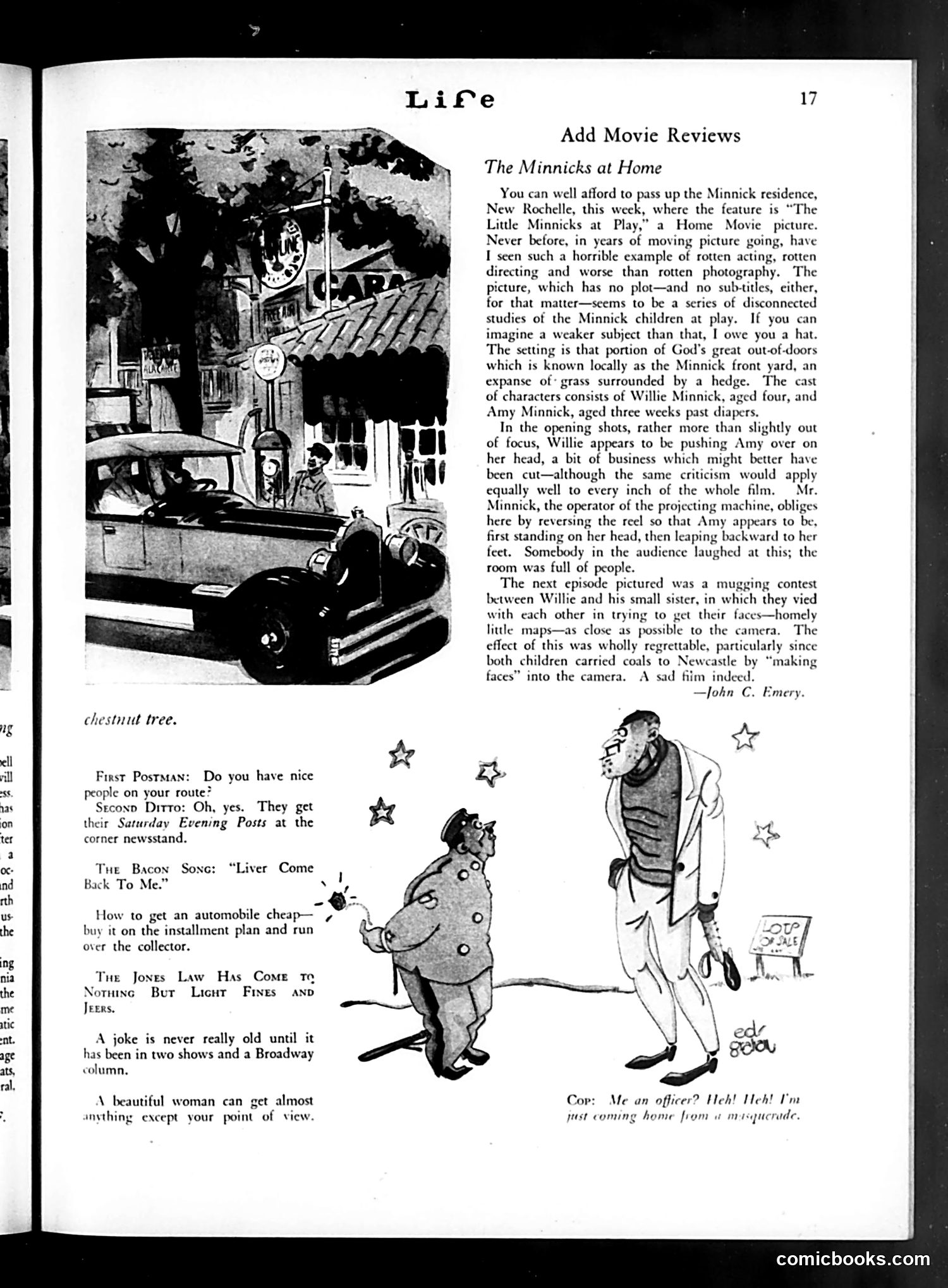
This page contains a movie review and satirical cartoon. The review criticizes "The Little Minnicks at Play," a home movie featuring the Minnick children, condemning it as having "rotten acting, rotten directing and worse than rotten photography" with no plot or subtitles. The cartoon below depicts two figures: a heavyset woman (likely representing a stereotype of poor or working-class femininity) confronting a well-dressed man in a coat. The caption reads: "Cop: *Me an officer? Heh! Heh! I'm just coming home from a masquerade.*" The joke relies on the woman's apparent inability to distinguish the man's actual profession from costume, satirizing either female perception or the unreliability of appearances—a common trope in early 20th-century American humor.
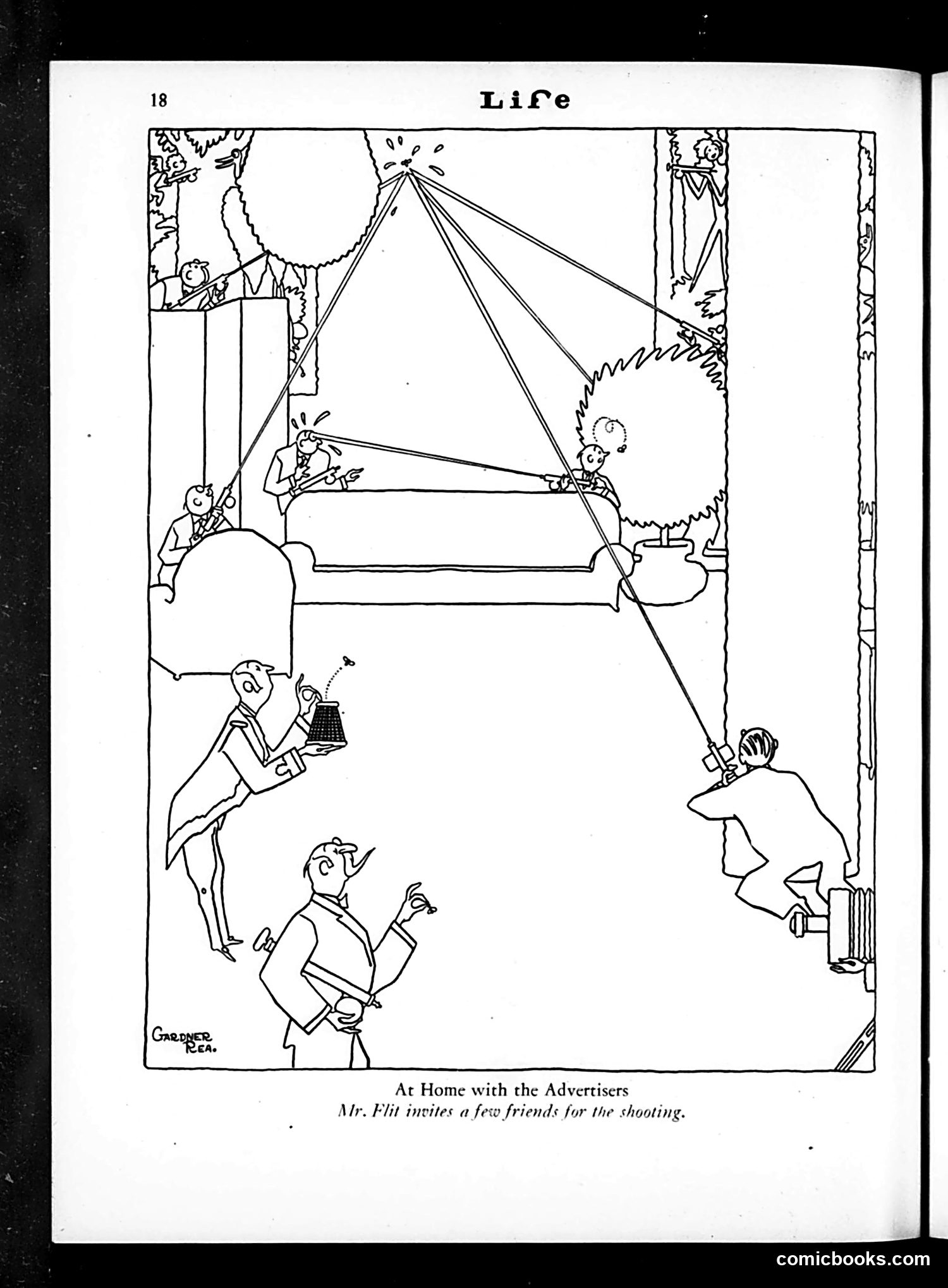
This is a satirical cartoon from *Life* magazine titled "At Home with the Advertisers," showing Mr. Flitt inviting friends for hunting. The cartoon depicts advertising's pervasiveness in everyday life through absurdist humor. The joke appears to be that even in a supposedly private, recreational moment—a hunting party at home—commercial advertising has invaded and dominated the space. The elaborate setup with ropes, pulleys, and multiple figures suggests the artificiality and excessive machinery of modern advertising domination of leisure activities. The cartoonist (signed "Gardner Rea") satirizes how advertisers infiltrate all aspects of life, transforming even intimate social gatherings into marketing opportunities. This reflects early 20th-century anxieties about consumer culture and commercial manipulation of daily experience.
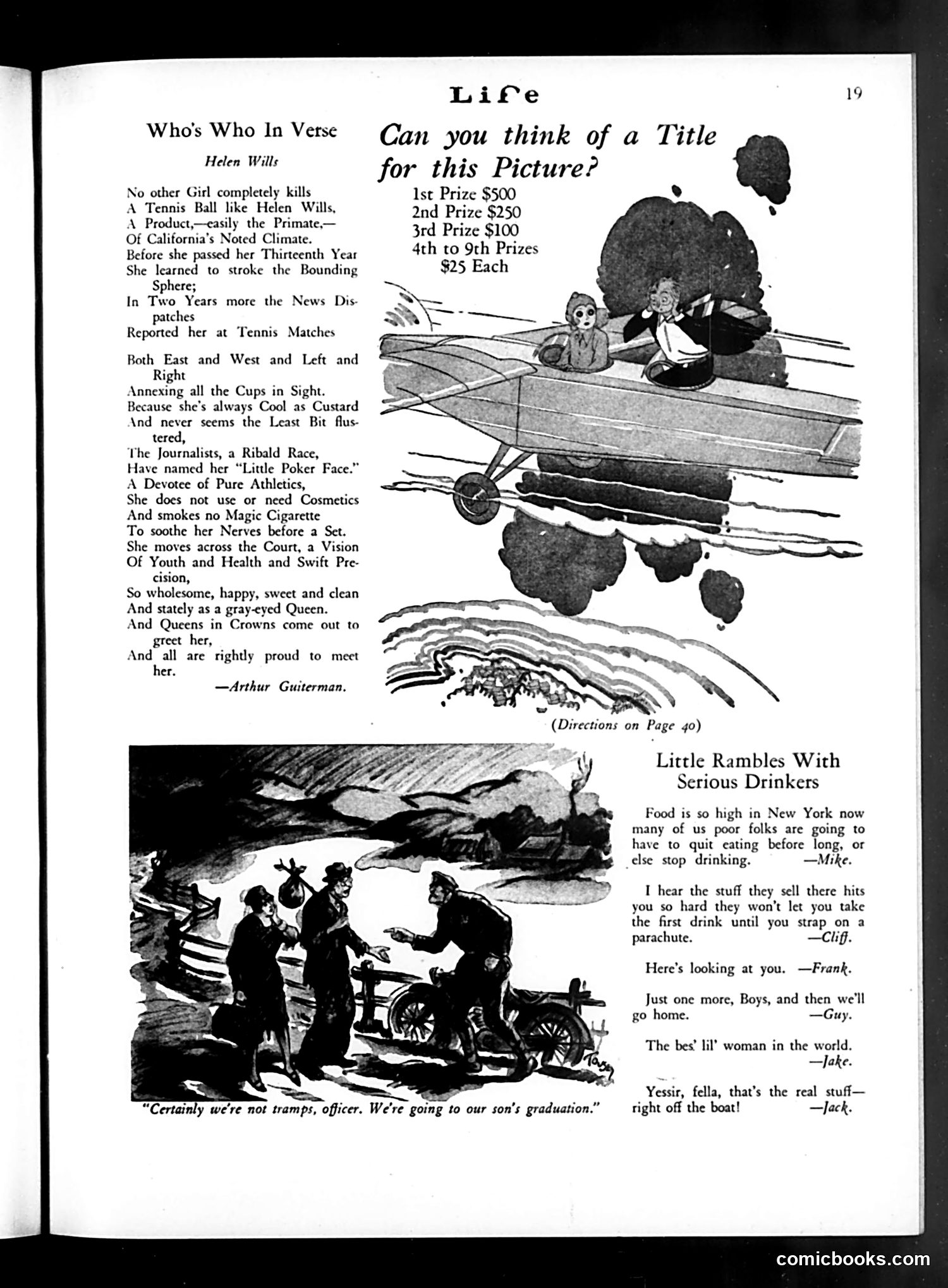
**Top Section - Helen Wills Tribute:** A celebratory poem by Arthur Guiterman praises tennis champion Helen Wills, famous for her emotionless demeanor ("Little Poker Face"). The verse highlights her athletic prowess, wholesome character, and international fame—she's depicted as a model of pure athleticism who eschews cosmetics and smoking. This reflects 1920s admiration for the "New Woman" athlete. **Bottom Section - Prohibition-Era Satire:** The cartoon and accompanying quotes mock working-class men during Prohibition. They claim they're heading to "our son's graduation" while clearly going to drink illegally. The dialogue satirizes both the desperation of poor drinkers (forced to choose between eating and drinking) and the dangers of bootleg alcohol ("strap on a parachute"). This is sharp social commentary on how Prohibition affected lower classes while the wealthy accessed quality liquor—and how ordinary people rationalized illegal drinking.
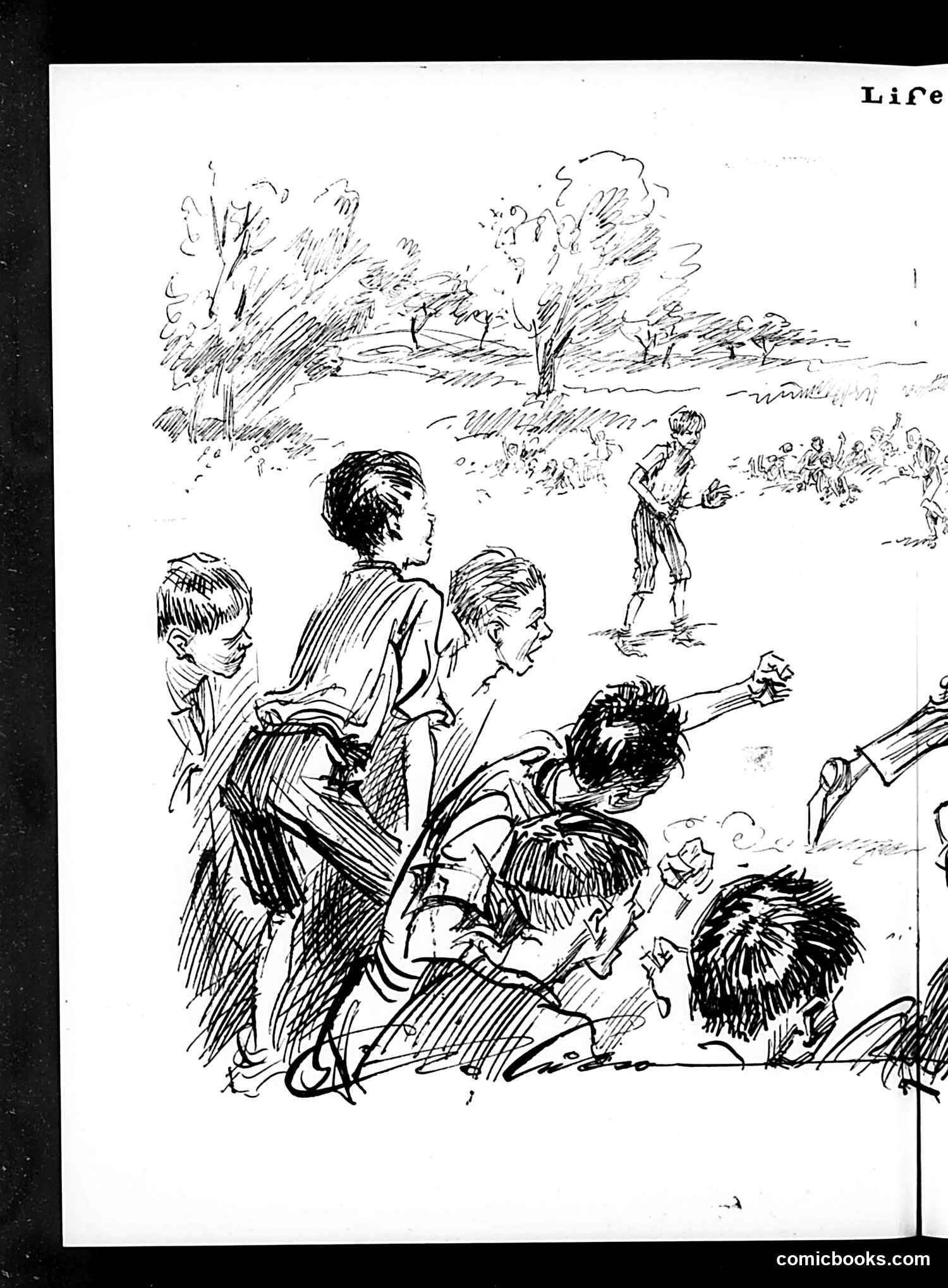
This page from *Life* magazine shows an illustration titled "Life" depicting children at outdoor play in a pastoral setting. The foreground features five children of varying ages in period clothing (appearing early 20th century), engaged in energetic activity. The background shows trees, rolling landscape, and additional figures playing in the distance. The illustration appears to celebrate childhood innocence and the simple joys of outdoor recreation—a common *Life* magazine theme emphasizing wholesome American values. The sketchy, expressive drawing style and idyllic rural setting romanticize natural childhood development away from urban industrial society. Without additional visible text or context, the specific satirical point remains unclear, though the page likely advocates nostalgic or progressive views on child welfare and education prevalent in that era.
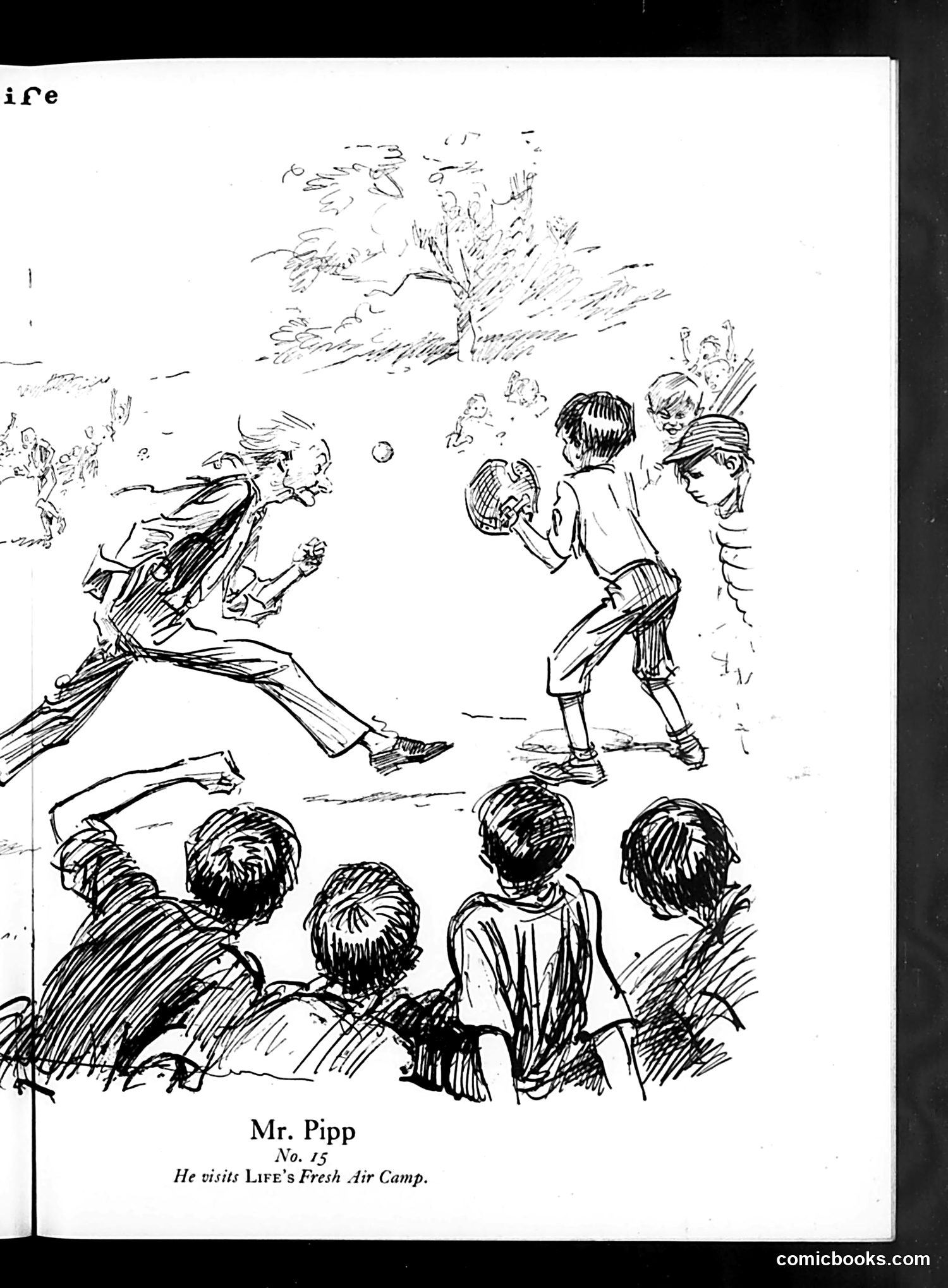
This is an illustration (No. 15) from Life magazine depicting "Mr. Pipp" visiting "Life's Fresh Air Camp." The cartoon shows an energetic adult figure (Pipp) playing ball with a group of children in what appears to be an outdoor recreation setting. The children are gathered to watch or participate in the activity. The satire likely reflects Life magazine's own charitable Fresh Air Camp initiative—a real program that provided urban children outdoor recreation. "Mr. Pipp" appears to be a character visiting the camp, possibly for satirical commentary on wealthy benefactors or public figures engaging in charitable activities. Without additional context about who "Mr. Pipp" represents specifically, the exact target of the satire remains unclear, though the tone suggests gentle mockery of the camp experience or its visitors.
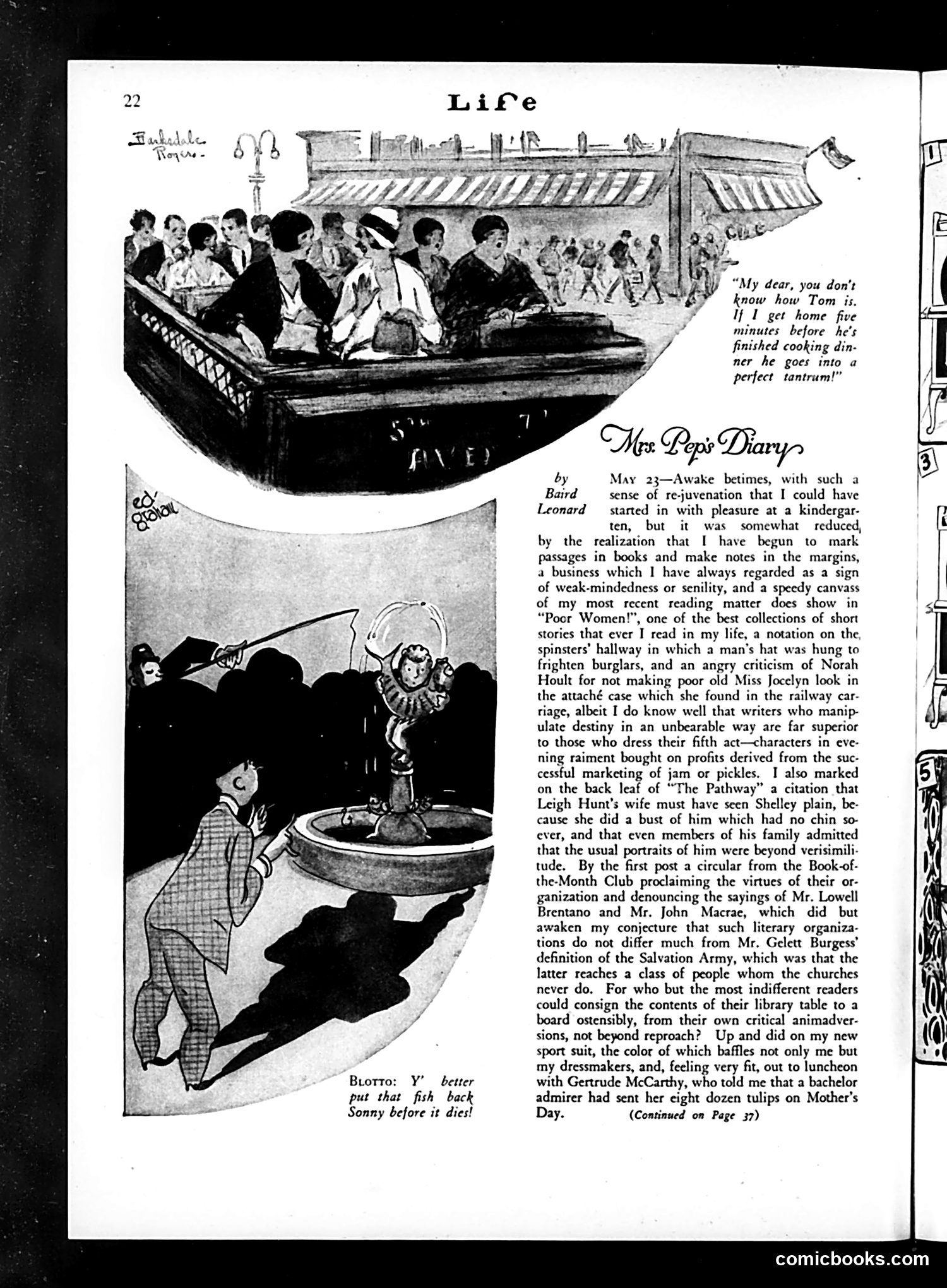
This page features a humorous diary column by Baird Leonard, accompanied by two cartoons satirizing domestic life and gender roles. **Top cartoon:** A woman complains to friends about her husband Tom becoming "perfectly" angry if she arrives home five minutes before he finishes cooking dinner. The joke satirizes the "new man" who has taken over household cooking—a role traditionally female. The satire cuts both ways: it mocks both the husband's territorial defensiveness over "his" cooking domain and implies the wife finds this role reversal absurd or emasculating. **Bottom cartoon:** A child tells his mother to return a fish to water before it dies, showing parental incompetence or indifference—basic domestic negligence played for laughs. The diary itself is a gossipy, literary commentary touching on contemporary authors and the Book-of-the-Month Club, reflecting upper-class reading habits of the era. The overall page satirizes modern domesticity and social pretensions among educated urbanites.
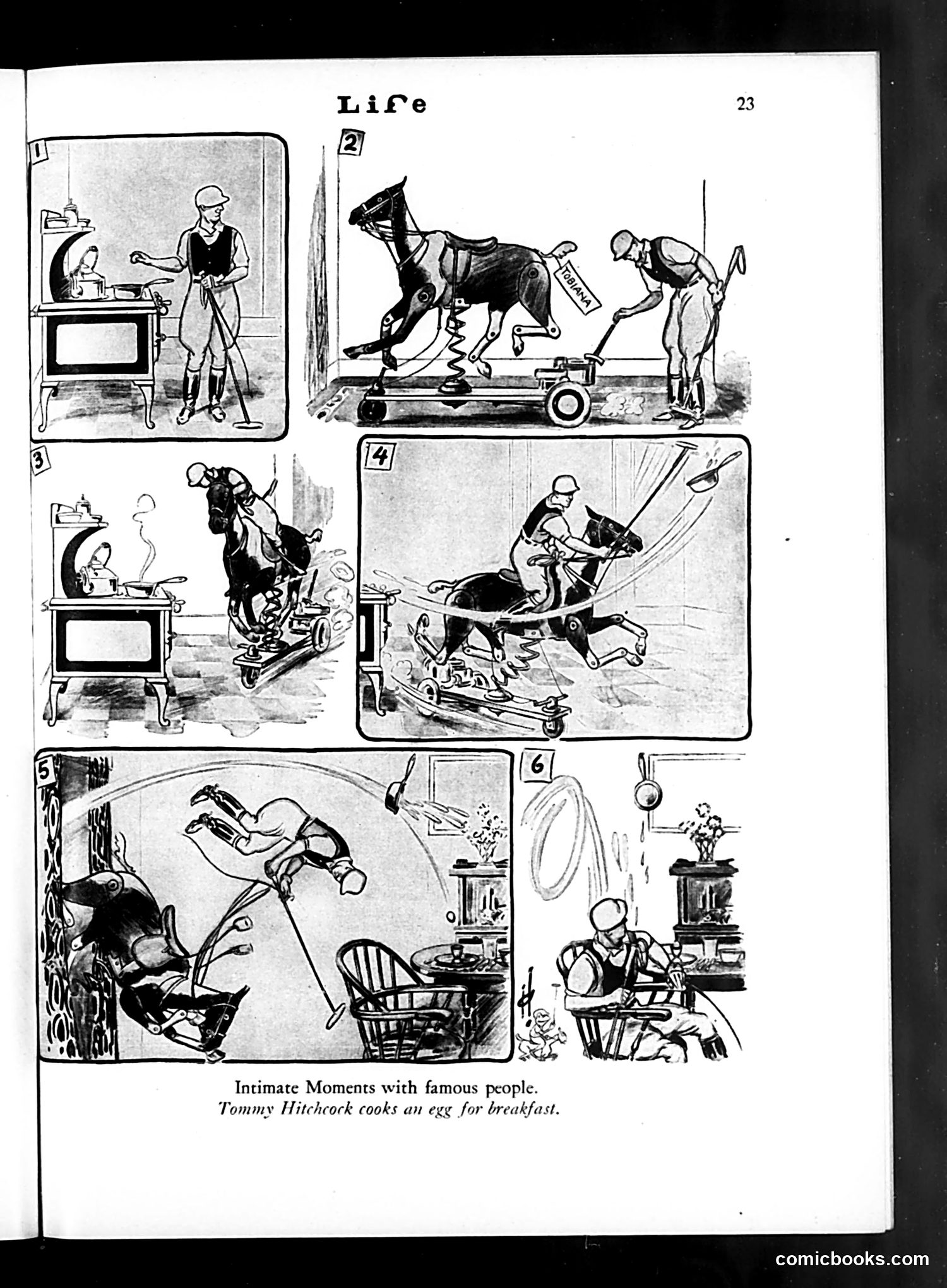
This is a humorous six-panel comic strip satirizing the celebrity profile genre. It shows Tommy Hitchcock (a prominent American polo player of the early 20th century) in increasingly absurd situations—beginning with him cooking a simple egg, then inexplicably involving a horse on a treadmill, acrobatic stunts, and chaotic kitchen scenes. The satire mocks the "intimate glimpse into famous people's lives" magazine format popular at the time. By transforming a mundane breakfast task into elaborate, ridiculous spectacle, the cartoonist ridicules how publications sensationalize and exaggerate celebrities' everyday activities. The joke undercuts the pretense that such features offer genuine insight into famous people's private lives.
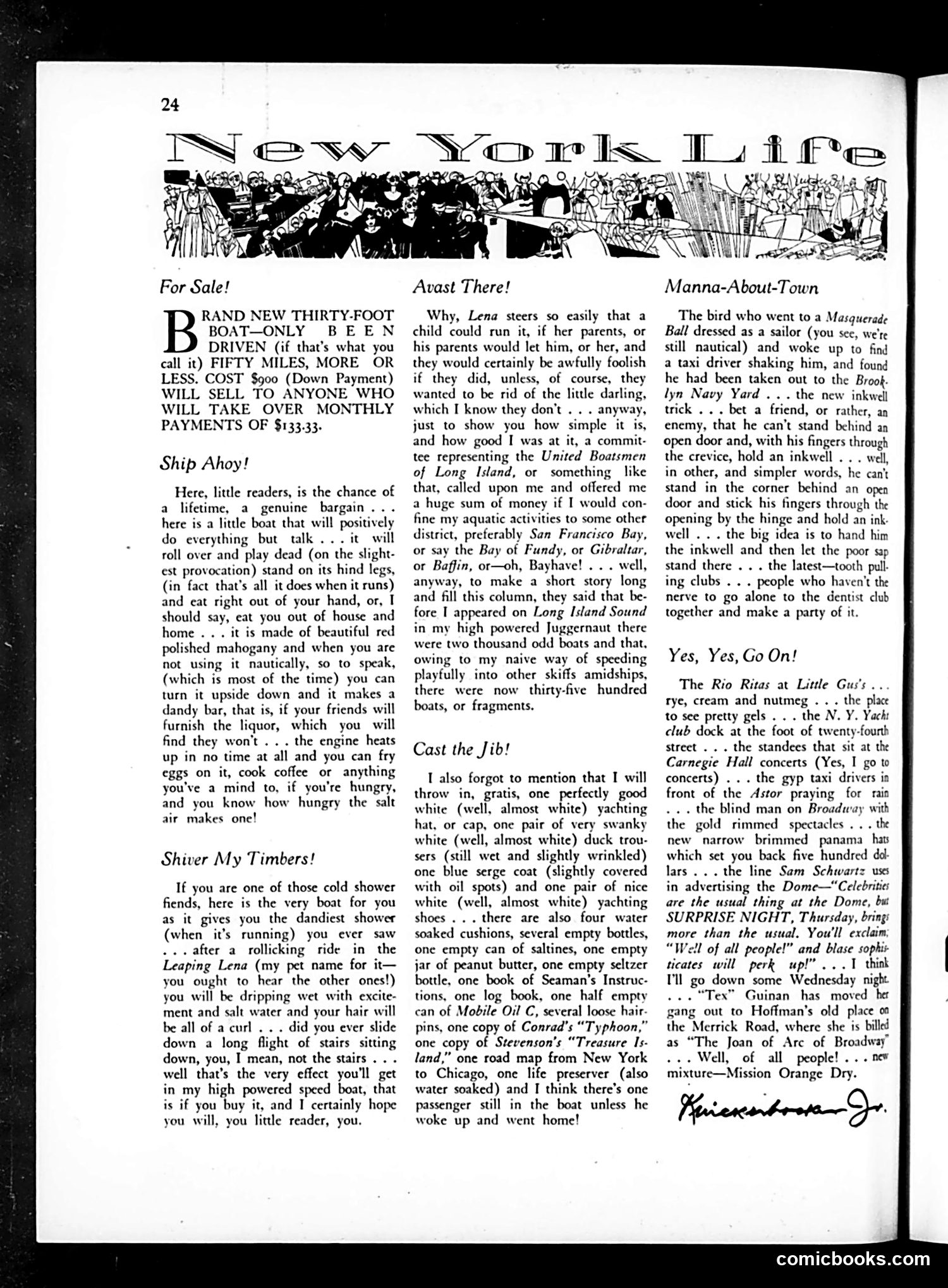
This page is a comedic classified advertisement for a defective speedboat, written as mock-serious sales copy. The humor targets 1920s consumer culture and reckless leisure. The "boat for sale" is presented as a bargain, but the text hilariously describes it as catastrophically dangerous and poorly made. It "rolls over," generates excessive heat, causes seasickness ("sliding down stairs"), and most absurdly, the seller claims his reckless speedboating on Long Island Sound increased nearby boats from 2,000 to 3,500—implying he's destroyed hundreds through collisions. The throwaway items included (soggy cushions, empty bottles, possibly a stranded passenger) are punchlines emphasizing the boat's worthlessness. The "United Boatsmen of Long Island" allegedly paid him to boat elsewhere, satirizing how irresponsible wealthy people damaged public spaces during the Prohibition-era pleasure-boating craze. This mocks both frivolous consumer spending and the careless arrogance of the wealthy.
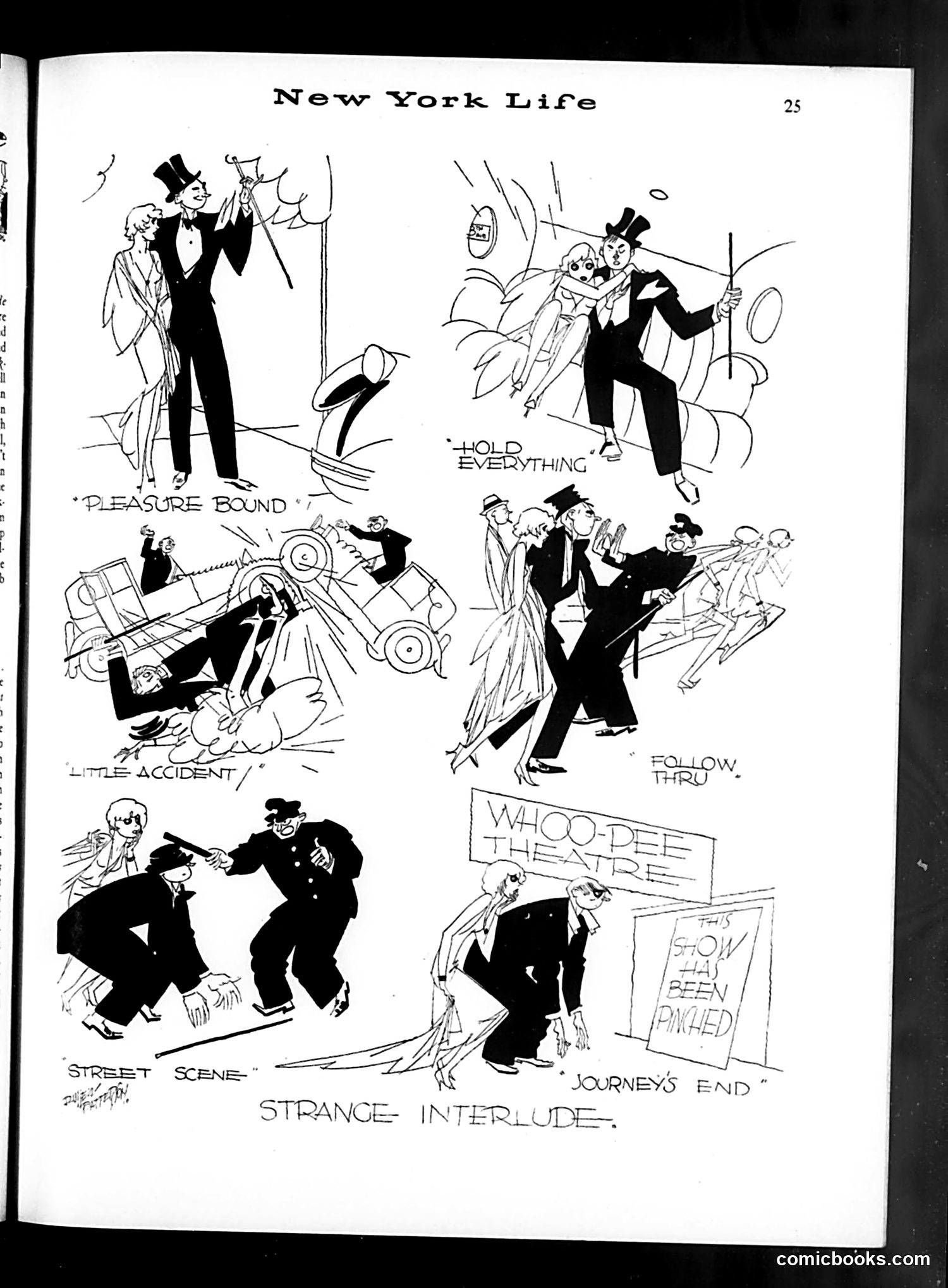
This page from *Life* magazine satirizes the Broadway play "Strange Interlude" through a series of humorous vignettes labeled with dance-like titles: "Pleasure Bound," "Hold Everything," "Little Accident," "Follow Thru," "Street Scene," "Whoop-Thee-There," and "Journeys End." The cartoon mocks contemporary New York theatrical productions by depicting formally-dressed couples and characters in absurd situations—colliding vehicles, chaotic movement, and physical comedy. The labeling suggests the cartoonist is playfully connecting popular Broadway show titles to exaggerated depictions of urban mishaps and romantic entanglements. This appears to be social satire targeting the pretentious theater scene and wealthy New York society's entertainment culture during the Jazz Age, using slapstick visual humor to deflate the sophistication of contemporary drama.
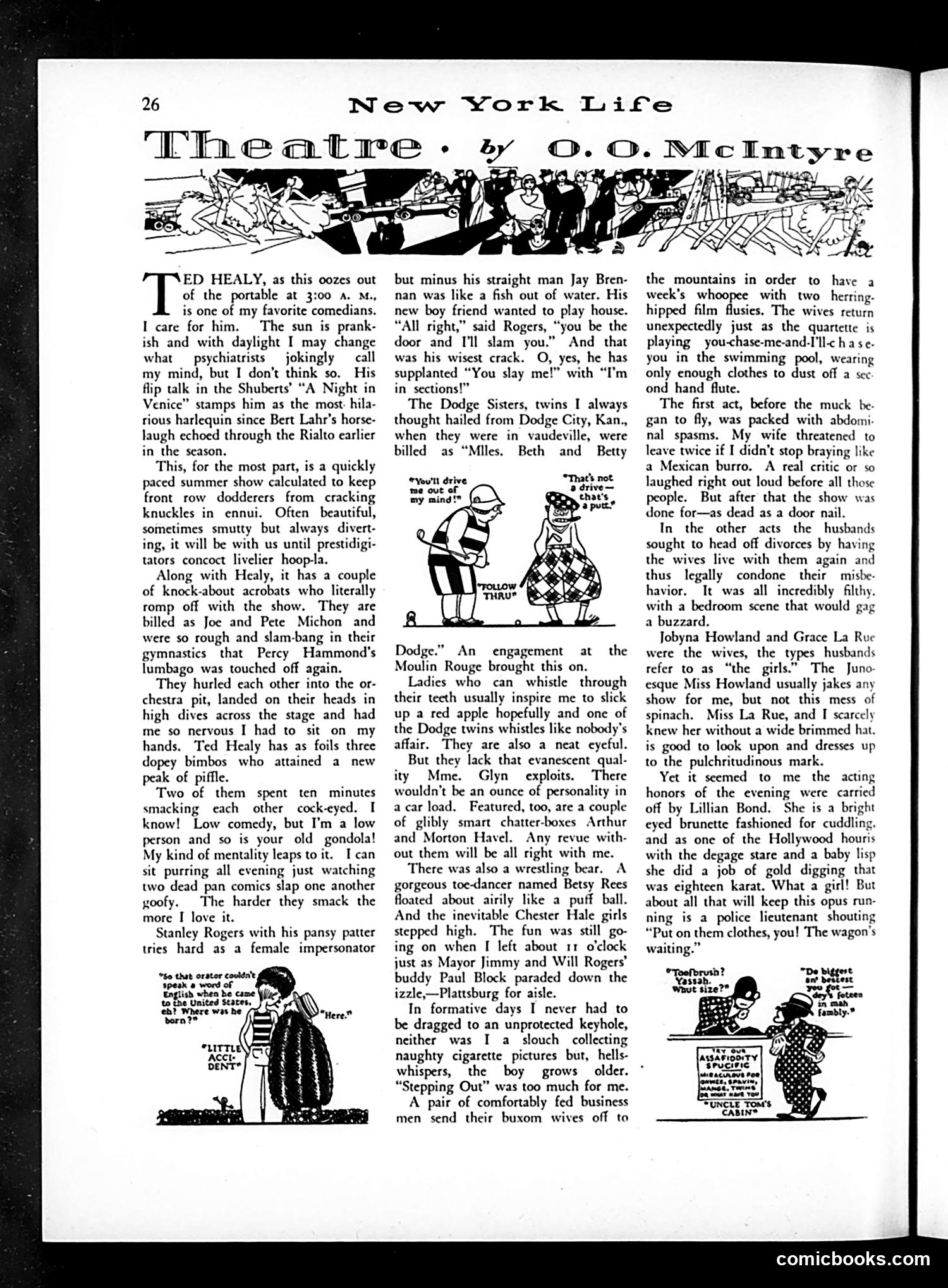
This is O.O. McIntyre's theater review from *New York Life* magazine, covering Broadway shows. The page critiques several performances: **"A Night in Venice"**: McIntyre praises comedian Ed Healy as a gifted physical comedian, comparing him favorably to Bert Lahr. He admires the acrobatic Michon brothers and enjoys the "low comedy" of slapstick—two female performers hitting each other. He's less impressed by Stanley Rogers' female impersonation act and the "Dodge Sisters" (whistling twins), finding them lacking personality. **"Stepping Out"**: McIntyre criticizes this show's plot about respectable businessmen's wives sneaking away for affairs with "film flusies" (actresses). He finds the first act funny but considers the swimming pool scene in scanty clothing morally objectionable—noting his wife threatened to leave. The cartoons illustrate jokes about female impersonation and the plot's marital infidelity premise. McIntyre presents himself as a lowbrow audience member who enjoys slapstick but grows uncomfortable with adultery themes as he ages.
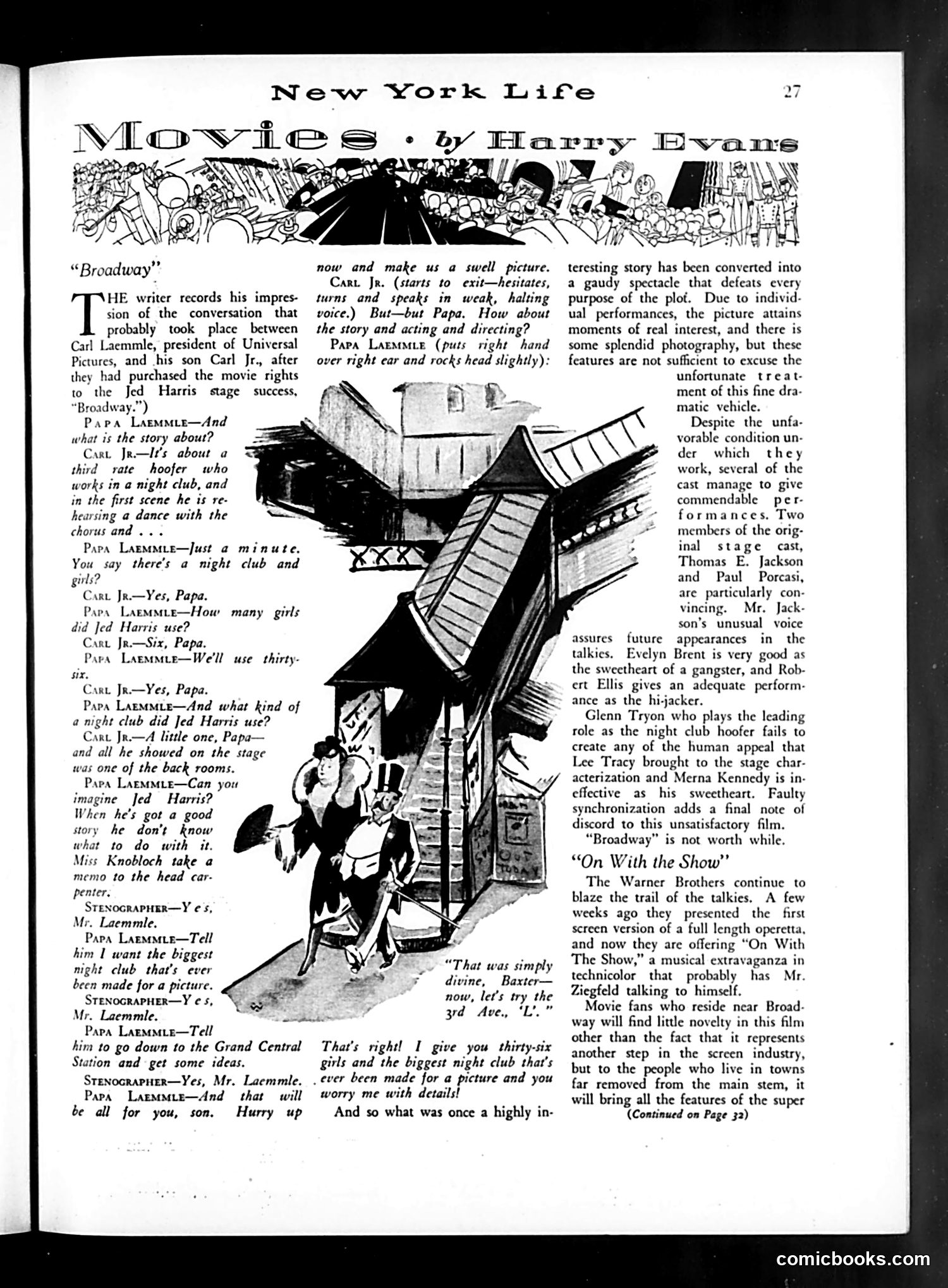
This page reviews early 1920s sound films ("talkies"). The main illustration depicts a night club scene, accompanying a satirical dialogue between Carl Laemmle (Universal Pictures president) and his son Carl Jr., who purchased film rights to the Broadway stage hit "Broadway." The humor mocks the movie industry's transition to talking pictures. The conversation reveals the father's ignorance—he doesn't understand basic details about the stage production he's funding, asking absurdly literal questions about "girls" and "night club" scenes. The review criticizes the resulting film adaptation as a "gaudy spectacle" that squanders the original play's quality. The cartoonist satirizes both the elder Laemmle's cluelessness and the industry's tendency to destroy theatrical works through oversized, expensive film production.
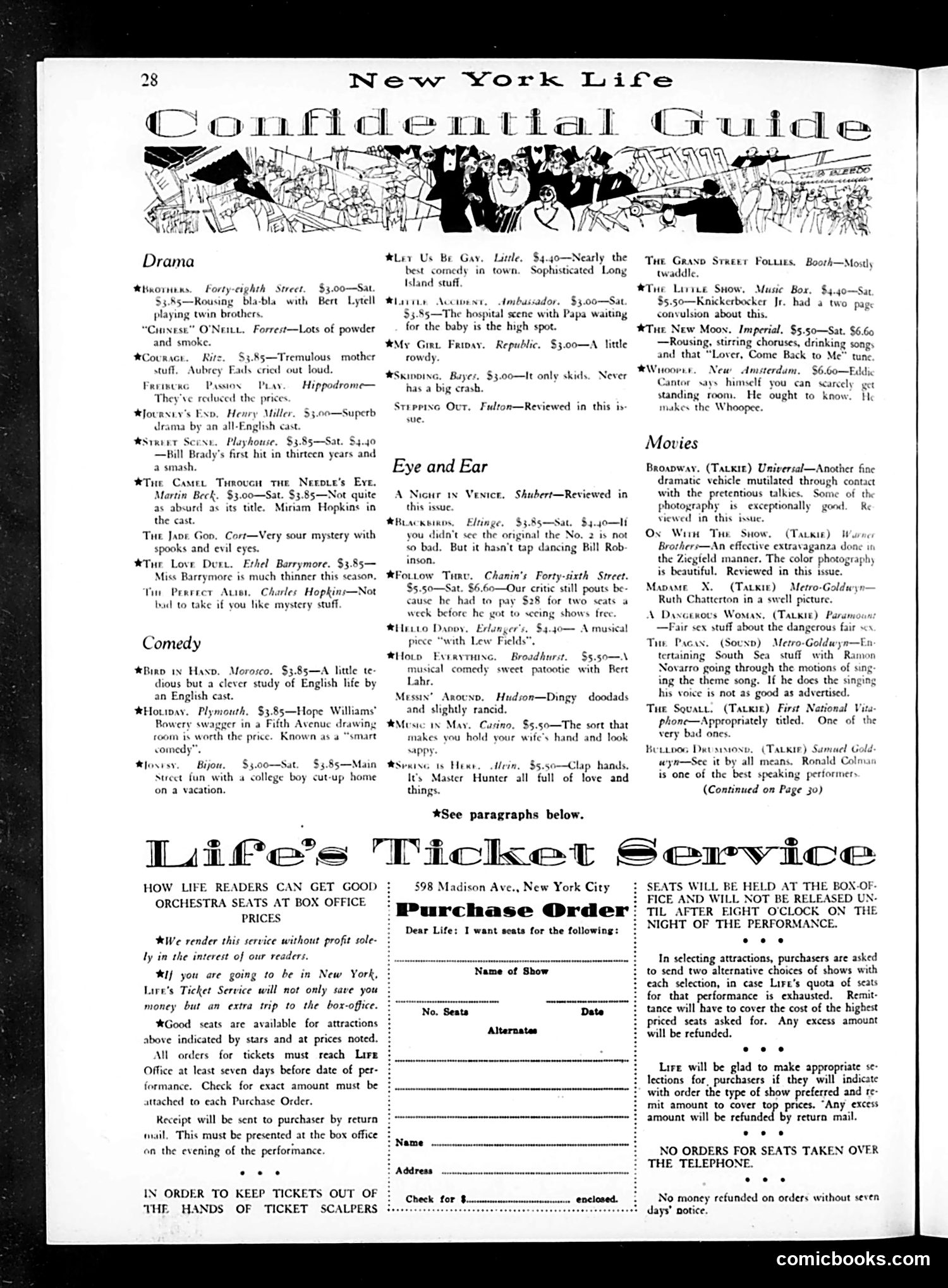
This page is primarily a **theater and entertainment listing and advertisement**, not a political cartoon. It's a "Confidential Guide" to Broadway shows, movies, and ticket services from Life magazine. The content includes: - **Drama reviews**: Brief, snappy critiques of Broadway plays with ticket prices ($3-$6.60), actors' names (Bert Lytell, Ethel Barrymore, Miriam Hopkins), and sarcastic commentary ("Not quite as absurd as its title") - **Comedy and musical theater**: Similar format with witty one-liners about shows - **Early "talkie" movies**: Reviews noting the transition to sound film, with some criticism of how "dramatic vehicles [were] mutilated through contact with the pretentious talkies" - **Ticket service advertisement**: Life magazine's own box office service allowing readers to purchase orchestra seats by mail The satire is **gentle and consumer-focused** rather than political—poking fun at theater productions and pricing rather than current events. The "Confidential" framing suggests insider theater gossip for sophisticated Manhattan readers.
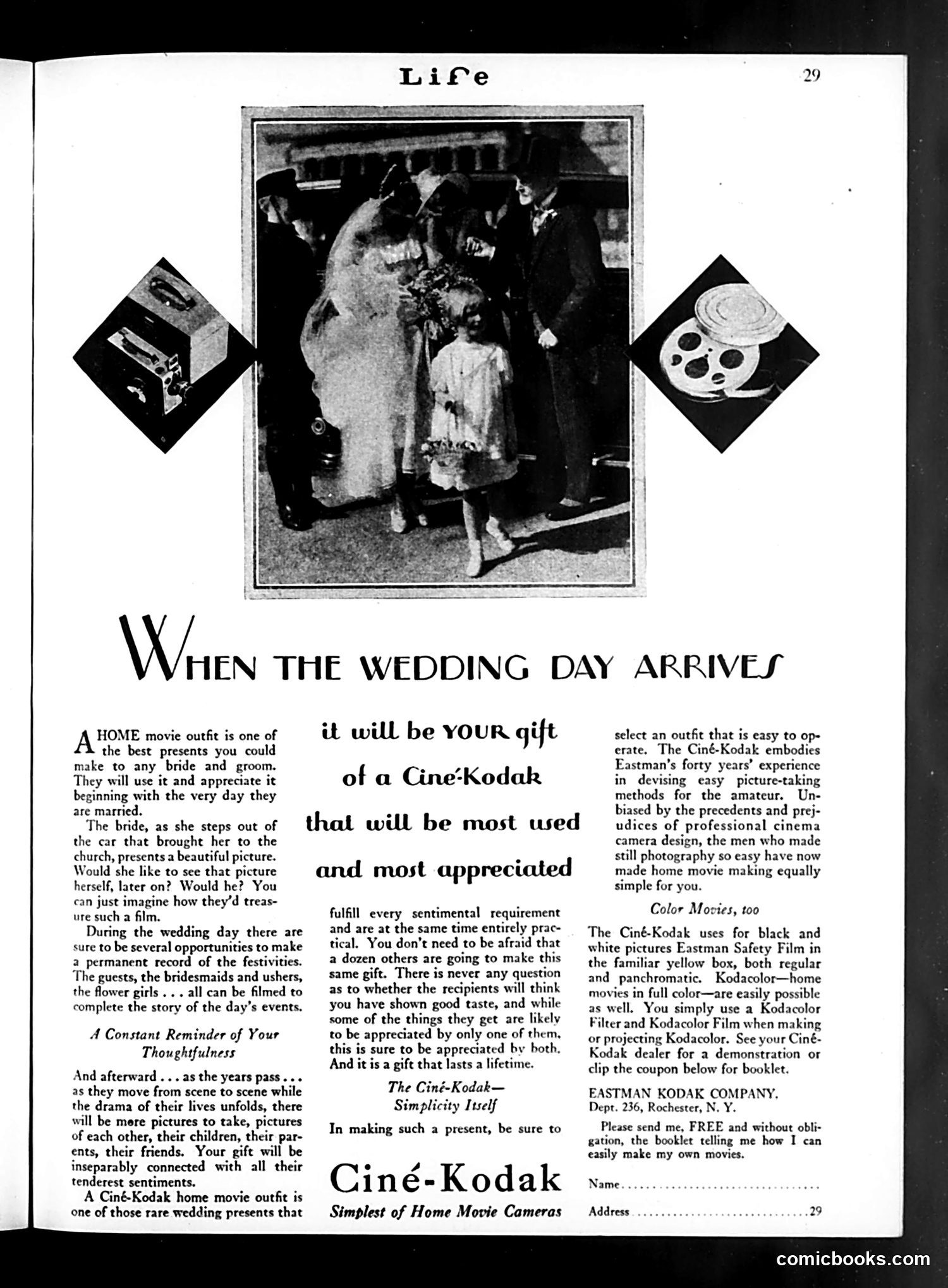
This is **not a political cartoon or satire**, but rather a **full-page advertisement** for Kodak's home movie camera, circa early-to-mid 20th century. The central image shows a wedding scene—a bride and groom with guests outside a church. The ad positions the Ciné-Kodak camera as an ideal wedding gift, emphasizing that newlyweds will use it "beginning with the very day they are married" to document their ceremony, guests, and future family milestones. The pitch appeals to **sentimental value**: the camera captures memories that become "inseparably connected with all their tenderest sentiments" over decades. Small diamond-shaped inset photos display the camera itself and film reels. The ad stresses the camera's **simplicity** ("Simplest of Home Movie Cameras"), drawing on Kodak's reputation for making photography accessible to amateurs. It notes the camera uses standard Kodak film and offers both black-and-white and color options. **Context for modern readers**: This reflects an era when home movie equipment was novel, aspirational technology—before video cameras and smartphones made recording everyday life ubiquitous.
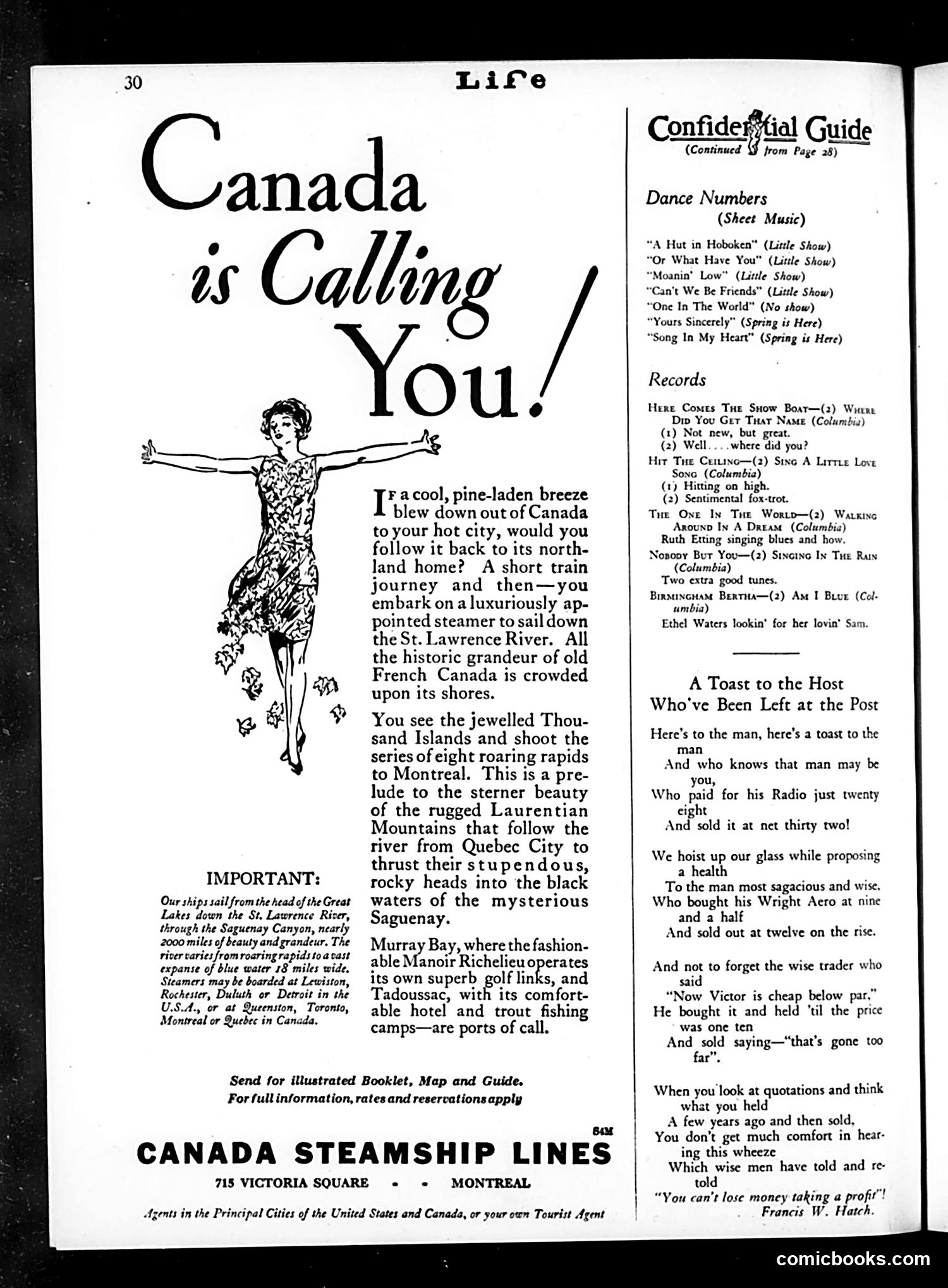
This page combines a **Canada Steamship Lines advertisement** with satirical content about financial speculation. **The Advertisement (left):** A glamorous illustration of a woman with outstretched arms promotes luxury river cruises down the St. Lawrence River. The copy romantically describes the journey through Canadian landscapes—the Thousand Islands, rapids, Laurentian Mountains, and resort destinations like Murray Bay—targeting American tourists seeking an escape from hot cities. **The Satire (right):** "A Toast to the Host Who've Been Left at the Post" mocks investors who made poor financial decisions during the stock market boom of the 1920s. The verses describe men who bought stocks (Radio, Wright Aero, Victor) at low prices but sold too early, missing massive profits—or conversely, held too long and lost money. The repeated maxim "You can't lose money taking a profit" is presented ironically, as these traders clearly *did* lose by misjudging markets. Together, the page contrasts leisurely vacation fantasies with the era's financial anxieties—a common *Life* magazine juxtaposition of aspirational advertising against contemporary economic reality.
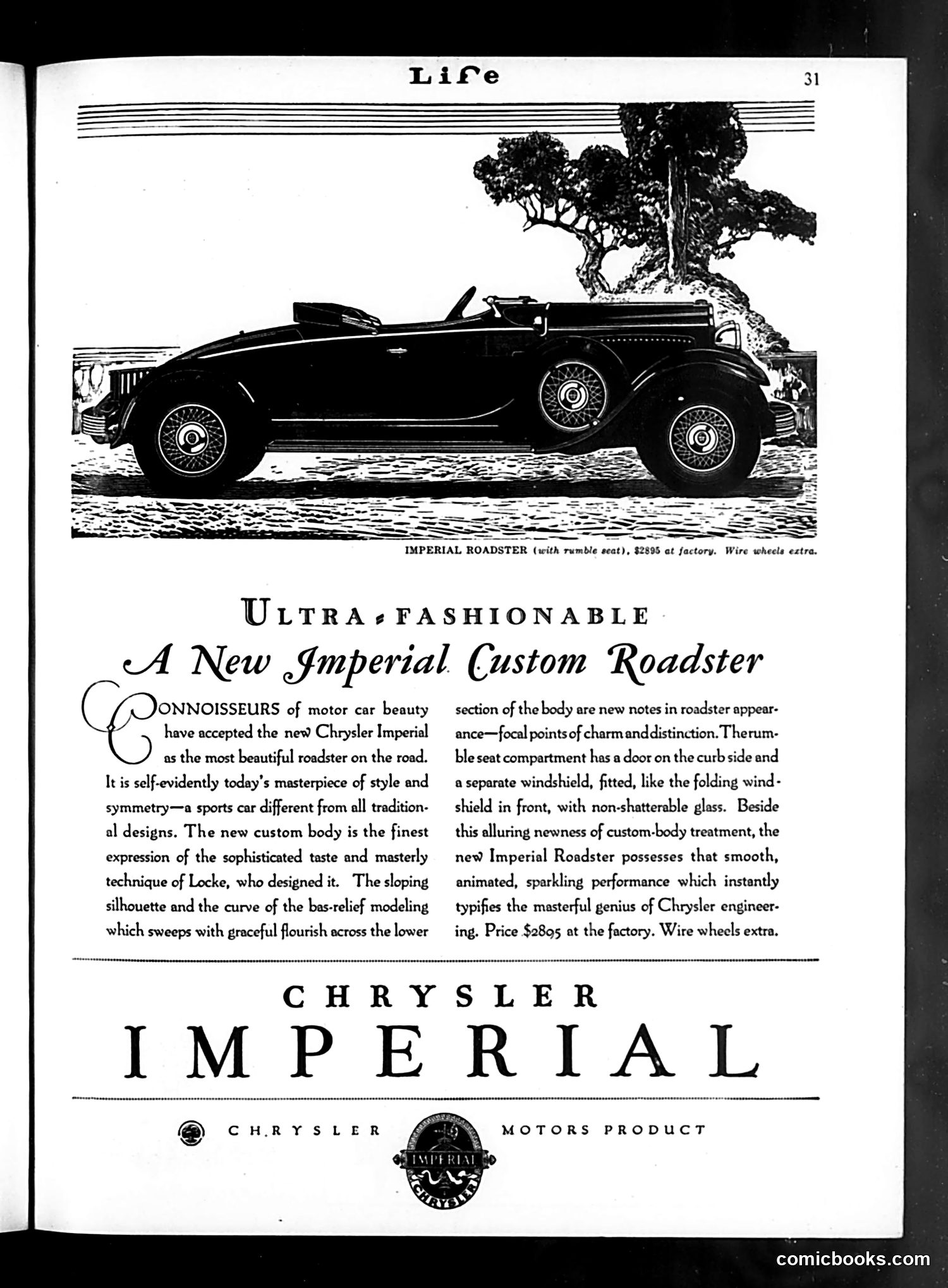
This page is primarily a luxury automobile advertisement, not political satire. It promotes the new Chrysler Imperial Custom Roadster, priced at $2,895 at the factory (wire wheels extra). The ad emphasizes the car's aesthetic sophistication, designed by Locke, highlighting its "sloping silhouette" and modern features like a rumble seat with its own door and windshield, plus non-shatterable glass. The copywriting appeals to "connoisseurs of motor car beauty," positioning the Imperial as superior to "all traditional designs." The illustration shows a sleek, open roadster beside a stylized tree. The tone throughout is aspirational marketing targeting wealthy buyers during what appears to be the late 1920s or early 1930s—an era when automobiles were luxury status symbols rather than mass-market necessities. There is no political commentary or social satire present on this page.
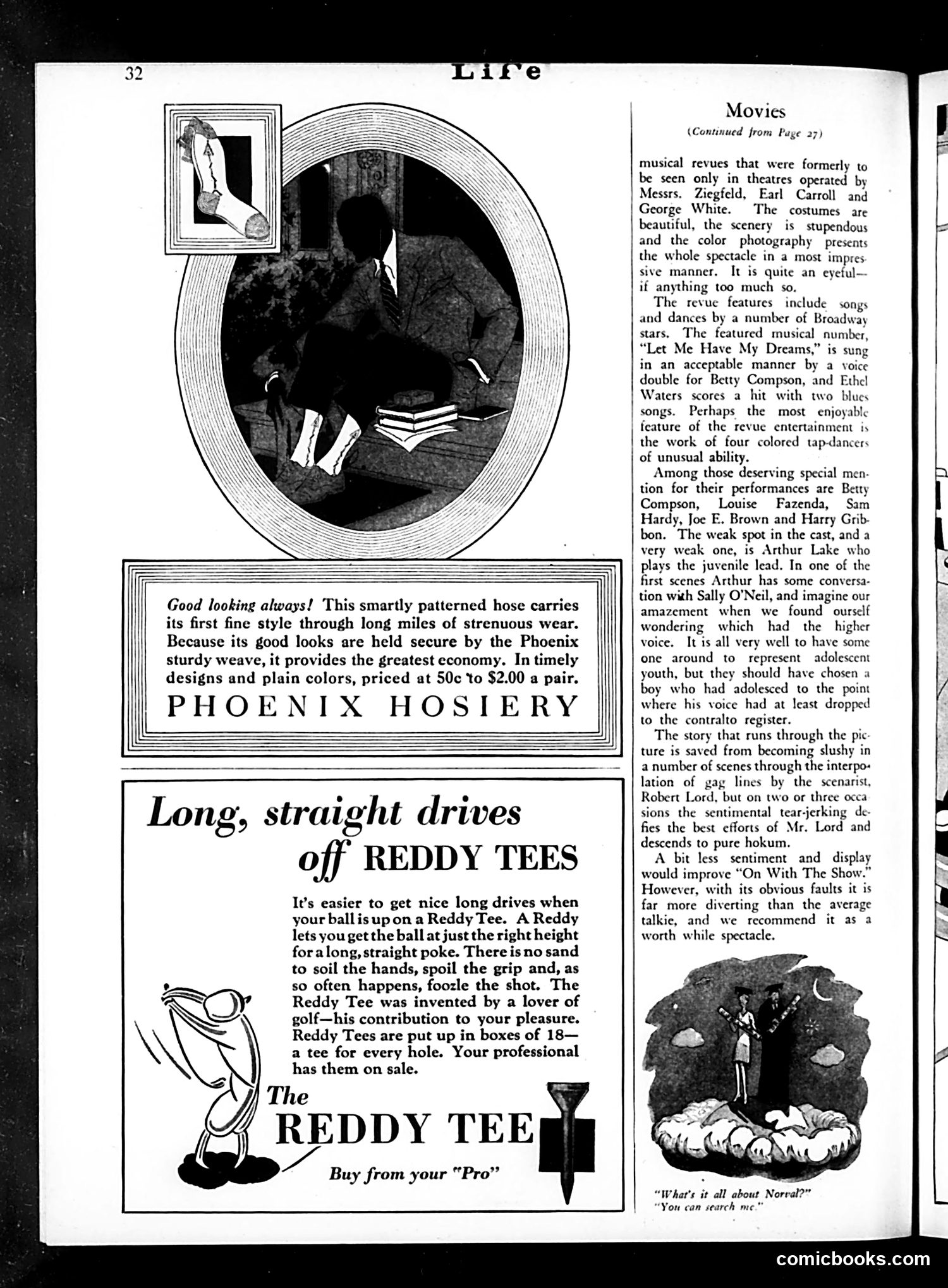
This page is primarily **advertising with a movie review**. The ads promote golf tees and women's hosiery—typical 1920s consumer goods. The small cartoon at bottom right appears to be a joke illustration accompanying the movie review of "On With The Show." The caption—"What's it all about Norval? You can search me"—suggests confusion about the film's plot, likely satirizing the reviewer's critique that the story is weak and sentimental despite entertaining musical numbers. The main movie review criticizes the talkie (early sound film) for relying too heavily on sentimentality and "pure hokum," though it praises the costumes, scenery, tap-dancers, and performances by Betty Compson and Ethel Waters. The reviewer particularly mocks Arthur Lake's casting as juvenile lead, joking his voice hadn't adequately deepened. The cartoon reinforces this satirical tone—characters literally cannot understand what the movie is about.
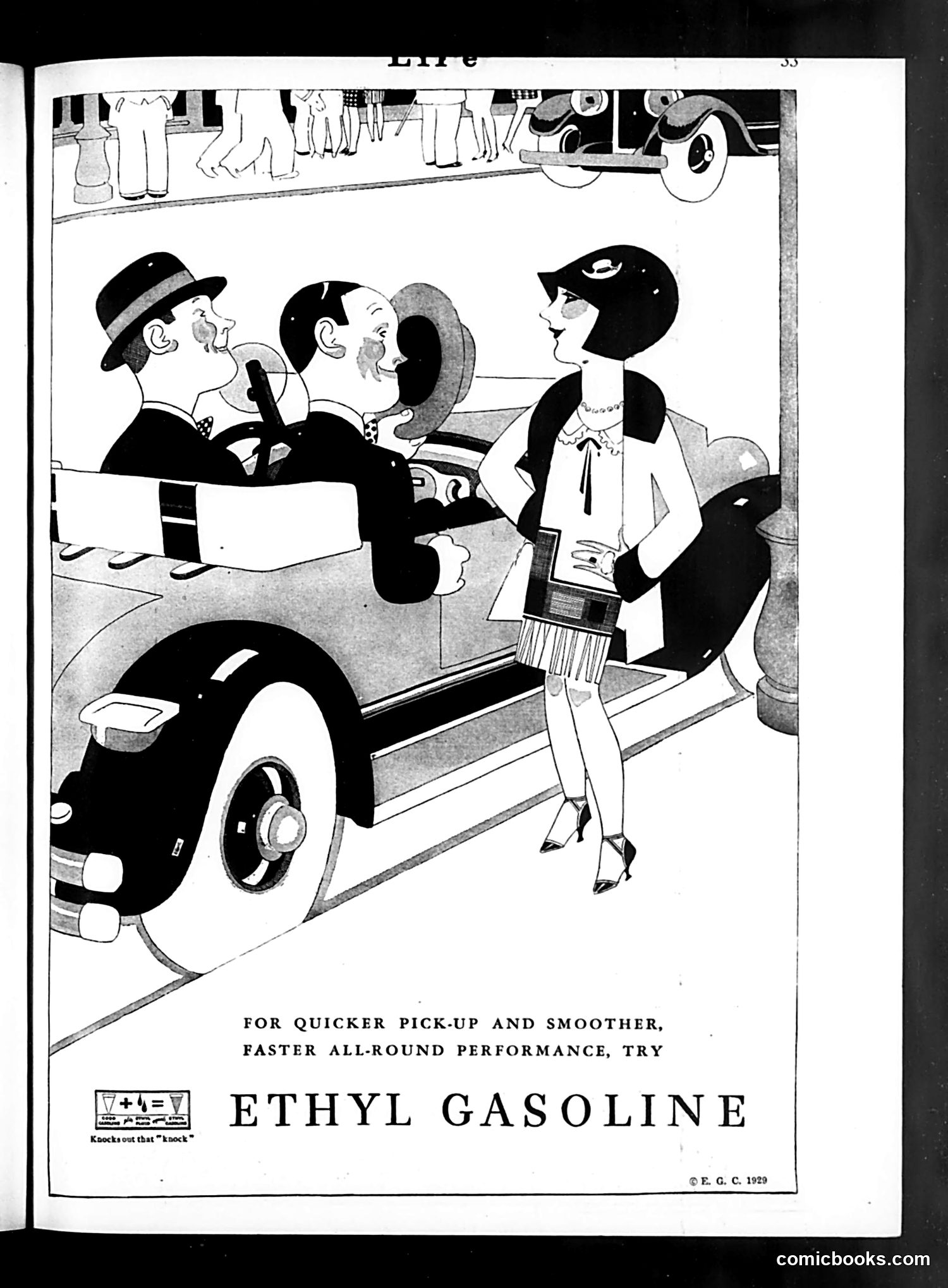
This is a 1920s advertisement for Ethyl gasoline, a premium fuel product. The illustration shows a fashionable woman in 1920s attire (cloche hat, short skirt, heels) standing beside a luxury automobile, conversing with two well-dressed men inside the car. The ad uses aspirational imagery typical of the era: the elegant woman, expensive vehicle, and well-groomed passengers suggest that using Ethyl gasoline signifies sophistication and modernity. The marketing pitch emphasizes performance benefits ("quicker pick-up," "faster all-round performance"). Historically, Ethyl gasoline contained tetraethyl lead as an anti-knock additive—a practice later banned for health and environmental reasons. The advertisement reflects early automotive advertising's focus on luxury association rather than safety information.
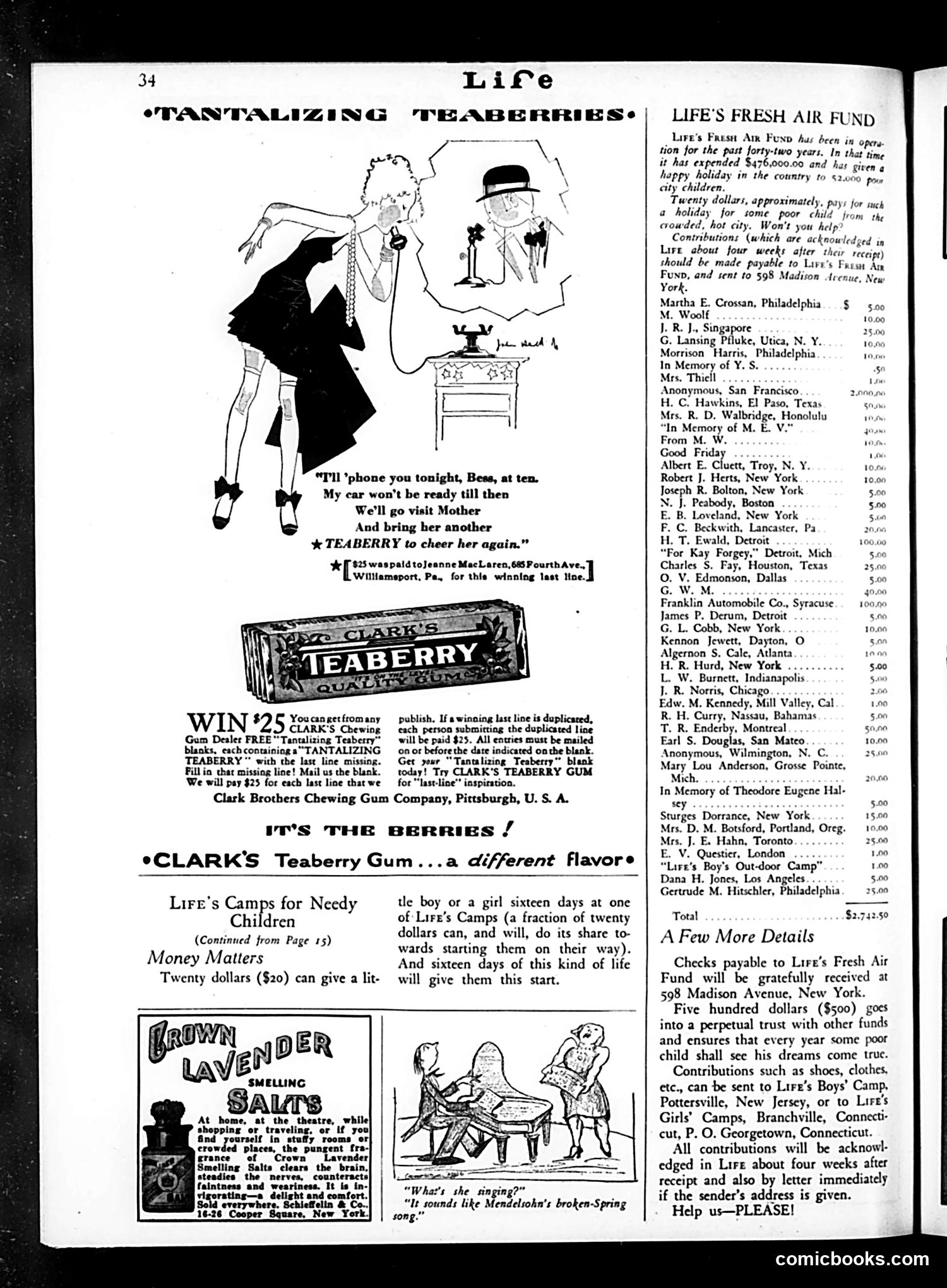
This page showcases **Clark's Teaberry Gum's advertising campaign**, not political satire. The cartoon depicts a young man phoning his date "Bess," promising to visit her mother and bring her teaberry gum as a gift—a light romantic scenario typical of 1920s advertising humor. The joke hinges on **teaberry gum as a courtship aid**: the product is presented as charming enough to impress both the girlfriend and her mother. The gum contest invites readers to complete the final line ("& TEABERRY to cheer her again") for a $25 prize—a significant sum in this era. The page also features **Life's Fresh Air Fund**, a genuine charitable initiative providing poor city children countryside vacations. The list shows contributor names and donation amounts, demonstrating the magazine's philanthropic mission alongside commercial advertising. The "broken-Spring song" reference appears to be unrelated satirical cartoon filler, though context is unclear from this page alone.
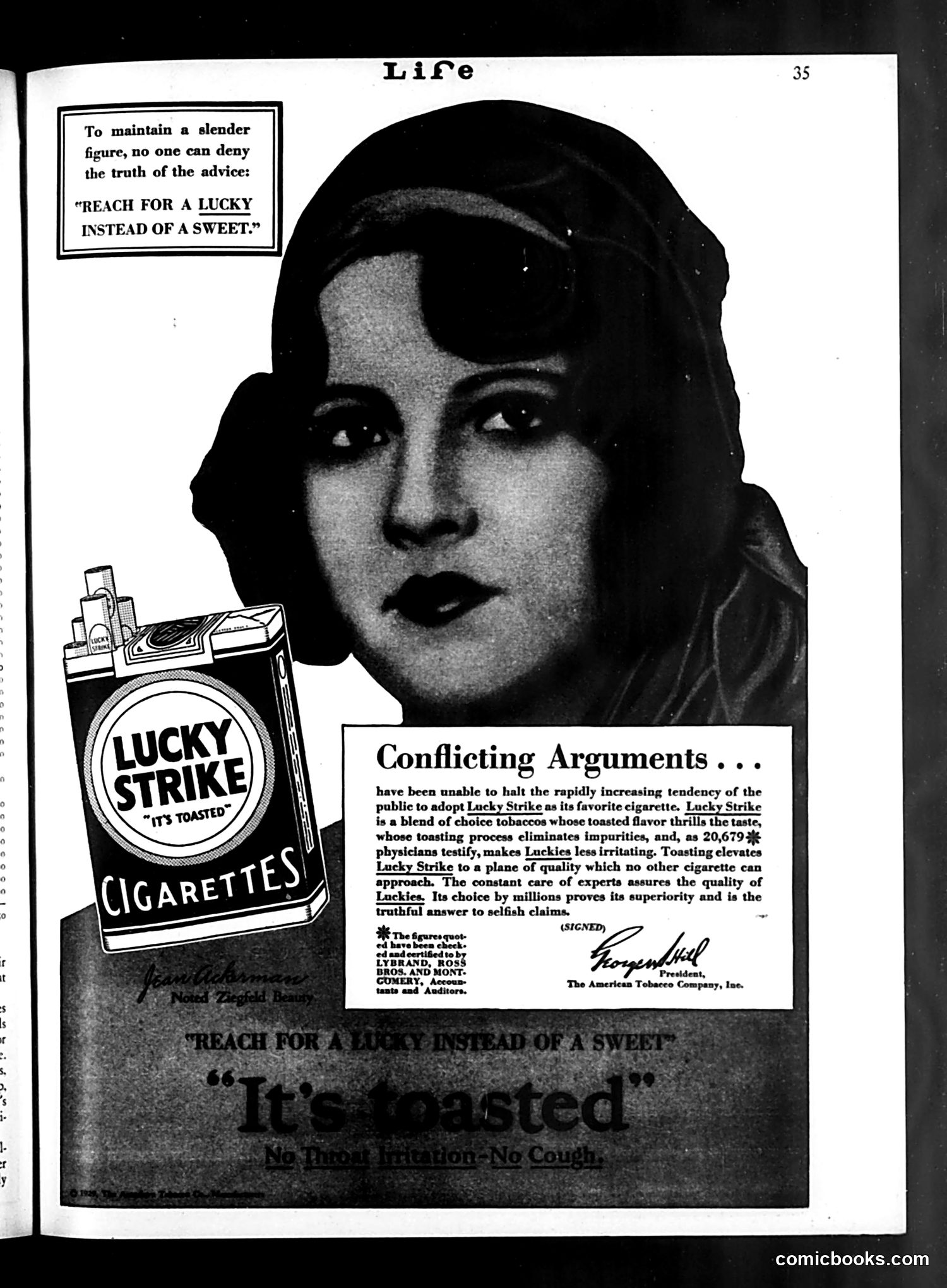
This is a **cigarette advertisement**, not political satire. The page promotes Lucky Strike cigarettes using the slogan "Reach for a Lucky Instead of a Sweet"—a marketing strategy positioning smoking as an alternative to candy consumption for weight-conscious women. The advertisement includes: - A glamorous woman's photograph emphasizing beauty and slenderness - Claims that Lucky Strikes are "toasted" and therefore less irritating - A false appeal to authority: "20,679 physicians testify" to health benefits - Dismissal of "conflicting arguments" against smoking For modern readers, this is shocking because it **openly markets cigarettes as a health and weight-loss product**. The "physicians testify" claim is particularly egregious—such health assertions would be illegal today. The gendered marketing (targeting women's vanity about figure) reflects mid-20th century advertising tactics that exploited social anxieties about appearance. This document exemplifies why tobacco advertising became heavily regulated.
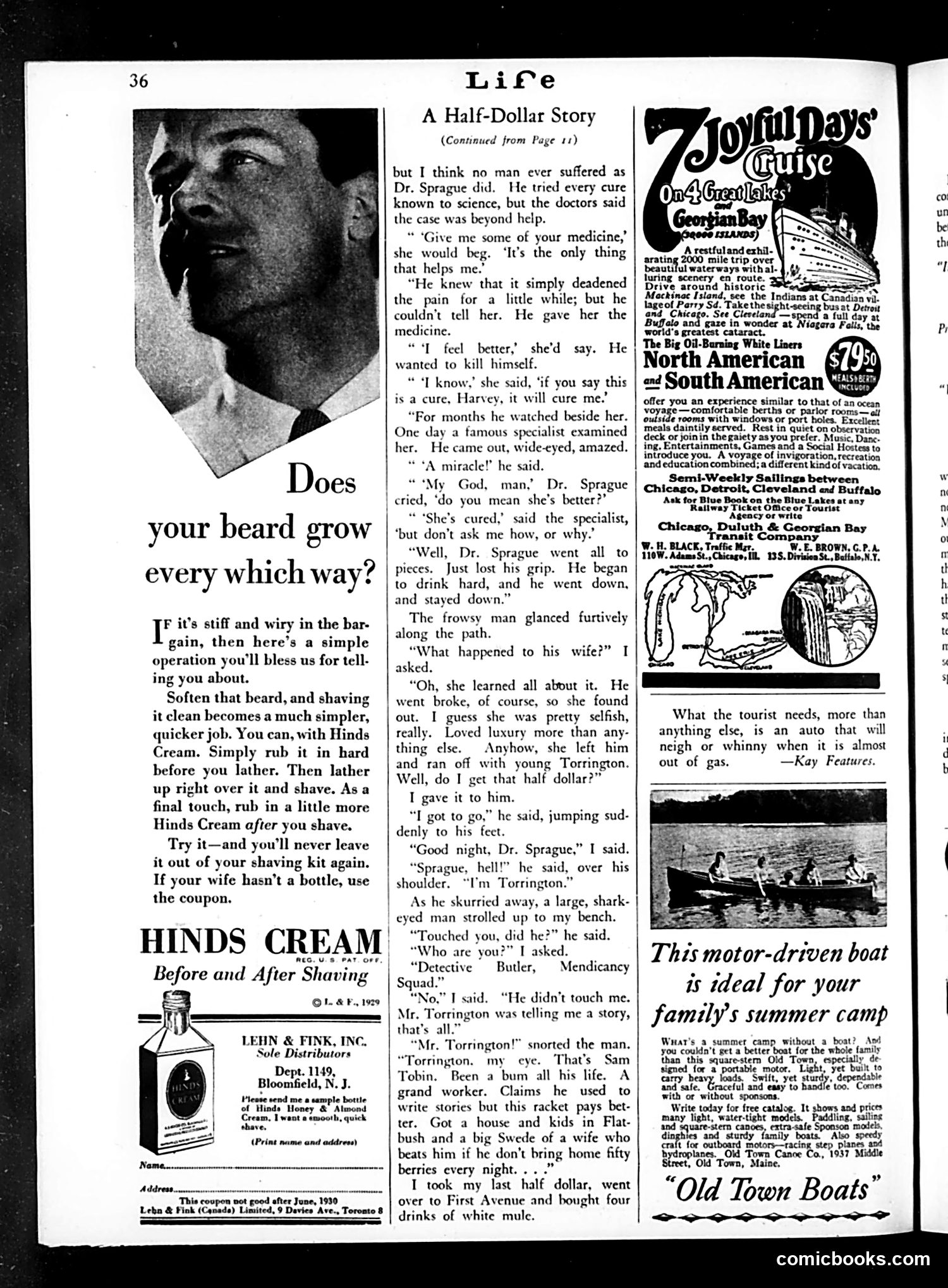
This page contains two distinct elements: **Left side:** A Hinds Cream shaving product advertisement featuring before-and-after imagery of a man's face, promoting the cream as a solution for coarse, unruly beards. This is straightforward 1920s-era grooming advertising with no satirical content. **Right side:** A serialized story titled "A Half-Dollar Story" (continued from page 11). The narrative presents a con artist's elaborate tale: a doctor claims his wife was mysteriously cured of illness, but the final twist reveals the storyteller is actually "Sam Tobin," a professional beggar/con man working the "Mendicancy Squad" racket. He fabricated the entire emotional narrative—complete with false identity "Torrington"—to extract money from the narrator. The story illustrates Depression-era urban hustling and the gullibility of charitable listeners. The page also contains travel advertisements for cruise lines and motor boats, typical of Life magazine's commercial content from this period.
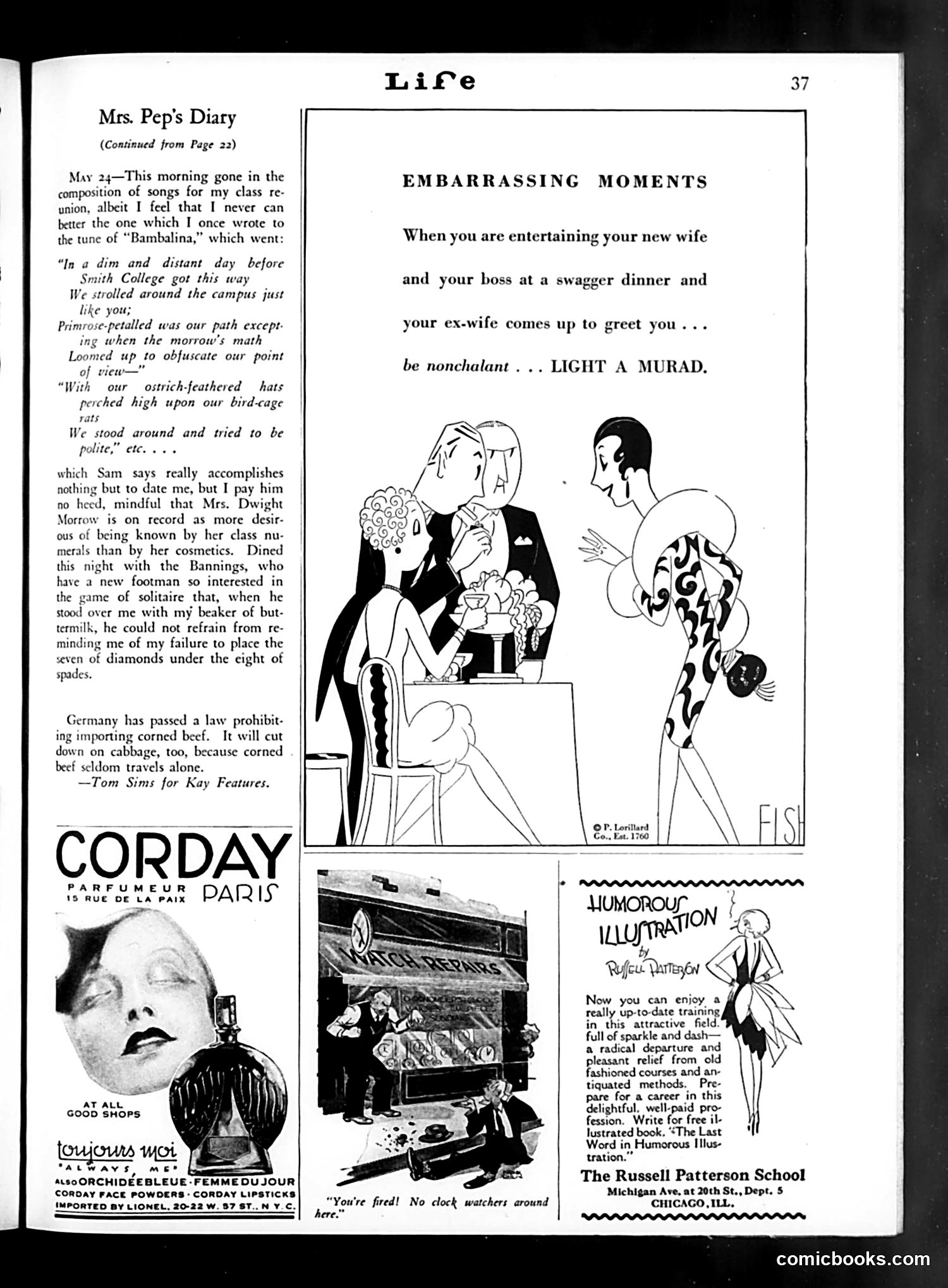
This cartoon satirizes male social anxiety in the 1920s. The scenario depicts a man entertaining his new wife and boss at a formal dinner when his ex-wife suddenly appears to greet him. The joke's "solution"—lighting a Murad cigarette to appear nonchalant—is pure advertising satire: smoking supposedly provides masculine composure in an awkward social situation. The cartoon mocks both the anxious husband (caught between current and former spouses) and the absurd advertising claim that a cigarette brand can resolve genuine social embarrassment. The illustration shows the ex-wife approaching while the new wife and boss remain at the dinner table, creating maximum comedic tension. This reflects 1920s attitudes about divorce being scandalous enough to cause real social discomfort, while also poking fun at how period advertising promised products could solve any social problem through a veneer of sophistication.
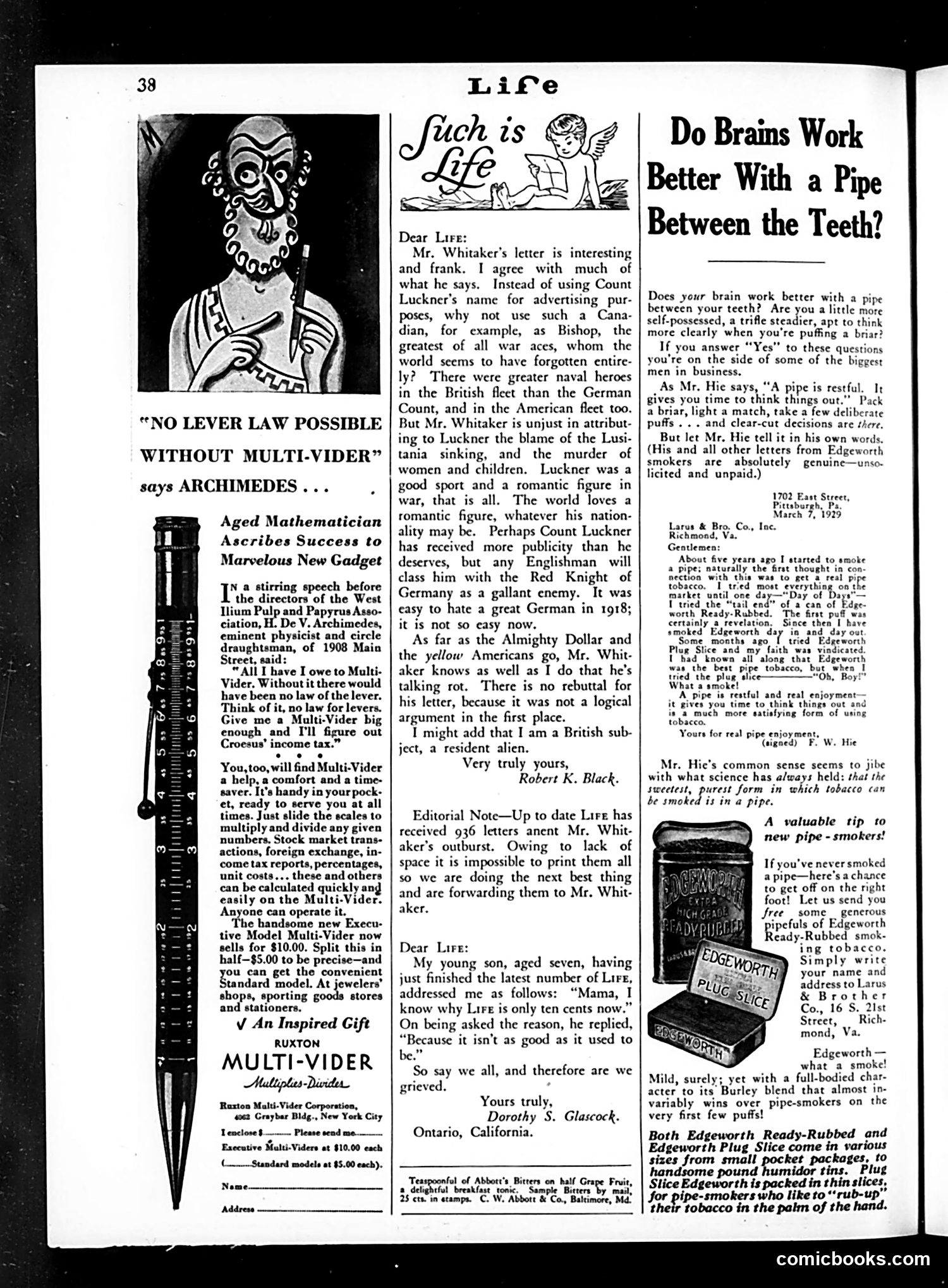
This page combines advertisements with reader letters about recent Life magazine content. **The Main Advertisement** features the "Multi-Vider," a pocket-sized mechanical calculator. The ad humorously attributes its invention to Archimedes, using pseudo-classical rhetoric ("No lever law possible without Multi-Vider") to satirize over-the-top advertising claims. The joke mocks contemporary business advertising's tendency to exaggerate product importance. **The Letters Section** discusses a previous article about Count Felix von Luckner, a German naval raider from WWI. Readers debate whether Life should feature this "romantic" enemy figure or promote Canadian war heroes instead. This reflects post-WWI tensions—the audience remains conflicted about celebrating former enemies. **The Pipe Smoking Article** poses whether smoking aids cognition, appealing to businessmen's vanity. The page's overall tone is satirical, gently mocking both commercial excess and lingering war-era attitudes.
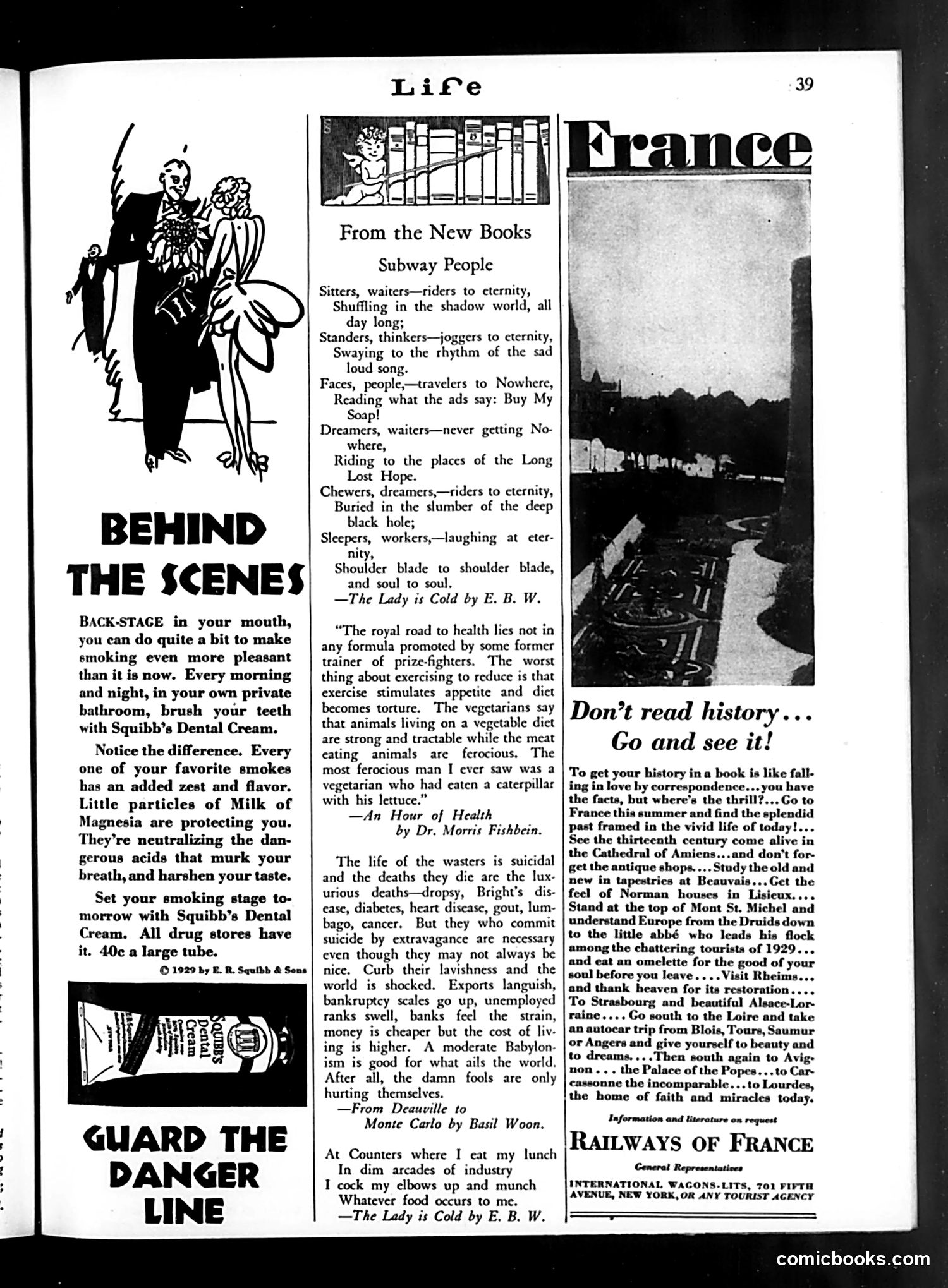
This page mixes advertising with social commentary typical of Life magazine's satirical approach. **"Behind the Scenes"** is a Squibb's Dental Cream advertisement dressed up as lifestyle advice—promoting tooth-brushing to enhance smoking enjoyment. The irony is deliberate: the ad acknowledges smoking's harmful effects ("dangerous acids," "harshen your taste") while selling a product that enables continued smoking. **"Guard the Danger Line"** appears to be an anti-smoking message, though the exact meaning is unclear from context alone. The literary excerpts mock various contemporary obsessions: "Subway People" presents urban commuters as spiritually dead; the health piece sardonically defends "moderate Babylonism" (luxury/excess); another mocks pretentious dieting advice. **The France travel advertisement** promises authentic historical experience as superior to reading—positioning tourism as the modern alternative to book-learning. The page exemplifies 1929 Life's formula: juxtaposing ads with satirical commentary that gently mocked consumer culture while still profiting from it.
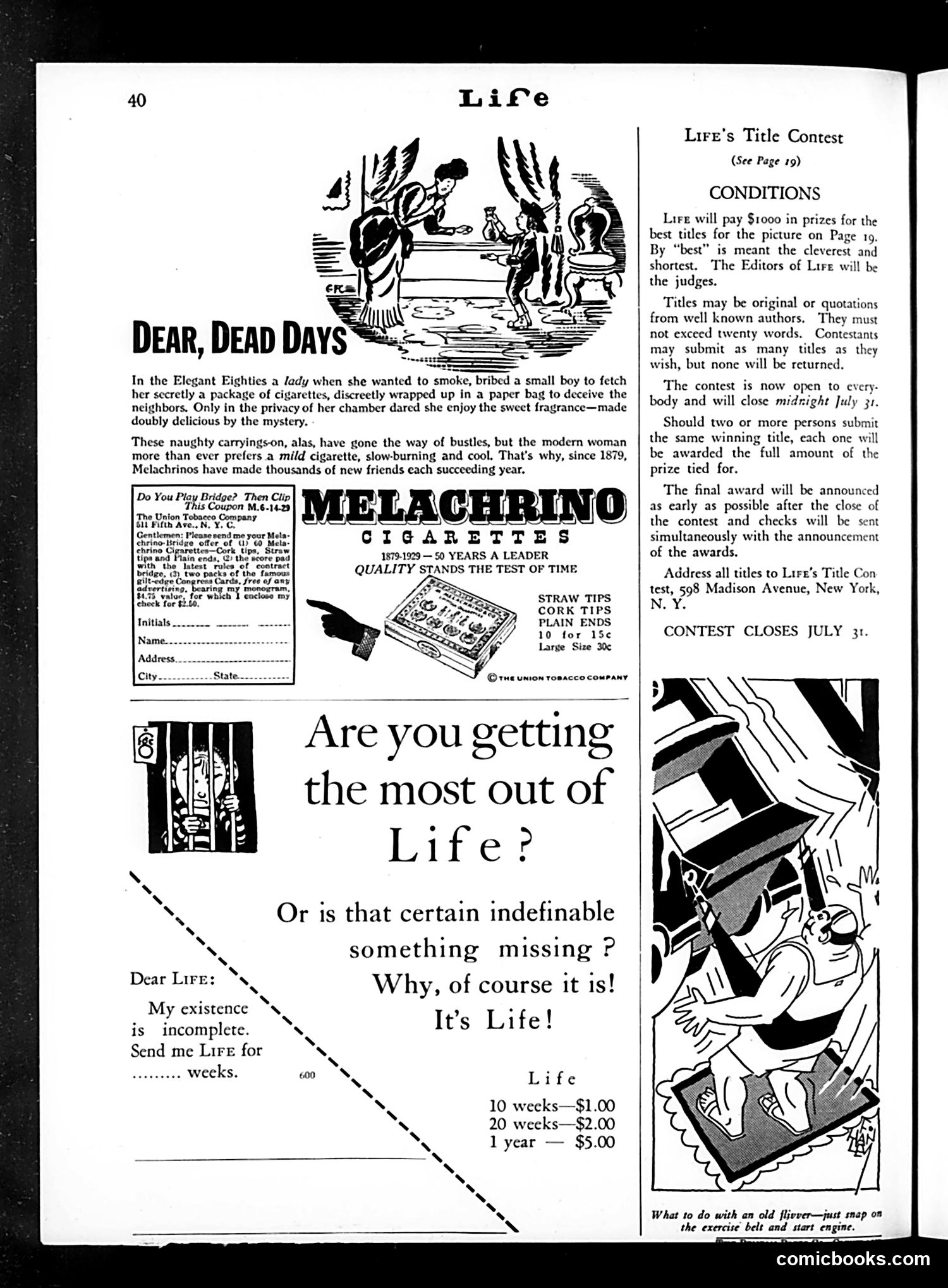
This page blends advertising with light social satire typical of 1920s Life magazine. The "Dear, Dead Days" article satirizes changing social norms around women smoking. It nostalgically contrasts the 1880s, when ladies had to secretly bribe boys to fetch cigarettes hidden in paper bags, with the modern era where women openly prefer mild cigarettes. The Melachrino cigarette ad leverages this commentary, marketing "mild" cigarettes as modern and sophisticated. The main cartoon jokes about Life magazine's indispensability—asking readers if they're "getting the most out of Life?" It plays on the dual meaning: Life as the magazine versus life itself. The subscription rates ($1-$5) suggest the magazine is essential to a complete existence. A smaller cartoon (bottom right) shows a humorous "fix" for an old car ("flivver")—attaching an exercise belt to the engine as if it needs fitness. The page also announces Life's title-writing contest ($1000 prize) for a picture on page 19, which readers cannot see here.
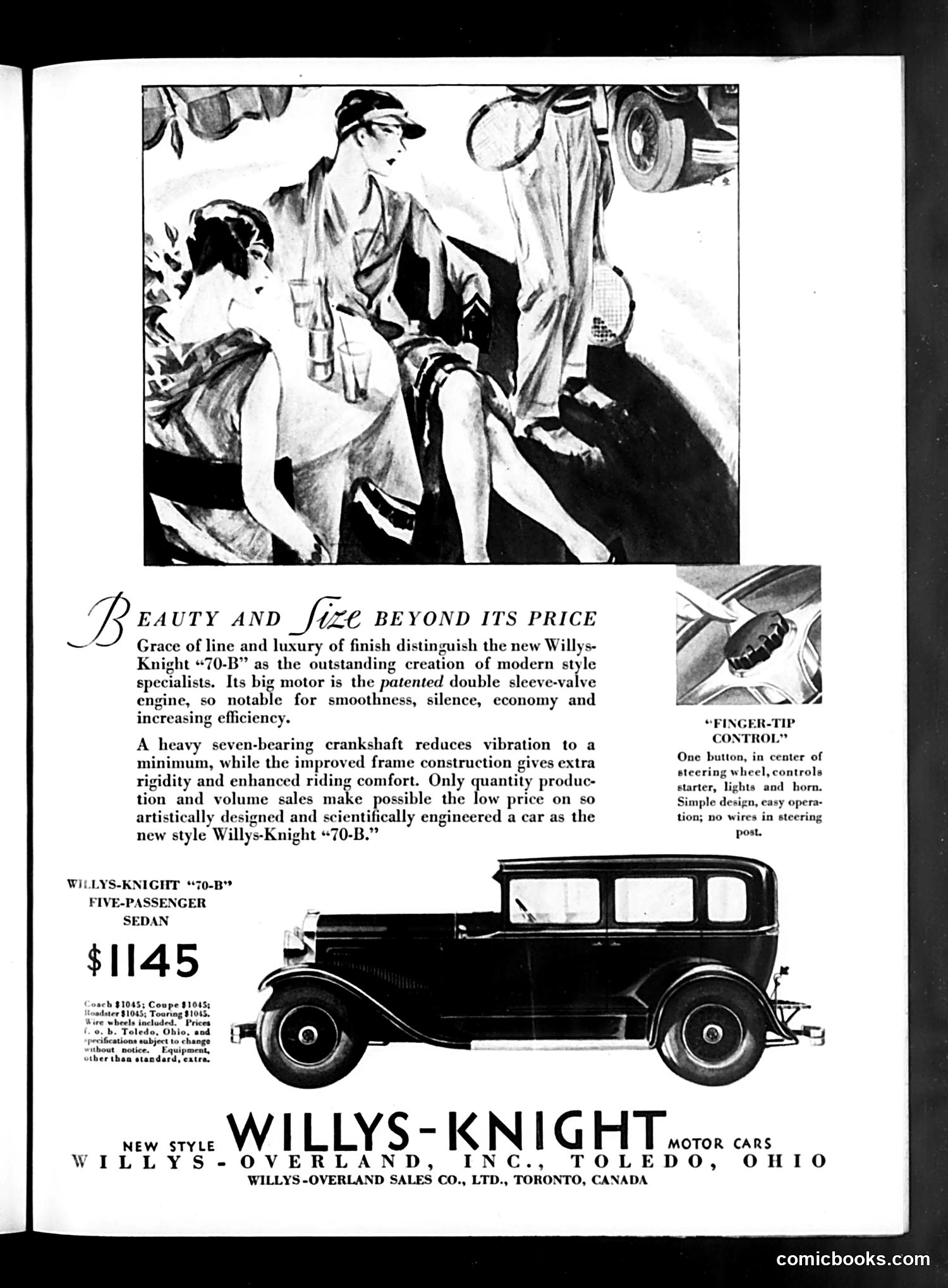
This is a **car advertisement**, not political satire. The page promotes the Willys-Knight "70-B" sedan at $1145. The illustration depicts stylish 1920s figures—a woman and man in fashionable attire—lounging near the automobile, emphasizing luxury and modernity. The "beauty and size beyond its price" headline targets affluent consumers seeking elegance at reasonable cost. Technical copy highlights the patented double sleeve-valve engine, seven-bearing crankshaft, and "finger-tip control" (one-button starter)—innovations positioning this as a scientifically engineered vehicle. The sidebar detail about simplified steering controls appeals to drivers seeking ease of operation. The side-profile illustration of the actual car emphasizes its streamlined design. Manufacturing details ("quantity production and volume sales") justify the relatively affordable price for such craftsmanship. This represents typical 1920s automotive advertising: combining aspirational lifestyle imagery with technical specifications to market cars to the growing middle-class consumer market.
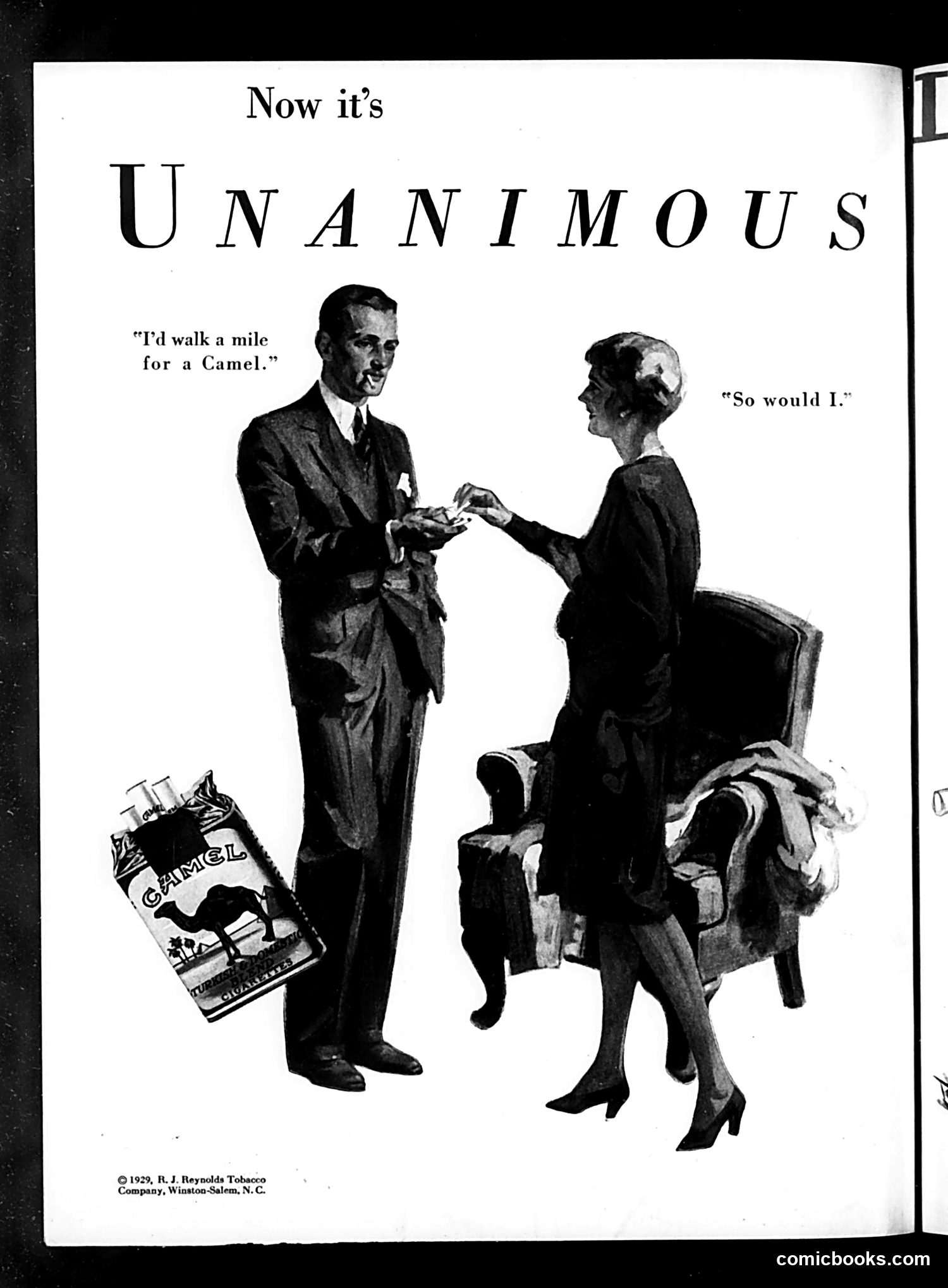
This is a 1929 Camel cigarette advertisement using satire. Two well-dressed figures (a man and woman) exchange the famous Camel slogan "I'd walk a mile for a Camel," with the woman agreeing "So would I." A Camel cigarette pack sits prominently in the lower left. The satire targets the slogan's absurdity by presenting universal agreement—hence "UNANIMOUS"—suggesting the phrase has become so culturally pervasive that even skeptics accept it. The ad exploits this mock-earnestness to reinforce brand loyalty through humor. The 1929 copyright confirms this predates modern health warnings, when cigarette advertising freely used humor and celebrity endorsement tactics to normalize smoking across all demographics, including women—relatively novel at that time.