
Life, 1929-06-14 · page 13 of 44
Life — June 14, 1929 — page 13: what you’re looking at
What you’re looking at
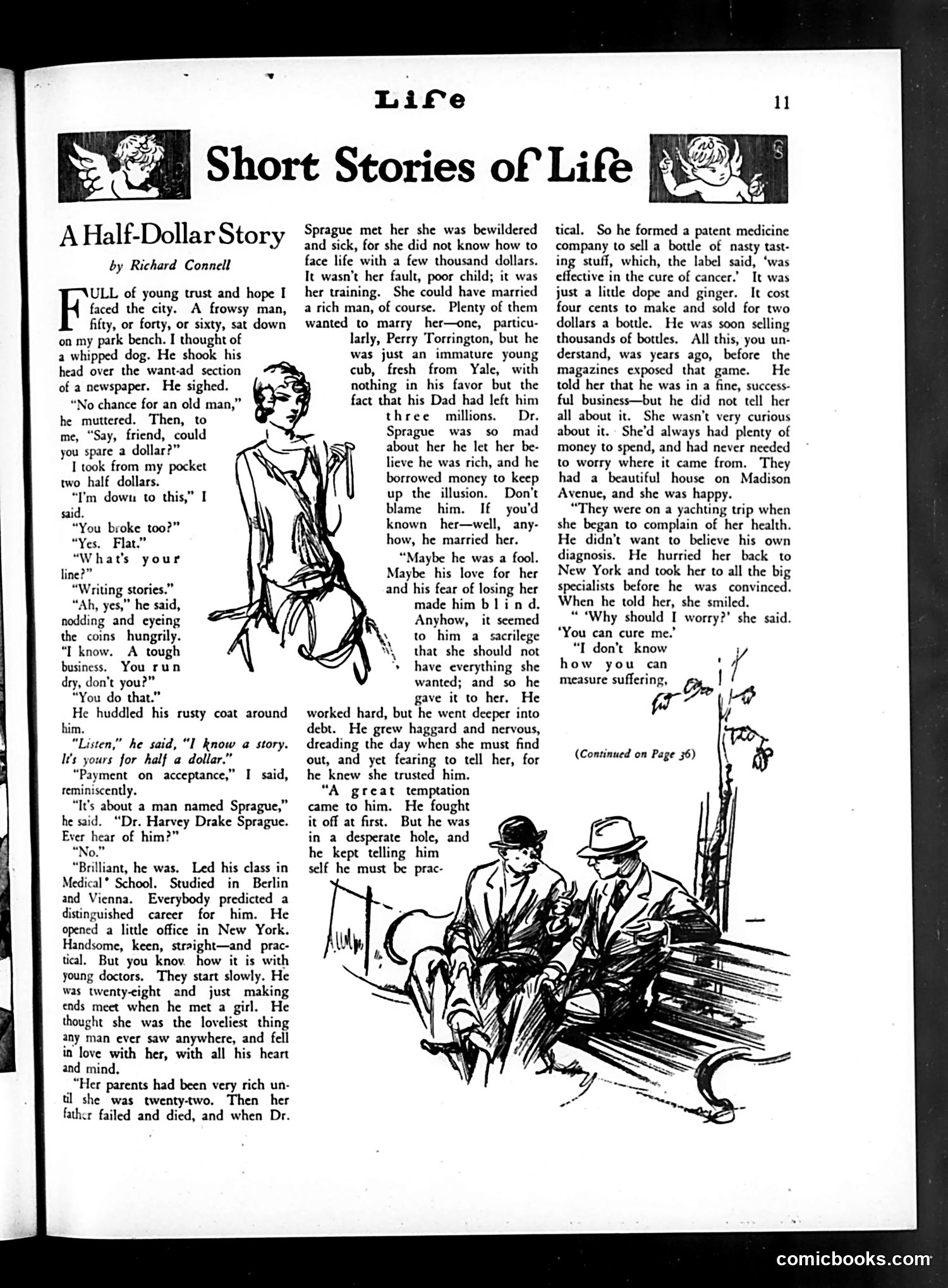
This page presents a short story rather than political satire. The narrative, illustrated with sketch-style drawings, tells of a young, idealistic man who meets a street hustler offering to share a story for fifty cents. The hustler then recounts the tale of Dr. Sprague, a brilliant medical student who fell in love with a wealthy woman, married her despite his modest circumstances, and subsequently struggled financially while she suffered health issues. The story explores themes of love, ambition, poverty, and sacrifice common to early 20th-century American fiction. There is no apparent political cartoon or satirical commentary visible—this is purely a serialized short story (noted as "Continued on Page 36"), typical of *Life* magazine's regular literary content alongside its famous humor and social commentary.
📄 Transcribed text from this page (OCR, searchable)
Machine-transcribed from the original scan — historical spelling and the odd misread are preserved.
Short Stories of Life AHalf-Dollar Story by Richard Connell ULL of young trust and hope I Fe the city. A frowsy man, fifty, or forty, or sixty, sat down on my park bench. I thought of a whipped dog. He shook his head over the want-ad section of a newspaper. He sighed. “No chance for an old man,” he muttered. Then, to me, “Say, friend, could you spare a dollar?” I took from my pocket two half dollars. “I'm down to this,” I said. “You broke too?” “Yes. Flat.” your “What's line?” “Writing stories.” “Ah, yes,” he said, nodding and eyeing the coins hungrily. “I know. A tough business. You run dry, don’t you?” “You do that.” He huddled his rusty coat around him. “Listen,” he said, “I know a story. It's yours for half a dollar.” “Payment on acceptance,” I said, teminiscently. “It’s about a man named Sprague,” he said. “Dr. Harvey Drake Sprague. Ever hear of him?” “No.” “Brilliant, he was. Led his class in Medical® School. Studied in Berlin and Vienna. Everybody predicted a distinguished career for him. He opened a little office in New York. Handsome, keen, straight—and_prac- tical. But you knov. how it is with young doctors. They start slowly. He was twenty-eight and just making ends meet when he met a girl, He thought she was the loveliest thing any man ever saw anywhere, and fell in love with her, with all his heart and mind. "Her parents had been very rich un- til she was twenty-two. Then her father failed and died, and when Dr. Sprague met her she was bewildered and sick, for she did not know how to face life with a few thousand dollars. Tt wasn’t her fault, poor child; it was her training. She could have married a rich man, of course. Plenty of them wanted to marry her—one, particu- larly, Perry Torrington, but he was just an immature young cub, fresh from Yale, with nothing in his favor but the fact that his Dad had left him three millions. Dr. Sprague was so mad about her he let her be- lieve he was rich, and he borrowed money to keep up the illusion. Don’t blame him. If you'd known her—well, any- how, he married her. “Maybe he was a fool. Maybe his love for her and his fear of losing her made him b 1 in d. Anyhow, it seemed to him a sacrilege that she should not have everything she wanted; and so he gave it to her. He worked hard, but he went deeper into debt. He grew haggard and nervous, dreading the day when she must find out, and yet fearing to tell her, for he knew she trusted him. “A great temptation came to him. He fought it off at first. But he was in a desperate hole, and he kept telling him e self he must be prac- f ¢\ tical. So he formed a patent medicine company to sell a bottle of nasty tast- ing stuff, which, the label said, ‘was effective in the cure of cancer.” It was just a litte dope and ginger. It cost four cents to make and sold for two dollars a bottle. He was soon selling thousands of bottles. All this, you un- derstand, was years ago, before the magazines exposed that game. He told her that he was in a fine, success- ful business—but he did not tell her all about it. She wasn’t very curious about it. She'd always had plenty of money to spend, and had never needed to worry where it came from. They had a beautiful house on Madison Avenue, and she was happy. “They were on a yachting trip when she began to complain of her health. He didn’t want to believe his own diagnosis. He hurried her back to New York and took her to all the big specialists before he was convinced. When he told her, she smiled. “Why should I worry?’ she said. “You can cure me.’ “I don’t know how you can measure suffering, if ir Pe (Continued on Page 36) ar comicbooks.com