
A complete issue · 36 pages · 1929
Life — May 31, 1929
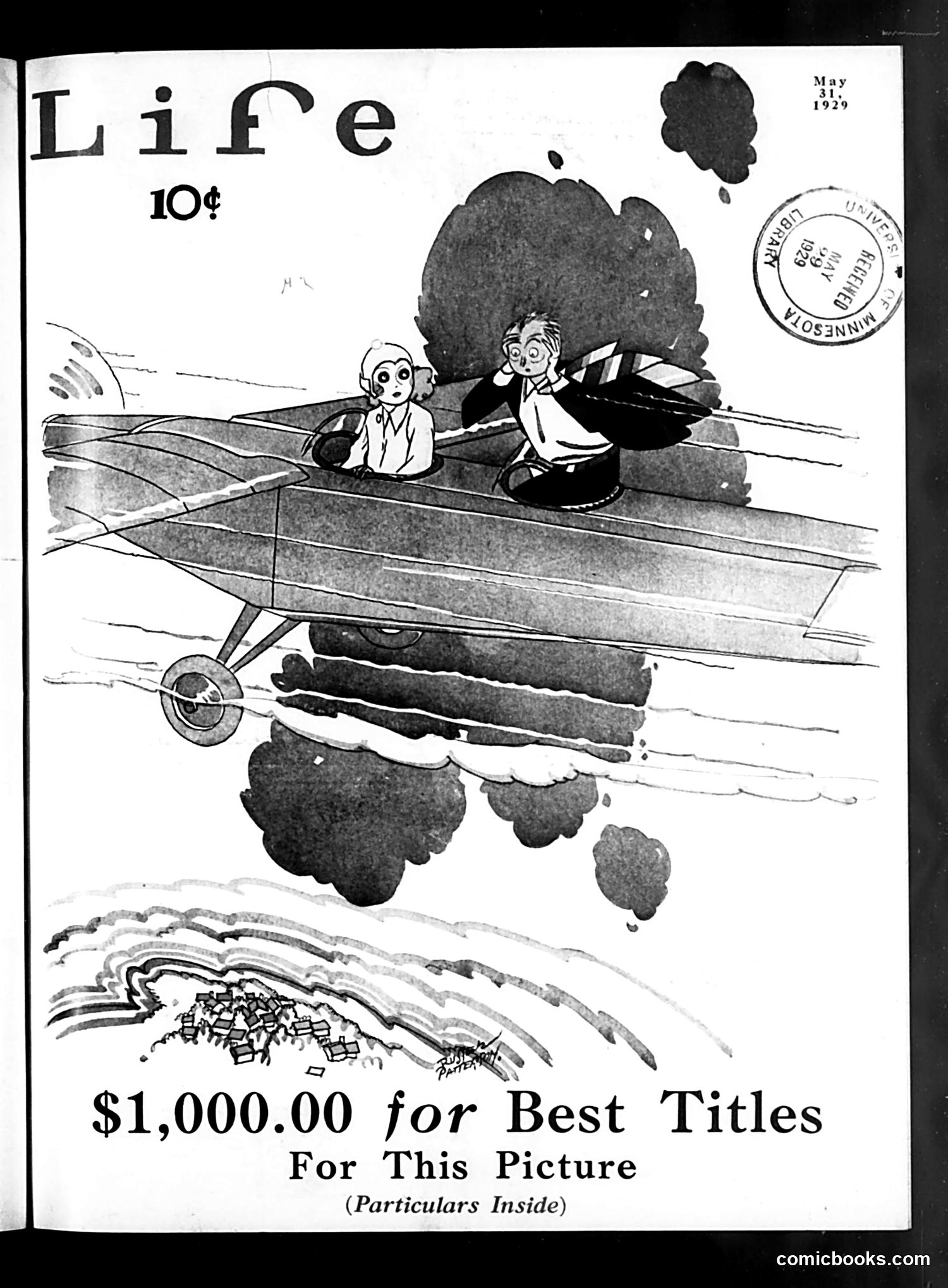
This is a contest page offering $1,000 for the best caption/title for the cartoon. The image shows two figures in an airplane flying through storm clouds above a city or town below. The cartoon appears to satirize early aviation in the late 1920s—a period when commercial and private flight was still novel and risky. The exaggerated, cartoonish style and the figures' expressions suggest anxiety about the dangers of flying. The storm clouds and turbulent scene emphasize the hazardous conditions pilots and passengers faced. This likely reflects public fascination and trepidation about aviation technology during this era, before commercial air travel became routine. The contest format was typical of Life's reader-engagement strategies.
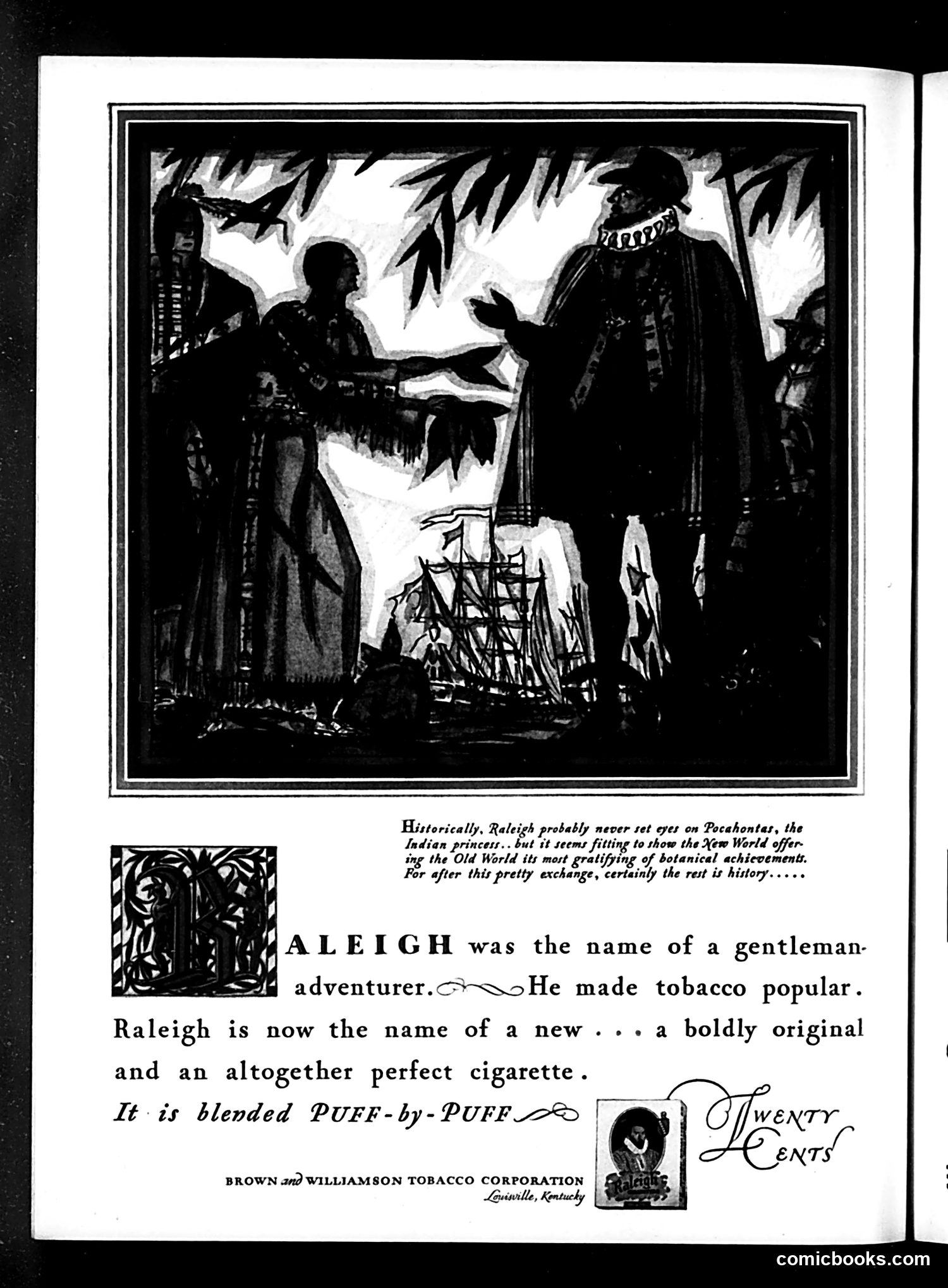
This page is primarily a **cigarette advertisement** for Raleigh brand cigarettes by Brown & Williamson Tobacco Corporation, disguised as historical commentary. The top illustration depicts a silhouetted scene of what appears to be European explorers meeting Native Americans, referencing Sir Walter Raleigh's colonial ventures. The accompanying text humorously suggests Raleigh "probably never set eyes on Pocahontas" but credits him with making tobacco popular. The advertisement plays on Raleigh's historical association with tobacco introduction to Europe, connecting the 16th-century explorer's name to the modern cigarette product. The tagline "blended puff-by-puff" and "twenty cents" price emphasize the product's quality and affordability. This represents early 20th-century advertising strategy: wrapping commercial promotion in entertainment and historical narrative to appeal to readers of *Life* magazine.
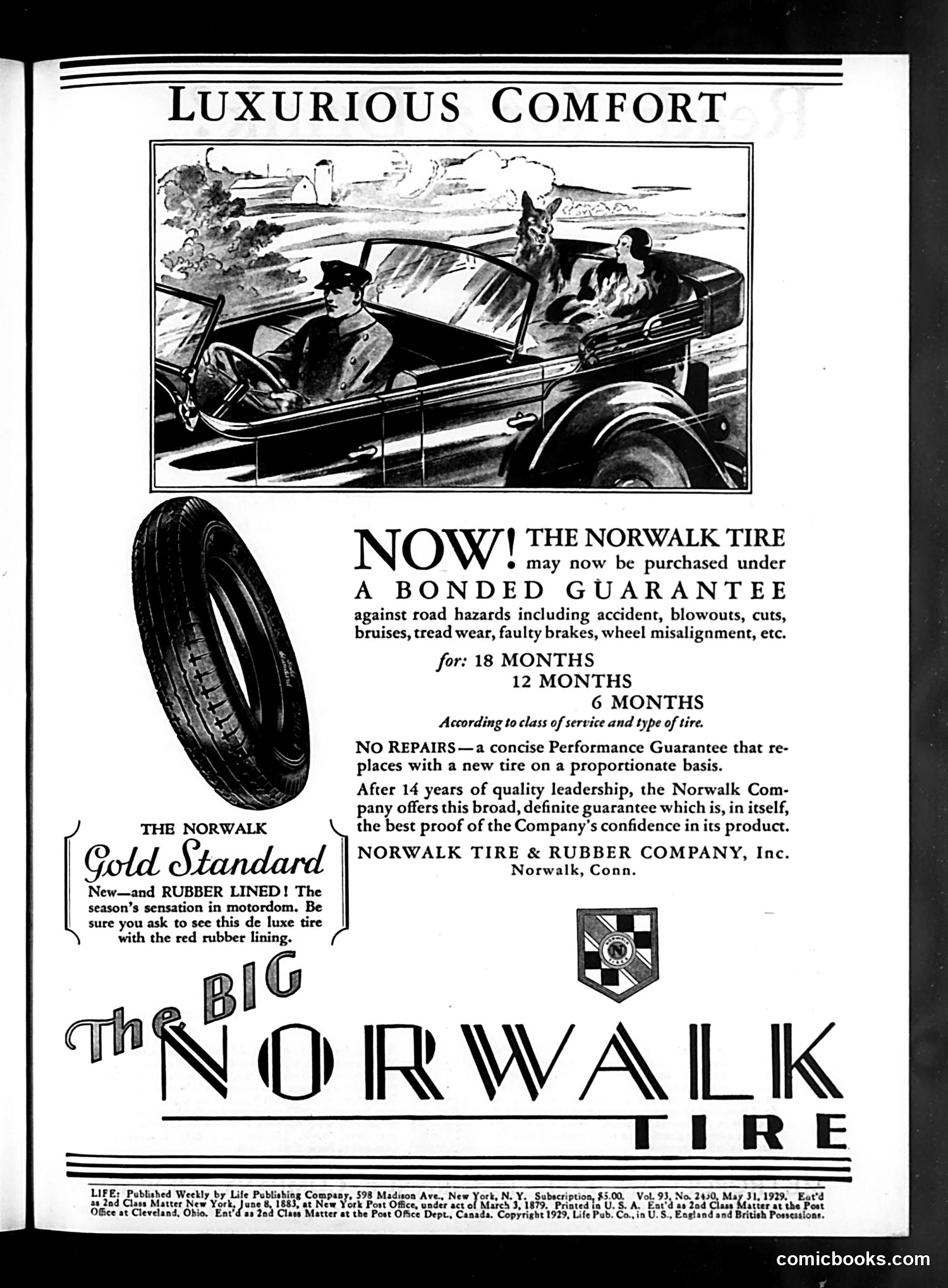
This page is primarily **advertising, not satire or political commentary**. It advertises the Norwalk Tire & Rubber Company's "Gold Standard" tire with a "Bonded Guarantee." The illustration at top shows a man and woman driving a luxury automobile with a dog, emphasizing comfort and leisurely motoring—the "Luxurious Comfort" promised by the product. This aspirational imagery was typical early-20th-century automobile advertising, appealing to wealthy consumers. The guarantee offers coverage for 6, 12, or 18 months against road hazards including blowouts and accidents, with replacement rather than repair. The ad emphasizes the company's "14 years of quality leadership" as proof of confidence in their product. This is straightforward commercial messaging, not political or social satire.
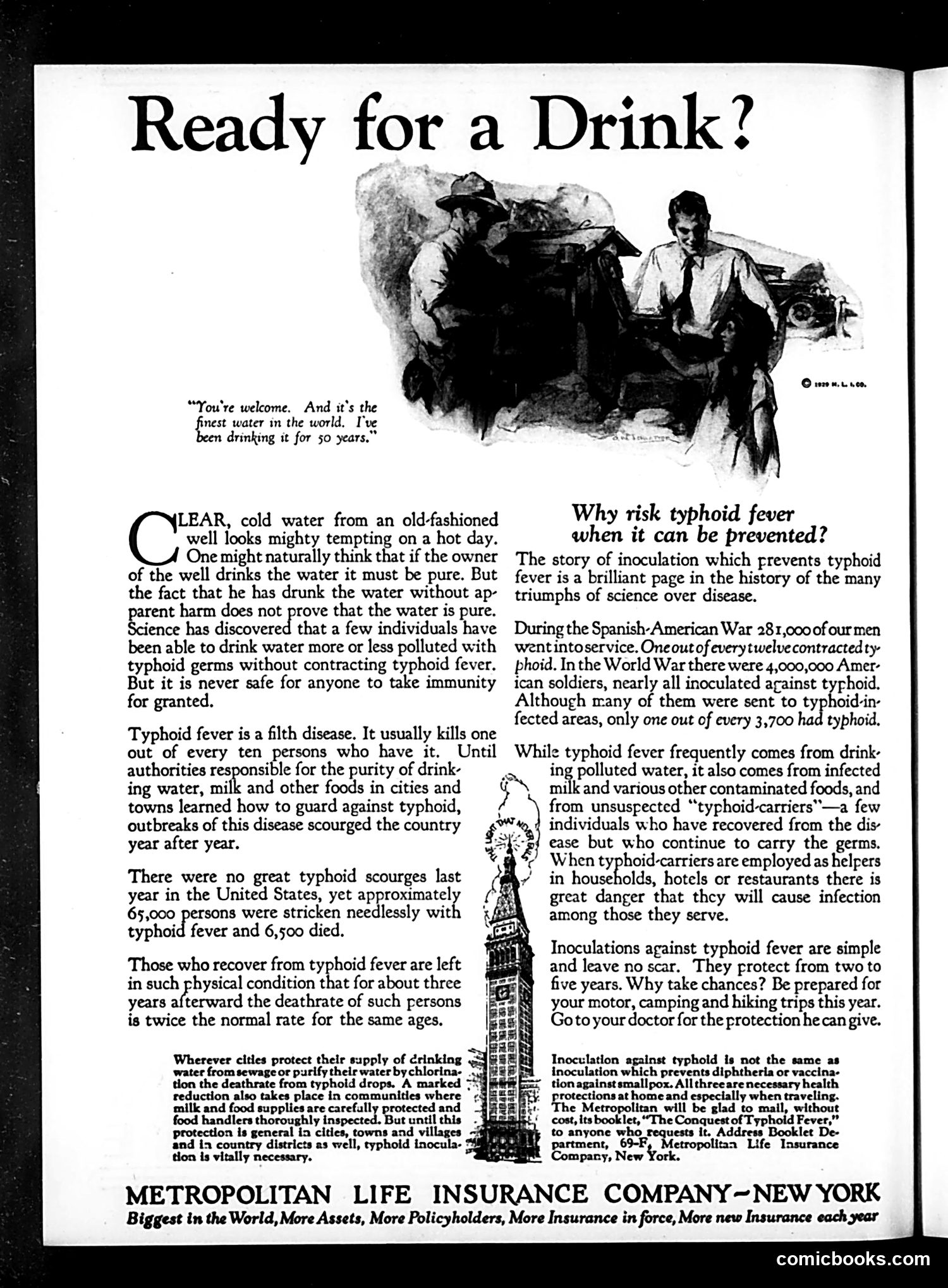
This is primarily a **public health advertisement** by Metropolitan Life Insurance, not satire. The "Ready for a Drink?" headline uses social concern as a hook to promote typhoid vaccination. The illustration depicts men at a well, referencing the common source of typhoid transmission through contaminated water—a genuine public health crisis of the early 20th century. The accompanying text educates readers that typhoid fever kills approximately 1 in 10 victims and that inoculation provides safe protection. The ad cites concrete statistics (281,000 soldiers in Spanish-American War, only 1 in 3,700 inoculated soldiers contracted typhoid) to encourage preventive medicine. Rather than satirical, this represents **earnest health advocacy** disguised within advertising, using insurance company credibility to promote medical best practices during an era of widespread waterborne disease.
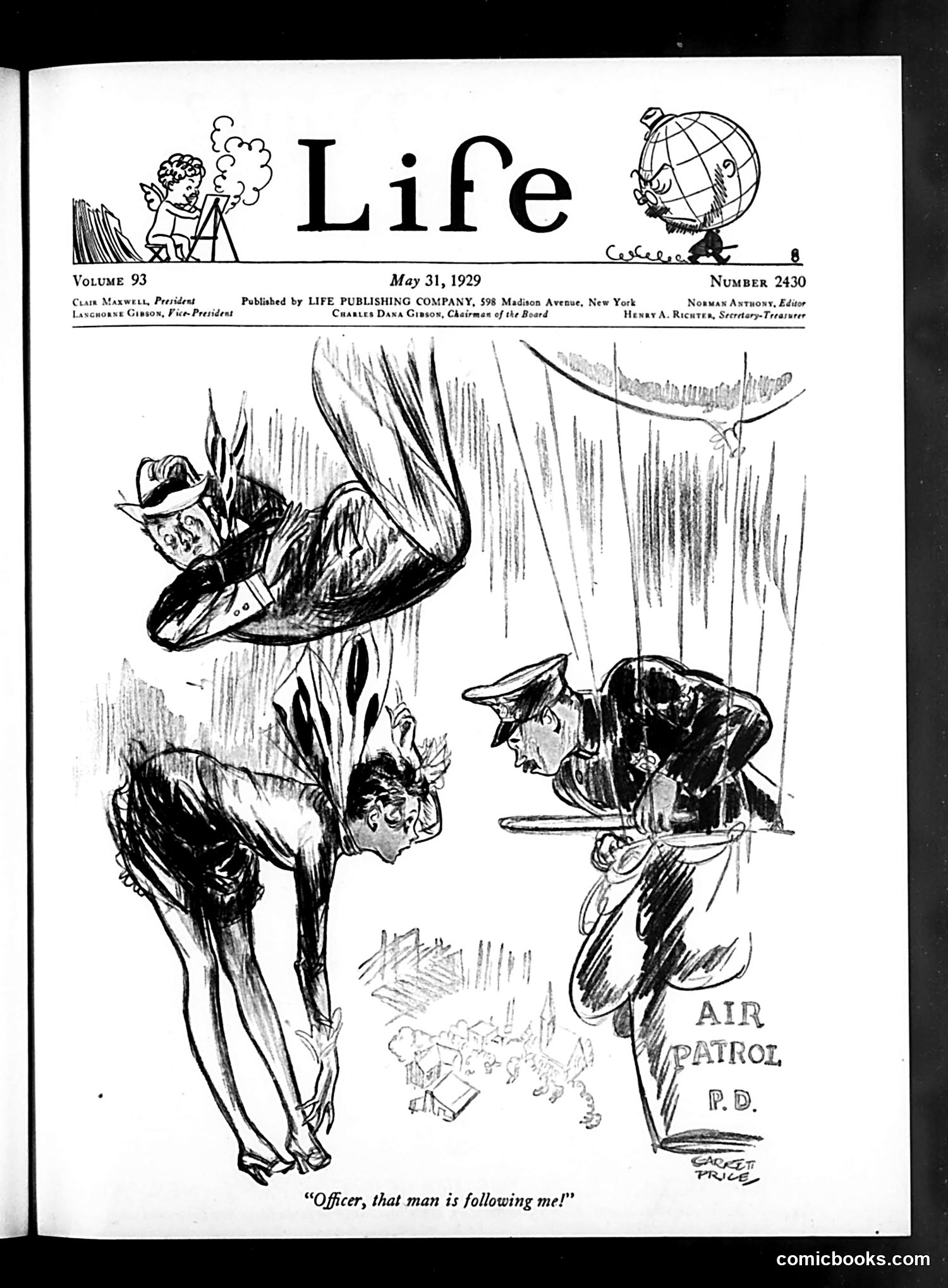
This cartoon depicts an Air Patrol officer chasing a man who appears to be fleeing. The caption reads: "Officer, that man is following me!" The satire likely references **Prohibition enforcement** during the 1920s-early 1930s. The "Air Patrol P.D." (Police Department) suggests aerial surveillance technology being deployed to catch bootleggers or alcohol violators. The ironic humor lies in the pursuer becoming the pursued—suggesting the absurdity or desperation of Prohibition enforcement, or possibly mocking the ineffectiveness of increasingly elaborate police tactics. The sketch's style is typical of Life's satirical commentary on contemporary social policy. The date places this squarely during Prohibition's final years, when enforcement had become notoriously problematic and unpopular.
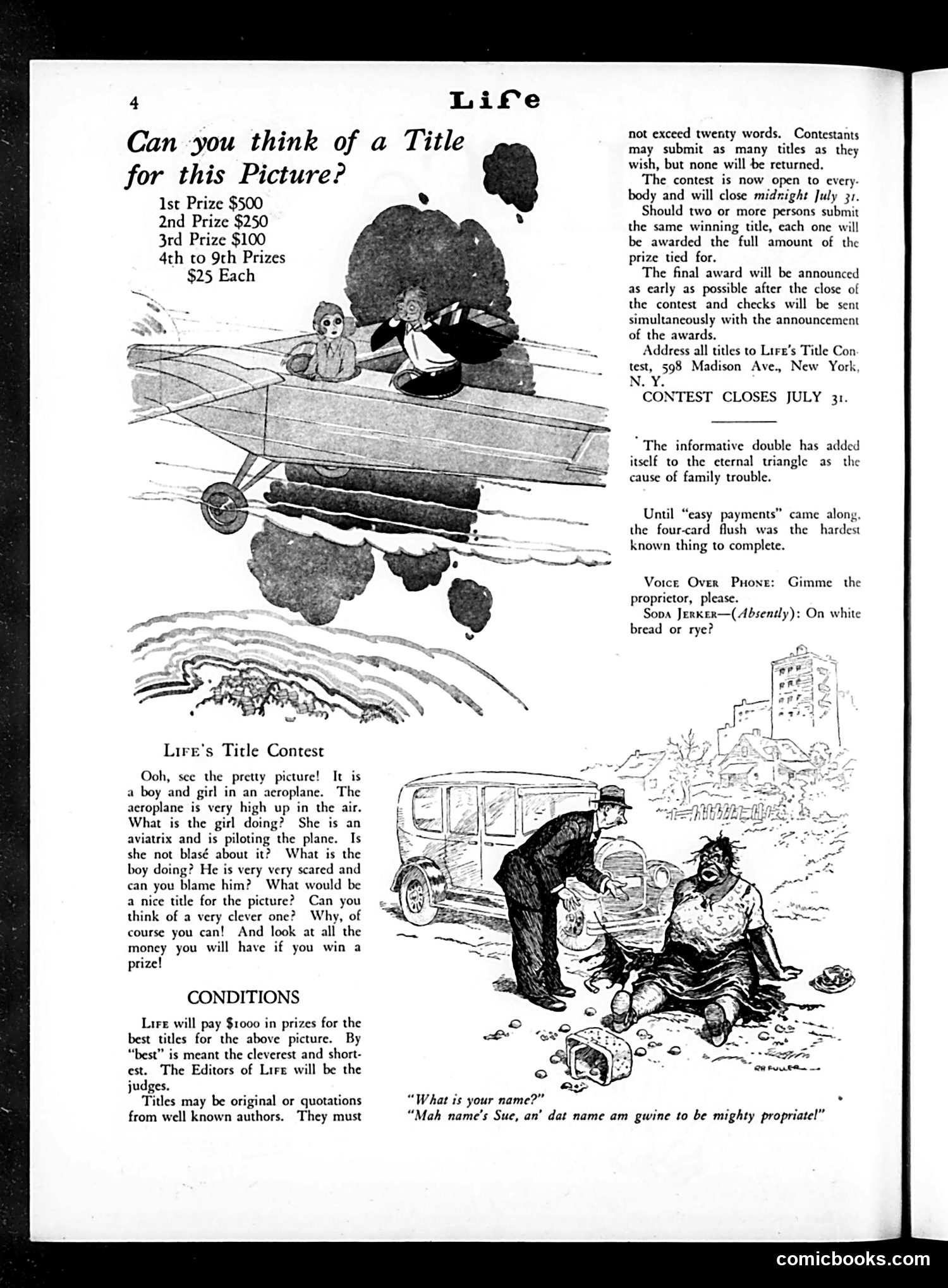
This page contains two separate items: **Top: A Title Contest** for an airplane picture showing a boy and girl in flight. The image depicts an "aviatrix" (female pilot) piloting the plane while a boy appears frightened. Life offers $1000 in prizes for clever titles, reflecting early-20th-century fascination with aviation and the novelty of women pilots. **Bottom: A Social Cartoon** showing a well-dressed man and woman encountering a disheveled person on a city street. The caption—"What is your name?" / "Mah name's Sue, an' dat name am gwine to be mighty propriate!"—relies on racist dialect humor typical of the era. The joke appears to reference class differences and poverty, though the specific meaning is obscured by its offensive stereotyping. Both items reflect Life's satirical approach to contemporary social and technological changes.
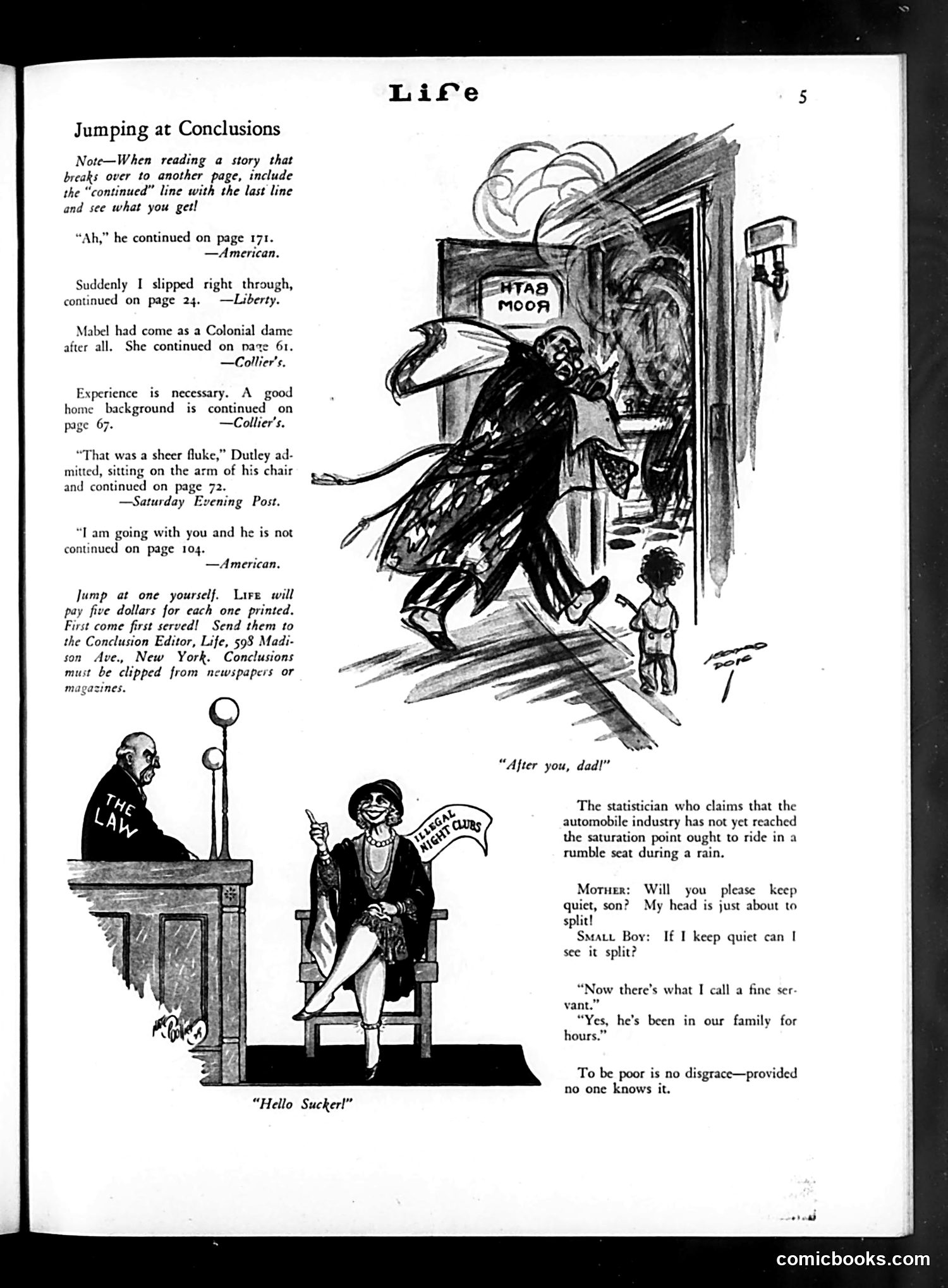
This page contains satirical cartoons and humorous short pieces typical of early 20th-century American humor. **"Hello Sucker!"** (lower left): Shows a woman at a podium labeled "THE LADY" speaking to what appears to be a male audience member, satirizing romantic or financial deception—likely mocking men being fooled by women or dubious schemes. **Top cartoon**: Depicts a witch-like figure at a door labeled "HTAB MOOR" (appears to be "BATH ROOM" reversed), with a small child below saying "After you, dad!" This mocks household chaos or the morning bathroom rush. The page also includes various short jokes and observations about domestic life, automobiles, and class differences, reflecting Life magazine's focus on satirizing contemporary American manners and social pretensions of the era.
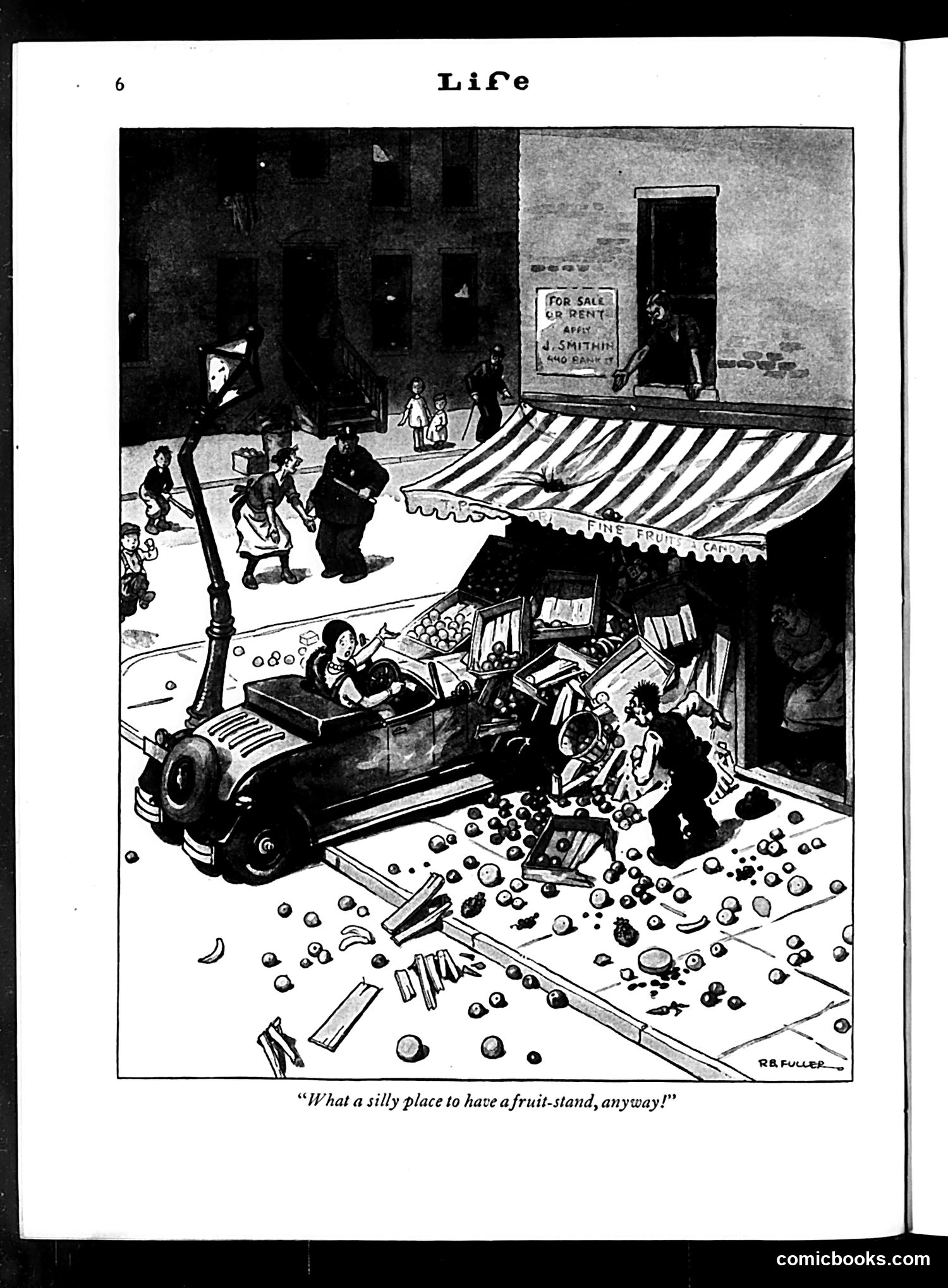
This is a single-panel cartoon by R.B. Fuller showing a car that has crashed through a fruit stand on a city street, scattering produce everywhere. The caption reads: "What a silly place to have a fruit-stand, anyway!" The satire is straightforward: the driver blames the fruit vendor for the accident's location rather than accepting responsibility for reckless driving. It's a commentary on how people deflect blame onto others for preventable mishaps caused by their own negligence or carelessness. The cartoon captures early 20th-century urban street life, with pedestrians, buildings, and a striped market awning visible. The joke relies on the absurdity of the driver's misplaced logic—a timeless satire on personal accountability and poor reasoning.
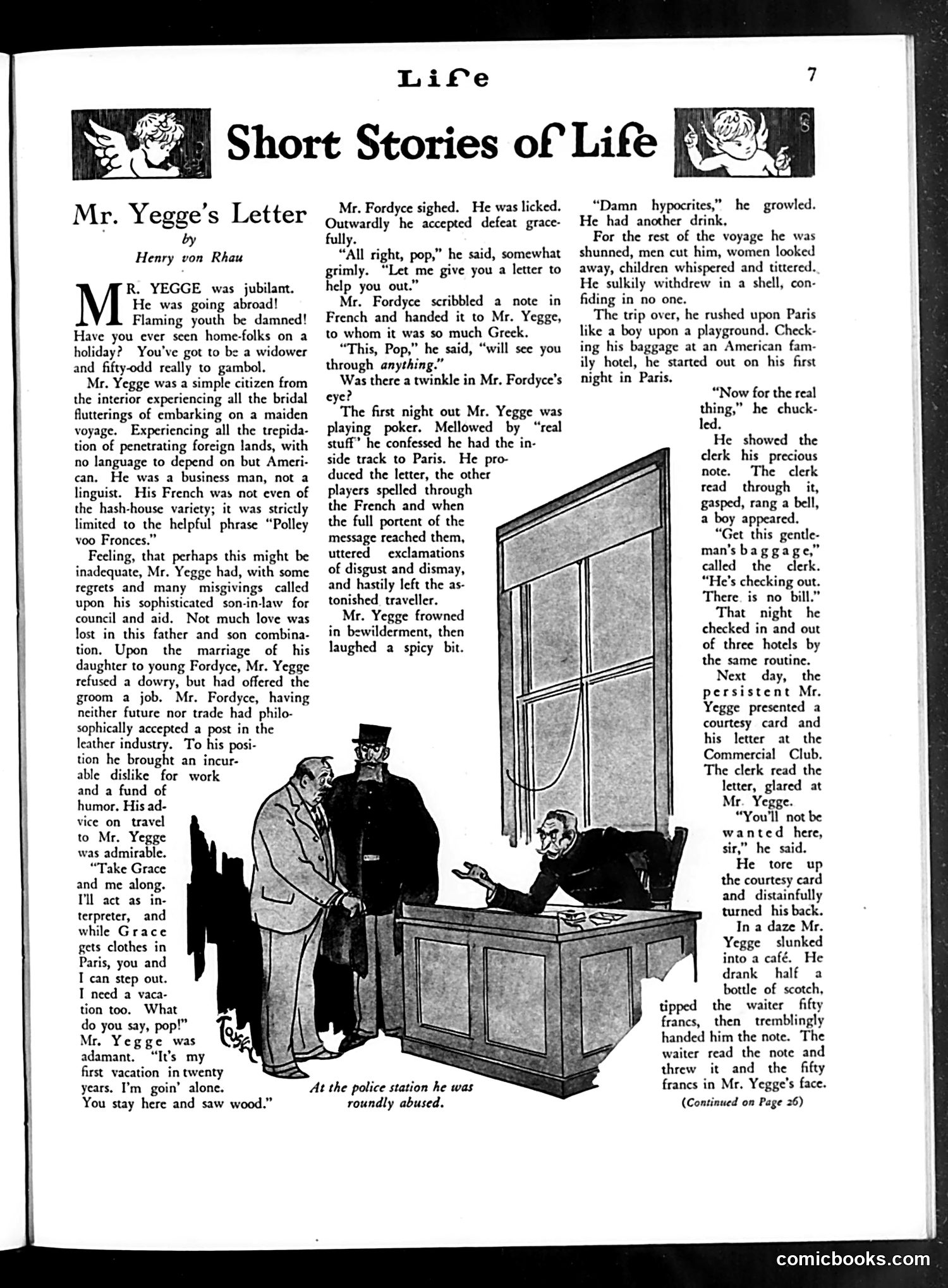
This short story satirizes a bumbling American businessman abroad. Mr. Yegge, described as "jubilant" but unsophisticated, embarks on his first vacation in twenty years. His father-in-law provides a letter of introduction to help him navigate Paris, but Yegge loses it in a poker game. The illustration shows him at a police station being "roundly abused" after the letter's loss creates complications. The satire targets American tourists of the early 20th century—men of business lacking linguistic skills or cultural refinement, prone to gambling and drinking, who bungle their way through European travel. The story mocks both Yegge's naïveté and the embarrassments he creates abroad.
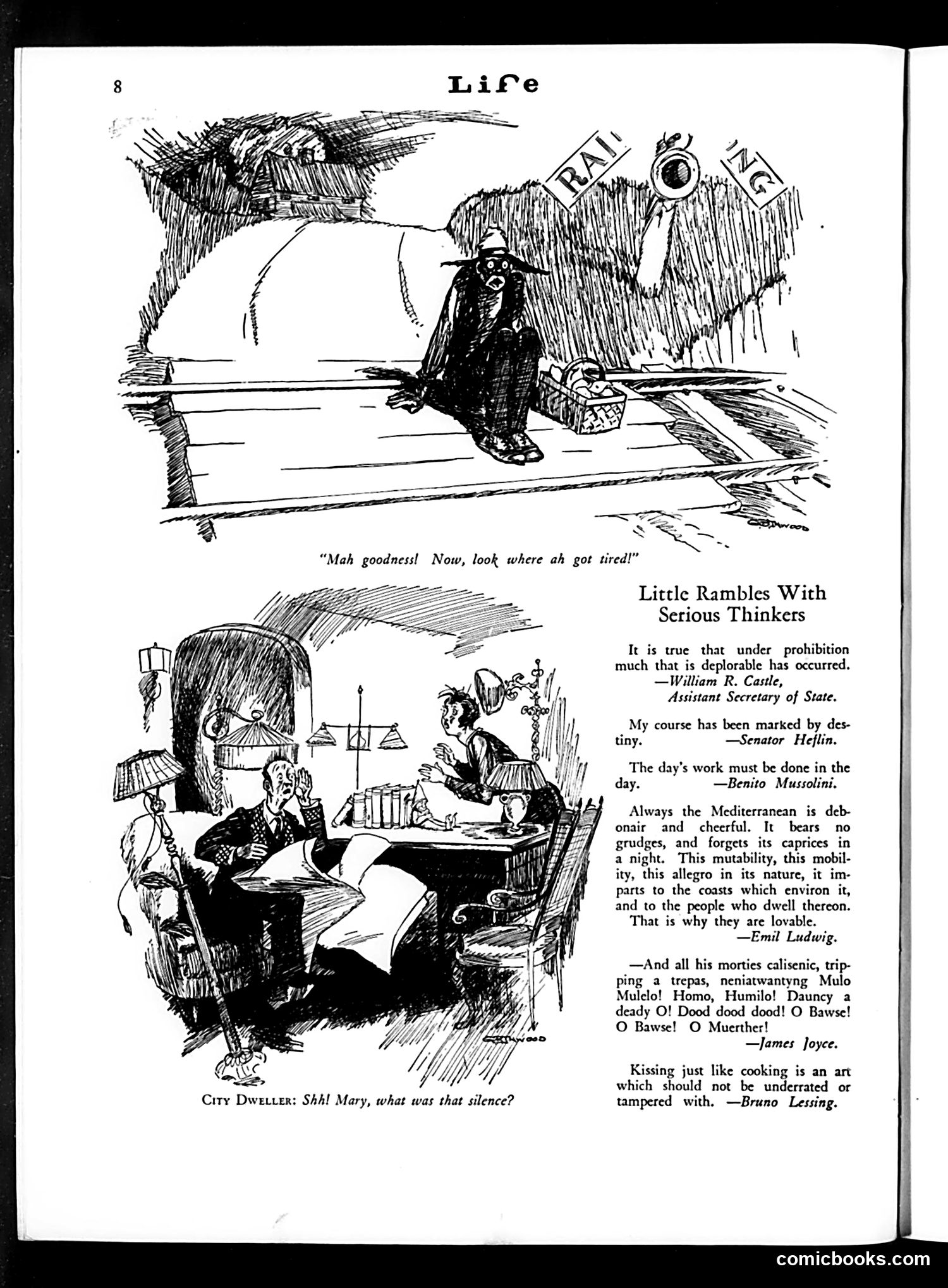
**Top Cartoon:** A disheveled figure sits exhausted among railroad signs ("RAIL," "ING") with a basket, saying "Mah goodness! Now, look where ah got tired!" This appears to be Depression-era commentary on labor and migration—likely satirizing the plight of unemployed workers or migrants following railway lines in search of work. **Bottom Cartoon:** Titled "City Dweller: Shh! Mary, what was that silence?" shows an urban couple startled by quiet. This satirizes modern city life's constant noise and the shock of silence—a social commentary on industrial/urban alienation. The page also features "Little Rambles With Serious Thinkers," a series of philosophical quotes from figures like Mussolini, Joyce, and Lessing, juxtaposed with humorous illustrations—typical of Life's satirical format.
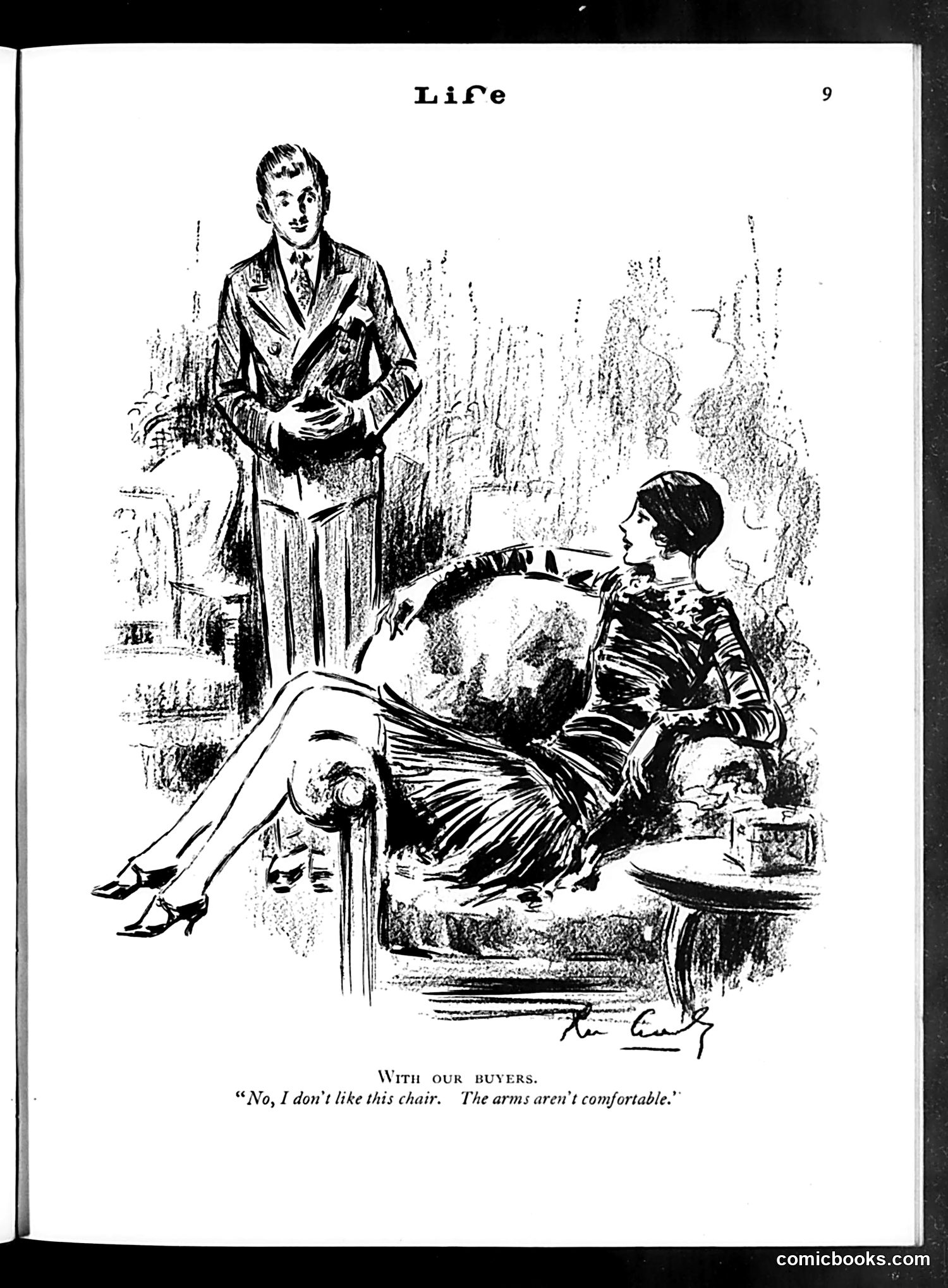
This is a humorous domestic scene satirizing furniture shopping or home furnishing decisions. A well-dressed woman reclines uncomfortably in an ornate chair while a salesman stands nearby. Her complaint—"No, I don't like this chair. The arms aren't comfortable"—illustrates a common retail experience: the tension between aesthetic appeal and practical comfort. The cartoon gently mocks both the customer's pickiness and the furniture industry's prioritization of style over function. The woman's fashionable dress and the chair's decorative design suggest that appearance often trumps usability in consumer goods. The title "With Our Buyers" indicates this represents typical interactions between salespeople and purchasing customers, making light of everyday consumer frustrations that remain relatable today.
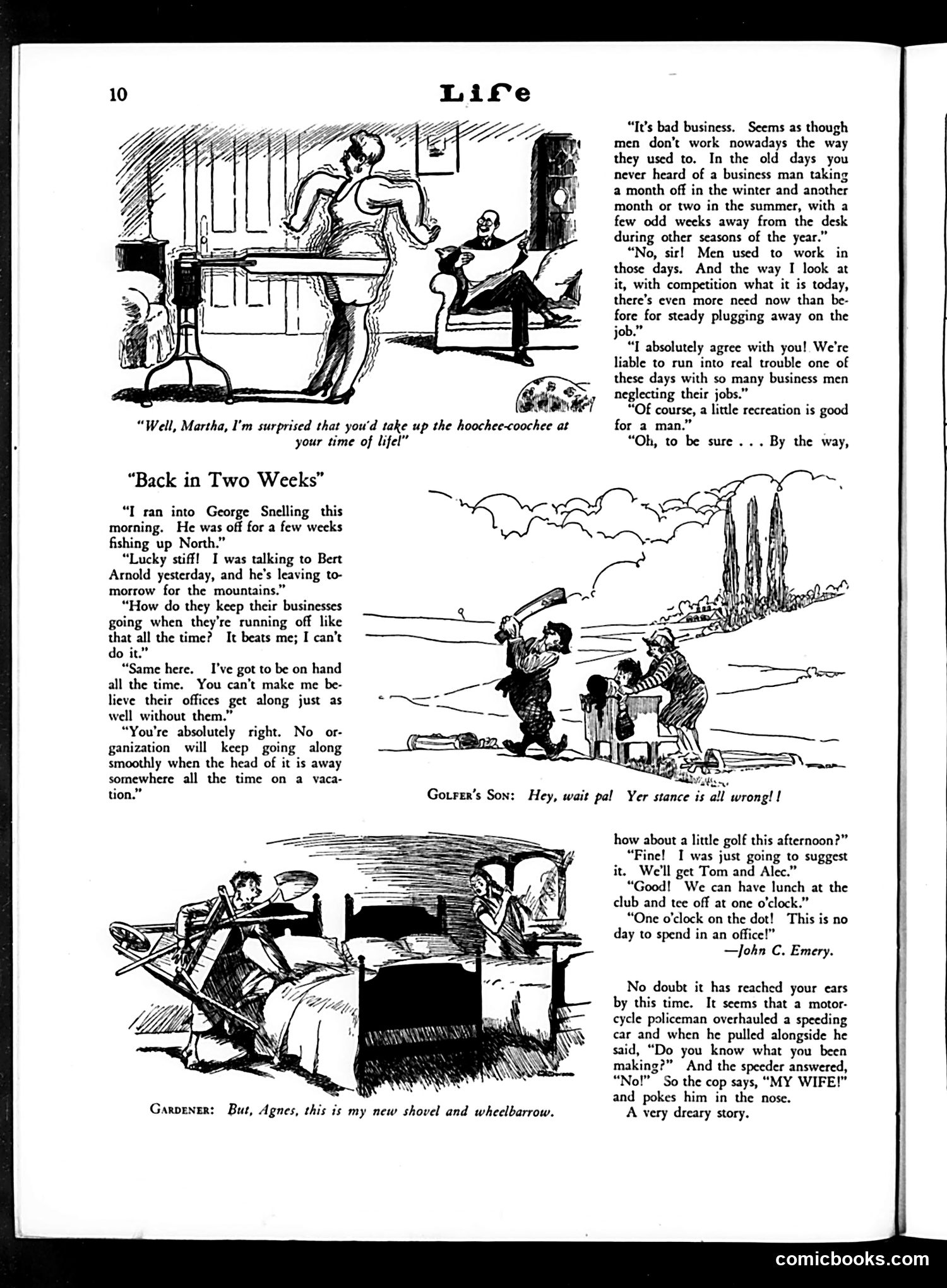
This page contains three separate cartoons satirizing early 20th-century business and leisure culture: 1. **"Well, Martha, I'm surprised that you'd take up the hoochee-coochee at your time of life!"** — A wife exercises on gym equipment while her husband expresses shock, mocking women adopting modern fitness practices. 2. **"Back in Two Weeks"** — A dialogue between businessmen debating whether executives can leave offices for vacation. The satire criticizes how businesses struggle when leaders take time off, and pokes fun at executives' inability to delegate or trust subordinates. 3. **"Golfer's Son"** and **"Gardener"** — Smaller jokes about leisure activities interfering with work obligations and domestic responsibilities, reflecting tension between new recreational pursuits and traditional responsibilities. The page satirizes how American business culture resists modernization and work-life balance.
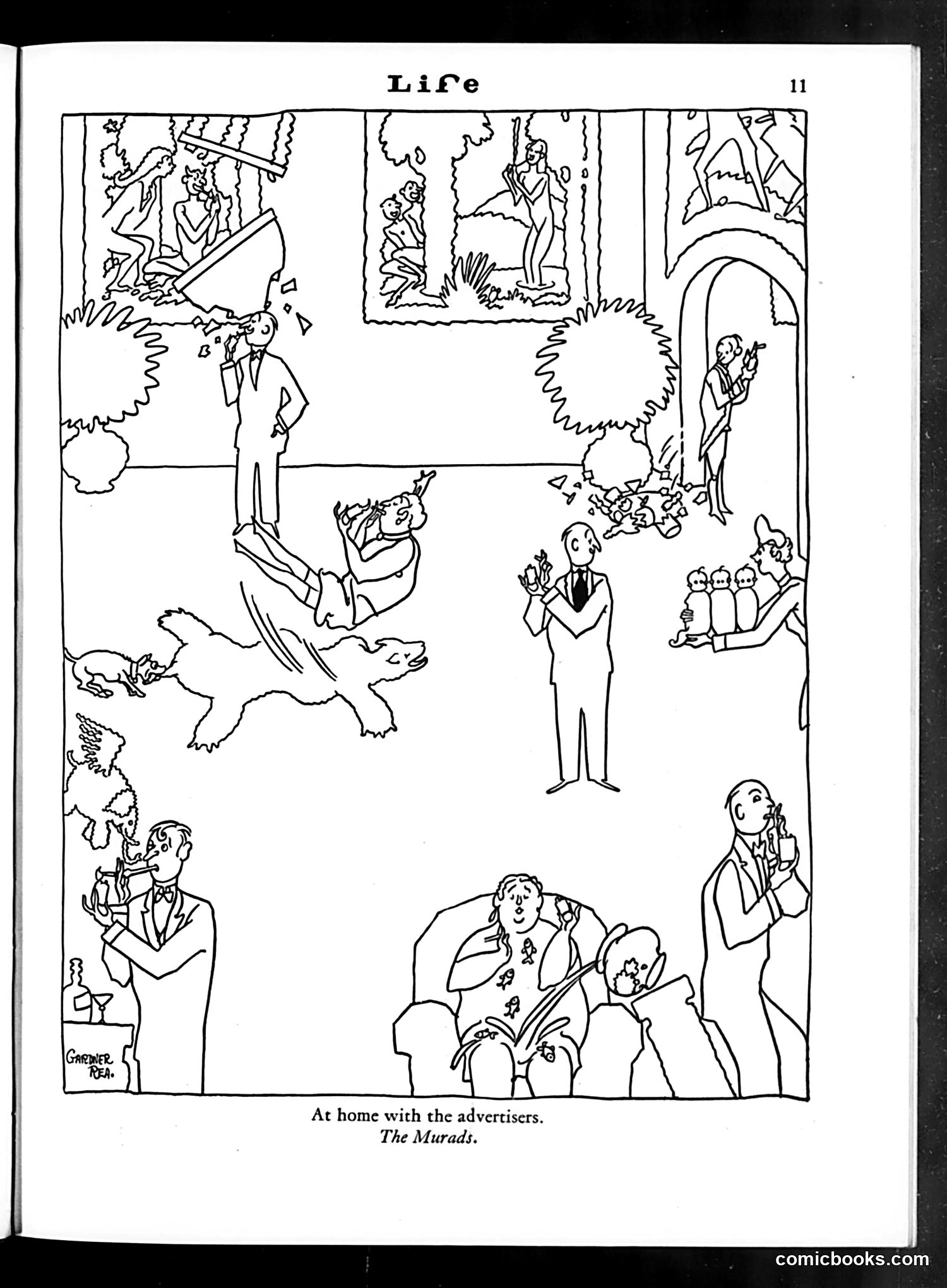
This single-panel cartoon satirizes advertising's pervasive influence on American domestic life. The scene depicts a wealthy household where murals and wall art have been replaced with advertisements—the ironic title "The Murads" is a pun on both "murals" and "Murad" cigarettes (a popular brand of the era). The cartoon shows family members in various rooms literally surrounded by advertising imagery and product placements integrated into their home décor. This is social satire: Life magazine is mocking how thoroughly commercial messages have invaded private domestic spaces, suggesting that advertisers have essentially colonized the American home itself. The signed detail "GARDNER, REA." indicates the cartoonist's credit.
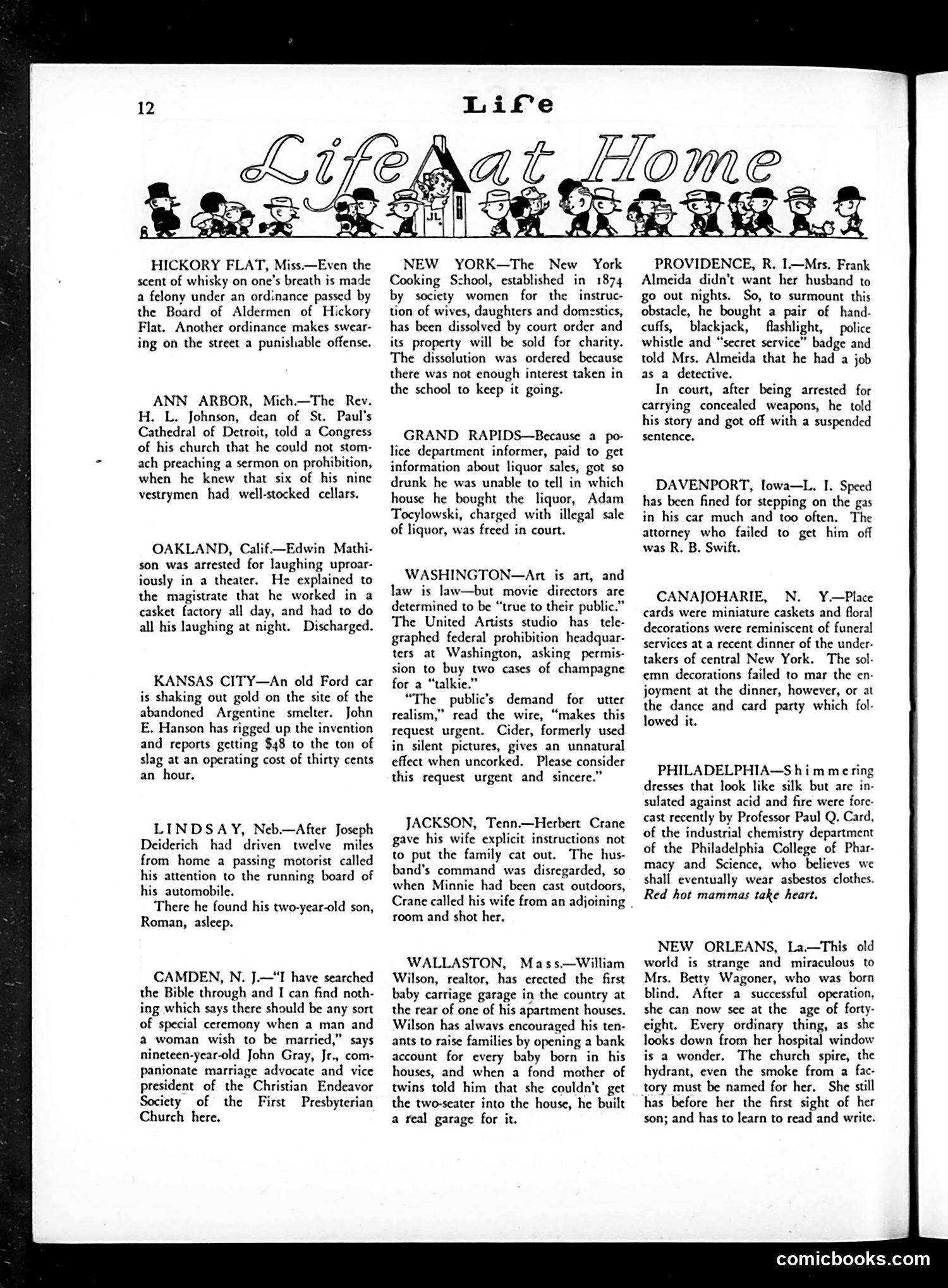
This is a "Life at Home" humor column featuring short anecdotes from various American towns. The header illustration shows a row of figures (adults and children) standing before a house, establishing a domestic theme. The brief stories mock everyday absurdities: a Michigan clergyman's hypocrisy (preaching prohibition while his vestrymen stockpile liquor), a California man arrested for excessive theater laughter, a Nebraska father finding his toddler asleep after a dangerous car ride, and a Kansas inventor monetizing salvaged gold. The column satirizes middle-class American life through situational irony and human folly. Most jokes rely on the contrast between stated values (temperance, proper conduct) and actual behavior. The tone is gently mocking rather than harsh—typical of Life's satirical approach to contemporary society during the Prohibition era.
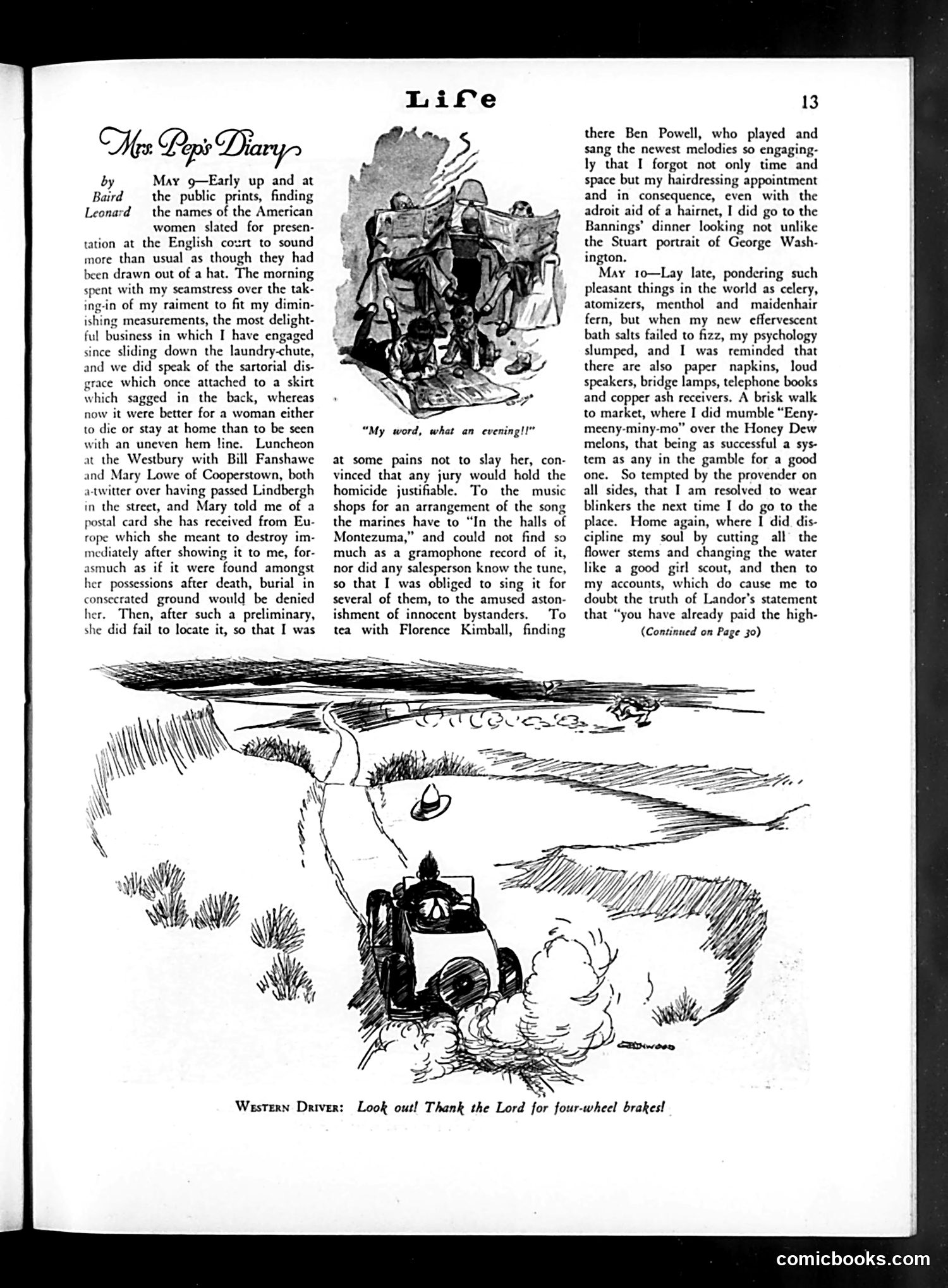
This page contains a diary entry by "Baird Leonard" describing social activities from May 9-10. The upper illustration shows a crowded social scene, likely depicting the writer's attendance at fashionable gatherings. The lower cartoon, captioned "Western Driver: Look out! Thank the Lord for four-wheel brakes!" depicts an automobile accident or near-miss scenario in a rural/desert setting. The joke appears to satirize the reliability of modern automobile braking systems—suggesting that only luck ("Thank the Lord") rather than engineering prevented disaster. The diary portion humorously catalogs mundane domestic frustrations (bath salts, paper napkins, bridge lamps), contrasting trivial household annoyances with social pretensions, typical of Life magazine's satirical approach to middle-class American life.
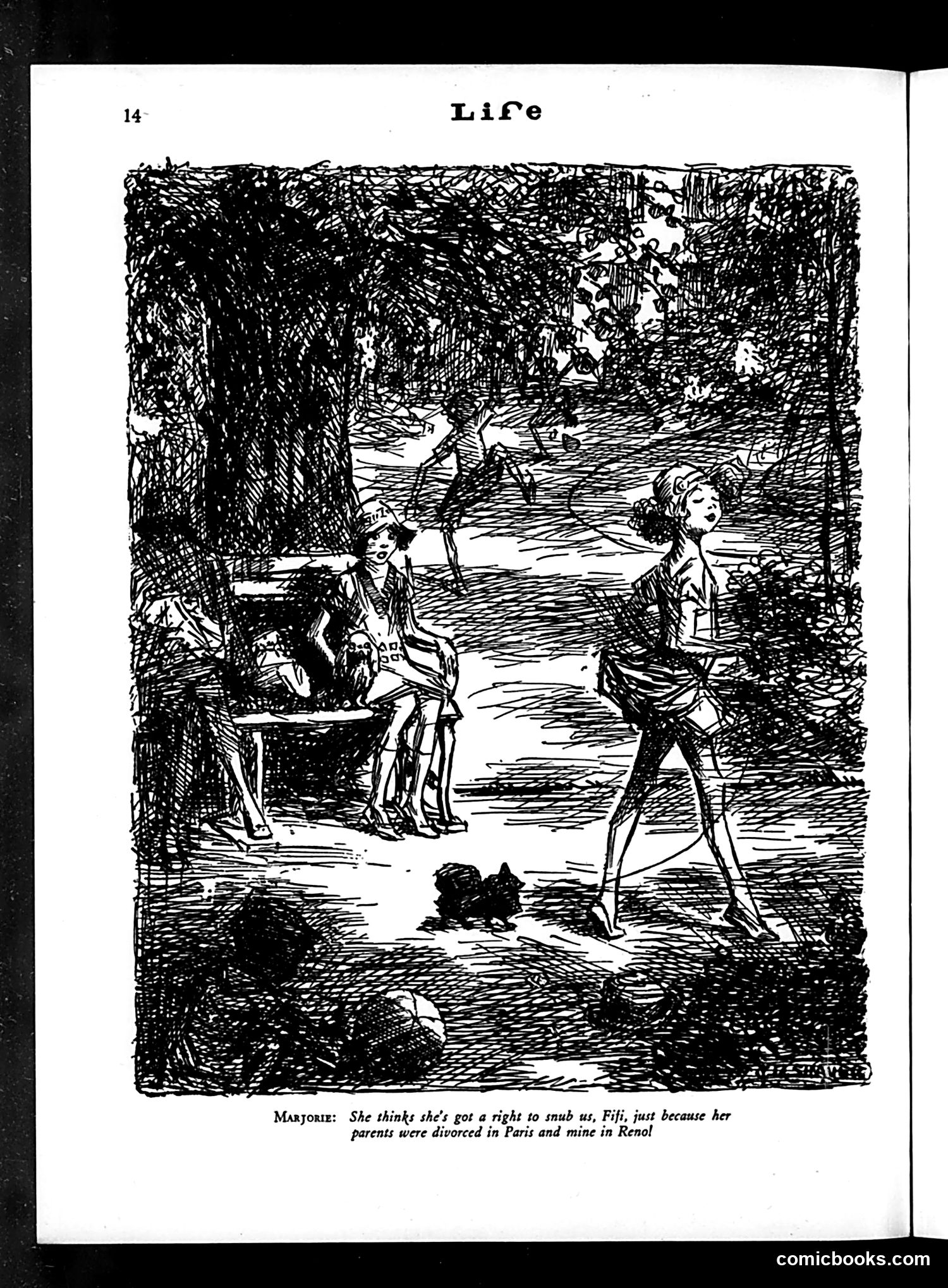
This is an illustration titled "Life" showing children in a wooded setting. The caption presents dialogue between characters named Marjorie and Fili, with Marjorie saying: "She thinks she's got a right to snub us, Fili, just because her parents were divorced in Paris and mine in Renol." The satire mocks early 20th-century social pretension and snobbery among the wealthy. The joke turns on the absurd notion that a child would boast about—or another child would feel inferior about—the *location* of their parents' divorce proceedings. The implication is that Paris carries more sophisticated cachet than "Renol" (possibly Reno, Nevada, a divorce destination). This satirizes both class consciousness and the casual treatment of family dissolution among the wealthy.
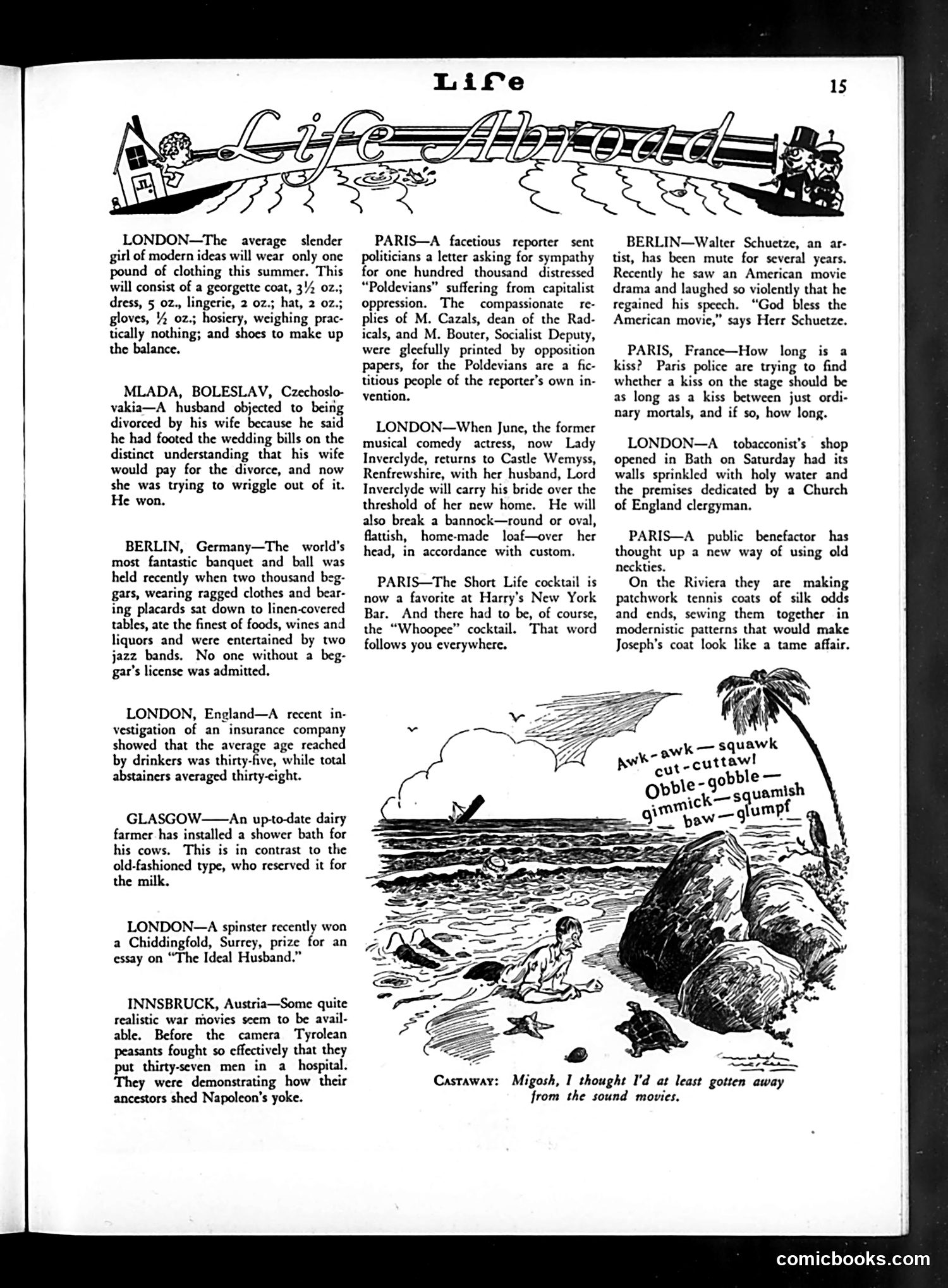
This page contains a satirical cartoon captioned "CASTAWAY," depicting shipwrecked people on an island with sound-effect words ("Awk—squawk," "Obble-gobble," "gimme—squamish," "baw—glumpt"). The joke appears to be a commentary on **sound movies** (talkies), which were relatively new technology in the late 1920s. The castaway character laments that he thought he'd "at least gotten away from the sound movies"—suggesting that even marooned on a deserted island, he cannot escape the annoying cacophony of talking pictures. The surrounding text consists of international gossip items from London, Paris, Berlin, and other cities—typical of Life's satirical format. The page satirizes modern fashion, celebrities, and social oddities rather than explicit political content.
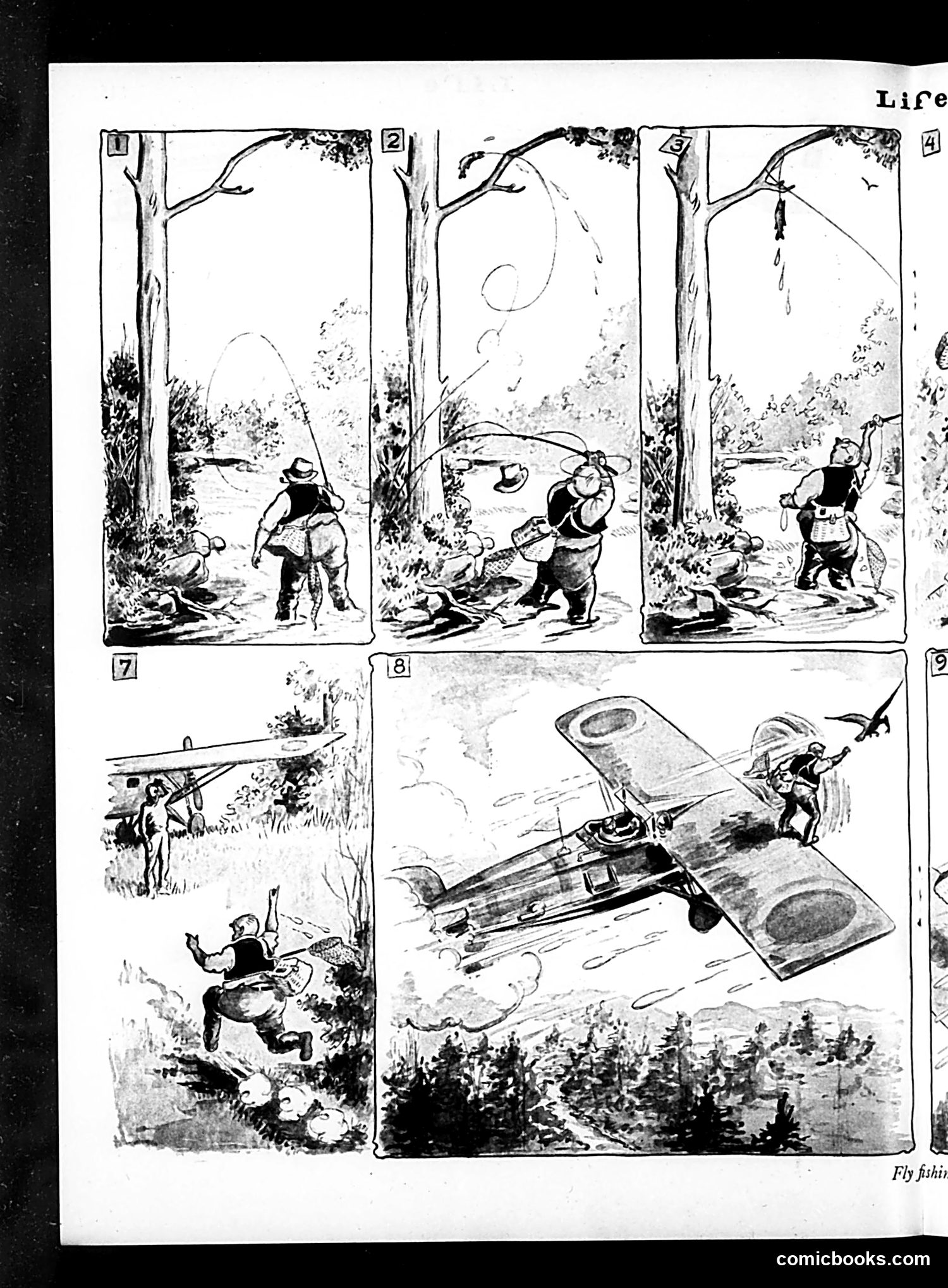
This appears to be a humorous comic strip about fishing, titled "Fly Fishin'" (visible at bottom right). The six-panel sequence shows a fisherman's progression from patient casting by a tree-lined stream (panels 1-4) to increasingly desperate and elaborate attempts to catch fish. By panels 7-8, the frustrated angler has escalated to physically fighting the environment and his equipment. Panel 9 depicts the absurd climax: he's apparently rigged a motorized airplane as a fishing contraption, soaring over a forested landscape. The satire mocks the obsessive, irrational lengths sportsmen will go to pursue their hobby. What begins as serene recreation devolves into frantic, ridiculous desperation—using increasingly impractical and dangerous methods. It's satirizing the vanity and stubborn determination of fishing enthusiasts.
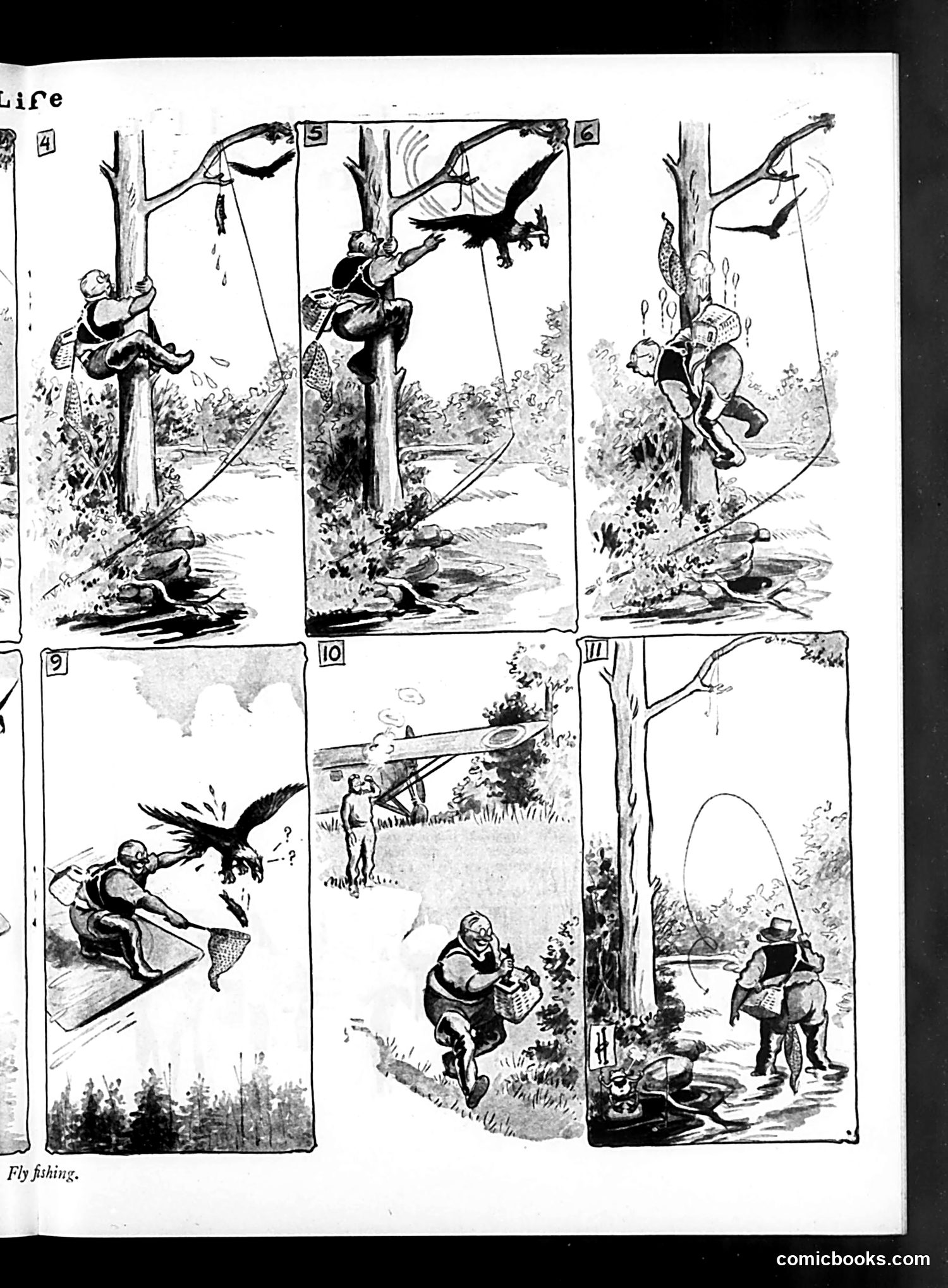
This is a humorous comic strip titled "Fly Fishing" that plays on the double meaning of the term. Rather than depicting traditional fishing with a rod and line, the panels show men attempting to catch actual flies (insects) using fishing equipment and techniques. The joke escalates across six panels: men use fishing rods with lines to catch flies near trees, one man uses a net, another employs a large mechanical or constructed device, and the final panels show increasingly absurd methods involving what appears to be a large net or trap structure by water. The satire relies on the literal interpretation of "fly fishing" — treating it as fishing *for* flies rather than the actual sport. It's a straightforward visual gag typical of Life magazine's humor approach.
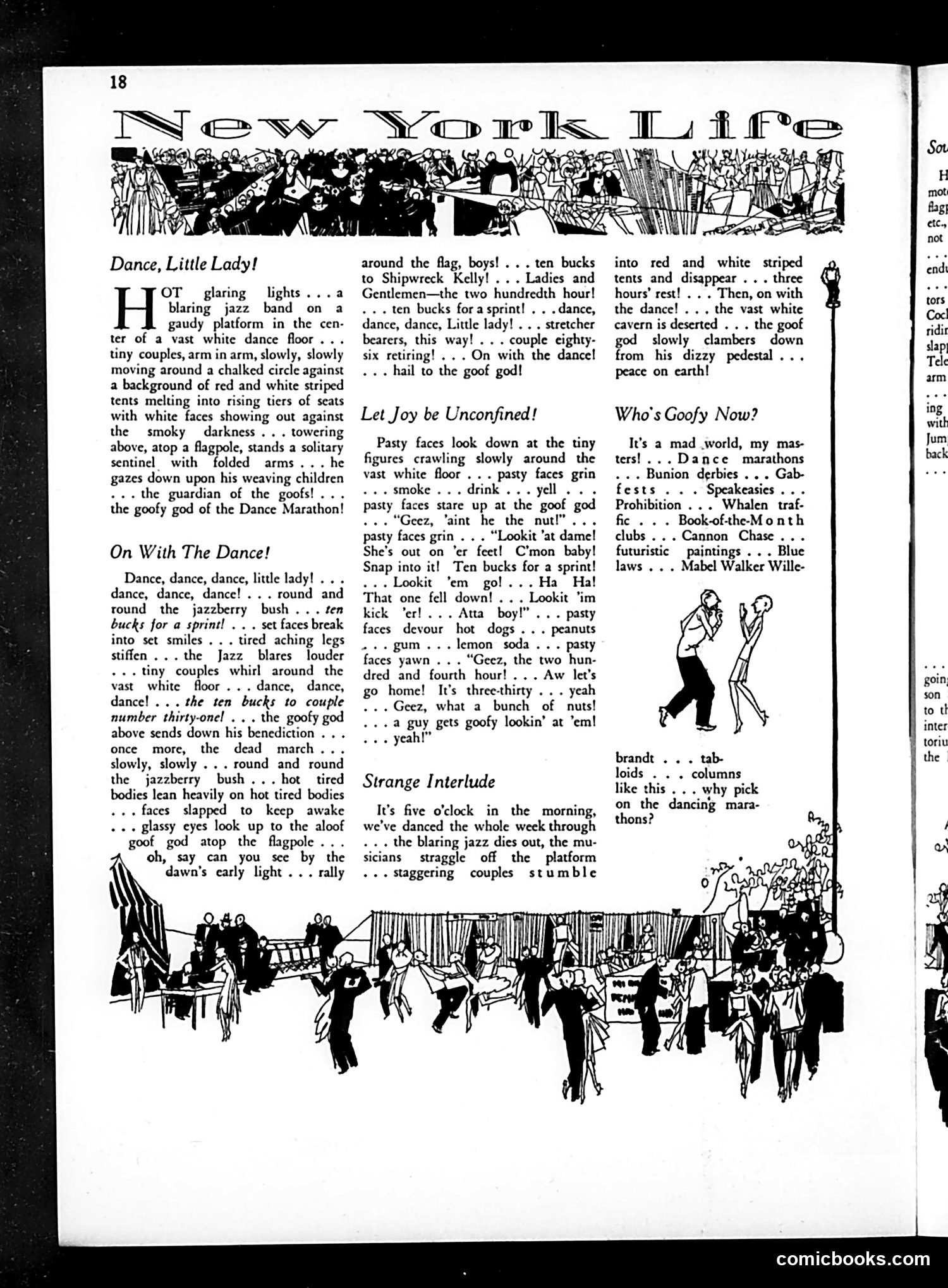
This page from *Life* magazine depicts the Jazz Age dance craze of the 1920s. The article "Dance, Little Lady!" satirizes the frenetic energy of contemporary dance marathons and jazz culture through vivid descriptions of crowded dance floors, where couples dance continuously for monetary prizes ("ten bucks for a sprint"). The satire targets both the dancers' exhaustion ("pasty faces grin," "bodies lean heavily on hot tired bodies") and the spectacle itself—crowds watching the suffering participants. References to "Shipwreck Kelly" (likely the famous flagpole sitter) and "the goofy god of the Dance Marathon" mock the era's obsession with endurance stunts and youth culture excess. The illustrations show couples dancing amid jazz bands, capturing the period's energetic but somewhat chaotic social scene. The overall tone is bemused critique of 1920s excess and modern entertainment's physical toll.
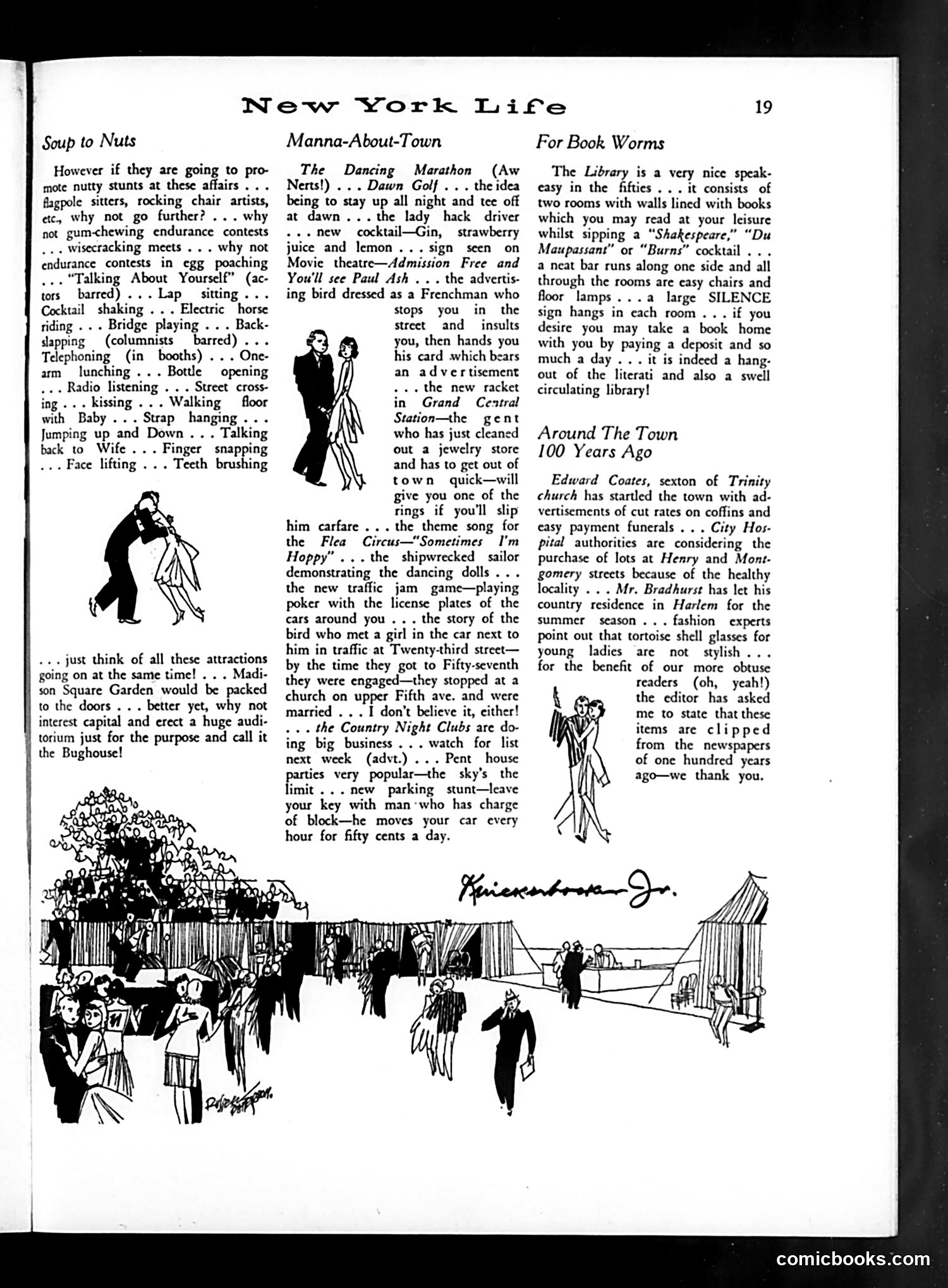
This page from *Life* magazine satirizes 1920s Manhattan fads and social trends through three columns of humorous commentary and sketches. **"Soup to Nuts"** mocks the era's obsession with endurance contests and stunts (flagpole sitting, marathon dancing) by proposing absurdly mundane "competitions"—gum-chewing, egg-poaching, teeth-brushing—suggesting New Yorkers will compete at anything. The writer proposes building an auditorium called "the Bughouse" (slang for asylum), implying the city itself is mad. **"Manna-About-Town"** catalogs current Manhattan crazes: all-night dancing marathons, speakeasy culture, and street hustlers. References to "Paul Ash" (a real theater personality) and "Flea Circus" ground the satire in actual 1920s attractions. The traffic jam anecdote jokes about Manhattan congestion. **"For Book Worms"** describes "The Library," an actual speakeasy (disguised as a library during Prohibition) serving literature-themed cocktails named after authors. **"Around The Town—100 Years Ago"** reprints 1820s newspaper clippings, providing historical contrast and gentle mockery of past fashion and social concerns. The overall effect satirizes Jazz Age excess and modern urban absurdity.
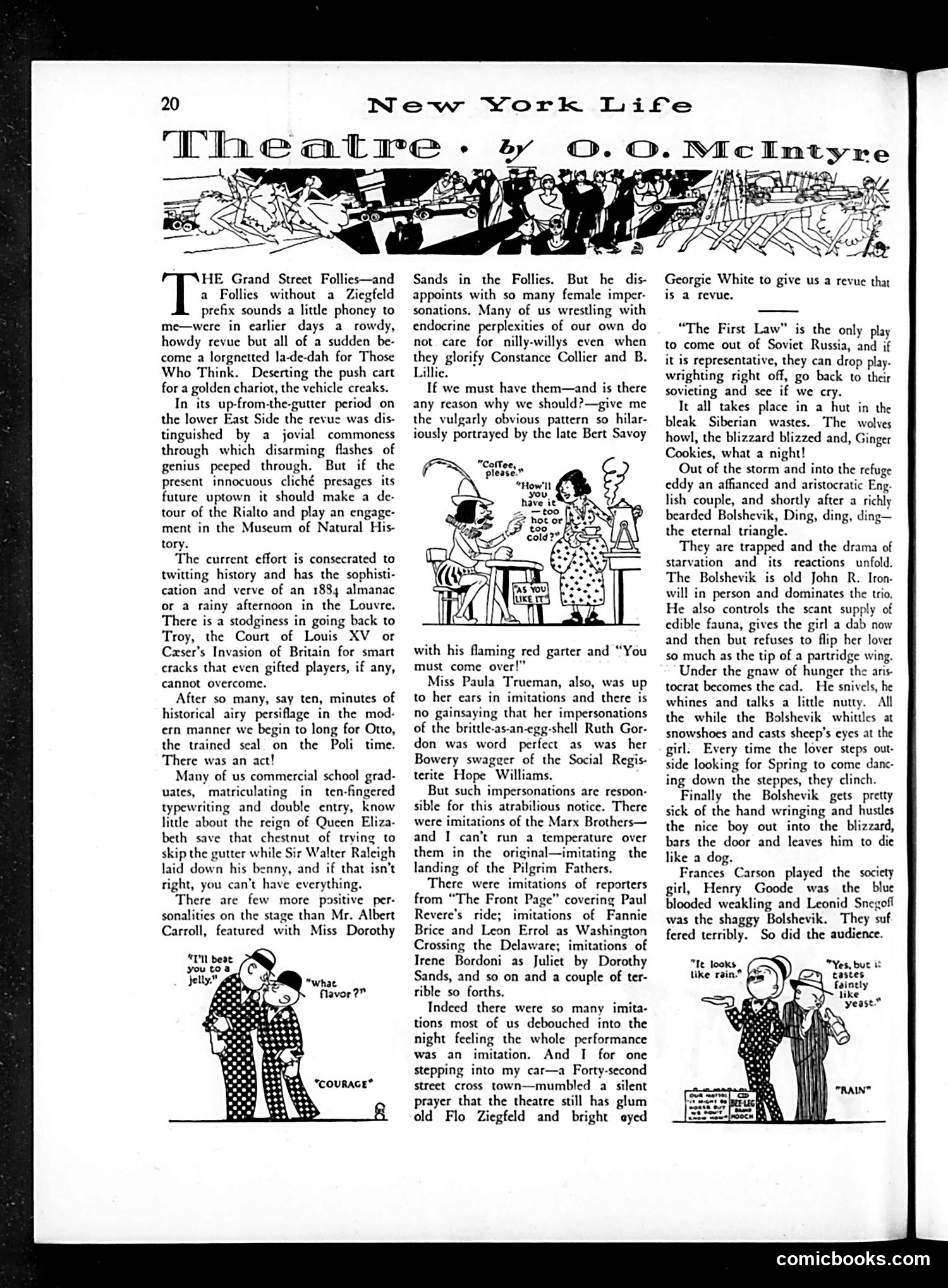
This is O.O. McIntyre's theatre review criticizing the Grand Street Follies revue for losing its original working-class charm. The review condemns the show's shift from rowdy, lower East Side entertainment to pretentious, sophisticated theatre attempting historical parody. McIntyre's main complaint: the revue relies excessively on impersonations—particularly female impersonators like Albert Carroll and Paula Trueman imitating famous performers (Ruth Gordon, Hope Williams, the Marx Brothers, Fannie Brice). He dismisses these as tired clichés that make the entire show feel like an imitation rather than original comedy. The cartoons illustrate typical vaudeville/revue humor with characters in polka-dot costumes. McIntyre contrasts the Follies unfavorably with Florenz Ziegfeld's productions, implying superior theatrical taste and originality. He also briefly reviews a Soviet play, "The First Law," dismissing it as equally poor—suggesting post-revolutionary Russian drama merits no serious consideration.
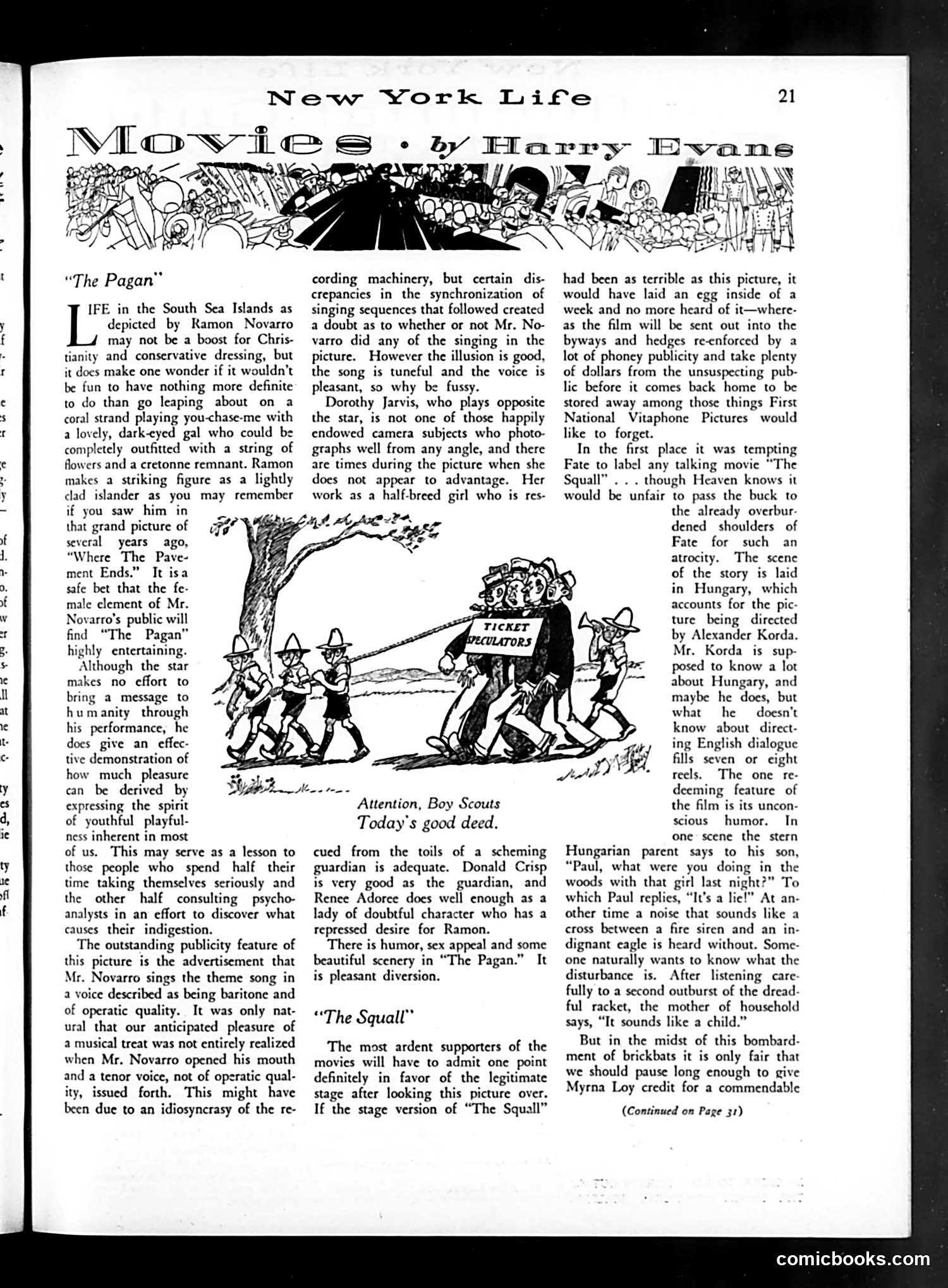
This page contains two film reviews by Harry Evans, published in Life magazine's "Movies" column. The small cartoon labeled "Attention, Boy Scouts—Today's good deed" appears to depict Boy Scouts confronting ticket scalpers (marked "TICKET REGULATORS"), satirizing the problem of ticket speculation at entertainment venues. The reviews themselves critique contemporary films: "The Pagan" starring Ramon Novarro is reviewed as entertaining escapism featuring a barely-clothed island romance, though Evans notes a glaring technical failure—Novarro's advertised baritone voice is clearly a tenor, suggesting dubious sound synchronization in this early talking picture. "The Squall," a Hungarian-set drama, is harshly dismissed as so incompetent that it represents an embarrassment even compared to failed stage productions. The satire targets both films' shortcomings and the emerging technology of "talking pictures" (talkies), which Evans suggests will allow even poor films to profit through wide distribution despite their quality.
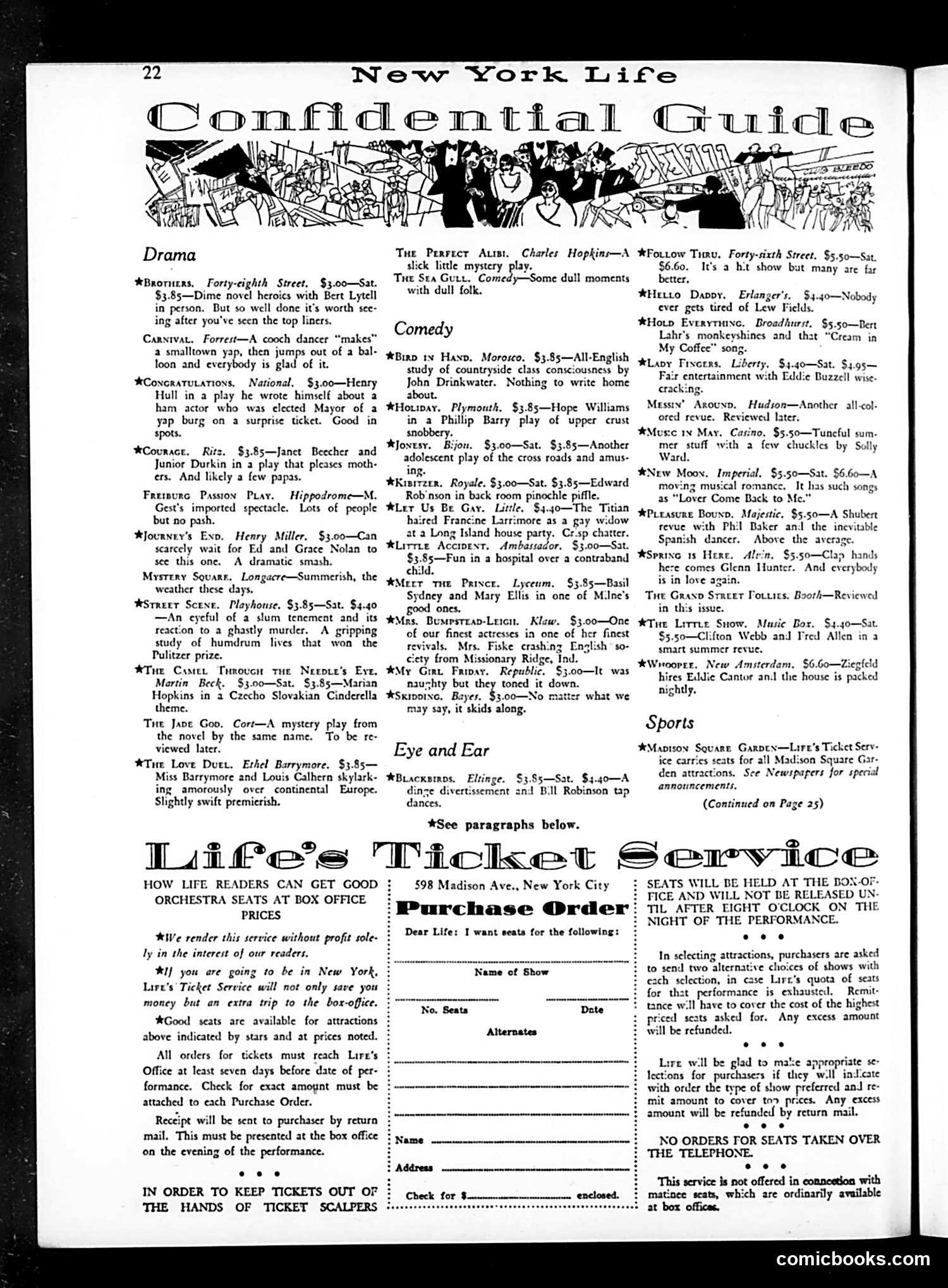
This is **not a cartoon page** but rather a **theater review and ticketing service page** from Life magazine's "Confidential Guide" section. The content consists of: 1. **Drama and Comedy Reviews**: Brief, snappy critiques of Broadway shows with ticket prices (ranging $1.00-$6.60). The reviews use witty, sarcastic commentary—e.g., "dime novel heroics," "cooch dancer," "ham actor"—reflecting Life's satirical voice. Notable actors like Bert Lytell, Ethel Barrymore, and Lew Fields are mentioned. 2. **Life's Ticket Service Advertisement**: A mail-order system allowing readers to purchase orchestra seats without visiting box offices, protecting them from "ticket scalpers." The satirical humor lies in the *review descriptions themselves*—quick, dismissive zingers about mediocre productions—rather than in visual cartoons. This reflects 1920s Broadway's output and Life's role as both entertainment critic and service provider for New York's theater-going public.
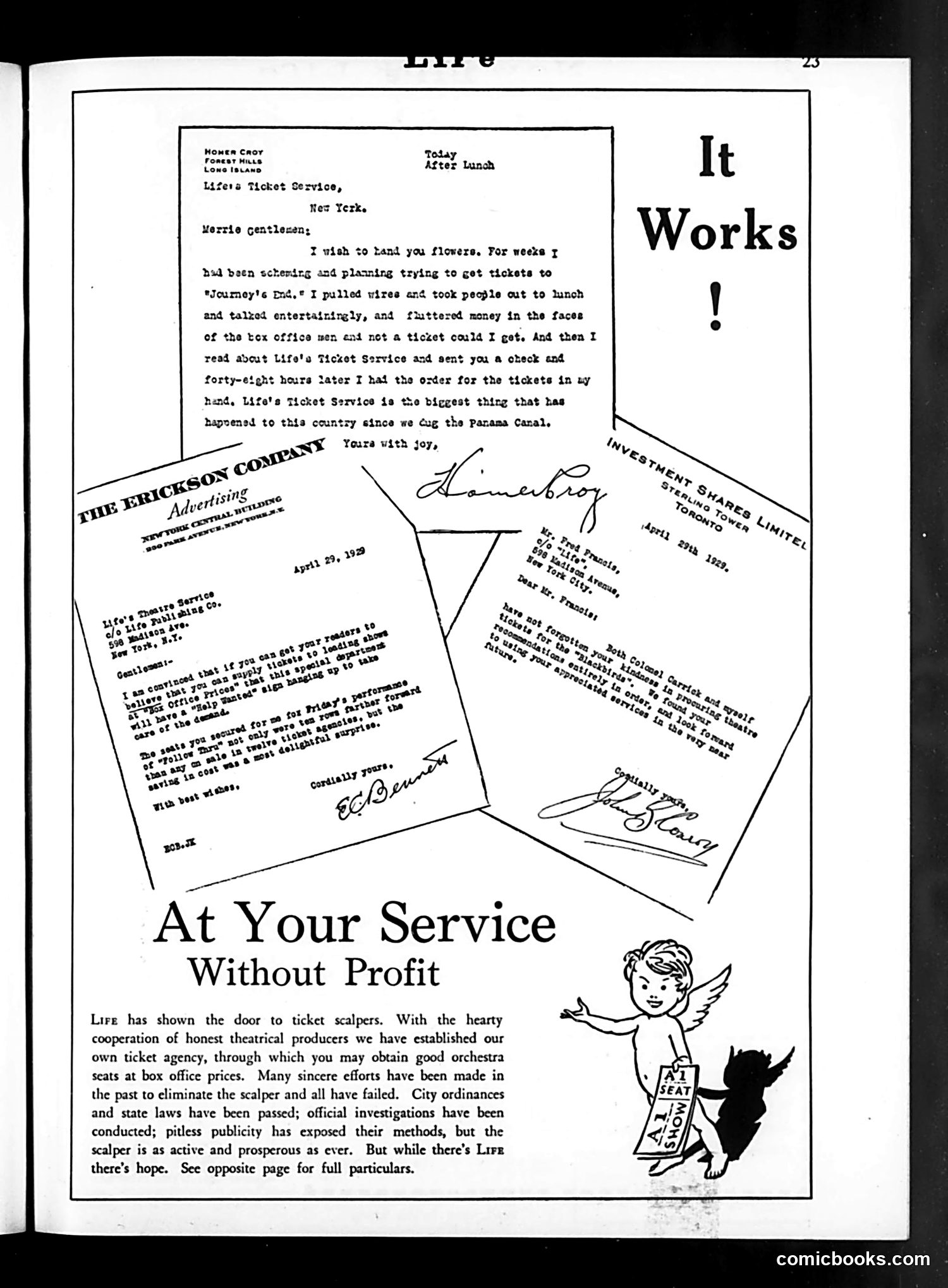
This page promotes **Life's new ticket agency**, positioned as a consumer service fighting theatrical ticket scalping—a major social problem of the era. The top letter, from a satisfied customer, humorously illustrates the frustration of obtaining Broadway tickets through normal channels. The writer spent weeks bribing box office staff, taking people to lunch, and "fluttering money" but couldn't get tickets to the popular play "Journey's End." Life's service delivered them in 48 hours. The bottom section frames this as a public service "without profit." Life claims to have partnered with honest producers to offer orchestra seats at legitimate box office prices, directly undercutting scalpers. The text acknowledges previous anti-scalping efforts—city ordinances, investigations, publicity—all failed, but Life expresses confidence in its solution. The cherub mascot and earnest tone suggest this was positioned as a progressive, consumer-friendly intervention into a corrupt market—a common Progressive Era reform approach.
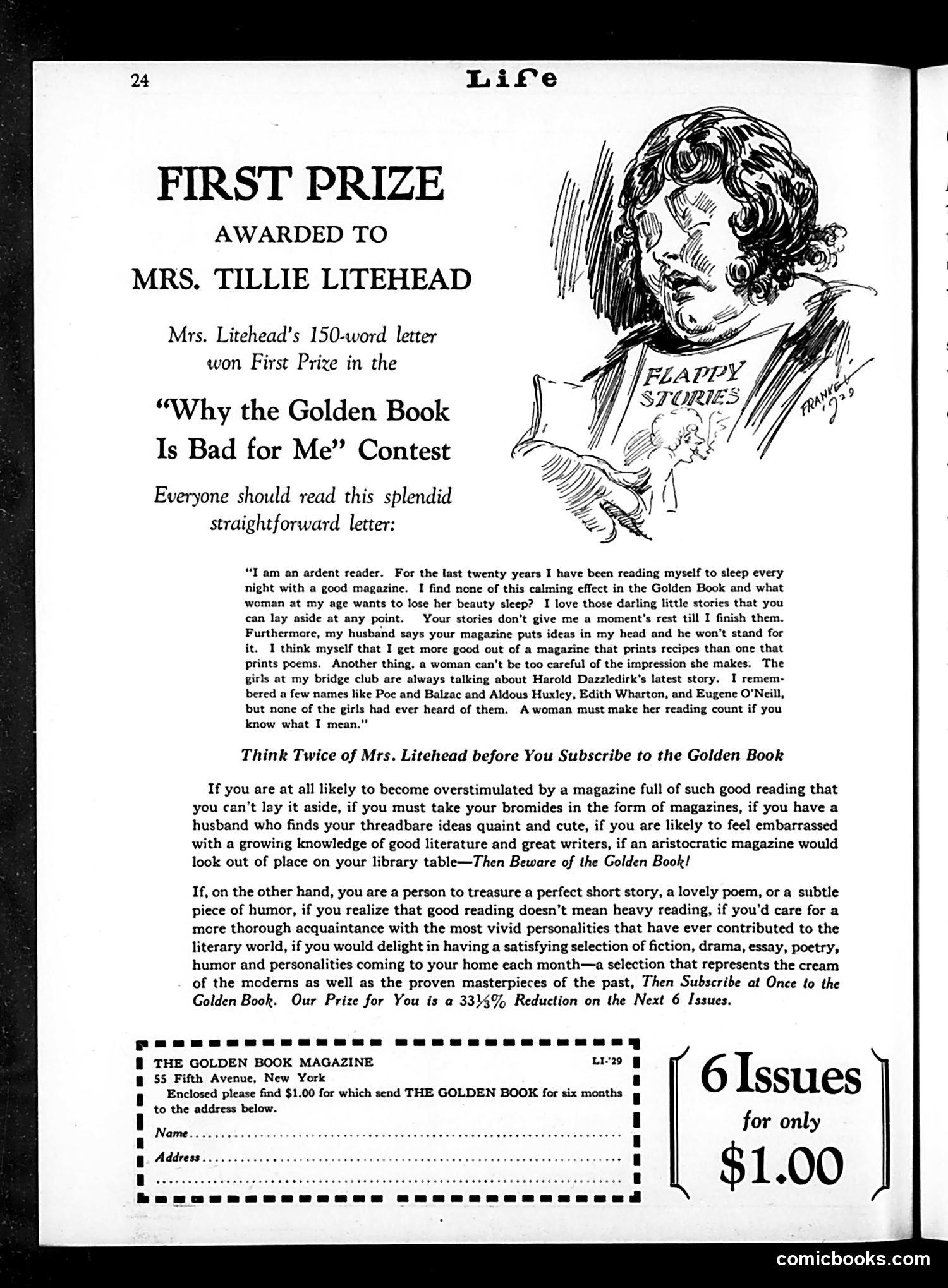
This is primarily **advertising** for *The Golden Book Magazine*, disguised as satire. The "first prize" is fake—a setup to mock a fictional letter from "Mrs. Tillie Litehead" (a comic name suggesting shallow thinking). The joke targets women readers perceived as intellectually unambitious. Mrs. Litehead complains that *The Golden Book* contains serious literature that prevents sleep and makes her husband uncomfortable with her developing ideas. She prefers simple stories and recipes to Poe, Balzac, and O'Neill. The magazine then uses this absurd complaint as a **reverse advertisement**: "If you're the kind of person embarrassed by good literature... avoid us. But if you value serious fiction and great writers, subscribe!" The satirical target is anti-intellectual attitudes, particularly among women expected to remain intellectually decorative. The sketch of a woman reading "Happy Stories" reinforces the contrast between lightweight entertainment and genuine literature. This reflects early 20th-century *Life* magazine's highbrow sensibility and appeals to educated readers by mocking those who reject literary culture.
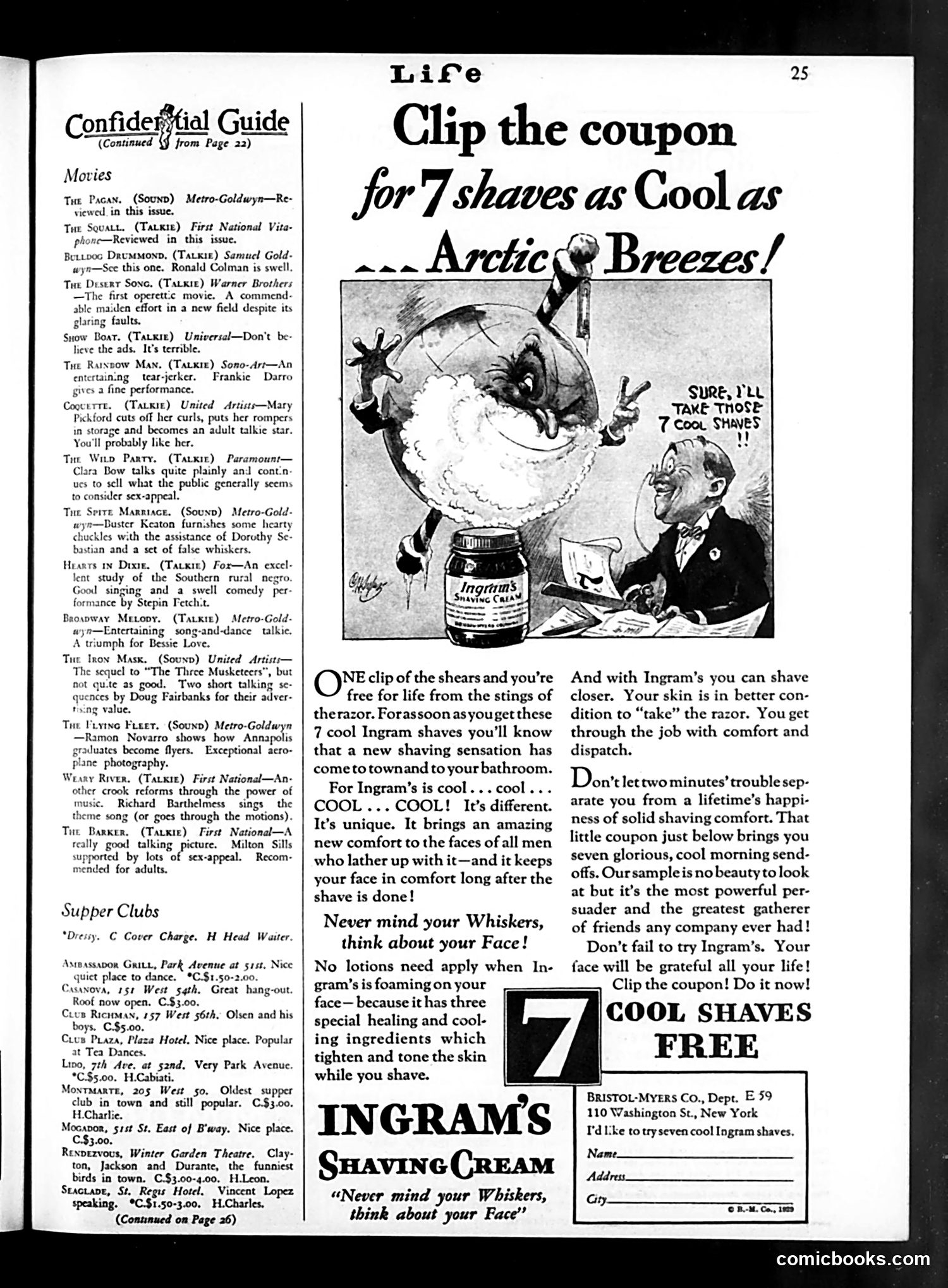
This page is primarily a **product advertisement** for Ingram's Shaving Cream disguised as editorial content in Life magazine. The cartoon depicts a jolly man's face (likely an Arctic explorer based on the fur hat and icy setting) holding a bottle of Ingram's, with the tagline "Sure, I'll take those 7 cool shaves!" **The pitch:** The ad promises that Ingram's provides "cool" shaving comfort through "three special healing and cooling ingredients." The repeated emphasis on "cool" appears designed to suggest refreshing, soothing relief. **The appeal:** The slogan "Never mind your Whiskers, think about your Face" repositions shaving from mere beard removal to facial skincare—a relatively modern marketing concept for the late 1920s. The Arctic imagery suggests extreme conditions where comfort matters most. **The gimmick:** A coupon for "7 free shaves" encourages trial. This was common advertising practice to drive product adoption. The page also includes movie reviews and supper club listings, typical Life magazine content from this era.
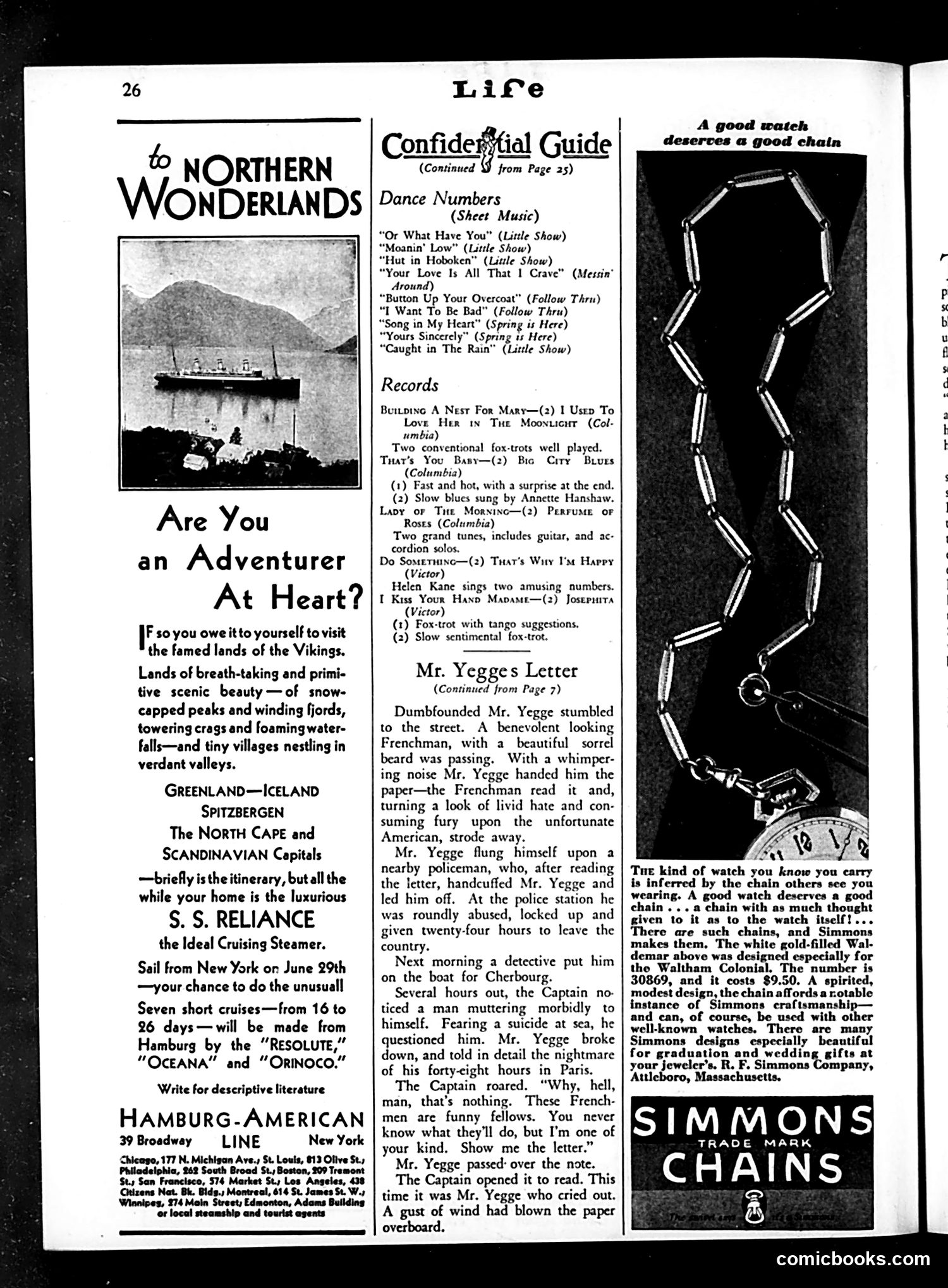
This page combines travel advertising with satirical humor and product promotion, typical of Life magazine's 1920s format. **Left side:** A Hamburg-American Line advertisement promoting luxury cruises to Northern European destinations (Greenland, Iceland, Scandinavia). The appeal to "adventurers" selling exotic Arctic scenery reflects the era's fascination with adventure tourism. **Center:** A "Confidential Guide" listing popular 1920s sheet music and phonograph records—mostly jazz and show tunes from Broadway productions like "Little Show" and "Follow Thru." This reflects the Jazz Age's cultural dominance. **Right side:** "Mr. Yegge's Letter"—a humorous anecdote where an American tourist in Paris hands a Frenchman an insulting note, is arrested by police, and finally learns the letter blew overboard before the Captain could read it. The joke satirizes both American tourists' ignorance and French volatility. **Bottom right:** A Simmons watch chain advertisement—luxury goods marketing typical of Life's affluent readership. The page reflects 1920s consumer culture, travel trends, and gentle satire of American abroad stereotypes.
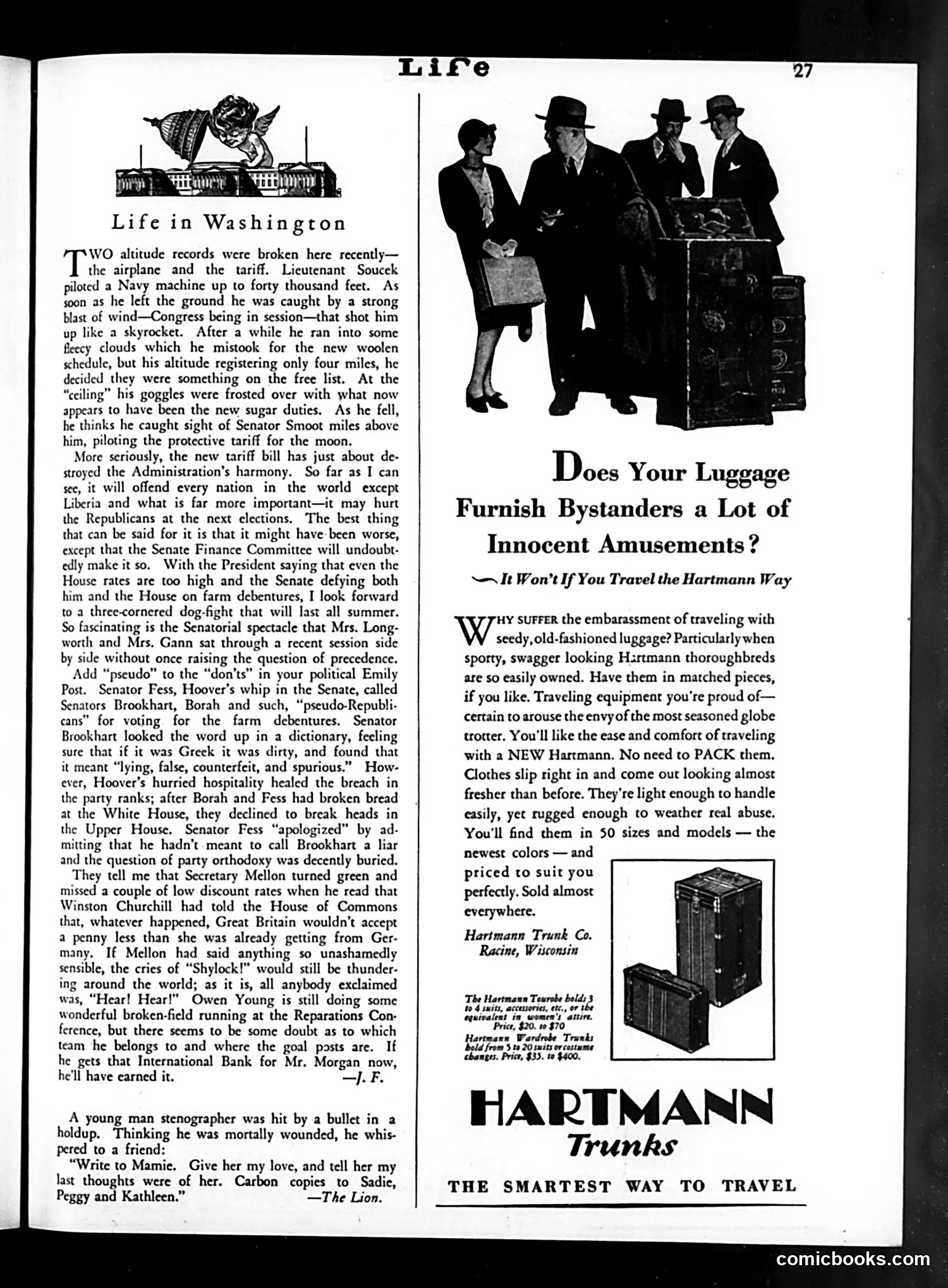
This page satirizes the **Hoover administration's tariff crisis**, likely early 1930s. The "Life in Washington" column ridicules the new tariff bill causing internal Republican discord. Key targets include: - **Senator Smoot**: Referenced as pilot of "the protective tariff"—likely Reed Smoot, key architect of the controversial Smoot-Hawley Tariff - **The tariff's chaos**: Depicted as so powerful it launches planes; Congress's divisiveness compared to wind gusts - **Party fracture**: Senator Fess calling fellow Republicans "pseudo-Republicans" over farm-debenture voting; the breach between Hoover's wing and insurgent Republicans (Brookhart, Borah) - **Administration incompetence**: Hoover saying even his own House rates are "too high" The satire mocks how protective tariffs—supposedly beneficial—are actually destroying Republican unity and threatening electoral prospects. The brief anecdote about the stenographer is unrelated comedic filler. The bottom half is a Hartmann luggage advertisement—typical period magazine content.
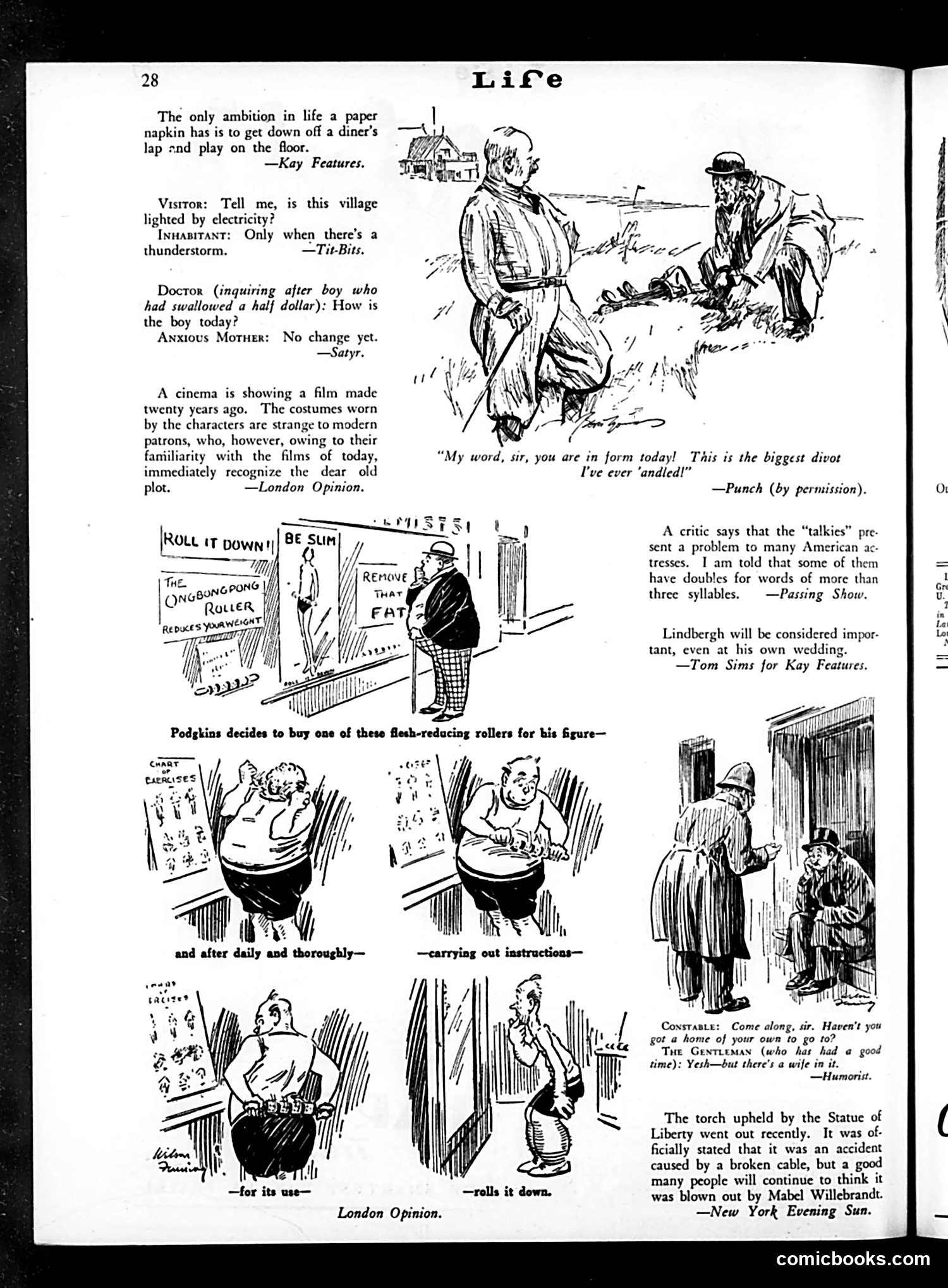
This page collects brief humorous quips and cartoons typical of 1920s satirical magazines. Key content includes: **Main cartoon**: "Podgkins decides to buy a flesh-reducing roller"—a multi-panel joke about a rotund man using an exercise device that paradoxically makes him fatter, mocking both weight-loss products and their ineffectiveness. **Social references**: - A jab at "talkies" (early talking films), suggesting American actresses need voice doubles for polysyllabic words - A crack about Lindbergh being overshadowed by celebrity even at his wedding - A reference to **Mabel Willebrandt**, a Prohibition enforcer, implying she's so strict she'd sabotage the Statue of Liberty's torch (which actually went out in 1924) **Other gags**: Include rural electrification jokes, cinema costume anachronisms, and drunken homelife humor—typical period comedy reflecting post-war American anxieties about modernity, Prohibition, and changing social norms.
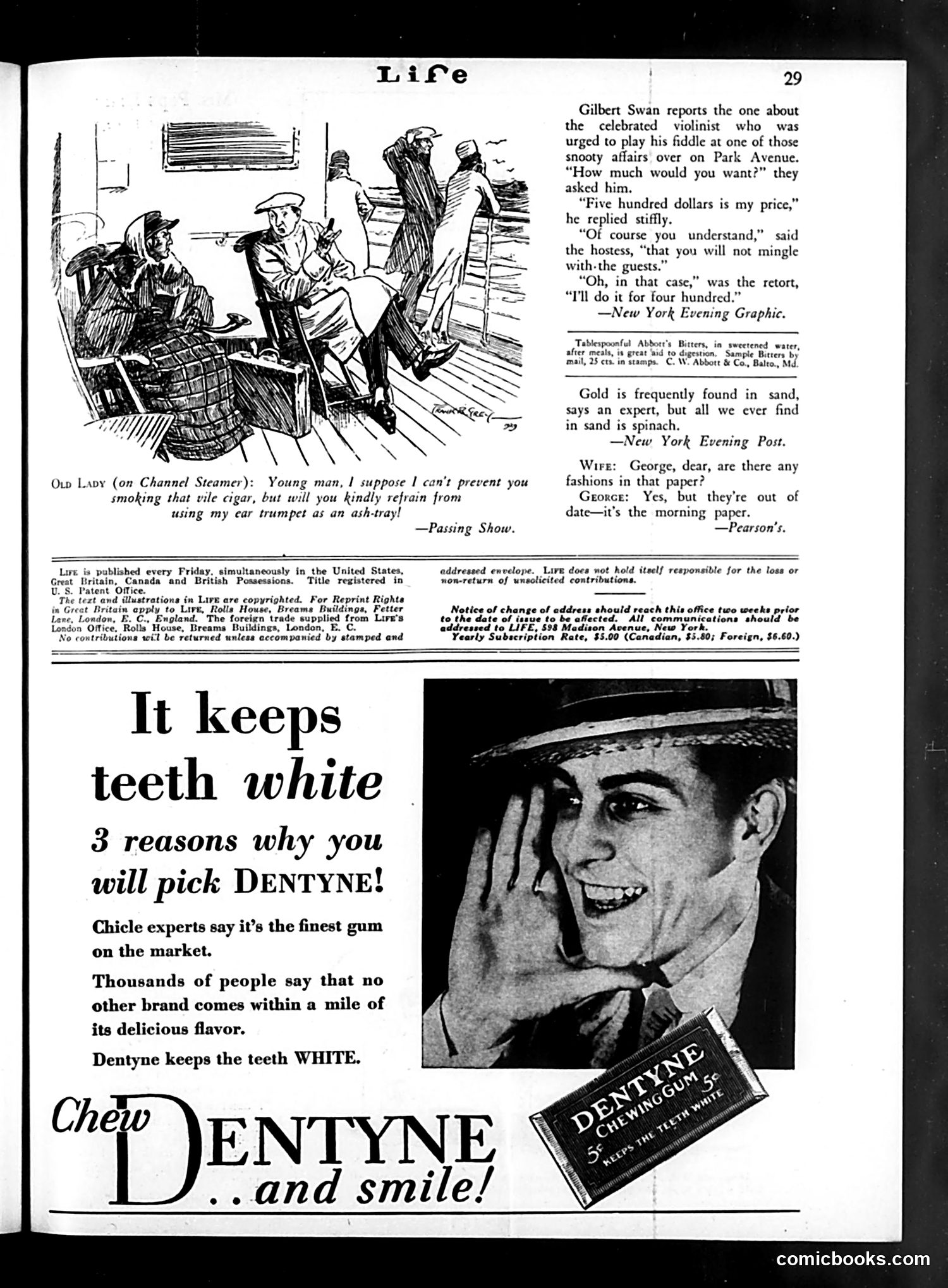
This page contains several satirical anecdotes typical of *Life* magazine's humor section, plus a vintage advertisement. The main cartoon depicts an **Old Lady on a Channel Steamer** scolding a young man for smoking a cigar near her, asking him to use her ear trumpet as an ashtray instead. The joke plays on the absurdity of her complaint—she's objecting to cigar smoke but offering an alternative that's equally ridiculous. The printed jokes below mock social pretension (a snobbish violinist negotiating lower pay to avoid mixing with wealthy hosts) and offer deadpan observations about finding spinach rather than gold in sand. The **Dentyne chewing gum advertisement** occupies the lower half, featuring a smiling man in a hat promoting three reasons to buy: expert approval, flavor superiority, and teeth-whitening properties. This represents typical early-20th-century advertising claims before modern consumer protection regulations.
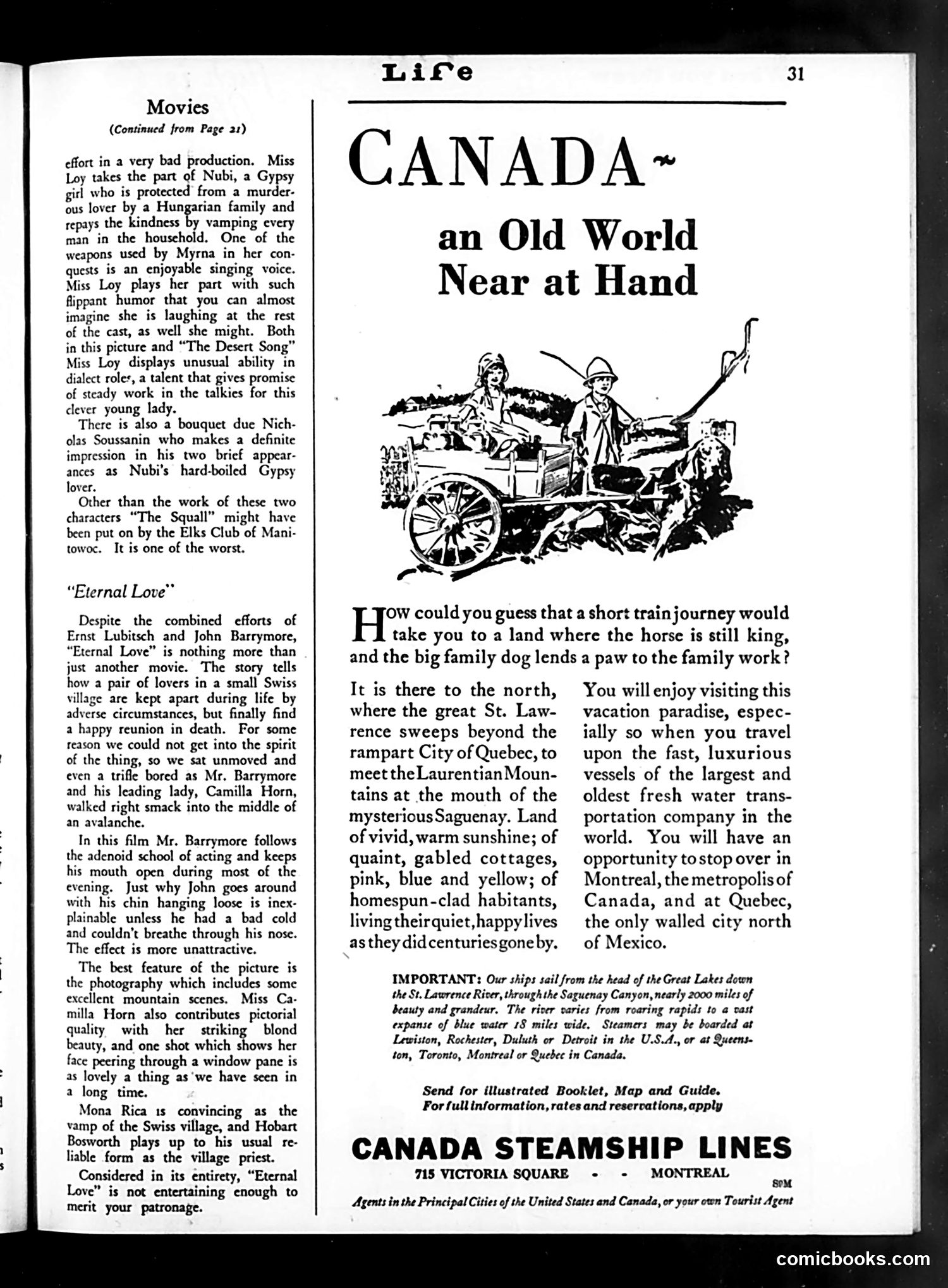
This page contains two elements: movie reviews and a travel advertisement. The **movie reviews** critique contemporary films. "The Squall" is dismissed as poorly made despite actress Myrna Loy's charming performance as a Gypsy woman; the reviewer suggests the rest of the cast is so weak the film barely rises above amateur theater. "Eternal Love," directed by Ernst Lubitsch and starring John Barrymore, is criticized as forgettable and emotionally uninvolving. The reviewer mocks Barrymore's acting style, specifically his habit of keeping his mouth open throughout scenes, finding it unattractive and inexplicable. The **advertisement** promotes Canada Steamship Lines' luxury cruises along the St. Lawrence River and Saguenay Canyon. It markets rural Quebec as an "Old World" vacation destination with picturesque villages, quaint cottages, and traditional habitants (French-Canadian farmers), appealing to tourists seeking exotic yet accessible travel from American Great Lakes ports.
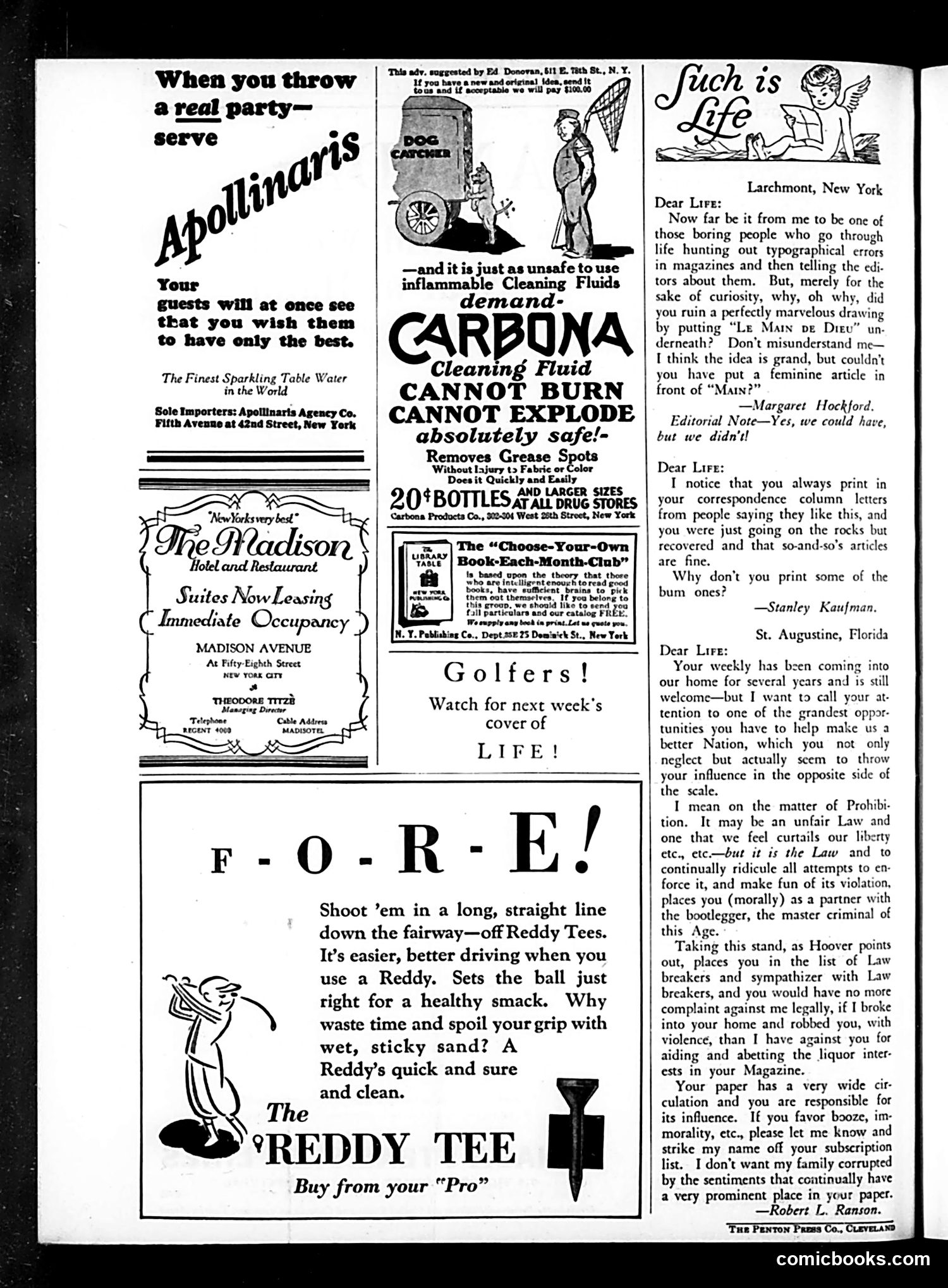
This page is primarily **advertisements and reader letters**, not political cartoons. The ads promote luxury goods (Apollinaris sparkling water, Madison Hotel, Carbona cleaning fluid, Reddy golf tees) to affluent readers—typical 1920s lifestyle marketing. The **"Such is Life" section** contains three reader letters addressing magazine content: 1. **Margaret Hockford** complains about a French caption error ("Le Main de Dieu" should use feminine article)—a humorous nitpick about typography. 2. **Stanley Kaufman** sarcastically asks why Life only prints positive reader mail, not critical letters. 3. **Robert L. Ranson** (St. Augustine, Florida) seriously criticizes Life for mocking **Prohibition enforcement**. He argues the magazine's anti-Prohibition stance makes it morally complicit with bootleggers and undermines the law—a heated social/political issue of the Prohibition era (1920-1933). The Ranson letter reveals contemporary tensions: some readers viewed Prohibition as legitimate law deserving respect, while Life apparently took a satirical, skeptical stance toward enforcement.
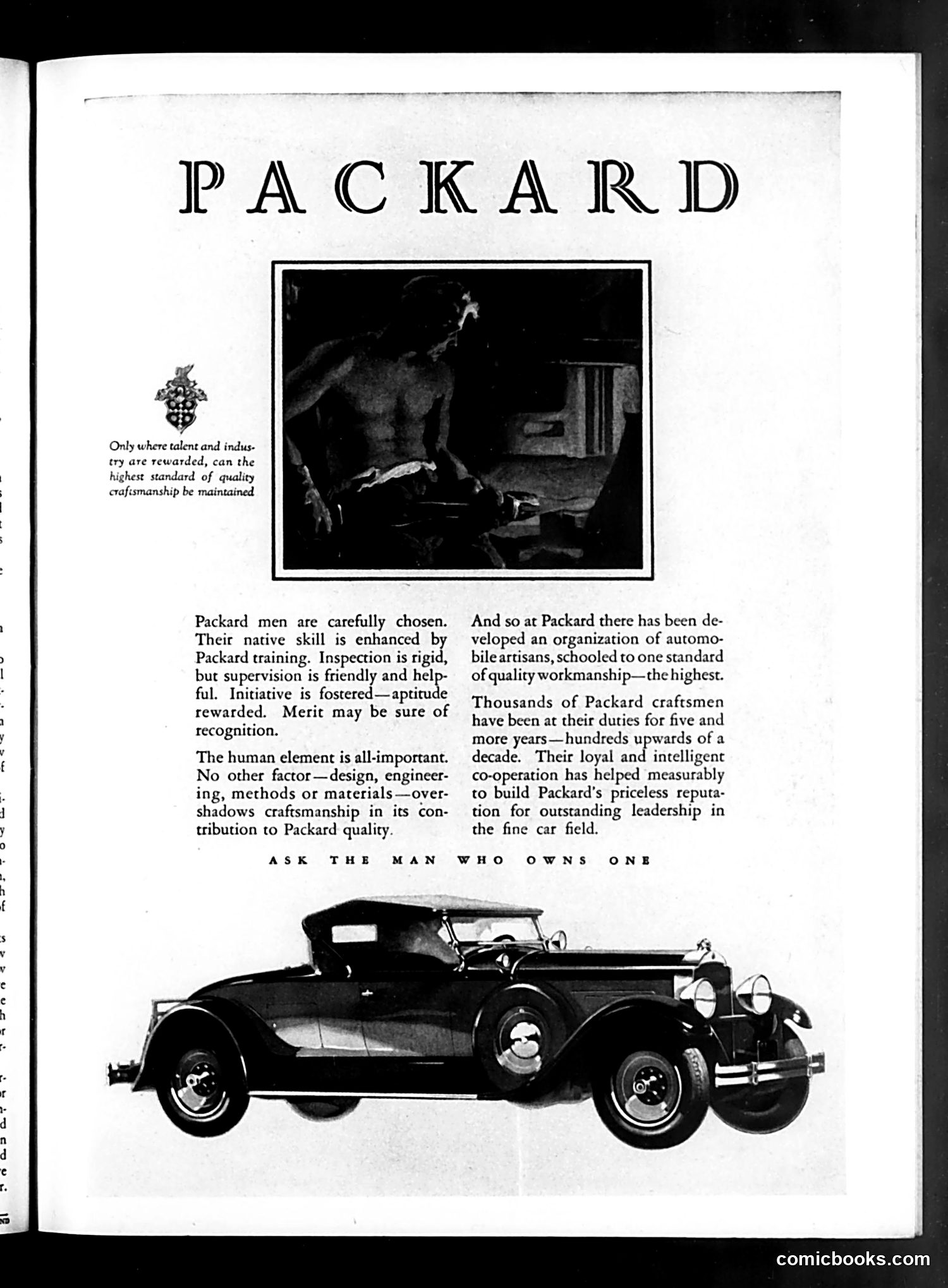
This is a **Packard automobile advertisement**, not political satire. It promotes luxury cars by emphasizing craftmanship and worker loyalty. The page features a photograph of skilled workers assembling a vehicle, accompanying text praising Packard's rigorous hiring and training practices. The famous tagline "Ask the Man Who Owns One" appears at bottom, alongside an illustration of a sleek Packard automobile. The advertisement's message targets affluent buyers by arguing that Packard's quality stems from carefully selected, well-treated, long-tenured craftsmen whose "merit" is "rewarded." This reflects 1920s-era industrial messaging linking worker satisfaction to product excellence—positioning Packard as a prestige brand built by dedicated artisans rather than assembly-line labor. The page contains no political cartoon or satire; it's purely commercial marketing.
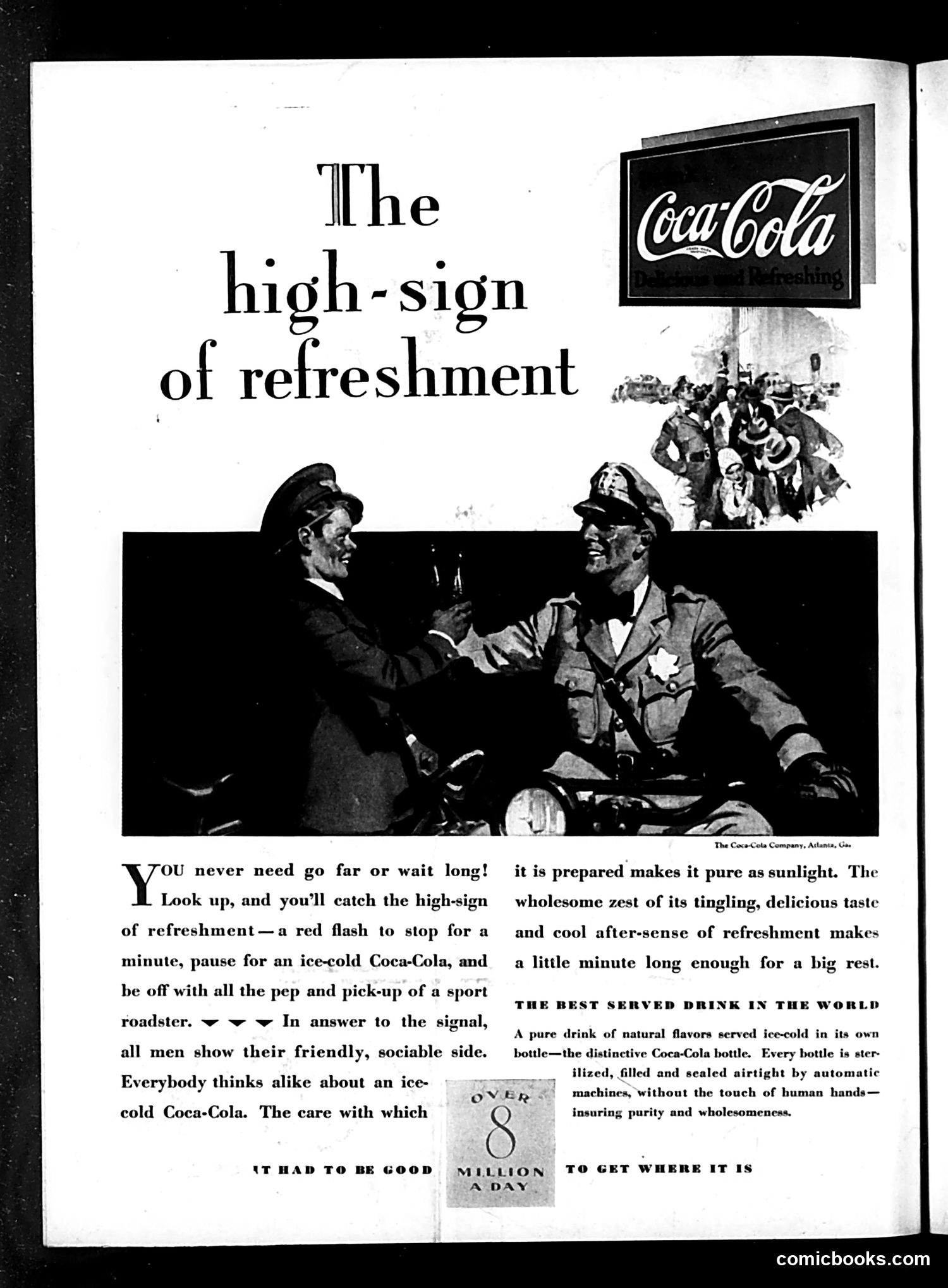
This is primarily a **Coca-Cola advertisement**, not political satire. The page depicts two working-class men (appears to be a factory worker and a motorcycle/roadster driver) sharing a Coca-Cola break, with the slogan "the high-sign of refreshment." The ad's appeal targets early 20th-century American values: it emphasizes that Coca-Cola unites men across social classes ("all men show their friendly, sociable side"), promotes efficiency and productivity ("pep and pick-up"), and assures purity through modern industrial processes ("automatic machines, without the touch of human hands"). The boast of "over 8 million a day" consumption suggests mass popularity as proof of quality. This reflects the era's faith in mass production and industrial standardization as markers of trustworthiness—a selling point that would resonate differently to modern readers, who often worry about industrial processing and human oversight in manufacturing.