
Life, 1929-05-31 · page 22 of 36
Life — May 31, 1929 — page 22: what you’re looking at
What you’re looking at
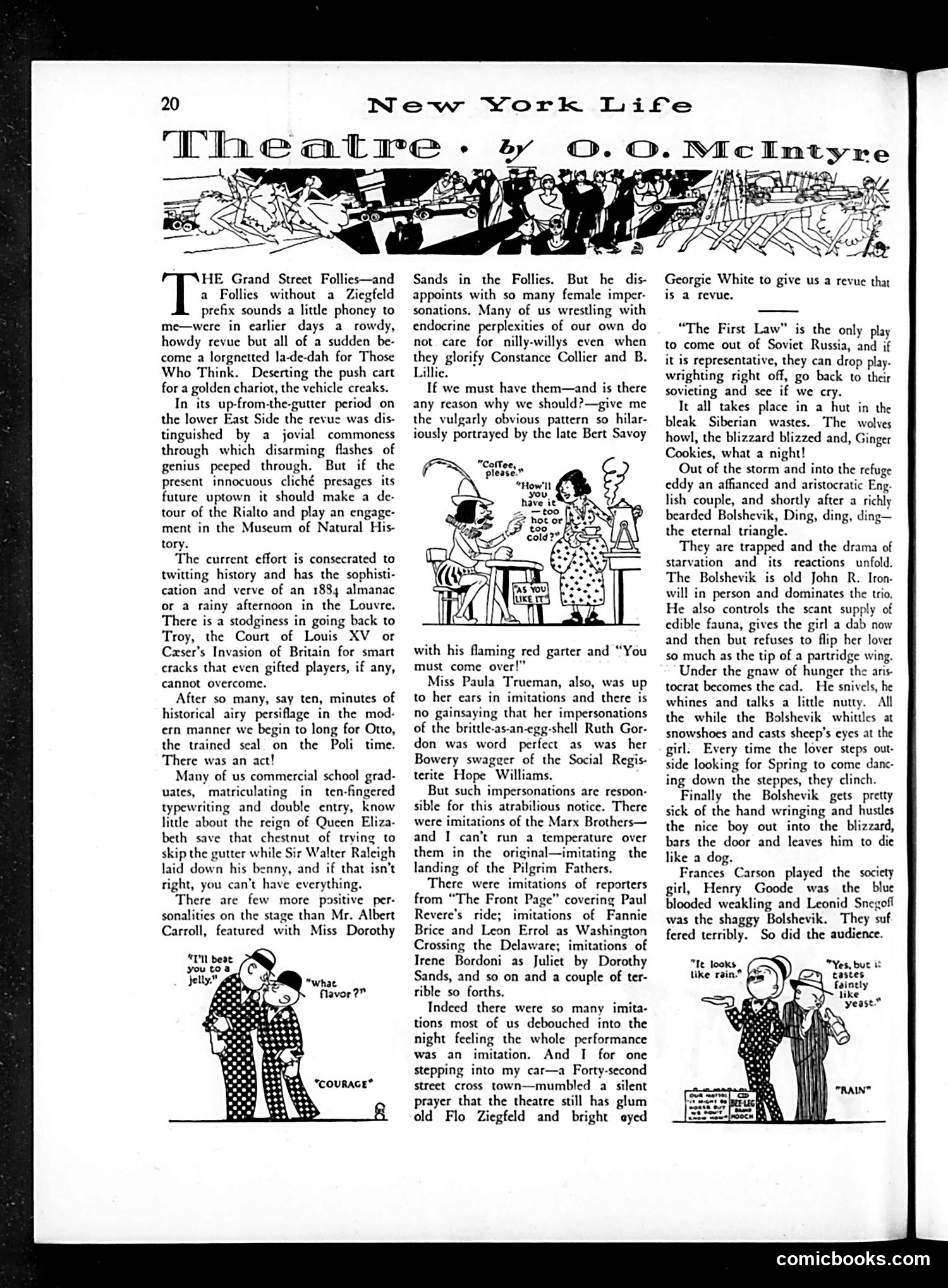
This is O.O. McIntyre's theatre review criticizing the Grand Street Follies revue for losing its original working-class charm. The review condemns the show's shift from rowdy, lower East Side entertainment to pretentious, sophisticated theatre attempting historical parody. McIntyre's main complaint: the revue relies excessively on impersonations—particularly female impersonators like Albert Carroll and Paula Trueman imitating famous performers (Ruth Gordon, Hope Williams, the Marx Brothers, Fannie Brice). He dismisses these as tired clichés that make the entire show feel like an imitation rather than original comedy. The cartoons illustrate typical vaudeville/revue humor with characters in polka-dot costumes. McIntyre contrasts the Follies unfavorably with Florenz Ziegfeld's productions, implying superior theatrical taste and originality. He also briefly reviews a Soviet play, "The First Law," dismissing it as equally poor—suggesting post-revolutionary Russian drama merits no serious consideration.
📄 Transcribed text from this page (OCR, searchable)
Machine-transcribed from the original scan — historical spelling and the odd misread are preserved.
20 HE Grand Street Follies—and a Follies without a Ziegfeld prefix sounds a little phoney to me—were in earlier days a rowdy, howdy revue but all of a sudden be- come a lorgnetted la-de-dah for Those Who Think. Deserting the push cart for a golden chariot, the vehicle creaks. In its up-from-the-gutter period on the lower East Side the revue was dis- tinguished by a jovial commoness through which disarming flashes of genius peeped through. But if the present innocuous cliché presages its future uptown it should make a de- tour of the Rialto and play an engage- ment in the Museum of Natural His- tory. The current effort is consecrated to twitting history and has the sophisti- cation and verve of an 1834 almanac or a rainy afternoon in the Louvre. There is a stodginess in going back to Troy, the Court of Louis XV_ or Caser’s Invasion of Britain for smart cracks that even gifted players, if any, cannot overcome. After so many, say ten, minutes of historical airy persiflage in the mod- ern manner we begin to long for Otto, the trained seal on the Poli time. There was an act! Many of us commercial school grad- uates, matriculating in ten-fingered typewriting and double entry, know little about the reign of Queen Eliza- beth save that chestnut of trying to skip the gutter while Sir Walter Raleigh laid down his benny, and if that isn’t right, you can’t have everything. There are few more positive per- sonalities on the stage than Mr. Albert Carroll, featured with Miss Dorothy “COURAGE* Sands in the Follies. But he dis- appoints with so many female imper- sonations. Many of us wrestling with endocrine perplexities of our own do not care for nilly-willys even when they glorify Constance Collier and B. Lillie. If we must have them—and is there any reason why we should?—give me the vulgarly obvious pattern so hilar- iously portrayed by the late Bert Savoy with his flaming red garter and “You must come over!” Miss Paula Trueman, also, was up to her ears in imitations and there is no gainsaying that her impersonations of the brittle-as-an-egg-shell Ruth Gor- don was word perfect as was her Bowery swagger of the Social Regis- terite Hope Williams. But such impersonations are respon- sible for this atrabilious notice. There were imitations of the Marx Brothers— and I can’t run a temperature over them in the original—imitating the landing of the Pilgrim Fathers. There were imitations of reporters from “The Front Page” covering Paul Revere’s ride; imitations of Fannie Brice and Leon Errol as Washington Crossing the Delaware; imitations of Irene Bordoni as Juliet by Dorothy Sands, and so on and a couple of ter- rible so forths. Indeed there were so many imita- tions most of us debouched into the night feeling the whole performance was an imitation. And I for one stepping into my car—a Forty-second street cross town—mumbled a silent prayer that the theatre still has glum old Flo Ziegfeld and bright eyed New York Life Georgie White to give us a revue that is a revue. “The First Law” is the only play to come out of Soviet Russia, and if it is representative, they can drop play- wrighting right off, go back to their sovieting and see if we cry. It all takes place in a hut in the bleak Siberian wastes. The wolves howl, the blizzard blizzed and, Ginger Cookies, what a night! Out of the storm and into the refuge eddy an affianced and aristocratic Eng. lish couple, and shortly after a richly bearded Bolshevik, Ding, ding, ding— the eternal triangle. They are trapped and the drama of starvation and its reactions unfold. The Bolshevik is old John R. Iron- will in person and dominates the trio. He also controls the scant supply of edible fauna, gives the girl a dab now and then but refuses to flip her lover so much as the tip of a partridge wing. Under the gnaw of hunger the aris tocrat becomes the cad. He snivels, he whines and talks a little nutty. All the while the Bolshevik whittles at snowshoes and casts sheep's eyes at the girl. Every time the lover steps out- side looking for Spring to come danc- ing down the steppes, they clinch. Finally the Bolshevik gets pretty sick of the hand wringing and hustles the nice boy out into the blizzard, bars the door and leaves him to die like a dog. Frances Carson played the society girl, Henry Goode was the blue blooded weakling and Leonid Snegofl was the shaggy Bolshevik. They suf fered terribly. So did the audience. like rain” comicbooks.com