
Life, 1929-05-31 · page 23 of 36
Life — May 31, 1929 — page 23: what you’re looking at
What you’re looking at
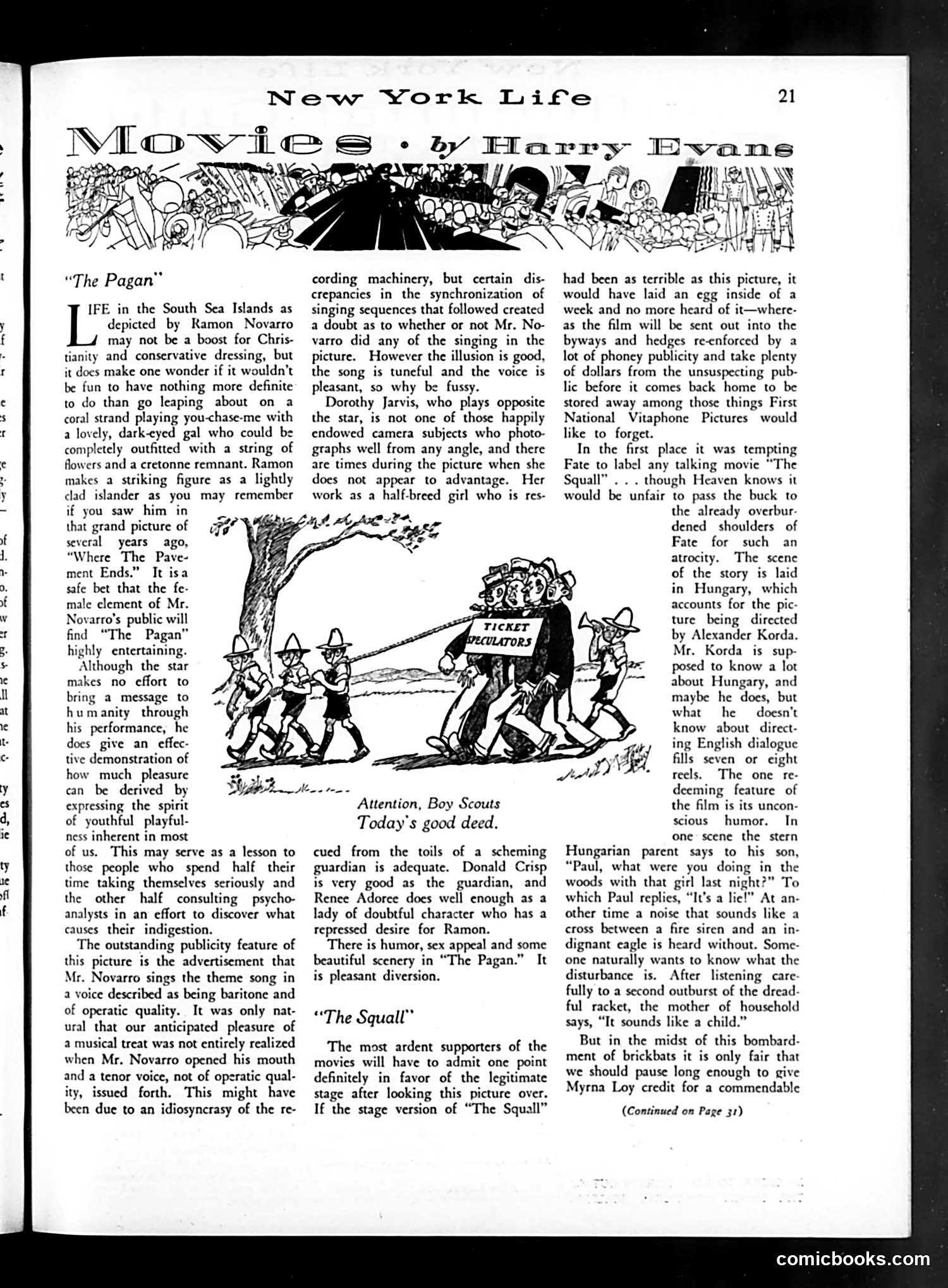
This page contains two film reviews by Harry Evans, published in Life magazine's "Movies" column. The small cartoon labeled "Attention, Boy Scouts—Today's good deed" appears to depict Boy Scouts confronting ticket scalpers (marked "TICKET REGULATORS"), satirizing the problem of ticket speculation at entertainment venues. The reviews themselves critique contemporary films: "The Pagan" starring Ramon Novarro is reviewed as entertaining escapism featuring a barely-clothed island romance, though Evans notes a glaring technical failure—Novarro's advertised baritone voice is clearly a tenor, suggesting dubious sound synchronization in this early talking picture. "The Squall," a Hungarian-set drama, is harshly dismissed as so incompetent that it represents an embarrassment even compared to failed stage productions. The satire targets both films' shortcomings and the emerging technology of "talking pictures" (talkies), which Evans suggests will allow even poor films to profit through wide distribution despite their quality.
📄 Transcribed text from this page (OCR, searchable)
Machine-transcribed from the original scan — historical spelling and the odd misread are preserved.
New York Life 21 Mlowvies. by Harry Hwans “The Pagan” IFE in the South Sea Islands as L depicted by Ramon Novarro may not be a boost for Chris- tianity and conservative dressing, but it does make one wonder if it wouldn’t be fun to have nothing more definite to do than go leaping about on a coral strand playing you-chase-me with a lovely, dark-cyed gal who could be completely outfitted with a string of flowers and a cretonne remnant. Ramon makes a striking figure as a lightly clad islander as you may remember if you saw him in that grand picture of several years ago, “Where The Pave- ment Ends.” It isa safe bet that the fe- male clement of Mr. Novarro’s public will find “The Pagan” highly entertaining. Although the star makes no effort to bring a message to humanity through his performance, he does give an effec- tive demonstration of how much pleasure can be derived by expressing the spirit of youthful playful- ness inherent in most of us. This may serve as a lesson to those people who spend half their time taking themselves seriously and the other half consulting psycho- analysts in an effort to discover what causes their indigestion. The outstanding publicity feature of this picture is the advertisement that Mr. Novarro sings the theme song in a voice described as being baritone and of operatic quality. It was only nat- ural that our anticipated pleasure of a musical treat was not entirely realized when Mr. Novarro opened his mouth and a tenor voice, not of operatic qual- ity, issued forth. This might have been due to an idiosyncrasy of the re- cording machinery, but certain dis- crepancies in the synchronization of singing sequences that followed created a doubt as to whether or not Mr. No- varro did any of the singing in the picture. However the illusion is good, the song is tuneful and the voice is pleasant, so why be fussy. Dorothy Jarvis, who plays opposite the star, is not one of those happily endowed camera subjects who photo- graphs well from any angle, and there are times during the picture when she does not appear to advantage. Her work as a half-breed girl who is res- Attention, Boy Scouts Today's good deed. cued from the toils of a scheming guardian is adequate. Donald Crisp is very good as the guardian, and Renee Adoree does well enough as a lady of doubtful character who has a repressed desire for Ramon. There is humor, sex appeal and some beautiful scenery in “The Pagan.” It is pleasant diversion. “The Squall” The most ardent supporters of the movies will have to admit one point definitely in favor of the legitimate stage after looking this picture over. If the stage version of “The Squall” had been as terrible as this picture, it would have laid an egg inside of a week and no more heard of it—where- as the film will be sent out into the byways and hedges re-enforced by a lot of phoney publicity and take plenty of dollars from the unsuspecting pub- lic before it comes back home to be stored away among those things First National Vitaphone Pictures would like to forget. In the first place it was tempting Fate to label any talking movie “The Squall” . . . though Heaven knows it would be unfair to pass the buck to the already overbur- dened shoulders of Fate for such an atrocity. The scene of the story is laid in Hungary, which accounts for the pic- ture being directed by Alexander Korda. Mr. Korda is sup- posed to know a lot about Hungary, and maybe he does, but what he — doesn’t know about direct- ing English dialogue fills seven or eight reels. The one re- deeming feature of the film is its uncon- scious humor. In one scene the stern Hungarian parent says to his son, “Paul, what were you doing in the woods with that girl last night?” To which Paul replies, “It’s a lie!” At an- other time a noise that sounds like a cross between a fire siren and an in- dignant eagle is heard without. Some- one naturally wants to know what the disturbance is. After listening care- fully to a second outburst of the dread- ful racket, the mother of household says, “It sounds like a child.” But in the midst of this bombard- ment of brickbats it is only fair that we should pause long enough to give Myrna Loy credit for a commendable (Continued on Page 31) comicbooks.com