
A complete issue · 44 pages · 1929
Life — February 8, 1929
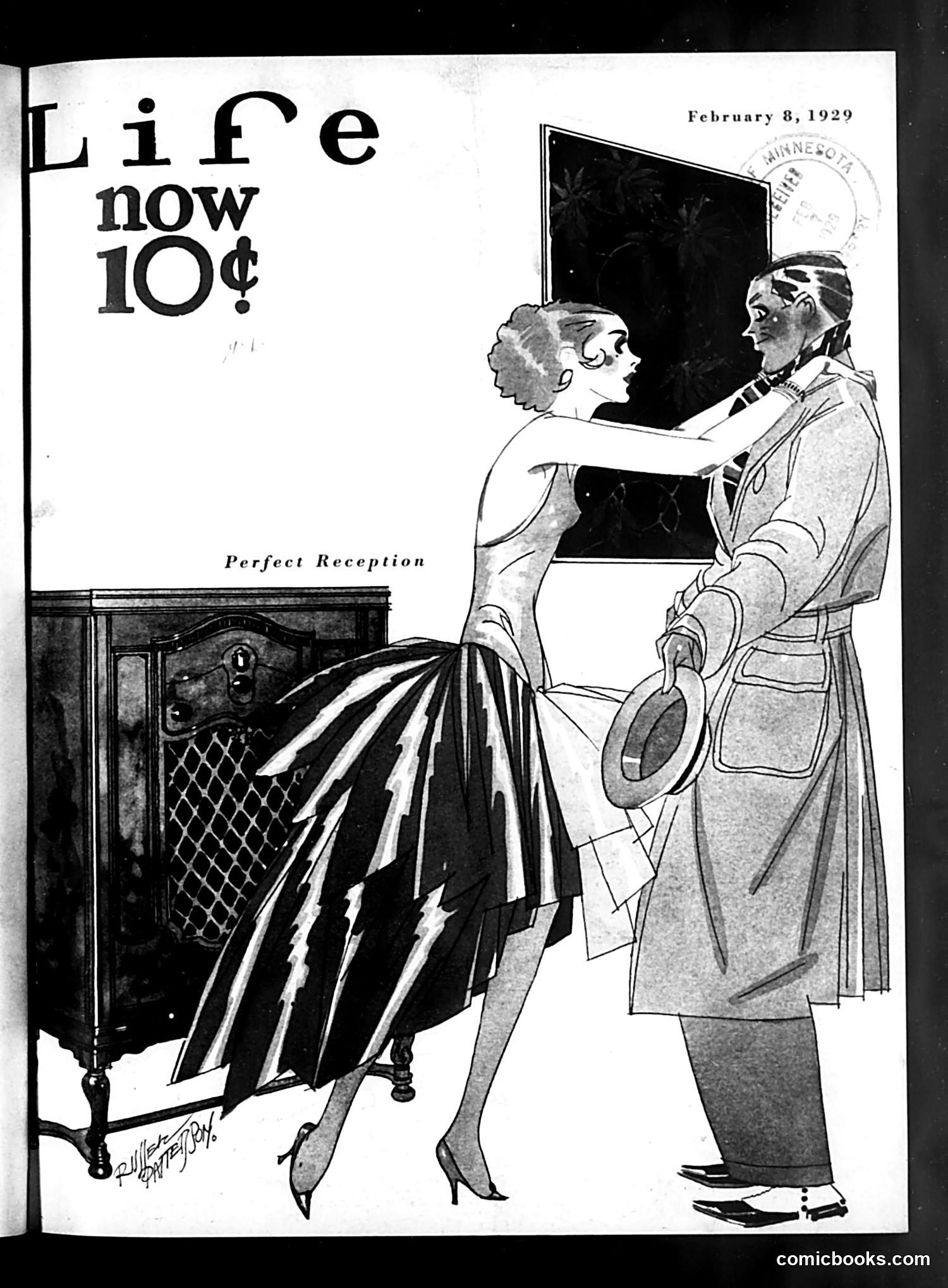
This is a magazine cover advertisement for radio receivers, not political satire. The illustration shows a couple admiring a new radio set labeled "Perfect Reception." The man holds a hat while the woman, in fashionable 1920s attire, gestures toward the radio cabinet with enthusiasm. The joke plays on double meaning: "perfect reception" refers both to the radio's signal quality and to the couple's warm social reception of the device itself. This reflects the 1920s radio boom—receiving sets were exciting new consumer technology that represented modernity and entertainment in the home. The "Life now 10¢" text indicates the magazine's cover price during this period. This is straightforward consumer advertising rather than political commentary.
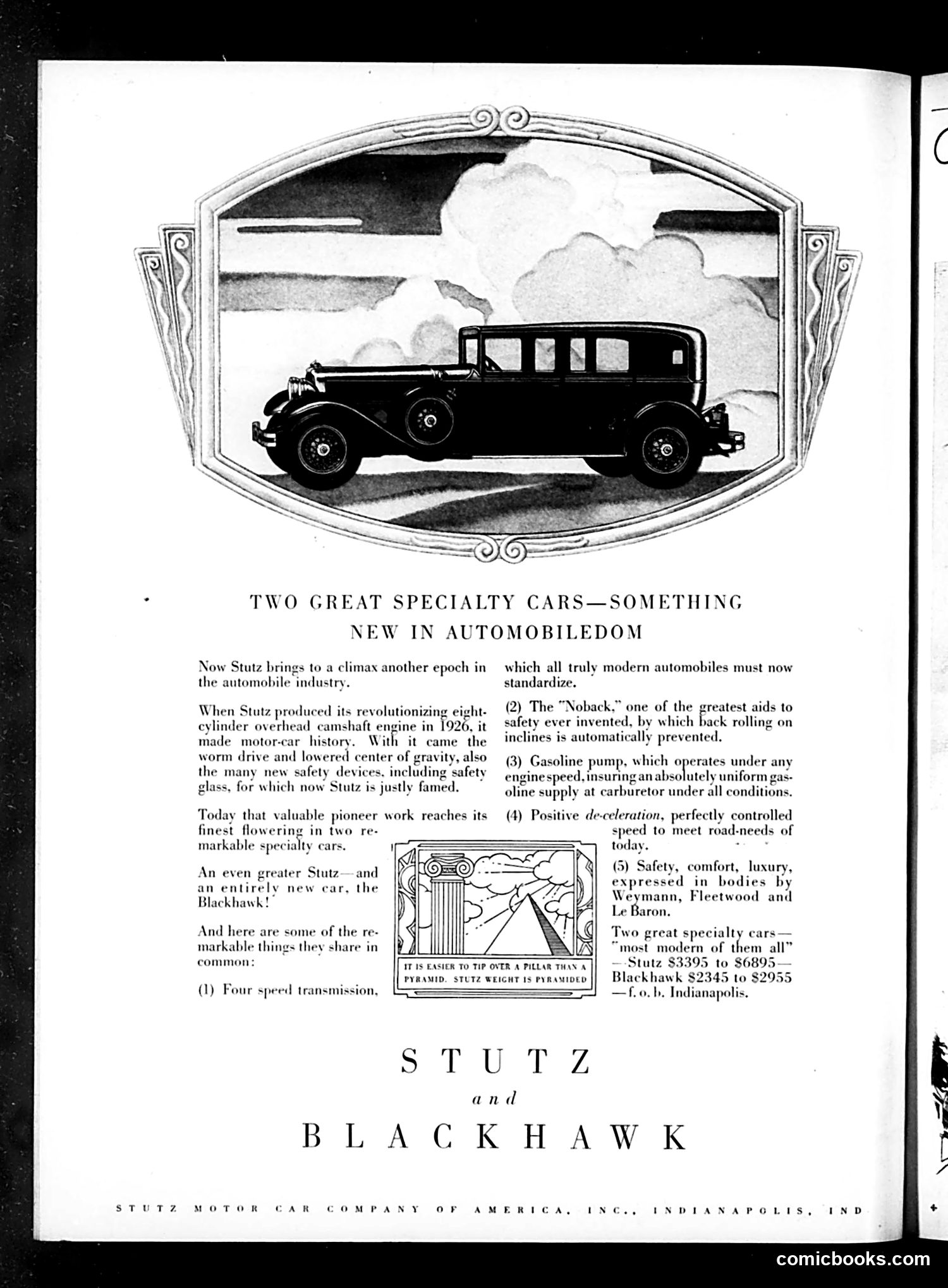
This page is primarily **advertising, not satire**. It promotes two Stutz automobile models—the Stutz and the Blackhawk—marketed as "specialty cars" featuring advanced engineering. The illustration shows a sleek sedan silhouetted against clouds, framed in an ornate art deco border. The text emphasizes innovations like an eight-cylinder overhead camshaft engine (introduced 1926), safety features ("Noback" anti-roll device, gasoline pump), and positive de-celeration control. There is no political cartoon or satirical content. This is a straightforward 1920s luxury car advertisement highlighting Stutz's technological superiority and styling appeal. Prices ranged from $3395 to $2955 f.o.b. Indianapolis.
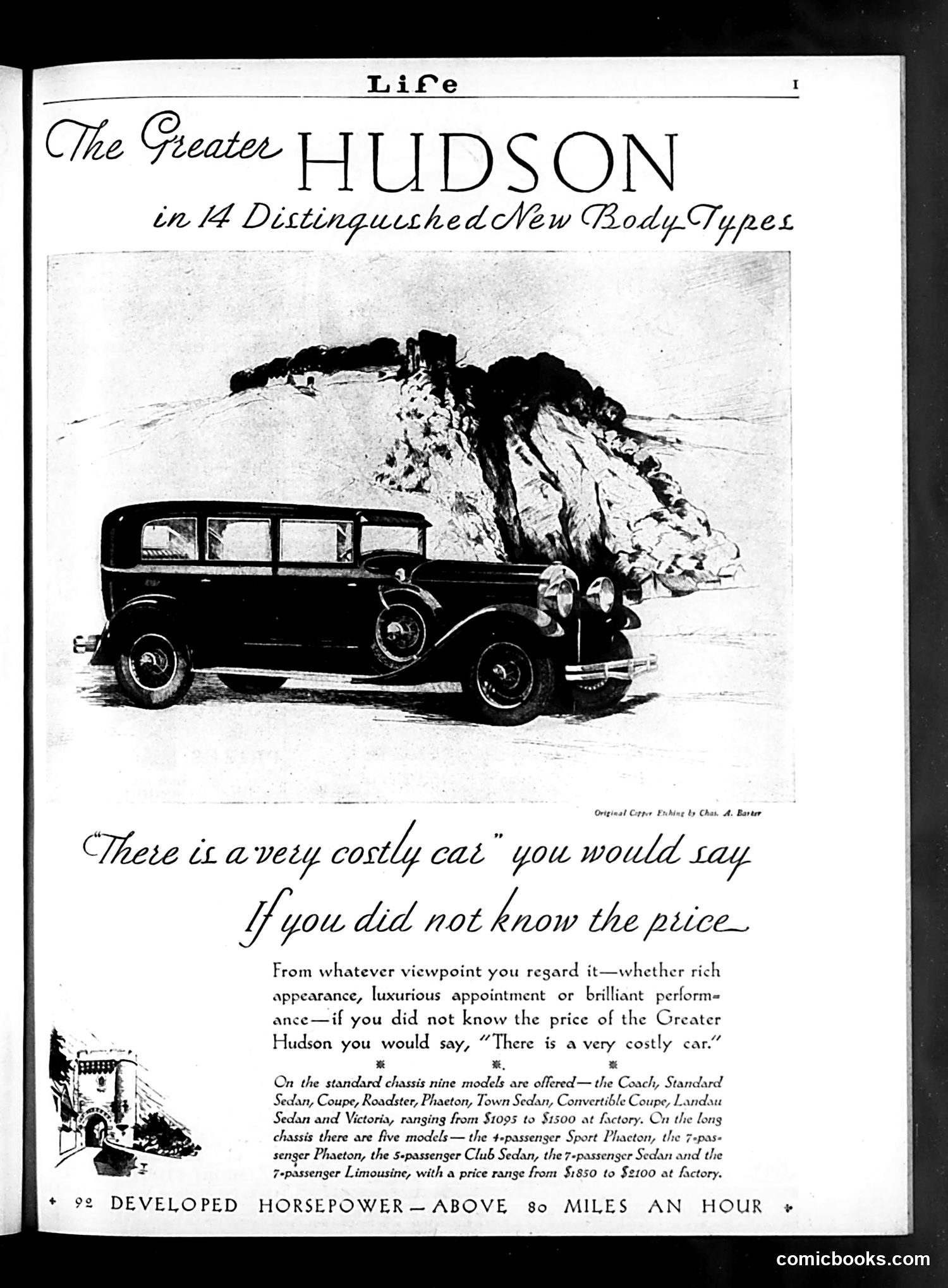
This is primarily a **Hudson automobile advertisement** rather than political satire or a cartoon. The page promotes the Greater Hudson in 14 body types, positioned as a luxury vehicle. The ad's humor is subtle: it uses the phrase "There is a very costly car you would say / If you did not know the price" to suggest Hudson offers luxury and performance at a reasonable cost—a sales pitch appealing to aspiring middle-class buyers who want to appear wealthy. The image shows a sleek sedan against a dramatic cliff backdrop, emphasizing elegance and capability. The specification details (horsepower, chassis options, price range $1,095-$2,100) reinforce that this is accessible luxury compared to more expensive competitors. This reflects 1920s consumer culture and automobile marketing strategies targeting upwardly mobile Americans.
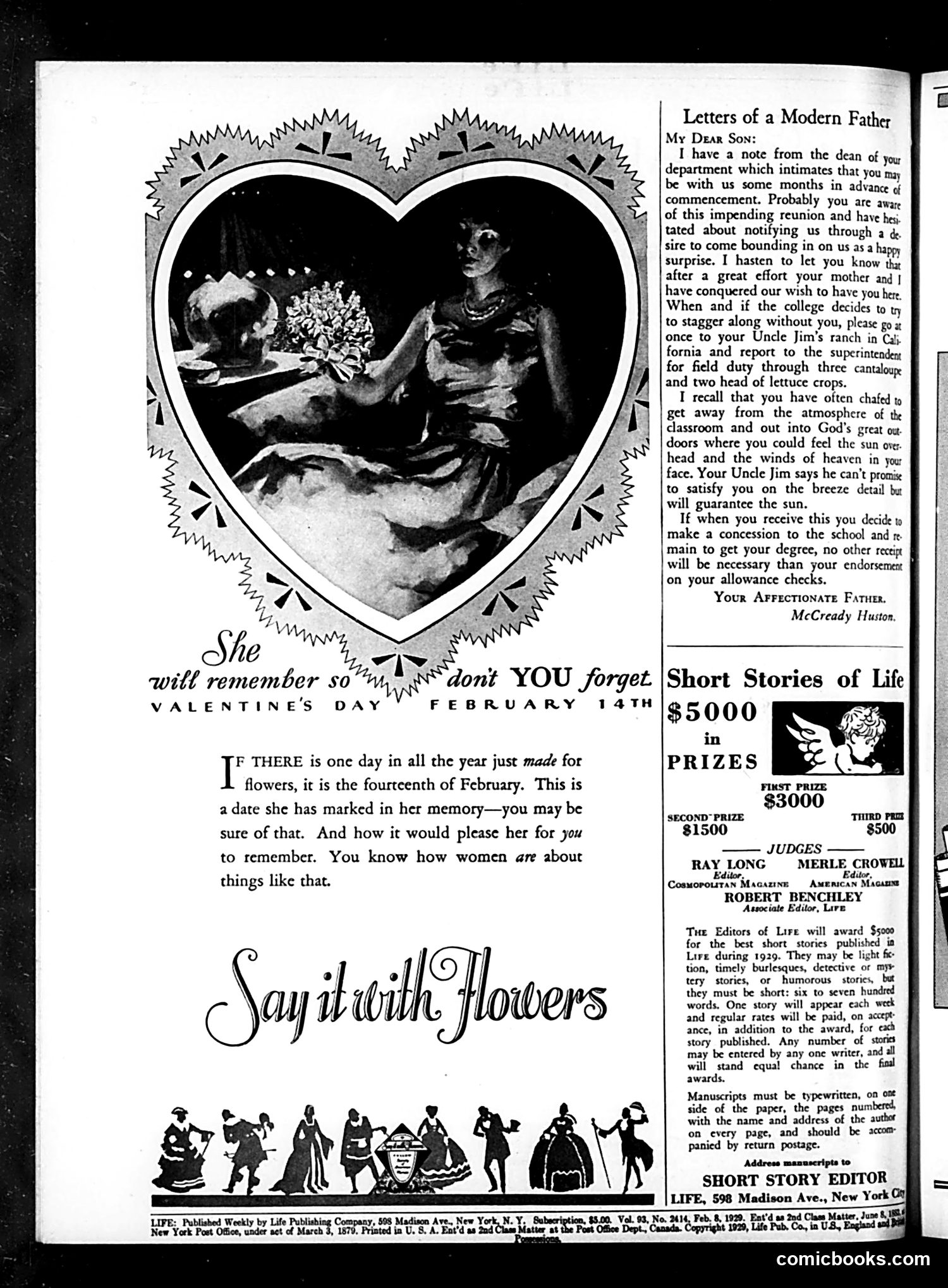
This page contains **no political cartoon**. Instead, it features two distinct items: 1. **A Valentine's Day Advertisement** (left): "Say it with Flowers" promotes sending flowers on February 14th. The heart-framed image shows a romantic couple, accompanying text encourages men to remember their sweethearts. This is straightforward commercial messaging, not satire. 2. **"Letters of a Modern Father"** (right): A humorous advice column where a father writes to his son about potentially skipping college commencement to work on Uncle Jim's ranch. The satire is gentle—poking fun at paternal anxiety and a son's desire to escape academia for outdoor work. The signature is "McCready Huston." The page also advertises a short story contest offering $5,000 in prizes through *Life* magazine. **No political satire is present.**
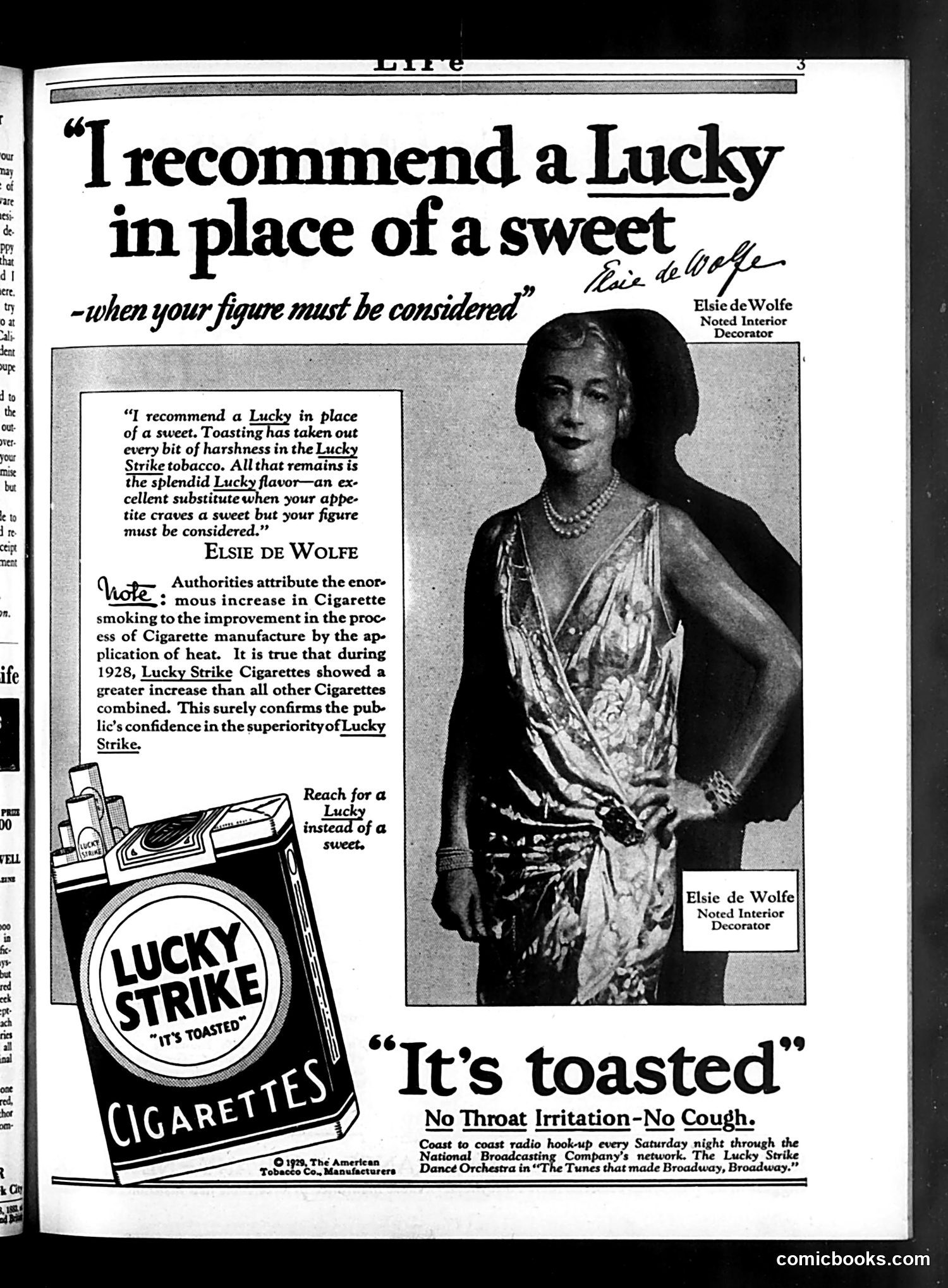
This is a **cigarette advertisement, not satire or political commentary**. It features Elsie de Wolfe, a renowned interior decorator of the era, endorsing Lucky Strike cigarettes. The ad's appeal targets weight-conscious women by suggesting cigarettes as a substitute for sweets—a common marketing tactic in early 20th-century tobacco advertising. Key claims include: - Lucky Strike's "toasting" process allegedly removes harshness - A note boasts cigarette sales increased more than competitors in 1928 - The slogan "No Throat Irritation—No Cough" makes health assurances - The tagline urges readers to "reach for a Lucky instead of a sweet" This represents pre-regulation advertising that would later be banned, using celebrity endorsement and health claims now recognized as misleading.
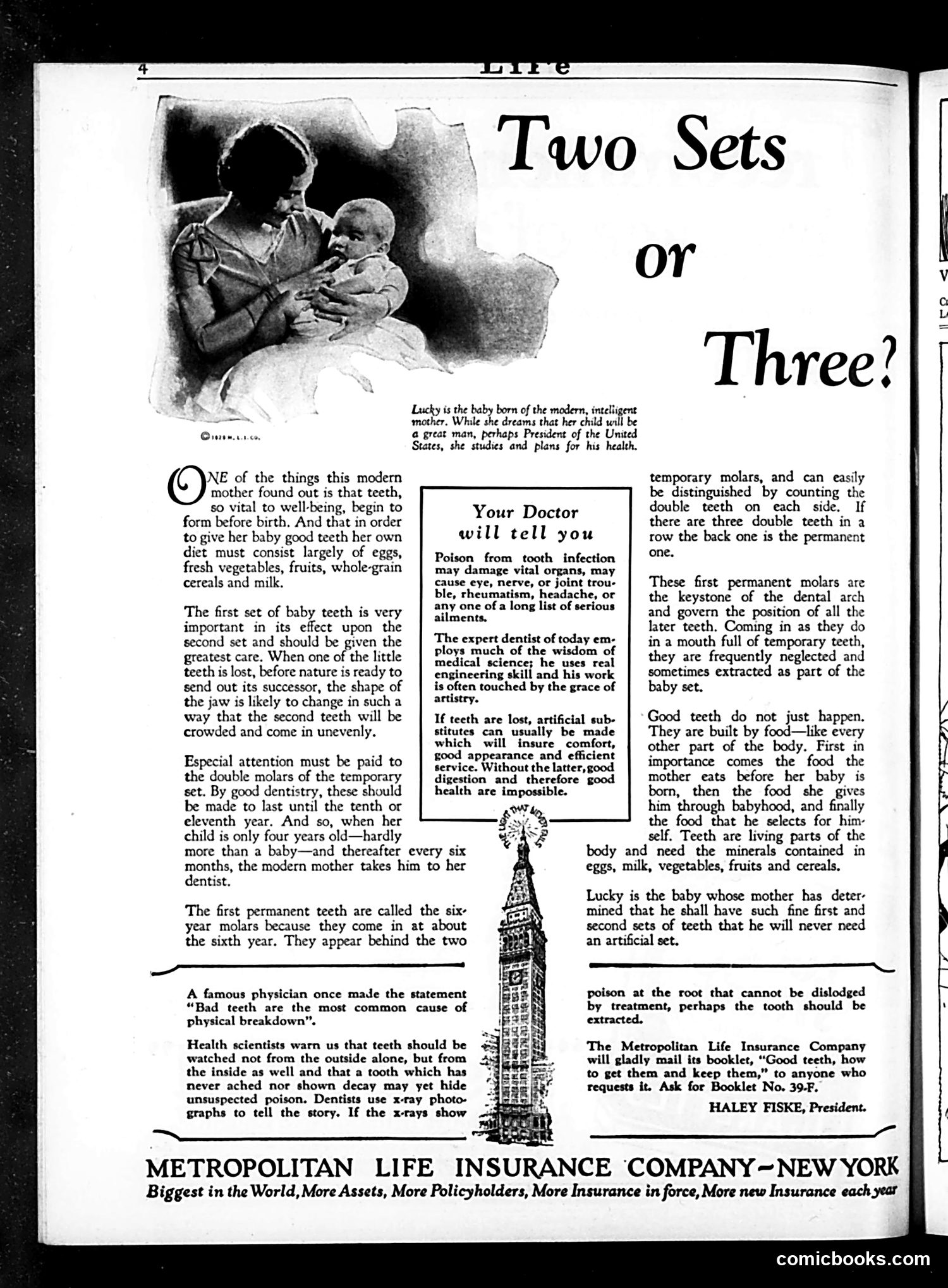
This is primarily a **corporate advertisement**, not satire. The "Two Sets or Three?" headline refers to baby teeth versus permanent teeth—a dental health educational piece dressed as editorial content. The accompanying illustration shows a mother with an infant, establishing the domestic/maternal angle. The text educates readers about child dentistry: baby teeth arrive around six months; permanent molars emerge around age six. The article cites a physician's statement that "bad teeth are the most common cause of physical breakdown," reflecting early-20th-century health anxieties. It emphasizes nutrition and preventive dentistry while promoting Metropolitan Life Insurance's approach to wellness. This represents **advertorial content**—marketing disguised as helpful information—a common Life magazine practice of its era.
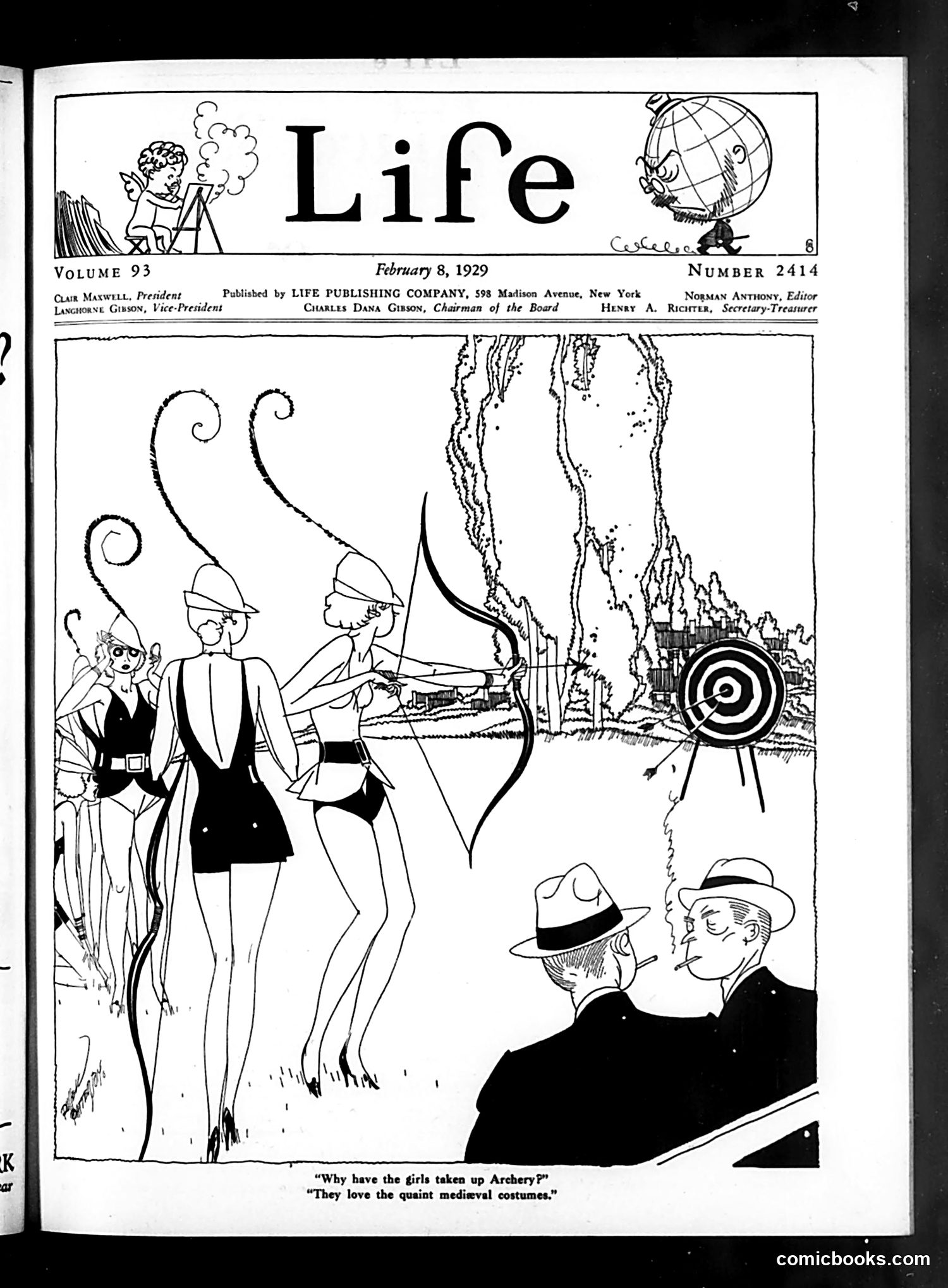
This is a humorous cartoon about archery as a recreational activity. Two men in fedoras (likely representing conventional 1920s businessmen or authority figures) observe three fashionably-dressed young women in medieval-inspired costumes practicing archery with bows. The joke, shown in the caption, plays on gender roles: when asked why girls have "taken up Archery," the response is "They love the quiet medieval costumes." The satire mocks both the women's apparent focus on fashion over the actual sport, and society's assumption that women pursue activities primarily for aesthetic reasons rather than genuine interest in the activity itself. The "quiet medieval costumes" reference suggests these outfits appeal to romanticized, old-fashioned ideals—likely ironic commentary on 1920s women's evolving independence.
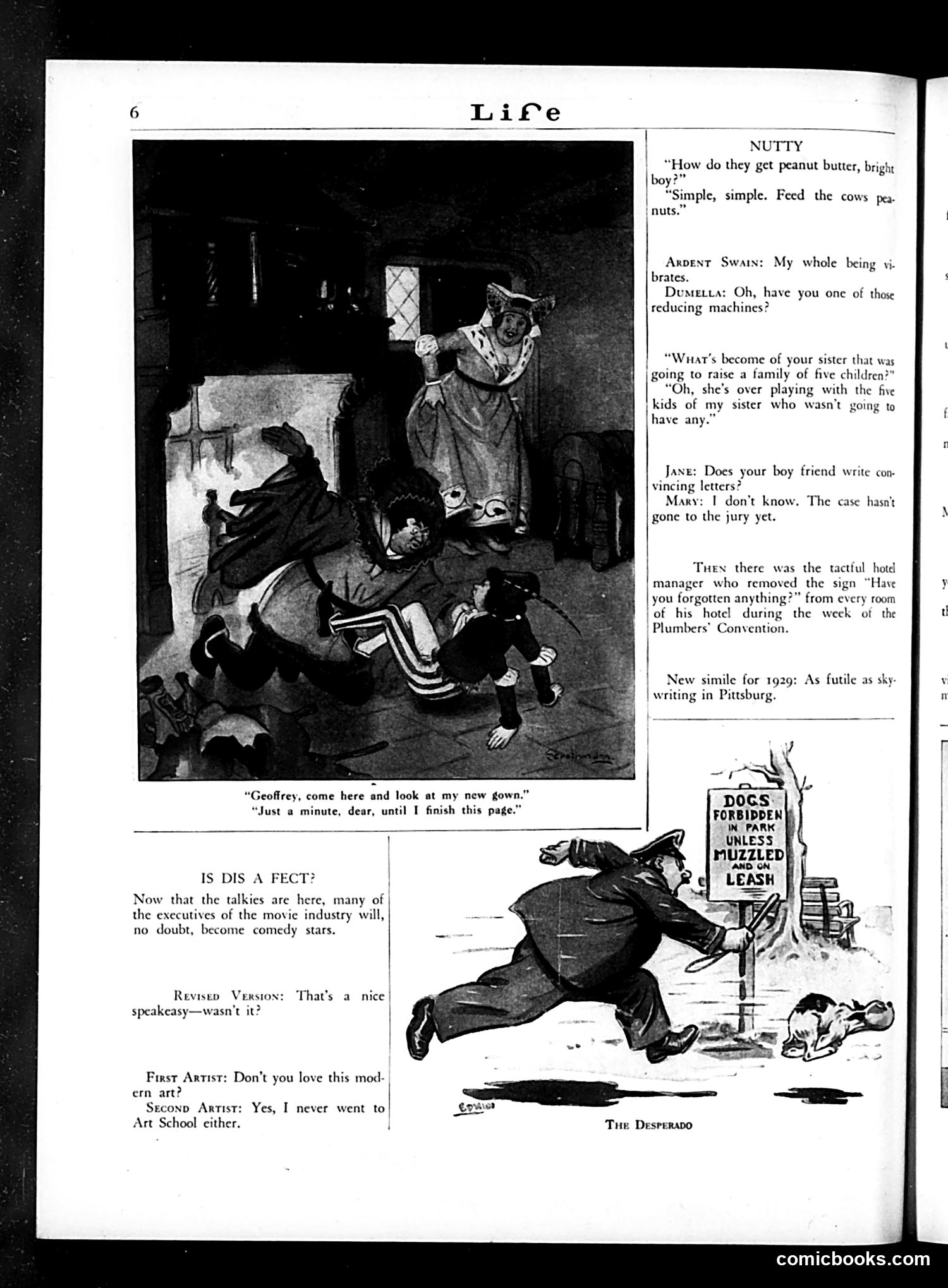
**Top Image & Caption:** A domestic scene showing a woman showing a man her new gown. The humor plays on marital dynamics and fashion vanity—common satire subjects for the era. **"Is Dis a Fect?" Section:** Brief commentary suggesting that talking pictures (newly introduced "talkies") are making movie executives into comedy stars, implying executives lack actual talent but benefit from the novelty of sound technology. **Bottom Cartoon "The Desperado":** A man frantically rushes past a park sign reading "DOGS FORBIDDEN IN PARK UNLESS MUZZLED ON LEASH." The joke appears to satirize either rule-breaking behavior or anxious compliance with regulations—the figure's panicked posture suggests absurd overreaction to a minor civic rule. Both pieces exemplify Life's 1920s-era satirical humor about everyday social situations and modern anxieties.
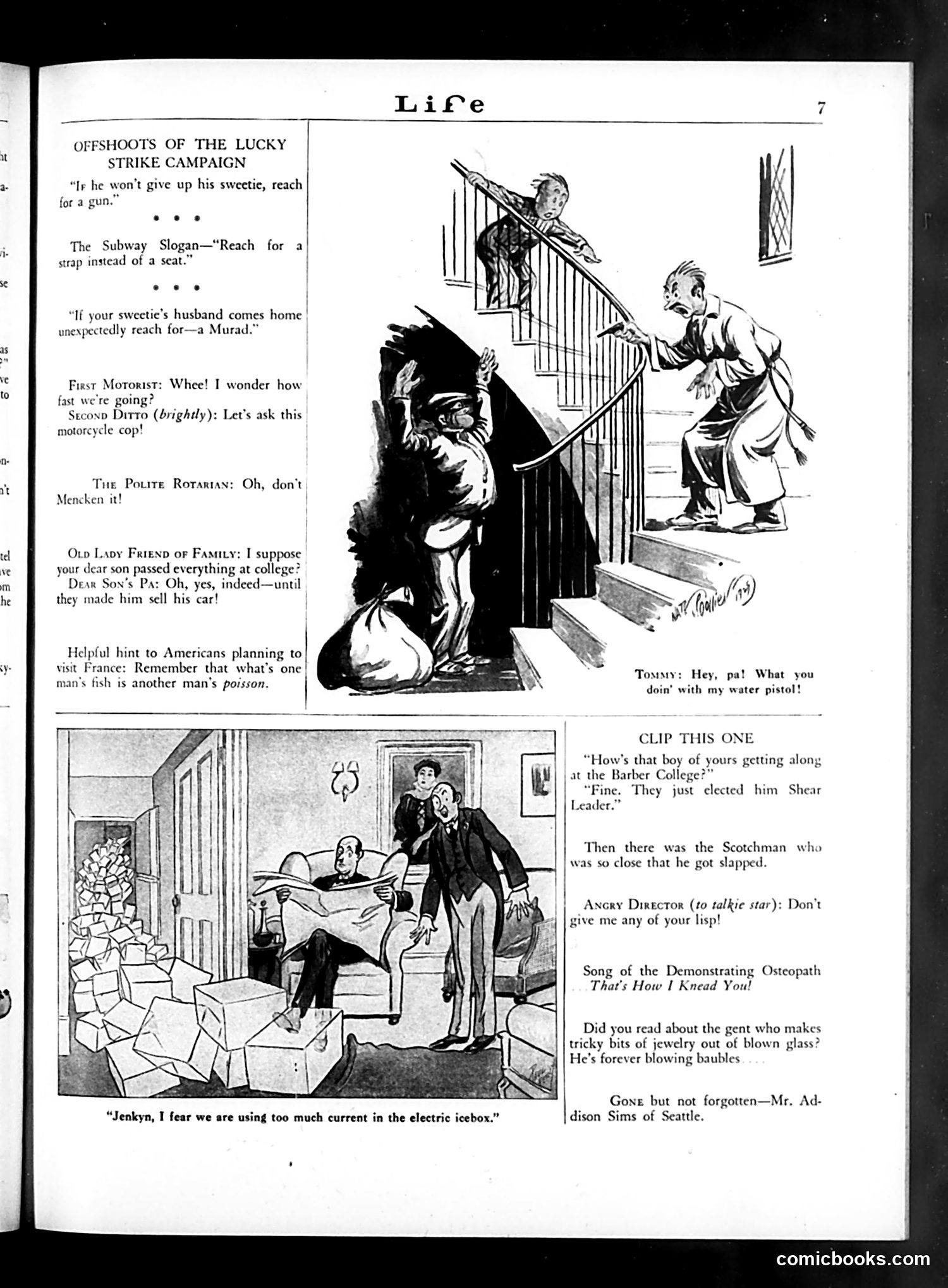
This page contains humor about labor strikes and social behavior from the early 20th century. **Top cartoon**: Shows a man descending stairs with a gun while his wife holds him back, captioned "Tommy: Hey, pa! What you doin' with my water pistol?" The joke satirizes strike violence—the father appears ready for confrontation, mistaking a child's toy for a real weapon. **Bottom cartoon**: Depicts a man in bed surrounded by overflowing papers/mail, with a woman standing nearby. The caption reads "Jenkyn, I fear we are using too much current in the electric icebox." This satirizes consumerism and the burden of modern household bills. The page also includes brief satirical quips about strikes, transportation, and social etiquette, typical of Life's editorial humor style.
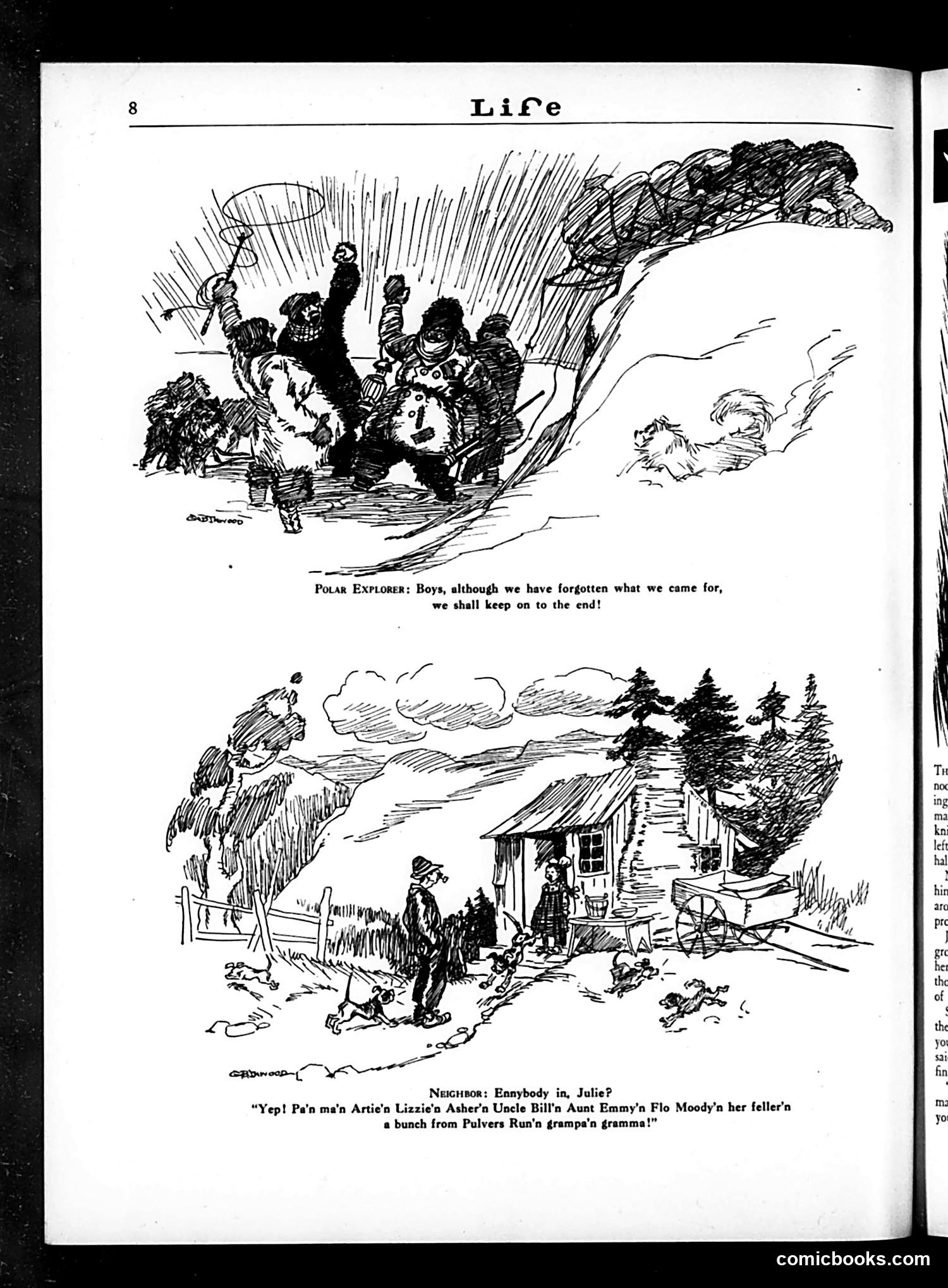
This page contains two satirical cartoons from *Life* magazine: **Top cartoon:** Depicts a polar explorer addressing his struggling team in harsh Arctic conditions. The caption reads: "Boys, although we have forgotten what we came for, we shall keep on to the end!" This appears to satirize polar exploration expeditions—likely referencing early 20th-century Arctic ventures—where the original scientific purpose becomes secondary to the stubborn pursuit of reaching the pole itself, regardless of hardship or lost objectives. **Bottom cartoon:** Shows rural/frontier characters at a humble cabin. The dialect-heavy caption about "Pa'n ma's Artie" and relatives appears to mock rural American speech patterns and genealogical tangles of backwoods communities, representing a common *Life* magazine trope of satirizing unsophisticated rural life for urban readers' amusement. Both exemplify *Life's* humor targeting exploration obsession and rural American stereotypes.
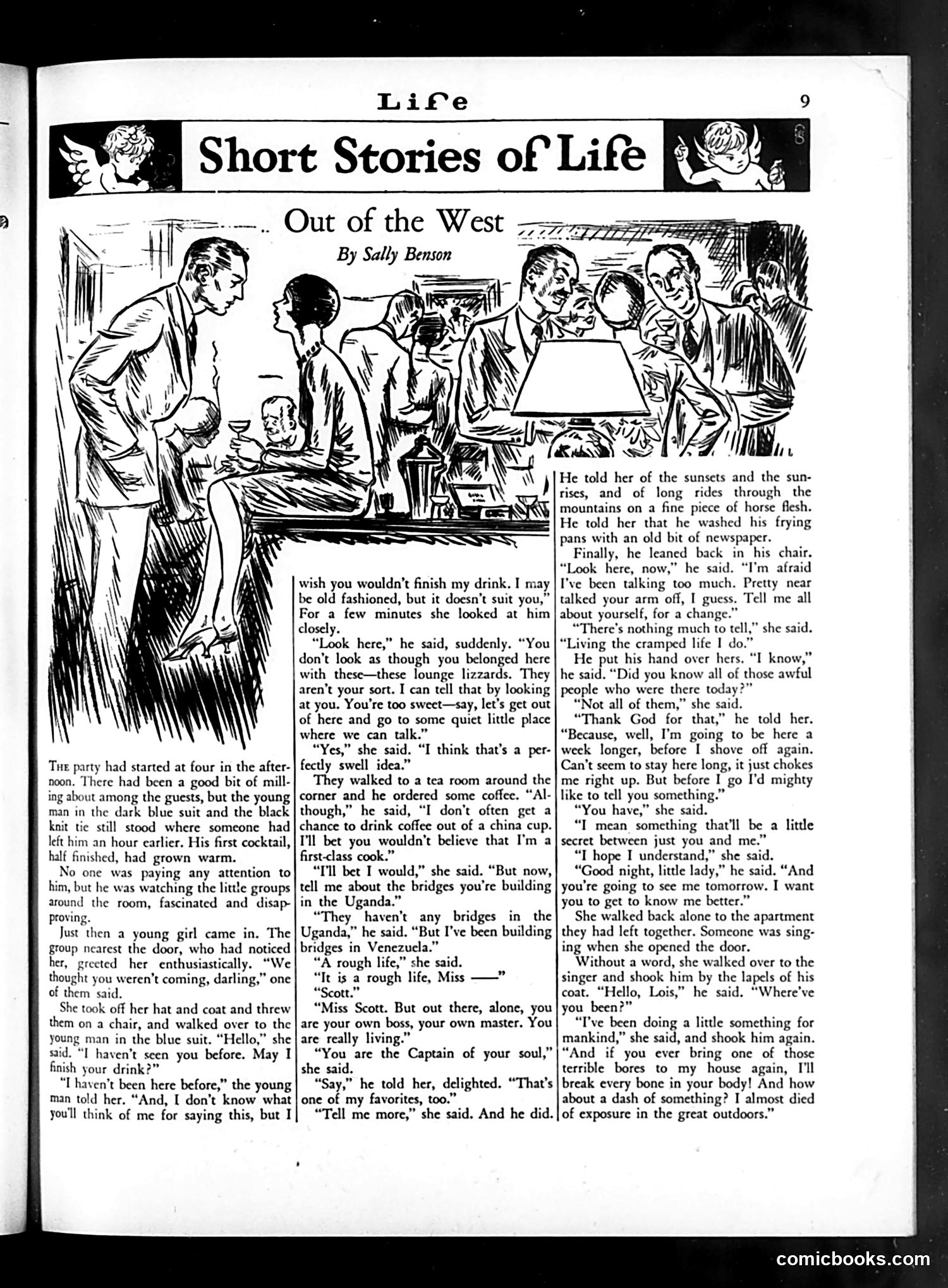
This is a short story, not political satire. The illustration shows a social scene at what appears to be a 1920s-30s cocktail party, where a young woman from the American West has captured a man's attention at an urban gathering. The story's humor derives from class and regional contrasts: the Western woman represents rural authenticity and independence ("you are your own boss, your own master"), while the urban sophistication of the party-goers emphasizes artificiality and constraint. The man finds her refreshing precisely because she's different from the "lounge lizards" surrounding him. The satire targets urban sophistication as shallow, positioning Western directness and frontier values as genuinely appealing alternatives to Eastern pretension.
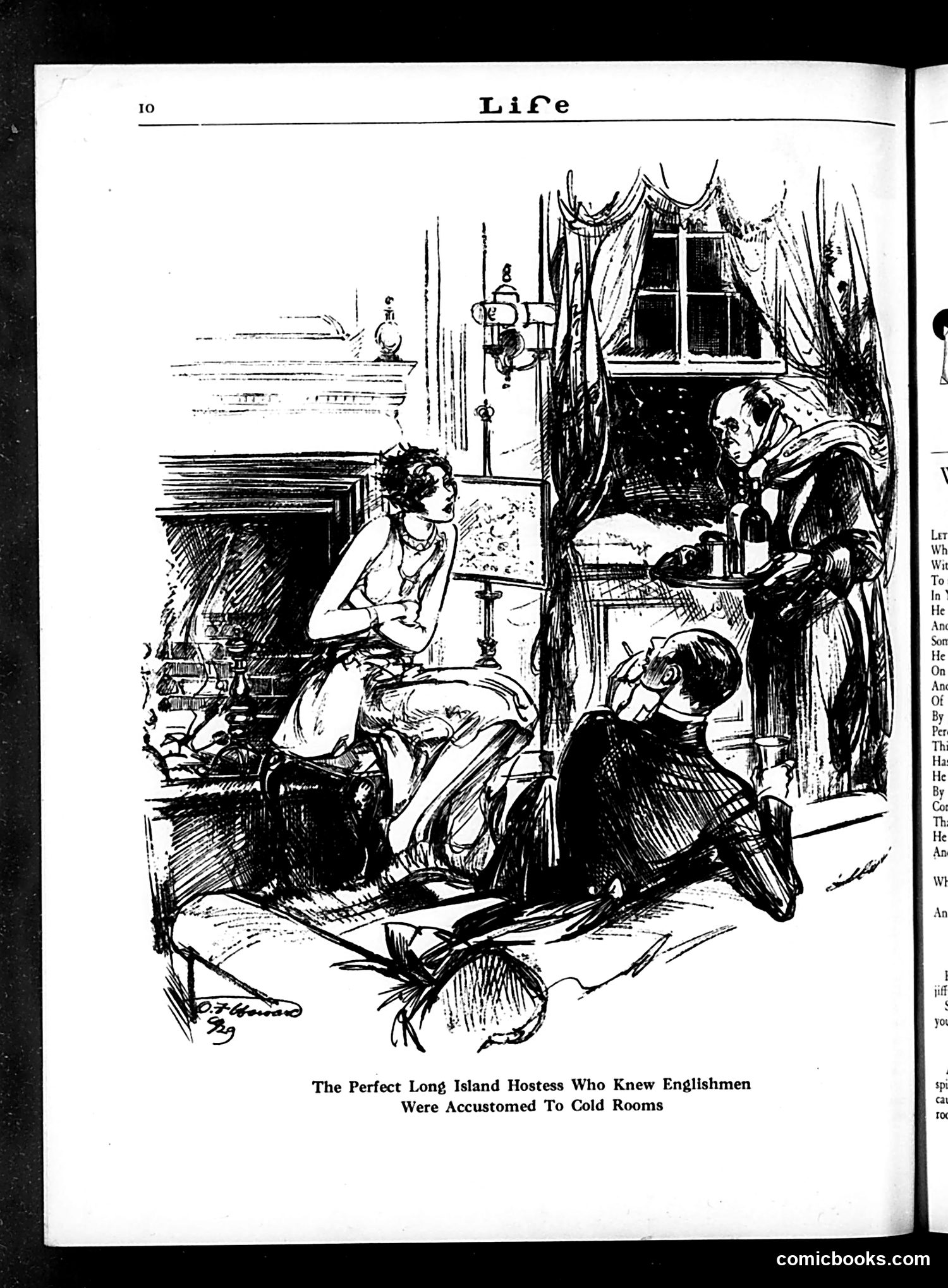
This satirical illustration depicts a social scene in what appears to be a wealthy Long Island home. The caption reads: "The Perfect Long Island Hostess Who Knew Englishmen Were Accustomed To Cold Rooms." The cartoon mocks American hostess etiquette and cultural pretension. The joke suggests that an American woman, attempting to impress British guests by catering to supposed English preferences, deliberately keeps her drawing room cold—a stereotype about English homes having inadequate heating. The scene shows a woman receiving visitors while maintaining this uncomfortable condition, satirizing both American social aspirations and the affectation of adopting "refined" European customs. The cartoon reflects early 20th-century class anxieties and the American tendency to adopt British mannerisms as markers of sophistication.
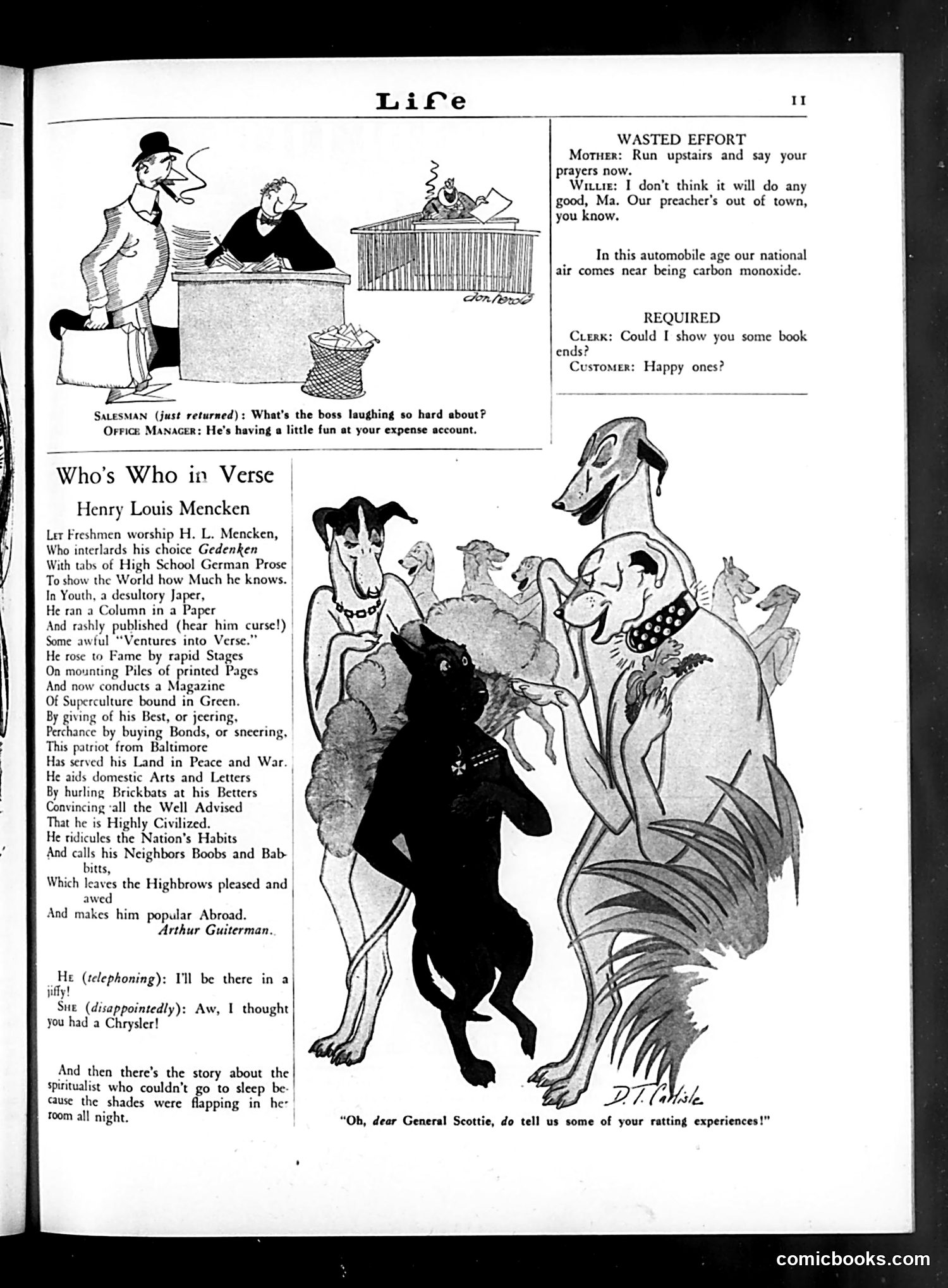
**Top Cartoon ("Wasted Effort"):** A salesman returns to find his boss laughing at his expense account. The joke mocks office dynamics—the boss enjoys humiliating employees over minor financial overages, suggesting petty office management culture. **"Who's Who in Verse":** A biographical poem about Henry Louis Mencken, a prominent American literary critic and satirist known for sharp social commentary. The verse humorously catalogs his accomplishments and quirks, including his criticism of American habits and neighbors. **Bottom Cartoon:** Dogs in formal attire question "General Scottie" about his "rating experiences." This appears to be a humorous play on military rank among dogs, possibly satirizing how people anthropomorphize pets or mock military formality.
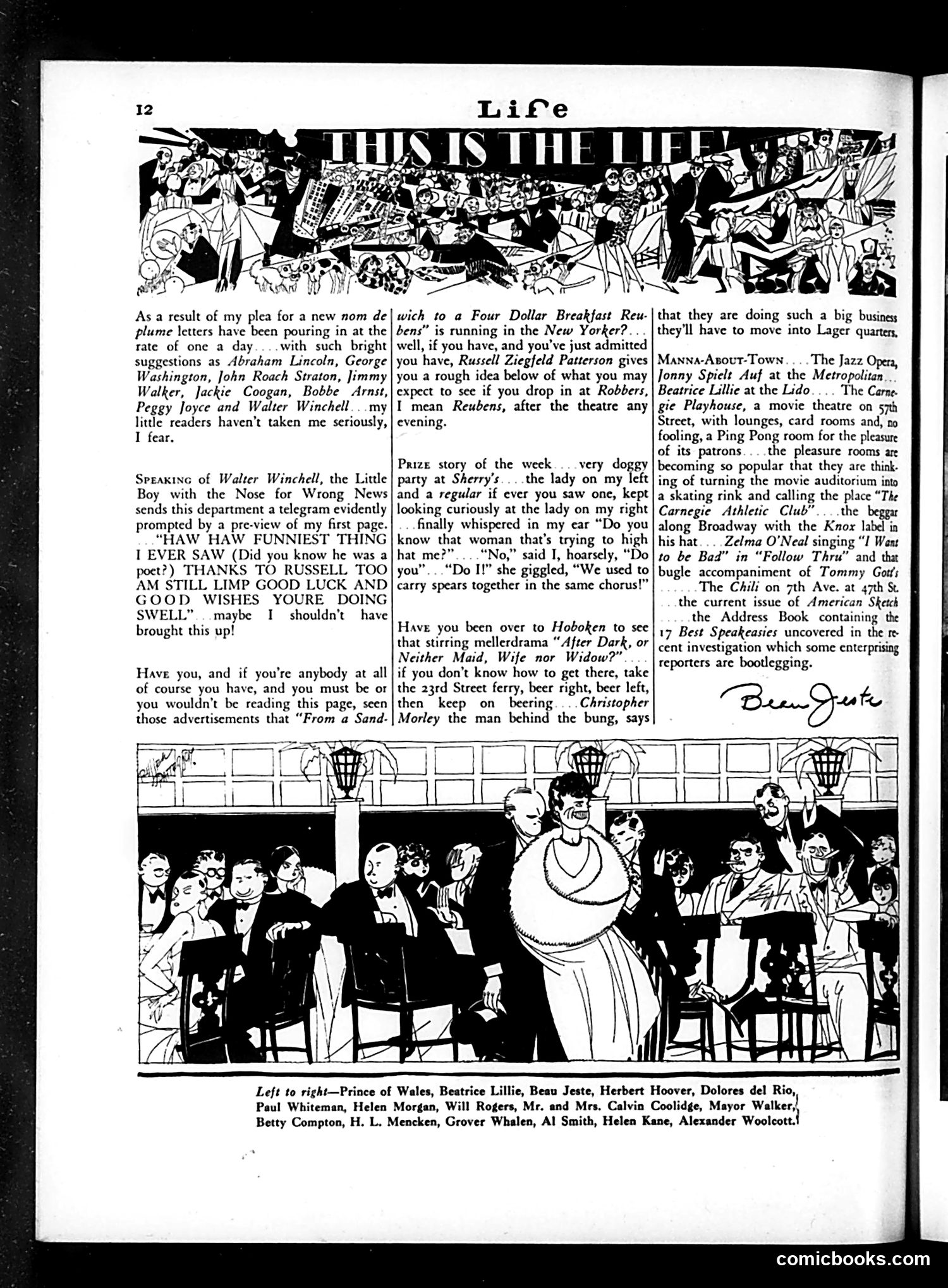
This page from *Life* magazine features a satirical column titled "THIS IS THE LIFE!" by Bruce Jute, accompanied by social commentary about New York leisure activities. The text mocks wealthy New Yorkers' social habits, referencing specific venues like **Sherry's** (an upscale restaurant), **Robbers** (a theater), and the **Carnegie Athletic Club**. Jute recounts an overheard conversation where a woman boasts about knowing someone famous, only to be deflated by the response "No." The illustration below depicts a formal social gathering—likely a party or nightclub scene—showing well-dressed attendees in what appears to be satirical commentary on New York's elite social scene and their pretensions. The caption names prominent figures including the **Prince of Wales** and various socialites, suggesting this depicts an actual high-society event being gently mocked for its self-importance and superficiality.
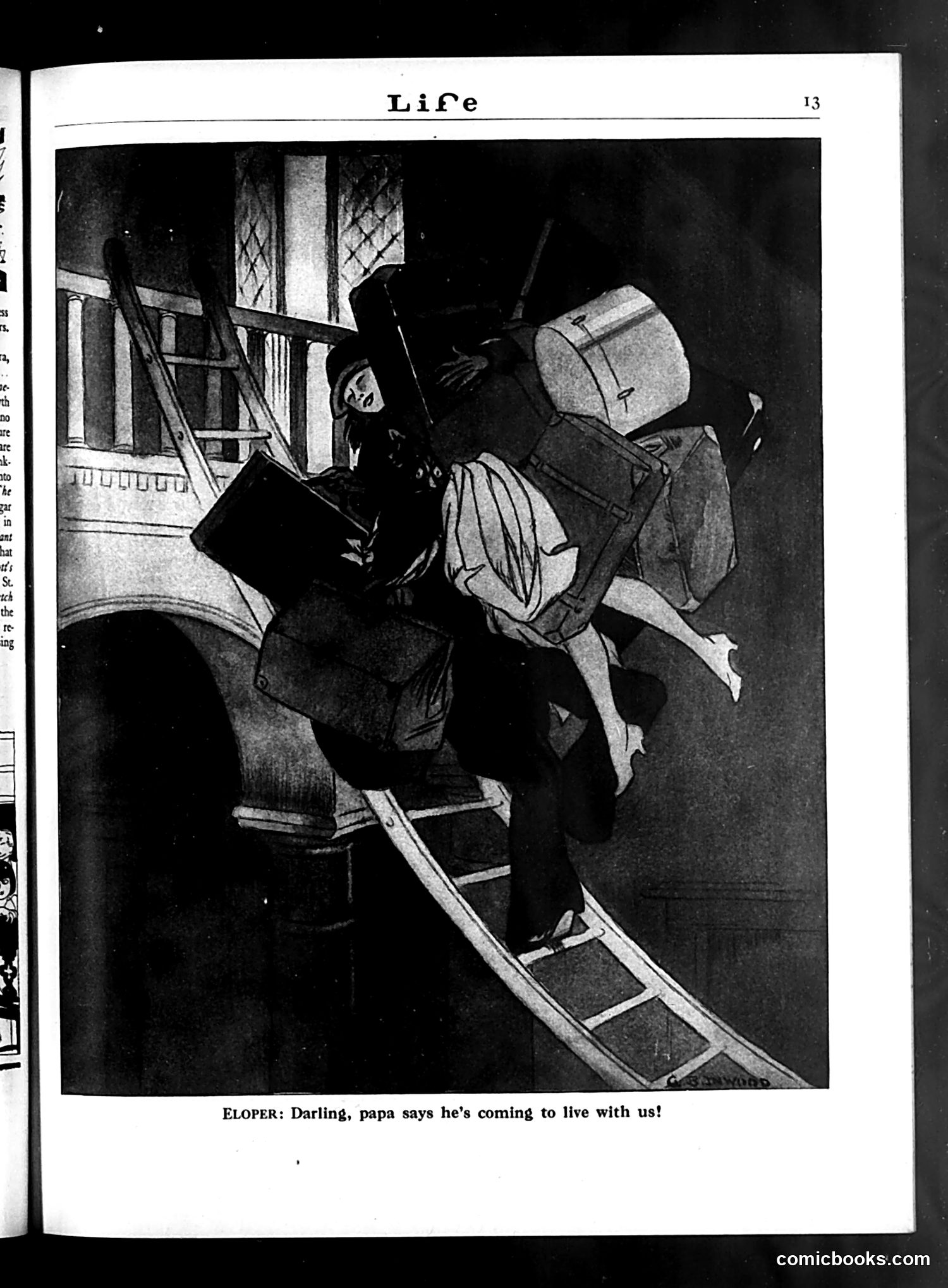
This is a single-panel cartoon titled "ELOPER" with the caption: "Darling, papa says he's coming to live with us!" The image depicts a young couple eloping—climbing down a ladder from a building (likely a window) at night with their belongings in bundles and a bucket. The joke plays on the common Victorian/early 20th-century scenario of young lovers running away to marry against parental wishes. The humor lies in the ironic twist: they're successfully escaping to elope, but the bride reveals her father plans to follow them anyway and move in with the newlyweds—defeating the purpose of their romantic elopement. It's satirizing both the rebellious spirit of young love and the intrusive nature of overbearing parents who won't let go, even after their children marry and leave home.
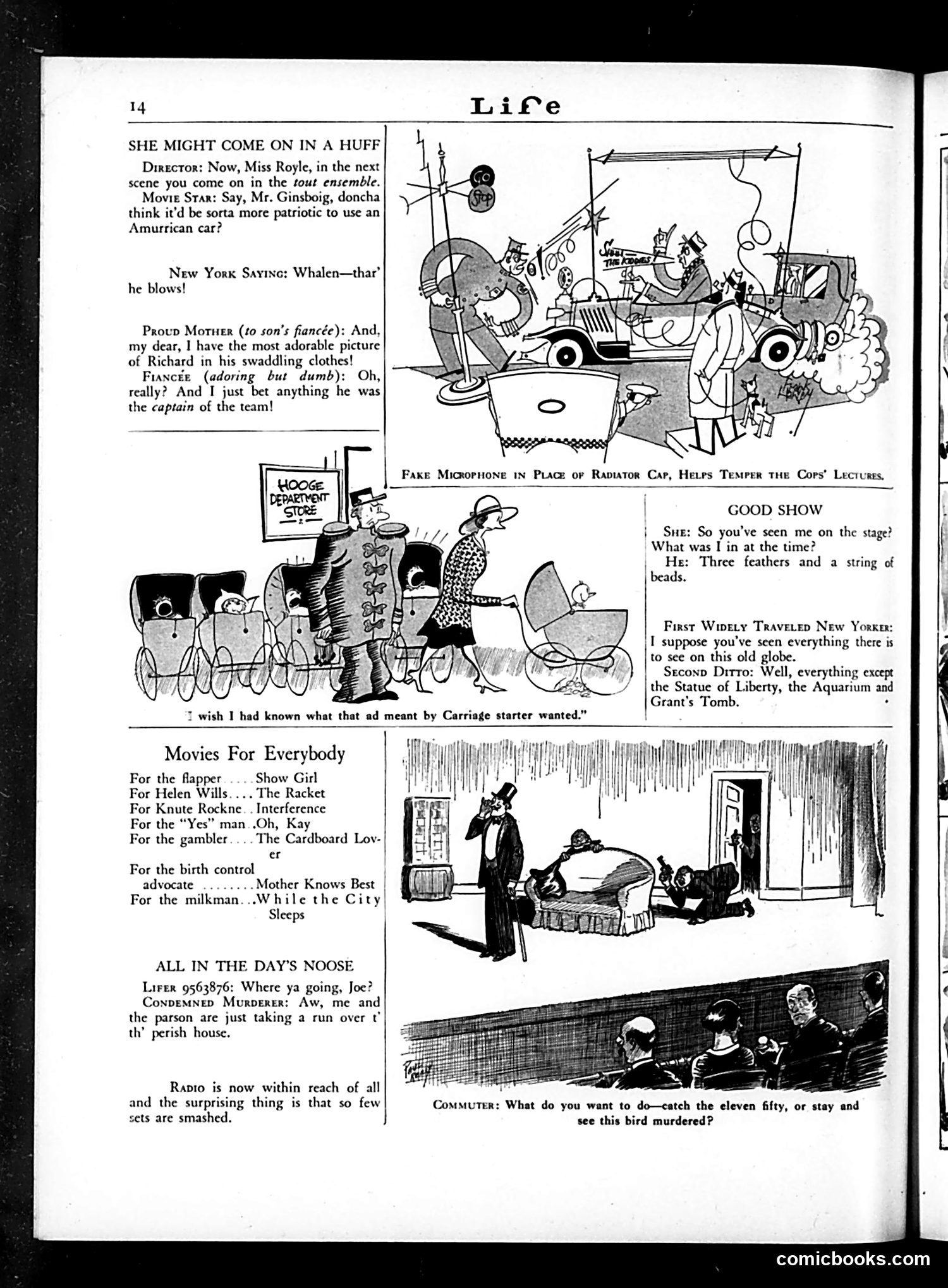
This page contains several satirical vignettes mocking early 20th-century American life: **Top cartoon**: A chaotic movie set with a fake microphone disguised as a radiator cap, satirizing how filmmakers improvised props and deceived audiences about production authenticity. **Middle section**: Various jokes about contemporary culture—including references to carriage starters, radio sets, and movie recommendations targeting different demographics (birth control advocates, milkmen, etc.). **"All in the Day's Noose"**: A dark joke about radio's ubiquity, suggesting listeners are trapped by it. **Bottom cartoons**: Social commentary on urban life—one depicting a crime scene, another showing commuters choosing between catching a murderer or missing a bird, satirizing people's priorities and desensitization to violence. The overall tone mocks modern technology, entertainment, and urban indifference.
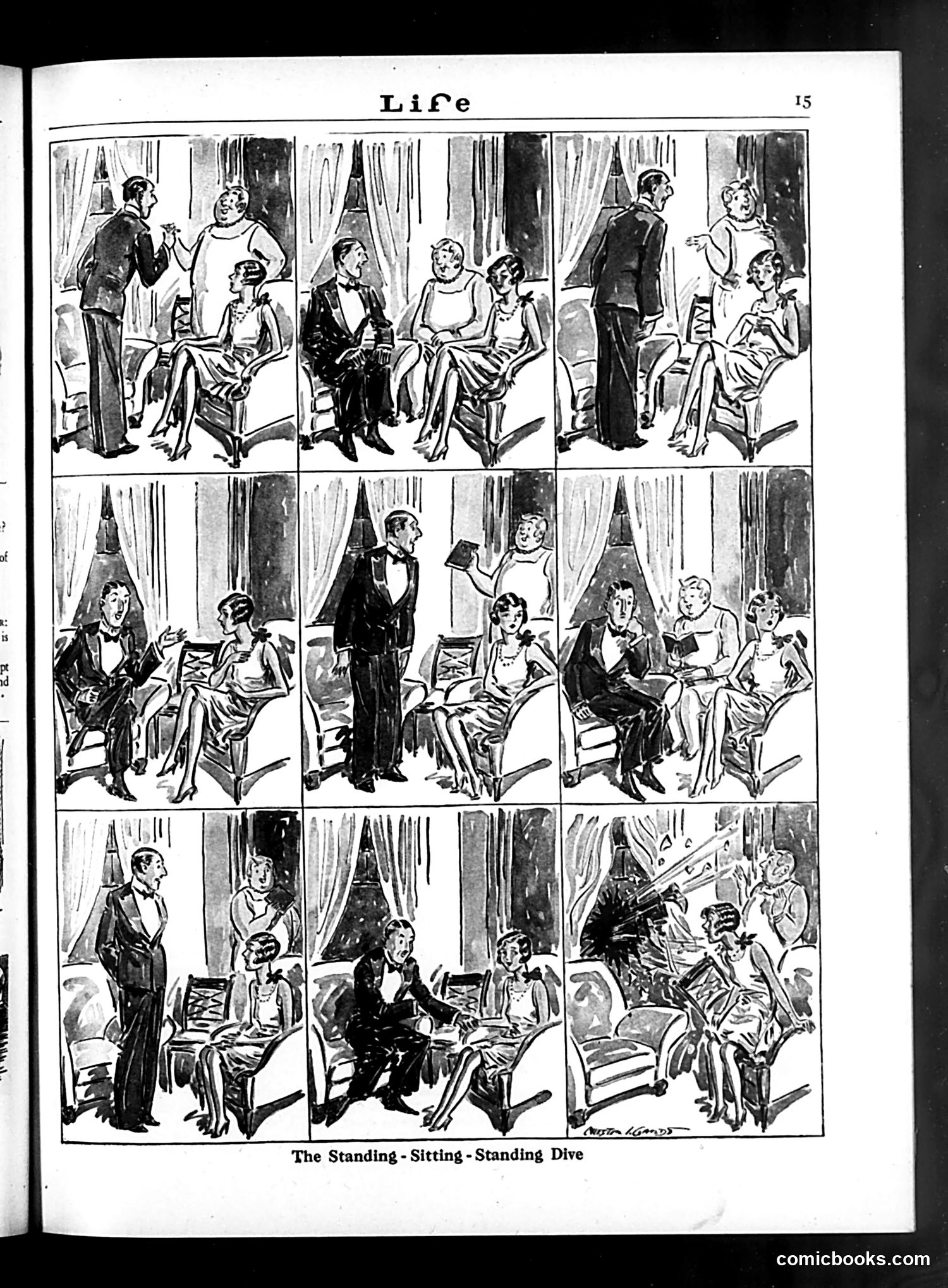
This is a satirical comic strip depicting the social dynamics of formal entertainment or courtship in what appears to be early 20th-century high society. The nine-panel sequence shows various poses and interactions between men in tuxedos and women in evening wear in an elegant parlor setting. The title "Standing-Sitting-Standing Dive" suggests the comic is mocking the repetitive, choreographed nature of social rituals—guests constantly shifting positions, sitting, standing, and engaging in elaborate conversational dances. The humor likely satirizes the artificial formality and tedious predictability of upper-class social gatherings, where interactions follow strict, prescribed patterns rather than genuine spontaneity. The "dive" suggests an exaggerated plunge into these expected behaviors.
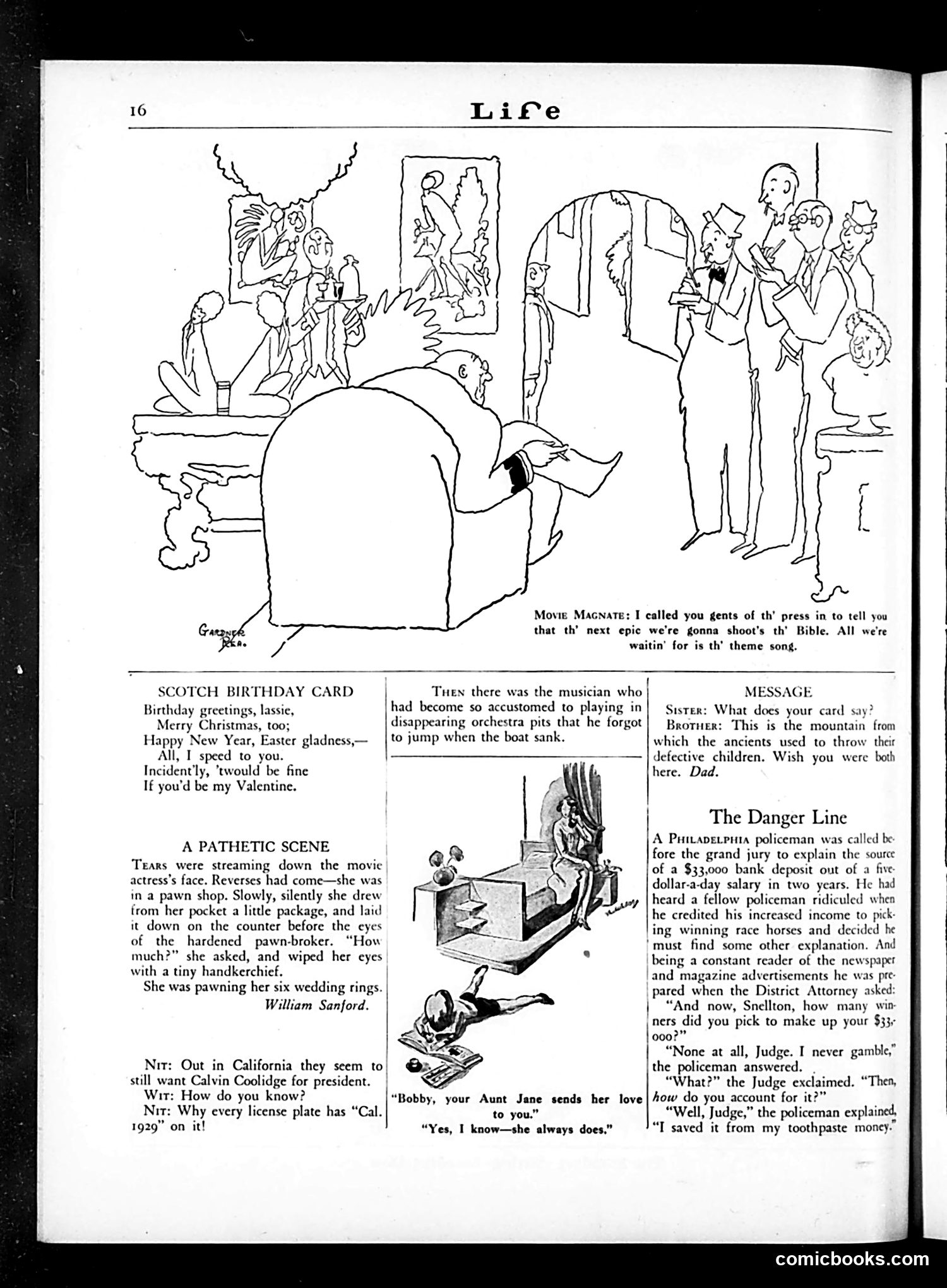
This satirical page from Life contains several humor pieces typical of 1920s-30s American magazine comedy: **Top cartoon**: A movie producer ("Movie Magnate") addresses press representatives, announcing he's planning an "epic" about Noah's ark with a theme song—satirizing Hollywood's obsession with grandiose, commercially-driven projects. **"The Danger Line"**: A Philadelphia policeman explains how he saved $13,000 from a modest salary by reading newspaper horse-racing advertisements and betting on winners. The District Attorney expresses skepticism, and the officer claims he saved the money from toothpaste—absurdist humor mocking both police corruption and get-rich-quick schemes. The other items are brief jokes about birthday greetings, a pawn shop scene, and a California political reference to Calvin Coolidge. The humor relies on contemporary social observations about commerce, entertainment, and urban life.
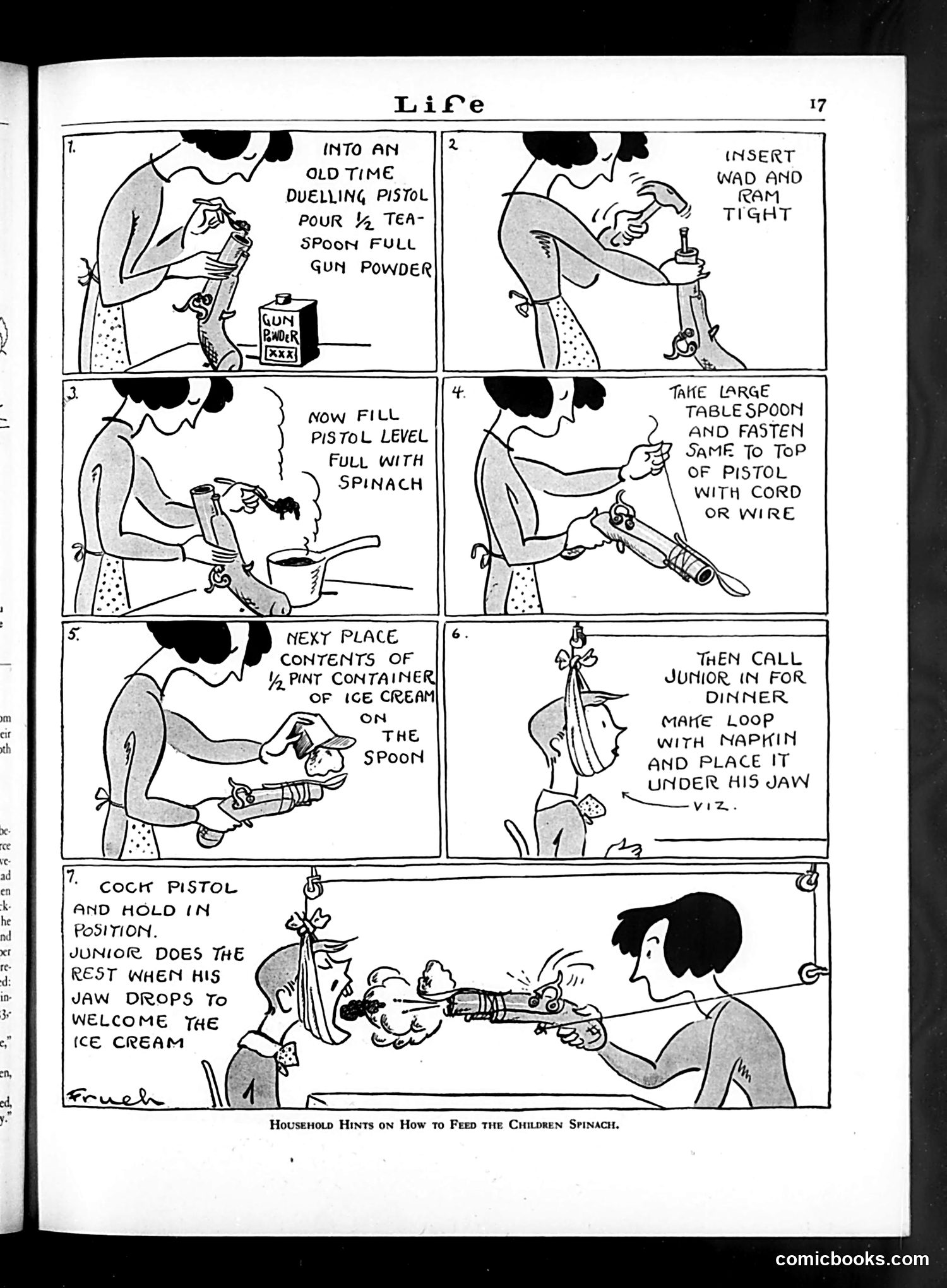
This is a humorous instructional comic showing a woman devising an elaborate contraption to trick a child into eating spinach. The seven-panel sequence depicts increasingly absurd steps: filling a dueling pistol with gunpowder and spinach, ramming it tight, adding ice cream, attaching the pistol to a cord suspended above a dining table, and finally having "Junior" fire it into his mouth when his jaw drops to welcome the "ice cream." The satire targets two things: parents' struggles forcing nutritious but unpopular foods on children, and the era's faith in mechanical or pseudo-scientific "solutions" to everyday problems. The elaborate weaponized approach mocks overly complicated parenting advice while acknowledging the genuine difficulty of child nutrition.
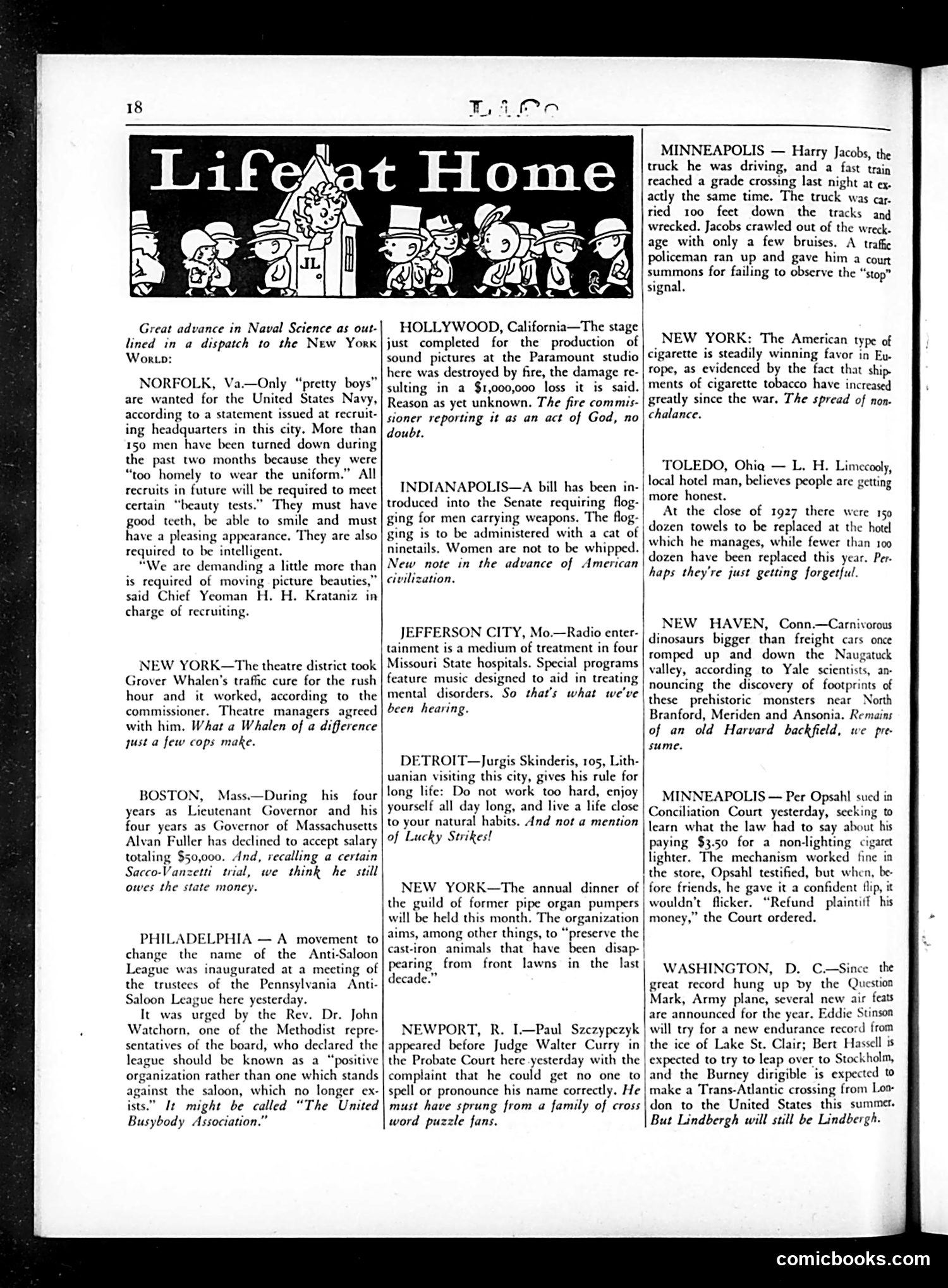
This is a satirical column of brief news items mocking American social absurdities circa late 1920s. Key targets include: **Navy recruitment standards**: The Navy demands "pretty boys" with good teeth and pleasing appearance—satirized as vanity over substance. **Prohibition-era hypocrisy**: The Anti-Saloon League rebrands itself positively rather than admitting the saloon "no longer exists," mocked as "The United Busybody Association." **Legal absurdity**: Indianapolis proposes flogging men with weapons using a cat-o'-nine-tails, but exempts women—presented as laughable "progress." **Dark humor**: A truck driver survives being carried 100 feet by a train but receives a traffic ticket for ignoring a stop signal—the irony being he's alive against odds. **Minor comedies**: A man sues over his unpronounceable name; wealthy Boston politician Alvan Fuller donates his salary (a Sacco-Vanzetti trial jab suggesting he "owes" the state). The column skewers regulatory overreach, moral posturing, and bureaucratic idiocy through deadpan reporting.
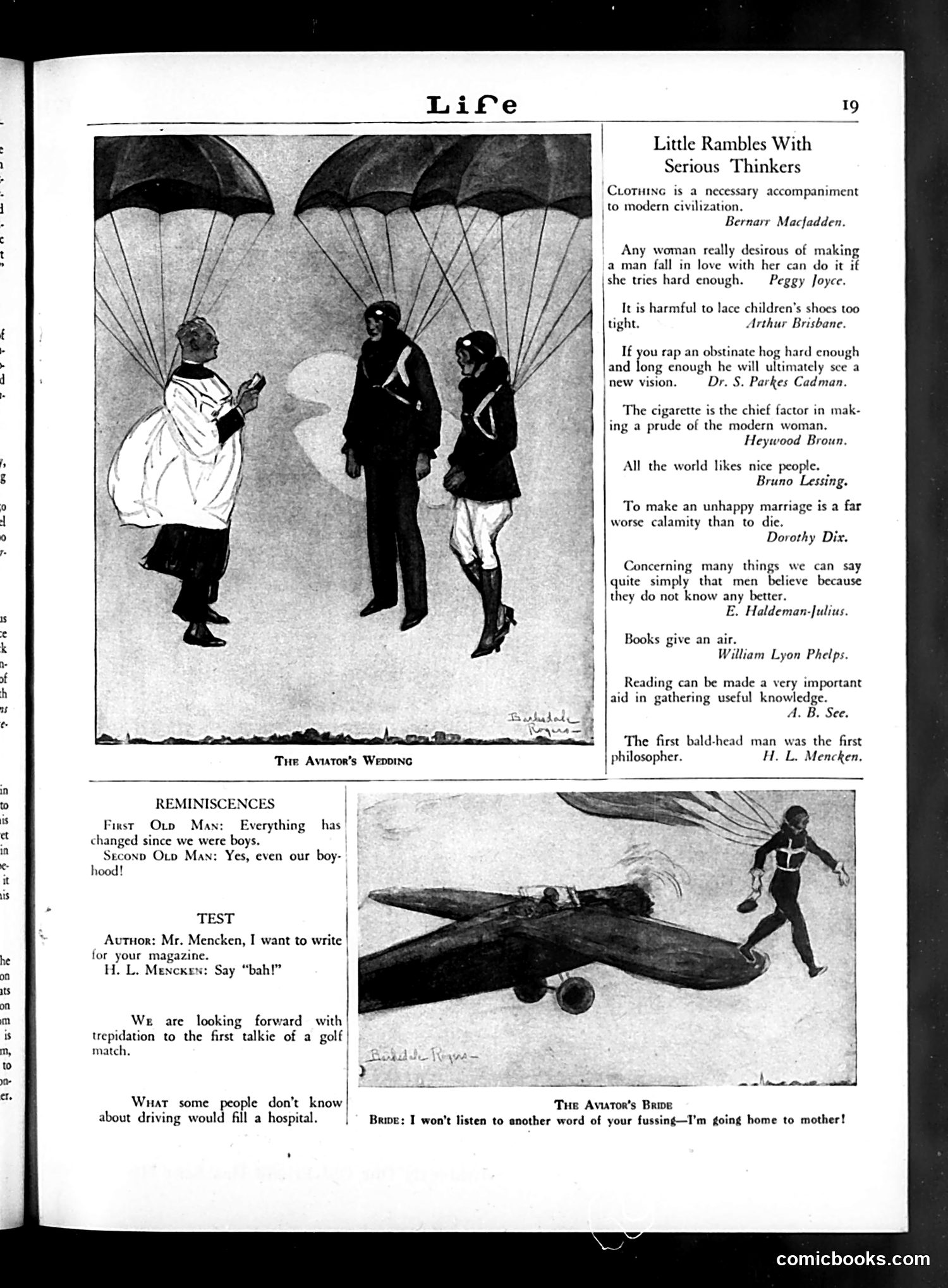
This page satirizes early aviation culture through two cartoons featuring newlyweds who are skydivers or parachutists (the "aviator" theme). **Top cartoon ("The Aviator's Wedding")**: Shows a bride in a parachute alongside two men descending. The joke plays on the modern, daring nature of aviation—even weddings now involve extreme sports. **Bottom cartoon ("The Aviator's Bride")**: Depicts the bride mid-parachute jump with the caption where she threatens to leave her new husband and "go home to mother" rather than tolerate his complaints. The satire targets 1920s modernity: the relatively new phenomenon of aviation as entertainment, changing gender roles (an active, adventurous bride), and marital dynamics where women assert independence rather than submit to husbands' nagging. The page's quotations about modern life (cigarettes, marriage, clothing) reinforce the theme of rapid social change in the era.
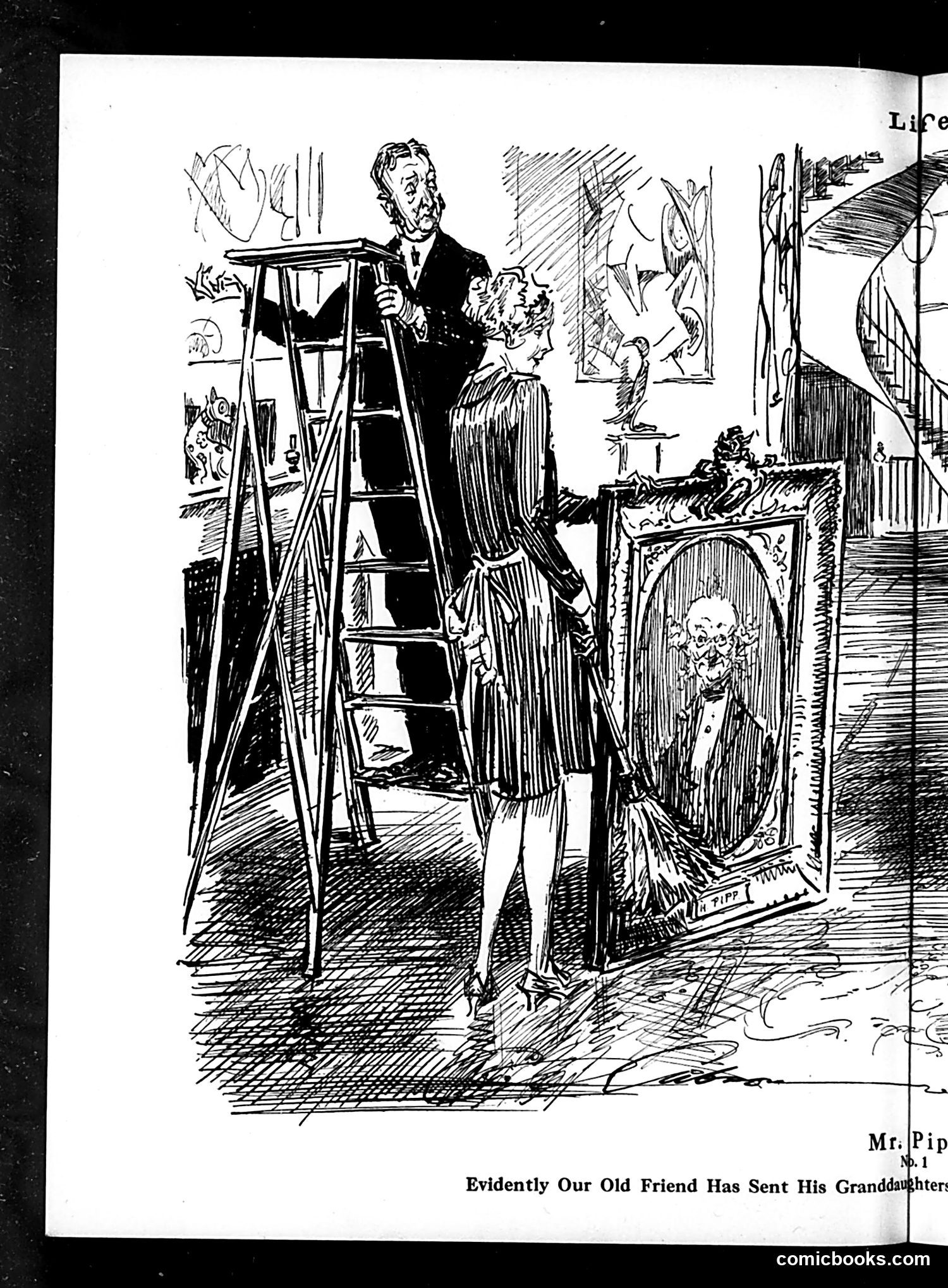
This cartoon depicts a domestic interior scene with two figures: a man on a ladder holding what appears to be artwork or a mirror, and a woman standing below observing his work. The caption reads "Evidently Our Old Friend Has Sent His Granddaughter." The satire appears to reference an absent "old friend" who has sent his granddaughter to visit. The humor likely plays on the situation—perhaps the granddaughter's presence has prompted home improvements or redecorating (the ladder work visible), or there's an implied domestic dynamic about preparing for an important visitor. Without additional context about which specific "old friend" is referenced or the magazine's publication date, the precise social or political target remains unclear. The illustration style and print quality suggest early-to-mid 20th century.
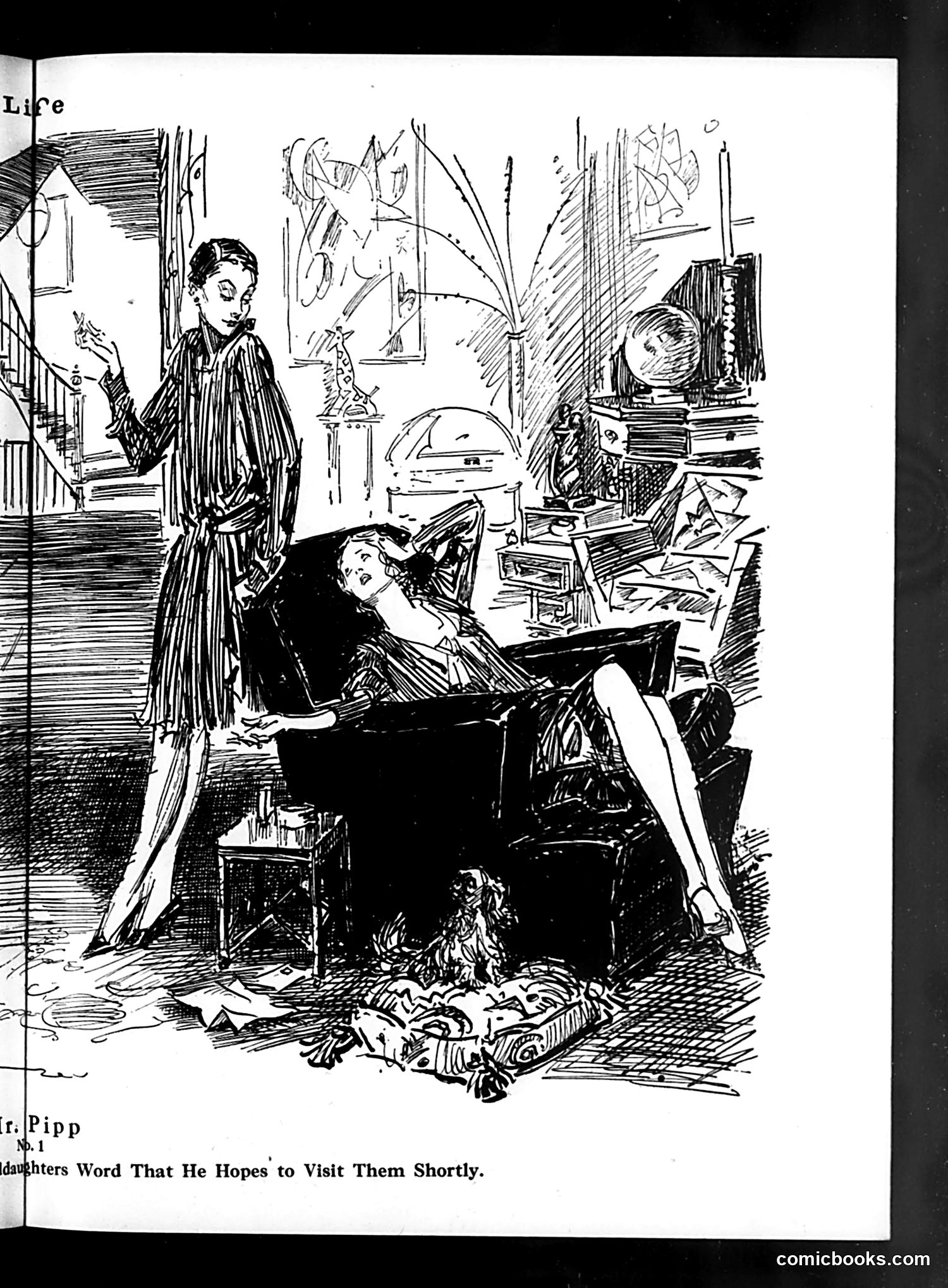
This appears to be an illustration from *Life* magazine showing a domestic scene in what seems to be an artist's studio or cluttered living space. A woman reclines in a chair while a man stands nearby, and a third figure (possibly a child or young person) sits at a desk surrounded by papers and artwork. The caption references "daughters" receiving "word that he hopes to visit them shortly," suggesting this depicts a father figure communicating his intentions to visit his children. The cluttered studio setting and the woman's relaxed pose might satirize bohemian artistic life or domestic arrangements of the era, though without additional context or a visible artist's signature, the specific satirical target remains unclear. The image's style and setup suggest commentary on family relationships or lifestyle choices among artistic circles.
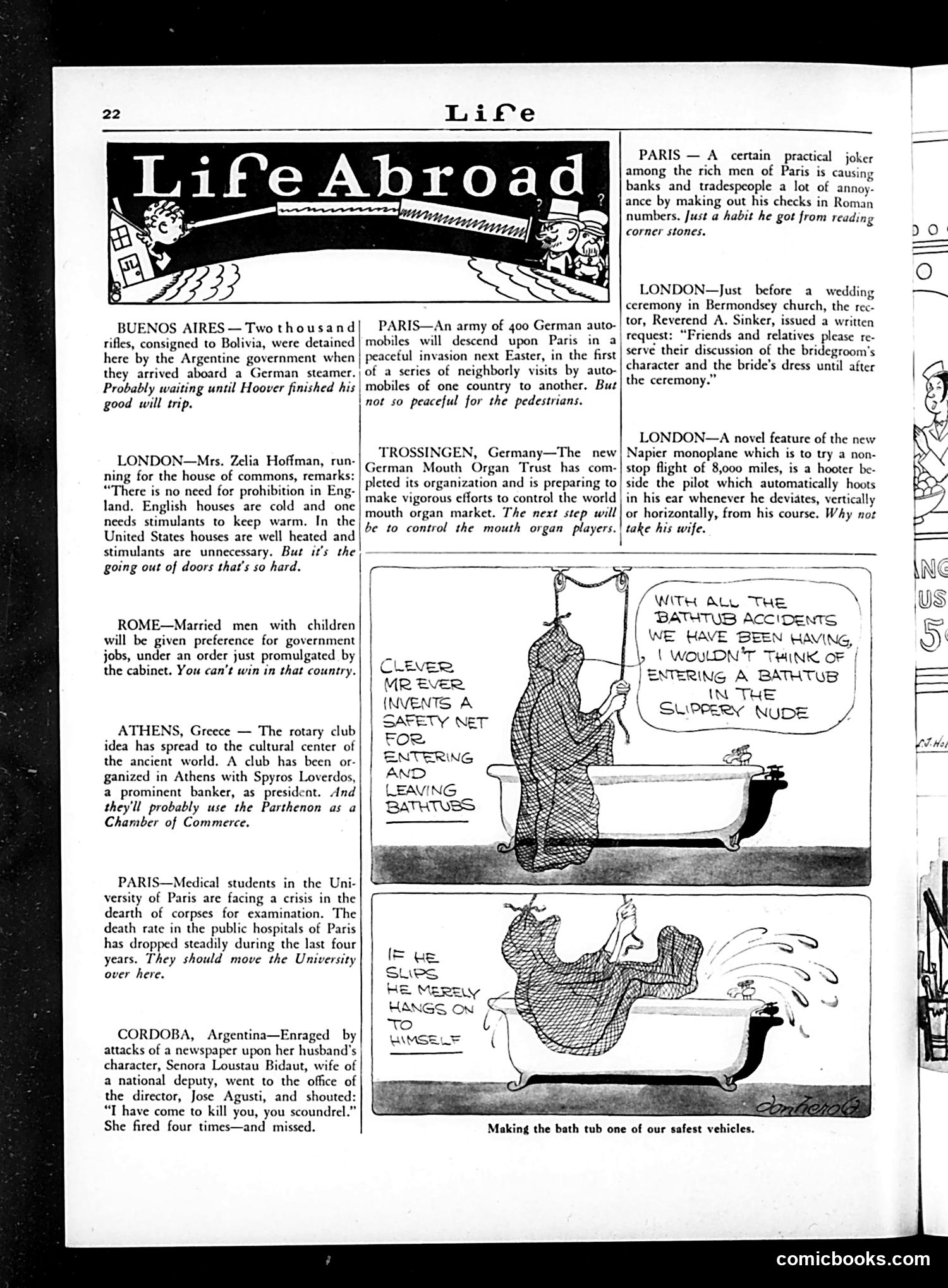
This page contains short humorous news items from various cities, followed by a two-panel comic about bathtub safety. **The Comic's Point:** A woman entering a bathtub is advised by a man to use a "safety net for entering and leaving bathtubs" because of recent bathing accidents. The joke satirizes over-engineered safety solutions—the man's elaborate net contraption is itself ridiculous and impractical (in the second panel, the woman slips anyway while using it). **The News Briefs** mock various international absurdities: Argentine rifles detained in Bolivia, English houses being cold, Germans planning auto invasions of Paris, and a woman firing four times at an official in Argentina. The caption calls bathtubs "one of our safest vehicles"—ironically suggesting mundane objects are dangerously unsafe.
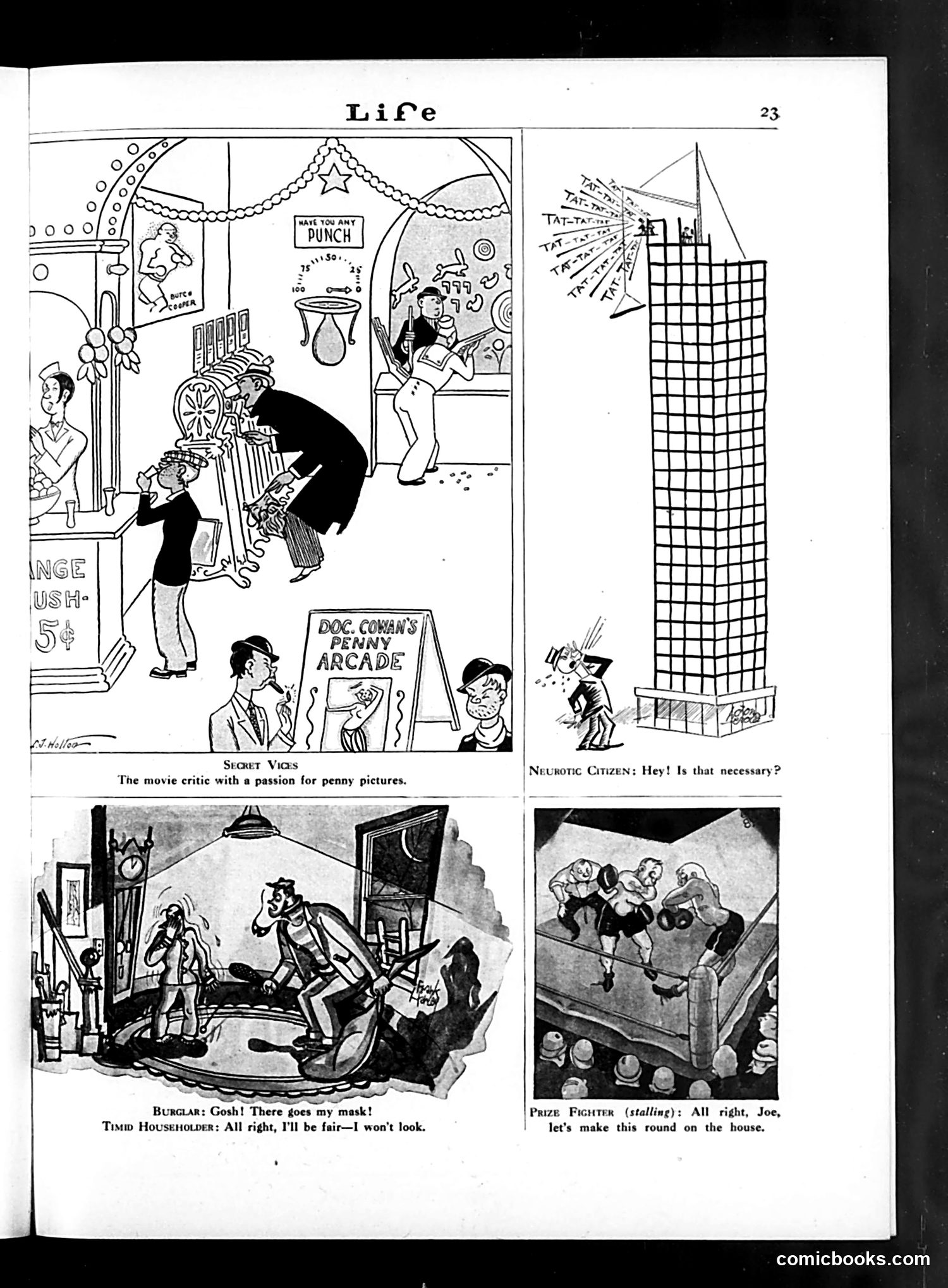
This page contains four satirical comic panels mocking various character types: 1. **"Secret Vices"** (top left): A film critic sneaks into a penny arcade despite his sophisticated profession, suggesting cultural hypocrisy—intellectual elites enjoying "lowbrow" entertainment. 2. **"Neurotic Citizen"** (top right): A man questions whether a skyscraper's construction safety measures are necessary, satirizing neurotic anxiety about modern urban infrastructure. 3. **"Burglar/Timid Householder"** (bottom left): A burglar and homeowner negotiate—the householder agrees not to look while the burglar steals his mask, mocking polite cowardice. 4. **"Prize Fighter"** (bottom right): A boxer suggests moving a fight "on the house" (to the roof), likely satirizing fixed fights or corruption in professional boxing. The page targets hypocrisy, anxiety, cowardice, and fraud in American society through humorous exaggeration.
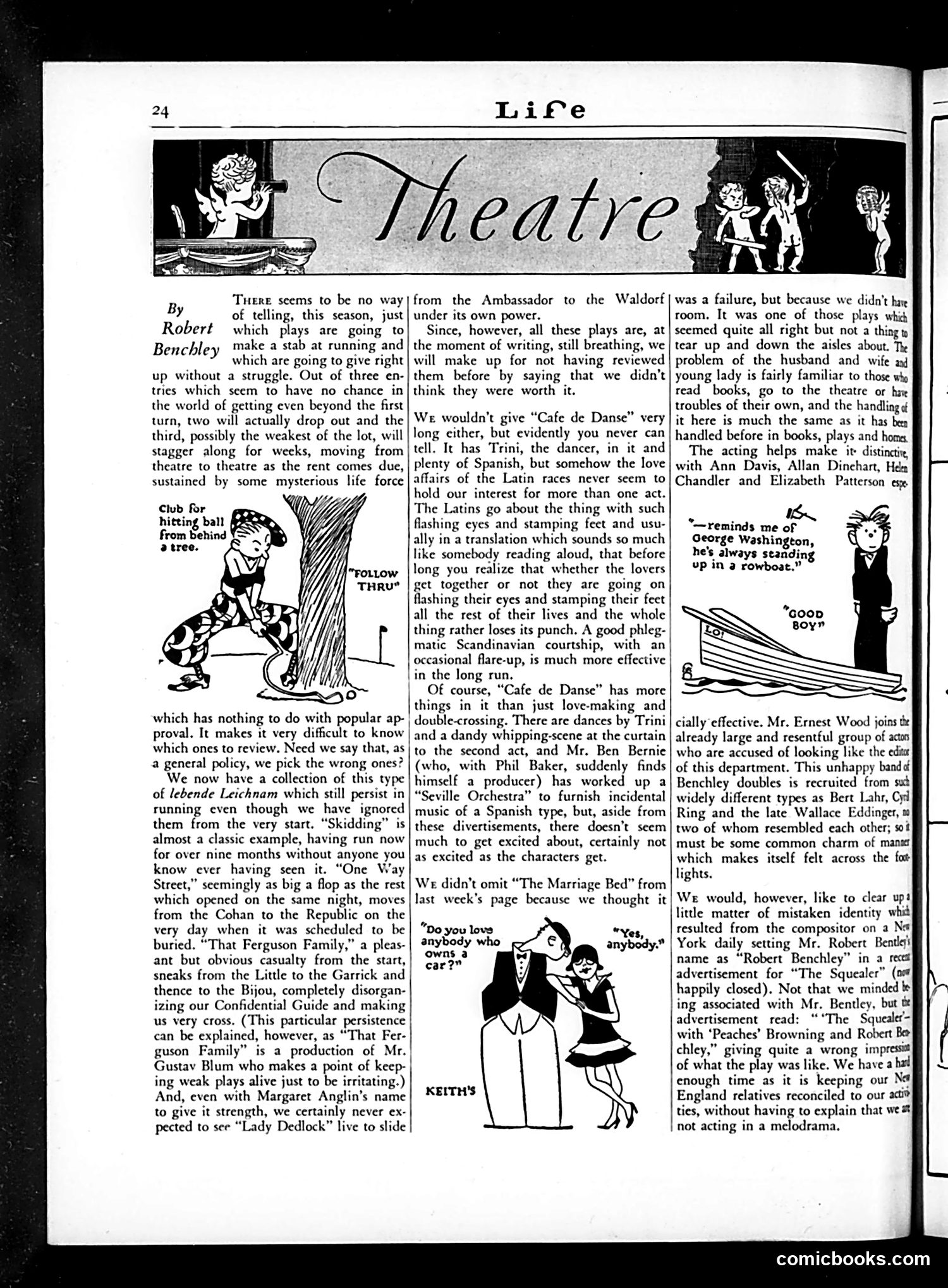
This is a theatre criticism column by Robert Benchley reviewing several Broadway plays. The cartoons illustrate his points humorously: **Left cartoon**: A character "hitting ball from behind a tree" with "FOLLOW THRU" caption—likely mocking weak plays that inexplicably persist despite poor quality, like "Skidding" which ran nine months despite being universally ignored. **Right cartoon**: A domestic scene captioned "Do you love anybody who owns a car?" from Keith's theatre, illustrating "The Marriage Bed"—a play about marital problems Benchley mentions but didn't review due to space. Benchley's main satirical point: Broadway's unpredictability is maddening. Some obviously doomed plays ("Skidding," "Lady Dedlock") inexplicably survive while others disappear. He criticizes "Cafe de Danse" as formulaic Spanish romance with flashy but hollow passion—Scandinavian restraint being more theatrically effective. The satire targets both the theatre industry's randomness and predictable dramatic conventions.
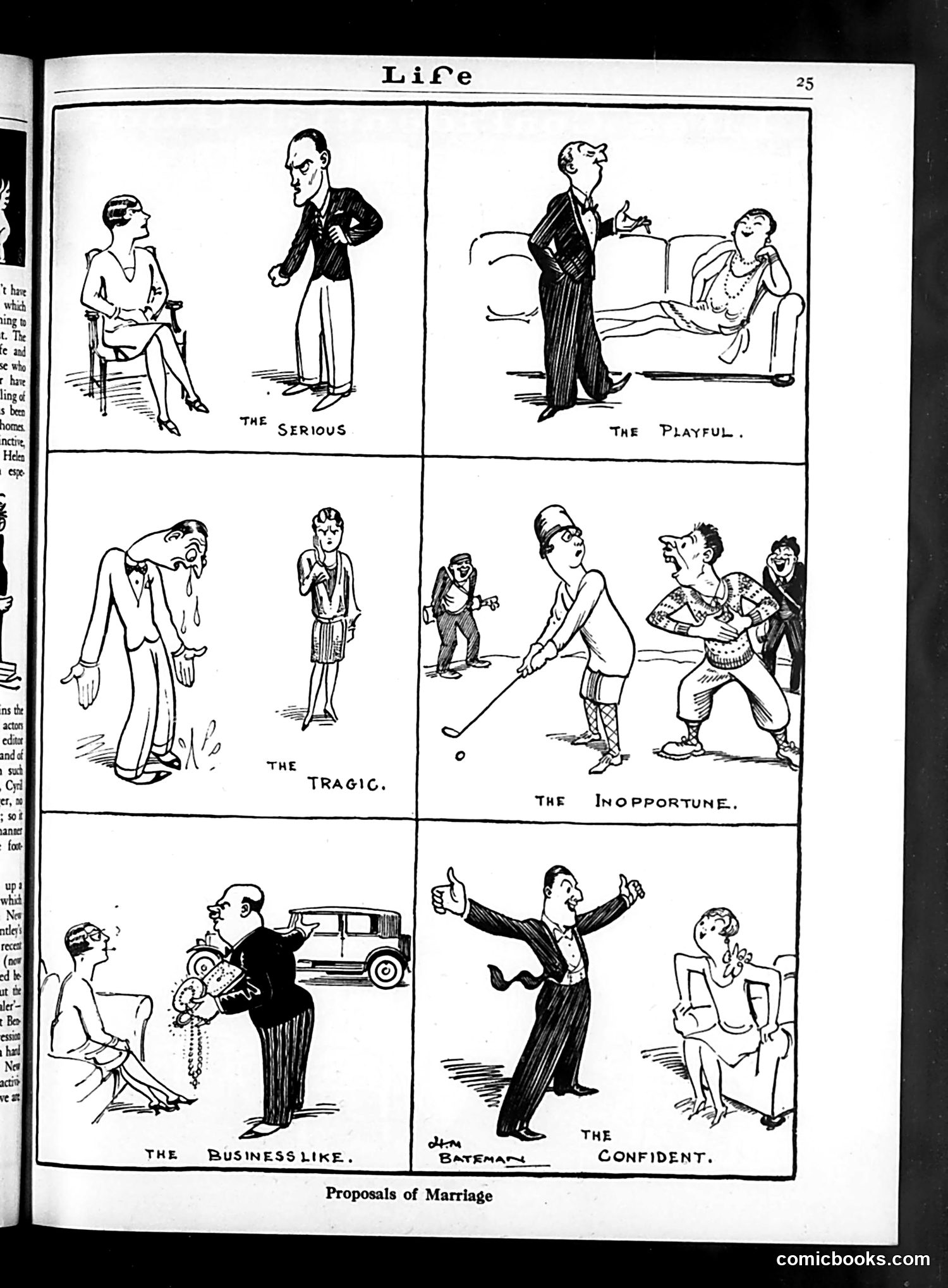
This page satirizes six different male courting styles through comedic scenarios. Each panel presents a stereotype of how men propose or conduct romantic relationships: **THE SERIOUS**: A stern, formal presentation **THE PLAYFUL**: Casual, lounging behavior suggesting lack of seriousness **THE TRAGIC**: Emotional desperation or melodrama **THE INOPPORTUNE**: Bad timing (attempting romance during sports/recreation) **THE BUSINESS LIKE**: Transactional approach with material goods (car, jewelry) **THE CONFIDENT**: Cocky self-assurance The satire mocks how different male personality types bungle or miscalculate romantic proposals. Each exaggerated behavior represents recognizable social types contemporary readers would identify. The humor derives from depicting marriage proposals as performed, artificial acts rather than genuine emotional exchanges—suggesting early 20th-century courtship was theatrical and rule-bound rather than authentic.
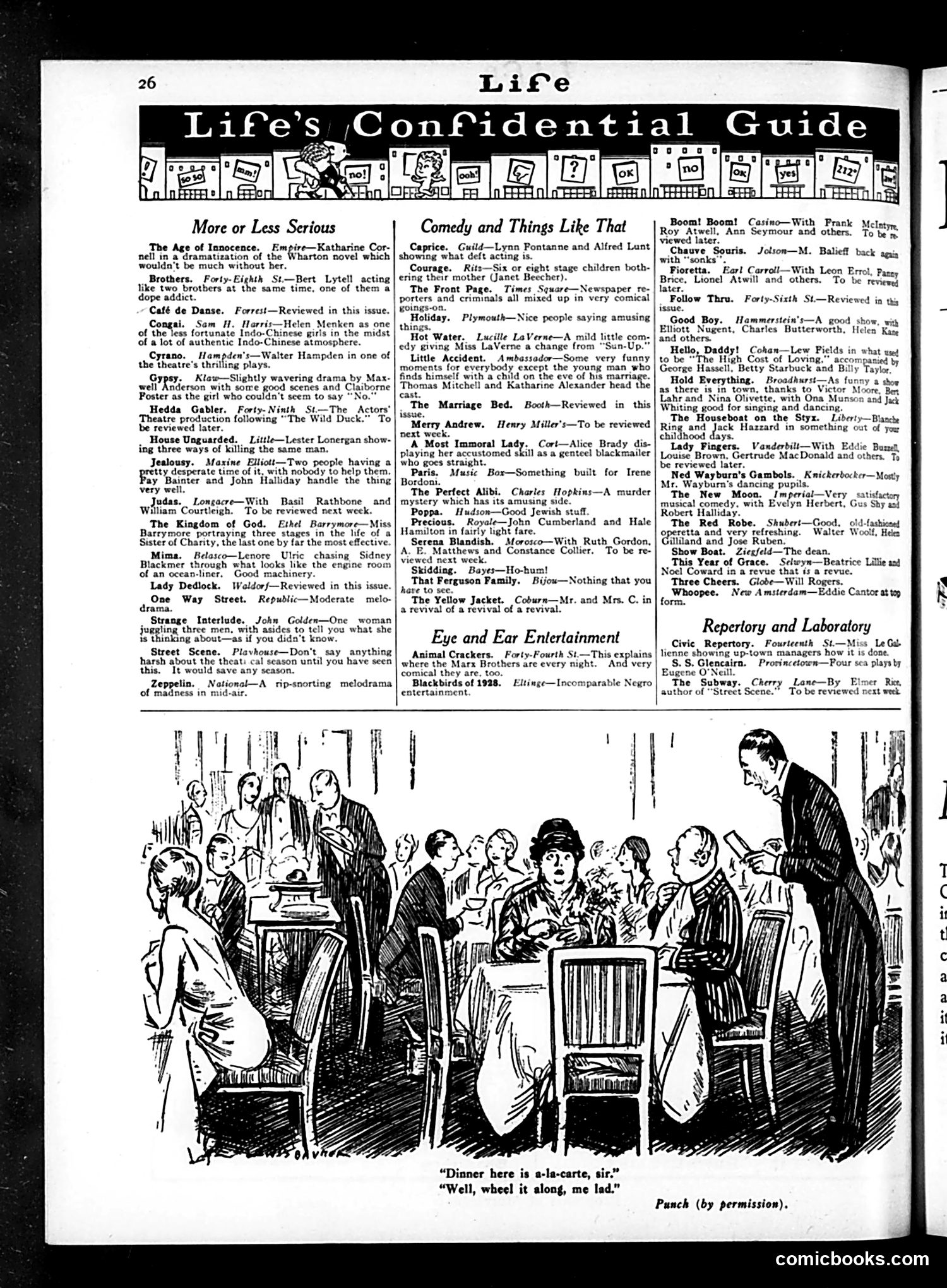
This page from Life magazine presents theater and entertainment reviews from what appears to be the 1920s. The content is straightforward criticism rather than political satire. The page lists Broadway shows with brief, witty assessments—some positive ("Street Scene...would save any season"), others dismissive ("One Way Street...Moderate melodrama"). Notable productions include Ethel Barrymore in *The Kingdom of God*, the Marx Brothers in *Animal Crackers*, and a revival of *The Yellow Jacket*. The cartoon at bottom depicts a formal dinner scene where a waiter presents a dish "à-la-carte," and a diner responds "Well, wheel it along, me lad"—a gentle joke about restaurant service pretension. This is primarily an **entertainment guide**, not political commentary. It reflects 1920s theatrical culture and Life's role as a comprehensive lifestyle magazine covering arts, entertainment, and society rather than hard news.
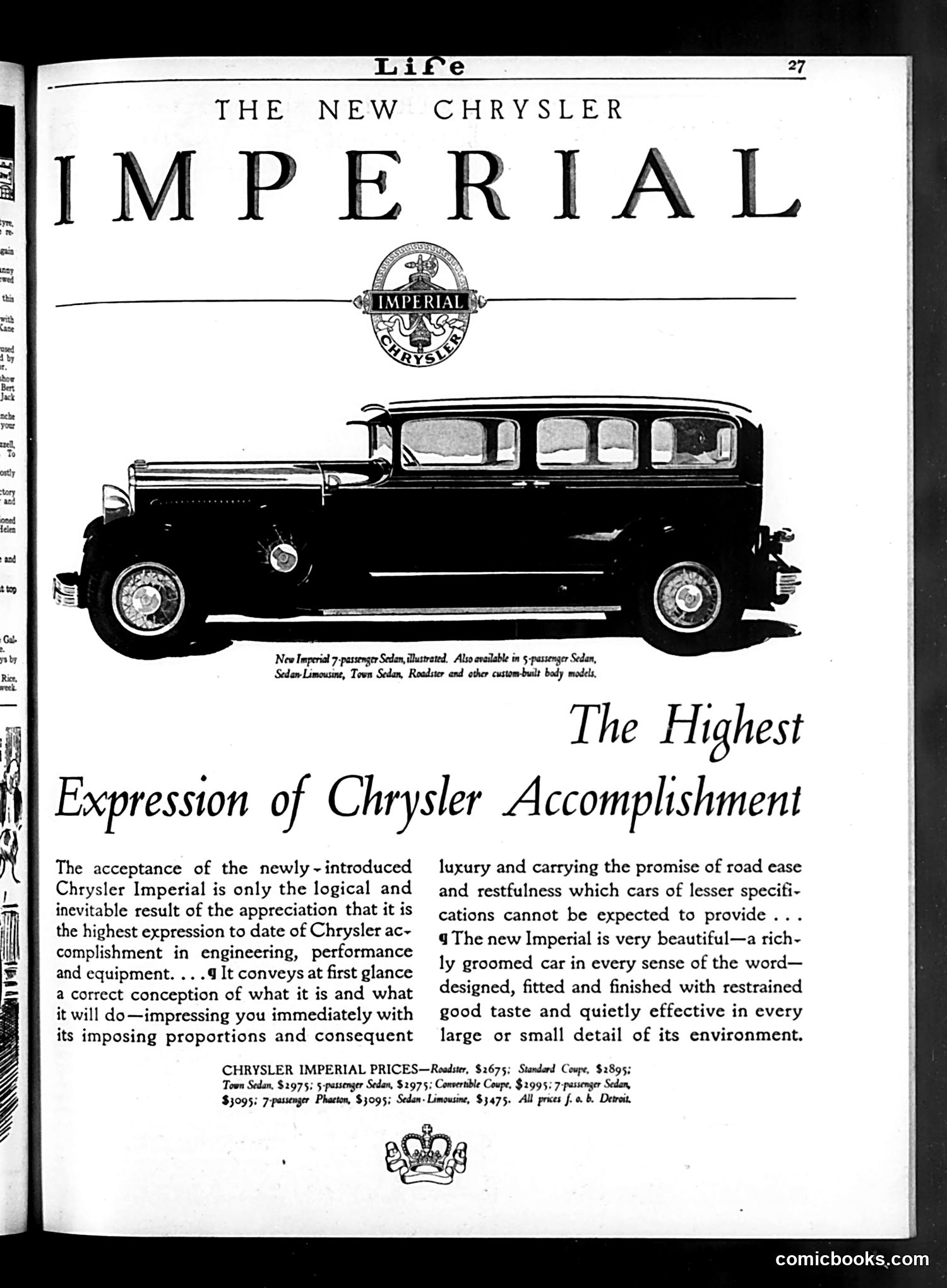
This is **not a cartoon or satire**—it's a straightforward automobile advertisement from Life magazine's early automotive era (appears to be 1920s-1930s based on styling and price points). The page advertises the new Chrysler Imperial sedan, presenting it as "the highest expression of Chrysler accomplishment" in engineering and design. The ad uses marketing language emphasizing luxury, craftsmanship, and performance—describing the car as "richly groomed" and featuring "restrained good taste." The illustration shows a side profile of a substantial, formal sedan with multiple passenger windows and prominent whitewall tires, typical of era luxury vehicles. **For modern readers:** This represents Depression-era aspirational marketing aimed at affluent consumers, using florid language to justify premium pricing ($2,675-$3,475—substantial sums in that period). The Imperial competed with Packard and Lincoln in the luxury segment. This is automotive advertising as historical document, not satire.
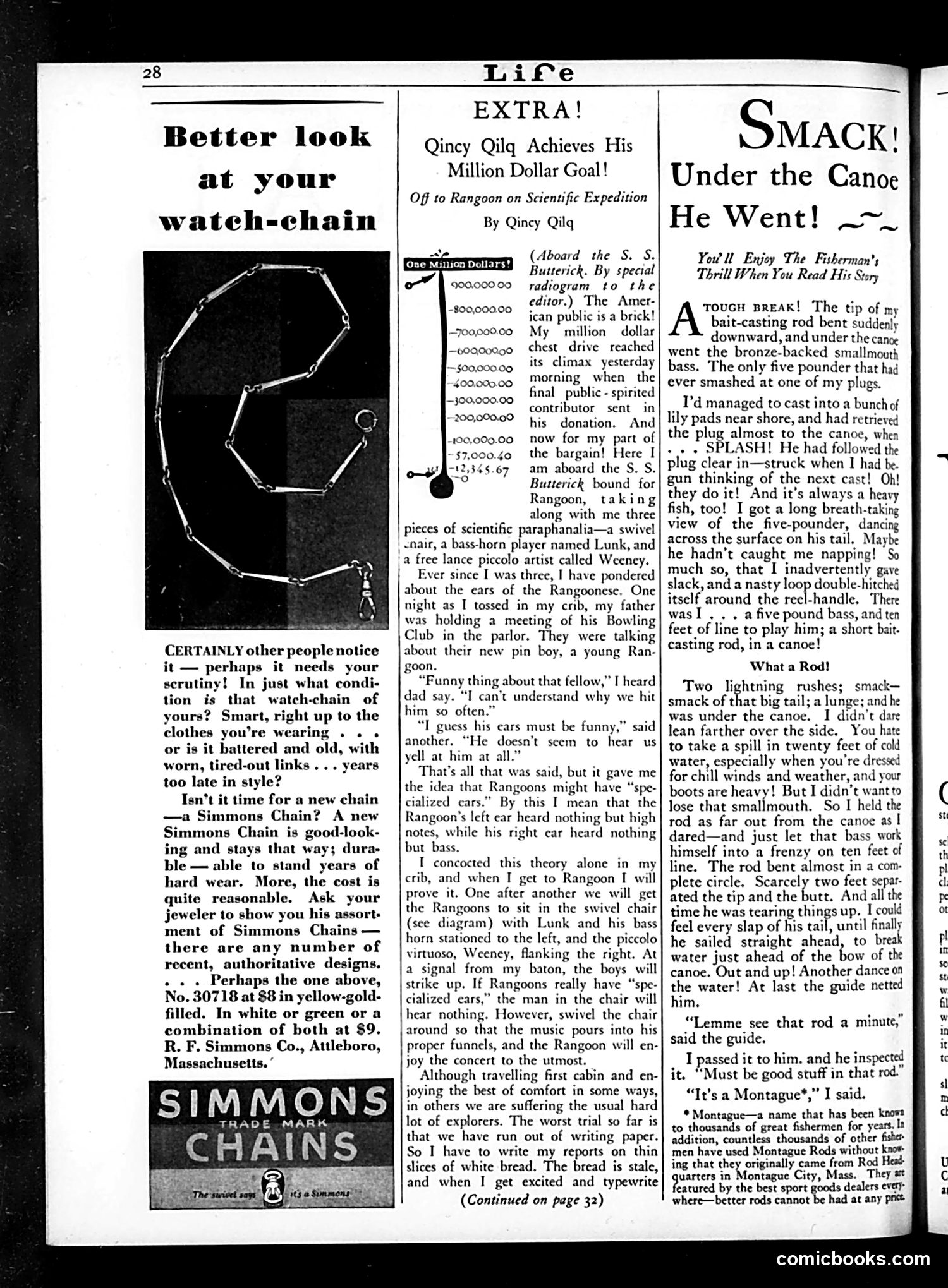
This page contains three distinct pieces: **Left: Simmons Chains Advertisement** A straightforward ad promoting watch-chains as a fashion accessory, emphasizing durability and style. The copy suggests that worn-out chains signal poor grooming and outdated taste—a status concern typical of 1920s advertising. **Center: "Quincy Qilq" Satire** A mock-serious piece spoofing pseudo-scientific expeditions. The fictional explorer claims to have raised a million dollars to test whether Rangoon residents have "specialized ears"—one hearing only high notes, one only bass. He'll test this using musicians and a swivel chair. The absurdity is the point: the elaborate setup for an obviously nonsensical theory, plus the detail that he's writing reports on stale bread because he ran out of paper. This mocks both grandiose scientific claims and gullible public fundraising. **Right: "Smack! Under the Canoe He Went!"** The beginning of a fishing adventure story promising thrills about a five-pound smallmouth bass. This appears to be serialized entertainment content typical of Life's mix of humor and light fiction.
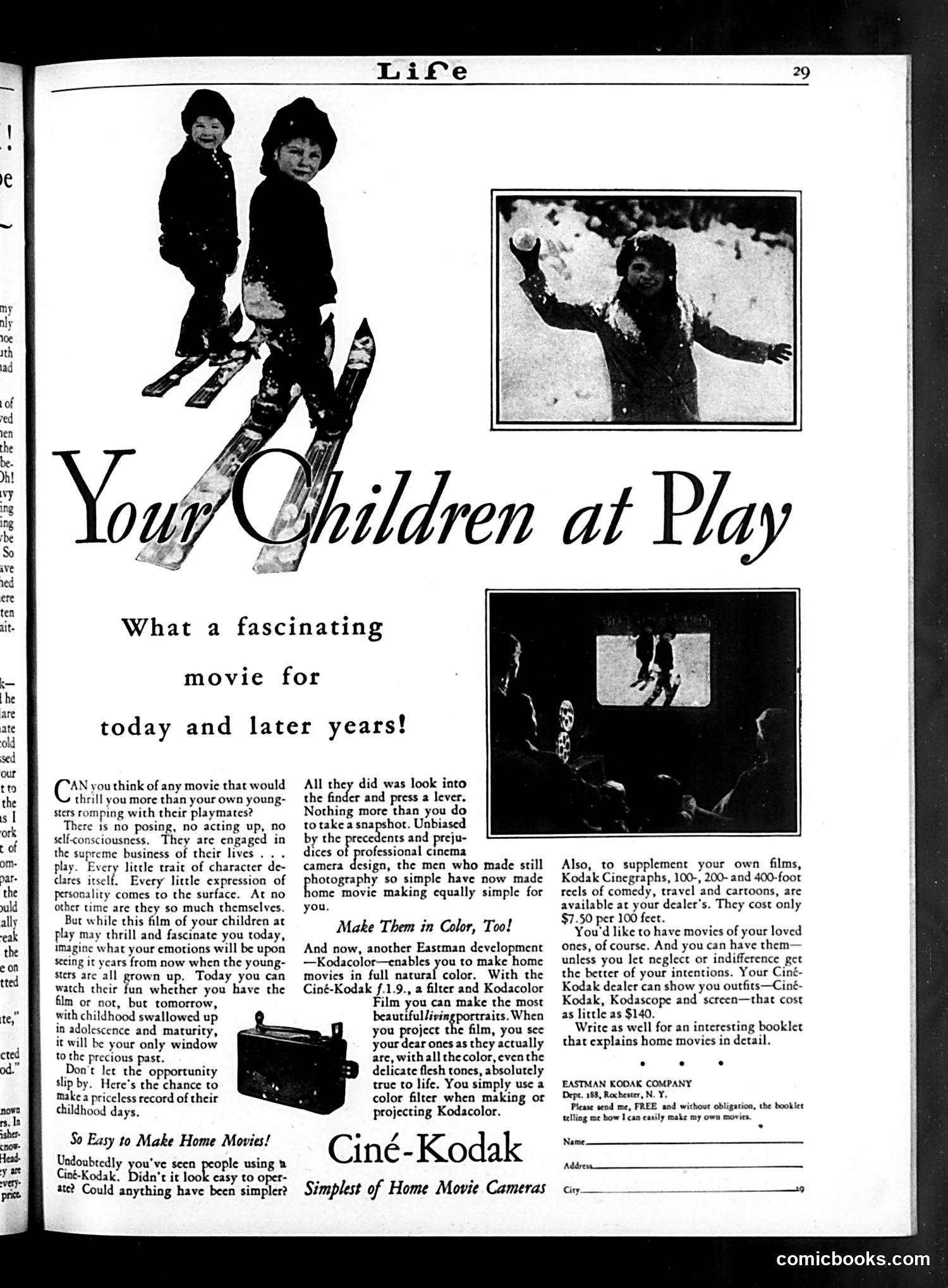
This is **not a cartoon or satire**, but rather a **straightforward advertisement** for Kodak's home movie camera (Ciné-Kodak), appearing in Life magazine. The page promotes the emotional appeal of filming children at play—emphasizing that such footage becomes precious as a family record once children grow up. Two photographs show children engaged in outdoor winter activities (skiing/sledding and playing in snow). The advertisement's pitch centers on: - **Simplicity**: The camera is easy to operate ("just look into the finder and press a lever") - **Emotional nostalgia**: Home movies preserve childhood moments lost to time - **New color technology**: Kodacolor film allows natural-color home movies - **Affordability**: Camera kits starting at $140 There is no political or social satire here. This is typical mid-20th-century consumer advertising leveraging parental sentiment and technological innovation to drive sales of home recording equipment—a relatively new capability for ordinary households at that time.
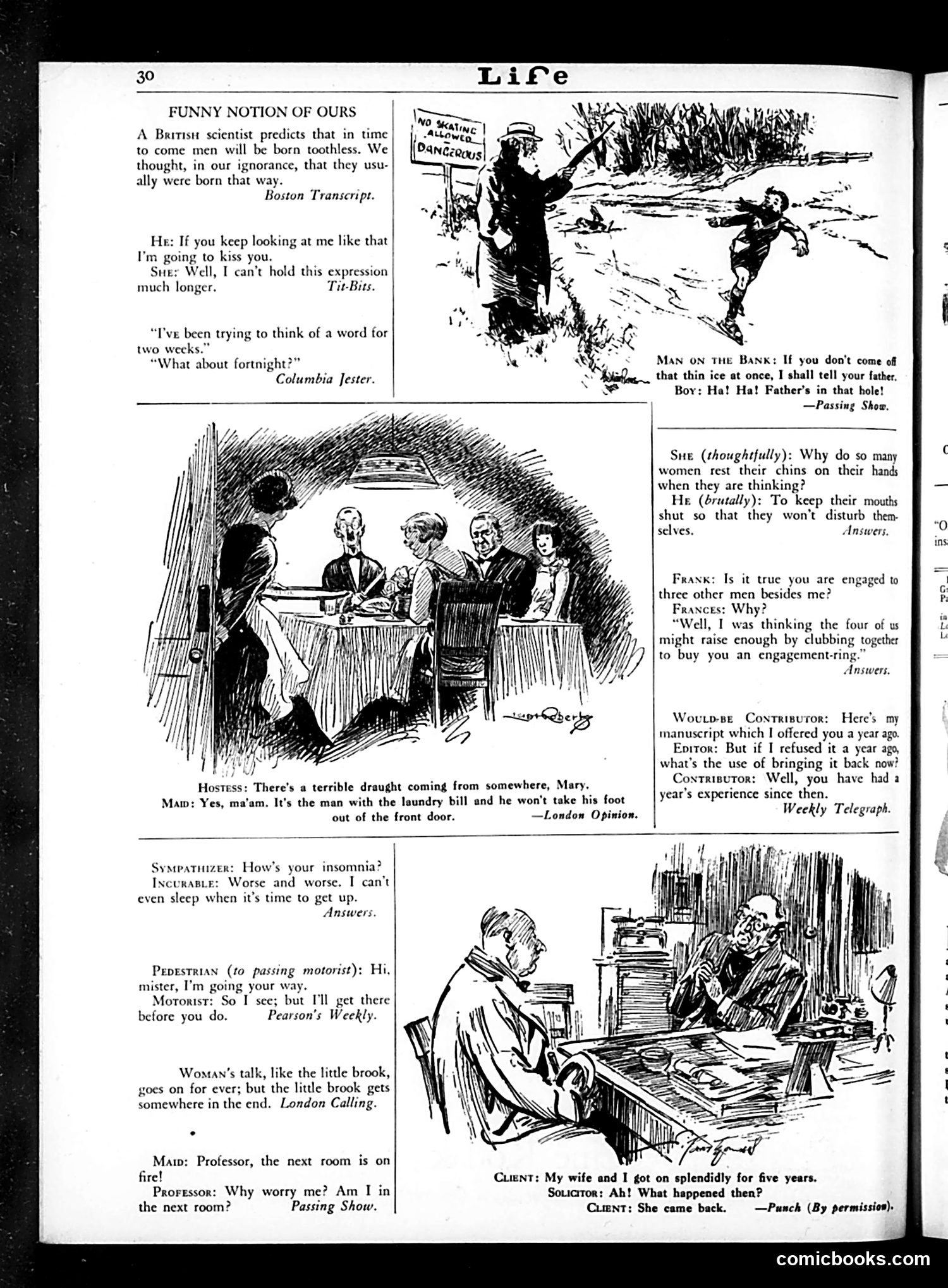
This page collects short jokes and humorous anecdotes from various early 20th-century publications, presented without political content. The humor targets universal human experiences: **Social observations**: A scientist predicts toothless births (joke: babies are already born that way); a woman's endless talking compared to a brook; insomnia sufferers unable to sleep even when intended. **Romantic/domestic comedy**: Flirting couples, a woman engaged to multiple men for financial reasons (comedic desperation), and a couple reconciling after five years apart. **Class-based humor**: A laundry collector refusing to leave until paid; a pedestrian warning a motorist they'll arrive first anyway (defiant working-class wit). **Professional absurdity**: A professor unconcerned about a fire in another room; a persistent writer resubmitting rejected work, claiming his year of experience justifies reconsideration. The cartoons illustrate select jokes with simple line drawings. Overall, the page reflects period comedy conventions: gender stereotypes, economic struggle, marital dynamics, and gentle mockery of human nature rather than topical satire.
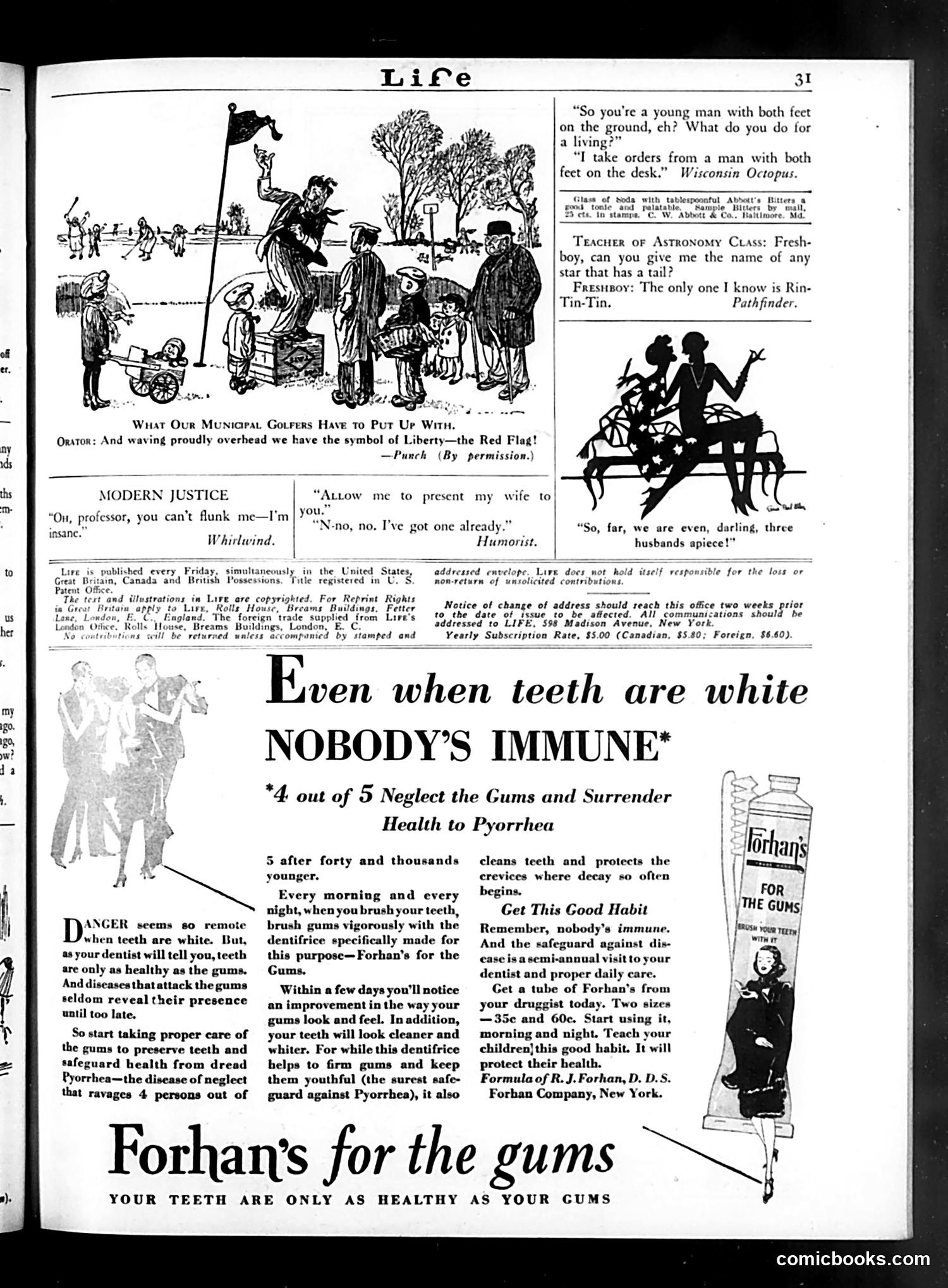
This page contains several short satirical jokes typical of 1920s Life magazine, plus a full-page advertisement for Forhan's toothpaste. **The cartoons/jokes:** The main cartoon depicts a municipal orator proudly gesturing to a red flag as "the symbol of Liberty," satirizing communist or radical rhetoric gaining prominence in post-WWI America. The joke mocks the disconnect between revolutionary rhetoric and reality. The other brief jokes mock: a worker taking orders from a lazy boss; a student naming "Rin-Tin-Tin" (a famous dog) as a star; and domestic infidelity ("three husbands apiece"). **The advertisement:** The large Forhan's ad addresses pyorrhea (gum disease), claiming "4 out of 5" people neglect their gums. It promotes daily brushing with their specialized toothpaste as prevention. This reflects early 20th-century advertising's use of health-scare tactics to market products. The page is primarily advertising content, with humor functioning as filler around commercial messaging.
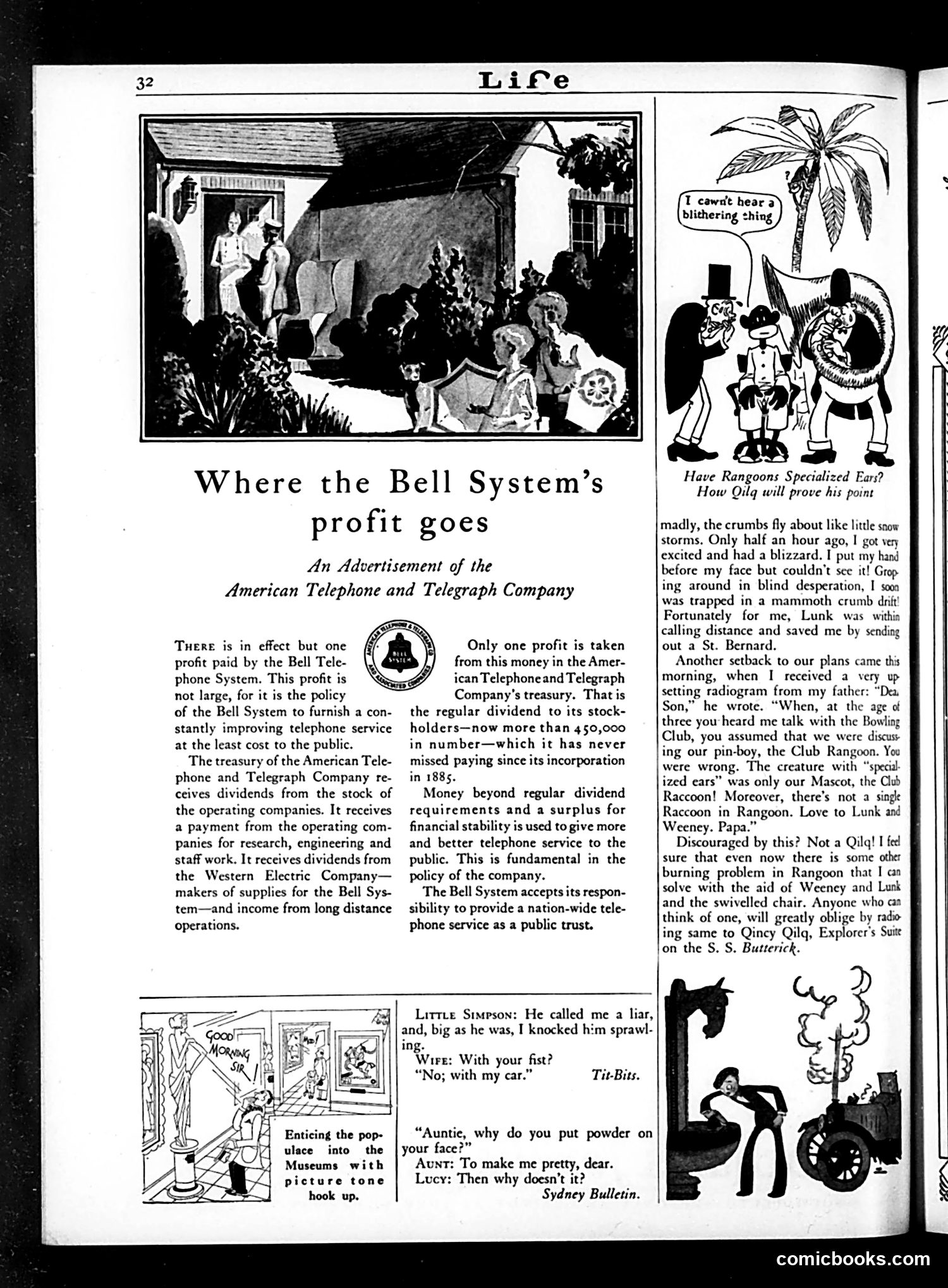
This page contains **advertising disguised as editorial content** for AT&T's Bell System telephone company, alongside humor columns and comic strips. The main advertisement claims Bell System profits fund research, infrastructure, and service improvements rather than excessive shareholder returns—a defensive message likely responding to public criticism of corporate monopoly practices during the early-to-mid 20th century. The illustrated scene depicts an upper-class social gathering, suggesting Bell's service enables sophisticated modern life. The remaining content includes unrelated joke sections ("Little Simpson," "Auntie") and a serialized adventure comic about "Qilq," an explorer attempting to prove Rangoons possess specialized ears—a fictional absurdist subplot typical of period humor magazines. The page exemplifies how *Life* magazine blended paid corporate messaging with satirical humor, allowing advertisers to present corporate narratives while the magazine's editorial voice remained elsewhere.
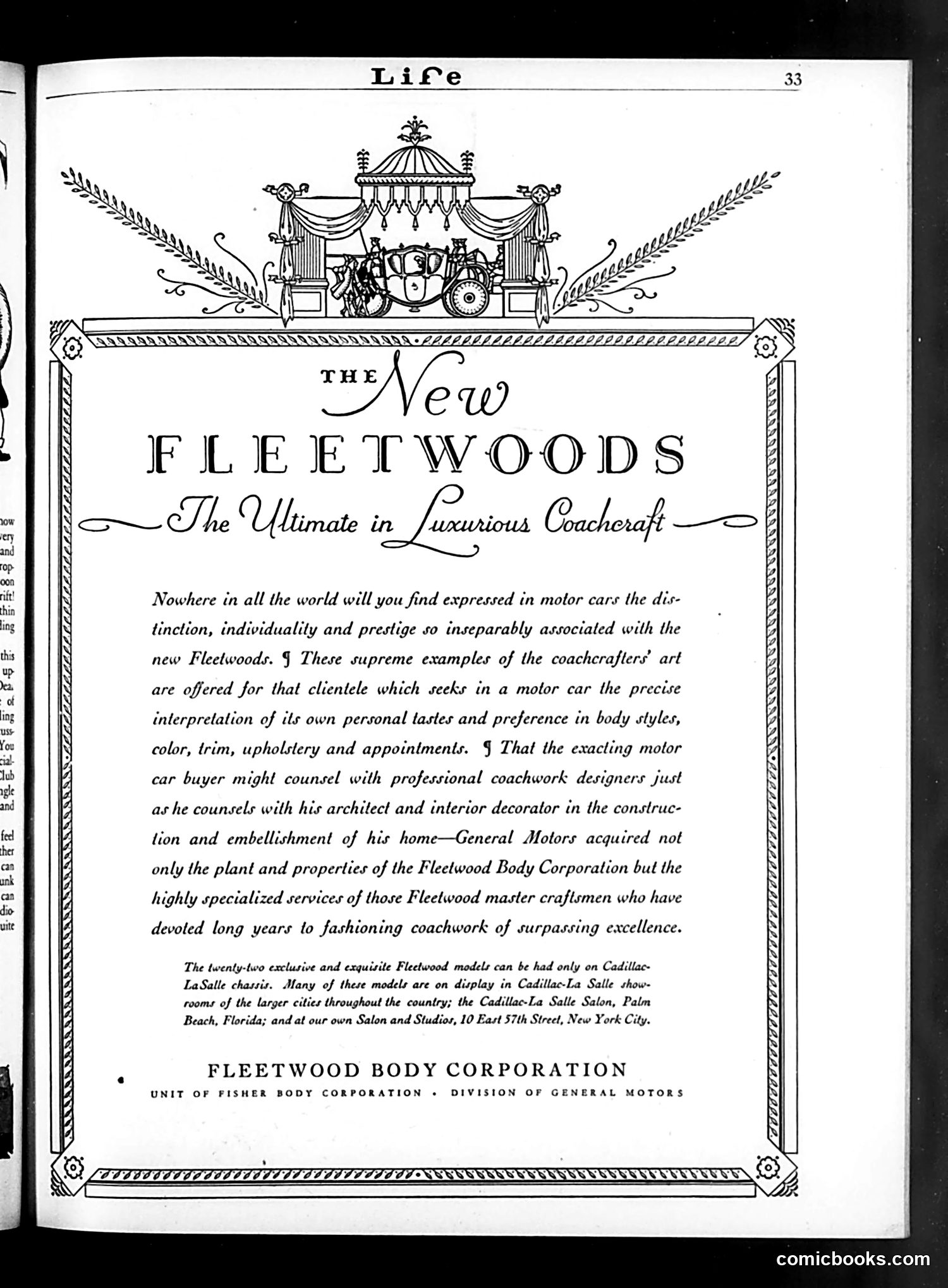
This is **not a cartoon or satire**—it's a full-page luxury automobile advertisement, not editorial content. The page advertises Fleetwood-bodied Cadillac and LaSalle automobiles as the pinnacle of personalized, exclusive motorcar craftsmanship. The ornate illustration at top depicts an elaborate, richly-appointed carriage, emphasizing luxury and prestige. The ad's message targets wealthy buyers by comparing custom car design to hiring an architect or interior decorator for one's home—positioning Fleetwood as offering bespoke, individualized automobiles for the discerning elite. This reflects 1920s-30s marketing: General Motors (then acquiring Fleetwood Body Corporation) positioned these vehicles as handcrafted luxury goods for the ultra-wealthy, offering twenty-two exclusive models. The ad emphasizes mastercraft, personal taste, and exclusivity—selling not transportation but status and distinction to affluent clientele.
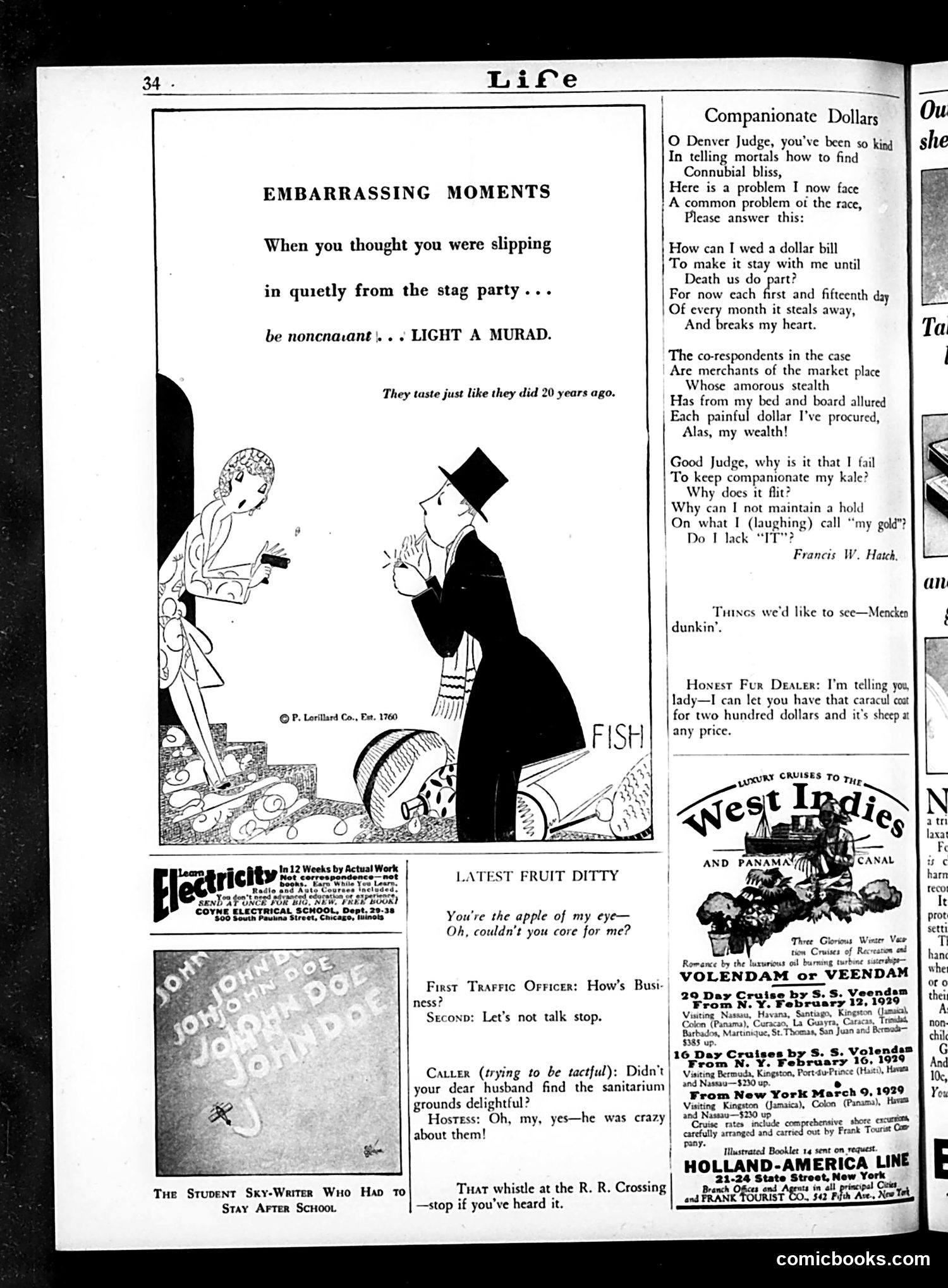
This page from *Life* magazine combines humor with social commentary typical of the 1920s-era publication. **Main Cartoon ("Embarrassing Moments"):** A formally dressed man attempts to sneak quietly from a stag party (bachelor gathering). The joke centers on trying to maintain composure while leaving discretely—the ad for Murad cigarettes suggests "lighting one" to appear nonchalant. The caption notes these cigarettes taste the same as 20 years prior, likely mocking advertising claims. **"Companionate Dollars" Column:** Satirizes the "companionate marriage" concept (a 1920s ideal emphasizing companionship over traditional roles). A writer complains that money mysteriously disappears monthly on the 1st and 15th—payday dates—blaming merchants and creditors who seduce one's finances away. It mocks both marital anxieties and consumer spending culture. **Minor Jokes:** Include puns ("core for me"), traffic officer banter, and sanitarium references (likely alluding to mental health institutions or drying-out facilities). The page reflects 1920s concerns: courtship rituals, marriage expectations, financial instability, and consumerism.
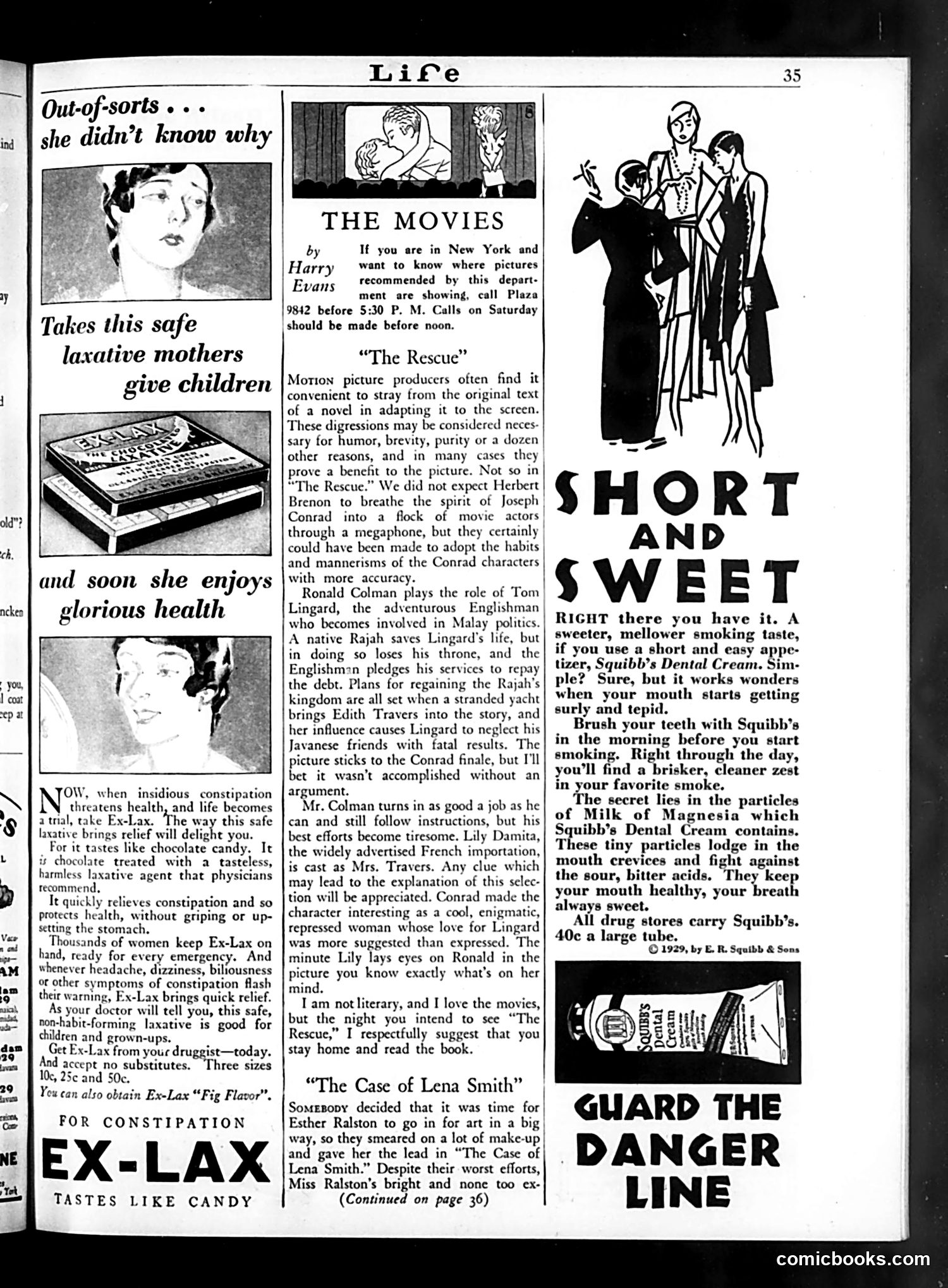
This page combines **product advertising with entertainment criticism**, typical of Life magazine's format. ## The Ex-Lax Advertisement The left side promotes a chocolate laxative using a common early 20th-century marketing approach: depicting a woman's vague malaise ("out-of-sorts...she didn't know why") solved by the product. The implication—that constipation caused unexplained female illness—reflects period medical misconceptions. The ad normalizes discussing digestive health directly with consumers. ## Movie Reviews Harry Evans reviews two films. His critique of "The Rescue" (starring Ronald Colman) expresses frustration that the film adaptation strays from Joseph Conrad's novel, particularly in character portrayal. He recommends readers "stay home and read the book" instead—a blunt dismissal. The Squibb's Dental Cream advertisement suggests brushing teeth before smoking, a practical tip reflecting smoking's social ubiquity. ## Overall Context The page reflects 1920s American consumer culture: direct medical/health messaging, film as entertainment worth serious critical discussion, and advertising integrated seamlessly into editorial content.
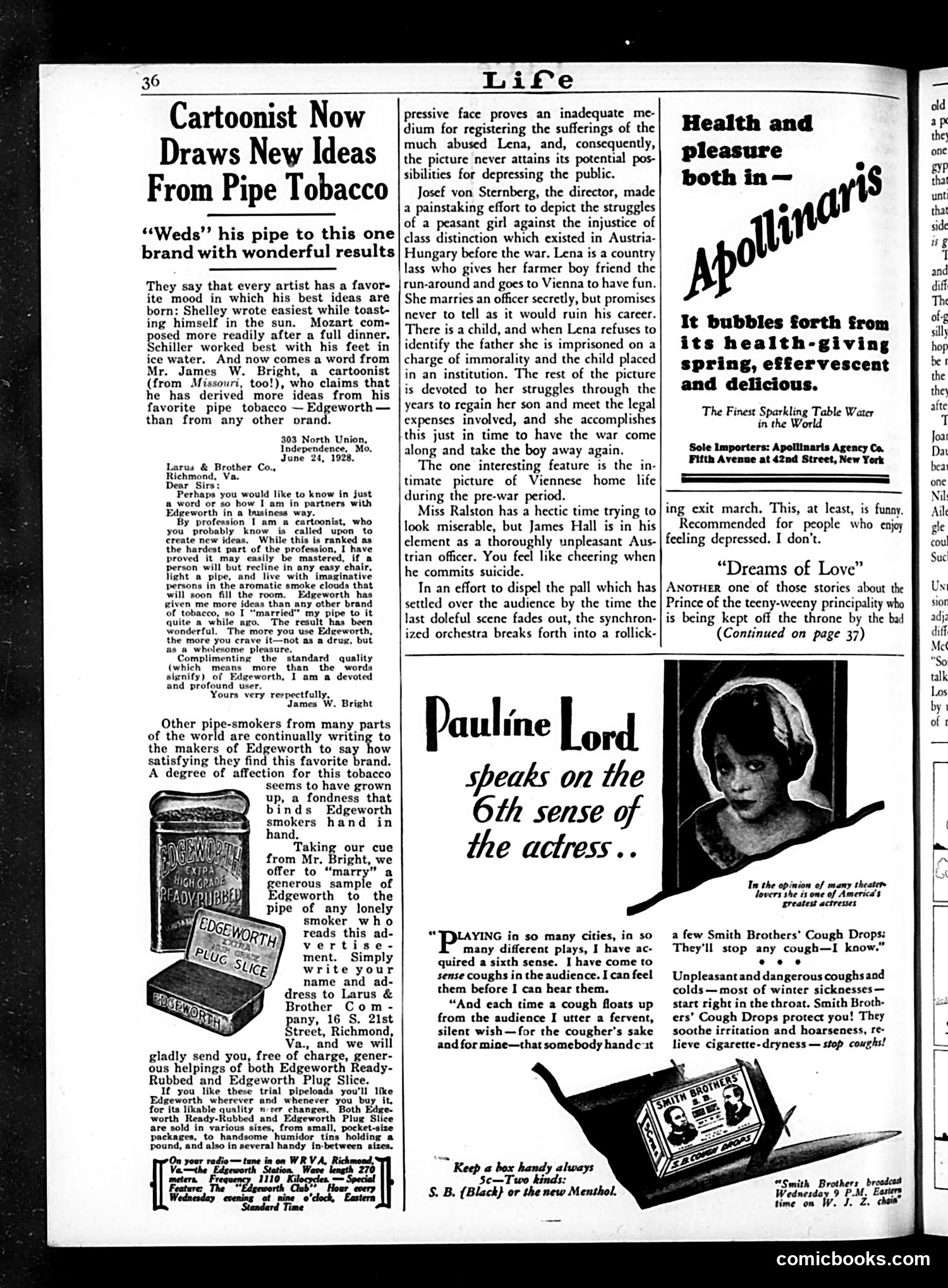
This page is primarily **advertising disguised as editorial content**—a common 1920s marketing practice. The main feature is a testimonial letter from cartoonist James W. Bright claiming Edgeworth pipe tobacco inspires his creative work. The "joke" (if satirical at all) is gentle: pairing the Romantic notion that artists need special conditions for inspiration (Shelley, Mozart, Schiller) with the mundane reality of pipe smoking as creative fuel. This appeals to male readers' aspirations toward artistic sophistication. The right column contains film criticism of what appears to be an Austrian drama ("Lena"), plus advertisements for Apollinaris sparkling water and Smith Brothers cough drops—typical Life magazine content mixing entertainment coverage with advertising. **No political satire is evident.** This is straightforward 1920s lifestyle marketing targeting middle-class male consumers, presenting pipe tobacco and branded products as markers of refinement and success.
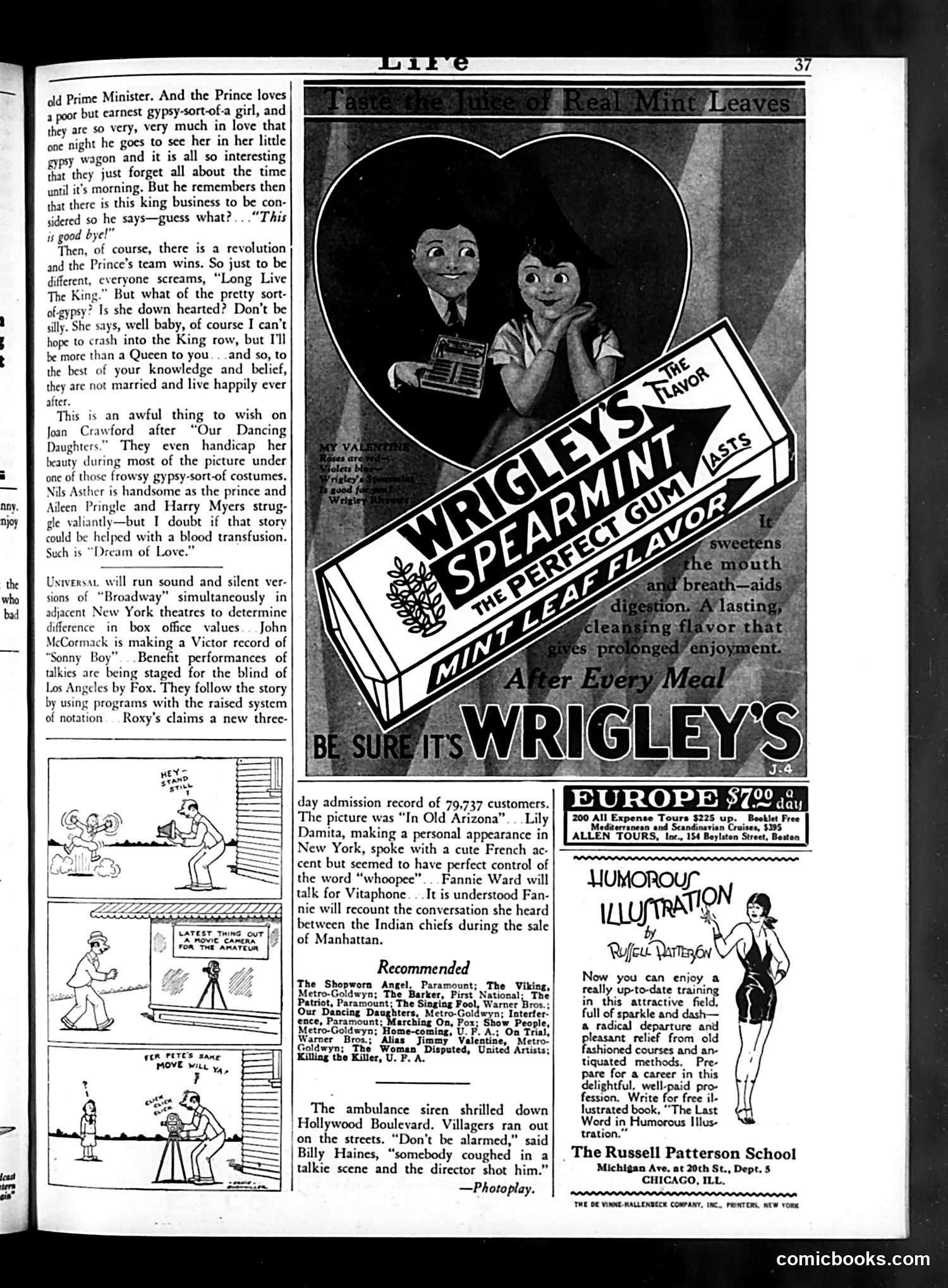
This page contains film reviews and advertisements from the silent/early-talkie era. The main text reviews "Dream of Love," a romantic melodrama starring Joan Crawford as a gypsy girl who falls for a prince (Nils Asther). The reviewer dismisses the plot as predictable and Crawford's costume as unflattering, though acknowledging the leads' attractiveness. The cartoon strips (lower left) appear to be humorous commentary on movie-making, showing amateur camera operators and film industry mishaps—typical Life satire about Hollywood's growing pains during the transition to sound films. The page also advertises Wrigley's spearmint gum and European tours. A notable joke references early talkie problems: an ambulance siren interrupts filming, with Billy Haines quipping that "somebody coughed in a talkie scene and the director shot him"—mocking both the sensitivity of early microphones and directors' desperation during the chaotic shift from silent to sound pictures.
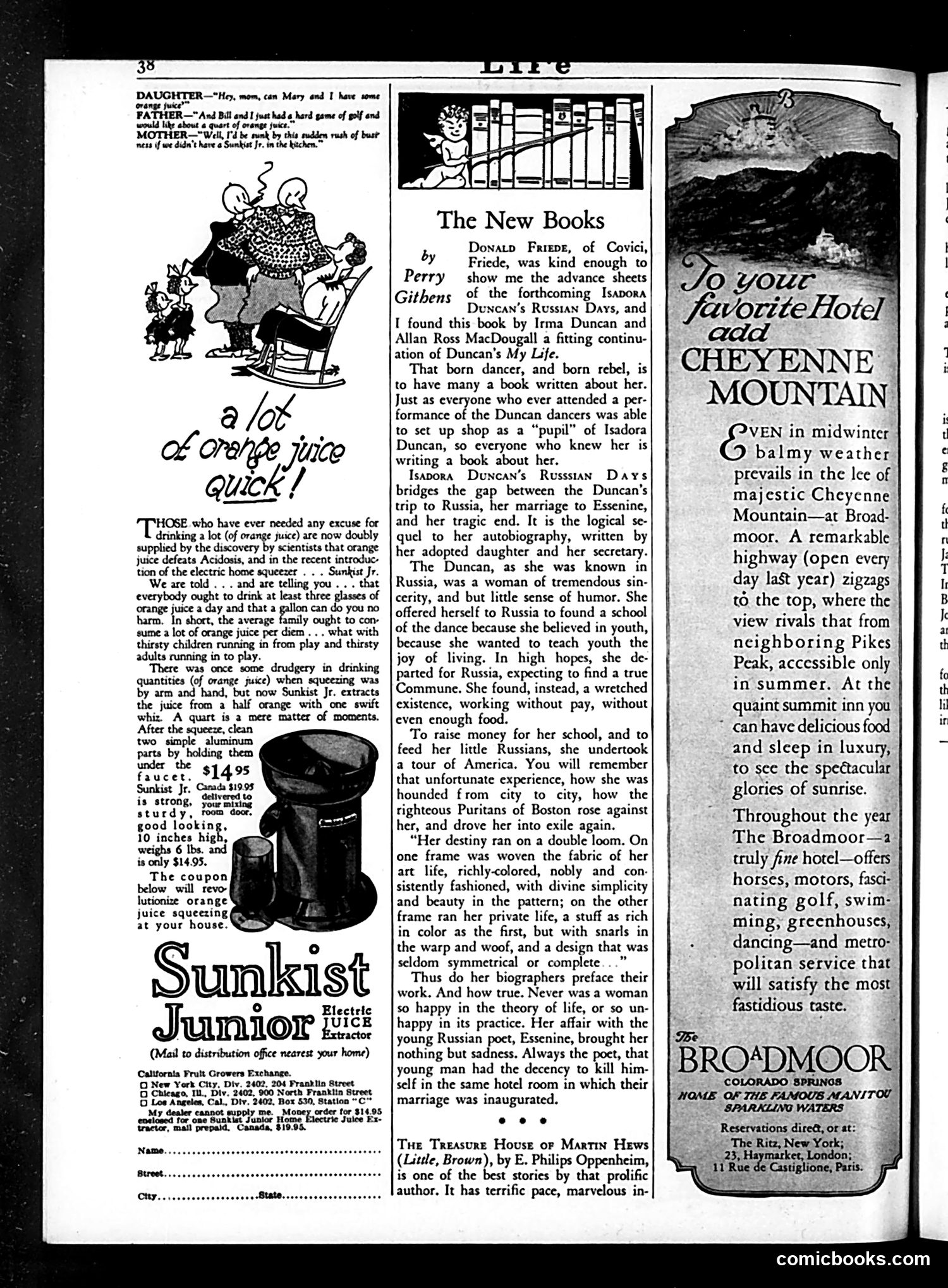
This page contains **advertising and book reviews** rather than political satire. **The Main Cartoon** (upper left) depicts a family squabble over orange juice—parents and children all wanting quantities of it. It's a humorous domestic scene introducing the **Sunkist Jr. electric juicer**, a new kitchen appliance. The joke relies on the absurd family competition for juice and the newfound ease of producing it in bulk. **The Advertisement** promotes the electric juice squeezer, claiming orange juice prevents "Acidosis" (a health concern of the era) and suggesting families should consume a gallon daily. The ad plays on parents' anxieties about children's health while marketing labor-saving technology. **The Book Reviews** discuss Isadora Duncan's autobiography and related works about the famous dancer, referencing her controversial tour of America and conflicts with Boston's "righteous Puritans." The page reflects 1920s American consumer culture: new electrical appliances marketed through family-centered humor, health pseudoscience, and celebrity gossip about the bohemian dancer Duncan.
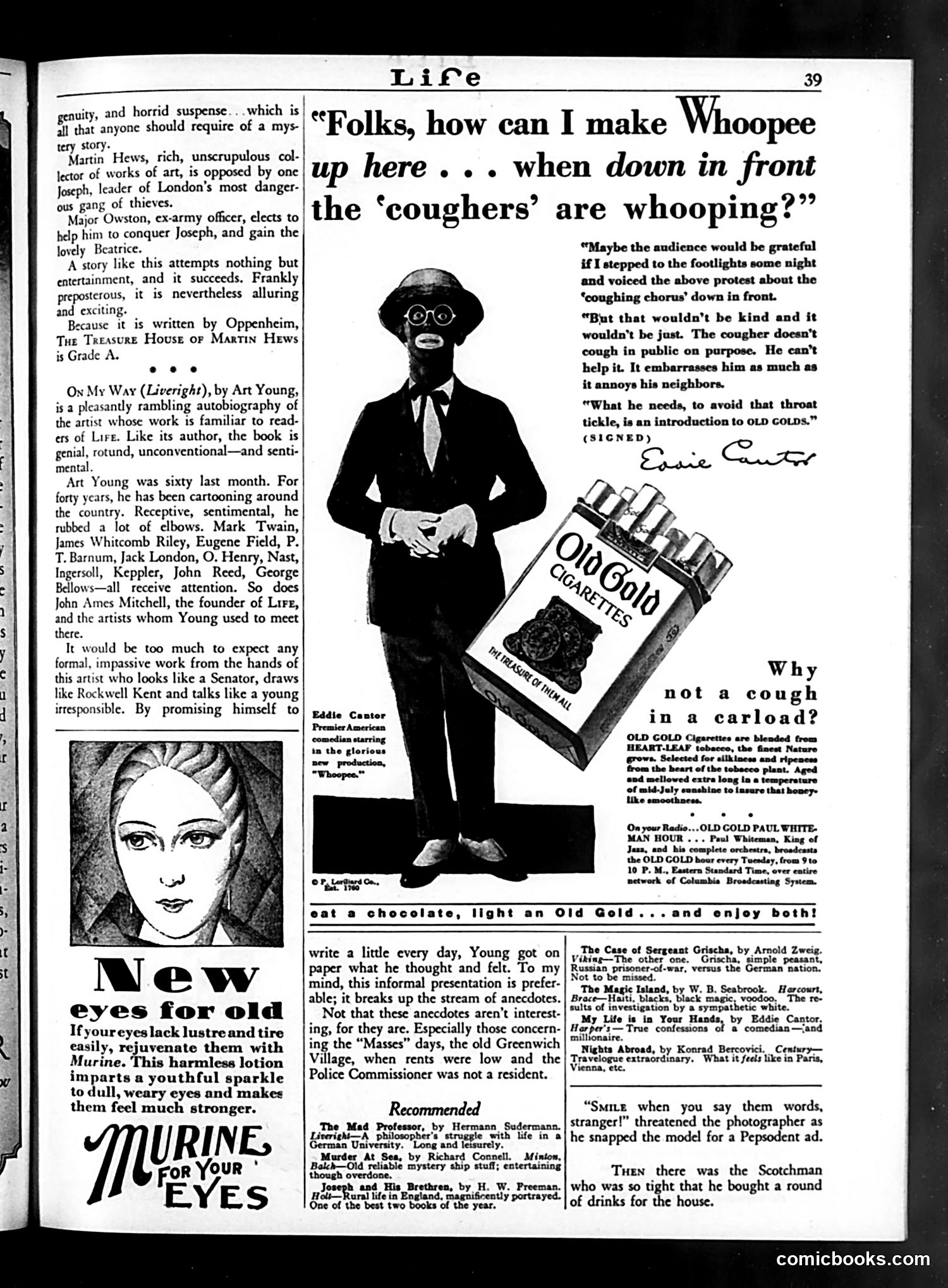
This page contains a **cigarette advertisement disguised as editorial content**, featuring comedian **Eddie Cantor** (star of the musical "Whoopee"). The cartoon shows Cantor on stage complaining that audience members coughing in the front rows ruin his performance. Rather than directly criticizing the coughers, the ad pivots to a "solution": **Old Gold cigarettes**, which supposedly won't cause coughing due to their "heart-leaf" tobacco blend aged for smoothness. The satire is implicit: the ad exploits Cantor's real problem (audience disruption) to sell cigarettes by claiming they're a *remedy* for coughing—essentially arguing that if audience members smoked Old Golds instead, they wouldn't cough during the show. The tagline **"not a cough in a carload"** became famous advertising copy. This reflects 1920s-30s advertising practices when health claims for tobacco were legal and cigarettes were aggressively marketed as harmless or even beneficial. The page also reviews books and promotes Murine eye drops, typical magazine fare of the era.
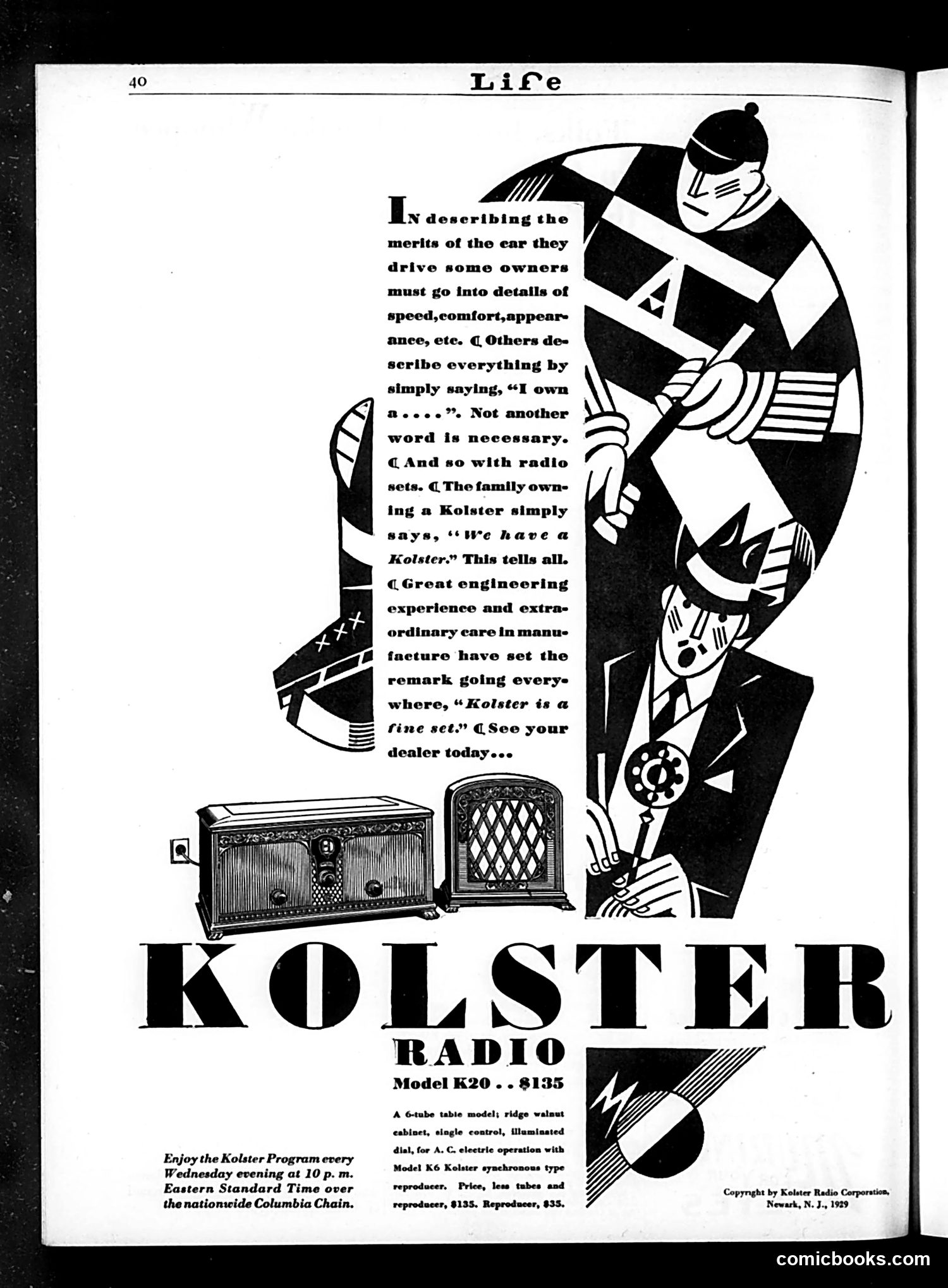
This is a **product advertisement**, not political satire. It promotes Kolster brand radios by using a clever comparative marketing strategy. The ad argues that prestigious products need no elaborate explanation. Just as car owners simply say "I own a [luxury car brand]" without details, radio owners say "We have a Kolster"—implying the brand name alone conveys quality. The text emphasizes that Kolster's reputation for "engineering experience and extraordinary care" is so established that no further description is necessary. The illustration shows a stylized figure in period winter clothing, suggesting affluence and modernity. The Model K20 radio shown below features a wood cabinet and dial typical of late 1920s design. This reflects pre-Depression advertising strategies emphasizing brand prestige and the growing consumer culture around new home technologies like radios.
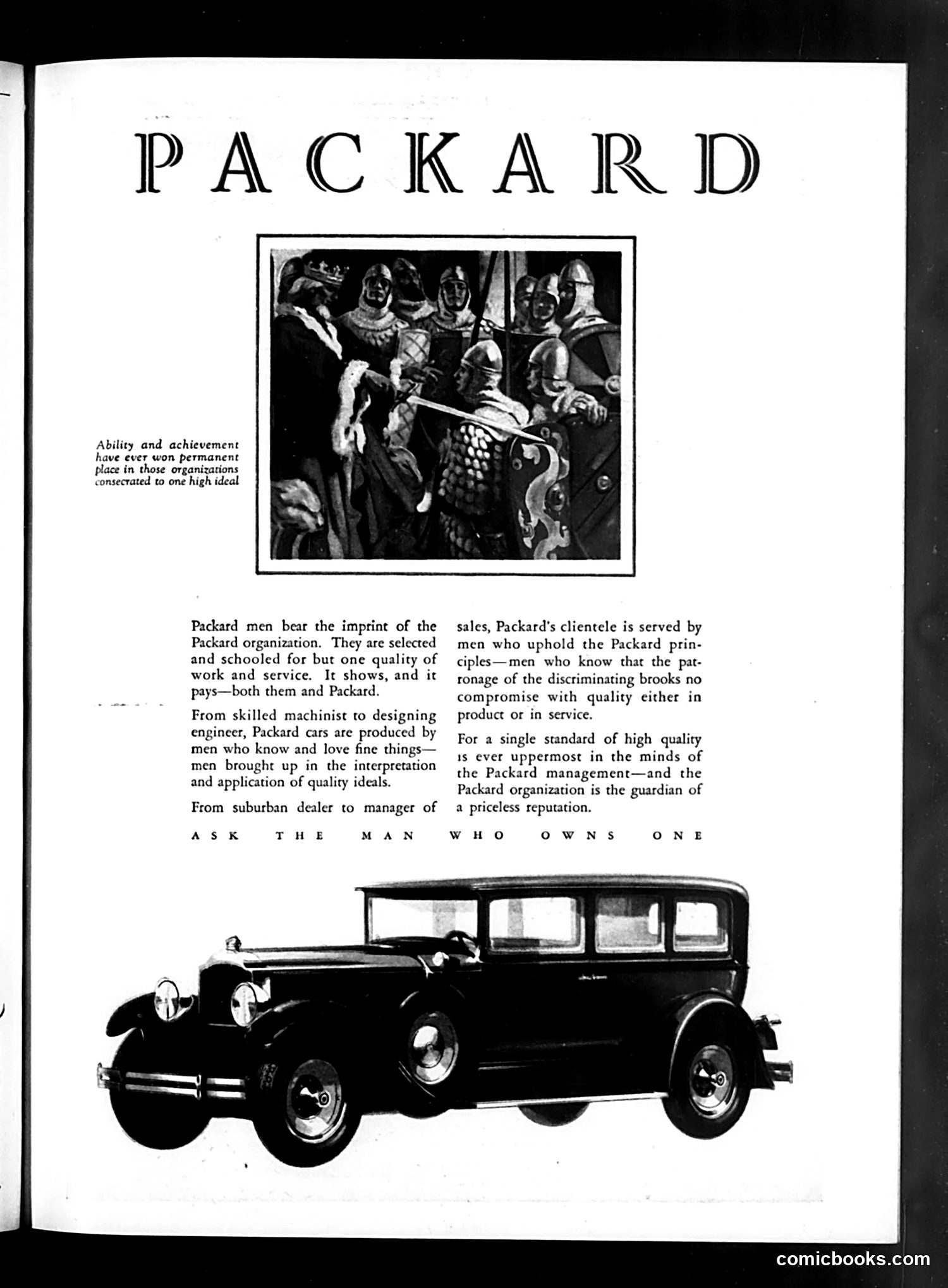
This is a **Packard automobile advertisement**, not political satire. The page promotes Packard luxury cars through corporate messaging rather than humor or social commentary. The historical image at top depicts what appears to be a **medieval or Renaissance scene**—figures in period armor and dress—likely chosen to evoke tradition, craftsmanship, and enduring quality (the caption references "ability and achievement" winning "permanent place"). The lower half shows a **1920s-era Packard sedan**, a high-end automobile brand. The ad's strategy emphasizes that Packard maintains quality standards across its entire organization—from factory workers to salesmen to management. The tagline "Ask the man who owns one" was Packard's actual historical slogan. For modern readers: this reflects early automotive advertising that sold **lifestyle and organizational philosophy** rather than technical specifications—positioning Packard as a prestigious brand for discriminating buyers who valued craftsmanship and service, not just the product.
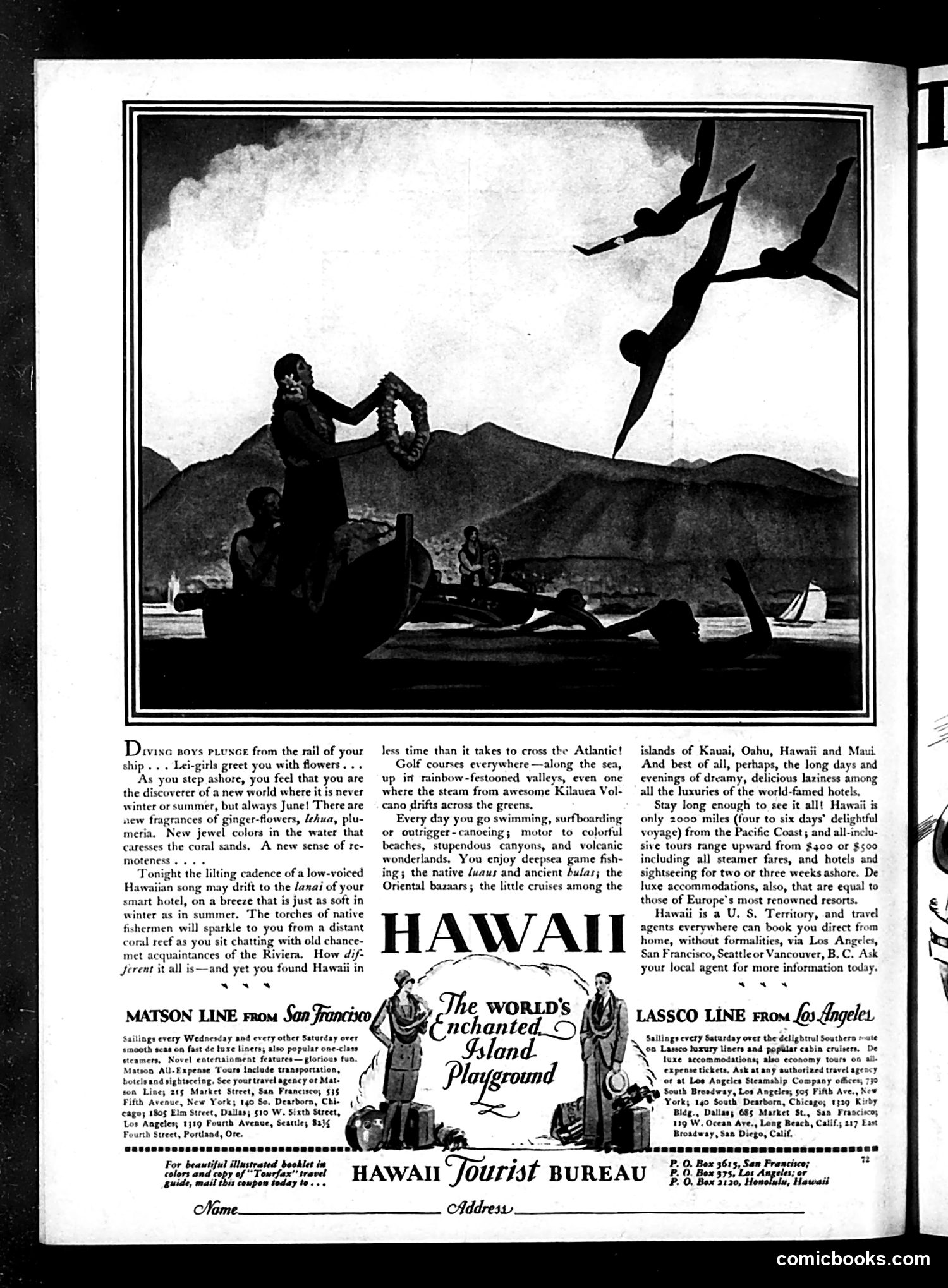
This page is primarily **travel advertising**, not political satire. It promotes Hawaiian vacations to American tourists via the Matson Line and Lassco Line steamship companies. The illustration depicts diving boys performing acrobatic dives—a romanticized image of native Hawaiian entertainment. The text emphasizes Hawaii's exotic appeal: perpetual summer weather, lei greetings, native songs, surfing, outrigger canoes, luaus, and golf courses. It promises escape from winter and Atlantic-crossing tedium. The ads stress accessibility: Hawaii is "only 2000 miles" away via Los Angeles or San Francisco ports, reachable in "four to six days," with packaged all-inclusive tours starting at $400-$500. The **cultural framing** reflects 1920s-era tourist marketing: Hawaii is presented as a romantic "enchanted island playground" rather than a U.S. territory with indigenous people. Native culture—songs, dances, fishing—is commodified as exotic entertainment for wealthy American travelers. The page embodies the era's colonial-era tourism that treated Hawaiian culture as spectacle for consumption.