
A complete issue · 40 pages · 1927
Life — December 8, 1927
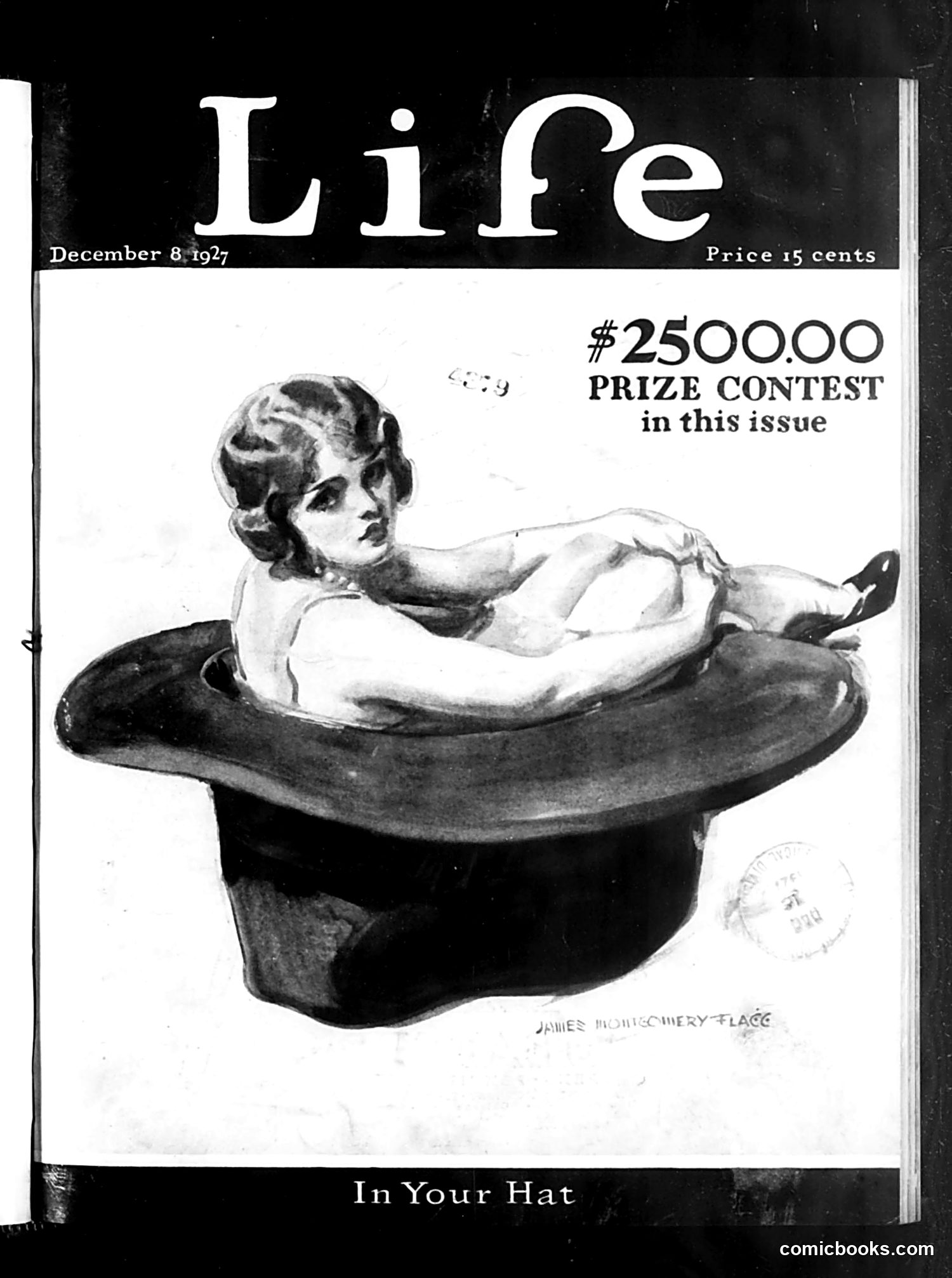
This cover illustration by James Montgomery Flagg depicts a flapper-era woman reclining inside an oversized top hat, titled "In Your Hat." The image plays on 1920s social commentary about women's fashions and behavior during the Jazz Age. The satire likely mocks both the impracticality of women's fashion trends and, more broadly, the era's social anxieties about "modern" women. The phrase "in your hat" was period slang meaning something absurd or dismissive—essentially, the image suggests that the flapper's lifestyle or fashion sense belongs "in your hat" (i.e., is ridiculous). The $25,000 prize contest promoted on the cover was a marketing gimmick common to Life magazine during this era.
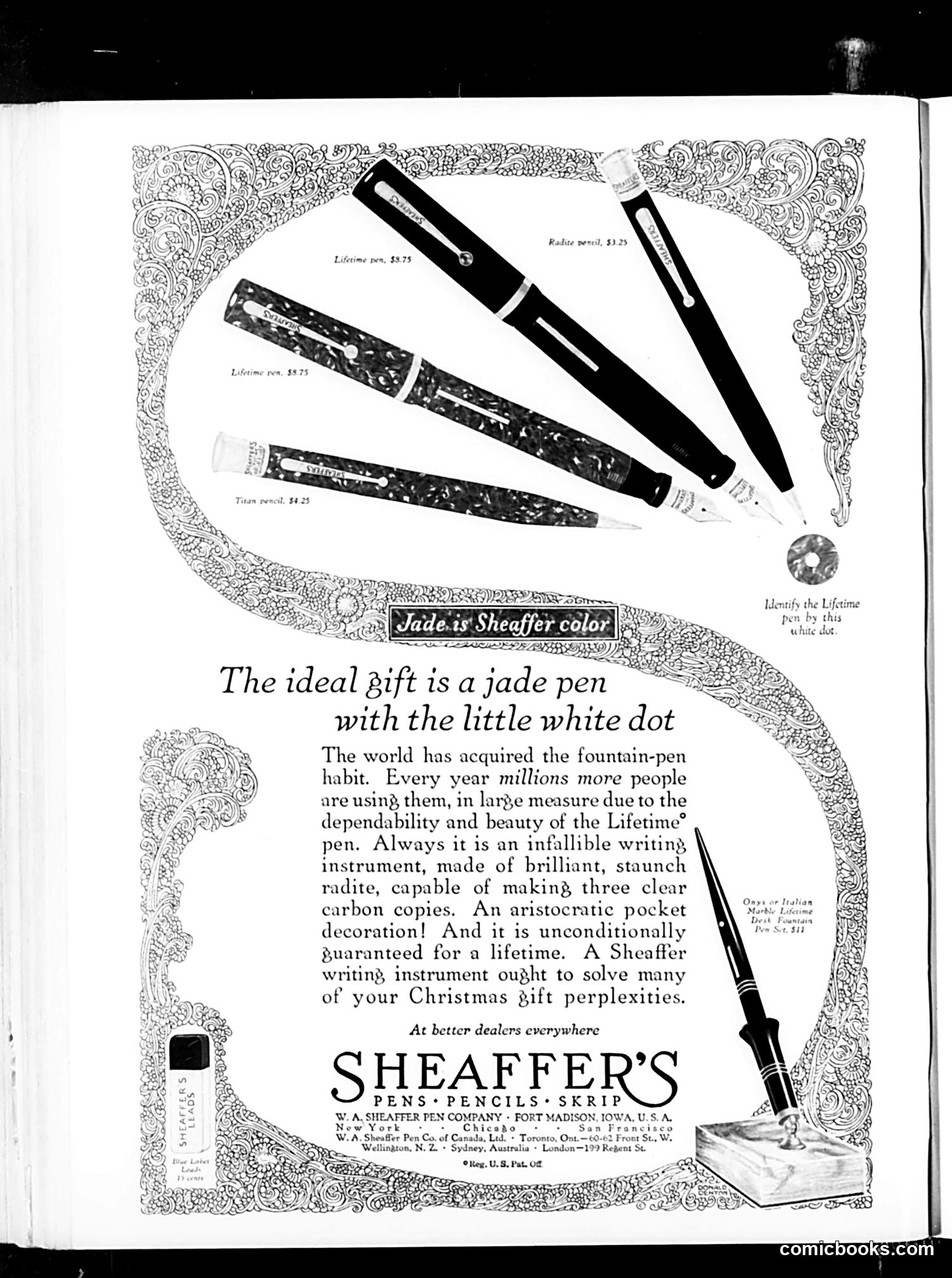
This page is **primarily an advertisement**, not political satire or a cartoon. It's a Sheaffer's pen advertisement from an era when Life magazine (founded 1883) mixed editorial content with advertising. The ad promotes "Jade" colored Sheaffer fountain pens as ideal Christmas gifts. It emphasizes the pens' reliability, durability ("guaranteed for a lifetime"), and status as "an aristocratic pocket decoration." The ornate border and elegant typography reflect early-20th-century advertising design aesthetics. The "little white dot" mentioned refers to a Sheaffer trademark identifying authentic Lifetime pens. The ad lists multiple price points and pen styles, with distribution information for various cities including Fort Madison, Iowa (Sheaffer's headquarters). This is commercial promotion, not satirical commentary.
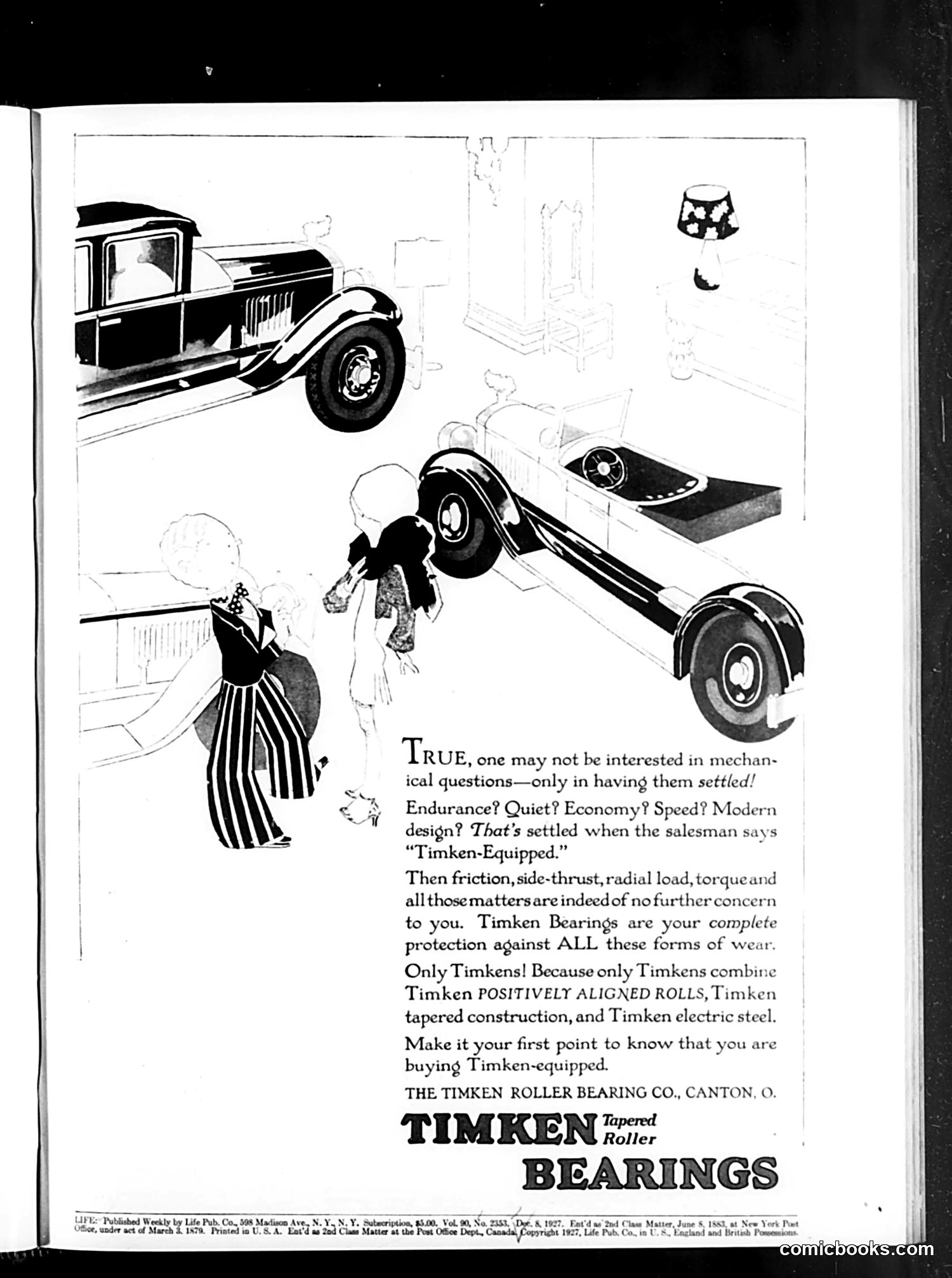
This is primarily a **Timken Roller Bearings advertisement**, not political satire. The image shows a stylized 1920s scene with a fashionable woman and three automobiles of different eras, illustrating automotive progress. The ad's humor is gentle and commercial: it suggests that car buyers don't care about technical bearing specifications—they just want reliability ("settled"). The satire is self-directed: Timken admits customers aren't interested in mechanical details, only results. The "Timken-equipped" designation serves as reassurance that complex engineering has been handled for them. The flapper-style woman and period cars date this to the 1920s, when automobiles were becoming consumer goods and marketing increasingly targeted style-conscious buyers rather than mechanically-minded owners.
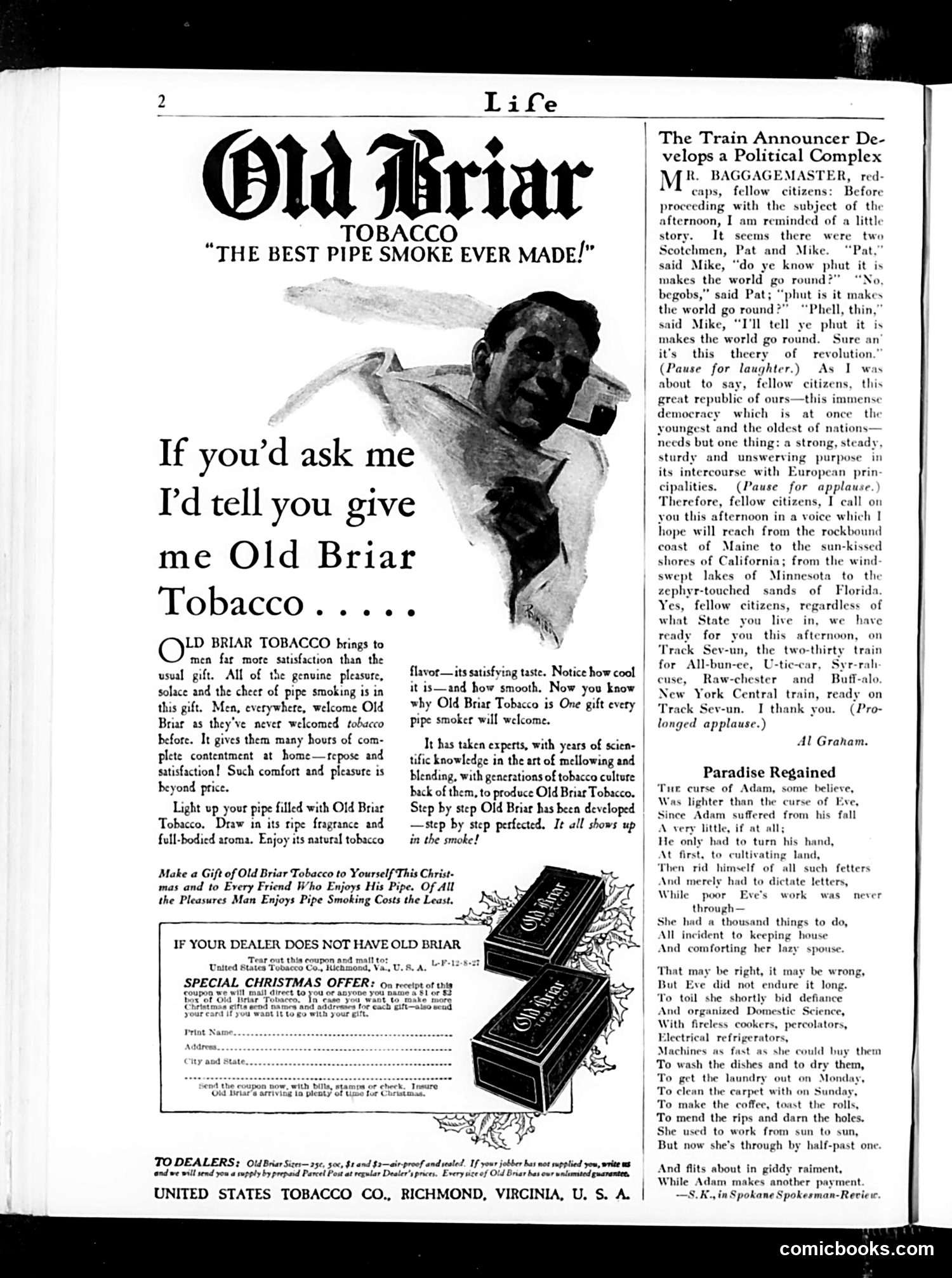
This page is primarily a **tobacco advertisement** for Old Briar Tobacco, occupying most of the space. The ad features a caricatured man smoking a pipe, emphasizing the product's quality and satisfaction. The right column contains two distinct pieces: 1. **"The Train Announcer Develops a Political Complaint"**: A humorous short story about a train announcer (Mr. Baggagemaster) who interrupts his duties to deliver a mock patriotic speech about American democracy. The joke appears to be satirizing overzealous civic rhetoric and bureaucratic pomposity. 2. **"Paradise Regained"**: A poem about Eve's post-Fall domestic life, humorously suggesting that Eve's invention of labor-saving devices (electrical refrigerators, washing machines) was her redemption from domestic drudgery. Both pieces are light satirical humor typical of Life magazine's satirical tradition.
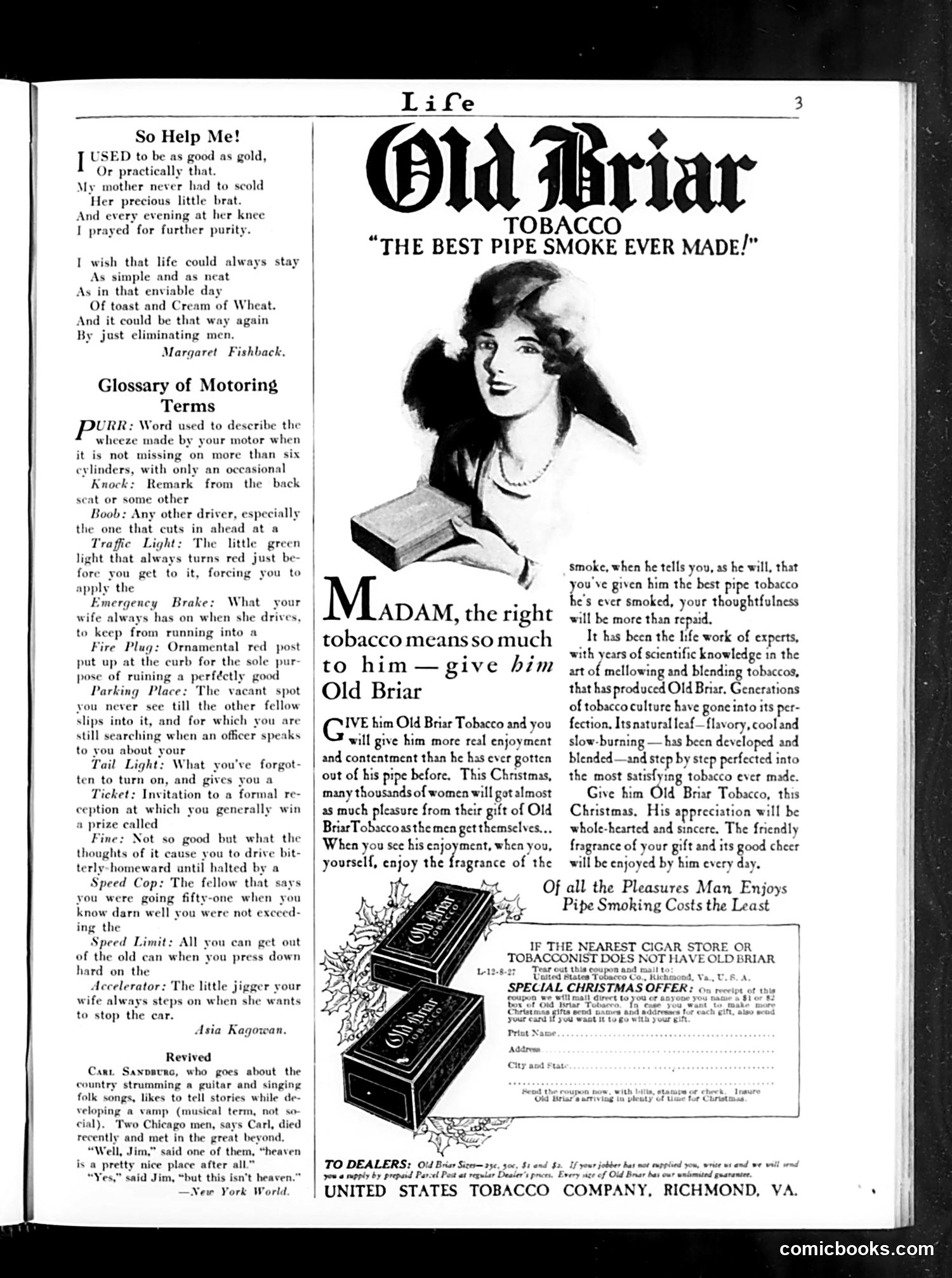
This page is **primarily advertising**, not political satire. It features a large advertisement for Old Briar Tobacco positioned as a Christmas gift recommendation. The ad depicts an attractive woman presenting tobacco packages, using gendered marketing typical of early 20th-century advertising. The sales pitch targets male gift-givers, emphasizing that Old Briar provides superior "enjoyment and contentment" compared to other pipe tobaccos. The page also includes: - A poem titled "So Help Me!" discussing life's simplicity - A "Glossary of Motoring Terms" defining period automotive slang (purr, knock, boob, etc.) - A brief anecdote about folk singer Carl Sandburg The tobacco advertisement dominates the layout and represents straightforward commercial content rather than editorial satire or political commentary.
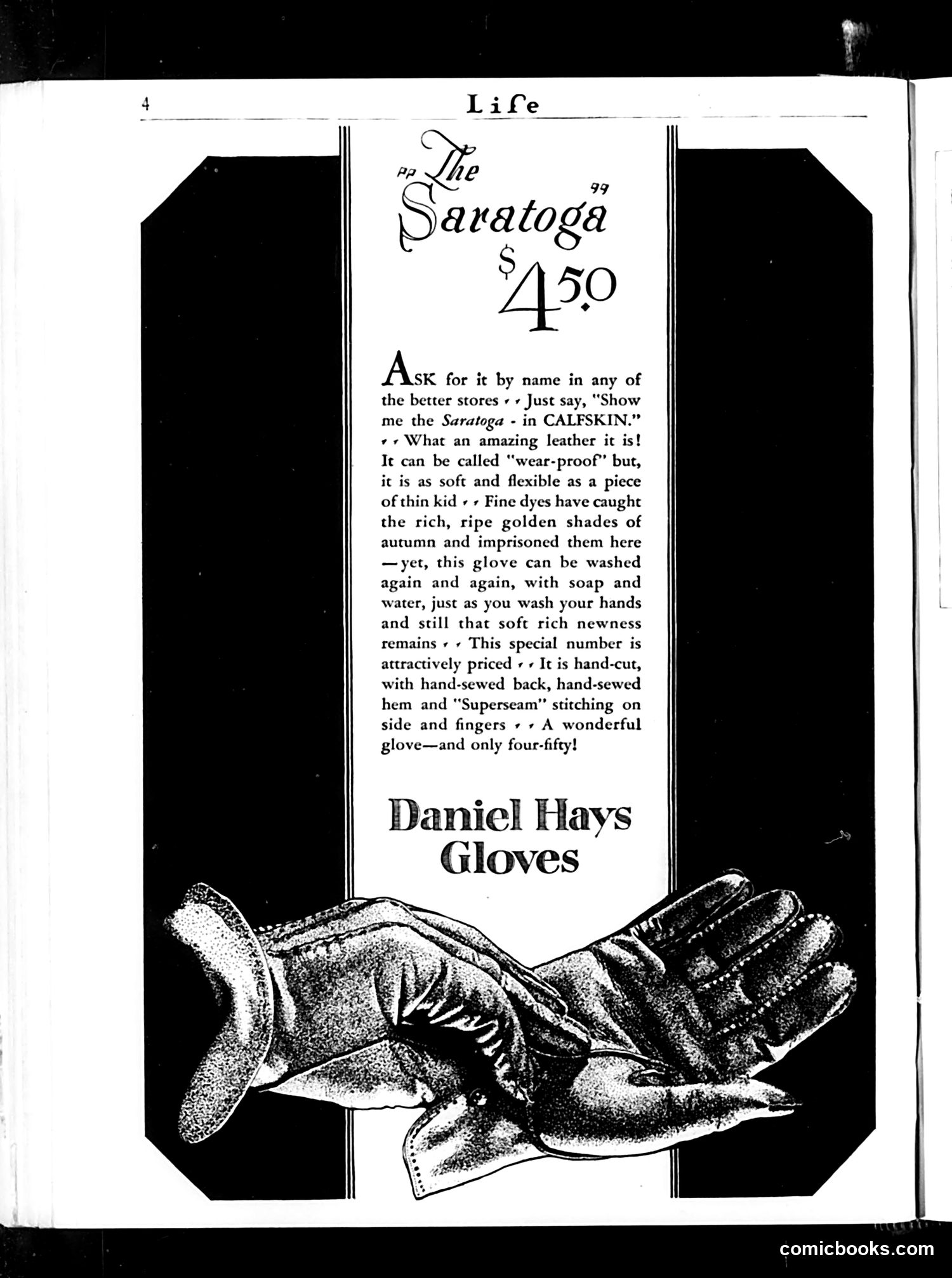
This page is **primarily an advertisement**, not political satire or editorial content. It advertises the "Saratoga" glove by Daniel Hays, priced at $4.50. The ad copy emphasizes the glove's practical qualities: it's described as "wear-proof" yet soft and flexible like kid leather, available in golden autumn shades, and washable with soap and water. The glove features hand-stitching, hand-sewn back and hem, and "Superseam" stitching. The illustration shows a pair of elegant gloved hands demonstrating the product's quality and craftsmanship. This is a straightforward luxury goods advertisement typical of Life magazine's commercial content during this era—no political commentary or satire is present.
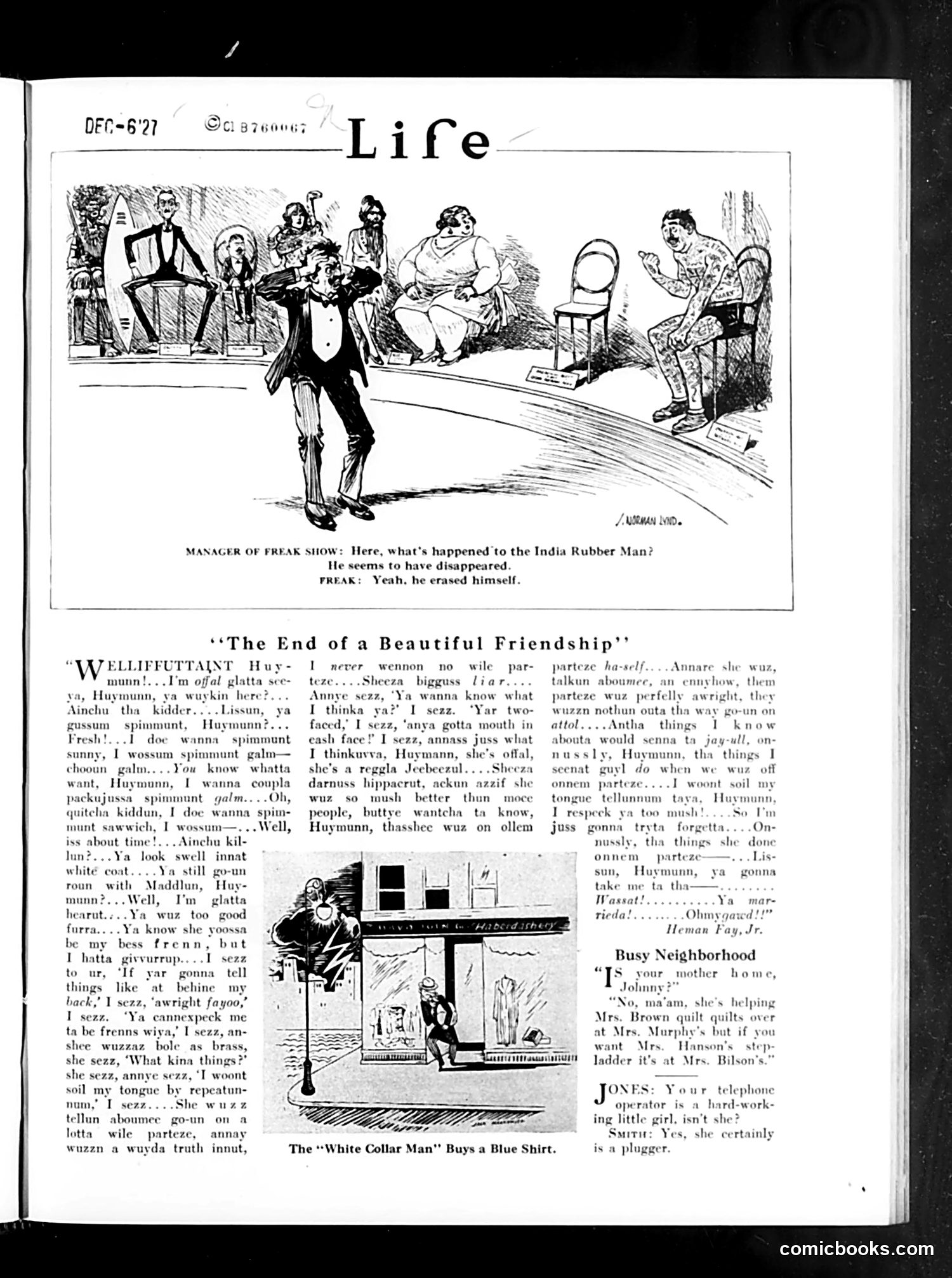
**Top Cartoon**: A freak show manager confronts a circus performer about a missing attraction—the "India Rubber Man." The freak responds he "erased himself," a dark joke about self-harm or disappearance, likely satirizing both circus exploitation of disabled performers and the sensationalism of such "human oddities" entertainment. **Bottom Left Story/Illustration**: "The End of a Beautiful Friendship" depicts dialect humor (appears to be a caricature using exaggerated African American vernacular). The crude spelling and phonetic dialogue were typical of early 20th-century American comedy but reflect racist stereotyping common to the era. **Bottom Right**: Brief social commentary pieces including "Busy Neighborhood" and "The White Collar Man Buys a Blue Shirt," offering mild domestic satire typical of Life's social humor.
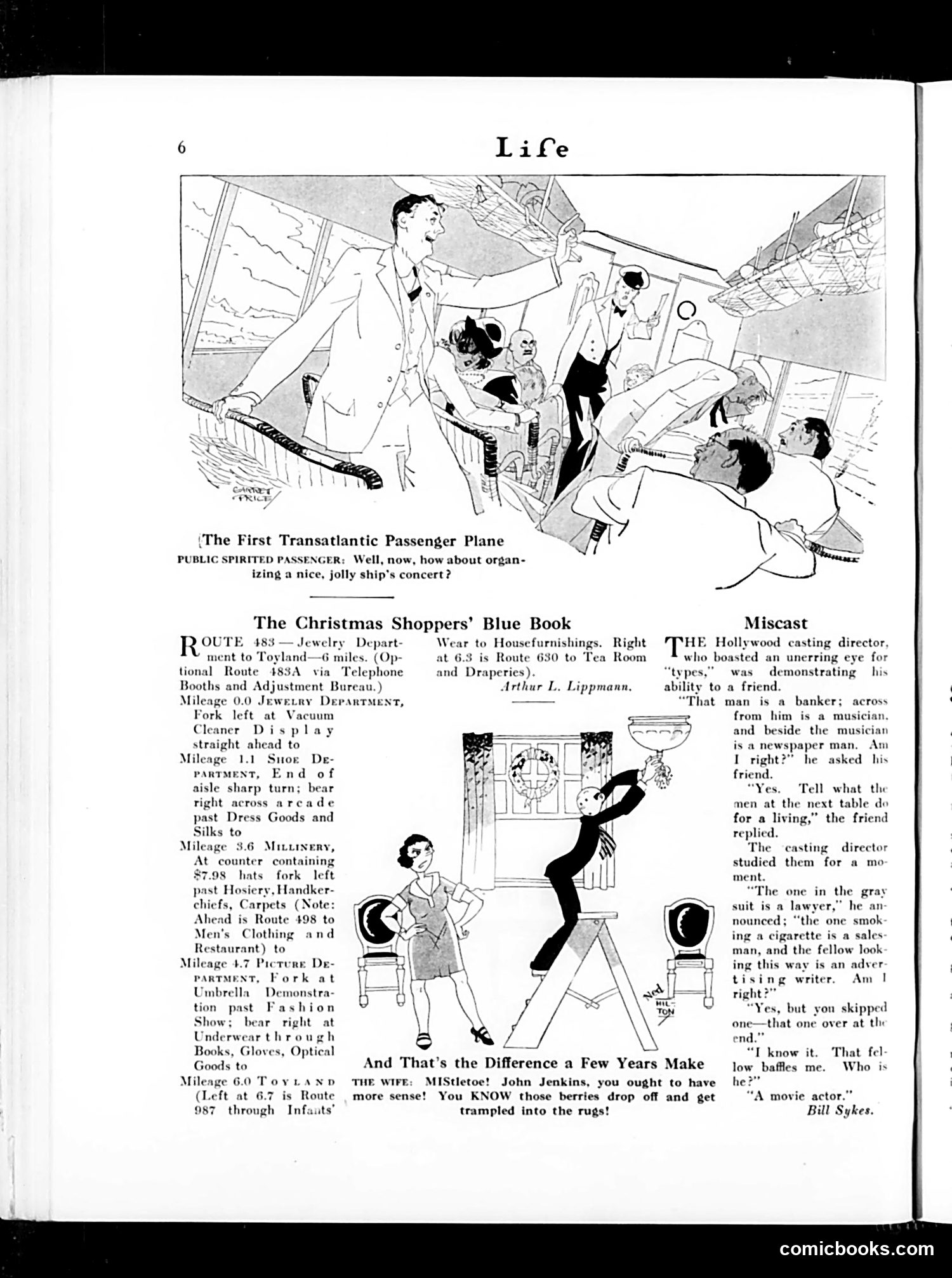
This page contains three distinct humor pieces from Life magazine's satirical content: 1. **"The First Transatlantic Passenger Plane"** (top): A cartoon depicting passengers aboard an aircraft, with one asking about organizing "a jolly ship's concert?" The joke plays on the novelty of transatlantic air travel and passengers' attempts to replicate shipboard entertainment traditions in this new transportation mode. 2. **"The Christmas Shoppers' Blue Book"** (left): A shopping guide listing department store locations and mileage, with an accompanying cartoon showing a woman decorating while a man plays music. The satire critiques the exhausting nature of holiday shopping and the distances shoppers must travel. 3. **"Miscast"** (right): A comedic dialogue where a Hollywood casting director mistakes various professionals (banker, musician, newspaper man, lawyer, salesman, advertising writer, movie actor) for different professions—satirizing typecasting and profession-based stereotypes in entertainment.
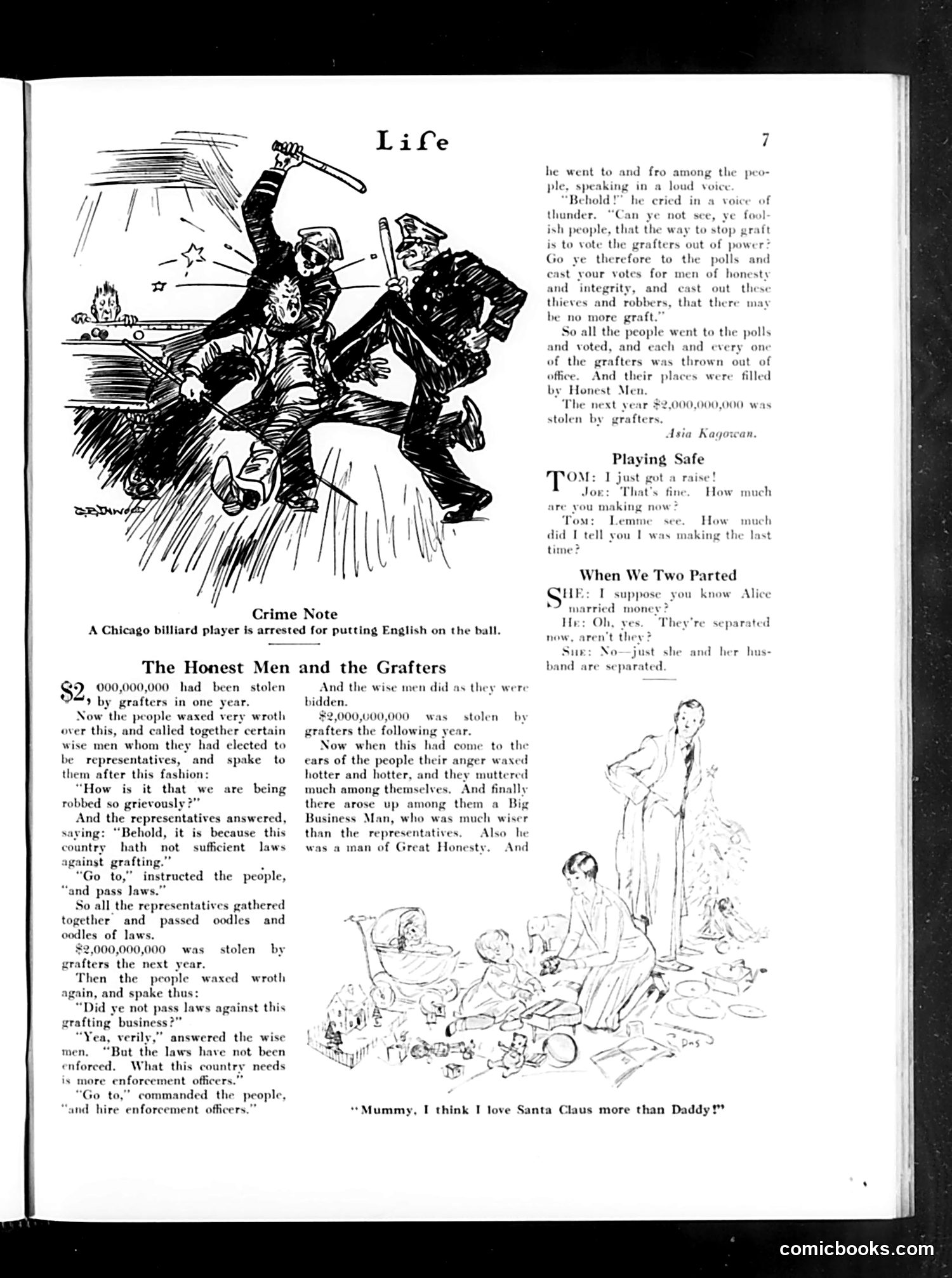
**"The Honest Men and the Grafters"** is a satirical fable about government corruption. The narrative describes how $2,000,000,000 was stolen annually by grafters, prompting citizens to demand reform. Wise men advised voting out corrupt officials and hiring enforcement officers instead of just passing laws. **The top cartoon** depicts a chaotic scene of what appears to be politicians or officials being violently removed or overthrown, illustrating the public's forceful response to corruption. **"Playing Safe"** and **"When We Two Parted"** are brief humorous dialogue pieces about employment raises and marital separation—likely social commentary on workplace dynamics and relationships. The overall page critiques systemic corruption, suggesting that legal reforms alone fail without proper enforcement and voter action.
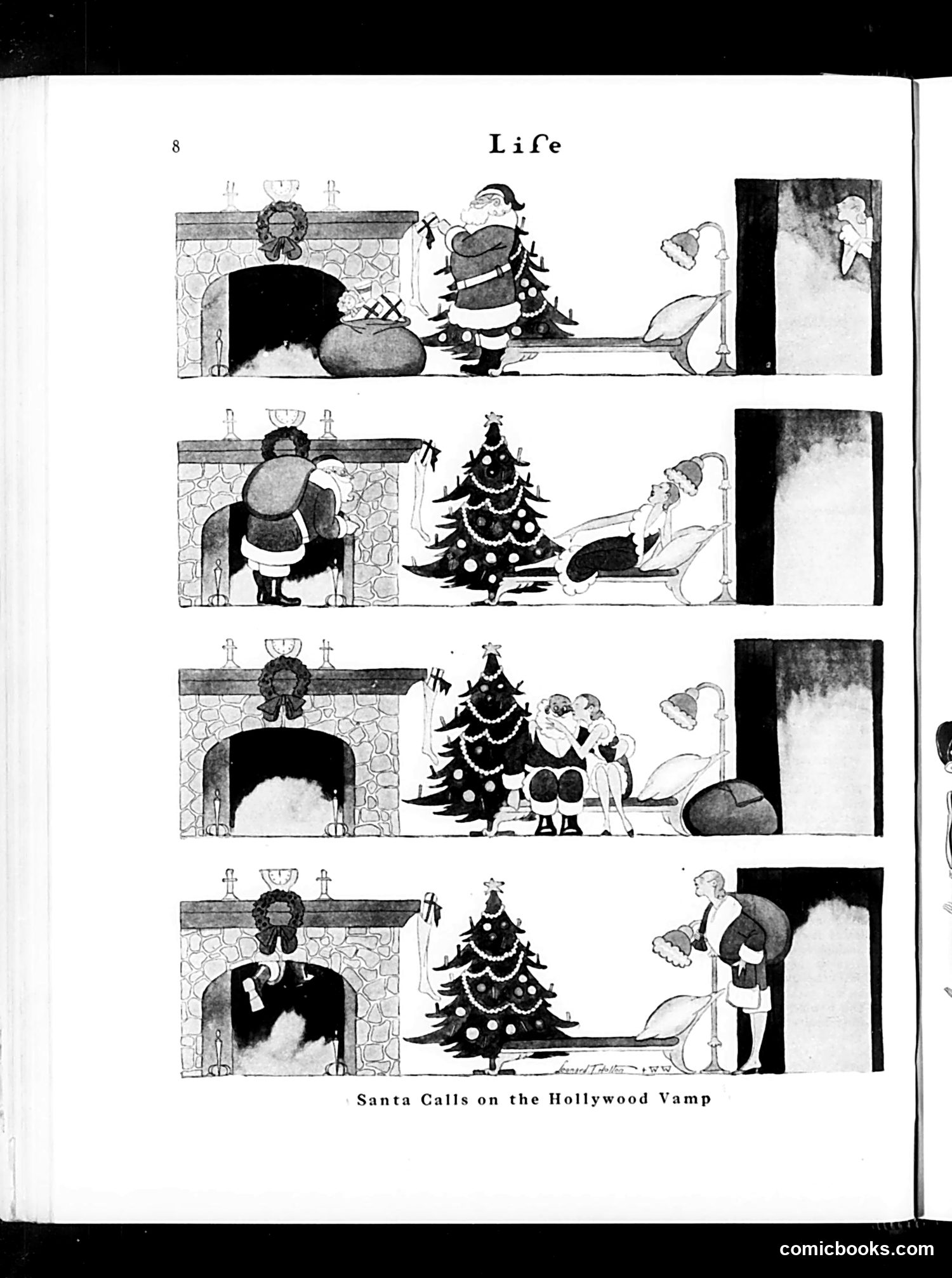
This four-panel comic strip satirizes the contrast between Santa Claus's wholesome Christmas image and the morally questionable "vamp" archetype popular in 1920s cinema—a seductive woman who manipulates men. The sequence shows Santa visiting what appears to be a starlet's home. In each panel, he grows increasingly disheveled and compromised, while the vamp (depicted in a decorative dress by the Christmas tree) appears to be manipulating or seducing him. By the final panel, Santa has lost his dignity entirely. The satire targets both Hollywood's "vamp" stereotype and the incongruity of placing innocent Christmas mythology alongside the era's sexually provocative entertainment culture—a collision of American values that Life's readers would have found darkly humorous.
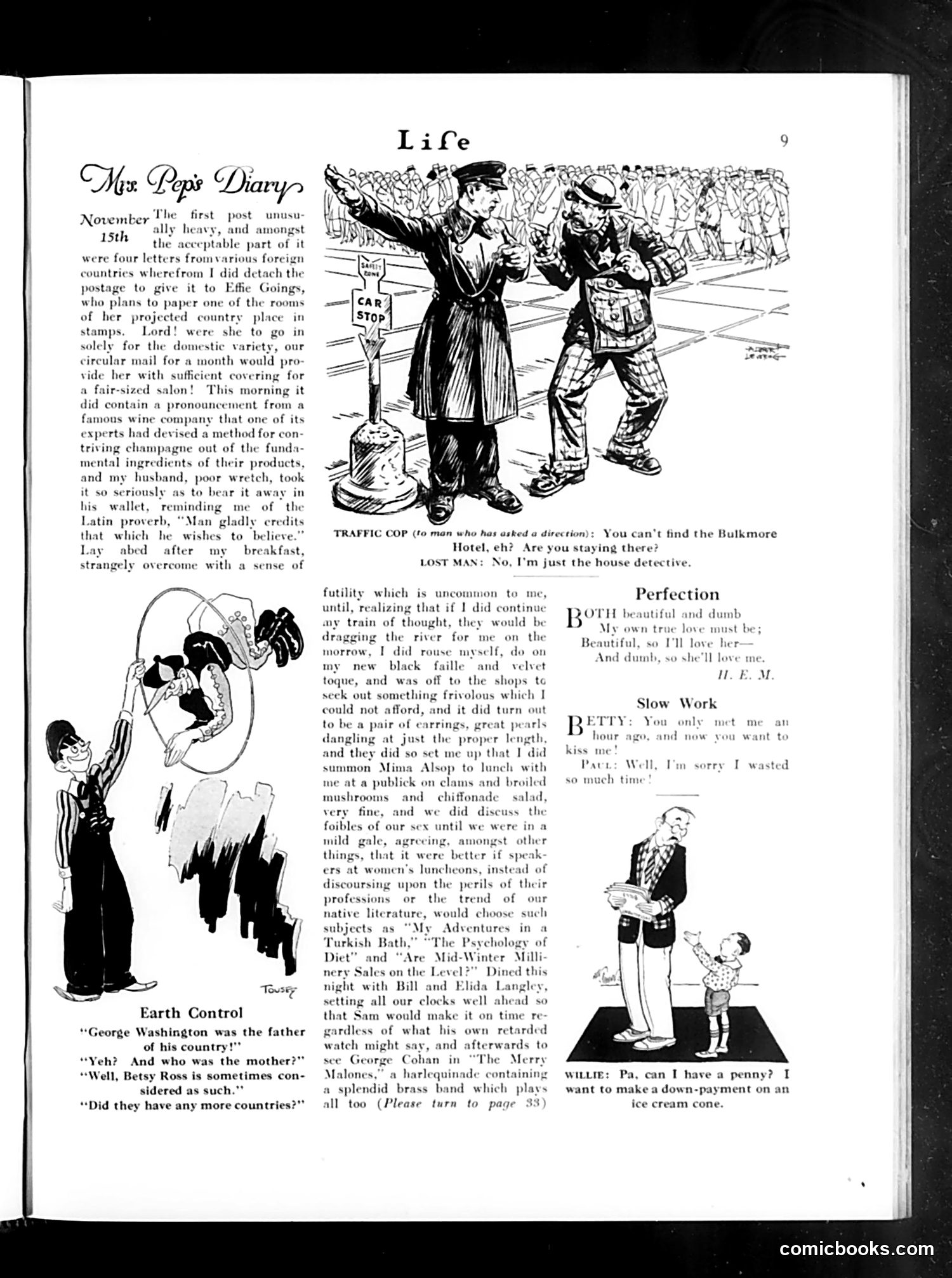
This page contains several humorous sketches typical of early 20th-century satirical magazines. The main cartoon, "Traffic Cop," depicts a woman stopping traffic to ask directions to the Bulkmore Hotel, while a man claiming to be "the house detective" offers help—the joke being her gullibility in trusting a stranger's assistance. "Earth Control" mocks children's naive understanding of geography through a conversation where a child asks if George Washington was "the father of his country," then questions whether he had other countries—play on literal versus figurative meaning. The remaining items—"Perfection," "Slow Work," and "Willie"—are brief comic sketches about romantic misunderstandings, work delays, and a child asking for money for ice cream. These reflect period humor about gender relations, childhood innocence, and everyday social situations.
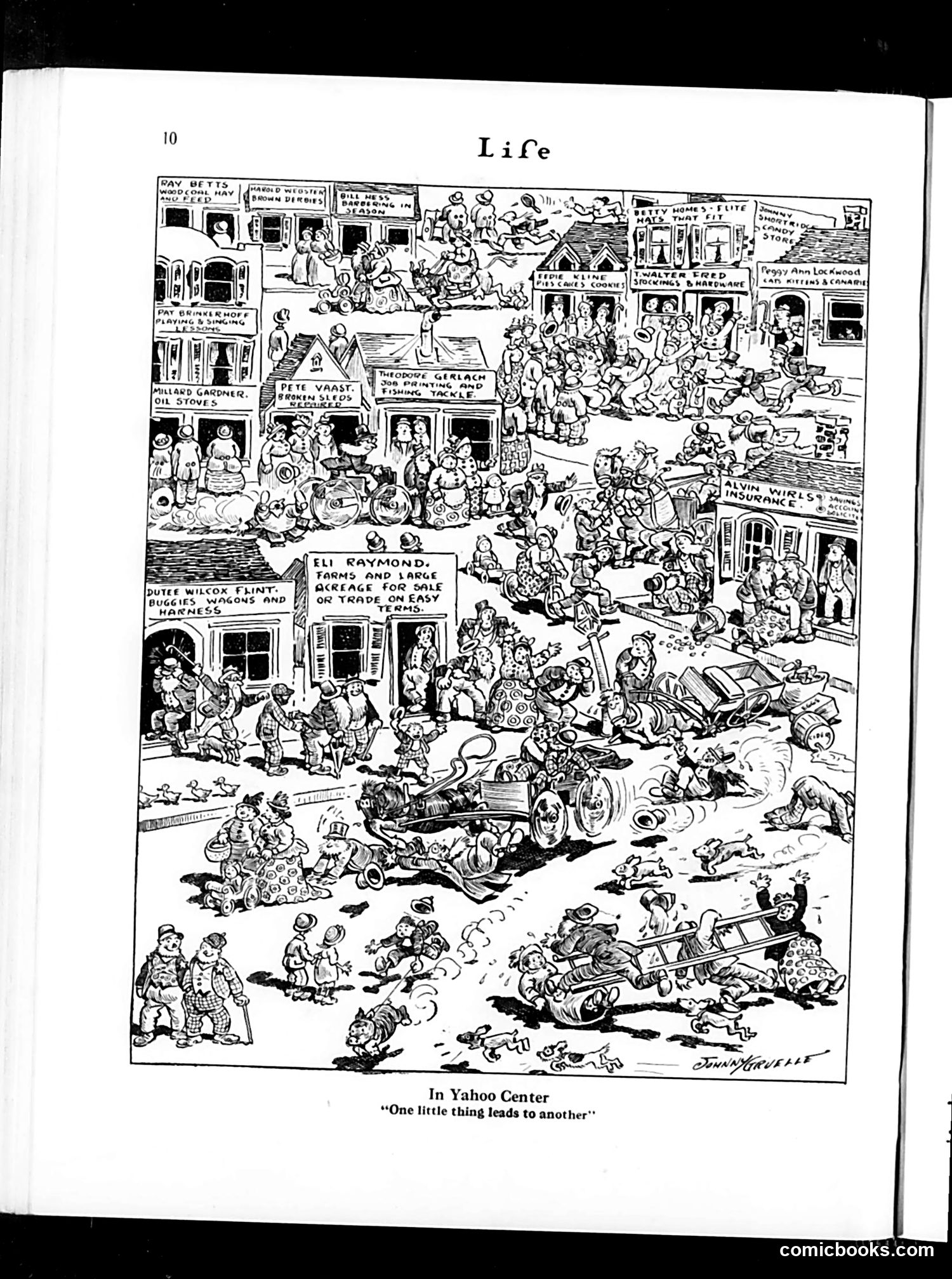
This is a densely-packed satirical cartoon depicting chaos in what appears to be an urban neighborhood or commercial district. The illustration shows numerous small incidents cascading into larger problems—a classic domino-effect satire. Visible storefronts include businesses like "Pet Ware," "Oil Stoves," and various shops. The cartoon depicts everyday people engaged in various mishaps: vehicle collisions, street brawls, property damage, and general pandemonium. The style suggests early-to-mid 20th century American life, satirizing how minor infractions or accidents can spiral into community-wide disorder. The title suggests the satire targets "Yahoo Center"—likely mocking a particular neighborhood's reputation for lawlessness or disorder, showing how small incidents multiply into chaos without intervention or proper order.
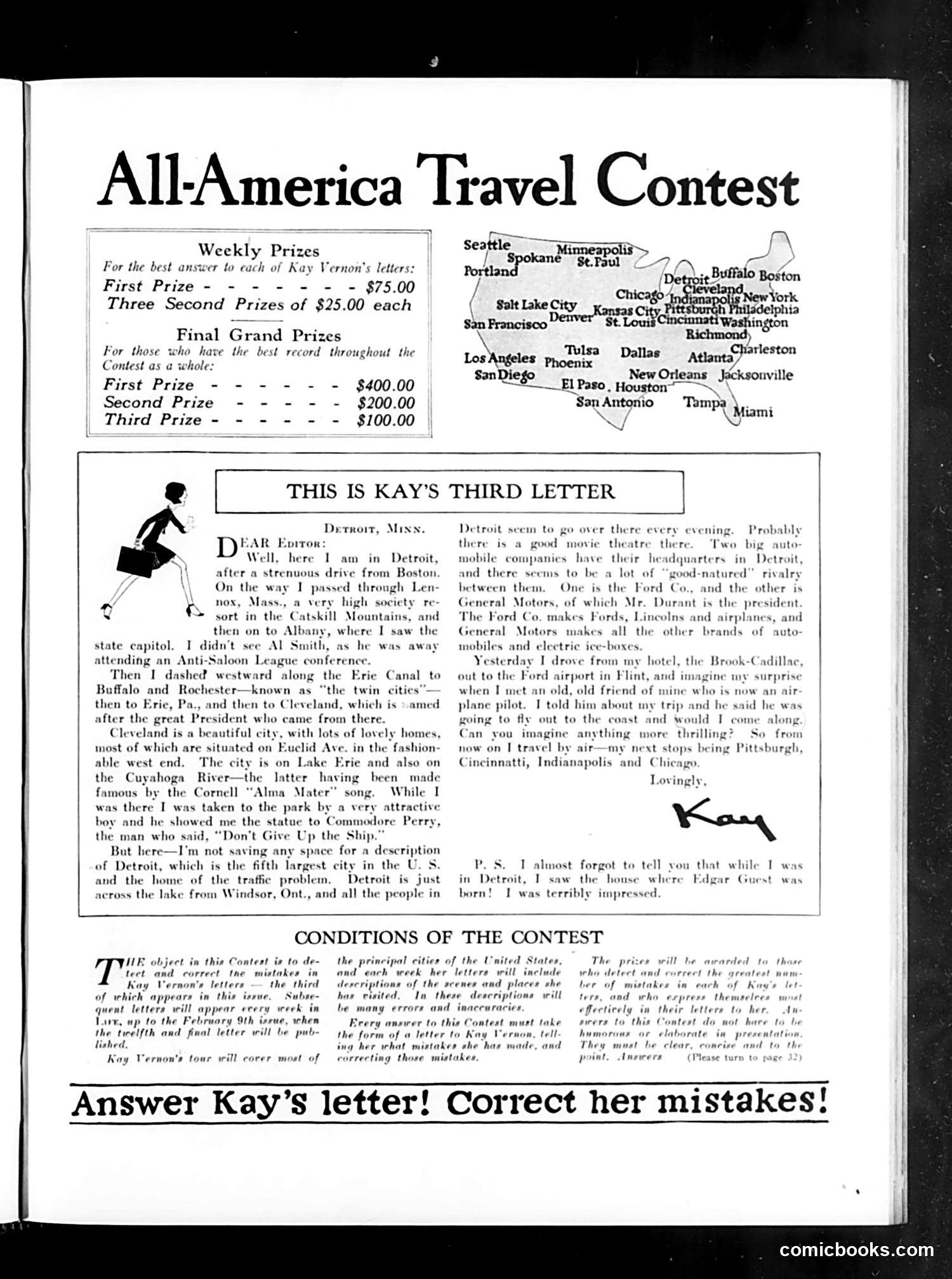
This page features a travel-themed contest where readers are invited to correct mistakes in letters from a character named "Kay Vernon." The format is straightforward: Kay writes about her travels across American cities, and readers must identify geographical or factual errors in her descriptions. The illustrated figure shows a woman in business attire traveling with a briefcase, suggesting the "modern woman" trope of the era—independent and mobile. The contest itself isn't satirical but rather an interactive game for readers, likely designed to engage them while subtly promoting American geography and travel. The prizes (weekly $75 and grand prizes up to $400) indicate this was a substantial circulation-building feature for *Life* magazine during what appears to be the mid-20th century.
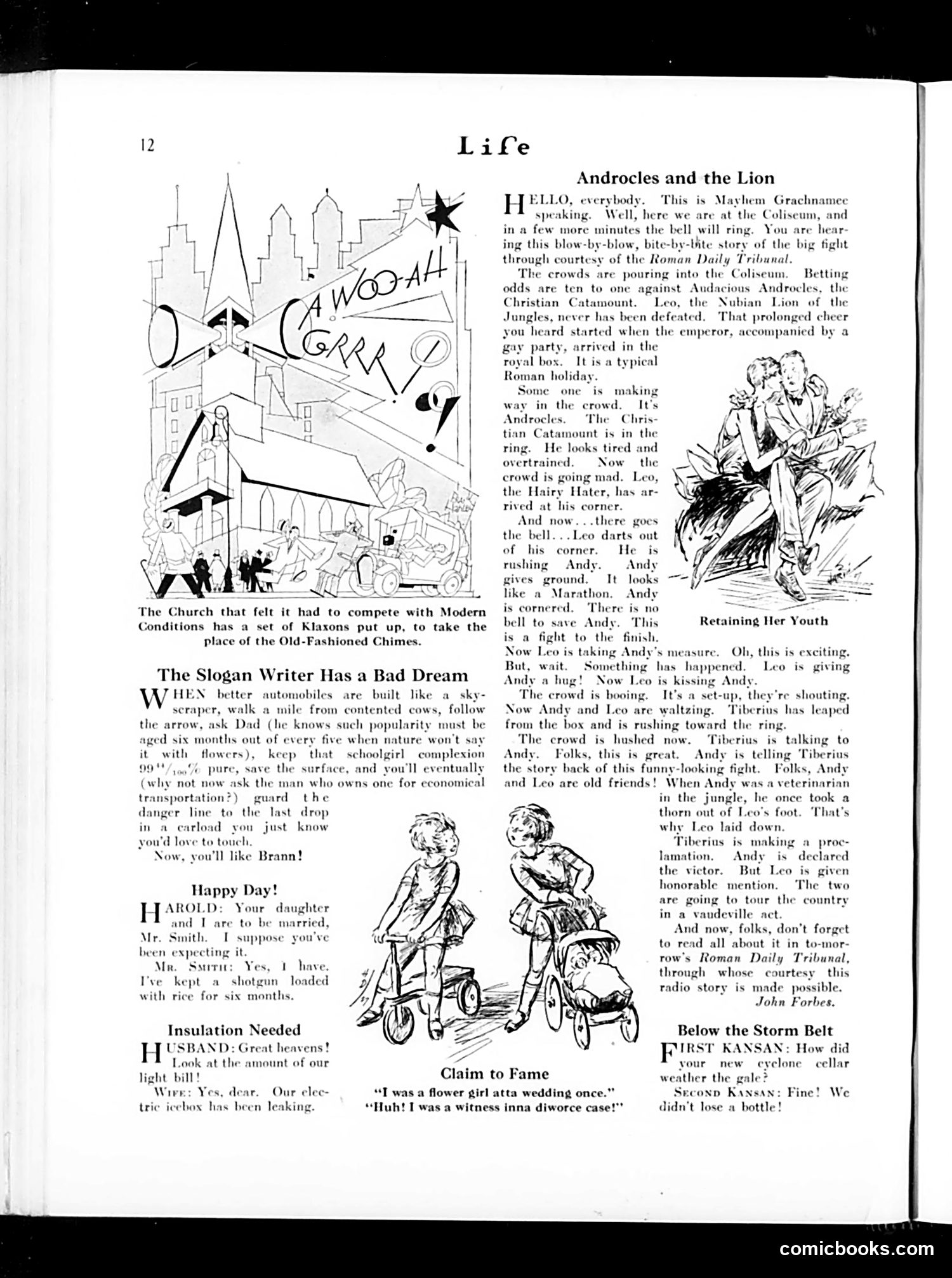
This page contains several humorous short pieces and illustrations typical of Life's satirical format: **"Androcles and the Lion"** is a mock radio broadcast announcing a gladiatorial fight at the Colosseum, with dramatic play-by-play commentary. The satire compares ancient Roman spectacles to modern sports broadcasting and entertainment culture. **"The Slogan Writer Has a Bad Dream"** mocks advertising copywriters, suggesting they're cynical hacks who produce flowery language masking mundane products—a critique of emerging consumer culture and commercial manipulation. The remaining pieces are brief jokes about everyday situations: a couple's upcoming wedding announcement, an electrical bill complaint, and two regional Kansas jokes about storm preparedness. The illustrations depict domestic and contemporary American scenes, emphasizing Life's focus on satirizing modern middle-class life and contemporary social trends.
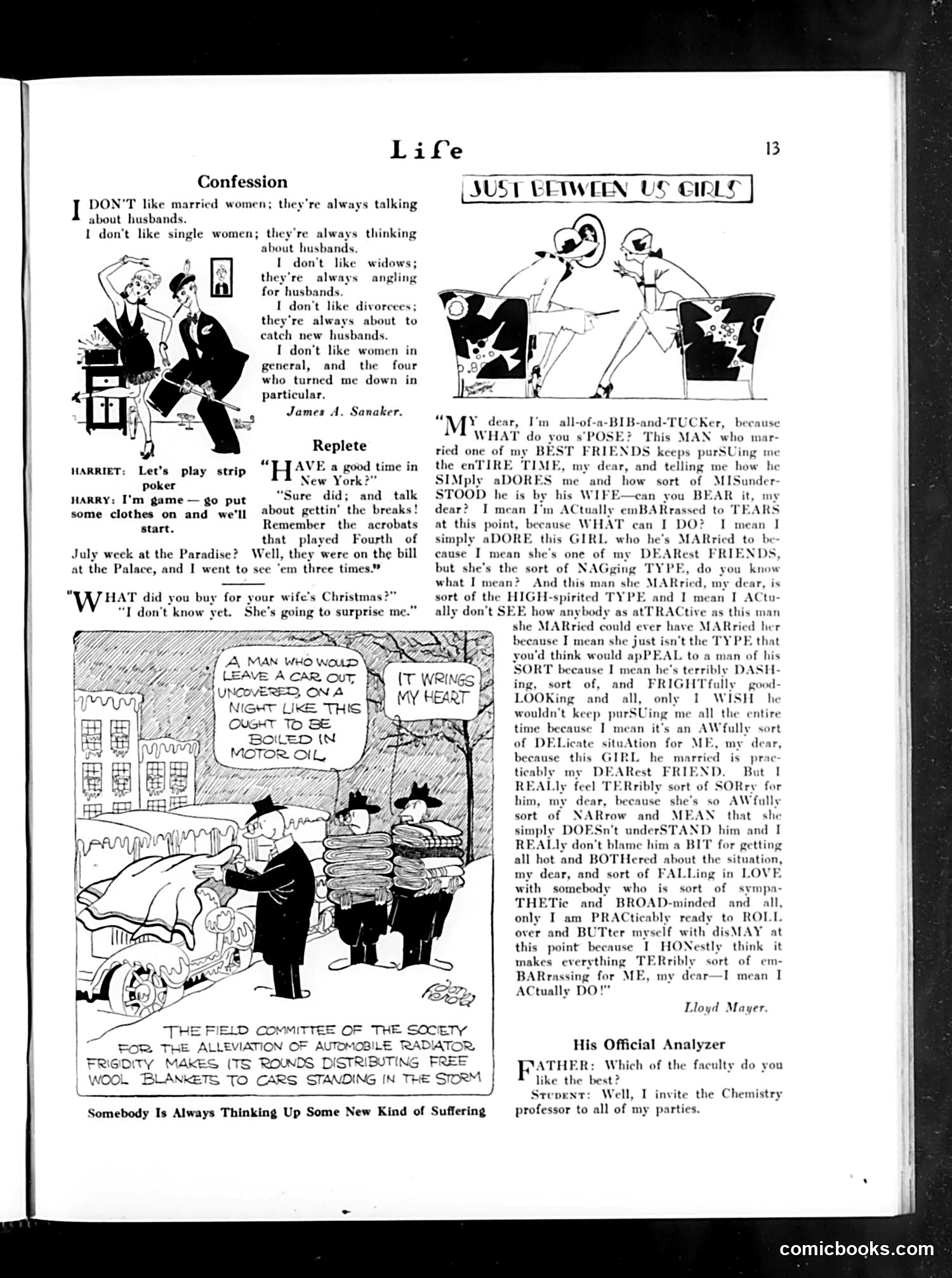
This page contains satirical humor pieces typical of 1920s Life magazine: **"Confession"** (top left) mocks romantic relationships through exaggerated complaints about married women, single women, widows, and divorcees—a common theme in period humor. **"Just Between Us Girls"** (top right) is an elaborate visual joke showing women playing sports/exercising, accompanying a lengthy letter written almost entirely in capitalized words and abbreviations (BFF, ADORE, MARRIED, etc.). This appears to satirize how women's correspondence was becoming increasingly casual and abbreviation-laden. **The car cartoon** (center) depicts men discussing leaving a car outside overnight "like this," with one saying it would be "boiled in motor oil"—dark humor about automotive care or theft. **"His Official Analyzer"** (bottom) is a brief joke about a chemistry professor. The overall tone reflects Jazz Age satirical sensibilities regarding modern dating, women's social independence, and changing communication styles.
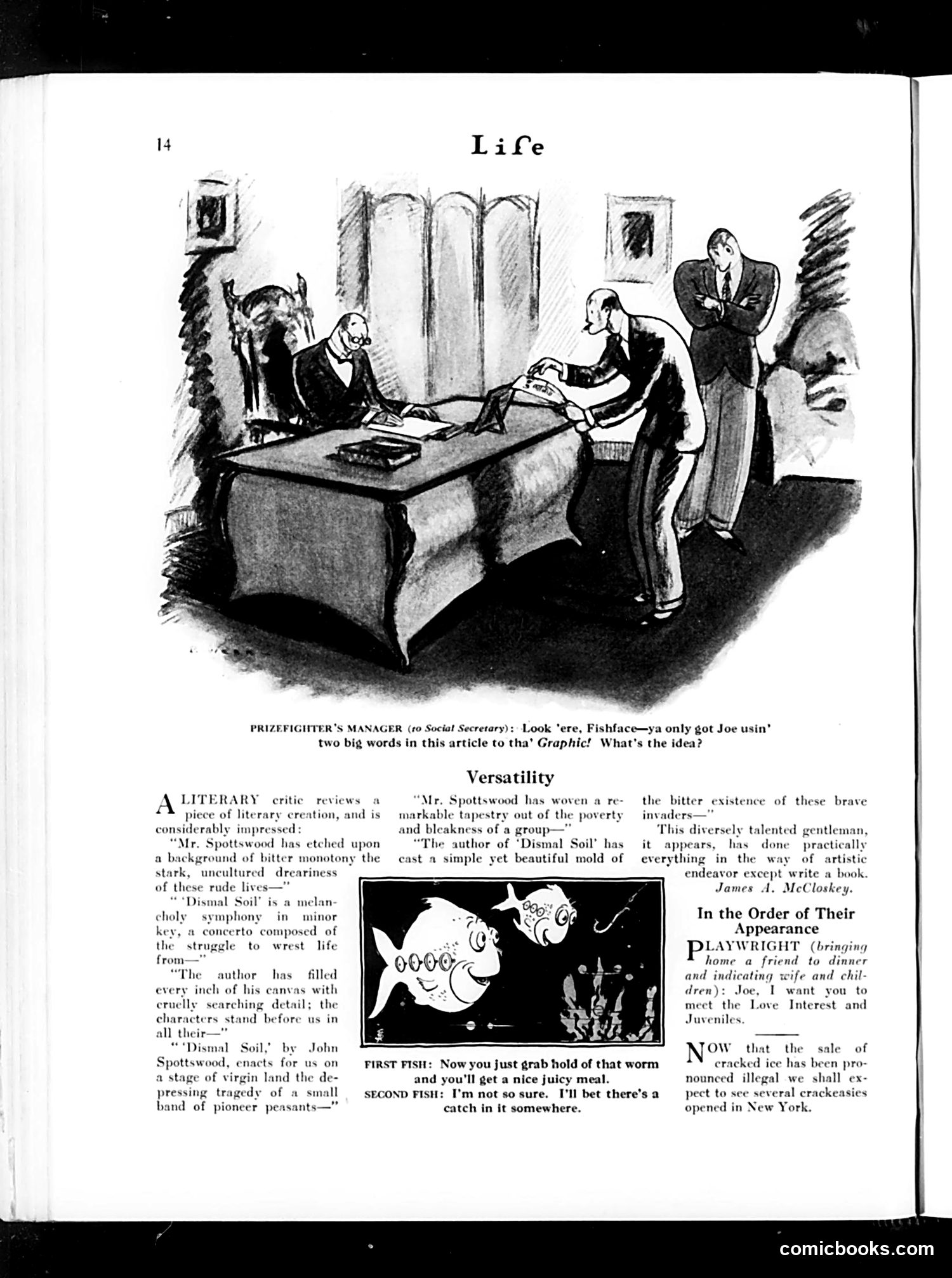
**Top Cartoon**: A prizefighter's manager (labeled in caption) discusses a boxer named "Joe" with what appears to be a sports journalist or editor. The manager urges using only "two big words" in an article about Joe for a graphic—suggesting the boxer is not intelligent and requires simplified language. This is satire on both sports journalism's tendency to sensationalize fighters and stereotypes about boxers' intellectual capacity. **Bottom Section**: Contains literary criticism of works by John Spottswood, including "Dismal Soil," with a small comic illustration about fish. The page transitions into a section titled "In the Order of Their Appearance" discussing a playwright bringing a friend to dinner. The content satirizes both literary pretension and social conventions of the era.
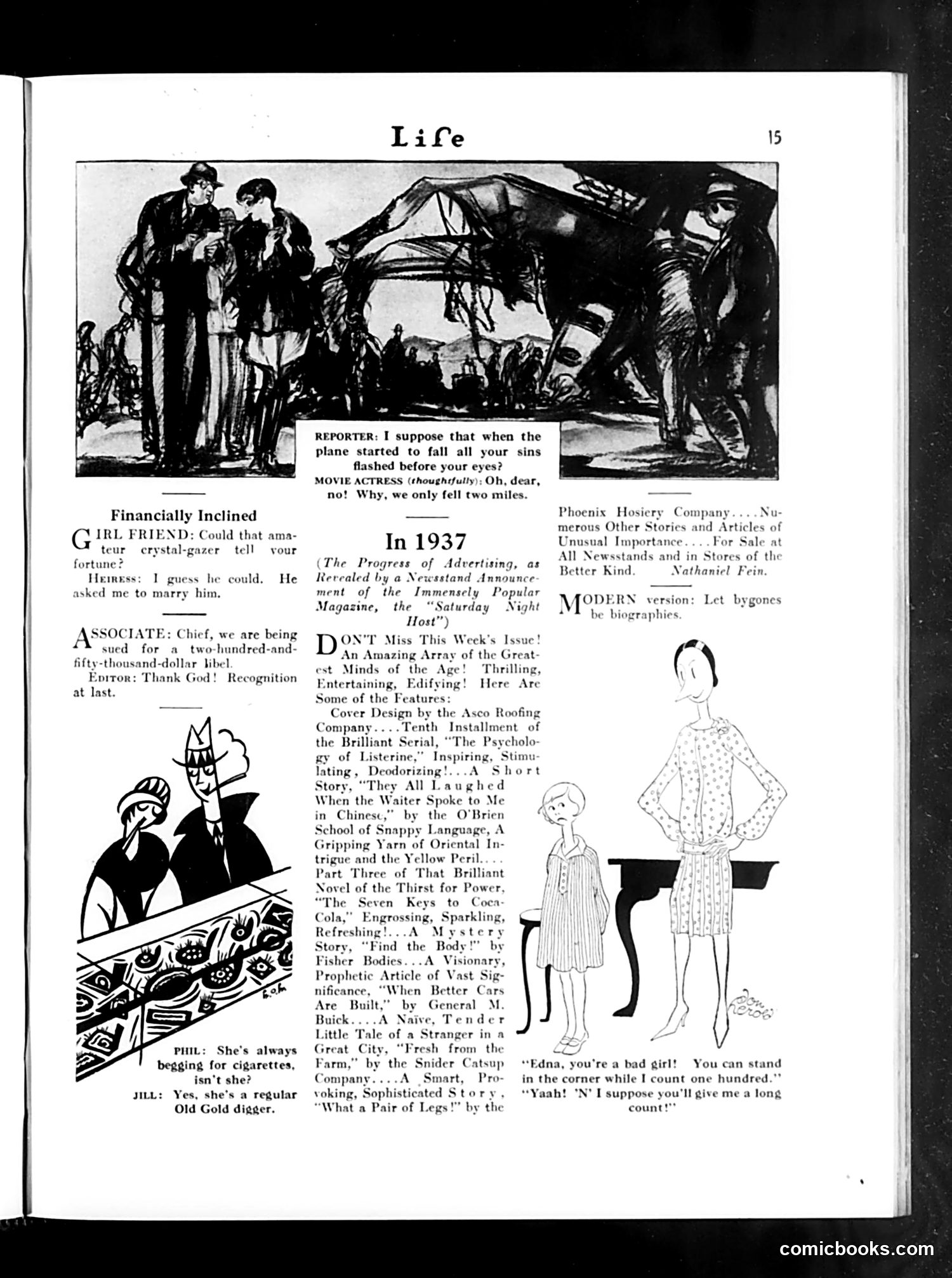
This is primarily a **humor/joke page from Life magazine**, not political satire. The content includes: **"Financially Inclined"** - A brief joke about a girl's amateur mathematician boyfriend proposing marriage for fortune. **"In 1937"** - An advertorial section promoting the magazine's upcoming content, listing various articles and features. **Two cartoon jokes:** 1. A dialogue between Phil and Jill about a woman "always begging for cigarettes" - suggesting she's a gold digger or financially dependent. 2. A domestic scene where a mother disciplines a child for standing in the corner, with the child's cheeky response about being counted out. The page reflects **1930s social attitudes** toward gender roles, romance as financial transaction, and child discipline. The satire targets shallow materialism and behavioral expectations rather than politics. The cartoons are simple gag-format humor typical of Life's miscellaneous entertainment content.
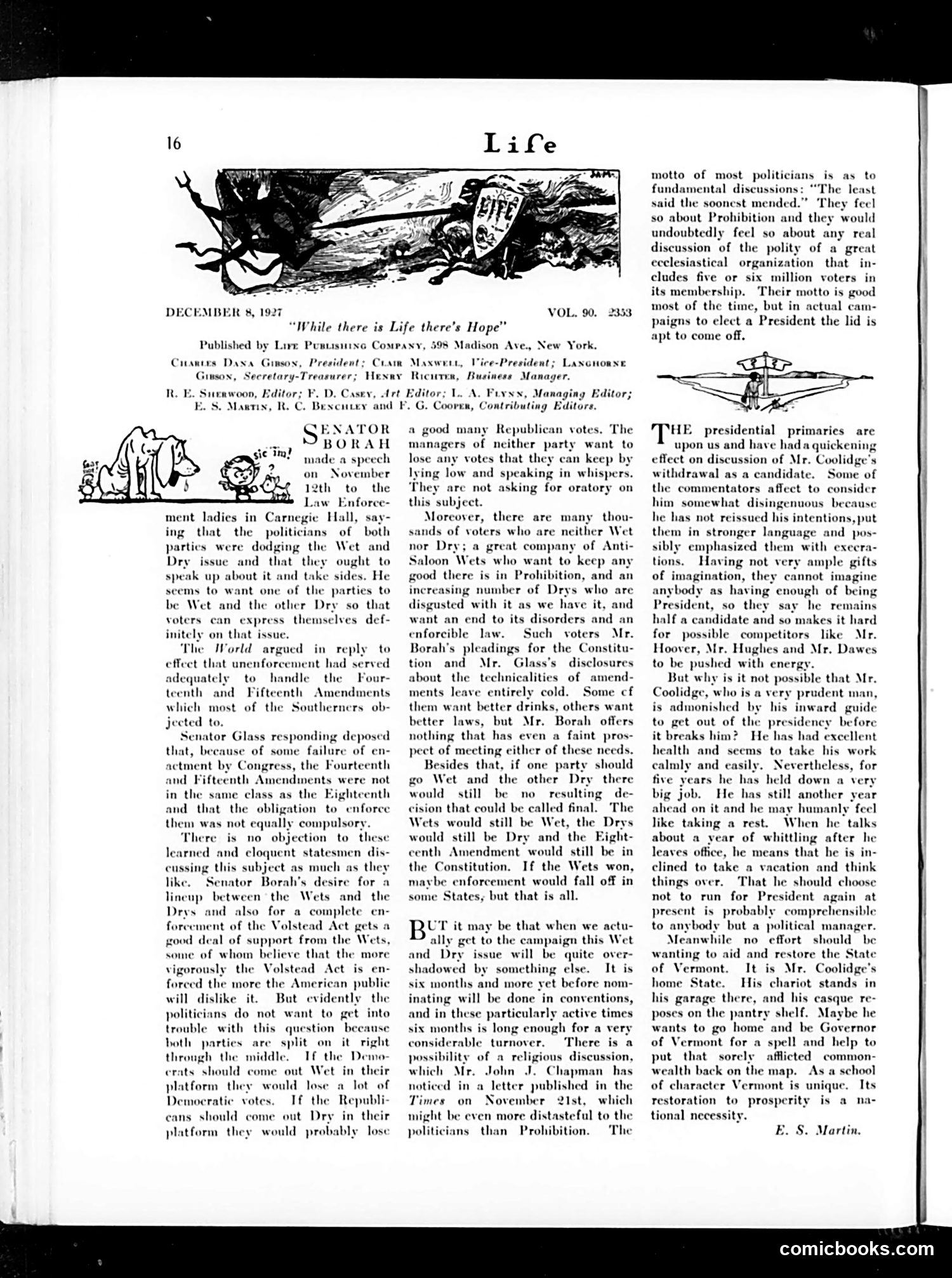
The cartoon at the page top depicts a figure labeled "LIFE" being attacked or overwhelmed by what appears to be a dark, chaotic force—likely representing political or social turmoil. The article discusses the **Wet vs. Dry debate** during Prohibition, referencing politicians including Senator Borah, Mr. Glass, and Mr. Coolidge. The text argues that Prohibition remains a divisive campaign issue, with both parties splitting on the subject. The piece suggests that religious discussions about Prohibition matter more to voters than other policy differences, and speculates whether the issue might overshadow the upcoming presidential campaign. It concludes that restoring prosperity to Vermont should be the priority over partisan Prohibition politics. The satire criticizes how politicians weaponize Prohibition rather than addressing substantive governance.
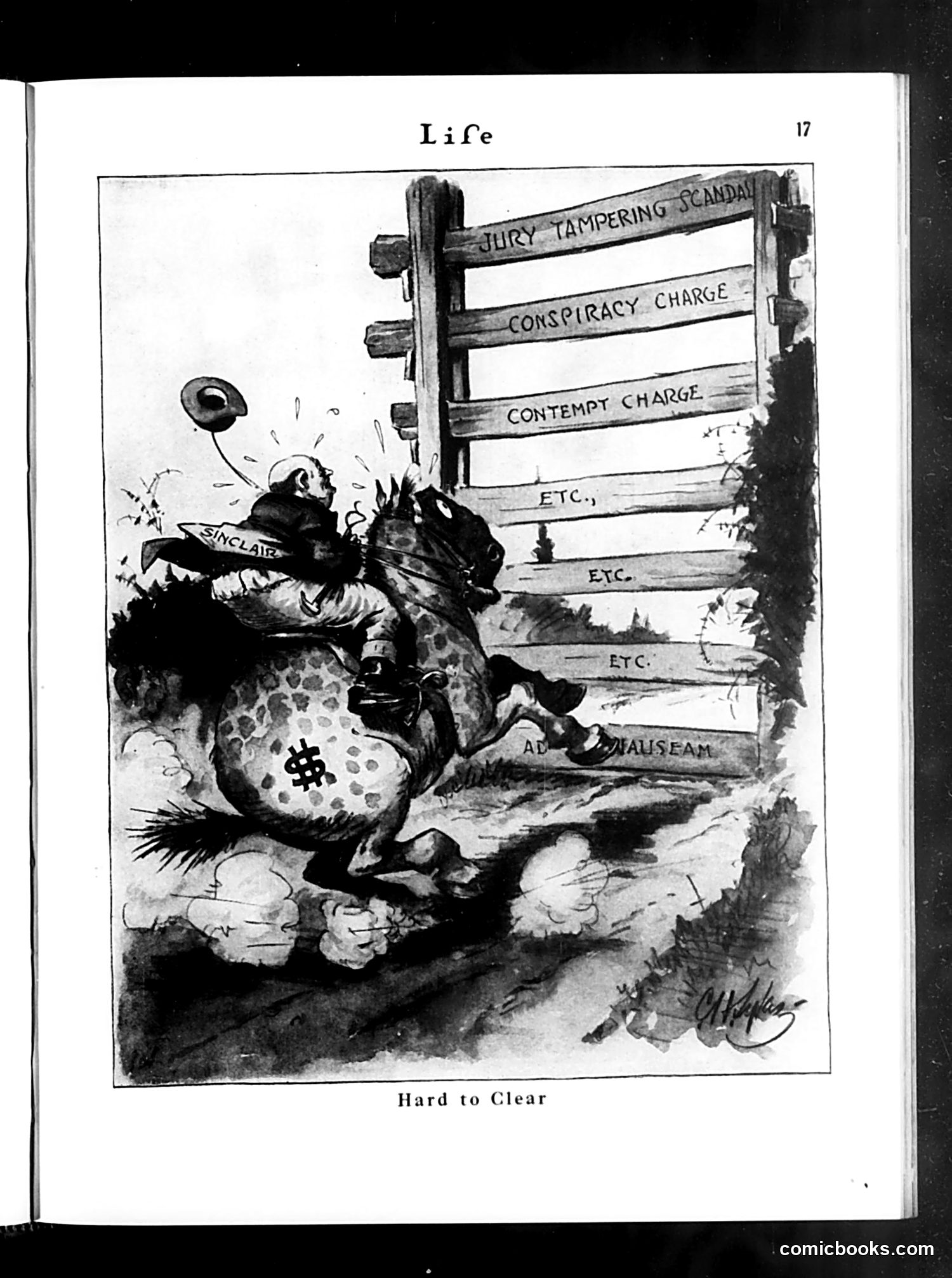
This political cartoon depicts a grotesque figure labeled "Sinclair" struggling beneath an enormous ladder of legal charges. From top to bottom, the rungs read: "Jury Tampering Scandal," "Conspiracy Charge," "Contempt Charge," "Etc.," repeated multiple times, and ending with "A--- MALISEAM" (likely "A--- MALISEUM" or similar). The figure appears exhausted, trying to push away the accumulating accusations. The satire suggests that someone named Sinclair faces so many legal problems that clearing even one charge seems impossible—hence the title "Hard to Clear." Without the publication date visible, the specific historical Sinclair and scandal referenced remain unclear, though this likely refers to a prominent legal controversy from Life magazine's era.
This appears to be a satirical cartoon from *Life* magazine depicting the interior of an airplane or airship. The scene shows passengers seated in rows, with several reading newspapers or magazines during flight. The upper windows display clouds, establishing the aerial setting. The satire seems to target **passenger behavior during air travel** — specifically, the mundane, ordinary nature of commercial flying. What was once an exotic, exciting experience has become routine; passengers casually read publications rather than marvel at flight itself. The detailed rendering of ordinary travelers absorbed in everyday activities suggests the cartoon mocks how quickly novelty becomes normalized. The caption fragment "The Patlo[...]" is incomplete, making the specific reference unclear. The cartoon likely critiques modern traveler complacency or the commercialization of aviation.
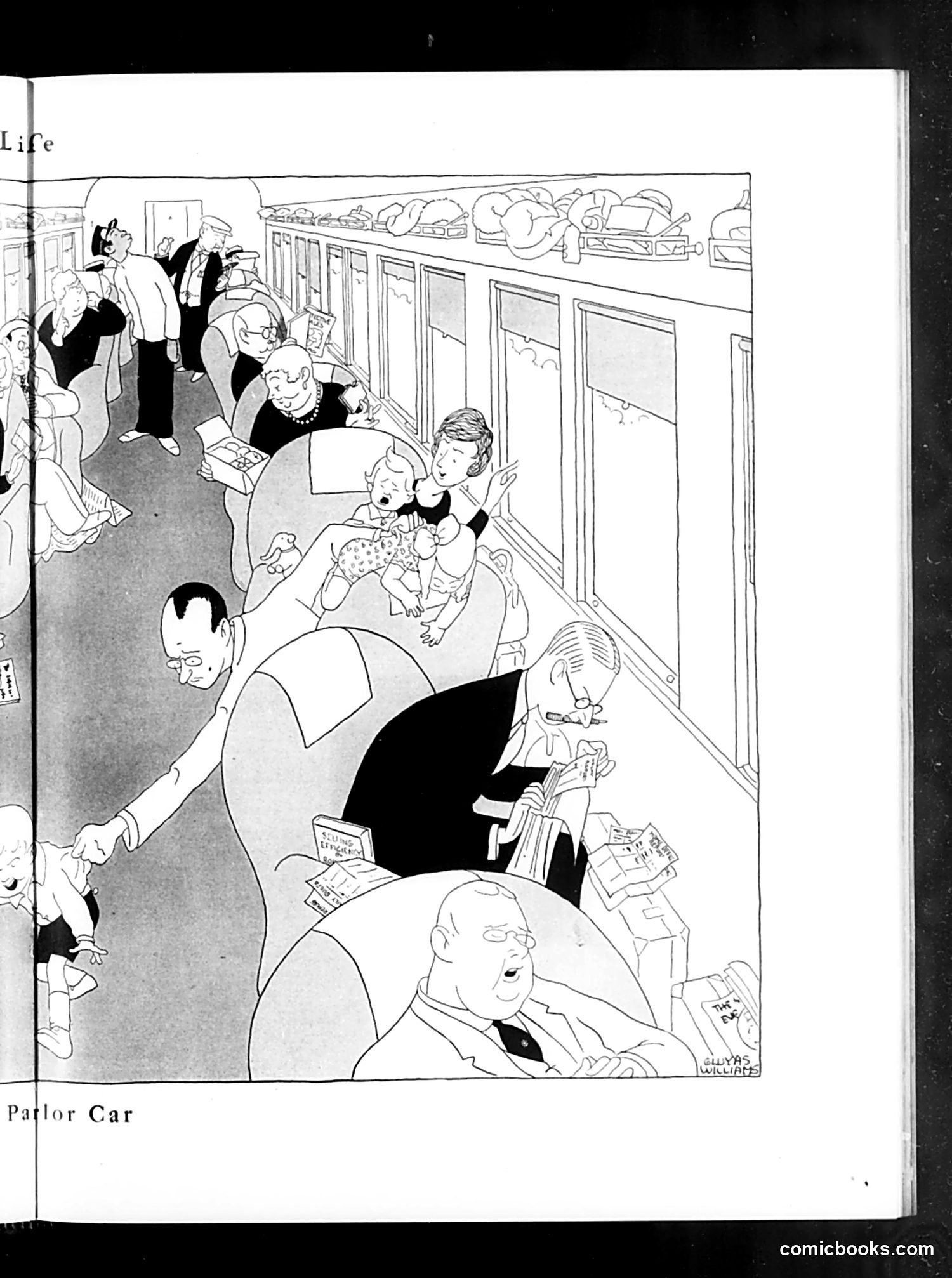
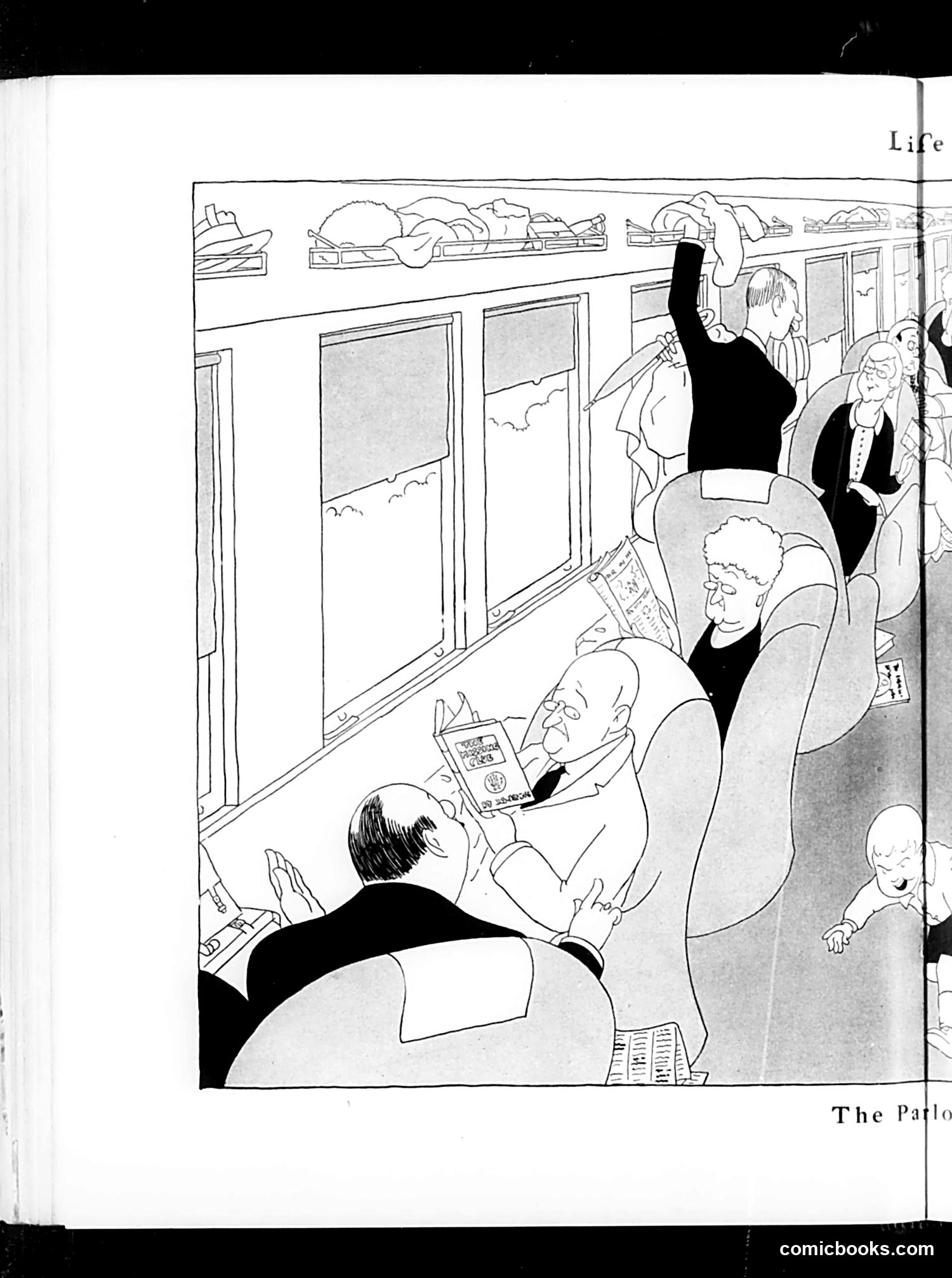
This cartoon depicts the interior of a railroad parlor car (a luxury passenger train car) crowded with travelers. The satire appears to target the discomfort and overcrowding of supposedly "first-class" rail travel, despite passengers paying premium prices for the parlor car experience. The composition emphasizes the cramped conditions: multiple well-dressed passengers are squeezed uncomfortably into the space, reading newspapers and magazines. The juxtaposition between the "parlor car" label—implying elegant, spacious accommodations—and the actual crowded, undignified reality creates the joke. This likely reflects early 20th-century complaints about railroad service quality and advertising that overpromised comfort to paying customers.
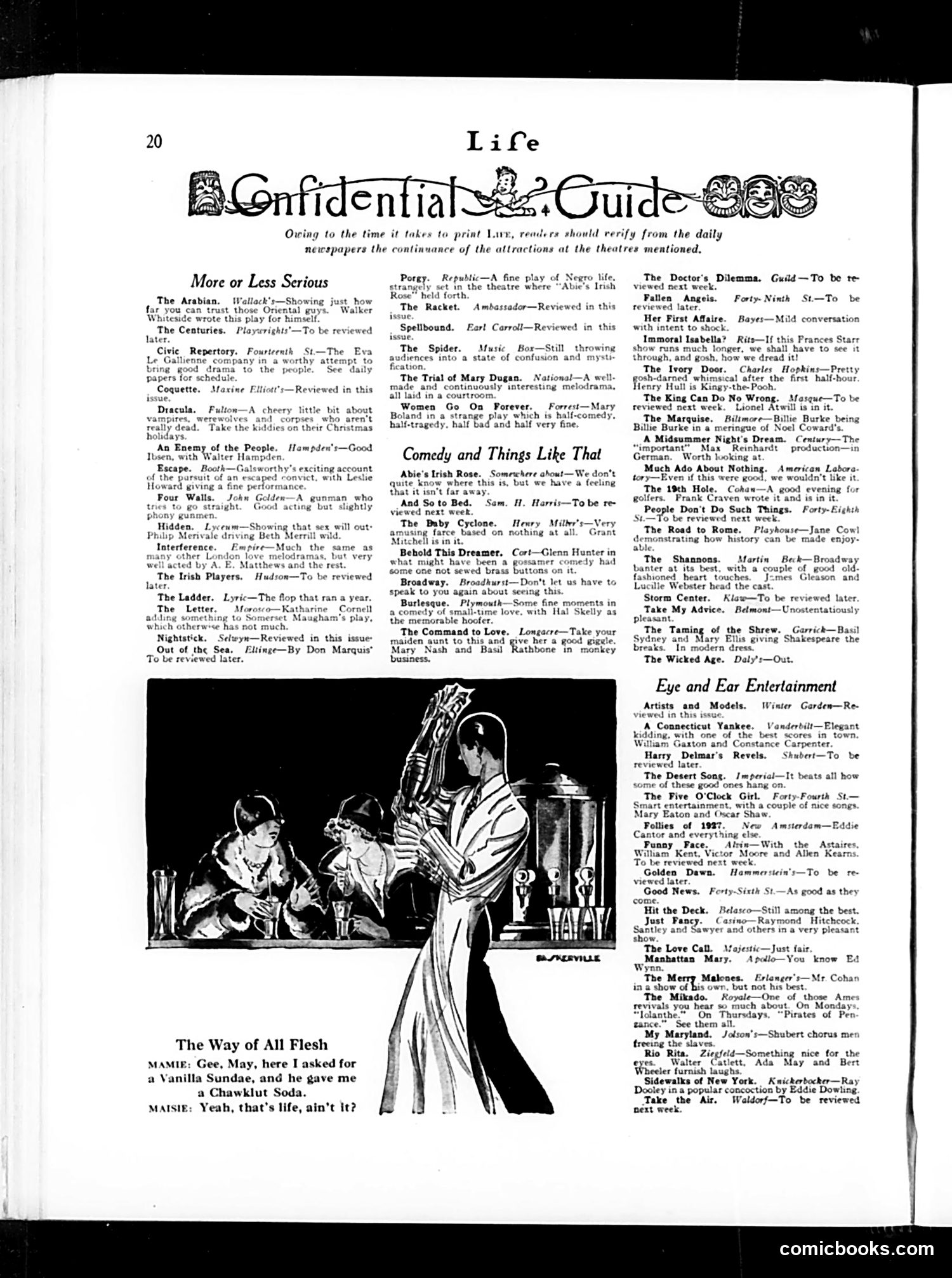
This page is a theatre review section from Life magazine's entertainment coverage. The main cartoon illustrates "The Way of All Flesh," a theatrical production, showing two women gossiping about a mundane disappointment: one ordered a vanilla sundae but received chocolate soda instead. The other responds "Yeah, that's life, ain't it?" The joke's satire is gentle social commentary—the caption ironically uses the grand title of a serious play to frame an utterly trivial domestic complaint. This creates humor through incongruity: treating a minor consumer disappointment with the weight of philosophical resignation suggests how people dramatize everyday annoyances. The surrounding text lists numerous Broadway shows from the 1920s, many now forgotten, with brief critical assessments. Notable productions include "Porgy" (significant for depicting African American life) and shows starring recognizable performers of that era. The page reflects the vibrant theatre culture that dominated American entertainment before cinema's dominance.
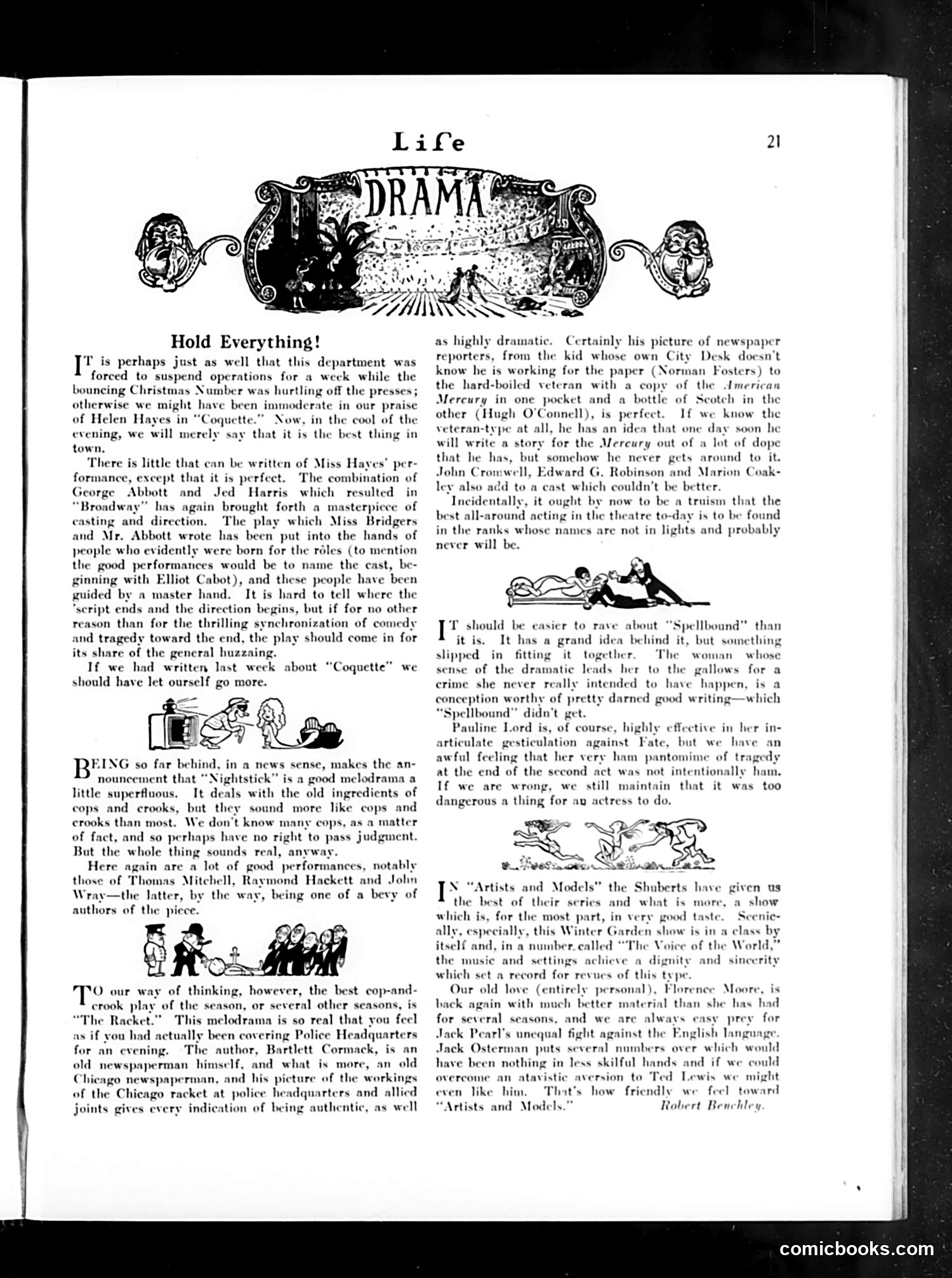
This page reviews Broadway plays from what appears to be the late 1920s. The critic praises Helen Hayes in *Coquette* as "the best thing in town," and commends the production team of George Abbott and Jed Harris for their work on *Broadway*. The reviewer also discusses *Nightstick* (a police melodrama), *The Racket* (a newspaper crime play featuring Edward G. Robinson), and *Spellbound*—criticizing the last for wasting a promising dramatic premise through poor execution, particularly faulting actress Pauline Lord's "ham pantomime." The cartoons appear to be generic theater-related illustrations showing audiences and performers, common decorative elements in this magazine. The overall tone is theatrical insider commentary—the critic assumes readers know these plays and performers, critiquing both material and execution while celebrating strong ensemble acting in supporting roles.
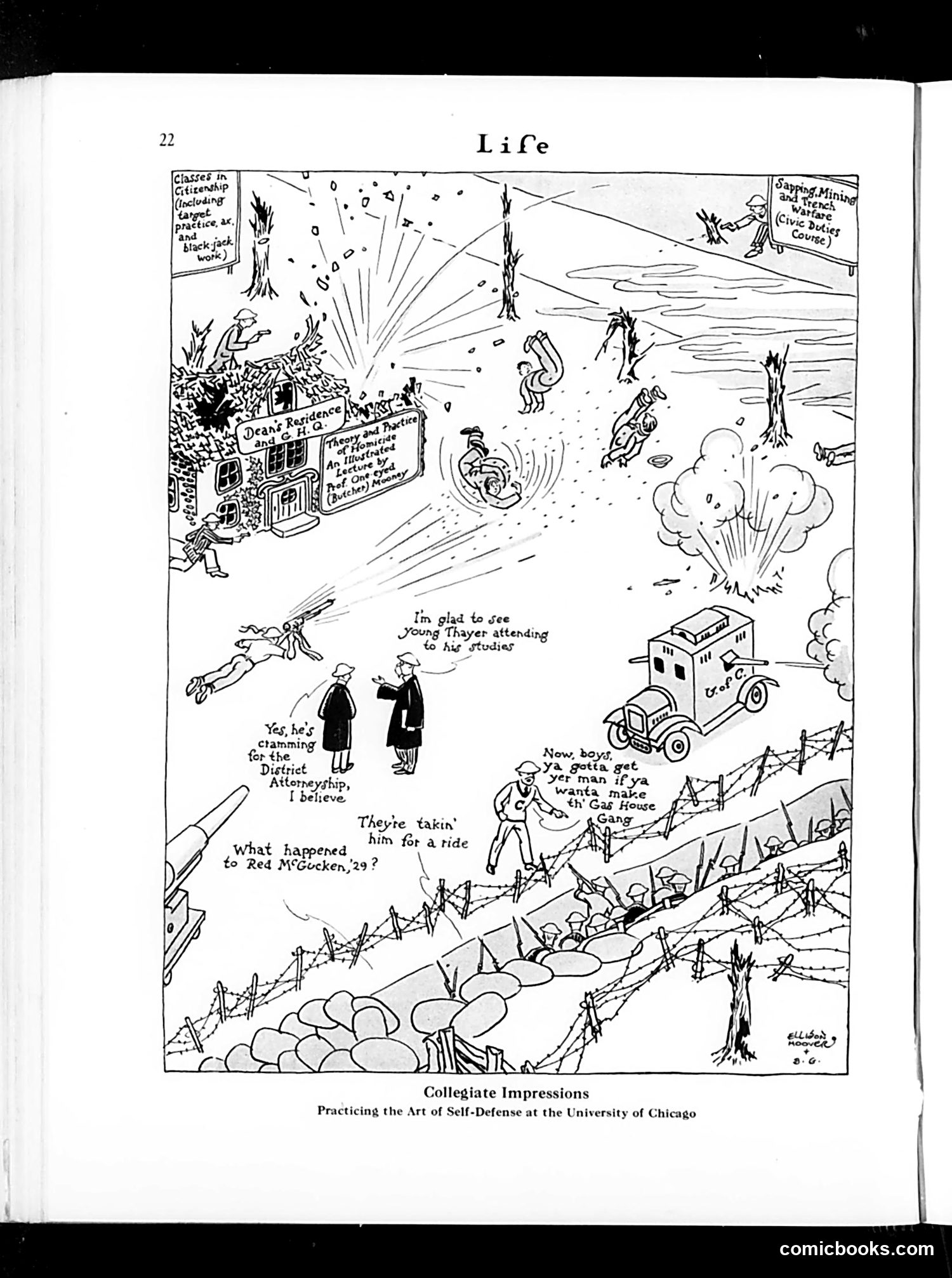
This cartoon satirizes self-defense training at the University of Chicago by depicting it as thinly-veiled preparation for **political violence and gangsterism** rather than legitimate education. The key figures appear to be university students and officials. One dialogue references "Young Thayer" attending "his studies," while another character approvingly notes he's "champing for the District Attorneyship." The cynical rejoinder—"Now, boys, ya gotta get yer man if ya wanna make th' District Attorneyship"—sarcastically equates legal ambition with violent criminality. References to "Red McCucken, '29" (unclear if real person or fictional) and characters being "taken for a ride" invoke **1920s-30s gangland terminology**. The war-torn landscape with explosions and destruction suggests the training is more militaristic than defensive. The satire mocks how prestigious institutions like University of Chicago might inadvertently (or deliberately) train future lawyers and politicians using brutish, violent methods—conflating academic advancement with mob-style tactics.
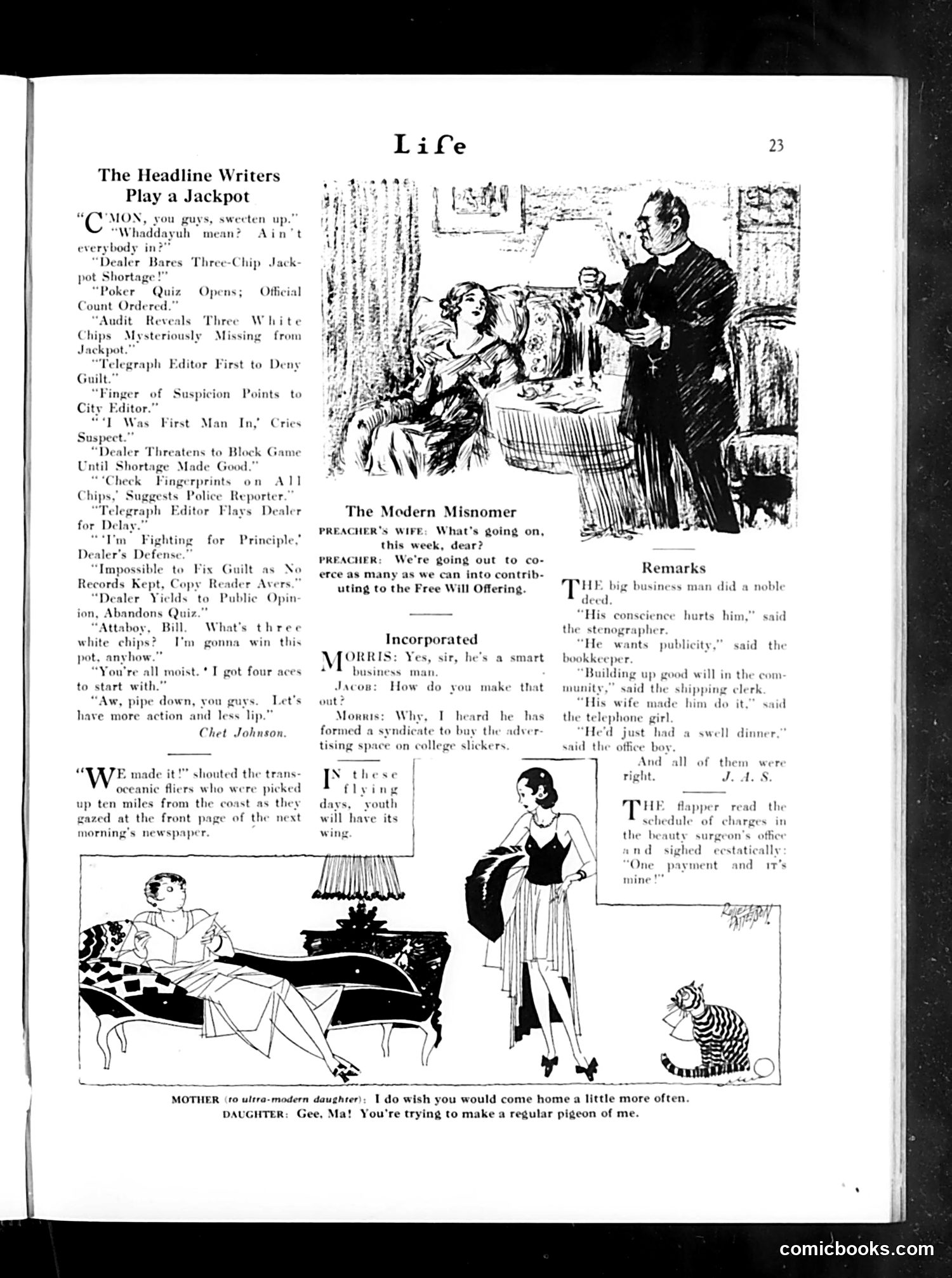
This page contains several satirical pieces mocking American society circa the 1920s: **"The Headline Writers Play a Jackpot"** satirizes sensationalist newspaper reporting. Headline writers are depicted as poker players competing to create the most dramatic stories from a minor incident (missing poker chips). The joke: journalists exaggerate trivial events into scandal through inflammatory headlines—"Finger of Suspicion," "Impossible to Fix Guilt"—mimicking how newspapers manufacture outrage. **"The Modern Misnomer"** mocks religious hypocrisy: a preacher calls a "Free Will Offering" (voluntary donation) while planning to "coerce" parishioners into contributing—contradicting the concept of free will. **"Remarks"** presents brief observations about a businessman's guilt-driven charity, suggesting his generosity stems from conscience rather than genuine kindness. **Lower cartoon** shows a modern daughter rejecting domesticity, calling her mother's plea to visit home more often an attempt to make her "a regular pigeon"—slang for a sucker or dupe. Overall, the page critiques journalistic sensationalism, religious cant, performative morality, and generational conflict over women's independence.
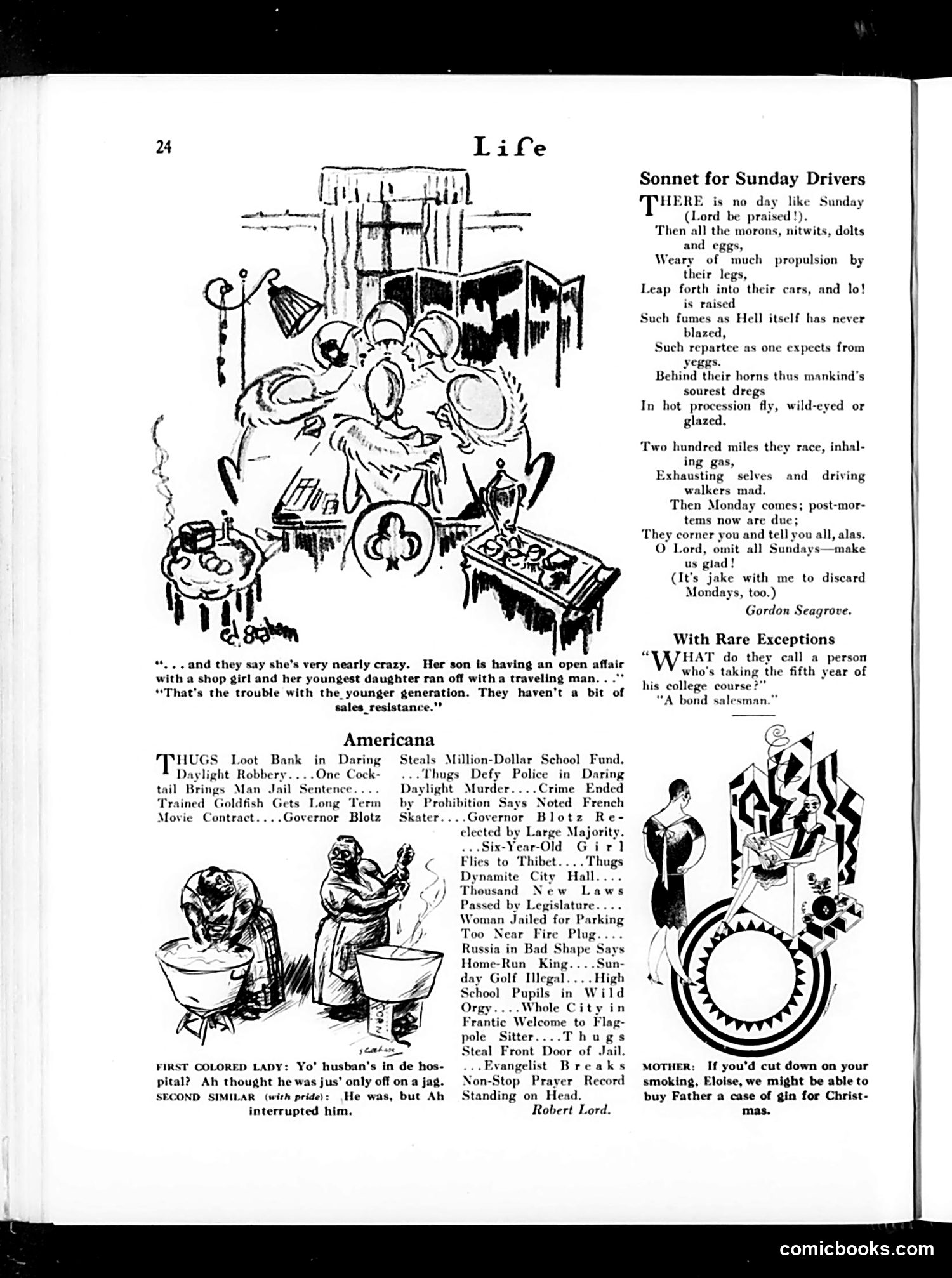
This page satirizes 1920s American society through multiple lenses: **"Sonnet for Sunday Drivers"** mocks motorists—newly common car owners—as reckless "morons" and "nitwits" who endanger pedestrians. The sonnet criticizes their dangerous Sunday driving culture and the resulting Monday complaints. **"Americana" section** collages absurd newspaper headlines reflecting the chaotic era: bank robberies, prohibition-era violence, arbitrary laws, and sensational crimes. It suggests American life has become ridiculous and lawless. **The dialogue jokes** target social attitudes: the first about "sales resistance" in the younger generation (consumerism and moral decline); the second, a racist stereotype about African American speech patterns and infidelity. **"With Rare Exceptions"** jokes darkly about college students taking five years—implying either stupidity or that they're repeating years—calling them "bond salesmen" (suggesting they're financial failures). The overall tone: American modernity—cars, crime, consumption, education—has created chaos and moral decay. The magazine mocks contemporary anxieties about the "younger generation."
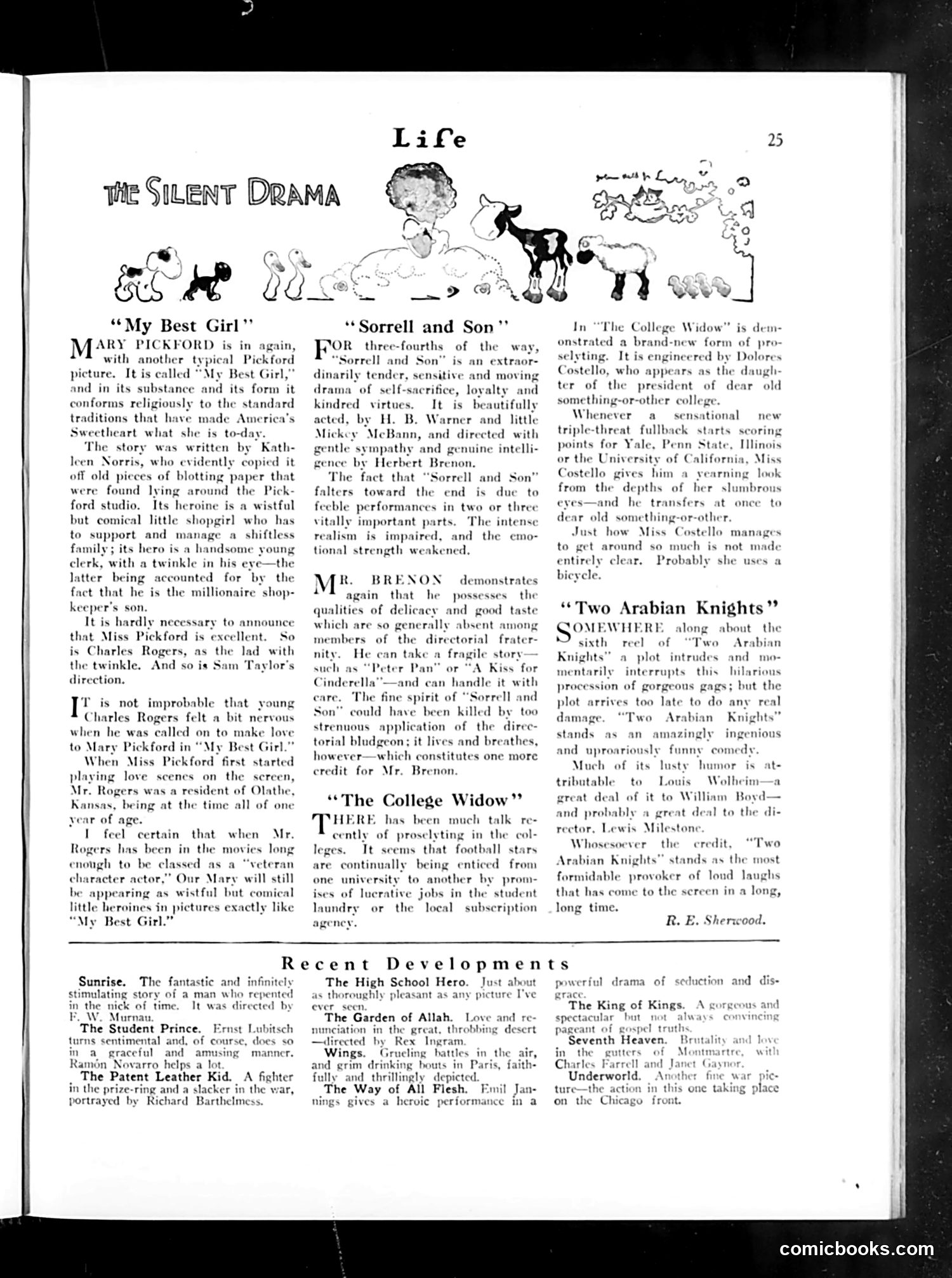
This page reviews four silent films, using satirical commentary typical of Life magazine's film criticism of the era. **"My Best Girl"**: The review mocks Mary Pickford's repetitive typecasting as a "wistful but comical little shopgirl," suggesting she'll play identical roles forever. It notes Charles Rogers was a Kansas infant when Pickford began her career—a jest about the age gap and his inexperience opposite Hollywood's established star. **"Sorrell and Son"**: Praises director Herbert Brenon's delicate handling of a sentimental drama, contrasting his finesse with other directors' blunt approaches. **"The College Widow"**: Satirizes "proselyting"—recruiting athletes between universities—by describing Dolores Costello's character using seduction rather than job offers to lure football stars to her father's college. **"Two Arabian Knights"**: Briefly notes the film's comedy arrives too late in the plot but credits Louis Wolheim and William Boyd for salvaging laughs. The reviews employ dry wit typical of 1920s film criticism, mocking formulaic plots and star personas.
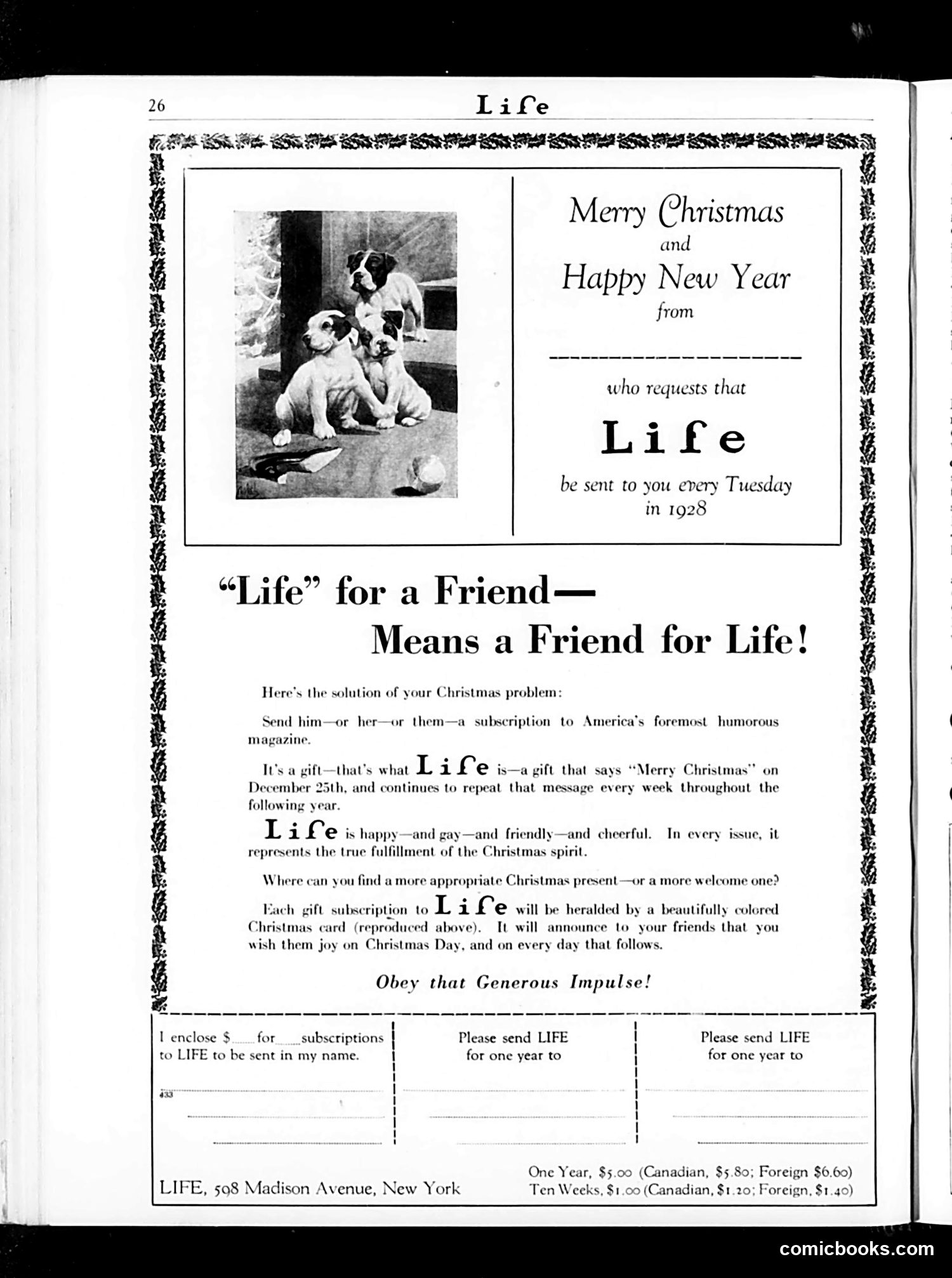
This is a **subscription advertisement**, not political satire. Life magazine—a weekly humor publication—markets gift subscriptions as Christmas presents. The page features two dogs in a photograph (top left), used as a cheerful, friendly visual to reinforce the magazine's brand identity as "happy—and gay—and friendly—and cheerful." The ad's sales pitch targets gift-givers: a Life subscription provides a year-long gift that repeats the Christmas message weekly. It promises recipients joy and laughter throughout 1928. The pricing structure offers flexibility (one-year or ten-week options at various domestic and international rates). The phrase "Obey that Generous Impulse!" uses mock-earnest language typical of 1920s advertising to encourage purchasing. **Context for modern readers**: Before streaming and digital media, magazine subscriptions were standard gift items, and Life's humor content made it a genuinely desirable present. The ad reflects pre-Depression consumer optimism.
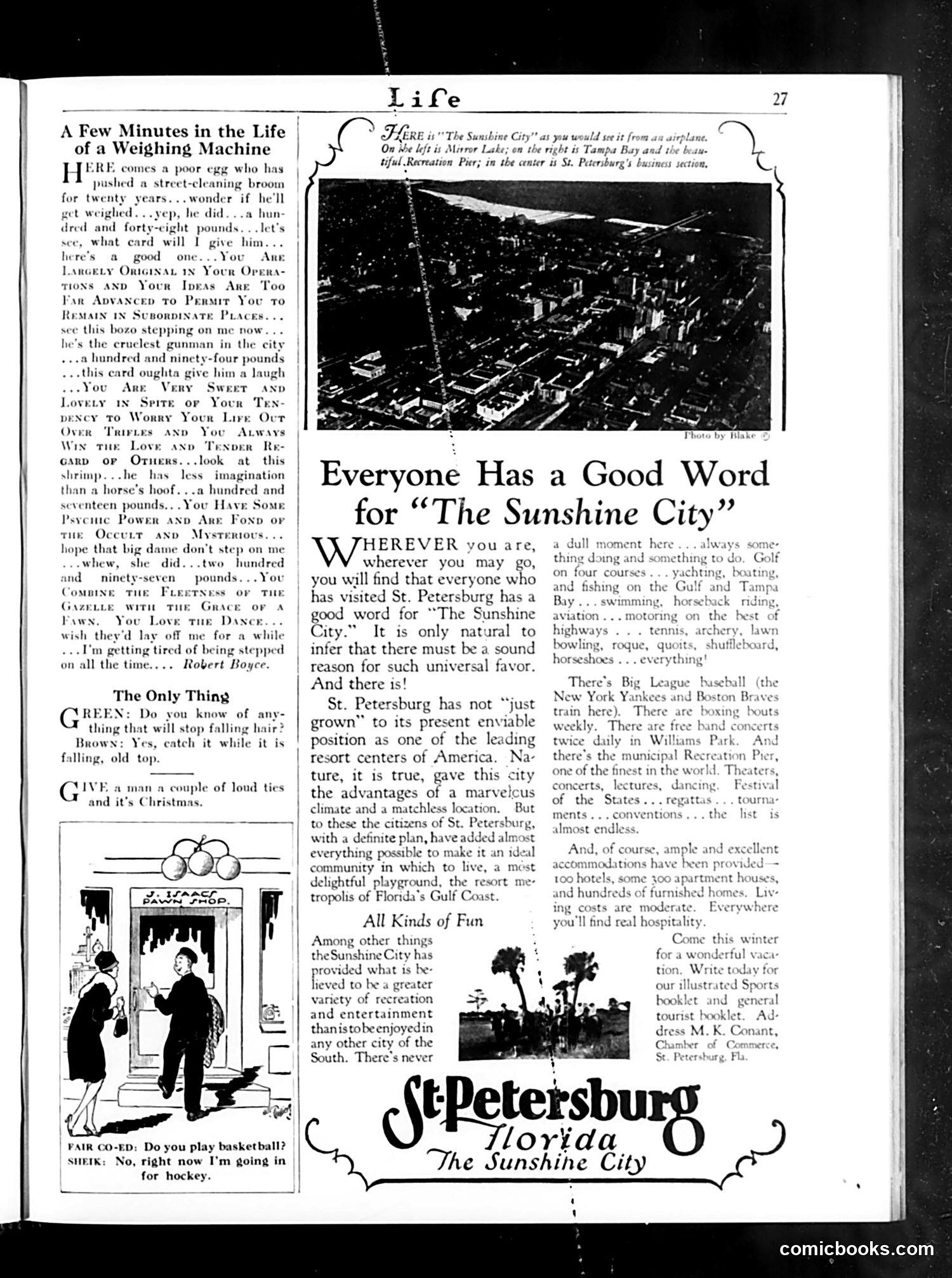
This is a satirical cartoon about coin-operated fortune-telling weighing machines, popular at the time. The joke mocks the machines' absurd personality readings based solely on weight. The cartoon follows a street-cleaning worker and other patrons as they step on a scale that dispenses cards with flattering but ridiculous character assessments. A "cruelest gunman" receives a card praising his sweetness; a man with less imagination than a horse gets praised for psychic powers; a heavy woman is told she possesses "grace of a fawn." The satire targets two things: (1) the pseudoscientific pretension of these machines, which claimed to divine personality from body weight, and (2) the universal inauthenticity of their praise—everyone gets compliments regardless of who they are, making the readings worthless. The humor depends on readers' familiarity with these novelty machines, once common at arcades and amusement parks. The final line ("I'm getting tired of being stepped on") provides dark comedy about the operator's perspective.
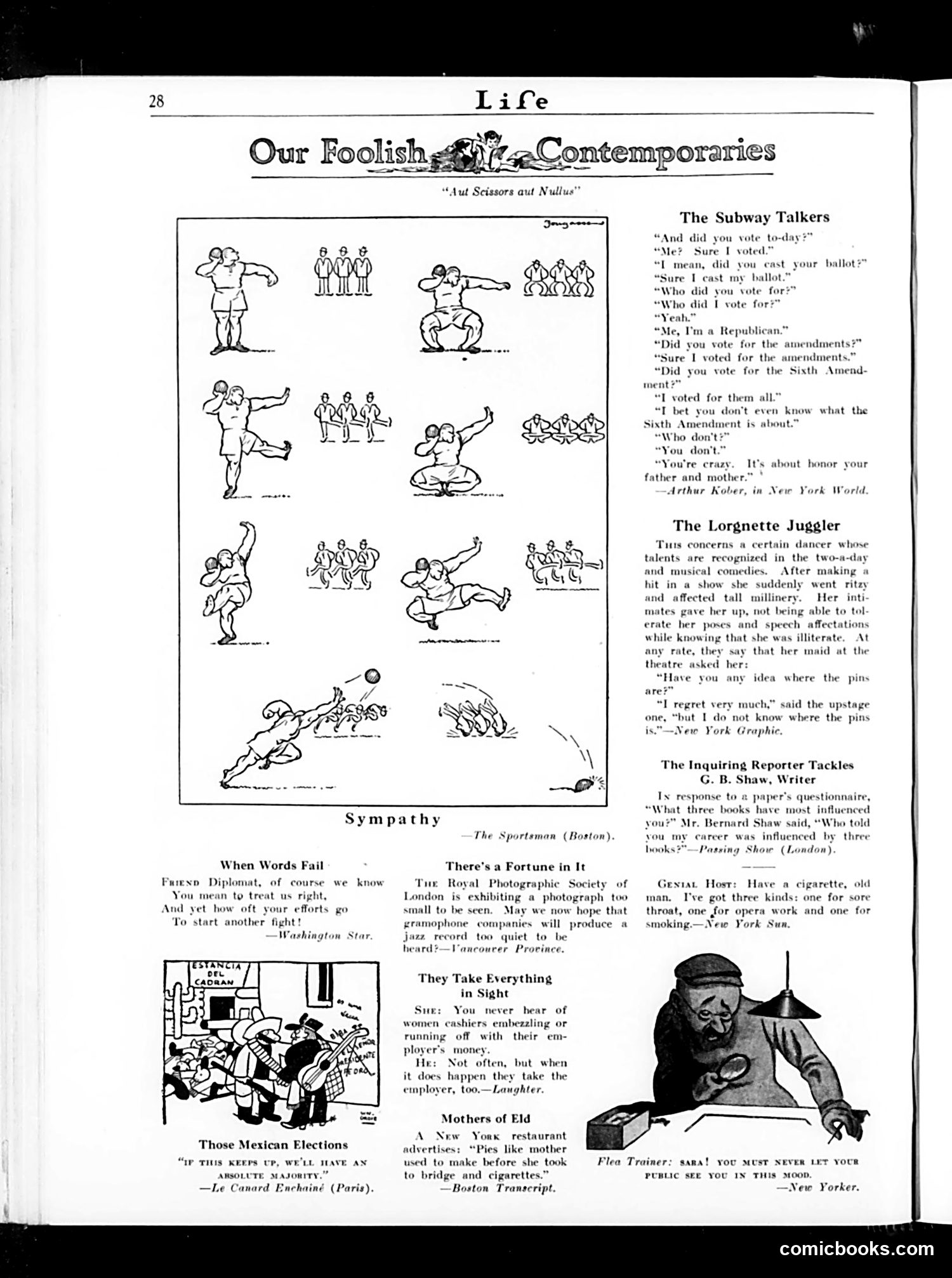
This page collects brief satirical items mocking contemporary social behavior and public figures. Key pieces include: **"The Subway Talkers"**: Ridicules voters who cast ballots without understanding what they're voting for—the man admits voting for "the Sixth Amendment" despite not knowing what it is, illustrating voter ignorance. **"The Lorgnette Juggler"**: Mocks a dancer who adopted affected mannerisms and pretentious style after minor success, becoming insufferable to friends who knew she was illiterate—satire of social climbing and false sophistication. **"Those Mexican Elections"**: A French cartoon suggesting Mexico's political instability is becoming absurdly violent. **Minor items** mock women's changing social roles (bridge and cigarettes replacing homemaking), wireless telegraph companies' poor service, and Bernard Shaw's literary influence. The overall theme: satirizing contemporary foolishness—voter apathy, pretension, gender role shifts, and modern technology's failures—through humorous anecdotes and cartoons.
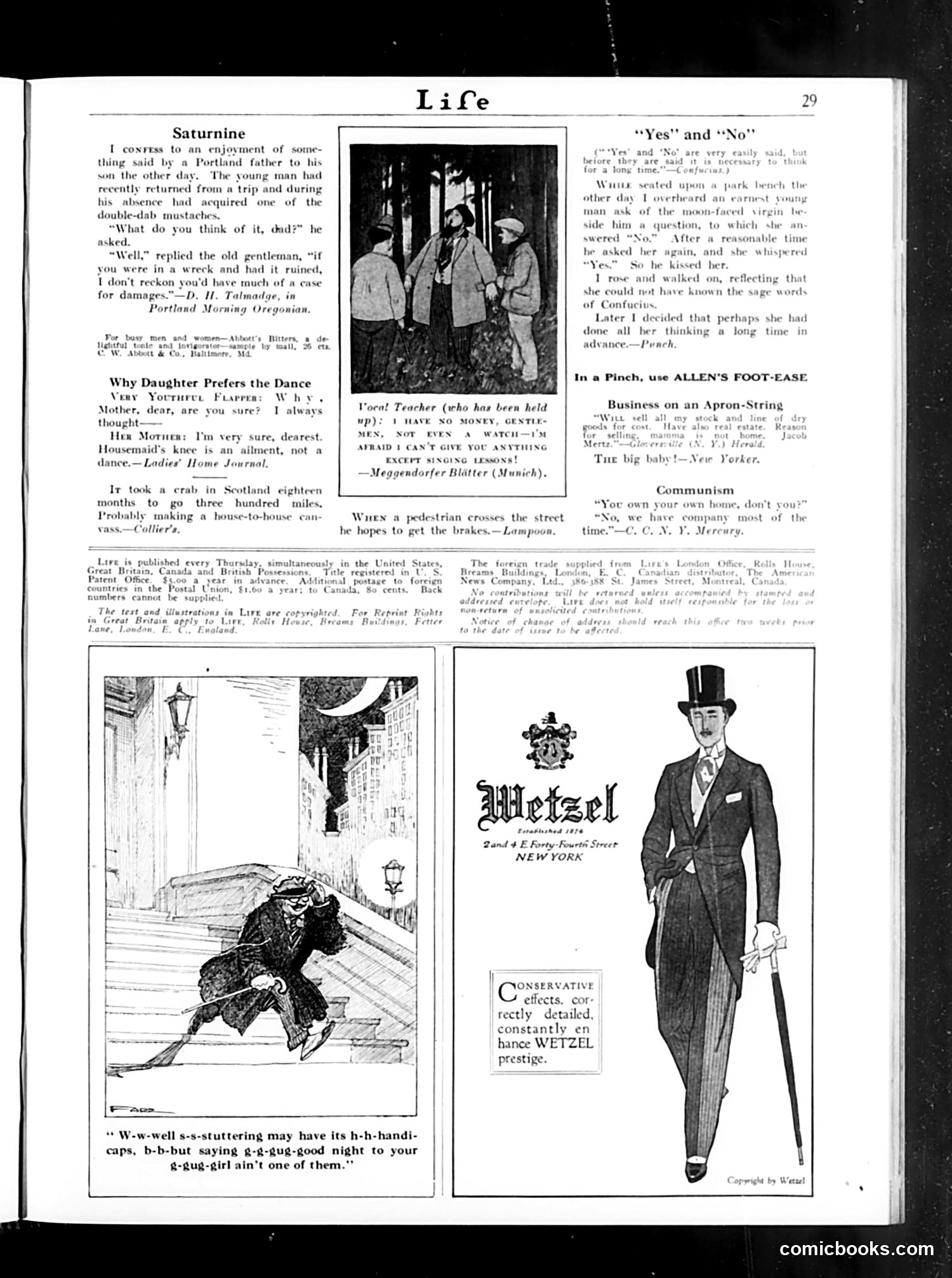
This page contains several brief humorous anecdotes and advertisements typical of early Life magazine's format. The top cartoon depicts a father mocking his son's new "double-dab mustache" by saying he wouldn't want such facial hair after seeing it ruined in a wreck—a joke about the mustache's absurd appearance. Another piece shows a vocal teacher claiming she cannot give money to a student, only singing lessons—satirizing the impracticality of artistic instruction as payment. The "Yes" and "No" section humorously describes a young man repeatedly asking an unnamed woman yes-or-no questions until she finally answers affirmatively, then kisses her—poking fun at romantic persistence and the philosophy of Confucius. A final cartoon depicts a stuttering man claiming that stuttering's only advantage is that saying goodnight to his girlfriend becomes easier—dark humor about speech impediments. The page also includes the Wetzel menswear advertisement featuring formal attire, representing the magazine's commercial content alongside satirical humor.
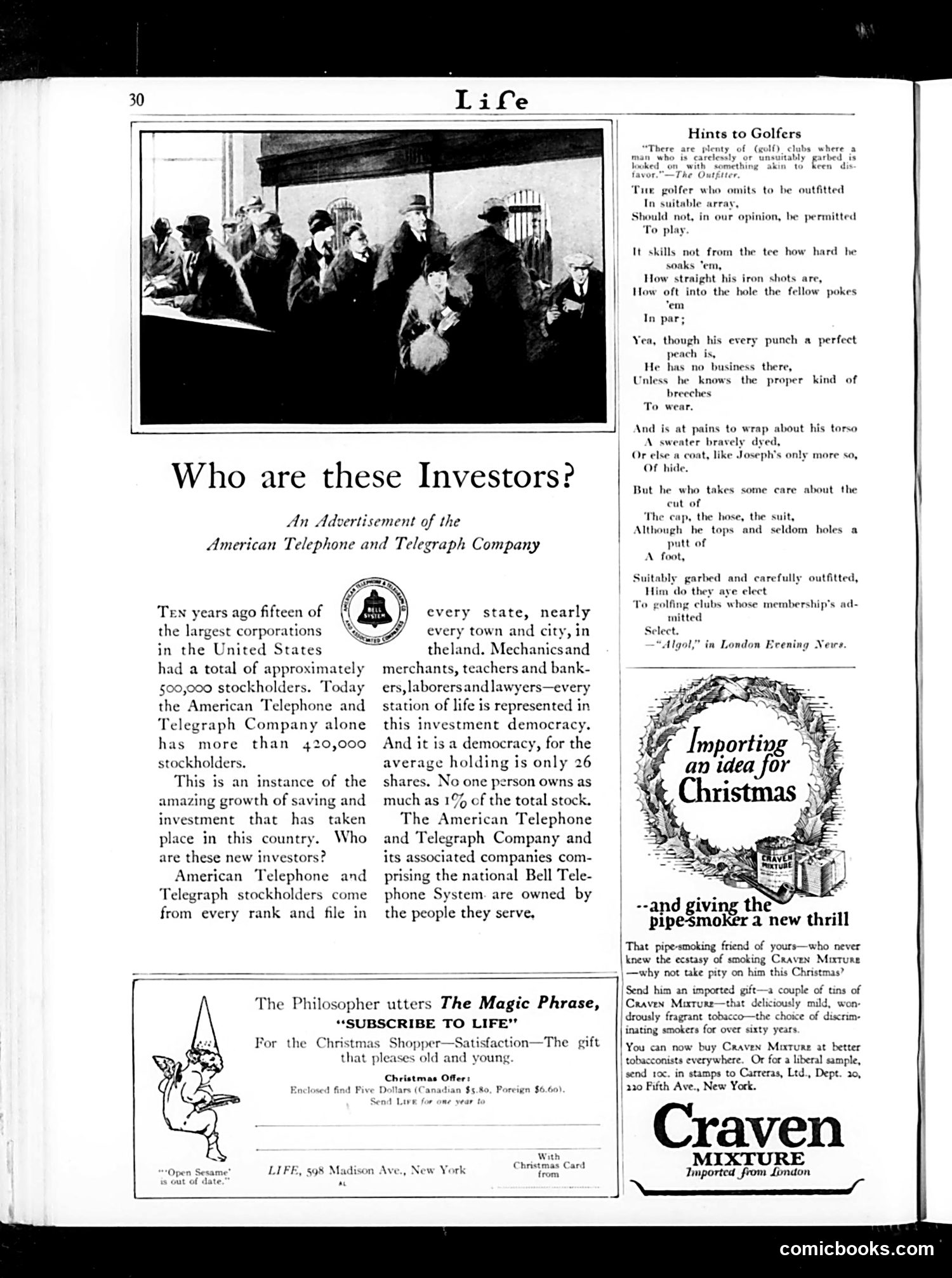
This page primarily features a large advertisement for American Telephone and Telegraph Company, emphasizing its democratized ownership—420,000 stockholders holding an average of only 26 shares each, representing "every rank and file" from mechanics to lawyers. The ad argues this represents "investment democracy" where no single person owns 1% of stock. The right column contains lighter satirical content: "Hints to Golfers" mocks snobbish country club culture, suggesting that proper attire (expensive breeches, sweater, coat) matters more than actual golfing skill for club membership admission—a jab at class-conscious exclusivity. Below appears a cigarette advertisement for imported Craven Mixture and a subscription offer for *Life* magazine itself. The contrast is notable: the AT&T ad celebrates broad-based investment accessibility while the golf satire criticizes how the wealthy still gatekeep social institutions through dress codes and appearance standards.
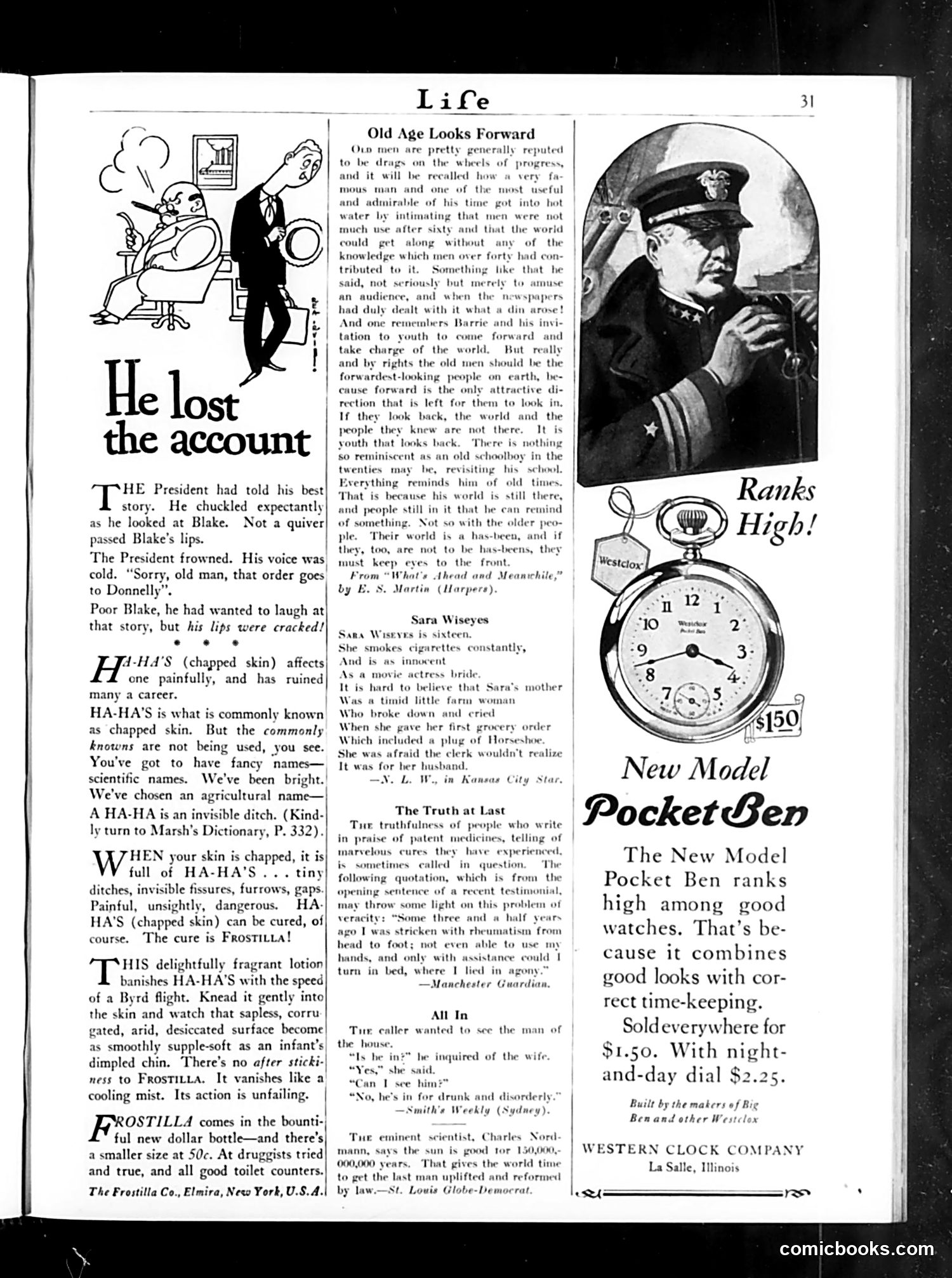
The main cartoon "He lost the account" depicts a workplace scenario where an employee (Blake) fails to laugh at his boss's (the President's) joke, costing him a client account that goes to a rival (Donnelly). The satire mocks rigid corporate hierarchies and the performative nature of office politics—where genuine human response (laughter) is weaponized as a measure of loyalty and competence. Blake's literal inability to laugh due to chapped lips becomes the vehicle for social commentary about how arbitrary workplace dynamics are: a physical ailment destroys professional standing. The irony is intentional: the page then advertises Frostilla lotion to cure "HA-HA'S" (chapped skin), using pseudo-scientific language. The ad capitalizes on the very anxiety the cartoon just created—that minor physical flaws can sabotage your career. The surrounding content includes miscellaneous humorous vignettes about aging, marital life, and dubious patent medicine testimonials—typical Life magazine fare satirizing American social pretension and commercial hucksterism.
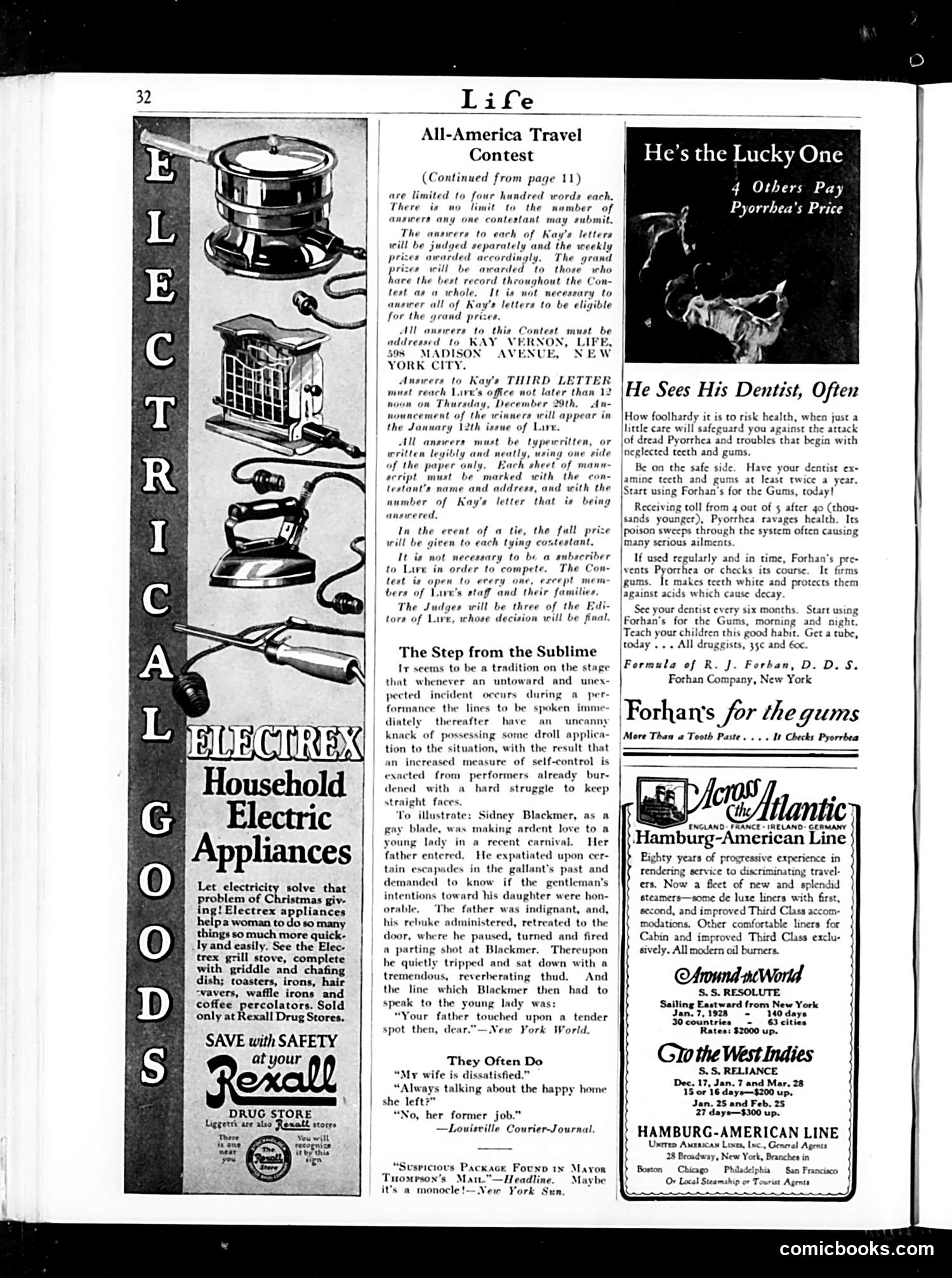
This page combines advertisements with humor content typical of Life magazine's satirical format. **Left side:** A large Electrex appliance advertisement promotes household electric goods (toasters, irons, waffle makers) as Christmas gifts, sold at Rexall Drug Stores. The pitch: electricity solves the "problem of Christmas giving" by offering practical appliances for women to complete domestic tasks "more quickly and easily"—reflecting 1920s assumptions about gender roles and domestic labor. **Center:** The "All-America Travel Contest" continuation describes a writing competition judged by Life editors, with details about submission rules and deadlines. **Right side:** Two advertisements: one for Forhan's dental product warns against pyorrhea (gum disease), using humor in the headline "He's the Lucky One / 4 Others Pay Pyorrhea's Price" to suggest dental neglect has serious health consequences. Below is a Hamburg-American cruise line advertisement promoting ocean travel to Europe and the Caribbean. The page reflects 1920s consumer culture, with modern electric appliances and travel positioned as aspirational goods, alongside health-consciousness messaging about dental care.
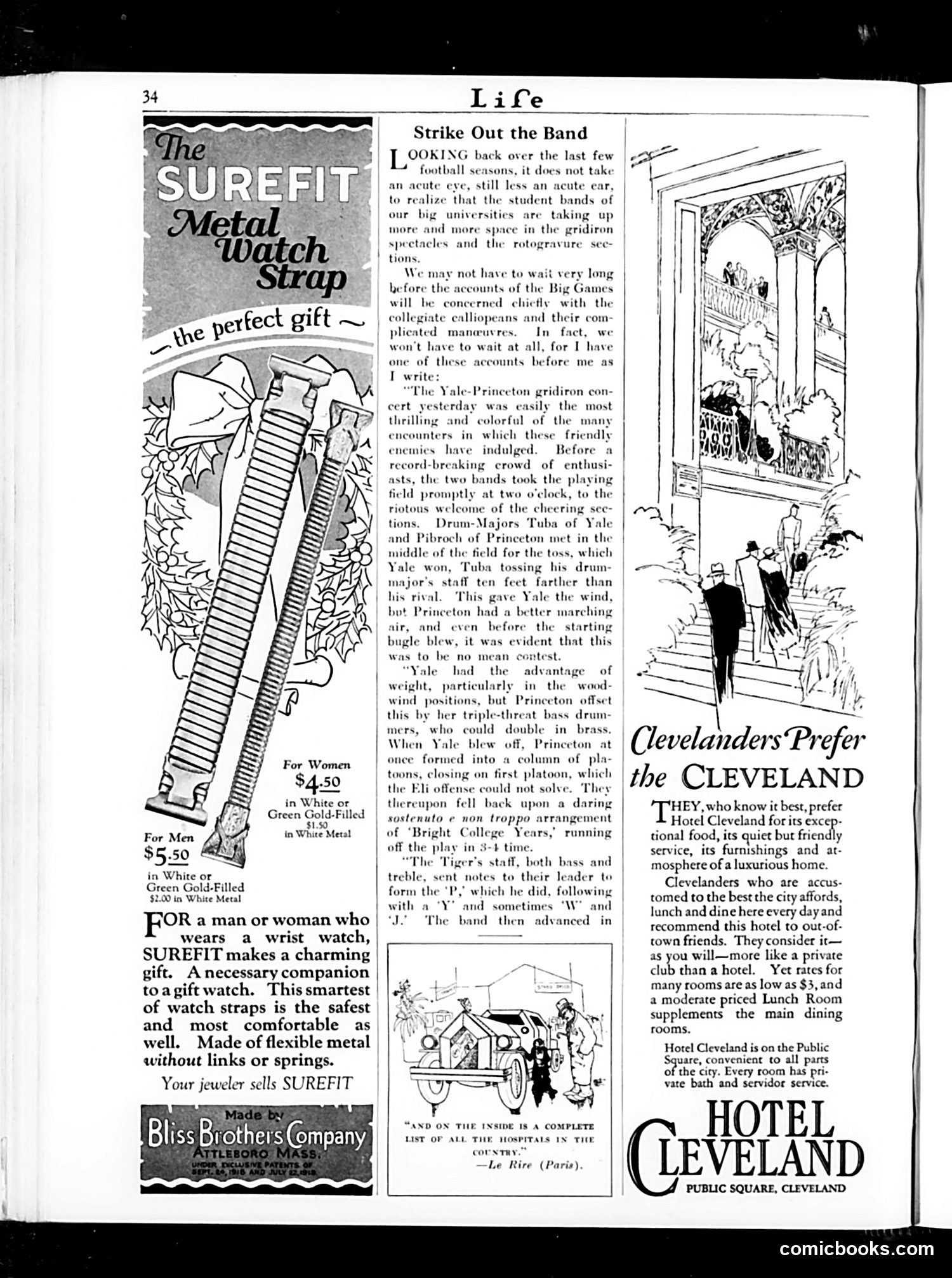
This satirical piece mocks the increasing prominence of university marching bands at major football games, particularly Yale-Princeton contests. The author presents a mock newspaper account treating the band performance as the main event rather than the football game itself. The satire uses absurdist humor: band drum majors "toss" for field position, bands execute elaborate formations (spelling "P" and "Y"), and strategic maneuvers like "triple-threat bass drummers" and arrangements of "Bright College Years" in 3-4 time become the focus. The implied complaint is that student bands have grown so elaborate and attention-consuming in "gridiron spectacles" that they overshadow the actual sport. This reflects early 20th-century anxieties about how college traditions were evolving—the bands had become significant entertainment draws themselves, rivaling football's importance at these prestigious institutions.
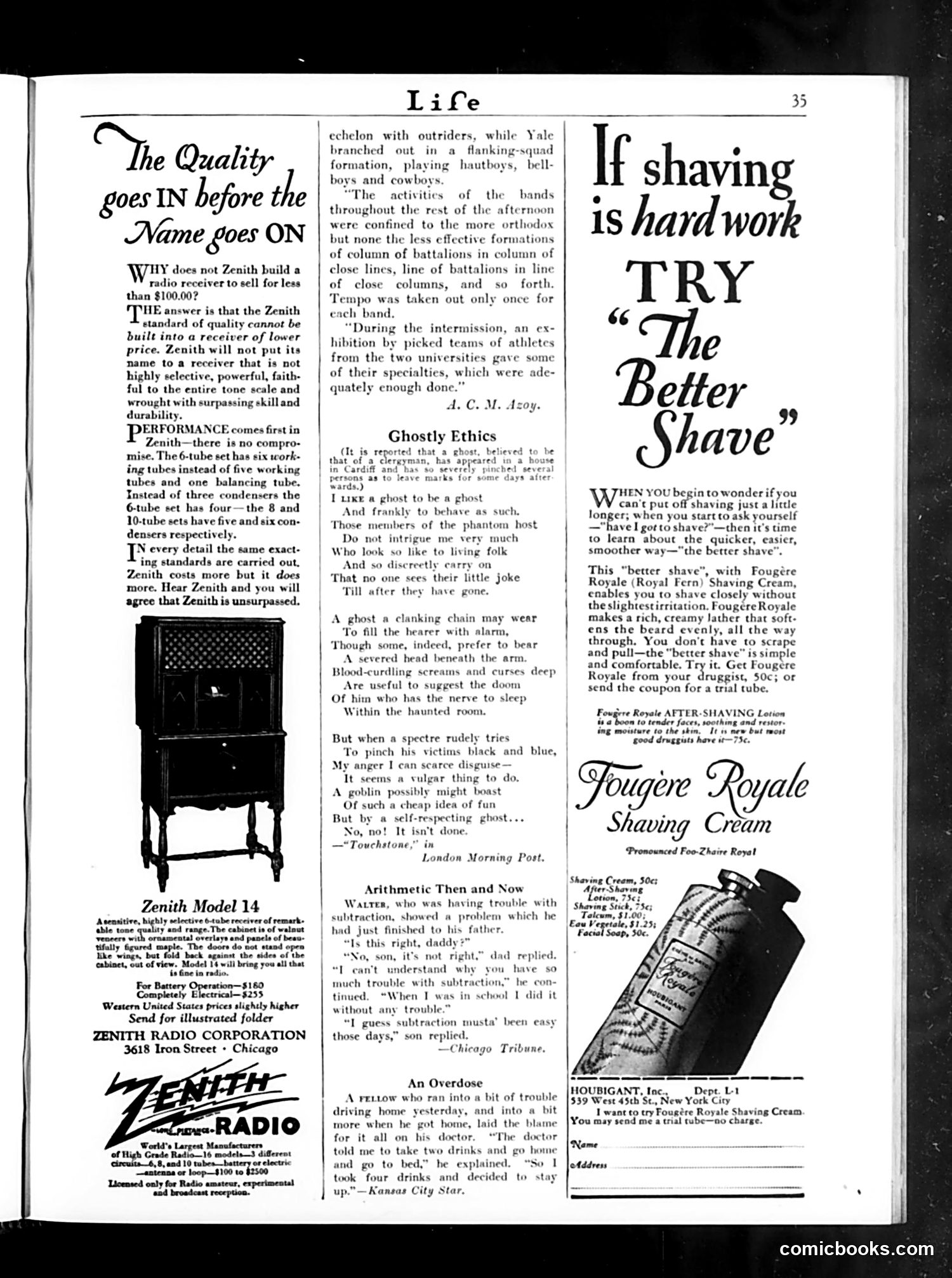
This page is primarily **advertising and humor content** with no political cartoons. The main visual element is a **Zenith Model 14 radio advertisement** featuring the receiver itself. The ad's satire is commercial, not political: it mocks cheaper competitors by claiming Zenith refuses to compromise quality for lower prices—"The Quality goes IN before the Name goes ON." The text content includes three **humorous short pieces**: 1. **"Ghostly Ethics"**—a poem satirizing pretentious ghosts who follow "rules" of haunting (chains, severed heads) rather than crude behavior like pinching victims. 2. **"Arithmetic Then and Now"**—a joke contrasting a father's easy subtraction in school with his son's modern struggles, suggesting educational decline. 3. **"An Overdose"**—a brief anecdote mocking a drunk man who blames his doctor for suggesting he drink four instead of two drinks. The **"Better Shave" advertisement** for Fougère Royale Shaving Cream occupies the right column. None of this content addresses contemporary politics or social issues—it's lightweight humor and product marketing typical of 1920s Life magazine.
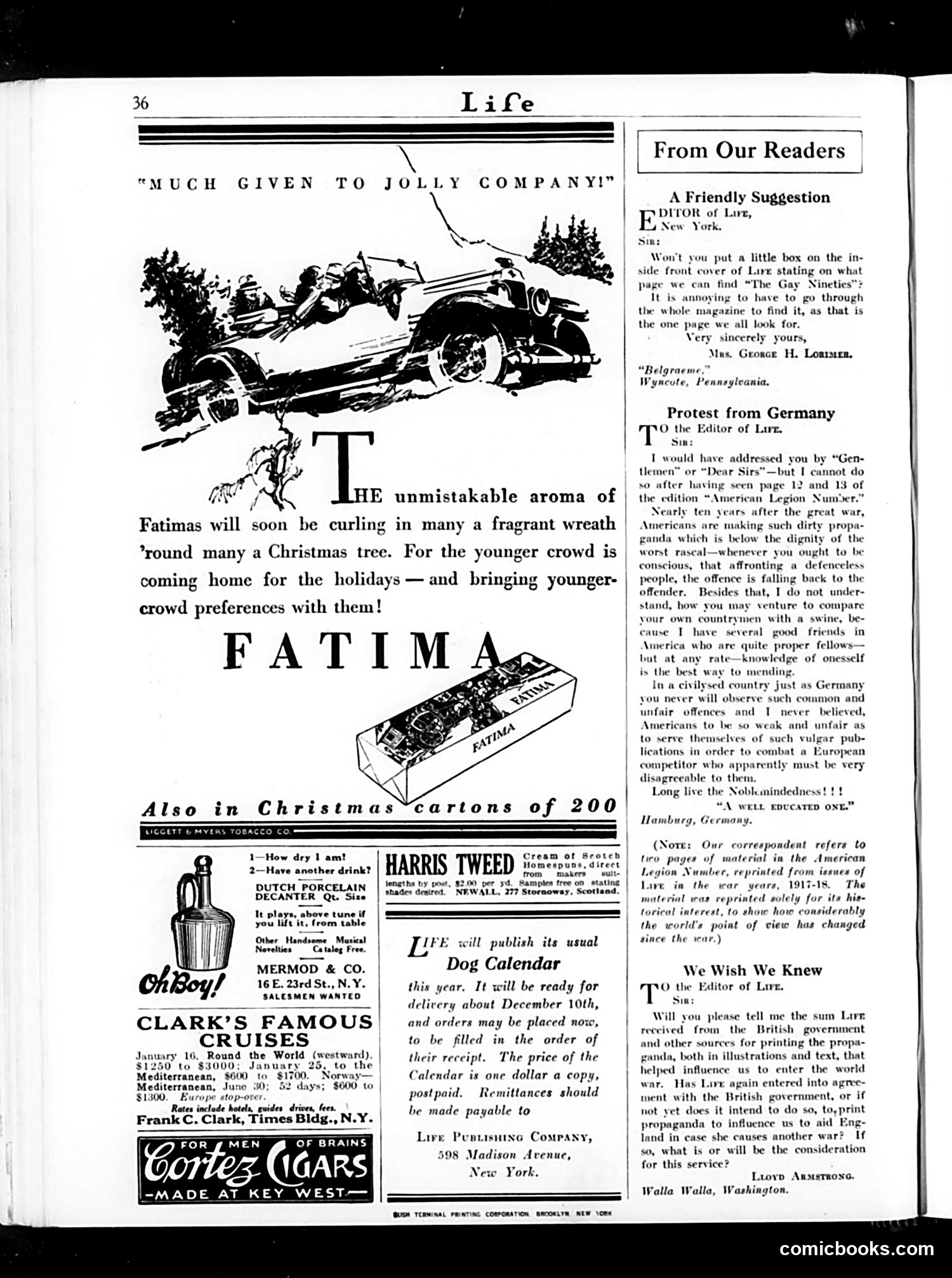
This page consists primarily of **advertisements and reader letters**, not political cartoons. The main advertisement features **Fatima cigarettes**, promoting holiday gift packages. The copy uses period marketing language appealing to young smokers returning home for Christmas. The "From Our Readers" section contains three letters: 1. A reader requests an index for "The Gay Nineties" feature 2. A **German correspondent protests** Life's reprinting of anti-German propaganda from 1917-18 (during WWI). He argues such material is undignified and questions whether Life is again serving British interests 3. An American reader asks whether Life received payments from the British government for pro-war propaganda and whether similar arrangements exist These letters reflect post-WWI tensions: Germany's resentment of wartime propaganda, and American suspicion about foreign influence on the press. Life's editorial note indicates the reprinted material was purely historical. The remaining content consists of tourism and consumer product advertisements typical of the era.
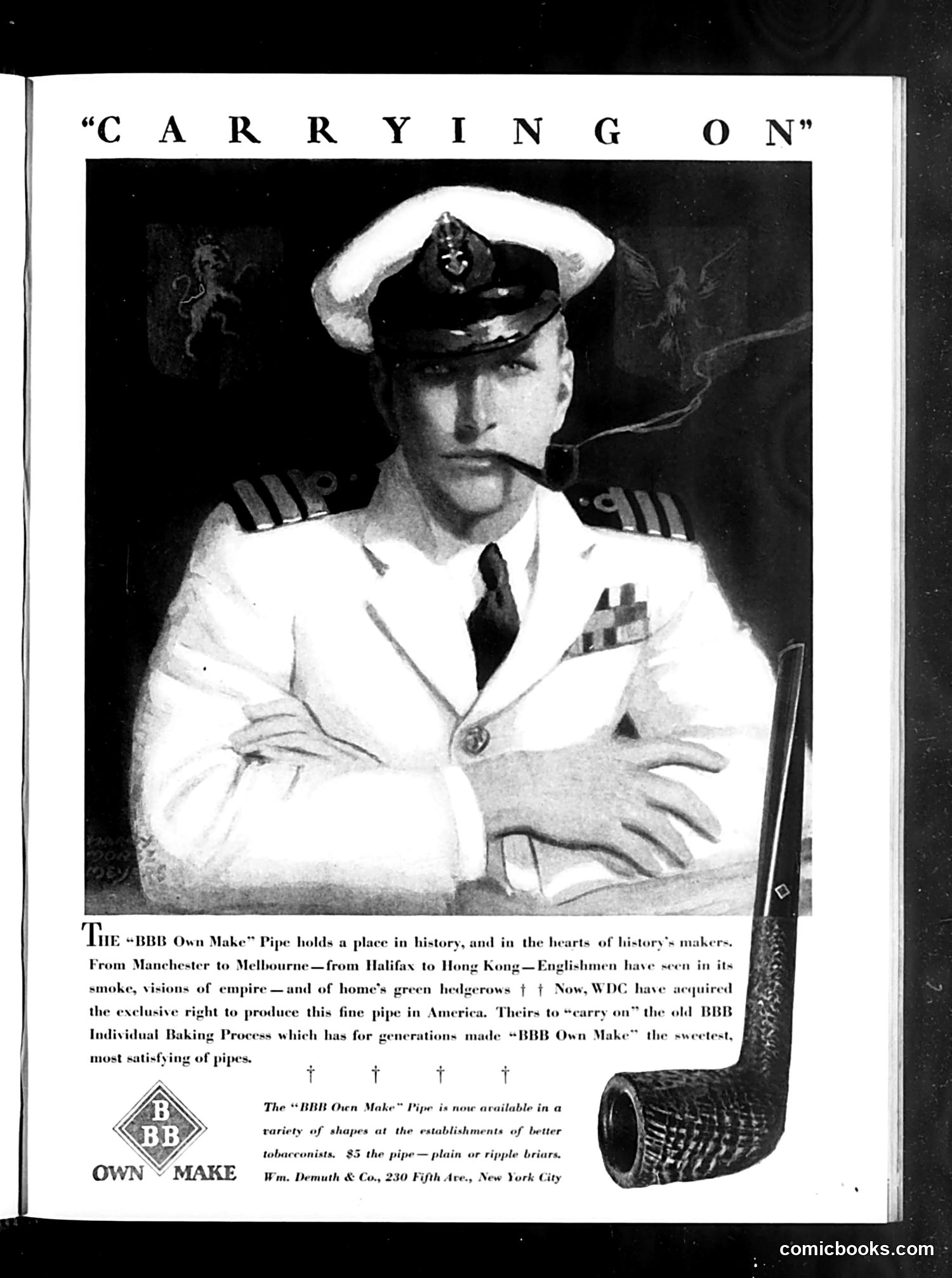
This is a **tobacco pipe advertisement**, not political satire. The page features a military officer in dress whites smoking a pipe, positioned as an aspirational figure of British imperial authority. The ad's central conceit plays on the phrase **"carrying on"**—a patriotic wartime slogan about maintaining British resolve. It claims the "BBB Own Make" pipe has accompanied British officers across the Empire (Manchester to Melbourne, Halifax to Hong Kong), thus linking pipe-smoking to imperial identity and masculine authority. The humor is subtle: American company WDC now produces these pipes in America, inverting the colonial relationship by manufacturing a quintessentially "British" product domestically. The ad sells both the pipe and an aspirational identity—smoking it means "carrying on" the traditions of empire and military dignity. This appears to be from an era when British imperial imagery still carried prestige for American consumers.
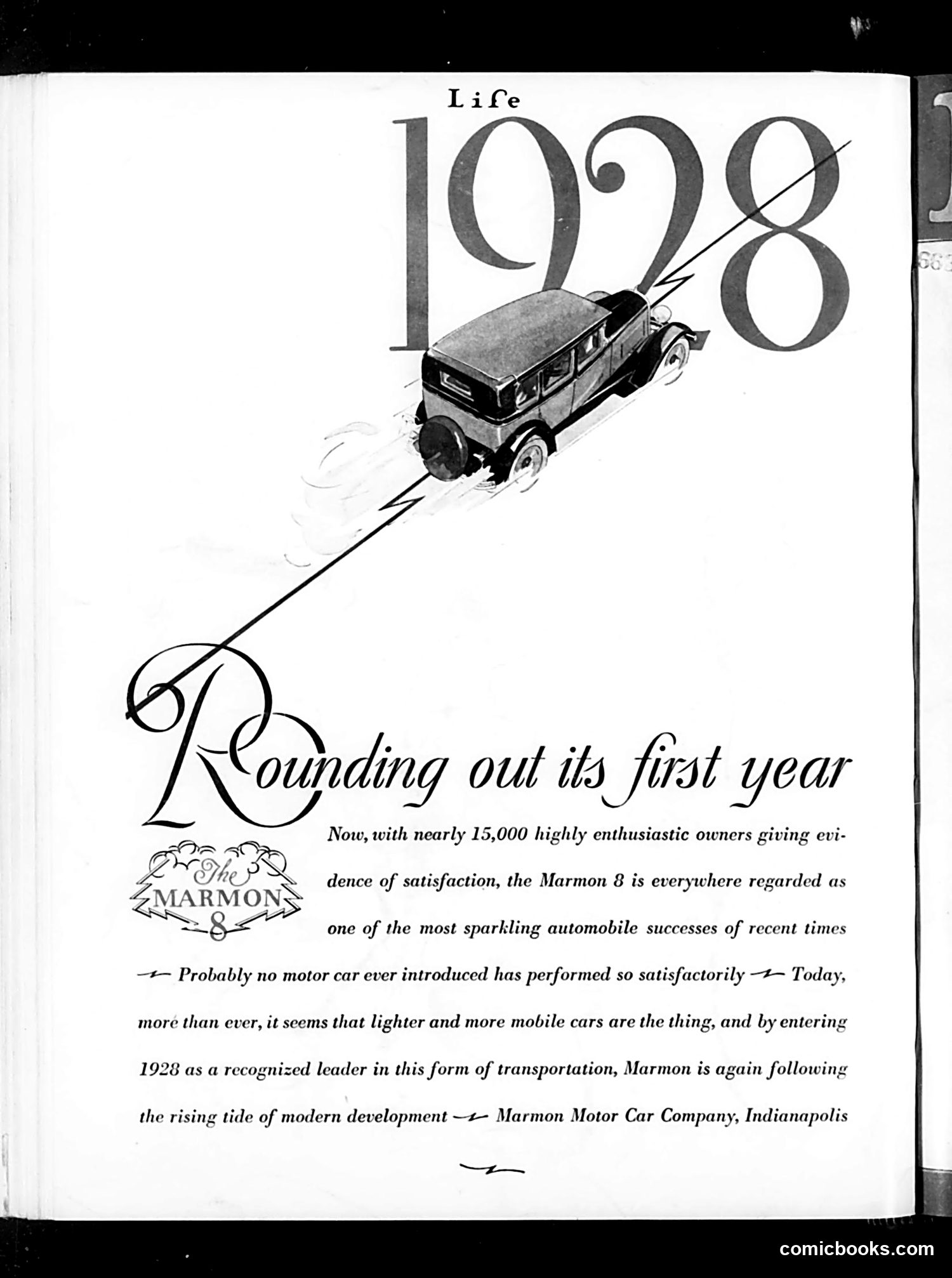
This is a **full-page advertisement**, not satire or political commentary. It promotes the Marmon 8 automobile, celebrating its first year of production (1928). The image shows a stylized car climbing upward along the number "8," visually representing progress and success. The text claims nearly 15,000 satisfied owners and positions the Marmon 8 as one of the era's most successful automobiles—a "sparkling" achievement. The ad emphasizes that the car represents modern automotive trends: lighter, more mobile vehicles are replacing heavier models. By framing 1928 entry as "following the rising tide of modern development," Marmon positions itself as forward-thinking and aligned with consumer preferences. This is straightforward product advertising typical of 1920s Life magazine, with no satirical intent or hidden political meaning.