
Life, 1927-12-08 · page 23 of 40
Life — December 8, 1927 — page 23: what you’re looking at
What you’re looking at
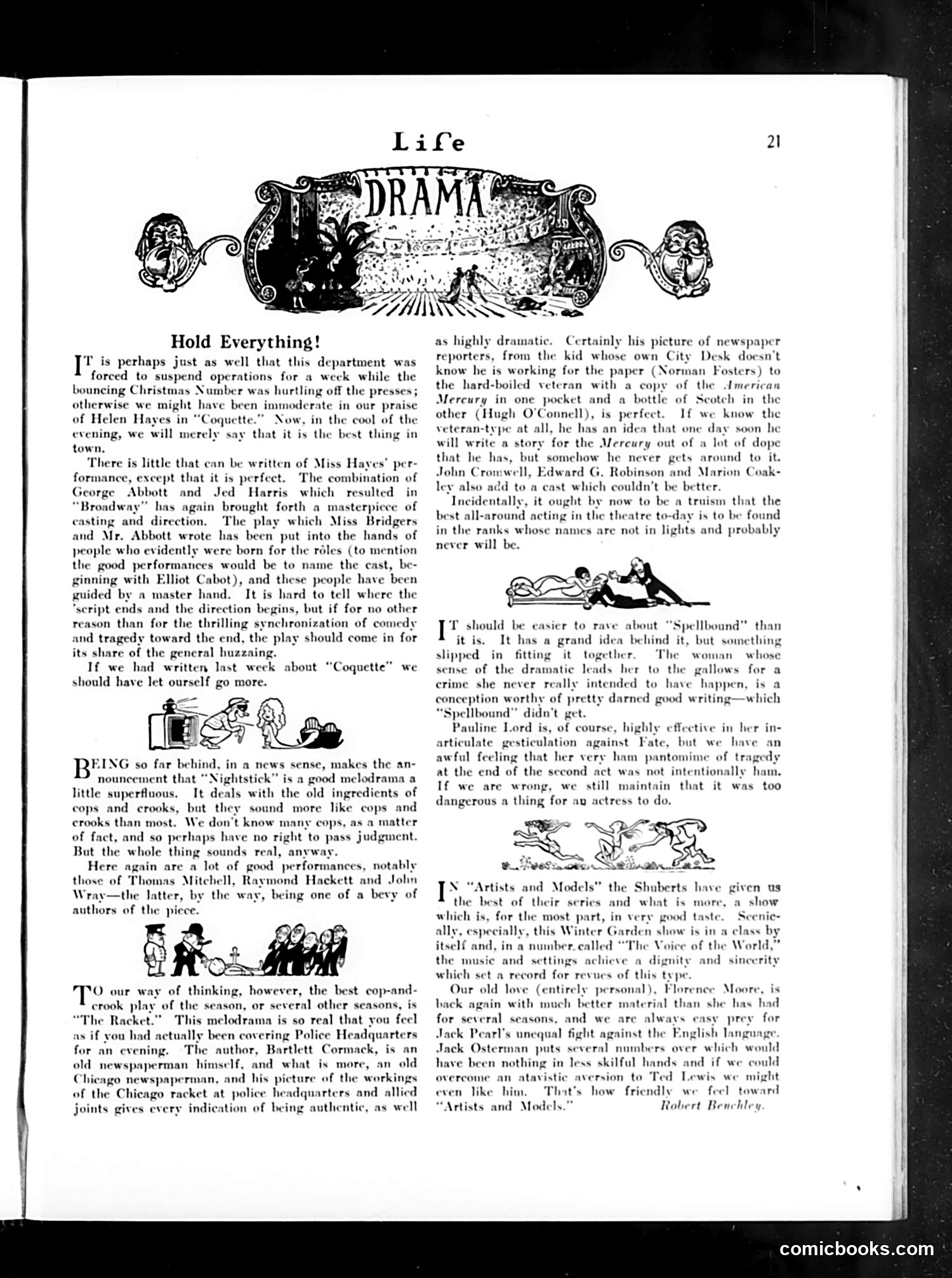
This page reviews Broadway plays from what appears to be the late 1920s. The critic praises Helen Hayes in *Coquette* as "the best thing in town," and commends the production team of George Abbott and Jed Harris for their work on *Broadway*. The reviewer also discusses *Nightstick* (a police melodrama), *The Racket* (a newspaper crime play featuring Edward G. Robinson), and *Spellbound*—criticizing the last for wasting a promising dramatic premise through poor execution, particularly faulting actress Pauline Lord's "ham pantomime." The cartoons appear to be generic theater-related illustrations showing audiences and performers, common decorative elements in this magazine. The overall tone is theatrical insider commentary—the critic assumes readers know these plays and performers, critiquing both material and execution while celebrating strong ensemble acting in supporting roles.
📄 Transcribed text from this page (OCR, searchable)
Machine-transcribed from the original scan — historical spelling and the odd misread are preserved.
Hold Everything! T is perhaps just as well that this department was forced to suspend operations for a week while the bouncing Christmas Number was hurtling off the presse otherwise we might have been immoderate in our praise of Helen Hayes in “Coquet Now, in the cool of the evening, we merely say that it is the best thing in town. There is little that can be written of Miss Hayes’ per- formance, except that it is perfect. The combination of George Abbott and Jed Harris which resulted in “Broadway” has again brought forth a masterpic casting and direction. The play which Miss Bridgers and Mr. Abbott wrote has been put into the hands of people who evidently were born for the réles (to mention the good perform: would be to name the cast, be- ginning with Elliot Cabot), and these people have been guided by a master hand. It is hard to tell where the ‘script ends and the direction begins, but if for no other reason than for the thrilling synchronization of comedy and tragedy toward the end, the play should come in for its share of the general huzzaing. If we had written last week about “Coquette” we should have let ourself go more. EING so far behind, in a news sense, makes the an- nouncement that “Nightstick” is a good melodrama a little superfluous, It deals with the old ingredients of cops and crooks, but they sound more like cops and crooks than most. We don’t know many cops, as a matter of fact, and so perhaps have no right to pass judgment. whole thing sounds real, anyway. again are a lot of good performances, notably Wray—the lat authors of th NO our way of thinking, however, the best cop-and- crook play of the season, or several other seasons, is he Racke This melodrama is so real that you feel i a had . for an evening. The author, Bartlett Corr old newspaperman himself, and what is more, an nd his picture of the worki ce headquarters Chicago newspaperman, of the Chicago racket at pe as highly dramatic. Certainly his picture of newspaper reporters, from the kid whose own City Desk doesn’t know he is working for the paper (Norman Fosters) to the hard-boiled veteran with a copy of the American Mercury in one pocket and a bottle of Scotch in the other (Hugh O'Connell), is perfect. 1f we know the veteran-type at all, he has an idea that one day soon he will write a story for the Mercury out of a lot of dope that he has, but somehow he never gets around to it. John Cromwell, Edward G. Robinson Marion Coak- east which couldn't be bet it ought by now to be a truism that the best all-around acting in the theatre to-day is to be found in the ranks whose names are not in lights and probably never will be. ae we T should be easier to rave about “Spellbound” than it is. It has a grand idea behind it, but something slipped in fitti it together. The whose sense of the dramatic leads her to the for a crime she never really intended to have happen, is a conception worthy of pretty darned good writing—which “Spellbound” didn’t get. Pauline Lord is course, highly effective in her in- articulate gesticulation against Fate, but we awful feeling that her very ham pantomime of tragedy at the end of the second not intentionally ham. If we are wrong, we still maintain that it was too dangerous a thing for ay actress to do. ASB OS Sn eS SO. ae SO woman gallows have an N “Artists and Models” the Shuberts have and what r the most part, in very good taste ally, especially, this Winter Garden show is in a class b: itself and, in a number.called “The Voice of the World, the mu and settings achieve a dignity and sincerity which set a record for revues of this type Our old love (entirely personal), Florence Moore, is back again with much better material than she has had for several seasons, and we are always easy prey for Jack Pearl's unequal fight against the English language. Jack Osterman puts several numbers over which would n nothing in less skilful hands and if we could aversion to Ted Lewis we might how friendly we feel toward Robert Benchley given us the best of their series show which ii is more, a Seenic- have be overcome an istic n like him. That's “Artists and Models.” comicbooks.com