
A complete issue · 36 pages · 1927
Life — August 25, 1927
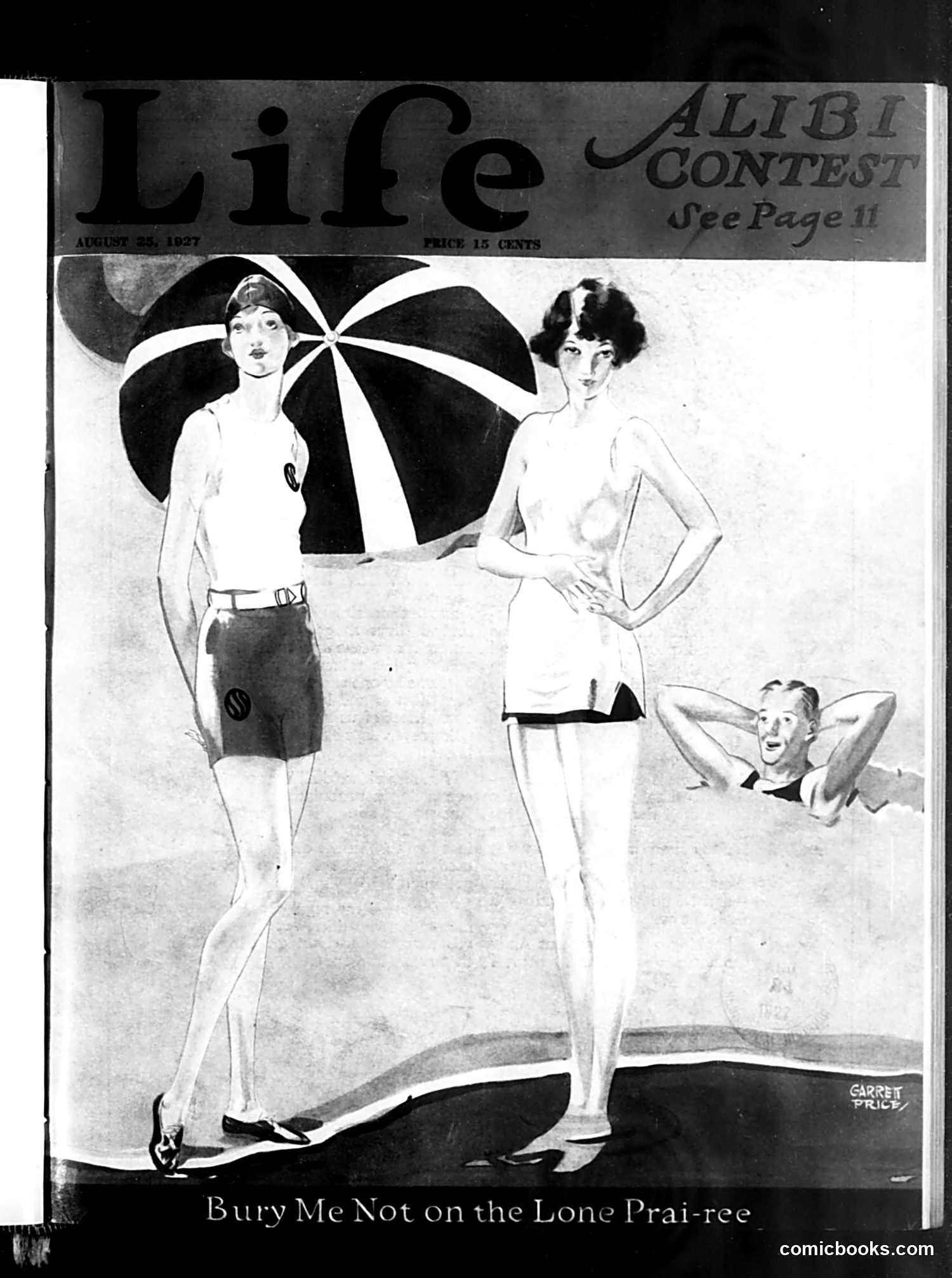
This cover depicts a beach scene with two women in 1920s bathing attire and a child. The title "Bury Me Not on the Lone Prai-ree" (a parody of the cowboy song "Bury Me Not on the Lone Prairie") suggests commentary on changing American lifestyles. The satire likely critiques the shift from rural/frontier culture to modern leisure culture—specifically beach vacations becoming fashionable among urban Americans in the Jazz Age. The women's confident poses and contemporary swimwear represent the "New Woman" of the 1920s, enjoying freedom and public recreation previously unavailable. The reference to being buried on the prairie humorously implies the old frontier way of life is "dead," replaced by seaside leisure and modern sensibilities. An "Alibi Contest" is advertised on the cover.
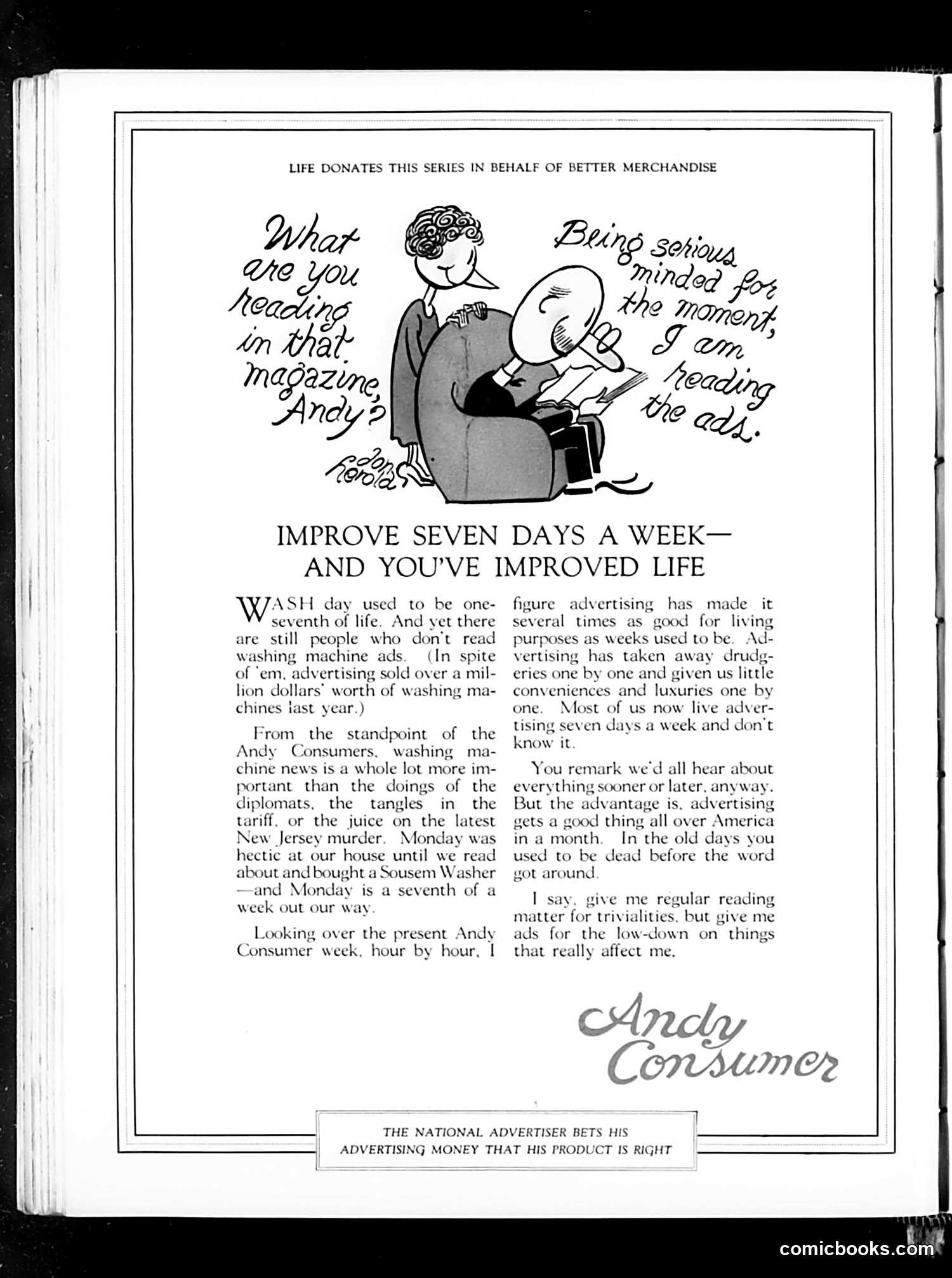
This is a **satirical advertisement** from Life magazine promoting better merchandise and advertising practices. The cartoon depicts a man reading ads while a woman asks what he's reading. His response—that he's "heading the ads"—is the joke: he's so absorbed in advertisements that they've become his primary reading material. The text argues that advertising has become ubiquitous in American life (appearing "seven days a week"), replacing substantive news about important matters. The satire critiques how advertising has infiltrated daily life, making consumers dependent on product information rather than meaningful content. The signature "Andy Consumer" personifies the average American as someone whose life is shaped by commercial messaging, making this a commentary on consumer culture's growing dominance in early-to-mid 20th century America.
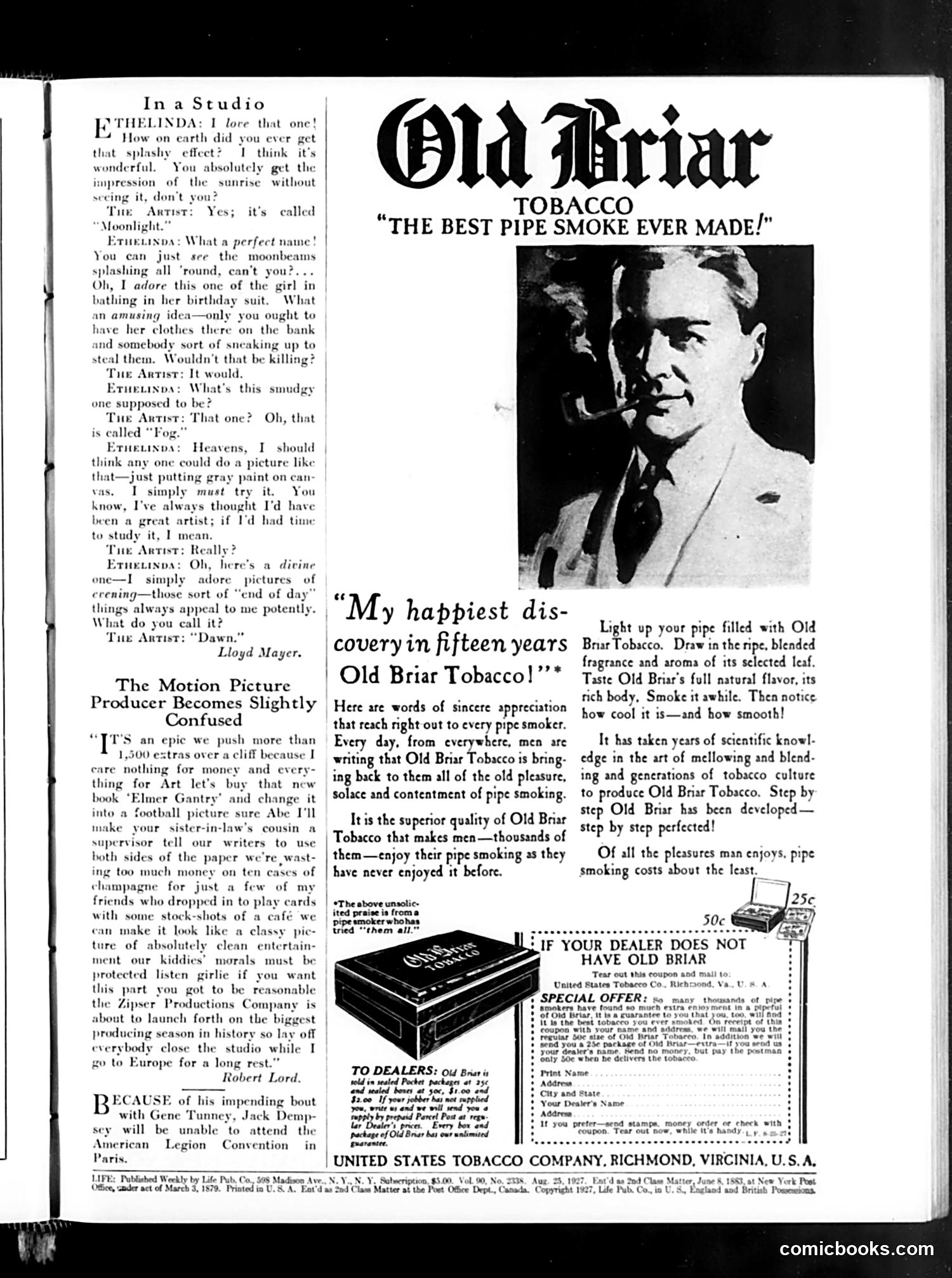
This page is **primarily a cigarette advertisement**, not a political cartoon. The top section contains a dialogue sketch titled "In a Studio" between characters Ethelinda and "The Artist" (credited to Lloyd Mayer), discussing painting techniques and artistic subjects—standard humorous filler content. The dominant content is a full-page **Old Briar Tobacco advertisement** featuring a man smoking a pipe. The ad emphasizes the tobacco's superior quality and appeals to pipe smokers with testimonials. There is no political satire or social commentary on this page. It represents typical 1920s magazine content: light humor alongside commercial advertising. The page reflects the era's casual acceptance of tobacco marketing in mainstream publications.
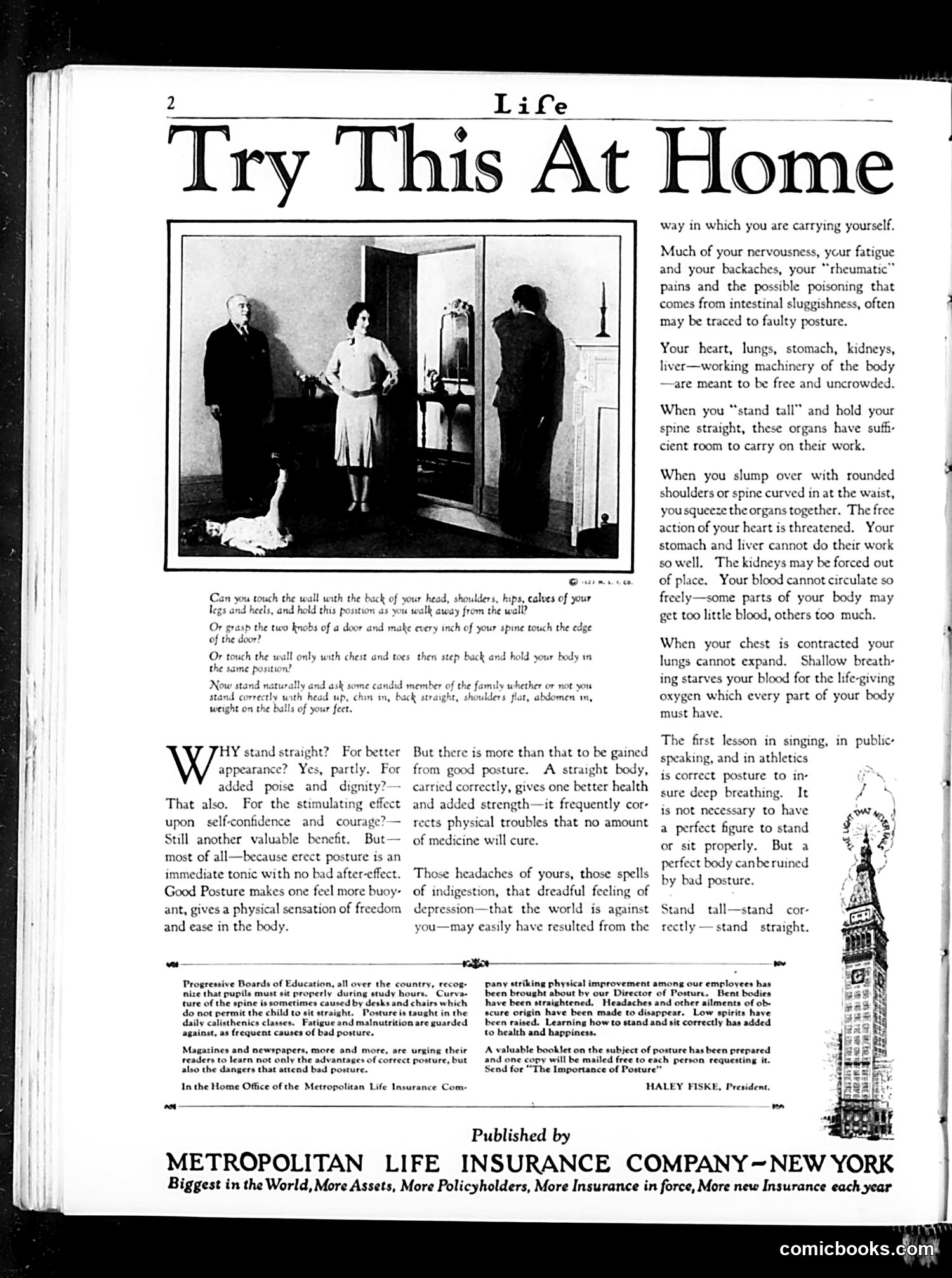
This page is primarily **advertising, not satire**. It's a Metropolitan Life Insurance Company advertisement disguised as health advice editorial content. The illustration shows people examining their posture in a mirror—a visual demonstration of the article's central message: good posture promotes health and confidence. The accompanying text argues that standing straight prevents various ailments (headaches, indigestion, poor circulation) and improves physical and mental well-being. The "Try This At Home" format encourages readers to check their own posture by touching a wall with specific body parts, making the health lesson interactive and personal. This reflects early 20th-century popular health culture, which often linked physical appearance and deportment to moral virtue and wellness—a common advertising strategy of the era.
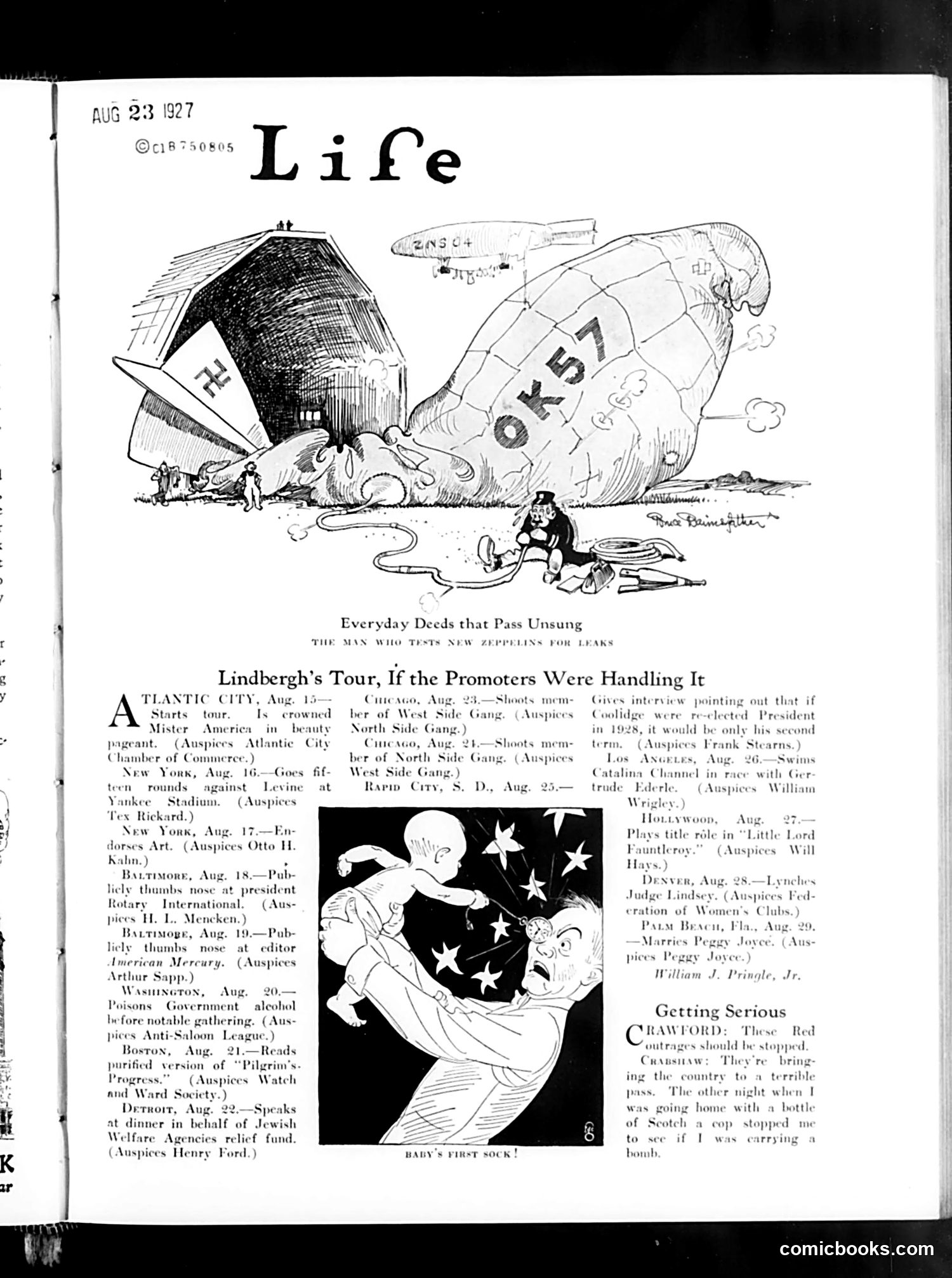
The main cartoon titled "Baby's First Sock!" depicts an infant with a swastika on its clothing, appearing to punch or strike at what looks like a Nazi flag or symbol. This appears to be satire about rising Nazi/fascist movements in Germany during the late 1920s—mocking the indoctrination of children into fascist ideology. The page's left column includes "Everyday Deeds that Pass Unsung" with various humorous news items, including a reference to Charles Lindbergh's tour (Lindbergh being the famous aviator). The right column contains social commentary under "Getting Serious," discussing various contemporary concerns. The overall tone is satirical commentary on contemporary political and social events of 1927.
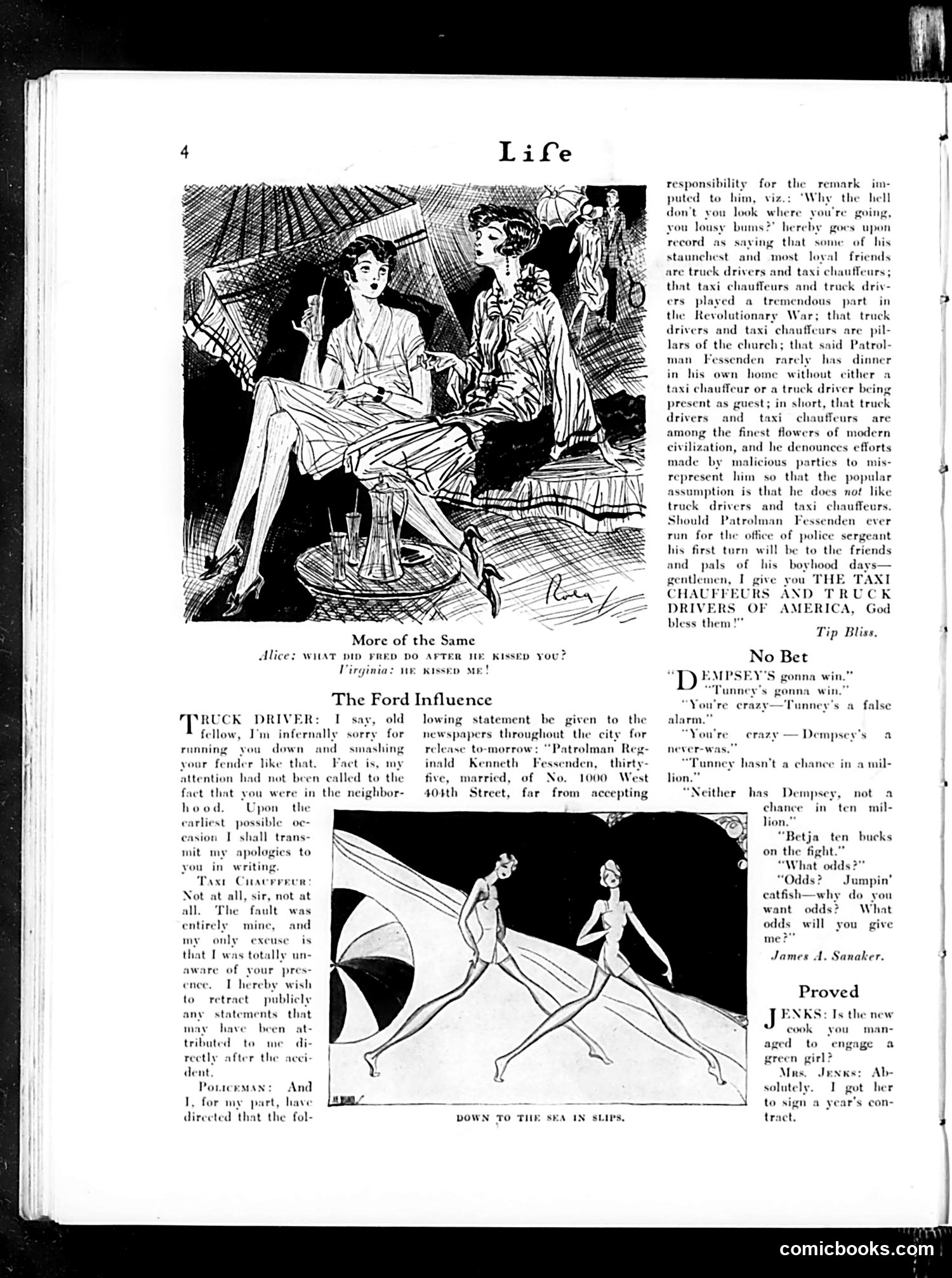
This page contains several brief satirical pieces typical of Life's humor format. "The Ford Influence" depicts a truck driver apologizing for a traffic accident, claiming he was "totally unaware of your presence"—likely satirizing how widespread automobile use (particularly Ford vehicles) was making drivers careless or oblivious. The accompanying illustrations show social scenes of the era. "More of the Same" depicts romantic interaction; "Down to the Sea in Ships" shows figures in maritime/nautical contexts. The right column contains short humorous exchanges ("No Bet," "Proved") playing on contemporary slang and betting culture. The overall tone reflects 1920s-era concerns about automobiles' growing social impact and changing social customs around courtship and leisure.
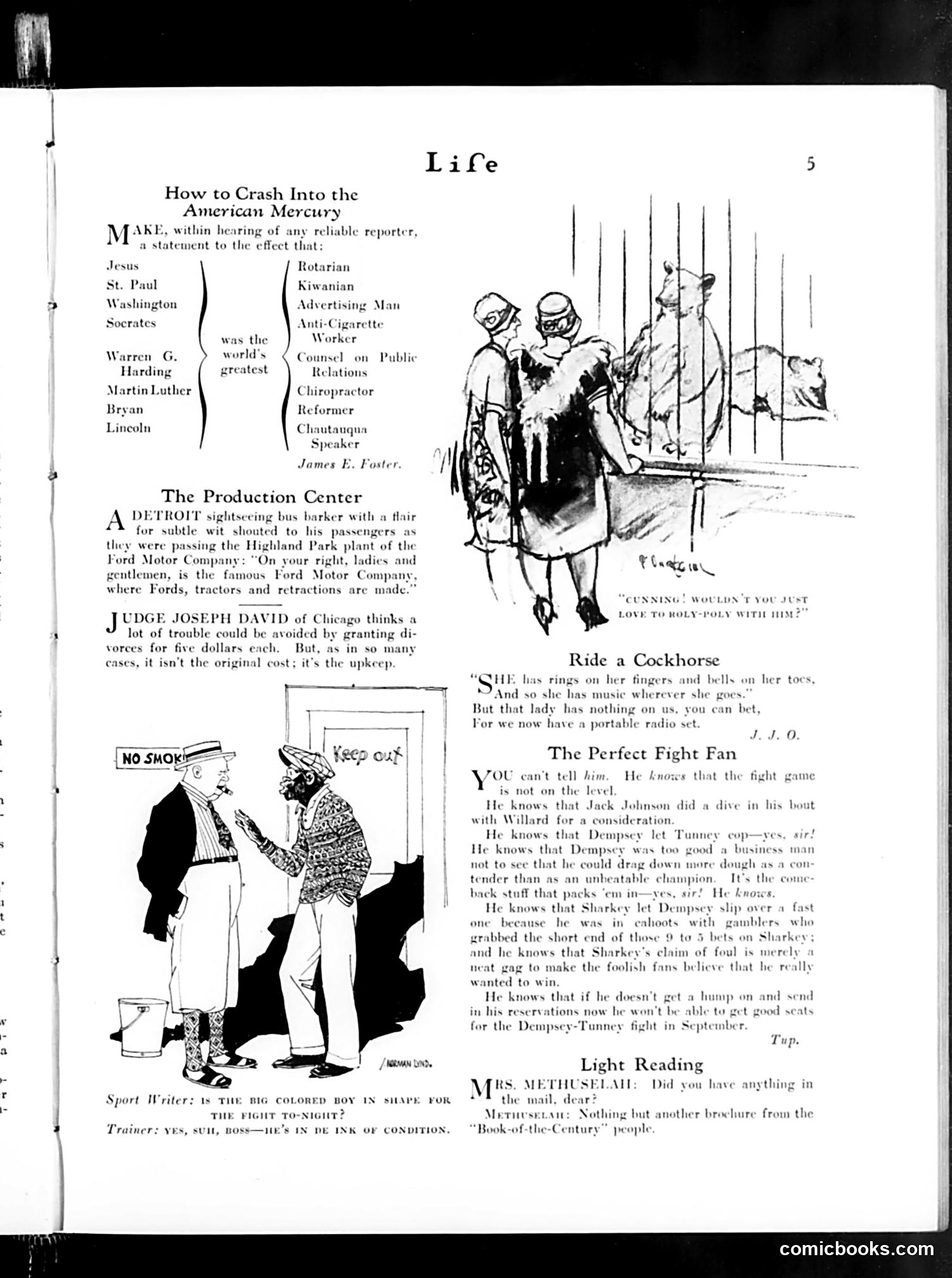
This page contains several short humorous pieces satirizing American life circa early 20th century. **"How to Crash Into the American Mercury"** lists historical and contemporary figures (Jesus, Lincoln, Warren G. Harding, etc.) as examples of "the world's greatest" public figures, sarcastically suggesting the Mercury magazine features only such names. **"The Production Center"** jokes about Ford Motor Company's Highland Park plant, with a sightseeing bus guide's boastful commentary—satire of corporate self-promotion. **"The Perfect Fight Fan"** mocks boxing enthusiasts' detailed knowledge of fighters' personal histories and rivalries, suggesting fans obsess over gossip rather than actual boxing skill. The cartoons illustrate these pieces with sketches of everyday people in humorous situations—a sport writer discussing fights, a woman on a "cockhorse" (toy horse), depicting common American pastimes.
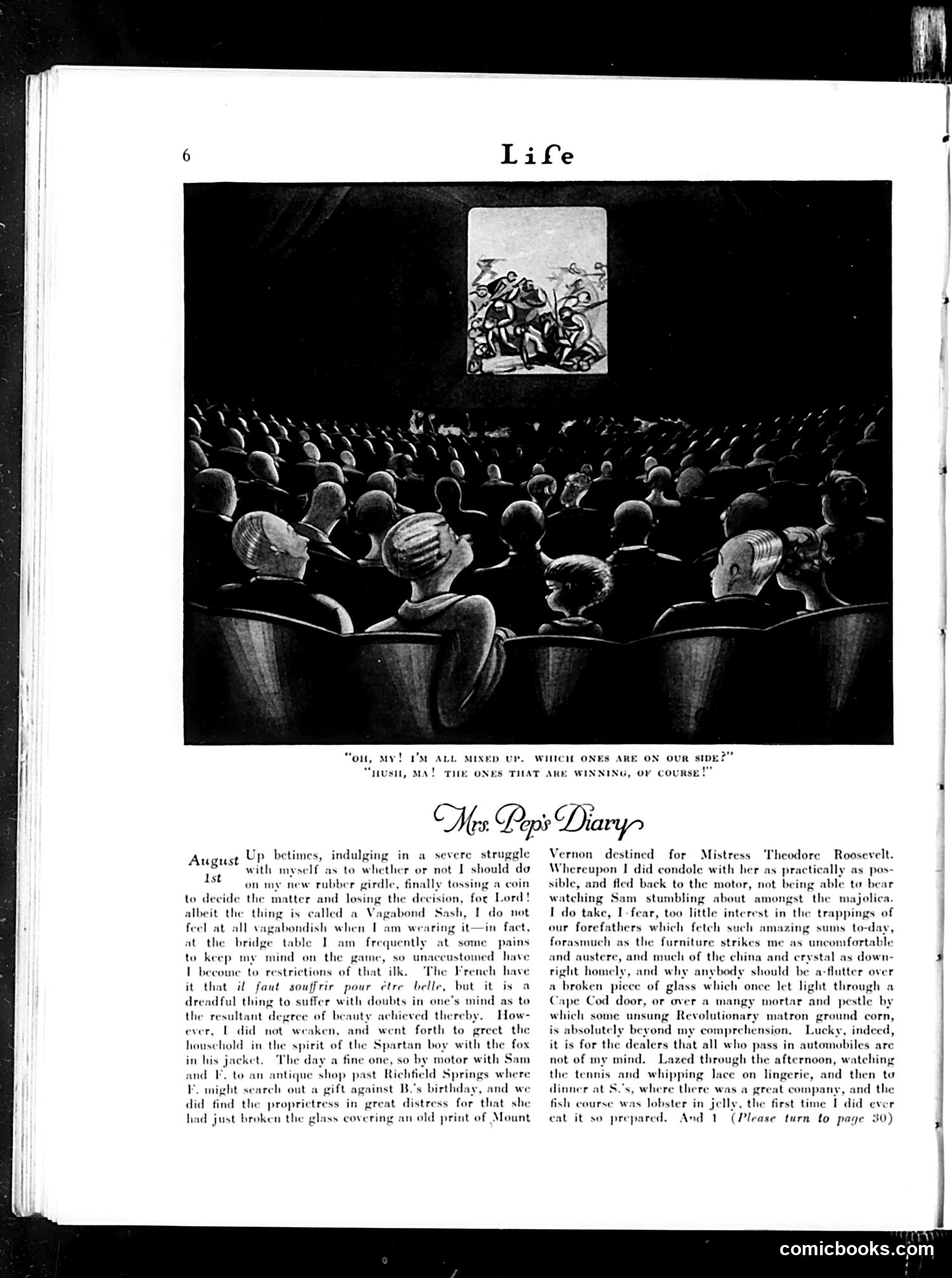
This page from *Life* magazine features a cartoon depicting a movie theater audience watching a film. The caption quotes confused viewers debating which side they're rooting for ("Oh, my! I'm all mixed up. Which ones are on our side?" / "Hush, Ma! The ones that are winning, of course!"). The accompanying text is "Mrs. Pep's Diary," dated August 1st, a personal essay recounting domestic activities—shopping, visiting Richfield Springs, attending a tennis match, and dining at a restaurant. The cartoon satirizes how average Americans consume entertainment, suggesting viewers judge films purely by excitement or spectacle rather than narrative clarity or moral positioning. The joke—rooting for "the ones that are winning"—mocks shallow patriotism and the public's preference for entertainment value over meaningful content.
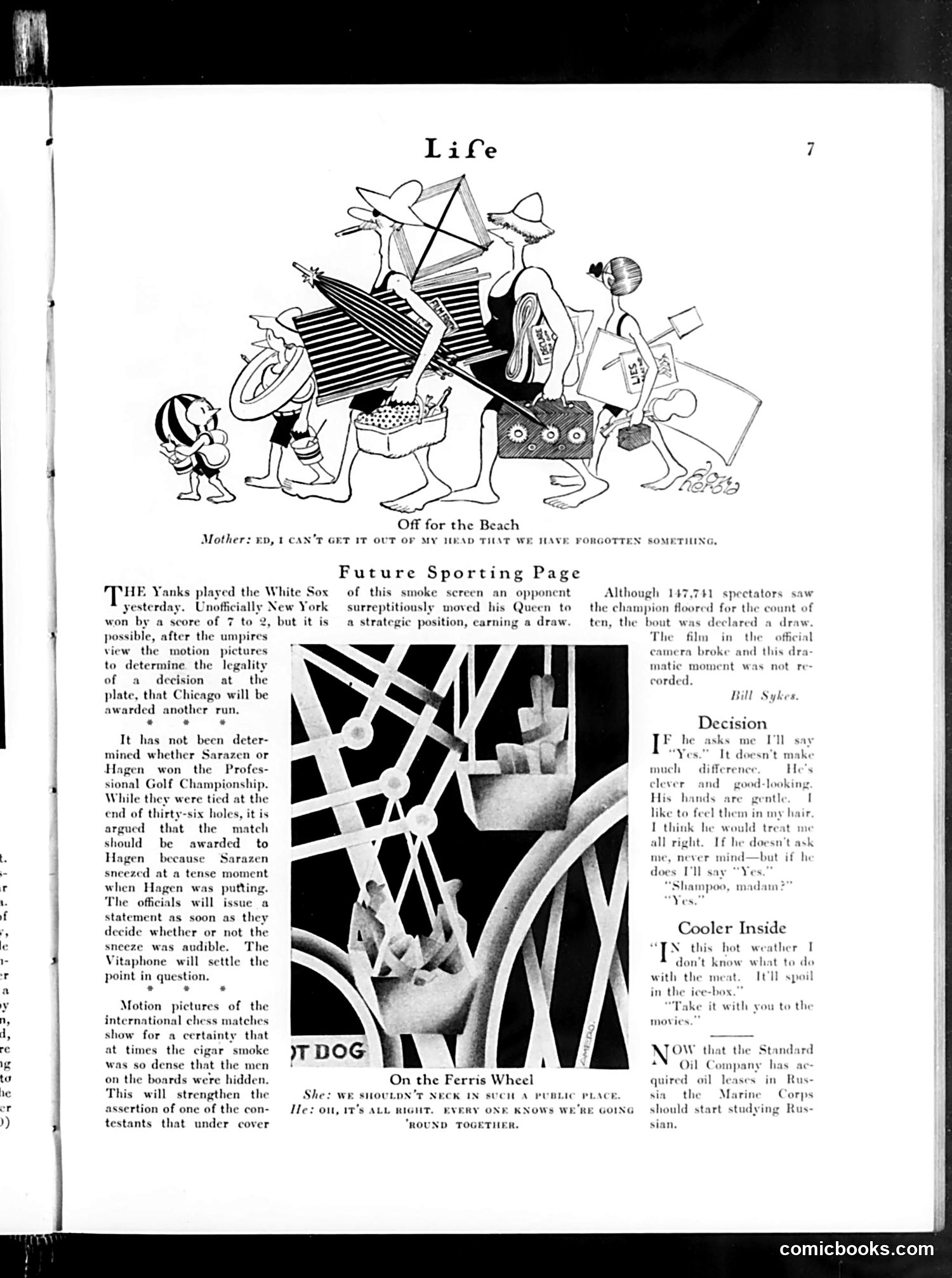
This page contains three distinct sections: 1. **"Off for the Beach"** - A humorous cartoon showing a family struggling to transport vacation gear, with the mother's caption lamenting forgotten items. It satirizes the chaos of family beach trips. 2. **"Future Sporting Page"** - Text discussing baseball (Yankees vs. White Sox) and golf championship disputes, representing early 20th-century sports coverage concerns. 3. **"On the Ferris Wheel"** - A photograph with accompanying dialogue between a couple, humorously depicting public romantic behavior. The captions suggest the couple's awkwardness about public displays of affection, with the man's comment about everyone watching them "going 'round together" implying social disapproval of such intimate public moments. The page reflects period attitudes toward propriety and family life in what appears to be the 1920s.
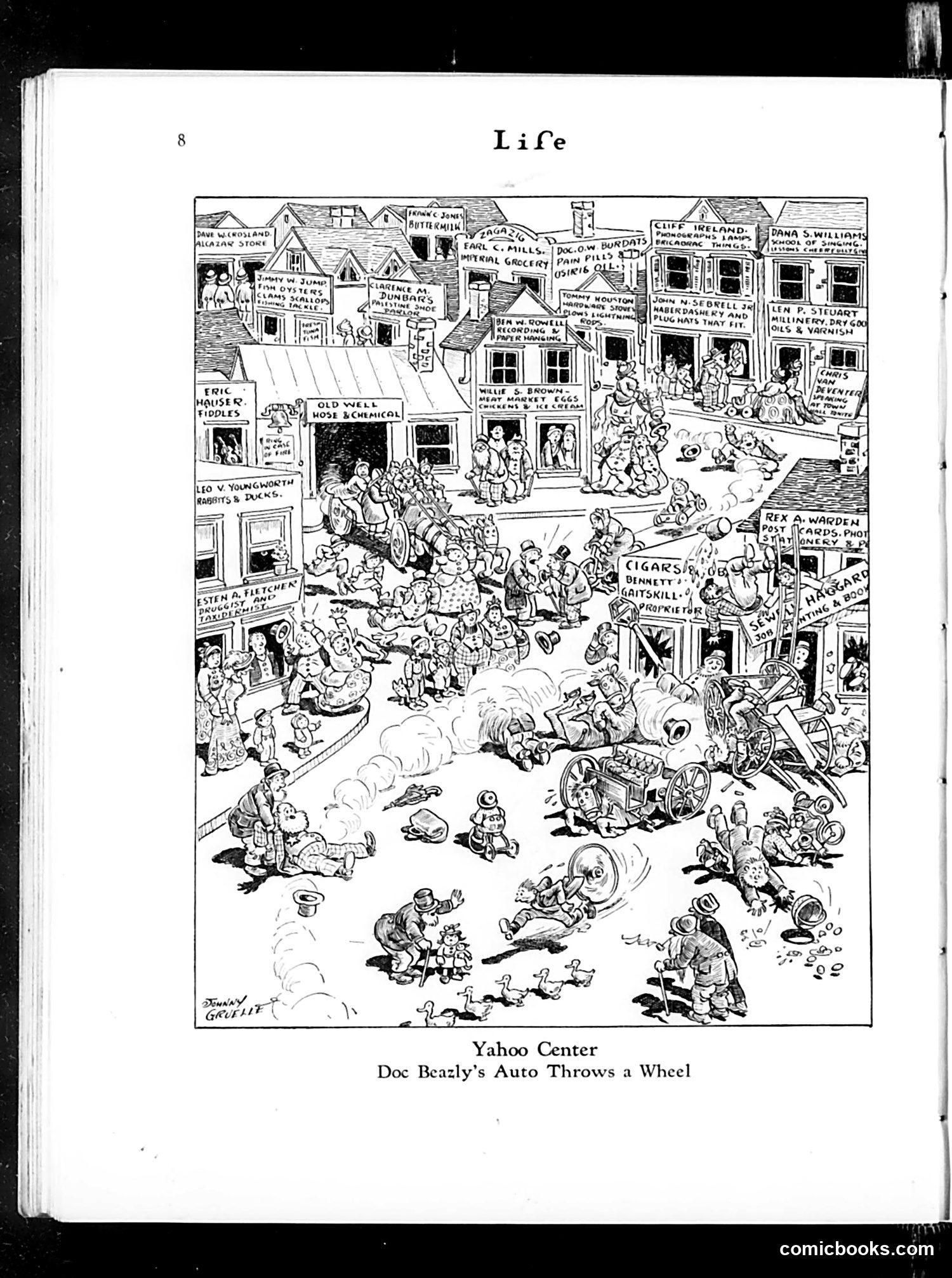
This is a crowded street scene satirizing early automotive culture. A vehicle has lost its wheel in the center of "Yahoo Center," causing chaos in what appears to be a busy commercial district. Multiple cars are piled up or overturned, while pedestrians scatter and react to the mayhem. The cartoon mocks the dangers and disruptions caused by early automobiles—then still novel and unreliable machines. The numerous storefronts with visible business names suggest this is a prosperous downtown area now disrupted by automotive accidents. The scene satirizes both the hazards of early motoring and the general chaos these new vehicles introduced to established urban life. The title character "Doc Beazly" appears to be responsible for this catastrophic mishap.
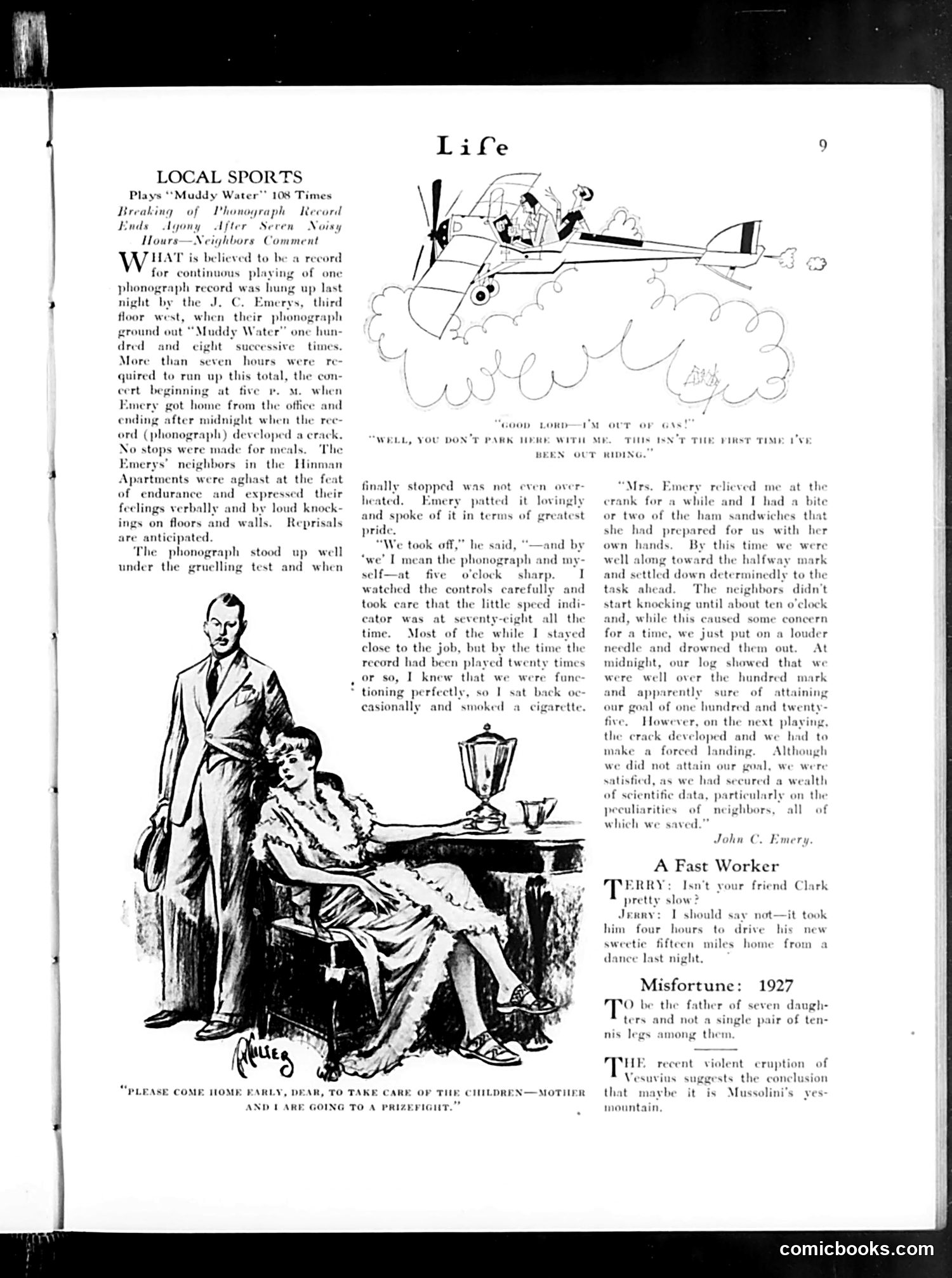
This page contains humorous anecdotes and illustrations rather than political cartoons. The main content includes: **"Local Sports"** - A brief item about a phonograph record-playing endurance contest, featuring a cartoon of people in an airplane labeled "Good Lord—I'm out of gas!" The joke satirizes both the obsession with breaking records and the absurdity of contestants playing "Muddy Water" repeatedly. **Lower illustration** - Shows a man telling a woman: "Please come home early, dear, to take care of the children—Mother and I are going to a prizefight," satirizing priorities where entertainment outweighs childcare responsibilities. The remaining text includes short humorous exchanges ("A Fast Worker") and a note about Vesuvius's 1927 eruption. The overall tone is light domestic satire typical of 1920s American humor magazines.
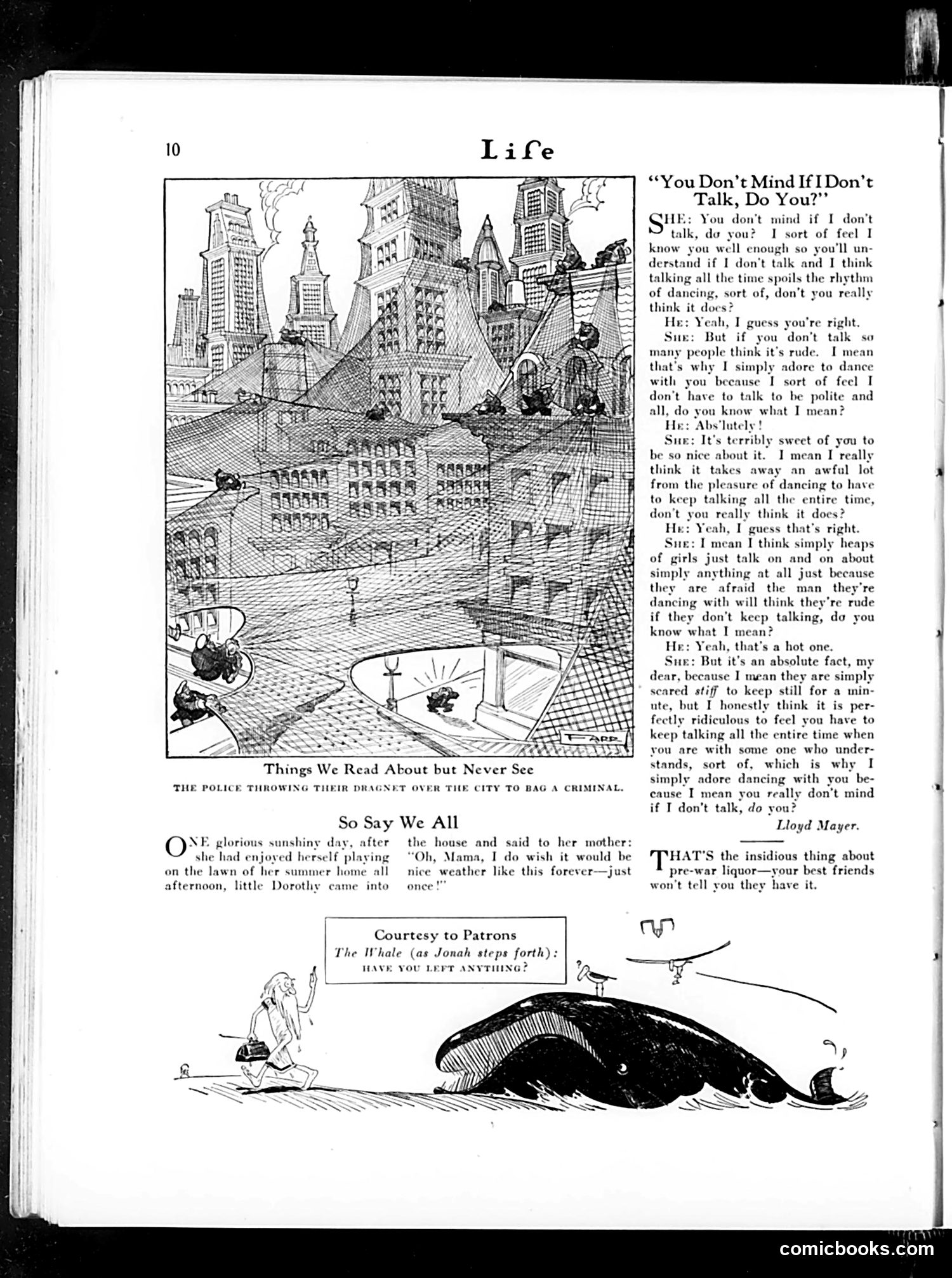
**Top Cartoon**: "Things We Read About but Never See" depicts police throwing a dragnet over a city to catch a criminal. This is satirizing the gap between newspaper headlines about police efficiency and actual crime-fighting results—readers see dramatic stories but rarely see criminals actually captured. **Main Article**: "You Don't Mind If I Don't Talk, Do You?" is a dialogue between a man and woman about dancing silently together. He appreciates not having to maintain polite conversation; she defends women's constant talking as nervousness around men. The piece satirizes gender stereotypes about female chattiness and dating etiquette of the era. **Lower Cartoon**: "Courtesy to Patrons" shows a whale asking "Have you left anything?" to a small figure, likely satirizing excess consumption or greed.
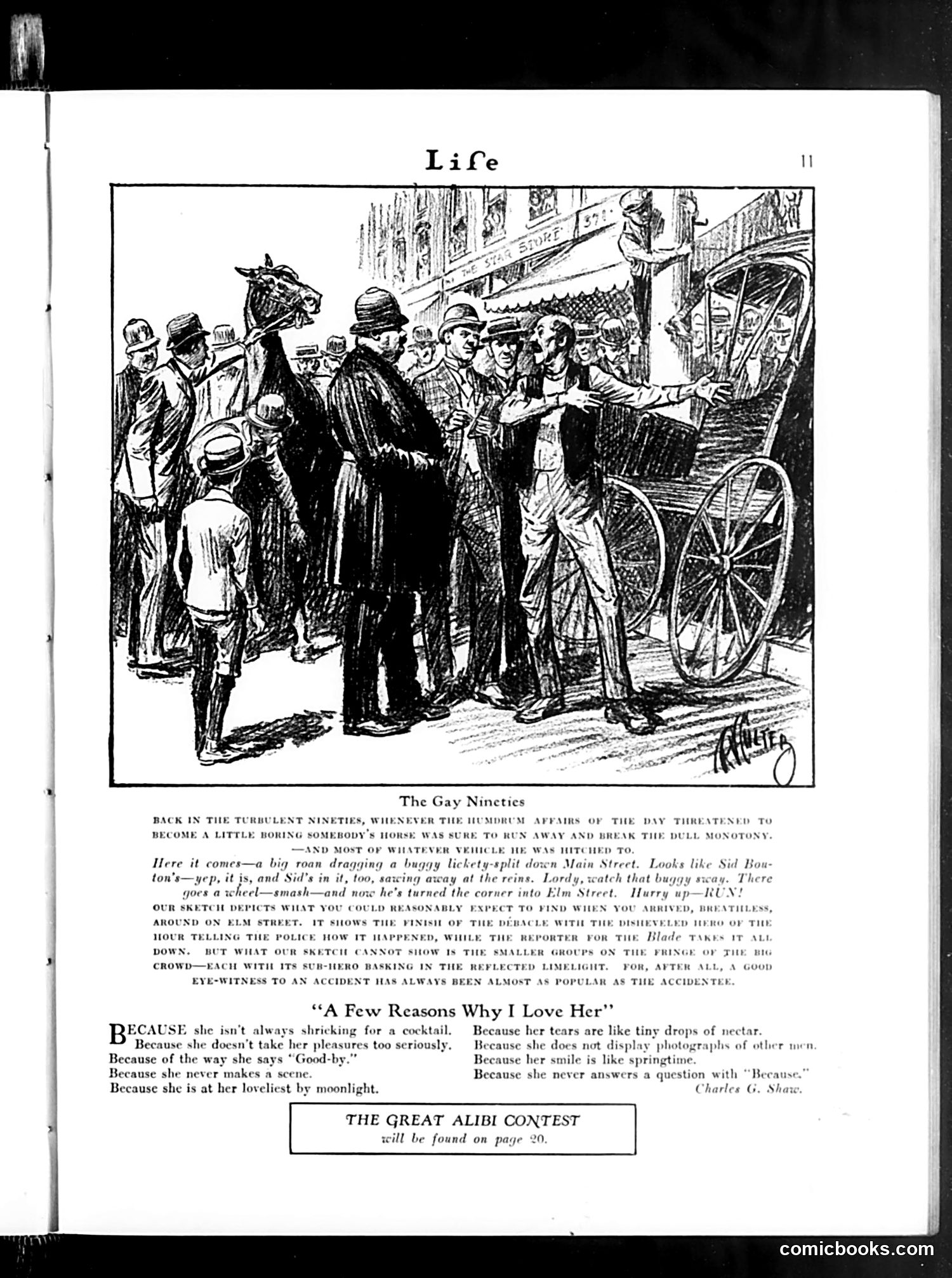
This page contains a satirical sketch titled "The Gay Nineties" depicting a street scene with multiple figures and a horse-drawn carriage. The accompanying text describes a chaotic accident scenario on Elm Street involving a runaway horse and broken vehicles—typical urban mishaps of that era. The humor derives from contrasting the period's romanticized nostalgia for the 1890s with the actual disorder and danger of that time. The sketch mocks both the era itself and contemporary readers who idealize it. Below, a humorous piece titled "A Few Reasons Why I Love Her" by Charles G. Shaw offers satirical observations about women, using wit typical of early 20th-century magazines—gentle mockery of romance and gender dynamics. The page also advertises "The Great Alibi Contest" on page 20, promoting reader participation in a competition.
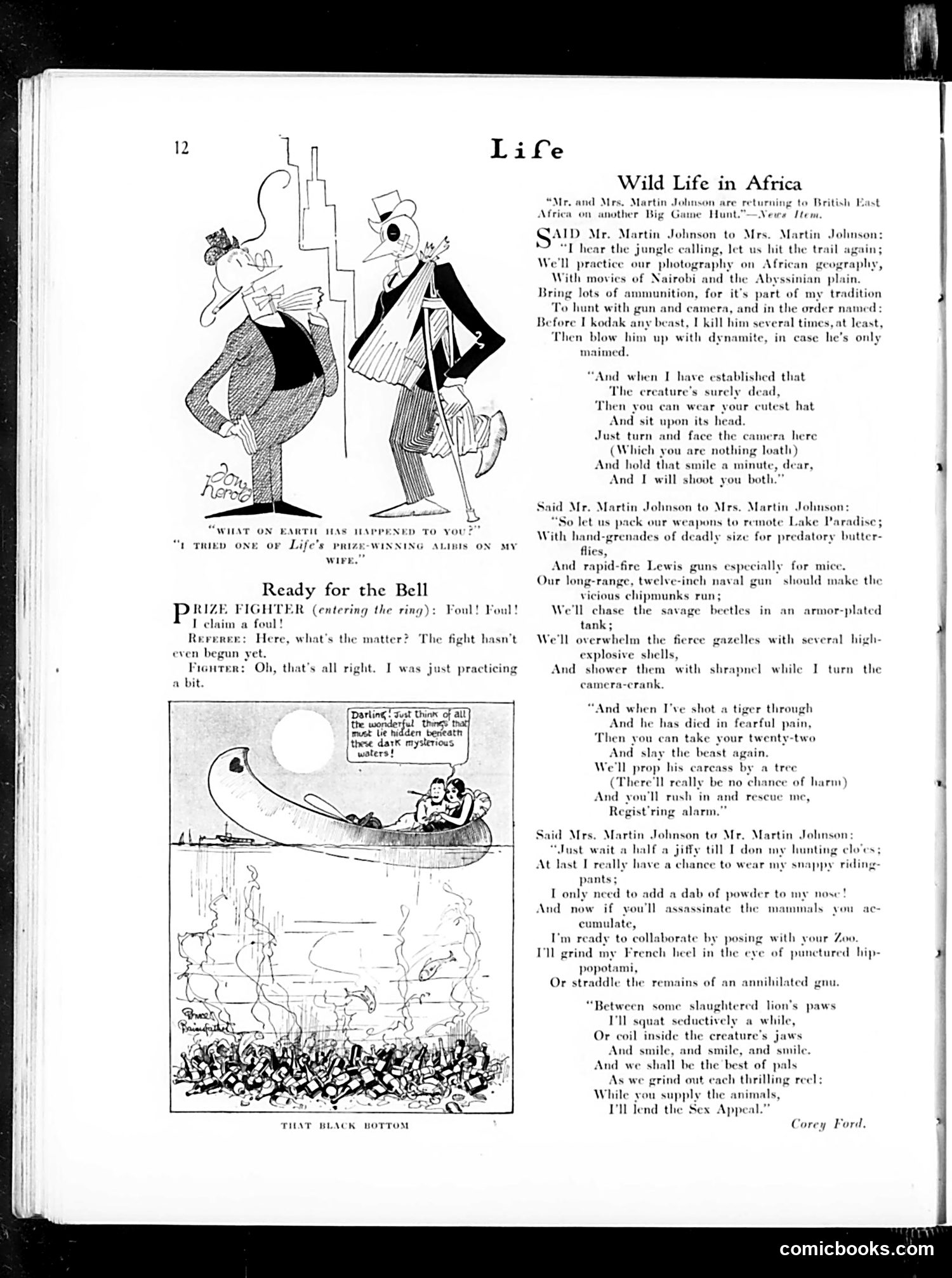
This page satirizes Mr. and Mrs. Martin Johnson, real-life explorers and wildlife photographers preparing for an African expedition. The cartoon mocks their ambitions through exaggerated dialogue where Mr. Johnson describes elaborate (and absurd) hunting and photography plans—including dynamite, Lewis guns, grenade launchers, and armor-plated tanks to document animals. The humor lies in the contrast between their stated goal of "photography on African geography" and the militaristic overkill proposed. Mrs. Johnson's responses parody the adventurous spouse, mentioning her hunting outfit and willingness to collaborate. The accompanying illustrations—showing a couple in a small boat and chaotic animal scenes—reinforce the satire of wealthy adventurers attempting serious wildlife documentation through comic incompetence. The piece ridicules early 20th-century safari tourism and documentary filmmaking as theatrical excess rather than scientific pursuit.
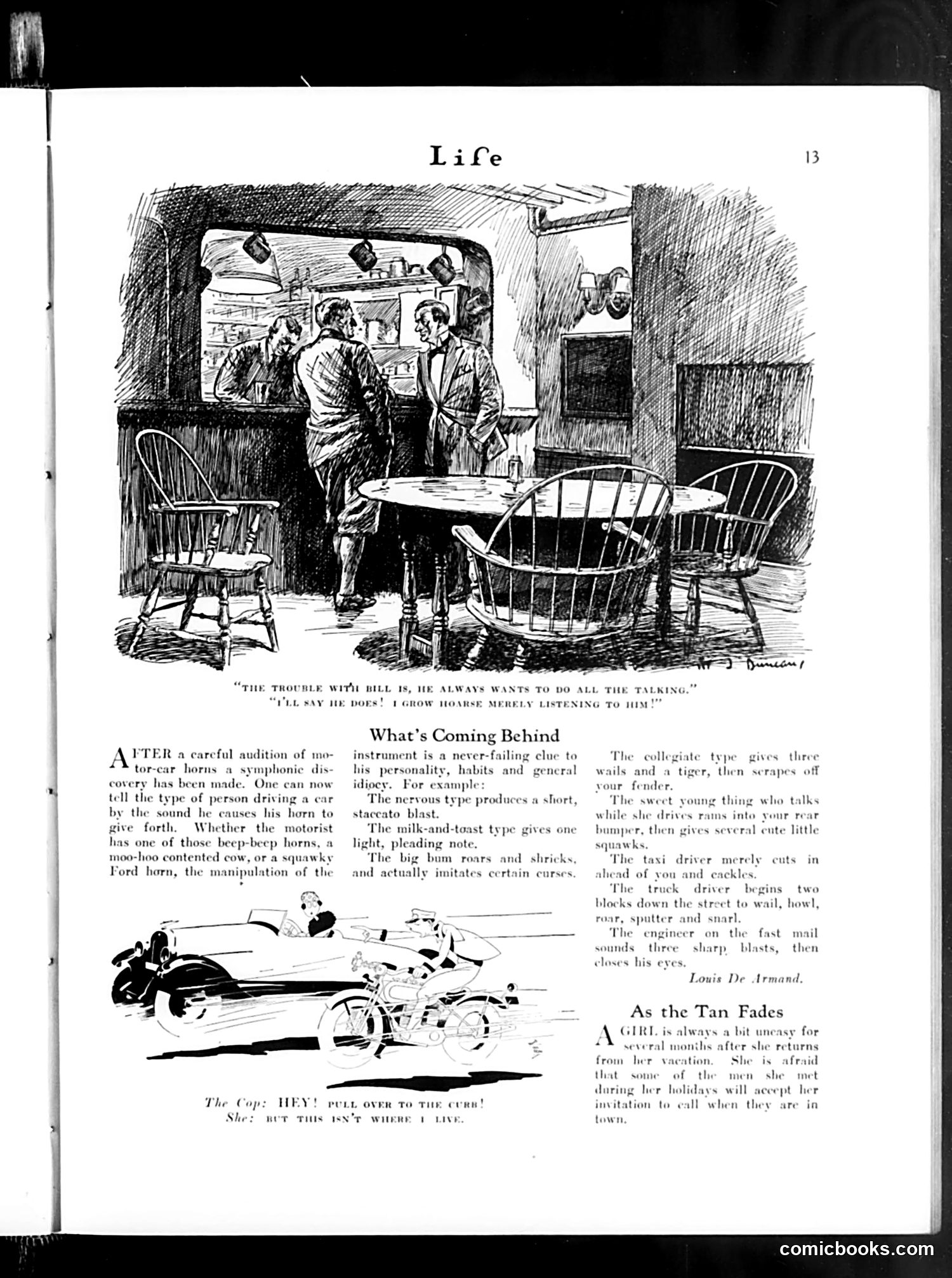
This page contains two distinct pieces of humor content from an early 20th-century American satirical magazine. The top cartoon depicts men in what appears to be a speakeasy or informal bar setting, with the caption about "Bill" always wanting to do all the talking. The joke plays on personality types—specifically the verbose, dominating conversationalist. The middle section, titled "What's Coming Behind," uses automobile horn sounds as a satirical device to characterize different driver types: nervous drivers producing short blasts, milk trucks giving pleading notes, and truck drivers creating elaborate sound effects. The accompanying cartoon shows a bicycle rider encountering traffic. The bottom section, "As the Tan Fades," discusses a woman's social situation post-vacation, suggesting humor about the contrast between holiday romance and real-life social realities. The overall tone reflects early automotive-age American humor and social observation.
This page discusses the Sacco and Vanzetti case, a controversial 1920s legal affair where two Italian immigrants faced execution for alleged murder. The left column explains that despite Massachusetts authorities' efforts to execute them, the case sparked international outcry and political sympathy among those who believed the trial was unfair. The right column discusses Governor Coolidge's refusal to intervene, framing it as political cowardice. It then pivots to praising General Wood's character and integrity. The skull illustration (top left) likely symbolizes the death sentence hanging over Sacco and Vanzetti. The satirical point appears critical of the legal establishment's handling of the case and judicial prejudice against the defendants.
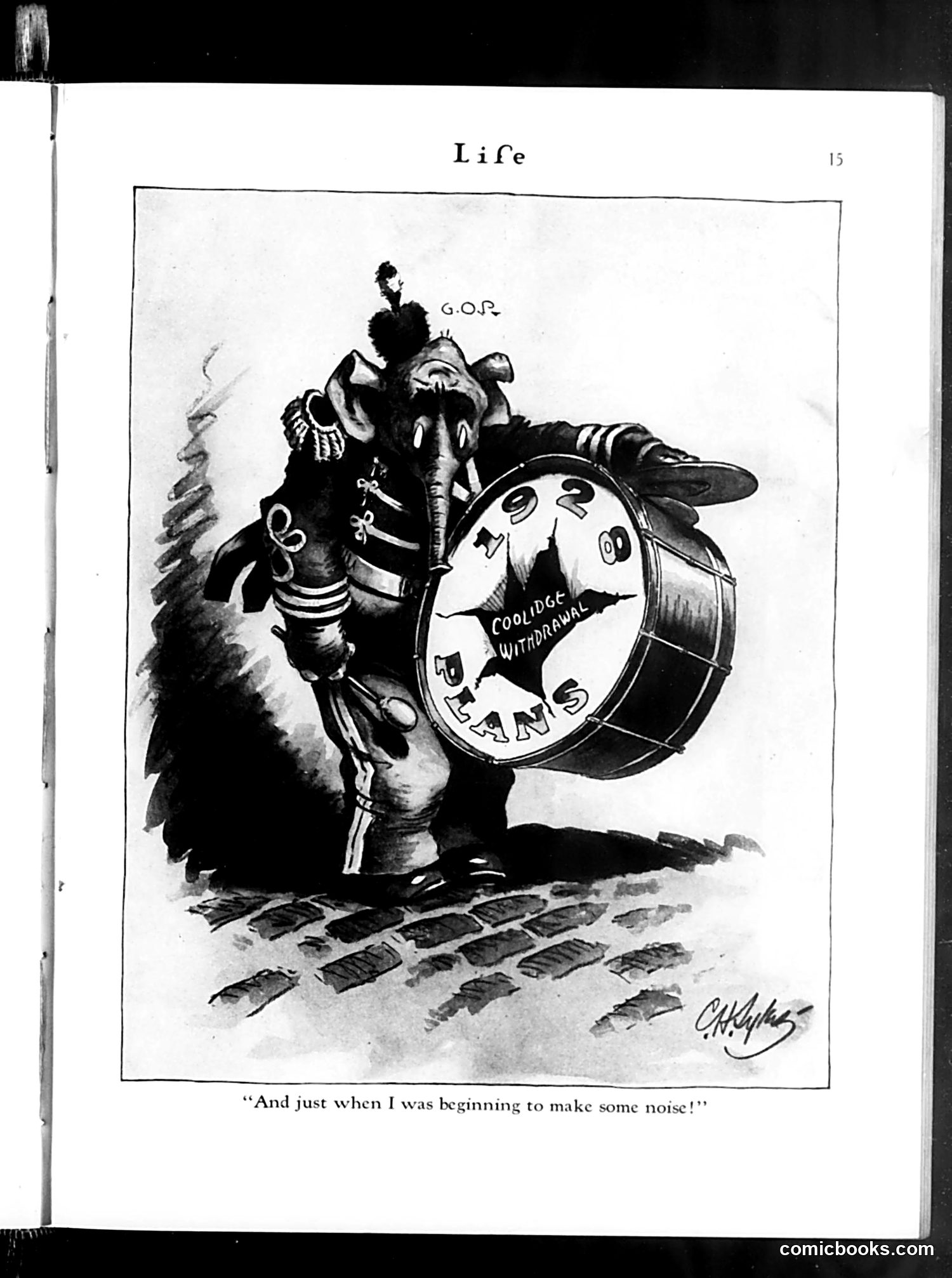
This Life magazine cartoon satirizes President Calvin Coolidge's political withdrawal. The figure labeled "G.O.P." (Republican Party) rides an elephant—the traditional Republican symbol—while holding a bass drum labeled "Coolidge Withdrawal Plans." The scattered dollar bills at the bottom suggest financial consequences. The caption reads: "And just when I was beginning to make some noise!" The satire criticizes Coolidge for dampening Republican momentum and campaign energy precisely when the party appeared poised for success. By depicting the elephant as silenced mid-performance, the cartoonist mocks the president's restraint and suggests his withdrawal strategy undermines the party's political fortunes. This reflects contemporary frustration with Coolidge's cautious, hands-off governing style during the prosperous 1920s.
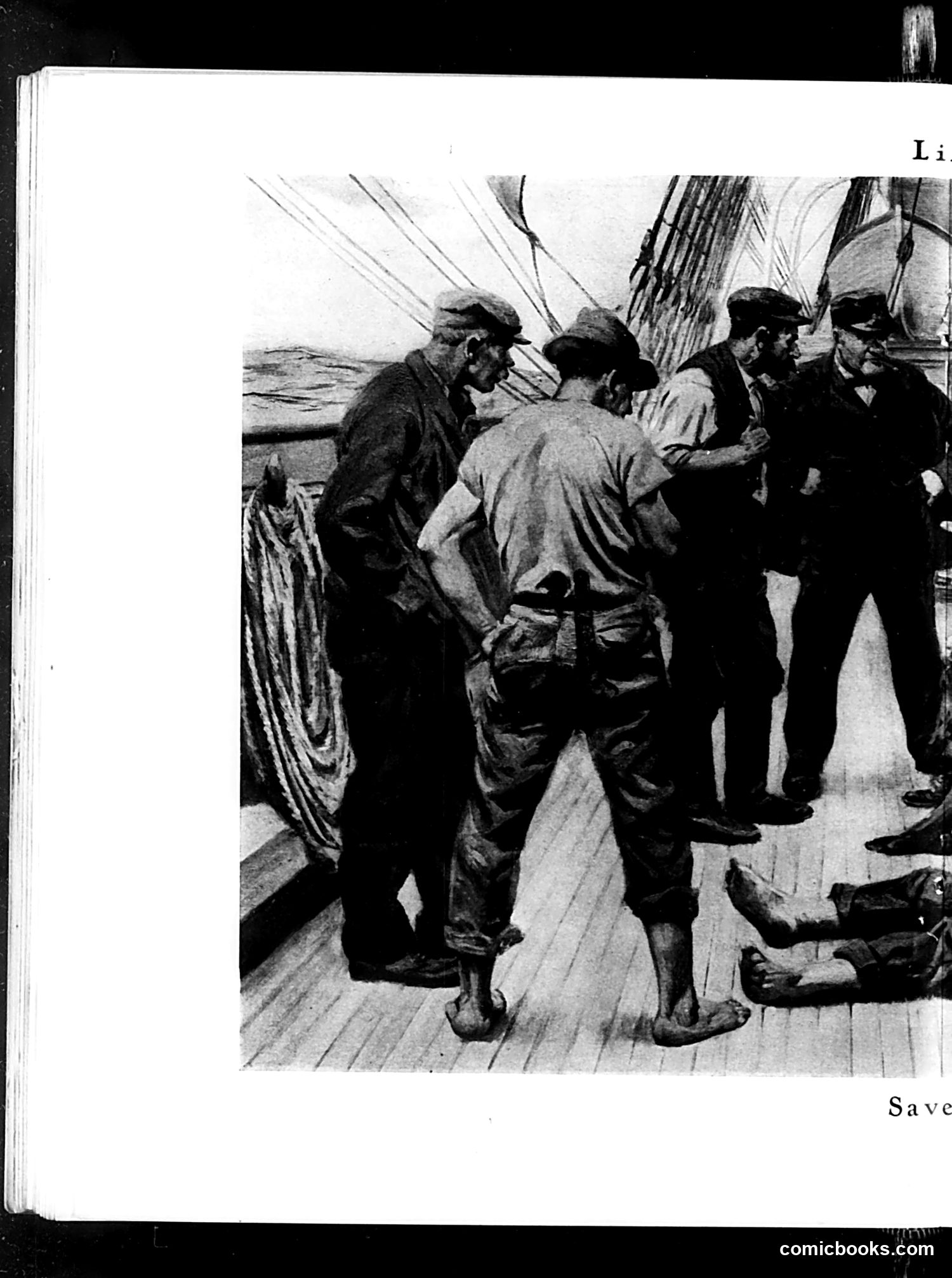
This appears to be a historical photograph rather than a cartoon, showing several men in period clothing gathered on the deck of a sailing ship. The image quality and black-and-white format suggest early-to-mid 20th century publication. The partial text visible ("Li" at top right and "Save" at bottom right) is insufficient to determine the specific context or subject matter. Without complete caption or article text, I cannot identify the figures, the ship, the event being documented, or the satirical point Life magazine intended to make. The photograph documents what appears to be some kind of gathering or meeting aboard a vessel, but the historical or political reference remains unclear from the image alone.
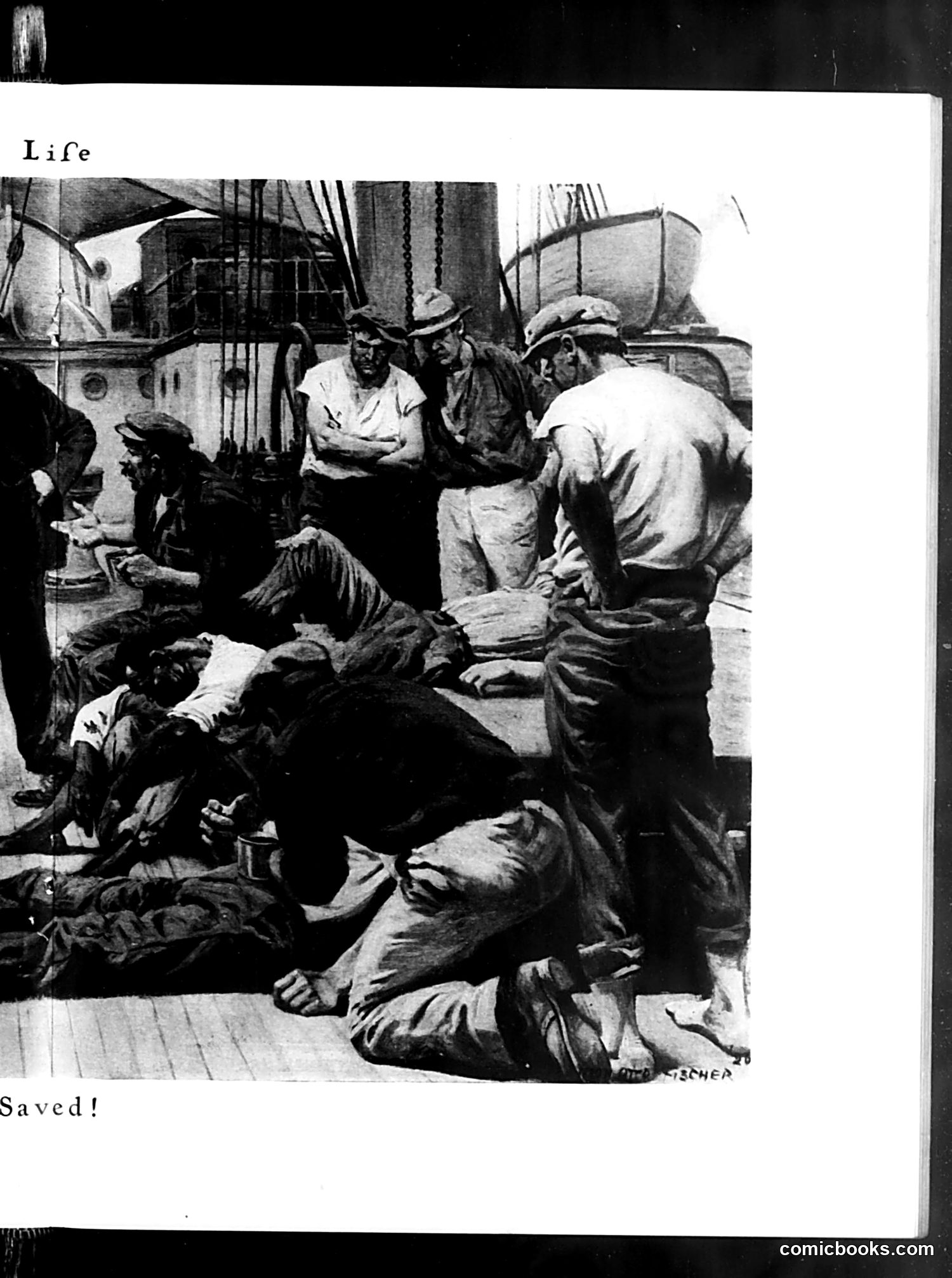
This page from *Life* magazine shows a dramatic rescue scene on a ship deck. The title "Life / Saved!" frames the image as celebrating human survival and intervention. The photograph depicts sailors and crew members attending to what appear to be shipwreck survivors lying on the deck. The composition emphasizes the contrast between active rescuers (standing, alert) and rescued individuals (prone, vulnerable). The vessel's rigging and lifeboats visible in the background establish the maritime emergency context. Without additional text or caption, the specific historical incident remains unclear. However, the page appears to use this dramatic rescue as an illustration of heroism and human compassion—typical themes for *Life* magazine's satirical yet humanistic approach. The image likely commented on maritime safety, survival, or moral duty during an era when such disasters were newsworthy.
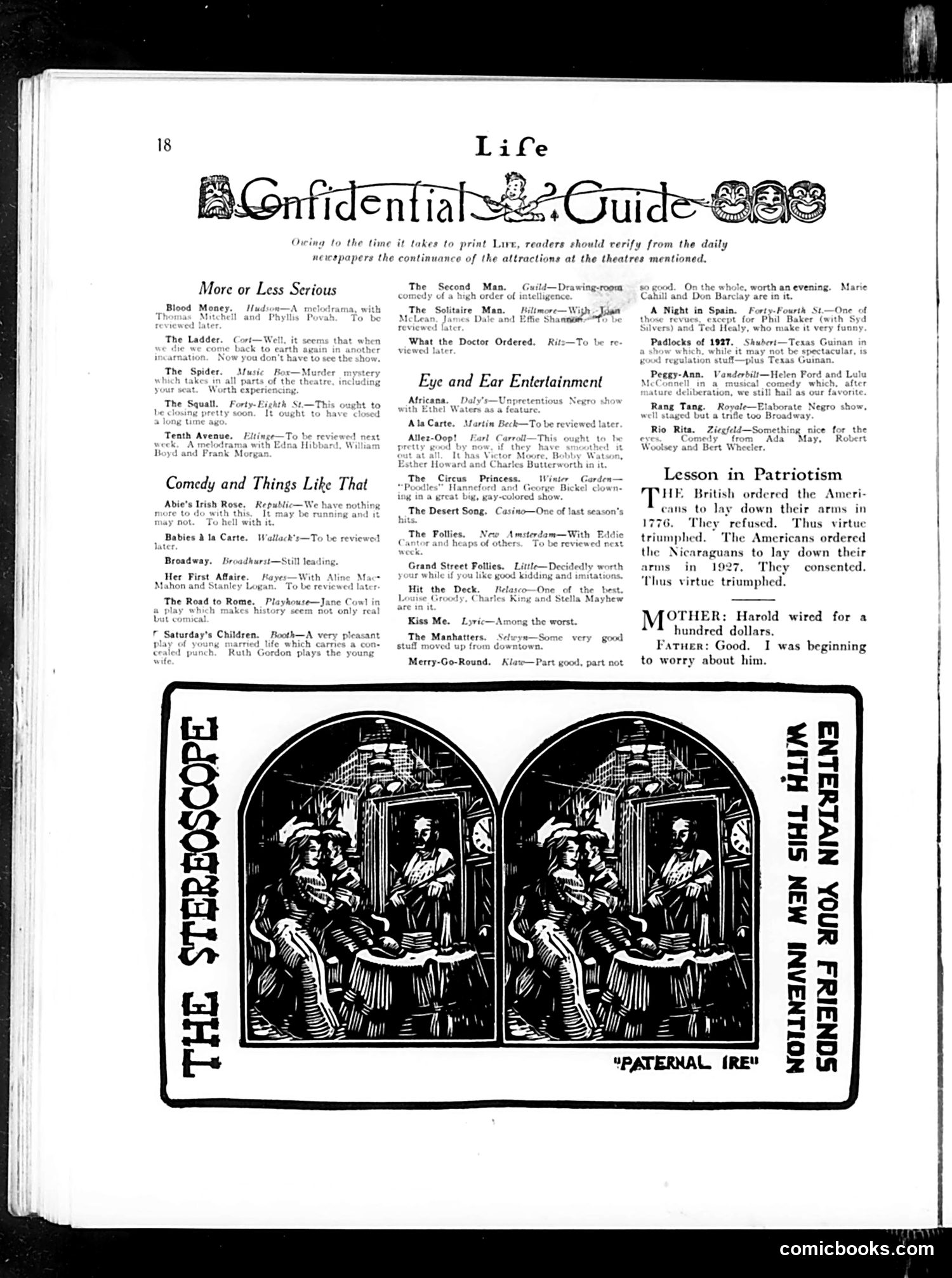
This page is primarily a **theatre guide and review section** with advertising, not a political cartoon. However, the small section titled "Lesson in Patriotism" contains sharp satirical commentary. The satire contrasts British and American imperial behavior: In 1776, Britain ordered American colonists to surrender their arms; the Americans refused, which Life frames as virtuous resistance. Yet in 1927, America ordered Nicaraguans to disarm, and they complied—which Life mockingly calls equally "virtuous." The joke exposes American **hypocrisy and imperialism**. What Americans celebrated as justified rebellion against British authority, they now impose on weaker nations. The parallel structure reveals that "virtue" is merely a self-serving label nations apply to their own actions while condemning identical behavior in others. The adjacent advertisement below ("Paternal Ire") appears unrelated—a stereoscope entertainment offering.
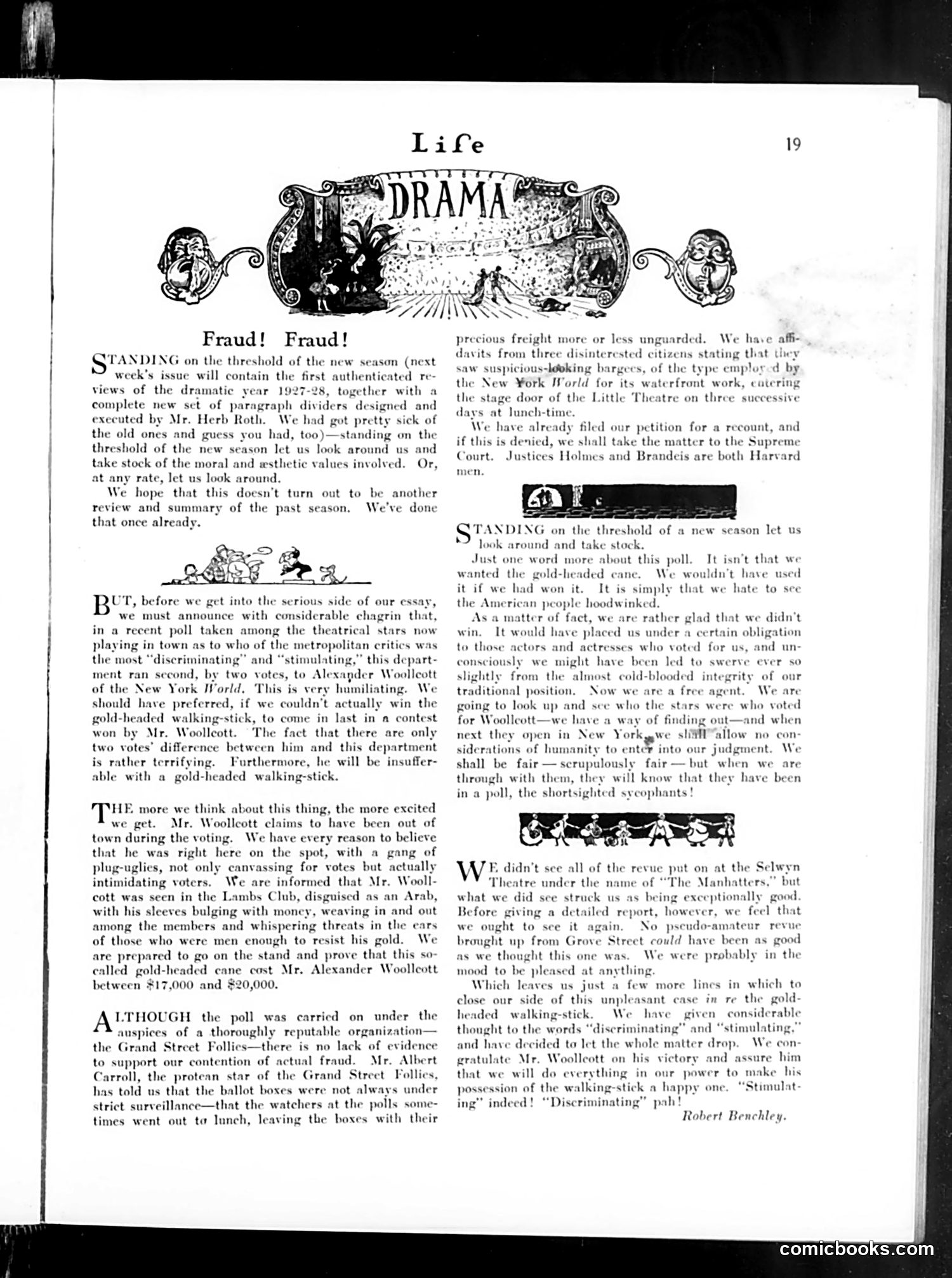
This is a satirical piece about a recent poll of theatrical critics conducted by the Grand Street Follies. The Life drama critic (author Robert Benchley) came second to **Alexander Woollcott** of the New York World in a vote for most "discriminating" critic—with the prize being a gold-headed walking stick. Benchley humorously accuses Woollcott of **election fraud**, claiming he stuffed ballot boxes, intimidated voters at the Lambs Club (a theater industry hangout), and spent $17,000-$20,000 securing votes. He cites suspicious "large barges" seen near the Little Theatre during voting. The satire is self-aware: Benchley pretends outrage while admitting he's actually *relieved* he lost, since winning would obligate him to favorable coverage of those voters' performances—compromising his critical integrity. It's gentle mockery of both Woollcott's prominent status and the theater world's vanity and competitiveness.
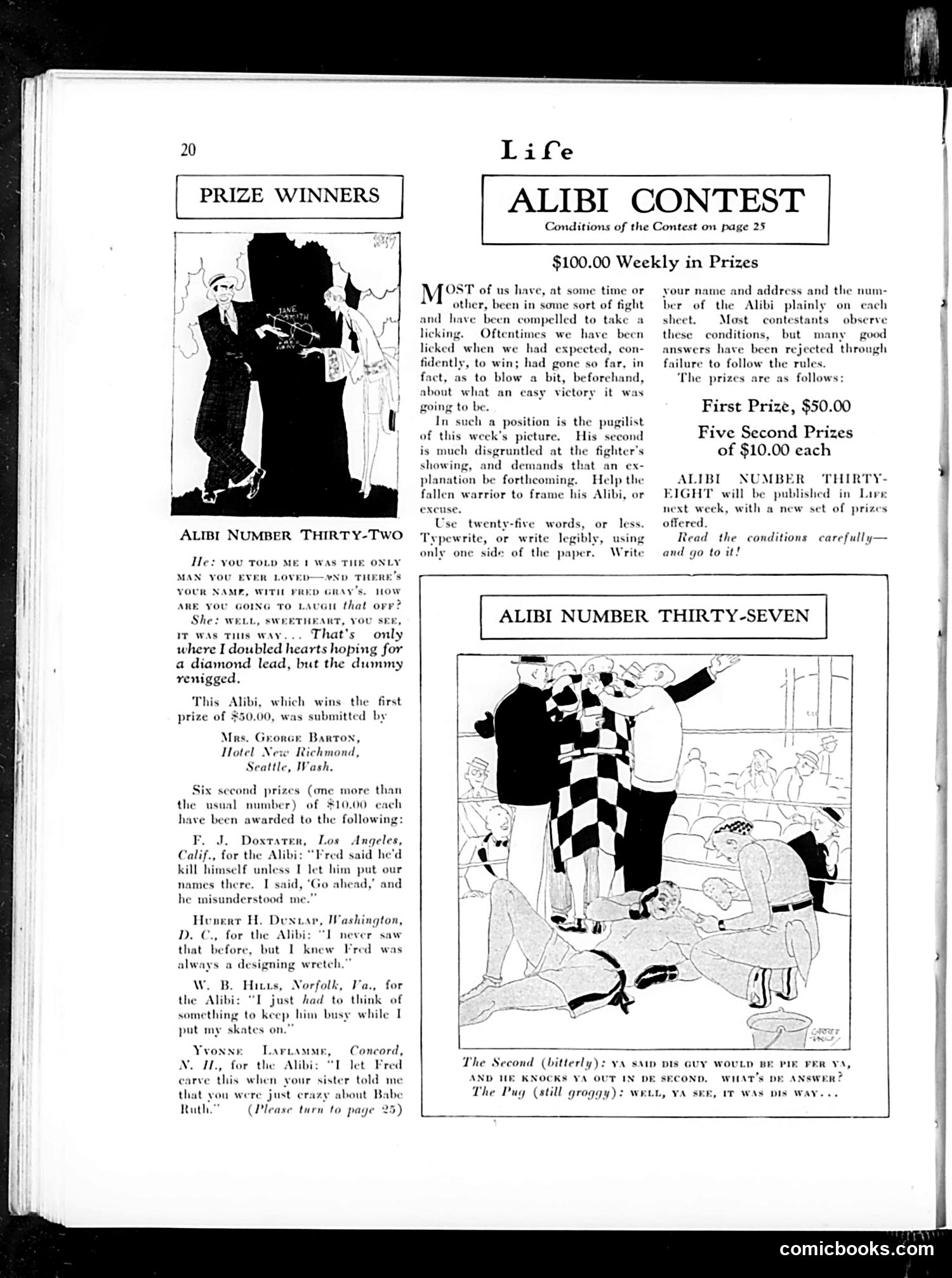
This page showcases **Life's humor contest** where readers submit creative excuses ("alibis") for embarrassing situations. The featured cartoon shows a boxer who's been knocked out in the second round—clearly an upset loss—while his angry manager demands an explanation. The joke format is satirical: readers must invent absurd excuses the defeated boxer might offer. The winning alibi from Mrs. George Barton uses bridge card-game terminology to claim she was distracted by a card game, not actually focused on the fight—a deliberately ridiculous and implausible excuse. The other prize-winning alibis similarly mock romantic infidelity and marital disputes through nonsensical explanations (a woman claims she was thinking about carving something for "Babe Ruth"). The satire targets both the human tendency to make excuses and the absurdity of trying to justify obvious failures. This was popular audience-participation humor in early 20th-century magazines.
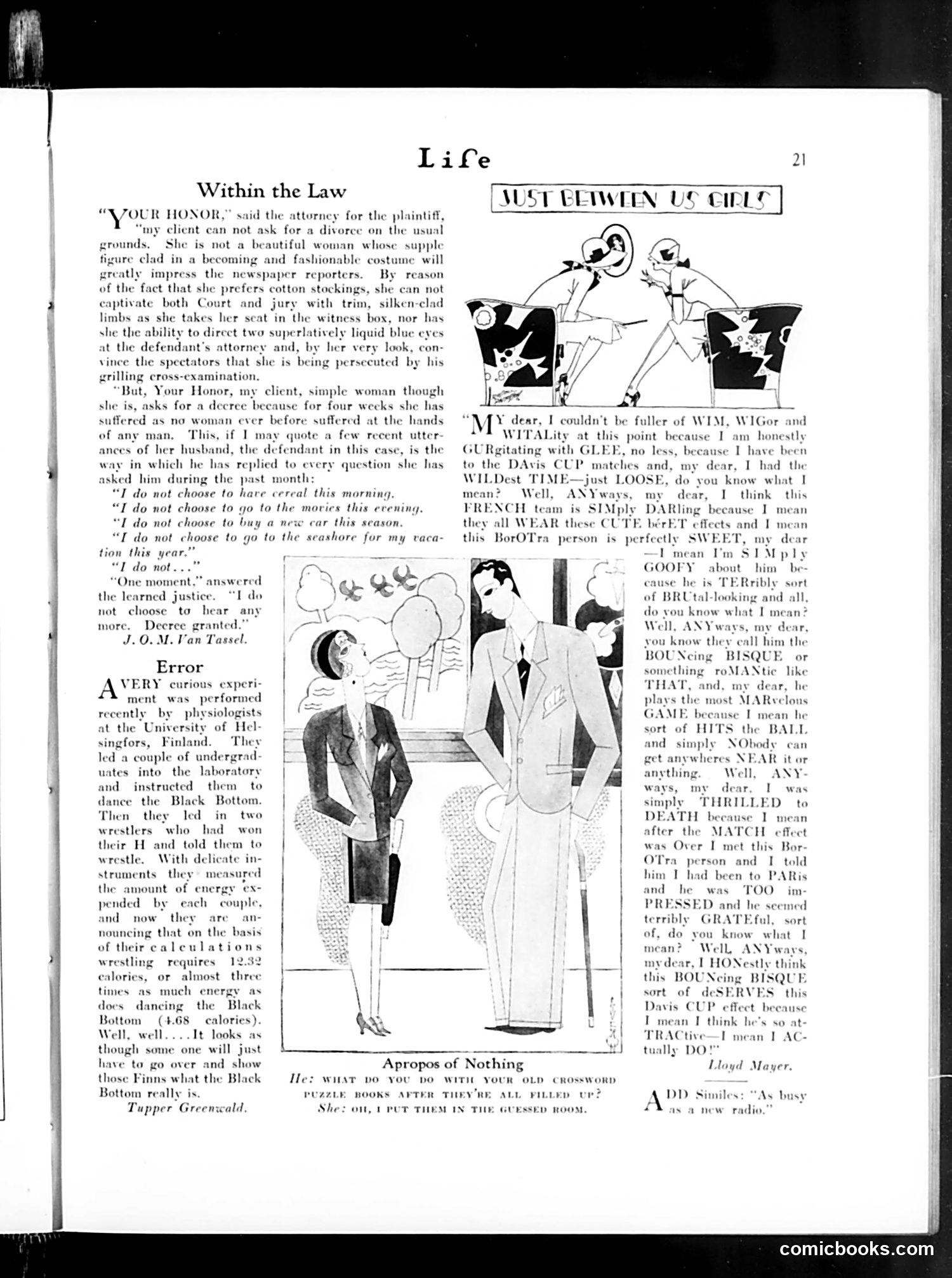
This page contains three satirical pieces typical of 1920s Life magazine humor: **"Within the Law"** mocks a divorce case where a plaintiff's attorney argues his client deserves divorce because her husband repeatedly refuses her requests using the phrase "I do not choose to..." The judge, recognizing the absurdity, grants the divorce, suggesting that even refusing trivial domestic requests constitutes grounds for dissolving a marriage. **"Error"** ridicules a Finnish university study claiming wrestling expends more energy than dancing the Black Bottom (a popular 1920s dance). The satire implies the research methodology is flawed—the conclusion seems obviously wrong. **"Just Between Us Girls"** parodies women's gossipy conversation, likely about the Davis Cup tennis tournament and French player Borotra. The affected capitalization and breathless tone mock how society women discuss sports and celebrities with exaggerated enthusiasm and superficiality. All three pieces use humor to critique contemporary social attitudes and behaviors.
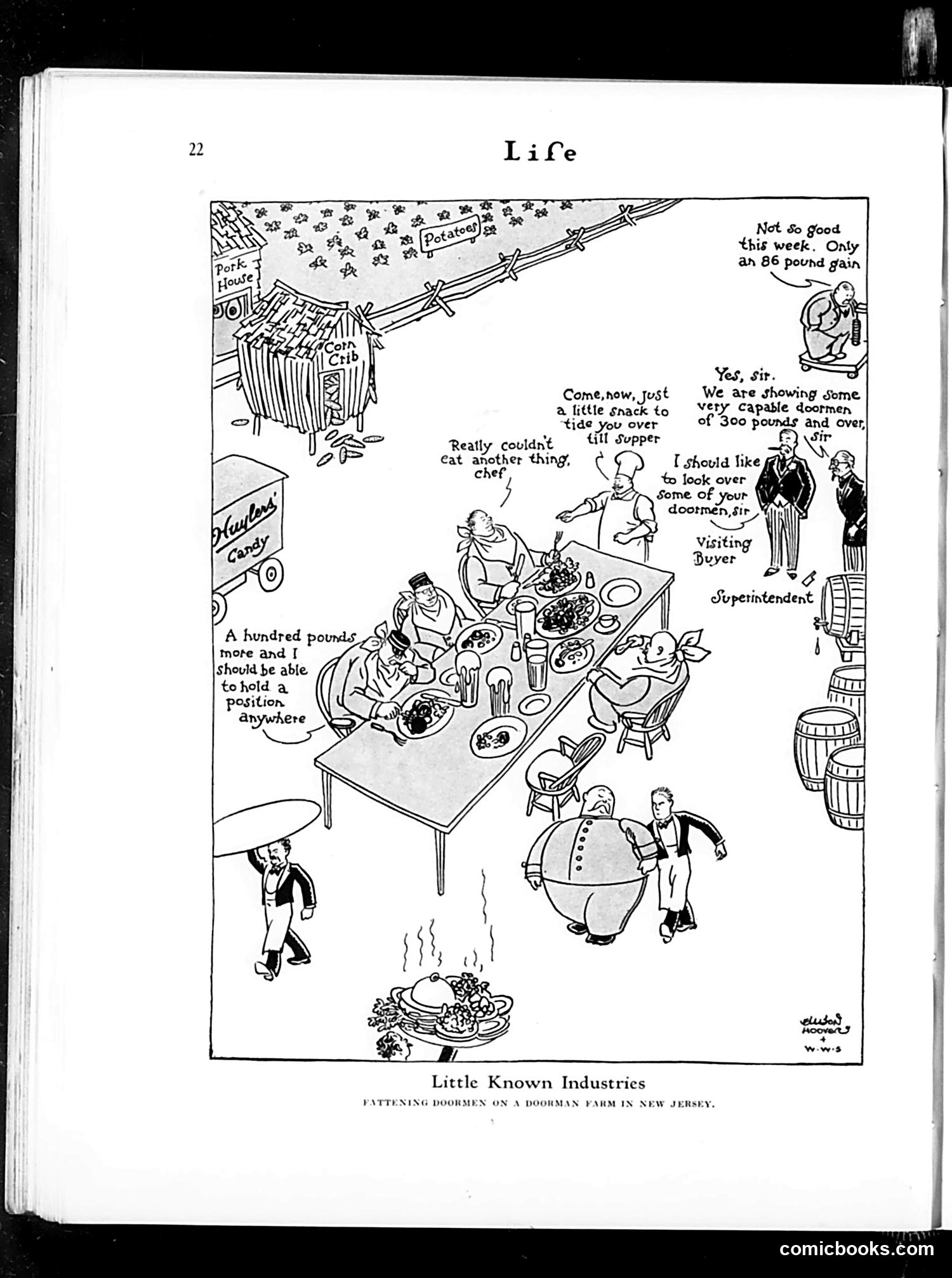
This satirical cartoon mocks the business of fattening doormen on a New Jersey farm. The joke plays on 1920s-era class anxieties and labor management peculiarities. The cartoon depicts a farm operation where overweight doormen are being deliberately fed and fattened like livestock. A visiting supervisor inspects the operation, commenting on the doormen's weight gains (86 pounds this week). The chef protests he "couldn't eat another thing," while a doorman boasts that 100 more pounds would make him qualified for a better position. The satire targets the era's obsession with physical size as a marker of status—particularly in service roles like doormen, where imposing bulk suggested authority and capability. By literalizing this as an actual agricultural operation, the cartoonist ridicules both the labor practices and the absurd class logic that equated weight with professional qualification. The "little known industries" subtitle adds dry humor, treating this absurdity as though it were a legitimate business enterprise.
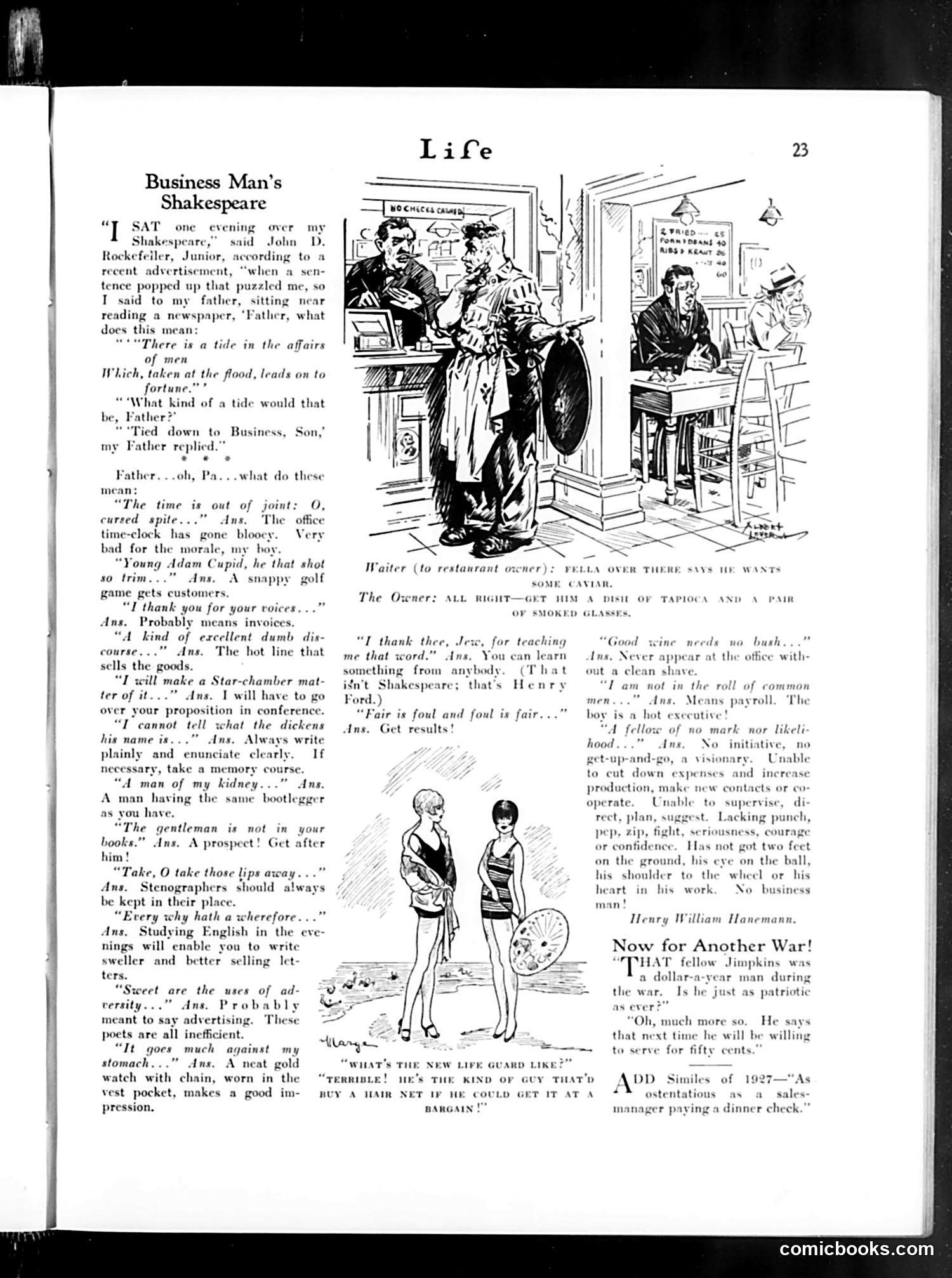
This satirical piece mocks the literalist, profit-driven mentality of American businessmen by having them reinterpret Shakespeare through a commercial lens. The humor centers on reducing profound literary passages to business jargon and cynical practicality. The main conceit attributes these absurd reinterpretations to John D. Rockefeller Jr. and his father, though the point is broader—any businessman would strip Shakespeare of meaning. Examples: "There is a tide...leads to fortune" becomes advice to focus on business; "I thank you for your voices" means "invoices"; "sweet are the uses of adversity" is about advertising rather than wisdom. The accompanying cartoons reinforce this theme—a restaurant owner serves a customer caviar through the lens of penny-pinching (tapioca instead), and various scenes show businessmen unable to grasp anything beyond transaction and profit. This attacks 1920s business culture's philistinism and materialism, suggesting that commercial success corrupts intellectual and aesthetic appreciation.
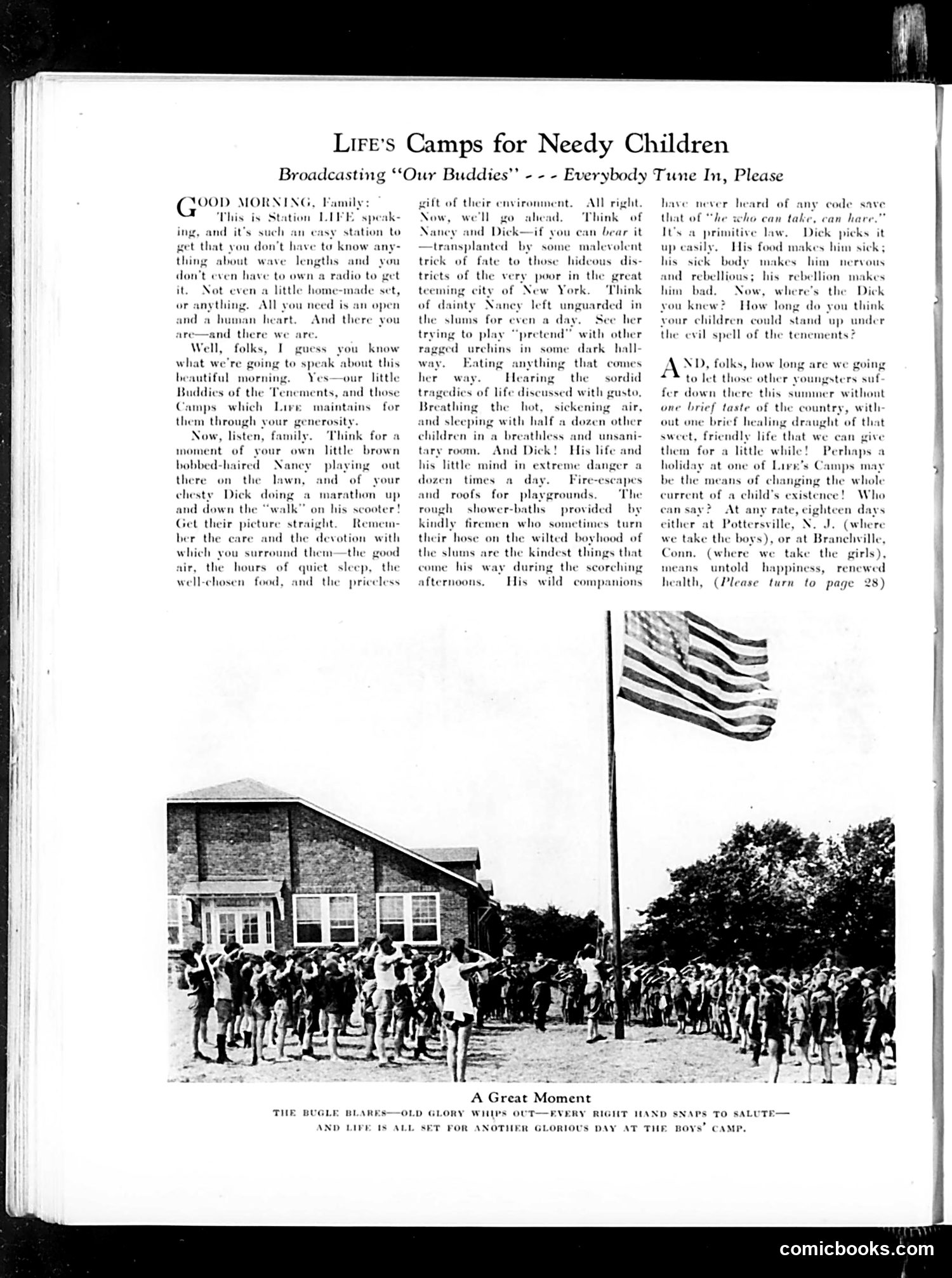
This is a charitable appeal—not satire—promoting Life magazine's real summer camps for poor urban children. The text contrasts two childhoods: privileged children like "Nancy" and "Dick" enjoying safe, nurturing home environments versus tenement children exposed to disease, crime, and neglect in New York's slums. The accompanying photograph shows the flag-raising ceremony at the boys' camp, depicting organized, patriotic structure meant to reassure donors that their contributions provide moral uplift alongside recreation. The "broadcast" framing mimics popular radio programs of the era, using informal, folksy language ("listen, family") to make charitable giving feel accessible and urgent. The appeal argues these camps offer transformative escape—eighteen days in the country providing physical and spiritual renewal for children otherwise condemned to urban poverty's "evil spell." This represents early-20th-century Progressive Era charity: well-intentioned but paternalistic, emphasizing moral salvation through nature and institutional structure.
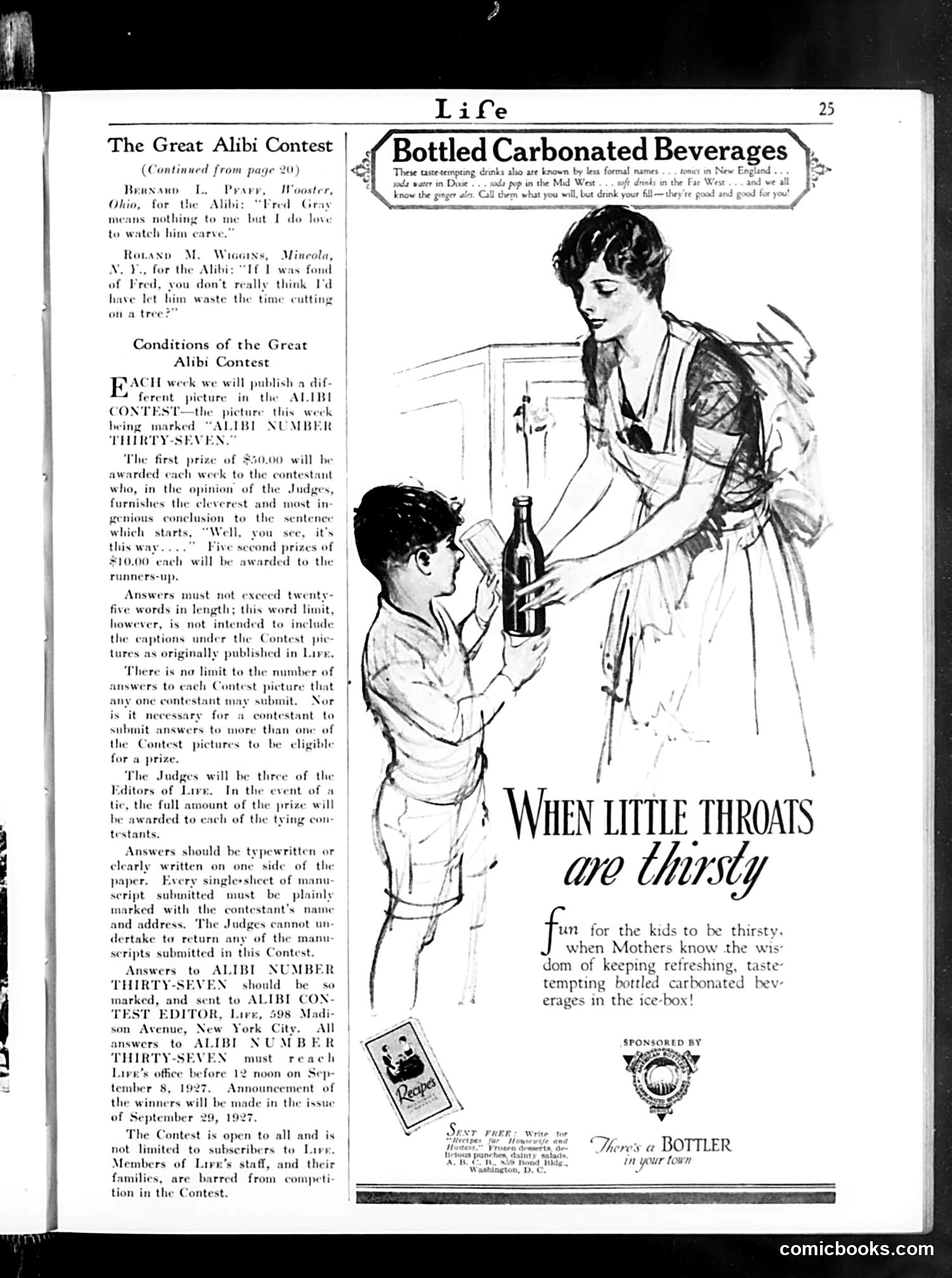
This page contains **two distinct elements**: a continuation of Life's weekly "Alibi Contest" (a humor competition where readers submit witty punchlines to captioned illustrations), and a **sponsored advertisement** for bottled carbonated beverages. The contest shows submissions about "Fred Gray" and tree-carving—likely references to a specific contemporary figure or event now unclear. Readers competed for $50 weekly prizes by completing humorous sentences ("Well, you see, it's this way..."). The **advertisement** uses an illustration of a mother offering a bottle to a thirsty child, promoting carbonated soft drinks as a convenient, wholesome family beverage. The phrase "when little throats are thirsty" frames the product as practical parenting. The note "There's a BOTTLER in your town" encourages local purchasing. This reflects 1920s advertising conventions: beverages marketed through domestic, maternal imagery emphasizing convenience and child appeal—notably without health concerns modern readers would recognize.
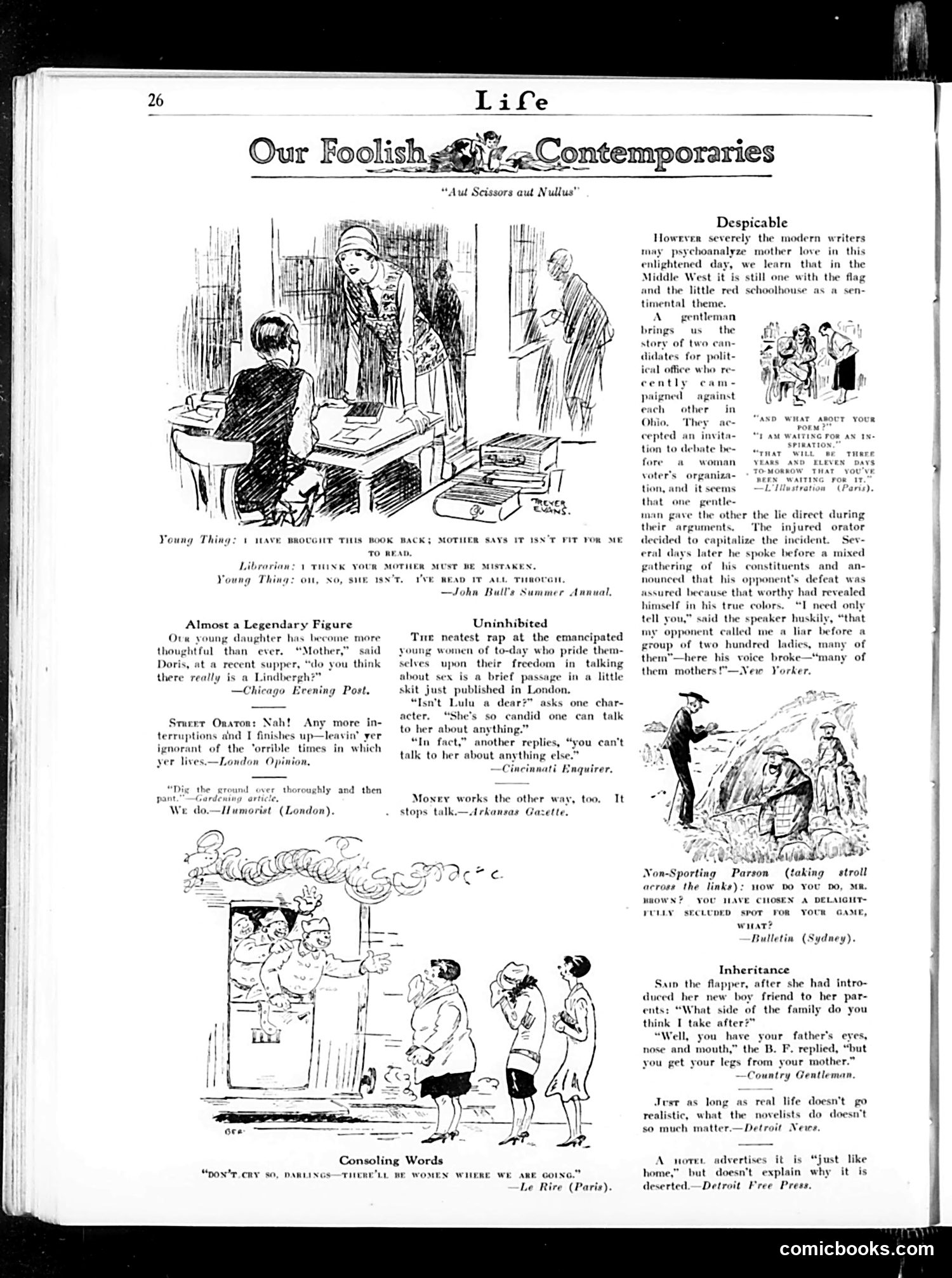
This page collects brief satirical jokes and cartoons mocking contemporary social foibles. Key sections include: **Political Campaign Incident**: Two Ohio political candidates engaged in a debate where one called the other a "liar." The injured party later exploited this before an audience of women, emotionally claiming his opponent "revealed himself in his true colors"—weaponizing the insult for sympathy votes. **Modern Women's Freedom**: A jab at young women's pride in their sexual frankness, quoting dialogue where women boast they can discuss sex openly without embarrassment. **Various Social Commentary**: Including jokes about librarians defending "indecent" books, a flapper's inheritance of her mother's legs, and novelists who claim their unrealistic fiction mirrors "real life." The satire targets early-20th-century anxieties: political opportunism, the "new woman's" sexual candor, changing social mores, and literary pretension. The cartoons use humor to critique foolishness in contemporary culture.
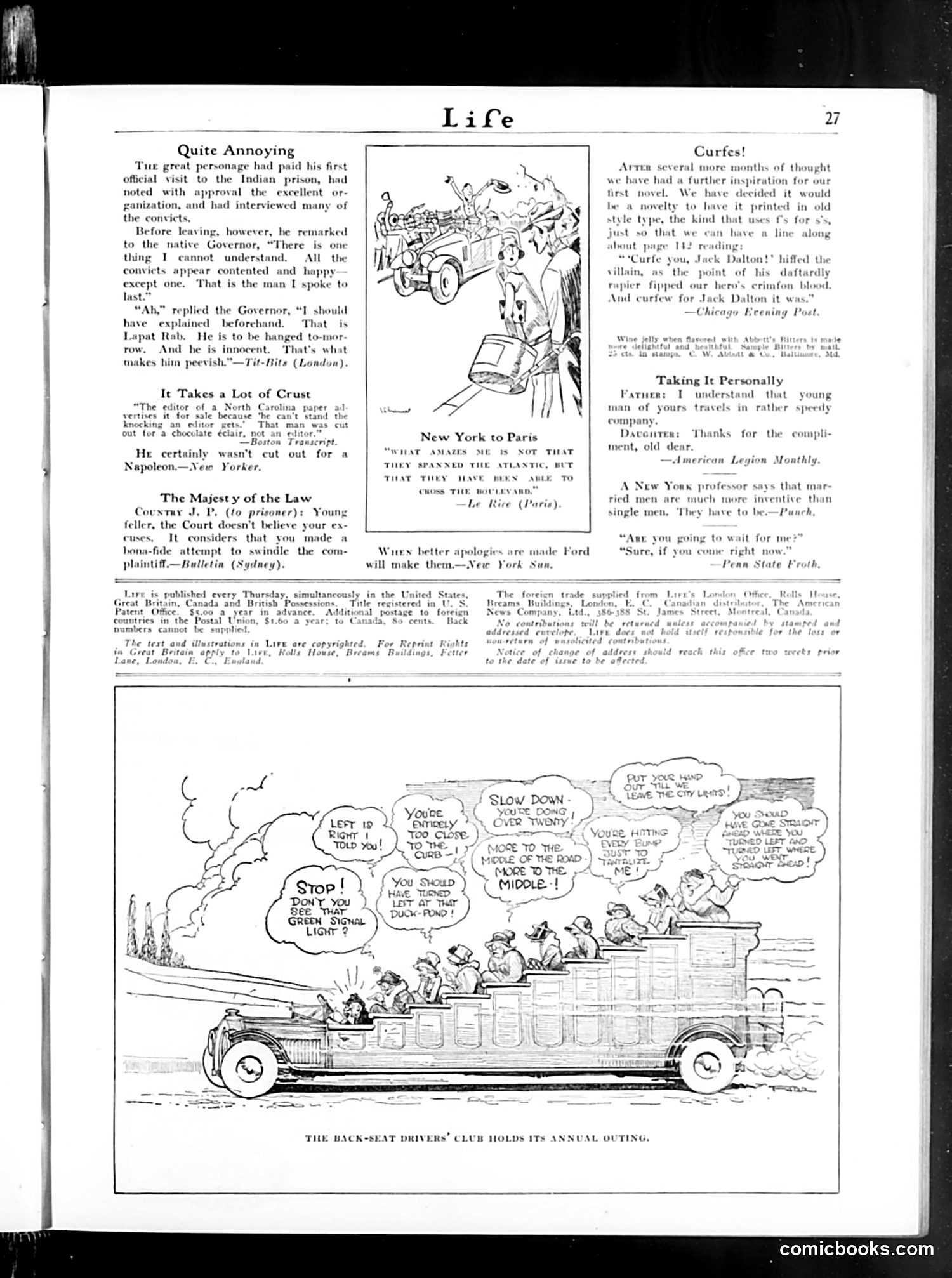
This page contains several short humorous items typical of Life's satirical style: **"Quite Annoying"**: A colonial official visits an Indian prison and notes all convicts seem content except one. The governor explains the man is innocent and scheduled for execution tomorrow—his innocence makes him "peevish." The joke satirizes the perverse logic of unjust systems. **"New York to Paris"**: A French publication marvels that aviators crossed the Atlantic, but finds it more remarkable they navigated the Boulevard (Paris's notoriously chaotic traffic). This jokes about Parisian driving hazards. **"The Back-Seat Drivers' Club"**: The large cartoon depicts a truck overloaded with passengers shouting conflicting driving instructions ("Left! Right! Slow down! Speed up!"). The caption satirizes backseat drivers—passengers who constantly direct the driver despite being passengers themselves. This was likely a widespread social annoyance of the automobile era. The other items are brief quips about marriage, legal absurdity, and publishing trends.
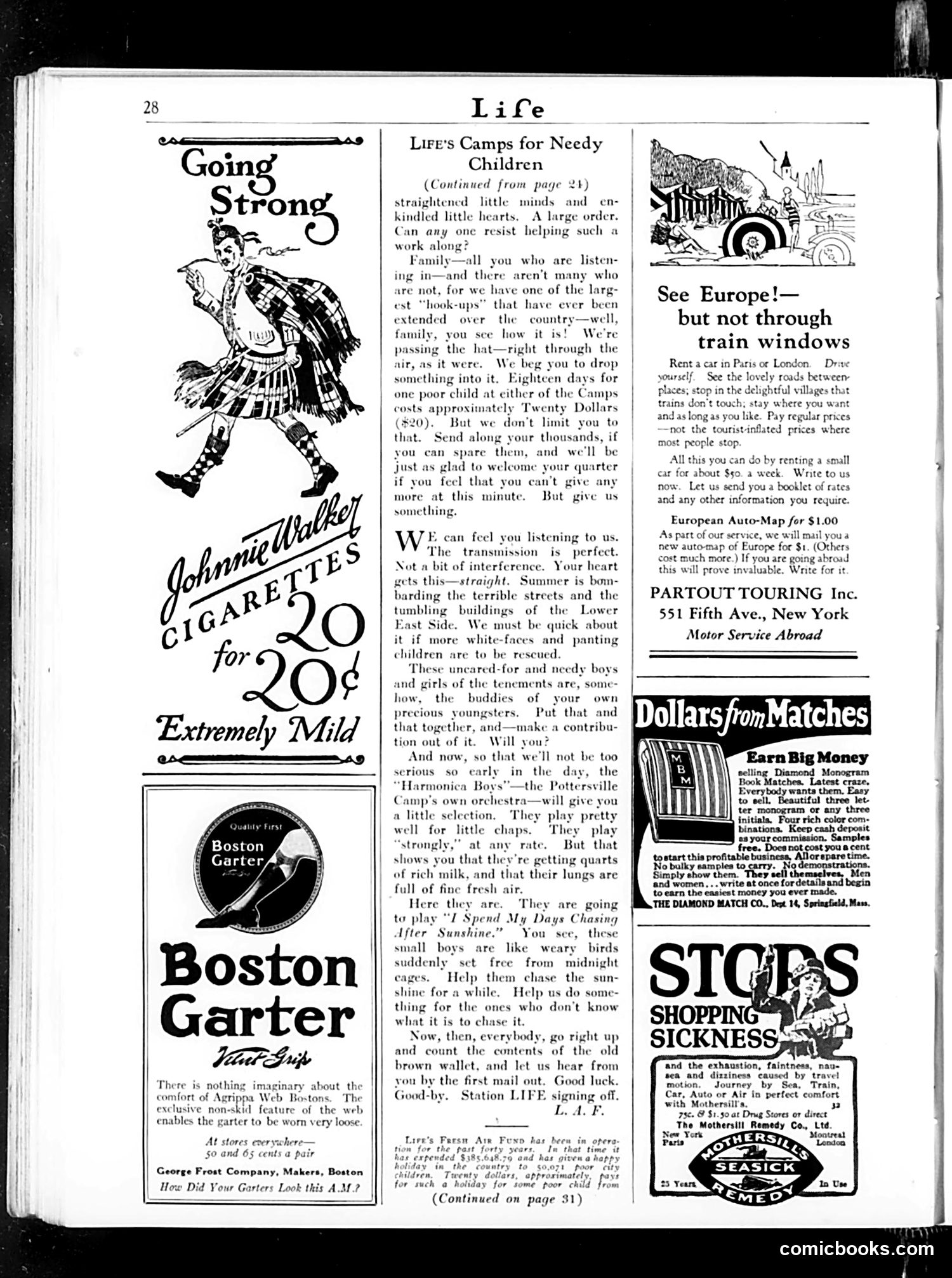
This page mixes **advertisements with charity fundraising** for Life's camps serving poor children. The main content is an emotional radio appeal (indicated by "listening in" and "transmission") requesting donations for camps caring for underprivileged children from New York's Lower East Side tenements. The pitch uses sentimental language about "needy boys and girls" and suggests even small contributions ("your quarter") help provide twenty dollars of care per child. The accompanying illustration shows the "Harmonica Boys" orchestra—poor children from the Pottersville Camp performing—as an emotional hook to inspire giving. The page includes **period advertisements**: Johnnie Walker cigarettes (20 for 20¢, marketed as "Extremely Mild"), Boston Garter stockings, European car rentals, and Diamond Match Company's matchbook sales scheme. These ads reflect 1920s consumer culture and opportunities. The overall strategy combines progressive charitable messaging with commercial appeal—typical of Life magazine's satirical yet philanthropic approach to contemporary social issues.
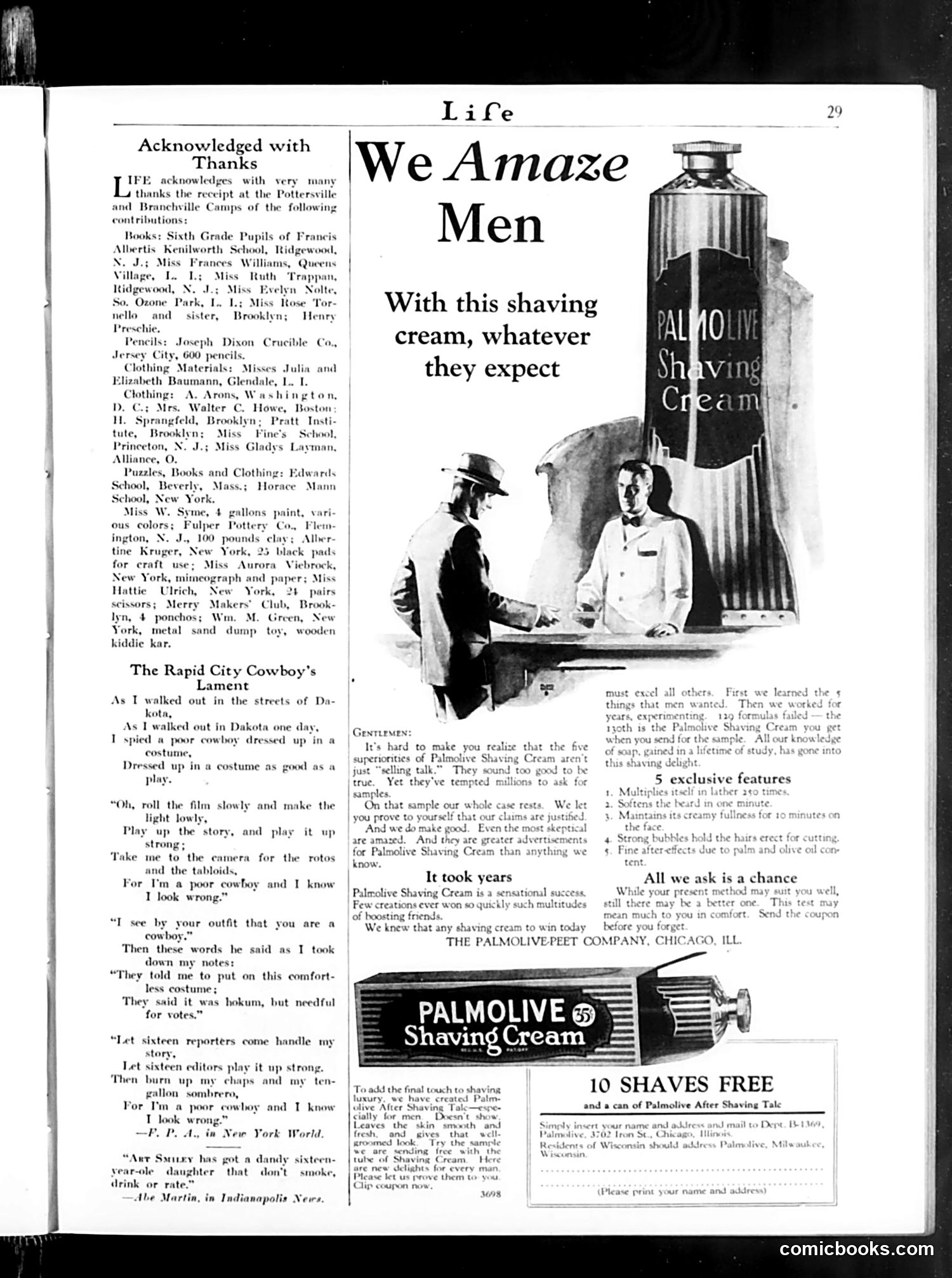
This page is primarily a **Palmolive Shaving Cream advertisement** disguised as editorial content in Life magazine. **The "Cartoon" Section:** "The Rapid City Cowboy's Lament" is a humorous poem about a poor cowboy dressed in costume who demands media attention—reporters, film cameras, tabloid coverage—while ironically claiming "I look wrong." The satire targets the era's obsession with publicity and the absurdity of seeking fame through appearances and media manipulation. **The Advertisement:** The dominant visual shows two men examining a large bottle of Palmolive Shaving Cream. The ad claims the product's superiority and offers "10 SHAVES FREE" as a promotion. Text emphasizes it took "years" to develop and lists specific features (multiple lather, creamy fullness, etc.). **Historical Context:** This reflects early-20th-century advertising practice: embedding commercial messages within entertainment/editorial content. The cowboy poem's theme of manufactured image ironically complements the ad's message about product superiority—both sell the idea that appearance and consumer choice matter. The page demonstrates how magazine advertising and satirical content coexisted, often blurring boundaries.
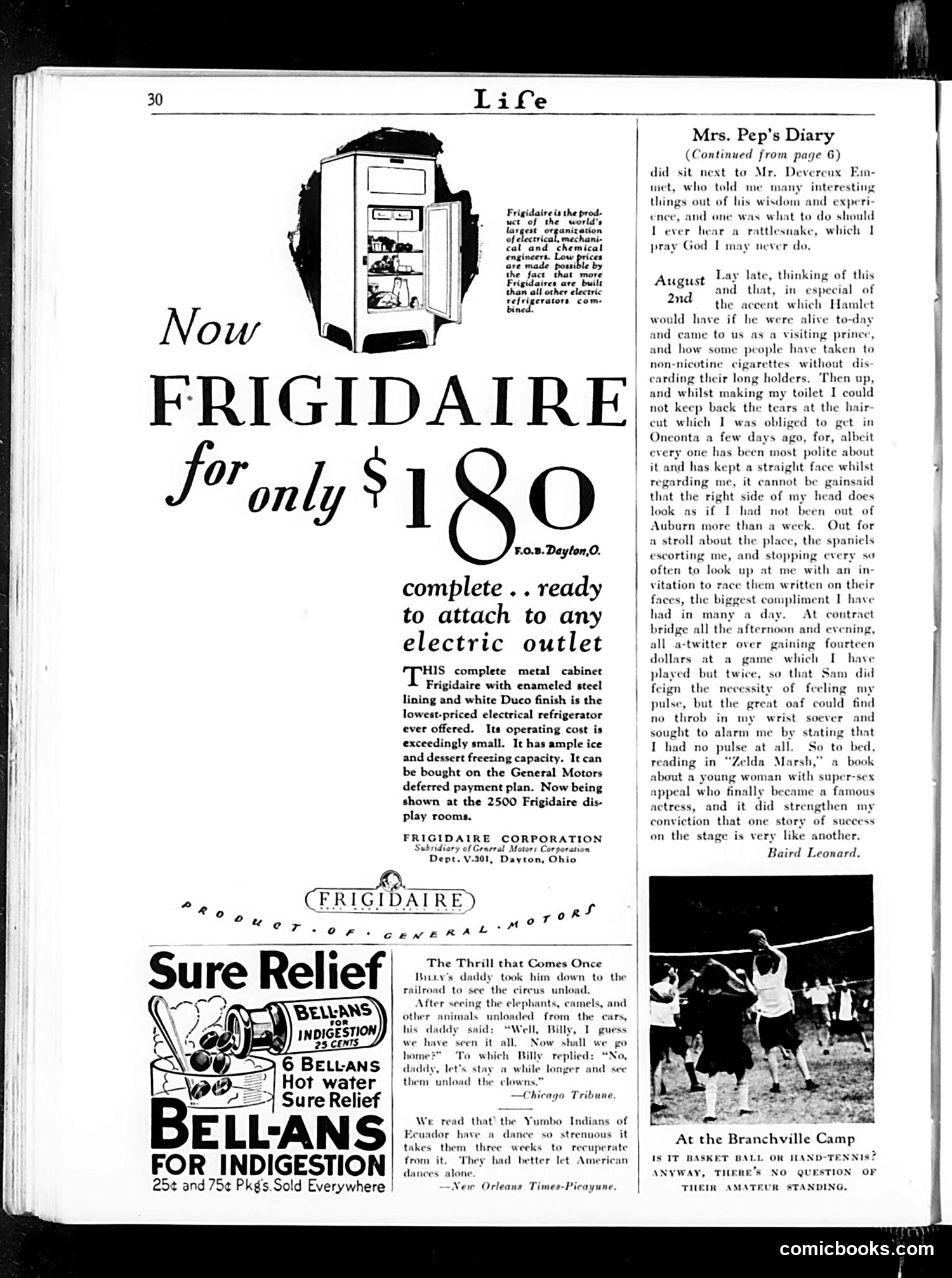
This page is primarily **advertising and social commentary**, not political satire. The dominant content is a **Frigidaire refrigerator advertisement** ($180, circa 1920s), promoting the appliance as affordable and ready-to-install. The ad emphasizes that Frigidaire outsells all competitors combined. The right column features **"Mrs. Pep's Diary,"** a society column recording mundane upper-class activities: tea with Mr. Devereux Emmet, a disappointing haircut in Oneonta, card games, and light reading. The tone is satirical—gently mocking the triviality of wealthy women's concerns and their affected literary references. Below are two **humorous anecdotes**: one about a child at the circus; another about Ecuadorian Indigenous peoples and their strenuous dancing (reflecting period attitudes toward non-Western cultures). A **Bellans indigestion remedy advertisement** occupies the lower left. The page demonstrates how Life magazine integrated advertisements with satirical commentary on contemporary manners and consumption, targeting educated, affluent readers of the 1920s era.
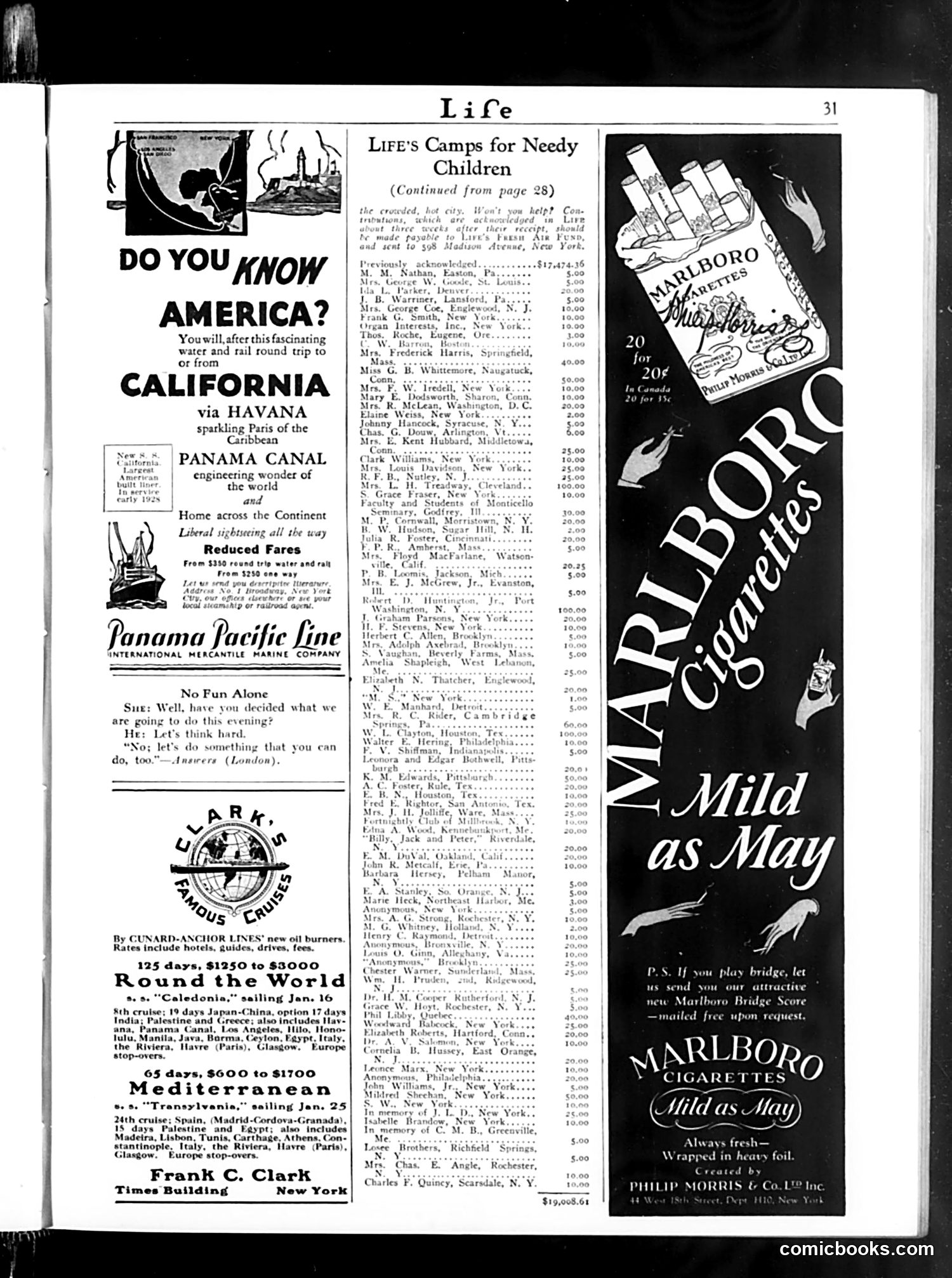
This page is primarily **advertising and announcements**, not political satire. The top half features travel advertisements for luxury cruises—Panama Pacific Line voyages to California via Havana and the Panama Canal, Cunard-Anchor Lines' round-the-world trips, and Mediterranean cruises. These target wealthy readers with disposable income for extended international travel. Below is a brief comic exchange titled "No Fun Alone"—a husband-wife joke about deciding what entertainment to pursue, likely a mild marital humor piece typical of Life's content. The page also includes fundraising acknowledgments for "Life's Camps for Needy Children," listing donors and amounts contributed, and a Marlboro cigarettes advertisement emphasizing the product is "mild as May." The page reflects 1920s-30s consumer culture: luxury travel marketing for the wealthy alongside charitable giving for the poor, and early cigarette advertising before health warnings.
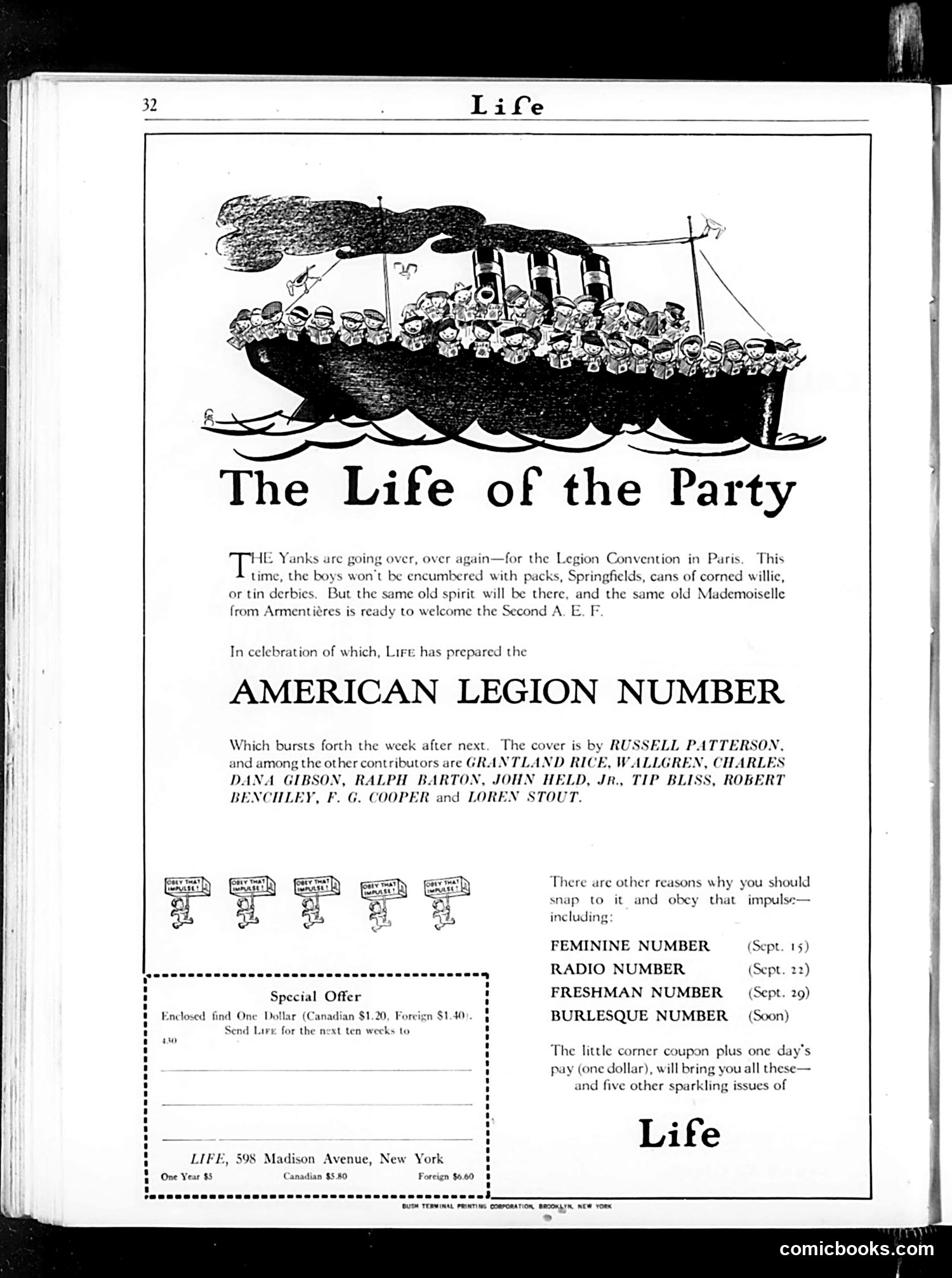
This is primarily a **subscription advertisement** for an upcoming American Legion special issue of *Life* magazine. The illustration shows a crowded ship full of soldiers heading to Paris for an American Legion Convention. The satire references **post-WWI nostalgia**: American soldiers ("the Yanks") are returning to Paris for a veterans' gathering, evoking their WWI experiences. The text humorously notes they'll travel without military gear this time, and references "Mademoiselle from Armentiéres"—a famous WWI-era soldier's song about French women—suggesting the social pleasures awaiting them. The ad promotes the upcoming special issue by listing other themed issues (*Feminine*, *Radio*, *Freshman*, *Burlesque* numbers), using humor to drive subscriptions. Contributors listed (Grantland Rice, Charles Dana Gibson, John Held Jr.) were prominent cartoonists and humorists of the era. The appeal targets readers nostalgic for wartime camaraderie and interested in entertainment-focused content.
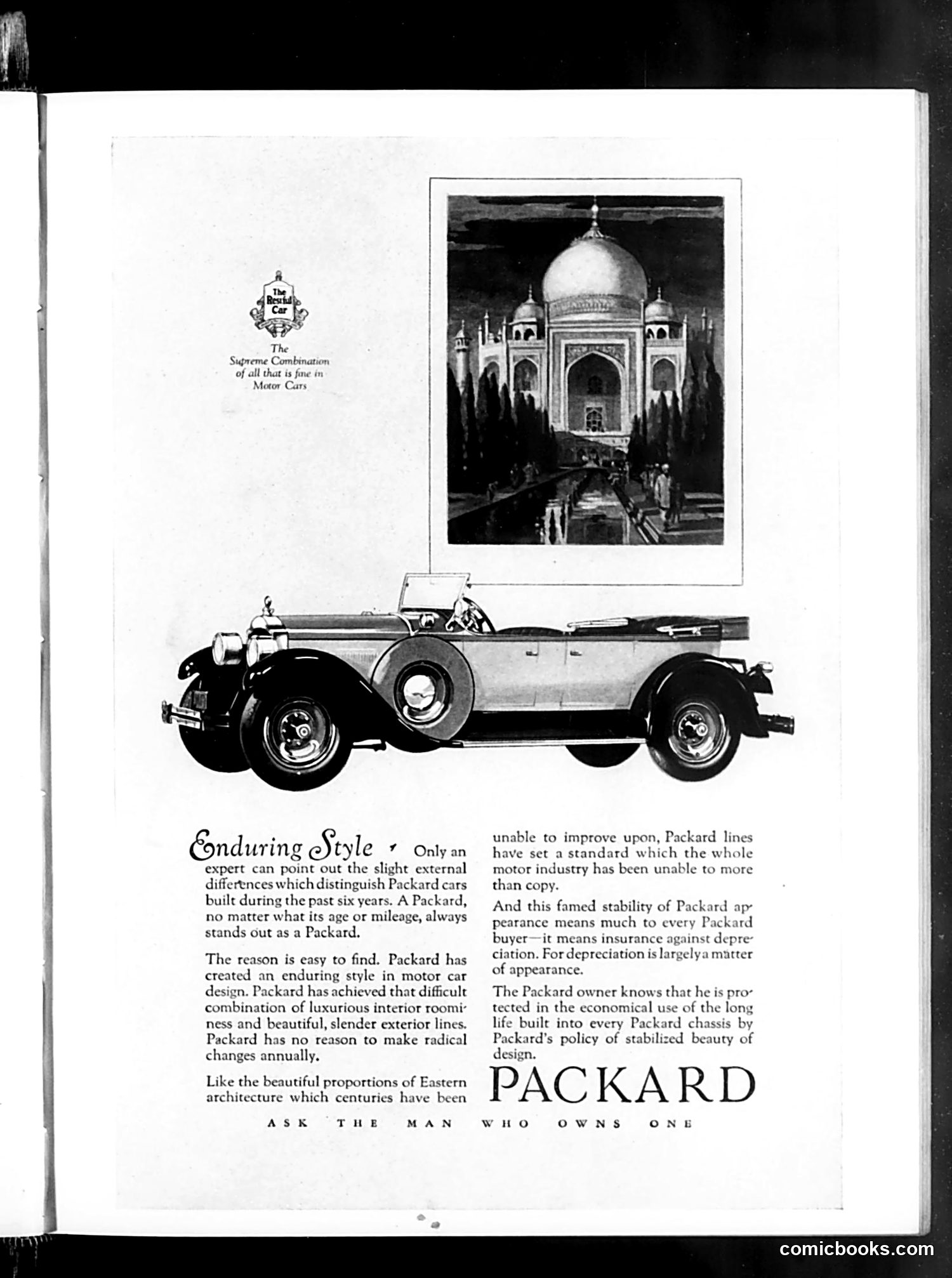
This is **not a cartoon or satire** — it's a straight automobile advertisement from Life magazine (likely 1920s-early 1930s). The page promotes Packard luxury cars by claiming their design has remained essentially unchanged for six years, positioning this constancy as a virtue. The advertisement compares Packard's "enduring style" to Eastern architecture (the Taj Mahal image at top), arguing that timeless design cannot be improved upon. The key sales pitch: Packard's stable appearance protects resale value better than competitors' cars, which undergo frequent style changes. The tagline "Ask the man who owns one" was Packard's actual slogan. This reflects 1920s-30s marketing philosophy — before planned obsolescence became standard — when manufacturers advertised durability and classical design as luxurious selling points rather than annual model redesigns.
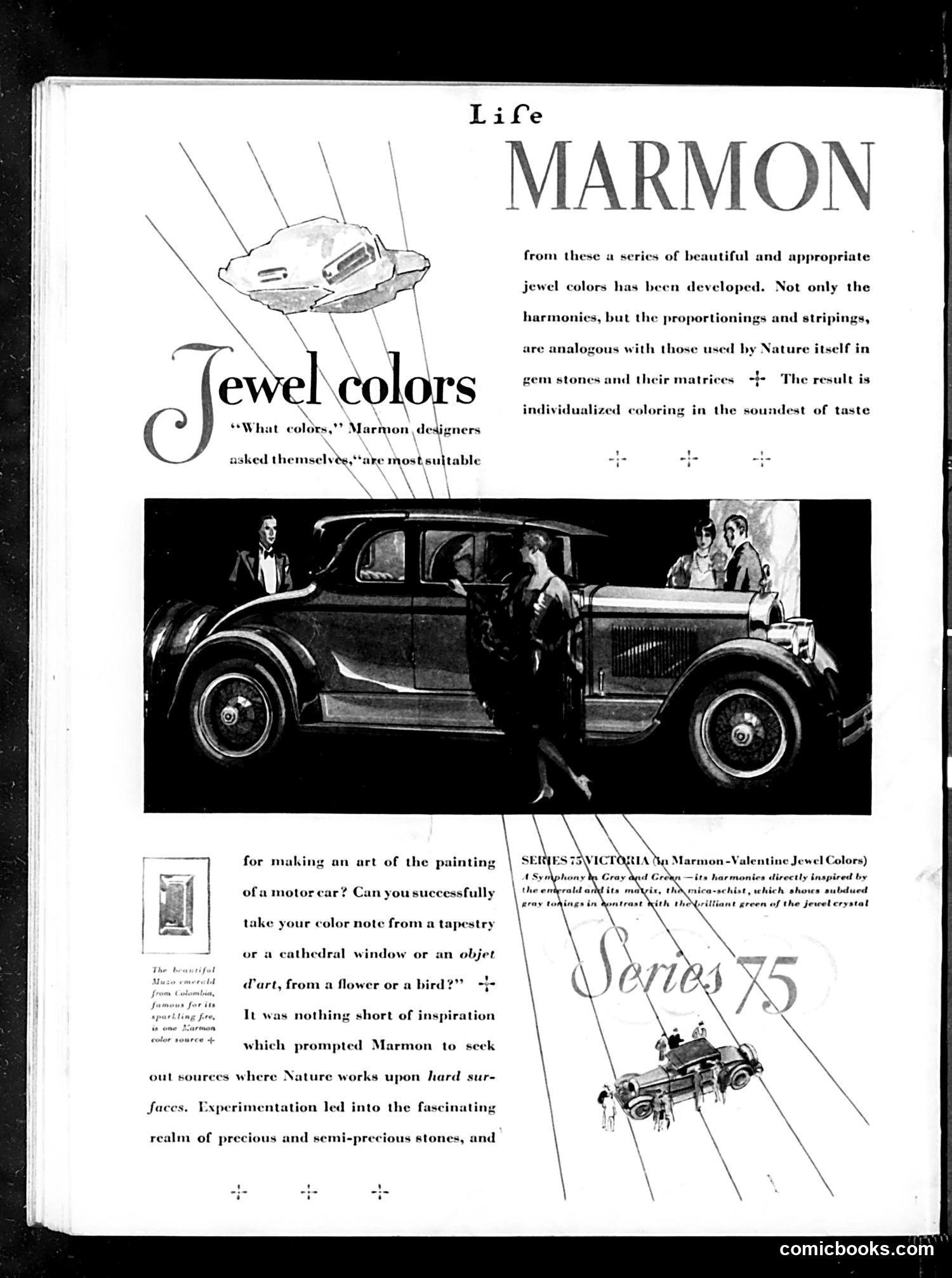
This is a **Marmon automobile advertisement**, not political satire. It's promoting the Marmon car company's new "jewel colors" paint options (Series 75). The ad poses a rhetorical question to designers: where should automotive colors come from? The answer: nature—specifically gemstones and precious stones. Marmon claims to have developed paint colors inspired by emeralds, rubies, and other gems, matching Nature's own color harmonies and proportions. The two car illustrations show elegantly dressed 1920s-era figures admiring Marmon vehicles, emphasizing luxury and sophistication. The overall message positions Marmon automobiles as artistic objects worthy of the same color consideration as fine jewelry or cathedral windows. This reflects early-20th-century marketing that framed cars as status symbols and aesthetic achievements, not merely transportation.