
A complete issue · 36 pages · 1927
Life — August 18, 1927
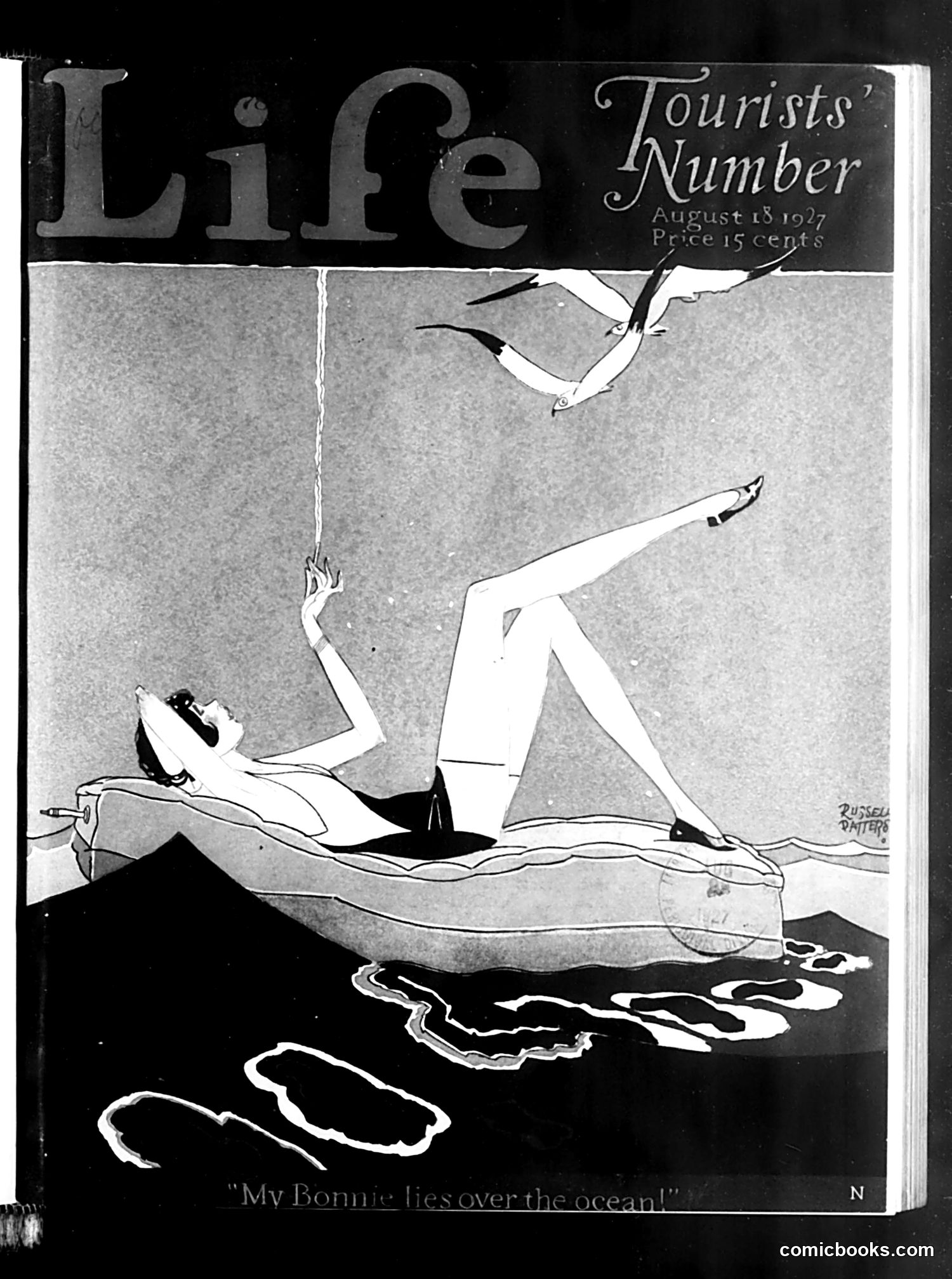
This is the cover illustration for Life's special "Tourists' Number." The artwork depicts a woman reclining on a beach, gazing upward dreamily while holding a string attached to a small airplane flying overhead. The caption reads: "My Bonnie lies over the ocean!" The illustration references the famous song "My Bonnie Lies Over the Ocean" and appears to satirize romantic tourism and leisure culture of the 1920s. The airplane detail likely alludes to modern travel possibilities of the era, when aviation was becoming a viable (though expensive) transportation option. The image captures the escapist fantasy of tourists seeking romantic adventure and exotic destinations—a central theme for Life's special tourist-focused edition aimed at affluent American travelers.
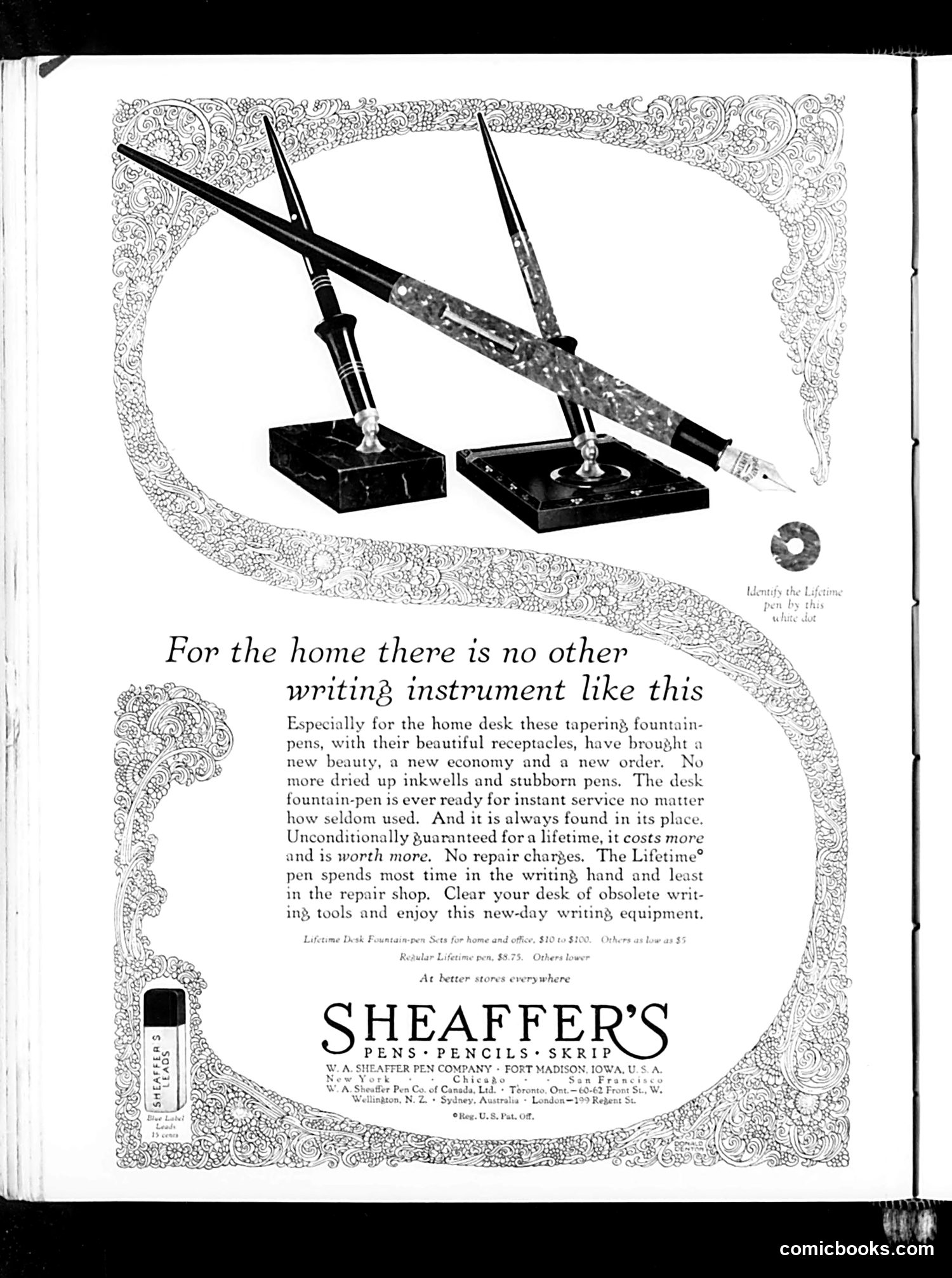
This is primarily a **product advertisement**, not satire or political commentary. It promotes Sheaffer's fountain pens and desk pen sets for home use. The ad's appeal is practical rather than humorous: it emphasizes that these pens are reliable ("unconditionally guaranteed for a lifetime"), always available for writing, and superior to dried-up inkwells and broken competitors. The copy suggests replacing "obsolete writing tools" with modern fountain pens. The decorative ornamental border and the two pen sets displayed on stands are typical of early 20th-century advertising aesthetics. There is no identifiable political cartoon, caricature, or satirical commentary present—this is straightforward commercial marketing aimed at home desk users.
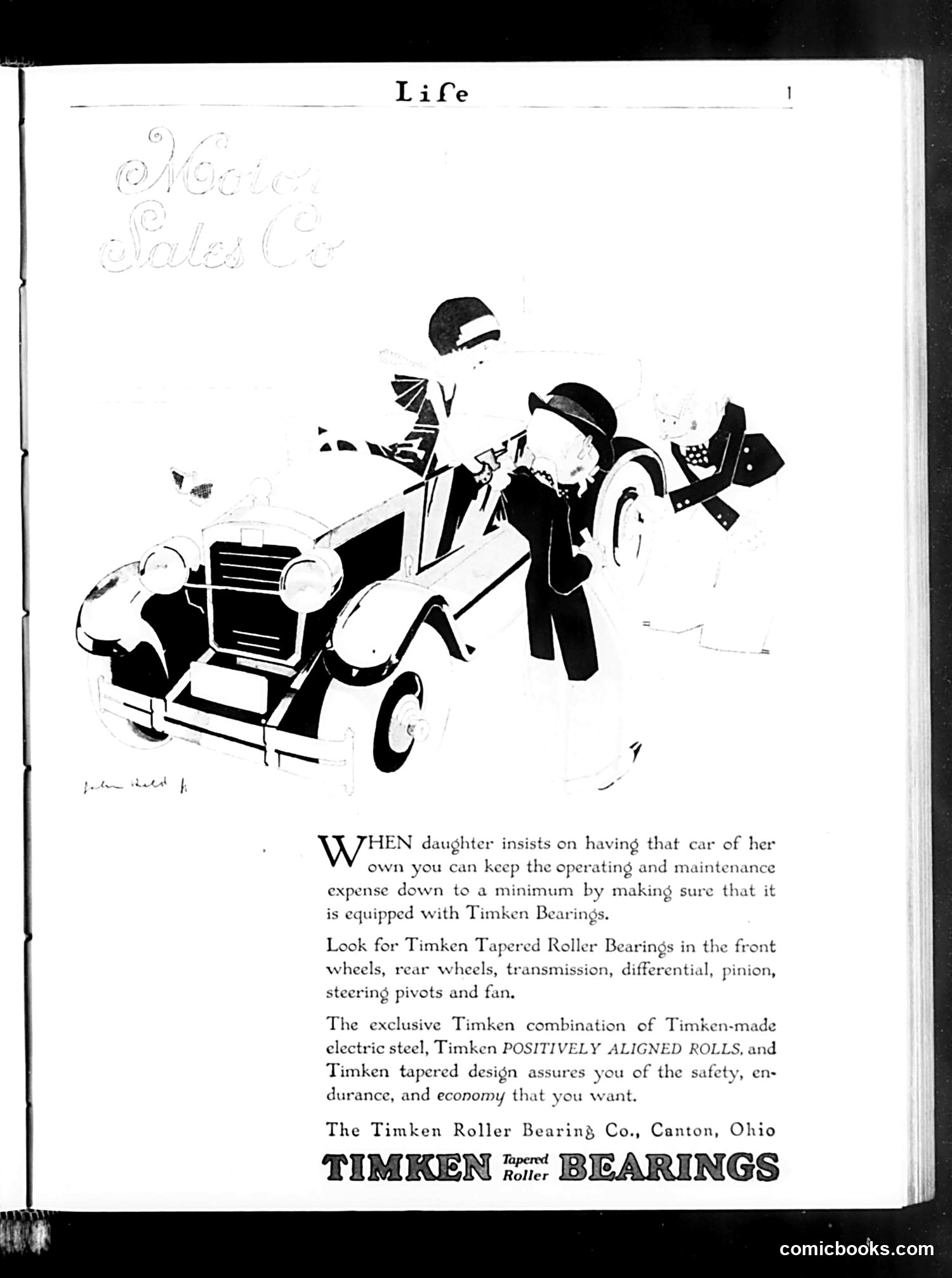
This page is primarily a **Timken Roller Bearings advertisement**, not political satire. The illustration depicts a stylized 1920s scene of a fashionable young woman and man with a luxury automobile—likely referencing the cultural moment when automobiles became status symbols and personal possessions for the wealthy. The ad's humor targets middle-class fathers: it playfully warns that when daughters demand their own cars, bearings (mechanical components) become crucial for keeping maintenance costs "down to a minimum." The illustration's art-deco style and the couple's elaborate clothing emphasize the frivolous luxury of the scenario. This is fundamentally a **commercial advertisement** exploiting gender stereotypes and emerging consumer culture—particularly women's newfound independence and purchasing power in the 1920s—to sell industrial components.
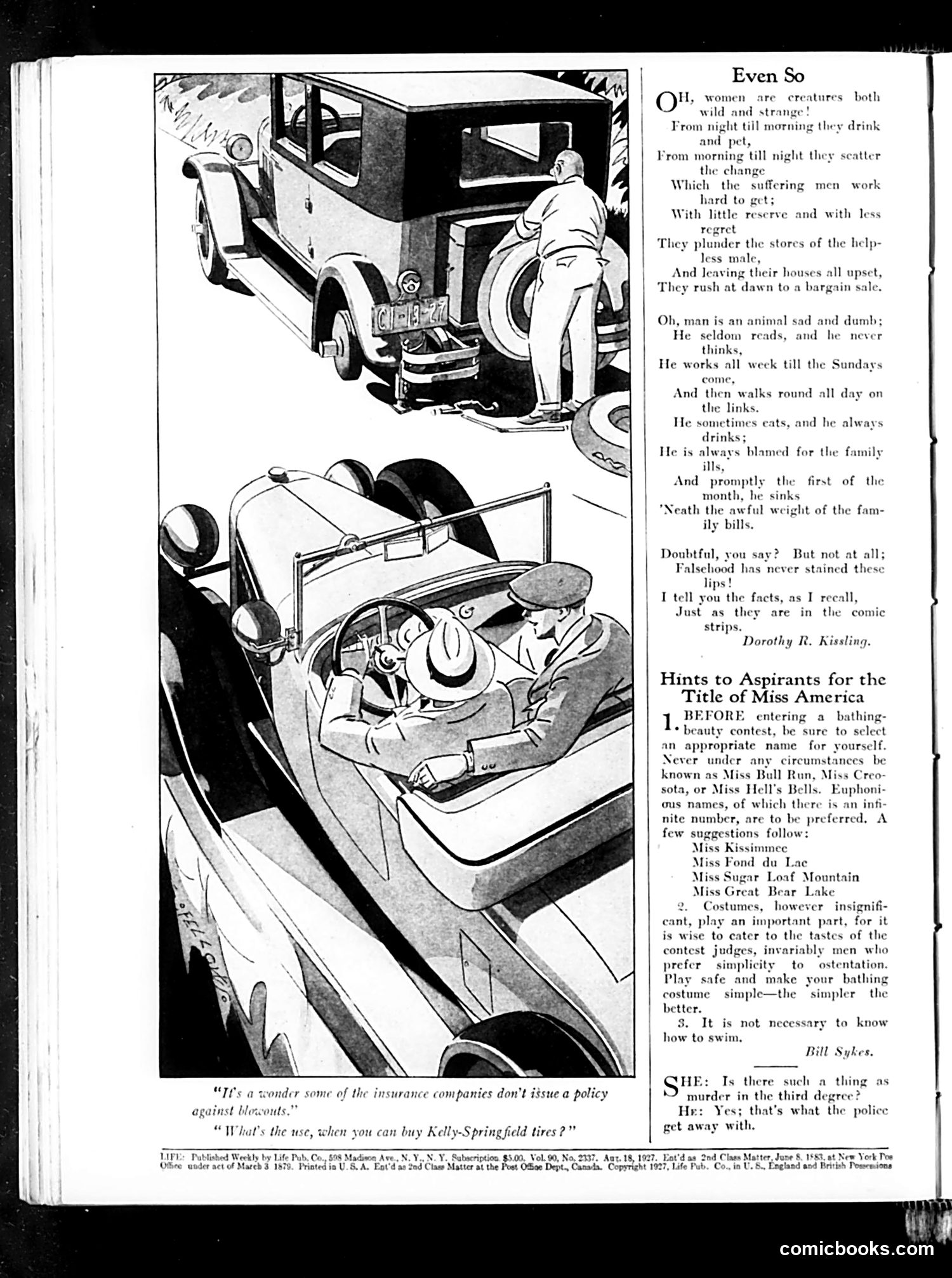
The page contains two distinct humor pieces: **Top cartoon**: Shows car insurance absurdity. A man examines a damaged vehicle while another stands nearby. The caption mocks insurance companies' reluctance to cover accidents, with a joke about Kelly-Springfield tires being so reliable that insurers won't issue policies against them. **Bottom section**: "Hints to Aspirants for the Title of Miss America" offers satirical advice for beauty pageant contestants, suggesting ridiculous stage names and noting that knowing how to swim is unnecessary. This likely references the newly-popular Miss America pageant (began 1921). **Right column**: A poem by Dorothy R. Kisling critiques men's irresponsibility as breadwinners, and a brief joke about murder charges. The overall tone reflects 1920s consumer culture anxieties and gender dynamics.
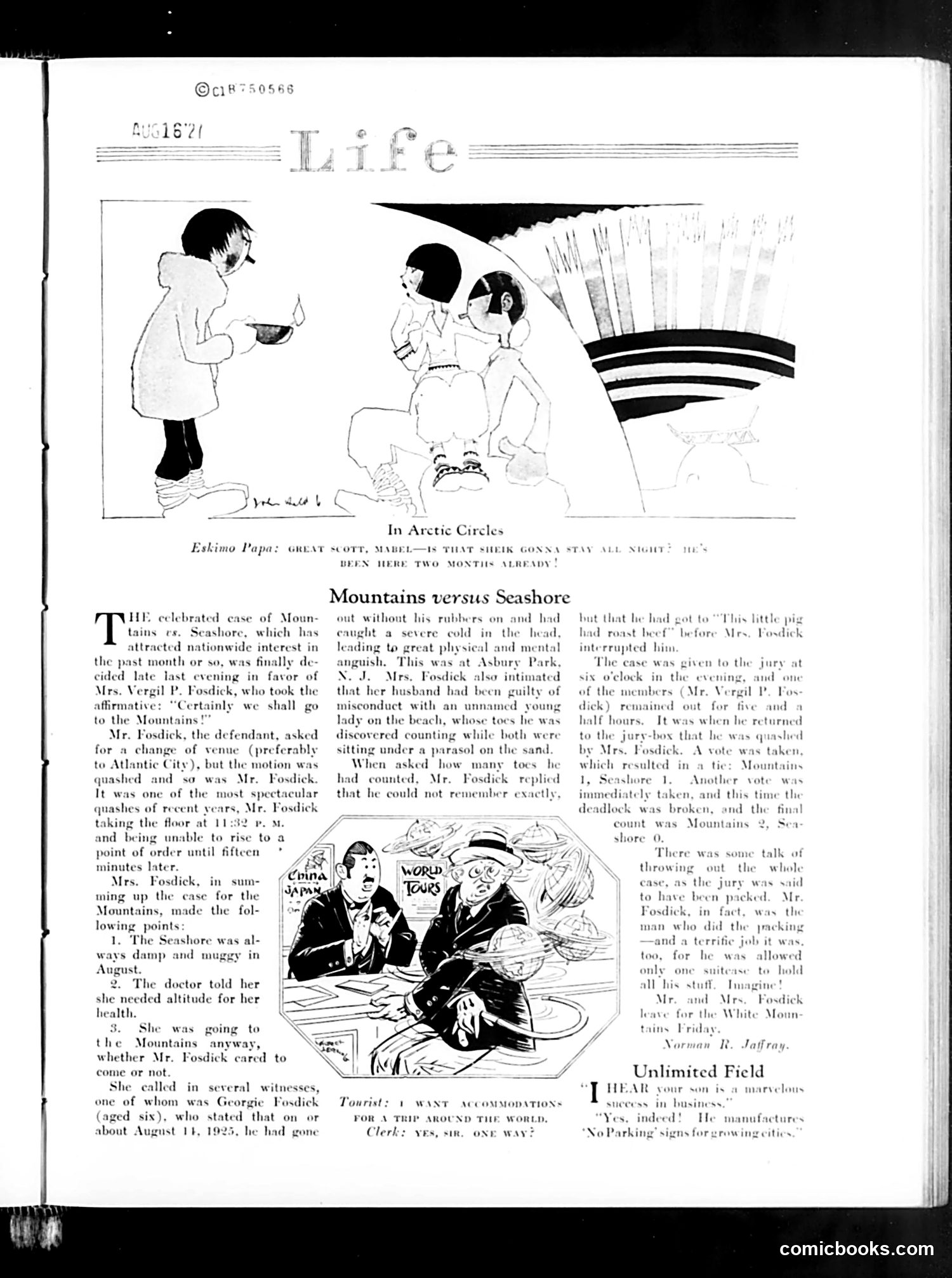
This page contains two distinct pieces: **"Mountains versus Seashore"** is a humorous legal anecdote about a custody dispute over a child between Mr. and Mrs. Fosdick. The case humorously argues whether the mountains or seashore is healthier for children. The accompanying cartoon shows the couple and their lawyer reviewing documents about the case, with a caption referencing "world tours" and "china"—suggesting the absurdity of wealthy people litigating over trivial matters while possessing resources for elaborate travel. **"Unlimited Field"** appears to be a brief joke about business success, with a clerk telling a tourist that accommodations for world travel are available, but the manufacturer's "No Parking" sign is growing, suggesting ironic limitations despite claimed unlimited opportunities. The satire targets wealthy Americans' frivolous litigation and the gap between business success and practical life constraints.
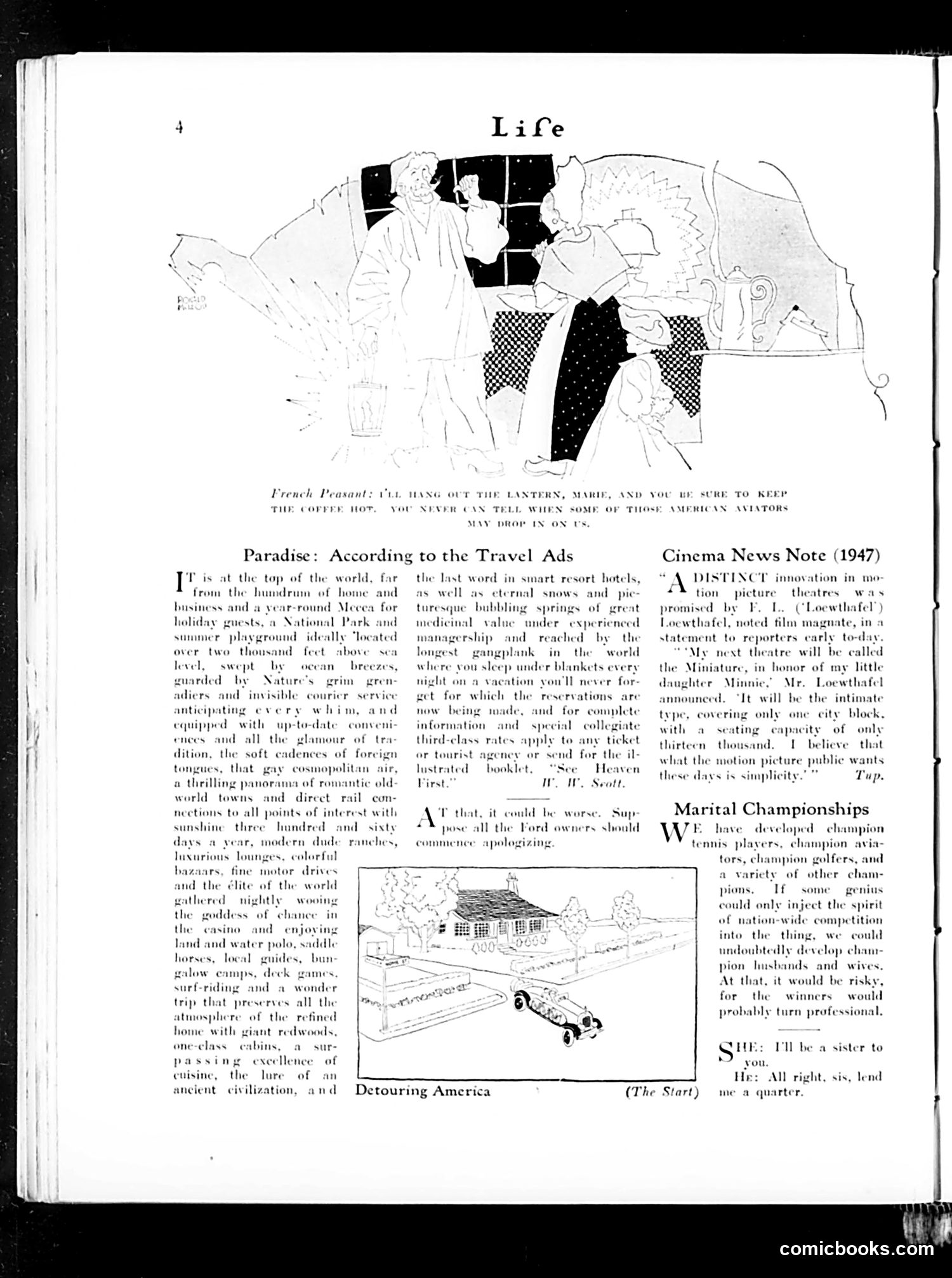
This page contains three distinct sections: **Top cartoon**: Depicts a French peasant warning American aviators about keeping coffee hot and watching for American visitors—likely satirizing American military presence in post-WWI France and the cultural friction between American servicemen and French civilians. **"Paradise: According to the Travel Ads"**: A humorous essay mocking idealized resort advertising, contrasting glossy promotional language with reality. **"Detouring America"**: An illustration showing a house and car, captioned "(The Start)," appearing to humorously depict American road-trip culture. **"Marital Championships"** and **"Cinema News Note (1947)"**: Brief social commentary pieces on competitive marriages and theater innovations. The page reflects early-to-mid 20th-century American preoccupations: travel culture, military relations with Europe, and domestic social trends. The satire targets advertising exaggeration and cultural attitudes of the era.
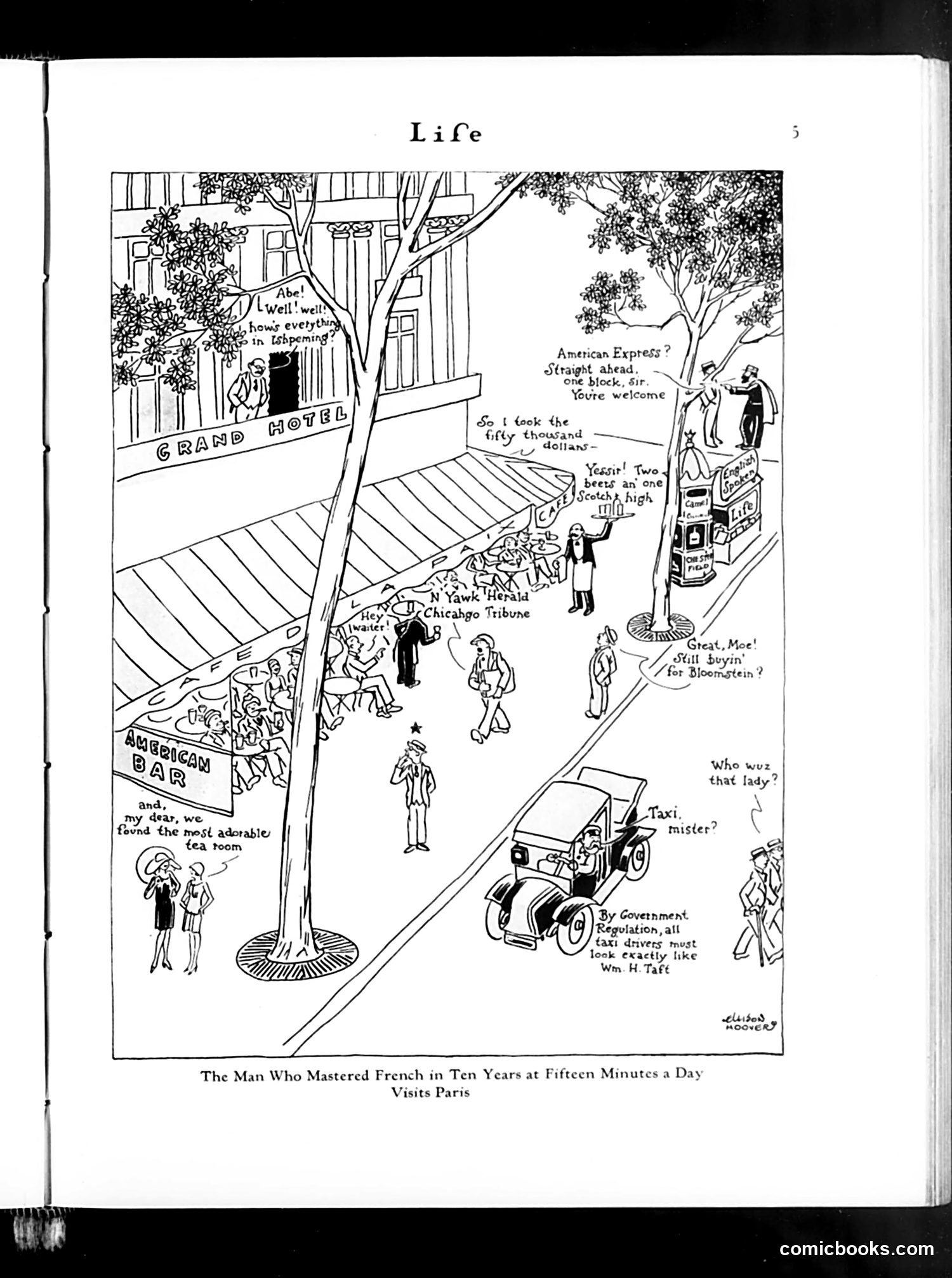
This cartoon satirizes a tourist in Paris who learned French through a popular correspondence course or language method. The humor plays on the gap between textbook French and real Parisian life. The figure encounters various Parisians—from hotel staff to taxi drivers to newspaper vendors—each delivering rapid-fire authentic French or Parisian commentary ("Yessir! Two beers an' one Scotch, high!"). The joke is that despite his diligent study, actual conversational Paris overwhelms him. References to the *Chicago Tribune*, *New York Herald*, Bloomstein, and William Howard Taft ground this in recognizable American and Parisian contexts of the early 20th century. The satire mocks both over-confident language learners and the disconnect between formal instruction and real-world communication.
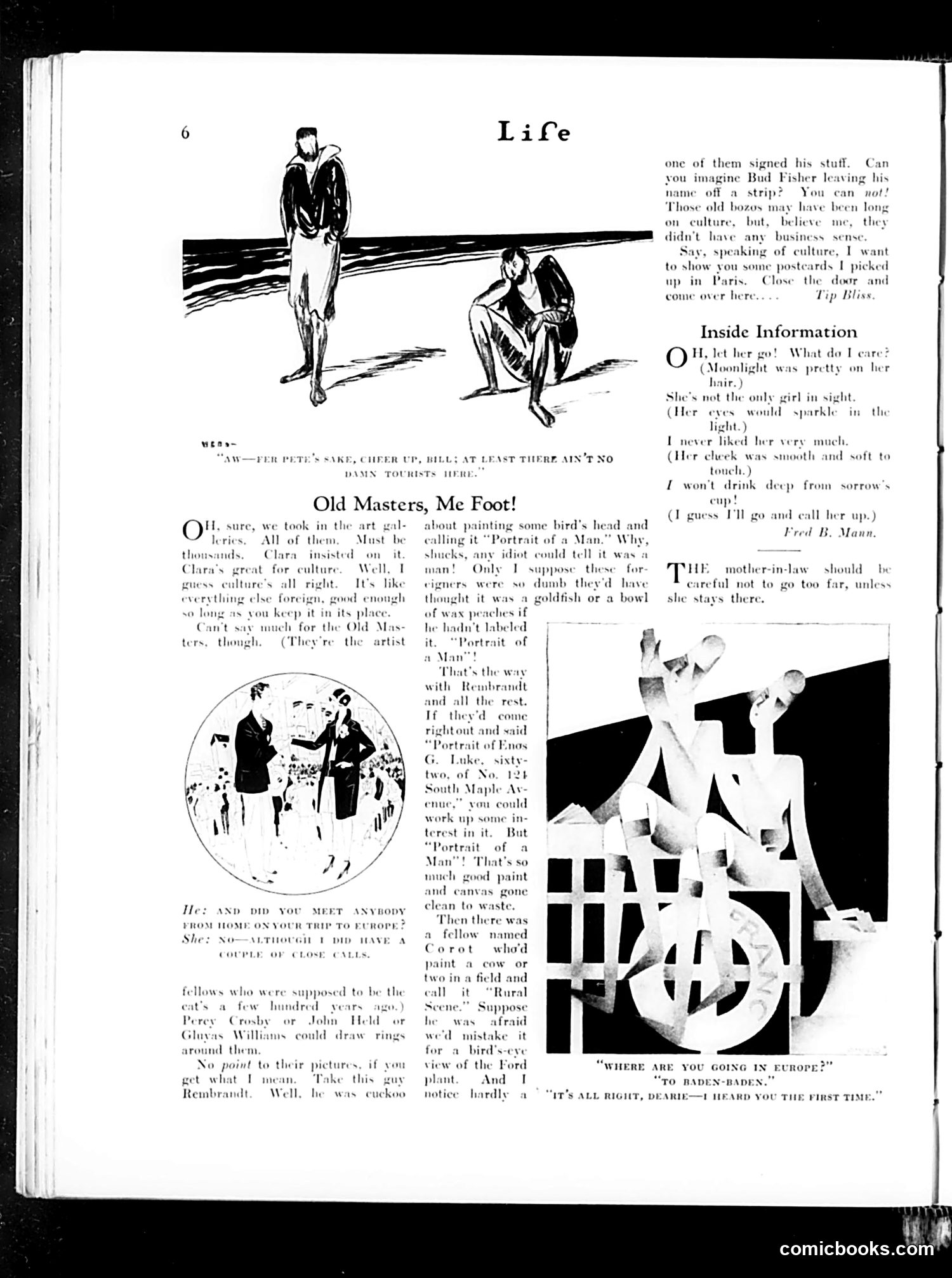
This page satirizes wealthy Americans' pretensions about art and culture. The main article, "Old Masters, Me Foot!", mocks people who purchase reproductions of famous paintings (mentioning Rembrandt) without understanding art. The author ridicules collectors who display works attributed to Old Masters—naming them casually as status symbols rather than genuine acquisitions. The cartoon at bottom depicts a conversation about European travel, with the caption "Where are you going in Europe? To Baden-Baden." This likely jokes about Americans visiting fashionable European spa towns as tourists, suggesting superficial cultural tourism rather than genuine cultural engagement. The "Inside Information" column uses similar mockery, suggesting wealthy Americans pursuing culture lack actual taste or knowledge, merely performing sophistication for social standing.
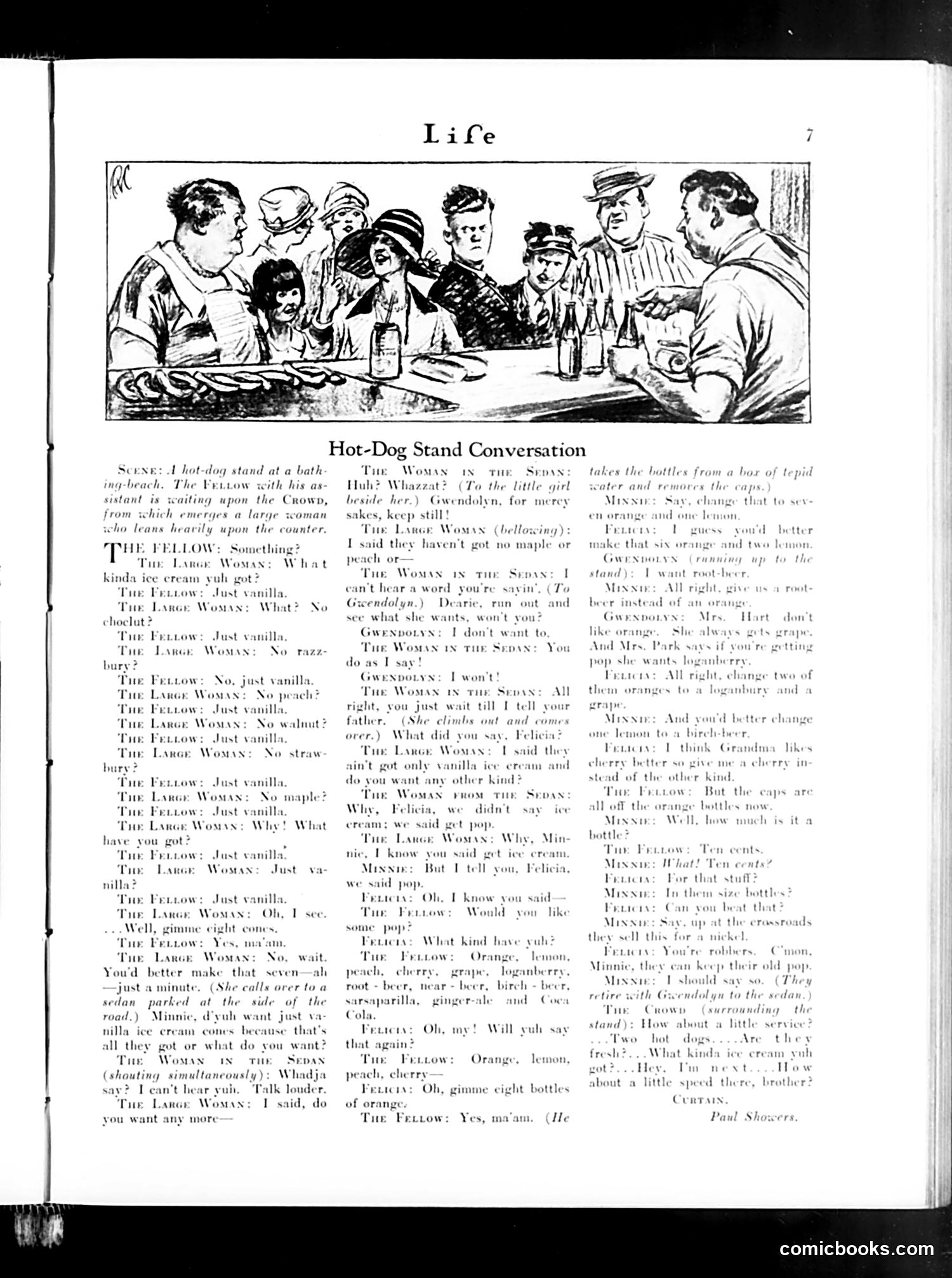
This satirical sketch depicts a working-class scene at a beach hot-dog stand, where a large woman vendor argues with customers over pricing and product quality. The humor centers on a dispute about vanilla ice cream versus other flavors, with the vendor insisting on vanilla while customers demand alternatives like orange and lemon. The satire targets consumer haggling and vendor resistance to customer preferences—common friction points in early 20th-century street commerce. The characters' heavy dialect and working-class appearance emphasize class-based humor typical of *Life* magazine's satirical approach. The crowded, boisterous scene mocks both vendors' stubbornness and customers' petty demands, reflecting broader social attitudes about commerce and class distinction in the era.
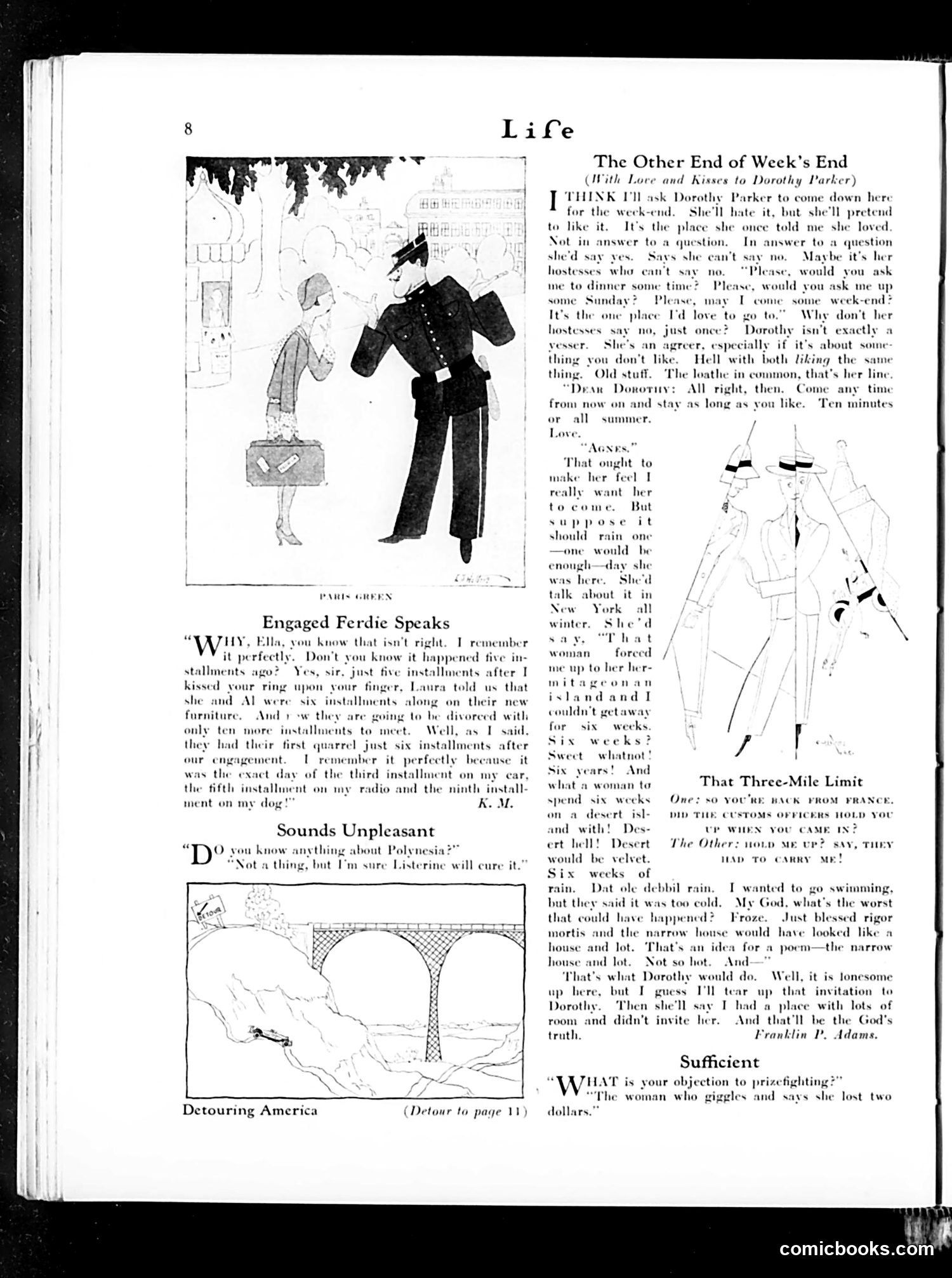
This page contains several humor columns and illustrations typical of Life's satirical format. "Engaged Ferdie Speaks" humorously discusses installment-plan furniture purchases and engagement ring financing—reflecting 1920s consumer culture anxieties about buying on credit. "Sounds Unpleasant" features a cartoon about Polynesia, with a humorous quip about Listerine (the mouthwash) as a cure, playing on advertising culture. "The Other End of Week's End" is a sarcastic letter about weekend social obligations and the difficulty of getting a reluctant hostess to invite someone repeatedly. "That Three-Mile Limit" appears to reference Prohibition-era customs enforcement at borders, with the joke involving smuggling or illegal alcohol transport. "Sufficient" is a brief joke about a woman's objection to prizefighting. These pieces showcase Life's focus on contemporary consumer culture, social etiquette, and Prohibition-era humor.
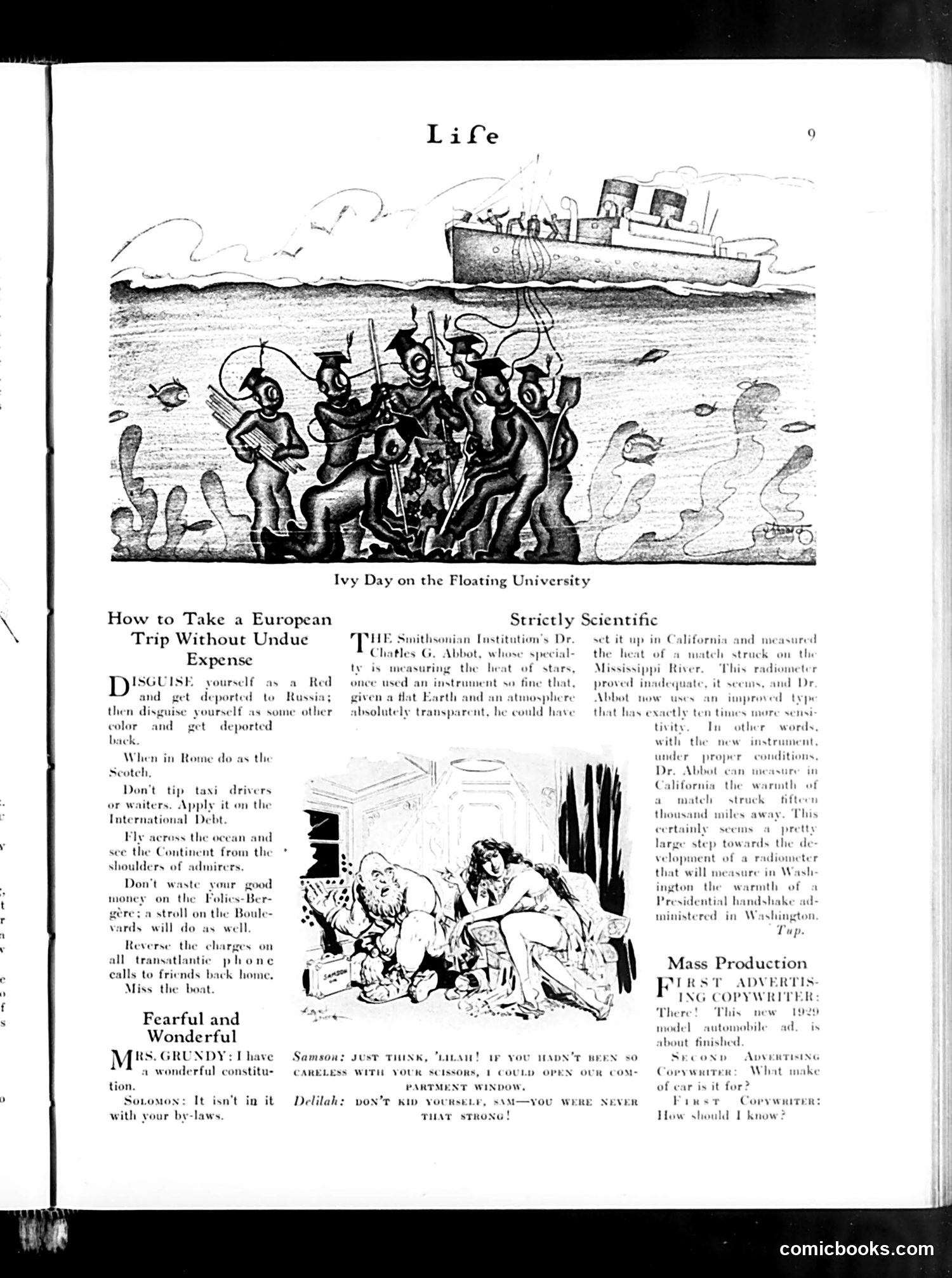
This page from Life contains three distinct satirical pieces: 1. **"Ivy Day on the Floating University"** (top illustration): Shows underwater figures with diving equipment connected to a ship above, satirizing an academic expedition or educational cruise. 2. **"How to Take a European Trip Without Undue Expense"**: Advice column mocking tourists, suggesting disguising oneself as a Red Cross worker or other figures to avoid paying—satirizing American tourists' cheapness and the prevalence of international debt. 3. **"Fearful and Wonderful"**: A brief dialogue joke between characters named Samson and Delilah about scissors and compartment windows, playing on the biblical reference. 4. **"Strictly Scientific"** and **"Mass Production"**: Appear to be short humor pieces about scientific measurement and advertising copywriting. The page emphasizes 1920s-era travel humor and professional satire.
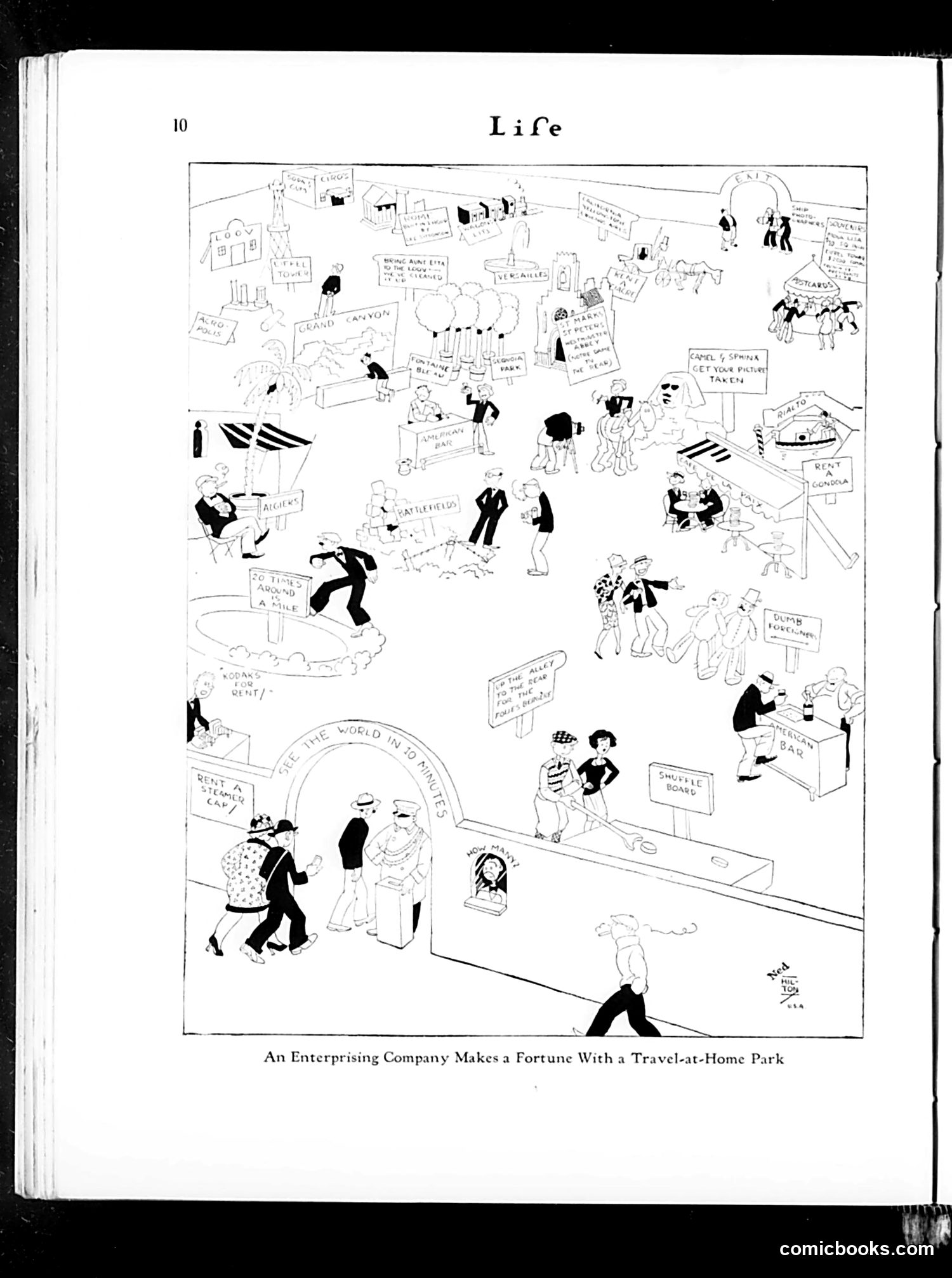
This single-panel cartoon satirizes a commercial amusement venture—a "travel-at-home park" designed to simulate vacation experiences without actual travel. The illustration depicts various attractions and activities crammed into one location: rides, games, food stands, theatrical performances, and recreational facilities. The satire targets Depression-era entrepreneurship and Americans' desire for affordable leisure. Instead of costly vacations, this park offers packaged entertainment within a contained space. The cartoon mocks both the commercial exploitation of this desire and the peculiar concept of simulating distant places domestically. The busy, chaotic composition emphasizes how entertainment has been industrialized and commercialized into a unified, accessible product for profit.
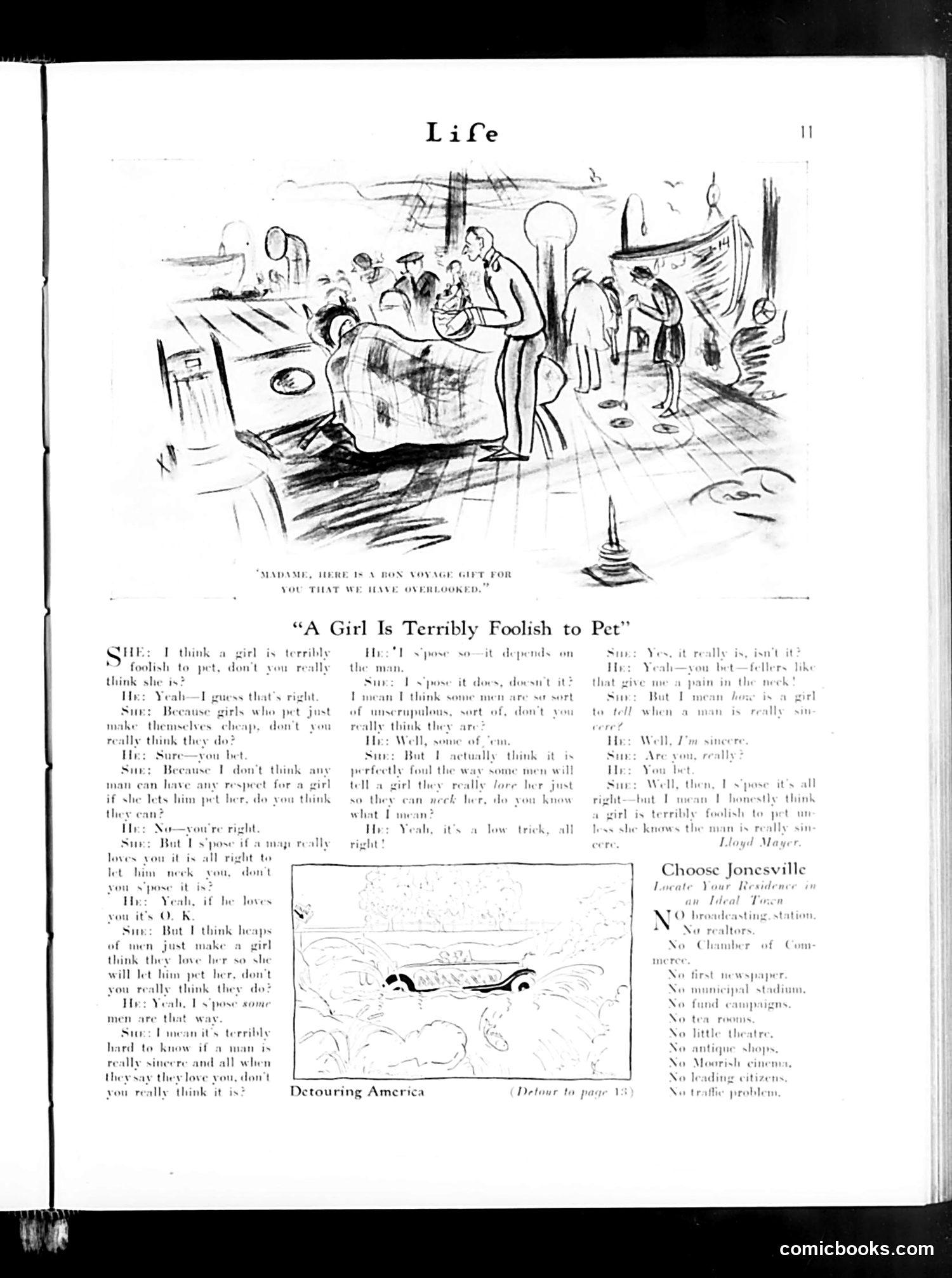
This page presents a humorous dialogue between a man and woman debating whether girls who pet (engage in physical intimacy) are foolish. The man argues it's a "low trick" to judge girls by their willingness; the woman counters that men who love women yet criticize them for the same behavior are hypocrites. The cartoon satirizes gender double standards of the era—specifically the sexual hypocrisy where men expected restraint from women while facing no equivalent judgment themselves. The dialogue format allows both perspectives, though the woman's final point about male inconsistency appears to win the argument. The "Detouring America" cartoon below appears unrelated—a separate illustration about travel.
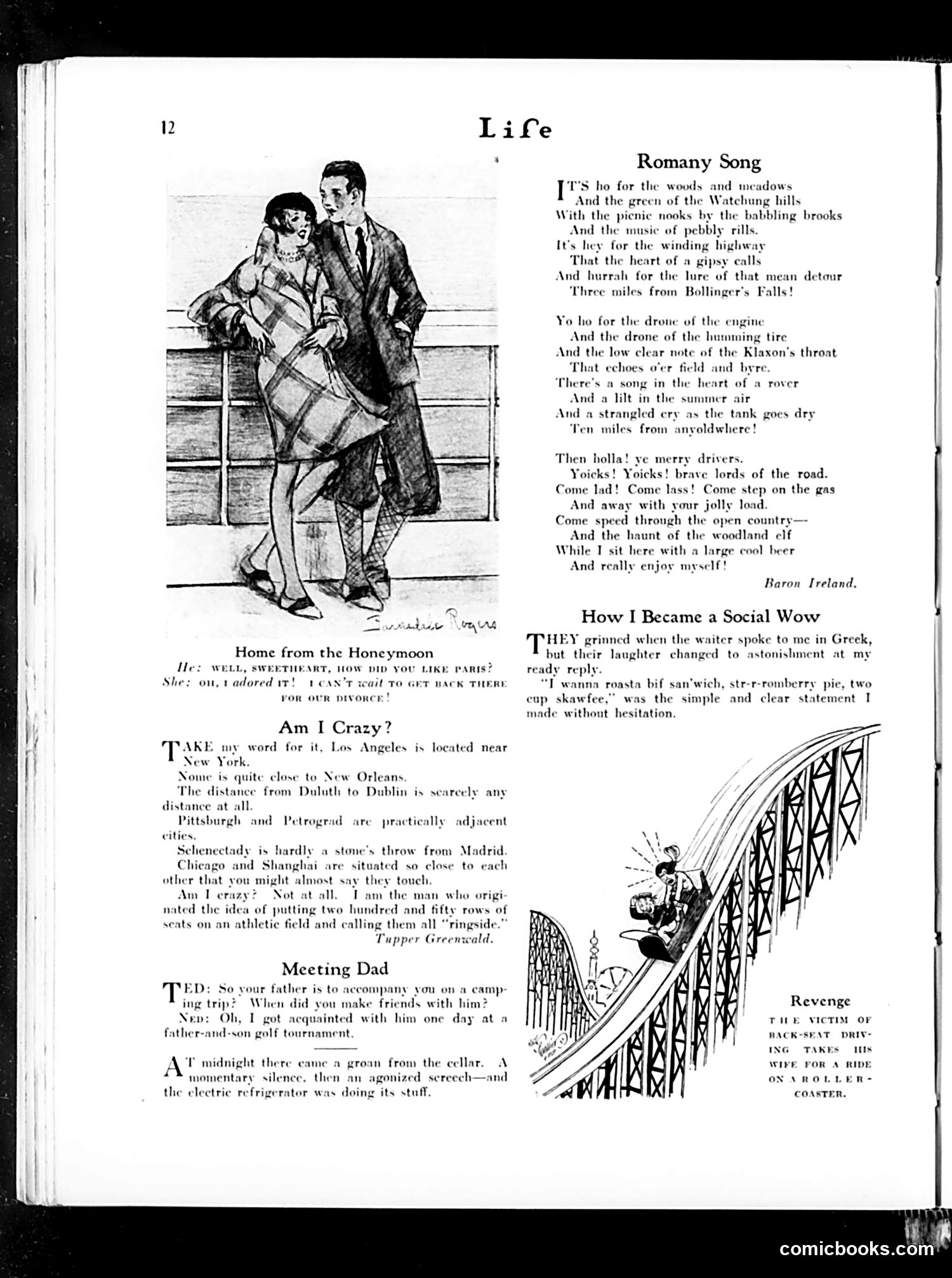
**"Home from the Honeymoon"** (top illustration): A couple returns from their honeymoon. The husband asks if the waiter served them well; the wife responds sarcastically that she "adored it" but can't wait to get back for their divorce. This jokes about marriage troubles—suggesting even newlyweds are already unhappy, a common satirical theme about modern matrimony. **"Am I Crazy?"** satirizes geographic ignorance, mocking people who claim distant cities are adjacent (Los Angeles near New York, Pittsburgh near Petrograd). The author claims he invented the "ringside" seating concept at sports events, establishing himself as reasonable while others lack basic geography knowledge. The remaining pieces appear to be humorous short stories rather than political commentary.
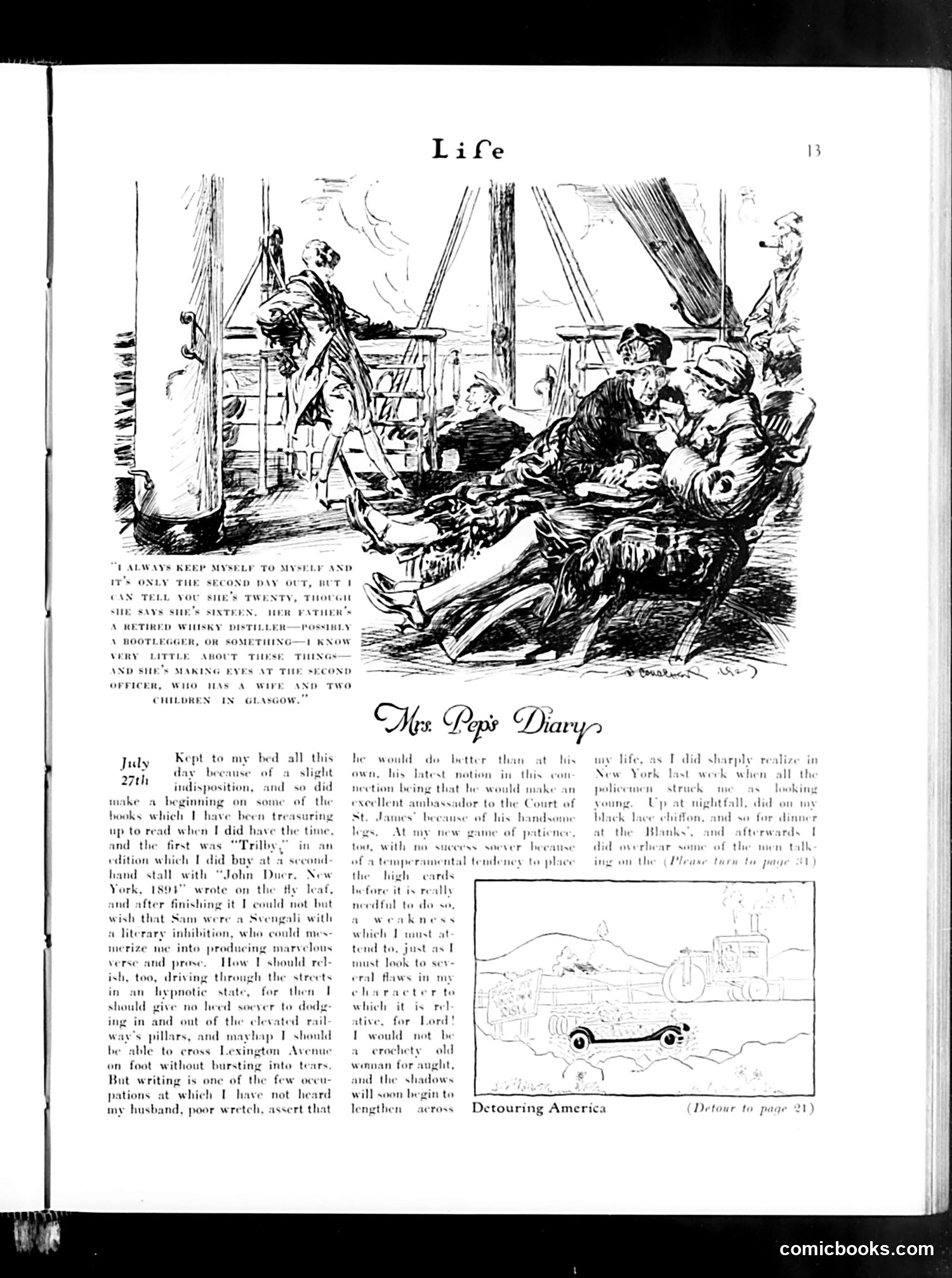
This page contains a satirical diary entry dated July 27th, alongside a sketch titled "Detouring America." **The Diary Entry** mocks the author's literary pretensions and domestic frustrations. She mentions reading books by "John Duer, New York, 1891" and wishing her husband Sam possessed "literary inhibition" to discuss poetry and prose. She complains about writing as therapeutic escape from her constrained life—a critique of upper-class women's limited intellectual outlets and domestic entrapment. **The Illustration** shows passengers aboard what appears to be a ship or boat, depicting leisure-class entertainment and social interaction. **"Detouring America"** (bottom) appears to advertise travel content, referencing automotive tourism culture emerging in the 1920s-30s era. The overall satire targets bourgeois aspiration, marital dissatisfaction, and women's intellectual unfulfillment.
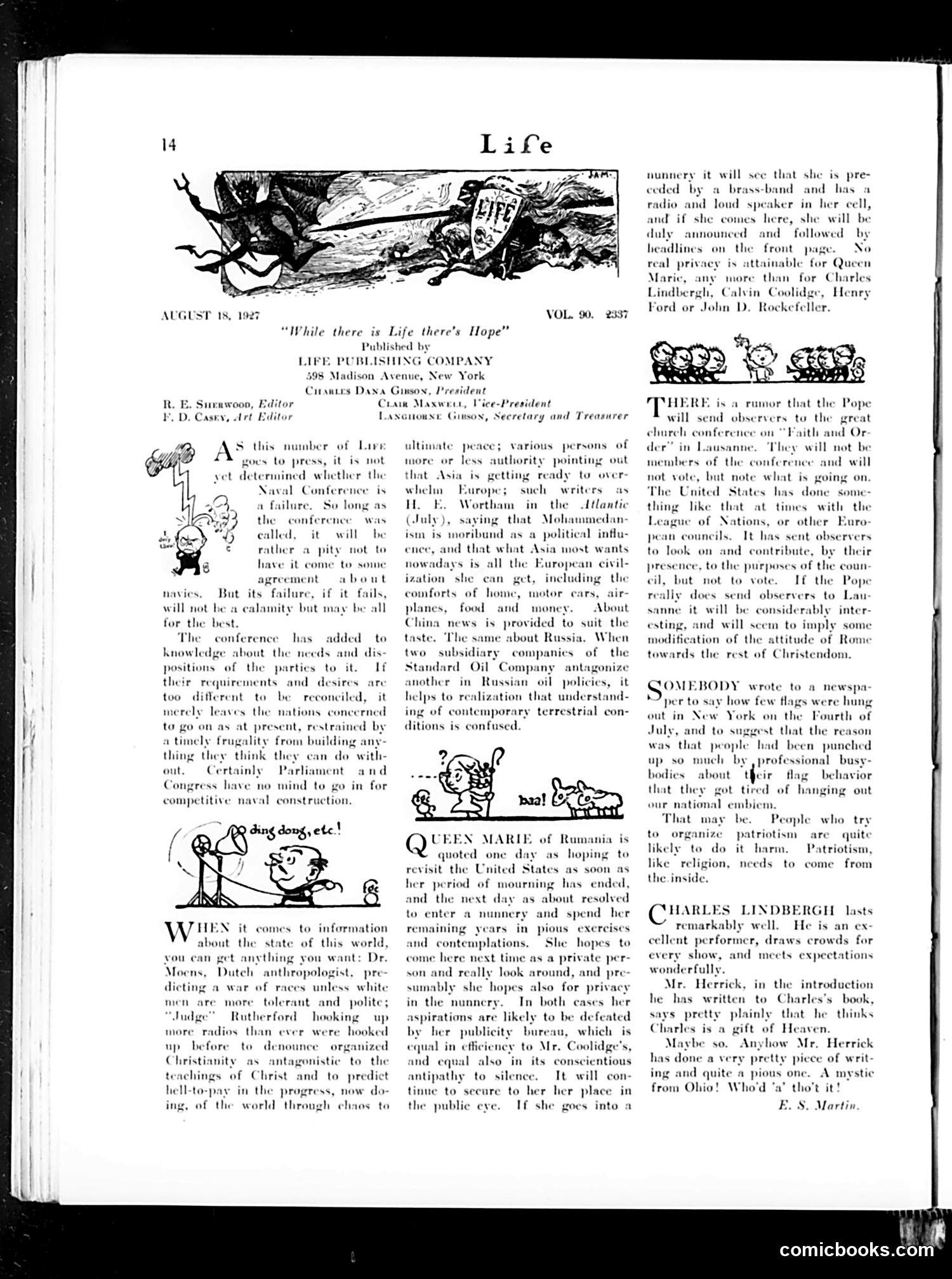
This page contains editorial commentary and small cartoon illustrations typical of Life's satirical format. The main text discusses the Pan-European Conference and Asia's readiness for European civilization, suggesting diplomatic and international tensions of the era. A cartoon labeled "ding dong, ding it!" appears to show someone ringing a bell—likely satirizing public attention-seeking or announcements. The page references Queen Marie of Romania's hoped efforts to resist the United States and mentions Charles Lindbergh, noting his "remarkable" performance and "every show." This reflects Lindbergh's celebrity status following his 1927 transatlantic flight, which occurred just weeks before this magazine's publication date. The satire targets both international politics and American celebrity culture of the post-WWI period.
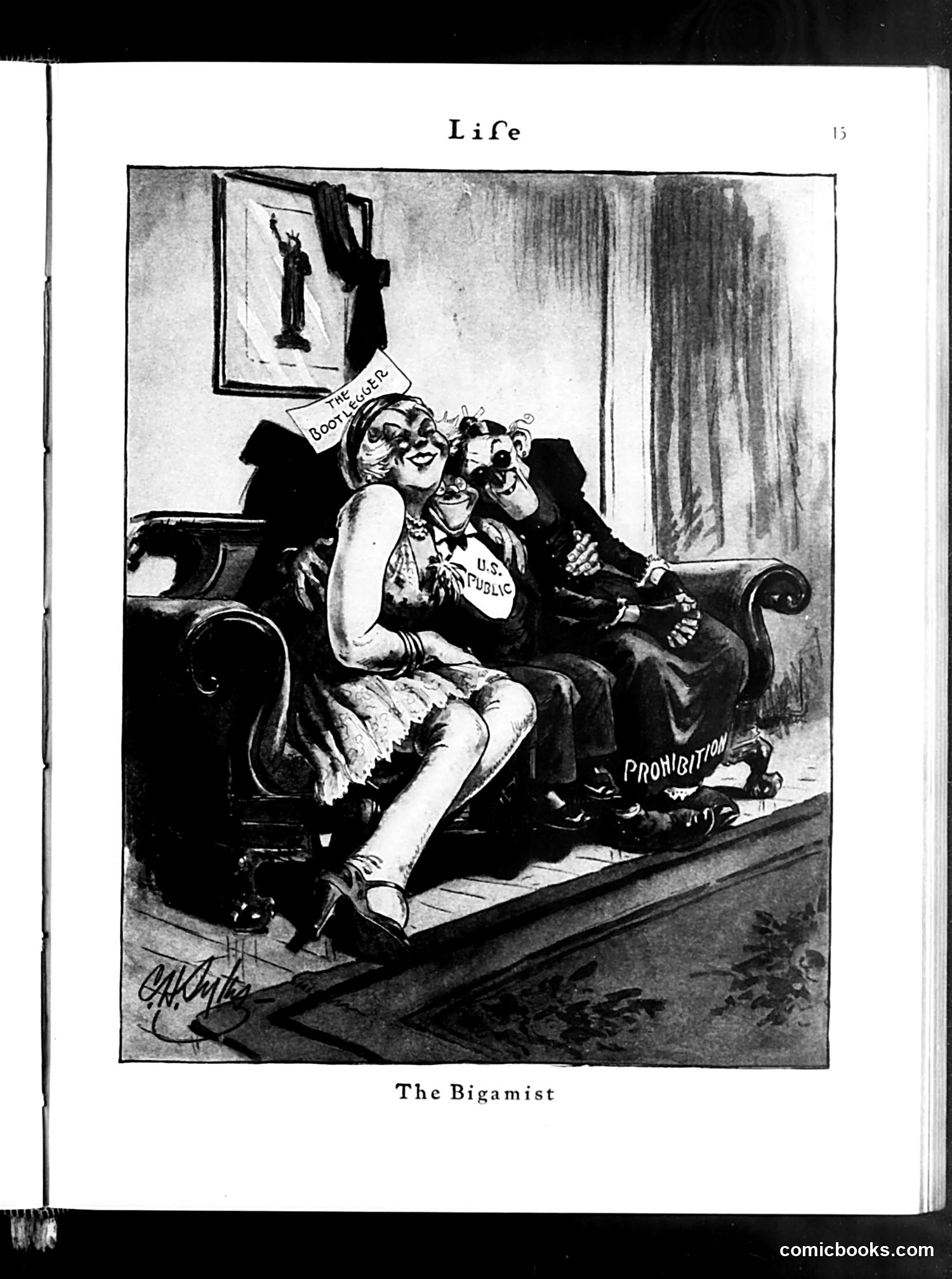
This satirical cartoon critiques Prohibition-era hypocrisy. The central female figure wears a "U.S. Public" sash, personifying America itself. She's depicted in a car with two male companions labeled "The Bootlegger" and "Prohibition"—portraying the nation as unfaithfully married to both lawlessness and its own laws simultaneously. The cartoon suggests that Prohibition, while officially the law, coexists with widespread bootlegging and illegal alcohol consumption, making America a "bigamist" caught between competing commitments. The framed portrait on the wall likely represents constitutional authority being ignored. This is classic 1920s social commentary mocking the failure of Prohibition enforcement and America's divided stance on the policy.
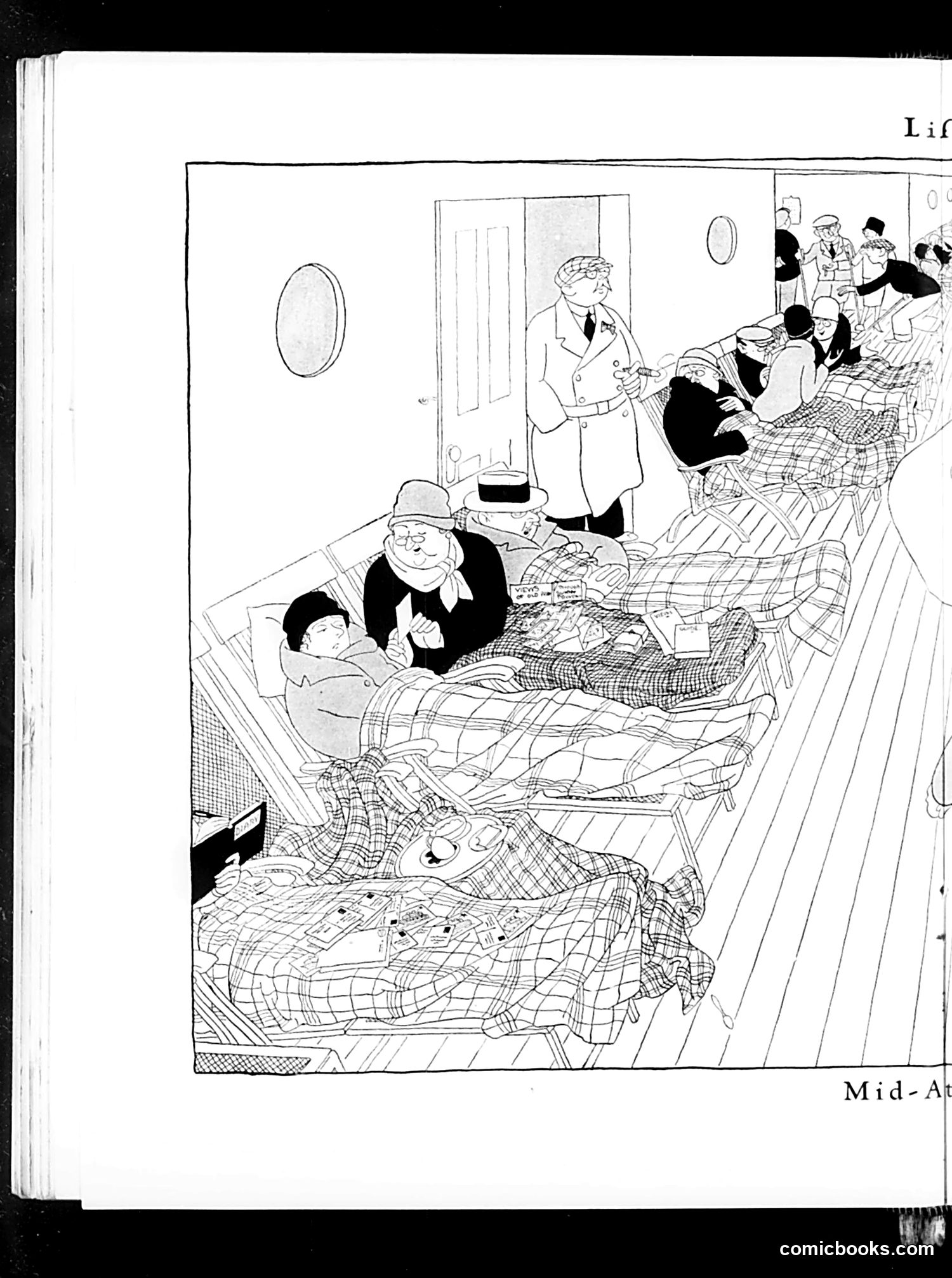
This cartoon depicts a ship's dormitory or bunk area, likely from Life magazine's satirical coverage of early 20th-century travel or immigration conditions. The scene shows numerous passengers crammed into tight sleeping quarters with checkered blankets, while well-dressed officials or inspectors tour through the space. The satire appears to critique overcrowded and poor conditions aboard ships—possibly commenting on immigrant transport, steerage accommodations, or passenger vessel practices of the era. The contrast between the cramped, uncomfortably arranged sleeping passengers and the formally-dressed visitors touring the space suggests mockery of either official inspections that overlooked actual conditions or the gap between promised and actual passenger accommodations. The style and subject matter suggest this commentary on maritime conditions and passenger welfare was meant to expose uncomfortable truths to Life's readers.
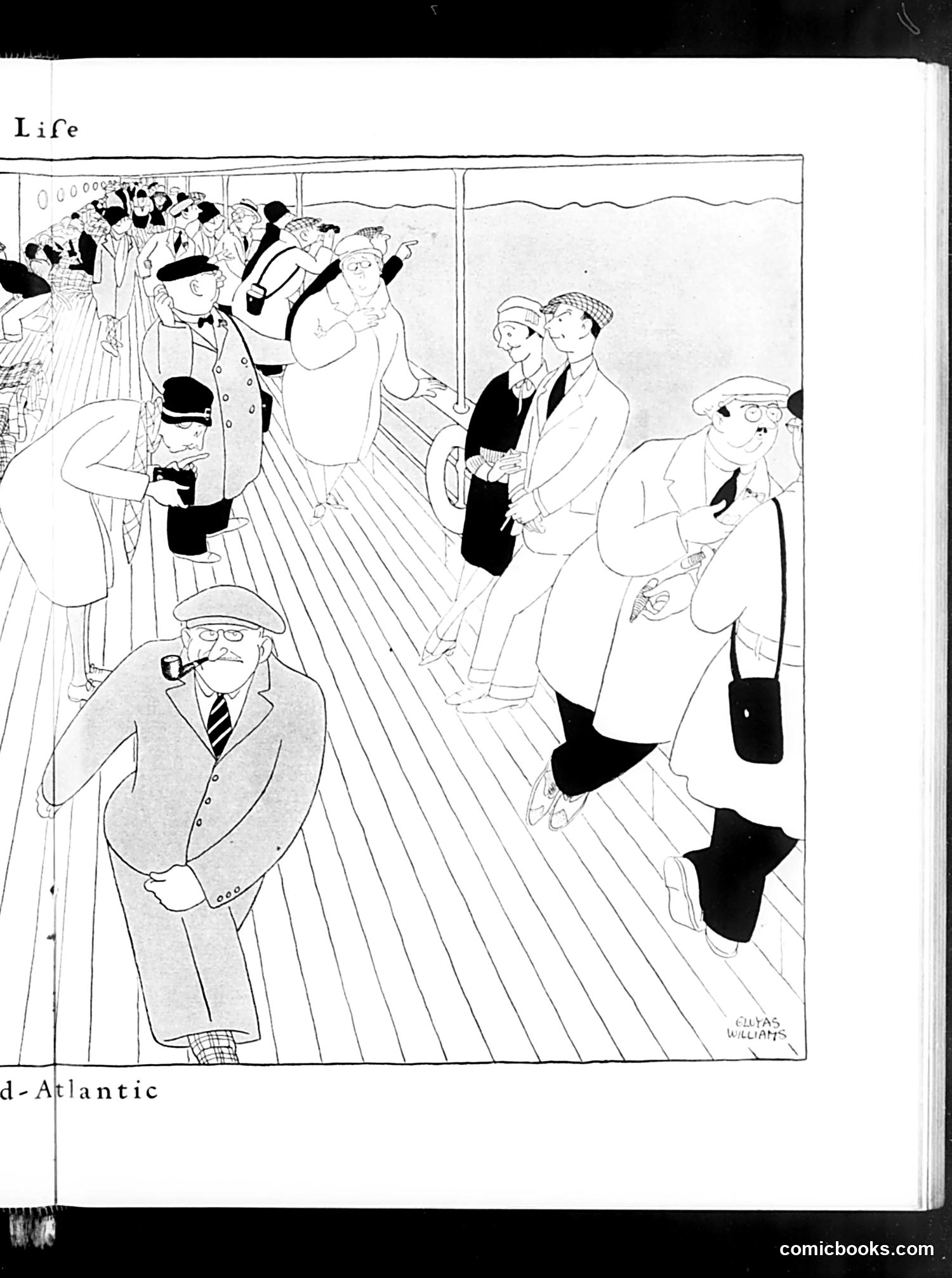
This cartoon, signed by Cluyas Williams, depicts a scene aboard what appears to be a ship (indicated by the wooden deck planking and the "d-Atlantic" text, likely referencing a transatlantic vessel). The satire appears to target **class distinctions during ocean travel**. A portly, working-class man in the foreground (smoking a pipe, wearing casual attire) contrasts sharply with well-dressed passengers behind him—men in formal coats and hats, women in fashionable dress crowded together. The joke likely critiques the **segregation of passenger classes** on ships, or satirizes how different social classes occupied separate spaces during transatlantic crossings. The contrast between the relaxed, solitary working-class figure and the cramped, formal upper-class passengers suggests commentary on inequality or the absurdity of rigid class hierarchies during travel.
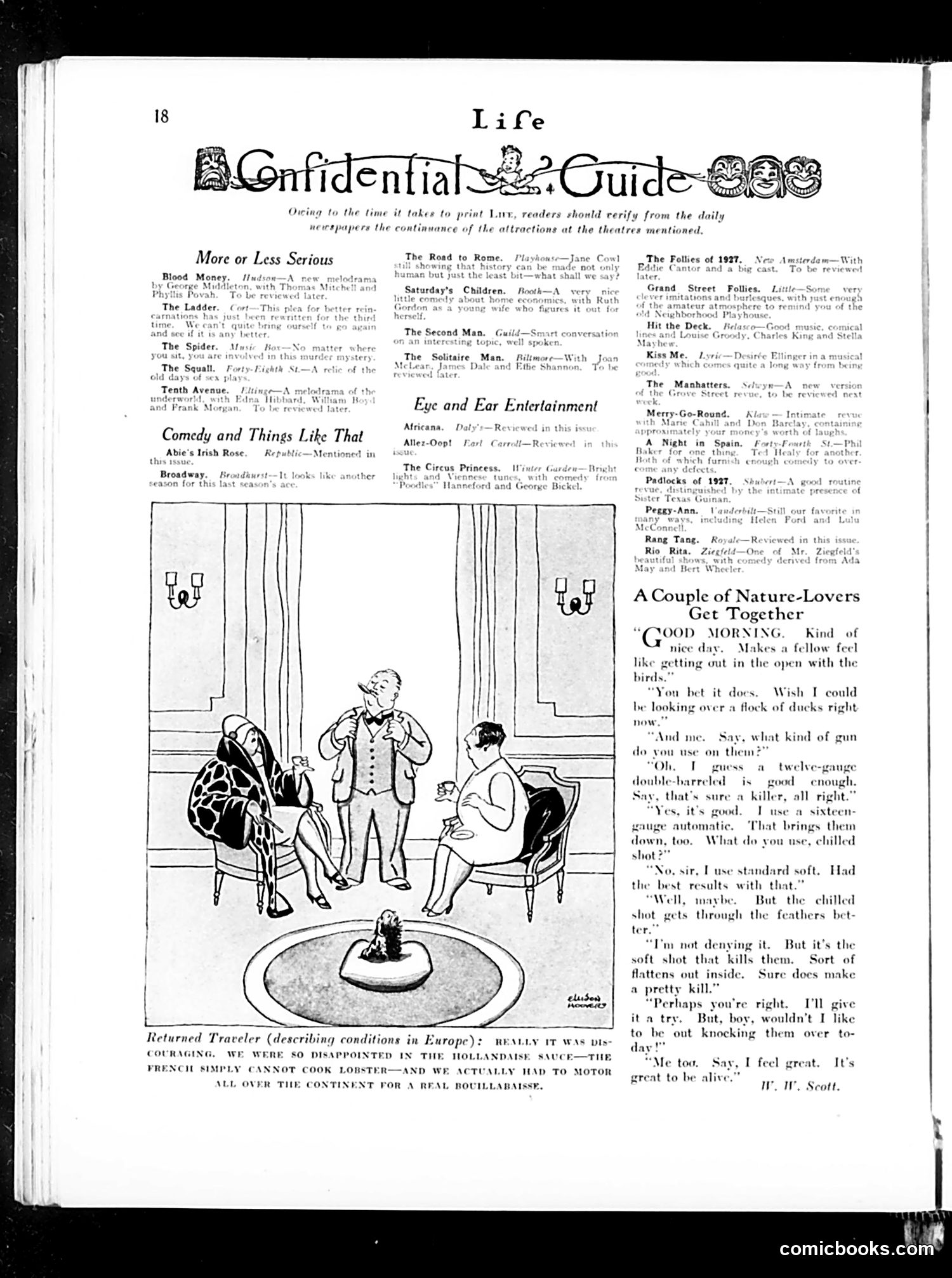
This single-panel cartoon satirizes American tourists' complaints about Europe after World War I. The setup features a traveler describing disappointing conditions abroad to listeners at home. The joke targets wealthy Americans' entitled expectations: they were so disappointed that despite traveling "all over the continent," they couldn't even find a proper bouillabaisse sauce or cook lobster to their standards. The punchline—"we actually had to motor all over the continent for a real bouillabaisse"—mocks the absurdity of complaining about minor culinary inconveniences while traveling extensively across post-war Europe. The satire reflects 1920s American attitudes: post-war tourism was booming among the wealthy, yet many returned with complaints rather than cultural appreciation. The cartoon suggests these travelers' priorities were superficial (food quality) rather than understanding European recovery or cultural exchange. It's gentle mockery of American tourists' provincial attitudes and excessive expectations.
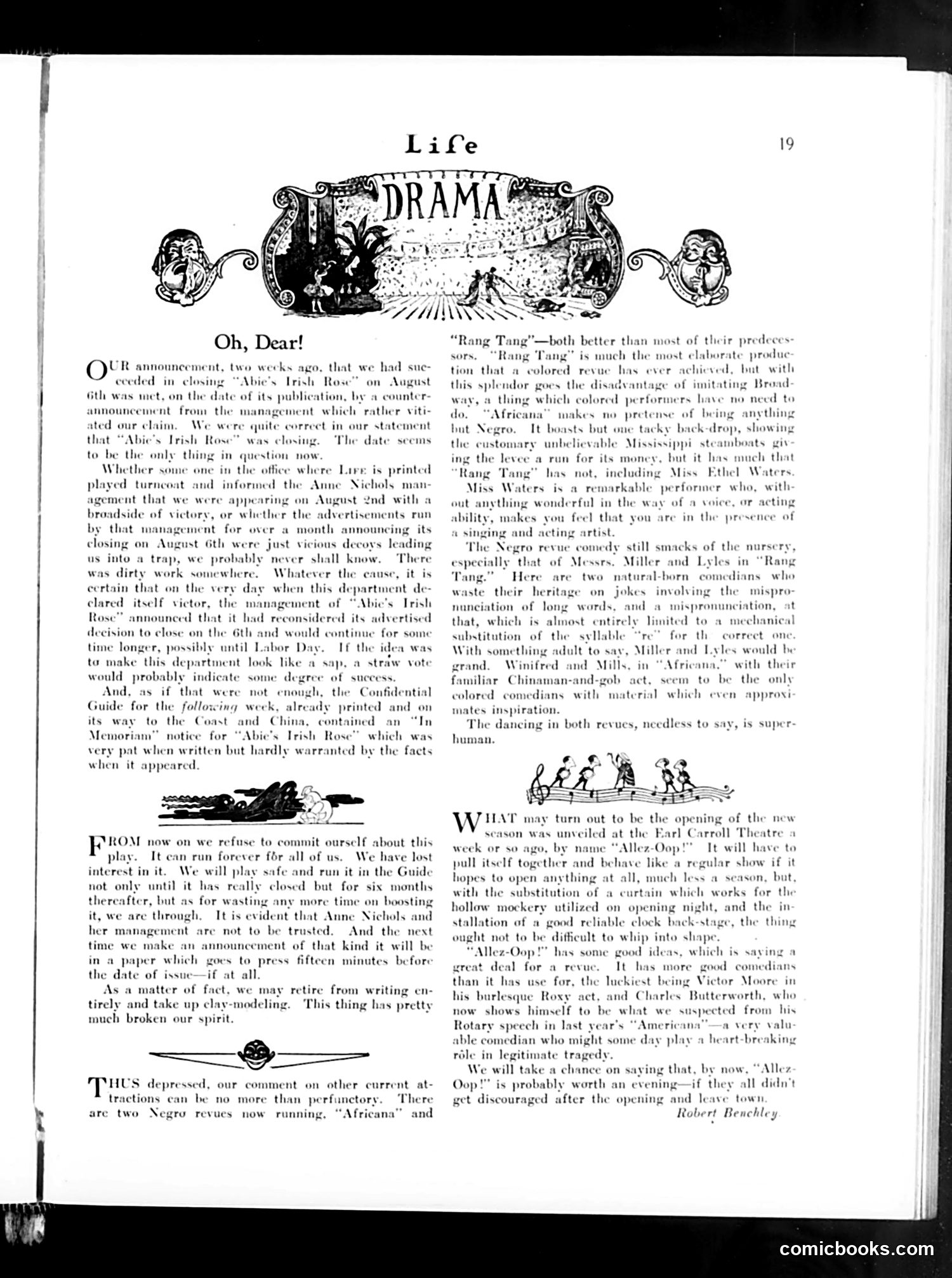
This page reviews two concurrent Black musical revues: "Africana" and "Rang Tang." The critic praises both as superior to their predecessors, but with reservations. **"Africana"** is deemed the more elaborate production, though it imitates Broadway's style unnecessarily. **"Rang Tang"** features Ethel Waters, whom the critic calls "remarkable"—notably praising her *stage presence* rather than her voice, suggesting how performers compensated within racial constraints. The satire targets the comedians Miller and Lyles, who "waste their heritage" making jokes about mispronouncing long words—a "mechanical substitution" implying their comedy relies on crude dialect humor rather than substantive material. The critic contrasts this with Winifred and Mills, whose "Chinaman-and-gob act" at least has developed material. The underlying critique: Black performers possessed genuine talent but were confined to stereotypical material and inferior theatrical conditions relative to white Broadway productions.
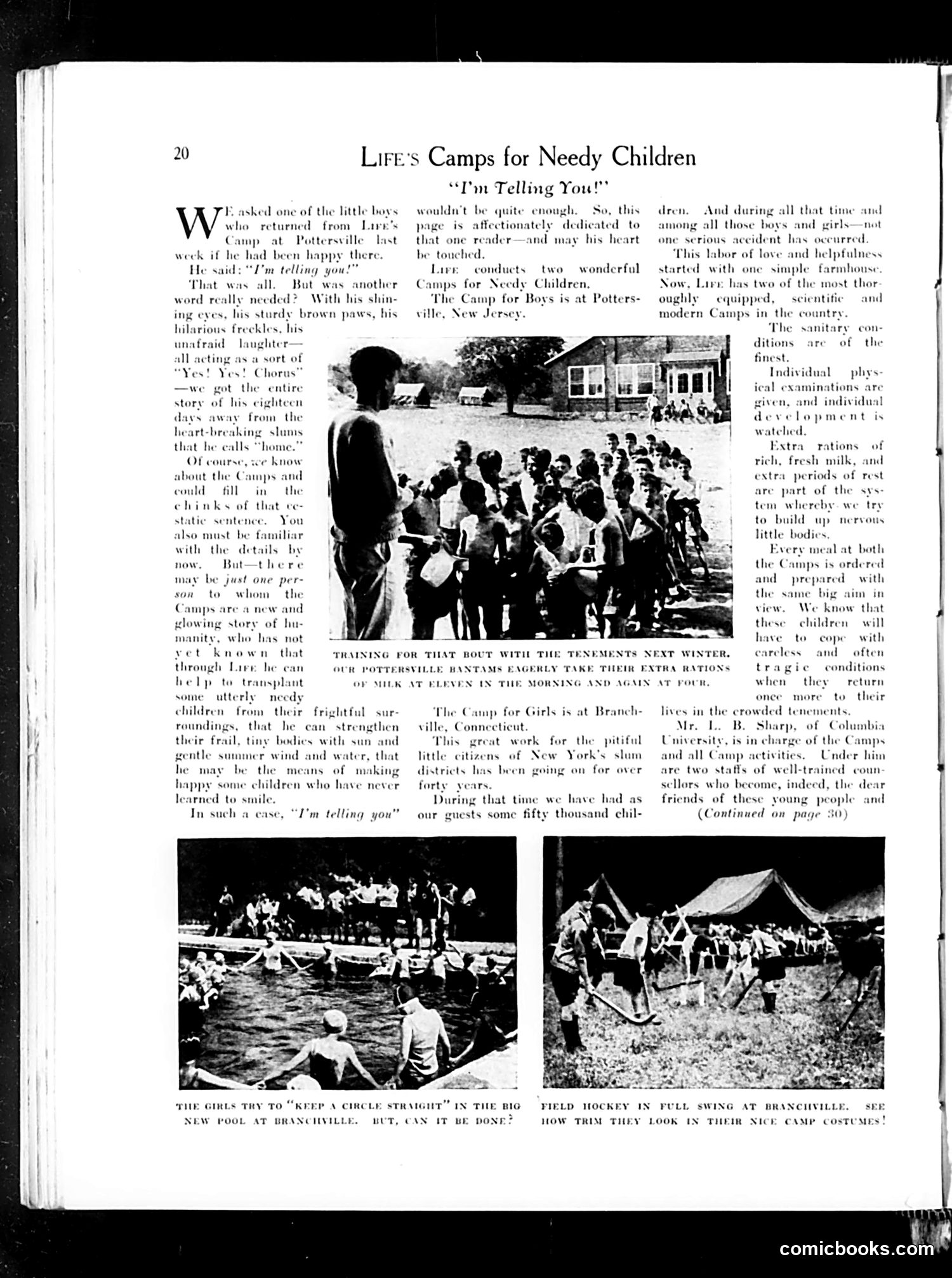
This is not satire or political commentary, but rather **advocacy journalism**—a promotional article for Life magazine's own charitable initiative. The page describes two summer camps Life magazine operates for impoverished children from New York City slums: one for boys in Pottersville, New Jersey, and one for girls in Branchville, Connecticut. The article emphasizes the camps' therapeutic benefits: physical examinations, nutritious meals (extra milk rations), rest periods, and supervised activities like swimming and field hockey. The opening anecdote—a boy saying "I'm telling you!"—serves as emotional testimony to the camps' success. Three photographs show children engaged in wholesome activities, contrasting their temporary rural refuge with their permanent "heart-breaking slums." The article notes the program has operated for forty years and served "some fifty thousand children." It credits Mr. L.B. Sharp of Columbia University as director. This represents **early 20th-century progressivism**: using media to document and promote charitable work addressing urban poverty and child welfare.
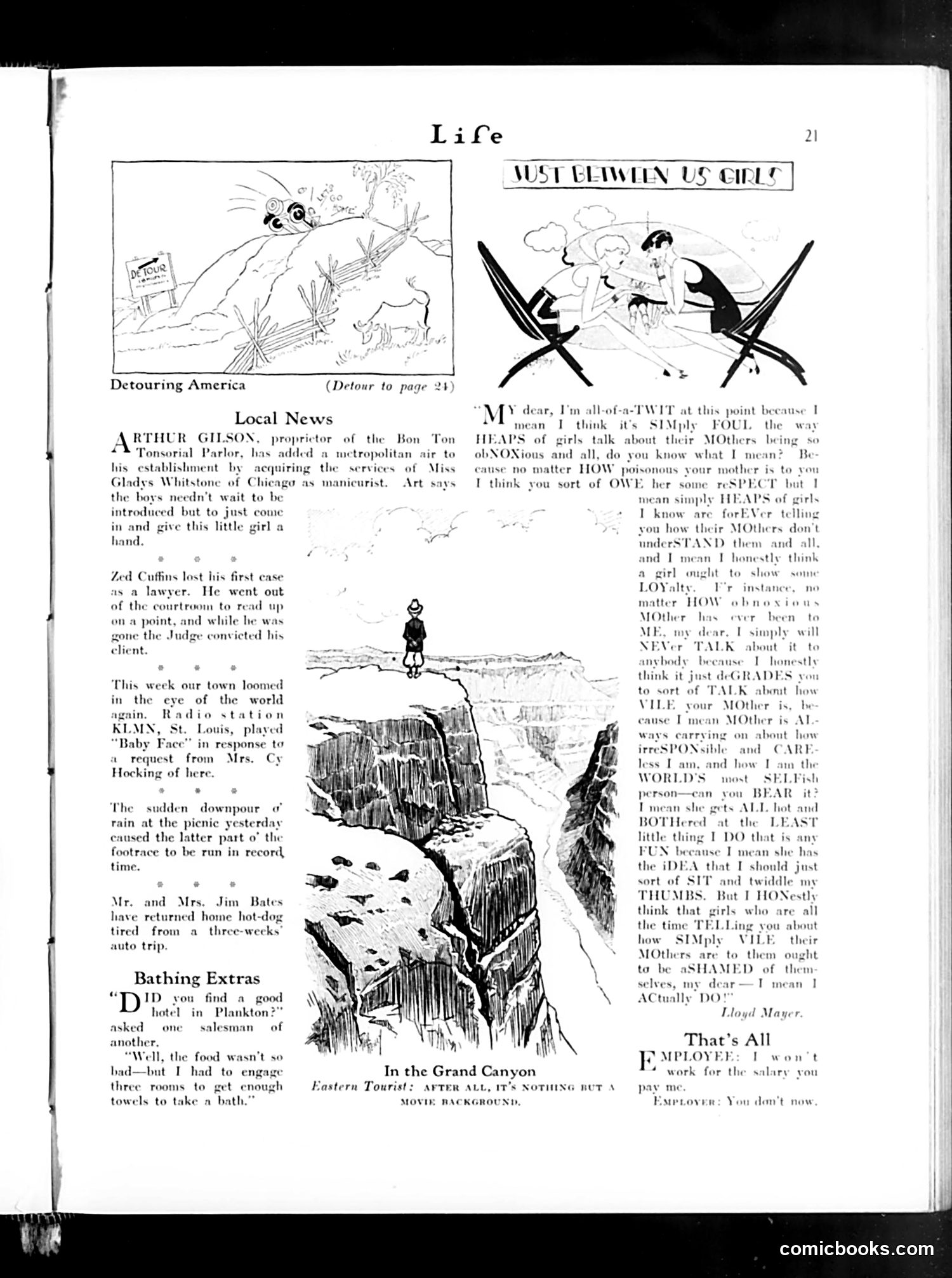
This page contains local humor and satire typical of Life's small-town comedy section. The "Local News" items mock provincial American life: a barber adding "sophistication" by hiring a manicurist, a newly-minted lawyer losing his first case through incompetence, and travelers exhausted by driving. The main cartoon, "In the Grand Canyon," satirizes tourists who treat natural wonders as mere backdrops, reducing sublime landscape to movie scenery—a jab at Hollywood's influence on American sensibilities. The large text piece by Lloyd Mayer mocks teenage girls' complaints about their mothers, presenting an exaggerated adolescent voice that contradicts itself: girls criticize mothers for being controlling while admitting they themselves are selfish and irresponsible. The satire targets both affected teenage rebellion and parents' genuine frustrations with youth. The final exchange ("That's All") is a brief joke about employment negotiations—a worker demands a raise only to learn the employer won't grant one.
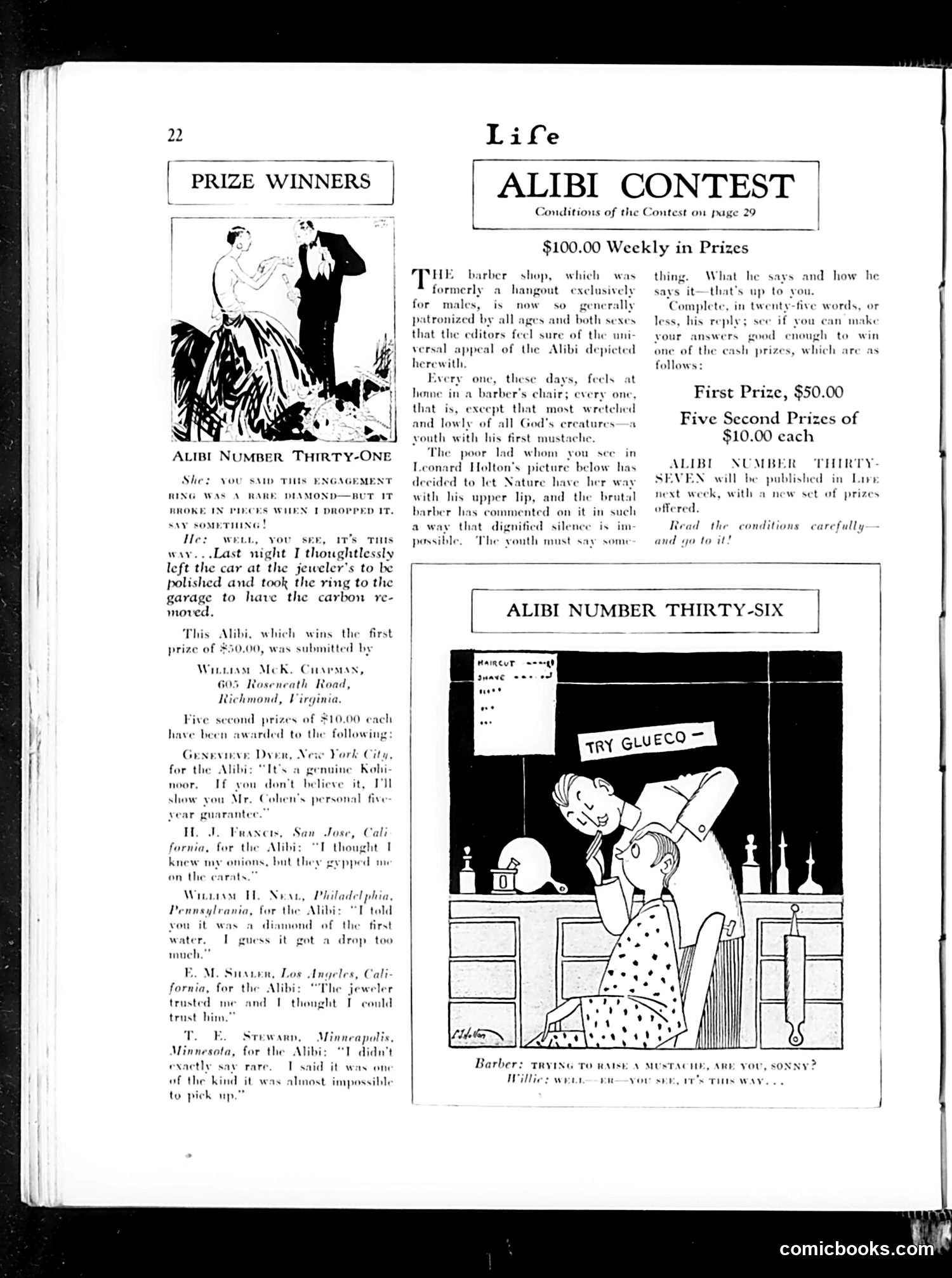
This page showcases *Life* magazine's "Alibi Contest"—a humor competition where readers submit witty excuses for absurd situations. The winning entry (Alibi #31) features a couple where the man must explain why an "rare diamond" engagement ring shattered when dropped: he claims he'd mistakenly left it at the garage for carbon removal instead of the jeweler. The joke relies on the absurdity of confusing a precious ring with a car part. The cartoon (Alibi #36) depicts a young man with his first mustache visiting a barber. The barber asks sarcastically, "Are you trying to raise a mustache?" The boy's response—presumably awkward and defensive—is what readers must complete in 25 words or fewer to win $50. The satire mocks the universal male experience: adolescent self-consciousness about facial hair and social awkwardness. The contest format itself was popular entertainment during this era, inviting reader participation and humor.
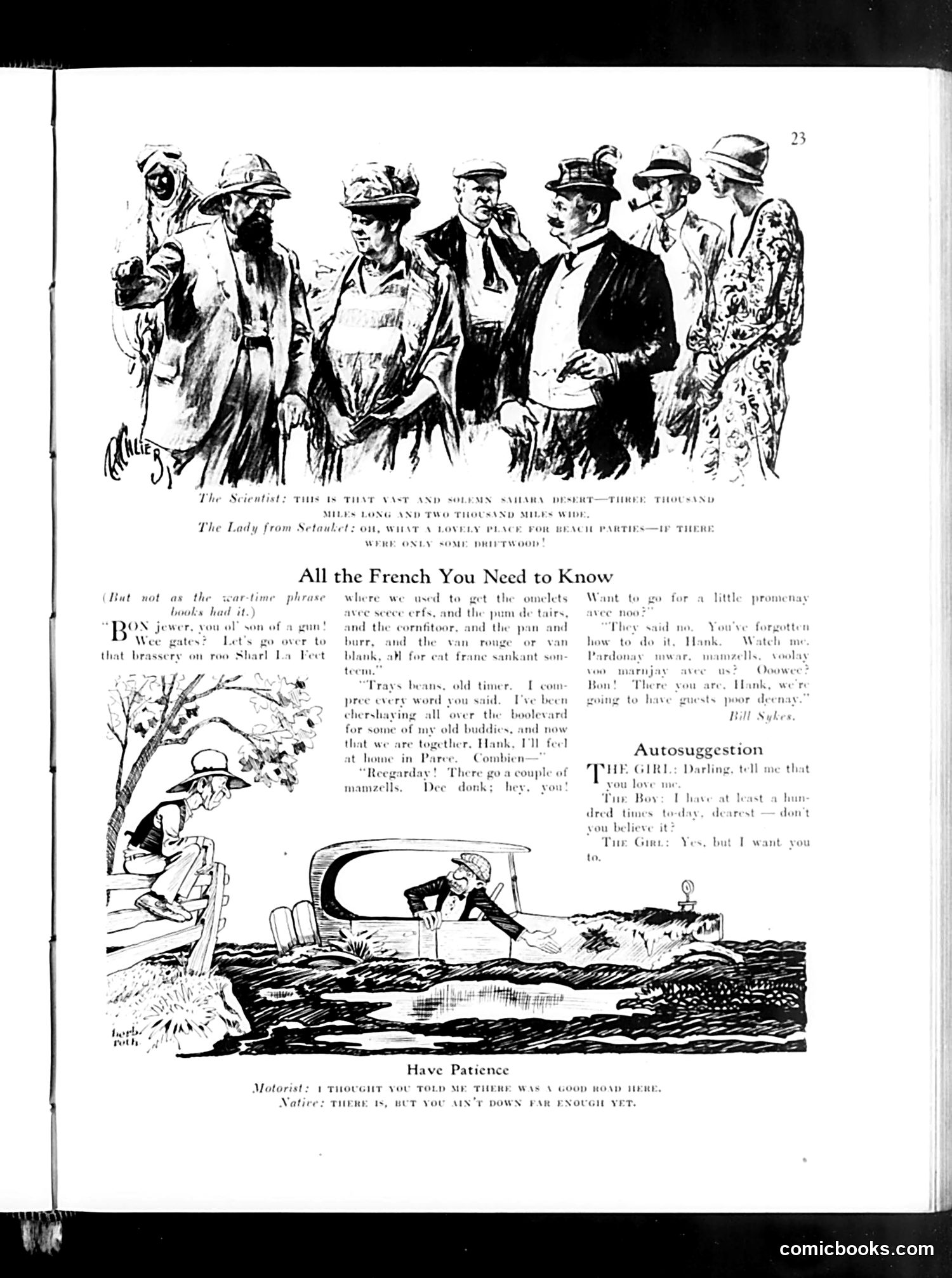
This page contains three separate satirical pieces: **Top cartoon**: Depicts a "scientist" and "lady from Setauket" discussing a vast desert. The joke mocks American tourists' inability to appreciate natural wonders without commercial amenities—the lady envisions beach parties rather than geological majesty, suggesting shallow materialism. **"All the French You Need to Know"**: Satirizes American soldiers returning from World War I who pepper their speech with mangled French phrases and slang picked up abroad. The exaggerated dialogue ("Bon jewer," "Combien") mocks this affected pretension and the soldiers' misunderstanding of actual French. It's gentle mockery of war veterans trying to seem sophisticated. **"Have Patience"**: A motorist complains to a native about poor road conditions. The native's reply—that the road exists but the motorist hasn't driven far enough yet—is absurdist humor about infrastructure inadequacy, likely reflecting post-WWI America's developing highway system and rural road conditions. All three pieces lampoon American cultural attitudes: materialism, affected sophistication, and infrastructure limitations.
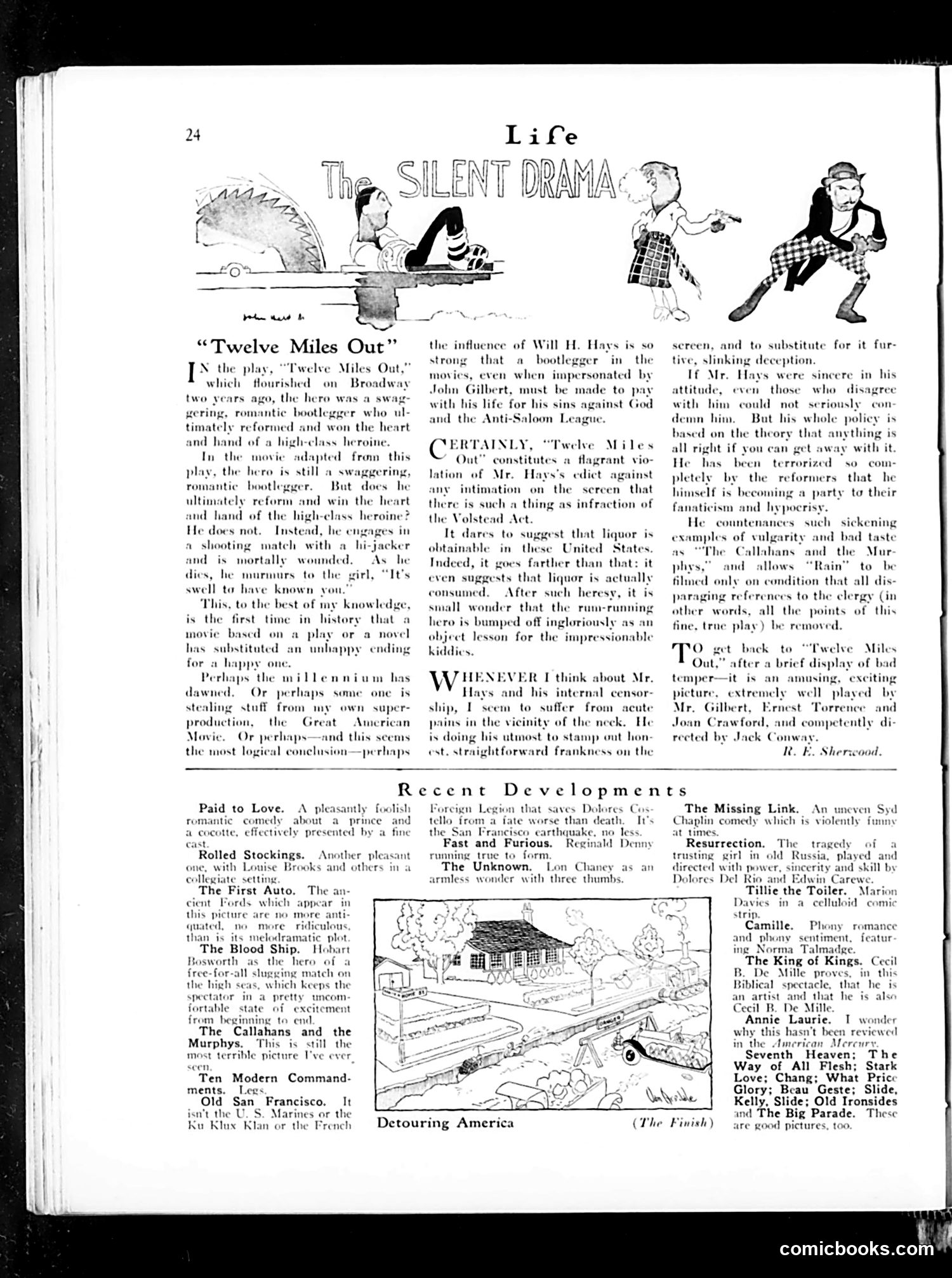
This review discusses a 1924 film adaptation that notably changed its source play's ending: the bootlegger hero now dies rather than reforms and finds happiness. The satirist argues **Will H. Hays**—Hollywood's chief censor enforcing the Motion Picture Production Code—forced this unhappy ending. Hays, backed by the Anti-Saloon League and temperance reformers, demanded moral punishment for any character who violated Prohibition laws, even if the original story didn't require it. The author mocks this hypocrisy: Hays claims to uphold straightforward morality while actually practicing "furtive, slinking deception." By allowing liquor to exist on-screen only to punish its users, the censor paradoxically suggests wrongdoing while preventing honest treatment of the subject. The complaint reflects 1920s cultural tension between reformers imposing strict moral codes on entertainment and artists seeking creative freedom. The reviewer presents Hays not as principled but as terrorized by censors into compromising artistic integrity.
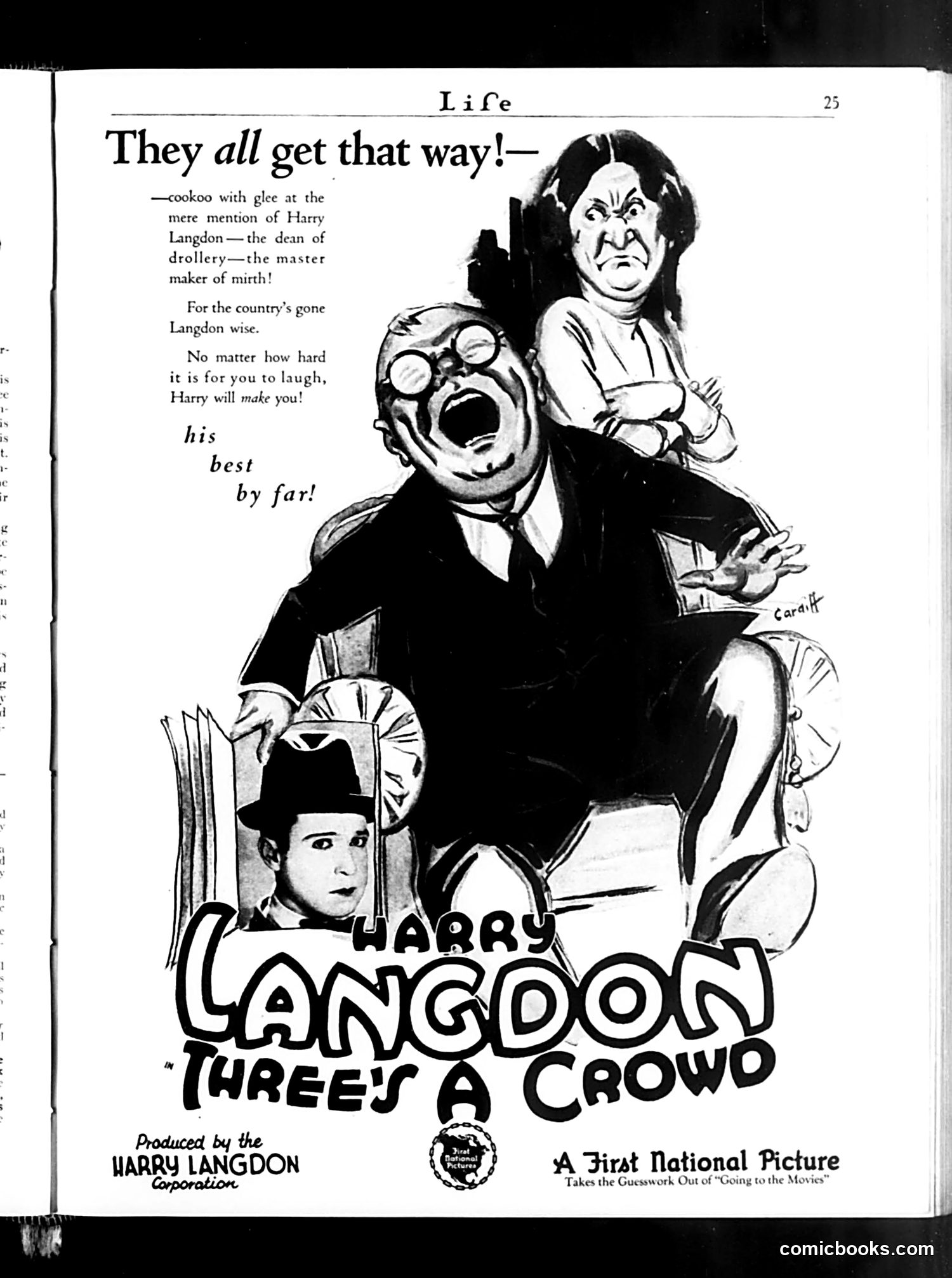
This is a **movie advertisement** for comedian Harry Langdon's film "Threes a Crowd," produced by First National Pictures. The page satirizes Langdon's comedic style through exaggerated caricatures showing his characteristic facial expressions—wide-eyed, slack-jawed reactions meant to convey confusion or bewilderment. The text uses hyperbolic praise ("dean of drollery," "master maker of mirth," "his best by far") to promote Langdon as a guaranteed laugh-getter. The phrase "No matter how hard it is for you to laugh, Harry will make you!" suggests his physical comedy is irresistible. The multiple distorted faces illustrate the absurd emotional reactions audiences should expect. This represents 1920s silent film marketing, when comedians like Langdon, Chaplin, and Keaton built careers on physical humor and distinctive facial expressions rather than dialogue.
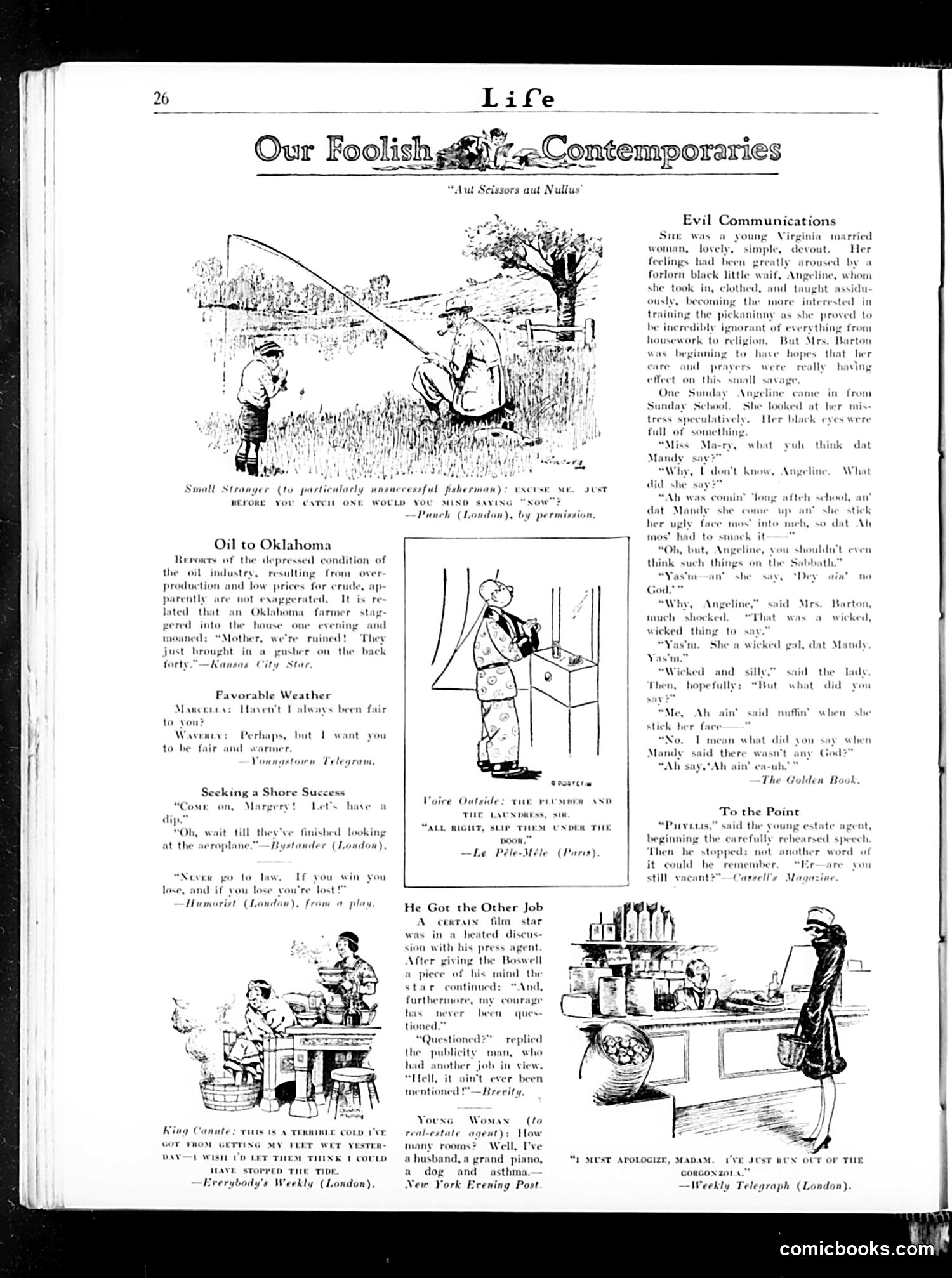
This page collects satirical short pieces mocking contemporary social behaviors and attitudes. **"Evil Communications"** presents a morality tale: a Virginia woman tries to "civilize" a Black child servant named Angeline, teaching her religion and propriety. The satire targets the hypocrisy of such efforts—when Angeline repeats crude language learned from another servant, the woman is shocked, missing the irony that her "Christian training" hasn't actually taken root. **"Oil to Oklahoma"** jokes darkly about oil industry depression: a ruined farmer returns home announcing his land now has an oil gusher—typically good fortune, but worthless due to oversupply and price collapse. **Other brief pieces** satirize: men's fairness in weather (expecting warmth alongside fairness), lawyers' paradoxes, airplane spectators, a publicity agent's shameless character assassination, and a real estate agent's euphemisms about noisy neighbors. The page's humor assumes readers' familiarity with these social situations—wealth loss, racial stereotypes, professional dishonesty—presented as universal human folly worthy of mockery.
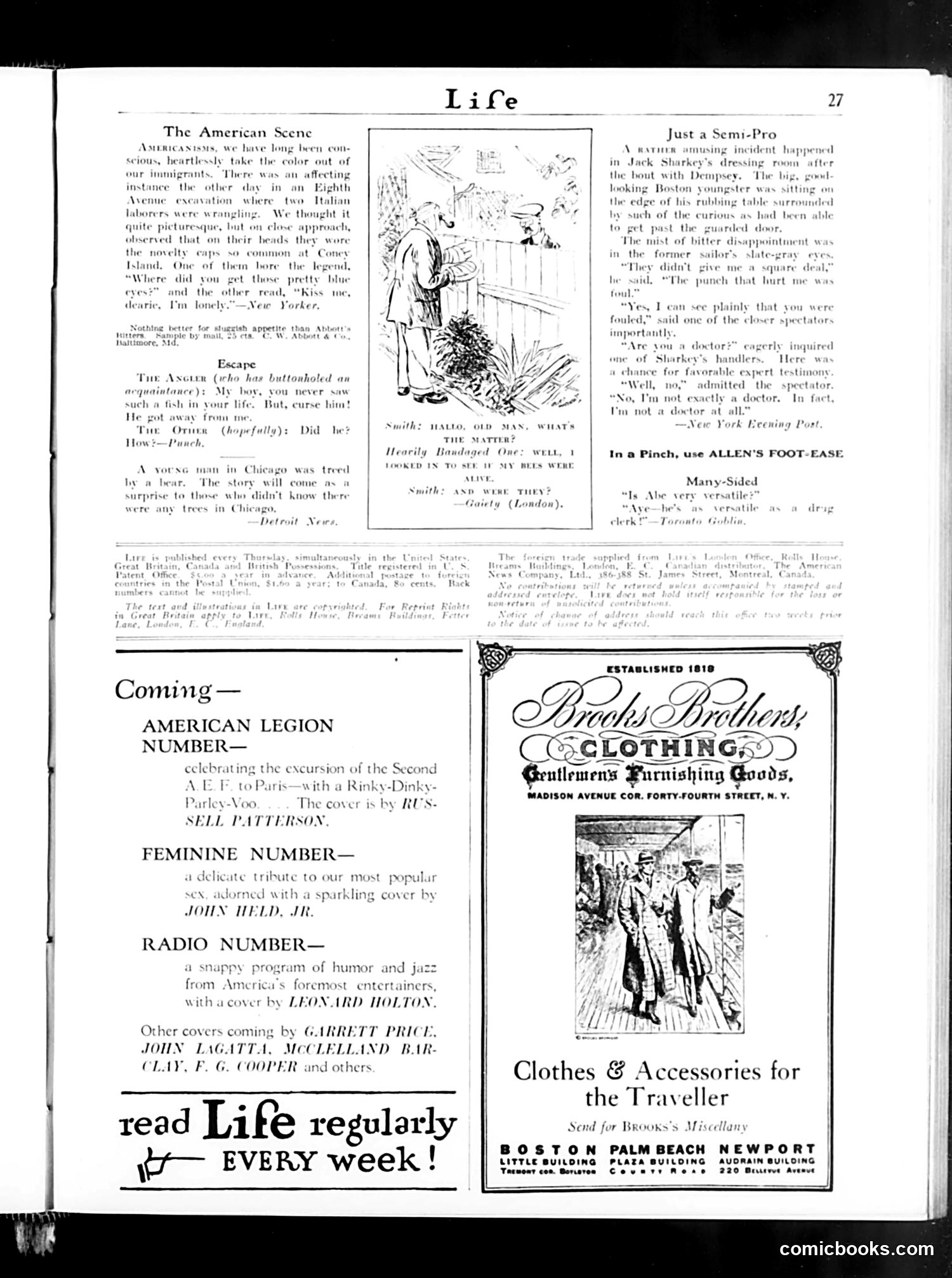
This page features satirical vignettes typical of Life's humor section. "The American Scene" presents brief, observational jokes about American life: 1. **Italian laborers**: A sentimental reference to Italian immigrants working in NYC construction, depicted quarreling—playing on contemporary stereotypes of emotional, argumentative immigrant workers. 2. **The Angler**: A fisherman exaggerates his catch to an acquaintance, a classic tall-tale joke format. 3. **The Onion**: A hopeful but unclear reference (possibly a pun or local reference). 4. **Chicago bear incident**: A young man treed by a bear—absurdist humor suggesting unlikely wildlife dangers in urban areas. 5. **"Just a Semi-Pro"**: References boxer Jack Sharkey and boxing culture; the joke involves someone claiming to be a non-professional boxer/fighter. The page also advertises Life's upcoming special issues (American Legion, Feminine, Radio numbers) and Brooks Brothers clothing for travelers. The cartoons rely on period-specific social contexts—immigrant stereotypes, boxing popularity, and observational Americana humor—that would resonate with 1920s readers.
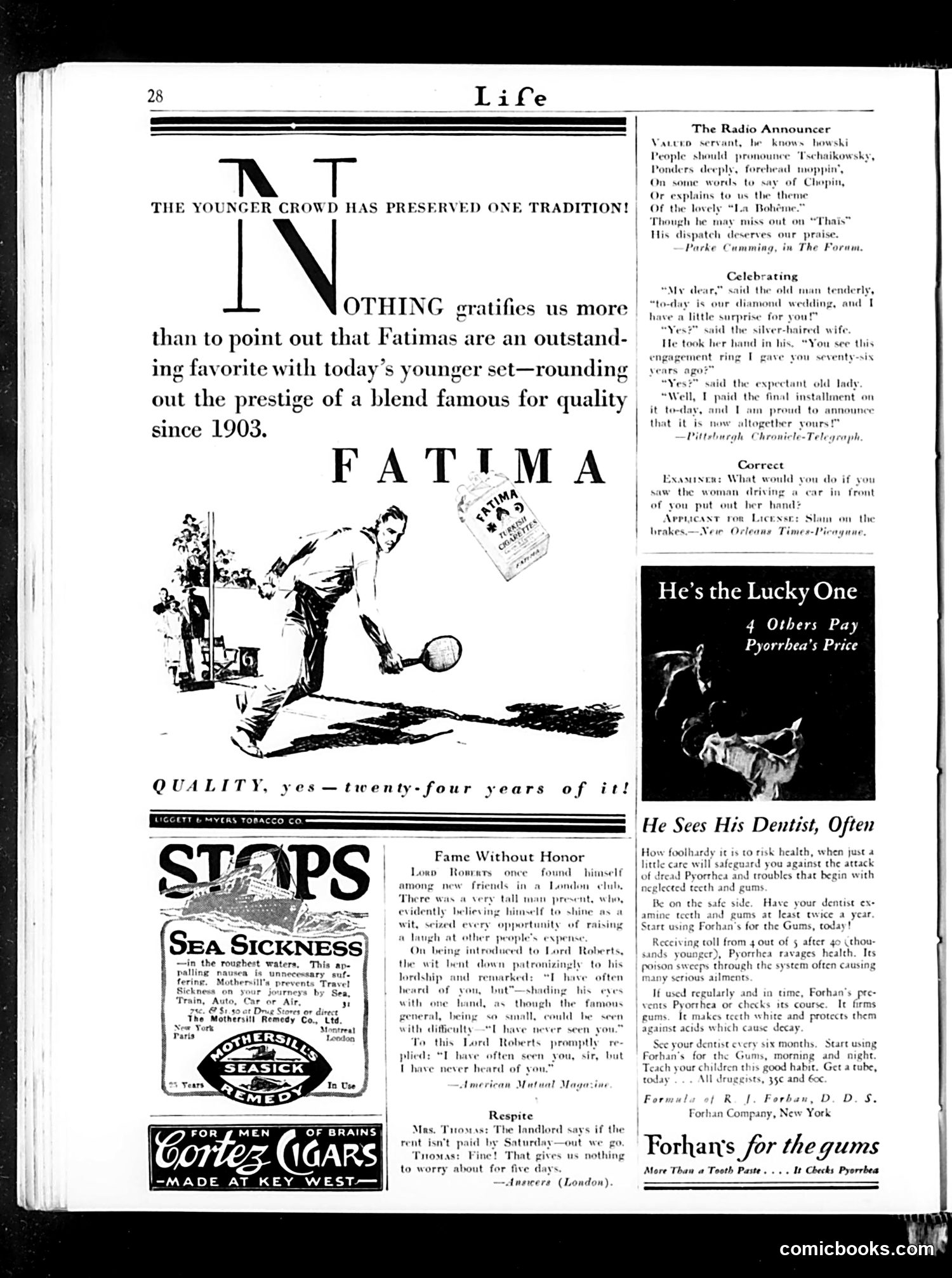
This page is primarily **advertising** rather than political satire. The dominant content is a Fatima cigarette advertisement featuring an illustration of a man kicking up his heels in celebration, emphasizing the brand's 24-year tradition of quality. The page includes several smaller elements: - **"The Radio Announcer"** and **"Celebrating"** appear to be brief humorous anecdotes about social situations, typical of Life's miscellaneous filler content - **"Fame Without Honor"** recounts a British anecdote involving Lord Roberts (a recognizable military figure of the era) and a witty tall man in a London club - Multiple product advertisements for **Stops Sea Sickness remedy**, **Cortez Cigars**, and **Forhan's toothpaste** (emphasizing prevention of pyorrhea, a periodontal disease) The humor is genteel and conversational rather than satirical—focused on wordplay and social awkwardness rather than political commentary. This reflects Life's 1920s identity as a lighter, entertainment-focused magazine before its later transformation into a serious news publication.
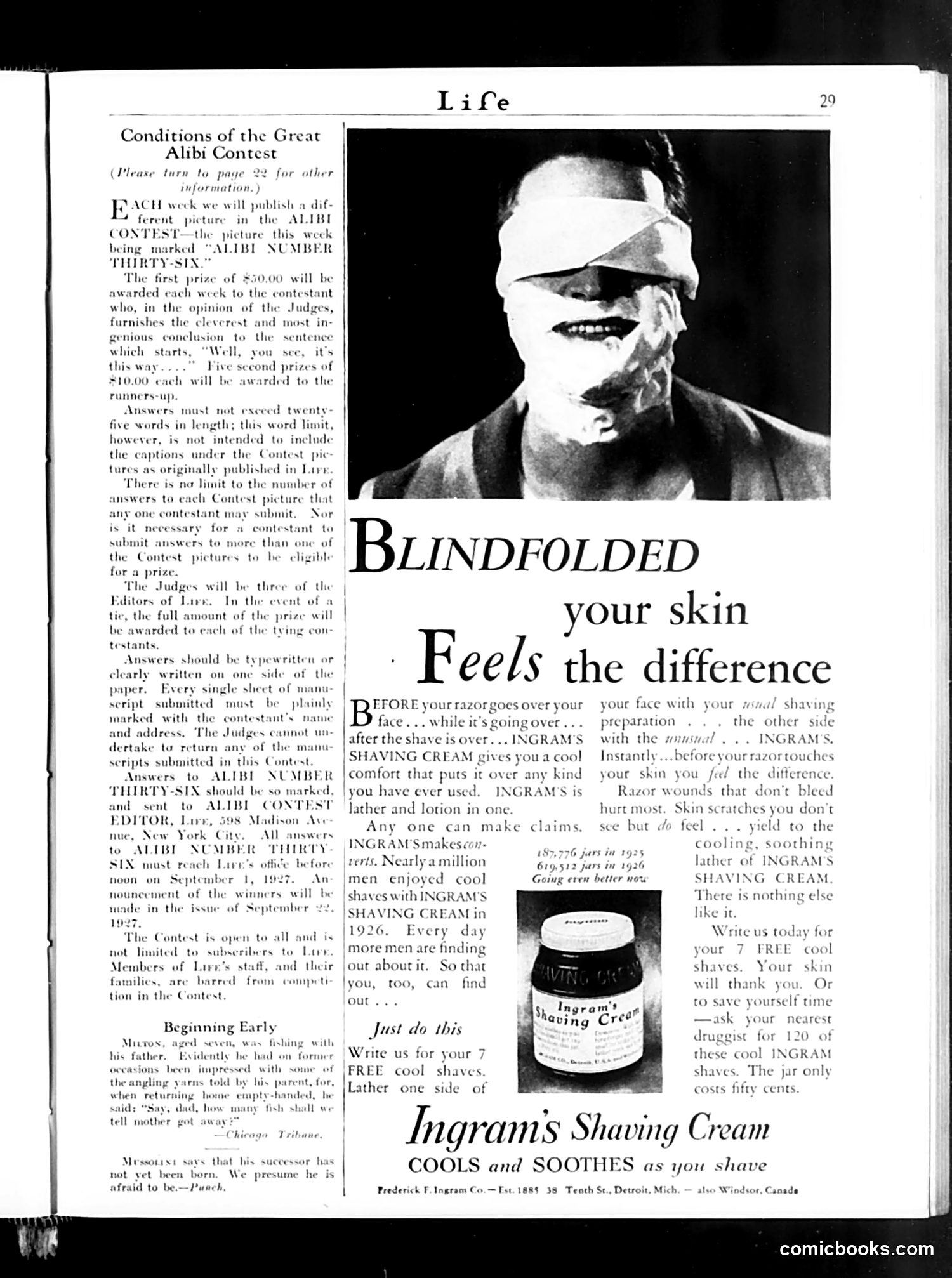
This page is primarily **advertising and contest information**, not political satire. The dominant content is an advertisement for Ingram's Shaving Cream featuring a photograph of a man with eyes blindfolded by a white cloth—the visual pun being "Blindfolded / your skin / Feels the difference." The ad claims the cream is so effective users needn't see to feel its superior cooling and soothing properties. The left column contains rules for Life's "Alibi Contest," a weekly reader-submission competition where contestants write humorous caption conclusions to published pictures (this week's being "Alibi Number Thirty-Six"). Winners receive cash prizes. A small item titled "Beginning Early" briefly notes a seven-year-old named Miros fishing with his father, impressed by tall tales—likely filler content. The page reflects 1920s advertising aesthetics and Life's dual function as both satirical magazine and entertainment publication with reader contests.
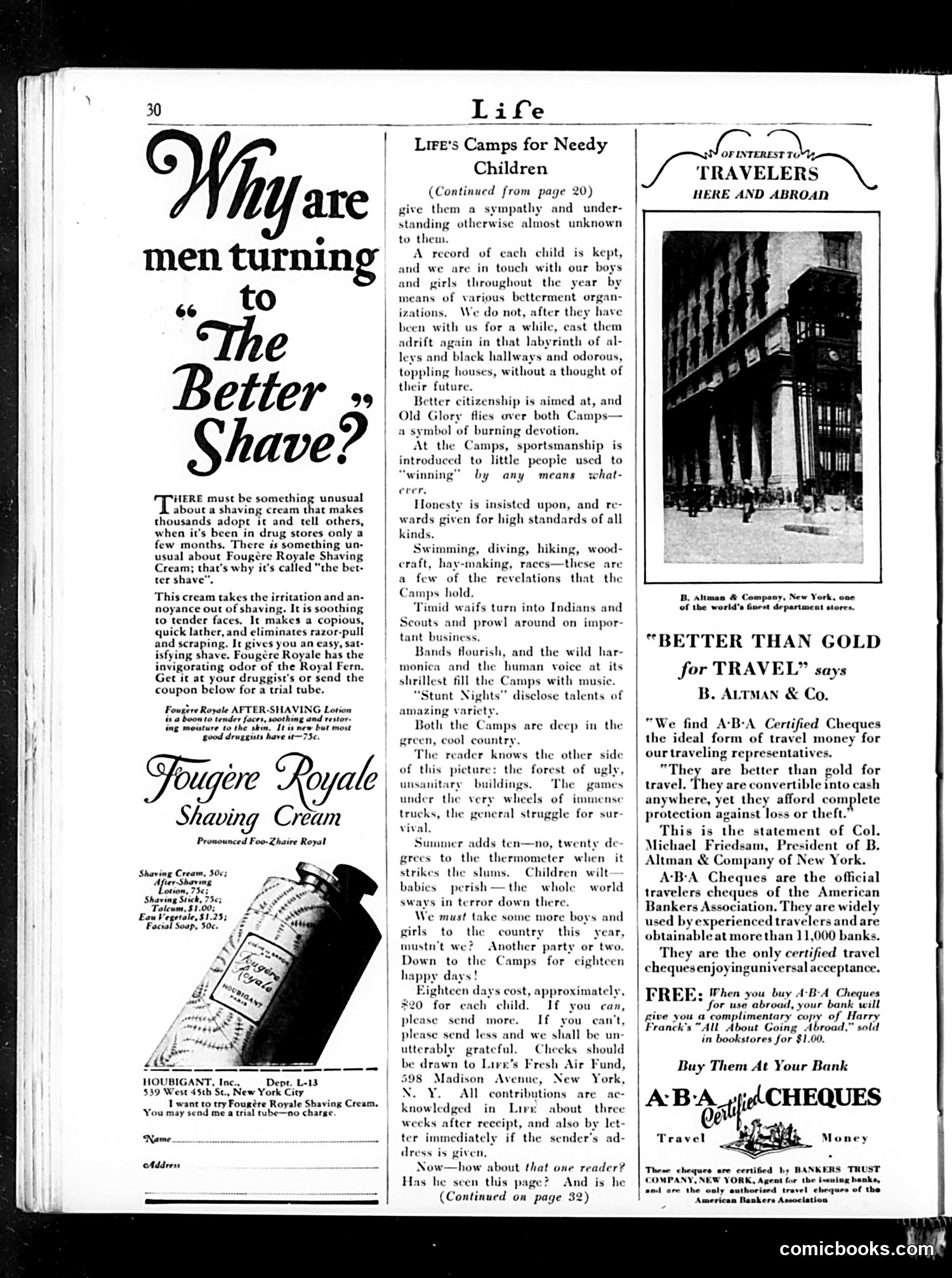
This page is primarily **advertising**, featuring two unrelated ads: **Left side:** A Fougère Royale shaving cream advertisement emphasizing its soothing properties and "better shave" quality. The ad uses straightforward product claims rather than satire. **Right side:** An A-B-A Certified Cheques travel advertisement claiming superiority over gold as travel currency—positioned as safer and more convenient for travelers. **Center column:** The main editorial content concerns Life magazine's charitable camps for poor children, describing recreational activities (swimming, hiking, scouting) and moral education aimed at improving citizenship. It appeals for reader donations to send more "timid waifs" from city slums to the countryside for 18 days. **The satire/social commentary** emerges implicitly in the camp article: the contrast between urban poverty (described as "alleys and black hallways and odorous, toppling houses") and the redemptive countryside experience. The piece reflects early 20th-century Progressive Era attitudes about poverty relief and character-building through nature exposure—a paternalistic but well-intentioned approach to urban social problems. There are no political cartoons on this page.
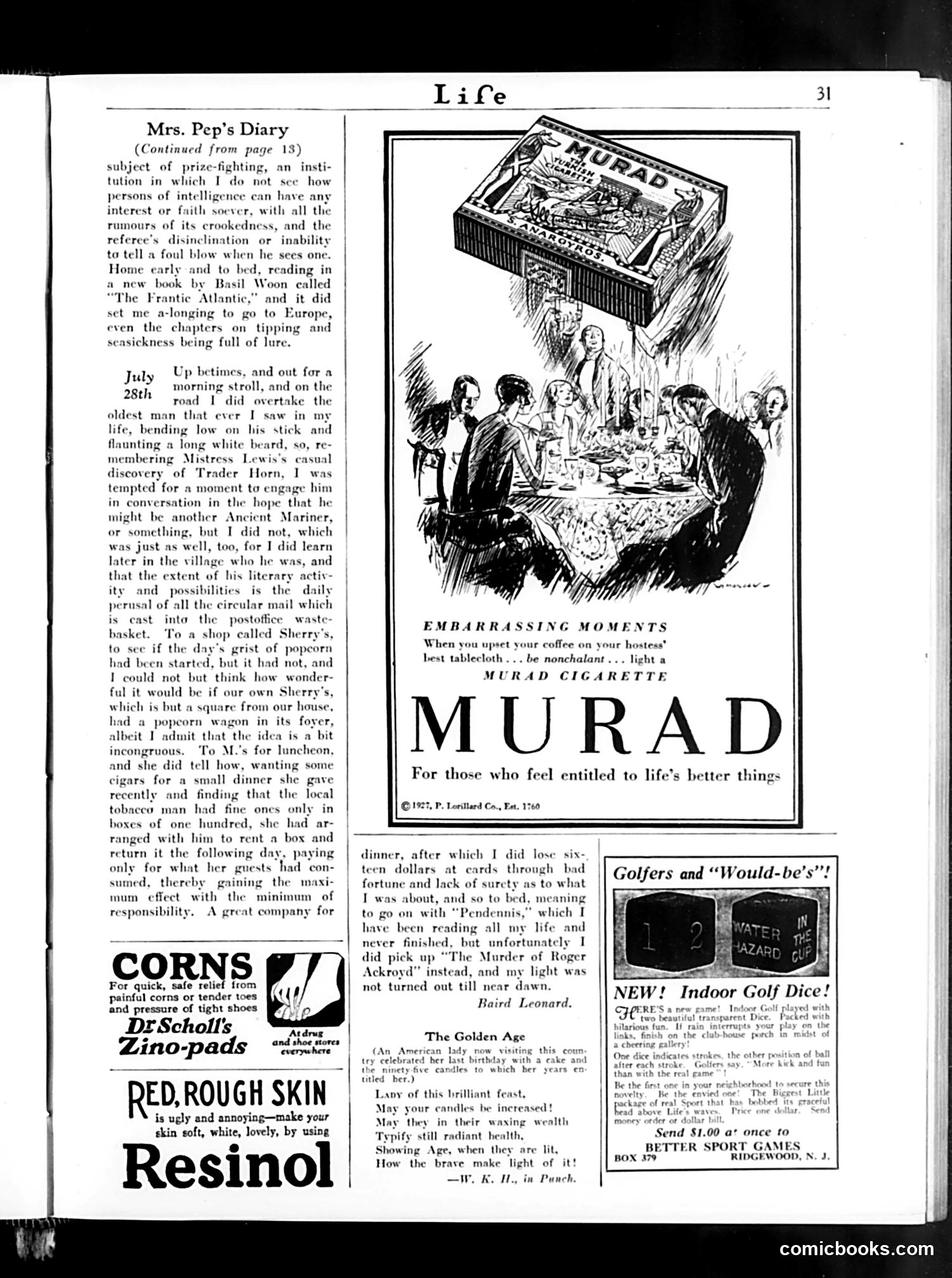
This page features a serialized diary column satirizing upper-middle-class social life and pretensions. The narrator describes mundane events—meeting an elderly man, shopping, attending dinner—with mock-serious literary flourishes, referencing books like *The Frantic Atlantic* and *The Murder of Roger Ackroyd*. The satire targets genteel society's affectations: the diarist's snobbish dismissal of prize-fighting, fascination with potentially "exotic" characters, and casual mention of losing sixteen dollars at cards. A particular jab appears in the anecdote about renting a cigar box rather than buying one outright—mocking wealthy people's excessive penny-pinching despite their means. The accompanying poem "The Golden Age" gently teases an elderly woman celebrating her birthday, suggesting vanity in aging. Surrounding advertisements (Dr. Scholl's pads, Resinol, Murad cigarettes) are typical period product placement, with Murad's tagline—"For those who feel entitled to life's better things"—ironically echoing the diary's tone of presumptuous refinement.
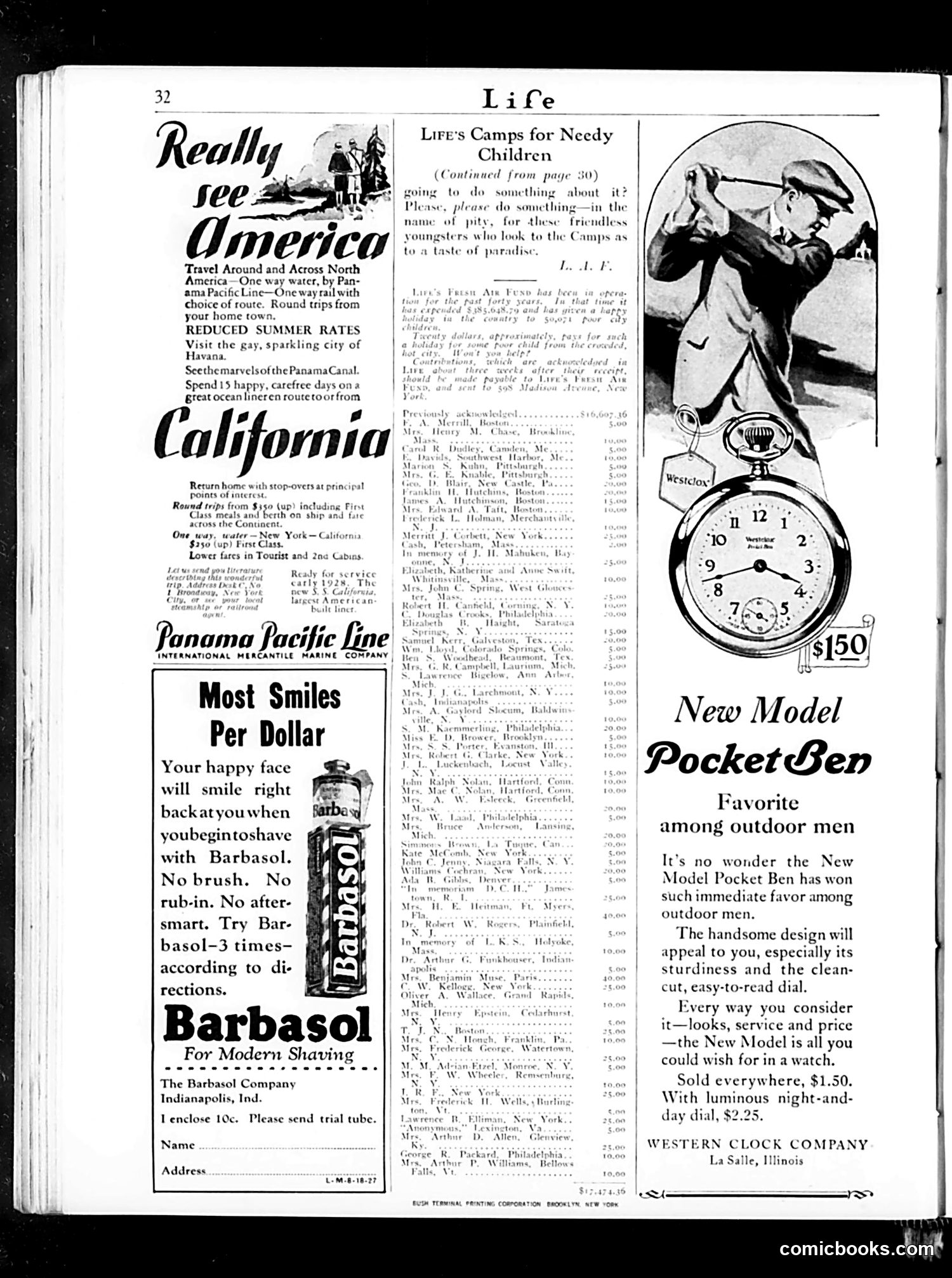
This page is primarily **advertising**, not satirical content. It contains four distinct ads: 1. **"Really See America"** — Panama Pacific Line travel advertisements promoting reduced summer rates for trips to Havana and the Panama Canal, targeting middle-class leisure travelers. 2. **"Most Smiles Per Dollar"** — A Barbasol shaving cream ad emphasizing convenience ("no brush, no rub-in") for modern men. 3. **"New Model Pocket Ben"** — A Western Clock Company pocket watch advertisement priced at $1.50, marketed to "outdoor men" with claims of durability and clear readability. 4. **"Life's Camps for Needy Children"** — A fundraising appeal listing donors' names and amounts, appearing to be a philanthropic initiative. The page header indicates this continues coverage from page 30. There is **no political cartoon or satirical content visible** — this is a straightforward commercial and charitable listing typical of 1920s-era magazine pages, designed to generate revenue while promoting contemporary consumer goods and social causes.
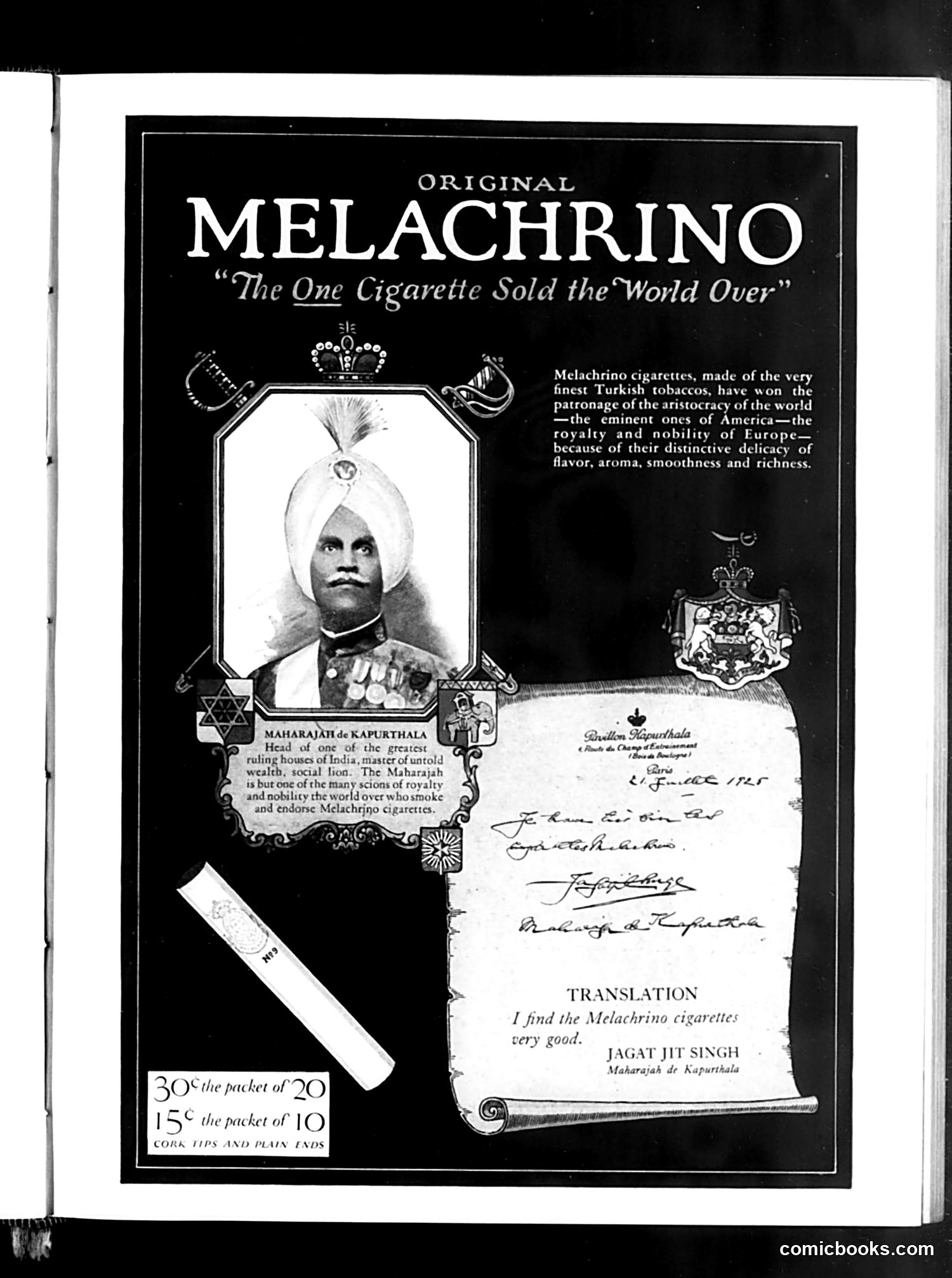
This is a **cigarette advertisement**, not political satire. It features the Maharaja de Kapurthala, an actual Indian royal figure, endorsing Melachrino Turkish cigarettes as a luxury product favored by "the aristocracy of the world." The ad uses imperial-era marketing tactics: displaying a non-Western ruler as testimony to product prestige, suggesting that royalty and nobility worldwide—both American elites and European nobility—smoke these cigarettes. A handwritten endorsement from "Jagat Jit Singh, Maharajah of Kapurthala" appears on the right. **For modern readers**: This represents early 20th-century advertising's casual exploitation of colonial-era imagery and real foreign dignitaries to market products as globally elite and exclusive. The prominent placement of an Indian maharaja's portrait was meant to signal sophistication and worldwide appeal rather than to mock him, though the power dynamics of such endorsements would be scrutinized today.
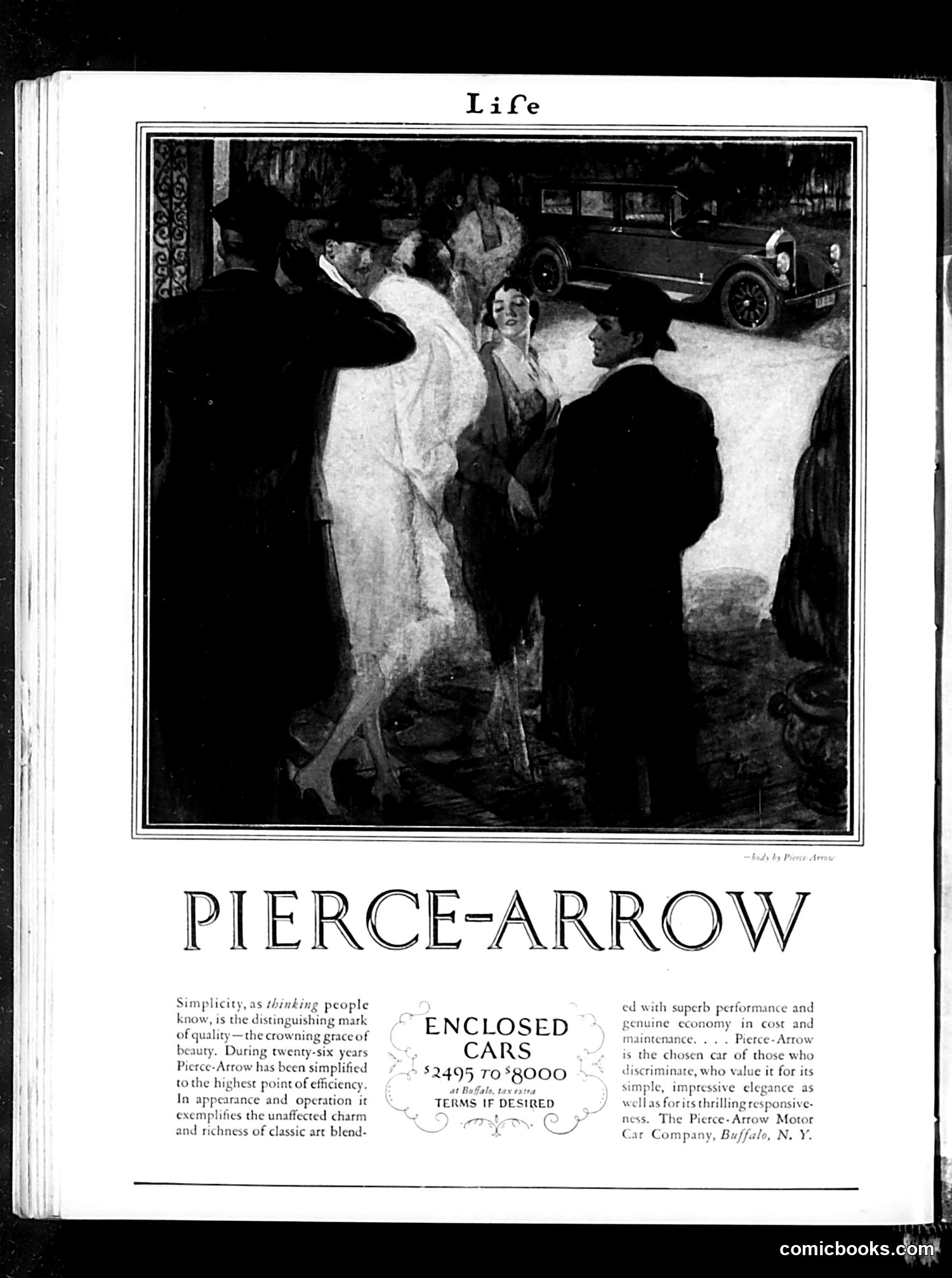
This is **not a cartoon or satire**, but rather a **full-page automobile advertisement** from Life magazine. The page advertises Pierce-Arrow enclosed cars, priced from $2,495 to $8,000, with financing available. The photograph shows well-dressed people examining or admiring a vehicle at night, suggesting elegance and sophistication. The ad's text emphasizes that Pierce-Arrow represents "simplicity" and "quality"—marketing luxury vehicles to discriminating buyers who value "unaffected charm and richness of classic art blend." This appeals to the wealthy, educated audience Life typically reached. The Pierce-Arrow Motor Car Company was based in Buffalo, New York. The ad positions the brand as the choice for sophisticated consumers who appreciate both performance and economy. This reflects early-20th-century luxury car marketing targeting the affluent elite.