
Life, 1927-08-18 · page 26 of 36
Life — August 18, 1927 — page 26: what you’re looking at
What you’re looking at
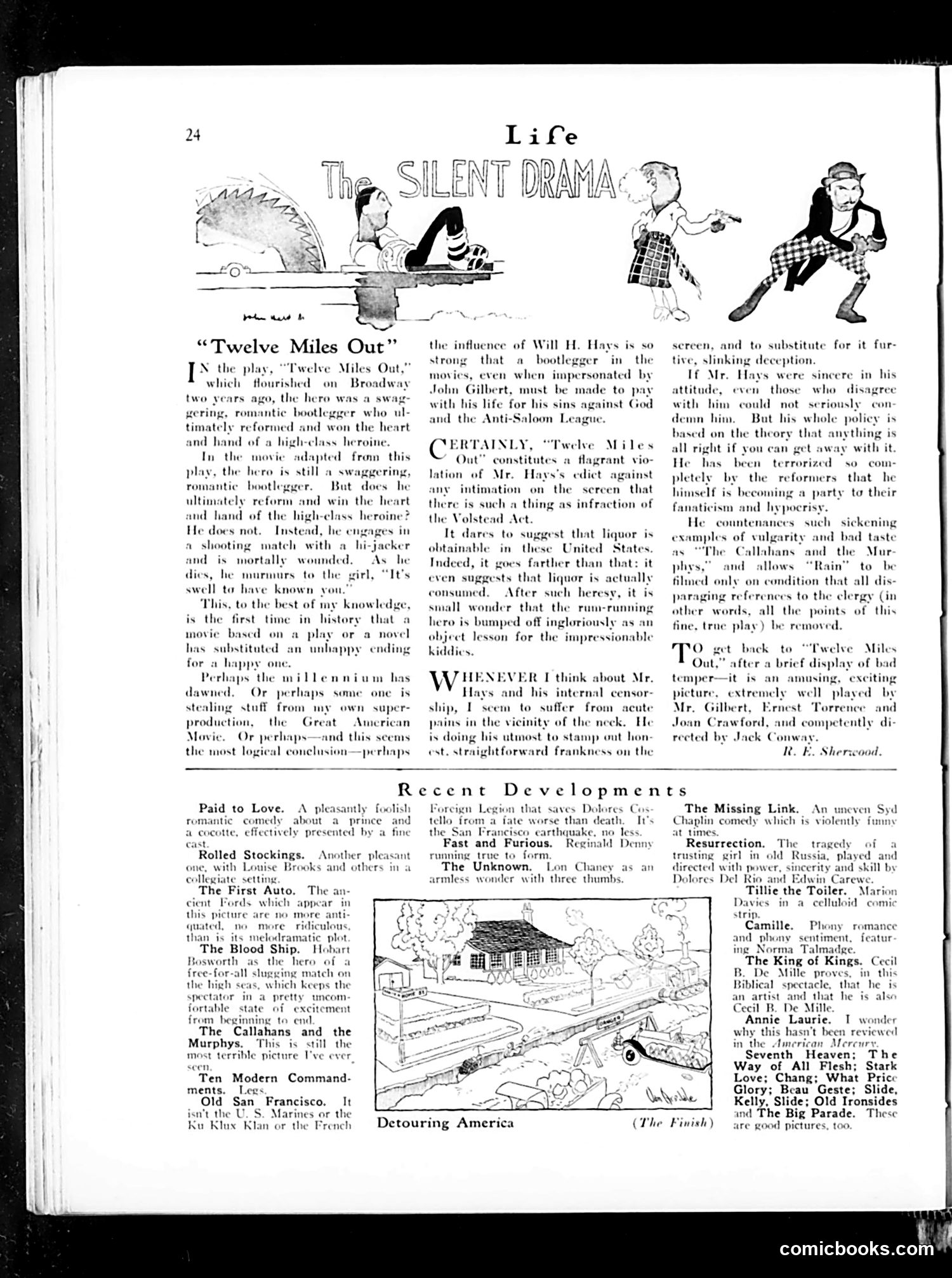
This review discusses a 1924 film adaptation that notably changed its source play's ending: the bootlegger hero now dies rather than reforms and finds happiness. The satirist argues **Will H. Hays**—Hollywood's chief censor enforcing the Motion Picture Production Code—forced this unhappy ending. Hays, backed by the Anti-Saloon League and temperance reformers, demanded moral punishment for any character who violated Prohibition laws, even if the original story didn't require it. The author mocks this hypocrisy: Hays claims to uphold straightforward morality while actually practicing "furtive, slinking deception." By allowing liquor to exist on-screen only to punish its users, the censor paradoxically suggests wrongdoing while preventing honest treatment of the subject. The complaint reflects 1920s cultural tension between reformers imposing strict moral codes on entertainment and artists seeking creative freedom. The reviewer presents Hays not as principled but as terrorized by censors into compromising artistic integrity.
📄 Transcribed text from this page (OCR, searchable)
Machine-transcribed from the original scan — historical spelling and the odd misread are preserved.
“Twelve Miles Out” N the play, “Twelve Miles Out,” which flourished on Broadway two years ago, the hero was a swag- yering, romantic bootlegger who ul- timately reformed and won the heart and hand of a high-class heroine. Tn the play, the hero is still a swaggering, romantic bootlegger. But ultimately reform and win the heart movie adapted from this does he md hand of the high-class heroine He does not. 1 shooting match with a and is mortally dies, he murmurs to th Instend, he engages in wounded. swell to have known y This, to the best of my knowledge, is the first time in’ history that a movie based on a play or a novel has substituted an unhappy ending for a happy one. Perhaps the millennium has dawned, stealing stuff from my own super- production, the Great | American Movie. Or perhaps—and this seems the most logical conclusion —perhaps Or perhaps sume one is the influence of Will H. Hays is so that a bootlegger in the movies, even when impersonated by John Gilbert, must be made to pay with his life for his sins against God and the Anti-Saloon League. Cc ERTAINLY, “Twelve Miles Out” constitutes a flagrant vio- lation of Mr. Hays’s edict against any intimation on the that there is such a thing as infraction of the Volstead Act It dares to suggest that liquor is obt le in’ these United States. Indeed, it goes farther than that: it even suggests that liquor is a After such heresy small wonder that the rum-running hero is bumped off ingloriously as an strong seree consumed. object lesson for the impressionable kiddies. V HENEVER I think about Mr. Hays and his internal censor ship, I scem to suffer from acute y of the neck. He yp out b est. straightforward frankness on the pains in the viei is doing his utmost to s! sereen, and to substitute for it fur- tive, slinking deception. If Mr. Hays were sincere in his attitude, with him could not seriously But his whe based on the theory that anything is all right if you can get away with it. He has been terrorized so com- pletely by the reformers that he himself is becoming a party to their fanaticism and hypocrisy. He countenanees les of vulgarity Callahans and even those who disagree con demn hin » policy is such” sickening and bad taste and the Mur “Rain” to be filmed only on condition that all dis- paraging references to the clergy (in all the points of this y) be removed. exan as "The phys,’ allows other words, fine, trne ple back to ‘Twelve Miles after a brief display of bad temper—it is an picture. extremely well pl Mr. Gilbert, ‘Torre Joan Crawford, and competently di- ted by Jack Conway. ROE amusing, exciting d by Ernest and Sherwood. Recent Paid to Love. A pleasantly foolish omantic comedy about a prince and tte, effectively presented by a fine cast Rolled Stockings. Another pleasant one, with Louise Brooks and others in a collegiate setting The First Auto, cient Fords which this picture The an- ppear in ire no more anti- quated, no more ridiculous than is its melodramatic plot The Blood Ship. Hobart Sosworth as the hero of a free-for-all slugging match on the high seas, which keeps the spectator in a pretty uncom fortable state of excitement from beginning to end. The Callahans and the Murphys, This is still the most terrible picture I've ever seen Ten Modern Command- ments. Legs Old San Francisco. It Foreign Legion that saves Dolores tello from a fate worse than death. It’s the San Francisco earthquake, no less Fast and Furious. Reginald Denny running true to form The Unknown. Lon Chaney as an armless wonder with three thumbs. Developments The Missing Link. An uneven Syd Chaplin comedy which is violently fum at times. Resurrection. The tragedy of a trusting girl in old Russia, played ane directed with power, sincerity and skill by Dolores Del Rio and Edwin Carewe Tillie the Toiler. Marion isn’t the U.S. Marines or the Ku Klux Klan or the French Detouring America (The Finish) Davies in a celluloid comi strip. Camille. Phony and phony sentimern ing Norma Talmadge. The King of Kings. Cecil B. De Mille proves, in this Biblical spec that he is an artist and that he is alse Cecil B. De Mille Annie Laurie. I wonder why this hasn't been reviewed in the American Mercury. Seventh Heaven; The Way of All Flesh; Stark Love; Chang; What Pricc Glory; Beau Geste; Slide, Kelly, Slide; Old Ironsides The Big Parade. These are good pictures, to ‘ comicbooks.com*