
A complete issue · 40 pages · 1926
Life — April 22, 1926
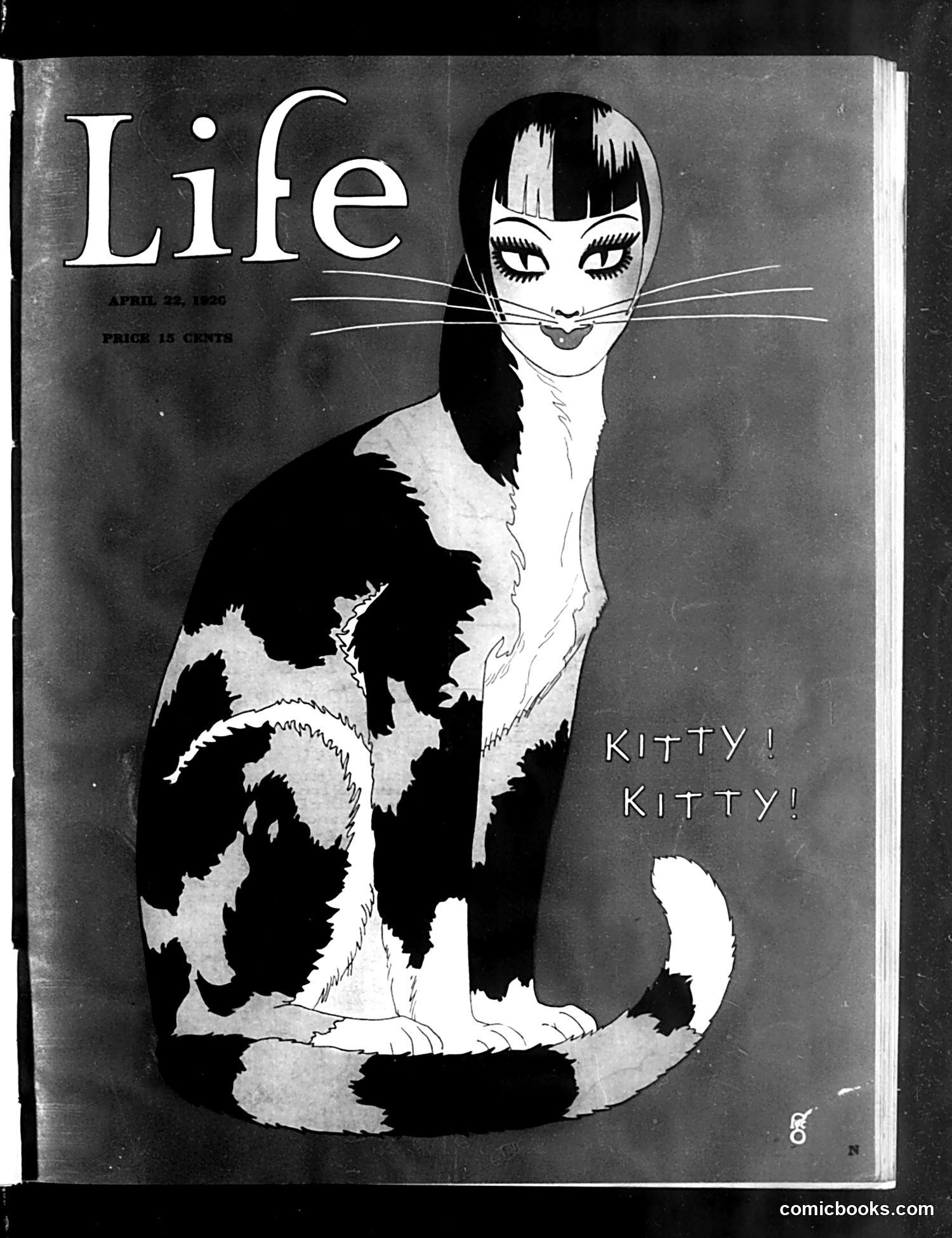
This cover features a stylized woman with exaggerated 1920s features—dramatic eye makeup, bobbed hair with bangs, and sharp facial contours—holding a black-and-white cat. The text "KITTY! KITTY!" suggests the cover's playful tone. The illustration exemplifies 1920s "flapper" aesthetic and modernist art style. The woman's extreme makeup and sophisticated pose reflect the era's "New Woman"—independent, fashionable, and cosmopolitan. The cat, a companion to this glamorous figure, reinforces themes of urban sophistication. The price of 15 cents and the artist's signature indicate this is a professional satirical magazine cover, likely mocking or celebrating contemporary fashion trends and women's changing social roles during the Jazz Age.
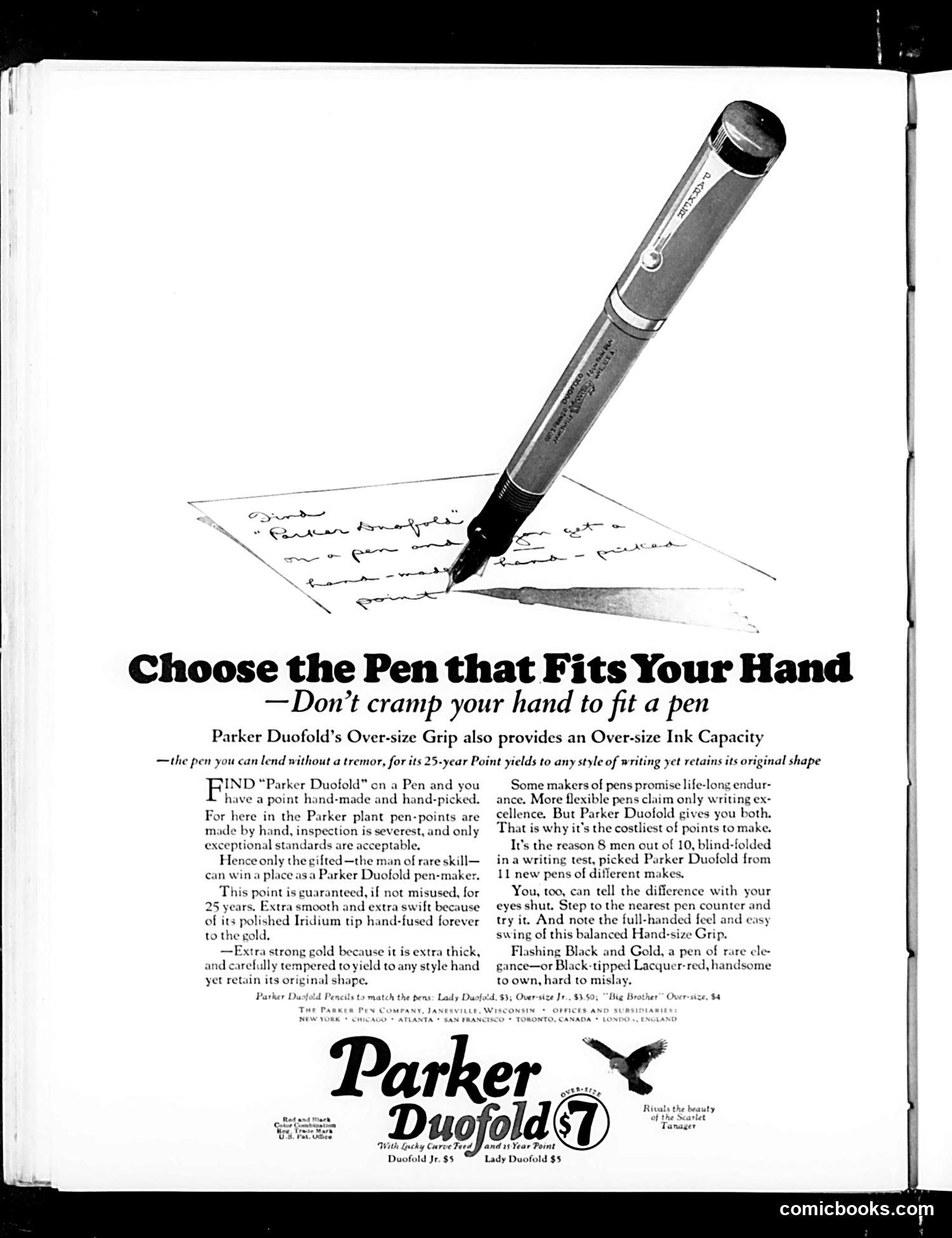
This page is **not a political cartoon or satirical content**—it is a straightforward **product advertisement** for Parker Duofold fountain pens, likely from the 1920s-1930s based on the styling and typography. The advertisement uses the tagline "Choose the Pen that Fits Your Hand—Don't cramp your hand to fit a pen" to promote the Parker Duofold's oversized grip design. The image shows the pen writing on paper, with marketing copy emphasizing the pen's quality, durability (25-year point guarantee), hand-crafted construction, and iridium tip. The ad includes endorsement language about blind-folded writing tests and comparative performance claims. There is no satire, political commentary, or caricature present—this is commercial advertising copy typical of the era.
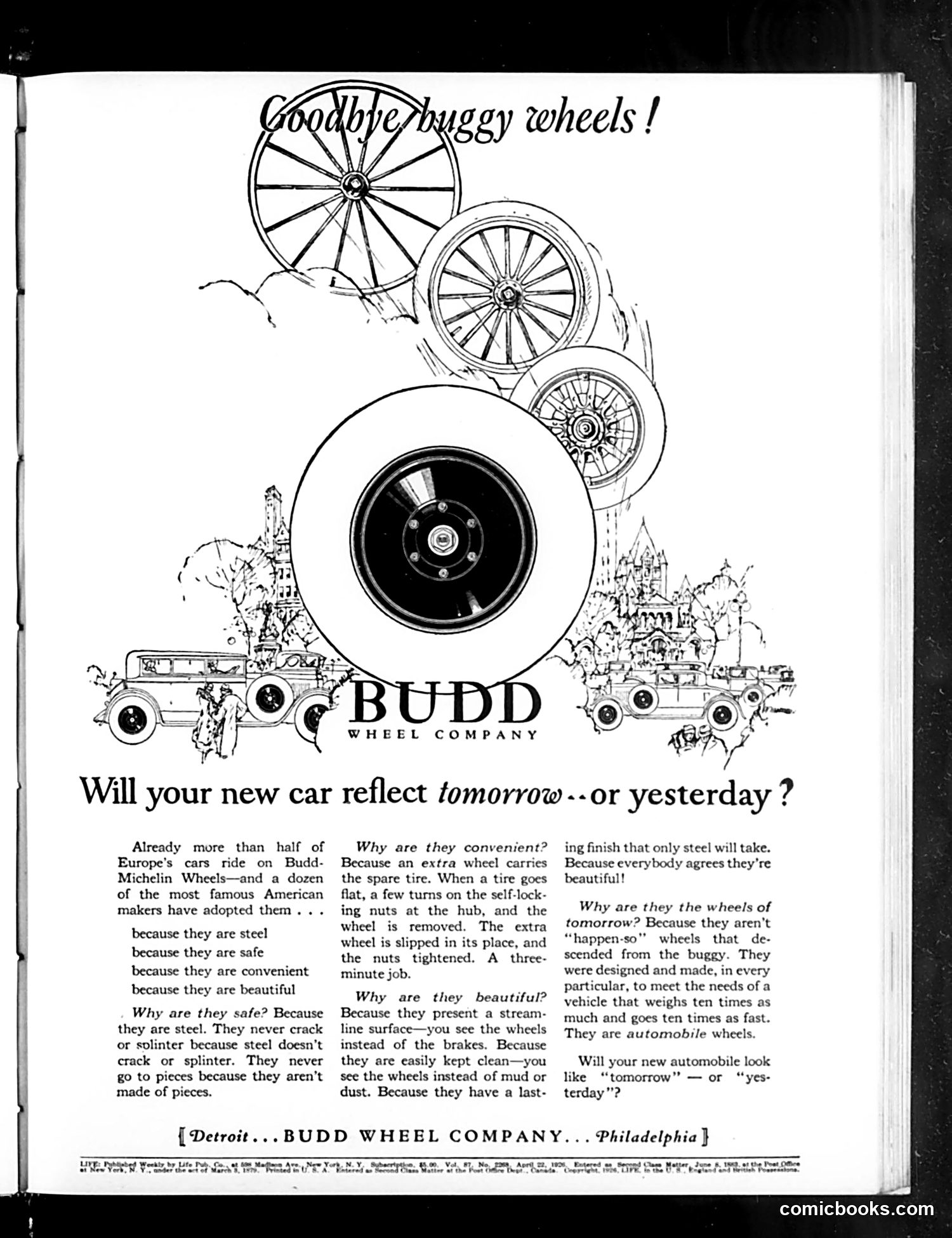
This is **not satire or political cartoon**, but rather a **straightforward advertisement** for Budd Wheel Company, a manufacturer of automobile wheels. The ad compares old buggy wheels (shown at top) with modern Budd steel wheels (center). The headline "Goodbye buggy wheels!" emphasizes the transition from horse-drawn to motorized transportation. The copy explains Budd wheels' practical advantages: they're steel (safer, won't crack), convenient (spare tire design), and beautiful (streamlined appearance). The rhetorical question "Will your new car reflect tomorrow—or yesterday?" uses forward-thinking messaging to position Budd wheels as modern and progressive technology. The illustration of cars and cityscape represents automotive progress and prosperity. This reflects early-to-mid 20th century American optimism about industrial innovation and automobile adoption.
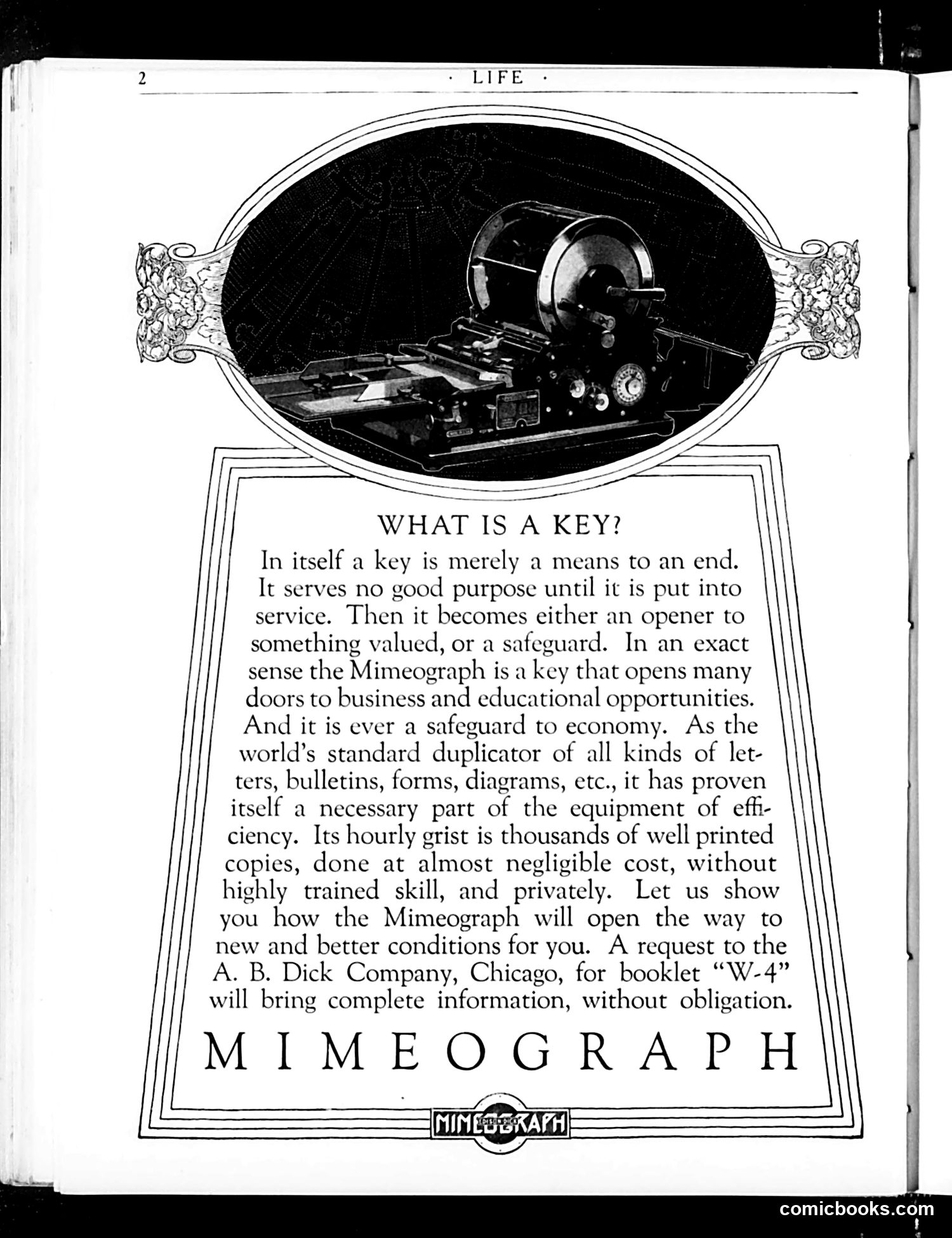
This is **not a political cartoon or satire**—it's a straightforward **advertisement for the Mimeograph machine**, published in *Life* magazine. The page uses the metaphor "What is a Key?" to promote the Mimeograph as a business tool. The advertisement argues that a key only has value when used; similarly, the Mimeograph becomes valuable by enabling access to "business and educational opportunities" and providing "economy." The ad emphasizes the machine's practical benefits: it cheaply produces thousands of printed copies without requiring skilled operators, making it an essential office device for efficiency. The image shows the actual Mimeograph machine itself—a drum duplicator typical of early-to-mid twentieth-century office equipment. This represents early marketing strategy using *Life*'s editorial space for commercial messaging.
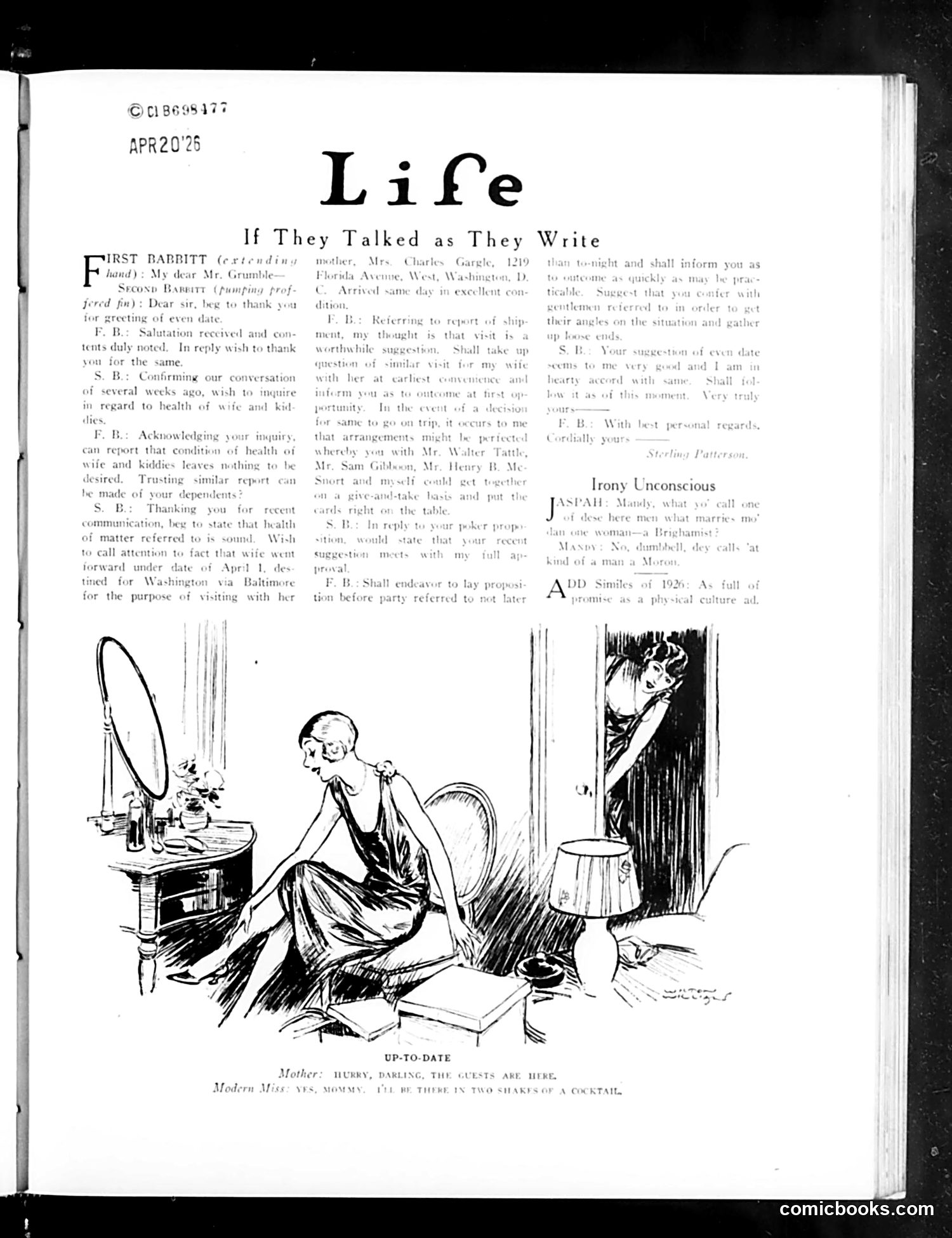
This page from *Life* magazine (dated APR 20'25, so April 1925) contains three sections: **"First Rabbit"** and **"Second Rabbit"** are brief humorous letters about rabbits and social visits—likely satirizing overwrought etiquette advice columns popular in that era. **"Irony Unconscious"** appears to be a similar mock-advice section using absurdist humor. **The main cartoon** ("Up-to-Date") depicts a woman at her vanity preparing for guests, with the caption mocking modern mothers who prioritize cocktails over home preparation. The satire targets 1920s social pretension and the newly fashionable "cocktail culture" emerging during Prohibition, suggesting that contemporary society had become superficial and cocktail-obsessed rather than genuinely hospitable. The woman's pose and setting emphasize vanity and frivolity.
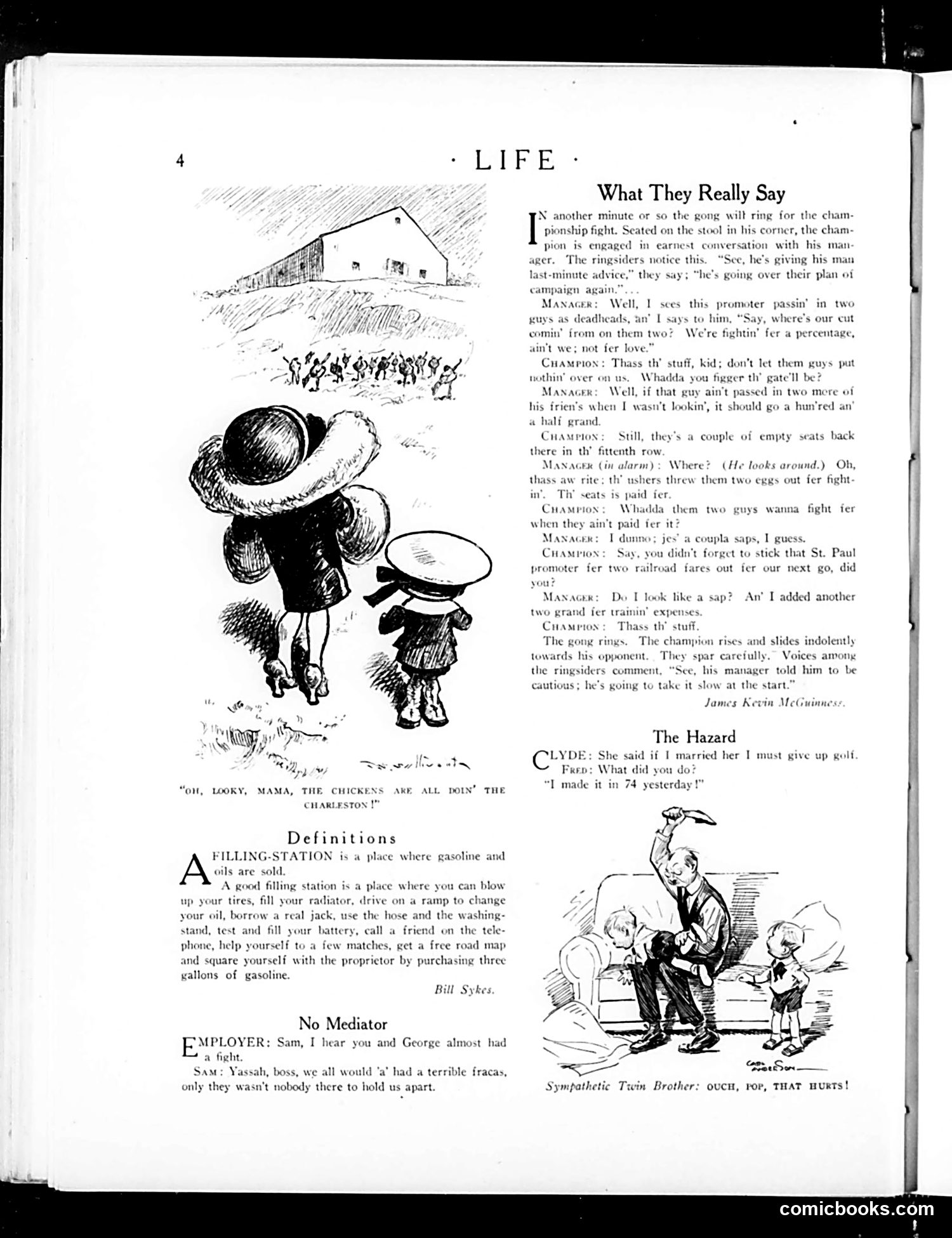
This page contains three separate humorous pieces: 1. **"What They Really Say"** - A sketch depicting a boxing championship fight, showing the actual crude banter between a champion boxer and his manager, contrasting what spectators imagine versus reality. The humor lies in exposing the unglamorous, mercenary nature of professional boxing. 2. **"The Hazard"** - A brief joke about a man who made a golf hole-in-one, with his wife's response about giving up golf if married. 3. **"Definitions"** and **"No Mediator"** - Short satirical pieces defining a filling station and depicting workplace conflict between employees. The overall tone is early 20th-century American satire, mocking professional boxing culture, golf obsession, and labor relations through observational humor.
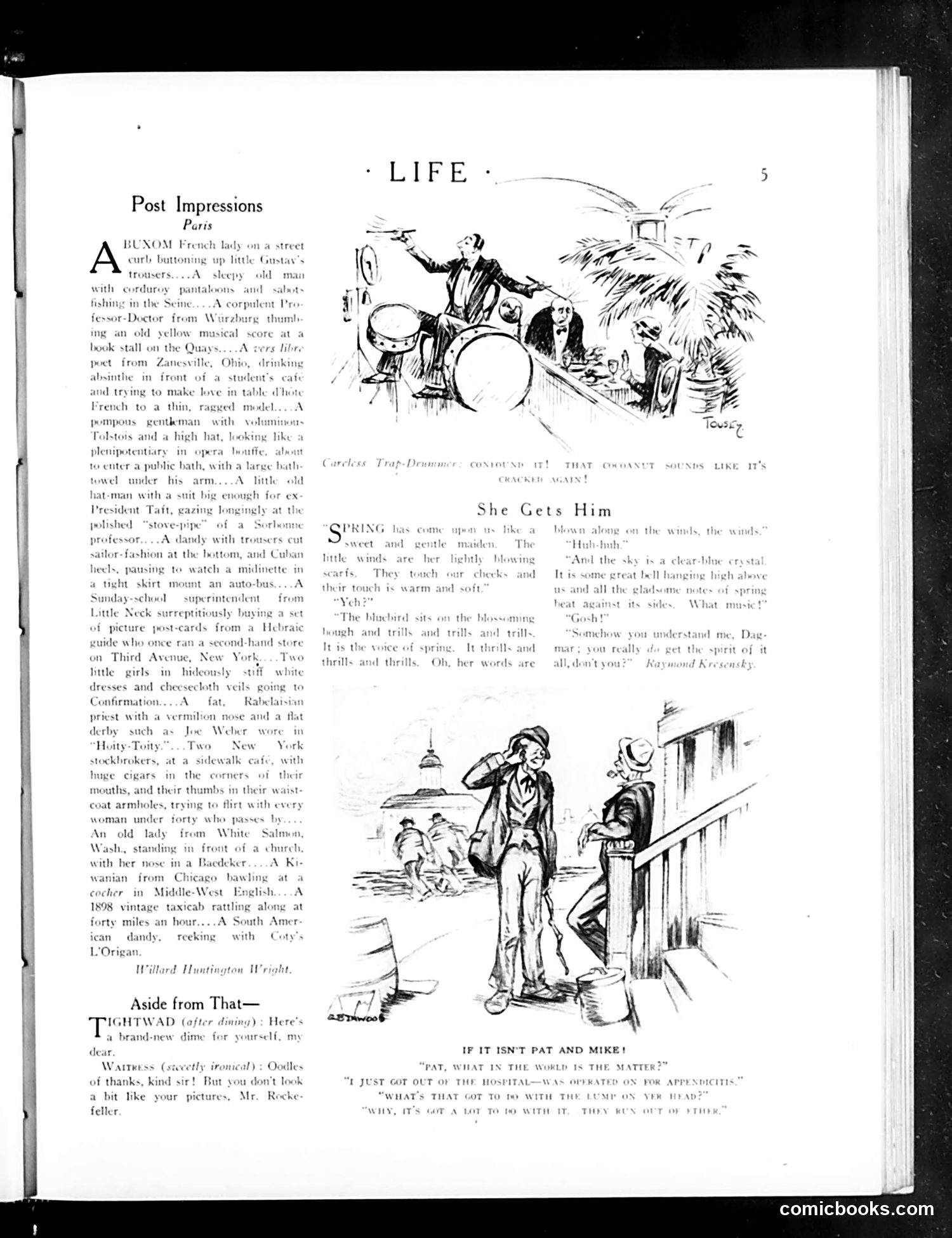
This page contains two main sections: **"Post Impressions: Paris"** — A humorous column by Willard Huntington Wright describing absurd encounters with American tourists and eccentrics in Paris, including a French lady trying to sell items, a cordupted Doctor, and various stereotypical characters. **Two Illustrated Stories:** 1. **"Careless Trap-Drummer"** — A cartoon showing musicians, with text joking about discordant sounds from inexperienced drummers. 2. **"She Gets Him"** — A narrative sketch with accompanying illustration depicting romantic dialogue between characters, with quotes about spring and emotional connection. **"Aside from That"** — Brief humorous exchanges between characters named Tightwad and Waitress about a diner bill. The page reflects early 20th-century American humor targeting tourist behavior, social pretension, and romantic courtship conventions through lighthearted satire and observational comedy.
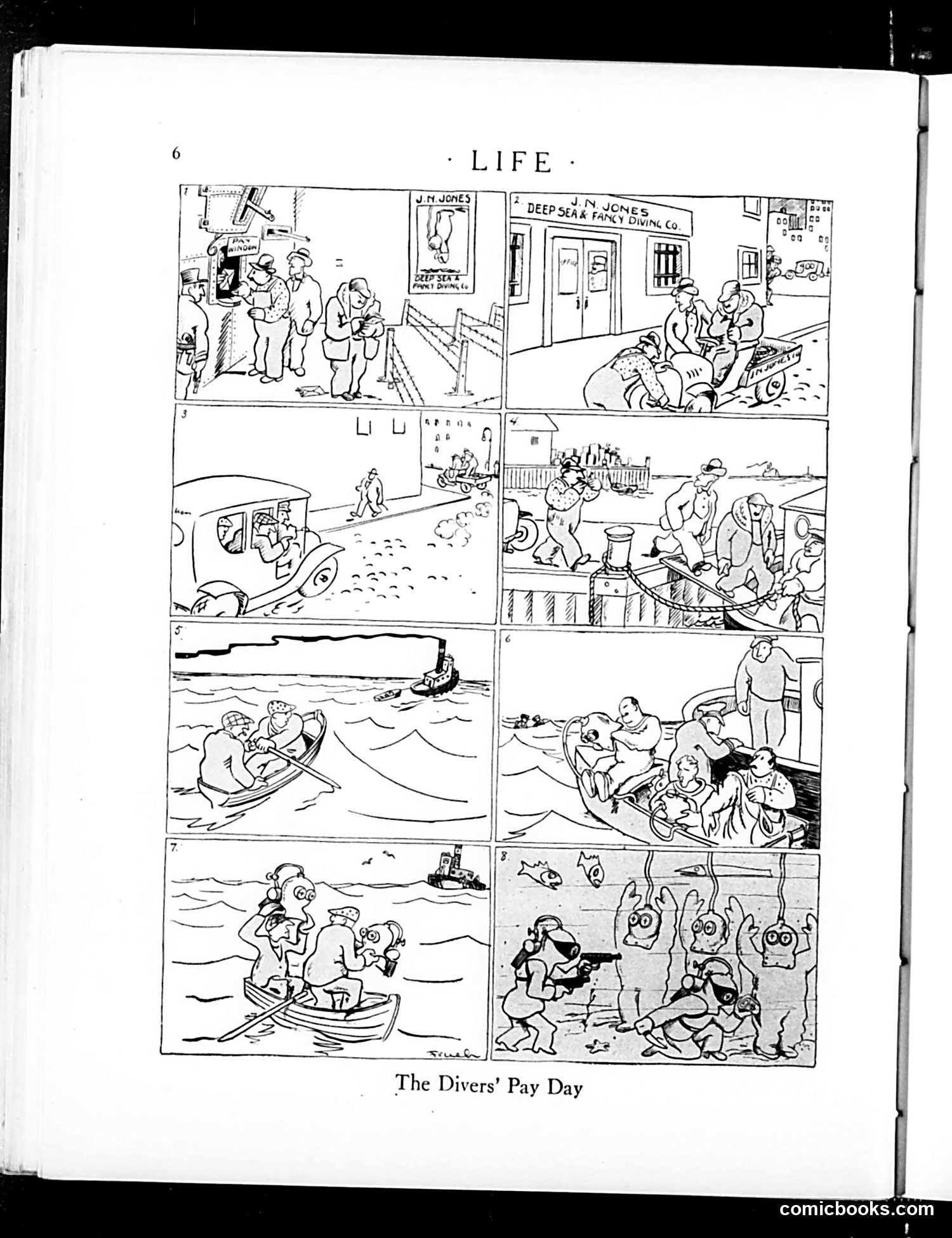
This comic strip satirizes working-class struggle during an economic period when dive shop workers or seafaring laborers faced wage disputes. The narrative shows workers visiting what appears to be "J.H. Jones Deep Sea Fancy Dining Co." (visible on storefront signs), suggesting they're spending meager earnings at overpriced establishments that exploit them. The progression depicts the workers' journey from the shop, through town, to the seaside, culminating in underwater scenes where they apparently work as divers. The final panels show increasingly chaotic behavior, possibly suggesting drunkenness or desperation as workers squander their "pay day" earnings. The satire likely critiques both exploitative wages and the workers' own poor financial choices—a common Life magazine theme mocking working-class behavior.
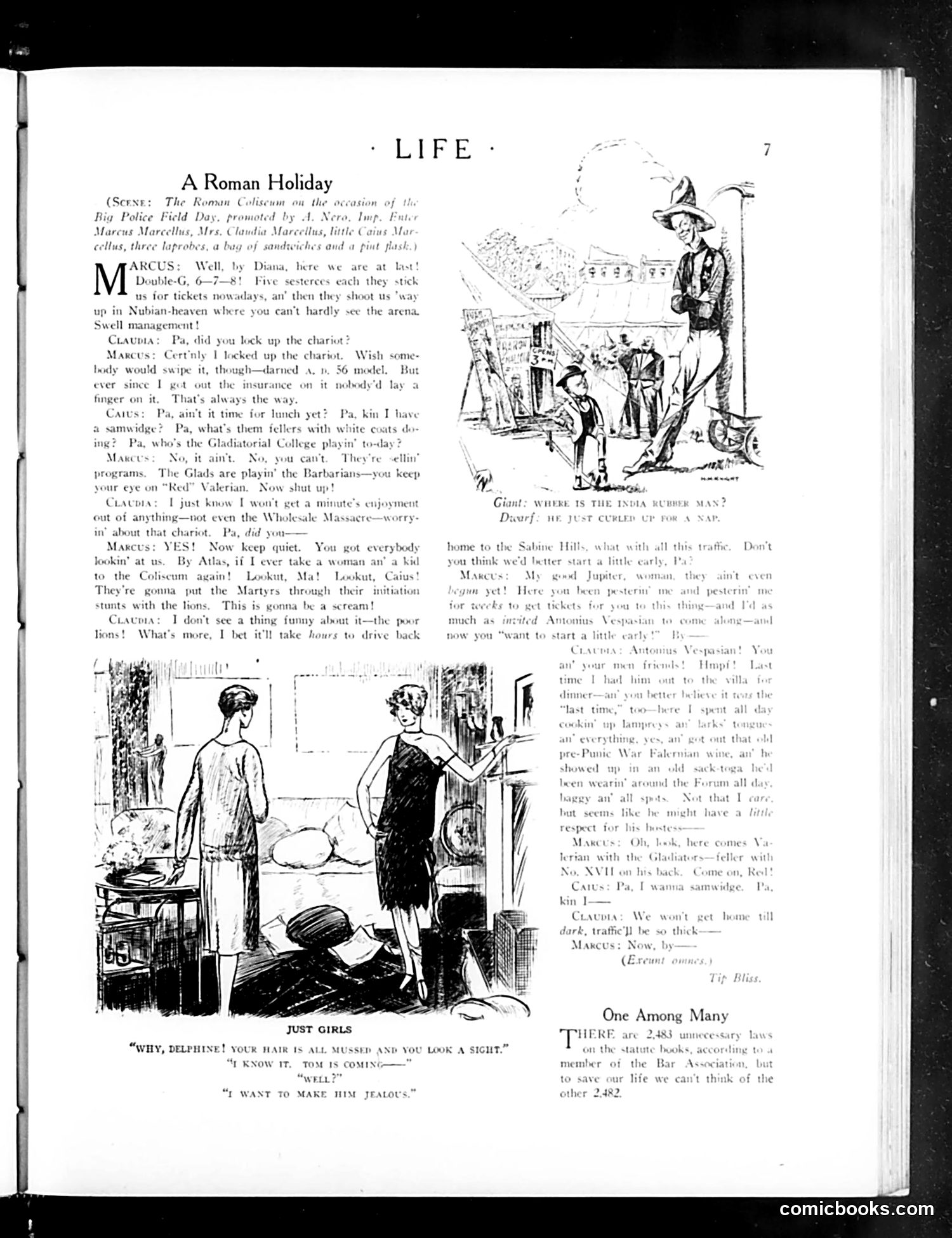
This page presents a satirical theatrical piece set at Rome's Colosseum during gladiatorial games. The dialogue mocks American tourists of the era—particularly wealthy ones seeking authentic "experiences" abroad while remaining culturally ignorant and self-absorbed. The humor targets: - **Tourist obliviousness**: Characters missing the actual spectacle while complaining about seating and refreshments - **Class pretension**: References to exclusive clubs (Cosmopolitan Club) and status-seeking behavior - **American cultural insensitivity**: Treating historical violence as mere entertainment The accompanying "Just Girls" cartoon depicts women's vanity, with the caption mocking female concern with appearance over substance—typical period satirical tropes about women. The satire suggests Americans abroad exported their materialism and superficiality even to ancient historical sites.
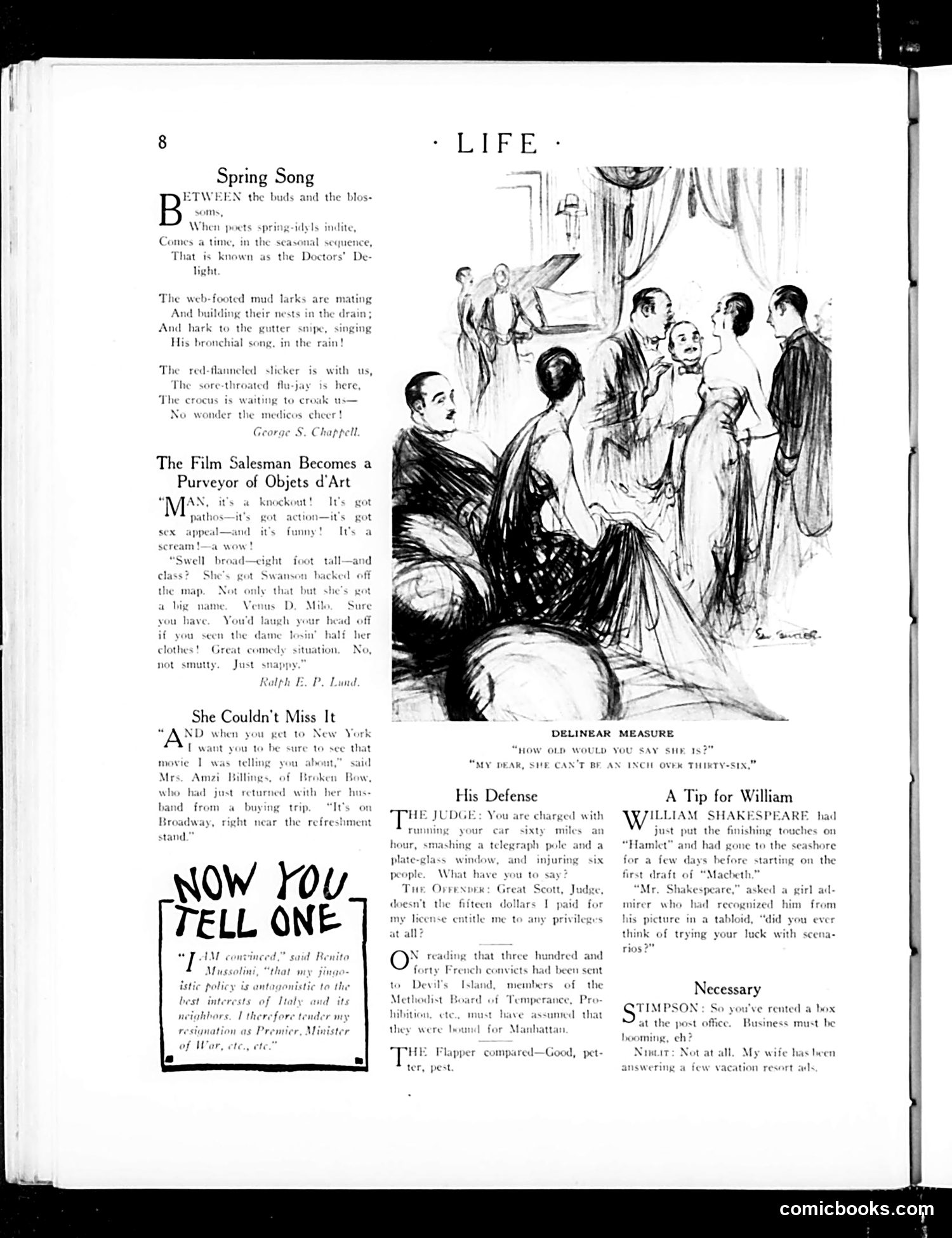
This page contains humorous short pieces and anecdotes rather than political cartoons. The main illustrated item is "Delinear Measure," showing a man being measured by a tailor while others observe—the joke concerns a wife insisting she's under thirty-six inches around the waist, while the tailor finds otherwise. Other brief pieces include "His Defense" (a judge questioning a speeding driver), "A Tip for William" (advice about Shakespeare's manuscript), and "Necessary" (a joke about renting a vacation box at an office). The opening poem, "Spring Song," is attributed to George S. Chappell and celebrates seasonal renewal with references to birds and nature. This is primarily comedic content targeting upper-middle-class domestic life rather than political satire.
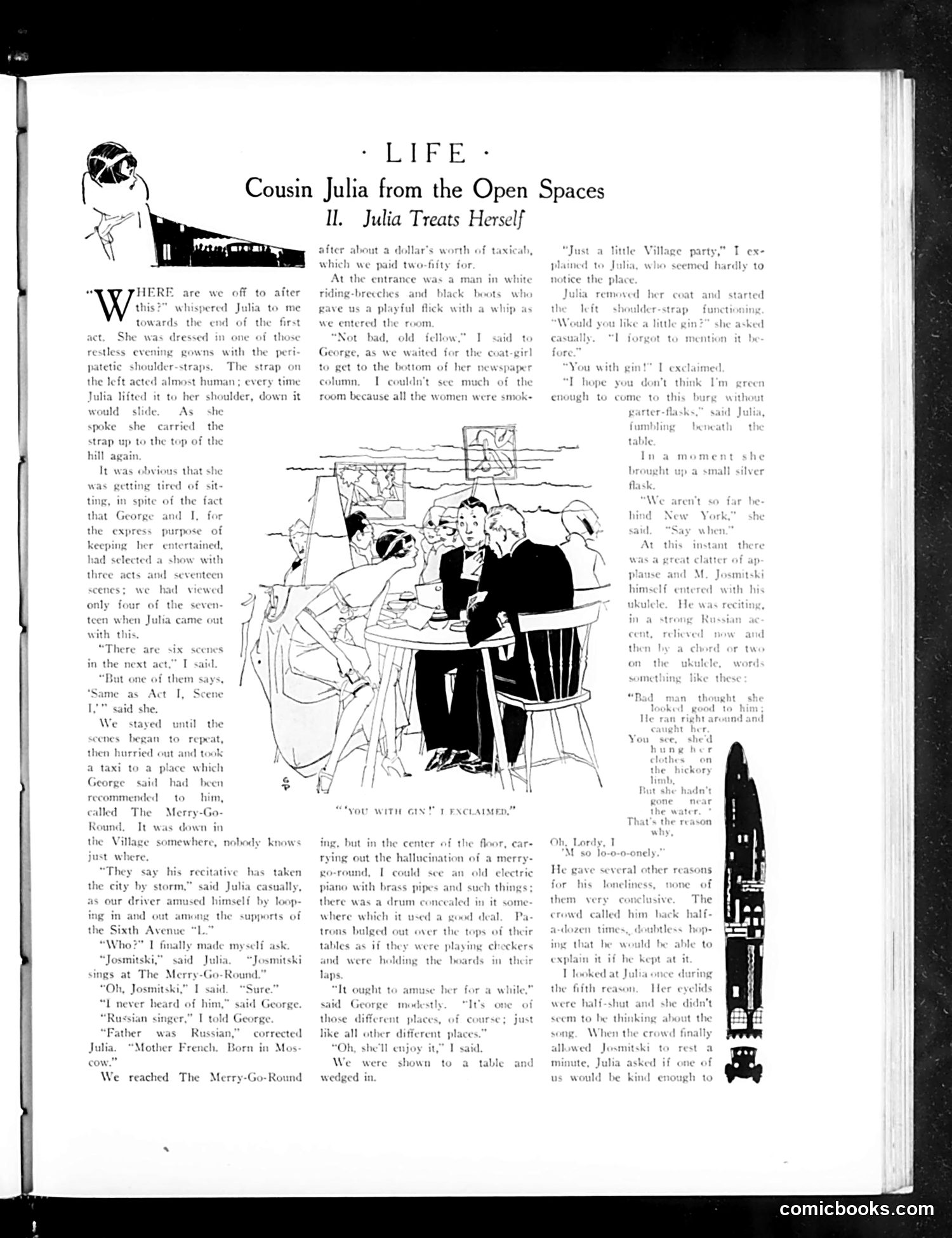
This page depicts "Cousin Julia from the Open Spaces" - a satirical character sketch about a rural woman visiting the city. The narrative describes Julia's discomfort with urban life: she's tired of sitting indoors and uncomfortable with the social scene. The central illustration shows Julia at what appears to be "The Merry-Go-Round," a nightclub or entertainment venue, where she observes peculiar urban entertainments (a Russian singer performing, electrical pianos, drum music). The satire targets the perceived artificiality and strangeness of city nightlife to unsophisticated rural visitors. The humor derives from contrasting rural simplicity with urban sophistication—Julia's bewilderment at cosmopolitan amusements was a common magazine trope of the era, reflecting early 20th-century urban-rural cultural divides.
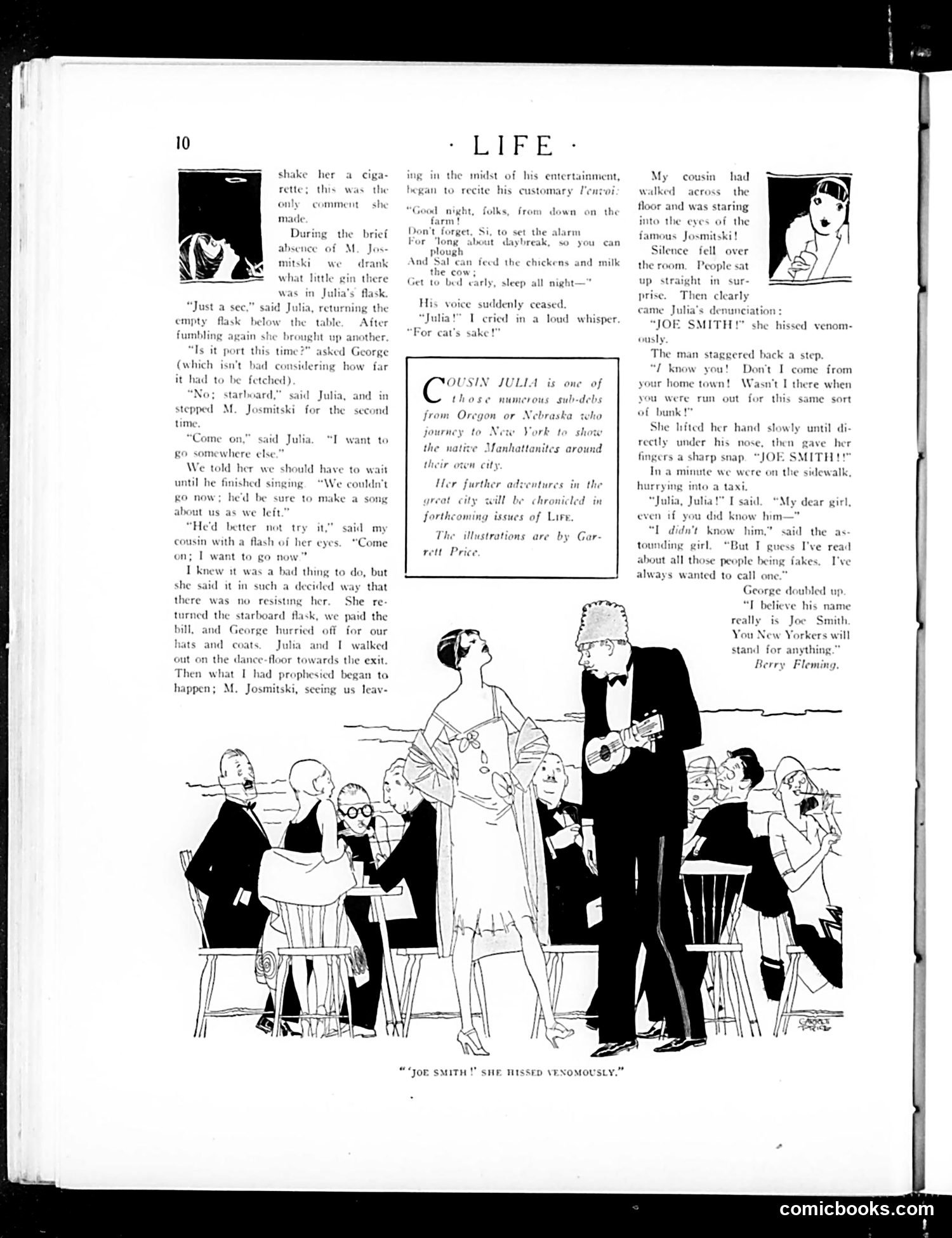
This page presents a short story about "Cousin Julia," a woman from Oregon or Nebraska visiting New York City. The narrative describes Julia's encounter with a man claiming to be "Joe Smith" at a social gathering. The humor centers on a common con-artist scheme of the era: a stranger approaches a visitor from out-of-town, claims to know them or be from their hometown, and attempts to gain their trust for nefarious purposes. Julia's sharp response—she slaps him and hisses "JOE SMITH!"—suggests she recognizes this as a scam. The accompanying illustration shows the dramatic moment at what appears to be a formal party or nightclub scene. The satire targets both predatory urban con-men and the gullibility of naive rural visitors to New York City.
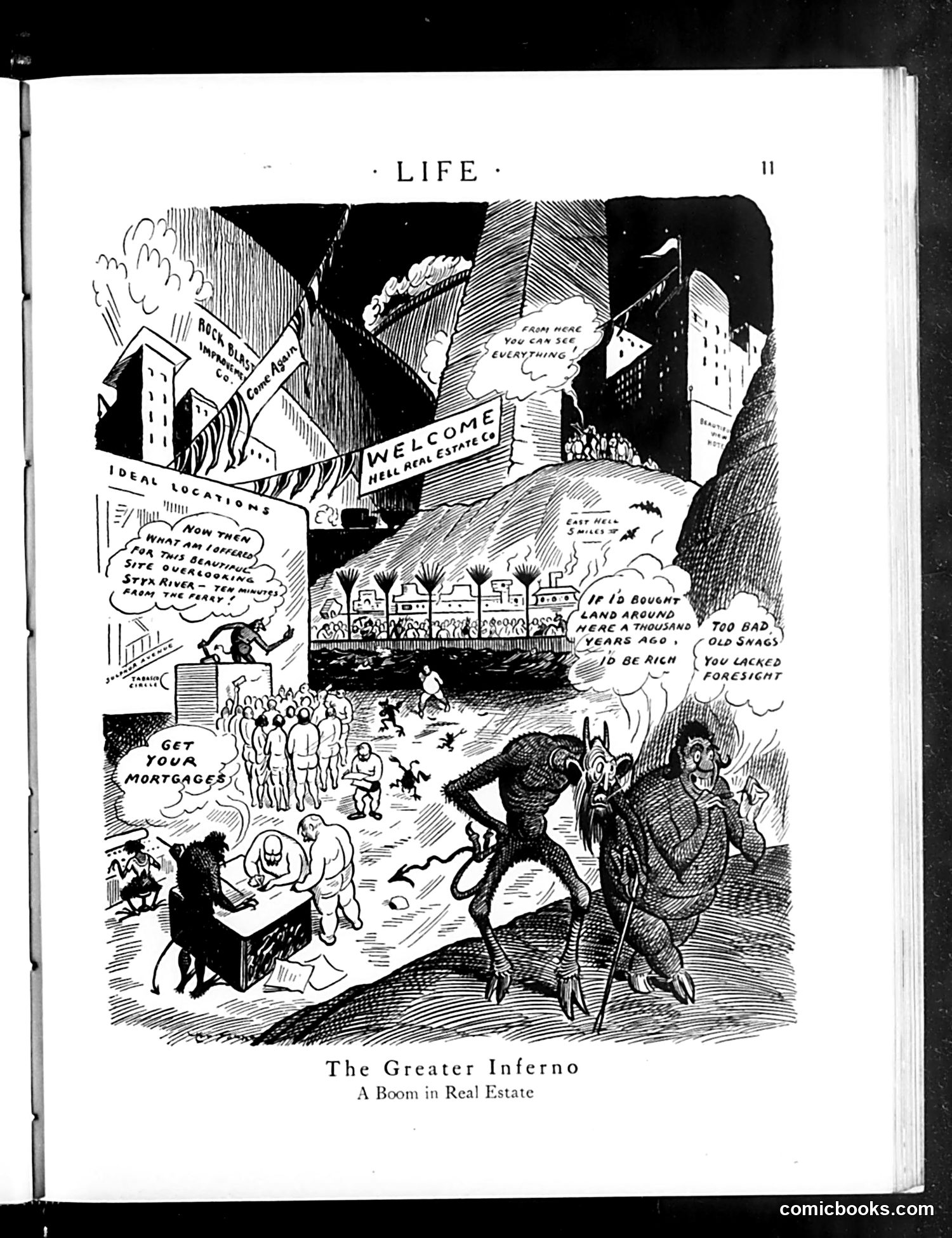
This satirical cartoon depicts the 1920s real estate speculation bubble. Demonic and grotesque figures—appearing to represent unscrupulous real estate agents and speculators—promote property sales to crowds of eager buyers in a hellish landscape. Speech bubbles reference inflated promises ("ideal locations," "welcome to hell real estate") and warning signs of financial recklessness ("if i bought land around here a thousand years ago, i'd be rich now," "too bad old snags, you lacked foresight"). The cartoon satirizes the frenzied, predatory nature of the real estate boom, comparing the marketplace to Dante's inferno. It warns readers about get-rich-quick schemes and the dangers of unbridled speculation, suggesting those promoting these deals are essentially demonic exploiters. This reflects genuine anxieties about economic excess preceding the 1929 crash.
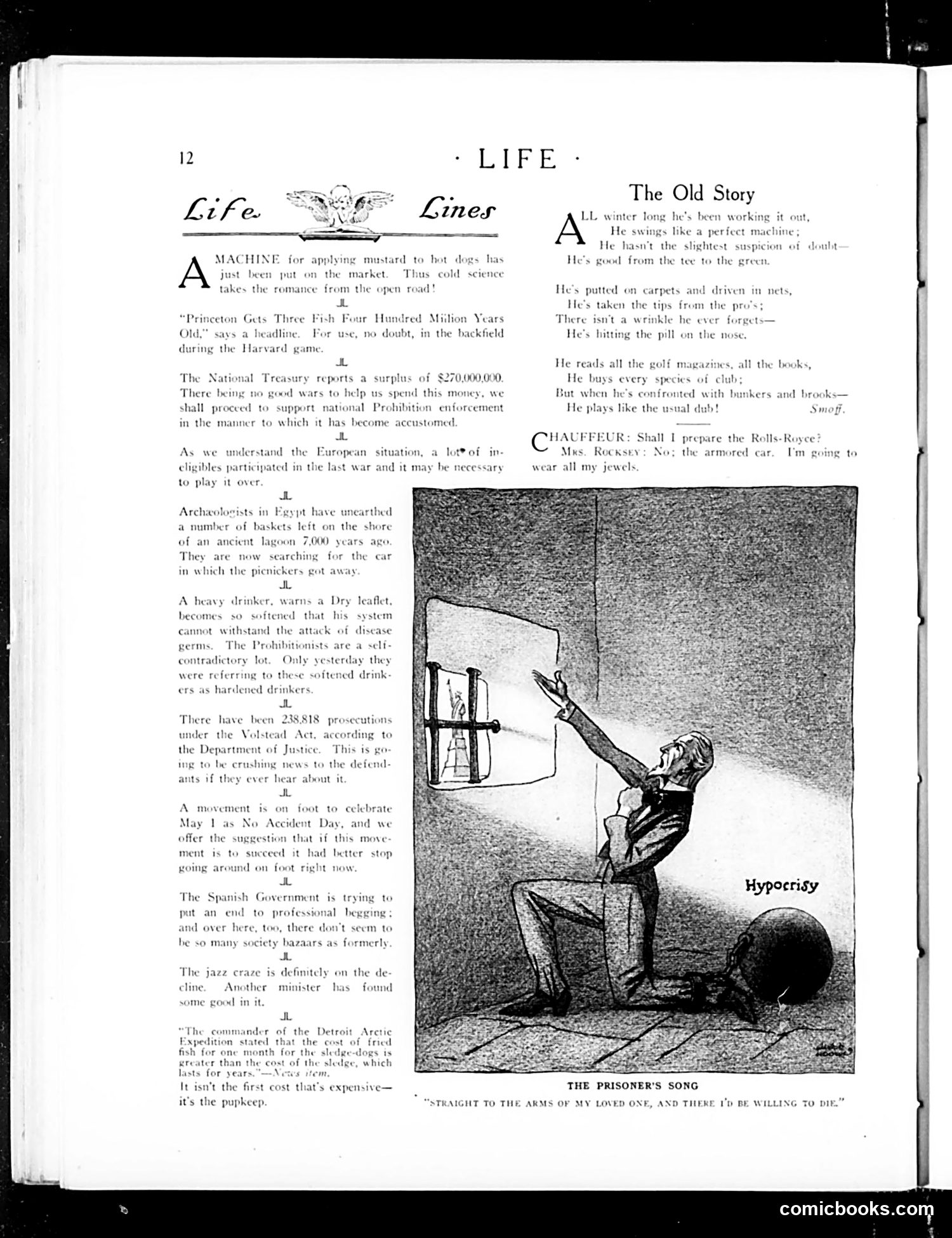
This cartoon depicts a man in prison stripes reaching desperately toward a woman outside his cell window, illustrating the sentimental 1920s song "The Prisoner's Song" (lyrics quoted: "Straight to the arms of my loved one, and there I'd be willing to die"). The cartoon is titled "Hypocrisy," suggesting ironic commentary. The surrounding "Life Lines" column discusses various social topics—Prohibition enforcement, drinking, and moral contradictions. The juxtaposition implies satire about society's selective morality: while enforcing laws against prisoners, society itself practices hypocrisy through widespread drinking during Prohibition and other contradictions between stated values and actual behavior. The emotional melodrama of the song contrasts with the magazine's critique of public dishonesty.
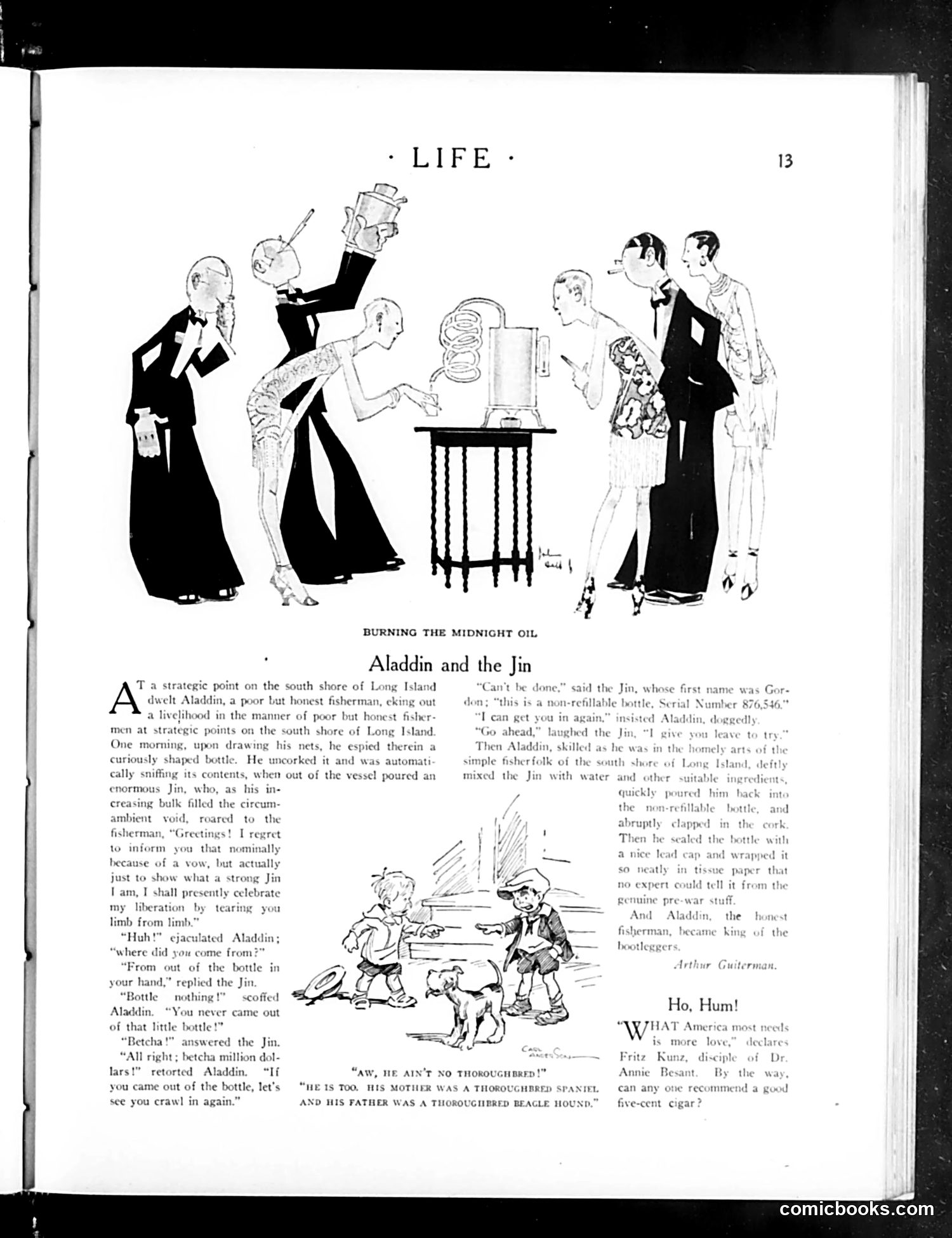
This page from *Life* magazine contains two distinct pieces: **Top illustration**: A sophisticated 1920s-era cartoon showing well-dressed partygoers engaged in "burning the midnight oil"—a humorous visual pun depicting literal oil burning in an elaborate device while guests in formal attire socialize. This satirizes the wealthy's tendency to stay up late at parties. **Main story**: "Aladdin and the Jinn" is a humorous fiction piece by Arthur Gutterman that reimagines the classic tale. A poor fisherman named Aladdin discovers a magical bottle containing a Jinn. The story plays on the original fairy tale, with comedic dialogue about the bottle's "serial number" and the Jinn's refusal to grant wishes, creating modern absurdist humor by treating magic with bureaucratic skepticism. The page reflects *Life*'s blend of satirical humor and literary parody.
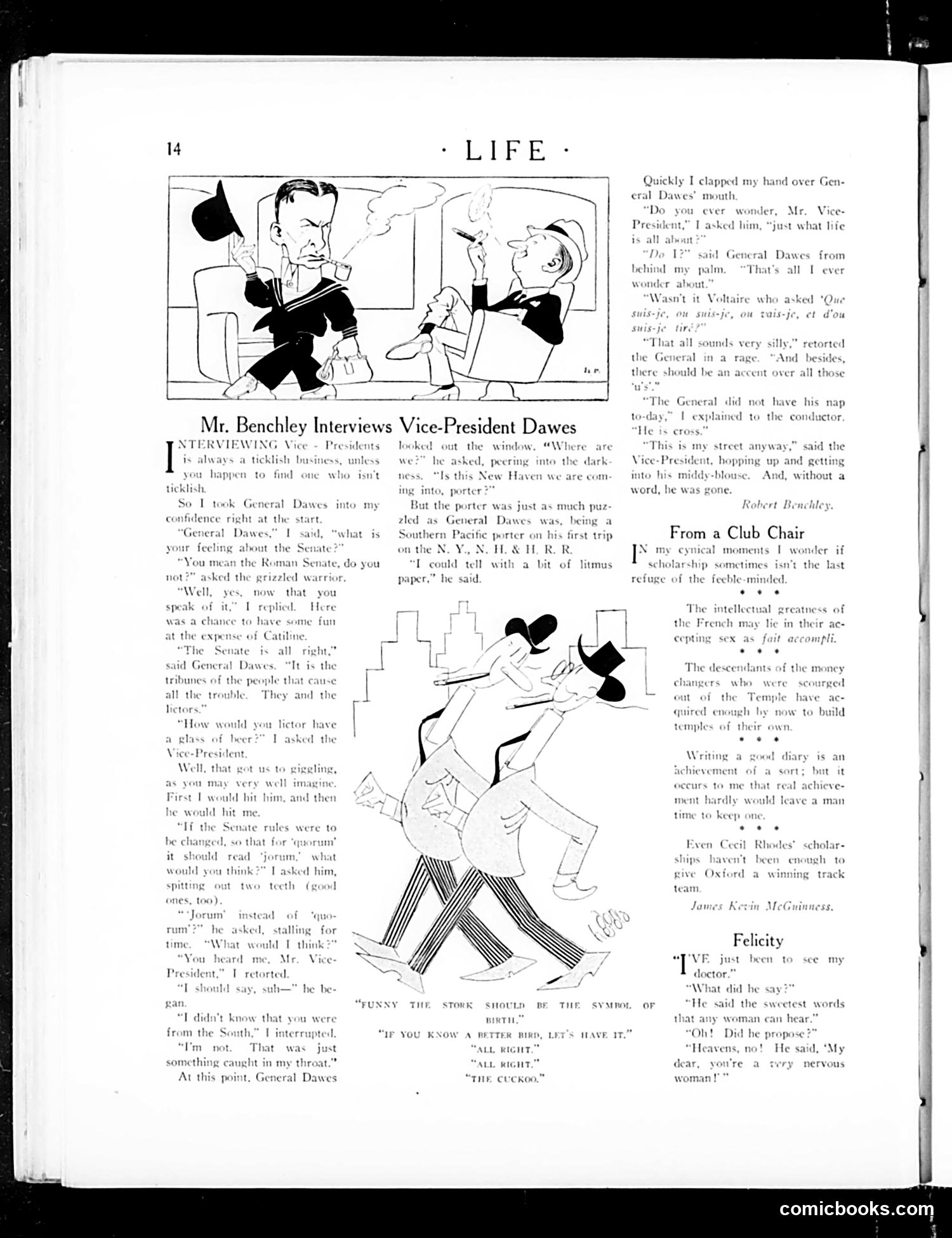
This cartoon satirizes an interview between humorist Robert Benchley and Vice-President Charles G. Dawes. The sketch mocks Dawes as pompous and evasive when asked straightforward questions about Senate proceedings and politics. The satire hinges on Dawes avoiding direct answers—when asked what life in the Senate is "all about," he deflects with vague pleasantries about Southern Pacific porters and New Haven trains. Benchley presses him on whether senators should read the Congressional Record, but Dawes continues dodging with wordplay about "quorum" versus "forum." The cartoon ridicules Dawes as an out-of-touch bureaucrat more concerned with trivialities than substantive governance, capturing contemporary frustration with evasive political leadership.
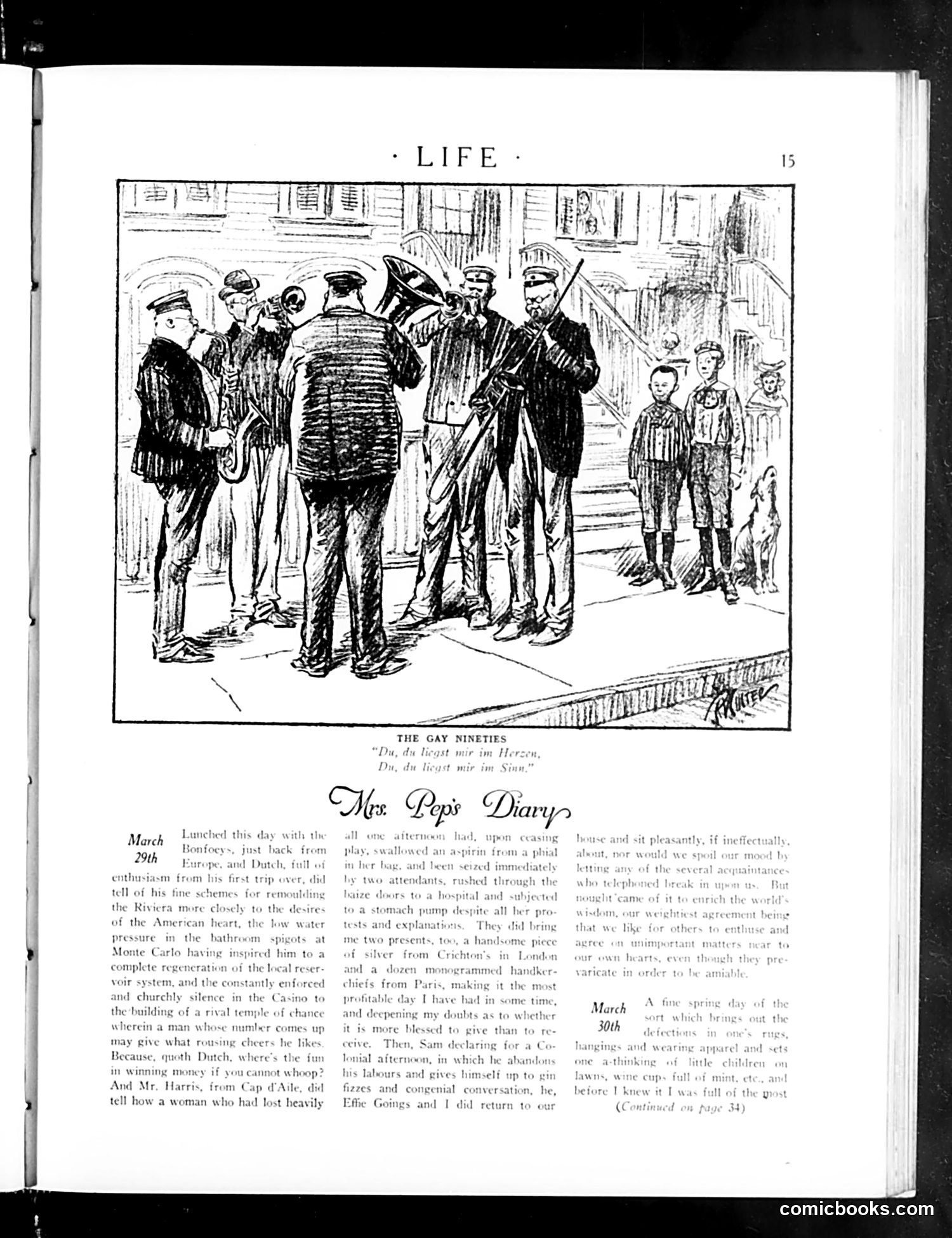
This illustration depicts a street scene titled "The Gay Nineties," showing well-dressed men in period clothing gathered on a sidewalk, with children visible in the background. The caption includes German text: "Da, da liegt mir im Herzen, / Da, da liegt mir im Sinn" (roughly "That's what lies in my heart"). The accompanying diary entry by "Mrs. Peps" references a social lunch and discusses relationships, marriages, and romantic entanglements among acquaintances. The cartoon appears to satirize 1890s social conventions—the formality of dress, the gossipy nature of polite society, and the gap between proper public behavior and private romantic scheming that the diary entry reveals. The humor lies in exposing social hypocrisy.
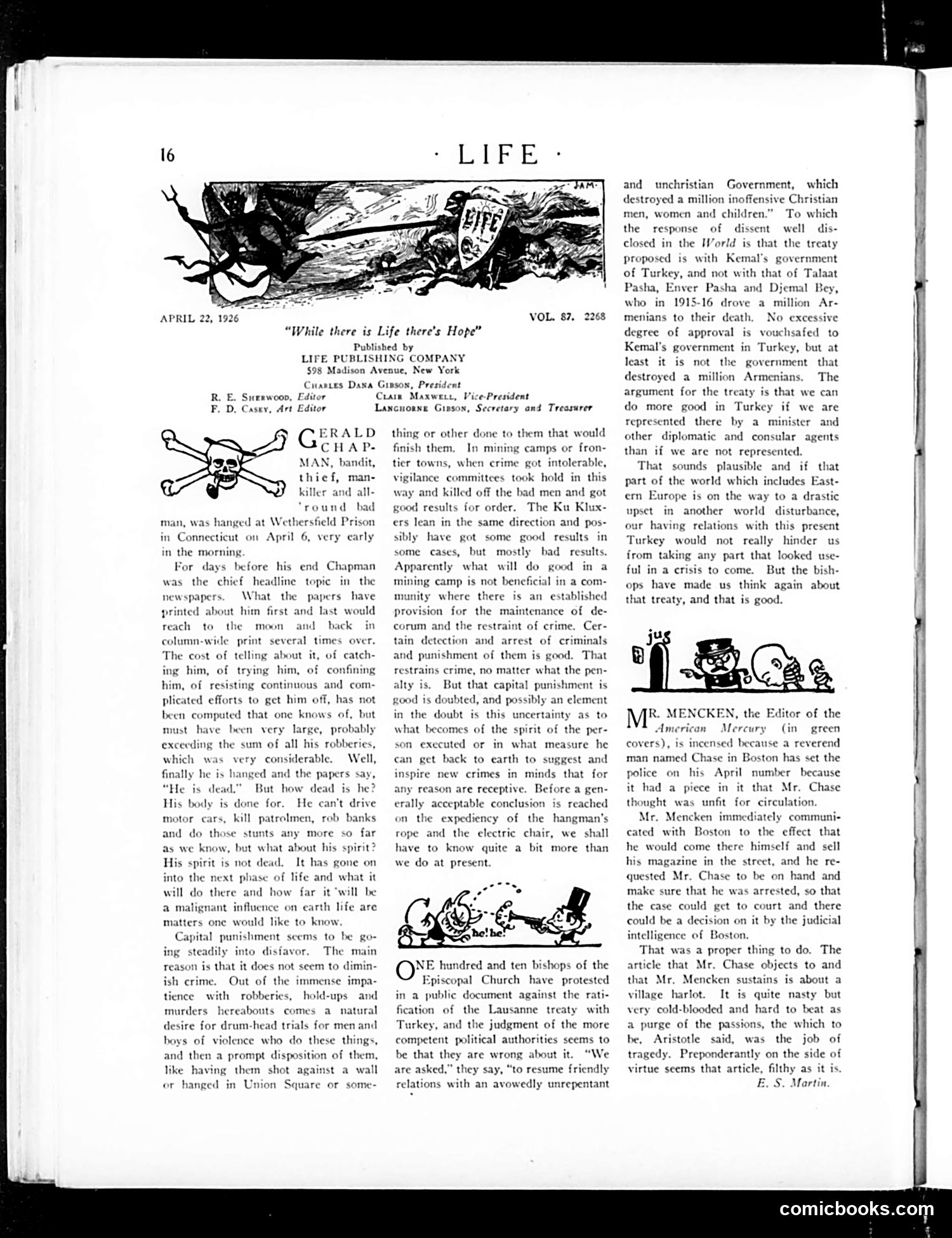
This page contains two political cartoons and editorial commentary addressing capital punishment and international diplomacy. The first cartoon depicts a hangman's noose with "LIFE" written on it, illustrating the article's title "While there is Life there's Hope." It critiques capital punishment, arguing against execution as justice. The second cartoon shows a figure labeled "Mencken" (referring to H.L. Mencken, the famous social critic and editor of *American Mercury*) confronting what appears to be a police officer or authority figure. The accompanying text discusses Mencken's arrest in Boston and satirizes police overreach. Both pieces exemplify *Life*'s satirical stance against government excess—whether judicial execution or police censorship—reflecting 1920s Progressive Era concerns about civil liberties and institutional power.
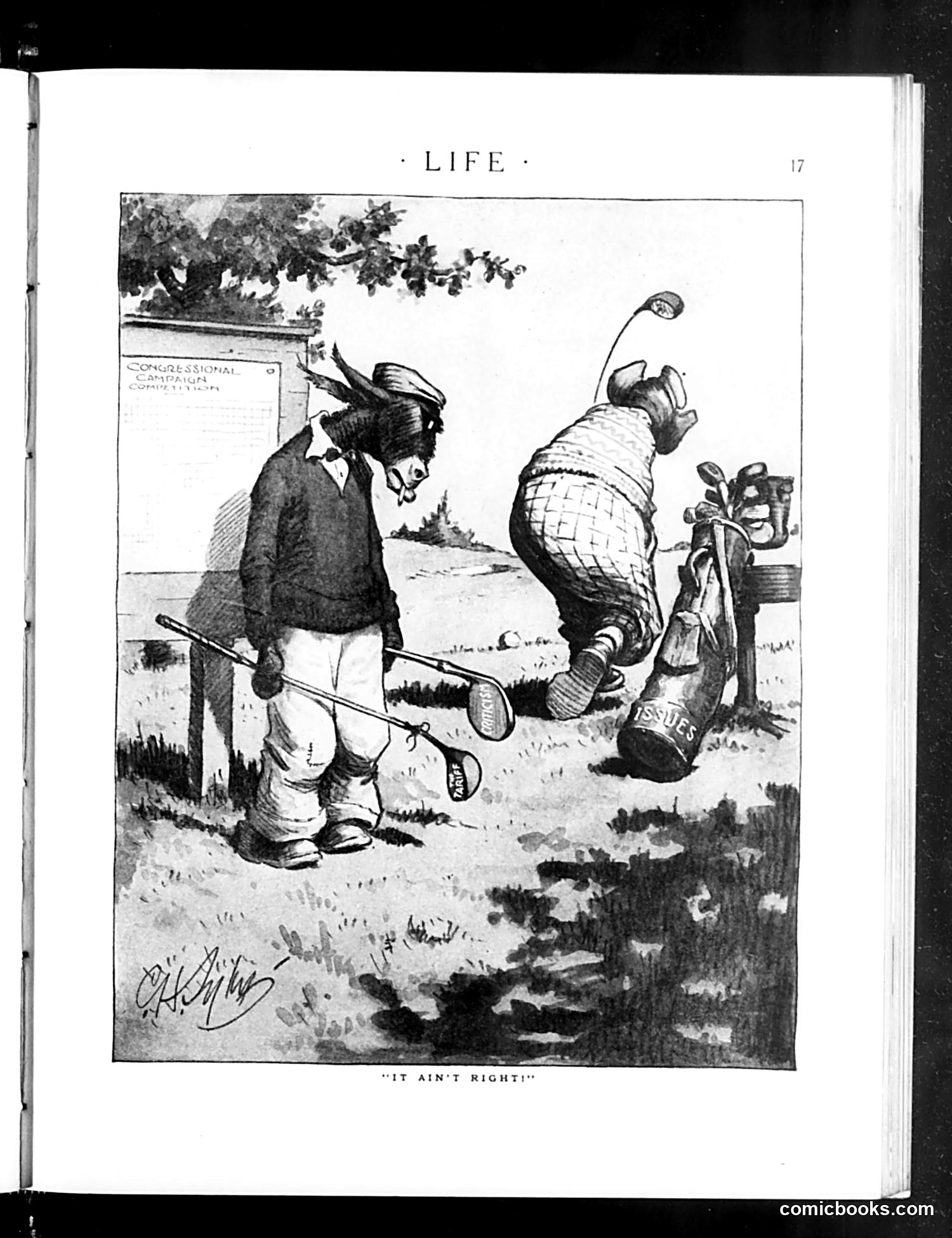
This satirical cartoon depicts two figures golfing, with the caption "It Ain't Right!" The figure on the left appears to be a politician or authority figure complaining to another golfer. In the background, there's a sign reading "CONGRESSIONAL CAMPAIGN," suggesting this critiques political behavior during election season. The joke likely satirizes hypocrisy: a politician complains about unfair golfing rules while simultaneously engaging in questionable campaign practices. The cartoon mocks the disconnect between politicians' public complaints about fairness and their actual conduct. The exaggerated caricature style was typical of early 20th-century Life magazine satire. Without clearer identification of the specific figures or date, the precise political target remains unclear, though the satire targets political double standards.
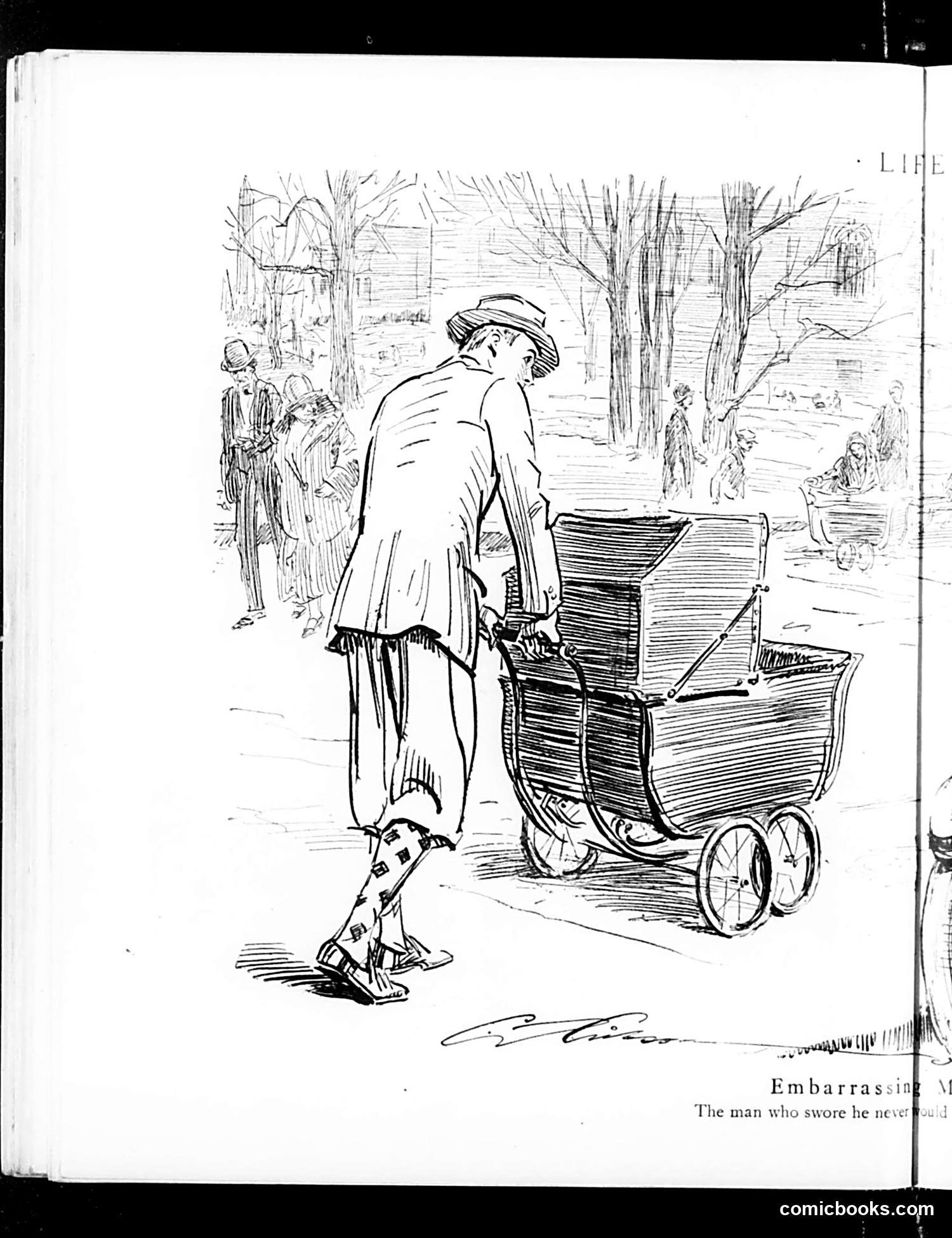
This is a sketch-style cartoon titled "Embarrassing" with the caption "The man who swore he never fou[nd]..." (text cut off). The image shows a man pushing a baby carriage down a tree-lined street, viewed from behind. He wears a hat and coat, appearing somewhat awkward or self-conscious about his public activity. The satire likely plays on social pretense: a man who previously claimed he never engaged in domestic childcare duties (or similar "unmanly" activities) is now caught doing exactly that. The joke hinges on the contradiction between what men publicly claimed about themselves versus their actual private behavior. The embarrassment comes from public exposure of this hypocrisy. Without the complete caption, the specific reference remains unclear, but the humor targets masculine posturing and social performance in early-20th-century American culture.
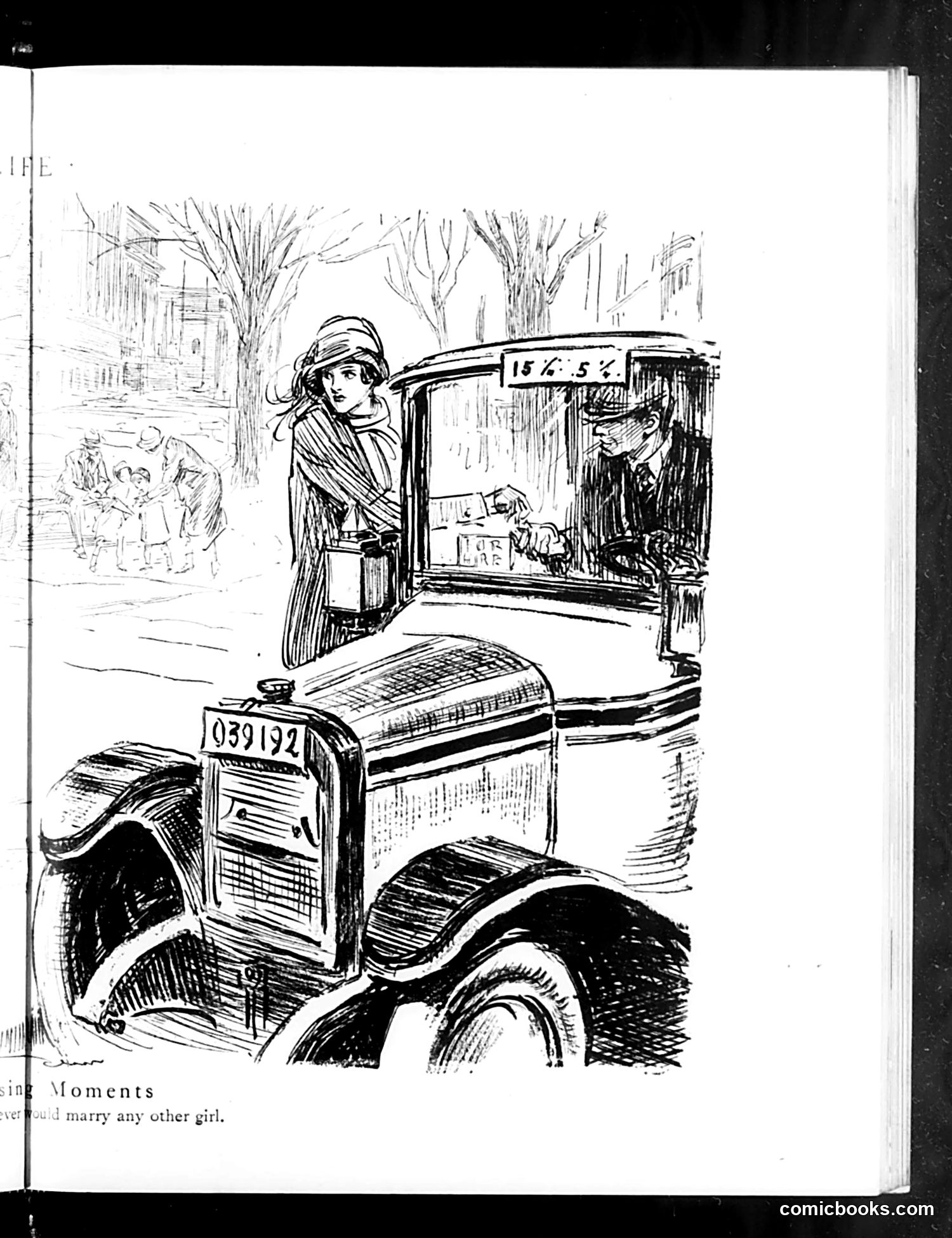
This is a satirical cartoon from *Life* magazine depicting a taxi cab scene. A woman leans toward the taxi window where a male driver sits, appearing to proposition or flirt with him. The taxi bears the number "039192." The visible text fragment reads "Moments" and mentions something about "marry any other girl," suggesting the joke concerns romantic or sexual propositions. The satire appears to target either taxi drivers' encounters with passengers, or possibly women's changing social behavior in the early-to-mid 20th century. Without the complete caption or context, the specific social commentary remains unclear, though it likely plays on period anxieties about urban morality or changing gender relations. The sketch style is typical of *Life*'s humorous illustrations from this era.
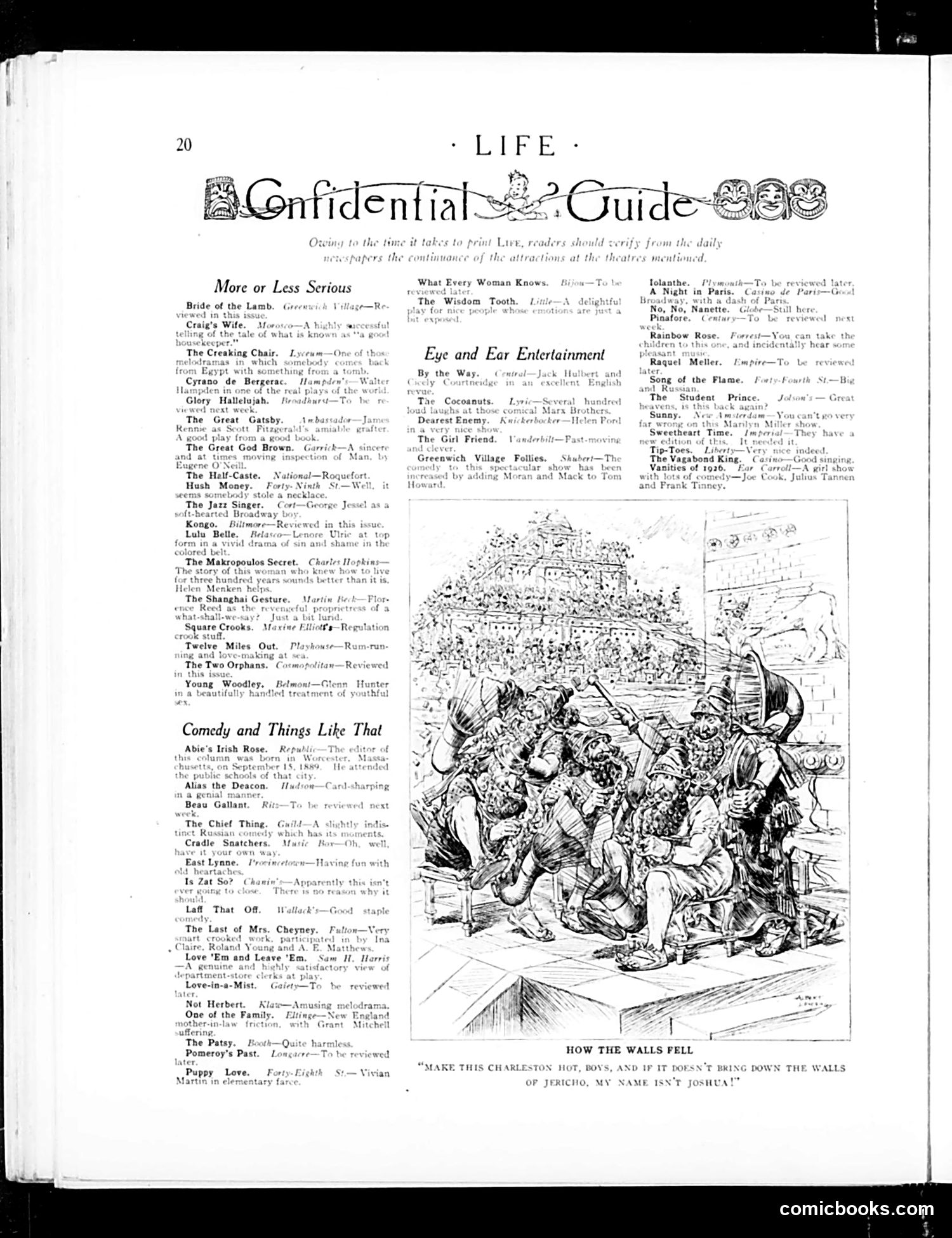
This page is a **theater guide** listing current Broadway shows, with a satirical cartoon illustrating the cultural phenomenon of the Charleston dance craze (mid-1920s). The cartoon depicts a chaotic scene of people dancing the Charleston—a wildly energetic dance that scandalized older generations. The exaggerated, frenzied figures emphasize the dance's vigorous movements and social disruption it represented. The caption quotes someone boasting they'll make Charleston "so hot" it will "bring down the walls of Jericho"—a biblical reference to Joshua's trumpet blast destroying Jericho's walls. The joke: the Charleston was seen as dangerously destabilizing to social order, literally threatening to destroy civilization's foundations. This satirizes both the dance's wild popularity and moral panic among conservatives who viewed the Charleston and Jazz Age youth culture as threats to traditional values. The cartoon mocks the hyperbolic fears while celebrating the era's transgressive energy.
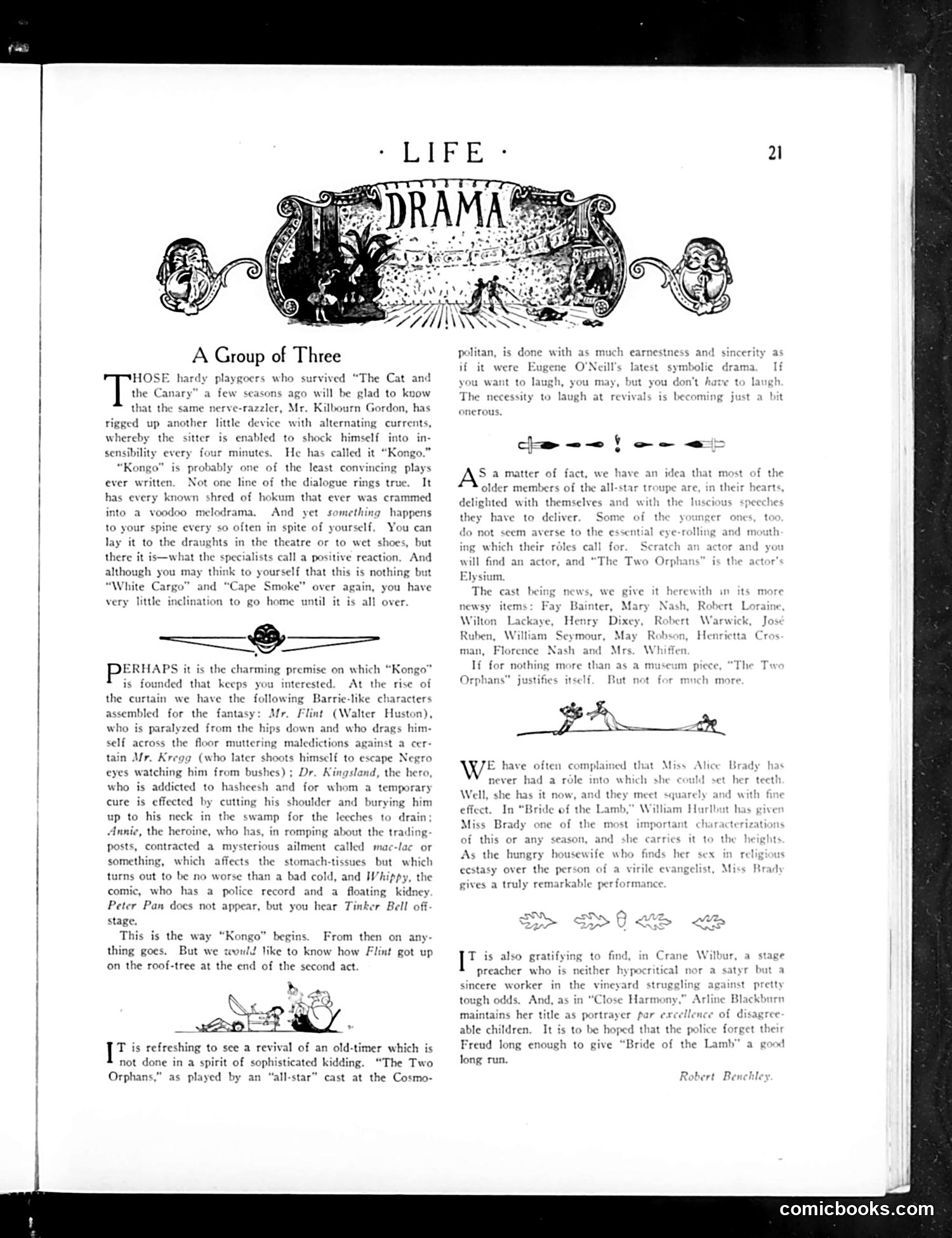
This page reviews theatrical productions, primarily focusing on "Kongo," a melodramatic play criticized for its absurd plot mechanics. The reviewer sarcastically catalogs the play's ridiculous elements: a paralyzed man who inexplicably reaches a rooftop, characters with implausible ailments (one contracted from "trading posts"), and shock devices meant to create artificial thrills. The satire targets the play's reliance on crude sensationalism over genuine drama. The reviewer notes that "Kongo" contains "not one line of the dialogue [that] rings true" yet audiences keep attending, attributing this to the play's "charming premise" rather than quality writing. The page also favorably reviews "The Two Orphans," an all-star revival performed earnestly rather than as mockery, praising the cast's sincere performances and noting that veteran actor Alice Brady delivers "a truly remarkable performance." The underlying critique: audiences will tolerate theatrical garbage if it delivers shock value, while genuinely committed dramatic work deserves appreciation.
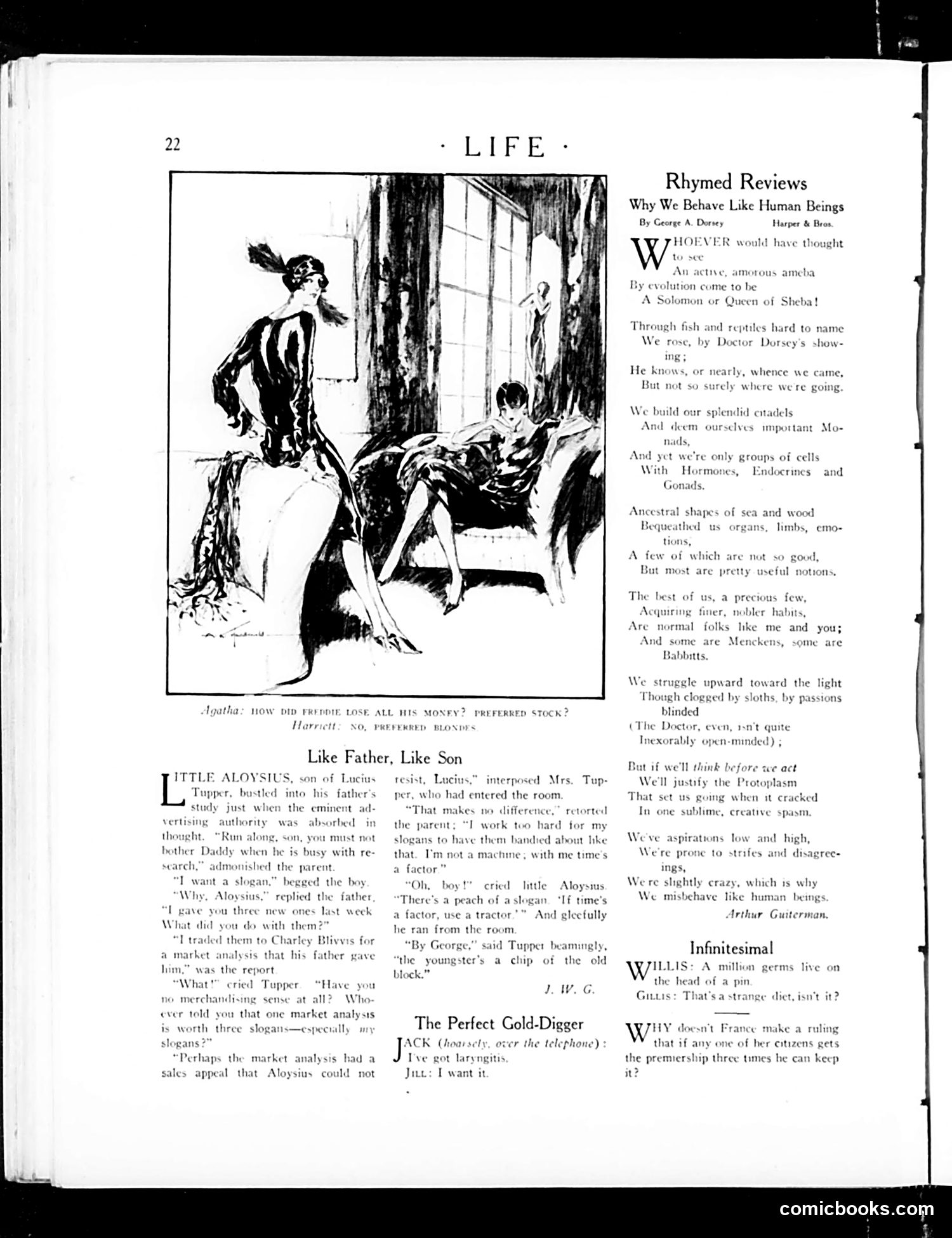
This page from *Life* contains several satirical pieces targeting early 20th-century American culture: **"Like Father, Like Son"** mocks advertising industry jargon and commercialism. Young Aloysius trades his father's marketing "slogans" to a friend for a "market analysis"—treating language and ideas as mere commodities. His father, an advertising executive, complains the boy has "no merchandising sense," yet paradoxically praises him when he unwittingly creates a catchy slogan ("use a tractor"). The satire targets how advertising professionals prioritize clever phrases over substance. **"The Perfect Gold-Digger"** appears to be a brief comedic exchange about a woman demanding expensive jewelry, likely satirizing materialistic courtship and feminine greed—a common *Life* trope. **"Rhymed Reviews"** is a poem reviewing George Dorsey's evolutionary biology book, humorously suggesting humans are merely sophisticated collections of cells driven by hormones and base instincts, not the rational beings we pretend to be. It mocks both scientific determinism and human self-delusion about our own nature.
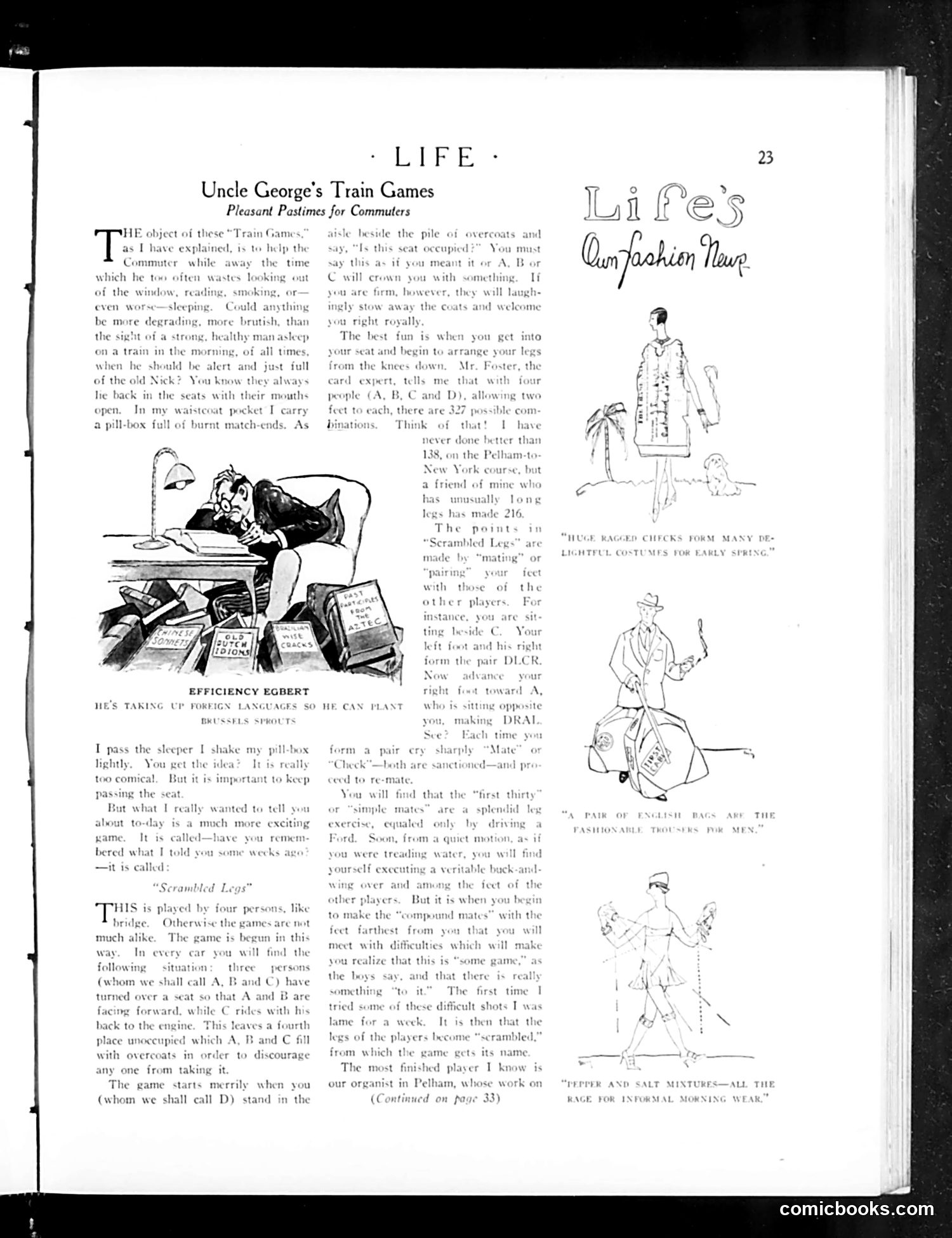
This page presents a humor column about commuter games played on trains. The main article describes "Train Games"—pastimes passengers invented to entertain themselves during boring commutes. The cartoons illustrate fashion advice for commuters. Sketches show women in 1920s-style clothing labeled as appropriate "informal morning wear" and men's accessories like "English bags" for commuting. One cartoon labeled "Efficiency Egbert" mocks a businessman taking up foreign languages during his commute—satirizing the self-improvement culture of the era and the notion that busy professionals could optimize every moment. The "Train Games" themselves are leg-stretching exercises disguised as games played between car seats, with names like "Scrambled Legs." The satire gently pokes fun at commuters' creativity in fighting boredom and the somewhat absurd lengths they'd go to entertain themselves during tedious rail journeys—a relatable problem for early 20th-century urban workers.
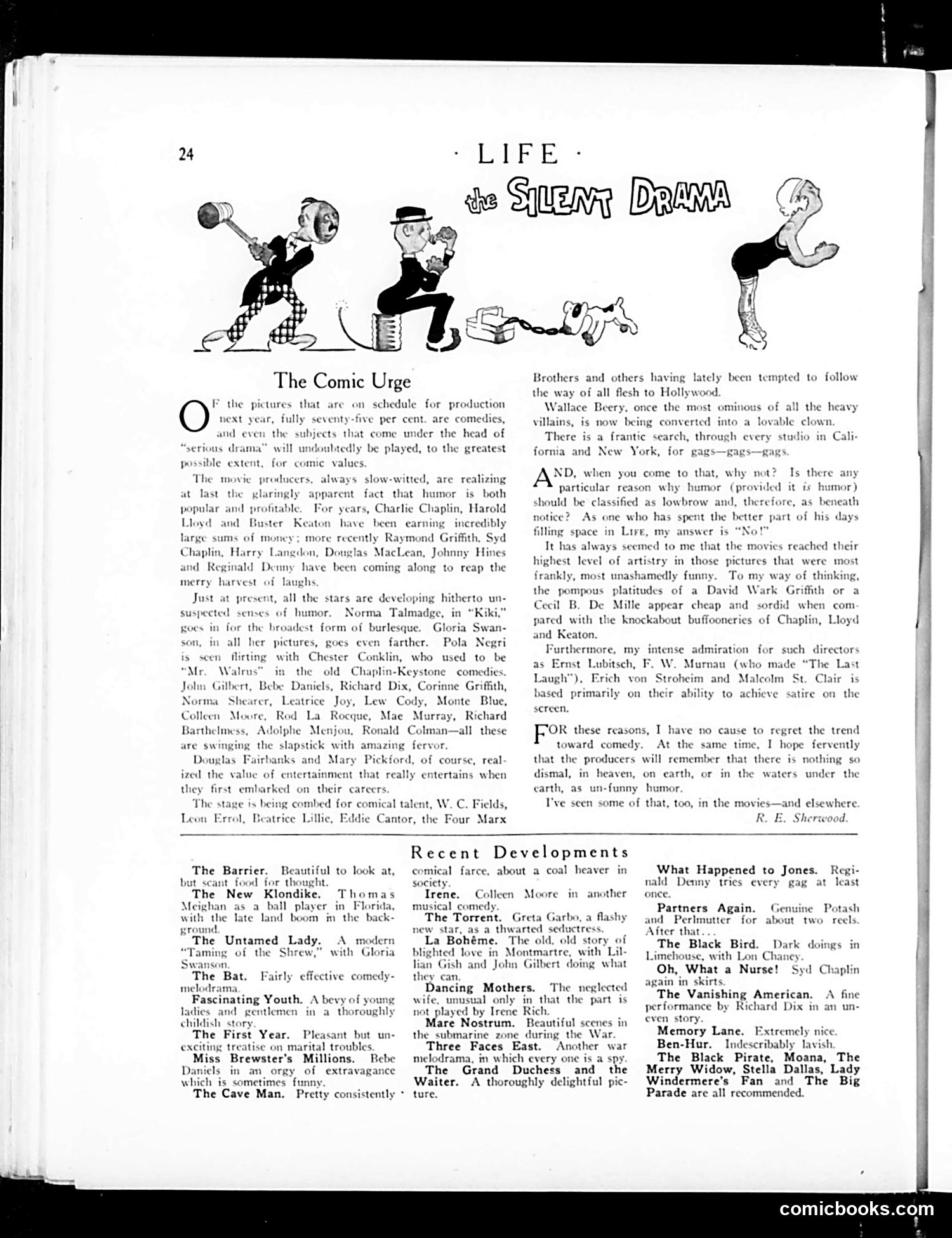
This page discusses Hollywood's shift toward comedy films. The author (R. E. Sherwood) argues that while 75% of upcoming productions are comedies, this trend is justified and valuable. The piece celebrates comic stars—Chaplin, Lloyd, Buster Keaton, and newer talent like Norma Talmadge and Gloria Swanson—who've proven comedy is both popular and profitable. However, Sherwood defends comedy against snobbish criticism that classifies humor as "lowbrow." He argues the best silent films achieved their highest artistry through comedy, praising directors like Lubitsch and Stroheim for sophisticated satire. The cartoon header depicts classic silent-film physical comedy: slapstick performers with exaggerated poses and props (bowling ball, accordion, money). Sherwood's main point: comedy deserves respect as serious cinema, not dismissal as lowbrow entertainment. The "Recent Developments" section briefly reviews new film releases.
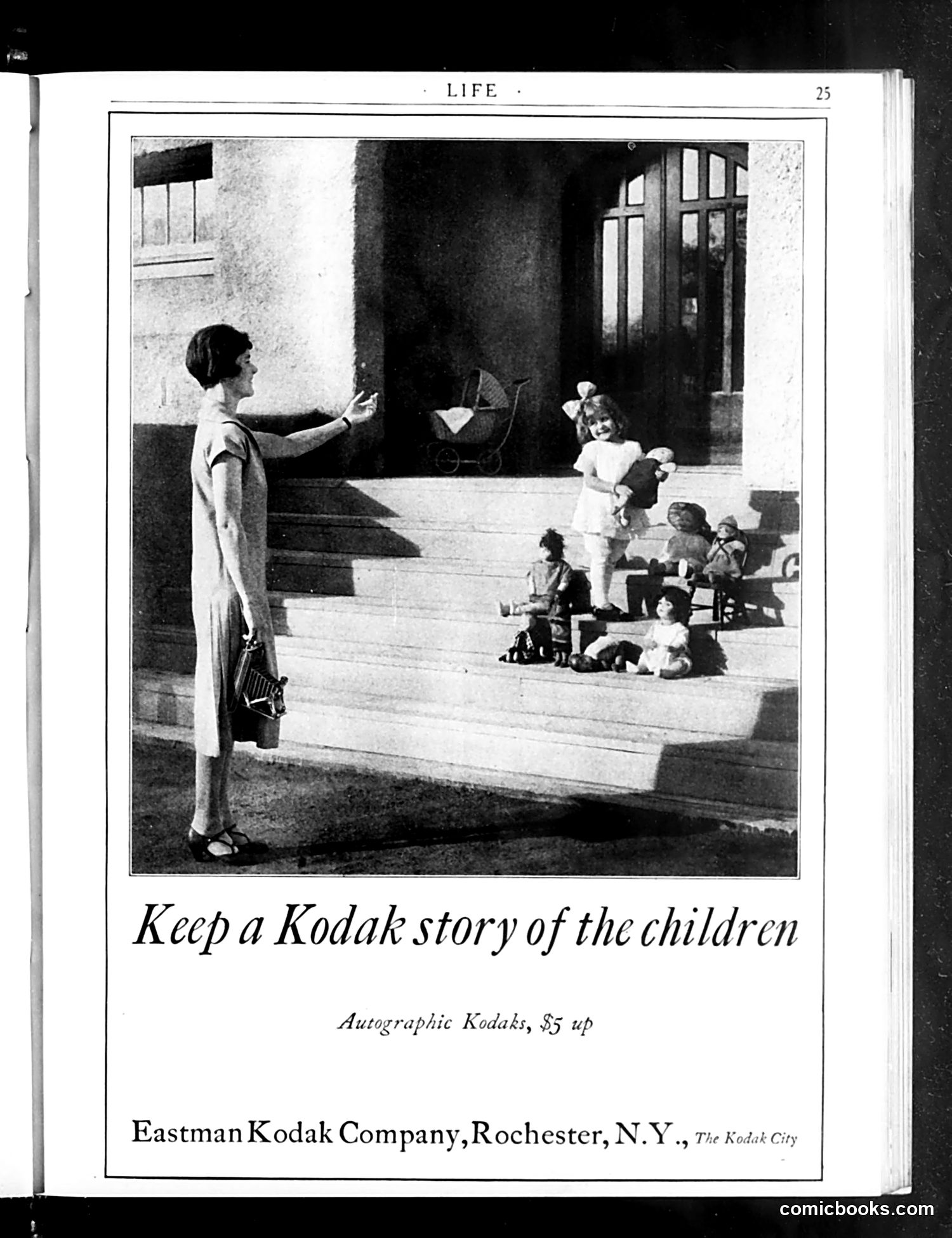
This is a **Kodak advertisement**, not satire or political commentary. The page shows a woman photographing children playing outdoors on steps, with a baby carriage visible in the background. The ad's appeal is straightforward: it encourages parents (particularly mothers) to document their children's everyday moments using Kodak cameras. The phrase "Keep a Kodak story of the children" suggests that photography preserves memories and family narratives. The pricing ("$5 up") and mention of "Autographic Kodaks" indicate these were relatively affordable consumer cameras for the era. The domestic scene—a woman supervising children at play—reflects early-20th-century gender roles and the emerging middle-class practice of casual family photography as a leisure activity and sentimental keepsake.
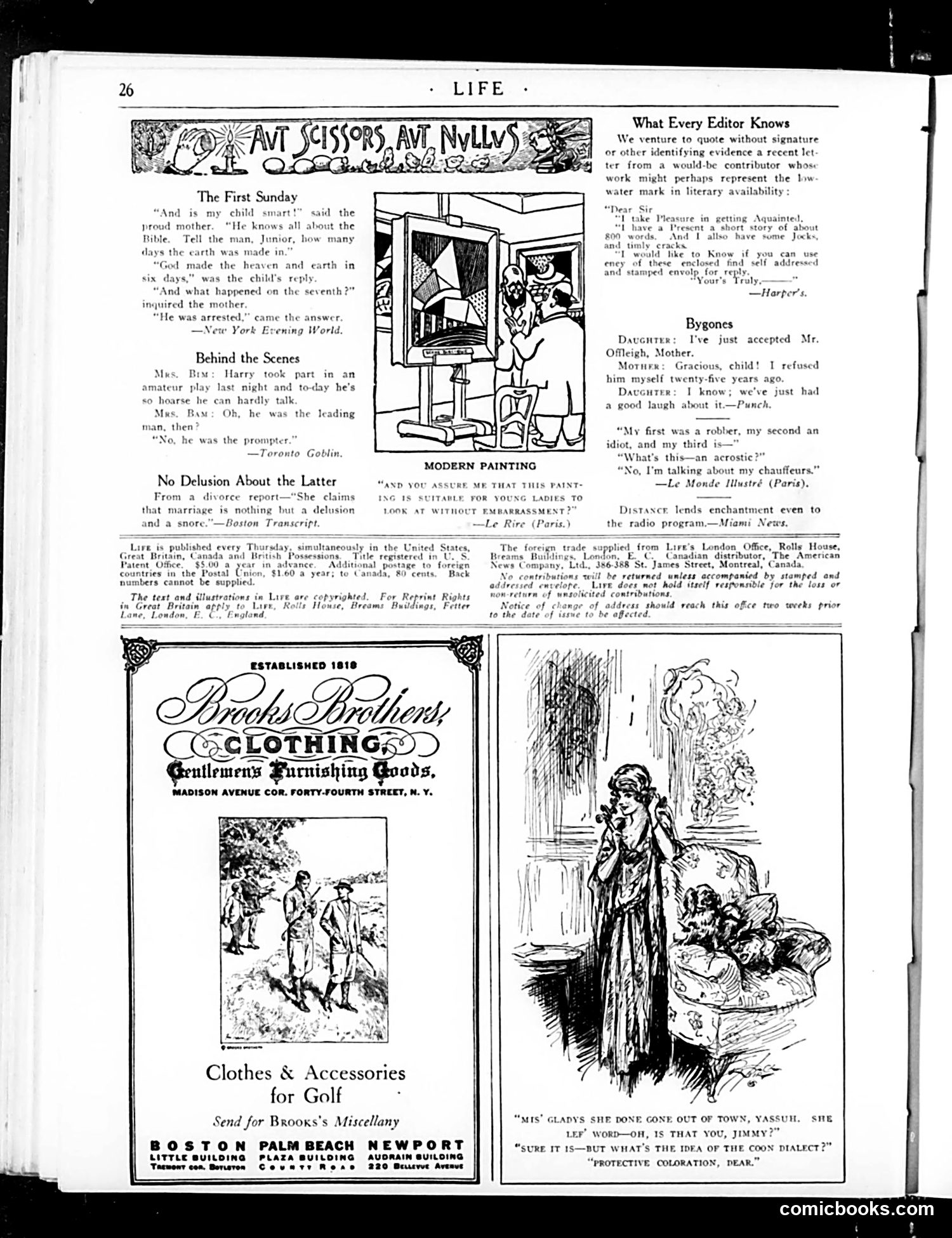
This page contains several humor pieces typical of early 20th-century Life magazine: **"The First Sunday"** jokes about a child's biblical ignorance—the joke being that when asked how many days creation took, the child answers "six," but then says "on the seventh [day] he was arrested," confusing Genesis with a news crime story. **"Behind the Scenes"** is a brief theatrical anecdote about an actor losing his voice from overuse during an amateur play. **"No Delusion About the Latter"** presents a divorce-court quip: a woman claims marriage is "nothing but a delusion and a snore." **"Modern Painting"** (with French source *Le Rire*) depicts a woman concerned that a modernist painting is inappropriate for young ladies to view without embarrassment—satirizing both avant-garde art's controversial nature and Victorian prudishness. The remaining items are brief quips from various sources and period advertisements for Brooks Brothers clothing. The page is primarily humor and advertising rather than political satire, reflecting Life's general editorial mix of the era.
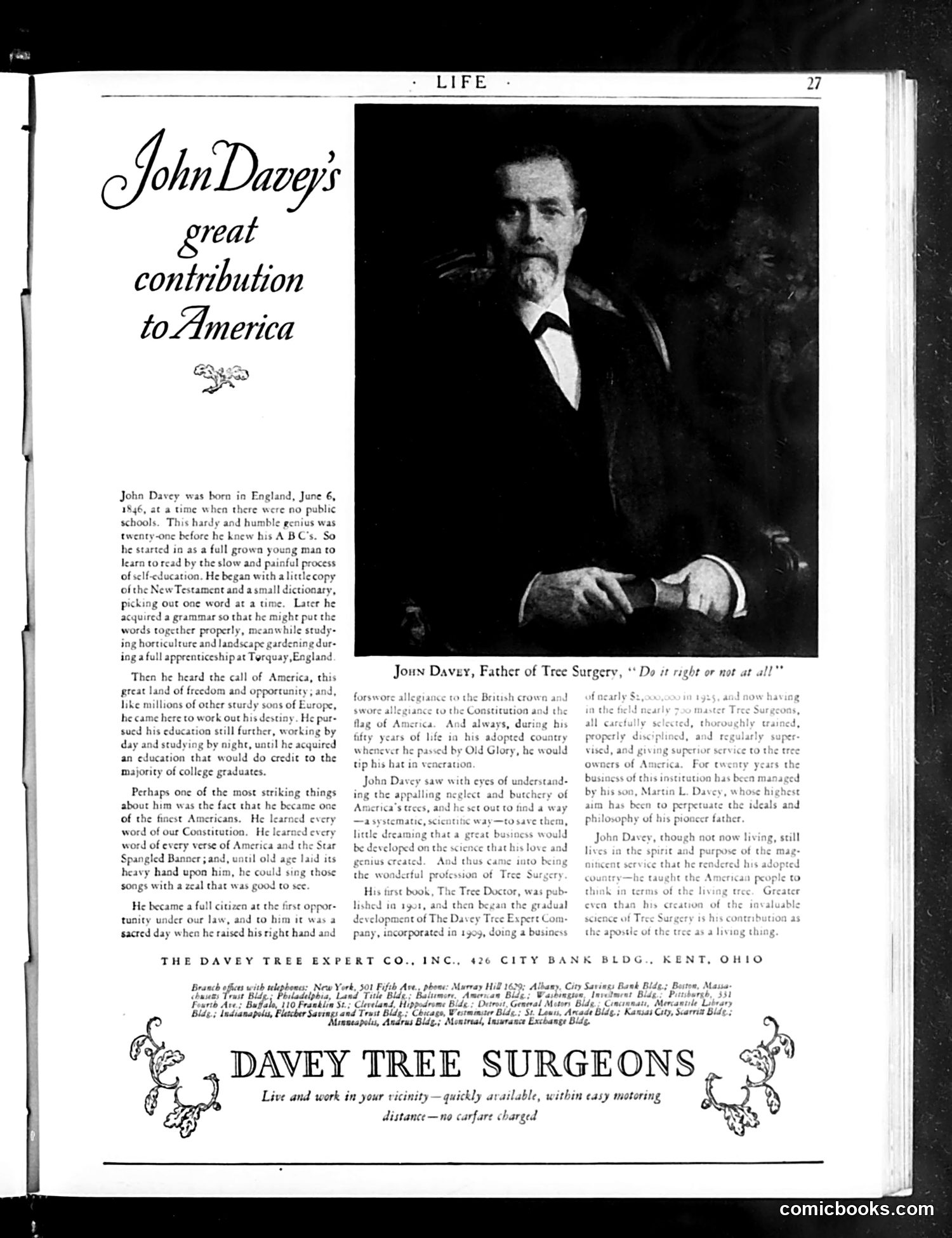
This is **not a cartoon or satire**, but rather a **paid advertisement** disguised as editorial content—a common practice in early 20th-century magazines. The page celebrates John Davey, founder of the Davey Tree Expert Company (headquartered in Kent, Ohio). The narrative frames Davey as an American success story: an English-born, self-educated man who taught himself to read as an adult, immigrated to America, and built a thriving business in tree surgery and landscape care. The accompanying portrait shows a distinguished gentleman in formal dress—the visual embodiment of Victorian respectability and achievement. **For modern readers**: This represents advertorial propaganda, blending biographical glorification with brand promotion. The "great contribution to America" framing elevates commercial tree care to patriotic importance, while the rags-to-riches immigrant narrative served as persuasive marketing to potential customers and investors during the industrial era.
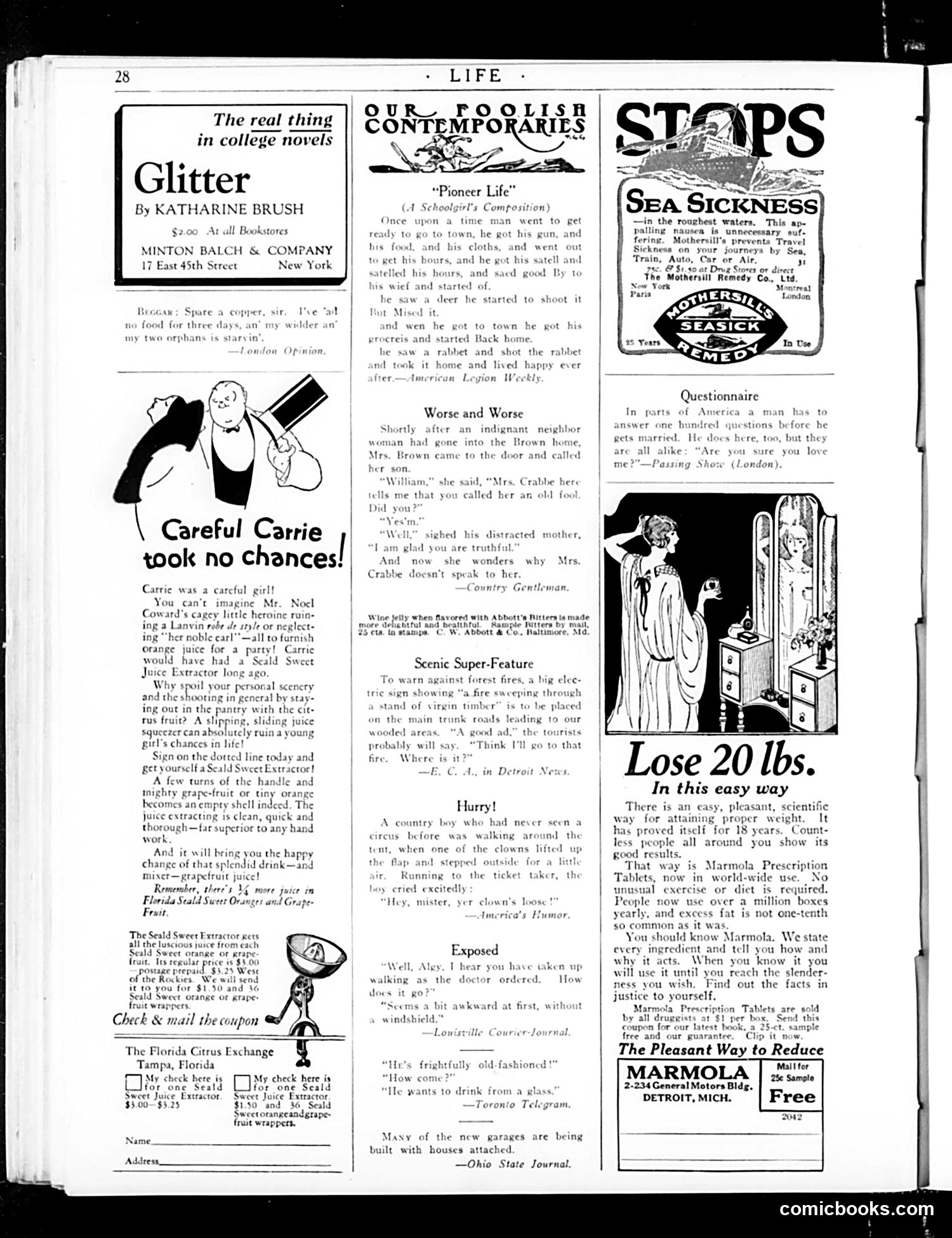
This page from *Life* magazine contains primarily **advertisements and light humor** rather than political satire. The main cartoon, "Careful Carrie took no Chances," depicts a young woman avoiding risky party behavior—specifically declining to wear a borrowed expensive dress to a social event, fearing she might damage it. The joke plays on 1920s social anxieties about propriety and class consciousness among young women. The page also includes: - A book advertisement for *Glitter* by Katharine Brush (a college novel) - Humorous anecdotes labeled "Our Foolish Contemporaries" mocking rural or unsophisticated characters - Multiple **patent medicine and consumer product advertisements** (juice extractors, sea sickness remedies, weight-loss tablets called Marmola) The overall tone is lighthearted social commentary on modern manners and consumer culture, typical of *Life* magazine's satirical style during this era. There is no significant political content visible on this page.
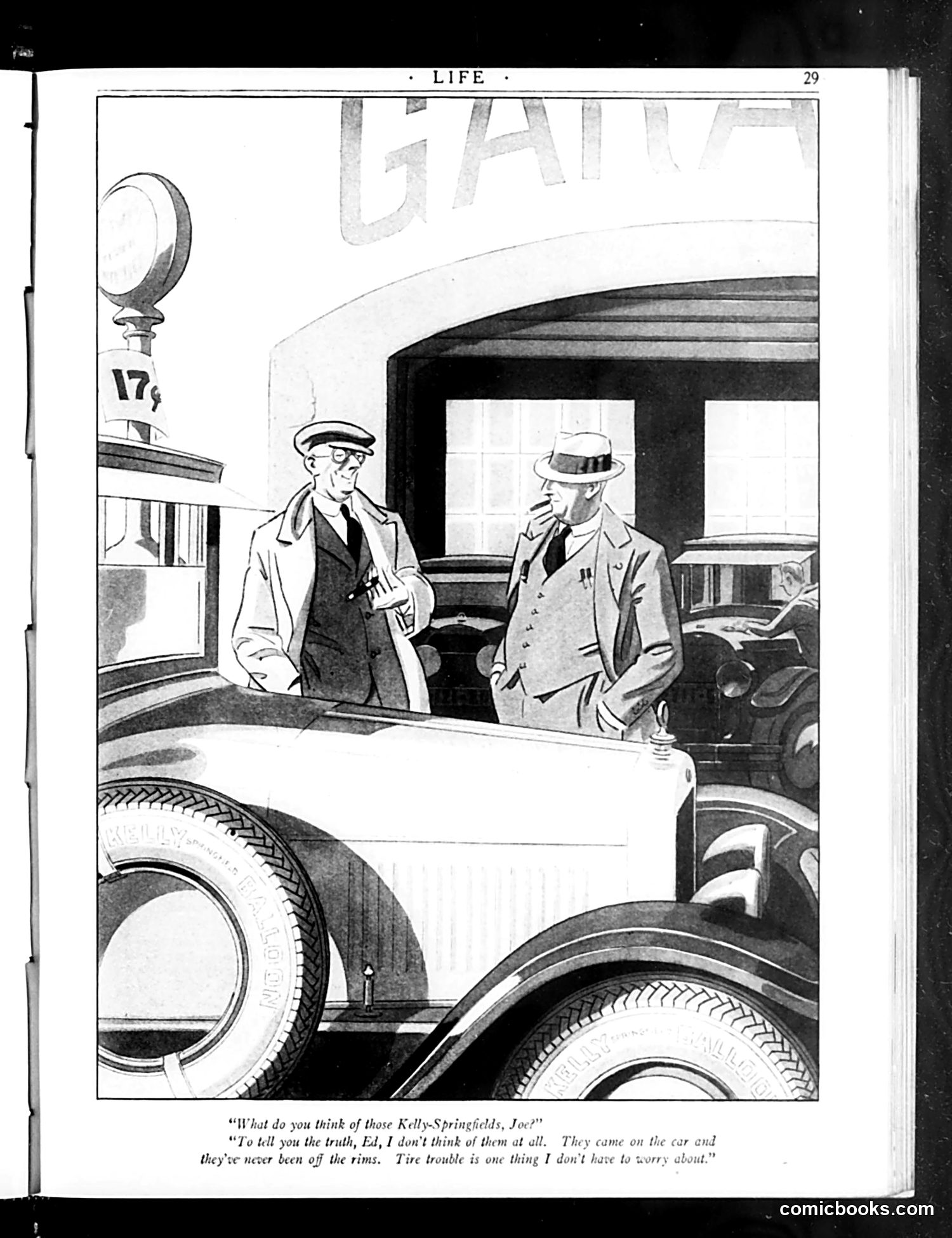
This is a **tire advertisement disguised as a cartoon joke**. Two men in period dress (appearing to be from the 1920s-30s based on their hats and suits) discuss Kelly-Springfield brand tires. The humor relies on a endorsement: one man claims the tires perform so reliably that he never thinks about them—they've never left the rims, meaning zero tire trouble. This is promotional messaging framed as casual male conversation, a common advertising technique of the era. The "joke" targets the audience's desire for dependable car parts. The reference to "tire trouble" being eliminated is the sales pitch: Kelly-Springfield tires are so dependable they eliminate worry entirely. This represents early-20th-century automotive advertising mixed with satirical magazine content—Life published both genuine humor and sponsored advertisements in similar formats.
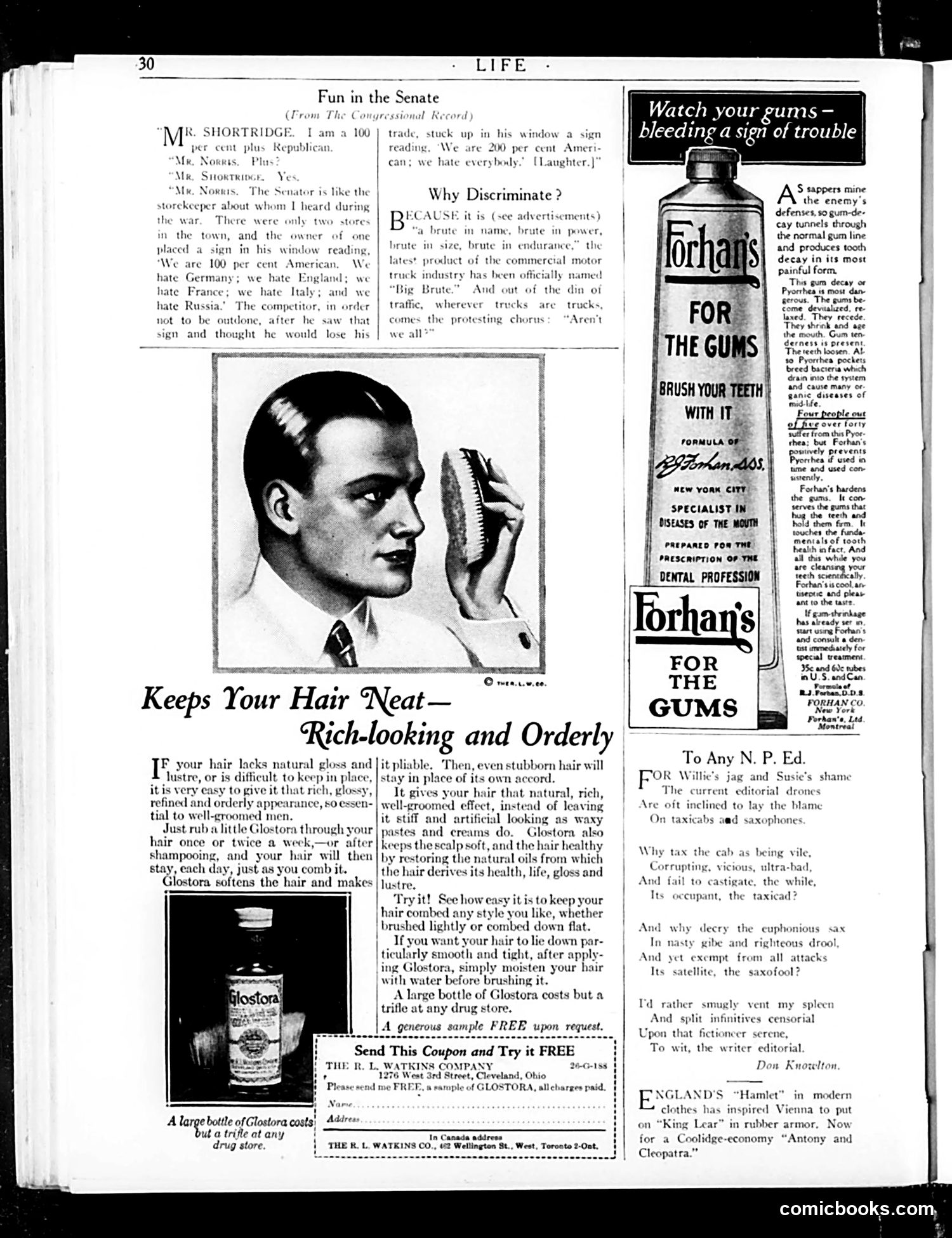
This page contains two main elements: **"Fun in the Senate"** is a political anecdote. Senator Shortridge (Republican) recounts a wartime story: a storekeeper posted a sign reading "We are 100% American; we hate everybody." A competitor, wanting to seem more patriotic, countered with a sign declaring his truck "The Big Brute"—attempting to out-patriot the first merchant. The satire mocks excessive wartime nationalism and competitive jingoism, where Americans publicly claimed to hate all foreign nations simultaneously while competing to appear most patriotic. **The remainder is advertising**: Glostora hair product and Forhan's toothpaste dominate the page, along with an unrelated editorial letter criticizing taxicabs and saxophones. These ads are typical of Life's revenue model. The page reflects post-WWI American satirical commentary on exaggerated patriotic displays and consumer culture.
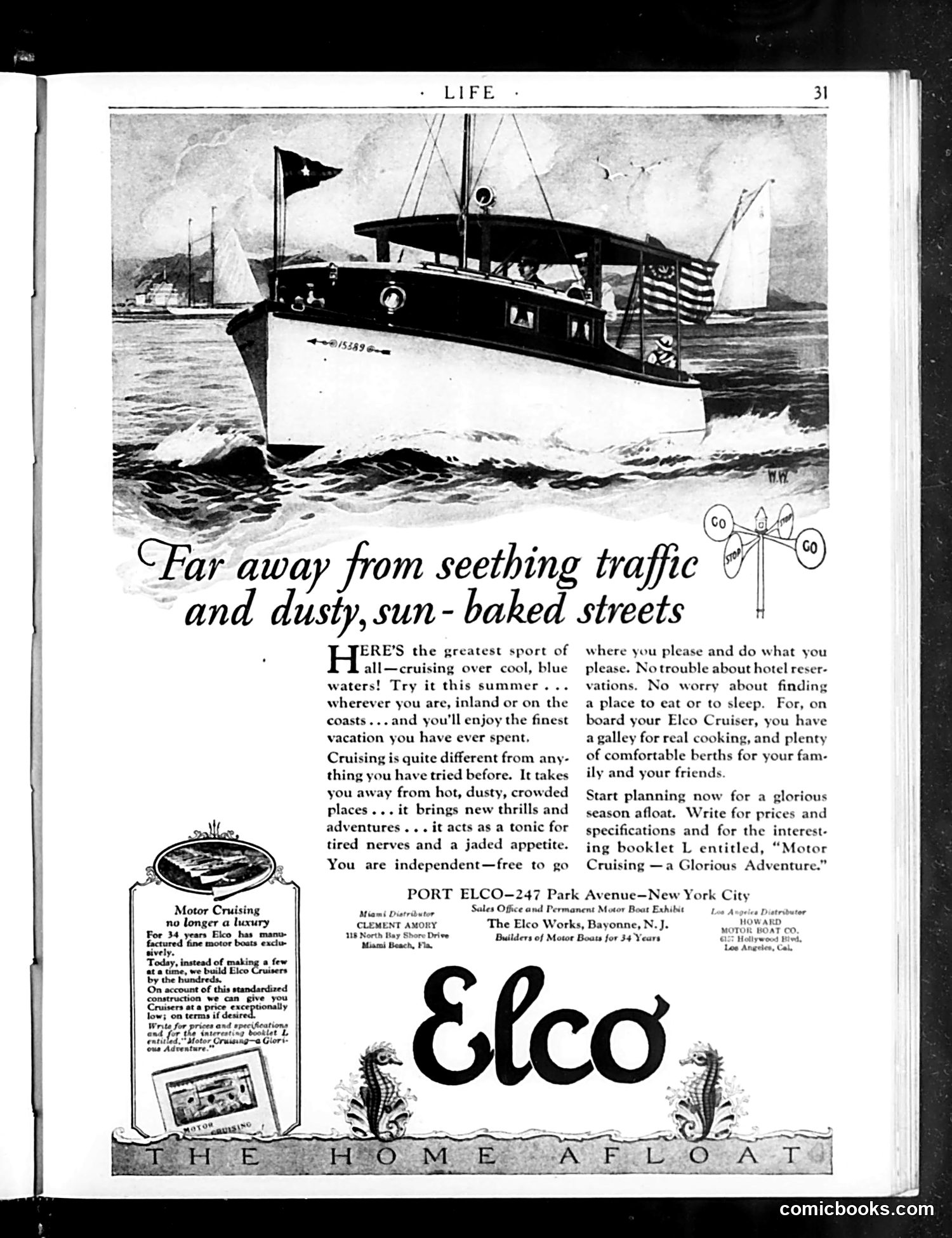
This is a **full-page advertisement**, not satire or political commentary. It promotes Elco motor cruisers—recreational boats manufactured for 34 years by the Elco Works in Bayonne, New Jersey. The ad targets affluent readers by positioning boat ownership as an escape from urban congestion ("seething traffic and dusty, sun-baked streets"). The key sales pitch: standardized manufacturing has made these luxury cruisers affordable and available on credit terms. The imagery shows a substantial cabin cruiser with American flags, suggesting leisure and freedom. Text emphasizes independence, adventure, and comfort—amenities like galleys and berths for families—positioning the boat as a mobile vacation solution requiring no hotel reservations. The decorative footer ("The Home Afloat") and seahorse motifs reinforce the leisure fantasy. This reflects 1920s-30s marketing to the middle and upper classes seeking escape from industrial urban life.
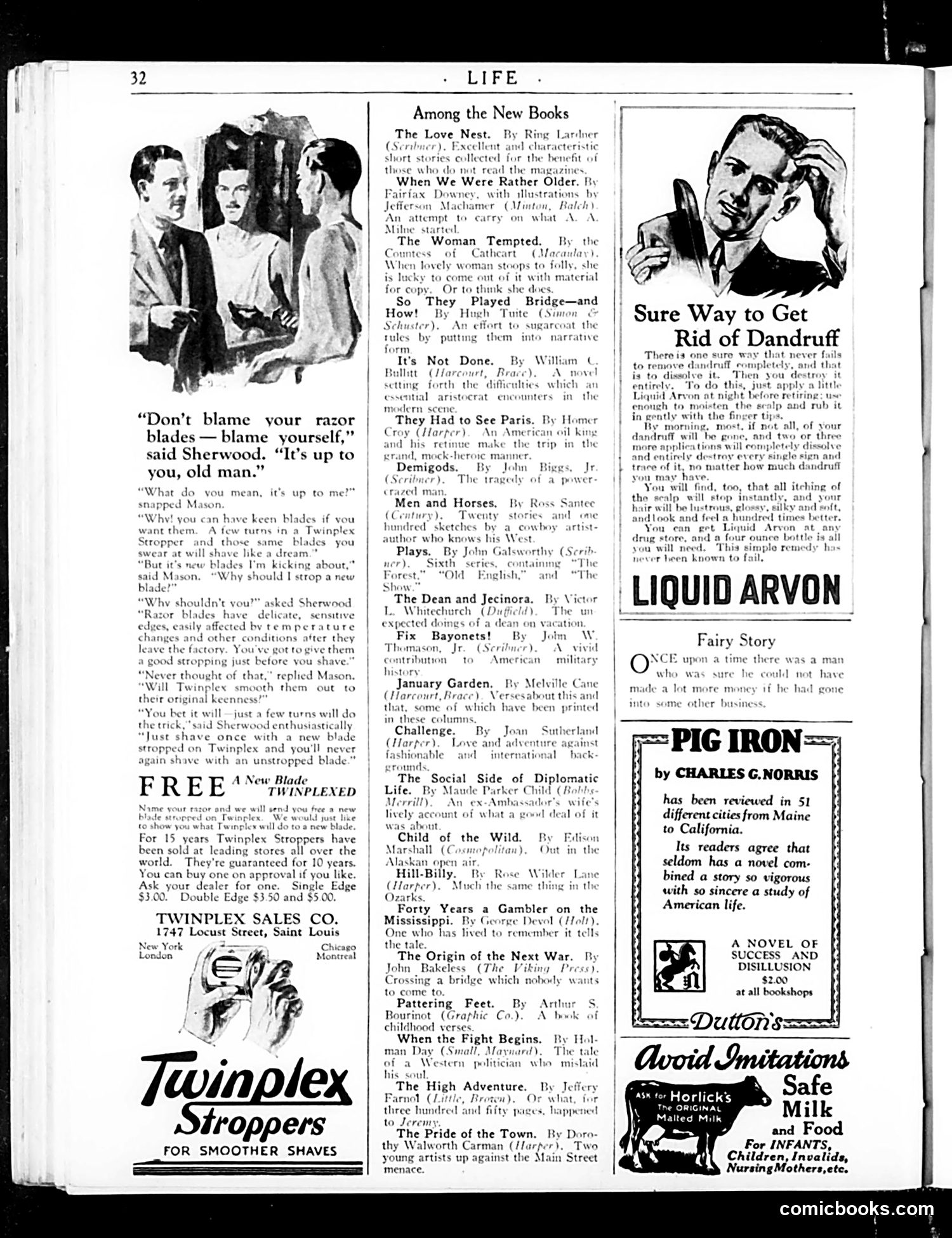
This is a **product advertisement disguised as a comic dialogue**, not political satire. Two men—Sherwood and Mason—debate razor blade maintenance. Mason complains that new blades dull quickly; Sherwood argues the problem lies with the user, not the blade. He promotes the **Twinplex Stropper**, a device that allegedly restores blade sharpness through stropping. The "satire" is mild consumer humor: Mason's frustration with razor performance is redirected toward his own negligence. The advertisement suggests that proper stropping maintenance—not inferior products—solves shaving problems. The rest of the page lists new book releases and other advertisements (Liquid Arvon dandruff treatment, Pig Iron novel, Horlicks milk). This appears to be a typical Life magazine page mixing editorial content with advertising revenue.
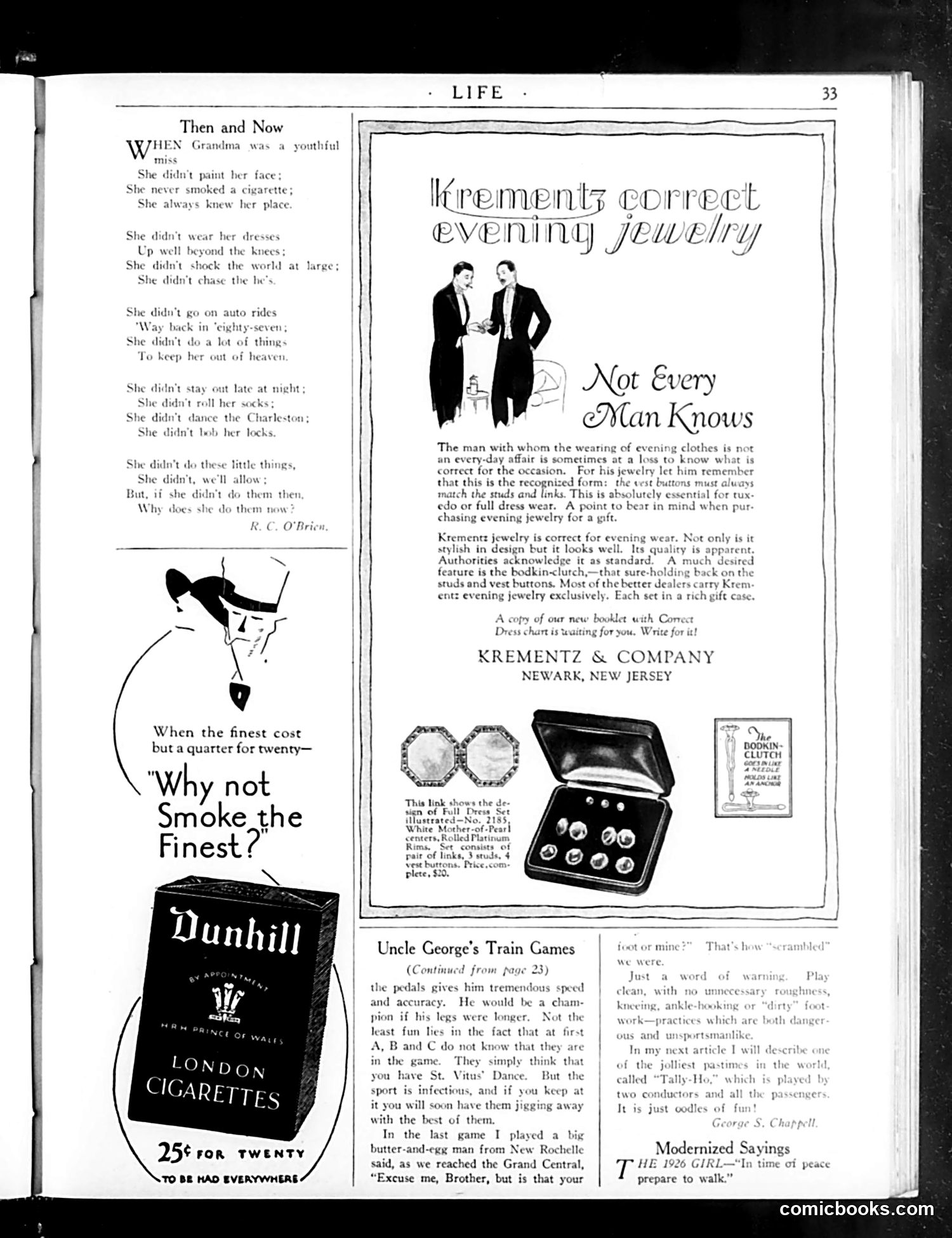
This poem contrasts "Grandma's" era with modern times (1920s). It mocks contemporary young women by listing what grandmothers *didn't* do—didn't paint faces, smoke, wear short dresses, go on unchaperoned car rides, stay out late, roll stockings, or dance the Charleston. The implication: modern women do all these things. The satire targets the "New Woman" of the 1920s—the flapper—whose behavior scandalized older generations. The poem's final question, "Why does she do them now?"—paired with a Dunhill cigarettes ad—suggests social decline. The opposite page contains an advertisement for Krementz evening jewelry and articles about train games and modernized sayings, typical Life magazine content mixing editorial with advertising.
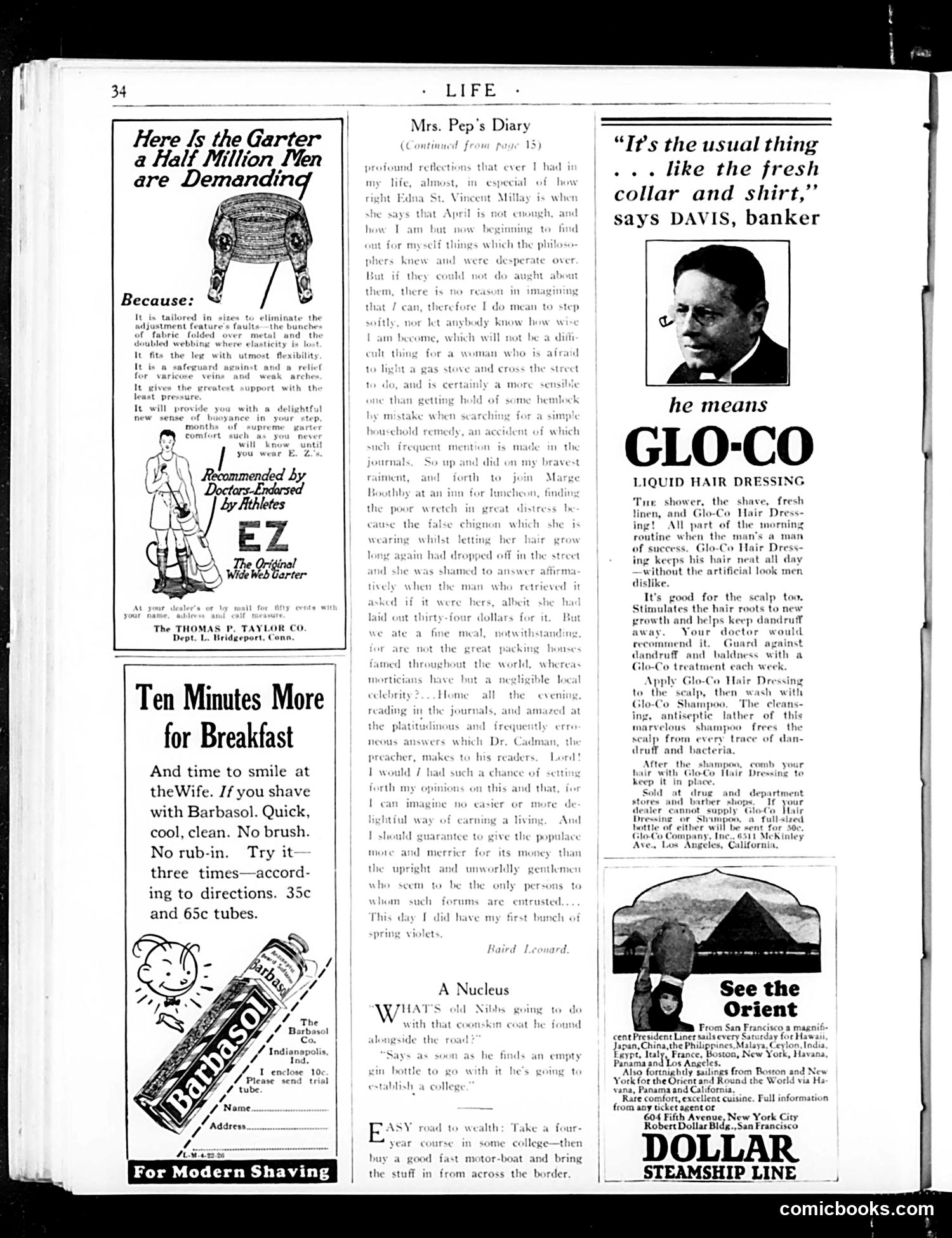
This page consists primarily of **advertisements** rather than satirical cartoons. The main content includes: 1. **E.Z. Garter ad** (top left): Promotes a garter designed to eliminate discomfort and support hose, "recommended by doctors for athletes." The humor is mild—playing on the idea that half a million men are "demanding" this mundane product. 2. **Barbasol shaving cream ad**: Advertises quick, brushless shaving with time left to "smile at the wife"—reflecting early 20th-century domestic ideals. 3. **Glo-Co Hair Dressing ad**: Features "Davis, banker" endorsing liquid hair dressing as part of a successful man's morning routine, emphasizing appearance and grooming as markers of professional success. 4. **Dollar Steamship Line ad**: Promotes luxury travel to Asia. 5. **Mrs. Pep's Diary**: A gossip column discussing social observations and romance. Rather than political satire, this reflects the **advertising-driven consumer culture** and **gender norms of the 1920s**, where product endorsements and personal grooming signified respectability and success.
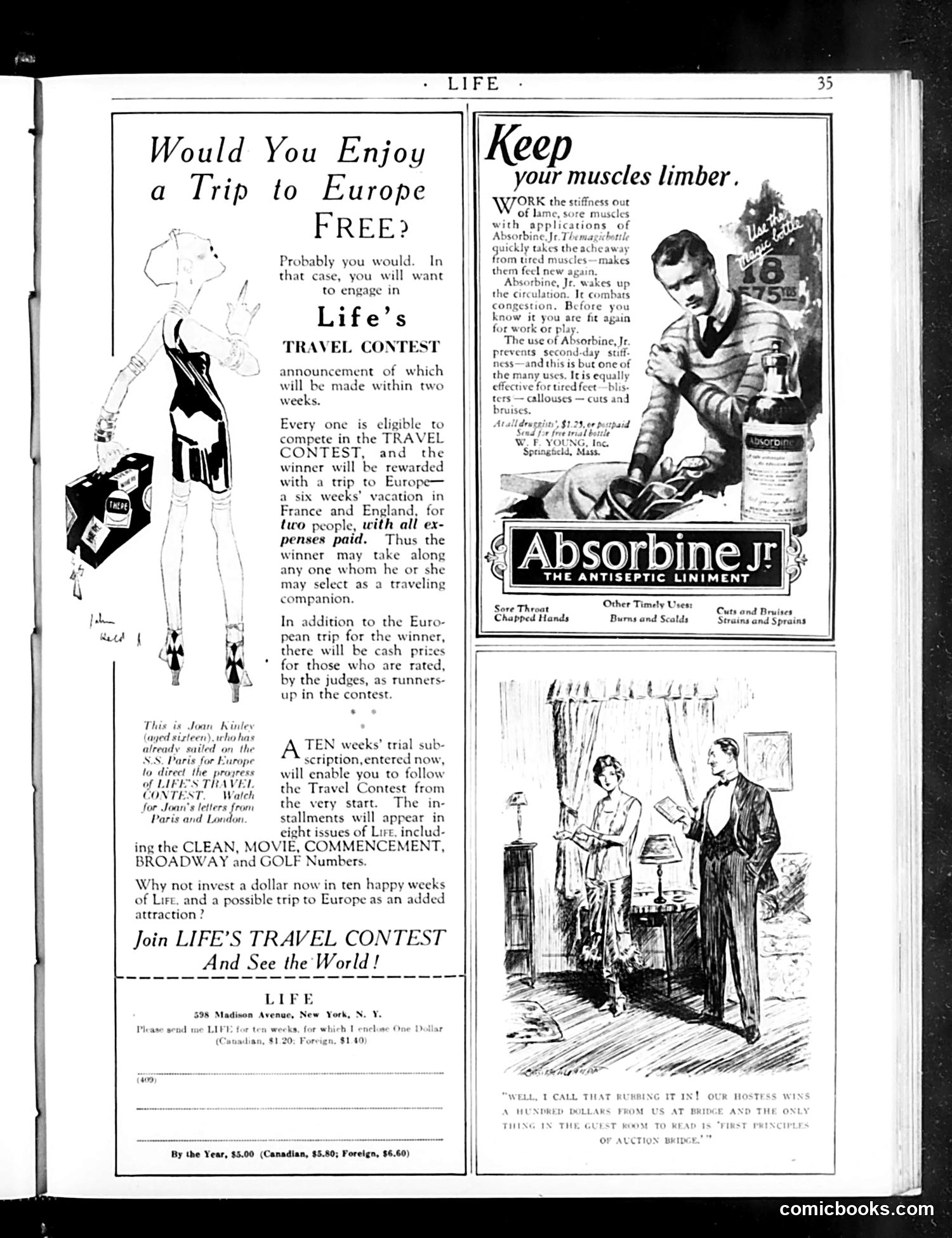
This page promotes **Life's Travel Contest**, offering readers a chance to win a free six-week European vacation for two people to France and England. The contest announcement will be made within two weeks, with cash prizes for runners-up. The left side features an illustration of a stylish woman with luggage, emphasizing the glamorous vacation prize. The right side contains an advertisement for **Absorbine Jr.**, a liniment product claiming to relieve muscle soreness and stiffness from work or exercise. It lists uses including sore throats, burns, cuts, and strains. Below the ad is a cartoon showing what appears to be a domestic scene with dialogue about "rubbing" winning money at bridge—a humorous reference to card games as a competing way to earn travel money. The page also mentions Joan Hinley, a sixteen-year-old already sailing to Europe to document the contest's progress in future Life issues.
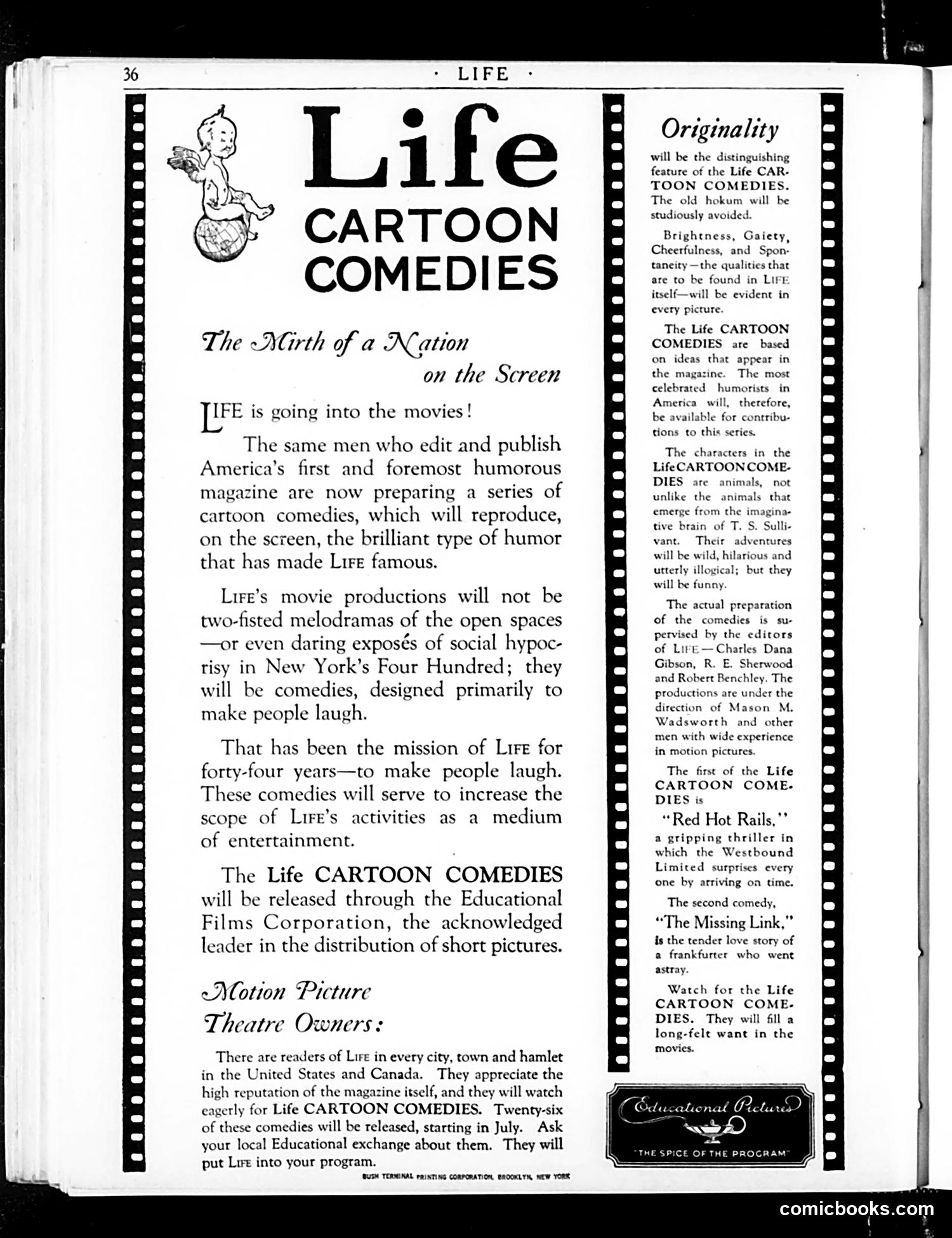
This is primarily a **trade advertisement**, not satire. Life magazine announces its expansion into motion pictures with animated comedies distributed through Educational Films Corporation. **Key points:** The page promotes that Life's editors—including famous humorist T.S. Sullivant and writer Robert Benchley—are creating cartoon shorts featuring animal characters in absurdist scenarios. Two comedies are advertised: "Red Hot Rails" (a joke about a train arriving on time) and "The Missing Link" (about a frankfurter in love). The pitch emphasizes that Life's comedies will avoid "hokum" and melodrama, instead focusing on humor that matches the magazine's 44-year reputation for making people laugh. Theater owners are encouraged to book these 26 planned shorts starting in July. This reflects the 1920s boom in animated shorts as theatrical programming, when established magazines like Life leveraged their brand and content into film production—a precursor to modern media franchising.
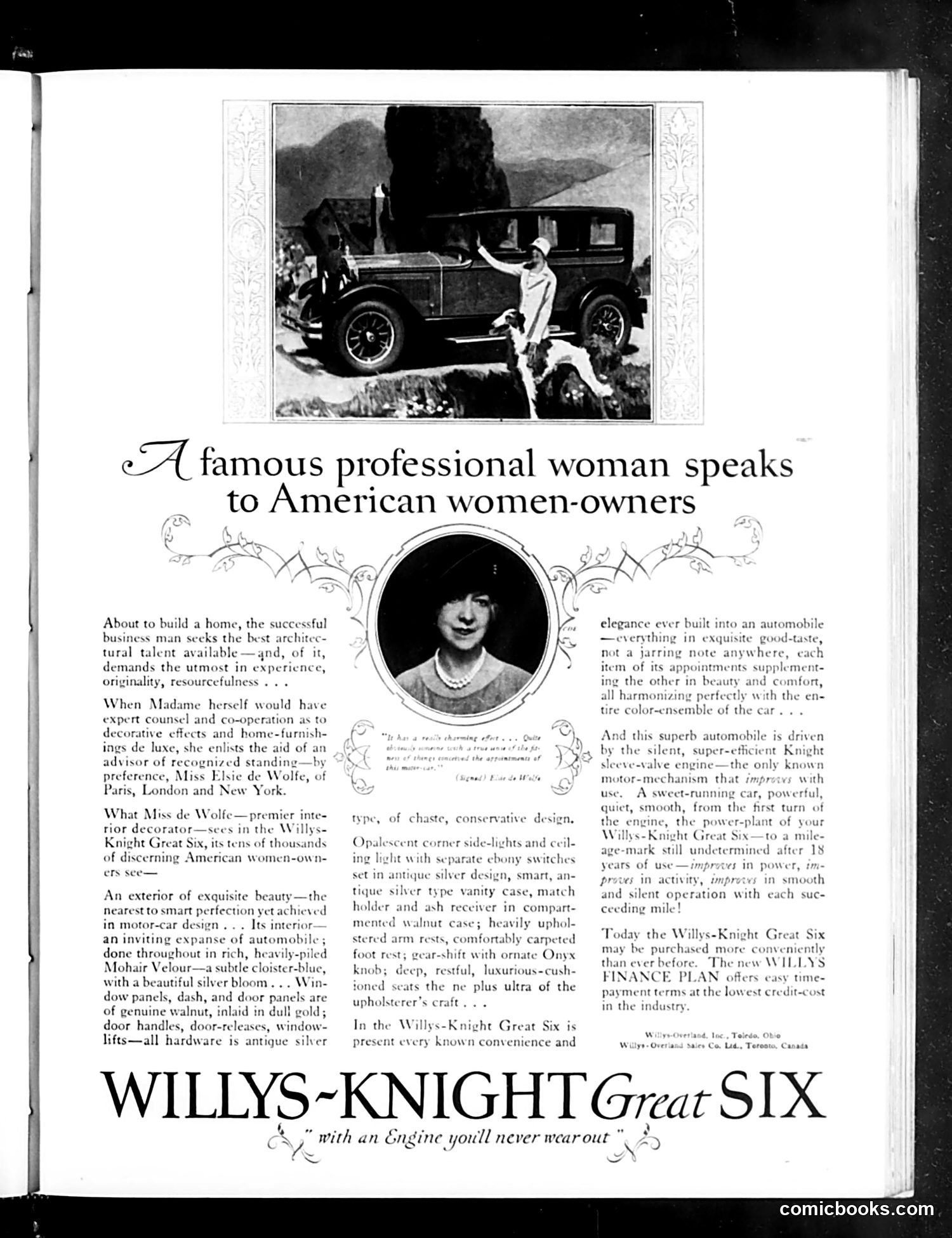
This is primarily an **automobile advertisement**, not political satire. It sells the Willys-Knight Great Six by endorsing it through **Elsie de Wolfe**, a famous real interior decorator of the era known for designing wealthy homes in Paris, London, and New York. The advertisement's strategy targets women car-owners by claiming that just as successful businessmen hire expert architects and wealthy women hire expert decorators like de Wolfe, discerning female automobile owners should recognize the car's superior design. The copy emphasizes luxurious interior details—mohair velvet, walnut inlays, antique silver hardware—positioning the vehicle as a status object comparable to fine home furnishings. The tagline "with an Engine you'll never wear out" highlights the car's mechanical reliability. This appears to be a 1920s-era advertisement capitalizing on women's growing economic independence and purchasing power, though framed through traditional notions of feminine taste and refinement.
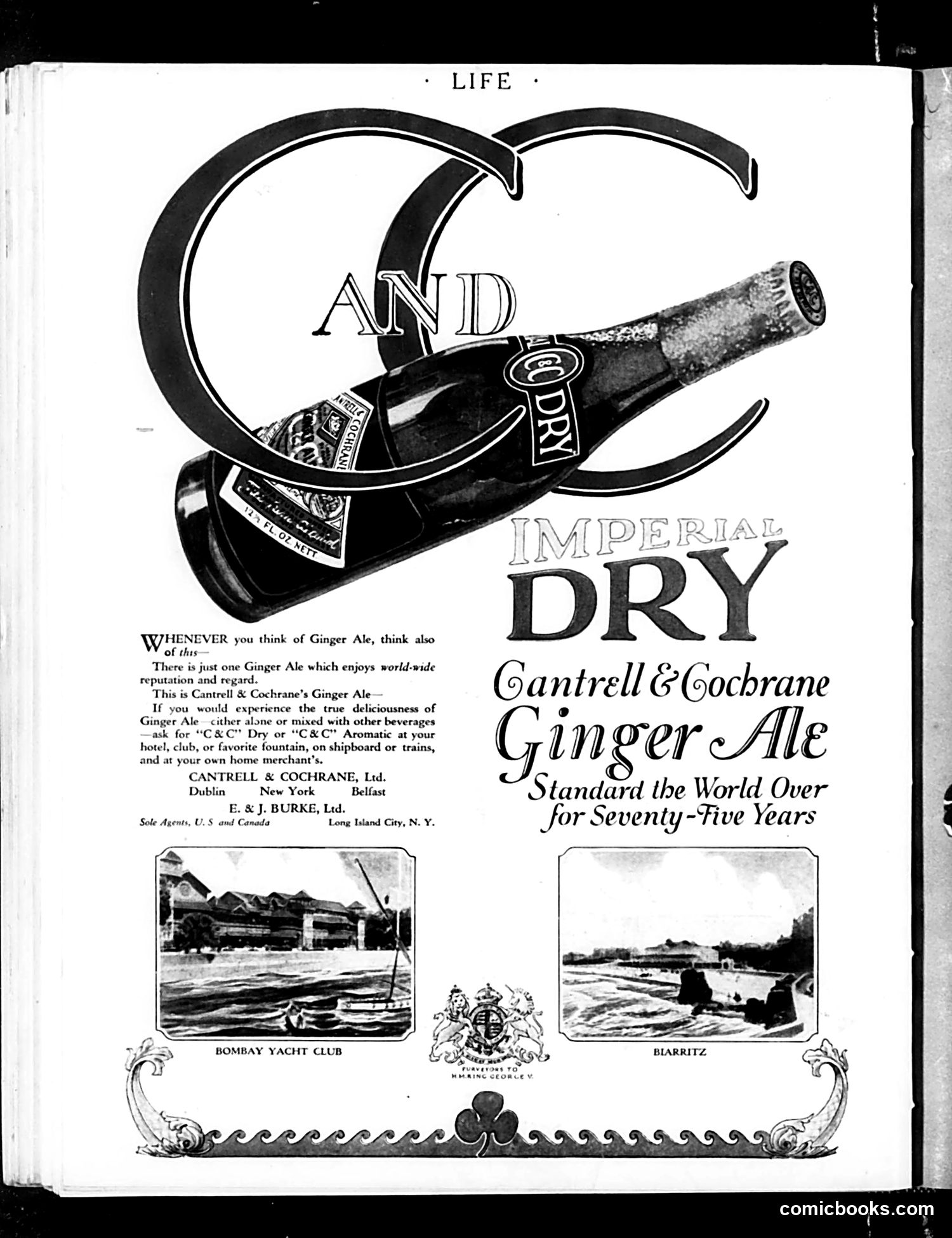
This is primarily a **product advertisement**, not political satire. It promotes Cantrell & Cochrane's Imperial Dry Ginger Ale, an Irish beverage brand. The large decorative letter "C" frames a ginger ale bottle and serves as the visual centerpiece. The text emphasizes the product's prestige and 75-year global reputation, claiming it's "Standard the World Over." The advertisement includes two photographs of upscale leisure venues—Bombay Yacht Club and Biarritz—to associate the ginger ale with affluent, cosmopolitan lifestyles. This positioning strategy suggests the drink appeals to wealthy travelers and club members. The bottom text lists distribution agents and sales locations (Dublin, New York, Belfast, Long Island City), indicating this ran in an American publication targeting an audience familiar with both Irish products and international luxury travel. There is **no political cartoon or satire** on this page—it's straightforward commercial advertising using lifestyle imagery and prestige branding.