
Life, 1926-04-22 · page 11 of 40
Life — April 22, 1926 — page 11: what you’re looking at
What you’re looking at
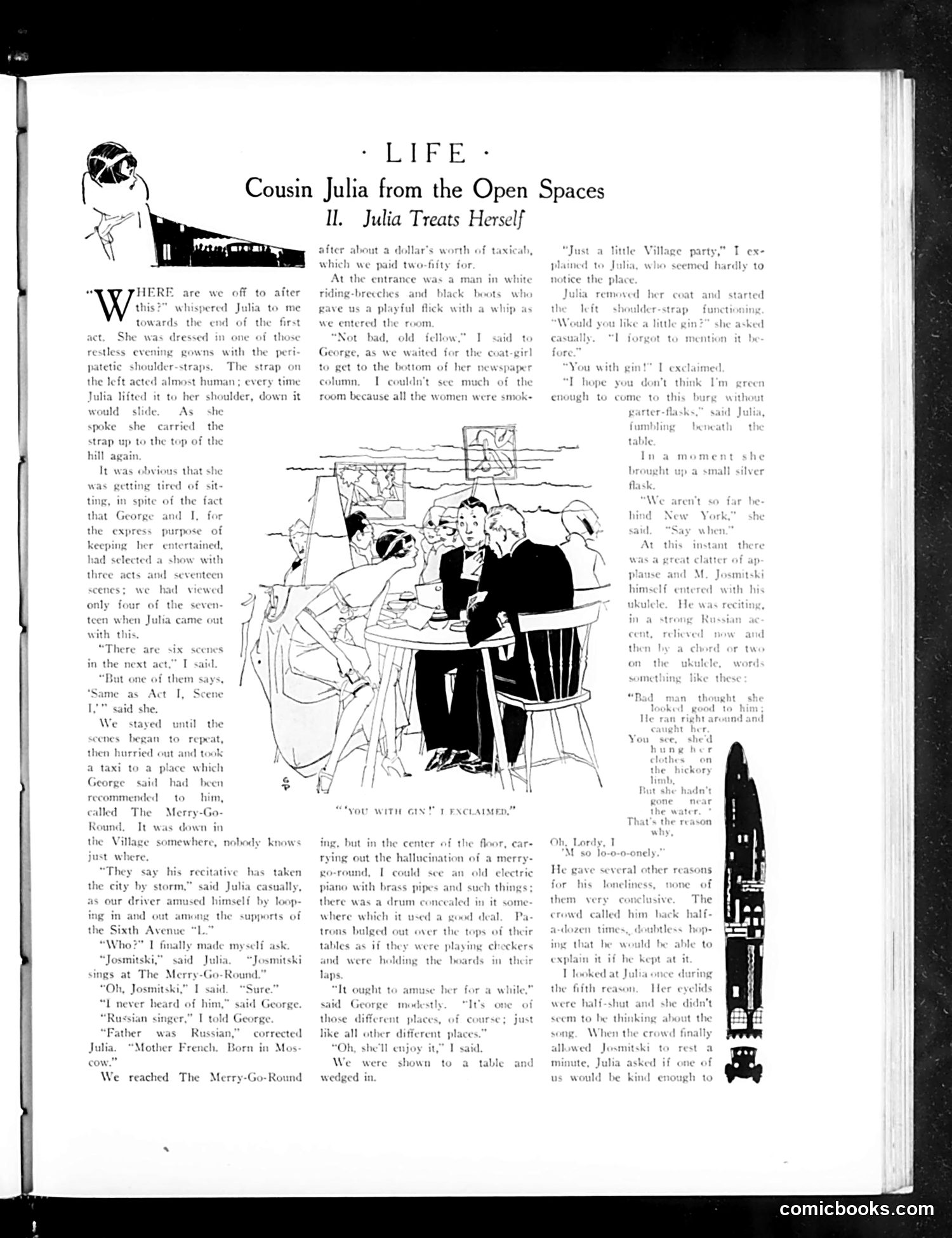
This page depicts "Cousin Julia from the Open Spaces" - a satirical character sketch about a rural woman visiting the city. The narrative describes Julia's discomfort with urban life: she's tired of sitting indoors and uncomfortable with the social scene. The central illustration shows Julia at what appears to be "The Merry-Go-Round," a nightclub or entertainment venue, where she observes peculiar urban entertainments (a Russian singer performing, electrical pianos, drum music). The satire targets the perceived artificiality and strangeness of city nightlife to unsophisticated rural visitors. The humor derives from contrasting rural simplicity with urban sophistication—Julia's bewilderment at cosmopolitan amusements was a common magazine trope of the era, reflecting early 20th-century urban-rural cultural divides.
📄 Transcribed text from this page (OCR, searchable)
Machine-transcribed from the original scan — historical spelling and the odd misread are preserved.
LIFE - Cousin Julia from the Open Spaces Il. Julia Treats Herself which we At the ent in w ce the place HERE are we off to after — riding-brecches an Julia rem d tar 1 2° whispered Julia to me gave us a playful whip 1 p we entered the r Would y a litt he a George, as we wa of her tir i pite of the fact nteen scenes; we had viewed only four of the seven | them s as Act I, Scene I’ said she, We “Same a taxi to the Village somewhere, t the hallucinatior ust where ryi said Julia casually, piano with brass pipe sed hin by there was a drum « among the supports of | where which it the Sixth Avenue “l trons bulged “Who?” I finally made m: ask tables as if the “Josmitski,” said Julia, “Josmitski and were hy The Merry-Go-Round. laps ] “Oh, Josmitski,” I said. “Sure.” “It ought to amus “L never heard of him, t places | Father was Russia | Julia. “Mother French | cow.” | We reached The Merry-Go-Round — wedged in r different comicbooks.com