
Life, 1926-04-22 · page 18 of 40
Life — April 22, 1926 — page 18: what you’re looking at
What you’re looking at
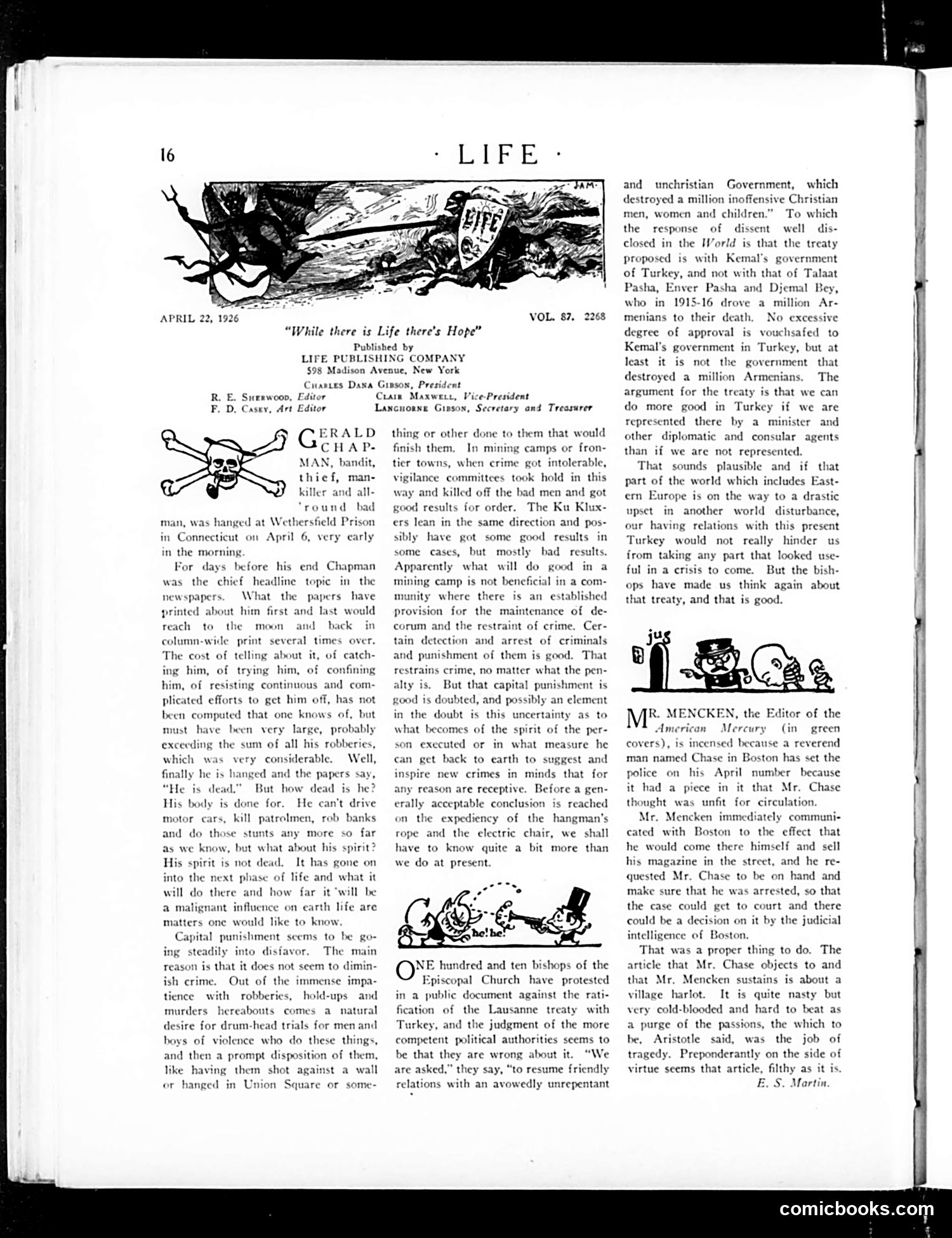
This page contains two political cartoons and editorial commentary addressing capital punishment and international diplomacy. The first cartoon depicts a hangman's noose with "LIFE" written on it, illustrating the article's title "While there is Life there's Hope." It critiques capital punishment, arguing against execution as justice. The second cartoon shows a figure labeled "Mencken" (referring to H.L. Mencken, the famous social critic and editor of *American Mercury*) confronting what appears to be a police officer or authority figure. The accompanying text discusses Mencken's arrest in Boston and satirizes police overreach. Both pieces exemplify *Life*'s satirical stance against government excess—whether judicial execution or police censorship—reflecting 1920s Progressive Era concerns about civil liberties and institutional power.
📄 Transcribed text from this page (OCR, searchable)
Machine-transcribed from the original scan — historical spelling and the odd misread are preserved.
APRIL 22, 1926 “While there is Life there's Hope” Published by LIFE PUBLISHING COMPANY $98 Madison Avenue, New York Cuastes Dana R. E. Surrwoon, Edi F. D. Casey, Art Editor | ERALD CHAP- MAN, bandit, thief, man- killer and all- ‘round bad man, was hanged at Wethersfield Prison in Connecticut 1 April 6, very early in the morning For days before his end Chapman was the chief headline topic in. the newspapers. What the papers have printed about him first and last would mand back i column-wide print several times over. reach to the om y The cost of telling about it, of catch- ing him, of trying him, of confining him, of resisting continuous and com- plicated efforts to get him off, has not been computed that one knows of, but must have been very large, probably exceeding the sum of all his robberies, which was very considerable, Well, finally he is hanged and the papers say, “He is dead.” But how dead is he? His body is done for. He can't drive motor cars, kill patrolmen, rob banks and do those stunts as we know, but what about his spirit? ny more so far His spirit is not dead, It has gone on into will do there and how far it ‘will be a malignant influence on earth life are know ne next phase of life and what it matters one would like t pital punishment seems to be go- ing steadily into disfavor. The main is that it does not seem to dimin- ish crime. Out of the imme tience with robberies, hold-ups and se impa- murders hereabouts comes a natural desire for drum-head trials for men and hoys of violence who do these thing mpt disposition of them, like having them shot ag and then a pr pst a ow or hanged in Union Square or some- itor Crate Maxwett, Vice-President Lancuoane Gisson, Secretary and Treasurer thing or other done to them that would finish them, In mini tier towns, when crime got intolerable, mps or fron- vigilance committees took hold in this way and killed off the bad men and got good results for order. The Ku Klux- ers lean in the same direction and pos- sibly have got some good results in some cases, but mostly bad results. Apparently what will do good in a mining camp is not beneficial in a com- munity where there is an established provision for the maintenance of de: corum and the restraint of crime. Cer- tain detection and arrest of criminals and punishment of them is good. That restrains crime, no matter what the pen- alty is. good is doubted, and possibly an element in the doubt is this uncertainty as to But that capital punishment is what becomes of the spirit of the per- son executed or in what measure he can get back to earth to suggest and inspire new crimes in minds that for any reason are receptive. Before a gen- erally acceptable conclusion is reached on the expediency of the hangman's rope and the electric chair, we shall have to know quite a bit more than we do at present NE hundred and ten bishops of the Episcopal Church have protested in a public document against the rati- fication of the Lausanne treaty with Turkey, and the judgment of the more competent political authorities seems to be that they are wrong about it. “We , “to resume friendly relations with an avowedly unrepentant are asked,” they sa: and unchristian Government, which destroyed a million inoffensive Christian men, women and children.” To which the response of dissent well dis- closed in the World is that the treaty proposed is with Kemal's government of Turkey, and not with that of Talaat Pasha, Enver Pasha and Djemal Bey, who in 1915-16 drove a million menians to their death. degree of approval is vouchsafed to Kemal’s government in Turkey, but at Ieast it is not the government that destroyed a million Armenians. The argument for the treaty is that we can do more good in Turkey if we are represented there by a minister and other diplomatic re No excessive and consular agents than if we are not represented. That sounds plausible and if that part of the world which includes East- ern Europe is on the way to a drastic upset in another world disturbance, our having relations with this present Turkey would not really hinder us from taking any part that looked use- ful in a crisis to come. But the bish- ops have made us think again about that treaty, and that is good. R. MENCK n Me covers), is incensed because a reverend man named Chase in Boston has set the police on his April number because it had a piece in it that Mr. Chase th , the Editor of the Ameri ury (in green ught was unfit for circulatio Mr. Mencken immediately communi- cated with Boston to the effect that he would come there himself and sell his magazine in the street, and he re- quested Mr. Chase to be on hand and make sure that he was arrested, so that the case could get to court and there could be a decision on it by the judicial intelligence of Boston. That was a proper thing to do. The article that Mr. Chase objects to and that Mr. Mencken sustains is about a village harlot. It is quite nasty but very cold-blooded and hard to beat as a purge of the passions, the which to be, Aristotle said, was the job of tragedy. Preponderantly on the side of virtue seems that article, filthy as it is E. S. Martin comicbooks.com