
Life, 1926-04-22 · page 26 of 40
Life — April 22, 1926 — page 26: what you’re looking at
What you’re looking at
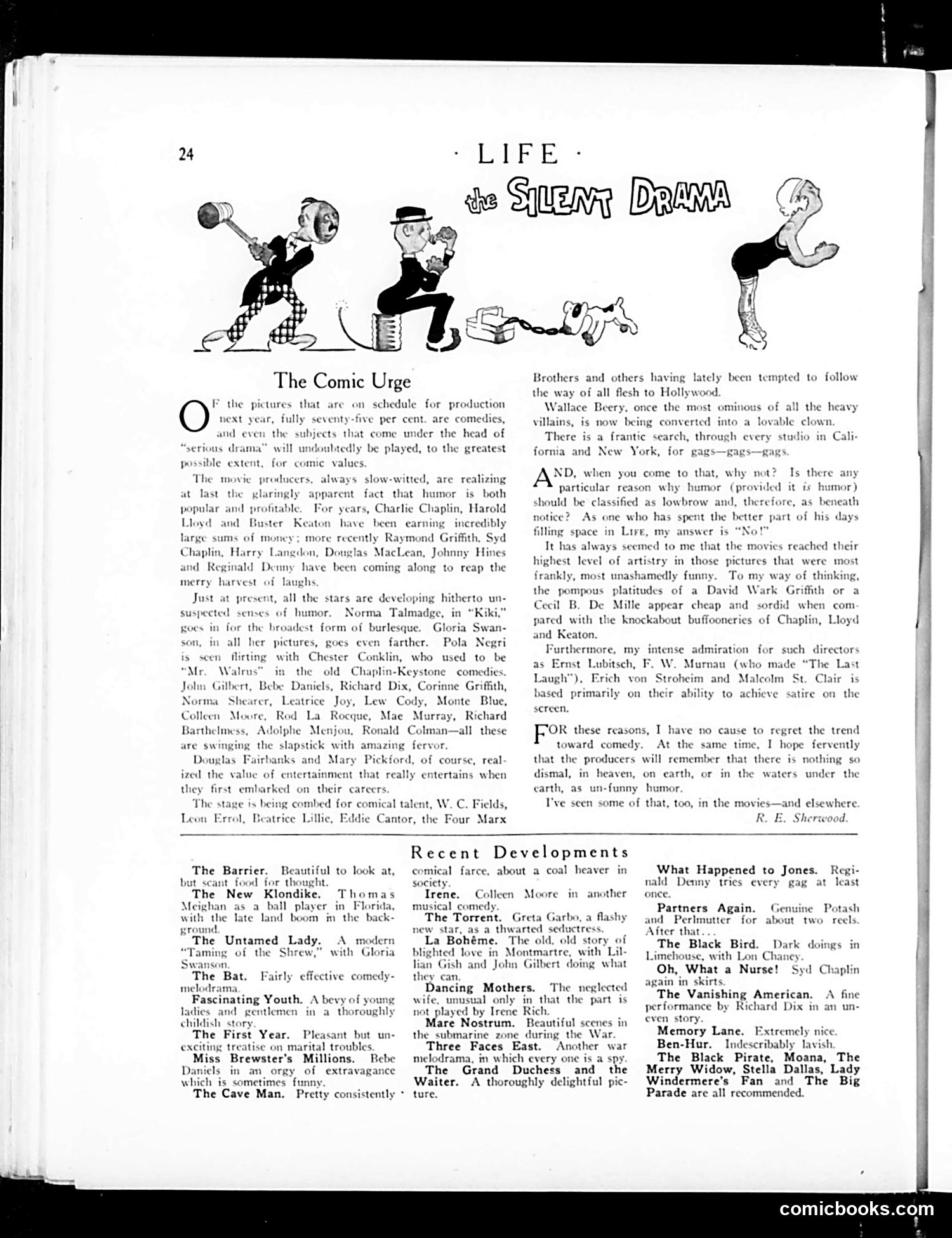
This page discusses Hollywood's shift toward comedy films. The author (R. E. Sherwood) argues that while 75% of upcoming productions are comedies, this trend is justified and valuable. The piece celebrates comic stars—Chaplin, Lloyd, Buster Keaton, and newer talent like Norma Talmadge and Gloria Swanson—who've proven comedy is both popular and profitable. However, Sherwood defends comedy against snobbish criticism that classifies humor as "lowbrow." He argues the best silent films achieved their highest artistry through comedy, praising directors like Lubitsch and Stroheim for sophisticated satire. The cartoon header depicts classic silent-film physical comedy: slapstick performers with exaggerated poses and props (bowling ball, accordion, money). Sherwood's main point: comedy deserves respect as serious cinema, not dismissal as lowbrow entertainment. The "Recent Developments" section briefly reviews new film releases.
📄 Transcribed text from this page (OCR, searchable)
Machine-transcribed from the original scan — historical spelling and the odd misread are preserved.
The Comic Urge F the pictures that are on schedule for production O next year, fully seventy-five per cent. are comedies, and even the subjects that come under the head of ma” will w “serious ubtedly be played, to the greatest nic values. He extent, for cx The movie aly aut last the popular and pro’ For years, Charlie Chaplin, Harold ays slow-witted, are realizing nt fact that humor is both Lloyd and Buster have been earning incredibly large sums of money; more recently Raymond Griffith, m, Douglas MacLean, Johnny H and Reginald Denny have been coming Syd Chaplin, Harry Lar es ng to reap the merry harvest of laughs. Just vected senses of humor, Norma Talmadge esent, all the stars are developing hitherto un- dest form of burlesque. Gloria Swan- farther. Pola N with Chester Conklin, who used to be “Mr. Walrus” in the old Chaplin-Keystone comedies John ¢ 1 Dix, Corinne Griff Norma Shearer, Leatrice Joy, Lew Cody, Monte Colleen Moore 1 La Roce Barthelmess, Adolphe goes in for the | son, in all her pictures, is seen flir . Bebe Daniels, Richar Mae Murray, Ri Menjou, Ronald Colman—all these are swinging the slapstick with ar Douglas Fairbanks and Mary Pic ized the value of entertainment that really entertains when they first er The stage is being combed for comical talent, W. zing fervor. ford, of course, real arked their careers. C. Fields, Brothers and others having lately been tempted to follow of all flesh to Hollywood. the most omin, villains, is now bei averted into at There is a frant . throug fornia and New York, for ga A should be 2? As one who has spent the the w Wall. Beery, ¢ of all the heavy able clown. in Cali seare h every stud: ags—Rags. D, when you come to that, why not? Is there any particular reason why humor (provid jassified as lowbrow and, th tter part of his days ¢ in Lire, my answer is Cy It has always seemed to me that the movies reached their highest level of ar istry in those pictures that were most To my way of thinking, wid Wark Griffith or a and sordid when com. neries of Chaplin, Lloyd frankly, most unashamedly funt the pompous platitudes of a I Cecil B. De Mille appear ch pared with the knockabout buf and Keaton. Furthermore, my intense ad: as Ernst Lubitsch, F, W. M L: iration for such directors 1 (who made “The Last h"), Erich von Stroheim and Malcolm St. Clair is ed primarily on their ability to achieve satire on the screen, ‘OR these reasons, I have no cause to regret the trend toward comedy, At the same time, I hope fervently that the producers will remember that there is nothing so dismal, in heaven, on earth, or in the waters under the carth, as un-funny humor I've seen some of that, too, in the movies—and elsewhere Leon Errol, Beatrice Lillie, Eddie Cantor, the Four Marx R. E. Sherwood. Recent Developments The Barrier. Beautiful to look at, comical farce, about a coal heaver in | What Happened to Jones. Regi- but scant food for nt. society nald Denny tries every gag at least The New Klondike. Thomas Irene. Colleen Moore in another nce. Meighan as a ball player in Florida, musical comedy : Partners Again. Genuine Potash with the late land boom m the back- The Torrent. Greta Garbo, a flashy and Perlmuttee for about two. reels ground, new star, as a thwarted seductress. A ftec: that The Untamed Lady. “Taming of the Shrew A_ moderr La Bohéme. The old, old story of ‘The Black Bird. Dark d with Gloria blighted love in Montmartre, with Lil- Zs in Limehouse, with Lon Chaney Swanson lian Gish and John Gilbert doing what , ss The Bat. Fairly effective comedy- they can OF LW hata) Nurselr’ Syd! Chaplin melodrama Dancing Mothers. The neglected “3 Fascinating Youth. A bevy of wife, unusual only in that the part is ladies and gentlemen in a thoroughly — not played by Irene Rich The Vanishing American. A fine performance by Richard Dix in an un- childish story Mare Nostrum. Beautiful scenes in ¢¥en story . . The First Year. Pleasant but un- the submarine zone during the War. Memory Lane. Extremely nice exciting treatise on marital troubles. Three Faces East. Another war Ben-Hur. Indescribably lavish. Mi Dar Brewster's Millions. Bebe melodrama, in which every one is a spy. The Black Pirate, Moana, The Is in an. orgy of extravagance The Grand Duchess and the Merry Widow, Stella Dallas, Lady which is sometimes funny. Waiter. A thoroughly delightful pice Windermere’s Fan and The Big The Cave Man. Pretty consistently * ture. Parade are all recommended. comicbooks.com