
A complete issue · 36 pages · 1924
Life — October 30, 1924
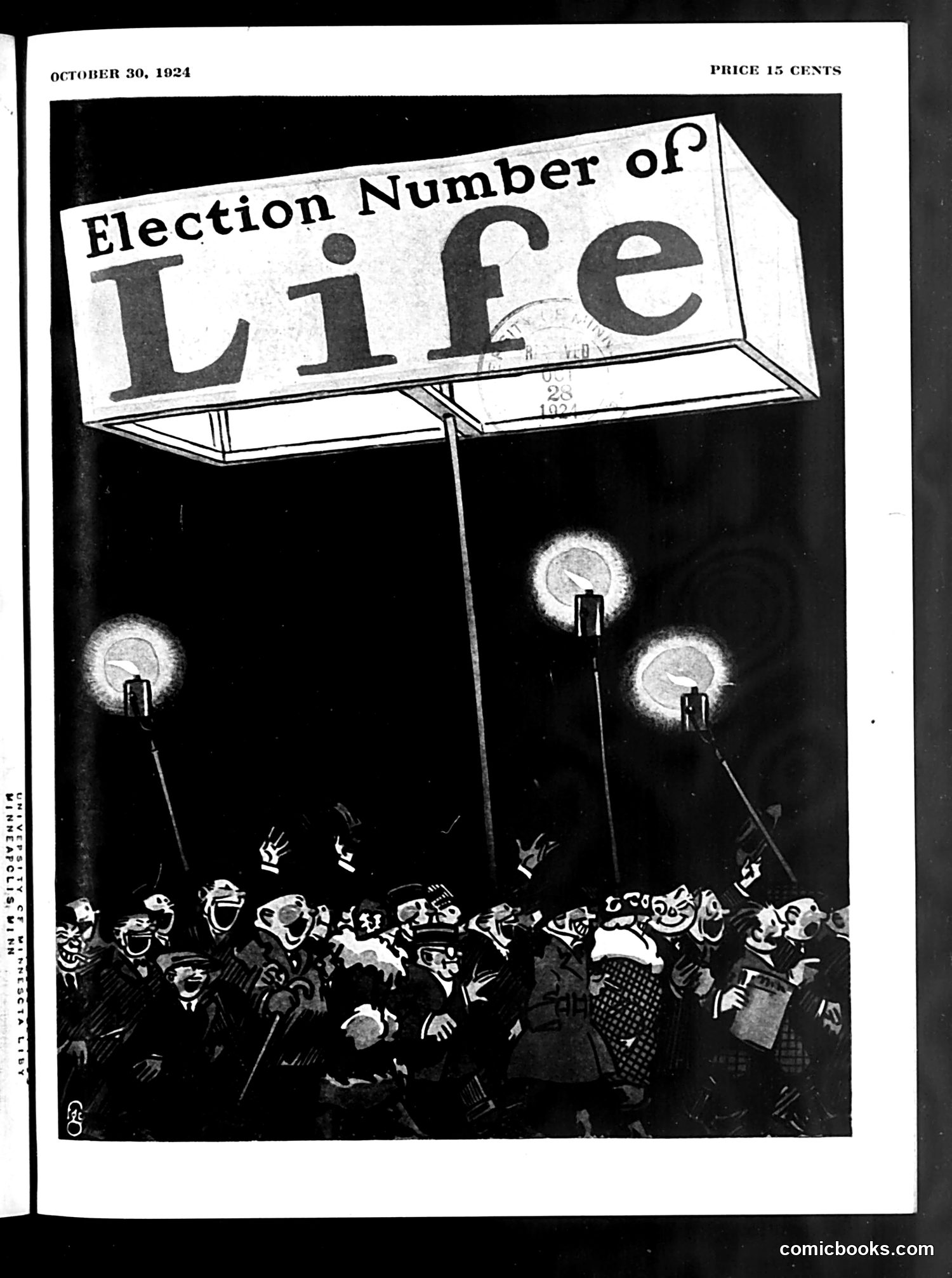
This is the cover of Life magazine's special "Election Number" issue, published just days before the 1924 U.S. presidential election. The cartoon depicts a massive crowd of voters gathered beneath a large sign reading "Election Number of Life," illuminated by three bright lights above them. The masses appear animated and engaged, rendered in caricatured style typical of the era's satirical art. The image conveys the intensity and widespread public attention surrounding the election. The dramatic lighting and crowd composition emphasize the democratic process as a major civic spectacle. Without additional context visible on this page, the specific candidates or issues being satirized remain unclear, though the visual emphasis on mass participation suggests commentary on the election's significance to American voters.
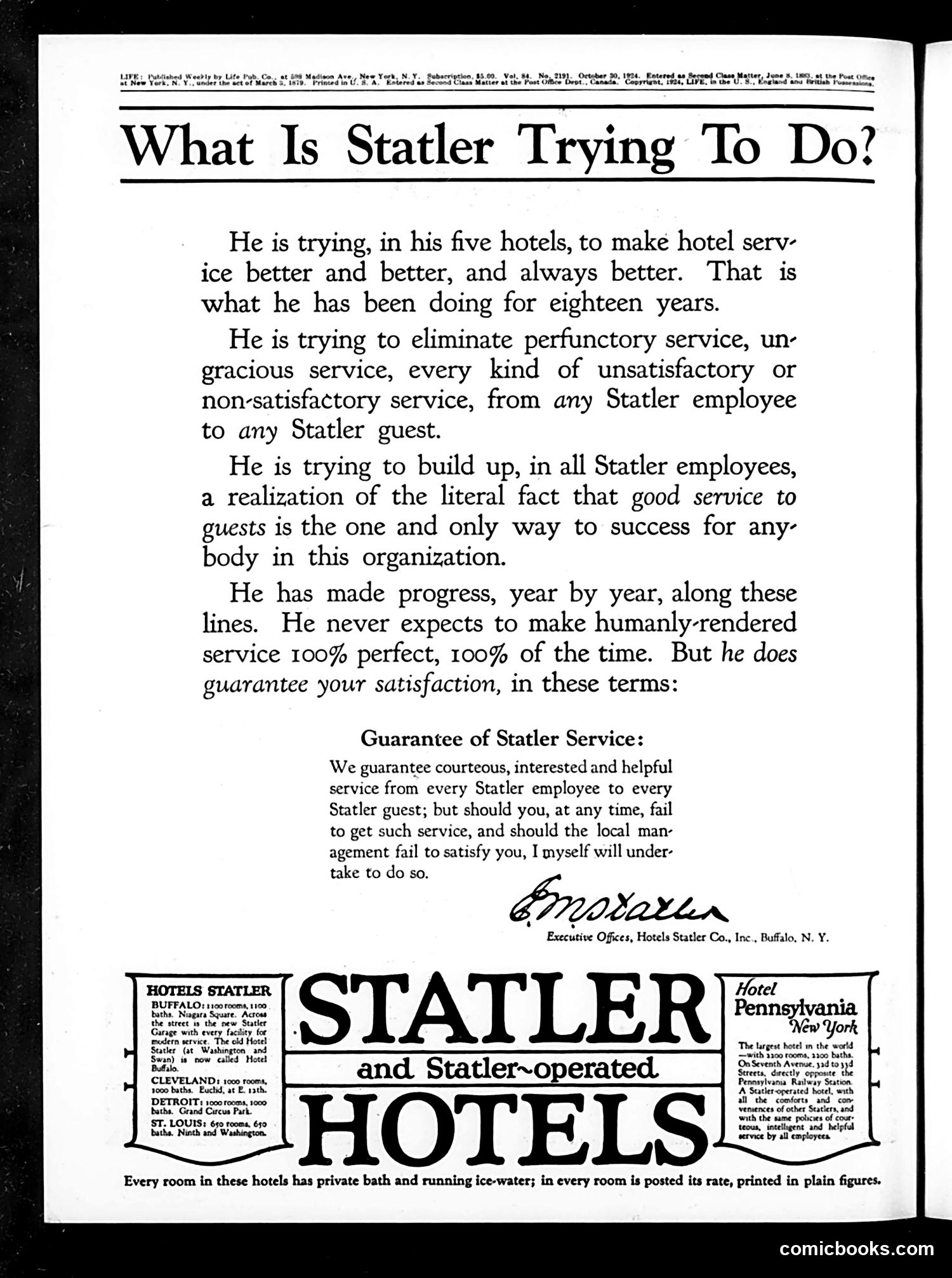
This page is **primarily an advertisement**, not satire or political commentary. It's a paid promotion for Statler Hotels (a major American hotel chain) from 1924. The headline "What Is Statler Trying To Do?" is rhetorical advertising copy explaining the company's service philosophy. E.M. Statler (founder) uses the piece to outline his business model: eliminating poor service and training employees to prioritize guest satisfaction. The "Guarantee of Statler Service" is a corporate promise printed over Statler's signature, emphasizing personal accountability for customer experience. The bottom section lists various Statler hotel locations (Buffalo, Detroit, St. Louis, New York) and highlights amenities like private baths and posted room rates—standard luxury hotel marketing for the era. This is **brand-building advertising**, not editorial satire.
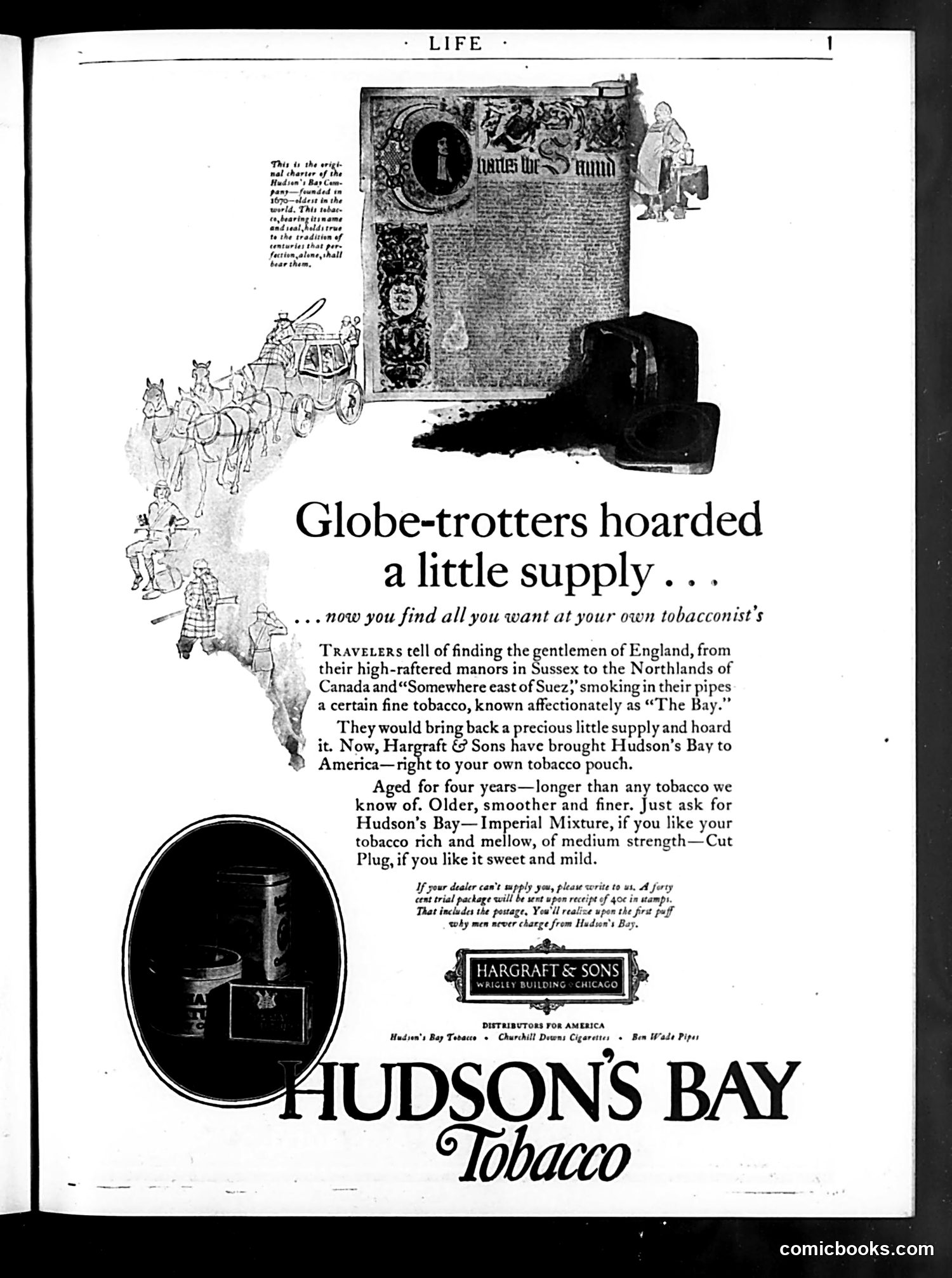
This is primarily a **product advertisement** for Hudson's Bay tobacco by Hargraff & Sons (Chicago distributor), not political satire. The page uses romantic imagery of **globe-trotting adventurers and explorers** to market tobacco. The illustrated vignette shows gentlemen from English manors traveling internationally—to Canada's Northlands and "somewhere east of Suez"—smoking "The Bay," a supposedly rare, hoarded tobacco. The ad claims the product is **aged four years** and superior to competitors. It appeals to masculinity and worldliness: the ideal customer is a well-traveled gentleman who appreciates fine tobacco. The ornate historical document at top appears decorative, reinforcing the product's association with tradition and prestige rather than conveying specific historical reference.
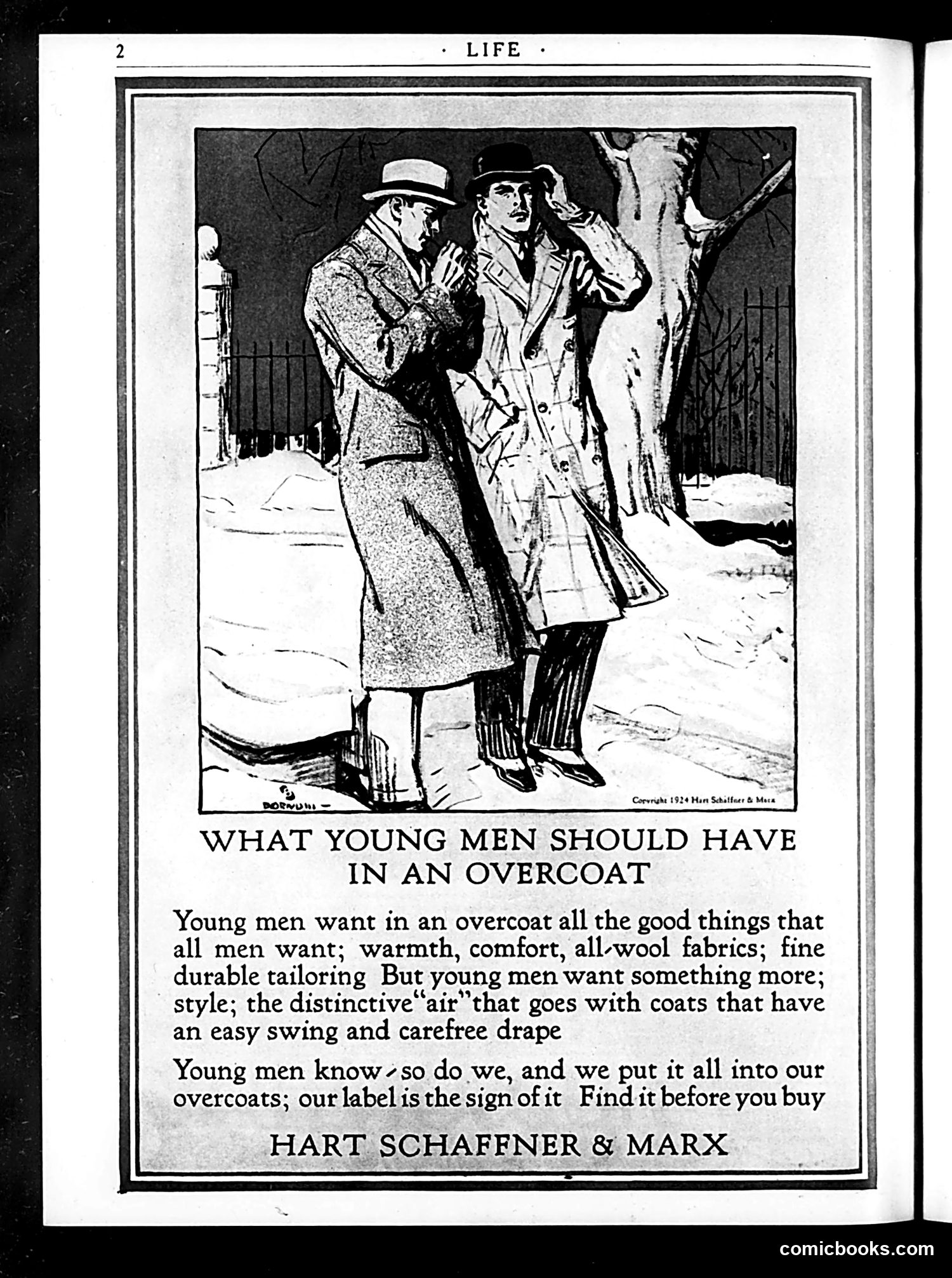
This is not a political cartoon but rather a **1924 fashion advertisement** for Hart Schaffner & Marx overcoats, published in *Life* magazine (which was then a satirical/humor publication that carried advertisements). The image shows two young men in winter clothing examining an overcoat outdoors in snowy conditions. The ad copy emphasizes that young men want overcoats combining practical benefits (warmth, comfort, wool fabric, tailoring) with style—specifically "the distinctive 'air' that goes with coats that have an easy swing and carefree drape." The humor is implicit rather than satirical: it plays on young men's desire to appear fashionable and stylish while staying warm. The ad promises Hart Schaffner & Marx delivers both function and fashion, positioning their label as the marker of quality. This reflects 1920s consumer culture and targeted marketing to young male fashion consciousness.
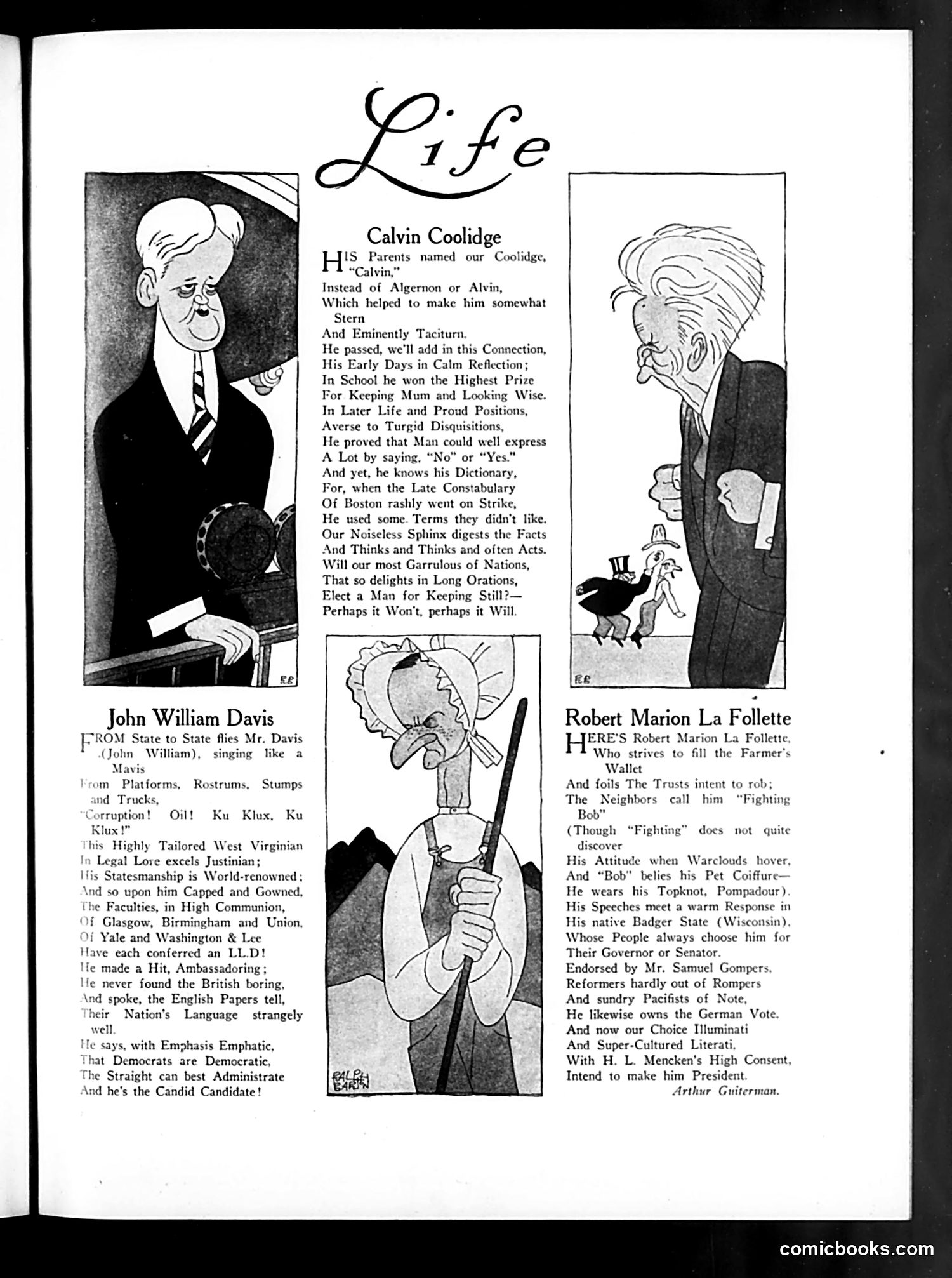
This *Life* magazine page satirizes three political figures from the 1920 presidential election era: **Calvin Coolidge** (top left): Mocked for his taciturn nature—the text jokes he could express complex ideas simply by saying "No" or "Yes," referencing his reputation for extreme quietness. **John William Davis** (bottom left): A Democratic politician depicted as constantly campaigning across states, criticized for association with corruption and the Ku Klux Klan ("Ku Klux"). **Robert Marion La Follette** (top right): A Progressive/reformer shown as a farmer-advocate fighting trusts, endorsed by Samuel Gompers (labor leader). The caricatures exaggerate their distinctive physical features typical of period political cartooning. The satire targets each figure's perceived weaknesses or public personas during this competitive election cycle.
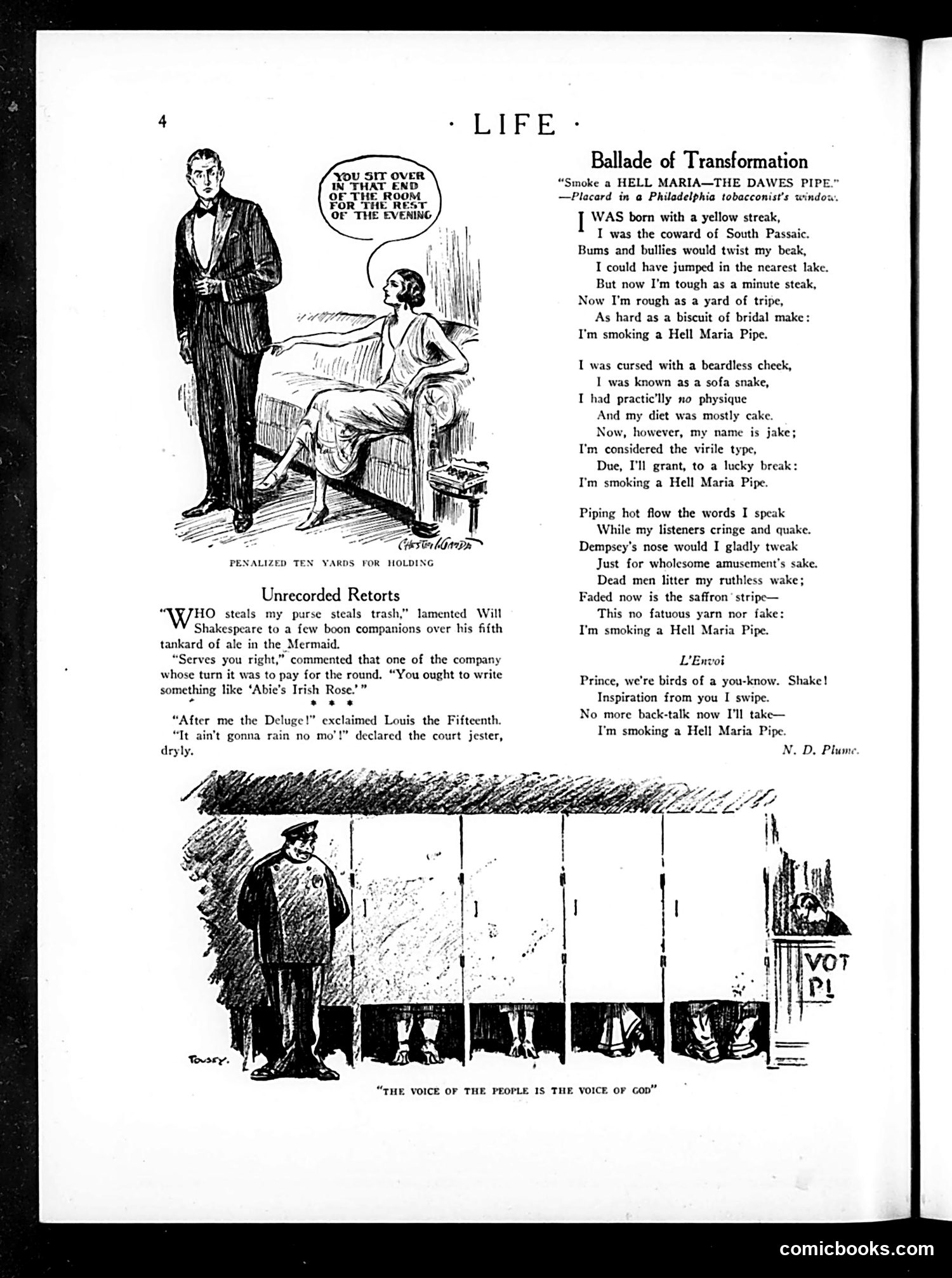
The page contains three distinct satirical items: **"Penalized Ten Yards for Holding"** (top cartoon): A man and woman on a bed; the man says he sat over her to rest, implying physical intimacy. The caption suggests legal/social penalties for improper conduct, likely commentary on evolving morality standards. **"Unrecorded Retorts"**: Brief humorous anecdotes about witty comebacks, including a Shakespeare reference and a joke about King Louis XV allegedly denying rain—political humor about authority figures. **"The Voice of the People is the Voice of God"** (bottom): Shows a figure at voting booths with multiple compartments displaying different activities/vices below. This satirizes the gap between democratic ideals and actual voter behavior, suggesting the public's voice reflects corruption rather than virtue. The "VOT" sign (partially visible) confirms voting as the target.
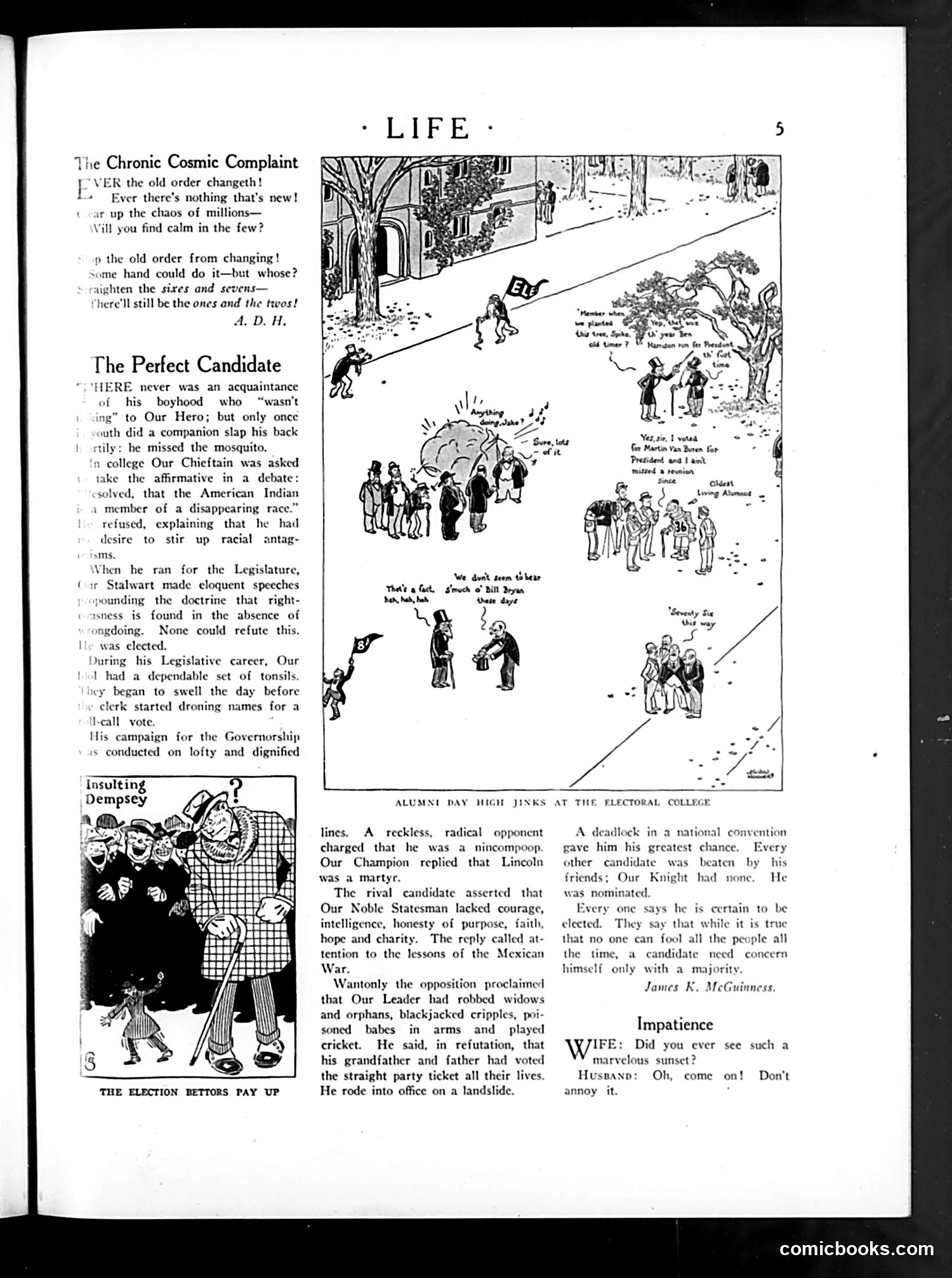
This satirical cartoon depicts a chaotic political gathering where various figures—appearing to represent political candidates and their supporters—engage in rowdy behavior at what's labeled as the Electoral College. The accompanying text describes "The Perfect Candidate," a political figure whose campaign is satirized: he avoided taking stances, missed opportunities to distinguish himself, and ultimately failed at every political endeavor from debates to legislative races, relying instead on a "landslide" victory fueled by underhanded tactics. The cartoon ridicules both political candidates who lack substance and the electoral process itself, suggesting that success comes through manipulation rather than merit. The chaotic scene emphasizes corruption in American politics and the disconnect between noble democratic ideals and messy electoral realities.
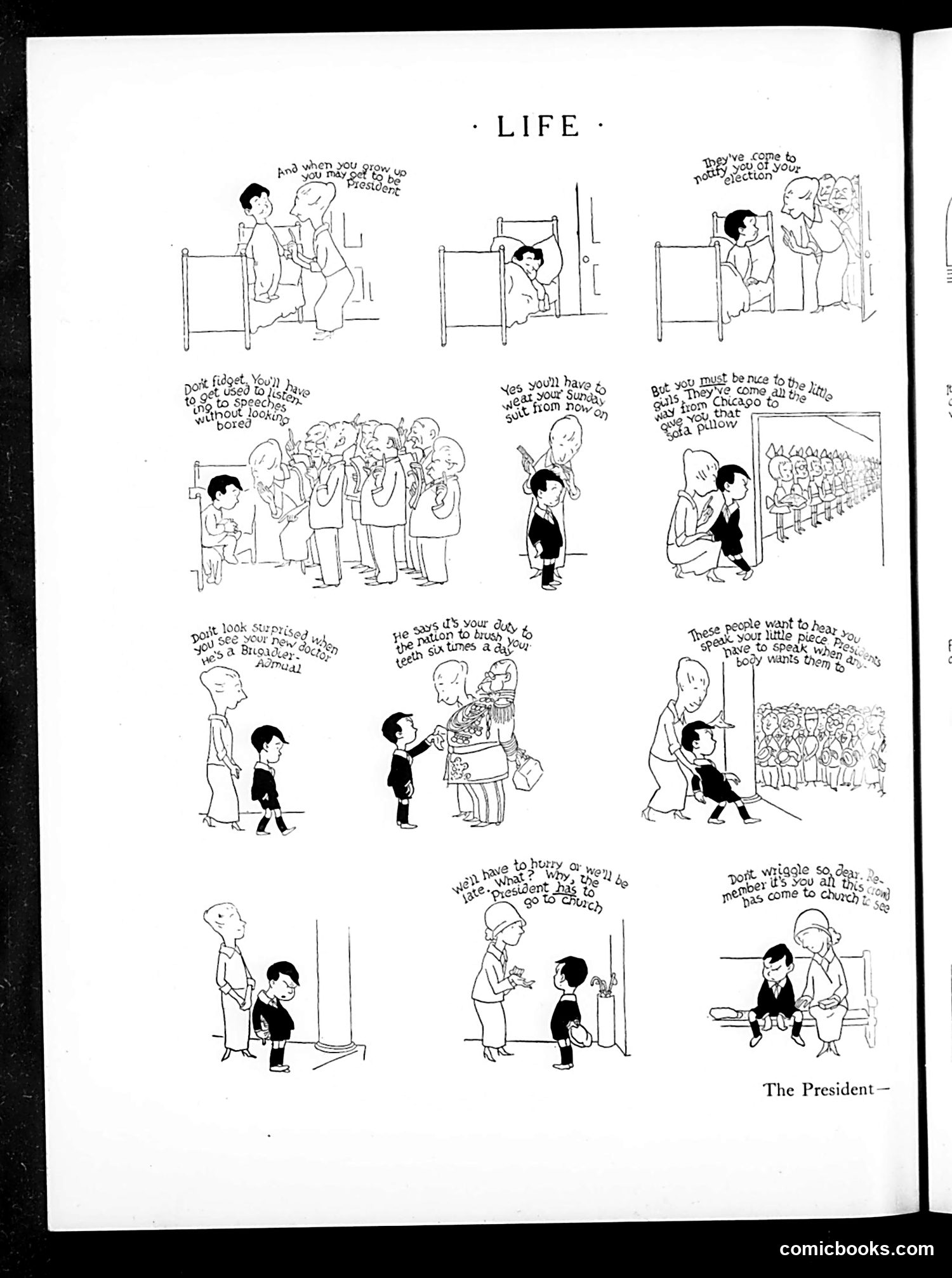
This satirical comic strip titled "LIFE" follows a small boy from childhood through adulthood, documenting how adults progressively impose societal expectations upon him. The sequence shows: - Parents telling him to behave properly and attend speeches - Being dressed in formal Sunday clothes - Forced to attend church and participate in public events - Being paraded before crowds who want to hear him speak - Eventually becoming "The President" The satire suggests that American social institutions—family, church, civic duty, and politics—systematically mold children into compliant citizens and future leaders. The boy's transformation from free child to formal "President" implies that success in American society requires surrendering individuality to institutional demands and public expectations. The cartoon critiques how conformity is culturally enforced from childhood onward.
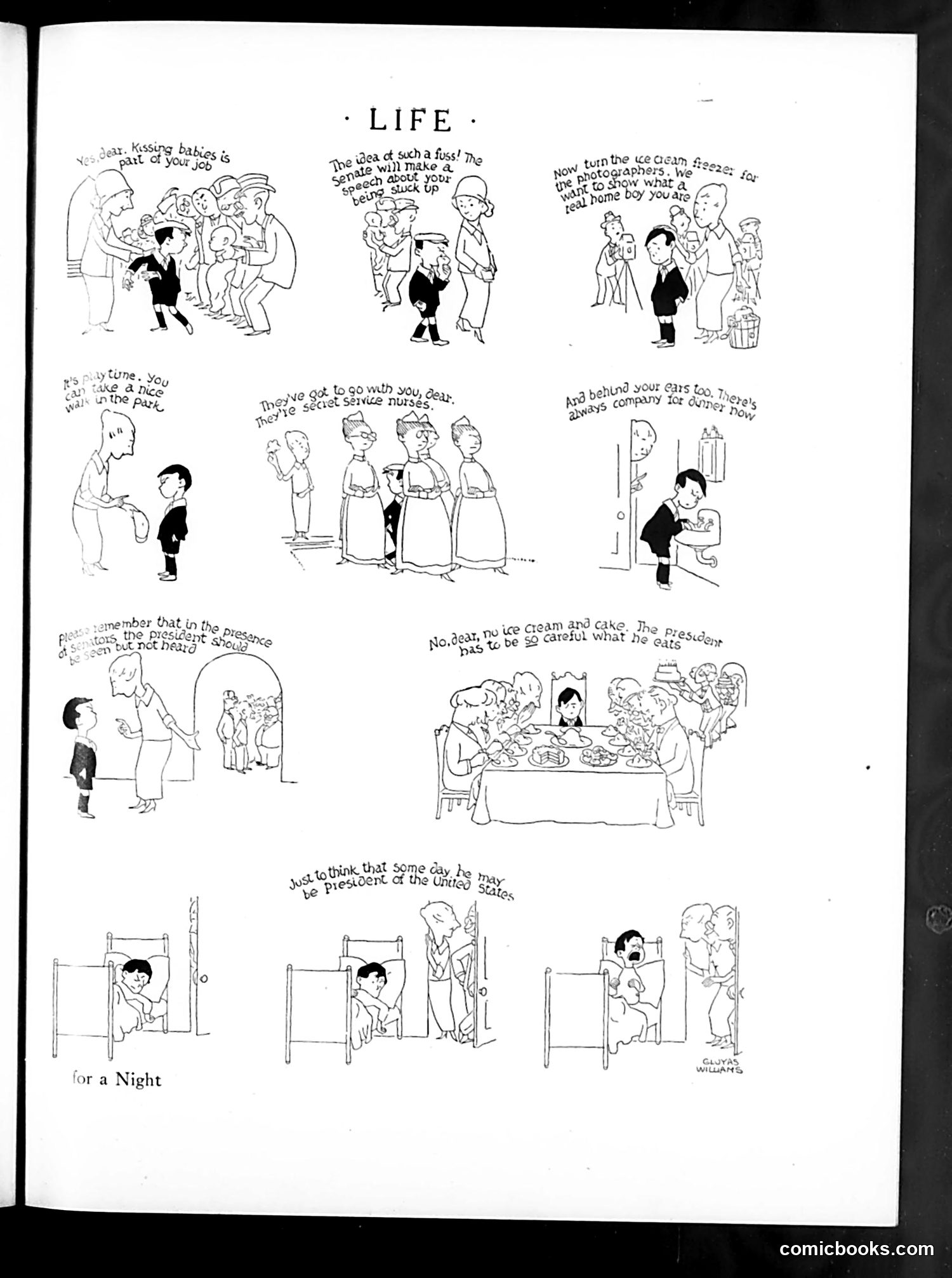
This satirical comic strip follows a young boy through various life stages, each panel showing adults telling him what his future holds. The sequence humorously depicts societal expectations: 1. Parents kissing babies is "part of sex" 2. He'll experience romance and heartbreak 3. He'll be photographed constantly 4. He needs "a place in the park" (domestic space) 5. Nurses will care for him (suggesting medical dependence in old age) 6. The President must carefully watch his diet 7. Finally, he imagines becoming President himself The final panels show him in a crib at night, the joke being that despite all these grand aspirations about becoming President, he'll ultimately end up like everyone else—confined and dependent. It's a sardonic commentary on how childhood dreams clash with the mundane reality of adult life and mortality.
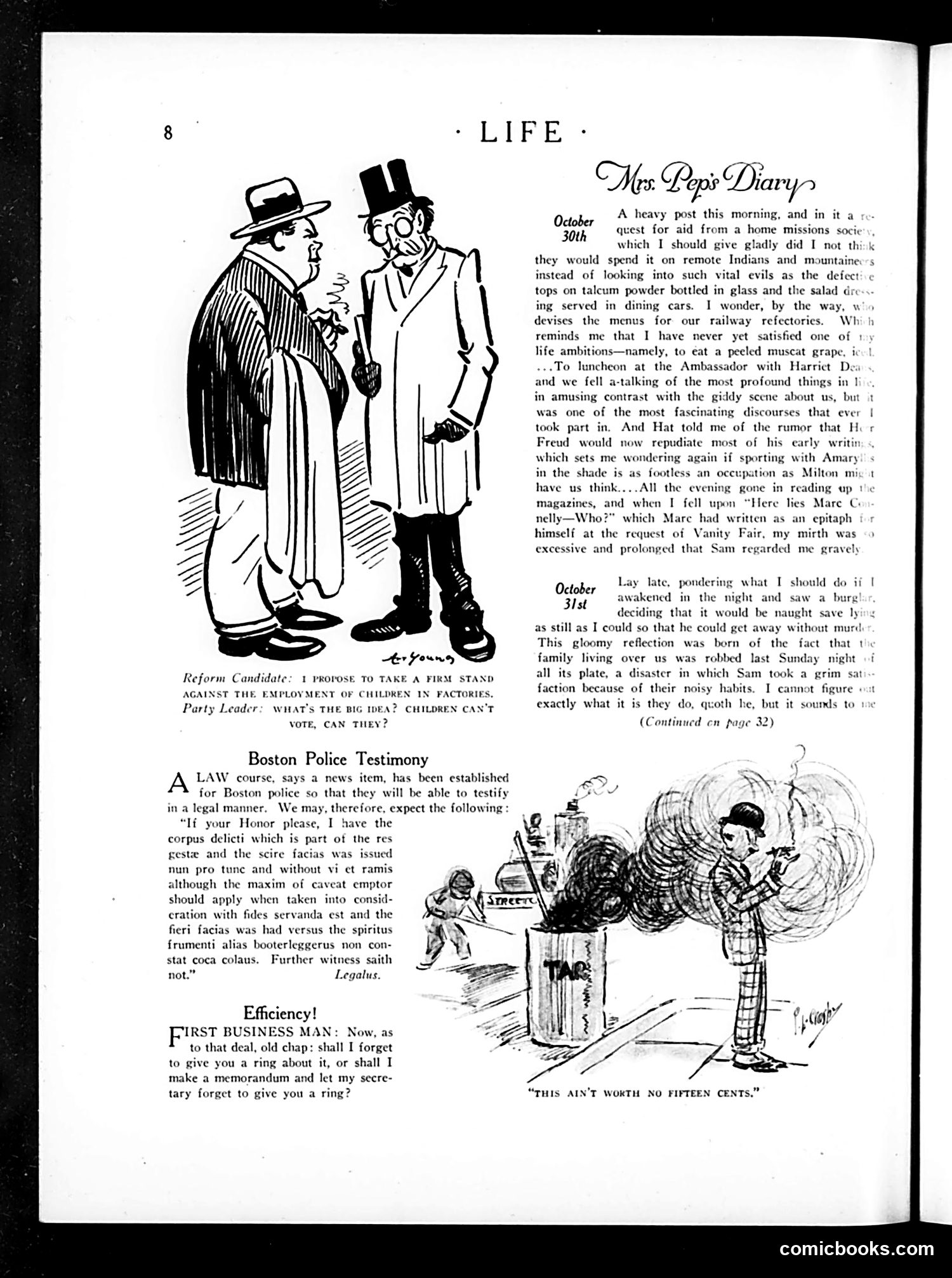
The top cartoon depicts two figures—a "Reform Candidate" and a "Party Leader"—in conversation. The reform candidate proposes "to take a firm stand against the harmful effects of children's factory work," while the party leader dismissively asks "what's the idea? children can't vote, can they?" This satirizes political hypocrisy: politicians support reforms only when constituents can vote on them. Children, having no voting power, don't merit protection despite obvious moral wrongs. The cartoon critiques how self-interest rather than principle drives political priorities. The lower cartoon shows a street vendor with refuse, captioned "this ain't worth no fifteen cents"—likely satirizing inefficiency or poor business sense, though context is limited here.
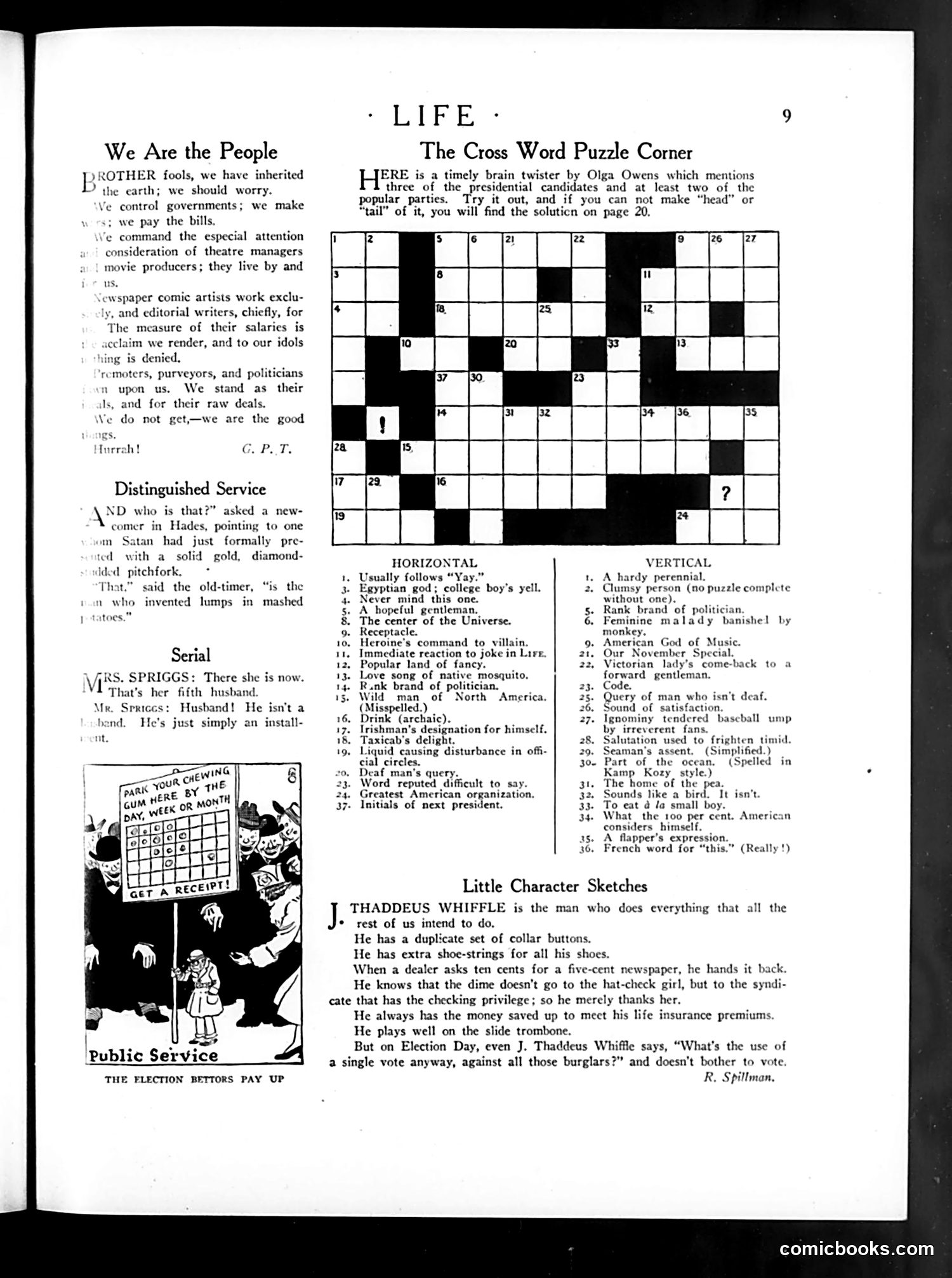
This page contains satirical commentary and puzzles rather than political cartoons. The main content includes: **"We Are the People"**: A C.P.T. (likely Communist Party Taunt) piece sarcastically listing what "brother fools" believe the people control—governments, wars, bills—while acknowledging reality: entertainers, politicians, and promoters actually hold power and receive undeserved acclaim. **"Distinguished Service"**: A brief anecdote about a newcomer in Hades pointing to someone Satan introduced with "solid gold, diamond-studded pitchfork"—the old-timer identifies him as someone who "invented lumps in mashed potatoes," suggesting criticism of unnecessary product complications. **J. Thaddeus Whiffle sketch**: Depicts an everyman character who meticulously saves money and follows rules but refuses to vote, viewing his single vote as useless against "all those burglars"—satirizing political apathy. The page emphasizes 1920s-era social commentary on power structures and civic responsibility.
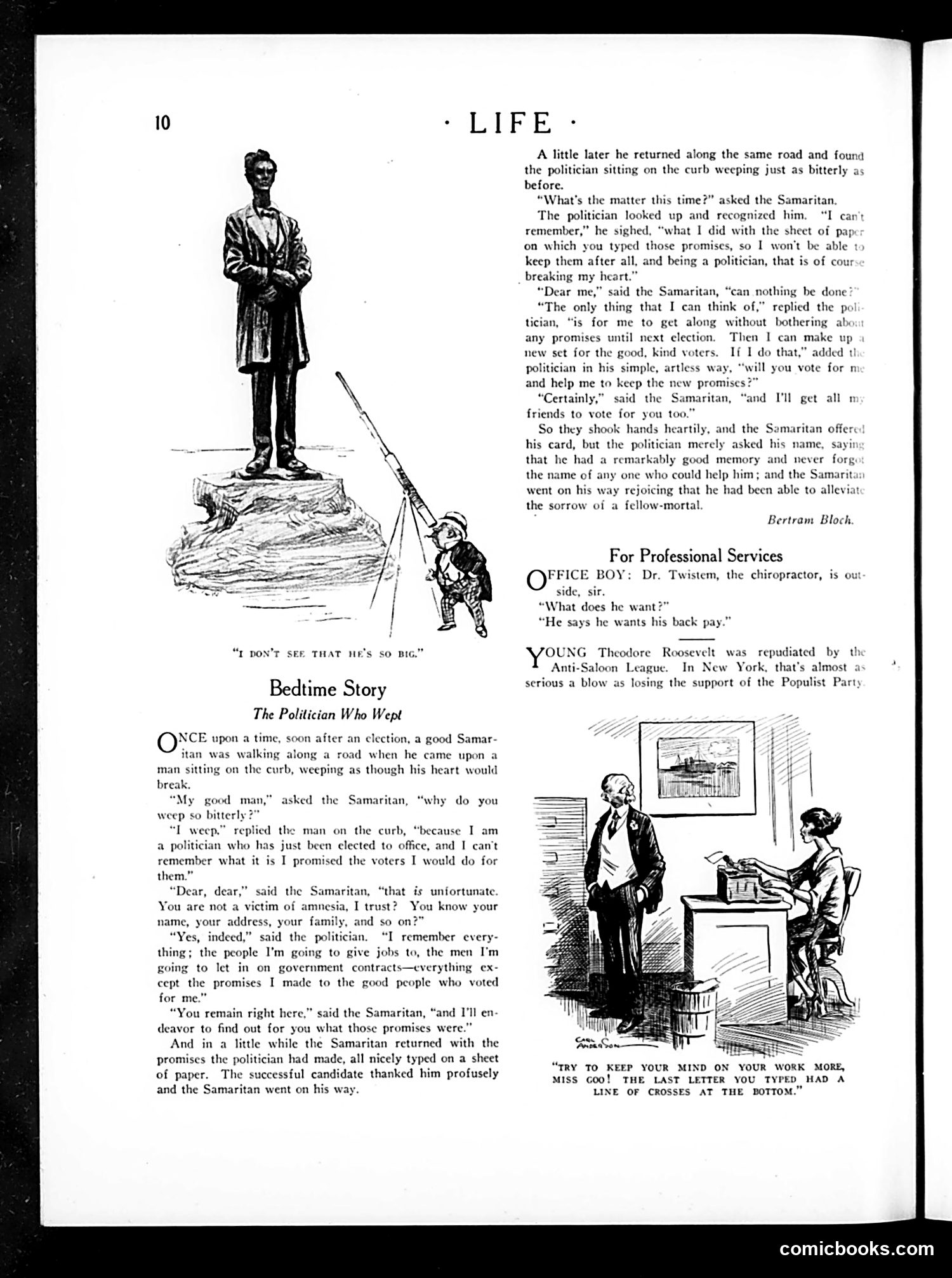
This page from *Life* magazine contains two pieces of satire about politicians and broken promises. **"The Politician Who Wept"** (main story): A Samaritan helps a newly-elected politician who's devastated because he lost the paper listing promises he made to voters. The satire ridicules politicians for making grandiose campaign pledges they never intend to keep—the politician is actually *relieved* to lose the written record. The Samaritan's offer to help him remember shows the absurdity: the politician promptly suggests forgetting those promises until the *next* election, when he'll invent new ones. **"For Professional Services"** (brief joke): A chiropractor's office boy reports the doctor wants his "back pay"—a pun playing on both unpaid wages and the medical specialty of treating backs. Both pieces mock political dishonesty and self-serving behavior.
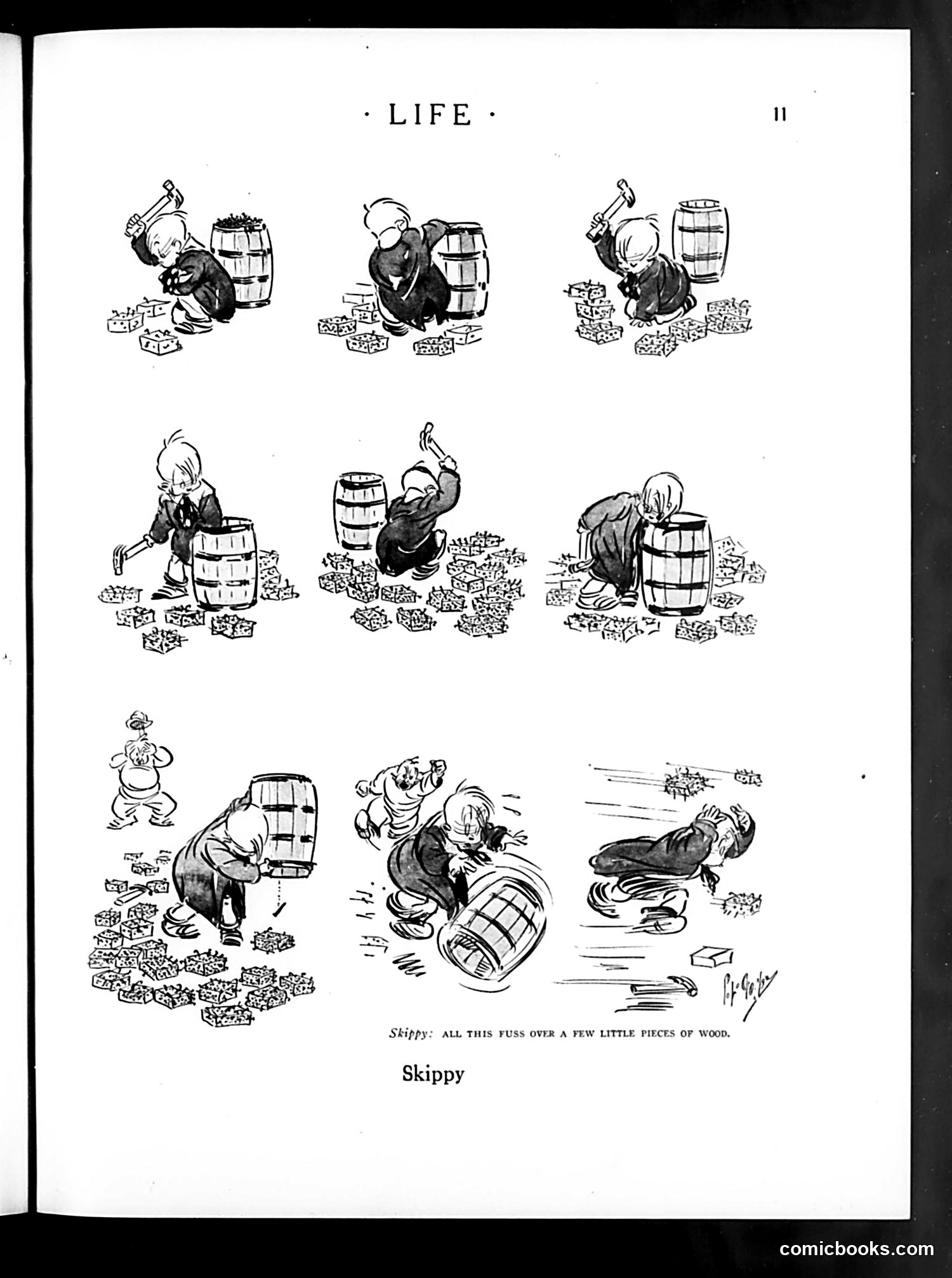
This page features a sequential comic strip titled "Skippy" that satirizes class disparities through physical comedy. The strip shows a well-dressed boy (Skippy) repeatedly striking wooden barrels with an axe while surrounded by scattered money or valuables. The progression depicts escalating destruction and chaos, culminating in the final panel where Skippy lies exhausted among the debris. His dialogue states: "ALL THIS FUSS OVER A FEW LITTLE PIECES OF WOOD." The satire appears to mock wealthy, privileged children who thoughtlessly destroy property they view as worthless, while others might desperately need such resources. The comic contrasts Skippy's casual destruction of material goods with the potential value those items hold for less fortunate people—a commentary on privilege and obliviousness to others' circumstances.
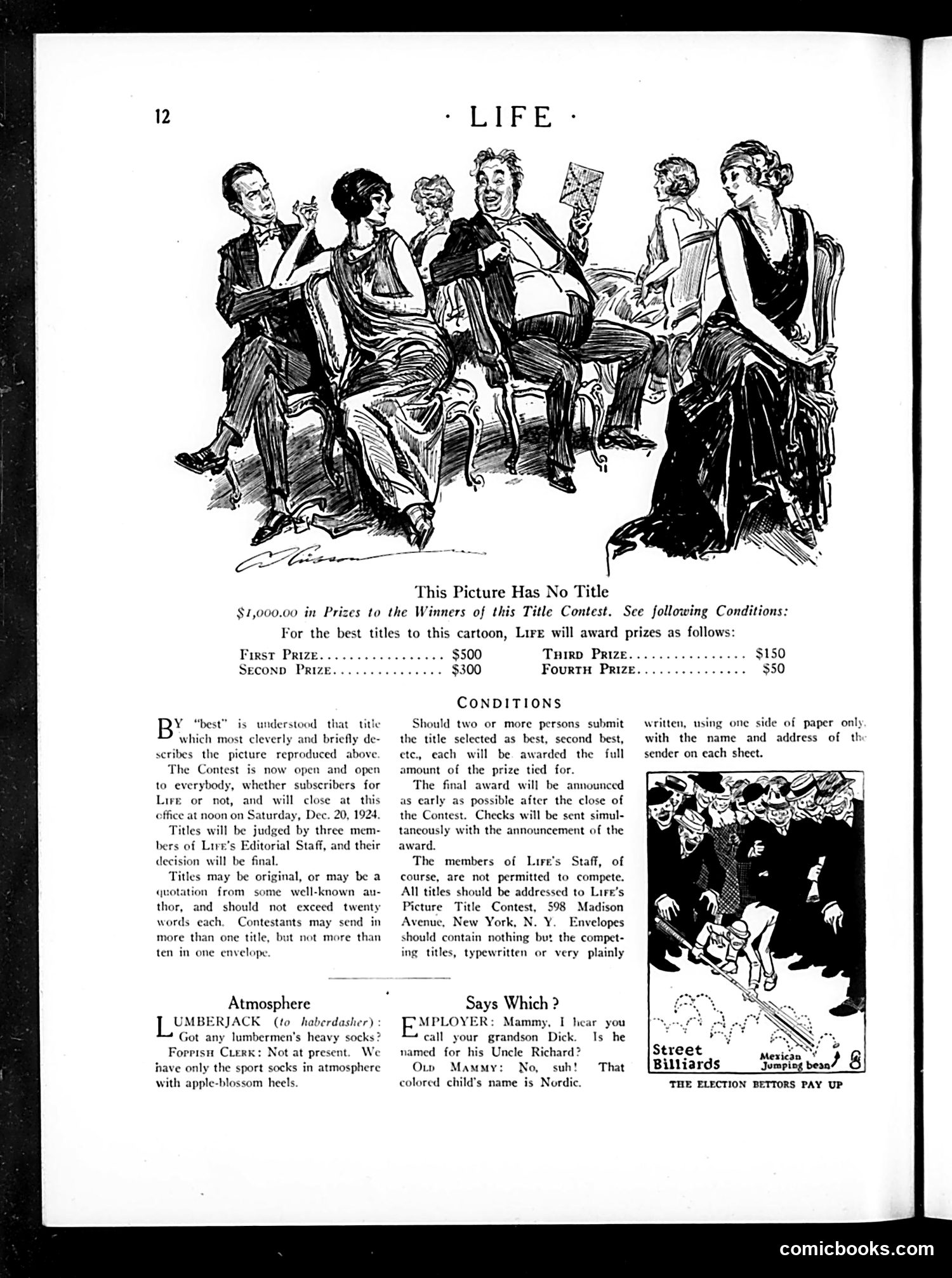
This page is primarily a **contest announcement** rather than satirical content. The main illustration shows a social gathering of well-dressed people in what appears to be a 1920s parlor setting. Life is soliciting reader submissions for the best title to this untitled cartoon, offering $1,000 in total prizes (first prize $500). The page also includes two minor comic snippets: "Atmosphere" (a joke about lumberjacks' socks) and "Says Which?" (a grandmother mishearing her grandson's name as "Nordic"). These appear to be filler material typical of period magazines. The contest deadline is December 20, 1924, making this a historical artifact of Life's interactive engagement with readers.
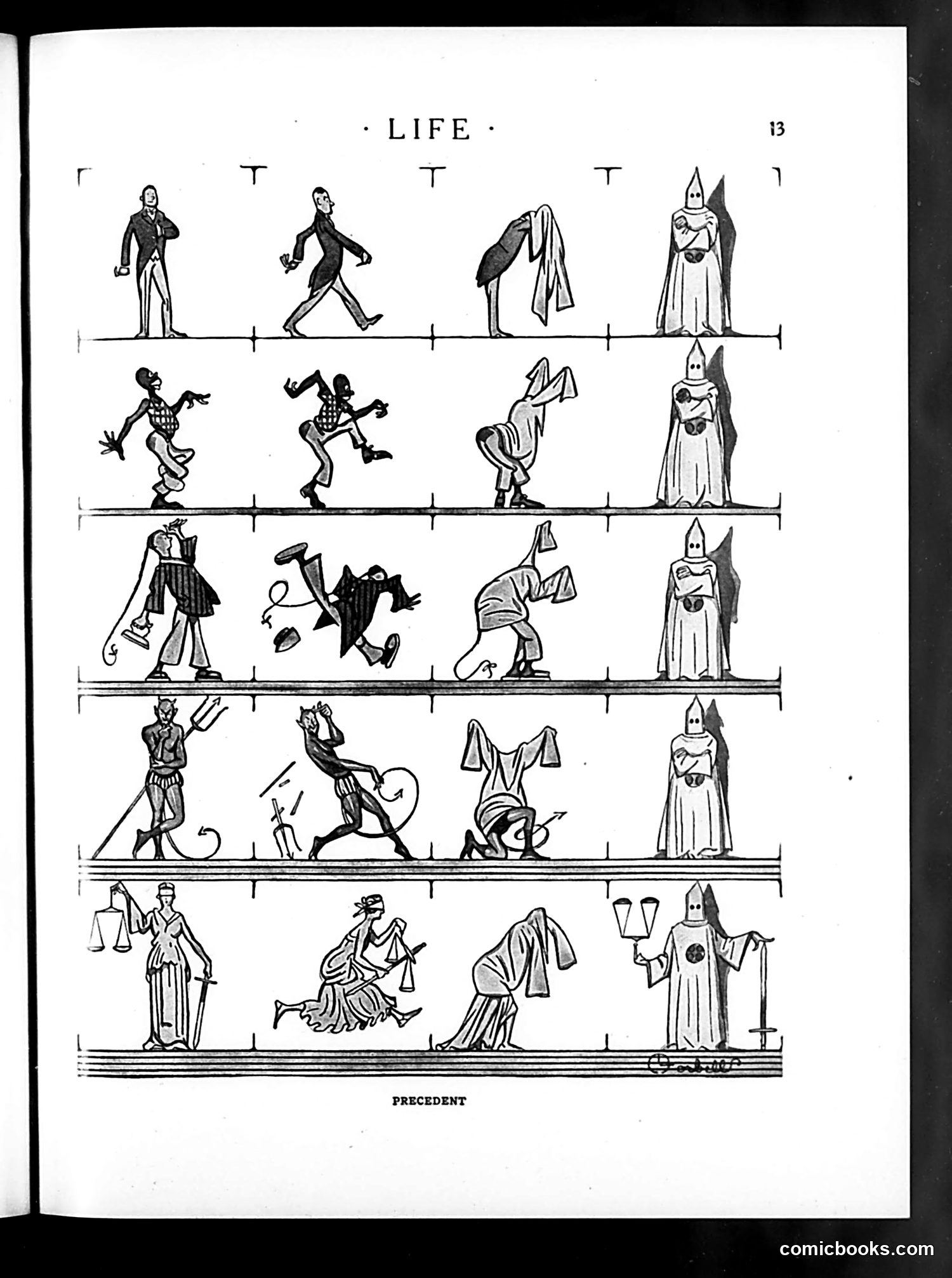
This satirical cartoon illustrates the concept of precedent—likely legal or social precedent—through a sequential visual narrative. Each horizontal row appears to show a progression of increasingly absurd or degraded behavior, with a robed authority figure (possibly a judge or religious official) appearing on the right side of each row, seemingly condoning or accepting each new level of misconduct. The joke critiques how precedent enables escalation: once one questionable act is accepted, it becomes the baseline for the next transgression. The figures progress from relatively normal conduct to increasingly outlandish behavior—dancing, acrobatics, partial nudity—yet the authority figure remains unchanged and approving, illustrating how precedent can rationalize progressively worse conduct through the logic of "it happened before, so it's acceptable now."
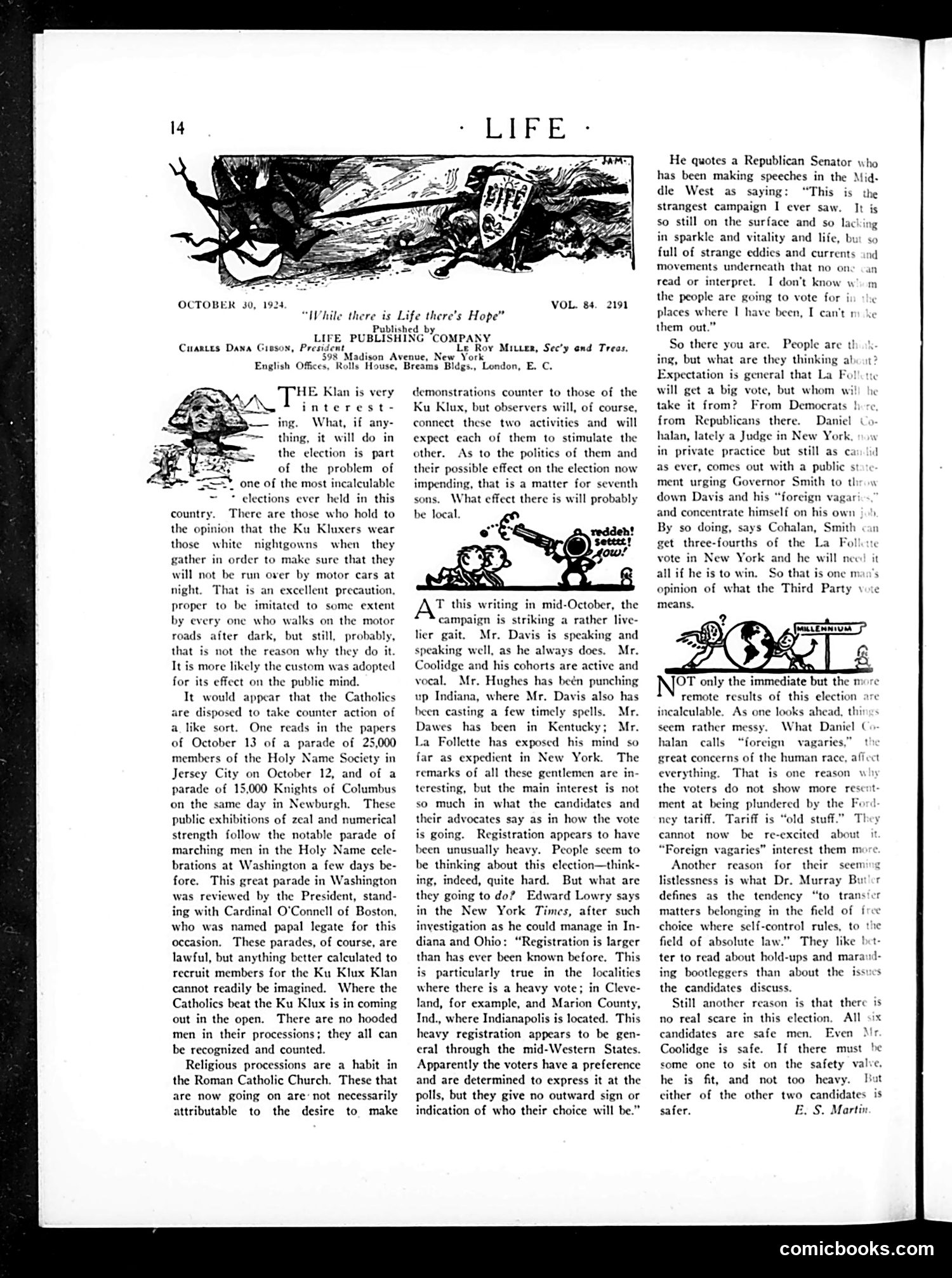
This page from Life magazine's October 30, 1924 issue discusses the U.S. presidential campaign then underway. The main article critiques the Ku Klux Klan's political activities, noting their efforts to organize and influence voters through nighttime motor-car parades—described as "excellent precaution" but "more likely the custom adopted for its effect on the public mind." The text also discusses campaign strategies of various candidates (likely Coolidge, Davis, and LaFollette based on context) and voter registration patterns, particularly in mid-Western states. The author appears skeptical of the election's substance, characterizing it as "striking rather lively-gait" but questioning what voters actually intend to do. The accompanying illustrations are political cartoons, though their specific subjects are difficult to discern clearly from this reproduction.
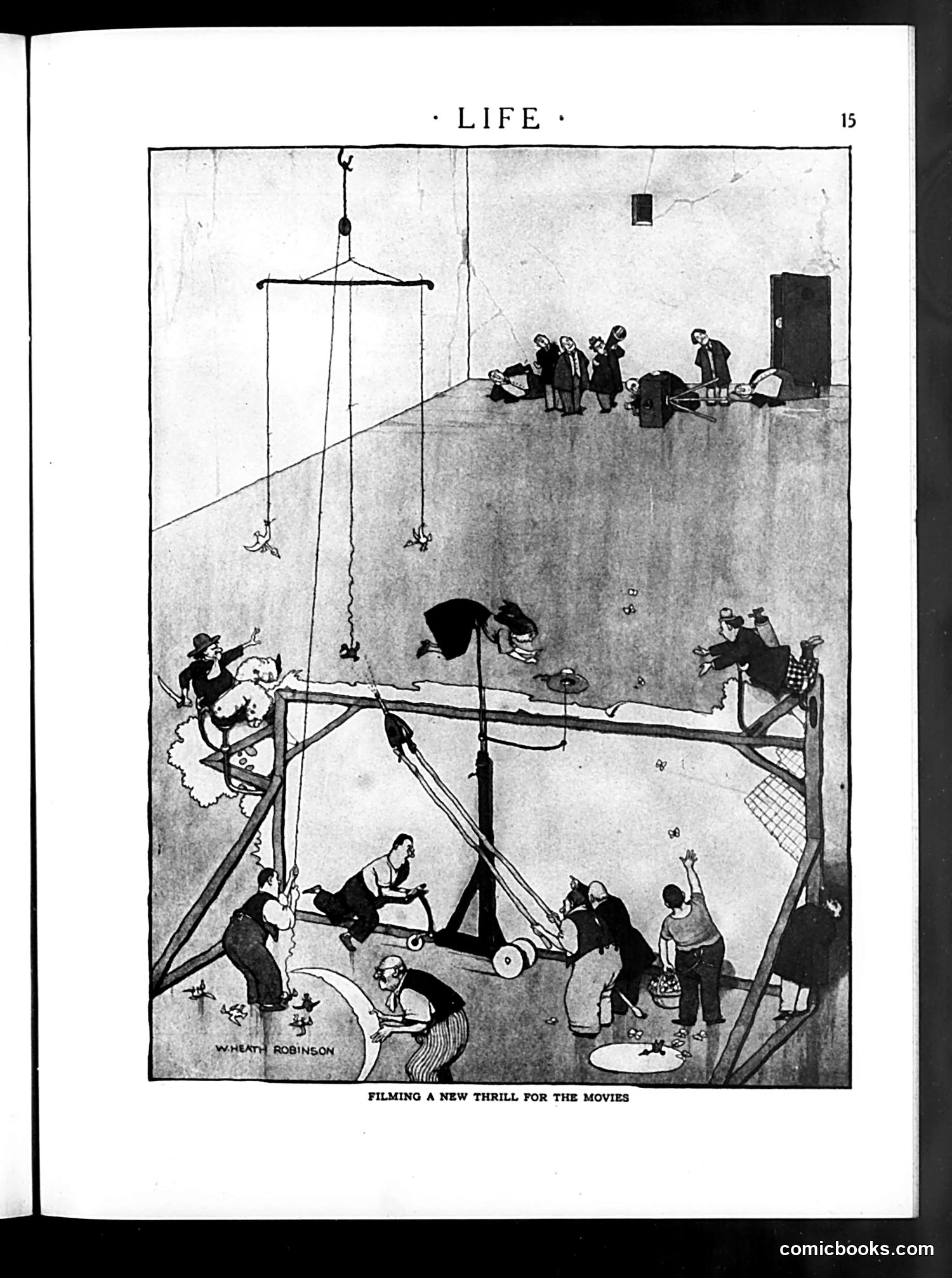
This satirical illustration by W. Heath Robinson depicts a film set with elaborate mechanical contraptions designed to create cinematic "thrills." The cartoon shows a multi-level studio setup where actors perform dangerous stunts using pulleys, ropes, and apparatus while crew members operate equipment and observe from various positions. The satire targets early cinema's obsession with spectacular, increasingly dangerous stunts to attract audiences. Robinson ridicules how filmmakers engineered artificial excitement through mechanical devices rather than genuine storytelling. The crowded, chaotic nature of the setup—with multiple people managing complex machinery—emphasizes the absurdity of prioritizing spectacle over substance. This reflects 1920s-era anxieties about cinema's reliance on sensationalism and physical danger to entertain audiences.
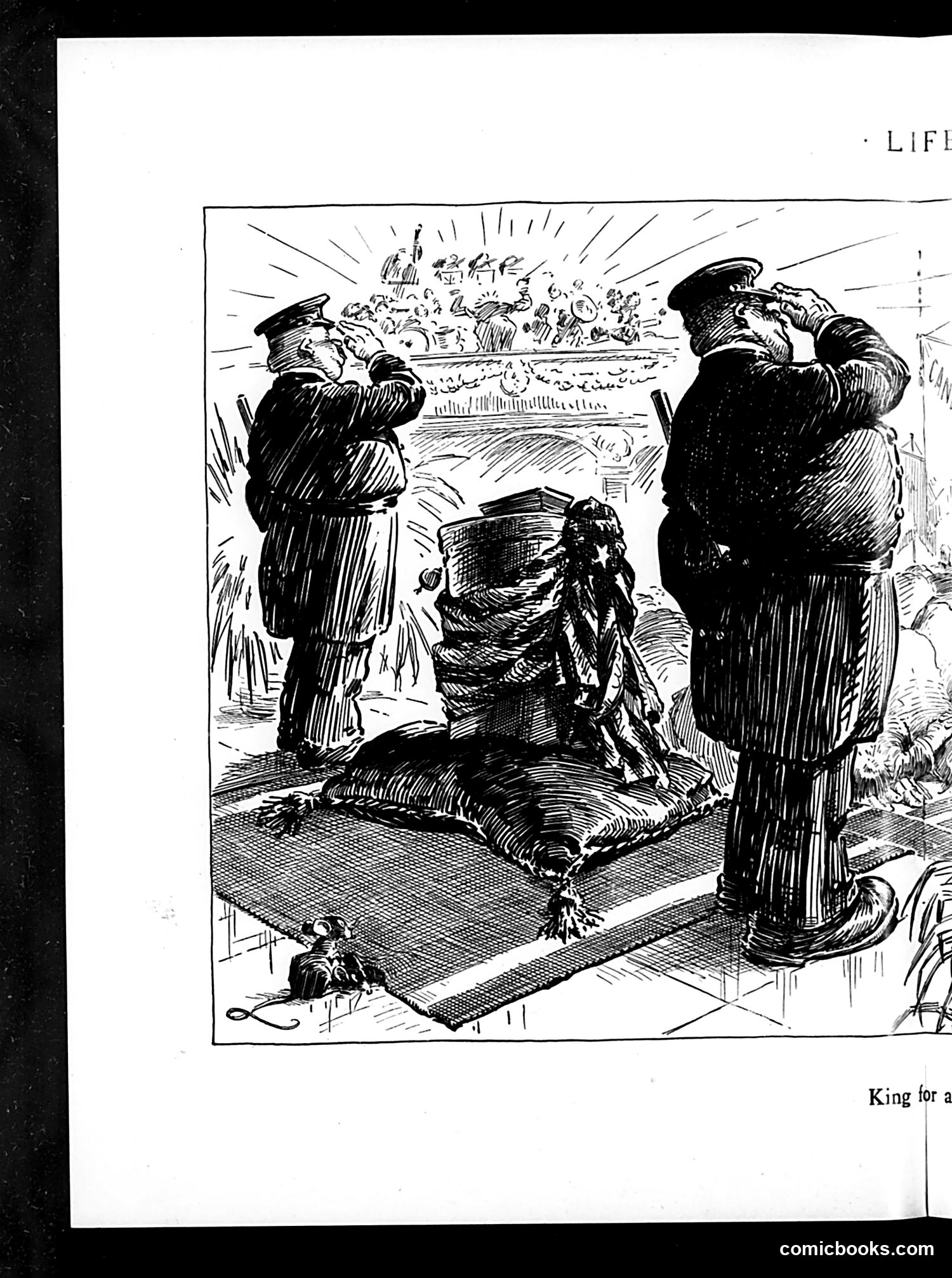
This appears to be a satirical cartoon from *Life* magazine depicting a military or authority scene. Two uniformed figures (likely military or police officers, identifiable by their caps and formal dress) stand observing what appears to be a bound or restrained figure on the ground. A small figure in the lower left corner seems to be watching the scene. The caption reads "King for a," suggesting incomplete text that likely continues on a following page. Without the complete caption and without being able to definitively identify the specific historical moment, the cartoon appears to critique abuse of power or authoritarian treatment. The composition emphasizes the contrast between authority figures and a powerless subject, typical of *Life* magazine's satirical social commentary.
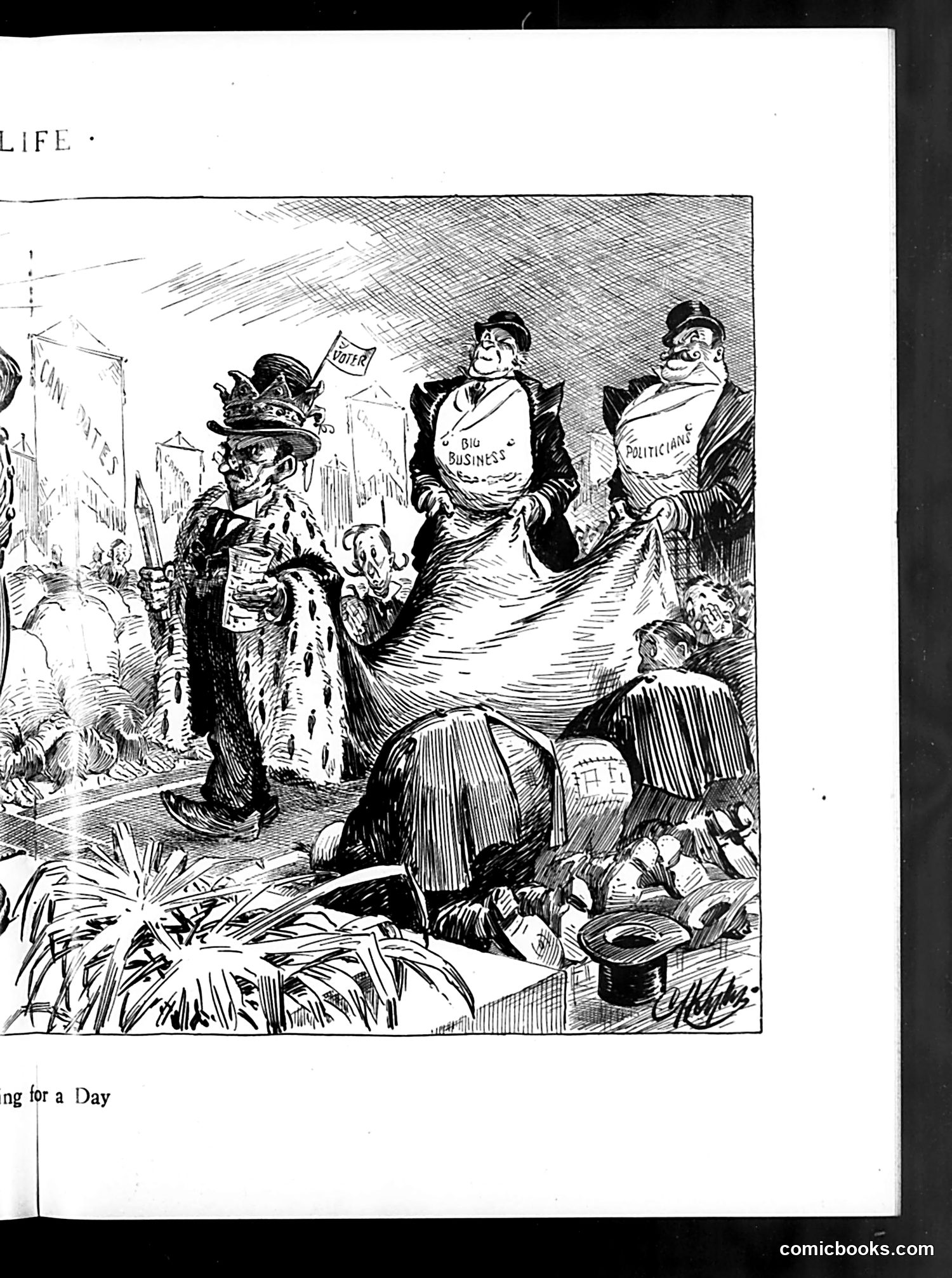
This satirical cartoon depicts three well-dressed figures—labeled "Big Business" and "Politicians"—standing over common working people who appear impoverished or struggling. The figure on the left wears a crown and royal robes, suggesting monarchy or extreme wealth/power. The composition shows a clear hierarchy: the wealthy and politically connected stand elevated while ordinary citizens crouch below in apparent destitution. The satire critiques the collusion between big business and politicians, suggesting they exploit or oppress the working class for personal gain. The royal imagery emphasizes how disconnected the elite are from ordinary people's struggles. This reflects early 20th-century Progressive Era concerns about corporate power, political corruption, and economic inequality—themes Life magazine frequently addressed through political commentary.
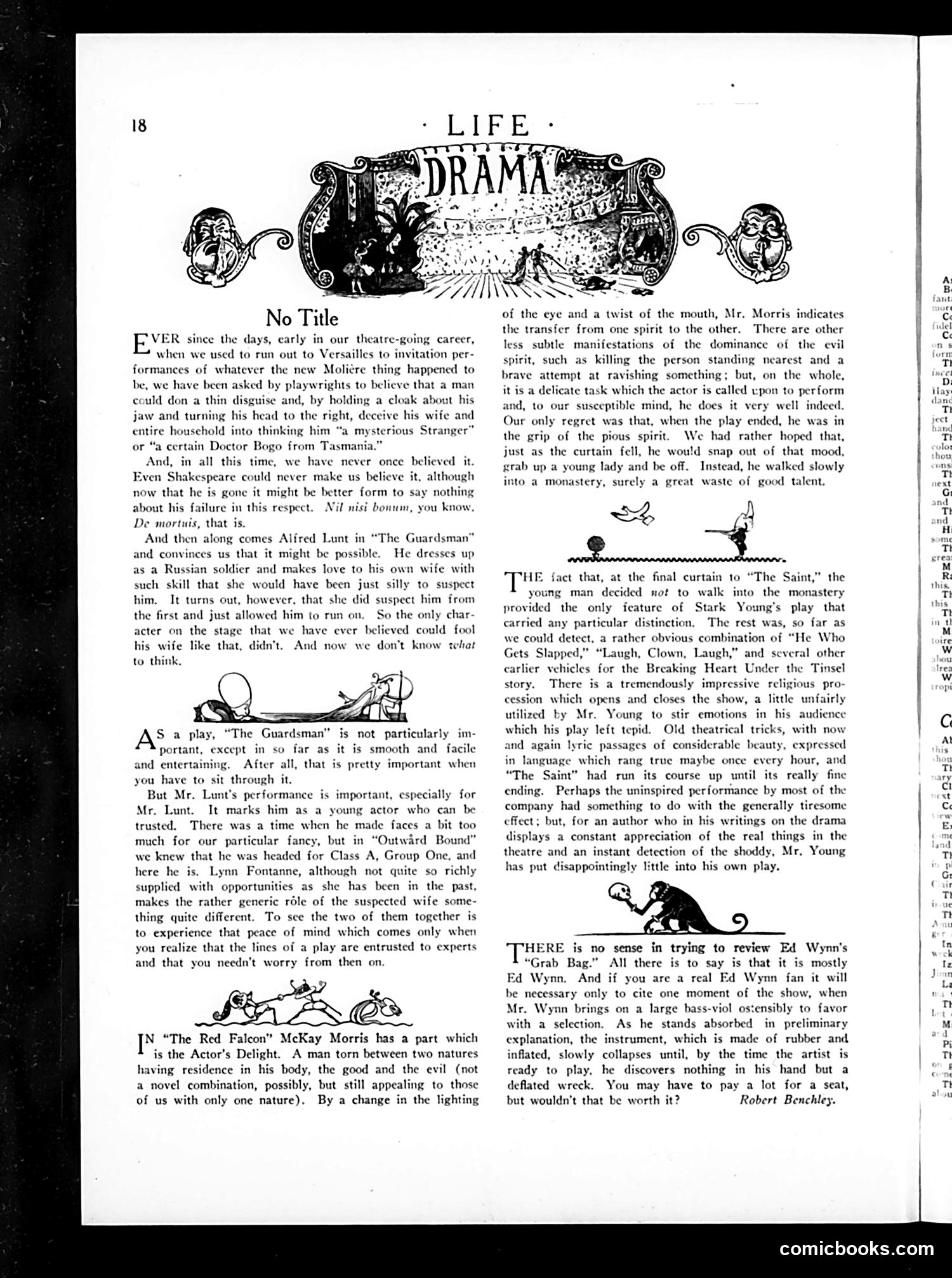
This is a theater criticism column reviewing several contemporary Broadway plays. The page contains no political cartoons—instead, it features decorative theatrical vignettes and discusses acting performances. The critic reviews four plays: *The Guardsman* (praising Alfred Lunt's ability to convincingly disguise himself as a Russian soldier to seduce his own wife), *The Red Falcon* (noting McKay Morris's skill depicting a man torn between good and evil impulses through subtle facial expressions), and *The Saint* (critiquing Stark Young's derivative plot that borrows from earlier plays like "He Who Gets Slapped"). The humor is theatrical rather than political—the critic expresses surprise that Lunt actually succeeds where Shakespeare failed: making an audience believe a thin disguise could fool someone. The tone is urbane and sophisticated, typical of Life magazine's drama coverage for educated readers interested in Broadway productions of this era.
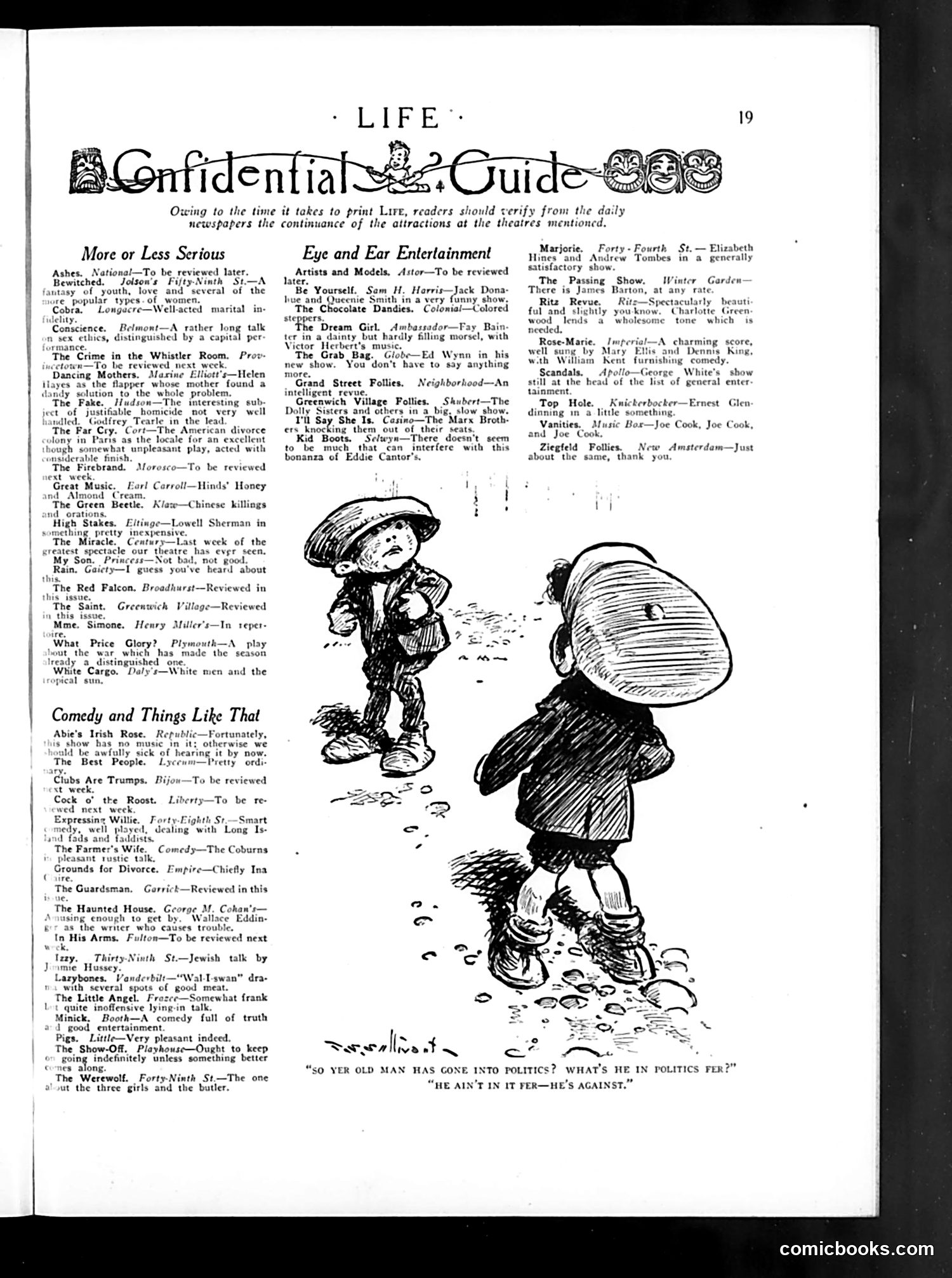
This page is a theater-review guide listing New York Broadway shows with brief critical assessments. The cartoon illustrates the guide's satirical premise: an old man has gotten interested in politics, prompting a younger man's dismissive comment that "he ain't in it fer—he's agin'st." The joke satirizes political engagement itself—suggesting that entering politics means primarily *opposing* things rather than supporting them constructively. This reflects 1920s cynicism about American political discourse and partisan gridlock. The page itself catalogs contemporary Broadway offerings (comedies, musicals, dramas) at specific theaters, with capsule reviews ranging from enthusiastic to dismissive. Shows like "Abie's Irish Rose," "Rain," and "What Price Glory?" are referenced, providing a snapshot of 1923 popular theater.
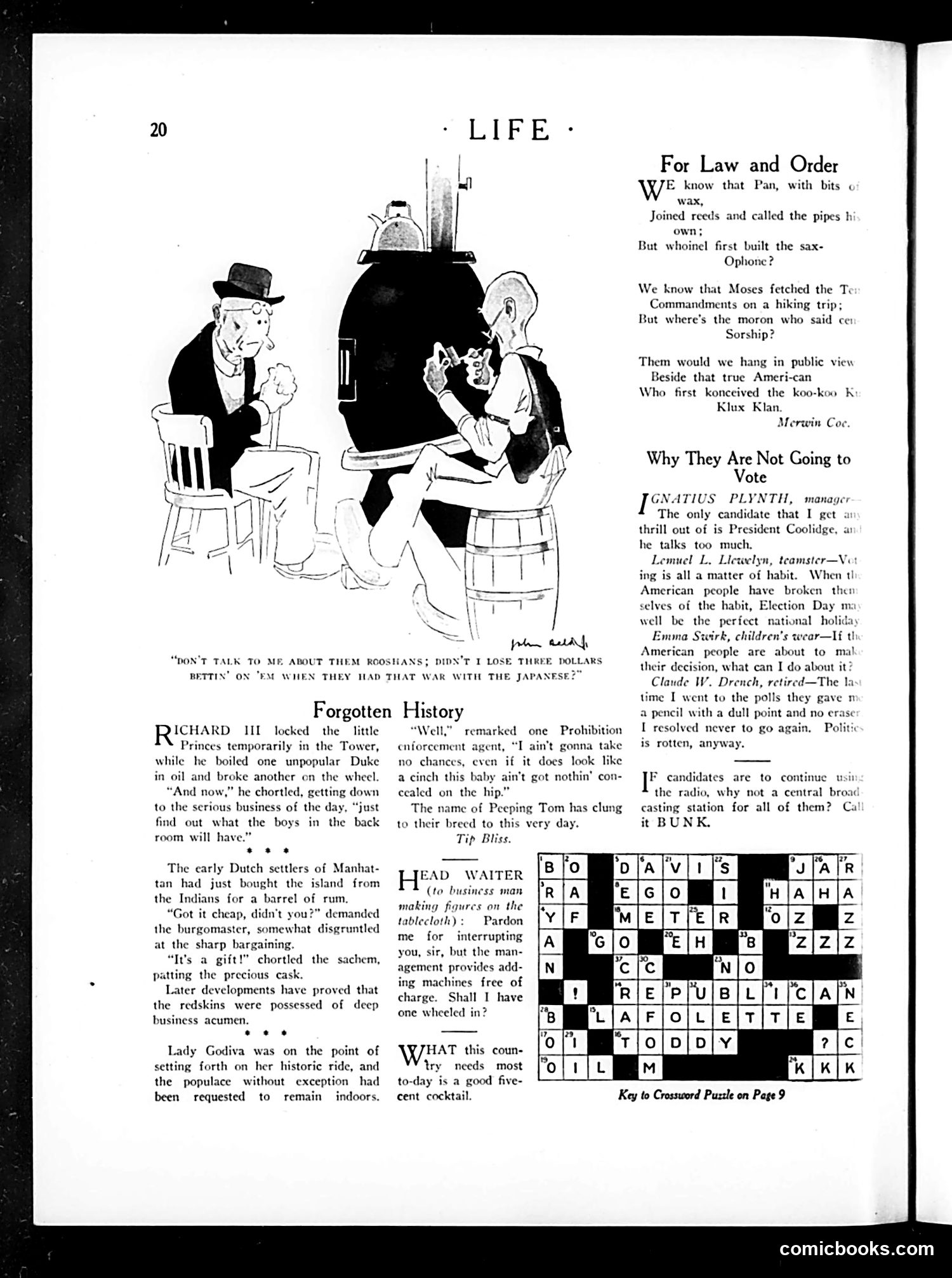
**Main Cartoon:** Shows a man complaining to another about Russians, saying he lost three dollars betting on them during "that war with the Japanese" (the 1904-05 Russo-Japanese War). The satire mocks Americans' casual indifference to foreign affairs, reducing geopolitical events to failed gambling bets. **"Forgotten History" Section:** A series of historical anecdotes drawn to satirize human behavior. It references Richard III's crimes, the Dutch purchase of Manhattan from Native Americans for rum (mocking the "shrewd deal"), and Peeping Tom during Lady Godiva's ride—each illustrating how historical figures engaged in dubious or criminal acts that became normalized. The Prohibition enforcement agent checking Lady Godiva appears to satirize overzealous 1920s prohibition enforcement. **"For Law and Order":** A satirical poem by Merwin Coe expressing outrage that the KKK inventor receives no public acknowledgment while historical figures are celebrated—clearly ironic condemnation of the Klan. **"Why They Are Not Going to Vote":** Features various citizens explaining voter apathy—habit, indifference, poorly-maintained voting equipment—reflecting 1920s disengagement with democracy.
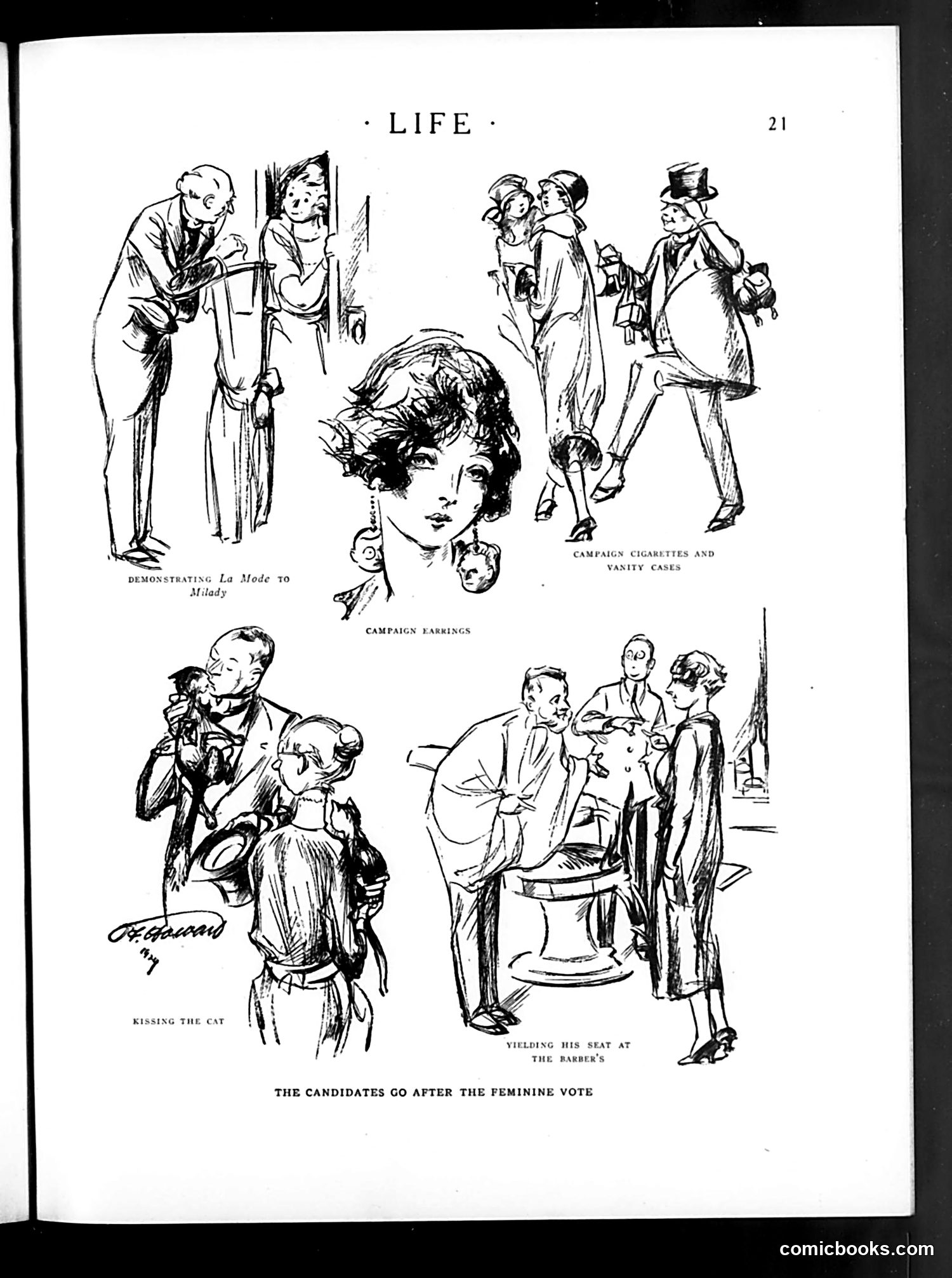
This Life magazine page satirizes male politicians courting women voters, likely from the early 20th century when women's suffrage was a contested political issue. The sketches mock candidates employing absurd tactics to win "the feminine vote": demonstrating fashion ("La Mode"), gifting campaign earrings and vanity cases, kissing cats, and yielding barber chairs. These vignettes ridicule the assumption that women voters could be swayed by trivial gestures and frivolous appeals rather than substantive policy positions. The title "The Candidates Go After the Feminine Vote" underscores the satirical point: male politicians treated women's political participation as a novelty requiring condescending, gimmicky strategies rather than genuine respect for women as serious voters. The cartoons mock both the politicians' assumptions about women's interests and, implicitly, the era's broader resistance to women's political equality.
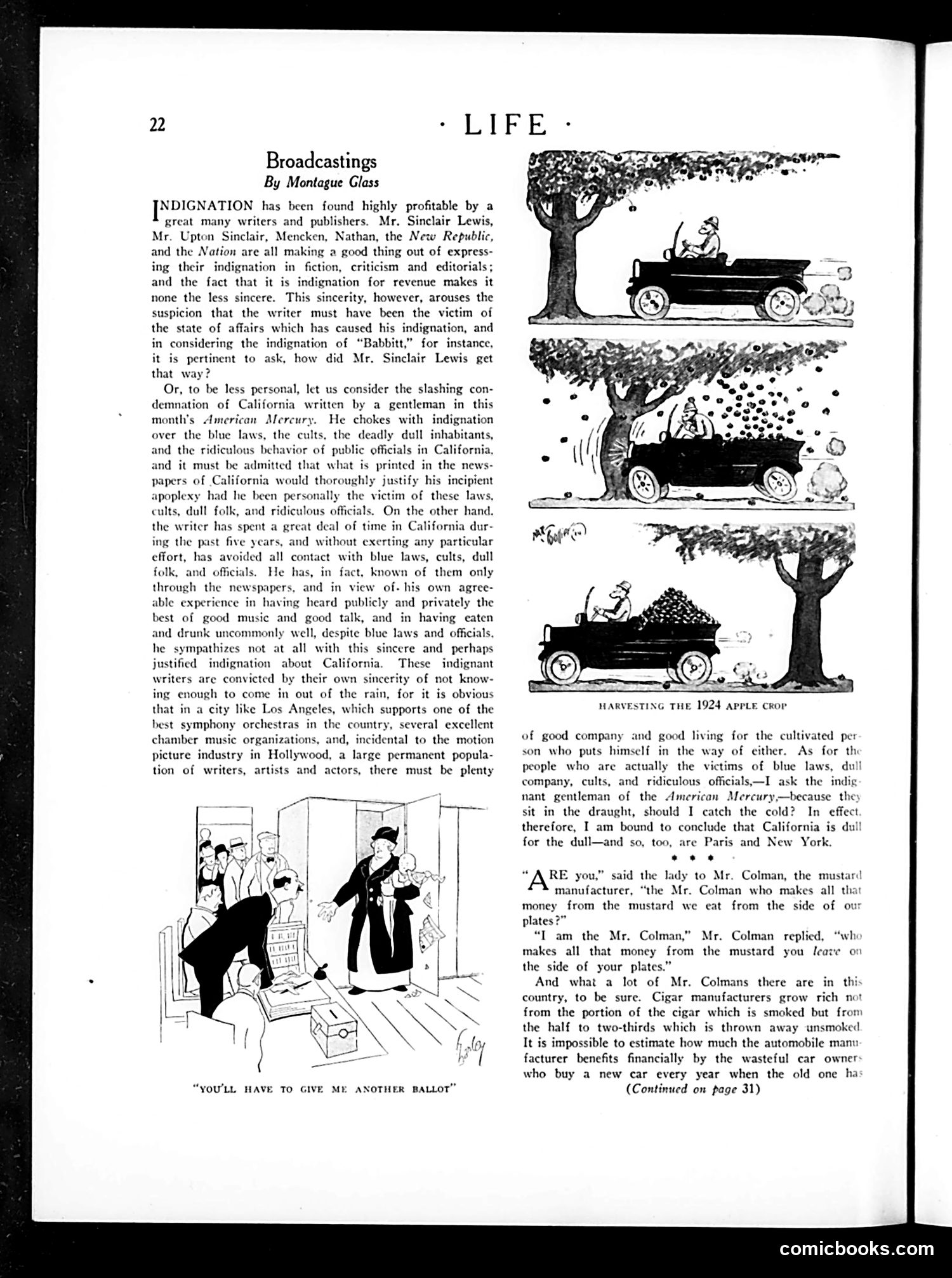
This page contains two satirical pieces by Montague Glass in *Life* magazine: **"Broadcastings" essay:** Glass critiques prominent writers (Sinclair Lewis, Upton Sinclair, H.L. Mencken) who profit from expressing moral indignation about social problems in their work. He argues they attack California's "blue laws" (restrictive Puritan legislation) without actually experiencing the hardships they condemn—they've enjoyed good music, food, and company while avoiding the laws themselves. His point: their righteous anger rings hollow when they haven't genuinely suffered the injustices they denounce. **Bottom cartoon:** Titled "You'll Have to Give Me Another Ballot," it appears to reference voting/ballot issues, likely related to 1924 elections, though the specific context is unclear from the image alone. **"Harvesting the 1924 Apple Crop" illustrations:** Three sequential truck cartoons showing apples being loaded, presumably commenting on agricultural commerce or economic productivity during that period. The overall theme critiques intellectual hypocrisy and performative outrage for profit—a surprisingly modern concern.
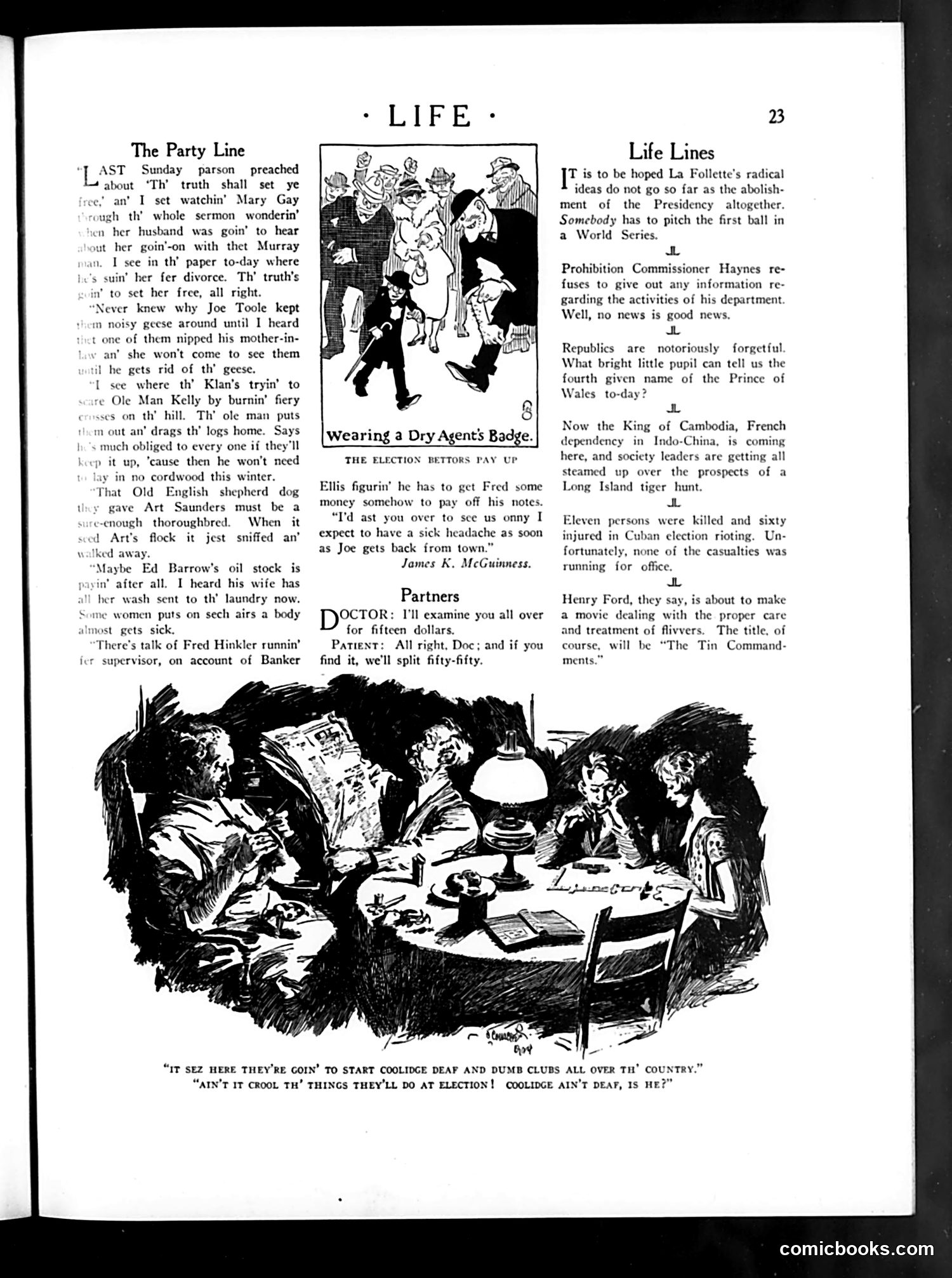
This page contains two distinct satirical pieces from the 1920s: **"The Party Line"** presents rural gossip filtered through dialect humor—stories about divorce, the KKK's intimidation tactics, and small-town scandal. The humor relies on folk wisdom deflating serious issues. **The lower cartoon** mocks President Calvin Coolidge's famous taciturnity (his reputation for saying very little). The joke depicts people planning to start "Coolidge Deaf and Dumb Clubs" across the country—satirizing how his silence made him seem as if he couldn't communicate, treating his reticence as a disability. One character clarifies "Coolidge ain't deaf, is he?"—acknowledging the absurdity while the humor persists. **"Life Lines"** offers brief editorial quips, including jabs at Prohibition Commissioner Haynes for withholding information, and mockery of Henry Ford's upcoming film about proper automobile care. The page reflects 1920s concerns: Prohibition, the KKK's renewed activity, Coolidge's presidency, and Ford's cultural influence—all filtered through Life's trademark irreverent, class-conscious wit.
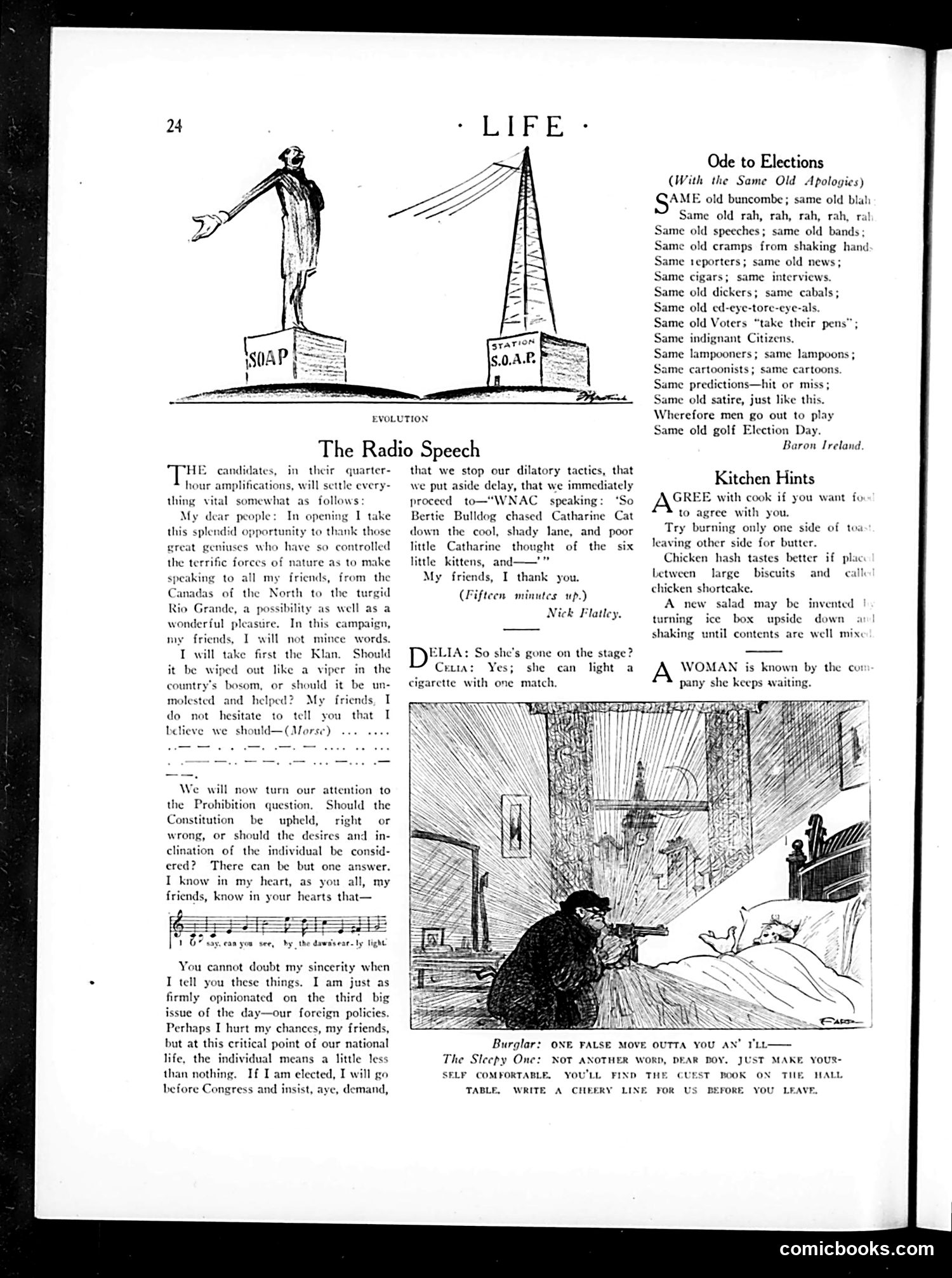
This 1920s *Life* magazine page satirizes election-season political speeches. "The Radio Speech" mocks candidates' empty rhetoric: they promise to address major issues (the KKK, Prohibition, foreign policy) with grandiose language about "terrific forces of nature" and radio technology, then deliver nothing substantive—the speech keeps getting interrupted by a children's story about "Bertie Bulldog" chasing a cat. The "Evolution" cartoon contrasts a soap statue (representing old advertising/humbug) with a radio tower (representing modern technology), suggesting politicians merely use new media to broadcast the same old lies. The poem "Ode to Elections" reinforces this: every election repeats identical speeches, dirty tricks, and satire—nothing genuinely changes. The cartoons and content all convey that despite technological progress and electoral promises, politicians remain predictably dishonest and elections remain essentially unchanged theater.
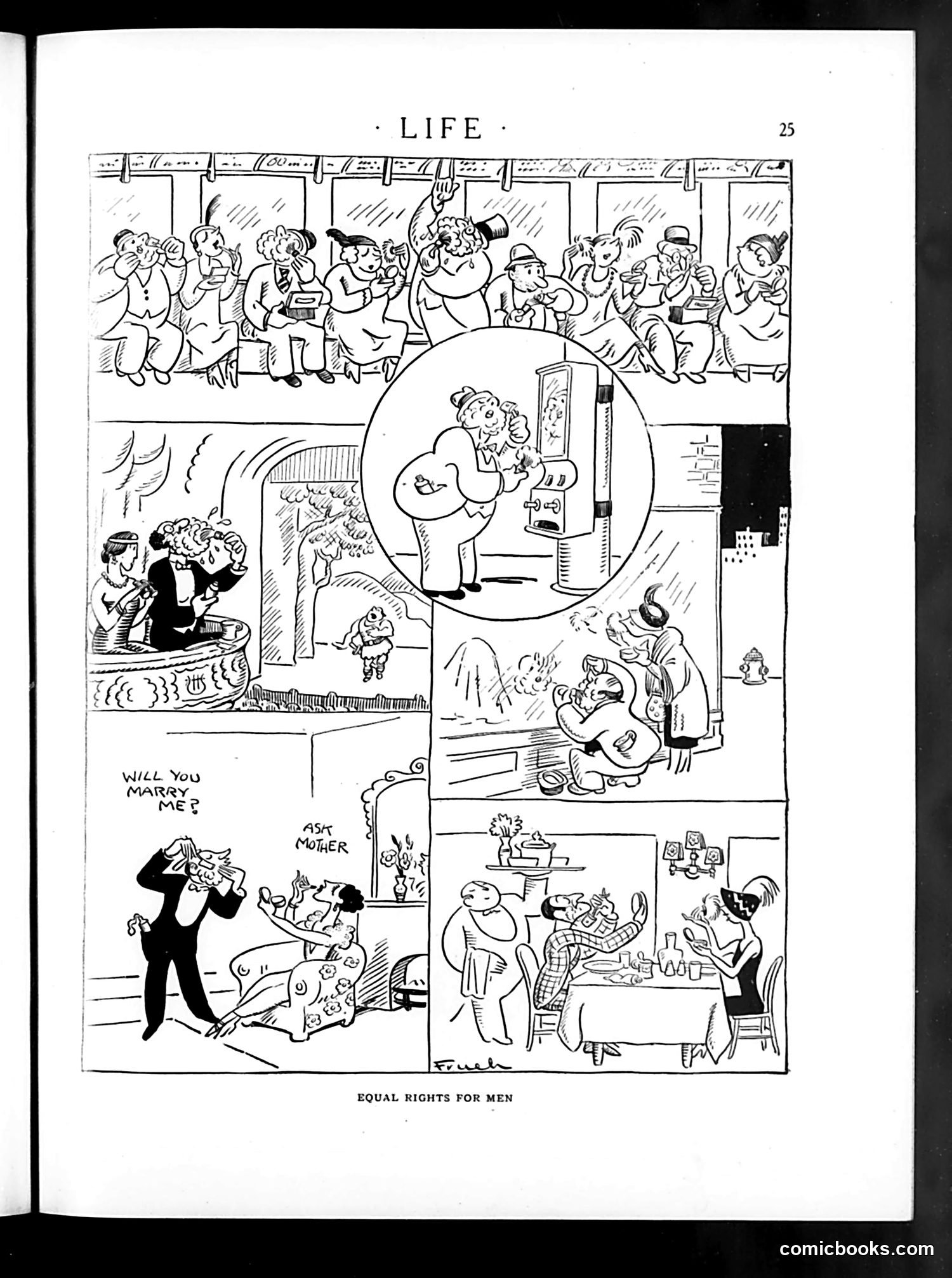
This cartoon satirizes the women's rights movement, likely from the early-to-mid 20th century, by inverting gender roles as reductio ad absurdum. The title "Equal Rights for Men" is ironic. The panels depict absurd scenarios where women hold power: a woman in an office (top center) while men appear subordinate; a man proposing "Will You Marry Me?" while appearing desperate; domestic scenes where women manage households and finances while men are marginalized. The satire mocks the idea of female equality by suggesting it would create chaos and undermine men's traditional authority. This reflects anti-suffrage and anti-feminist sentiment of the era, using humor to argue that women's rights would be ridiculous or harmful. The cartoon represents conservative opposition to women's equality movements of its time.
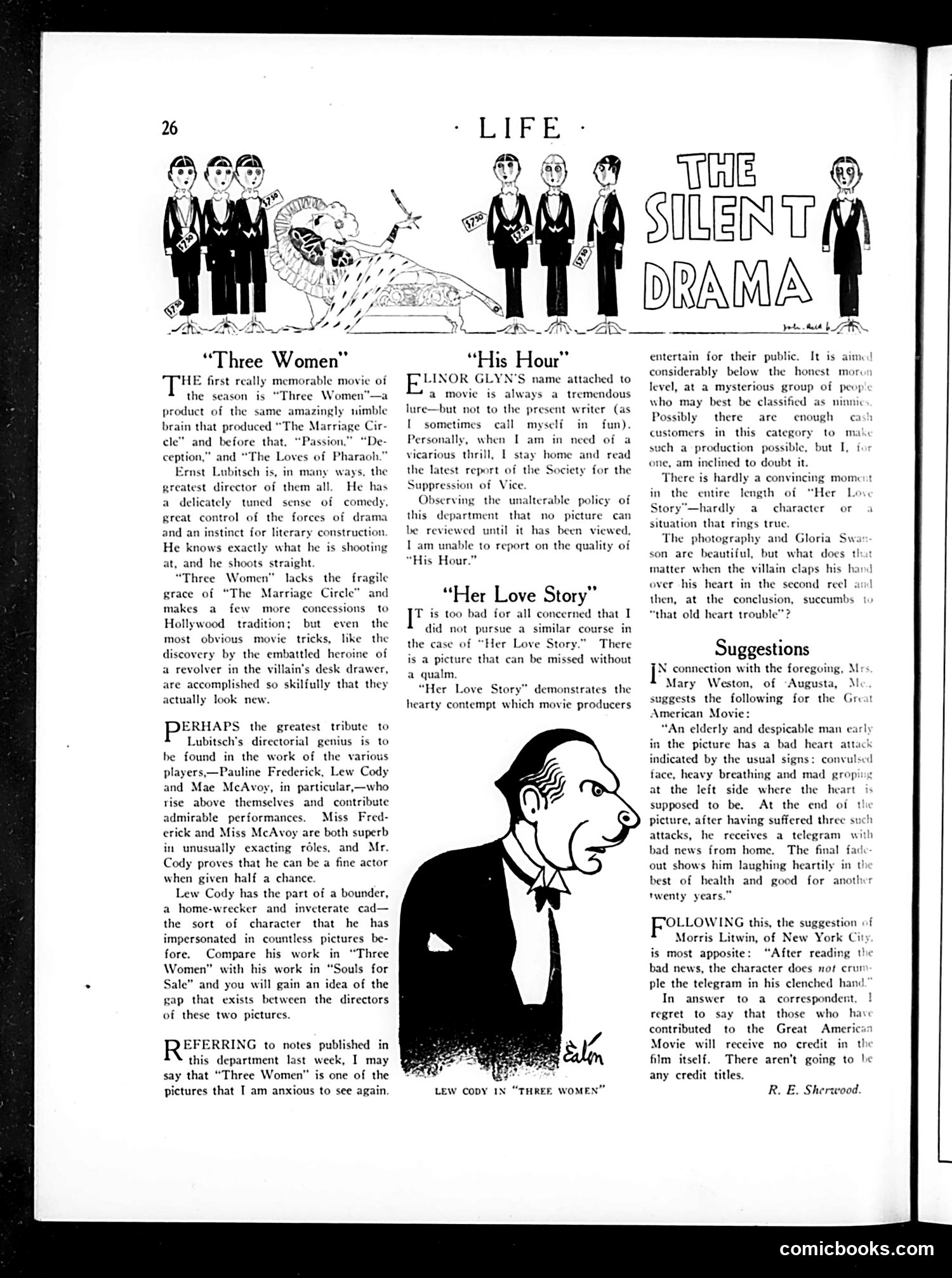
This is a film criticism column reviewing three silent movies from the early 1920s. The main subjects are: **"Three Women"** - Praised as the season's best film, directed by Ernst Lubitsch (a renowned German-American director). The critic admires the performances of actors Pauline Frederick, Lew Cody, and Mae McAvoy, and notes how Lubitsch elevates even hackneyed movie tricks (like finding a revolver in a villain's desk) through skilled direction. **"His Hour"** - Dismissed without review, as the critic's policy requires viewing before criticism. **"Her Love Story"** - Harshly condemned as contemptuous toward audiences, aimed at "ninnies" rather than intelligent viewers. The critic ridicules its melodramatic plot device where a villain with heart trouble conveniently recovers or dies as needed. The page includes reader suggestions for improving the "Great American Movie," satirizing formulaic silent film plotting. A caricature of Lew Cody accompanies the text.
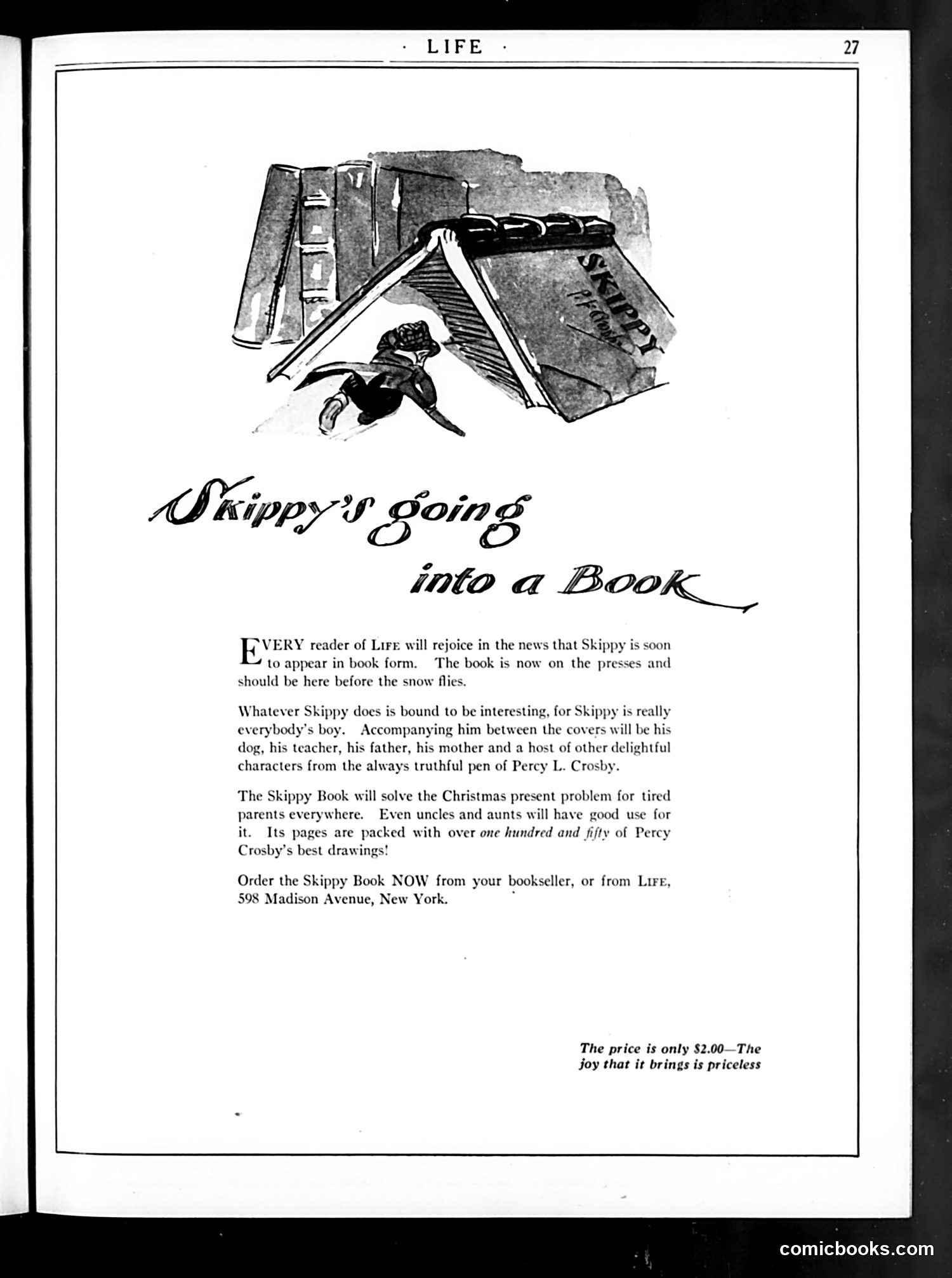
This is primarily a **book advertisement** rather than satirical content. Life magazine is promoting an upcoming book collection of "Skippy," a popular comic strip by Percy L. Crosby about a mischievous boy character. The illustration shows Skippy diving into or emerging from books and papers, visualizing the concept of the character "going into a book form." The ad emphasizes the book's appeal as a Christmas gift, claiming it contains "over one hundred and fifty" of Crosby's drawings. The modest $2.00 price point is presented as exceptional value. The advertisement positions Skippy as "everybody's boy"—a relatable, wholesome character whose adventures with his dog, family, and teacher would appeal broadly to parents seeking gift solutions. This represents early 20th-century merchandising of comic strip characters into book collections.
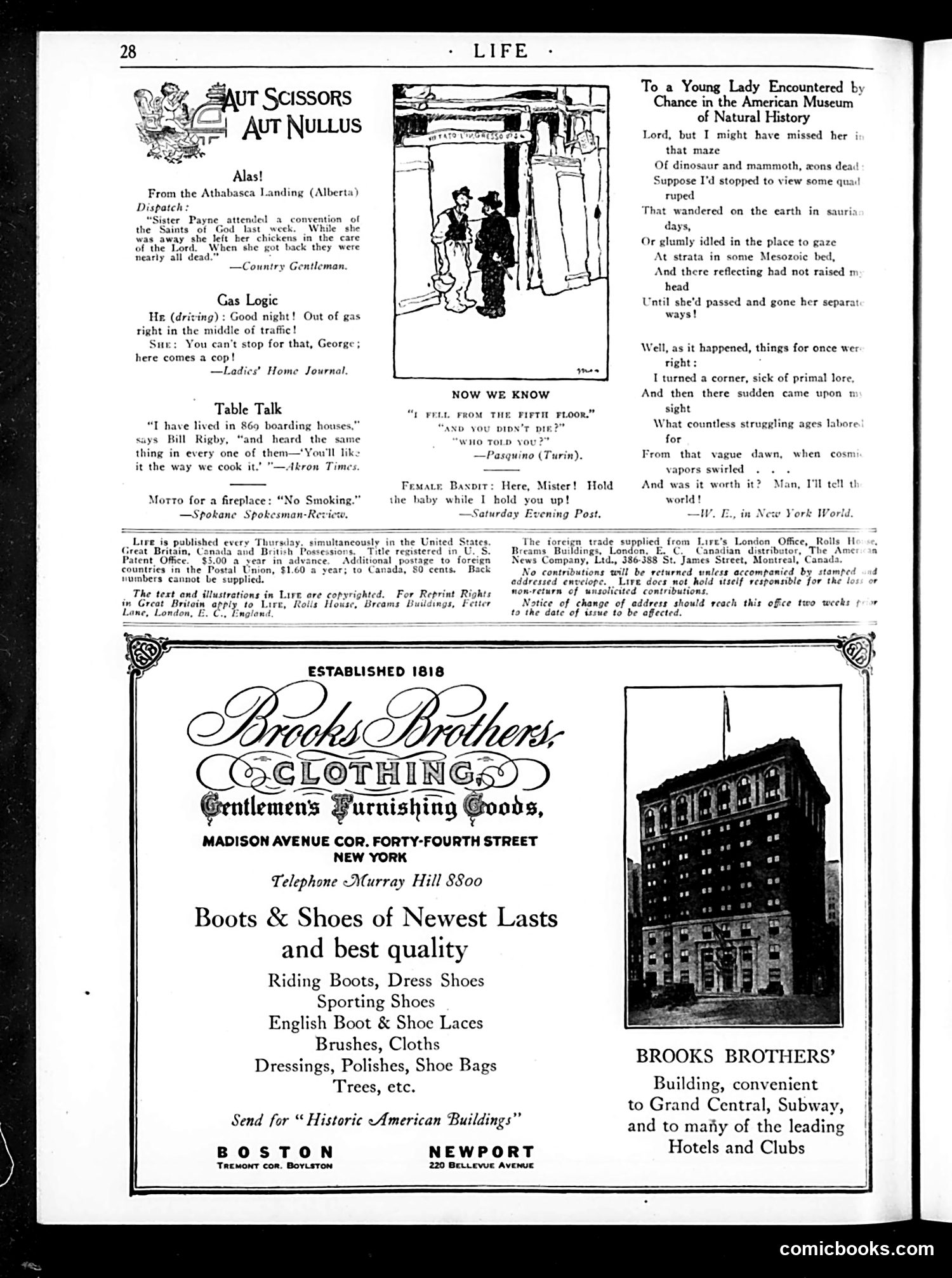
This page consists primarily of **short humor pieces and advertisements** rather than political cartoons. The humor sections include: - **"Gas Logic"**: A domestic joke about a woman stopping a car out of gas, worried a cop will arrive - **"Table Talk"**: A boarding house cliché about repetitive cooking - **"Now We Know"**: A brief exchange about a baby (unclear context from OCR) - A longer **poem about encountering a young woman at the American Museum of Natural History**, contrasting prehistoric specimens with modern feminine beauty—a sentimental piece with mild flirtation The cartoon illustration (top right) appears to show two figures in what looks like a museum or institutional setting, though details are unclear. The page is dominated by a **Brooks Brothers clothing advertisement** (established 1818), promoting gentlemen's furnishings, boots, and shoes from their Manhattan location. Overall, this represents Life's mix of light domestic satire, sentimental poetry, and commercial advertising typical of early 20th-century magazines.
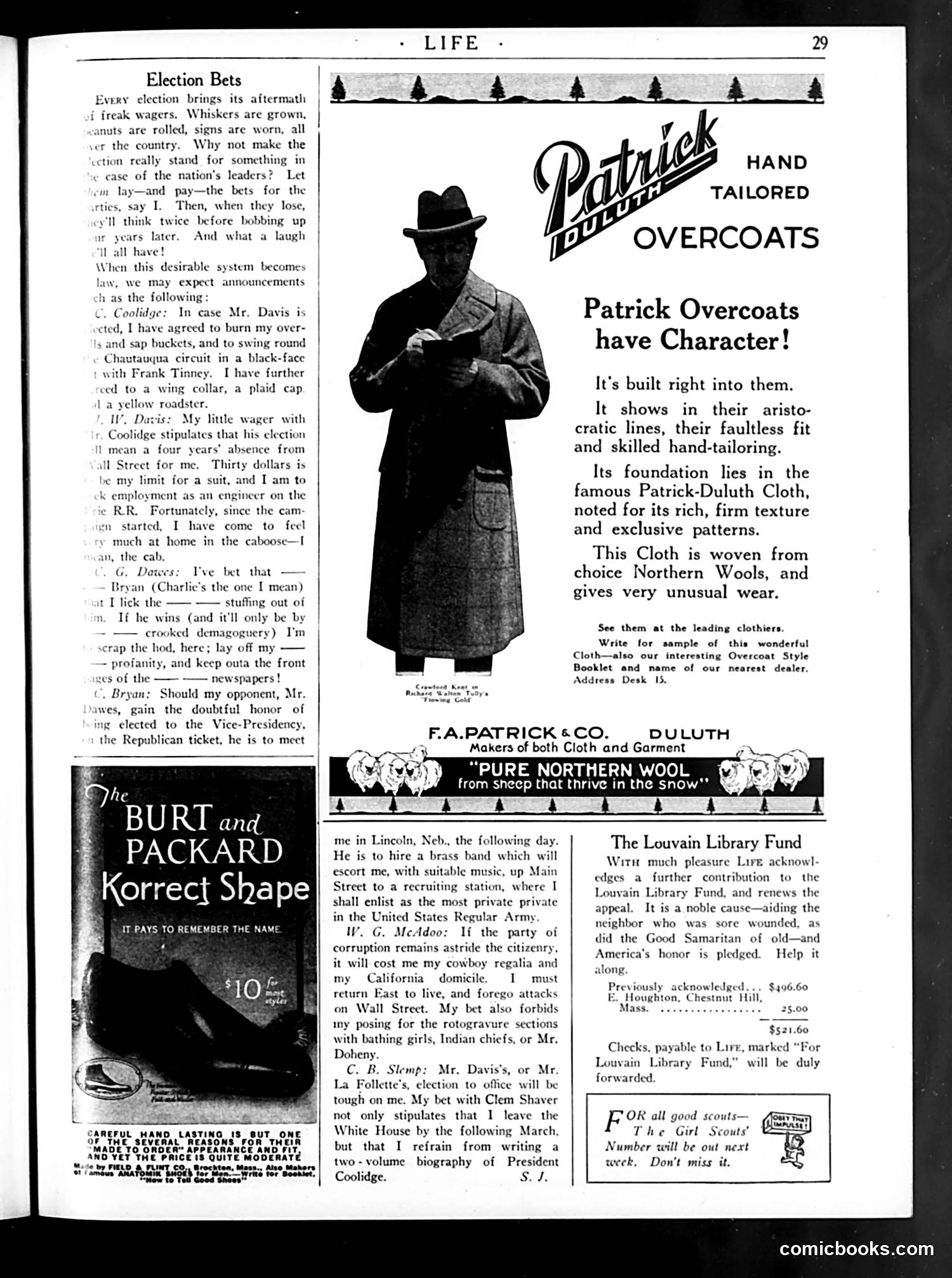
This 1924 *Life* magazine feature satirizes election-year wagering by prominent political figures. The humor lies in increasingly absurd personal bets tied to presidential outcomes—politicians promise humiliating consequences if their candidate loses. The references include: - **Davis vs. Coolidge**: The 1924 presidential race between John W. Davis (Democratic) and Calvin Coolidge (Republican) - **William Jennings Bryan**: The three-time failed presidential candidate, mocked as a "crooked demagogue" - **McAdoo, La Follette, Slemp**: Various political figures making foolish wagers The satire's point: politicians make grandiose public bets they'll never honor, treating serious elections frivolously. The crude language (asterisks replacing profanities) emphasizes the speakers' vulgarity and desperation. The joke mocks both partisan passion and political hypocrisy—these figures claim conviction while making bets they clearly expect to avoid paying.
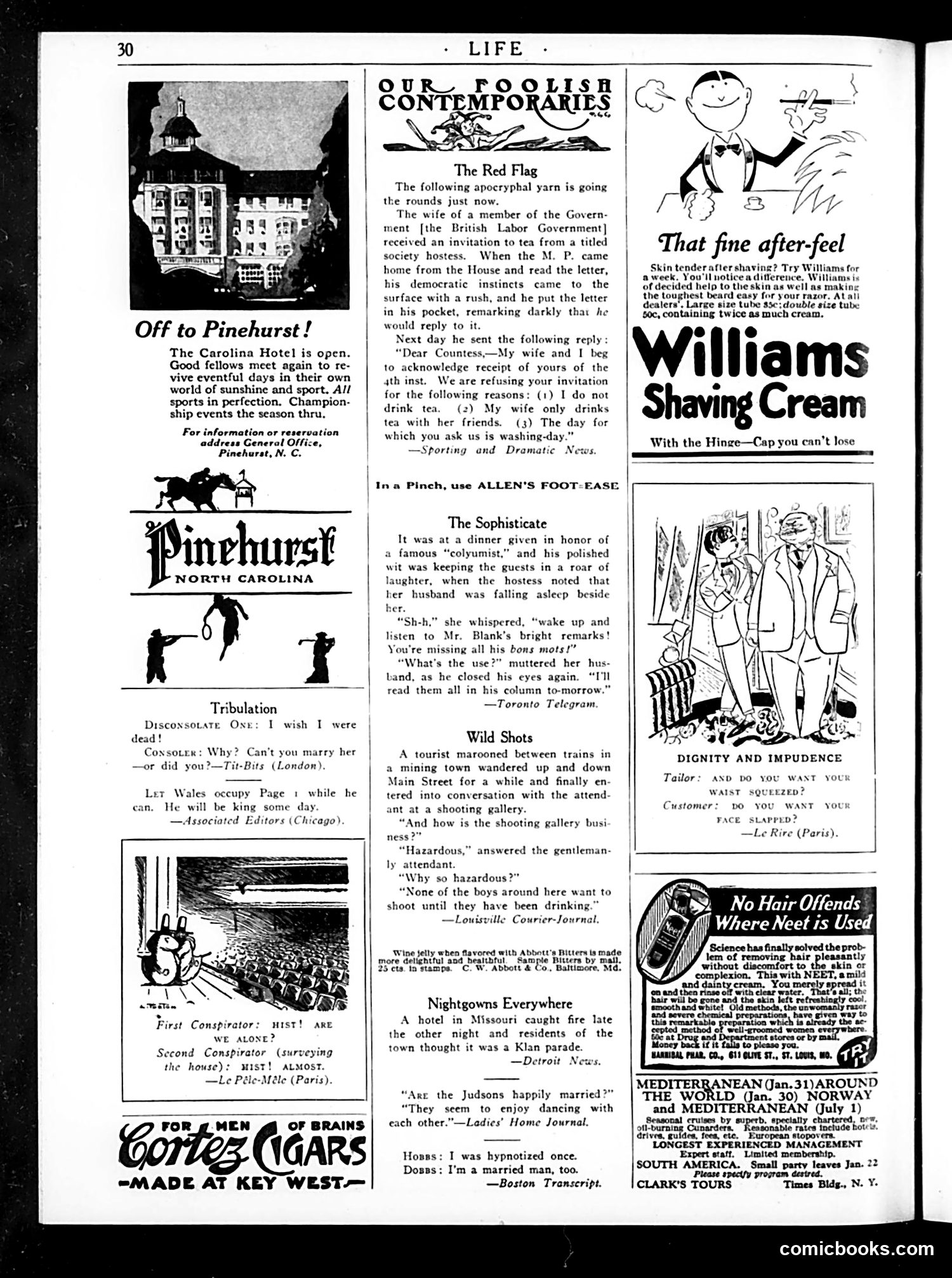
This page contains several short satirical anecdotes mocking British politics and social pretension: **"The Red Flag"** satirizes a British Labor Government MP's ostentatious rejection of upper-class hospitality. The joke: his democratic posturing—refusing a titled hostess's tea invitation with reasons like "washing day"—reveals performative radicalism rather than genuine principle. **"The Sophisticate"** mocks intellectual vanity: a famous newspaper columnist's witty dinner remarks bore the host, who admits he'll simply read them in tomorrow's column anyway. **"Wild Shots"** and smaller jokes target small-town American culture and human absurdity. The page is predominantly **advertising** (Williams Shaving Cream, Neet hair removal, Cortez Cigars, hotel promotions), typical of 1920s Life magazine layout. The cartoons use simple line drawings to illustrate these brief anecdotes—visual gags accompanying written humor rather than standalone political commentary.
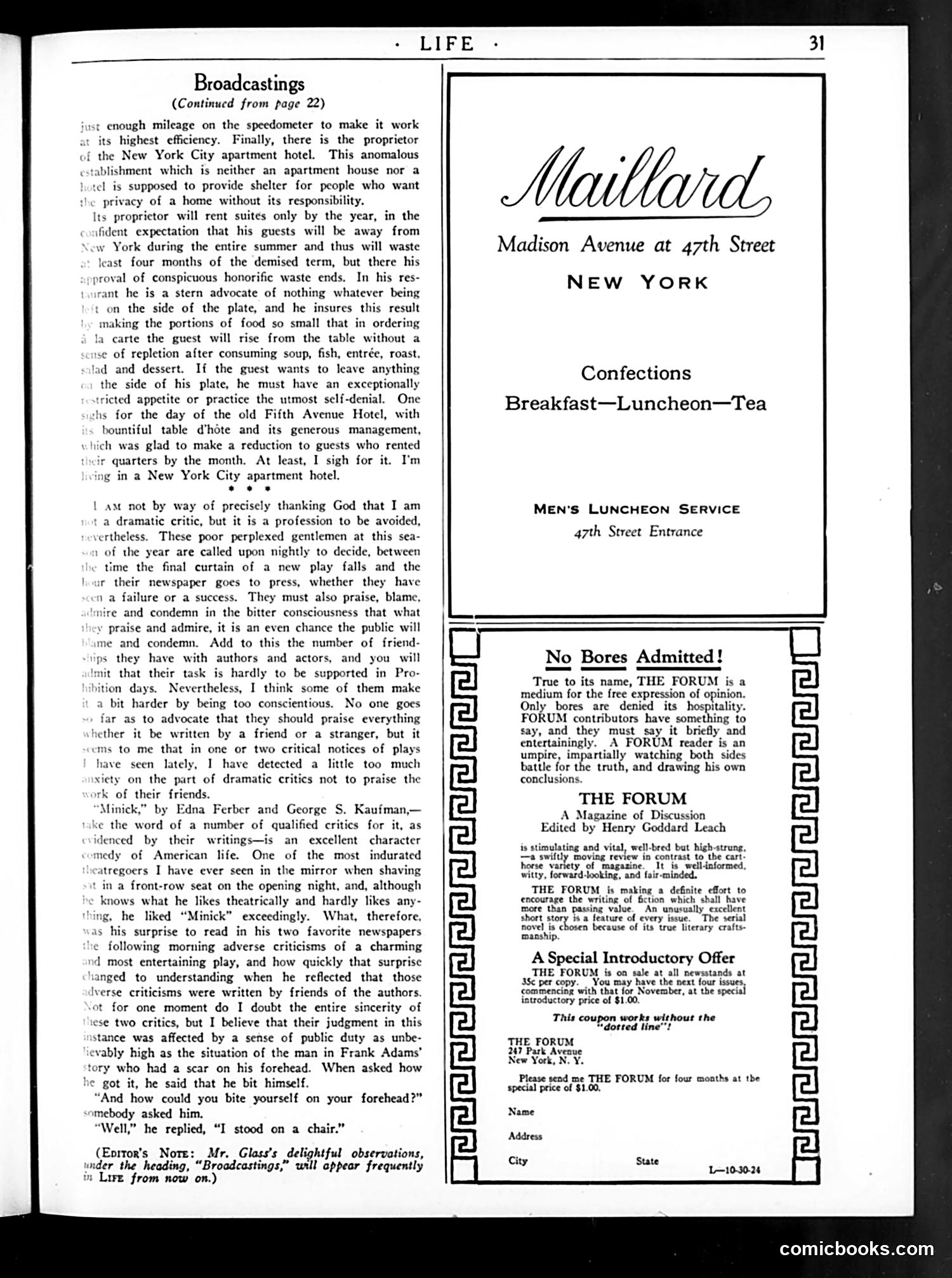
This page is primarily a **satirical essay** rather than a cartoon. The author critiques three New York establishments and professions: 1. **Apartment hotels**: Mocked for renting yearly while expecting guests to be absent four months, then serving absurdly tiny portions to discourage appetite—a contradiction of hospitality. 2. **Dramatic critics**: The main target. The author argues critics face impossible pressure deciding a play's success/failure nightly, then praising or condemning it. He illustrates how friendship bias corrupts judgment, citing negative reviews of "Minick" (a Ferber-Kaufman play) written by the authors' friends—supposedly from excessive "public duty" rather than honest critique. The Frank Adams anecdote at the end satirizes this contorted logic: a man bit his own forehead by standing on a chair—absurd, yet matching the critics' self-defeating behavior. The piece advocates for honest criticism independent of friendship obligations.
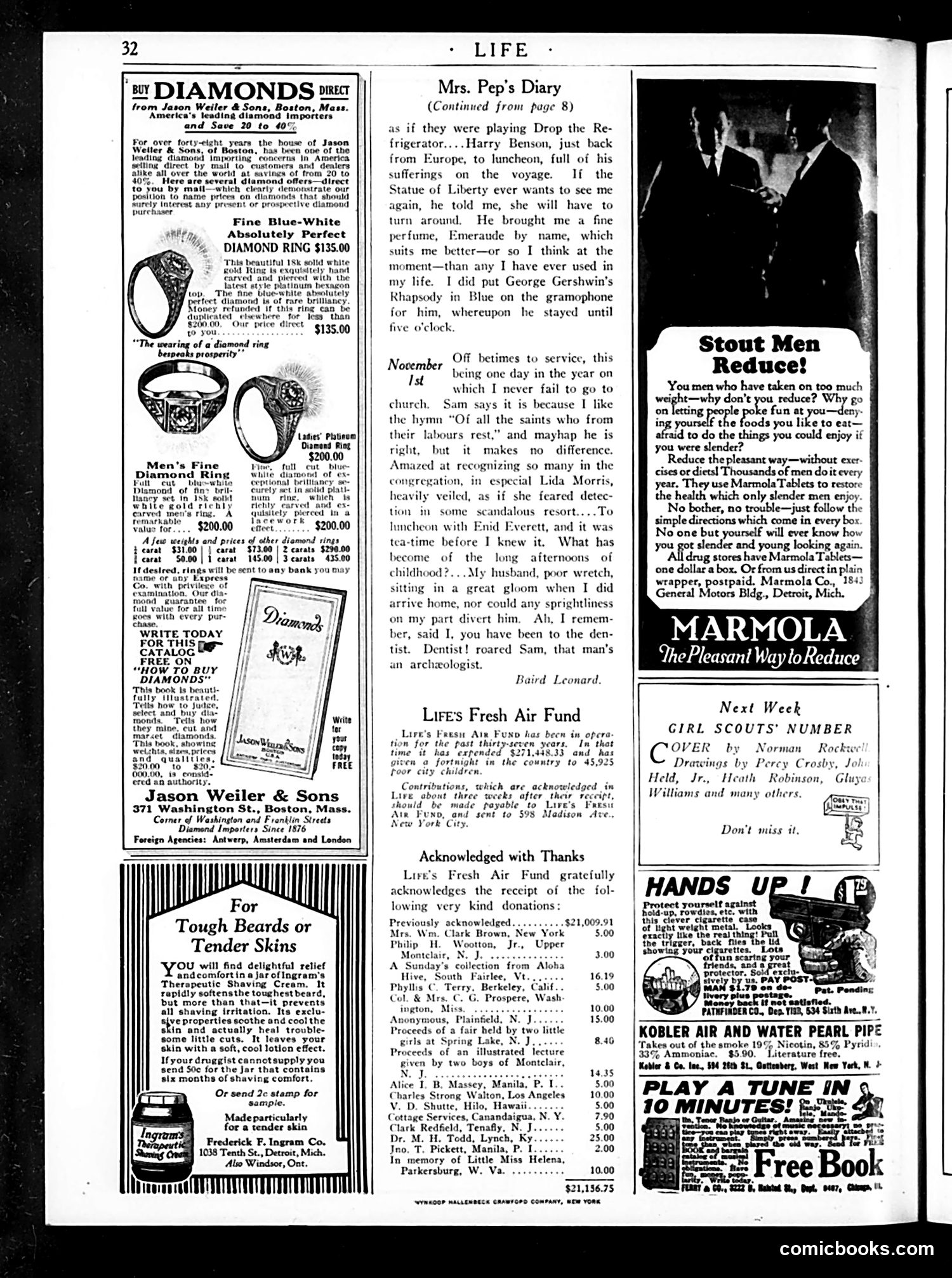
This page is primarily **advertising** rather than satirical content. The dominant features are commercial ads: 1. **Diamonds** (Jason Weiler & Sons): A Boston diamond importer selling rings at $135-$200 directly to consumers, claiming 20-40% savings versus retail. 2. **Ingram's Shaving Cream**: Marketed to men with "tough beards or tender skins," emphasizing comfort and preventing irritation. **Editorial Content:** - **Mrs. Pep's Diary** (continued column): A gossip-style diary entry describing social visits, including a reference to someone returning from Europe with complaints about voyage seasickness. - **LIFE's Fresh Air Fund**: A charity appeal documenting donations to send poor children to the country, showing contributions ranging from $3-$25. The page reflects 1920s-era consumer culture (jewelry, grooming products) and social concerns (child welfare charity). There are no political cartoons or satirical commentary visible. This is a typical magazine issue mixing advertising with light social commentary and charitable appeals.
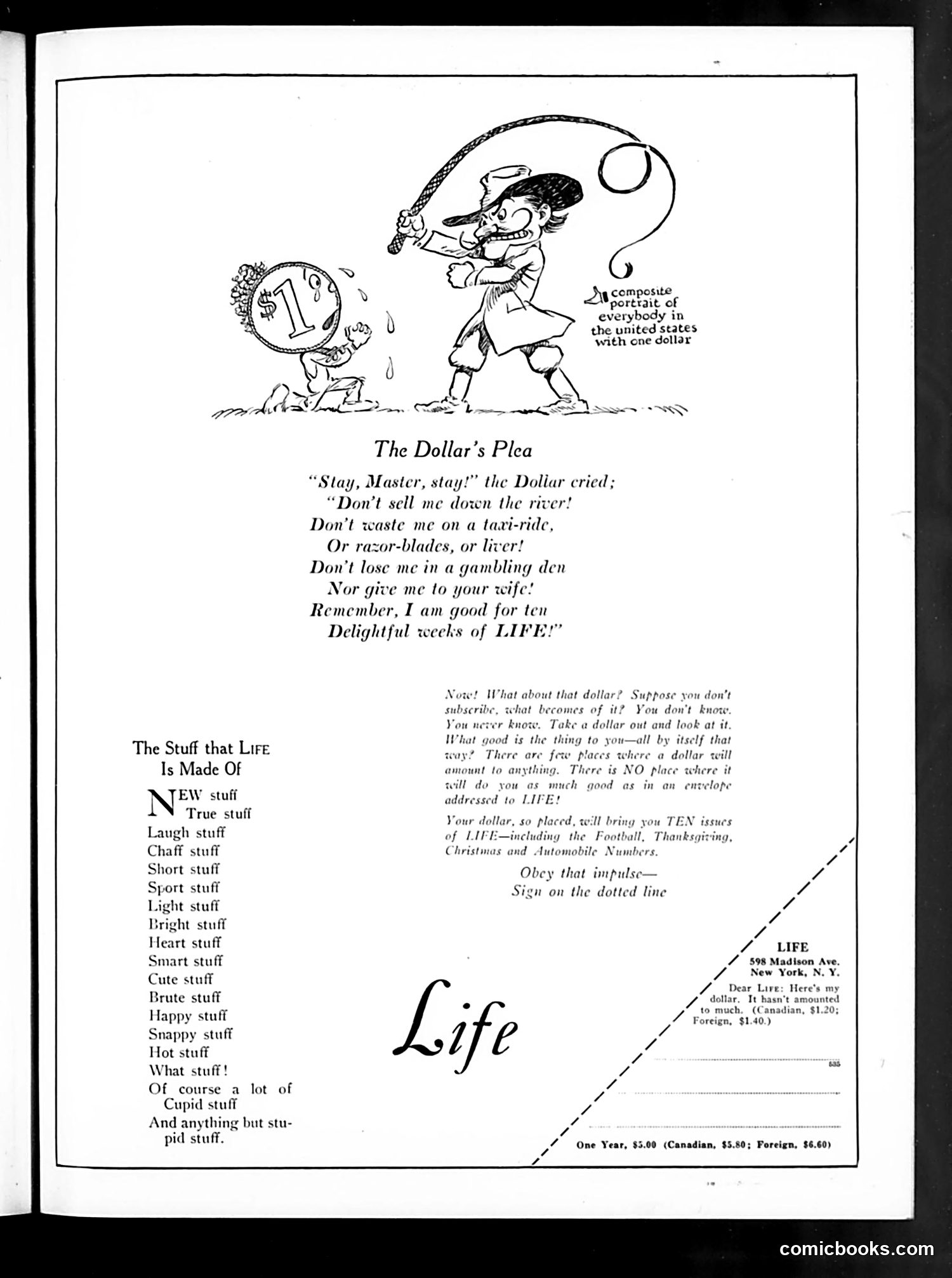
This is a satirical advertisement for *Life* magazine disguised as a humorous plea. The cartoon depicts a personified dollar bill literally begging its owner not to waste it on frivolous expenses—taxi rides, razors, gambling, or giving it to one's wife—and instead subscribe to *Life* for ten weeks. The joke targets consumer spending habits of the era: the dollar warns against the various wasteful ways Americans squander money. The advertisement's ironic premise is that subscribing to *Life* is the *only* worthwhile use for a dollar, making it simultaneously self-promoting and satirical about American consumer culture. The left sidebar listing "The Stuff that Life Is Made Of" (laugh stuff, smart stuff, etc.) reinforces the magazine's appeal as offering substantive, quality entertainment compared to frivolous spending.
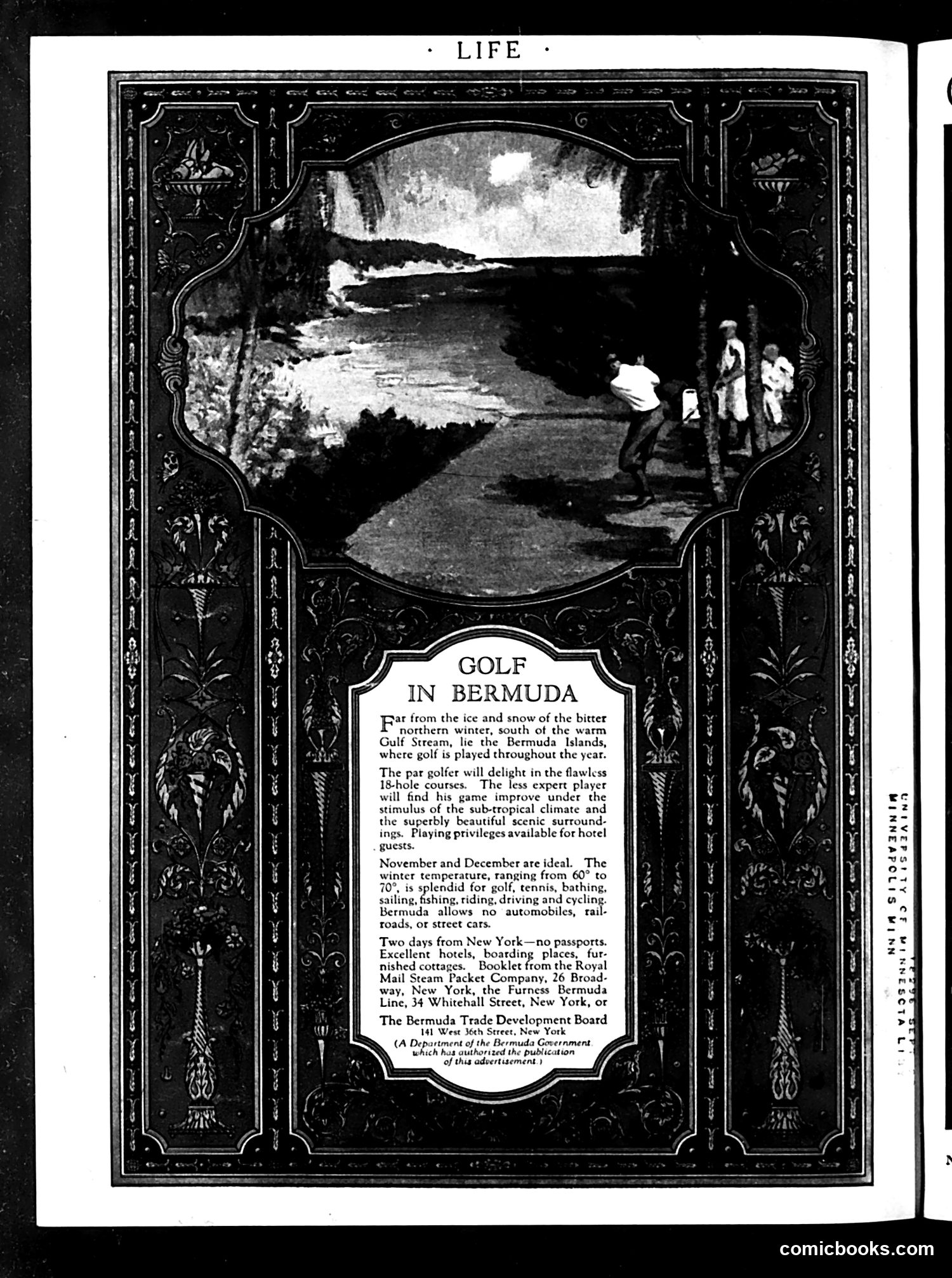
This page is primarily a **tourism advertisement** for Bermuda, not political satire. It promotes Bermuda as a winter golf destination, emphasizing its advantages over the "bitter northern winter" of the American Northeast. The key selling points include: - Year-round golfing on "flawless 18-hole courses" - Warm subtropical climate (60-70°F in November-December) - Additional activities: tennis, sailing, fishing, riding, cycling - No automobiles, railroads, or street cars (positioning it as peaceful/exclusive) - Accessibility: "Two days from New York—no passports" - Luxury accommodations for "hotel guests" The photograph shows golfers on a scenic course overlooking water and landscape. This represents early 20th-century affluent leisure marketing, targeting wealthy Americans seeking winter escapes. The advertisement appears authorized by the Bermuda government's Trade Development Board.