
Life, 1924-10-30 · page 24 of 36
Life — October 30, 1924 — page 24: what you’re looking at
What you’re looking at
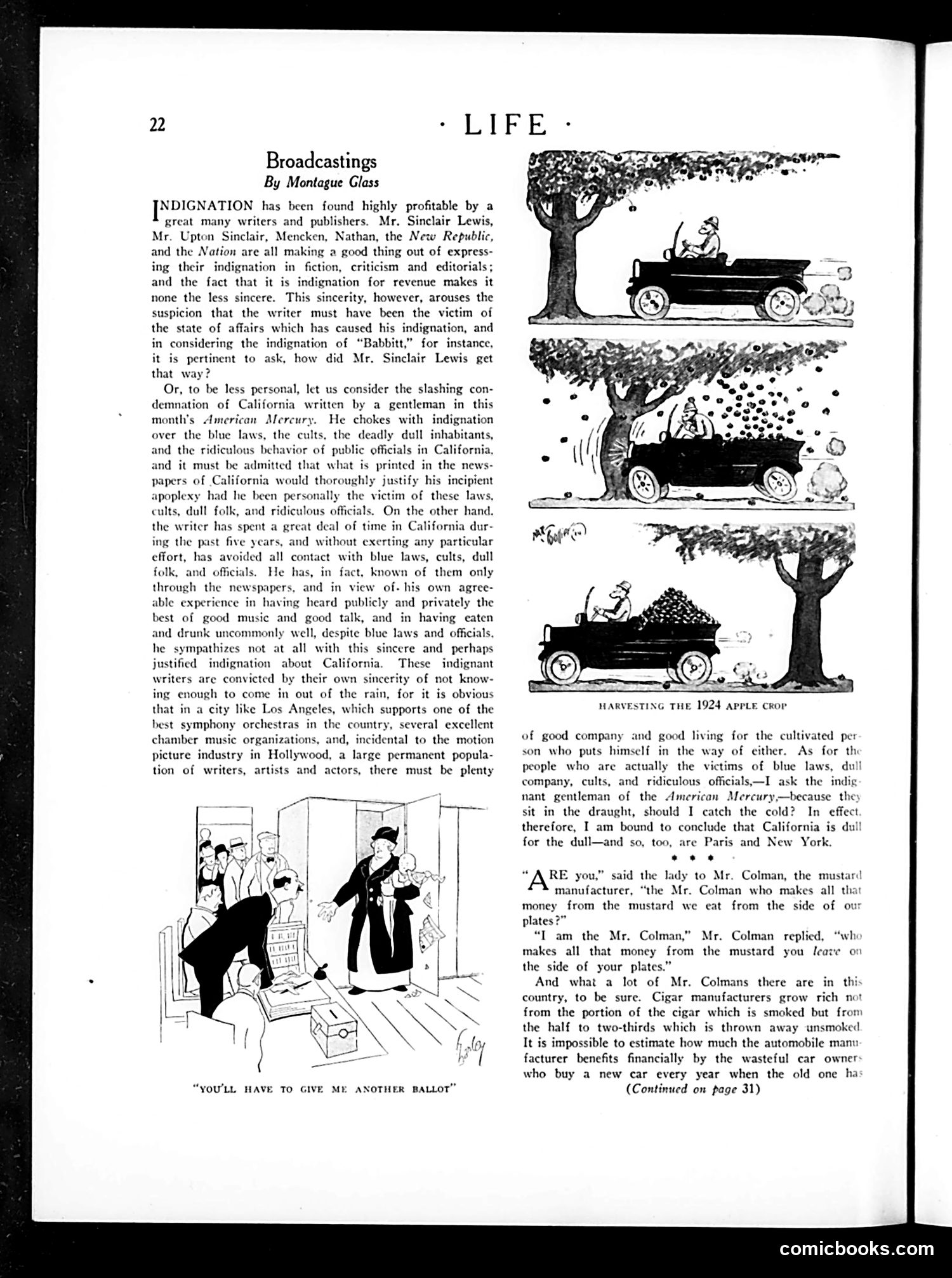
This page contains two satirical pieces by Montague Glass in *Life* magazine: **"Broadcastings" essay:** Glass critiques prominent writers (Sinclair Lewis, Upton Sinclair, H.L. Mencken) who profit from expressing moral indignation about social problems in their work. He argues they attack California's "blue laws" (restrictive Puritan legislation) without actually experiencing the hardships they condemn—they've enjoyed good music, food, and company while avoiding the laws themselves. His point: their righteous anger rings hollow when they haven't genuinely suffered the injustices they denounce. **Bottom cartoon:** Titled "You'll Have to Give Me Another Ballot," it appears to reference voting/ballot issues, likely related to 1924 elections, though the specific context is unclear from the image alone. **"Harvesting the 1924 Apple Crop" illustrations:** Three sequential truck cartoons showing apples being loaded, presumably commenting on agricultural commerce or economic productivity during that period. The overall theme critiques intellectual hypocrisy and performative outrage for profit—a surprisingly modern concern.
📄 Transcribed text from this page (OCR, searchable)
Machine-transcribed from the original scan — historical spelling and the odd misread are preserved.
Broadcastings By Montague Glass NDIGNATION has been found highly profitable by a great many writers and publishers. Mr. Sinclair Lewis, Mr. Upton Sinclair, Mencken, Nathan, the New Republic, and the Nation are all making a good thing out of express- ing their indignation fiction, criticism and editorials; and the fact that it is indignation for revenue makes it none the less sincere. This sincerity, however, arouses the suspicion that the writer must have been the im of the state of affairs which has caused his indignation, and in considering the indignation of “Babbitt,” for instance, it is pertinent to ask, how did Mr. Sinclair Lewis get that way? Or, to be less personal, let us consider the slashing con- demnation of California written by a gentleman in this month's American Mercury. He chokes with indignation over the blue laws, the cults, the deadly dull inhabitants, and the ridiculous behavior of public officials in California, and it must be admitted that what is printed in the ne papers of California would thoroughly justify his incipient apoplexy had he been personally the victim of these laws, cults, dull folk, and ridiculous officials. On the other hand. the writer has spent a great deal of time in California dur- ing the past five years, and without exerting any particular effort, has avoided all contact with blue laws, cults, dull folk, and officials. He has, in fact, known of them only through the newspapers, and in view of. his own agree- able experience in having heard publicly and privately the best of good music and good talk, and in having eaten and drunk uncommonly well, despite blue laws and officials, he sympathizes not at all with this sincere and perhaps justified indignation about California. These indignant writers are convicted by their own sincerity of not know- ing enough to come in out of the in, for it is obvious that in a city like Los Angeles, which supports one of the best symphony orchestras in the country, several excellent chamber music organizations, and, incidental to the motion picture industry in Hollywood, a large permanent popula- tion of writers, artists and actors, there must be plenty “YOU'LL HAVE TO GIVE ME ANOTHER BALLOT” HARVESTING THE 1924 APPLE Cror of good company and good living for the cultivated per son who puts himself in the way of either. As for the people who are actually the victims of blue laws, dull company, cults, and ridiculous officials—I ask the indig nant gentleman of the American Mercury—because the sit in the draught, should I catch the cold? In effect therefore, I am bound to conclude that California is dul! for the dull—and so, too, are Paris and New York. eee “A RE you,” said the lady to Mr. Colman, the mustard manufacturer, “the Mr. Colman who makes all tha money from the mustard we eat from the side of our “Tam the Mr. Colman,” Mr. Colman replied, “whi makes all that money from the mustard you [eave on the side of your plates.” And what a lot of Mr. Colmans there are in thi country, to be sure. Cigar manufacturers grow rich not from the portion of the cigar which is smoked but from the half to two-thirds which is thrown away unsmoked It is impossible to estimate how much the automobile manu. facturer benefits financially by the wasteful car owner who buy a new car every year when the old one ha (Continued on page 31) comicbooks.com