
Life, 1924-10-30 · page 20 of 36
Life — October 30, 1924 — page 20: what you’re looking at
What you’re looking at
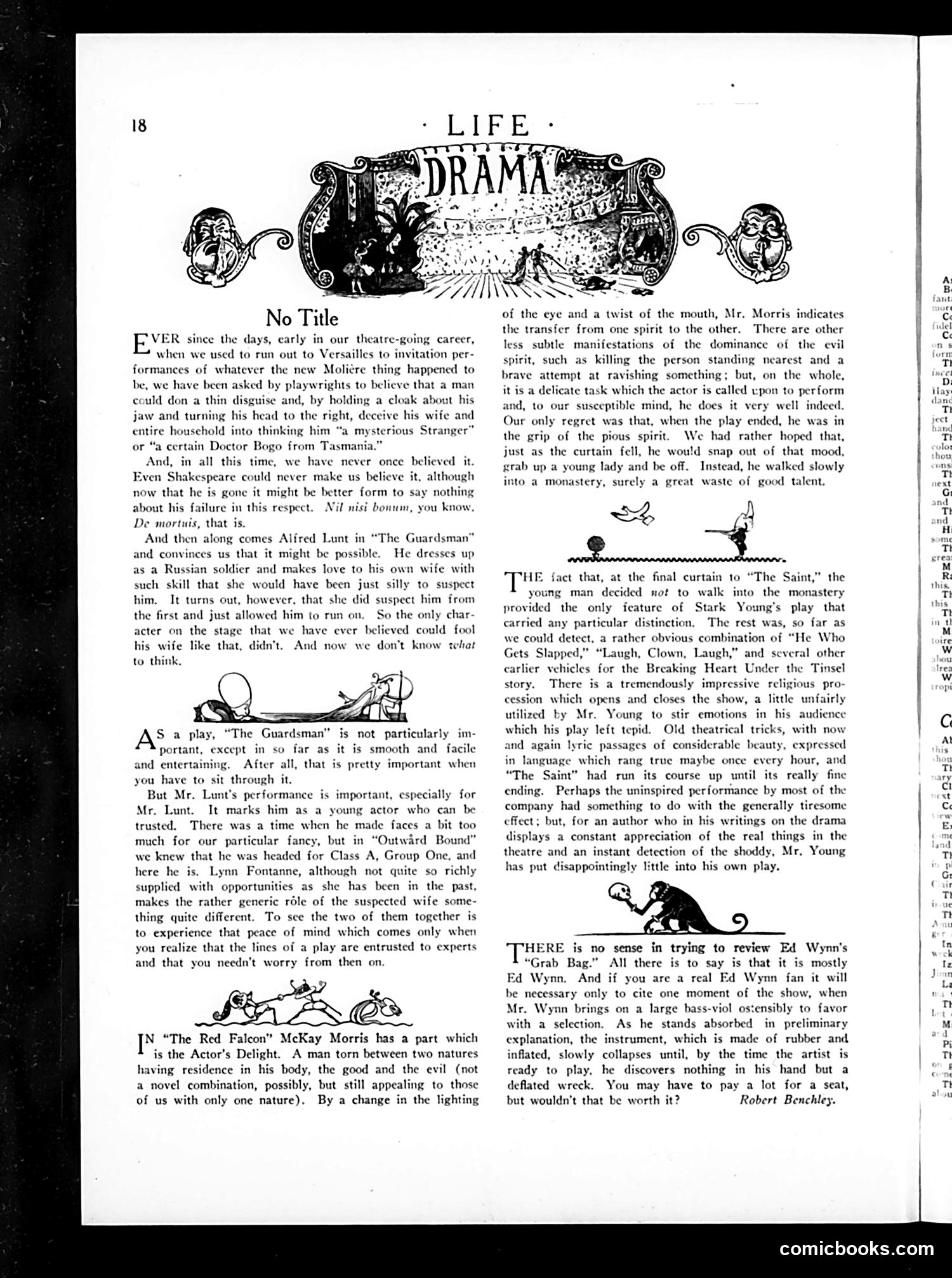
This is a theater criticism column reviewing several contemporary Broadway plays. The page contains no political cartoons—instead, it features decorative theatrical vignettes and discusses acting performances. The critic reviews four plays: *The Guardsman* (praising Alfred Lunt's ability to convincingly disguise himself as a Russian soldier to seduce his own wife), *The Red Falcon* (noting McKay Morris's skill depicting a man torn between good and evil impulses through subtle facial expressions), and *The Saint* (critiquing Stark Young's derivative plot that borrows from earlier plays like "He Who Gets Slapped"). The humor is theatrical rather than political—the critic expresses surprise that Lunt actually succeeds where Shakespeare failed: making an audience believe a thin disguise could fool someone. The tone is urbane and sophisticated, typical of Life magazine's drama coverage for educated readers interested in Broadway productions of this era.
📄 Transcribed text from this page (OCR, searchable)
Machine-transcribed from the original scan — historical spelling and the odd misread are preserved.
VER since the days, early in our theatre-going career, when we used to run out to Versailles to invitation per- formances of whatever the new Moliére thing happened to be, we have been asked by playwrights to believe that a man could don a thin disguise and, by holding a cle bout his jaw and turning his head to the right, deceive his wife and entire household into thinking him “a mysterious Stranger” or “a certain Doctor Bogo from Tasmania.” And, in all this time, we have never once believed it. Even Shakespeare could never make us believe it, although now that he is gone it might be better form to say nothing about his failure in this respect. Nil nisi bonwm, you know, De mortuis, that is. And then along comes Alfred Lunt in “The Guardsman” and convinces us that it might be possible. He dresses up as a Russian soldier and makes love to his own wife with such skill that she would have been just silly to suspect him. It turns out, however, that she did suspect him from the first and just allowed him to run on. So the only char- acter on the stage that we have ever believed could fool his wife like that, didn’t. And now we don’t know what to think, AS a play, “The Guardsman” js not particularly im- portant, except in so far as it is smooth and _ facile and entertaining. After all, that is pretty important when you have to sit through it. But Mr. Lunt's performance is important, especially for Mr. Lunt. It marks him as a young actor who can be trusted. There was a time when he made faces a bit too much for our particular fancy, but in “Outward Bound” we knew that he was headed for Class A, Group One, and here he is. Lynn Fontanne, although not quite so richly supplied with opportunities as she has been in the past, makes the rather generic réle of the suspected wife some- thing quite different. To sce the two of them together is to experience that peace of mind which comes only when you realize that the lines of a play are entrusted to experts and that you needn't worry from then on. y N “The Red Falcon” McKay Morris has a part which is the Actor’s Delight. A man torn between two natures having residence in his body, the good and the evil (not a novel combination, possibly, but still appealing to those of us with only one nature). By a change in the lighting of the eye and a twist of the mouth, Mr. Morris indicates the transfer from one spirit to the other. There are other less subtle manifestations of the dominance of the evil irit, such as killing the person standing nearest and a attempt at ravishing something; but, on the whole, it is a delicate task which the actor is called upon to perform and, to our susceptible mind, he does it very well indeed. Our only regret was that, when the play ended, he was in the grip of the pious spirit. We had rather hoped that, just as the curtain fell, he would snap out of that mood, grab up a young lady and be off. Instead, he walked slowly into a monastery, surely a great waste of good talent. = THe fact that, at the final curtain to “The Saint,” the young man decided not to walk into the monastery provided the only feature of Stark Young's play that carried any particular distinction. The rest was, so far as we could detect, a rather obvious combination of “He Who Gets Slapped,” igh, Clown, Laugh,” and several other carlier vehicles for the Breaking Heart Under the Tinsel story. There is a tremendously impressive religious pro- cession which opens and closes the show, a little unfairly utilized by Mr. Young to stir emotions in his audience which his play left tepid. Old theatrical tricks, with now and again lyric passages of considerable beauty, expressed in language which rang true maybe once every hour, and “The Saint” had run its course up until its really fine ending. Perhaps the uninspired performance by most of the company had something to do with the generally tiresome effect; but, for an author who in his writings on the drama displays a constant appreciation of the real things in the theatre and an instant detection of the shoddy, Mr. Young has put disappointingly little into his own play. HERE is no sense in trying to review Ed Wynn's Grab Bag.” All there is to say is that it is mostly Ed Wynn, And if you are a real Ed Wynn fan it will be necessary only to cite one moment of the show, when Mr. Wynn brings on a large bass-viol ostensibly to favor with a selection. As he stands absorbed in preliminary explanation, the instrument, which is made of rubber and inflated, slowly collapses until, by the time the artist is ready to play, he discovers nothing in his hand but a deflated wreck. You may have to pay a lot for a seat, but wouldn't that be worth it? Robert Benchley. comicbooks.com