
Life, 1924-10-30 · page 28 of 36
Life — October 30, 1924 — page 28: what you’re looking at
What you’re looking at
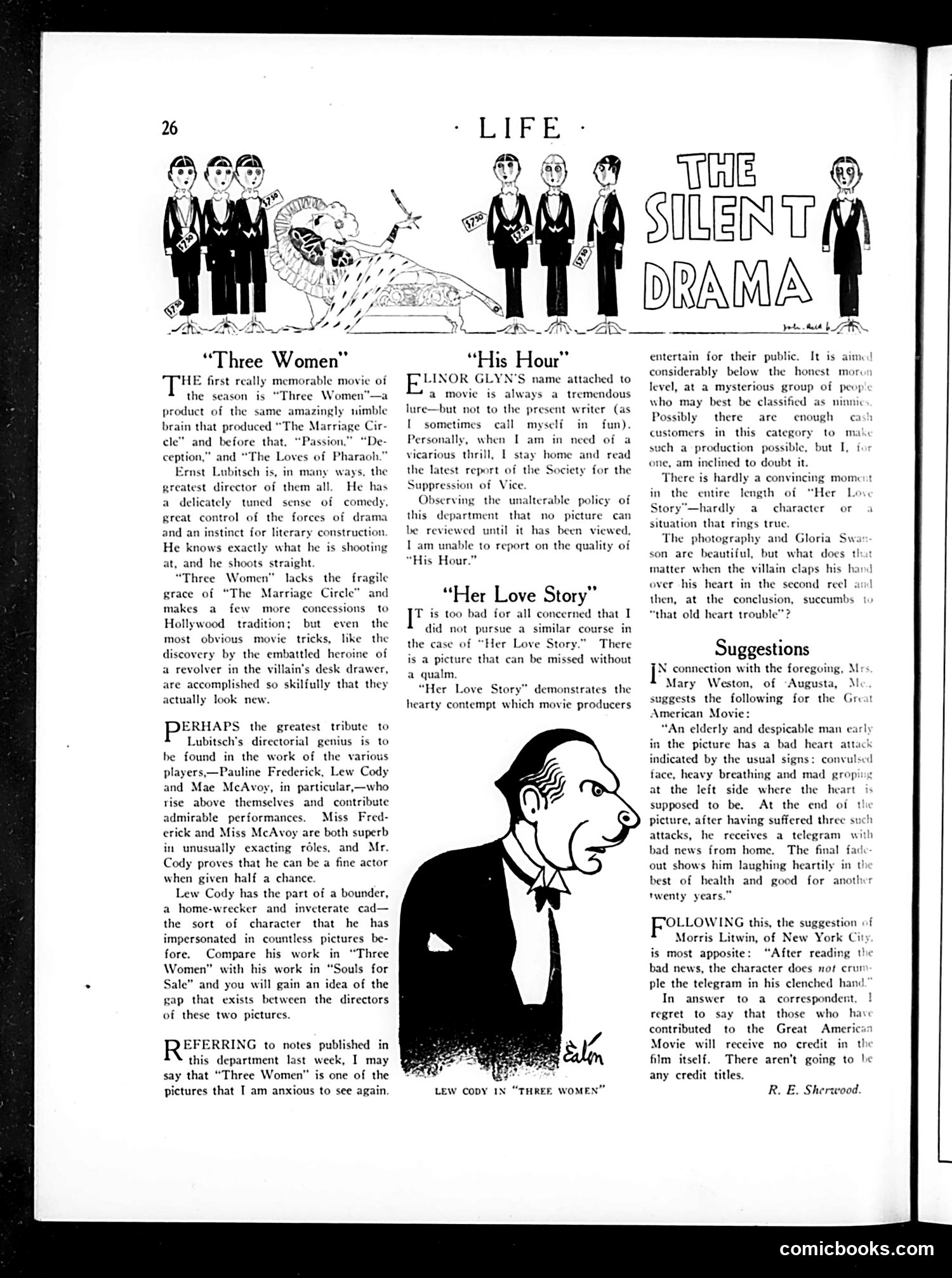
This is a film criticism column reviewing three silent movies from the early 1920s. The main subjects are: **"Three Women"** - Praised as the season's best film, directed by Ernst Lubitsch (a renowned German-American director). The critic admires the performances of actors Pauline Frederick, Lew Cody, and Mae McAvoy, and notes how Lubitsch elevates even hackneyed movie tricks (like finding a revolver in a villain's desk) through skilled direction. **"His Hour"** - Dismissed without review, as the critic's policy requires viewing before criticism. **"Her Love Story"** - Harshly condemned as contemptuous toward audiences, aimed at "ninnies" rather than intelligent viewers. The critic ridicules its melodramatic plot device where a villain with heart trouble conveniently recovers or dies as needed. The page includes reader suggestions for improving the "Great American Movie," satirizing formulaic silent film plotting. A caricature of Lew Cody accompanies the text.
📄 Transcribed text from this page (OCR, searchable)
Machine-transcribed from the original scan — historical spelling and the odd misread are preserved.
oy AA “Three Women” HE first really memorable movie of the season is “Three Women”—a product of the same amazingly nimble brain that produced “The Marriage Cir- cle” and before that, ception,” and “The Loves of Pharaoh.” Ernst Lubitsch is, in ma greatest director of them all, He has a delicately tuned comedy, great control of the forces of drama and an instinct for literary construction He knows exactly w at, and he shoots straight Three Women" lacks the fragile grace of “The Marriage Circle” and makes a few more concessions to Hollywood tradition; but even the most obvious movie tricks, like the discovery by the embattled heroine of a revolver in the villain’s desk drawer, are accomplished so skilfully that they actually look new. PERHAPS the greatest tribute to Lubitsch’s directorial genius is to be found in the work of the various players,—Pauline Frederick, Lew Cody and Mae McAvoy, in particular,—who rise above themselves and contribute admirable performance: Miss Fred- erick and Miss McAvoy are both superb in unusually exacting rdles, and Mr. Cody proves that he can be a fine actor when given half a chance. Lew Cody has the part of a bounder, a home-wrecker and inveterate cad— the sort of character that he has impersonated in countless pictures be- fore. Compare his work in “Three Women” with his work in “Souls for Sale” and you will gain an idea of the gap that exists between the directors of these two pictures. “Passion,” “De- ny ways, the sense of he is shooting EFERRING to notes published in this department last week, I may say that “Three Women” is one of the pictures that I am anxious to see again. Exo GLY) name attached to a movie is always a tremendous lure—but not to the present writer (as I sometimes myself in fun). Personally, when I am in need of a vicarious thrill, 1 stay home and read est report of the Society for the Suppression of Vice call Observing the unalterable policy of this department that no picture can be reviewed until it has been viewed, I am unable to report on the quality of “His Hour.” “Her Love Story” T is too bad for all concerned that I did not pursue a similar course in the ¢ Story.” There is a picture that can be missed without a qualm. “Her Love Story” demonstrates the hearty contempt which movie producers se of “Her Lov LEW CODY IN “THREE WOMEN” entertain for their public. It is aimed considerably below the honest m level, at a mysterious group of peor who may best be classified as ninnic Possibly there are enough — ca customers in this category to make such a production possible, but I, f on m inclined to doubt it. There is hardly a convincing moment in the entire length of “Her Love Story"—hardly a character or situation that rings true. The photography and Gloria Sw son are beautiful, but what does tl matter when the villain claps his hand over his heart in the second reel « then, at the conclusion, “that old heart trouble”? succumbs tv Suggestions ] ‘ connection with the foregoing, Mrs Mary Weston, of ‘Augusta, M suggests the following for the G American Movie: “An elderly and despicable man early in the picture has a bad heart attack indicated by the usual signs: convulsed face, heavy breathing and mad grop at the left side where the heart supposed to be. At the end of t picture, after having suffered three sw! attacks, he receives bad news from home. The final fac out shows him laughing heartily int best of health and good for twenty years.” ano! 'OLLOWING this, the suggestion of Morris Litwin, of New York City is most apposite: “After reading the bad news, the character does not crur ple the telegram in his clenched hanc In answer to a correspondent, regret to say that those who havc contributed to the Great American Movie will receive no credit in tl film itself. There aren't going to be any credit titles. R. E. Sherwood. comicbooks.com