
A complete issue · 36 pages · 1924
Life — October 9, 1924
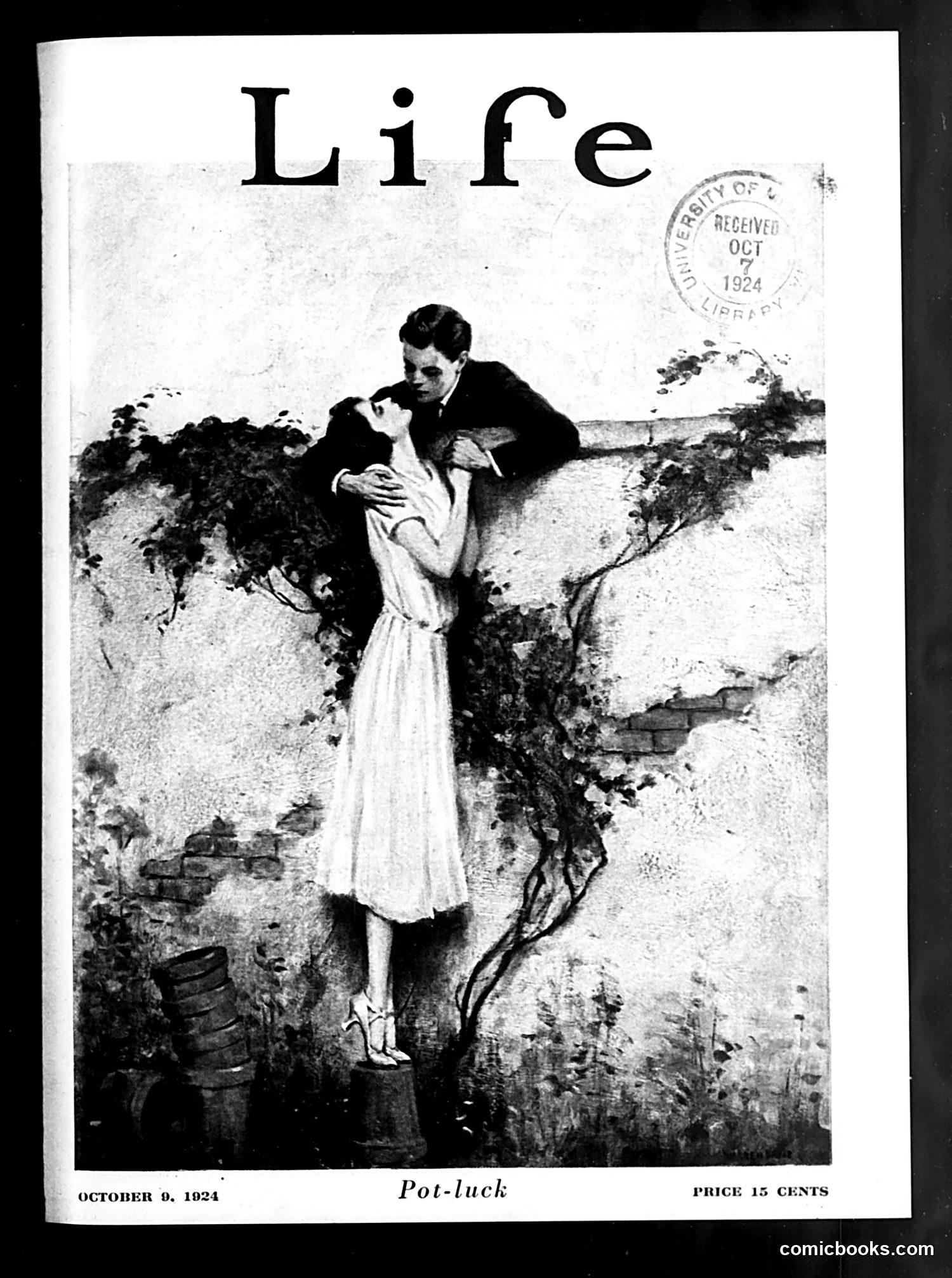
This cover illustrates the phrase "pot-luck," a common expression meaning uncertain or unpredictable results. The image shows a couple in an outdoor, rural setting near what appears to be a cooking pot or fire. The man is embracing a woman in a white dress against a backdrop of sparse vegetation and sandy/barren landscape. The "pot-luck" reference likely plays on courtship or romantic outcomes—suggesting that romance, like a pot-luck dinner, involves chance and unpredictability. The modest price of 15 cents and the period styling indicate this reflects 1920s attitudes toward dating and relationships. The satire appears gentle rather than biting, using domestic/romantic themes typical of Life's lighter social commentary during this era.
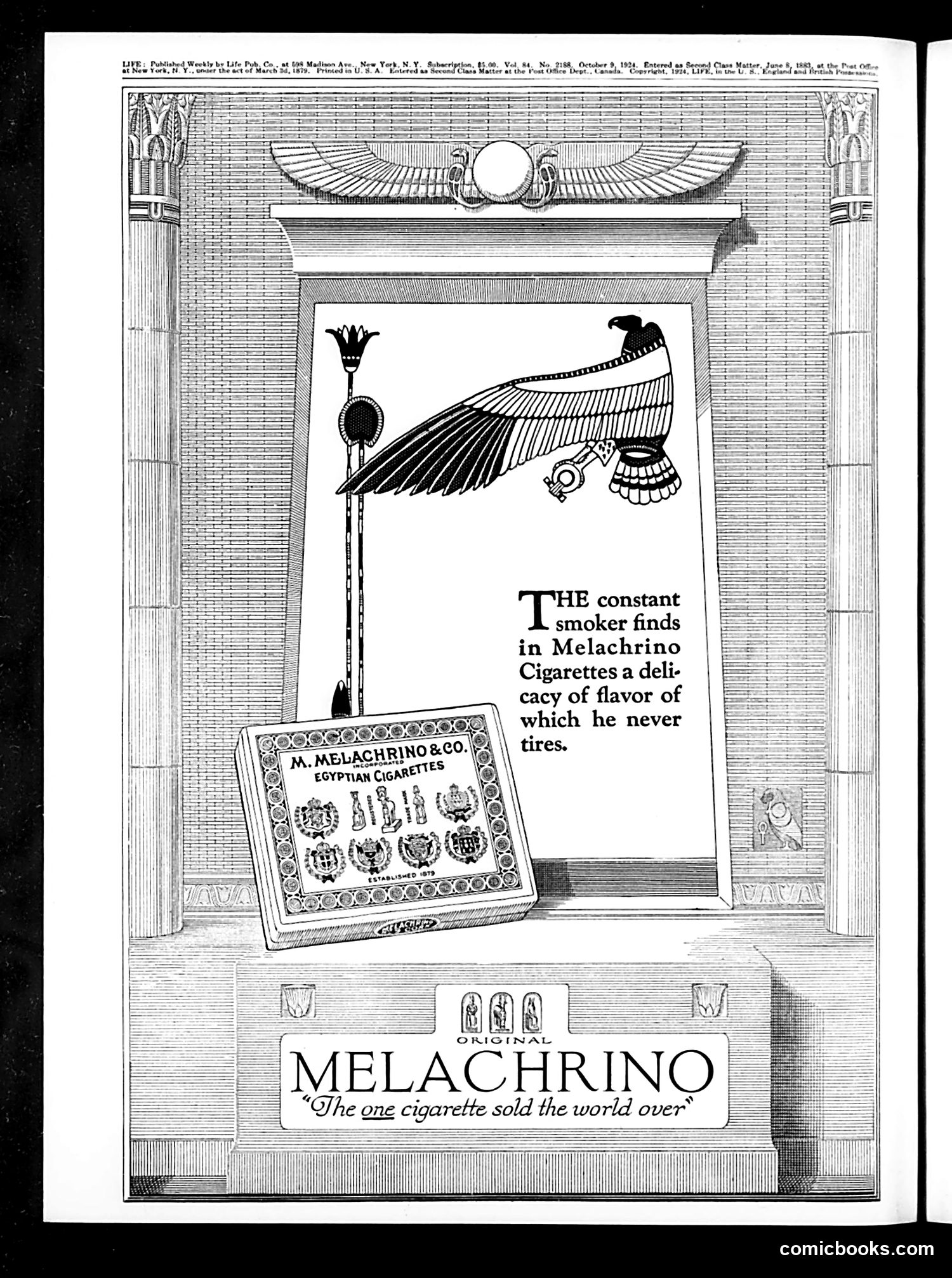
This is a **cigarette advertisement**, not political satire. The page promotes "Melachrino" Egyptian cigarettes with the tagline "The one cigarette sold the world over." The ad features Egyptian-themed decorative elements—a winged scarab beetle, lotus flowers, and hieroglyphic-style ornaments—designed to evoke luxury and exotic appeal. An actual Melachrino cigarette package is displayed prominently. The copy claims the product offers "a delicacy of flavor of which he never tires," targeting male smokers seeking premium cigarettes. This reflects **early 20th-century advertising strategy**: using historical/cultural imagery to suggest quality and prestige. Egyptian motifs were fashionable in the 1920s-30s following Tutankhamun's tomb discovery (1922), making them marketable symbols of sophistication and worldliness to Western consumers.
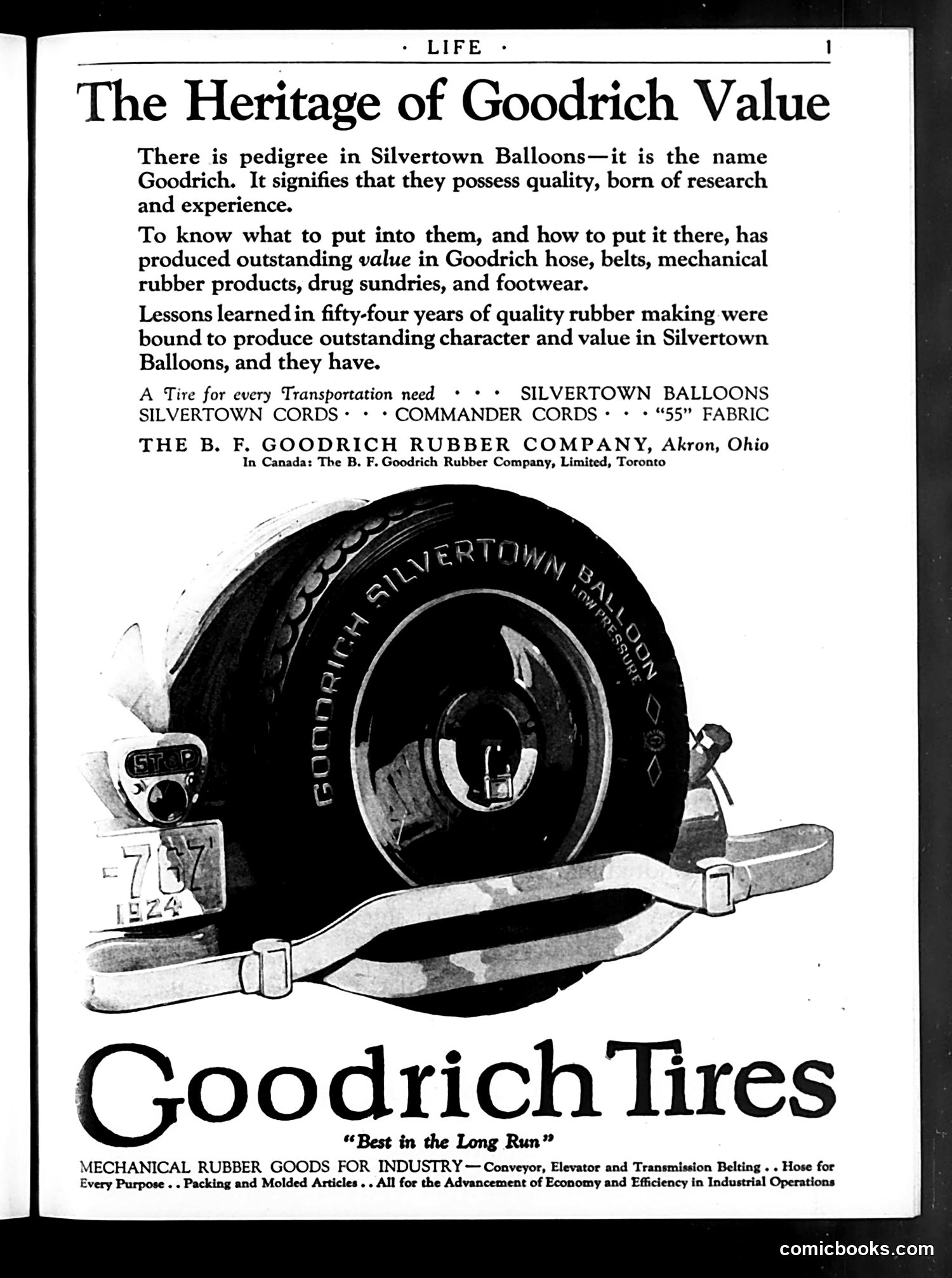
This is **not a political cartoon or satire**—it's a straightforward advertisement for Goodrich Tires and related rubber products from the B.F. Goodrich Rubber Company (Akron, Ohio). The page celebrates Goodrich's heritage and quality, claiming "fifty-four years of quality rubber making" have produced value in various products: balloons, hoses, belts, and footwear. The central image shows a large Silvertown Balloon tire held in cupped hands, emphasizing the product's quality and care in manufacturing. The tagline "Best in the Long Run" and references to "mechanical rubber goods for industry" position Goodrich as a reliable supplier for industrial and transportation needs. This is vintage corporate advertising, not editorial commentary or satire.
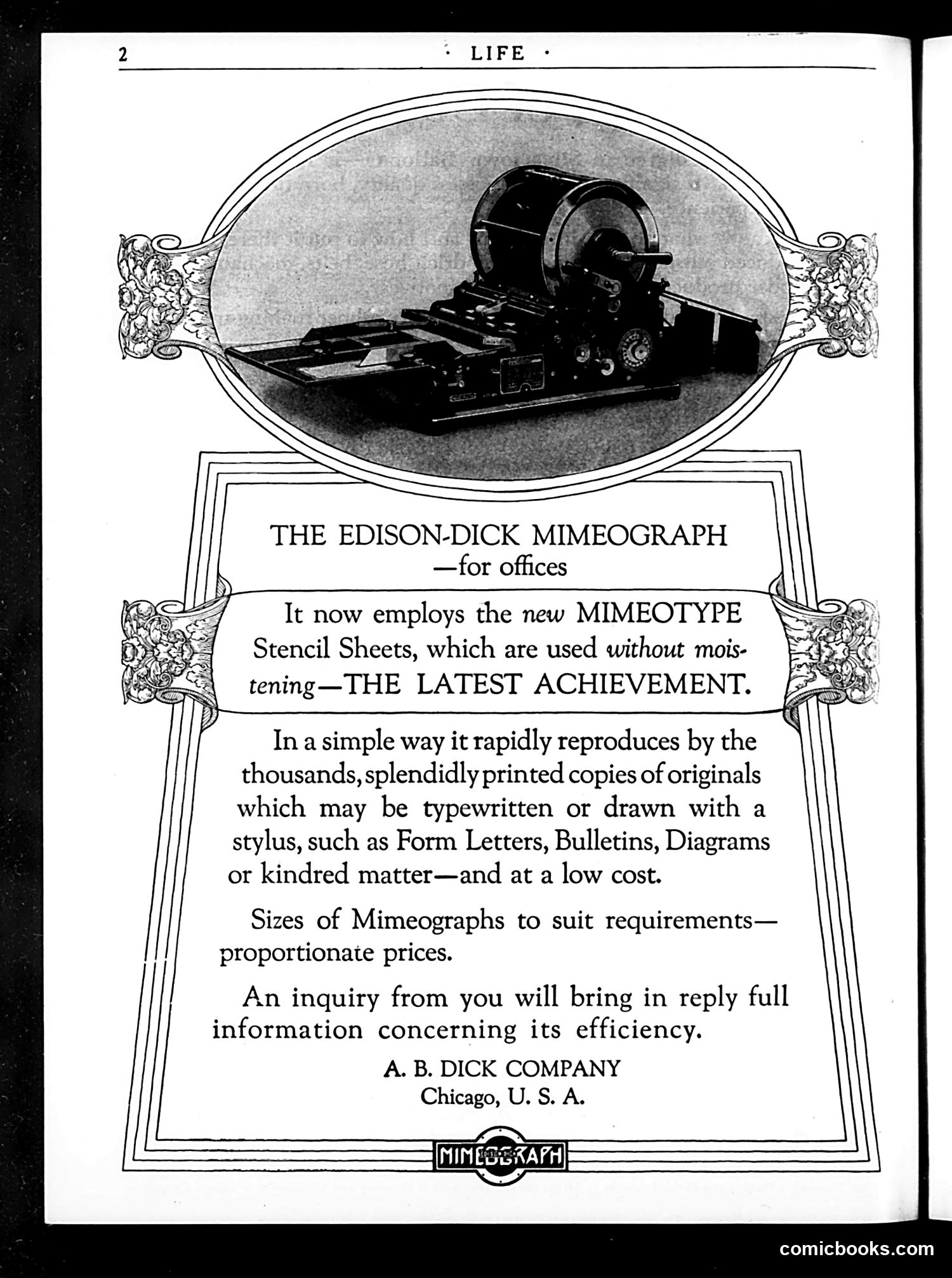
This page is primarily **advertising, not satire or political commentary**. It's a full-page ad for the Edison-Dick Mimeograph, a document reproduction machine marketed for office use. The ad highlights a new feature: "Mimeotype Stencil Sheets, which are used without moistening—THE LATEST ACHIEVEMENT." The machine image shows an industrial copying device typical of early 20th-century office technology. The advertisement emphasizes practical business benefits: rapid reproduction of typewritten or hand-drawn documents (letters, bulletins, diagrams) at low cost, with customizable sizes and proportionate pricing. The company invites inquiries about efficiency. There is no political cartoon, satire, or caricature present—simply a vintage office equipment advertisement from *Life* magazine's pages.
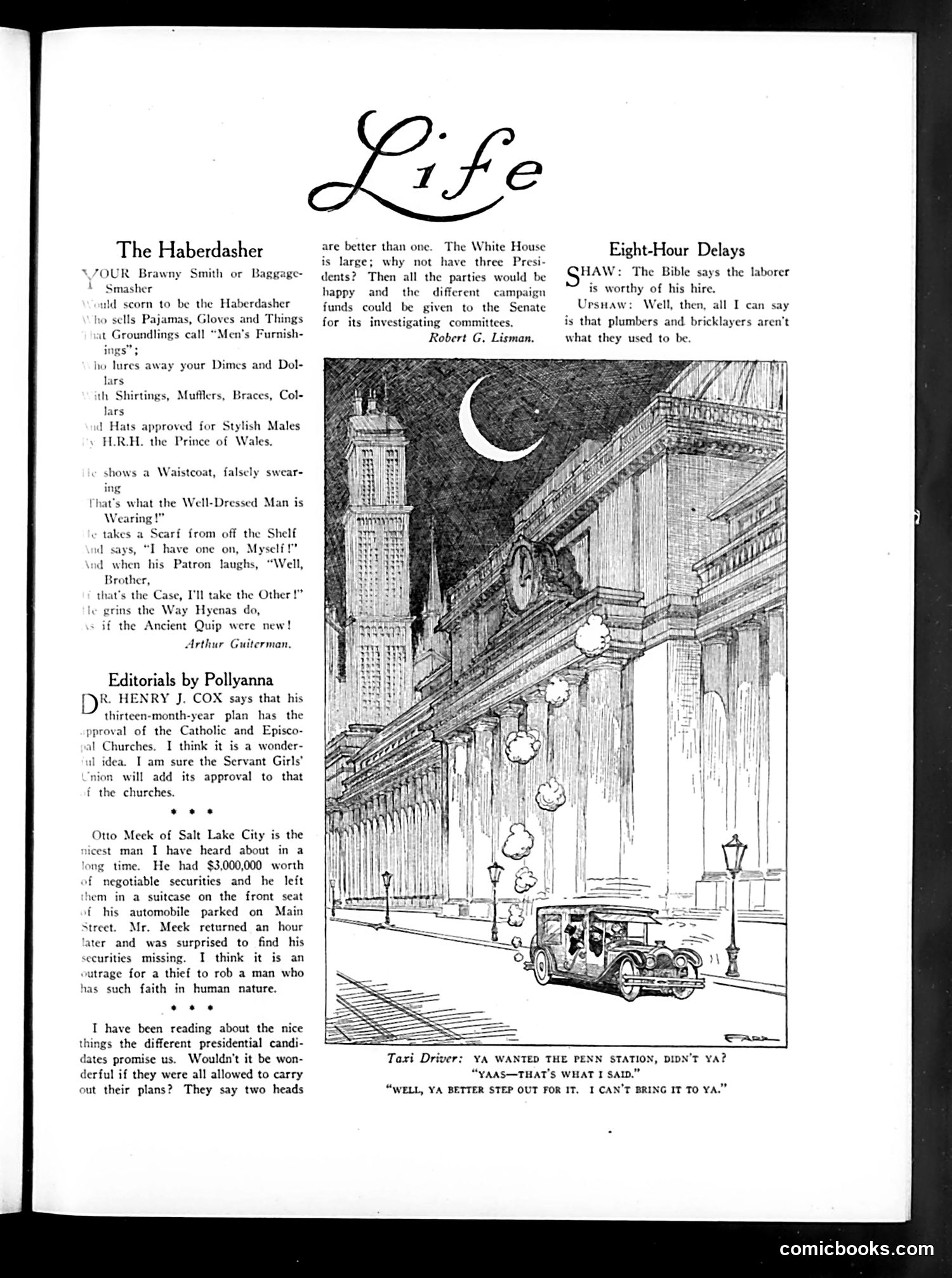
This cartoon satirizes taxi service in what appears to be a major American city (likely New York, given the architectural style). A taxi driver has taken a passenger to the wrong location—the Penn Station instead of where requested. When confronted, the driver insouciantly responds that the passenger should get out and walk, or he cannot retrieve it. The joke plays on labor disputes of the era. The caption "Eight-Hour Delays" references the eight-hour workday labor movement. The satire suggests that improved working conditions for taxi drivers have paradoxically degraded service quality—drivers now work shorter hours but provide worse service, leaving passengers stranded and frustrated. It's a critique of how labor reforms allegedly harmed consumer experience.
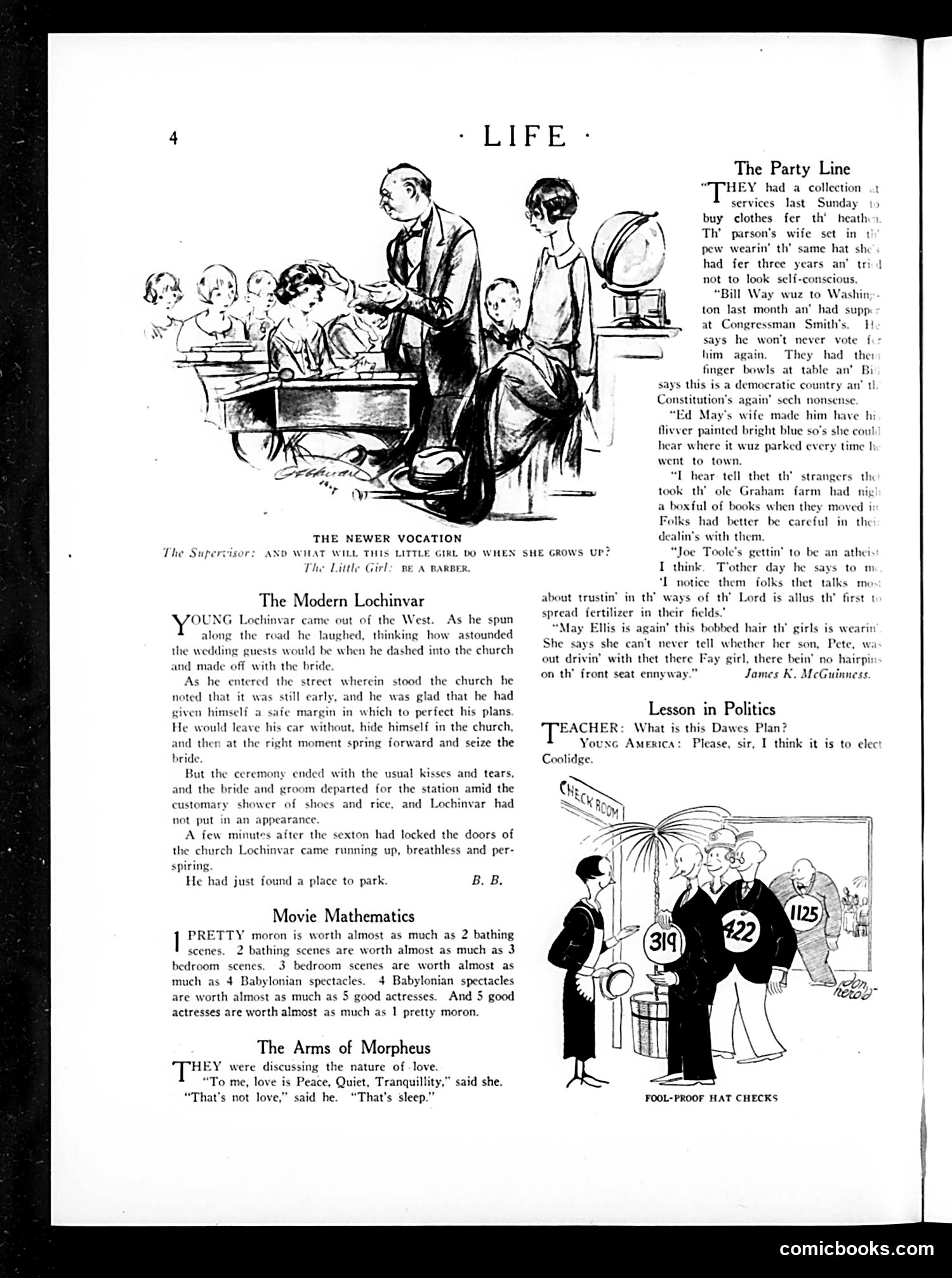
The "Lesson in Politics" cartoon satirizes American electoral politics through a dialogue between a teacher and student about the "Dawes Plan." The student (labeled "Young America") states he thinks the plan is "to elect Coolidge." This references the 1924 presidential election. Calvin Coolidge was the incumbent Republican president, and the "Dawes Plan" (Charles G. Dawes' economic proposal for post-WWI reparations) had become a political issue. The cartoon mocks how Americans reduce complex policy questions to partisan loyalty—the student conflates an economic plan with electoral outcomes, suggesting voters care only about winning elections rather than understanding actual policy. The other content on this page comprises humorous short anecdotes and jokes typical of Life magazine's satirical style, unrelated to politics.
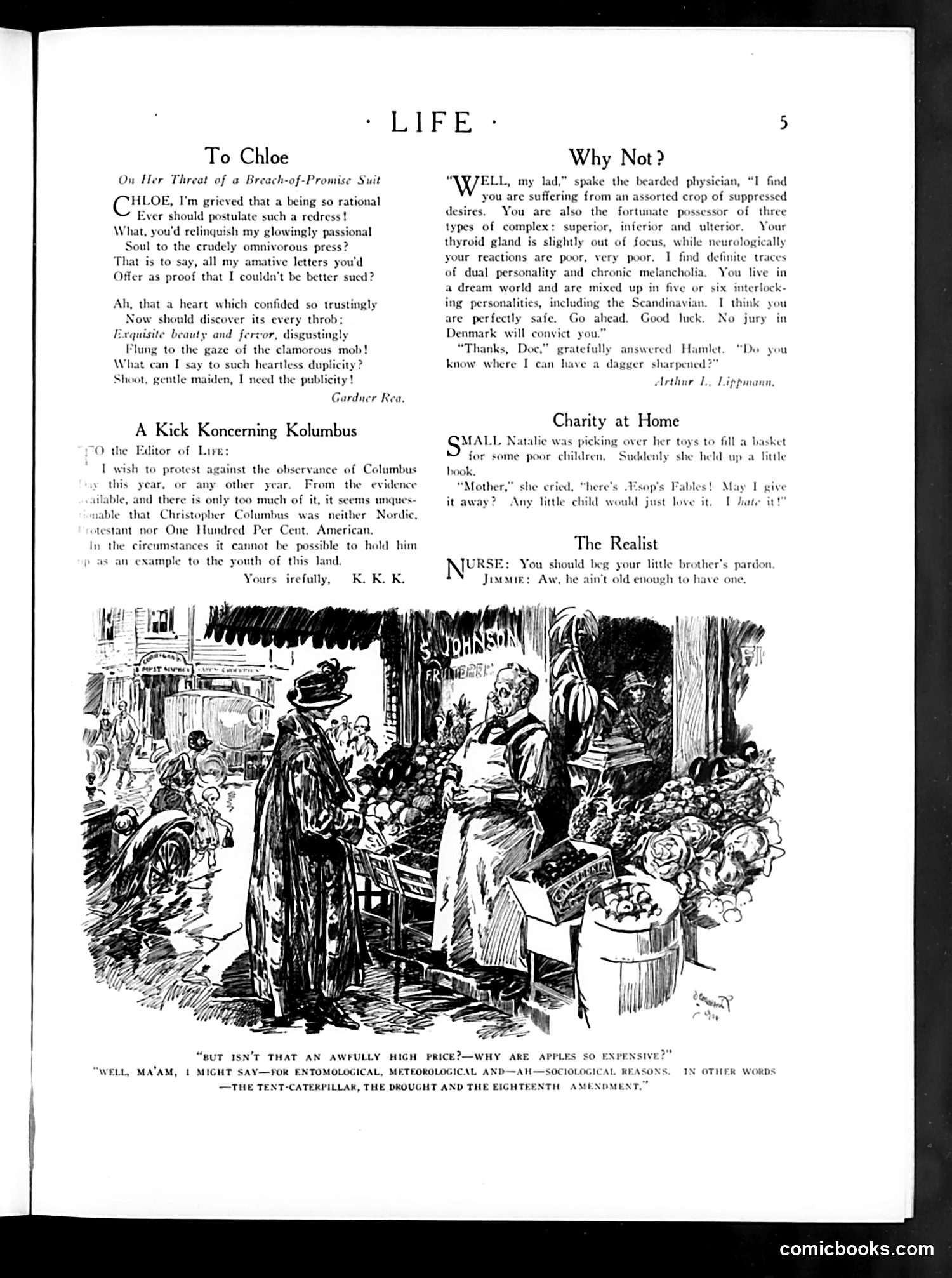
This page contains several short satirical pieces and one editorial cartoon. The main illustration shows a street market scene where a well-dressed woman inquires about expensive apples. A vendor responds with an elaborate explanation citing "entomological, meteorological, and sociological reasons"—invoking the "text-caterpillar, the drought and the eighteenth amendment." This is political satire about Prohibition (the 18th Amendment). The vendor comically blames high fruit prices on multiple factors, with Prohibition apparently among them. The humor targets how retailers used Prohibition as an excuse for price increases, and perhaps mocks the absurdity of citing it for unrelated economic problems. The page also includes poems and brief humorous pieces on unrelated social topics.
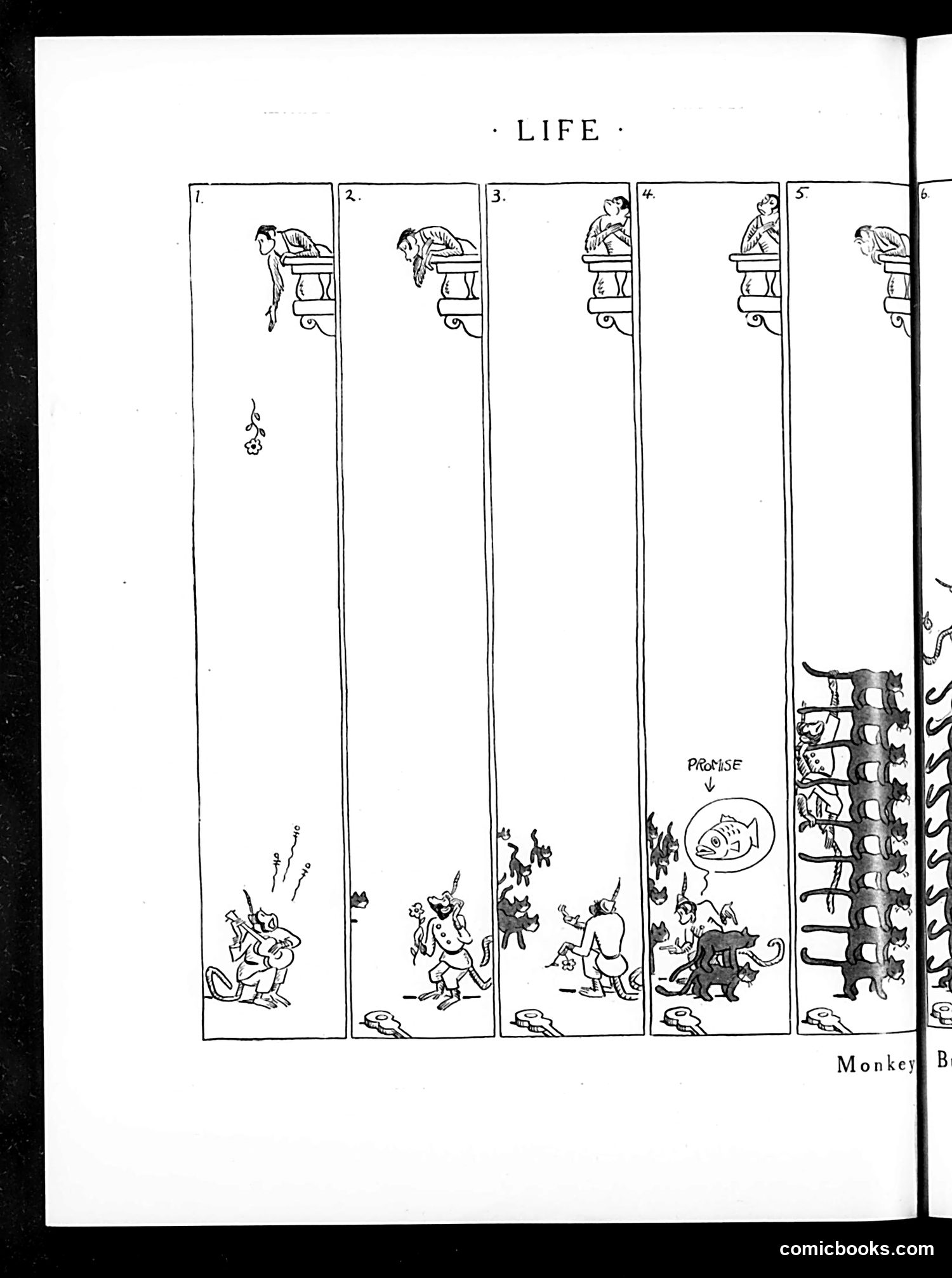
This six-panel satirical cartoon titled "LIFE" depicts the evolutionary progression of humanity in reverse—a commentary on human civilization and progress. Panel 1 shows primitive figures at the bottom with a figure at the top (perhaps representing aspiration or divinity). Each subsequent panel shows increasing social complexity: warfare and conflict (panels 2-3), hierarchical civilization with flags and organized society (panels 4-5), and by panel 6, what appears to be an organized structure (possibly suggesting either peak civilization or bureaucratic absurdity). The label "PROMISE" in panel 5 indicates ironic commentary on civilization's grand promises. The monkey reference at bottom suggests evolutionary humor—questioning whether human "progress" represents true advancement or merely organized chaos. The satire questions whether civilization genuinely improves upon simpler existence.
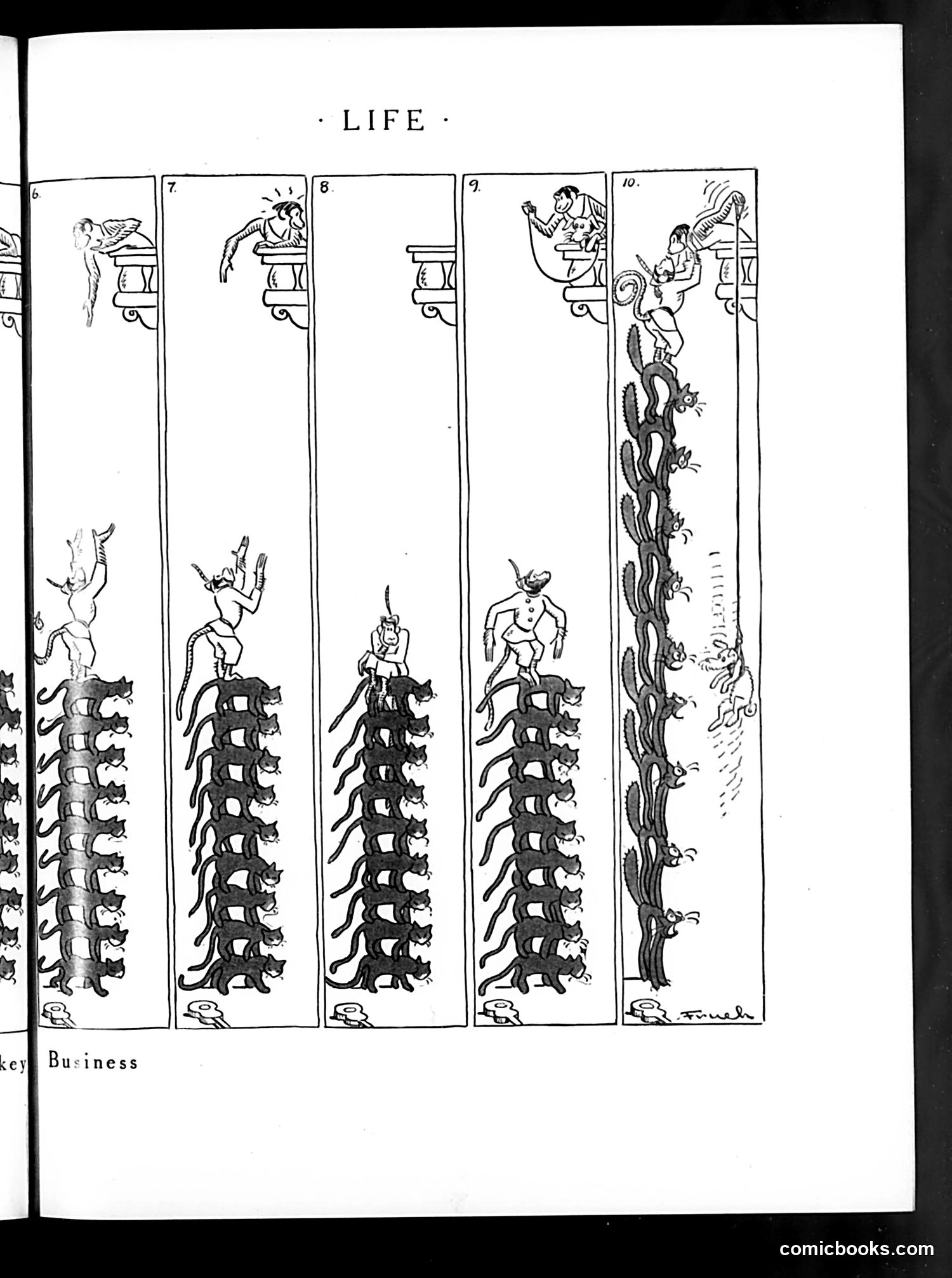
This page titled "LIFE" presents a satirical visual sequence numbered 6-10, depicting a figure's climb up a corporate or social ladder made of stacked bodies/people. The sequence shows progression: a winged figure ascends from the bottom, climbing over numerous prone human forms stacked vertically. By panel 10, the figure reaches the top where they recline in comfort, apparently having "made it." The satire critiques ruthless ambition and competitive capitalism—the literal trampling of others to achieve success. The stacked bodies represent the human cost of climbing the "ladder of success." The winged figure suggests aspiration, but the means (stepping on countless others) exposes the dark reality beneath capitalist advancement. The bottom text reference to "Business" reinforces this is social commentary on American business culture.
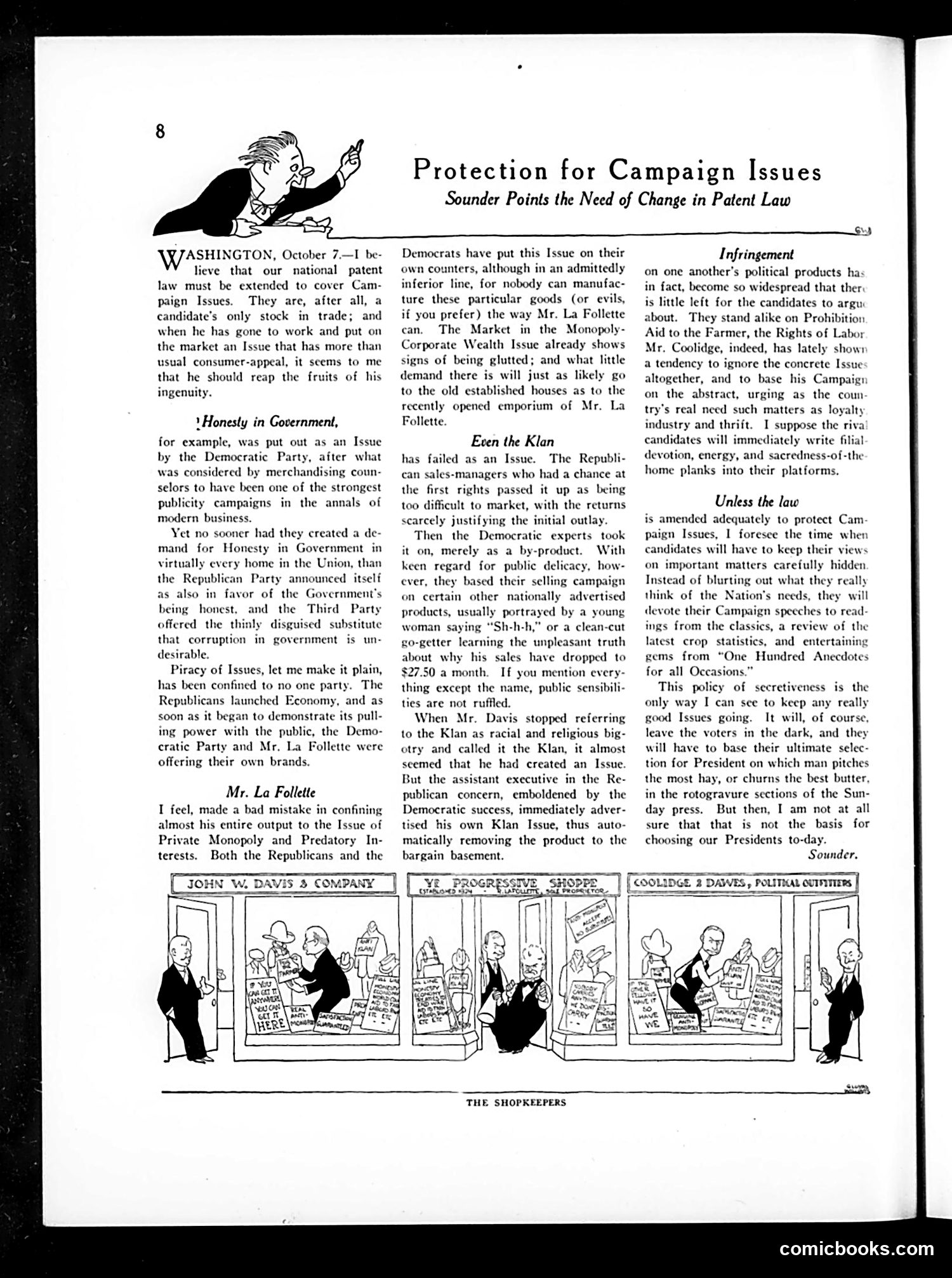
This page critiques how political parties exploit consumer products as campaign "issues." The article, attributed to "Sounder," argues that Democrats and Republicans have weaponized ordinary goods—like La Follette's market monopoly concerns and the Klan controversy—as political ammunition rather than addressing genuine policy matters. The cartoon "The Shopkeepers" depicts storefronts representing different political entities (John W. Davis & Company, The Progressive Shoppe, Coolidge & Davis Political Entities) displaying campaign slogans like merchandise in windows. This visual metaphor satirizes how campaigns market political positions as consumer goods, reducing serious governance to commercial salesmanship. The piece warns voters against being distracted by manufactured "issues" from substantive political discussion.
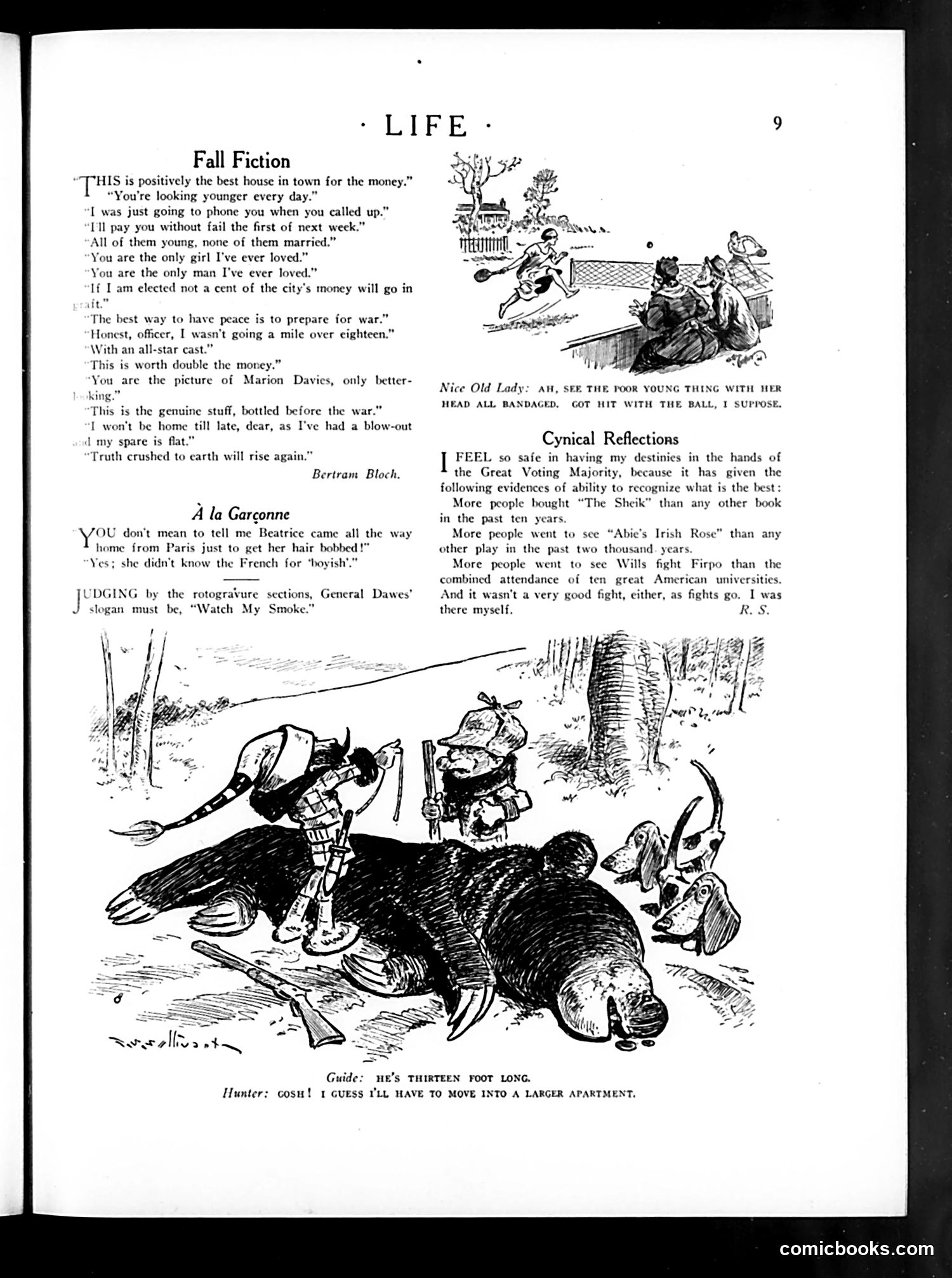
This page contains humor sections satirizing American society circa the 1910s-1920s. **"Fall Fiction"** mocks romantic clichés and conventional wisdom through exaggerated dialogue—phrases like "the best way to have peace is to prepare for war" and "truth crushed to earth will rise again" parody popular sayings. **"À la Garçonne"** jokes about fashion trends, referencing a woman's bobbed haircut and modern style (the "garçonne" was the fashionable 1920s flapper look). **"Cynical Reflections"** satirizes public taste, noting that more people attended popular entertainments like "The Sheik" and "Abie's Irish Rose" than serious literature or quality theater—mocking mass culture preferences. The cartoon below shows hunters with an enormous wild boar, with the hunter remarking he'll need a larger apartment, a joke about the beast's impractical size.
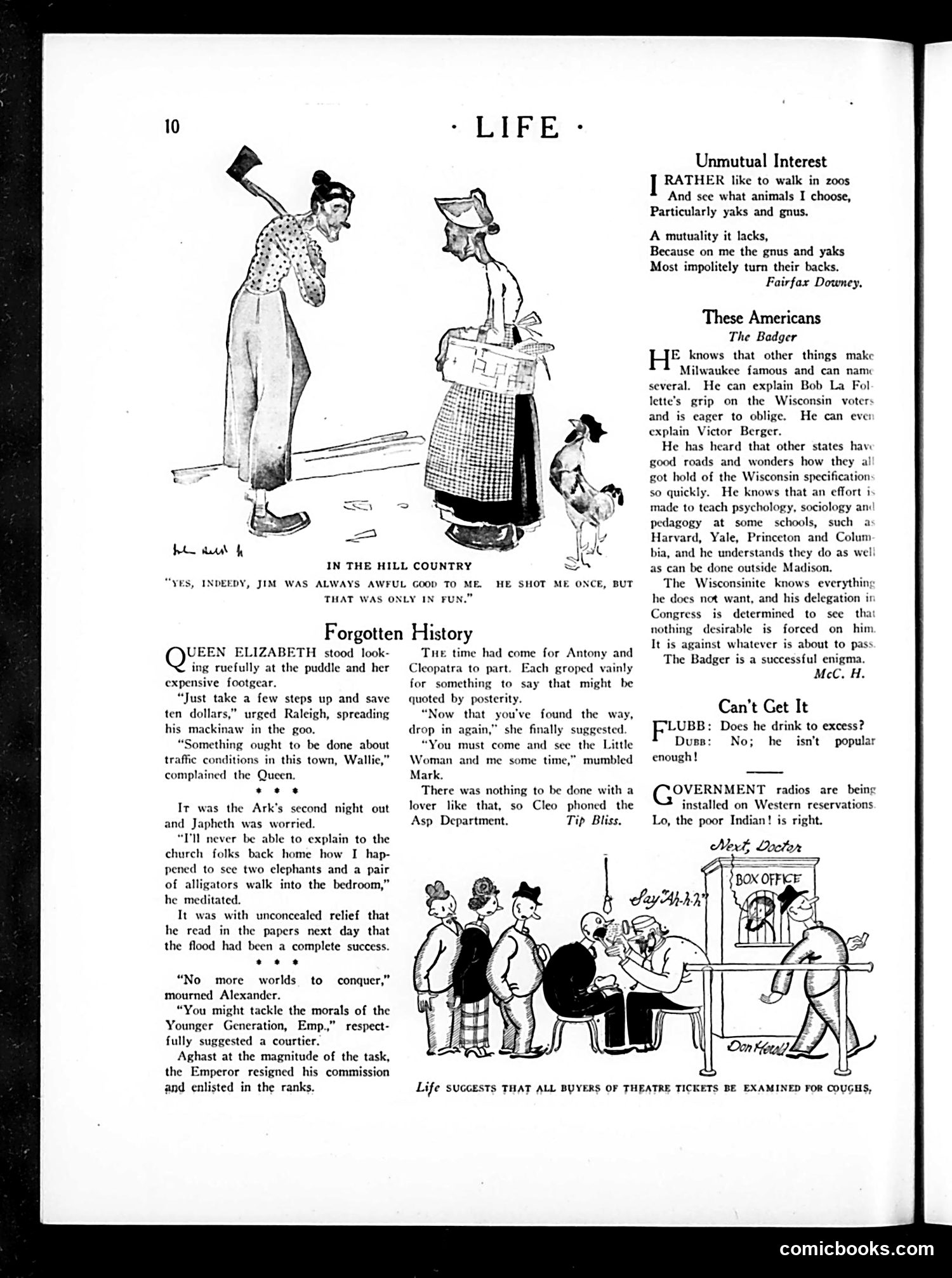
This page contains several satirical pieces. The main cartoon "In the Hill Country" depicts a woman chopping wood while a man watches, with the caption joking that "Jim was always awful good to me. He shot me once, but that was only for fun" — satirizing rural frontier violence as casually accepted. "Forgotten History" mocks historical pomposity through the story of Queen Elizabeth and Emperor Alexander, suggesting grand historical narratives are often invented or trivial. "These Americans: The Badger" profiles Wisconsin's political influence, praising the state's ability to shape national education and politics while resisting federal overreach. The smaller cartoons mock excess drinking and suggest theatre-ticket buyers should be examined for contagious illness — typical early 20th-century humor about public health and social vices.
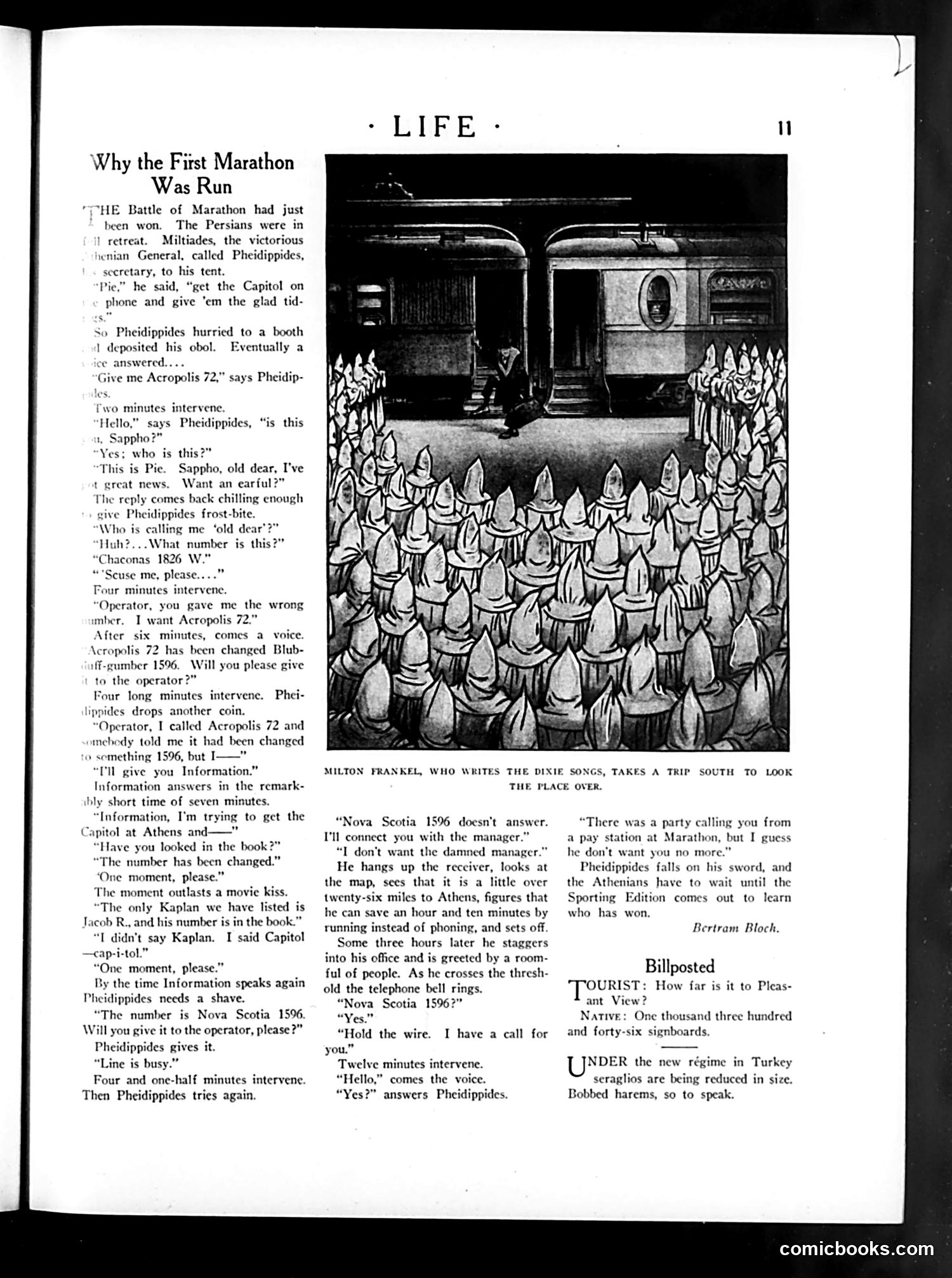
This page contains a humorous story about **Pheidippides**, the legendary Greek messenger who ran from Marathon to Athens to announce a military victory. The narrative satirizes modern telephone communication by having Pheidippides attempt to relay news via phone, encountering typical early 20th-century telephone frustrations: wrong numbers, disconnections, operator errors, and repeated failed attempts over several minutes. The central illustration shows soldiers in ancient Greek helmets gathered around a primitive **Airstream-style trailer or early motorhome**, suggesting the anachronistic clash between ancient history and modern conveniences. The satire targets the inefficiency and unreliability of contemporary telephone systems, implying that even an urgent historical message would struggle to get through using modern technology—a commentary on communication failures of the era.
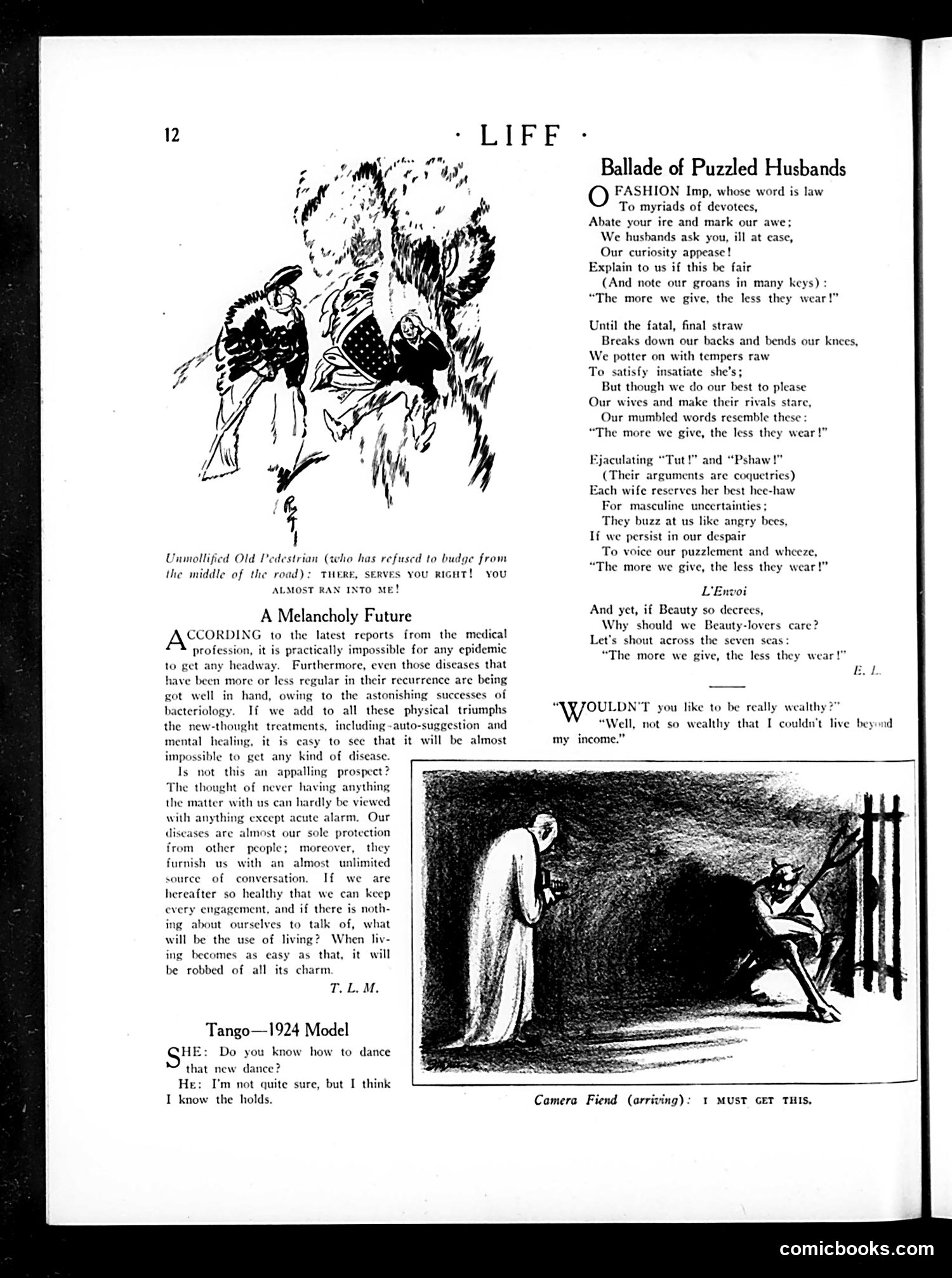
This page contains several distinct pieces of satire: 1. **"Ballade of Puzzled Husbands"** — A poem lamenting husbands' bewilderment at their wives' insatiable demands. The complaint is that no matter how much money or gifts husbands provide ("the more we give"), wives remain unsatisfied ("the less they wear"). This satirizes the perceived contradiction of wives requesting material wealth while allegedly spending it on less clothing. 2. **"A Melancholy Future"** — A serious medical essay predicting that as diseases become preventable, humanity will lose a primary topic of conversation and social concern, robbing life of meaning. 3. **"Tango—1924 Model"** — A brief humorous exchange about the modern dance, where the man jokes he knows "the holds," implying seduction rather than dance steps. 4. **Bottom cartoon** — Shows a photographer attempting to photograph a woman through a fence; the caption "Camera Fiend (arriving): I MUST GET THIS" appears to reference intrusive paparazzi or voyeurism.
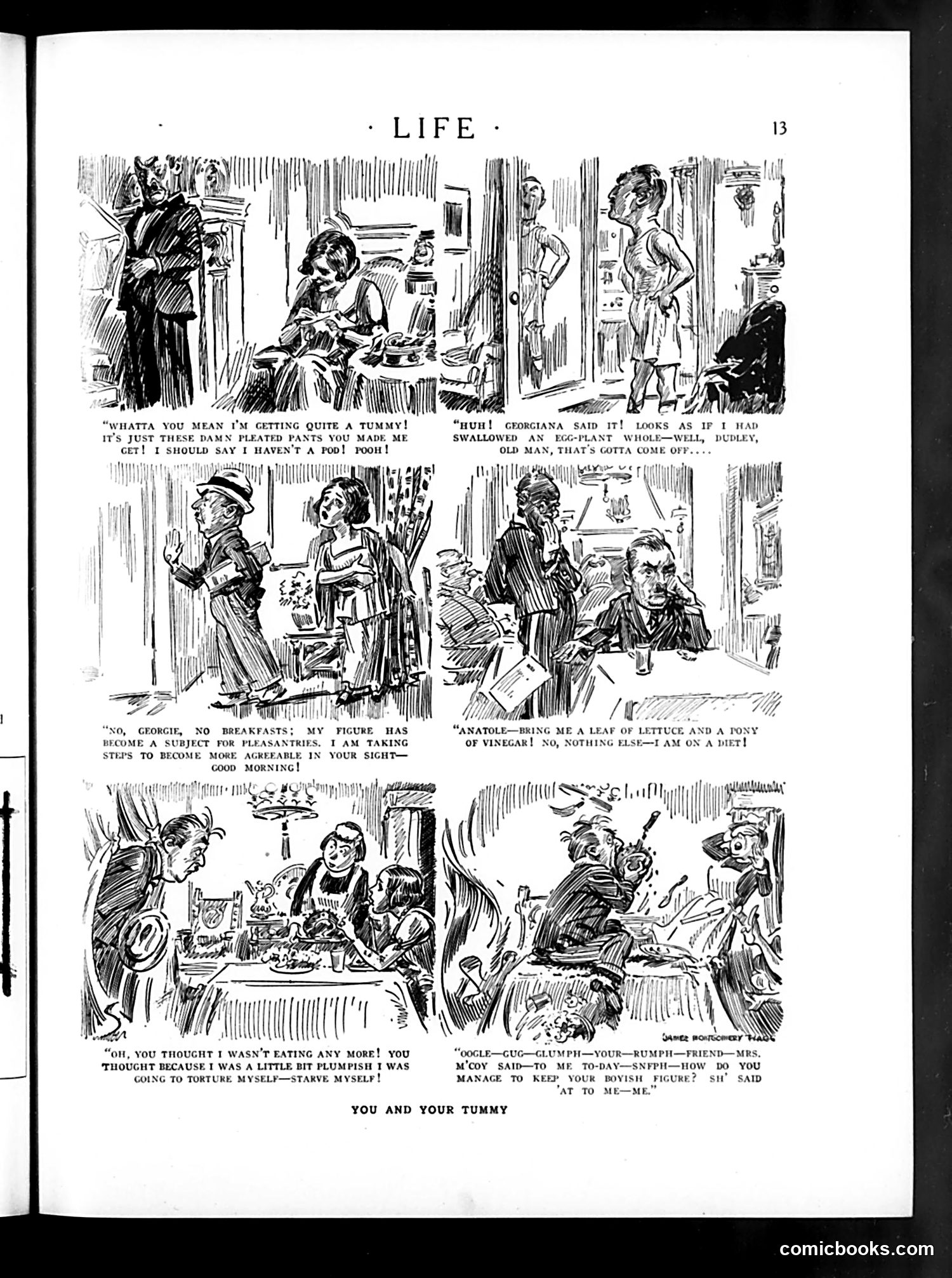
This is a humor comic strip satirizing diet culture and domestic life, likely from the early 20th century. The narrative follows a married couple's argument about eating and weight management. The husband complains his wife's cooking is making him gain weight ("getting quite a tummy"). She responds by restricting his diet drastically—no breakfast, no fatty foods. He retaliates by refusing to eat, claiming he's starving himself as self-torture. The joke satirizes the absurdity of their escalating diet war: he accuses her of intentionally starving him to punish his weight gain, while she insists her restrictions are for his health. The final panel shows them both eating heartily anyway, suggesting dietary willpower is futile. The satire targets contemporary anxiety about weight, nutrition fads, and marital power struggles over food and body image.
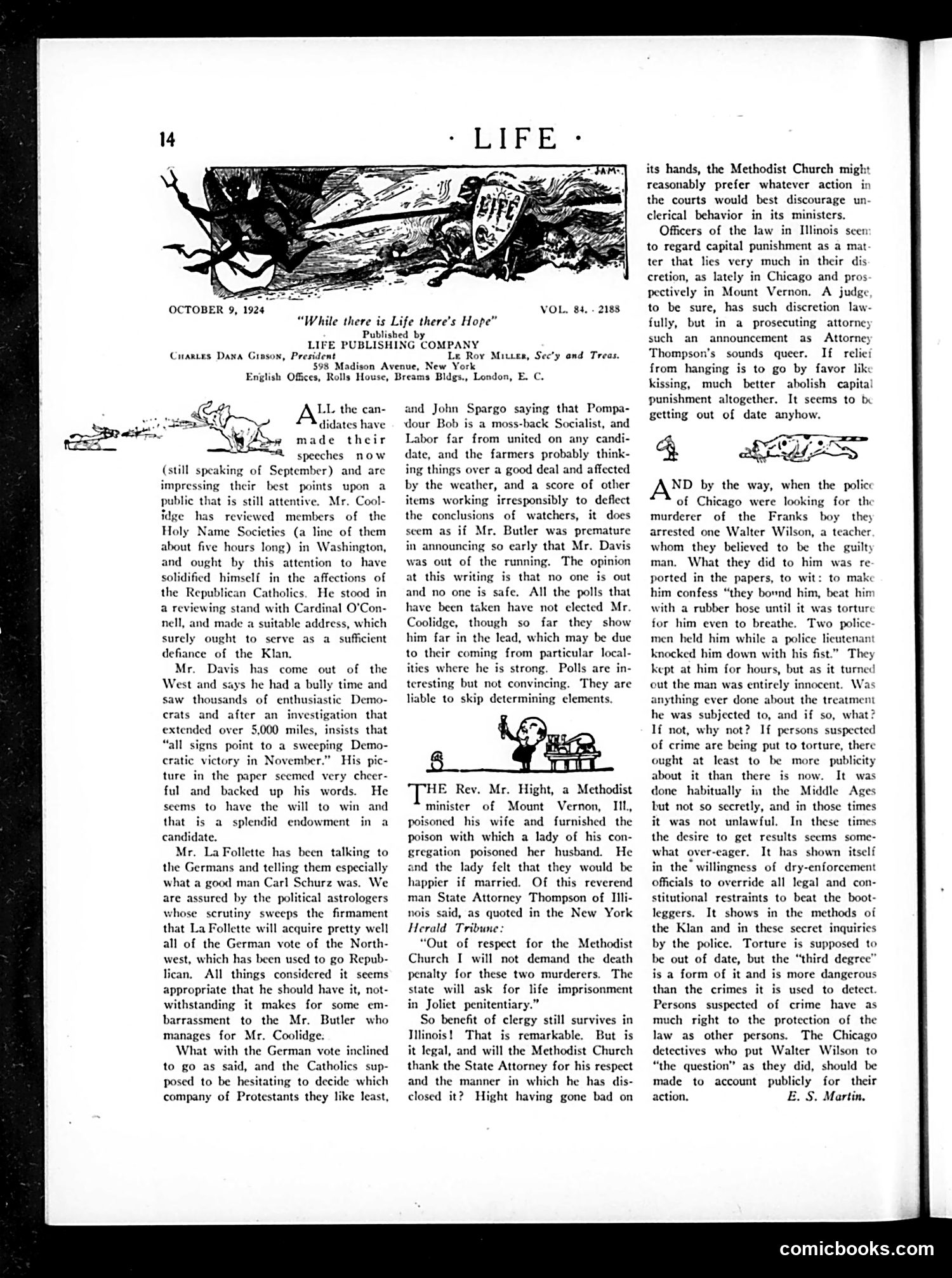
The page contains political commentary about the 1924 U.S. election. The main cartoon depicts a figure labeled "LIFE" appearing to struggle or fall, likely satirizing concerns about democratic institutions during the election period. The text discusses presidential candidates' positions, referencing "Coolidge" and critiquing various political figures. It mentions the "Republican Catholics" and debates over capital punishment in Illinois, specifically addressing State Attorney Thompson's discretion regarding execution. The satire targets political hypocrisy—particularly criticism of clergy involvement in political matters while also praising religious figures who take political stands. The piece argues newspapers should publicly account for their investigative actions, especially regarding police brutality allegations against a teacher named Walter Wilson. The overall tone mocks inconsistent moral positioning among politicians and institutions during this election cycle.
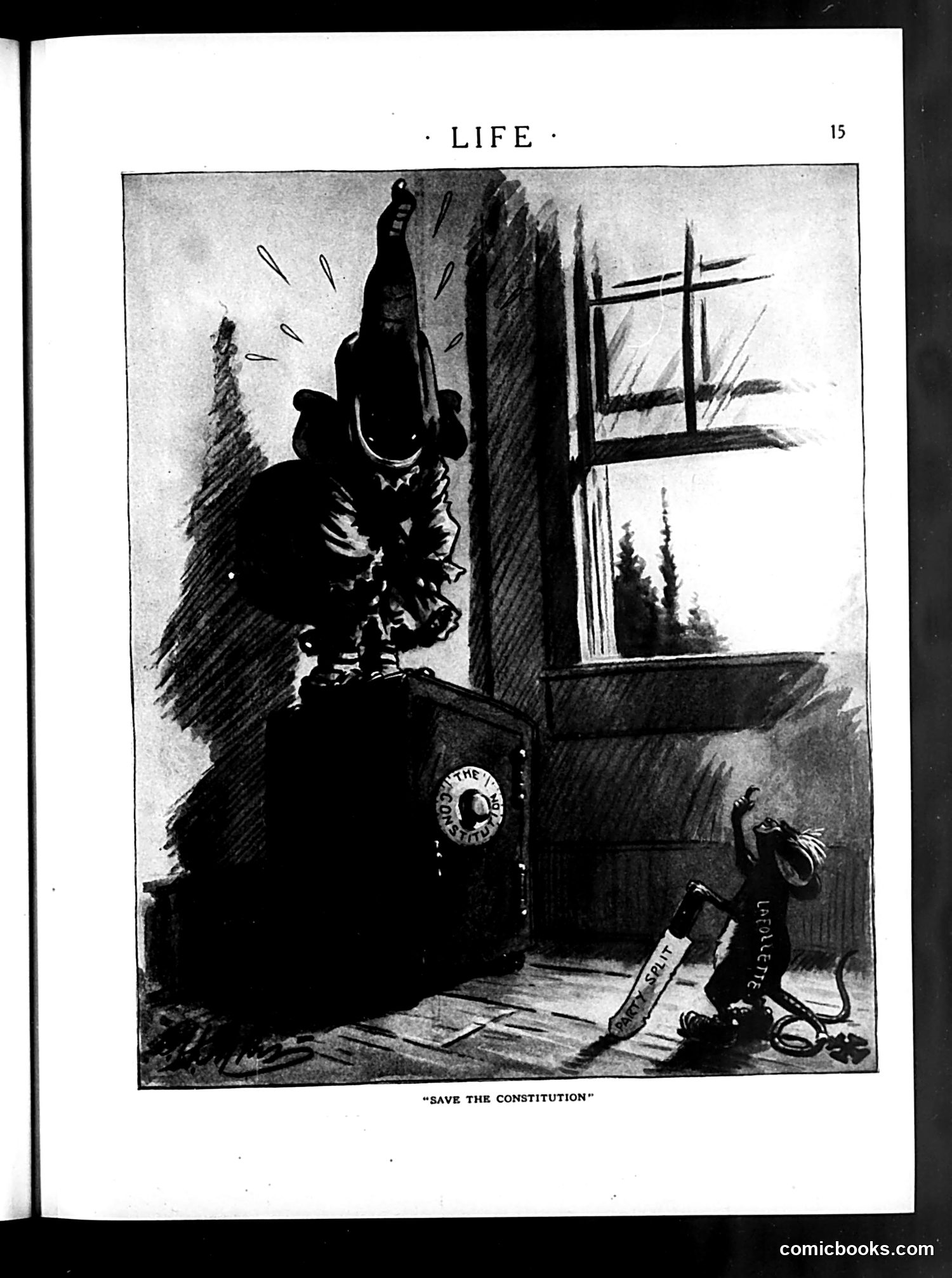
This political cartoon depicts a figure in military/authoritarian dress standing menacingly over documents labeled "Constitution" and what appears to be "Grapeshot" (likely referencing military force). The figure wears a medal or insignia marked "Order of the" (text cut off), suggesting a decorated military leader or dictator. The cartoon warns against threats to constitutional governance—specifically, the danger of military or authoritarian power overriding democratic institutions. The title "Save the Constitution" frames this as an urgent plea. Without knowing the specific publication date, this likely responds to contemporaneous concerns about executive overreach, military intervention in politics, or authoritarian movements. The stark black silhouette emphasizes the ominous nature of the threat depicted.

This page shows a minimalist illustration of a desert landscape with several palm trees of varying heights on sandy dunes. The image appears to be a visual metaphor or allegory, though the text fragment "The Twelve B" at the bottom is incomplete and doesn't clarify the cartoon's specific meaning. Without the full caption or article text, the precise political or social reference is unclear. The composition—with palm trees of different sizes arranged on barren terrain—could potentially reference colonialism, resource scarcity, or regional power dynamics, but this is speculative. The stark, simple style suggests satirical commentary typical of Life magazine's approach, but the specific target and joke cannot be reliably determined from the visible image and truncated text alone.
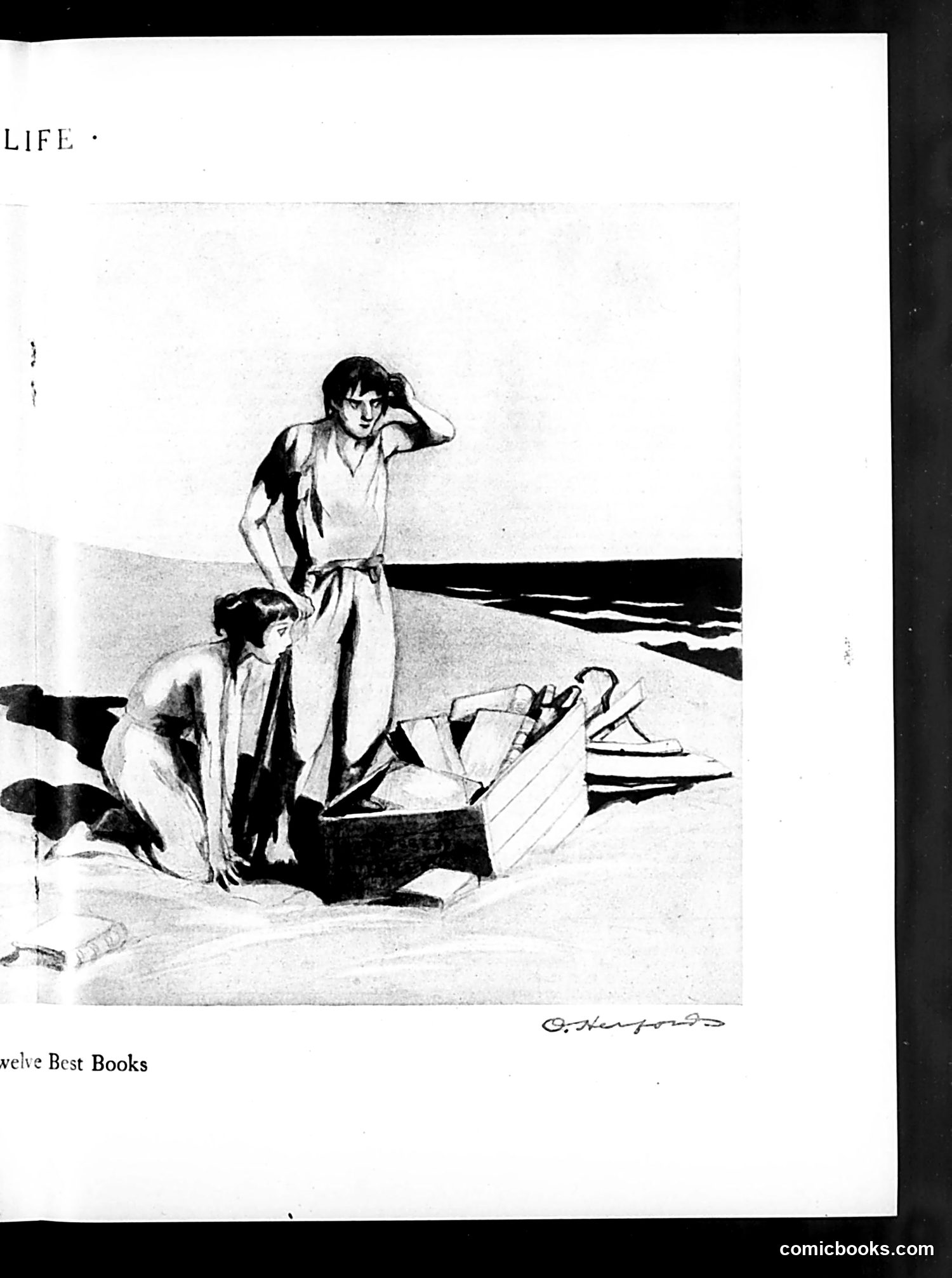
This appears to be a page from *Life* magazine featuring an illustration by what looks like a signed artist (signature visible lower right). The image shows two figures on a beach near boats—one standing and shading their eyes while looking outward, another kneeling or crouching. The scene suggests a maritime or nautical setting. The OCR text references "Twelve Best Books," suggesting this may be part of a literary or cultural feature rather than political satire. Without clearer context or visible caption text in the image, I cannot definitively identify the specific figures, historical reference, or satirical intent. The illustration style is consistent with early-to-mid 20th century magazine work, but the precise subject remains unclear from this page alone.
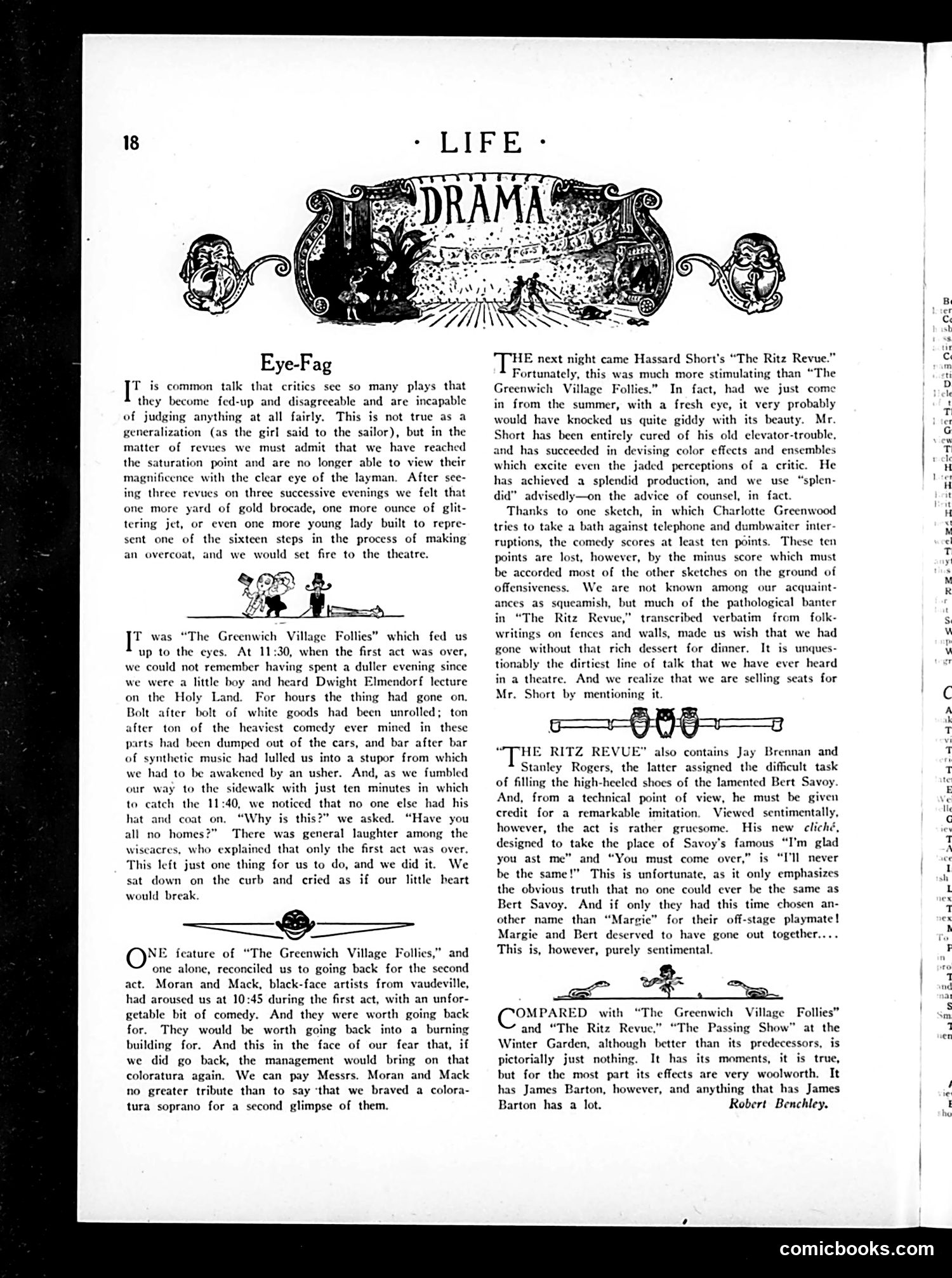
This is a theater critic's column reviewing three Broadway revues. The headline "Eye-Fag" (period slang for exhaustion) sets up the premise: critics attending too many shows become jaded and unable to judge fairly. The critic describes attending "The Greenwich Village Follies," finding it tediously long with excessive scenery and undistinguished music—so tedious that they sat on the curb and cried when discovering the first act wasn't over. The one redeeming feature: Moran and Mack, blackface vaudeville comedians, whose performance was worthy enough to brave a second act. The review then covers "The Ritz Revue," directed by Hassard Short, which the critic found more visually impressive but marred by crude humor—"pathological banter transcribed verbatim from fences and walls"—the dirtiest material they'd encountered in theater. The satire targets both overstuffed revue productions and the critic's own exhaustion affecting judgment. The column demonstrates Life's theatrical criticism style: witty, acerbic, and focused on production values and comedy quality.
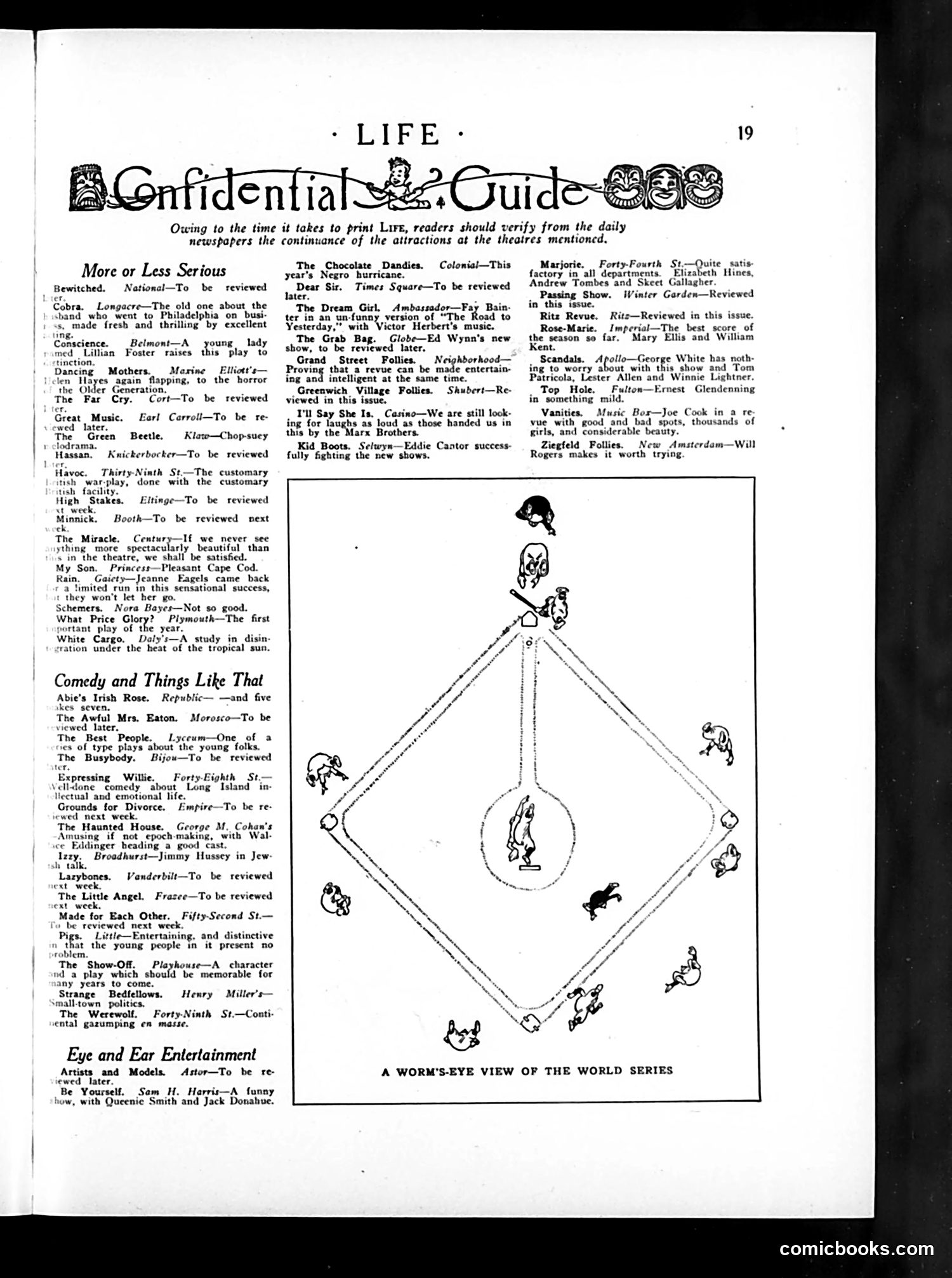
This page is primarily a **theater listings and reviews guide** for Broadway shows, not a political cartoon. However, it contains satirical theatrical criticism characteristic of Life magazine's approach. The listing titled "A Worm's Eye View of the World Series" (the illustration on the right) is a **humorous visual metaphor** showing baseball players from a worm's perspective—literally looking up from underground at a baseball diamond. This playfully mocks sports coverage's grandiose treatment of the World Series by reducing it to an ant's (or worm's) insignificant viewpoint. The theater reviews themselves use **witty, dismissive commentary**: describing "Abie's Irish Rose" as "and five jokes seven" (mocking its popularity despite thinness), calling certain plays "not so good," and praising others like "What Price Glory?" as "the first important play of the year." The satire lies in Life's confident pronouncements about theatrical merit and cultural significance.
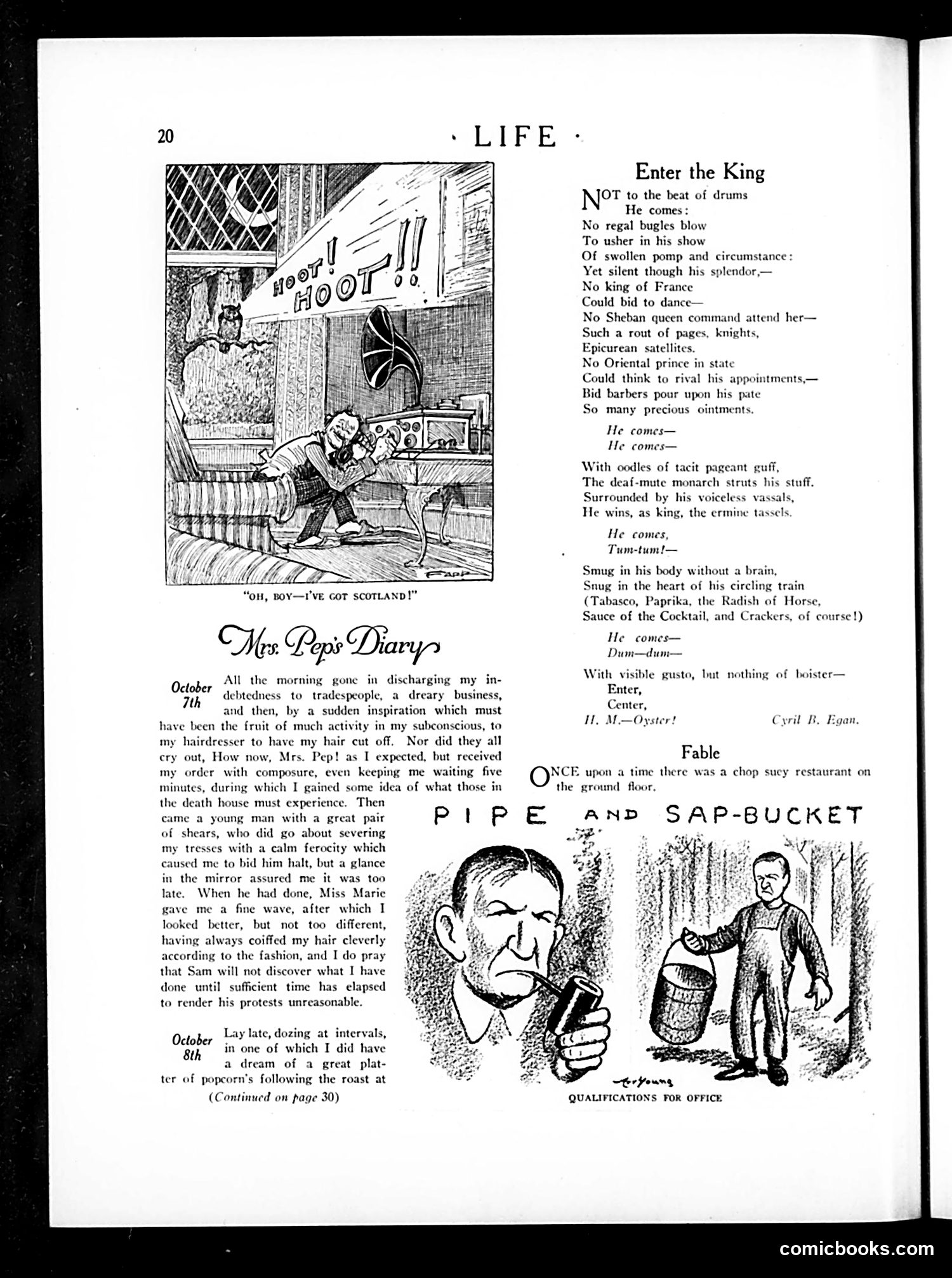
**Main Cartoon ("Oh, Boy—I've Got Scotland!"):** A figure lies in bed exclaiming he's "got Scotland," likely referencing a recent political event or territorial claim. Without the publication date visible, the specific reference is unclear, but the comedic setup suggests a dream or delusion about acquiring Scotland—possibly satirizing British imperial ambitions or a contemporary political dispute. **"Enter the King" Poem:** This satirizes a pompous ruler who arrives with pageantry and ceremony despite being intellectually empty ("smug in his body without a brain"). The "deaf-mute monarch" suggests someone who rules through appearance rather than substance, surrounded by yes-men named after food items (Tabasco, Paprika, Radish). It's likely mocking a contemporary political figure, possibly relating to early 20th-century European royalty or a specific leader's pretentiousness. **"Mrs. Pep's Diary"** and **"Pipe and Sap-Bucket" Fable:** Light domestic and social humor typical of Life magazine's satirical content. The page reflects Life's tradition of political satire through literary and visual means.
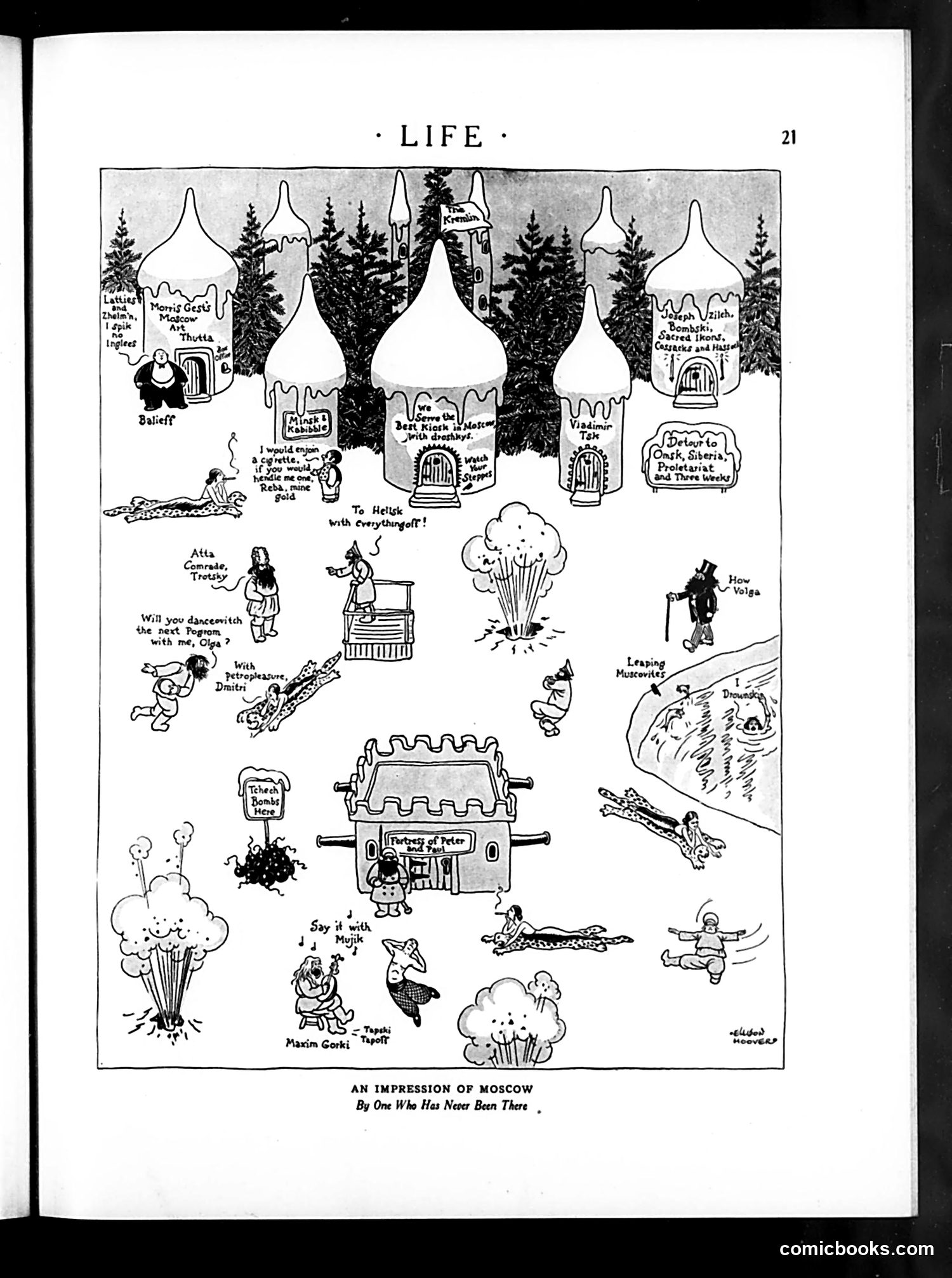
This is a satirical cartoon titled "An Impression of Moscow" that mocks exaggerated Western stereotypes about Soviet Russia. The image depicts a fantastical Moscow filled with onion-domed churches, Russian figures engaged in folk activities (dancing, leaping), and crude caricatures labeled with Russian names like "Dimitri" and "Maxim Gorki." The satire targets two audiences: Western readers unfamiliar with actual Russia (hence "by one who has never been there"), and possibly Soviet communism itself. References to "pogrom," "droshkys" (horse carriages), and "comrade" invoke popular Western clichés about czarist/Soviet Russia. The cartoon mocks both ignorant Western imaginings of Russia and, implicitly, Russian cultural exoticism being used for propaganda or entertainment purposes. It's essentially satirizing oversimplified, fantastical depictions of Russian life.
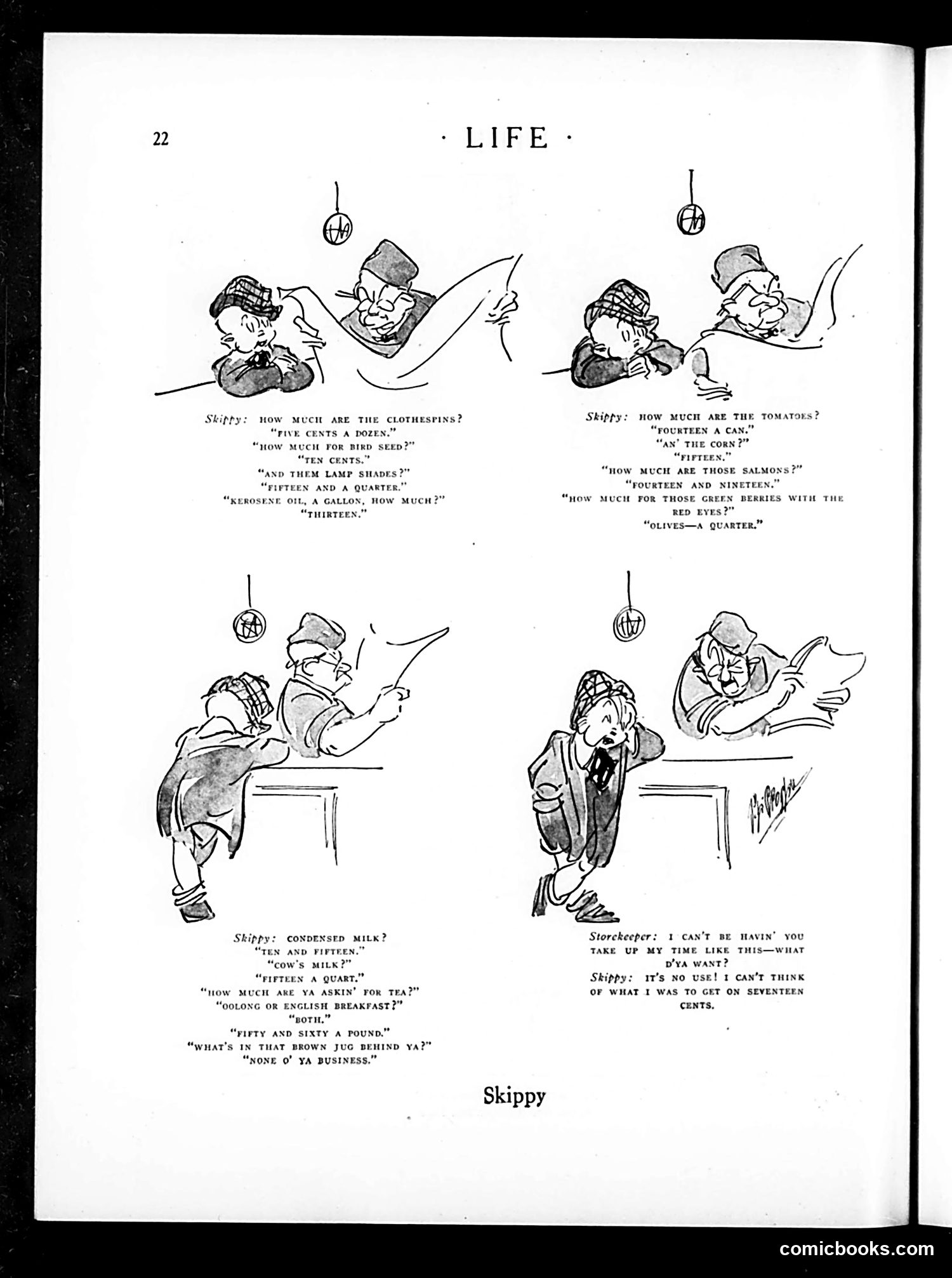
This is a humorous comic strip featuring **Skippy**, a mischievous boy character, and a frustrated shopkeeper. The joke satirizes childhood behavior: Skippy enters the store with a shopping list (or just seventeen cents) and proceeds to ask the price of nearly everything in the shop—clothespins, bird seed, lamp shades, kerosene oil, condensed milk, tea, olives—in rapid succession. The humor lies in the **contrast between Skippy's endless inquiries and his extremely limited budget** (seventeen cents). The exasperated storekeeper finally demands to know what Skippy actually wants to buy, but Skippy realizes he's been so focused on comparison-shopping that he's forgotten what he came for in the first place. This reflects a relatable childhood experience: getting distracted by curiosity rather than purposeful shopping. The satire gently mocks both childish absent-mindedness and the tedious nature of retail customer service.
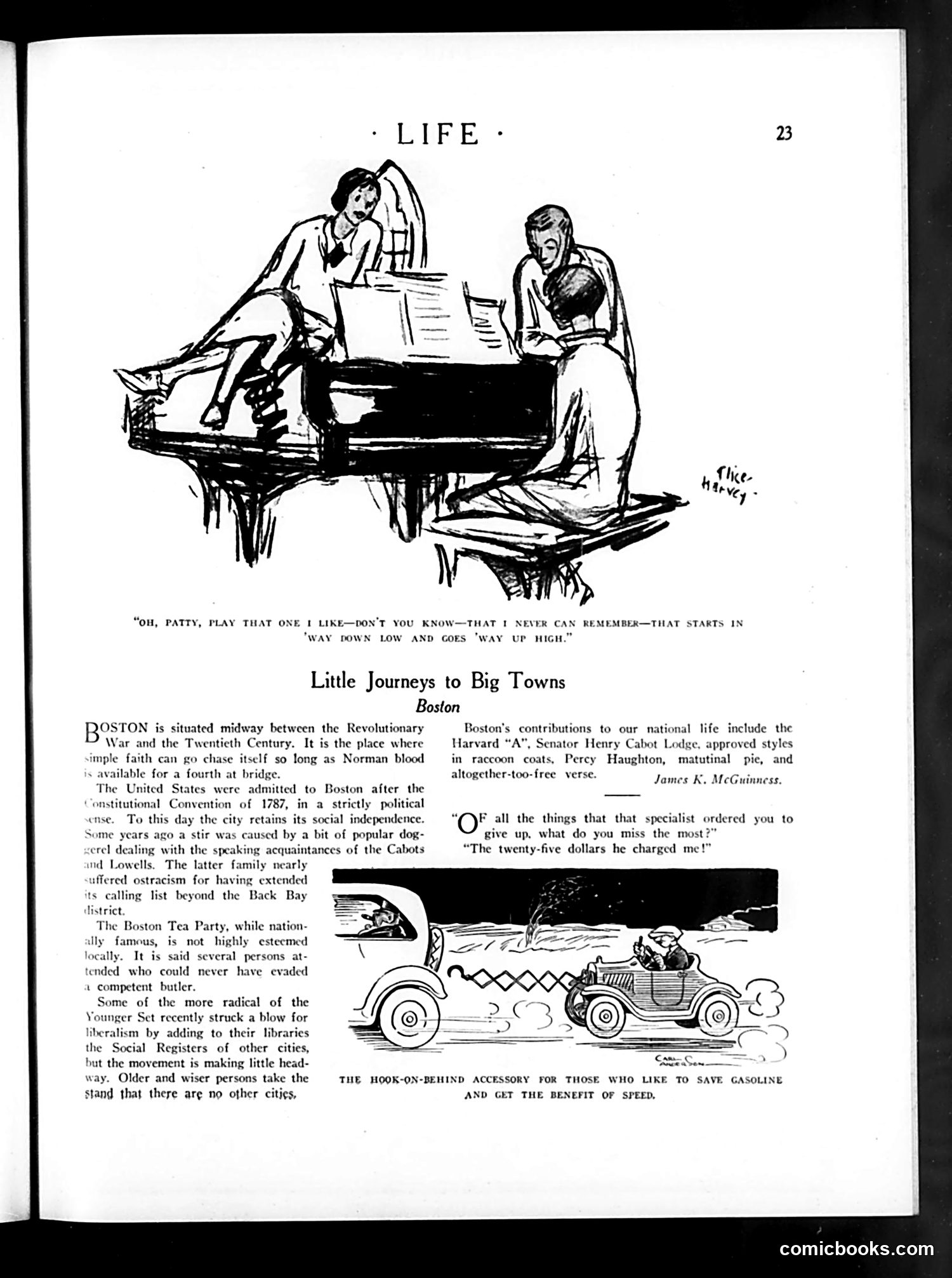
**Top Cartoon:** A couple at a piano—the woman sits on the bench while a man stands nearby. She's asking him to play a song she likes but can't remember, one that "starts in way down low and goes way up high." This is likely sexual innuendo, playing on double meanings of musical terminology. The humor relies on the woman's apparent innocence ("don't you know") masking suggestive intent. **Boston Article:** A satirical piece mocking Boston's upper-class social pretension. It jokes about the Cabot and Lowell families' exclusivity, suggests Boston considers itself superior to all other cities, and pokes fun at the city's conservative character. The references to Harvard, raccoon coats, and Senator Lodge reflect Boston's Brahmin establishment culture. **Bottom Cartoon:** Advertises a "hook-on-behind accessory"—appears to be a towing device allowing one car to pull another to save gasoline while still achieving speed. The humor likely involves the practical absurdity of the contraption and fuel-saving claims.
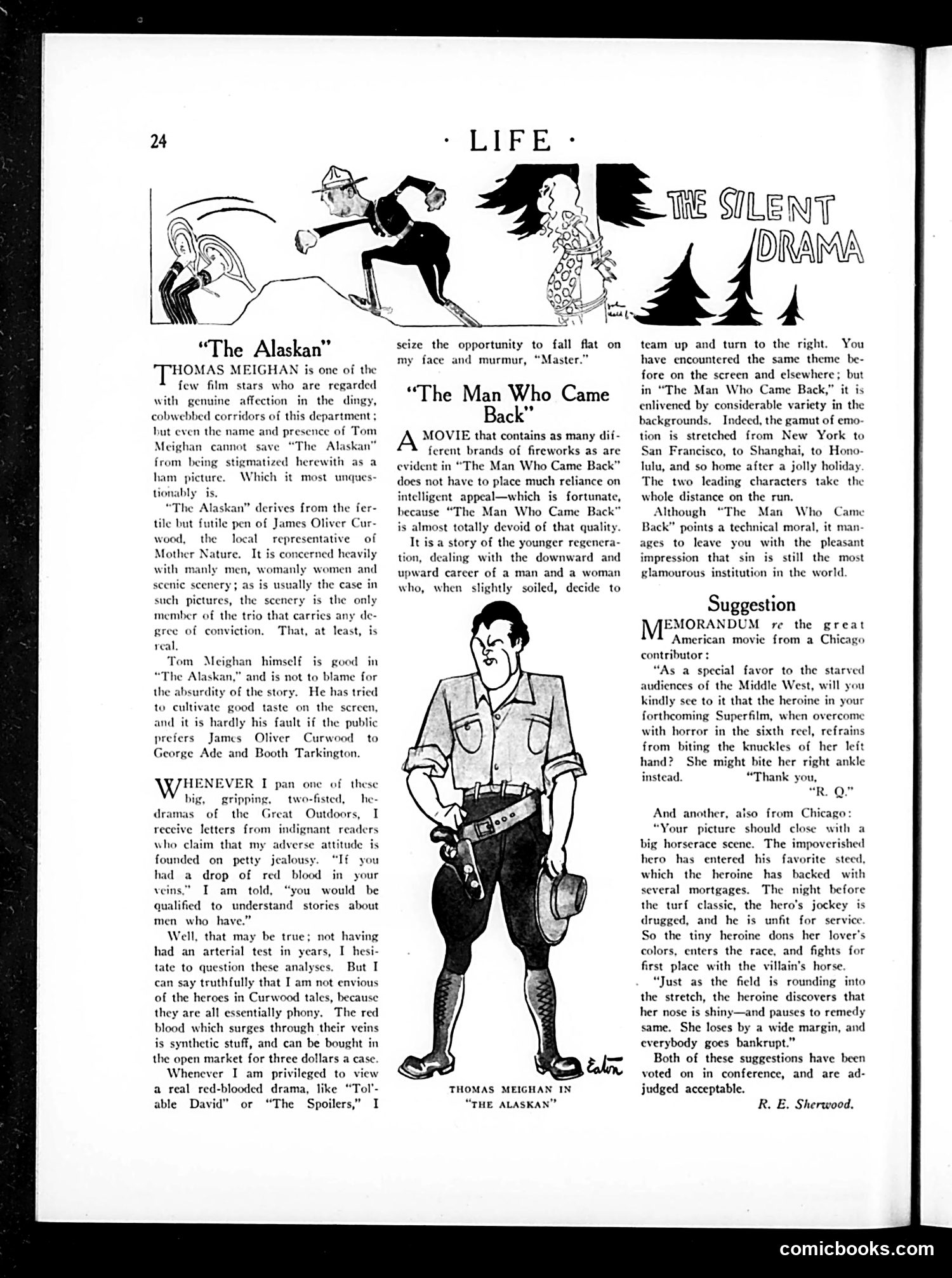
This page reviews two silent films, with particular scorn for "The Alaskan" starring Thomas Meighan. The critic dismisses it as a "ham picture" despite respecting Meighan as an actor—the problem lies with source material by James Oliver Curwood, a prolific pulp adventure writer known for formulaic "Great Outdoors" stories featuring "manly men, womanly women." The satirical thrust: readers attack the critic for lacking "red blood" when he pans these masculine melodramas. He responds that such films traffic in synthetic emotion—their "red blood" is literally purchasable theatrical hokum, not genuine drama. Real "red-blooded" films like "Tolable David" earn his genuine respect. "The Man Who Came Back" receives similar criticism for prioritizing exotic locations (New York to Shanghai) over intelligent storytelling, while inadvertently glamorizing sin. The "Suggestion" section mocks Hollywood's predictable formulas—female hysteria, improbable horserace climaxes with cross-dressing heroines—through fake reader letters requesting absurdist alternatives.
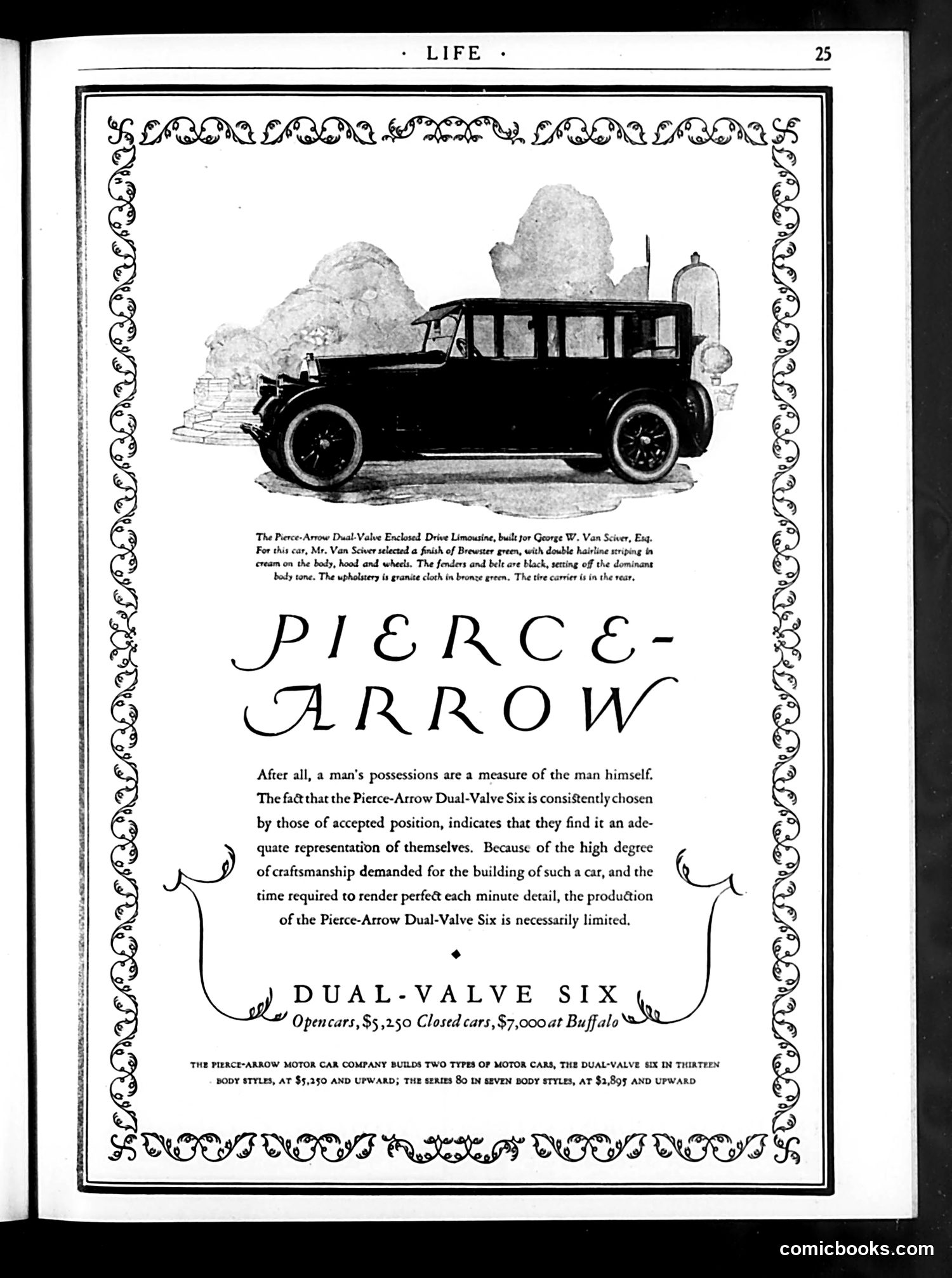
This is **not a cartoon or satire**—it's a luxury automobile advertisement disguised as editorial content in *Life* magazine. The ad promotes the Pierce-Arrow Dual-Valve Six by appealing to class consciousness. It argues that a man's possessions reflect his character ("a man's possessions are a measure of the man himself"), then claims that wealthy people of "accepted position" choose Pierce-Arrow cars because they represent adequate self-expression. The pitch emphasizes exclusivity: limited production due to meticulous craftsmanship justifies premium pricing ($5,250-$7,000 in 1910s dollars—extremely expensive). The specific customization described (Brewster green paint, hairline striping) reinforces that ownership signals refined taste and social standing. This represents early 20th-century luxury marketing that conflated consumer goods with personal worth and social class—a strategy targeting wealthy readers of *Life*.
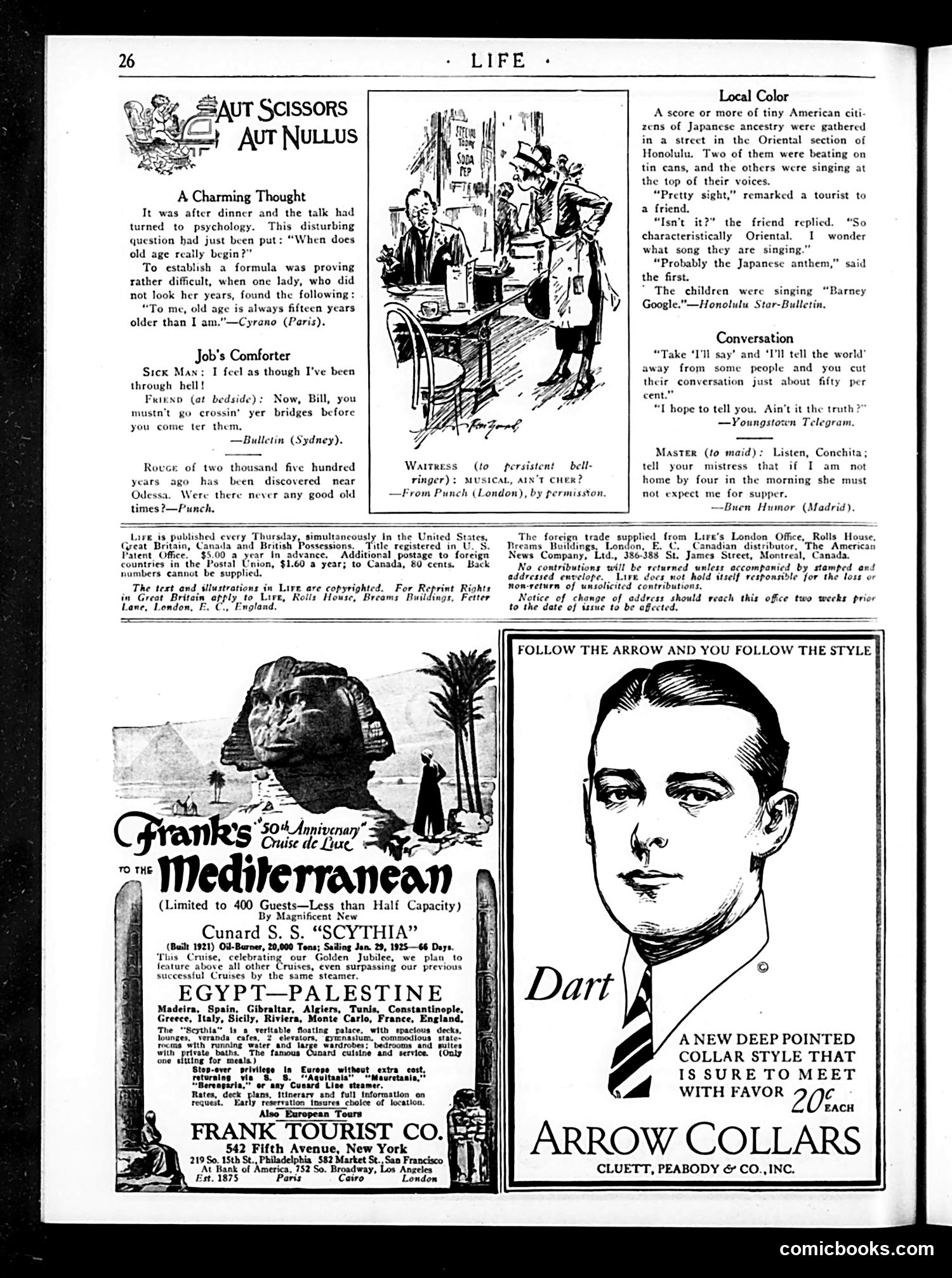
This page consists primarily of **short humor pieces and advertisements** rather than political cartoons. The content reflects 1920s American satirical humor: **The Cartoons/Humor:** - "A Charming Thought": A woman jokes that old age is always "fifteen years older than I am"—poking fun at vanity and age denial - "Local Color": Tourists in Honolulu assume Japanese-American children singing are performing traditional Japanese music, but they're actually singing "Barney Google" (a popular American song). This satirizes orientalist stereotyping and assumptions - Other brief jokes about psychology, comfort, and conversation patterns **The Advertisements:** The page includes a large Frank Tourist Company ad for Mediterranean cruises on the Cunard S.S. "Scythia," and an Arrow Collars advertisement featuring a stylized male portrait promoting a "deep pointed collar style" at 20 cents. **For Modern Readers:** The "Local Color" piece is the most politically resonant—it gently mocks how Americans projected "Oriental" identity onto Japanese-Americans based on appearance rather than actual cultural preferences.
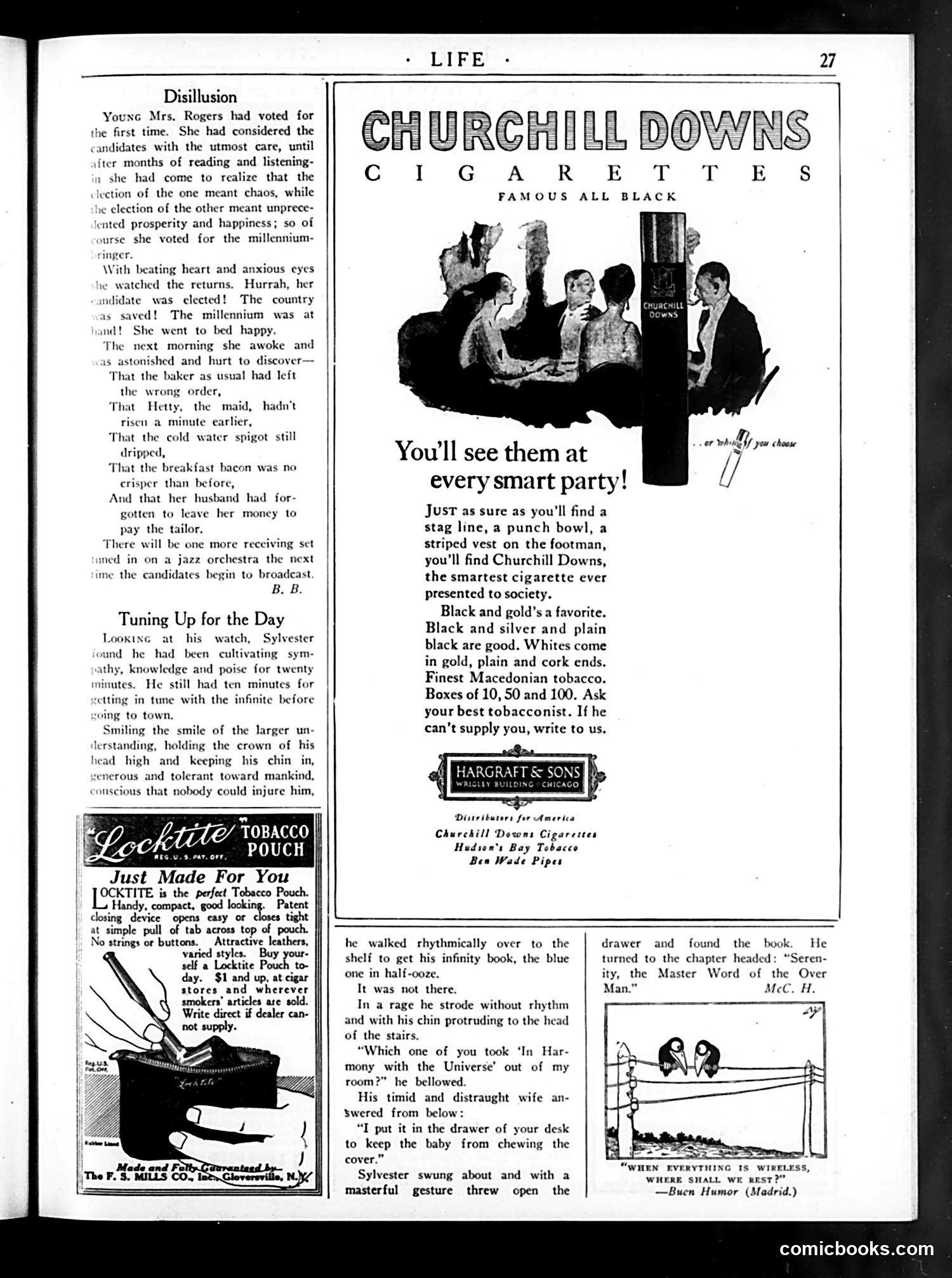
This page contains **two satirical stories** mocking early 20th-century American attitudes: **"Disillusion"** satirizes naive voter enthusiasm. A young woman votes for the first time, convinced one candidate will bring utopian prosperity ("the millennium"). She's crushed the morning after when her daily life remains unchanged—the baker still delivers wrong orders, the maid oversleeps, the water still drips, bacon isn't crispier, her husband forgets money for the tailor. The joke: voting won't fix mundane personal problems, deflating her idealistic expectations. **"Tuning Up for the Day"** mocks pseudo-spiritual self-improvement fads. A man named Sylvester spends 20 minutes cultivating "sympathy, knowledge and poise" and "tuning with the infinite" before work—adopting an affected smile and posture of enlightenment—only to be comically undermined by trivial domestic chaos (his wife hid his book to stop the baby chewing it). Both stories satirize American optimism, whether political or self-help oriented, as naïve and disconnected from reality. The page also features period cigarette and tobacco advertisements.
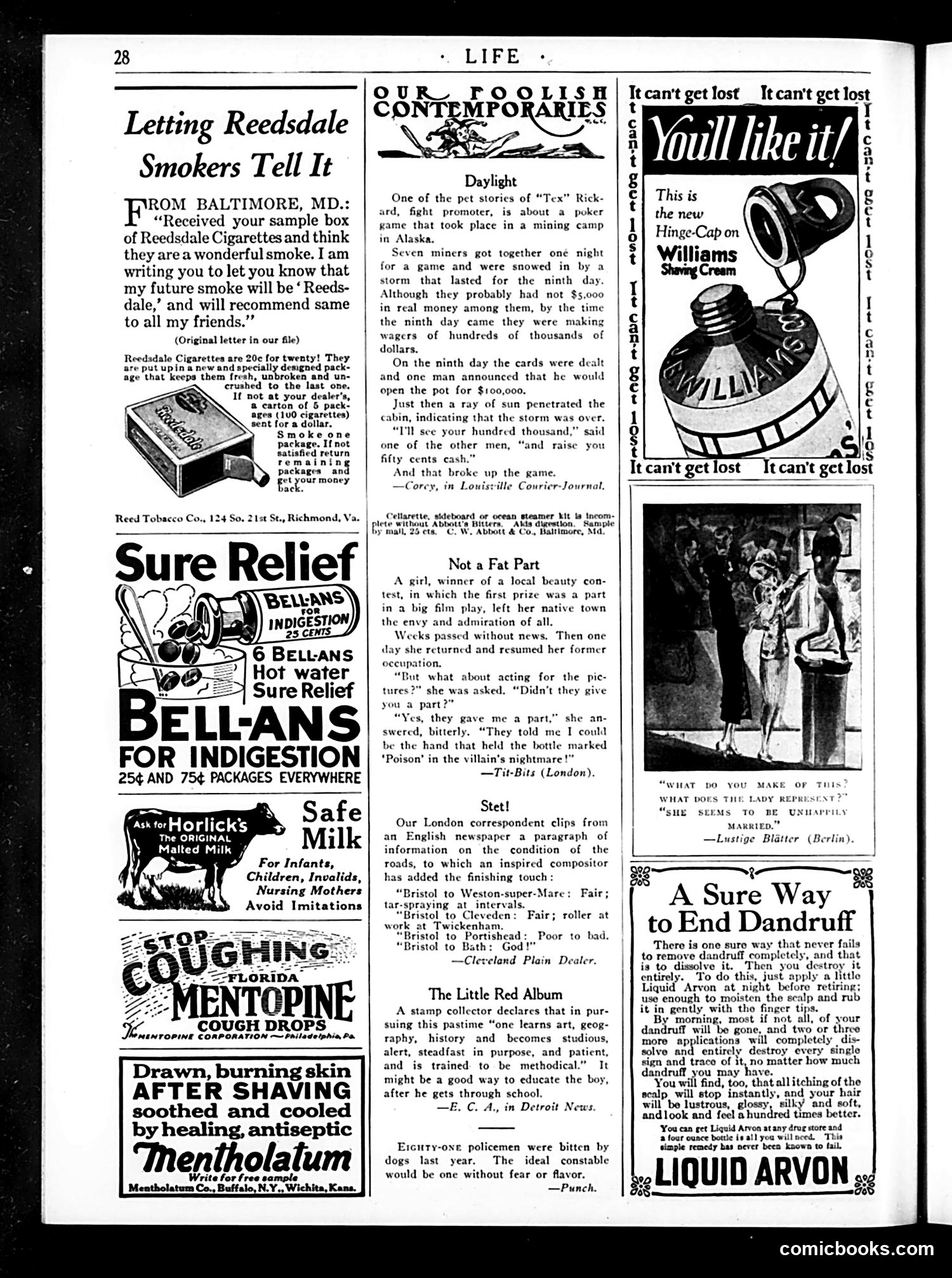
This page is primarily **advertising**, with a small section of humor content. The main satirical pieces are: **"Our Foolish Contemporaries" section:** - A poker story mocking inflated stakes: seven Alaska miners, snowed in, escalate bets to hundreds of thousands of dollars on day nine. When sunlight breaks the storm, one player calls a $100,000 raise with "fifty cents cash"—deflating the entire game's absurd logic. The satire targets get-rich-quick fever and gambling excess during this era. - "Not a Fat Part": A beauty contest winner leaves town for a film role but returns, having been cast only as "the hand that held the bottle marked 'Poison.'" The joke mocks Hollywood's treatment of beauty queens as interchangeable props rather than serious actresses. **The remaining content is straightforward period advertising** for Reedsdale cigarettes, Bell-ans antacid, Horlick's malted milk, menthol shaving products, and other patent medicines—typical of Life's revenue model in this era.
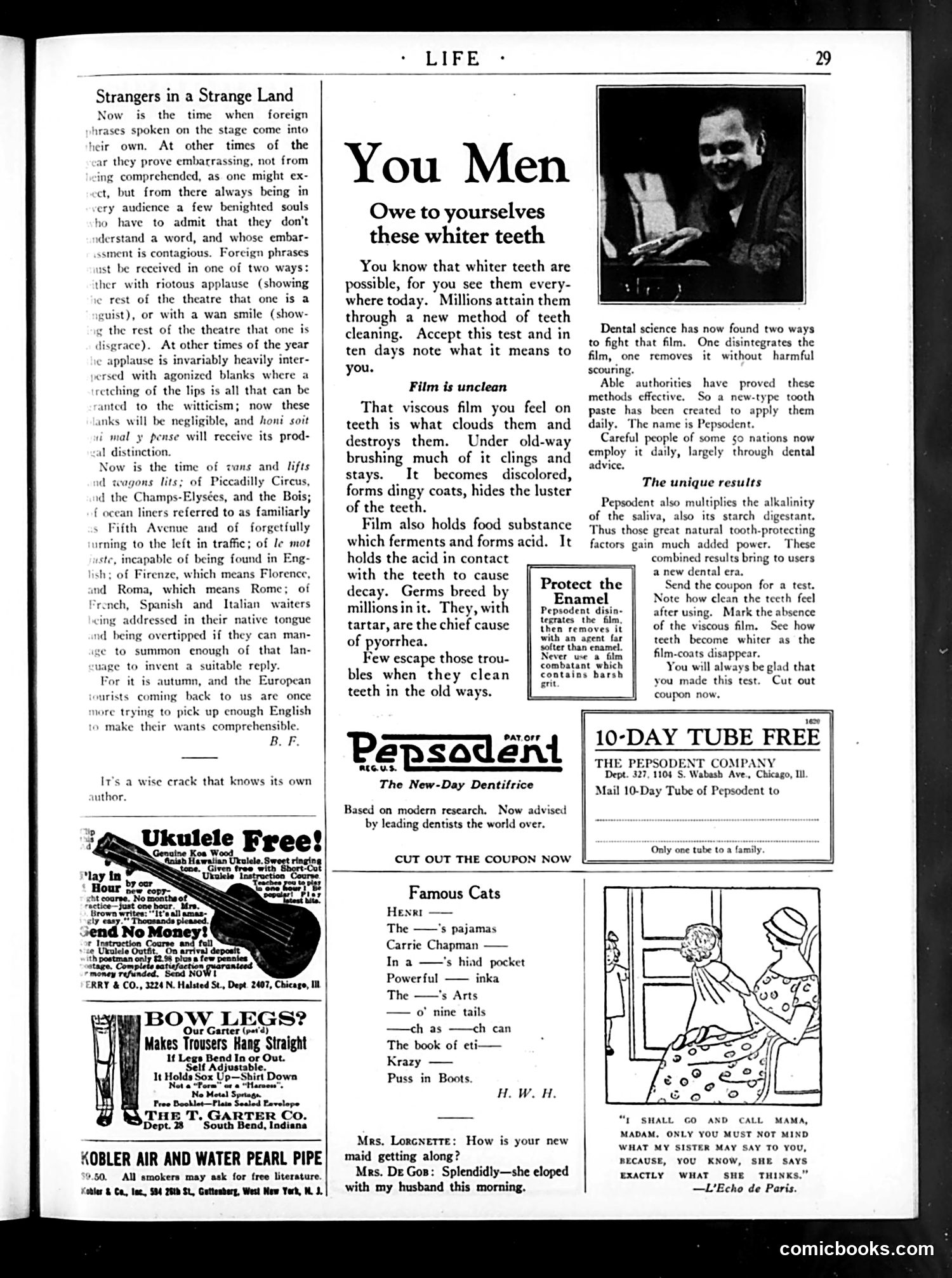
This page combines a satirical essay with period advertisements. The main article, "Strangers in a Strange Land" by B.F., satirizes affluent American tourists returning from Europe in autumn. The satire targets their affectation: they've picked up French and Italian phrases ("honi soit qui mal y pense," "le mot juste," "Firenze," "Roma") and now sprinkle them into conversation to appear cultured. The joke is that this performative sophistication creates awkward social moments—either the speaker receives overly enthusiastic applause (exposing pretension) or uncomfortable silence (revealing the listener's incomprehension). The essay mocks both the tourists' linguistic insecurity and American society's class anxiety around European sophistication. The page is otherwise dominated by product advertisements typical of the era: Pepsodent toothpaste, a ukulele offer, trouser supports for bow-legged men, and a "Famous Cats" humor column. These ads reflect 1920s consumer culture and domestic concerns.
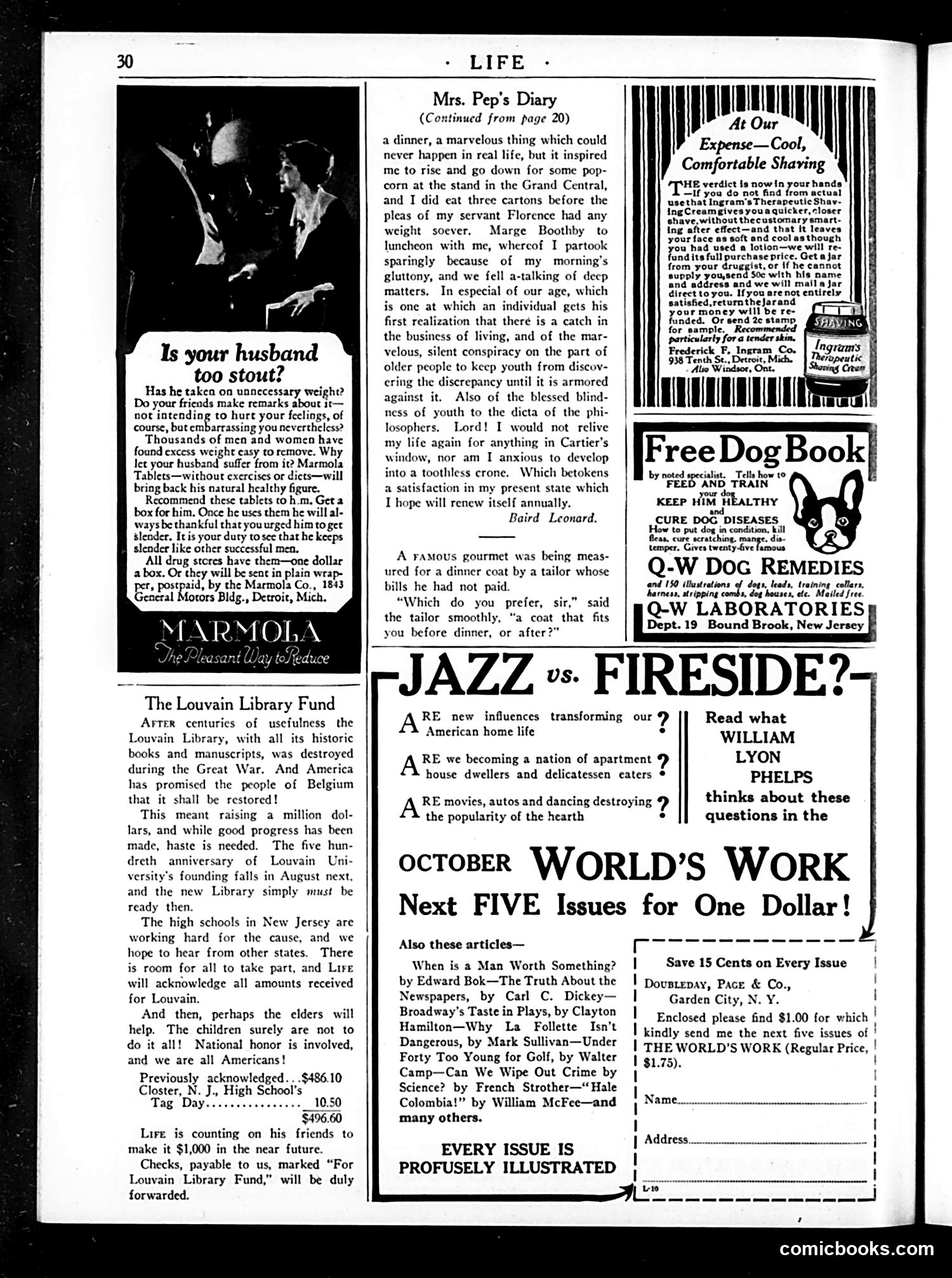
This page contains advertisements and social commentary typical of 1920s Life magazine. The main cartoon (left) advertises Marmola weight-loss tablets, using sexist messaging directed at wives: it suggests they have a "duty" to ensure their husbands stay slim and attractive, shaming them about their appearance to friends. The "Mrs. Pep's Diary" column (center) is satirical domestic commentary about modern life—food, socializing, and philosophical reflections on aging. The Louvain Library Fund notice appeals for donations to rebuild Belgium's famous library, destroyed in World War I, framing it as American patriotic duty. The page is primarily **advertising-driven**, promoting weight-loss pills, dog remedies, shaving cream, and magazine subscriptions. The satire is gentle and social rather than political—poking fun at domestic anxieties and consumer culture of the era.
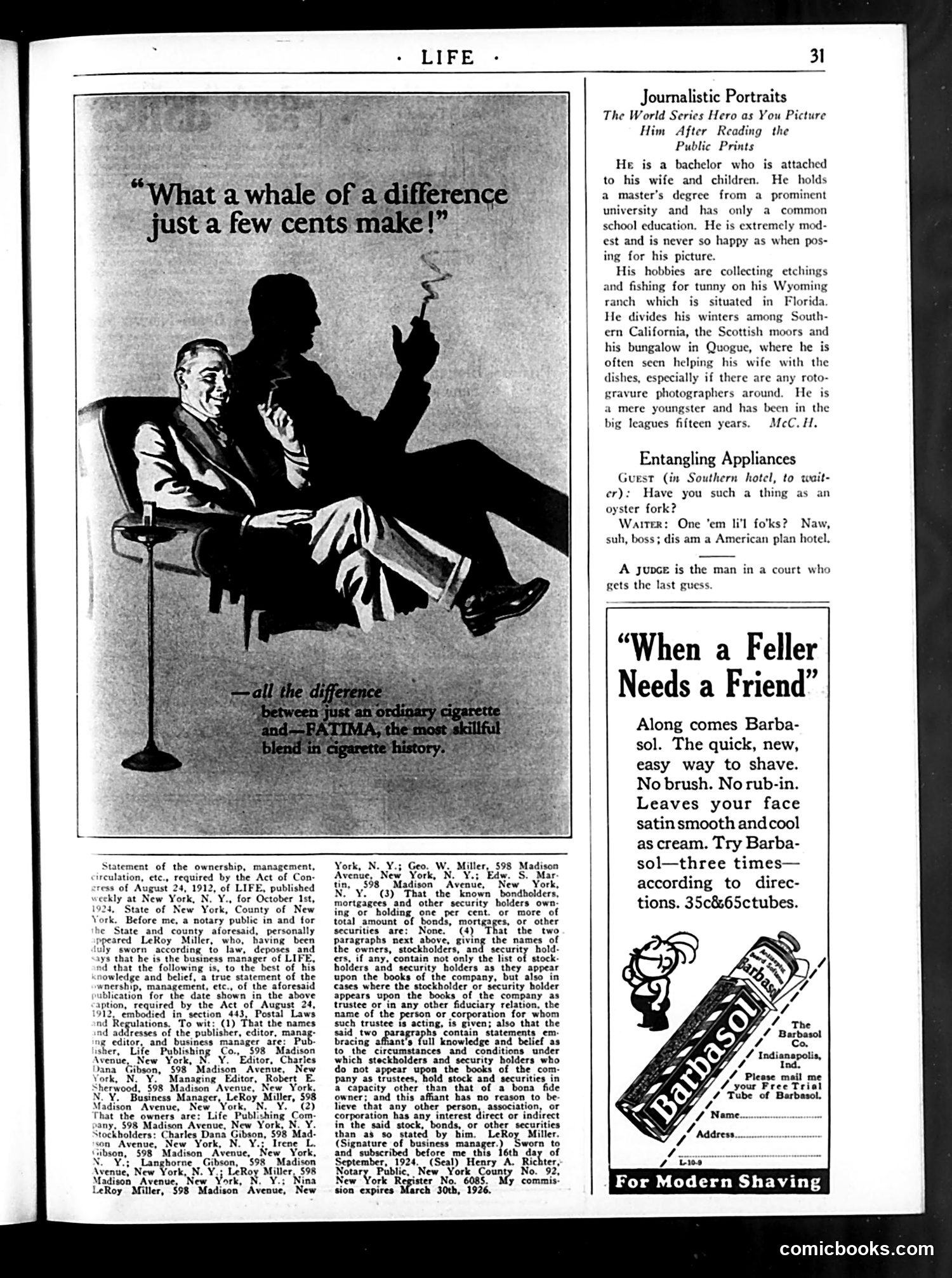
The main content is a **Fatima cigarette advertisement** featuring a silhouette illustration of two men in conversation. One man, seated and gesturing expressively, declares "What a whale of a difference just a few cents make!"—promoting Fatima as "the most skilful blend in cigarette history." Below the advertisement, the page includes **satirical commentary** labeled "Journalistic Portraits," mocking how newspapers and media create contradictory public images of celebrities (specifically referencing a World Series baseball hero). The text highlights absurd incompatibilities: a "bachelor" attached to wife and children, holding both a master's degree and common-school education, modest yet always posing for pictures, with hobbies located in geographically impossible places (Wyoming ranch "situated in Florida"). The satire criticizes sensationalist journalism's tendency to fabricate or embellish celebrity profiles to match reader expectations, creating implausible composite characters rather than accurate reporting. The page also includes routine copyright/ownership statements and an advertisement for Barbosol shaving cream.
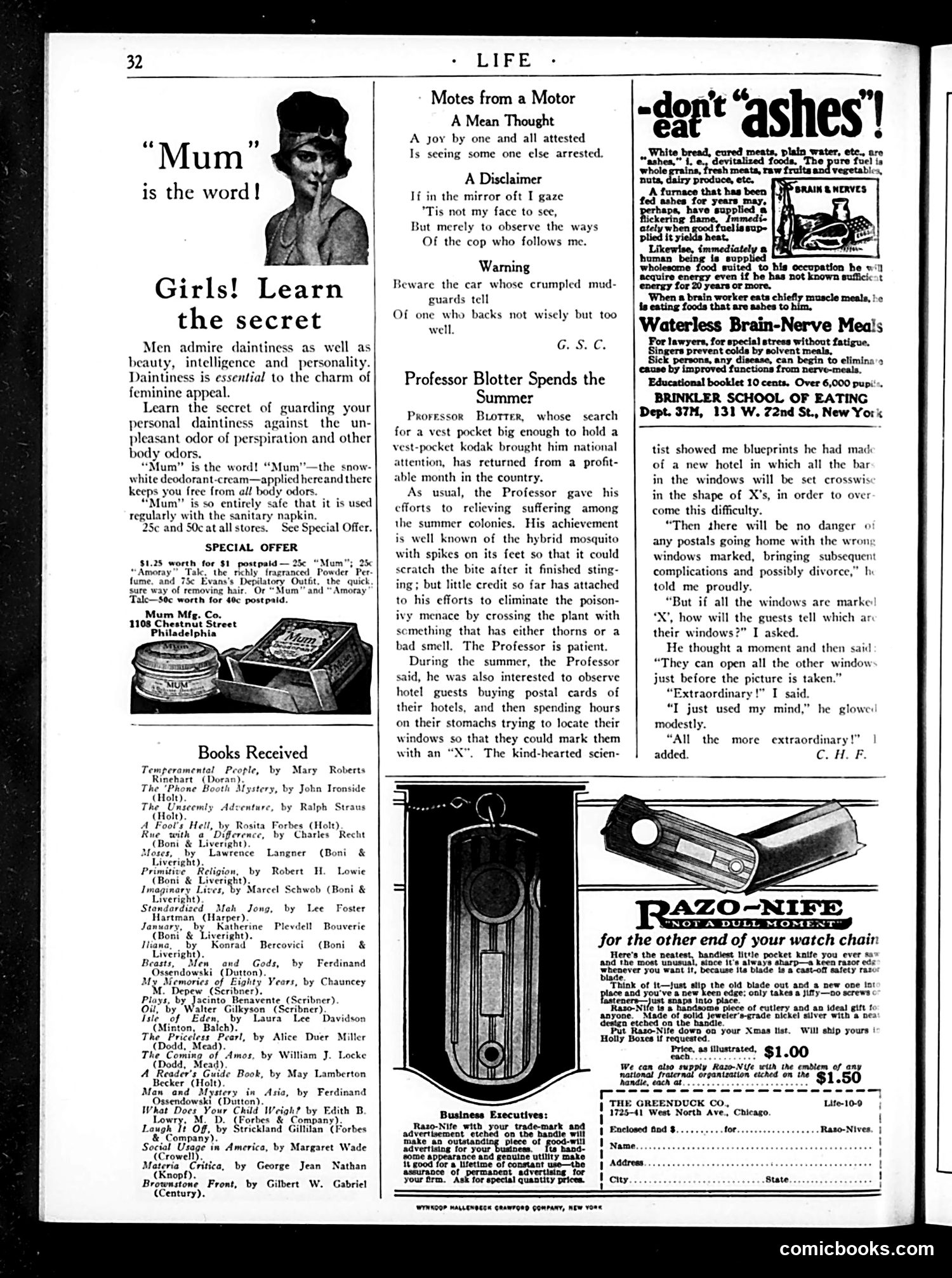
This page contains three distinct sections: **Left Side - "Mum" Deodorant Advertisement:** A vintage ad targeting women, promoting "Mum" deodorant cream as essential to feminine appeal and "daintiness." The gendered messaging—that men admire women who guard against body odors—reflects early 20th-century marketing that weaponized insecurity around natural bodily functions to sell products. **Center - Literary/Humor Columns:** "Motes from a Motor" contains three brief, cynical poems about 1920s life: enjoying others' misfortune, police surveillance, and careless driving. "Professor Blotter Spends the Summer" is a satirical piece mocking both a fictional professor's absurd scientific pursuits (breeding mosquitoes with legs, crossing poison ivy with thorns) and tourists' obsessive behavior photographing hotel rooms. **Right Side - Miscellaneous Ads and Book List:** A "Razor-Nife" pocket knife advertisement and a lengthy list of recently published books across various genres. The page is primarily **commercial and literary**, not political satire.
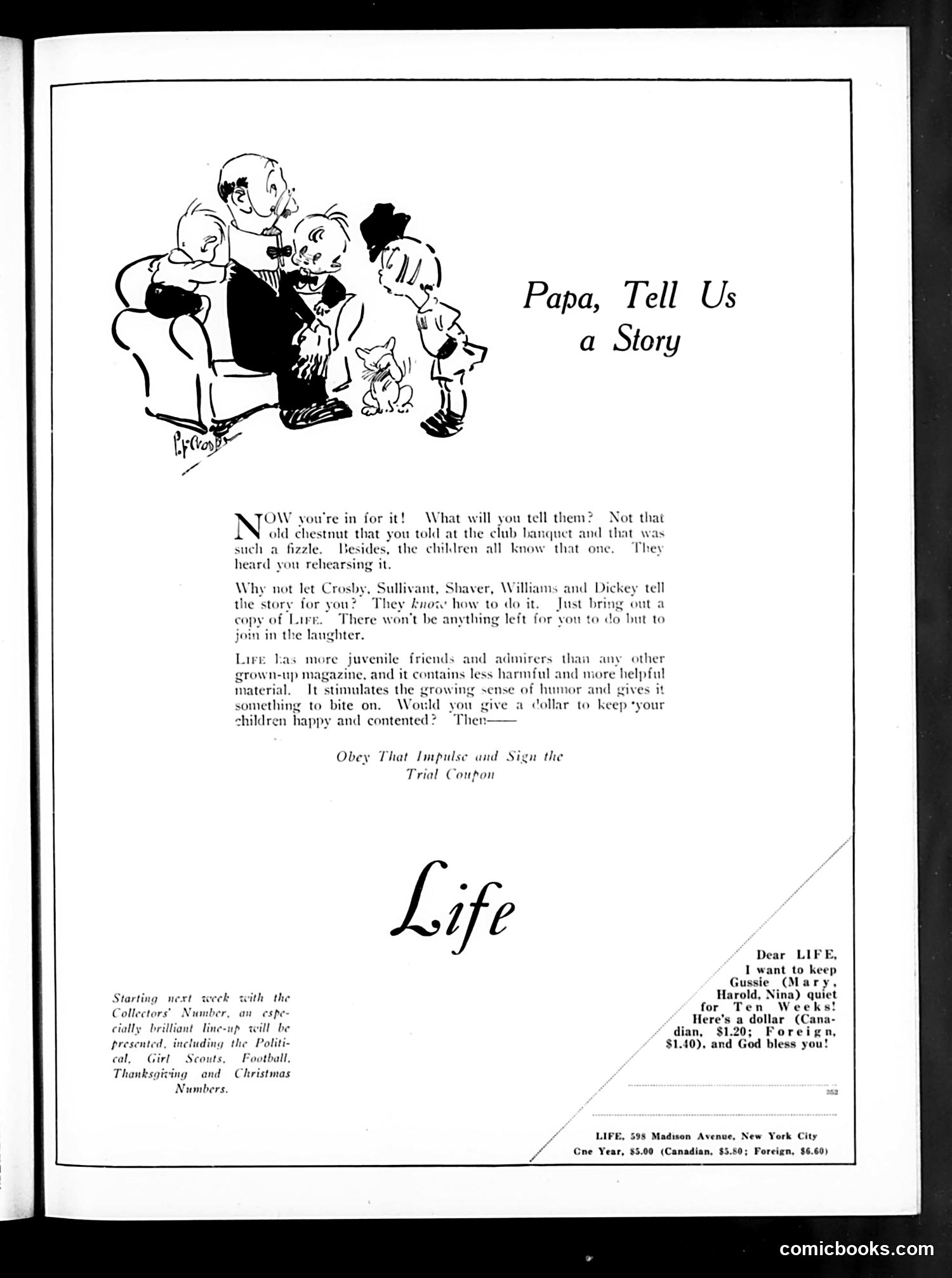
This is primarily a **subscription advertisement** for *Life* magazine, disguised as editorial content. The cartoon shows a father surrounded by children demanding a bedtime story—a relatable domestic scene designed to appeal to parents. The pitch: Rather than the father telling a worn-out story himself, he should subscribe to *Life* and let the magazine's cartoonists (Crosby, Sullivant, Shaver, Williams, and Dickey—names of prominent cartoonists of the era) entertain the children instead. The sales argument emphasizes that *Life* has "more juvenile friends and admirers than any other grown-up magazine" and contains helpful, humor-stimulating material—positioning it as both entertaining and morally beneficial for children. The ad invokes parental concern for children's happiness and intellectual development. The "trial coupon" offers a one-year subscription for $5.00 (or $1.20 for ten weeks). This is fundamentally a nostalgic, family-oriented marketing appeal typical of early-to-mid 20th century magazine advertising.

This is **not a cartoon or satire**—it's a straightforward advertisement for the Corto radiator, published in *Life* magazine during the early 20th century. The page promotes a decorative heating radiator designed by French engineer Louis Courtot. The "joke" or selling point is that a utilitarian heating device has been styled to resemble classical architecture—with slender columns—making it "an object of art" rather than an eyesore. The advertisement emphasizes practical benefits: quick heating response, 30% less floor space usage, and enhanced home aesthetics. Technical details highlight "threaded joints" as an exclusive feature ensuring tight connections without visible rods. The page includes a response card encouraging homeowners, builders, and planners to request illustrated booklets about the Corto radiator and matching boiler systems. The heating contractor serves as the distributor channel. This reflects early 20th-century marketing that positioned industrial/functional products as beautiful design elements—making home heating a matter of both efficiency and refined taste.