
Life, 1924-10-09 · page 20 of 36
Life — October 9, 1924 — page 20: what you’re looking at
What you’re looking at
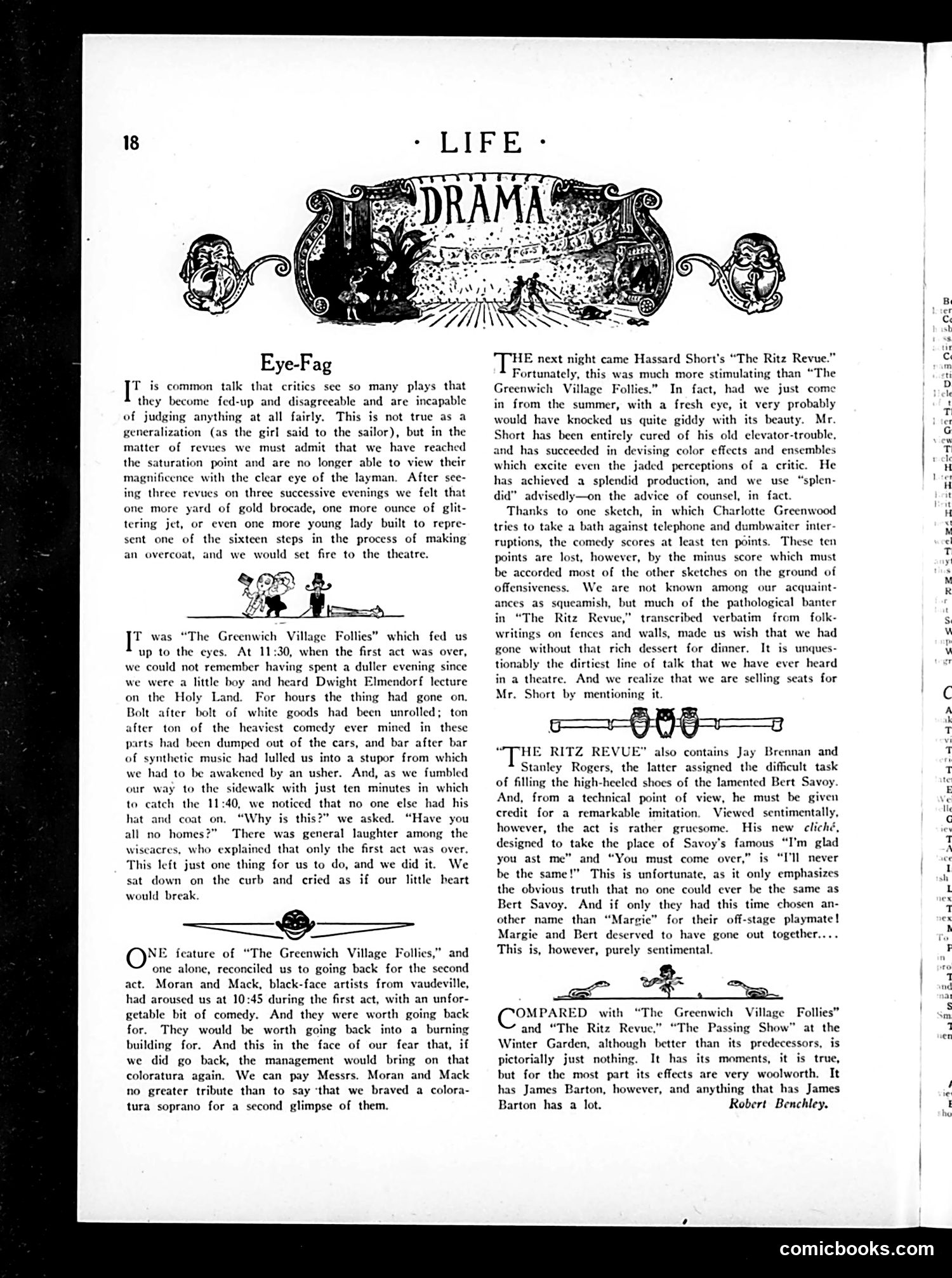
This is a theater critic's column reviewing three Broadway revues. The headline "Eye-Fag" (period slang for exhaustion) sets up the premise: critics attending too many shows become jaded and unable to judge fairly. The critic describes attending "The Greenwich Village Follies," finding it tediously long with excessive scenery and undistinguished music—so tedious that they sat on the curb and cried when discovering the first act wasn't over. The one redeeming feature: Moran and Mack, blackface vaudeville comedians, whose performance was worthy enough to brave a second act. The review then covers "The Ritz Revue," directed by Hassard Short, which the critic found more visually impressive but marred by crude humor—"pathological banter transcribed verbatim from fences and walls"—the dirtiest material they'd encountered in theater. The satire targets both overstuffed revue productions and the critic's own exhaustion affecting judgment. The column demonstrates Life's theatrical criticism style: witty, acerbic, and focused on production values and comedy quality.
📄 Transcribed text from this page (OCR, searchable)
Machine-transcribed from the original scan — historical spelling and the odd misread are preserved.
18 Eye-Fag T is common talk that critics see so many plays that they become fed-up and disagreeable and are incapable of judging anything at all fairly. This is not true as a generalization (as the girl said to the sailor), but in the matter of revues we must admit that we have reached the saturation point and are no longer able to view their magnificence with the clear eye of the layman. After see- ing three revues on three successive evenings we felt that one more yard of gold brocade, one more ounce of glit- tering jet, or even one more young lady built to repre- sent one of the sixteen steps in the process of making an overcoat, and we would set fire to the theatre. T was “The Greenwich Village Follies” which fed us up to the eyes. At 11:30, when the first act was over, we could not remember having spent a duller evening since we were a little boy and heard Dwight Elmendorf lecture on the Holy Land. For hours the thing had gone on. Bolt after bolt of white goods had been unrolled; ton after ton of the heaviest comedy ever mined in these parts had been dumped out of the cars, and bar after bar of synthetic music had lulled us into a stupor from which we had to be awakened by an usher. And, as we fumbled our way to the sidewalk with just ten minutes in which to catch the 11:40, we noticed that no one else had his hat and coat on. “Why is this?” we asked. “Have you all no homes?” There was general laughter among the wiseacres, who explained that only the first act was over. This left just one thing for us to do, and we did it. We sat down on the curb and cried as if our little heart would break. —_ & —— NE feature of “The Greenwich Village Follies,” and one alone, reconciled us to going back for the second act. Moran and Mack, black-face artists from vaudeville, had aroused us at 10:45 during the first act, with an unfor- getable bit of comedy. And they were worth going back for. They would be worth going back into a burning building for. And this in the face of our fear that, if we did go back, the management would bring on that coloratura again. We can pay Messrs. Moran and Mack no greater tribute than to say ‘that we braved a colora- tura soprano for a second glimpse of them. "THE next night came Hassard Short's “The Ritz Revue.” Fortunately, this was much more stimulating than “The Greenwich Village Follies.” In fact, had we just come in from the summer, with a fresh eye, it very probably would have knocked us quite giddy with its beauty. Mr. Short has been entirely cured of his old elevator-trouble, and has succeeded in devising color effects and ensembles which excite even the jaded perceptions of a critic. He has achieved a splendid production, and we use “splen- did” advisedly—on the advice of counsel, in fact. Thanks to one sketch, in which Charlotte Greenwood tries to take a bath against telephone and dumbwaiter inter- ruptions, the comedy scores at least ten points. These ten points are lost, however, by the minus score which must be accorded most of the other sketches on the ground of offensiveness. We are not known among our acquaint- ances as squeamish, but much of the pathological banter in “The Ritz Revue,” transcribed verbatim from folk- writings on fences and walls, made us wish that we had gone without that rich dessert for dinner, It is unques- tionably the dirtiest line of talk that we have ever heard in a theatre. And we realize that we are selling seats for Mr. Short by mentioning it ——Oi-— “THE RITZ REVUE” also contains Jay Brennan and Stanley Rogers, the latter assigned the difficult task of filling the high-heeled shoes of the lamented Bert Savoy. And, from a technical point of he must be given credit for a remarkable imitation. Viewed sentimentally, however, the act is rather grucsome. His new cliché, designed to take the place of Savoy's famous “I'm glad you ast me” and “You must come over,” is “I'll never be the same!" This is unfortunate, as it only emphasizes the obvious truth that no one could ever be the same as Bert Savoy. And if only they had this time chosen an- other name than “Marg for their off-stage playmate! Margie and Bert deserved to have gone out together.... This is, however, purely sentimental. 2. COMPARED with “The Greenwich Village Follies” and “The Ritz Revue,” “The Passing Show” at the Winter Garden, although better than its predecessors, is pictorially just nothing. It has its moments, it is true, but for the most part its effects are very woolworth, It has James Barton, however, and anything that has James Barton has a lot. Robert Benchley. comicbooks.com