
Life, 1924-10-09 · page 26 of 36
Life — October 9, 1924 — page 26: what you’re looking at
What you’re looking at
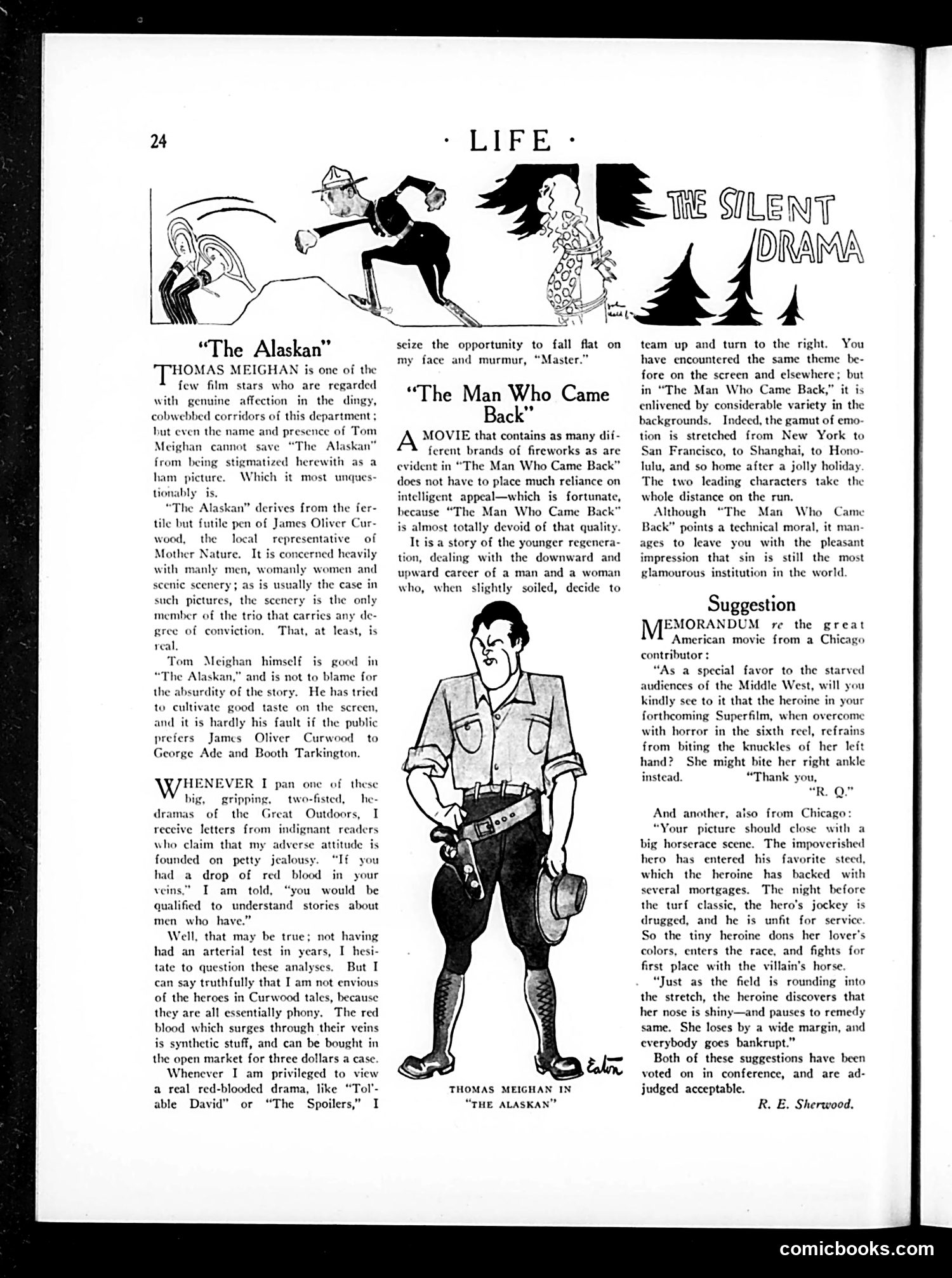
This page reviews two silent films, with particular scorn for "The Alaskan" starring Thomas Meighan. The critic dismisses it as a "ham picture" despite respecting Meighan as an actor—the problem lies with source material by James Oliver Curwood, a prolific pulp adventure writer known for formulaic "Great Outdoors" stories featuring "manly men, womanly women." The satirical thrust: readers attack the critic for lacking "red blood" when he pans these masculine melodramas. He responds that such films traffic in synthetic emotion—their "red blood" is literally purchasable theatrical hokum, not genuine drama. Real "red-blooded" films like "Tolable David" earn his genuine respect. "The Man Who Came Back" receives similar criticism for prioritizing exotic locations (New York to Shanghai) over intelligent storytelling, while inadvertently glamorizing sin. The "Suggestion" section mocks Hollywood's predictable formulas—female hysteria, improbable horserace climaxes with cross-dressing heroines—through fake reader letters requesting absurdist alternatives.
📄 Transcribed text from this page (OCR, searchable)
Machine-transcribed from the original scan — historical spelling and the odd misread are preserved.
THOMAS MEIGHAN is one of the few film stars who are regarded with genuine affection in the dingy, cobwebbed corridors of this department ; hut even the name and presence of Tom Meighan cannot save “The Alaskan” from being stigmatized herewith as a ham picture. Which it tionably is. *The Alaskan” derives from the fer- tile but futile pen of James Oliver Cur- wood, the local representative of Mother Nature. It is concerned heavily with manly men, womanly women and most unques- ry; as is usually the case in such pictures, the scenery is the only member of the trio that carries any de- f conviction. That, at least, is Tom Meighan himself is good in “The Alaskan,” and is not to blame for the absurdity of the story. He has tried to cultivate good taste on the screen, and it is hardly his fault if the public prefers James Oliver Curwood to George Ade and Booth Tarkington. HENEVER I pan one of these big, gripping, two-fisted, —he- dramas of the Great Outdoors, I receive letters from indignant readers who claim that my adverse founded on petty jealousy. “If you had a drop of red blood in your I am told, “you would be qualified to understand stories about men who hav Well, that may be true; not having had an arterial test in years, I hesi- tate to question these analyses. But I can say truthfully that I am not envious of the heroes in Curwood tales, because they are all essentially phony, The red blood which surges through their veins is synthetic stuff, and can be bought in the open market for three dollars a case. Whenever I am privileged to view a real red-blooded drama, like “Tol'- able David" or “The Spoilers,” I attitude is veins,” seize the opportunity to fall flat on my face and murmur, “Master.” “The Man Who Came Back” MOVIE that contains as many dif- ferent brands of fireworks as are evident in “The Man Who Came Back” does not have to place much reliance on intelligent appeal—which is fortunate, because “The Man Who Came Back” is almost totally devoid of that quality. It is a story of the younger regenera tion, dealing with the downward and upward career of a man and a woman who, when slightly soiled, decide to team up and turn to the right. You have encountered the same theme be- fore on the screen and elsewhere; but in “The Man Who Came Back,” it is enlivened by considerable variety in the backgrounds. Indeed, the gamut of emo- tion is stretched from New York to San Francisco, to Shanghai, to Hono- lulu, and so home after a jolly holiday. The two leading characters take the whole distance on the run, Although “The Man Who Came Back” points a technical moral, it man- ages to leave you with the pleasant impression that sin is still the most glamourous institution in the world. Suggestion MORANDUM re the great American movie from a Chicago contributor : “As a special favor to the starved audiences of the Middle West, will you kindly see to it that the heroine in your forthcoming Superfilm, when overcome with horror in the sixth reel, refrains from biting the knuckles of her left hand? She might bite her right ankle instead. “Thank you, “RQ.” And another, also from Chicago: “Your picture should close with a big horserace scene. The impoverished hero has entered his favorite which the heroine has backed with several mortgages. The night before the turf classic, the hero’s jockey is drugged, and he is unfit for service. So the tiny heroine dons her lover's colors, enters the race, and fights for first place with the villain’s horse, “Just as the field is rounding into the stretch, the heroine discovers that her nose is shiny—and pauses to remedy same, She loses by a wide margin, and everybody goes bankrup' Both of these suggestions have been voted on in conference, and are ad- judged acceptable. steed, R. E. Sherwood. comicbooks.com