
A complete issue · 37 pages · 1924
Life — June 26, 1924
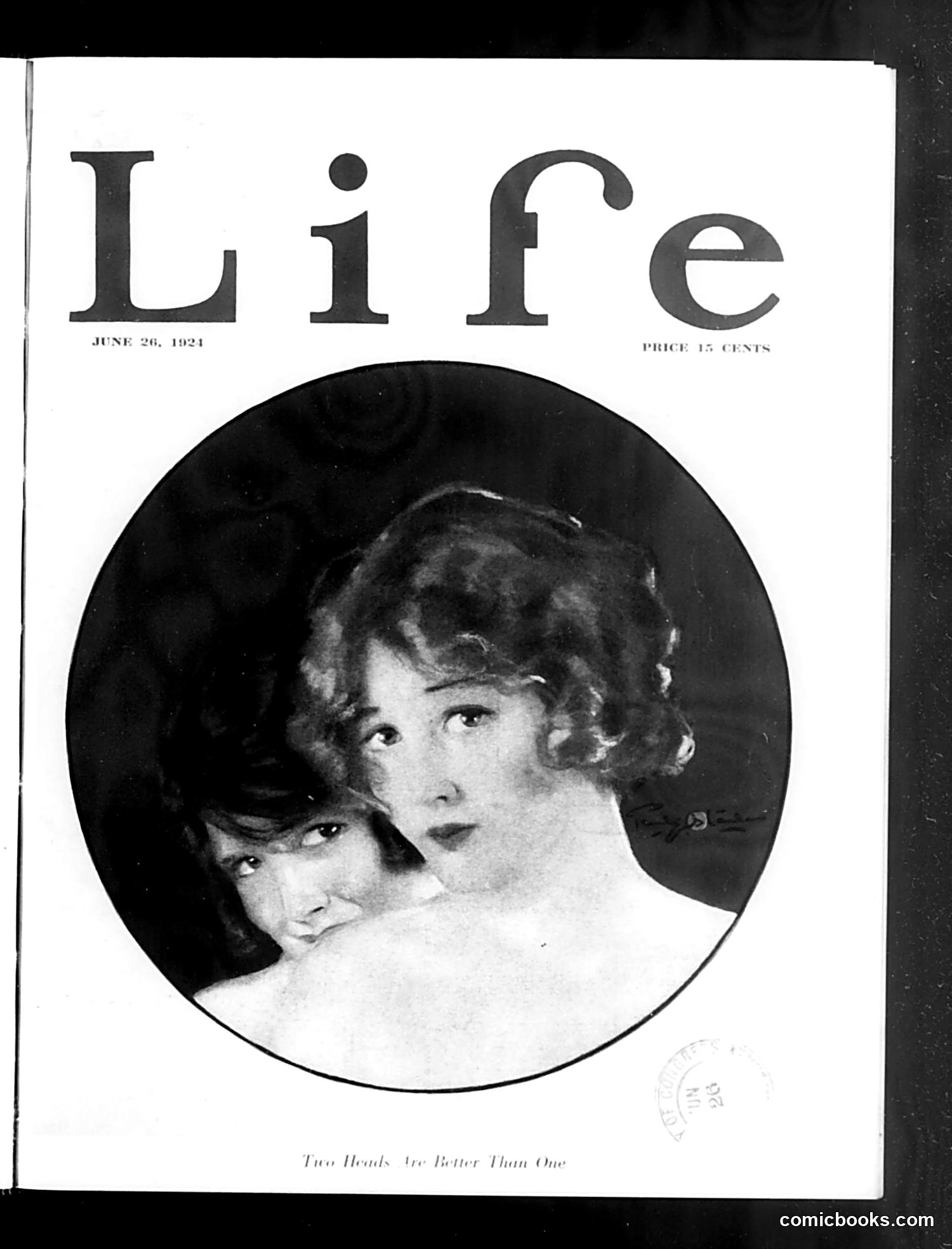
This is a magazine cover rather than a political cartoon. It features a circular photograph of two young women with 1920s-style bobbed hair and fashionable appearance. The caption reads "Two Heads Are Better Than One." The image appears to be a lighthearted commentary on the "New Woman" of the 1920s—the flapper era. The phrase likely plays on both the idiom about combined wisdom and contemporary anxieties about modern women's independence and visibility. The styling and presentation suggest satire about contemporary social attitudes toward young women's roles and intelligence during this transitional period in American culture. The price of 15 cents indicates this is an authentic period publication.
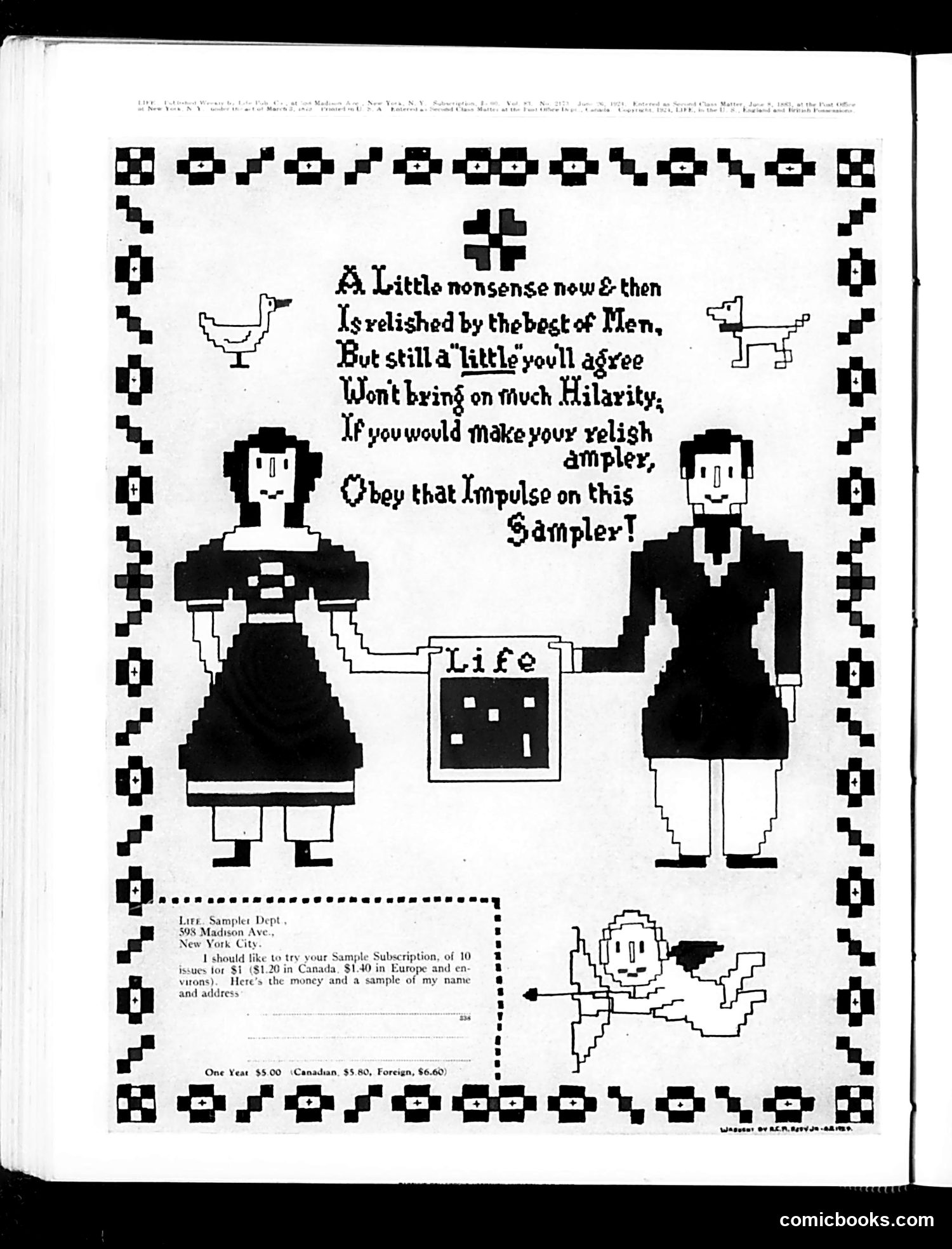
This page is primarily a **subscription advertisement** for *Life* magazine, not a political cartoon. The decorative border features pixel-art style illustrations typical of early 20th-century design. The central text is a humorous pitch encouraging subscriptions by suggesting that while "a little nonsense now & then / Is relished by the best of Men," readers should subscribe to *Life* to keep their "relish ampler." The accompanying illustrations show two figures exchanging what appears to be a small game or "Life" object, with decorative birds and figures around them. The bottom section contains subscription details: 10 issues for $1.50 in the US, $1.85 in Canada, or $2.20 abroad. This is fundamentally a marketing appeal using gentle satire about human nature and humor preferences.
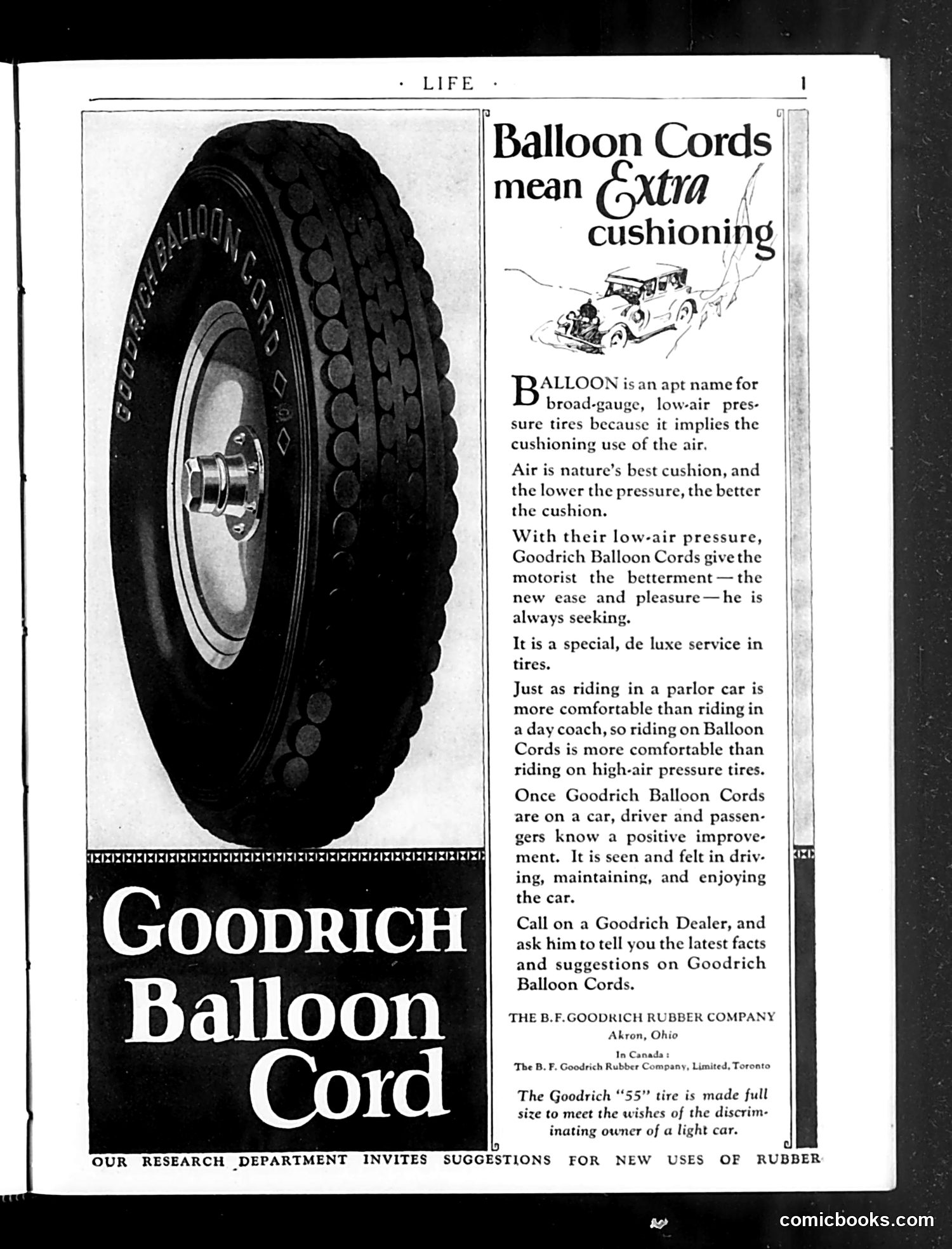
This page is **not satirical content** — it's a straightforward **advertisement for Goodrich Balloon Cord tires**, a product from the B.F. Goodrich Rubber Company (Akron, Ohio). The ad promotes low-air-pressure "balloon" tires as a luxury comfort feature for automobiles. The marketing pitch compares riding on Balloon Cords to traveling in a "parlor car" versus a "day coach," emphasizing smoother, more cushioned driving. The large tire image on the left showcases the product's broad, distinctive profile. This appears to be from the early automotive era when pneumatic tire technology was still novel and marketed as a premium amenity. The ad encourages readers to visit Goodrich dealers for more information about this new tire technology.
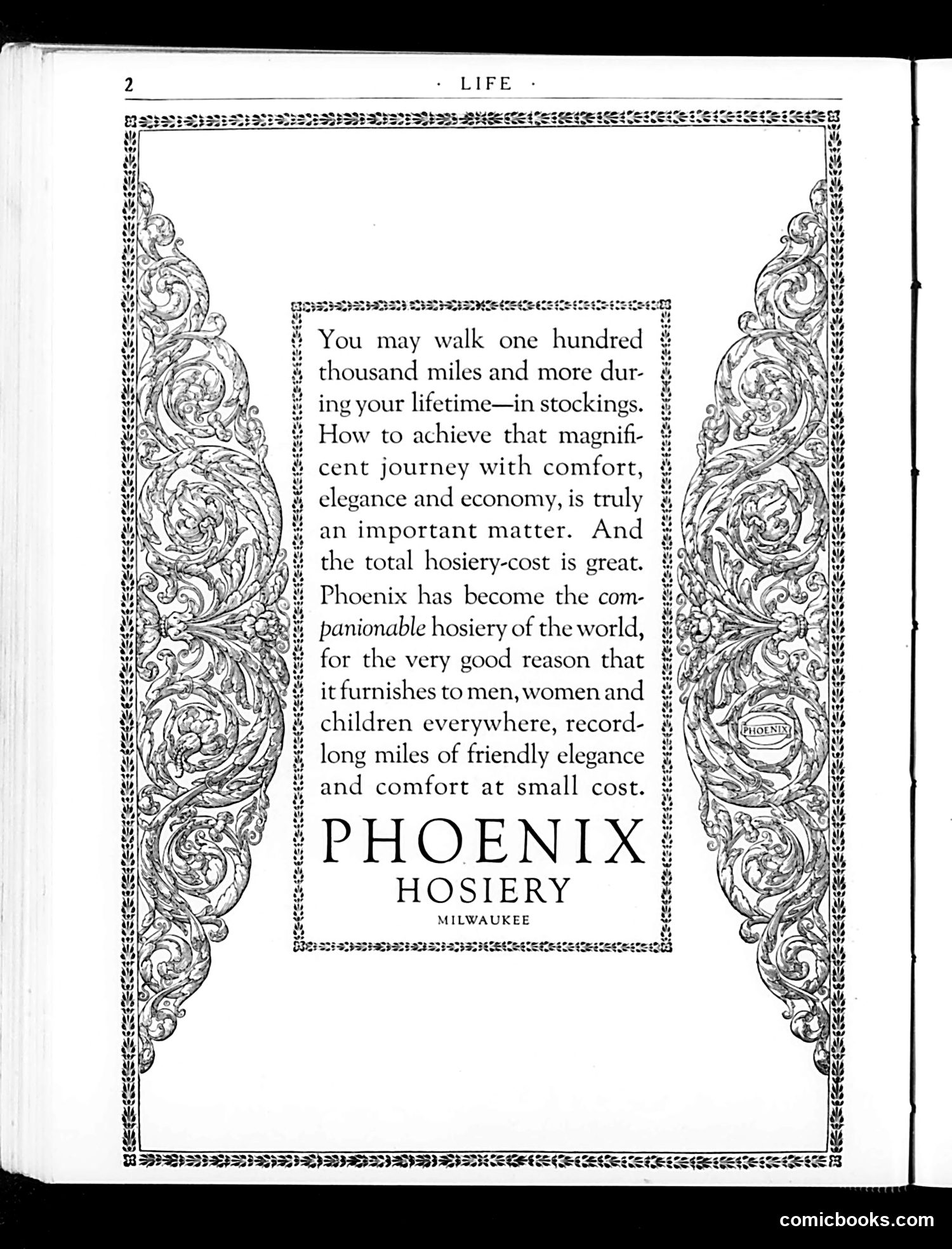
This page is **primarily an advertisement**, not a cartoon or satirical content. It's a Phoenix Hosiery ad from Milwaukee promoting stockings to consumers. The ad uses ornamental Art Nouveau-style borders and makes a sales pitch about durability and affordability. The key claim is that one could "walk one hundred thousand miles" in Phoenix stockings during a lifetime, while maintaining "comfort, elegance and economy." The language describing Phoenix as the "companionable hosiery of the world" and its appeal to "men, women and children everywhere" reflects early 20th-century consumer marketing strategies. There is no political satire or social commentary present—this is straightforward commercial advertising placed in *Life* magazine, which accepted paid advertisements alongside its satirical editorial content.
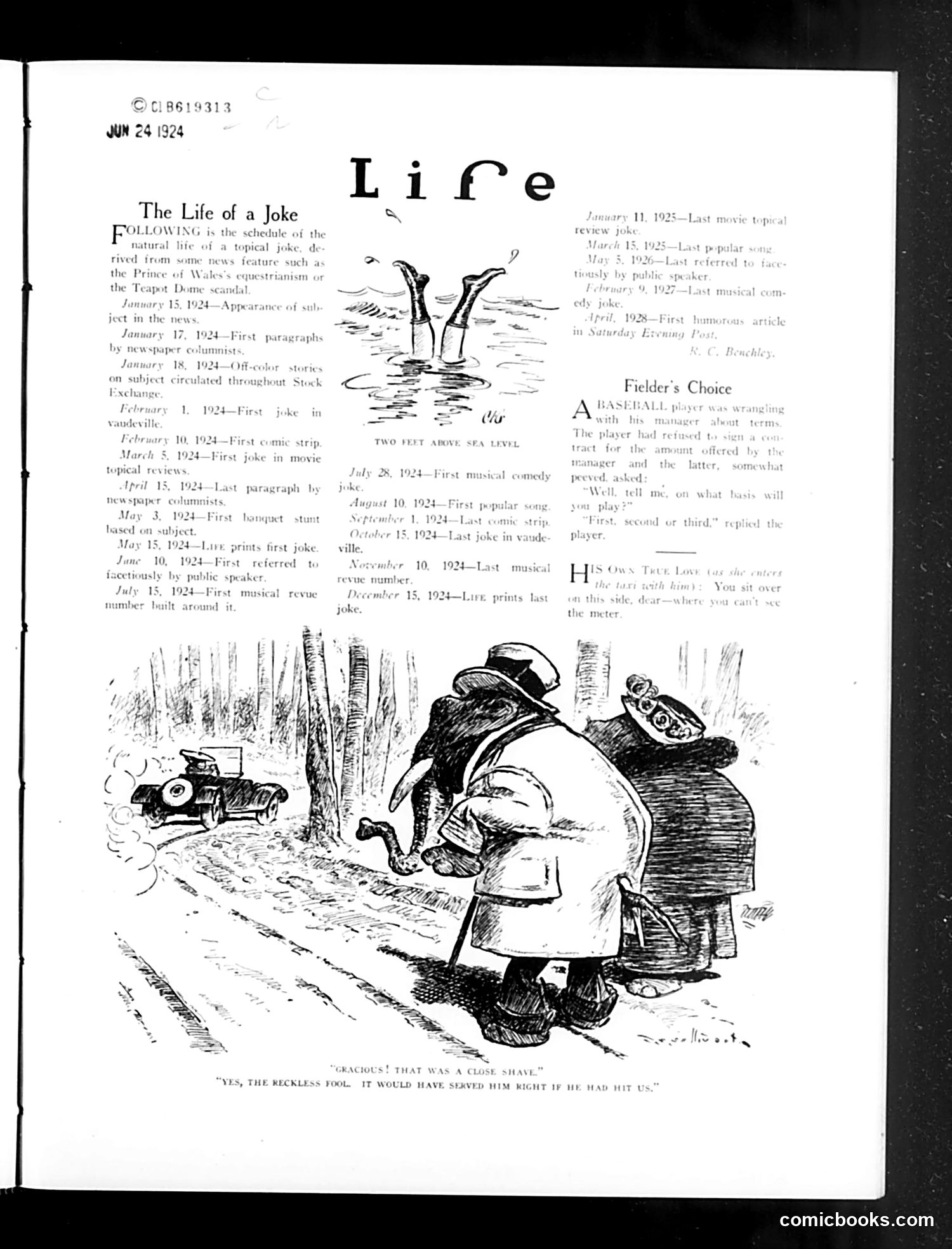
This page documents "The Life of a Joke"—tracking how a single joke evolved through various Life publications from January through December 1924, appearing in different formats (paragraphs, comic strips, musical comedy, movie reviews, banquets). The cartoon below depicts a near-miss automobile accident. A large woman has apparently stepped into the road; a car swerves to avoid her. The caption reads: "Gracious! That was a close shave. Yes, the reckless fool. It would have served him right if he had hit us." The joke satirizes absurd traffic logic—the woman nearly causes an accident through reckless pedestrian behavior, yet blames the driver for "recklessness" while suggesting he deserved to hit her. It's social commentary on 1920s automobile culture and unreasonable public behavior.
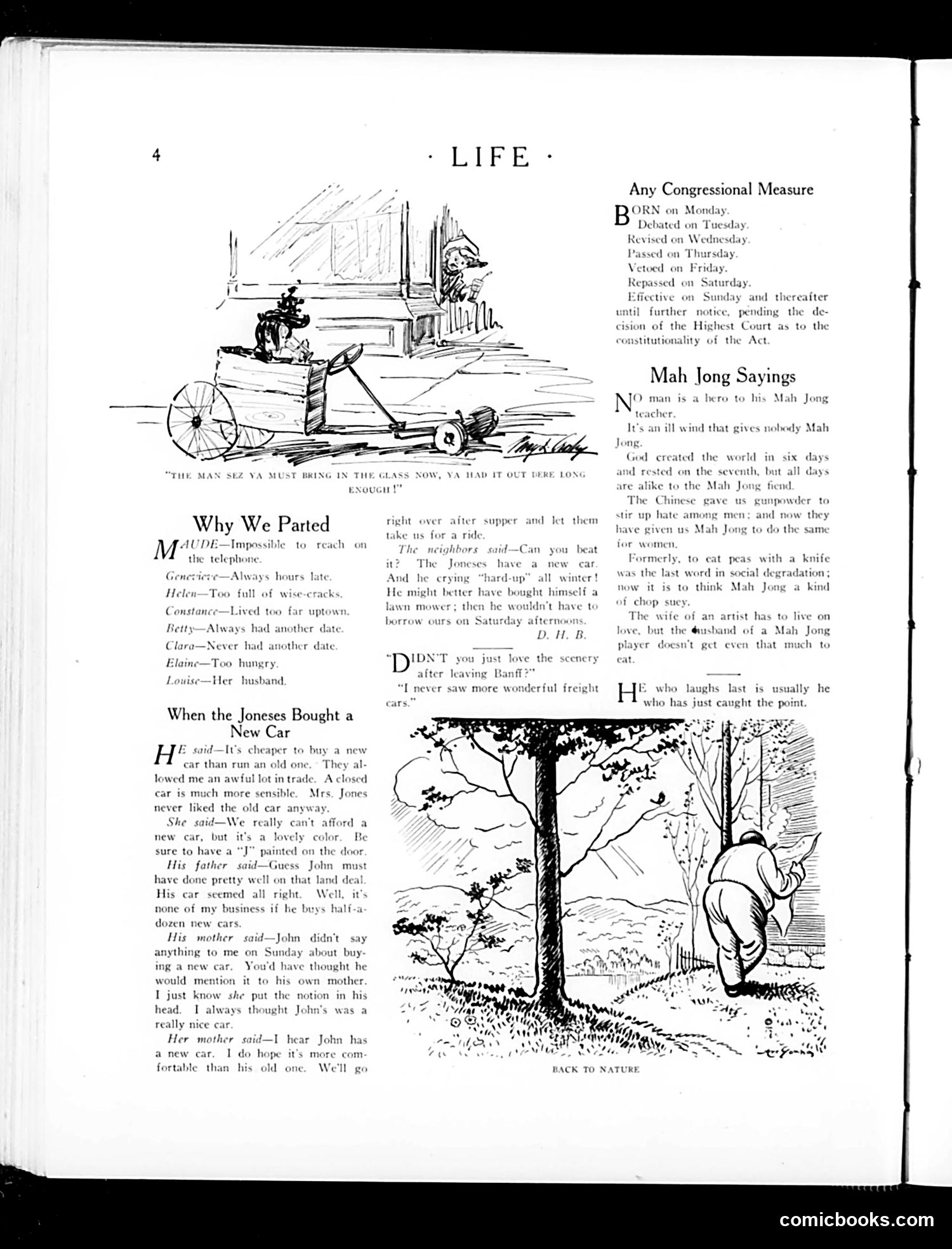
This page contains three distinct pieces of social humor typical of Life's satirical approach: 1. **"The Man See Ya Must Bring in the Glass Now, Ya Had It Out Here Long Enough"** - A cartoon about delivery workers, likely satirizing the inconvenience of home deliveries and the tension between service providers and householders. 2. **"Why We Parted"** - A humorous list of reasons for relationship breakups (Maude, Helen, Constance, Betty, Clara, Edith, Louise), using stereotypical female names to joke about serial dating and romantic incompatibility. 3. **"When the Joneses Bought a New Car"** - Satirizing middle-class materialism and status anxiety, showing how neighbors' competitive consumerism influences purchasing decisions—a common theme mocking American social pretension. The "Back to Nature" illustration accompanies "Mah Jong Sayings," reflecting the period's fascination with the Chinese game.
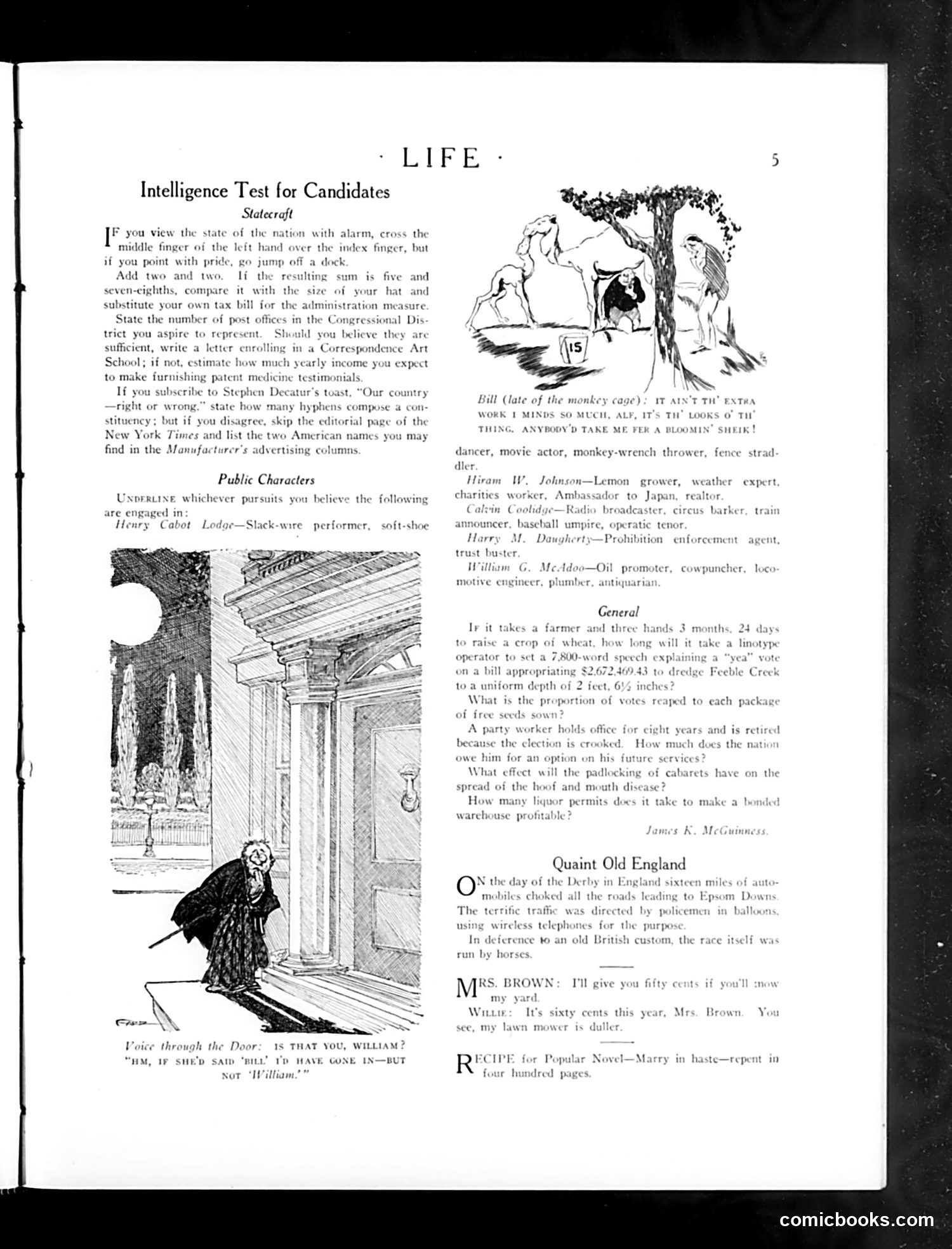
This page contains satirical content targeting early 20th-century American society and politics. **"Intelligence Test for Candidates"** mocks political candidates with absurd questions (crossing middle fingers, comparing objects to hats, calculating post offices). It satirizes the notion that politicians need special intelligence or qualifications. **"Public Characters"** section lists various occupations, likely mocking contemporary public figures or stereotypes. **"Price through the Door"** cartoon depicts a woman confronting a man, captioned with dialogue suggesting domestic tension about household expenses—a common satirical subject reflecting economic concerns of the era. **"Quaint Old England"** presents a humorous anecdote about the Derby horse race and traffic management, with dialogue between "Mrs. Brown" and "Willie" about lawn mower costs, mocking British class distinctions and inflation. The overall tone criticizes politics, domestic economics, and British customs.
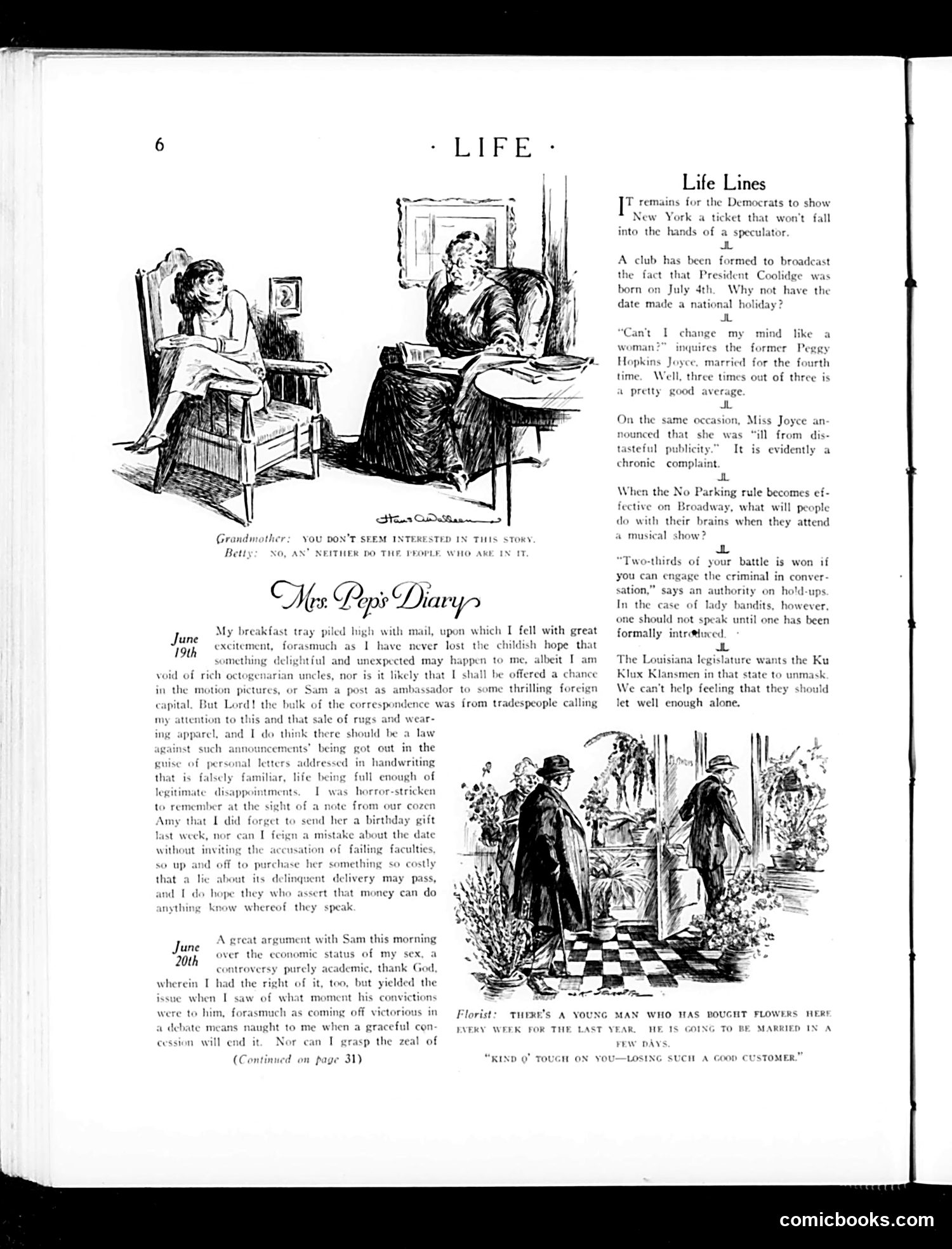
This page from *Life* magazine contains "Mrs. Pep's Diary" entries (June 19-20) and two satirical cartoons. The top cartoon shows a grandmother dismissing her granddaughter Betty from a family story, a joke about generational disinterest in elders' narratives. The bottom cartoon depicts a florist selling flowers to a young man, captioned with a joke about courtship—the customer plans to buy flowers weekly for a year before proposing marriage, with the florist warning he'll "lose such a good customer" once engaged. The diary entries humorously discuss mundane domestic complaints: receiving junk mail, an argument with her husband Sam about women's economic rights, and frustrations with forgotten birthday gifts. The satire targets domestic tedium and marital friction in early 20th-century middle-class life.
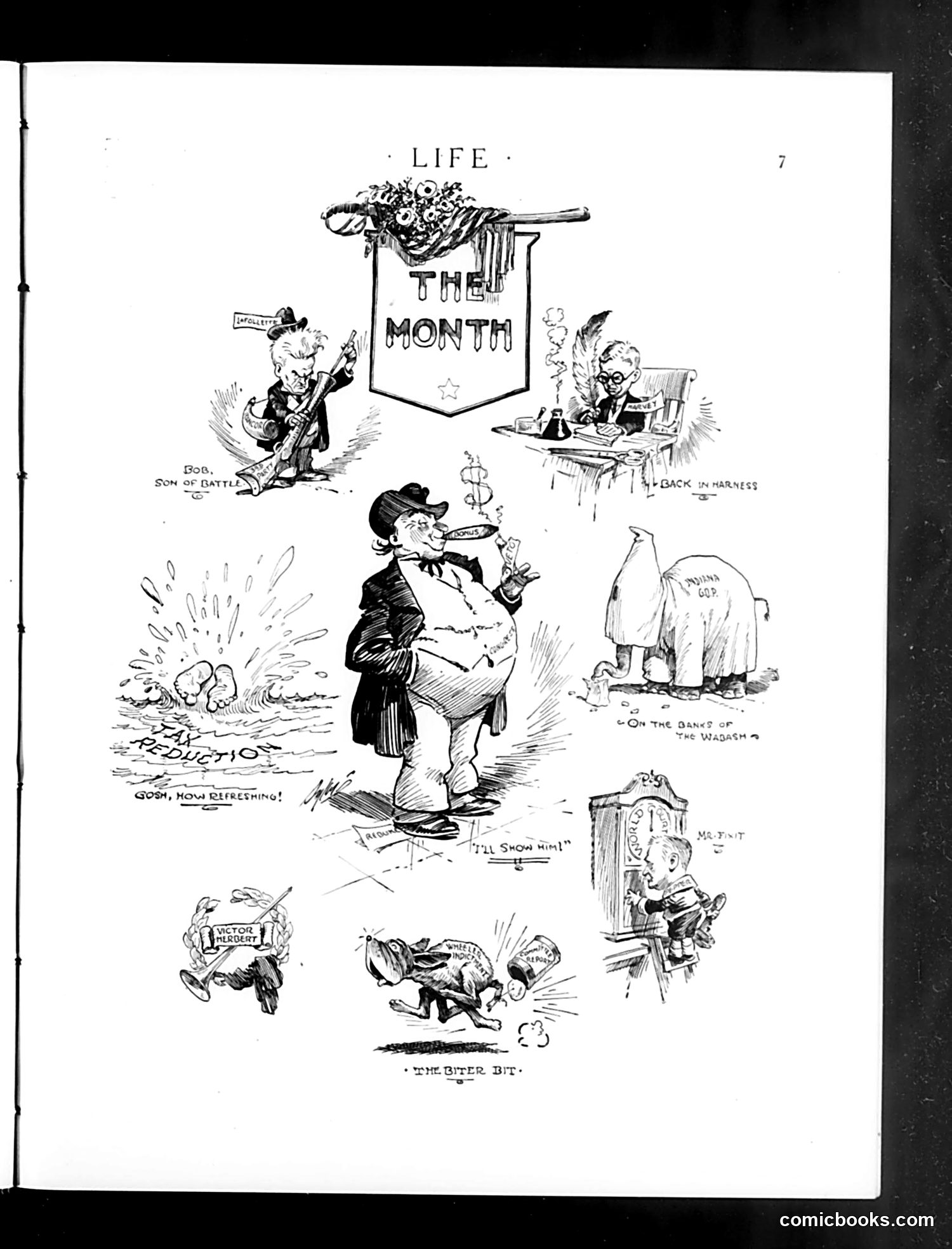
This page presents satirical vignettes mocking various contemporary figures and situations. The central figure appears to be a wealthy man enjoying luxuries ("I'll show him!") while surrounded by commentaries on current events. The sketches include: - "Bob, Son of Battle" - likely a military reference - "Back in Harness" - appears to reference someone resuming duty - "On the Range of the Wagash" - unclear reference - "Gosh, How Refreshing!" - seems to mock someone's relief or satisfaction - "One Bitter Bit" - suggests disappointment or consequences The overall theme appears to mock political figures, wealth disparities, and social hypocrisy typical of Life's satirical style. Without identified captions for specific figures, the exact targets remain unclear, though the artistic style and setup suggest commentary on prominent contemporary politicians or public figures.
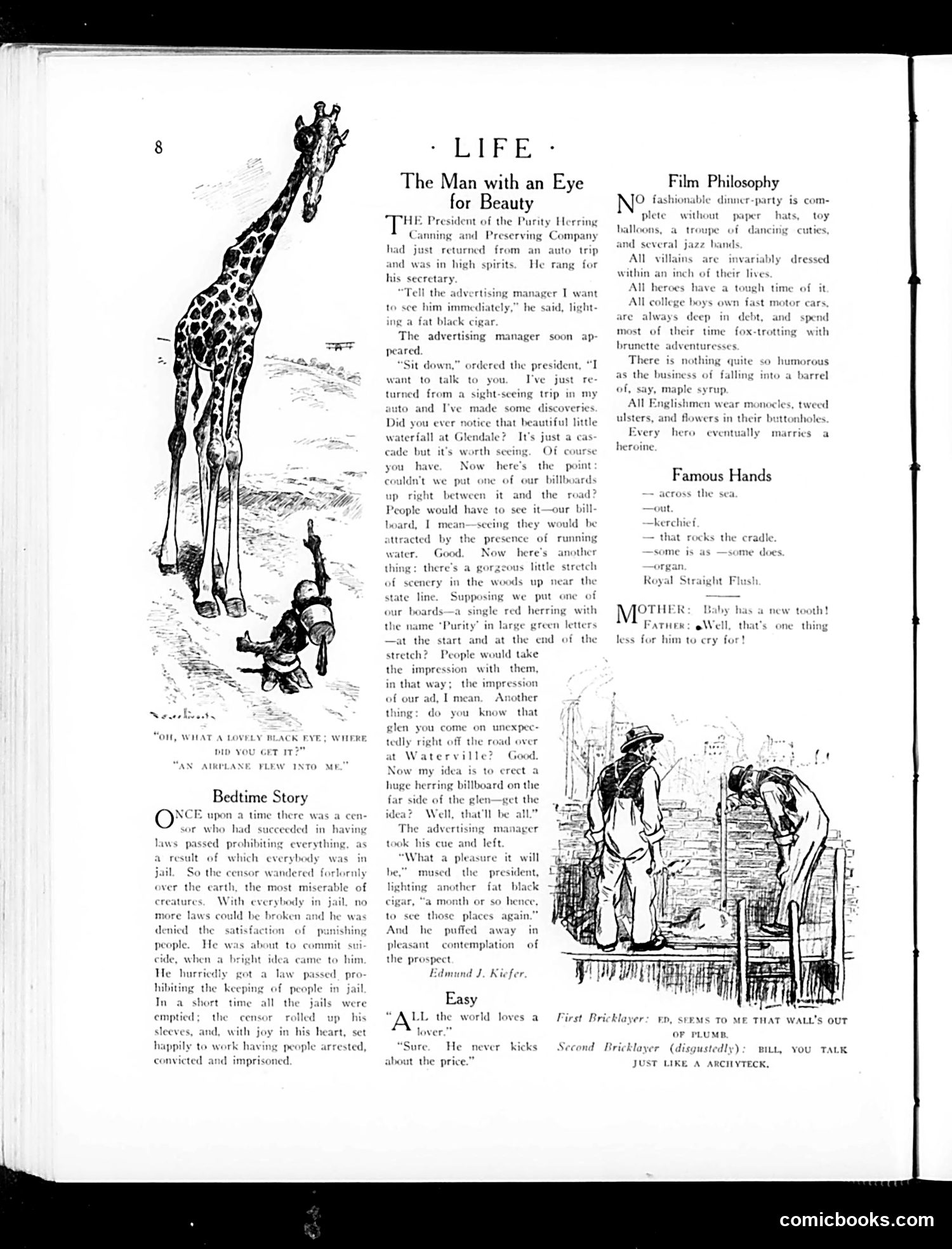
This page contains three satirical pieces: **"The Man with an Eye for Beauty"** features a giraffe illustration accompanying a story about a advertising executive pitching billboard placements near scenic locations (Glendale waterfall, Waterville). The satire mocks commercialism's intrusion into natural beauty—the executive wants to place herring billboards in gorgeous spots, reducing nature to advertising real estate. **"Bedtime Story"** satirizes censorship, describing a jailer who prevents inmates from being punished excessively, earning the censor's approval. It's political commentary on censorship's arbitrary nature. **"Famous Hands" and "Easy"** are brief humor pieces about everyday domestic situations (a baby's tooth, bricklayers' banter). The overall theme critiques advertising excess and commercial exploitation of nature and beauty.
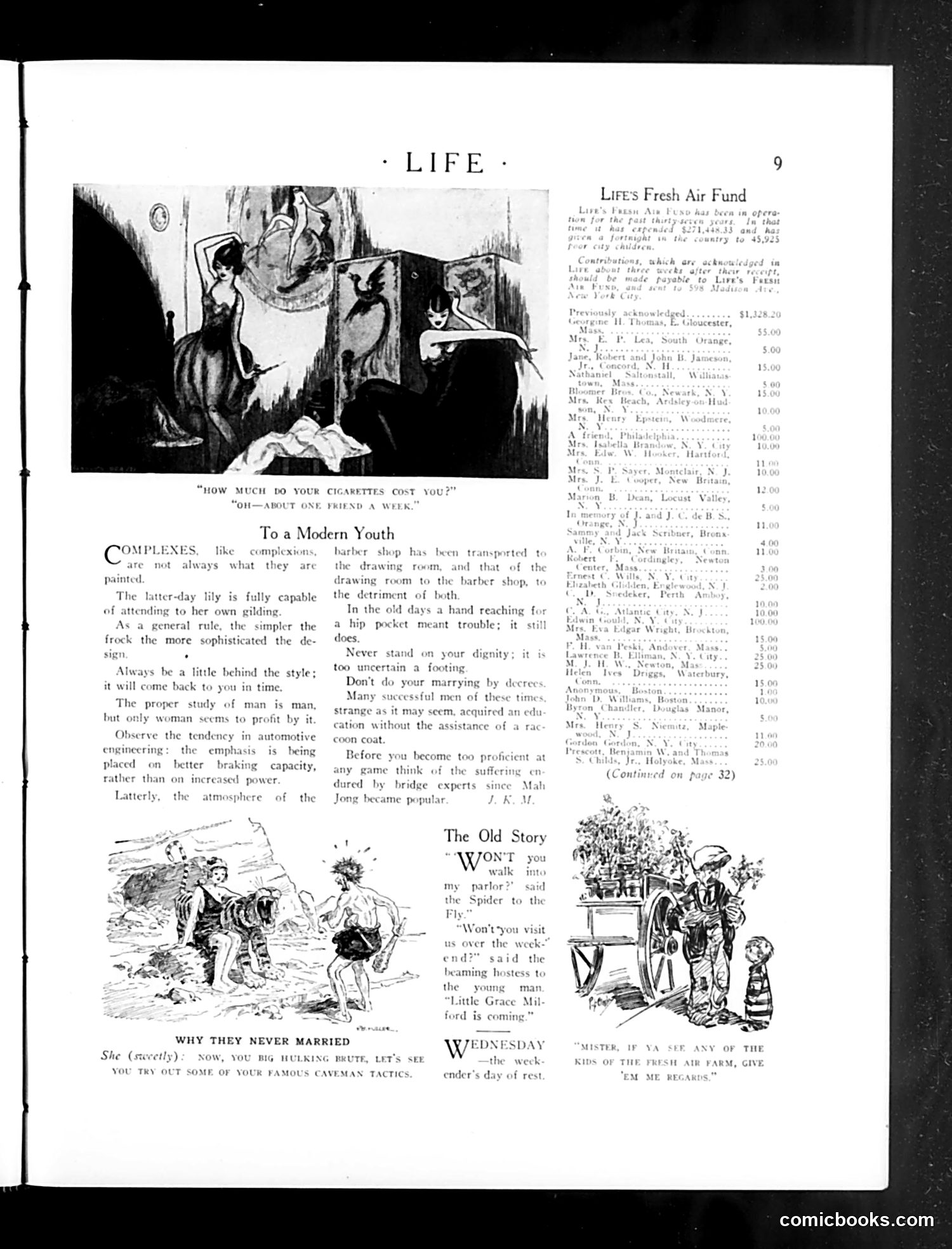
This page contains several satirical pieces targeting early 20th-century social conventions and modern youth behavior. **"To a Modern Youth"** critiques contemporary dating practices and materialism, advising against frivolous spending on cigarettes and cautioning young people against shortcuts in courtship and marriage. **"Why They Never Married"** appears to mock a romantic encounter where a man attempts to impress a woman with aggressive behavior ("brute force"), suggesting satire about misguided masculine tactics in courtship. **"The Old Story"** depicts what appears to be a traditional social visit scenario, contrasting old-fashioned hospitality customs with modern life. The page also includes **"Life's Fresh Air Fund,"** a charitable initiative providing urban poor children with country vacations—indicating Life magazine's philanthropic activities alongside its satire. The illustrations use period line-drawing style typical of early 20th-century magazine humor.
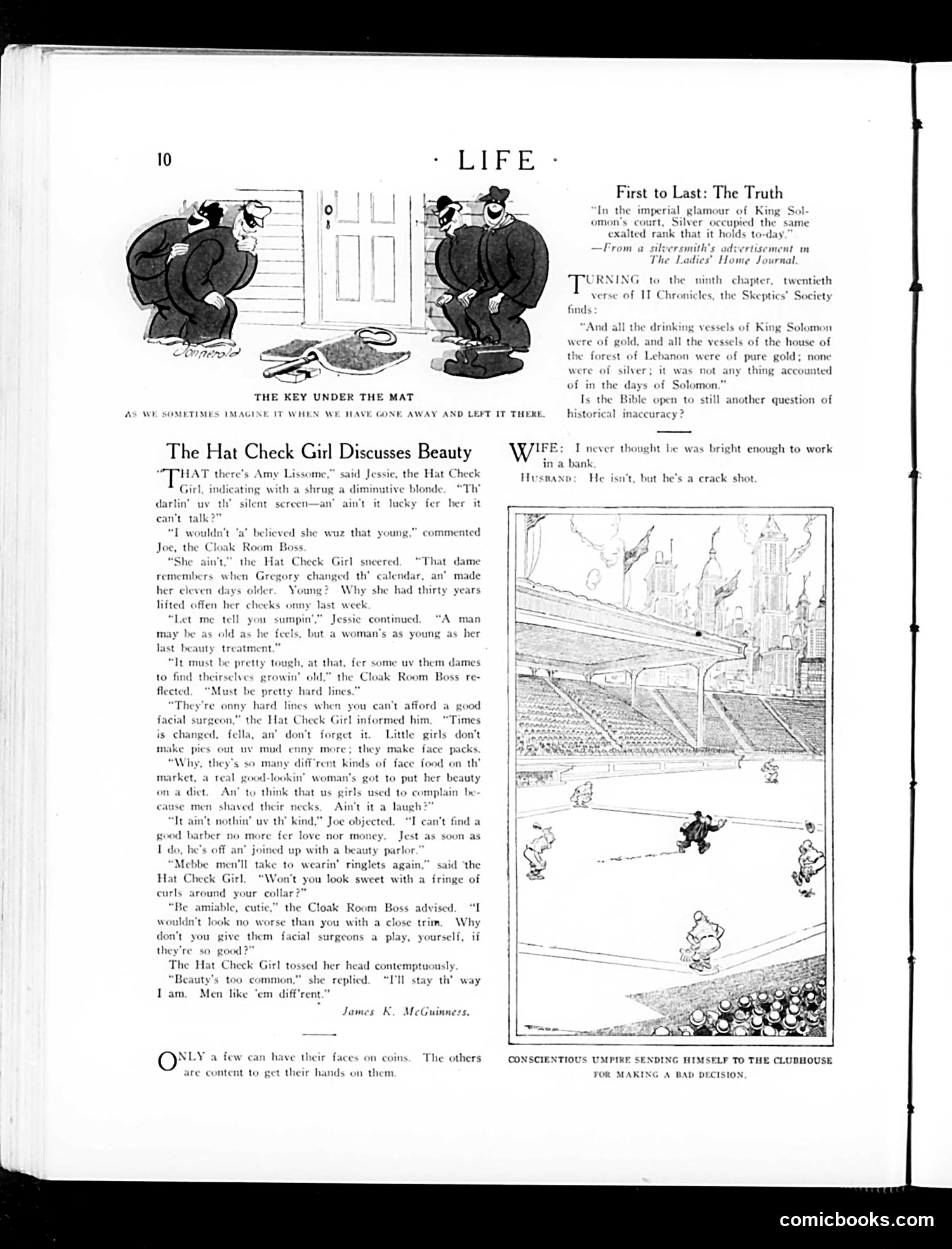
**Top Cartoon ("The Key Under the Mat"):** Shows two figures discovering a key hidden under a doormat, then finding the house ransacked. This is a visual joke about domestic carelessness—leaving a spare key in an obvious hiding place enables burglary. The satire targets homeowners' naive security practices. **Main Article ("The Hat Check Girl Discusses Beauty"):** A dialogue between Jessie (a "Hat Check Girl") and Joe about beauty standards and aging. The Hat Check Girl dismisses expensive beauty treatments, arguing that natural appearance matters more than cosmetic interventions. This reflects 1920s-era commentary on women's labor, beauty culture, and changing attitudes toward femininity and authenticity. **Bottom Cartoon:** A baseball/sports scene showing an umpire making a questionable call.
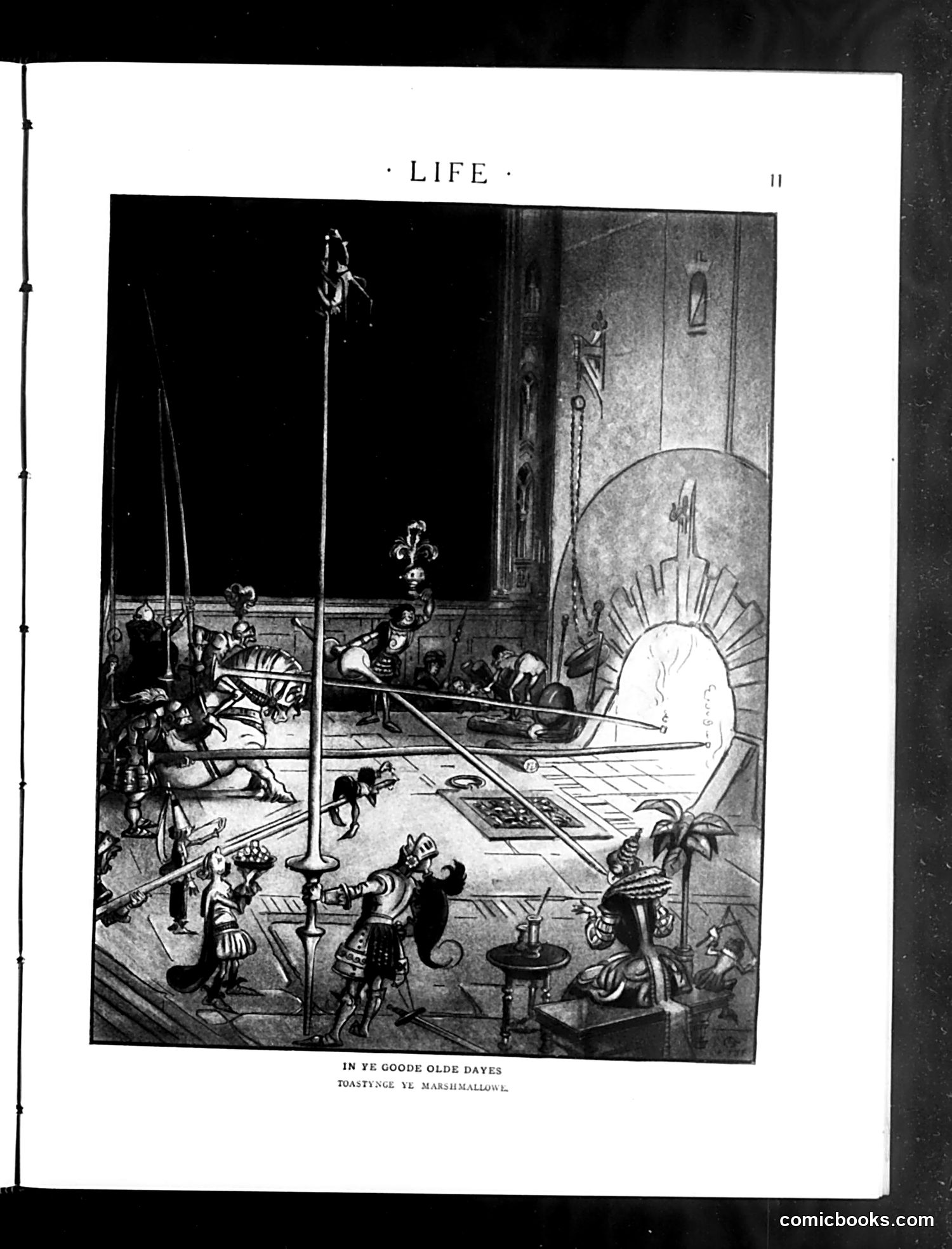
This illustration depicts a theatrical or ceremonial scene set in what appears to be a medieval or Renaissance great hall, with nobility observing from an elevated platform. The central action shows figures—some appearing monkey-like or grotesque—engaged in toasting marshmallows around a large glowing orb or sun-like object. The satire likely mocks Victorian nostalgia for "the good old days" by presenting an absurd, anachronistic image: marshmallows are a modern confection, making their presence in a historical setting ridiculous. The grotesque figures and theatrical staging suggest mockery of both romanticized historical recreation and contemporary society's pretensions. The joke appears to be that people foolishly idealize the past while importing modern conveniences into it.
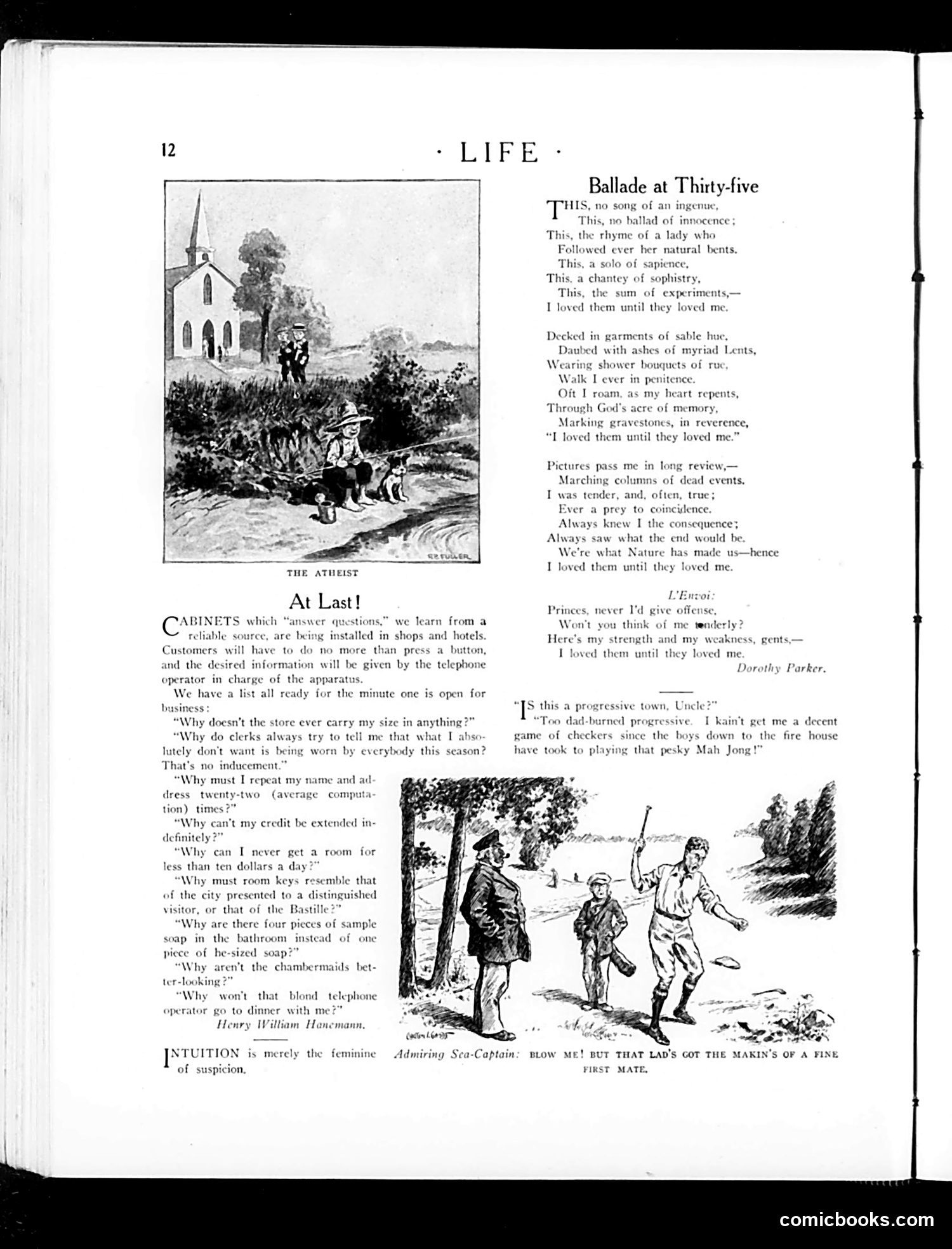
This page from *Life* magazine contains two distinct pieces: **"At Last!"** satirizes the then-new telephone technology installed in retail shops. The humor targets customer complaints about store policies—slow service, credit limits, dress codes, soap samples. The joke is that businesses now have "answer machines" for customer questions, implying that constant complaints have made automated responses necessary. It's satirizing both consumer entitlement and commercial frustration. **"Admiring Sea-Captain"** is a caption cartoon showing three figures near water. One says the lad "makes a fine first mate," suggesting nautical adventure or coming-of-age themes common in period literature and boys' fiction. The page also includes Dorothy Parker's poem "Ballade at Thirty-five," reflecting on romantic disappointment.
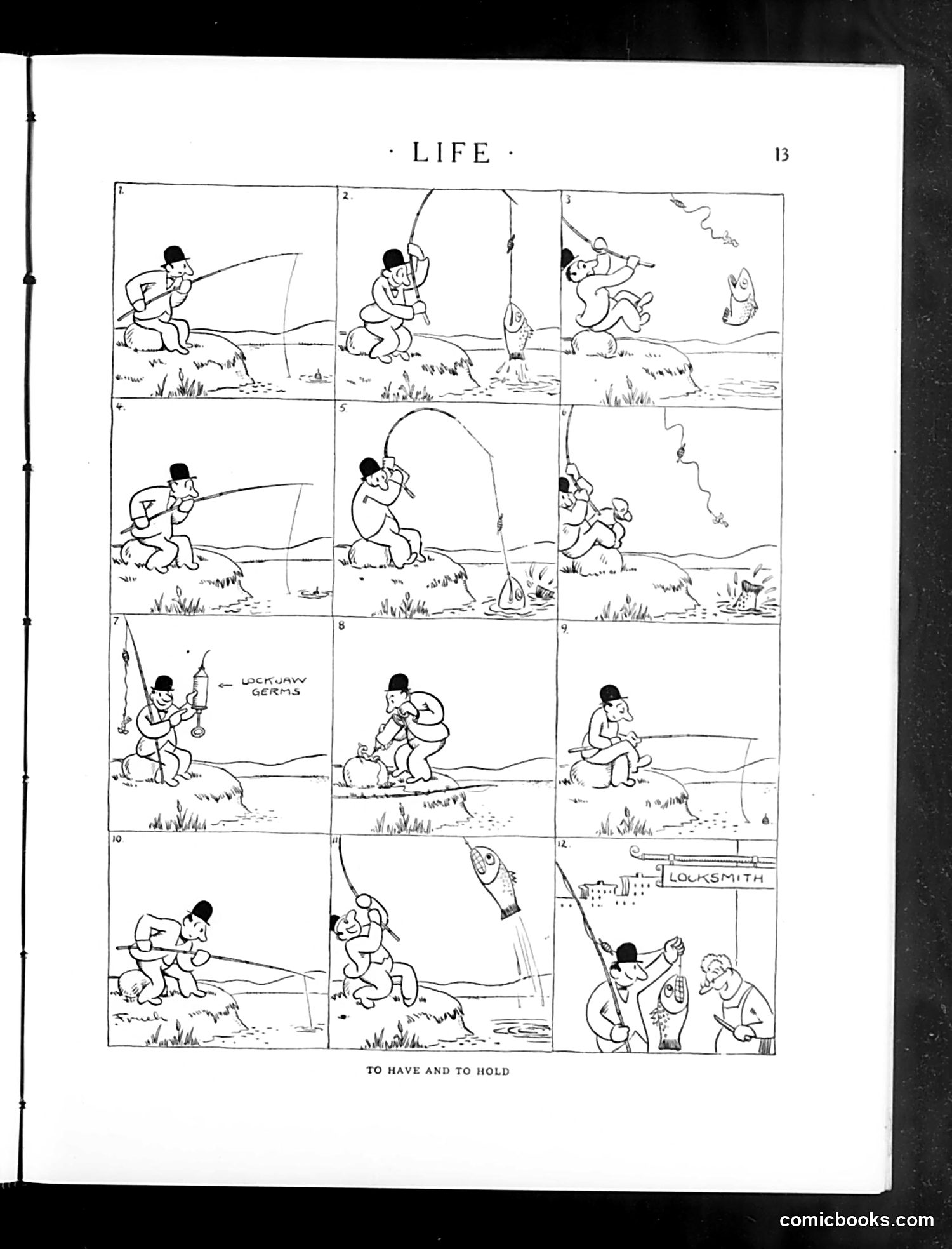
This is a humorous comic strip about fishing and marriage. A man catches progressively larger fish, advancing from panel to panel with growing excitement and effort. The sequence builds comedic tension through his increasingly desperate struggles. The final panel reveals the satirical point: the man arrives at a locksmith shop, seemingly suggesting that "catching" and "holding" a fish parallels the challenges of marriage—both requiring significant effort to secure and maintain. The title "To Have and To Hold" references traditional marriage vows, making this a commentary on the difficulty of sustaining relationships. One panel is labeled "Lockjaw Germs," though its specific reference is unclear from context alone.
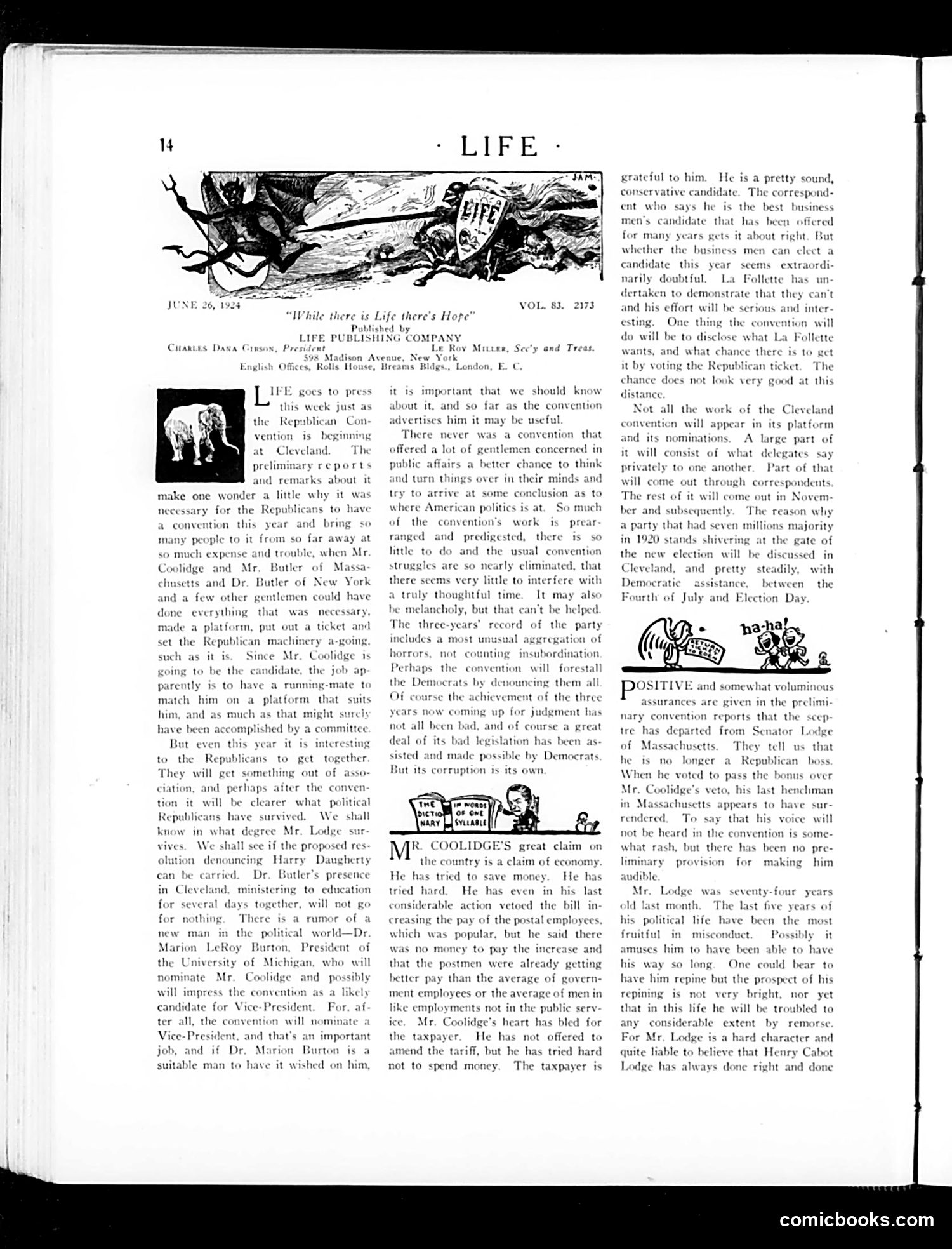
This page discusses the 1924 Republican National Convention in Cleveland. The main cartoon depicts an elephant (the Republican mascot) lying down, appearing exhausted or defeated, with the caption "While there is Life there's Hope." The text critiques the convention's work, noting it was heavily orchestrated with little genuine debate. It discusses Mr. Coolidge as a candidate, praising his economy efforts and fiscal conservatism, while also noting Senator Lodge of Massachusetts is no longer considered a Republican loss since Coolidge rejected him as Vice-Presidential running mate. The satire suggests the Republican Convention, despite its predetermined nature, still offered some hope for meaningful political engagement—though the elephant's prone position implies skepticism about that hope's prospects.
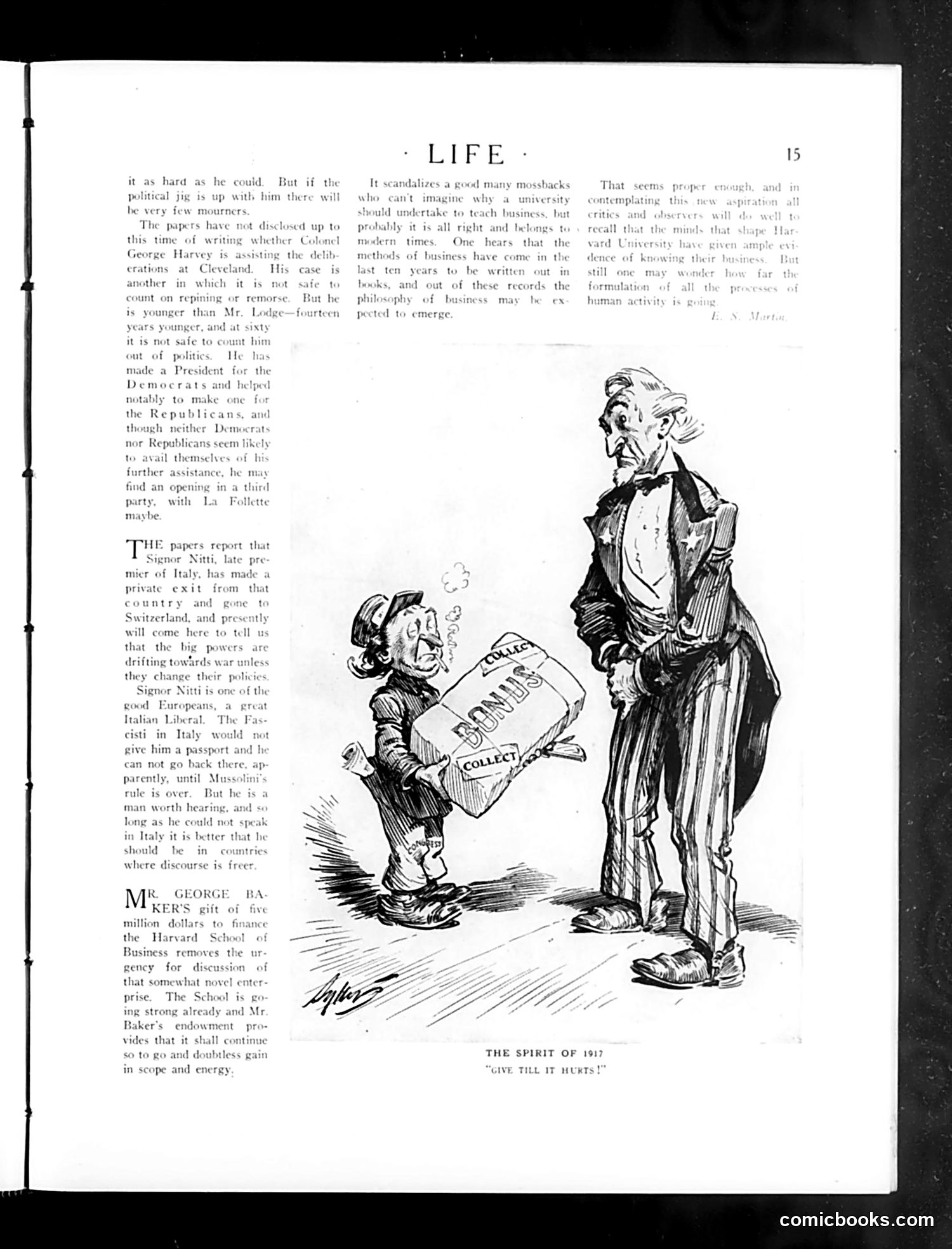
This political cartoon satirizes American fundraising efforts during World War I. A tall, dignified figure (likely Uncle Sam or a government official) looms over a smaller, struggling character carrying an oversized collection box labeled "FUNDS" and "COLLECT." The cartoon critiques aggressive wartime donation campaigns—the phrase "Give Till It Hurts" was an actual WWI slogan. The exaggerated size difference and the struggling posture of the smaller figure suggest the burden placed on ordinary citizens to contribute financially to the war effort. The image mocks both the relentless pressure of patriotic fundraising and the disparity between those making demands and those bearing the financial weight. The cartoon reflects public ambivalence about sustained wartime sacrifice.
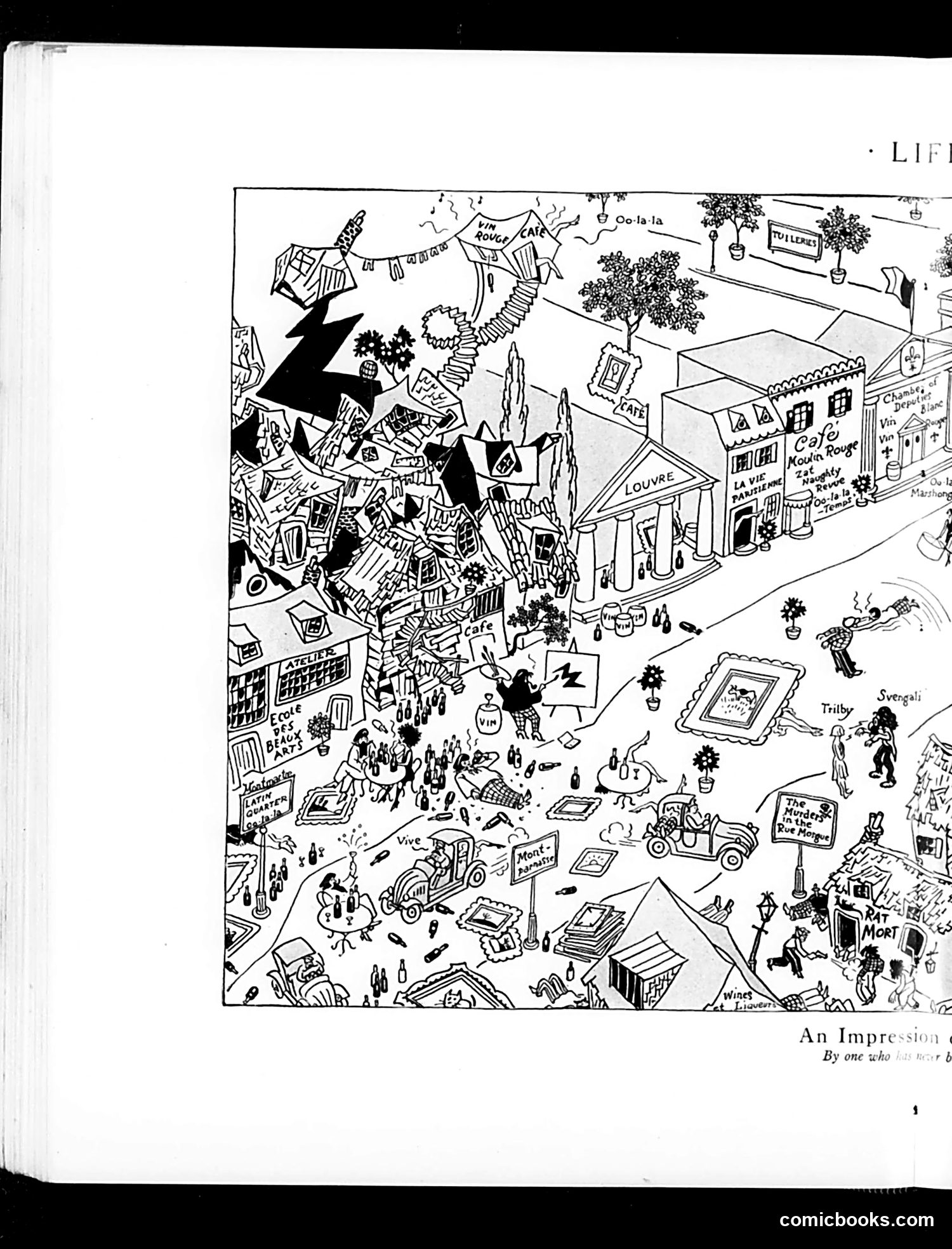
This is a densely detailed satirical map-view of Paris, titled "An Impression" (subtitle: "By one who..."). The illustration depicts Paris as a chaotic, crowded tourist destination overflowing with activity. Visible landmarks include the Louvre museum and various cafés. The scene is packed with tiny figures, automobiles, street vendors, and commercial signs—suggesting Paris as a consumer spectacle rather than a cultural capital. The large lightning bolt symbols and explosions scattered throughout suggest upheaval or chaos. This appears to be satire mocking either the commercialization of Paris, the frenetic nature of urban life, or perhaps the experience of tourists encountering an overwhelmingly crowded, modernizing city. Without the full subtitle visible, the exact target of the satire remains somewhat unclear, though the overall tone is critical of Parisian modernity.
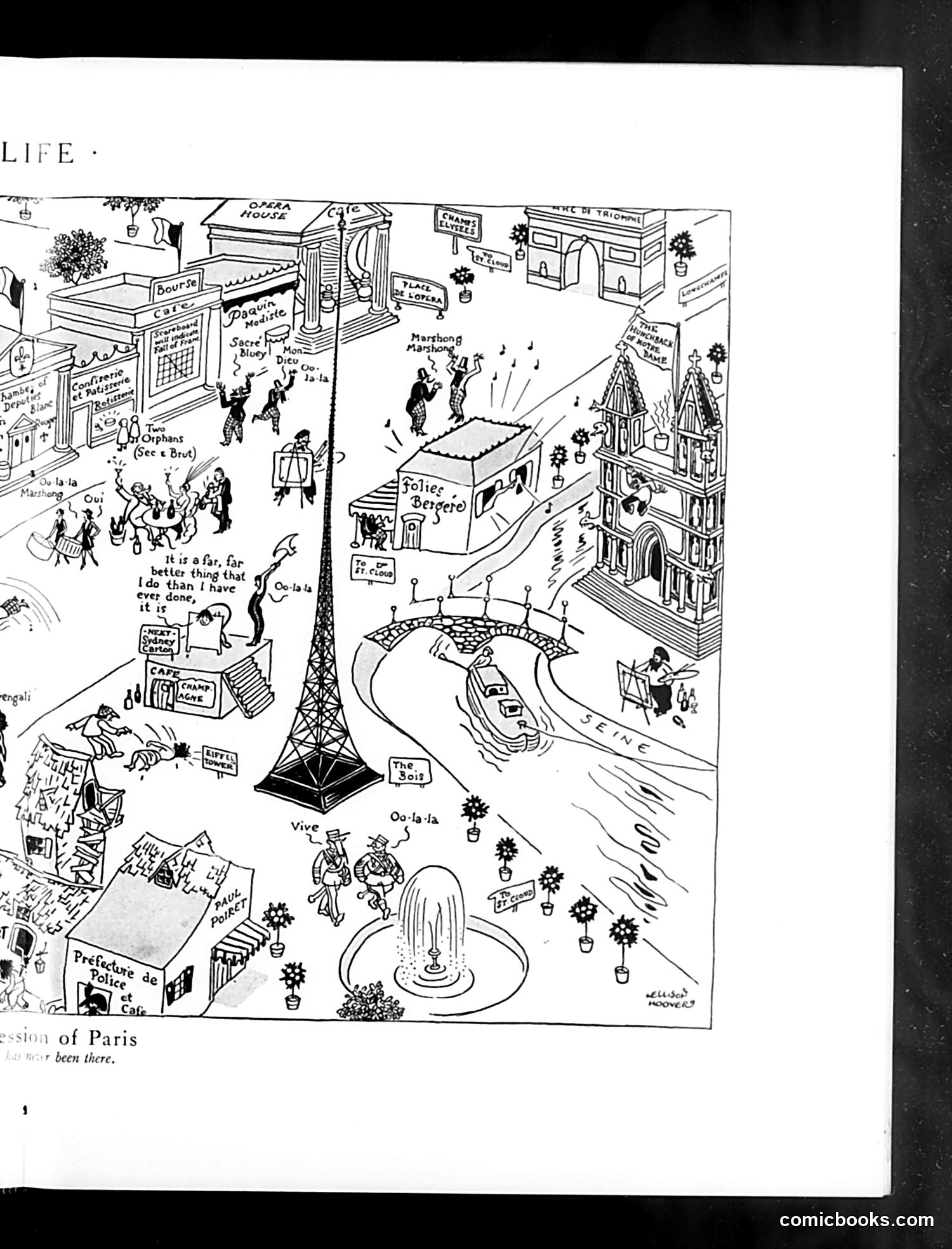
This is a detailed satirical map of Paris, drawn in an isometric perspective style. The illustration labels famous Parisian landmarks and locations—including the Eiffel Tower (prominently centered), the Seine river, the Folies Bergère theater, and various cafés and government buildings like the "Préfecture de Police." The cartoon depicts Paris as a lively social scene filled with leisure activities: people dining, dancing, flirting, and enjoying nightlife. The scattered French phrases ("Oo-la-la," "Vive," "Co-la-la") and musical notes emphasize Paris's reputation for romance, gaiety, and sophisticated pleasures. The text fragment ("It is a far better thing that I do than I have ever done") appears to be satirizing some cultural or political claim about Paris, possibly mocking American tourists' romanticized views of French life or a contemporary commentary on Paris's cultural prestige. The overall effect is a humorous, affectionate caricature of Paris as the world's capital of pleasure and romance.
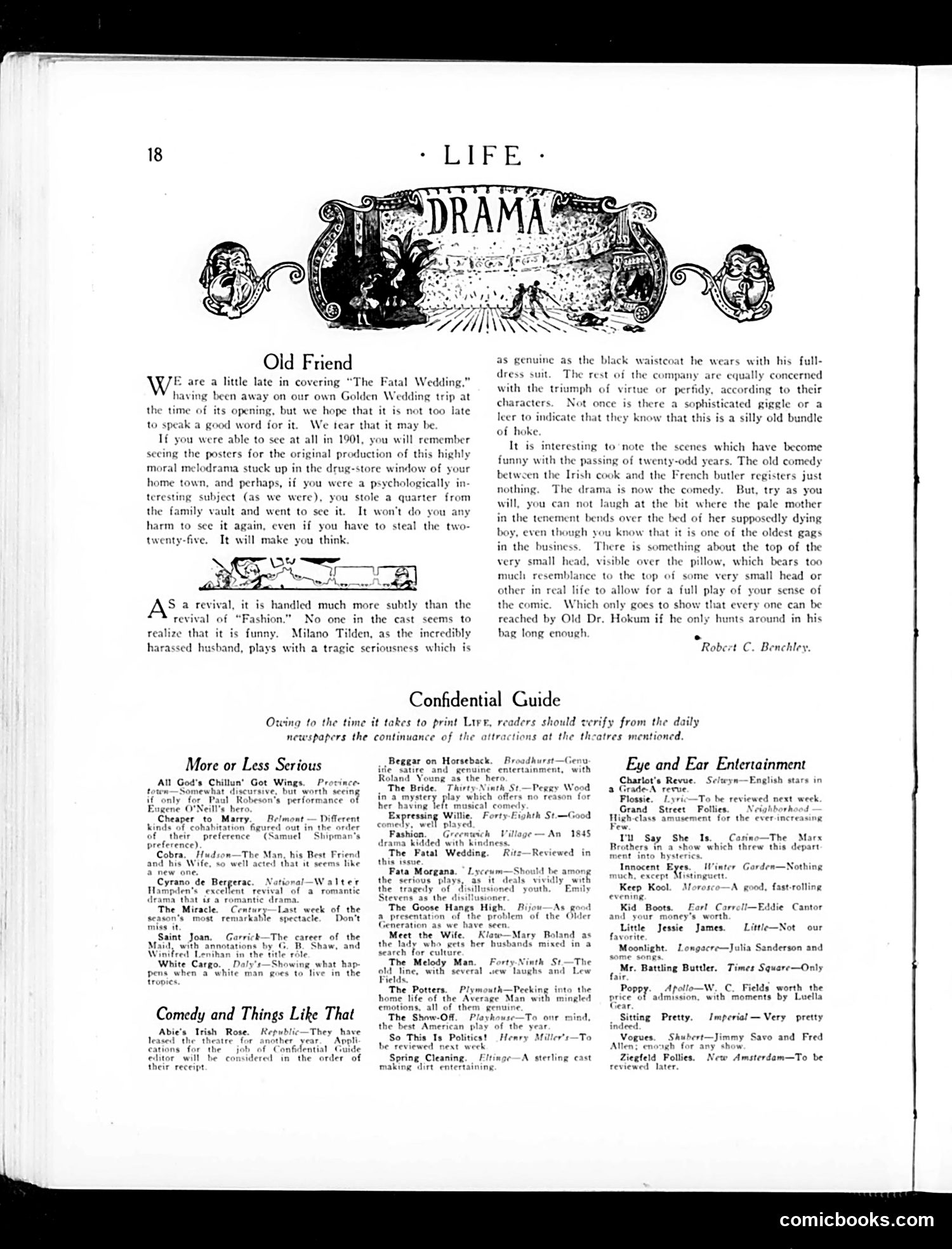
This page reviews **"The Fatal Wedding,"** a revival of a famous 19th-century melodrama originally popular around 1901. The satire targets the play's overwrought sentimentality and hokey plot devices—standard fare for moral melodramas of that era. **The joke:** Life mocks how audiences once wept at crude emotional manipulations (the dying child scene, the suffering mother) that now read as ridiculous. Critic Robert C. Benchley notes the cast plays it straight with "tragic seriousness," treating silly material as profound. He observes that only the *genuinely* pathetic moments (like a small child's head visible over a pillow) still move viewers—not because of the theatrical artifice, but because it accidentally resembles real life. The satire works by contrasting outdated theatrical conventions with modern sophistication. **The real humor:** modern audiences can't fully laugh because genuine human suffering keeps breaking through the melodrama's artificiality. Life's readers were expected to recognize they'd evolved beyond such crude entertainment.
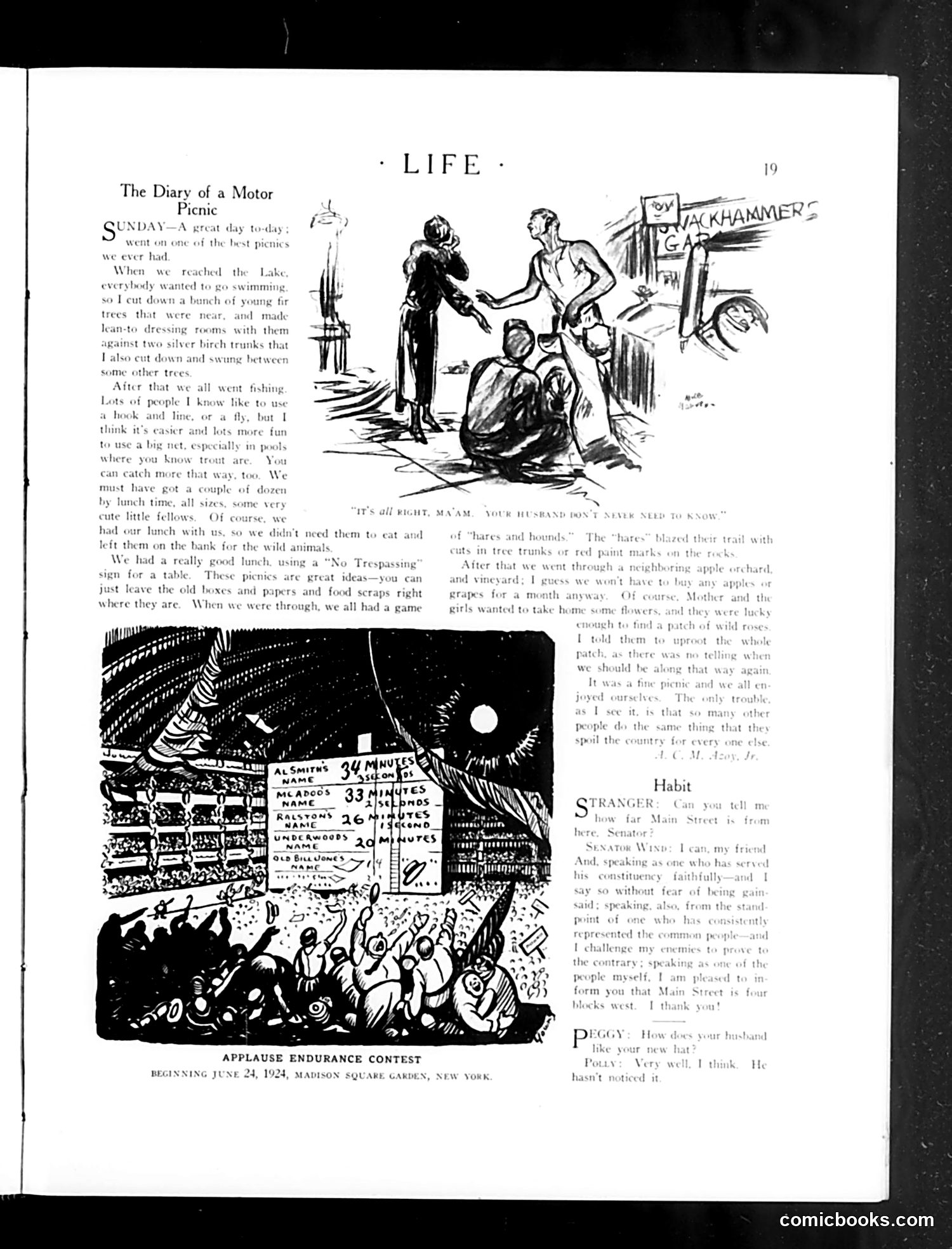
This page contains two satirical pieces from Life magazine (circa 1924): **"The Diary of a Motor Picnic"** (top): A humorous account mocking inconsiderate picnickers who litter and leave trash scattered after their outing—"leave the old boxes and papers and food scraps right where they are." The satire targets the casual disregard for natural spaces that apparently was common among early automotive tourists. **"Applause Endurance Contest"** (bottom illustration): A political cartoon depicting what appears to be a 1924 Madison Square Garden event. The packed stadium shows crowds applauding various performers or speakers, with timing boards showing "34 minutes," "33 minutes," and "26 minutes." This likely satirizes either a marathon applause competition or, more probably, the cult of celebrity and manufactured enthusiasm—mocking how audiences would mechanically applaud entertainers or public figures for extended, absurd periods. Both pieces employ satire to critique emerging 1920s consumer culture and mass entertainment phenomena.
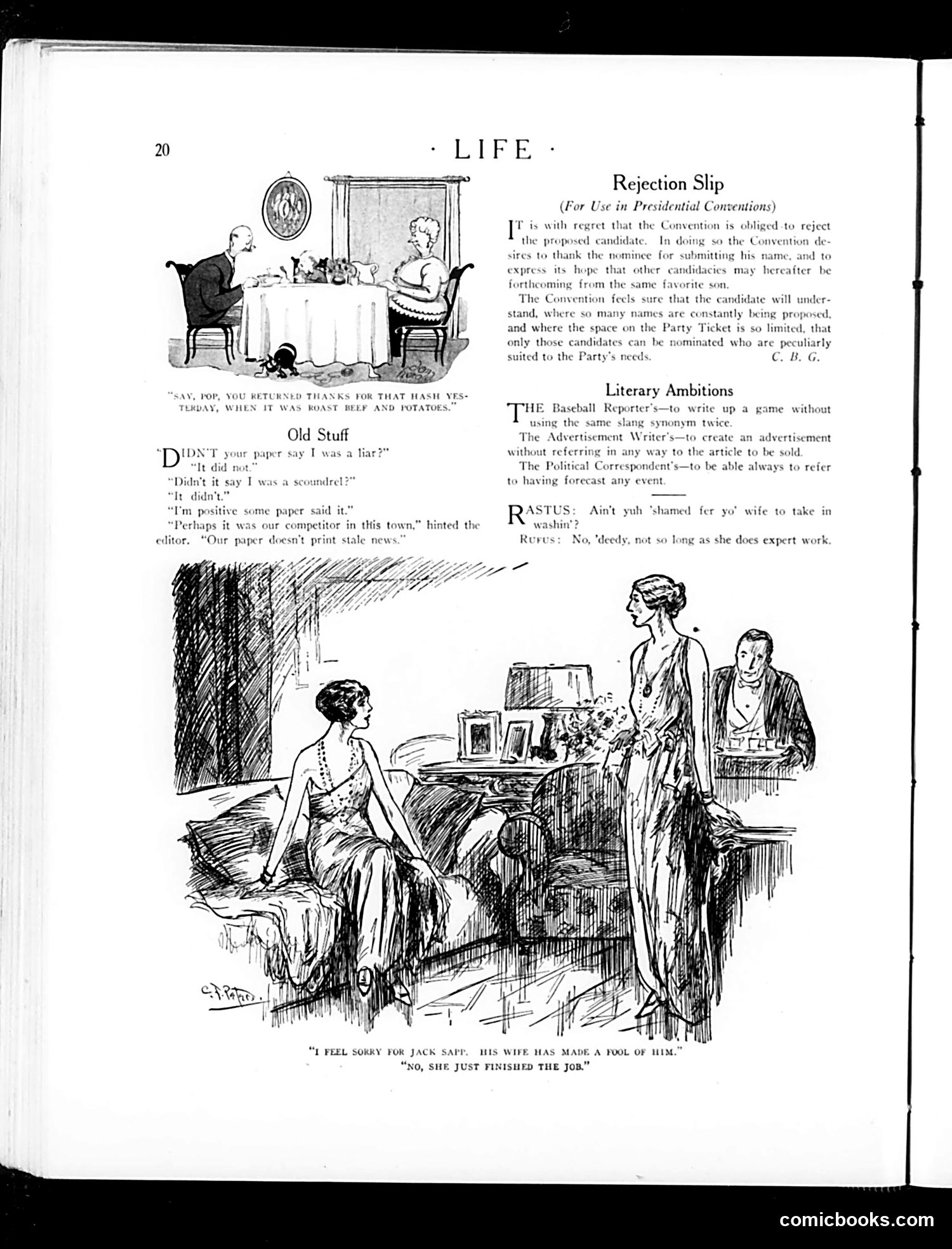
This page contains three satirical pieces: **"Old Stuff"** mocks newspaper dishonesty. An editor denies his paper called someone a liar, then a scoundrel—claiming "some paper said it" instead. The joke: newspapers routinely deny publishing statements they clearly published, a common practice of the era. **"Rejection Slip"** parodies the formal rejection letters sent to unsuccessful presidential convention nominees. It's a template expressing regret while thanking the rejected candidate for his submission, acknowledging the limited "space on the Party Ticket." This satirizes the polite fictions surrounding political rejection. **"Literary Ambitions"** lists journalists' professional struggles: baseball reporters repeating slang, ad writers promoting products without mentioning them, political correspondents avoiding predictions. The bottom cartoon shows a woman who's made her husband "a fool," but he's not ashamed because "she just finished the job"—likely suggesting she's accomplished something through expert work, possibly domestic labor or a profession. All target early 20th-century media and social conventions.
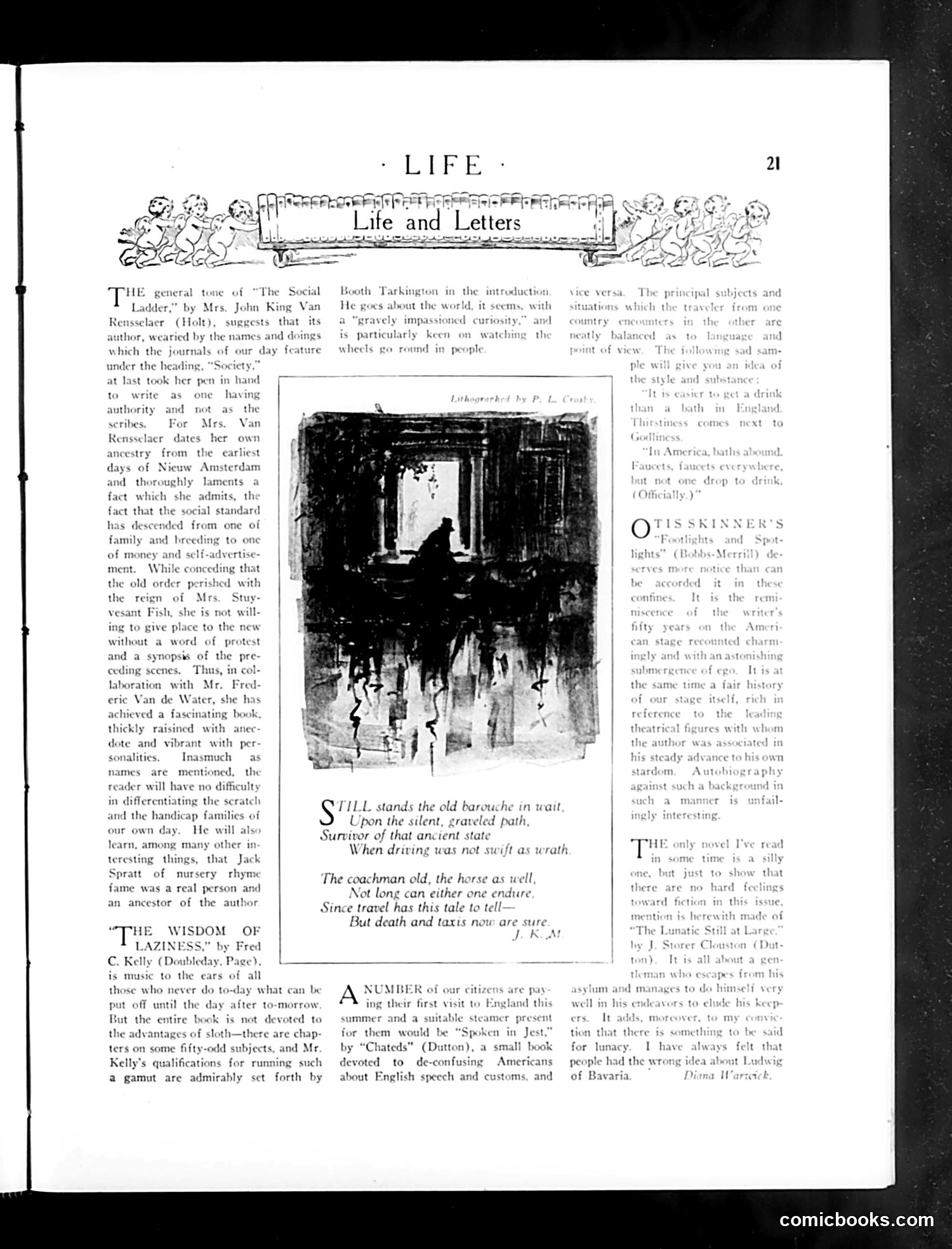
This page from Life magazine's "Life and Letters" section contains a literary review discussing a book by Booth Tarkington about observing "wheels go round in people"—examining American social dynamics and class structures. The central image shows **an old horse-drawn carriage (barouche) on a graveled path**, accompanying a poem lamenting the obsolescence of traditional transportation. The verses contrast the slow, dignified pace of carriages with modern "taxis," suggesting nostalgia for a vanished era of leisure and refinement. The satire targets the tension between America's old aristocratic pretensions (represented by families like the Van Rensselaers, Dutch colonial ancestry) and modern industrial progress. The carriage symbolizes fading gentility being replaced by efficient but undignified motorized taxis—a commentary on how industrialization demolished traditional class hierarchies and leisurely lifestyles that the old money class valued. This reflects early 20th-century anxieties about American modernization eroding established social orders.
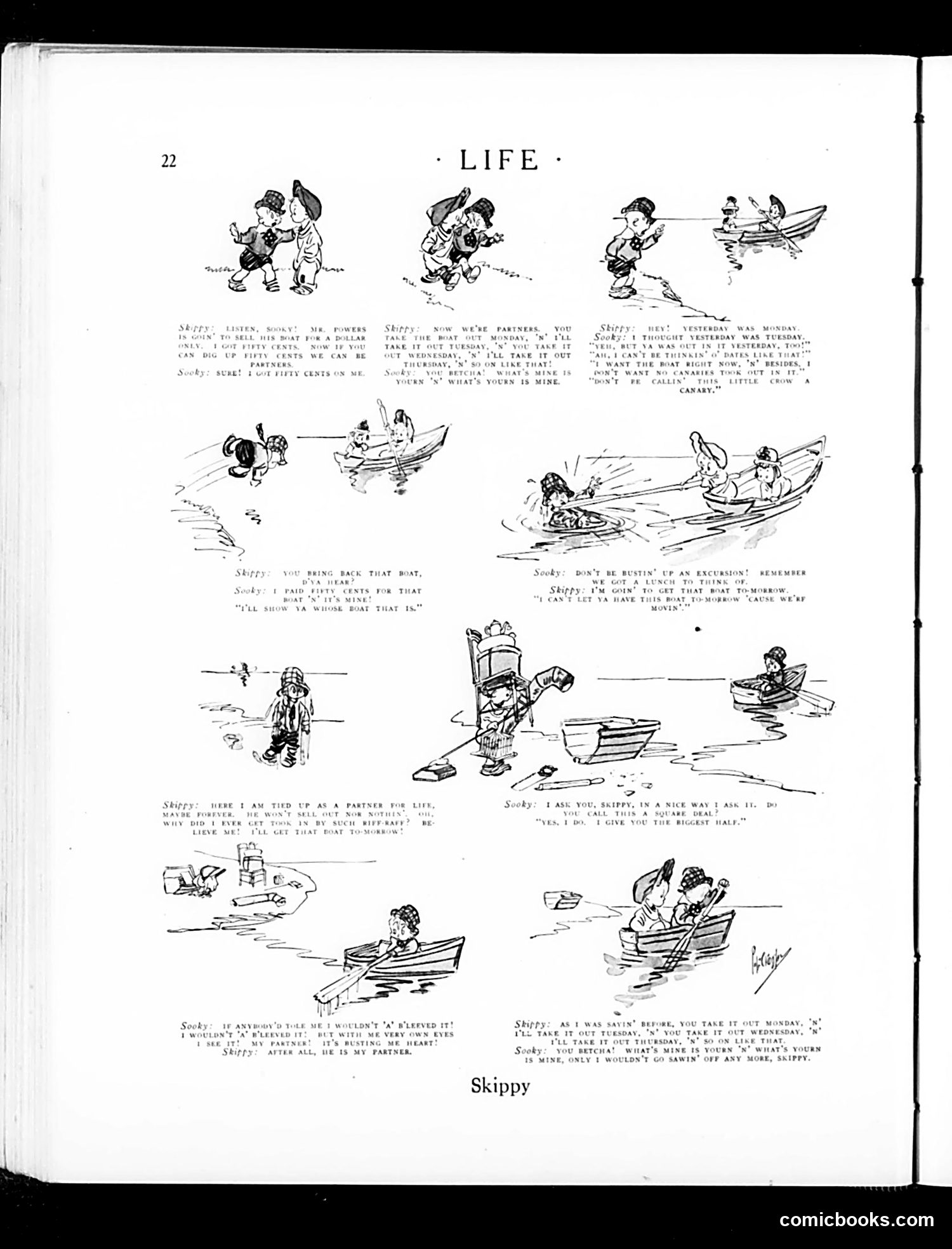
This is a humorous comic strip featuring two young characters—Skippy and Snoopy—engaged in a series of boat-related schemes and negotiations. The strip satirizes childhood bargaining and business dealings through their repeated attempts to borrow or trade boats. The humor centers on: - **Running negotiation gag**: The characters continuously haggle over boat ownership using absurd logic and shifting deal terms - **Childhood entrepreneurship**: Skippy and Snoopy act as if conducting serious business transactions, complete with formal agreements about when boats will be returned - **Role reversal**: They treat trivial playthings with exaggerated commercial seriousness The satire gently mocks how children mimic adult business practices while attempting petty acquisitions. The joke is universal—childhood negotiations over toys, not requiring specific historical context to appreciate today.
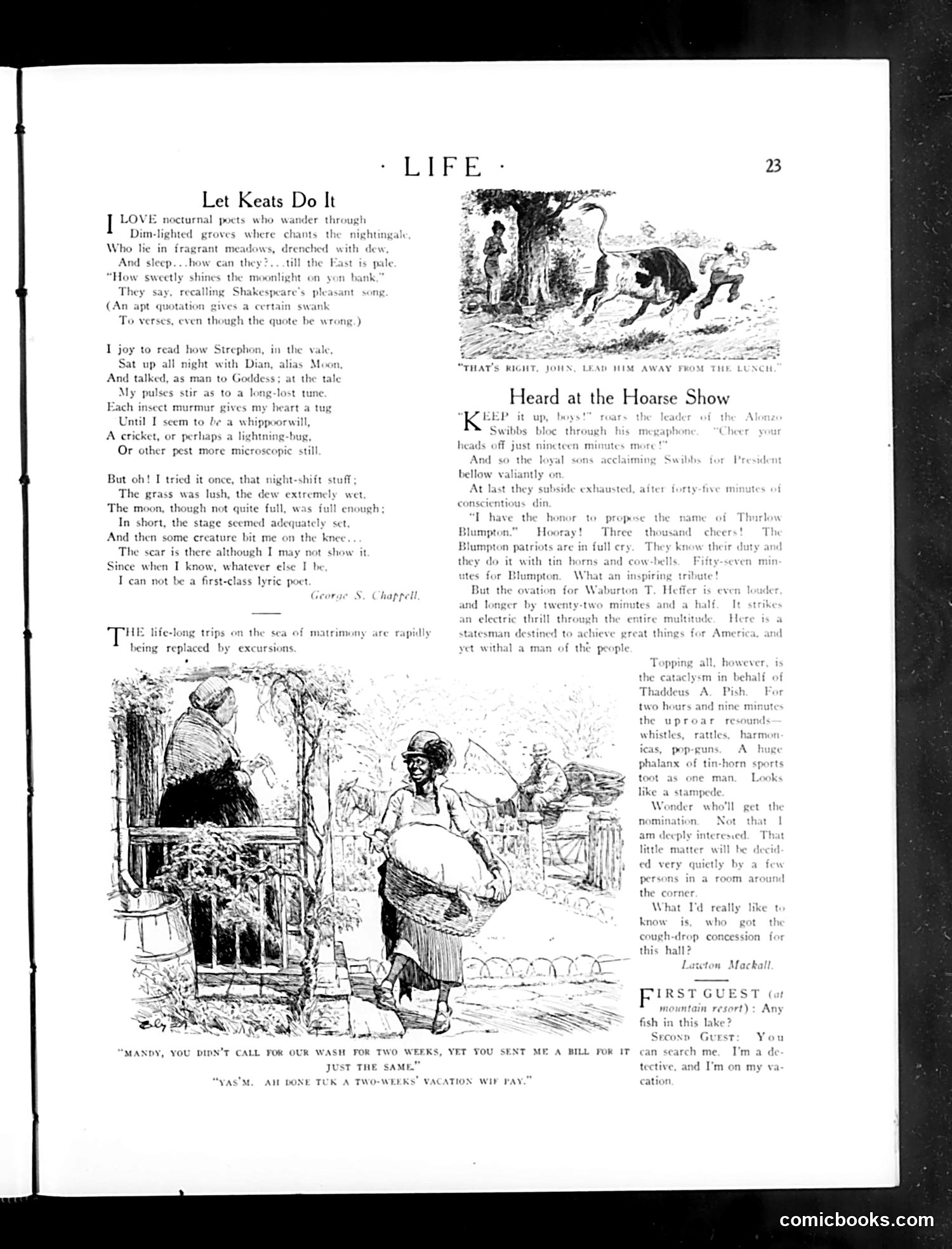
**Main Content:** The page features two distinct satirical pieces: 1. **"Let Keats Do It"** - A poem mocking Romantic poetry enthusiasts who romanticize nature. The speaker attempts to emulate Keats by lying in a meadow at night but gets bitten by insects, concluding he "cannot be a first-class lyric poet." The satire targets affected literary pretension and the gap between poetic idealization and reality. 2. **Bottom cartoon** - Depicts a domestic dispute between what appears to be a white employer and a Black maid named Mandy. The employer complains about an unpaid laundry bill despite Mandy taking a two-week paid vacation. The humor (by period standards) relies on the maid's apparent contradiction or shirking responsibility. This reflects early 20th-century racial stereotypes common in American humor. **Context:** Both pieces exemplify Life magazine's satirical approach—deflating pretension (literary affectation) and reinforcing contemporary social hierarchies through humor.
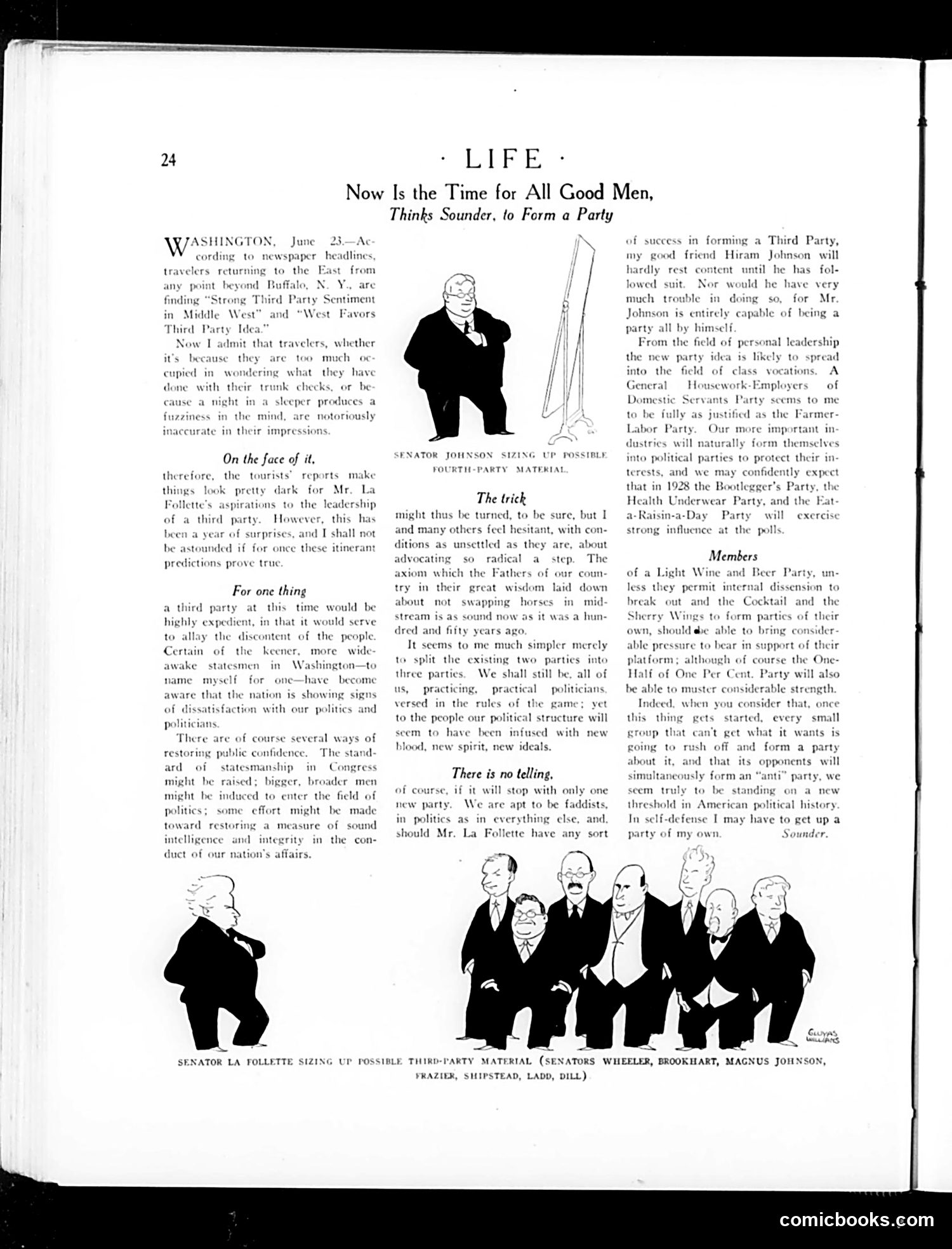
This 1924 *Life* magazine article satirizes the emerging Progressive "Third Party" movement. Senator Robert La Follette, shown examining potential allies, is considering forming an alternative to the Republican and Democratic parties amid widespread political dissatisfaction. The text mocks the proliferation of single-issue parties by proposing absurd examples: a "Light Wine and Beer Party," "Housework-Employers of Domestic Servants Party," and a "One-Half of One Per Cent. Party"—satirizing the fragmenting effect of allowing every discontent group to break away into its own party. The cartoons show La Follette (left) and fellow senators Wheeler, Brookhart, and Johnson (right) as potential third-party material. The satire suggests that while a third party might address legitimate grievances, it would ultimately balkanize American politics into competing factions, each pursuing narrow interests rather than broader national solutions. The writer predicts inevitable chaos if the movement succeeds.
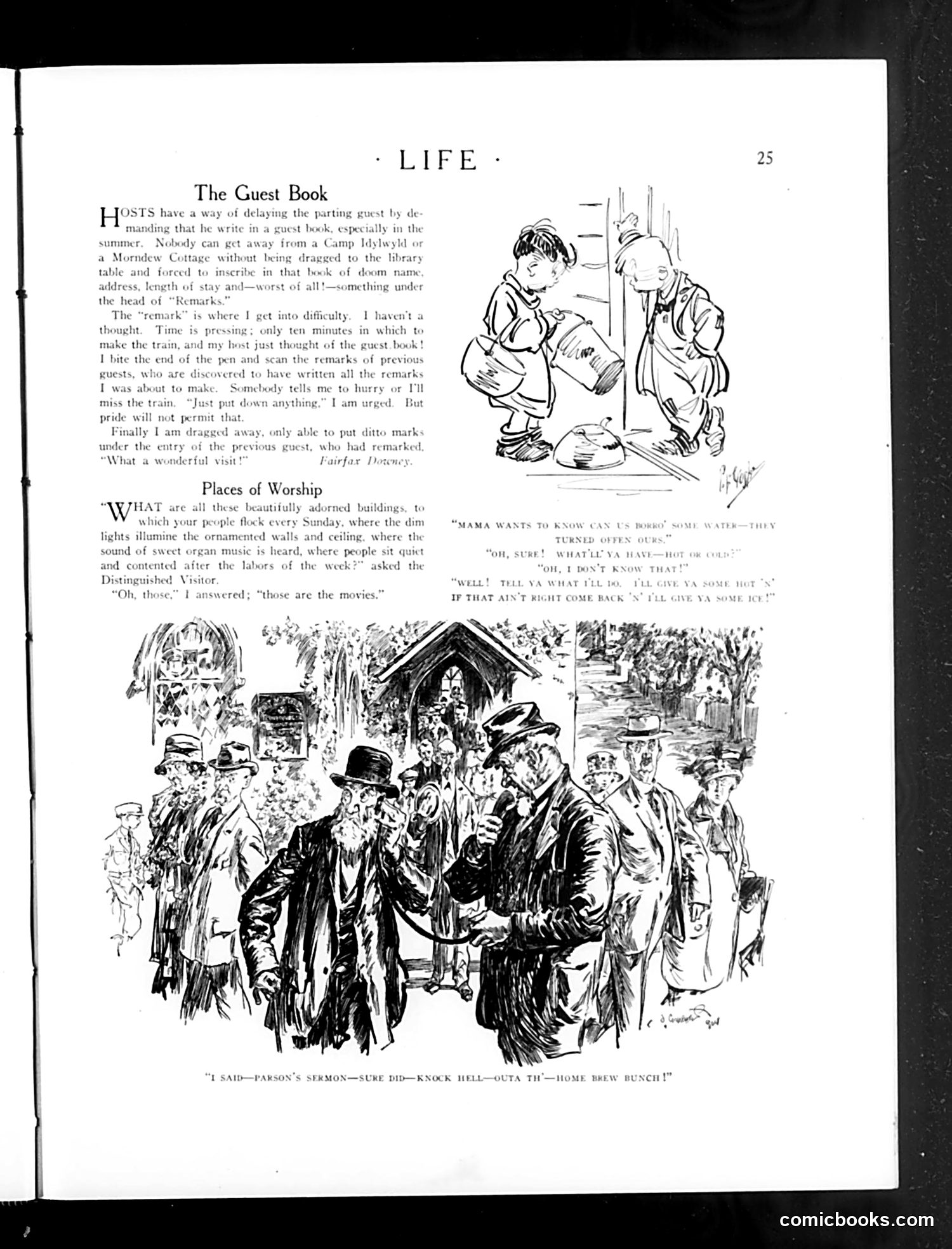
This page contains two separate humorous pieces satirizing American social customs. **"The Guest Book"** mocks the tedious obligation of country house visits, where guests must write comments in a ledger. The author complains about the pressure to write something witty within minutes before catching a train, and finds previous guests' remarks unhelpful or embarrassing. **"Places of Worship"** is the sharper satire. A distinguished visitor asks about beautifully adorned buildings where people gather on Sundays. The narrator replies they're "the movies"—not churches. The cartoon below shows a church exterior, but the caption mockingly attributes rowdy behavior (a sermon causing someone to "knock hell" out of home brew) to religious gatherings, implying moviehouses have replaced churches as America's true places of communal worship and social gathering. Both pieces gently satirize early 20th-century American leisure culture and the decline of traditional religious observance among the middle classes.
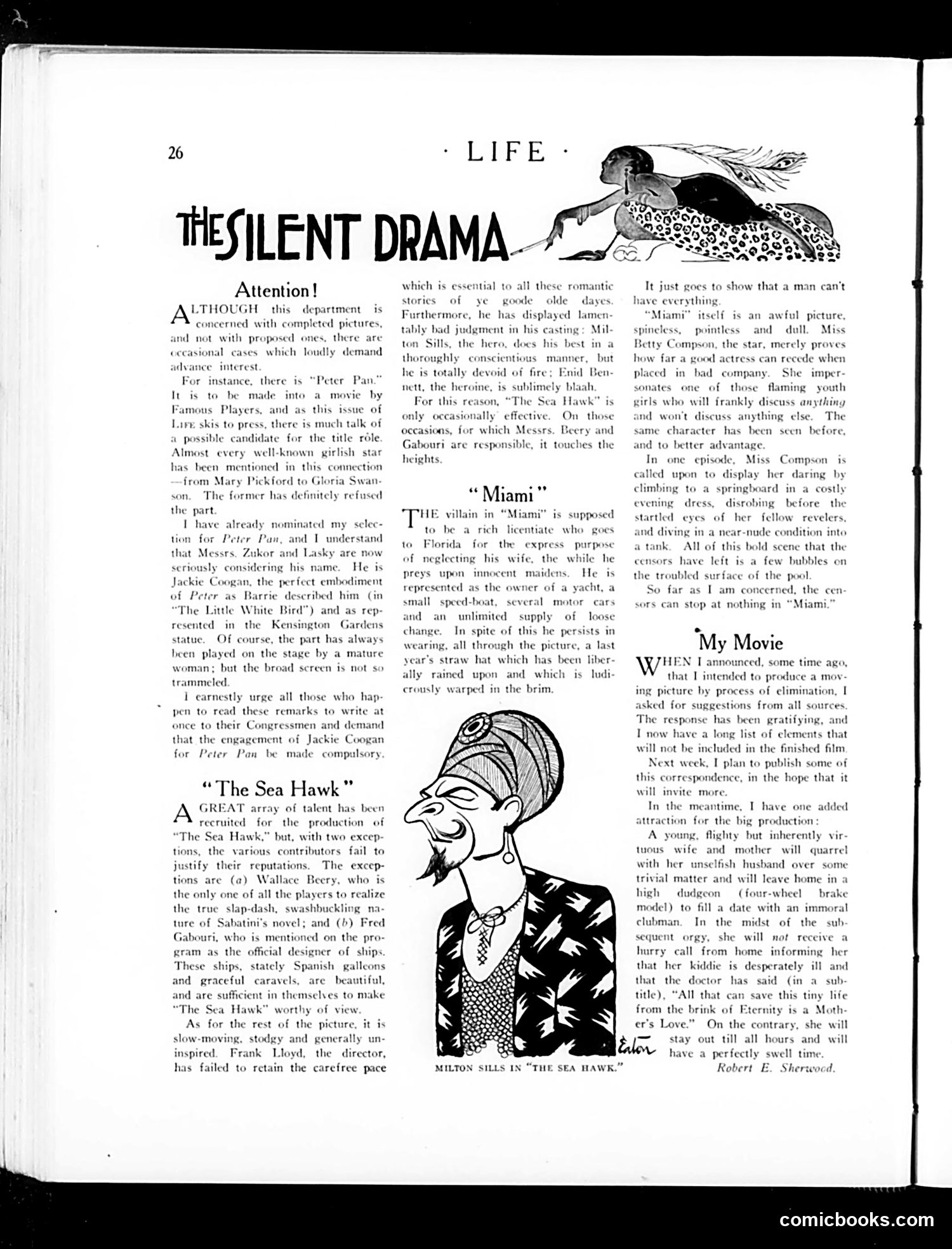
This page reviews three silent films. The main caricature shows **Milton Sills** in "The Sea Hawk"—a swashbuckling adventure picture. The reviewer praises the Spanish galleon sets but criticizes the film's sluggish pacing and the performances of most actors, excepting Wallace Beery. The "Miami" review mocks a melodrama about a wealthy libertine vacationing in Florida while neglecting his wife. The satire targets the absurd plot logic: despite owning yachts and cars, the villain inexplicably wears a decrepit straw hat throughout. The reviewer also ridicules actress Betty Compson's scene where she undresses before diving into a tank—noting the censors' inconsistent standards for what they'll permit. The page concludes with a brief announcement about an upcoming film production seeking input from readers. The overall tone is witty, contemporary film criticism poking fun at both filmmakers and emerging censorship standards of the silent era.
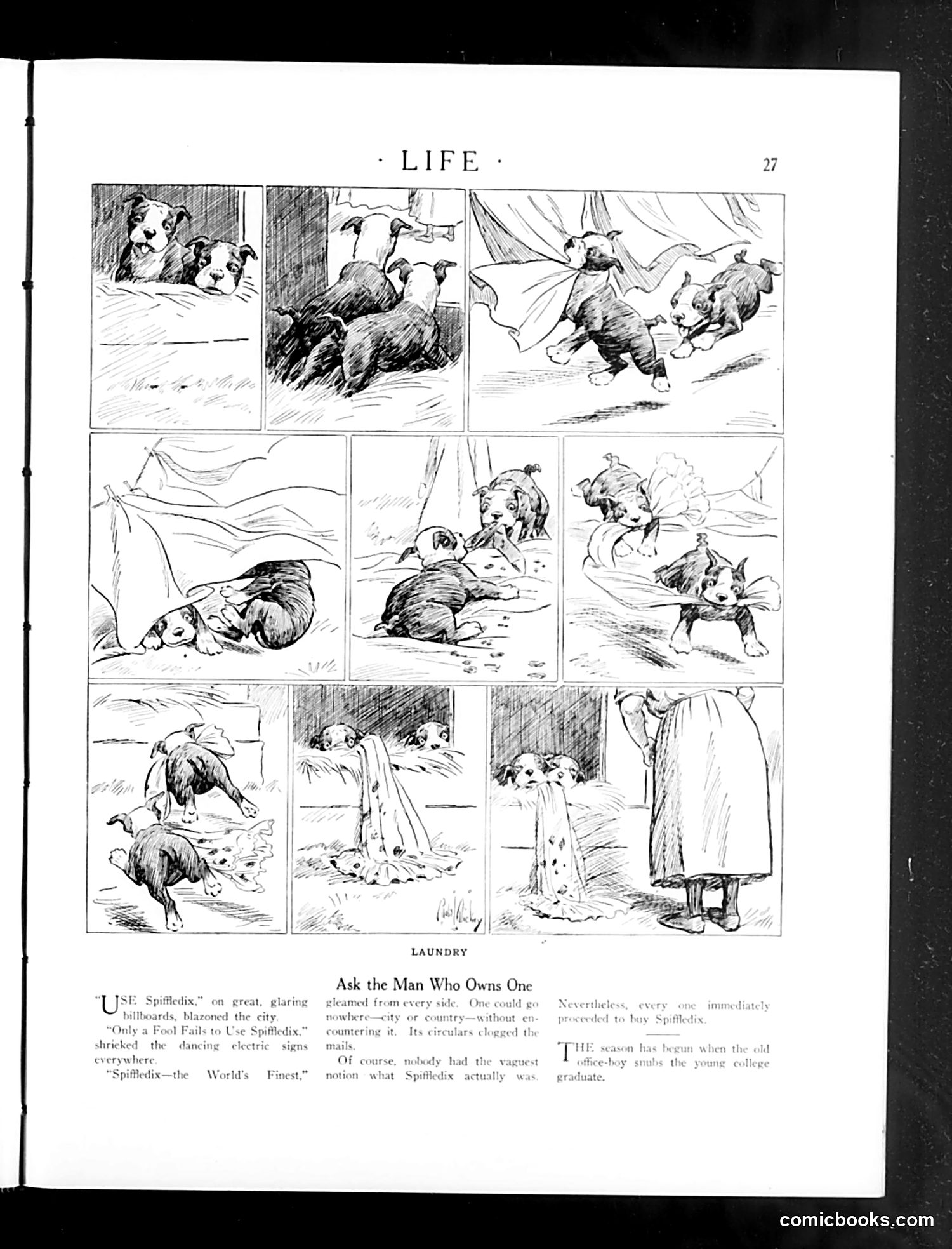
This page features a **comic strip about puppies doing laundry**, presented as an advertisement for a fictional product called "Spiffledix." The narrative shows small dogs engaged in various laundry activities—washing, hanging, and folding clothes—with increasingly chaotic results. The accompanying text parodies advertising copy, claiming Spiffledix is "the World's Finest" while admitting that "nobody had the vaguest notion what Spiffledix actually was." **The satire targets:** Over-the-top advertising rhetoric of the era, where billboards and signs promoted products with grand claims despite consumers having no genuine understanding of what they were buying. The absurdist humor—using puppies performing human tasks—emphasizes the disconnect between marketing hype and actual product value. This is vintage *Life* magazine satire, mocking consumer culture and misleading advertisements.
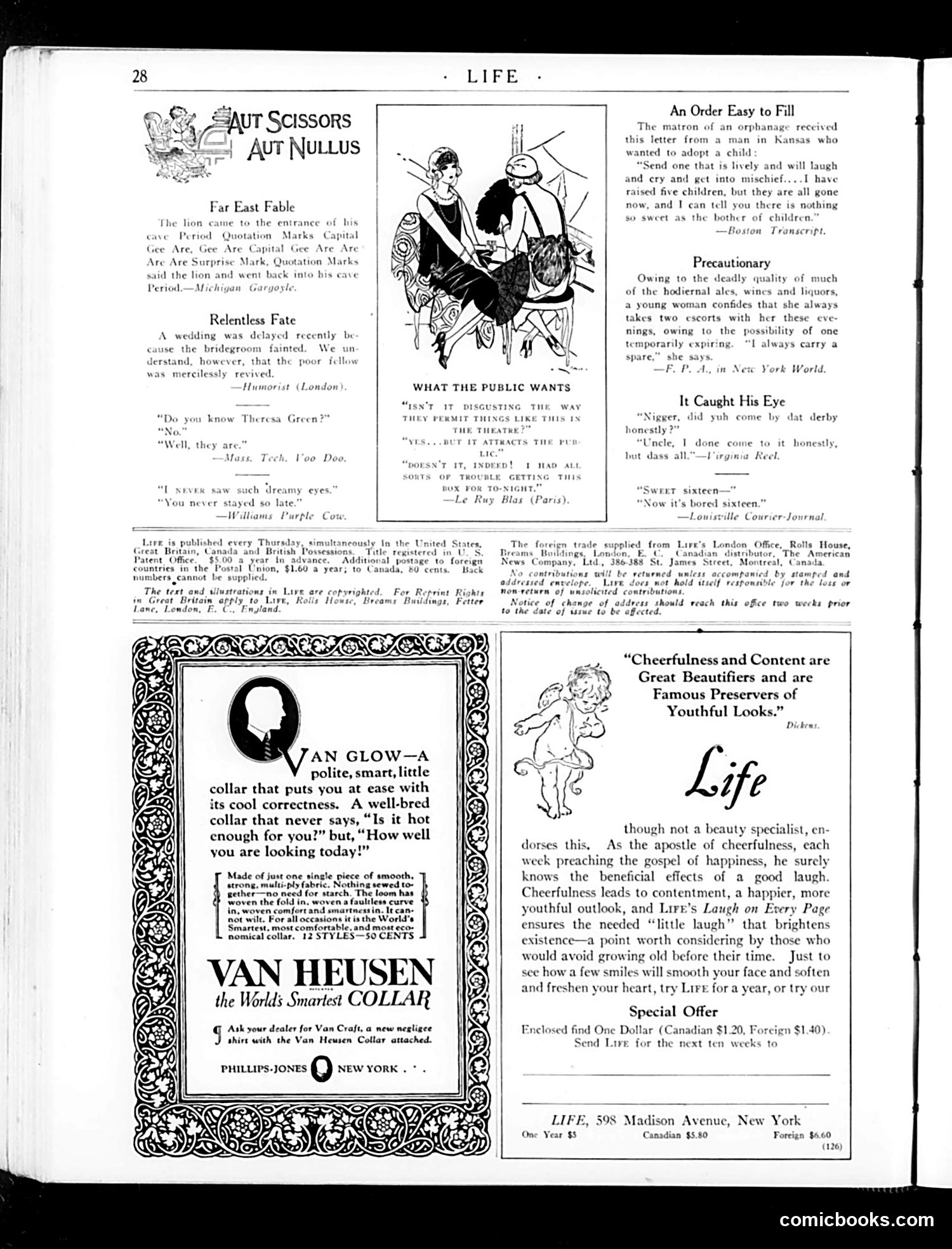
This page from *Life* magazine mixes humor columns, brief satirical pieces, and advertisements typical of early 20th-century American magazines. **The satirical content** includes short, punchy jokes targeting social pretensions and modern anxieties. "What the Public Wants" mocks theater patrons who tolerate poor performances. "It Caught His Eye" uses racial slurs (reflecting the era's casual bigotry) in a joke about class aspiration. "Precautionary" satirizes women's anxieties about alcohol quality by joking that a woman brings escorts in case she "temporarily expires" from bad drinks—dark humor about Prohibition-era concerns. **The prominent advertisement** is for Van Heusen collars, marketing them as markers of sophistication and correctness—appealing to readers' desires for social respectability. The overall tone reflects *Life*'s satirical stance on contemporary manners, morality, and consumer culture, using biting wit to expose social contradictions. The page demonstrates how early 20th-century humor often relied on class anxiety and casual prejudice as comedic tools.
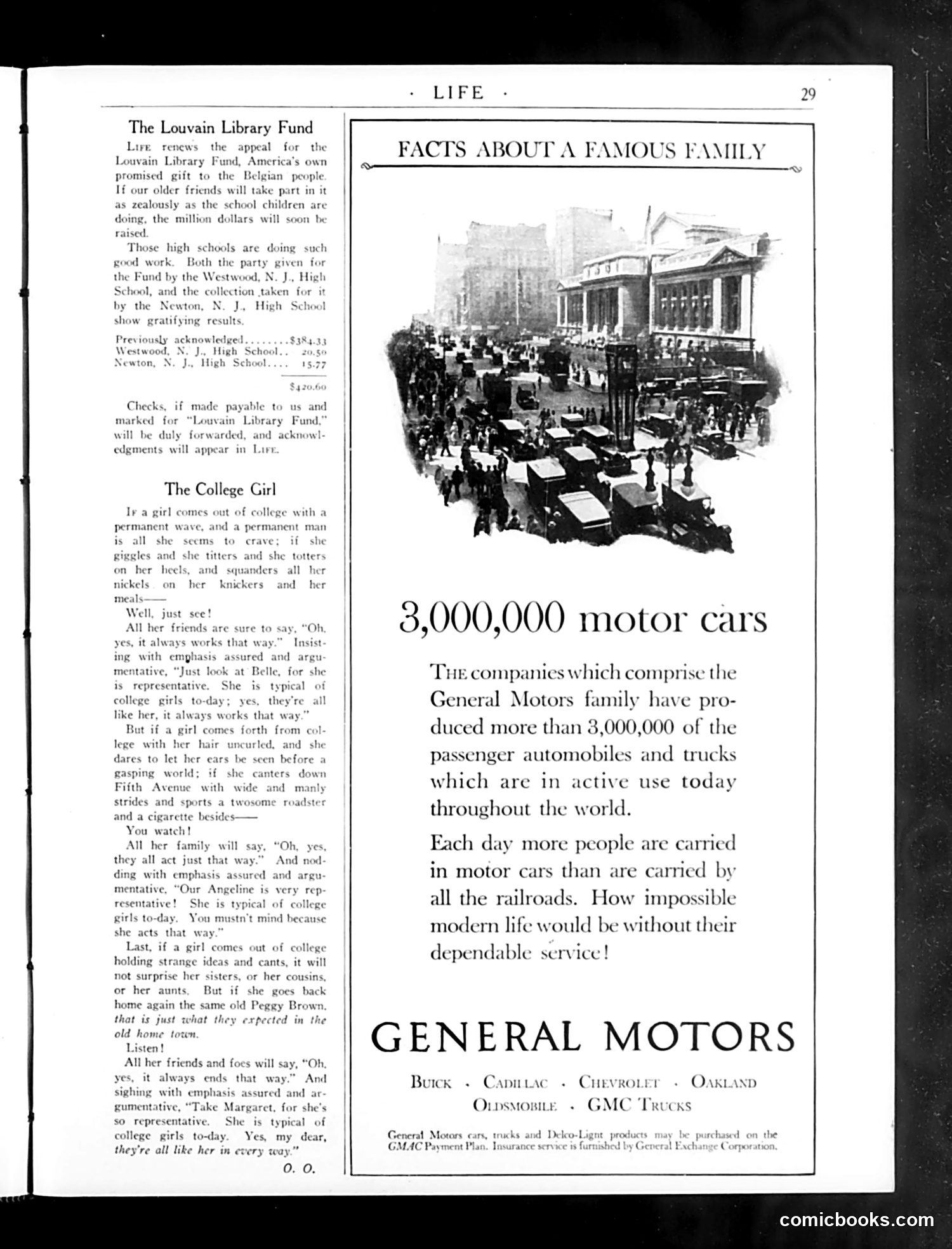
This page contains two distinct pieces: **Left column** ("The College Girl"): A satirical essay by O.O. mocking how families stereotype college girls. The piece humorously observes that whether a girl returns home permanently waved and fashionable, or independent and unconventional, or even unchanged—her family and friends will insist she's "typical" of modern college girls and claim "it always works that way." The satire targets not the girls themselves, but adults' tendency to rationalize and categorize young women's behavior through convenient generalizations. **Right side**: A General Motors advertisement featuring a photograph of a crowded public gathering (possibly a civic event or celebration) and promoting GM's production of 3,000,000 motor vehicles. The ad emphasizes automobiles' superiority to railroads for daily transportation and positions GM as essential to modern life. The page juxtaposes social commentary about changing female independence with corporate messaging about modern progress—both reflecting 1920s American culture.
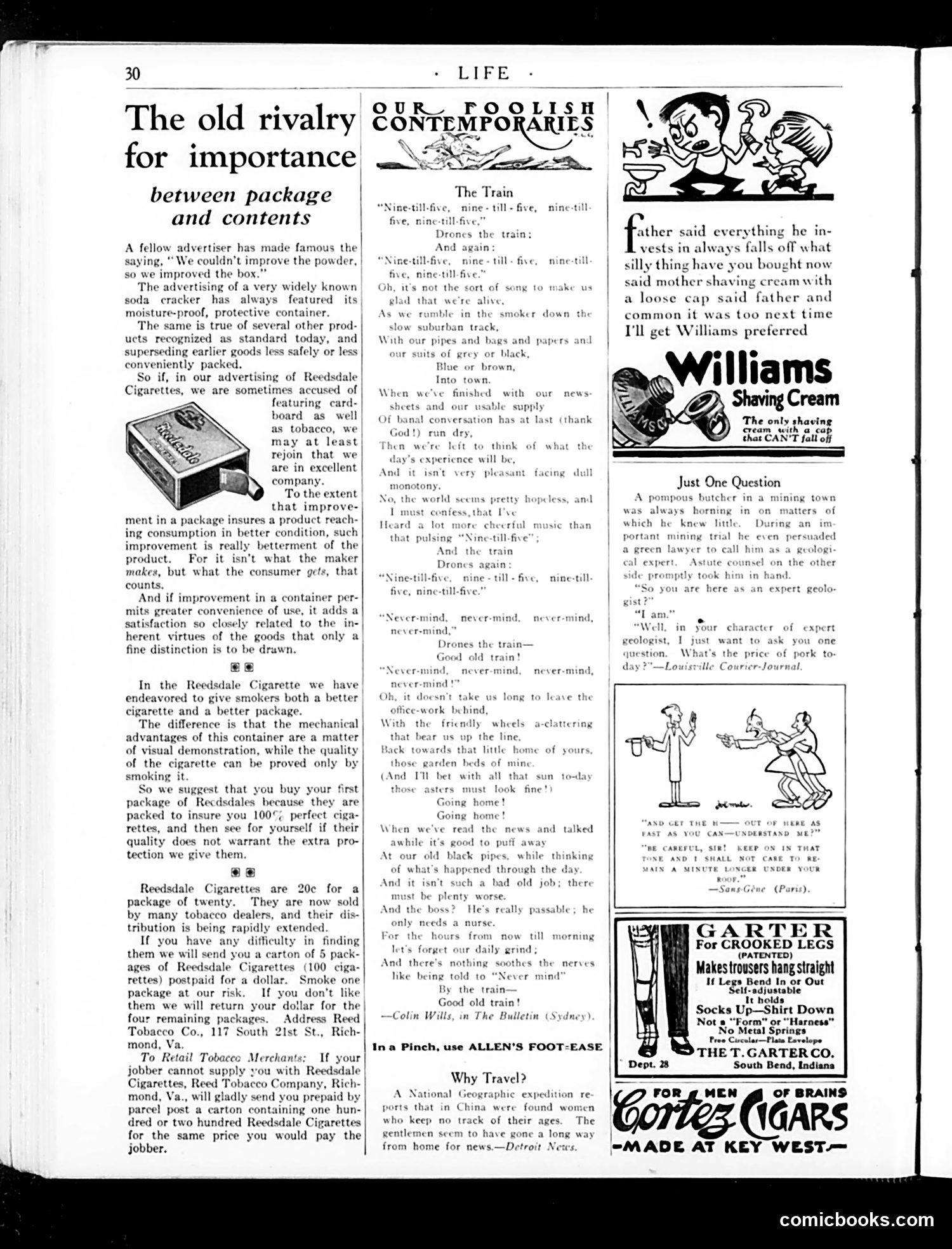
This page contains primarily **advertising content** rather than political satire. The main feature is a lengthy advertisement for **Reedsdale Cigarettes**, arguing that packaging quality matters as much as product quality—a "rivalry between package and contents." The ad compares cigarette packaging to successful branded products like soda crackers, emphasizing that protective containers ensure better consumption. The page also includes a **poem titled "The Train,"** apparently set to a monotonous melody ("Nine-till-five"), depicting commuters' daily journey from suburban homes to office work and back. The poem romanticizes escape from "office-work" and return to "garden beds," reflecting early 20th-century anxieties about industrial labor and suburban commuting. Additional content includes a **humorous domestic cartoon** about shaving cream preferences, an advertisement for **Williams Shaving Cream**, a **T-Garter Co. sock advertisement** (patented device), and a **Cortes Cigars ad**. The page reflects 1920s consumer culture and working-class routines rather than political commentary.
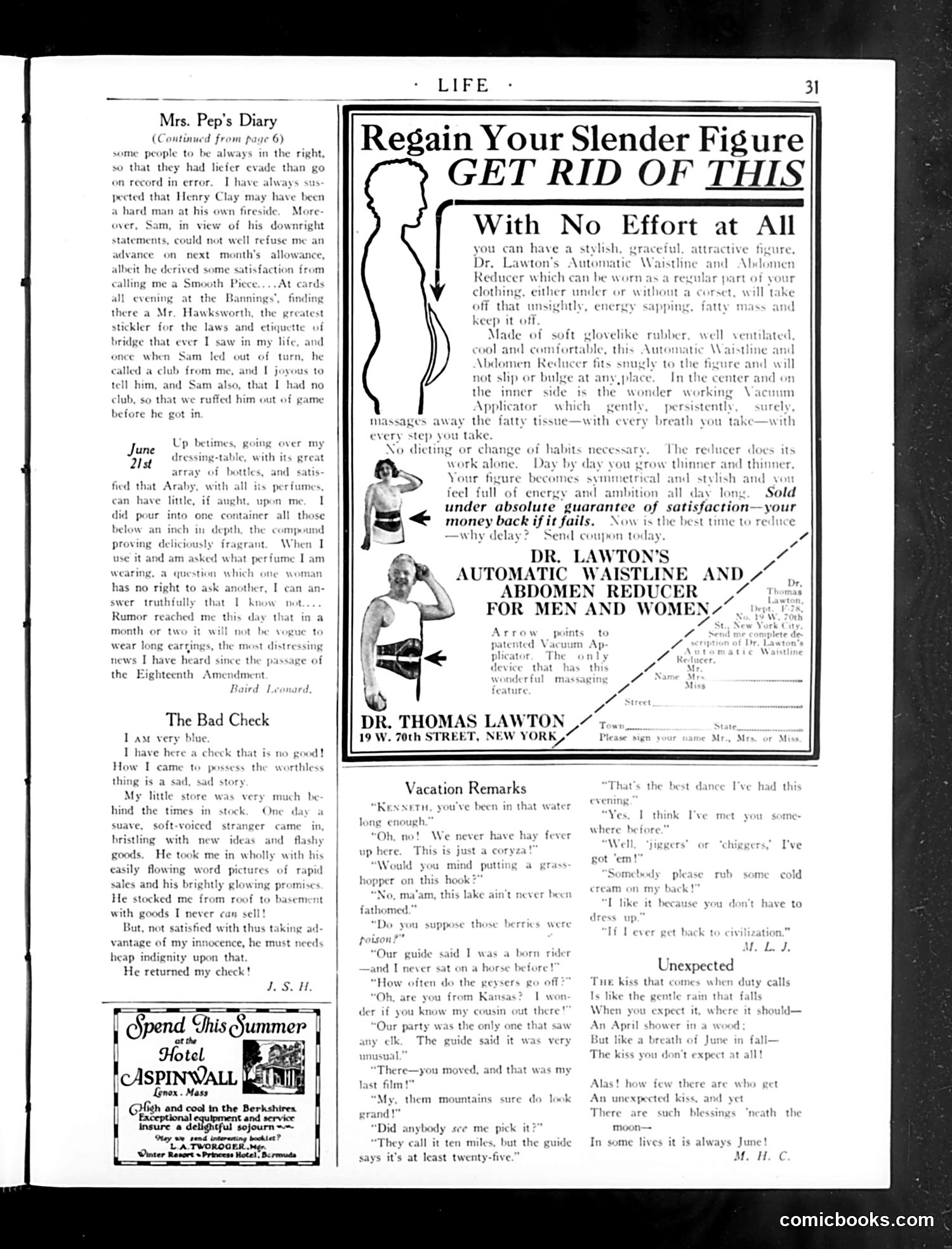
This page contains **primarily advertisements** rather than political satire. The dominant feature is a large ad for "Dr. Lawton's Automatic Waistline and Abdomen Reducer"—a vacuum-based weight-loss device marketed to both men and women. It promised effortless fat reduction by "massaging away" tissue with each breath, sold under money-back guarantee. The smaller content pieces are personal diary entries and humorous anecdotes typical of Life's lighter fare: "Mrs. Pep's Diary" recounts domestic trivialities, "The Bad Check" tells of retail fraud, and "Vacation Remarks" offers tourist conversation snippets. **The satire is subtle**: the ads themselves mock 1920s-era consumer gullibility—the promise of effortless body transformation without diet or exercise changes. The absurd mechanism (a rubber belt with a "vacuum applicator") represents the kind of dubious medical device marketed to Americans seeking quick fixes. The diary entries subtly satirize upper-middle-class social pretension and marital dynamics of the era, though these are incidental to the page's primary commercial purpose.
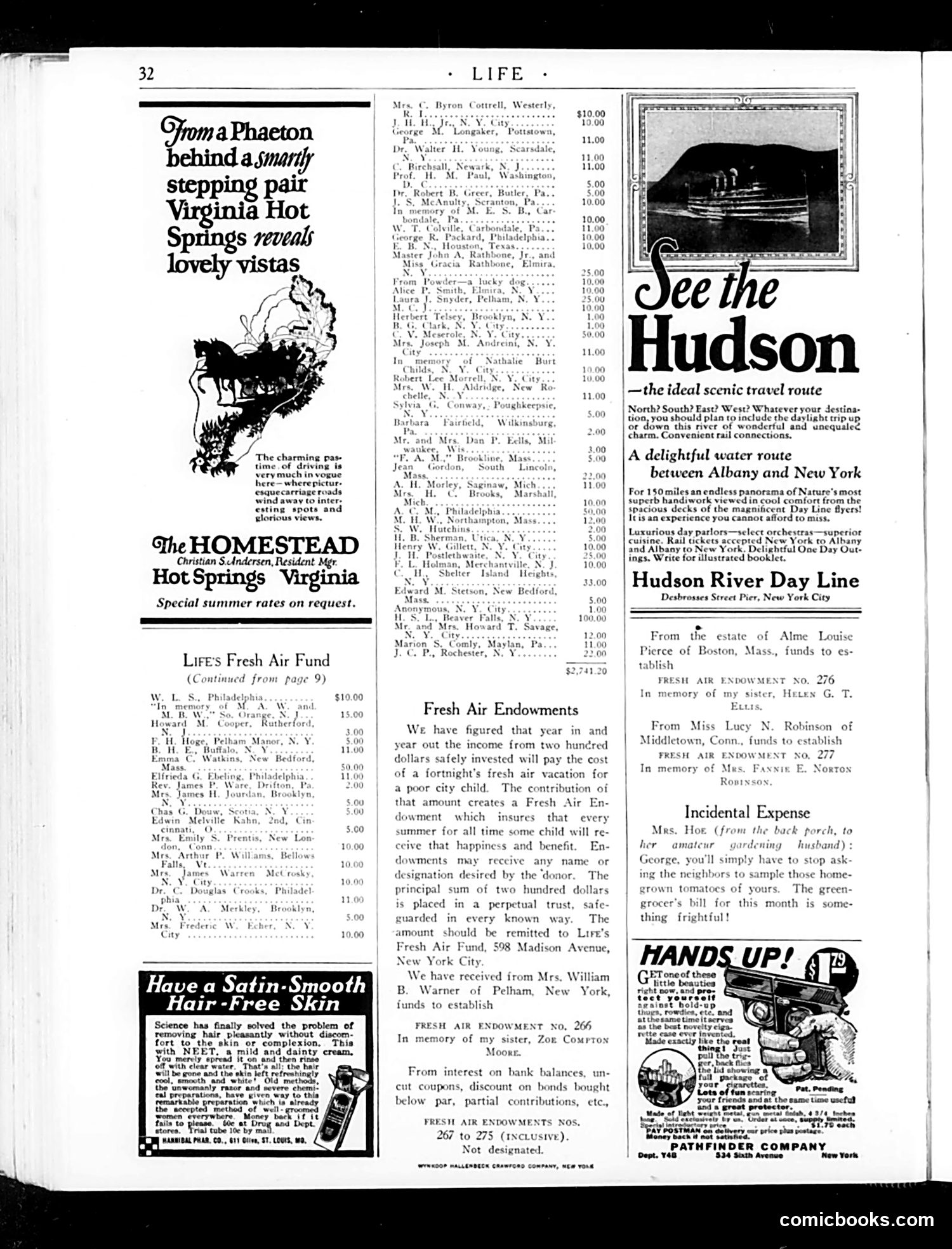
This page is primarily **advertising and charitable notices**, not political satire. The main content includes: **Advertisements:** - "The Homestead" resort in Hot Springs, Virginia, promoting scenic carriage drives - A hair removal cream (Hinds Honey & Almond Cream) targeting women - Hudson River Day Line steamship travel between Albany and New York - "Hands Up!" cigars with a novelty case **Charitable content:** The bulk of the page details **Life magazine's Fresh Air Fund**, a real charitable initiative providing poor city children summer vacations. It lists donors and endowments of $200 that fund two-week trips for disadvantaged children—presented as socially progressive philanthropy typical of early 20th-century American magazines. There is **no political cartoon** visible here. The small illustration of a horse-drawn carriage is merely promotional art for the resort. This is a typical page mixing leisure advertisements with charitable giving information, reflecting the magazine's mix of satire, lifestyle content, and social causes.
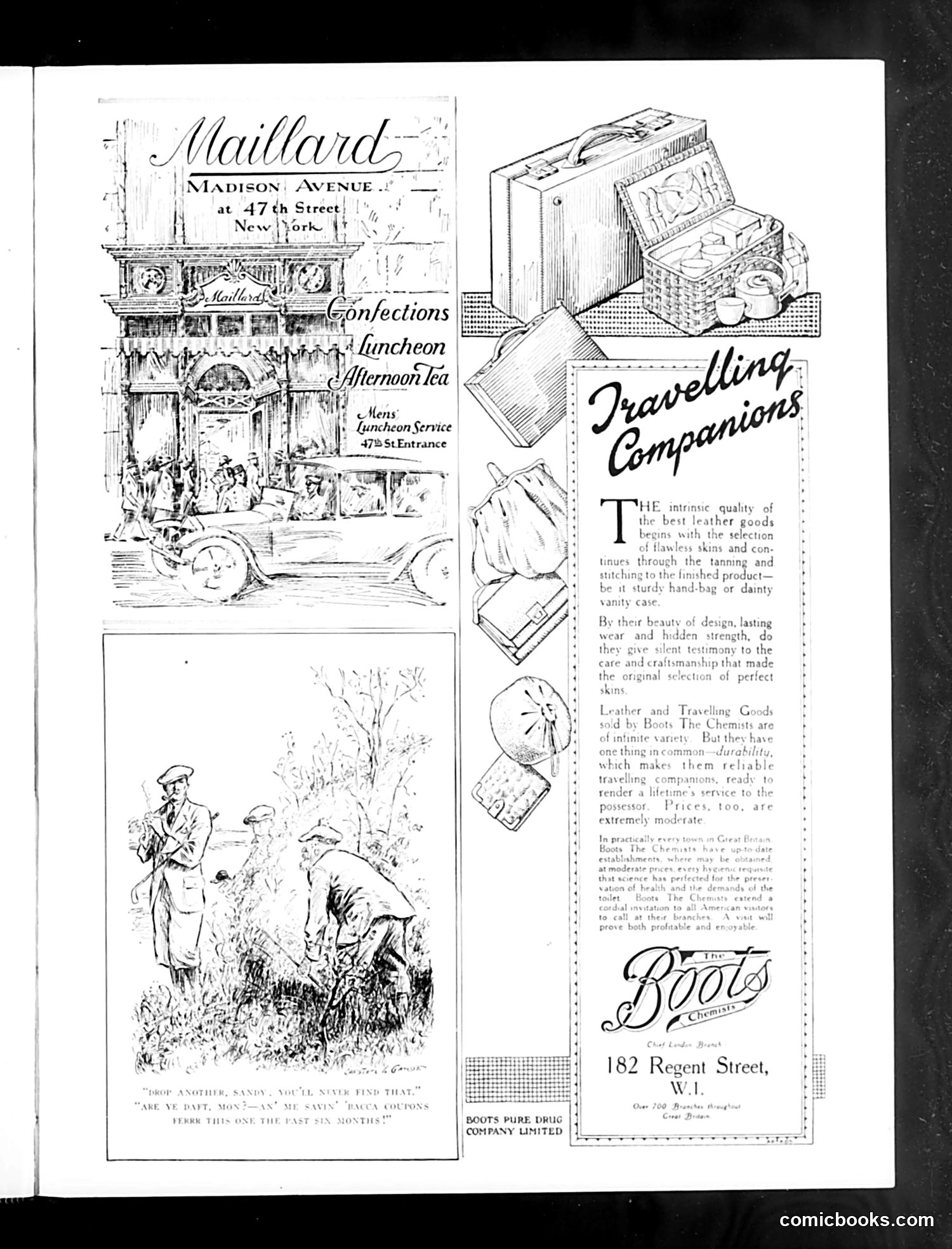
This page is primarily **advertising**, not satire or political commentary. The left side features two advertisements: a detailed sketch of the Maillard restaurant on Madison Avenue (offering confections, luncheon, and afternoon tea with a men's luncheon entrance), and below it, a cartoon illustration captioned "For Another Sauce, You'll Never Find That" — depicting what appears to be hunters or outdoorsmen in a rural setting, advertising Boots Pure Drug Company. The right side is a "Traveling Companions" advertisement for leather goods from Boots the Chemist (182 Regent Street, London). The text emphasizes quality leather craftsmanship and durability for travelers. There is no political satire on this page — it represents typical early 20th-century magazine advertising mixed with light illustrative humor.
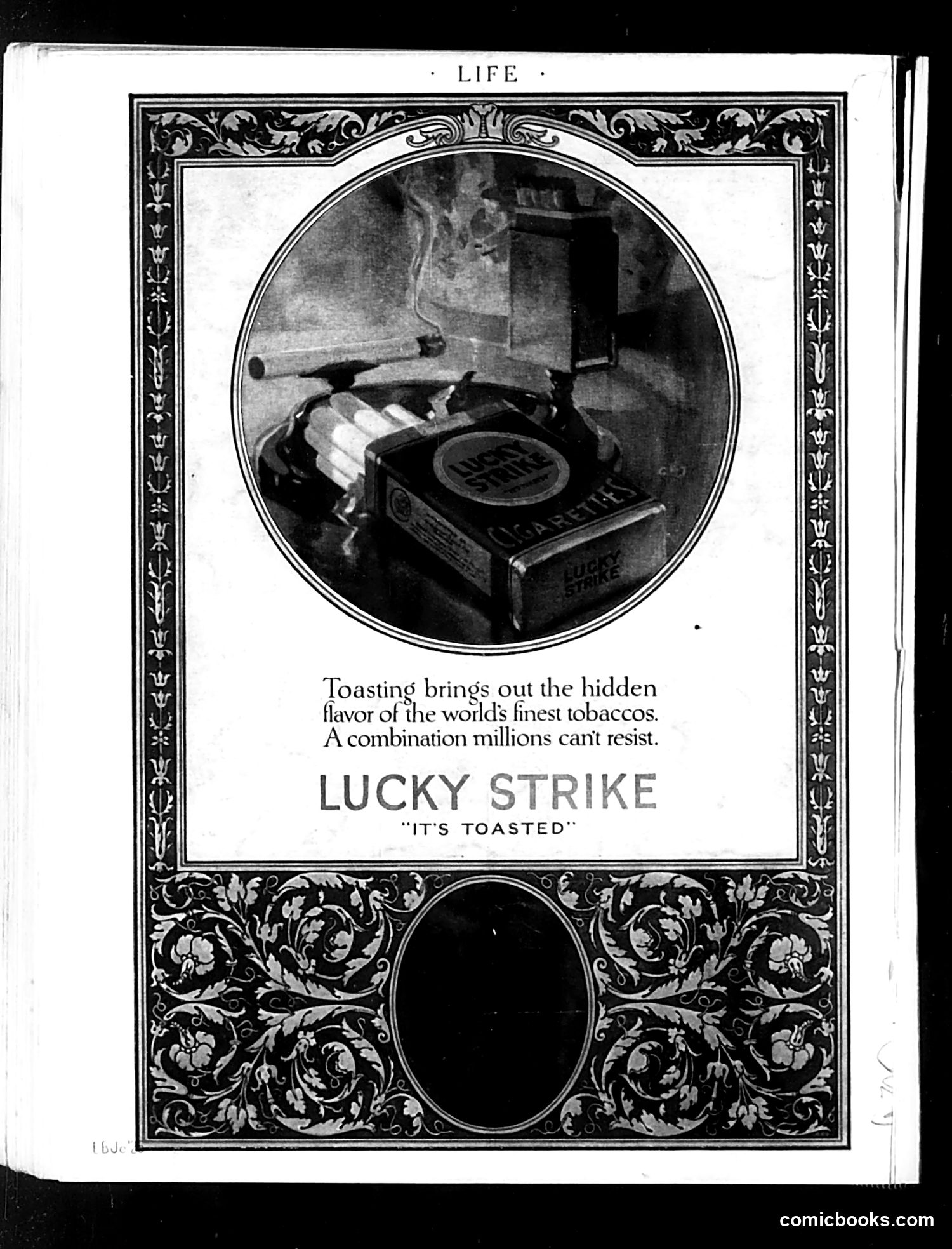
This is a **cigarette advertisement**, not political satire. The page shows a Lucky Strike tobacco ad featuring their famous "It's Toasted" slogan—a genuine marketing claim from the early 20th century emphasizing their unique toasting process. The circular image depicts the toasting equipment used in manufacturing. The ad's pitch is straightforward: toasting supposedly brings out hidden flavors in tobacco, making Lucky Strike irresistible to consumers. **For modern readers**: This represents an era when cigarette companies advertised openly in mainstream magazines without health warnings. The ornate Art Deco border and "LIFE" masthead indicate this appeared in the prestigious satirical magazine *Life*. This is a historical artifact showing how differently tobacco was marketed before its health dangers were widely acknowledged and advertising was heavily restricted.
I can see this is a nearly black page with minimal visible content—mostly darkness with some faint circular patterns or designs barely discernible on the right side, and a white vertical stripe on the left edge. The watermark "comicbooks.com" appears at the bottom right. The image quality and darkness make it impossible to identify any specific cartoons, figures, caricatures, or satirical content with confidence. Without legible text or clear imagery, I cannot determine what political or social references this page might contain, or explain the satire to a modern reader. This appears to be either a heavily degraded scan, a blank/title page, or a reproduction issue rather than a substantive editorial or cartoon page from *Life* magazine.