
Life, 1924-06-26 · page 23 of 37
Life — June 26, 1924 — page 23: what you’re looking at
What you’re looking at
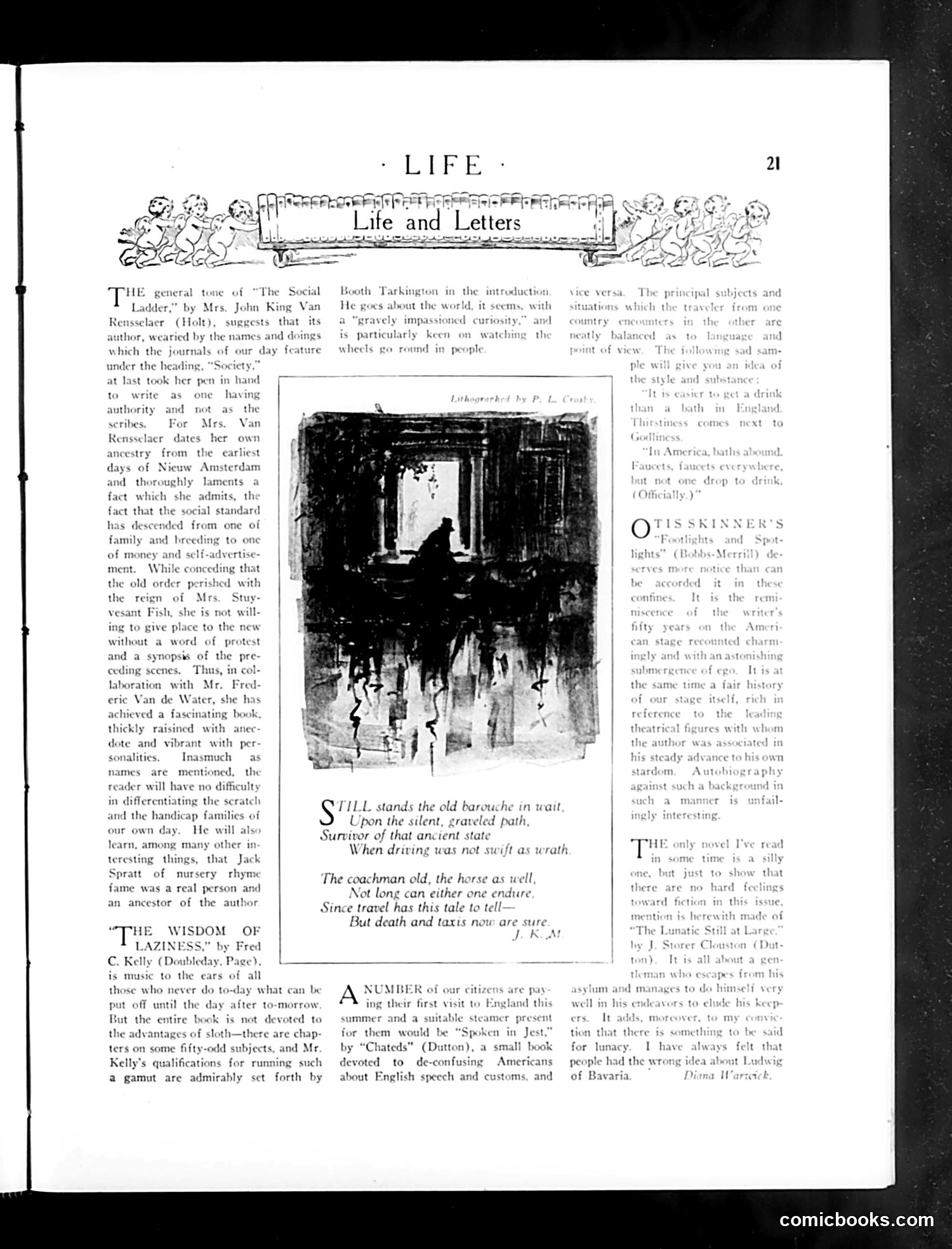
This page from Life magazine's "Life and Letters" section contains a literary review discussing a book by Booth Tarkington about observing "wheels go round in people"—examining American social dynamics and class structures. The central image shows **an old horse-drawn carriage (barouche) on a graveled path**, accompanying a poem lamenting the obsolescence of traditional transportation. The verses contrast the slow, dignified pace of carriages with modern "taxis," suggesting nostalgia for a vanished era of leisure and refinement. The satire targets the tension between America's old aristocratic pretensions (represented by families like the Van Rensselaers, Dutch colonial ancestry) and modern industrial progress. The carriage symbolizes fading gentility being replaced by efficient but undignified motorized taxis—a commentary on how industrialization demolished traditional class hierarchies and leisurely lifestyles that the old money class valued. This reflects early 20th-century anxieties about American modernization eroding established social orders.
📄 Transcribed text from this page (OCR, searchable)
Machine-transcribed from the original scan — historical spelling and the odd misread are preserved.
F ppas Sasso a Sog it Lif e and Letters sh i AS woth Tarkington in the He goes about the world, i names aid d is particularly keen on watchi our day fe wheels go round ir people her pen in hand one having authority ot as. the scribes. r Mrs. Van Rensselaer dates her n ancestry from the earliest days of Nieuw Amsterdam and. th ghly nts fact which she admits, th fact that the social standa: has descended from ¢ family and breedir of money and self ment. While conce the old order perist the reign ves Fish, ing to give without a word of pre and a synopsis of the pre- ceding scenes. Thus, in col- laboration with Mr. Fred. eric Van de W he has achieved a fascinating book thickly raisined with anec dote and vibrant with per ralities. In ch names are men reader will have no dif in differentiating the scratch A I } and the handicap families of S TILL stands the old barouche Upon the silent, graveled path Survivor of that ancient state When driving was not swift a our own day. He will als learn, among many other it teresting things, that Jack Sprat of irse} - pratt of nursery thy The coachman old, the horse as wel Not long can either one endure Since travel has this tale to tell But death and taxis now are sure © was a real person and nestor of the author HE WISDOM OF LAZINESS,” by Fred C. Kelly (Doubleday, Page). to the ears of all who never do lay what can be NUMBER of ou off until the day after to-morrow ing their first visit to I k is not devoted to summer and a suitable re are chap- ; jects, and Mr, by “Chateds” »n), a small book y Kelly’s qualifications for running s d e-confusing Americans people had the wrong a gamut are admirably set forth by English st and customs, and of Bavaria comicbooks.com