
A complete issue · 36 pages · 1924
Life — April 24, 1924
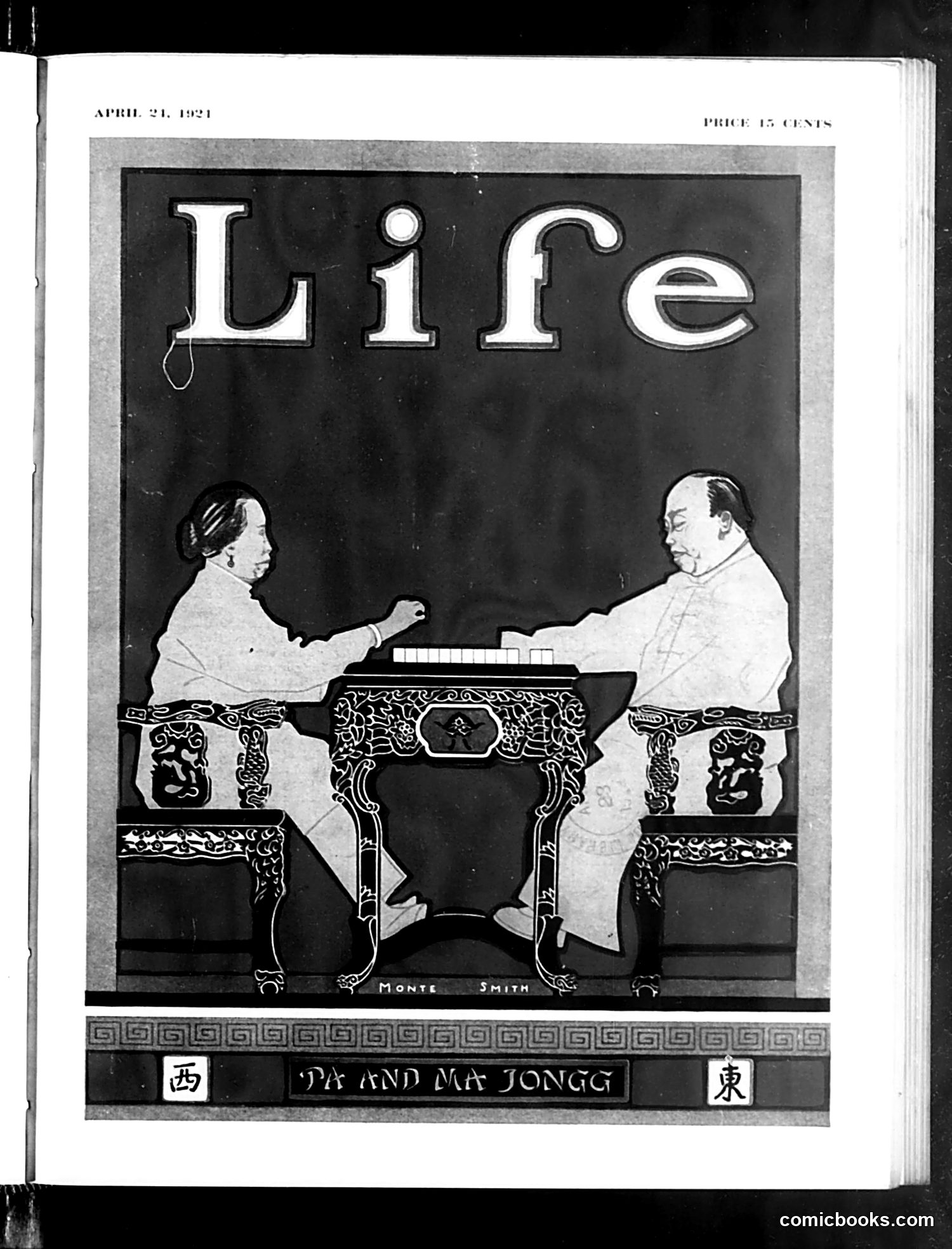
This cover illustrates "Pa and Ma Jongg," a satire on the mahjong craze sweeping America in the early 1920s. The cartoon, credited to Monte Smith, depicts two middle-aged figures playing mahjong at an ornately decorated table with Asian design elements. The joke targets how mahjong—the Chinese tile game—had become an obsessive fad among American adults, particularly wealthy women. The title puns on the game's name while the "Pa and Ma" framing suggests the game's appeal crossed generational lines, consuming leisure time across American society. The Asian aesthetic ornamentation emphasizes the game's exotic, fashionable appeal to contemporary audiences seeking novel entertainments during the prosperous 1920s.
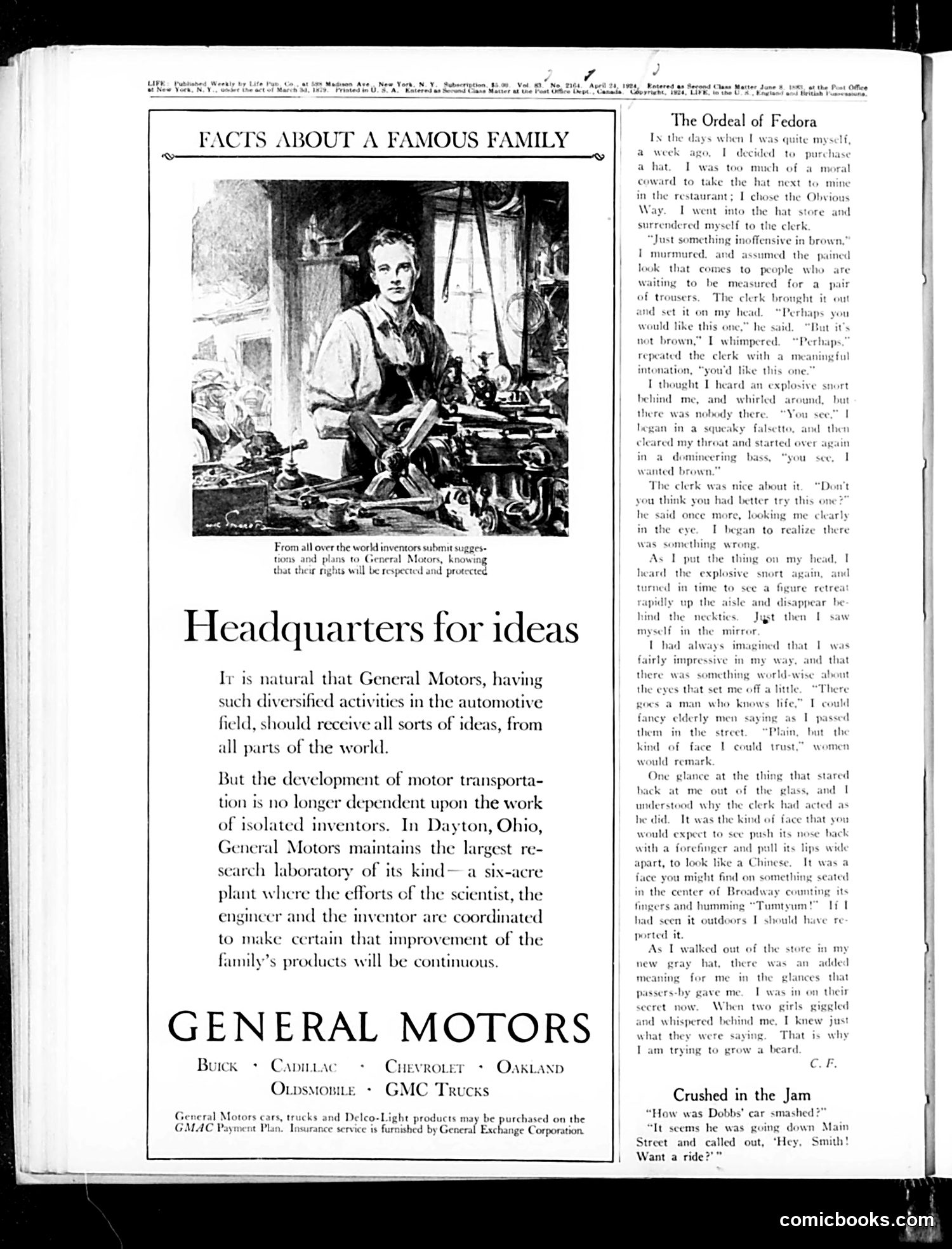
This page is primarily **advertising for General Motors**, not satirical content. The left side features a large illustration labeled "Facts About a Famous Family" showing a man working at a lathe or machine tool, depicting GM's research laboratory in Dayton, Ohio. The accompanying text promotes GM's "headquarters for ideas"—their six-acre research facility where scientists and engineers collaborate on product improvement. It lists GM brands: Buick, Cadillac, Chevrolet, Oakland, Oldsmobile, and GMC Trucks. The right side contains two separate short stories unrelated to the advertisement: "The Ordeal of Fedora" (about buying a hat) and "Crushed in the Jam" (a brief humorous anecdote). These are typical filler content for Life magazine, not political commentary.
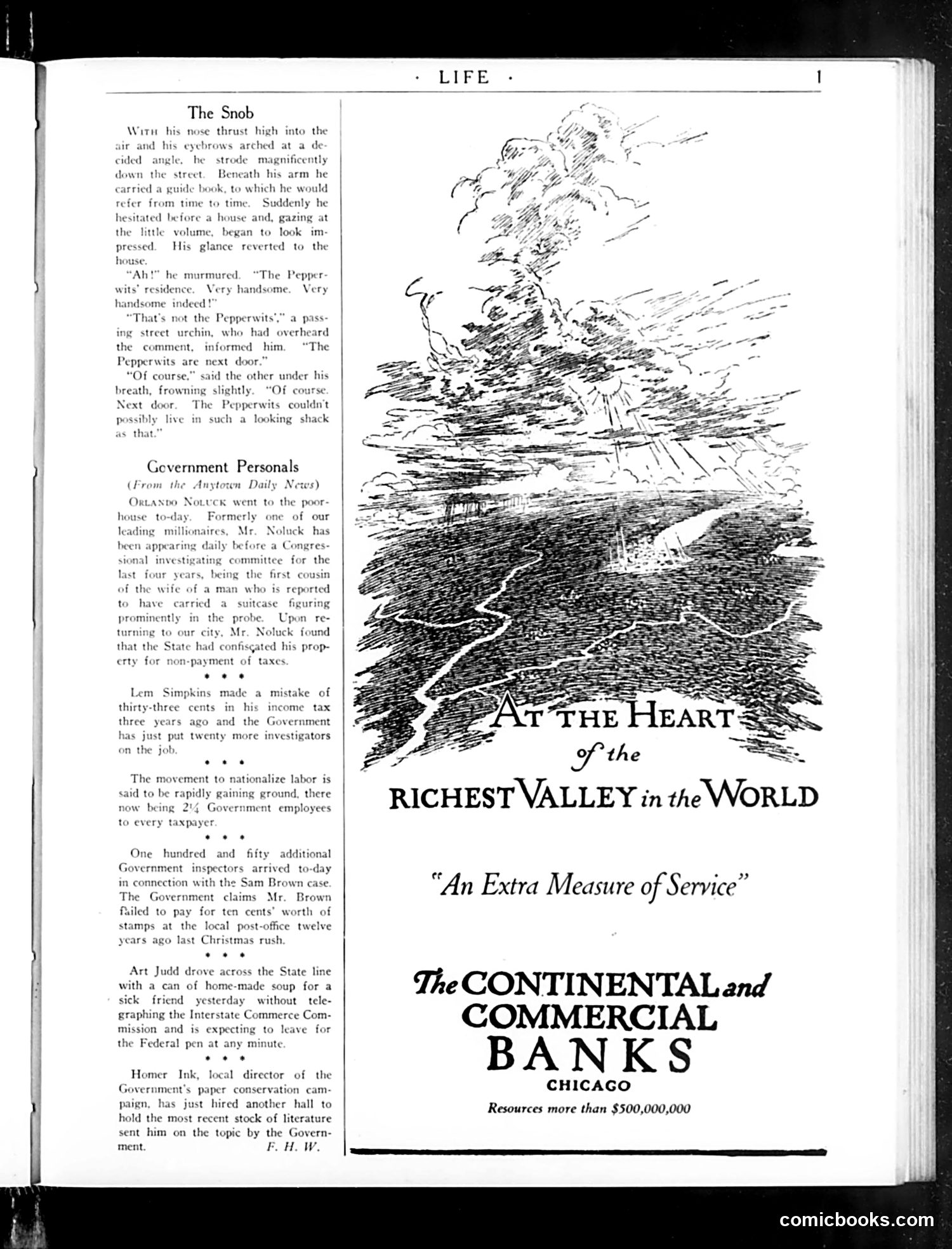
This brief satirical piece mocks social pretension. A character walks down the street with affected mannerisms—nose thrust high, arched eyebrows—carrying a guide book to appear cultured. When he pauses before a house, he becomes impressed and reverses his snobby attitude upon learning it belongs to "the Pepperwits." A passerby corrects him: the Pepperwits actually live elsewhere, and the house belongs to "Next door" neighbors. The snob reacts with disdain, declaring such people couldn't possibly inhabit "such a looking shack." The joke targets social climbers who judge people and homes based on reputation rather than actual merit—their pretentious standards flip depending on whose name is attached. The page otherwise contains "Government Personals" gossip items and a bank advertisement.
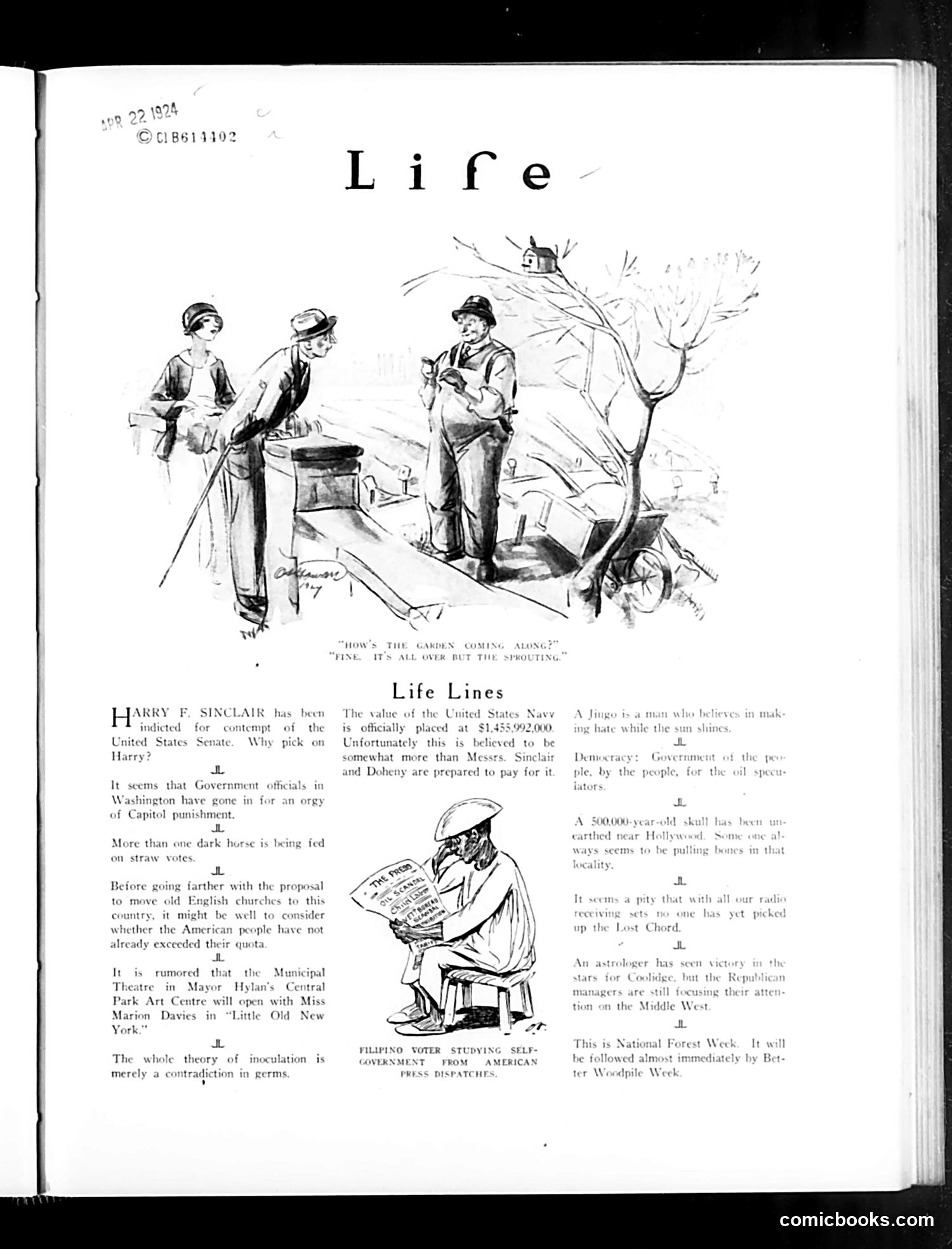
This page from *Life* magazine (dated March 22, 1924) contains a section titled "Life Lines"—brief satirical commentary pieces typical of the magazine's format. The top cartoon depicts three figures in a garden scene with the caption "How's the garden coming along? Fine. It's all over but the spouting." The humor appears to rely on a double meaning of "spouting"—both the literal sprouting of plants and the figurative sense of people talking excessively. The "Life Lines" section below includes various short observations, including references to Harry Sinclair's contempt charge with the U.S. Senate, moving English churches to America, and an astrologer's victory in Senate races. The cartoon inset shows a Filipino voter reading American press dispatches about self-government. The content reflects 1924 political and social commentary, though specific contemporary references would require additional historical context to fully explain.
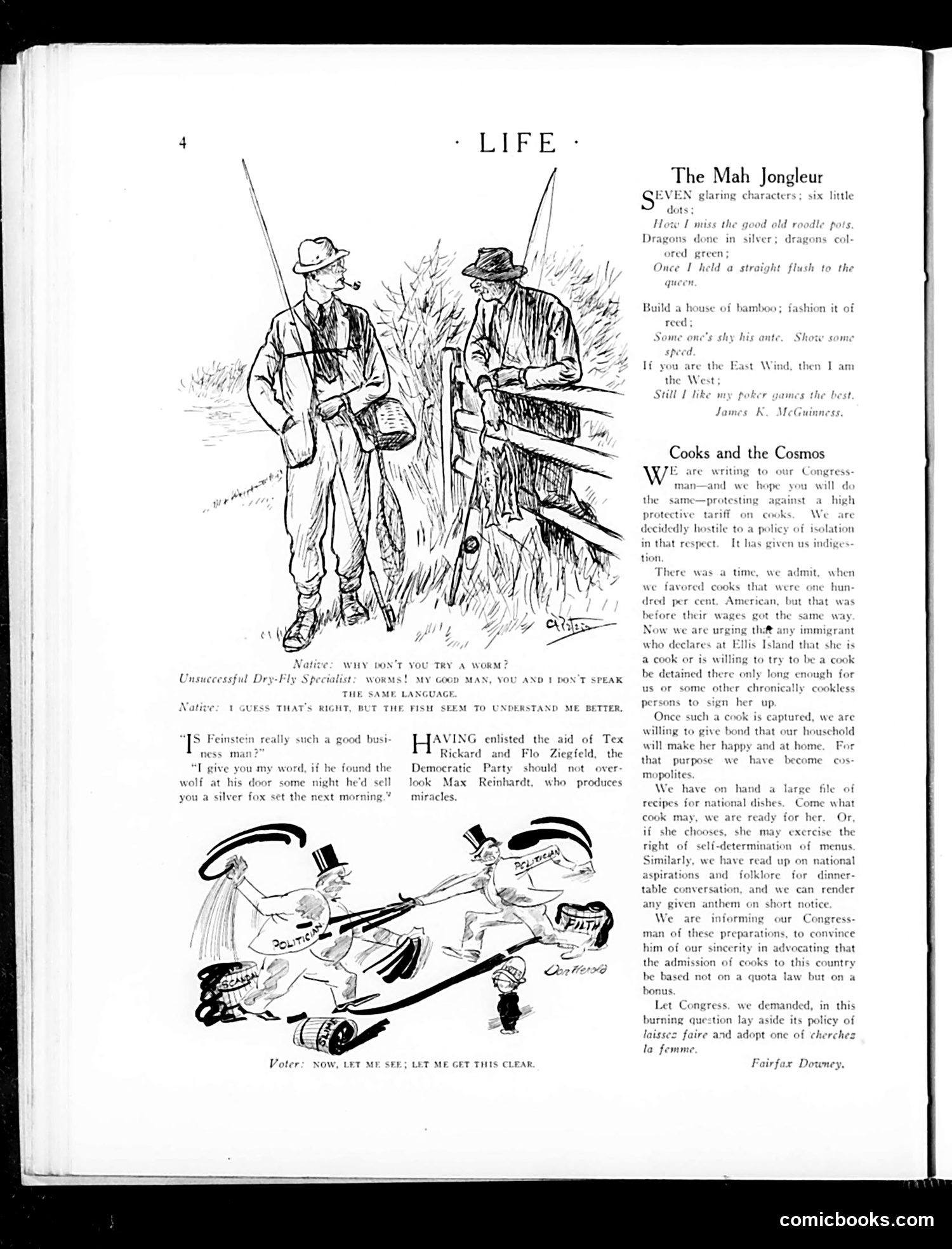
This page contains two separate satirical pieces: **"The Mah Jongleur"** (top): A poem mocking the 1920s craze for mah-jongg, the Chinese tile game that became wildly fashionable among American society. The cartoon depicts two men playing, with humorous observations about the game's popularity replacing traditional pastimes. **"Cooks and the Cosmos"** (bottom): A political satire by Fairfax Downey advocating for protective tariffs on imported cooks. The text references Ellis Island and immigration policy, arguing that American households should prioritize hiring domestic cooks. The cartoon shows politicians and voters debating this issue with exaggerated gestures, satirizing protectionist economic arguments of the era. Both pieces reflect 1920s American anxieties: faddish leisure trends and nativist immigration concerns disguised as economic policy.
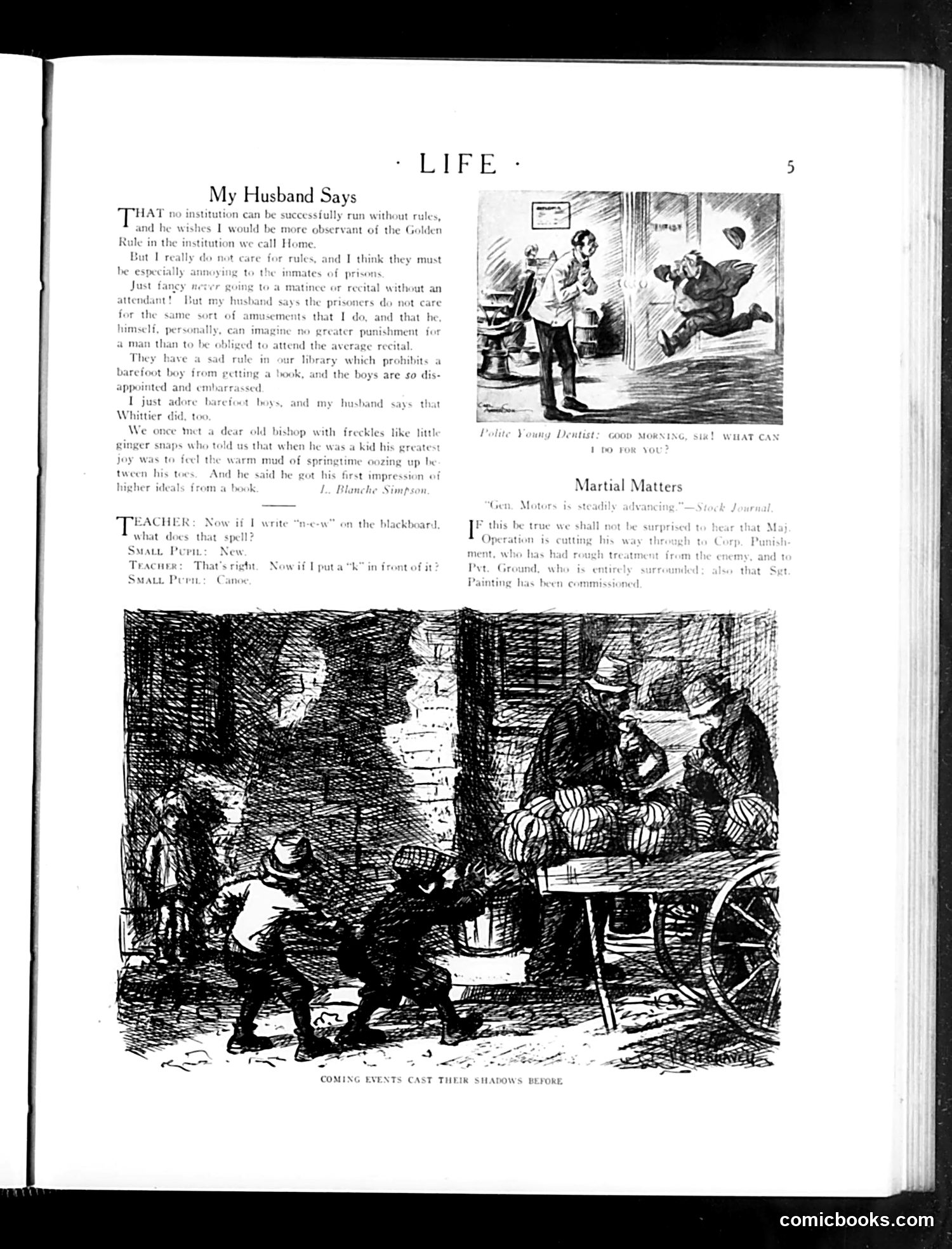
This page contains two distinct pieces: **"My Husband Says"** (top left): A humorous domestic essay about library rules and attendance at recitals, featuring a dialogue between a teacher and small pupil about spelling. **"Martial Matters"** (top right): A cartoon captioned "POLITE YOUNG DENTIST: GOOD MORNING, SIR! WHAT CAN I DO FOR YOU?" depicting a military officer visiting a dentist—likely satirizing military dentistry or the formality of professional interactions during wartime. **Bottom illustration** "COMING EVENTS CAST THEIR SHADOWS BEFORE": A detailed sketch of what appears to be a street vendor or merchant scene with multiple figures around a produce stand or cart, likely satirizing urban commercial life or working-class commerce. The page represents *Life*'s typical mix of domestic humor, professional satire, and social observation aimed at middle-class American readers.
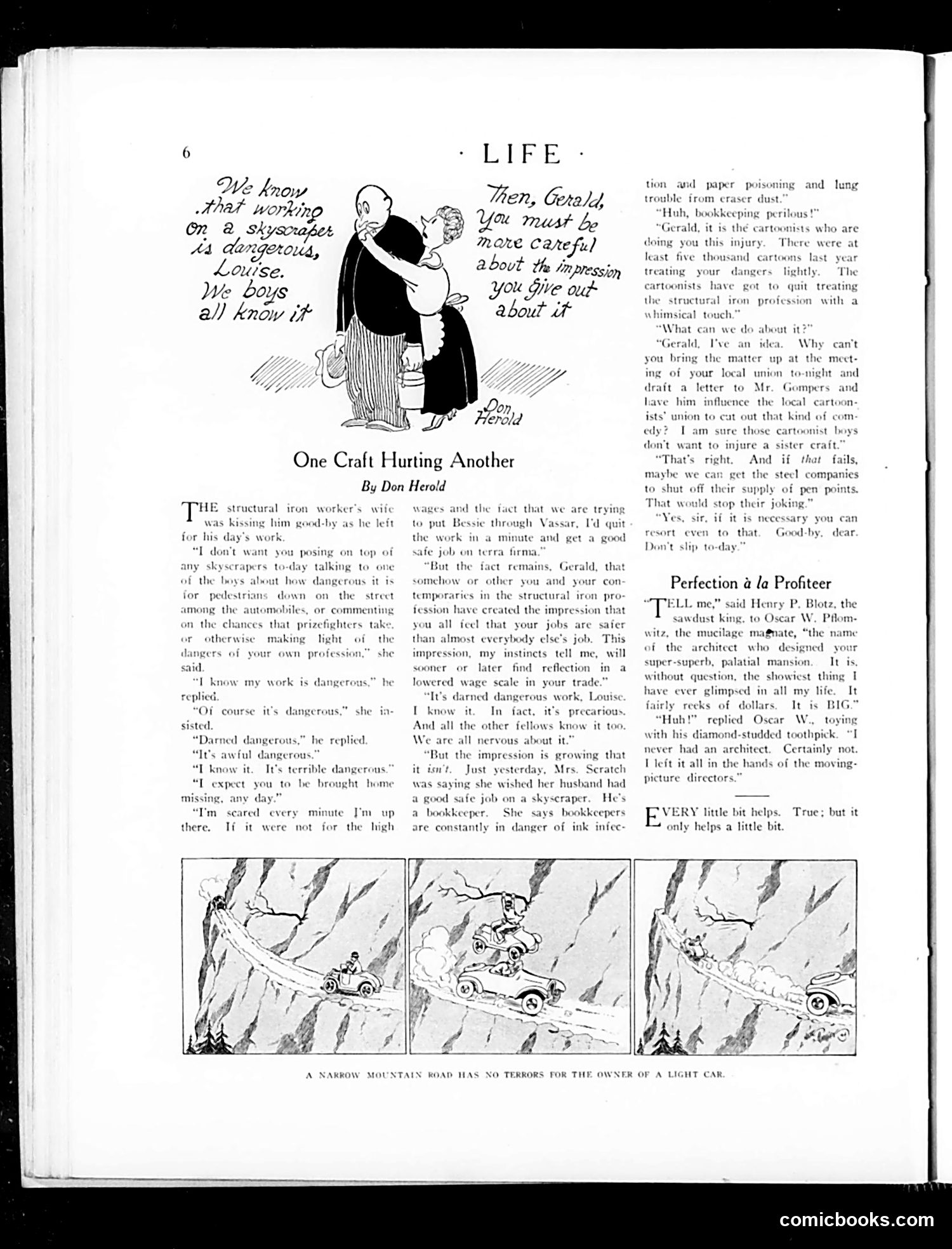
This satirical piece critiques workplace safety culture among different professions. A structural iron worker's wife warns her husband about dangerous skyscraper work, while he dismisses her concerns. The irony: he then lists other "dangerous" professions—cartoonists dealing with toxic materials, bookkeepers risking ink poisoning—that are comparatively trivial. The satire targets how people in any profession exaggerate their occupational risks. The wife suggests unionizing cartoonists to demand safety standards, satirizing labor organizing trends. The joke: cartoonists complaining about their "dangerous" jobs seem absurd compared to actual structural iron workers. The three-panel comic below shows cars on a mountain road, illustrating the lighter "dangers" of everyday life versus genuinely hazardous work.
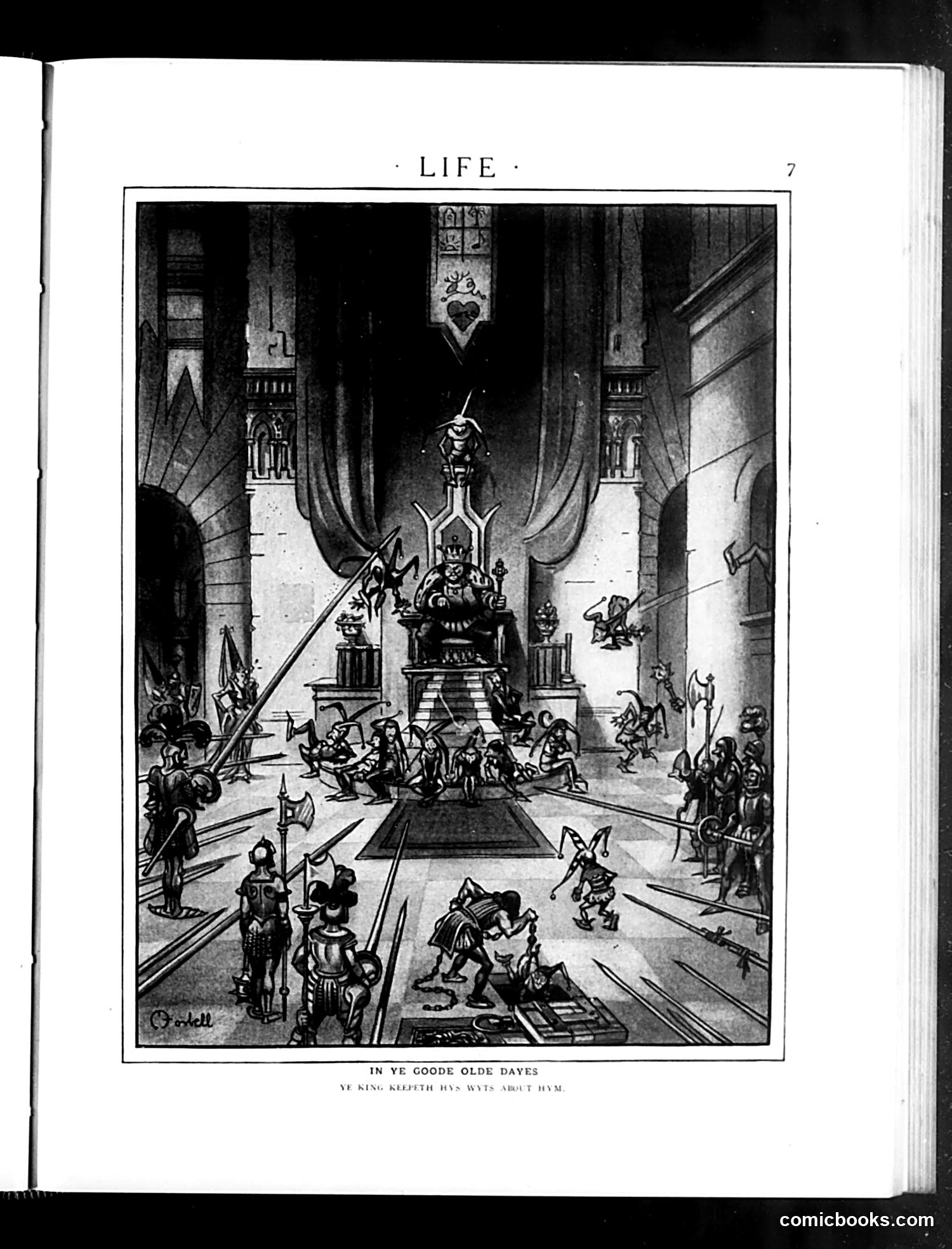
This satirical illustration depicts a medieval throne room scene with the caption "In Ye Goode Olde Days / Ye King Keepeth His Wits About Him." The cartoon mocks nostalgia for "the good old days" by showing a medieval king maintaining order and control over his court through apparent force and authority. Armed guards and courtiers surround an ornate throne, suggesting a hierarchical, militaristic society where the monarch's power is unquestioned and enforced. The satire likely critiques early 20th-century conservative arguments that earlier historical periods were superior to the present—implying that past "order" was maintained through authoritarian means rather than representing an ideal worth emulating. The artwork is signed by what appears to be "Cesell" or similar.
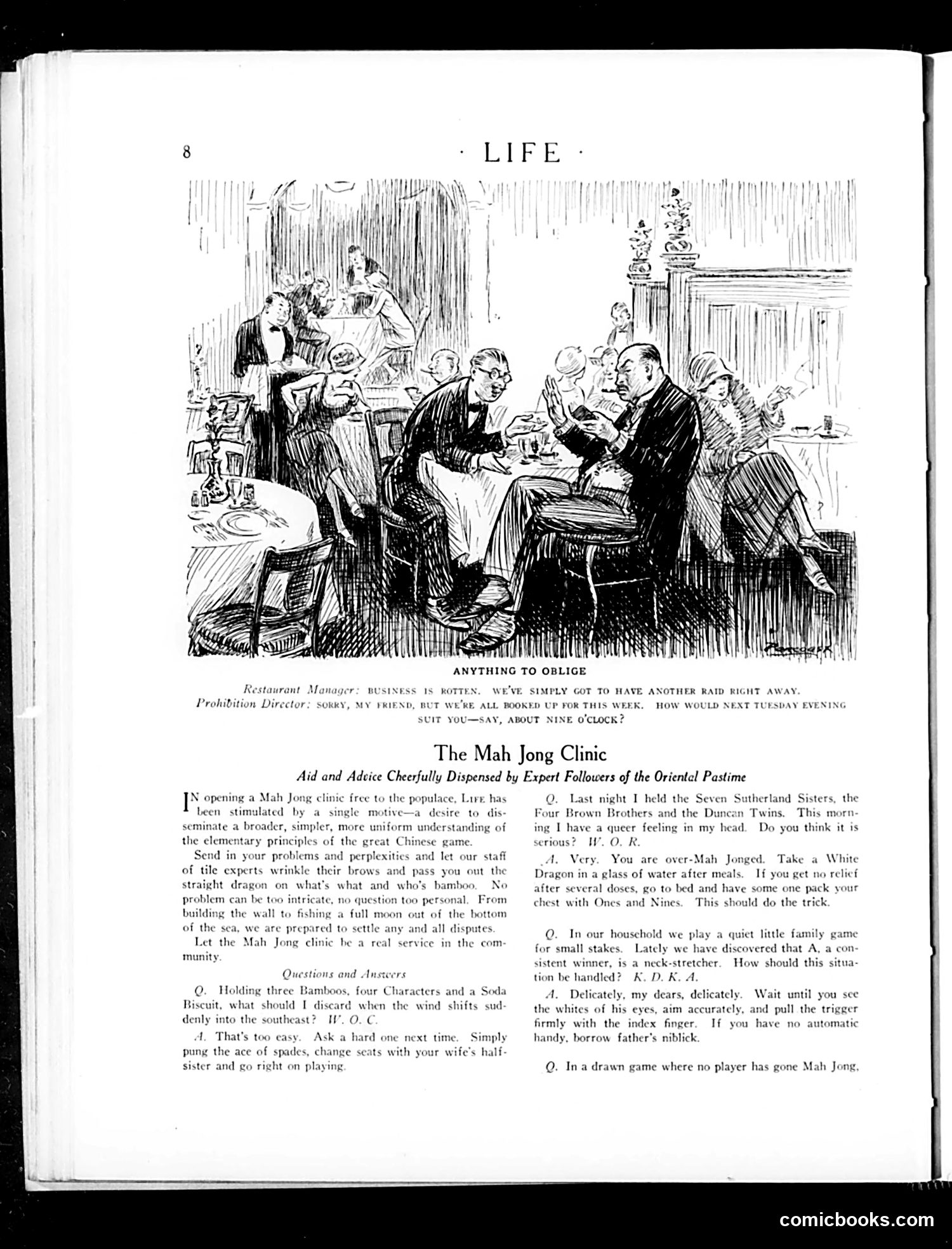
The cartoon depicts a restaurant scene where a **Restaurant Manager** and **Prohibition Director** are negotiating. The manager complains that "business is rotten" and they've "simply got to have another raid right away," asking the director to schedule one for next Tuesday at 9 PM. This satirizes **Prohibition-era corruption**. The joke is that raids—ostensibly enforcement actions against illegal alcohol—were actually *good for business*. A staged raid would generate publicity and appear legitimate to authorities, while the restaurant benefited from notoriety. The cartoon mocks how Prohibition enforcement became complicit with the very establishments it claimed to police, suggesting collusion between authorities and business owners for mutual profit.
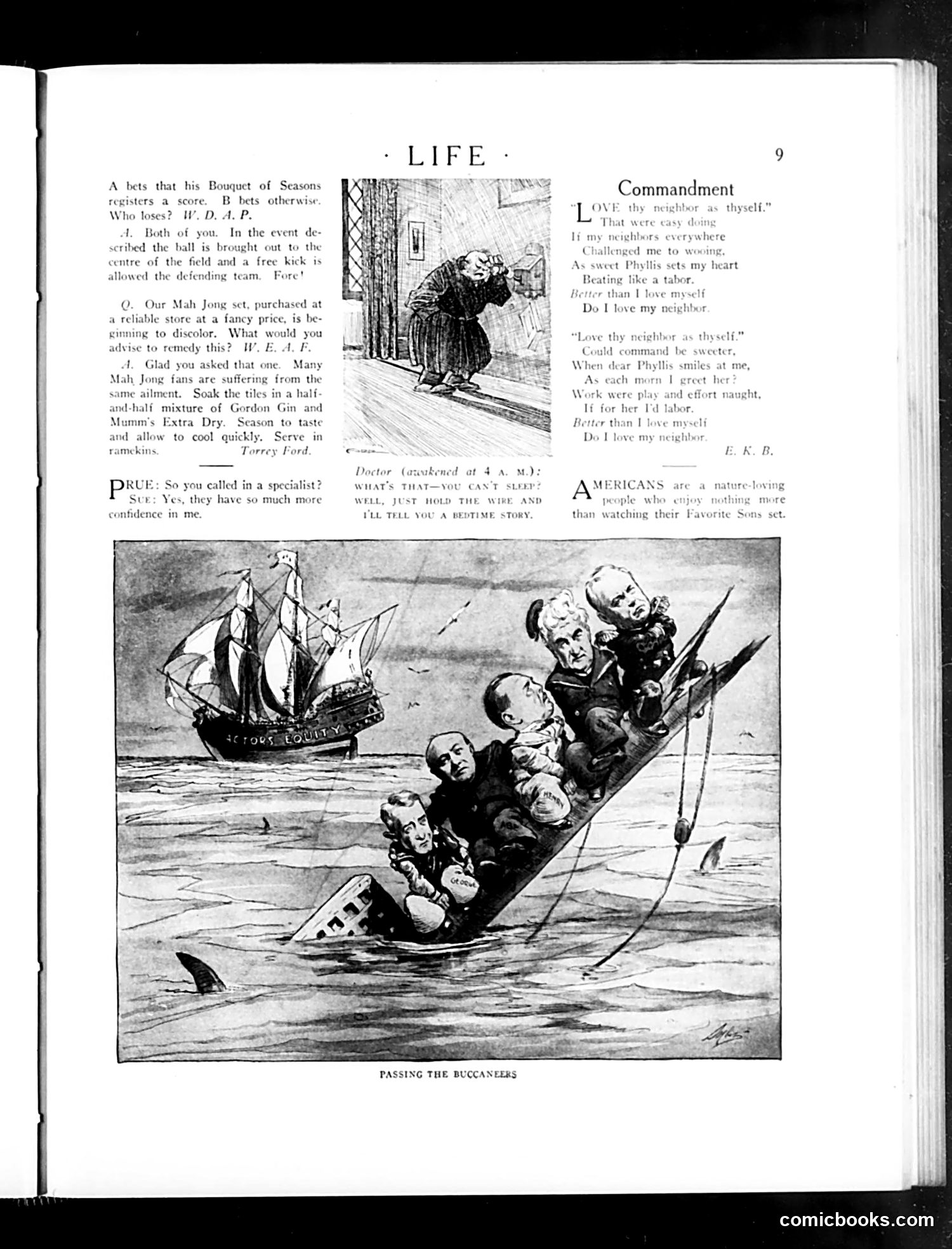
This satirical cartoon depicts caricatured figures in a small boat encountering a large sailing ship labeled "St. Louis Courier." The imagery references a popular American pastime: watching television's "Favorite Suns set" (mentioned in the text above). The cartoon appears to satirize Americans' obsession with entertainment and passive leisure activities. The "buccaneers" (likely referencing Tampa Bay's sports team or general pirate imagery) represent some form of entertainment spectacle, while the smaller boat's occupants frantically flee or navigate around it. The joke targets Americans' preference for watching entertainment over engaging in active pursuits—a critique of growing television culture and consumerism. The nautical setting humorously literalizes this escape from entertainment dominance.
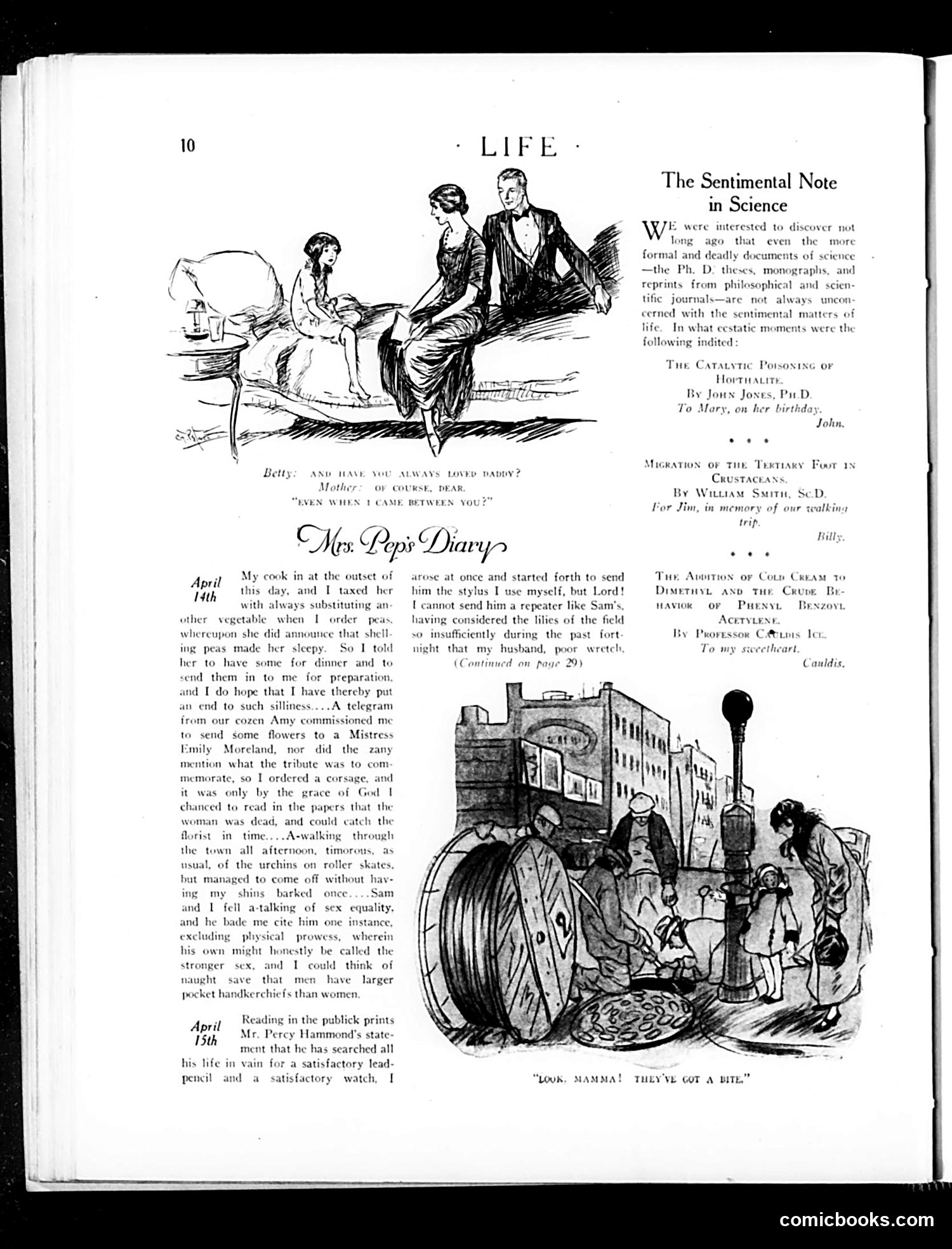
This page features **Mrs. Pop's Diary**, a humor column presenting domestic mishaps from April 14th-15th. The entries satirize middle-class household management: the cook's incompetence with vegetables, a servant's failure to deliver flowers properly, and a husband's futile search for a lost pencil and watch. The two illustrations depict **everyday domestic scenes**: the top shows a woman questioning her husband about his whereabouts, while the bottom shows children discovering food ("Look, Mamma! They've got a bite"), likely commenting on poor cooking quality. The page also lists scientific publications with sentimental dedications, gently mocking how formal academic work sometimes contains personal sentimentality—contrasting dry scholarship with human feeling.
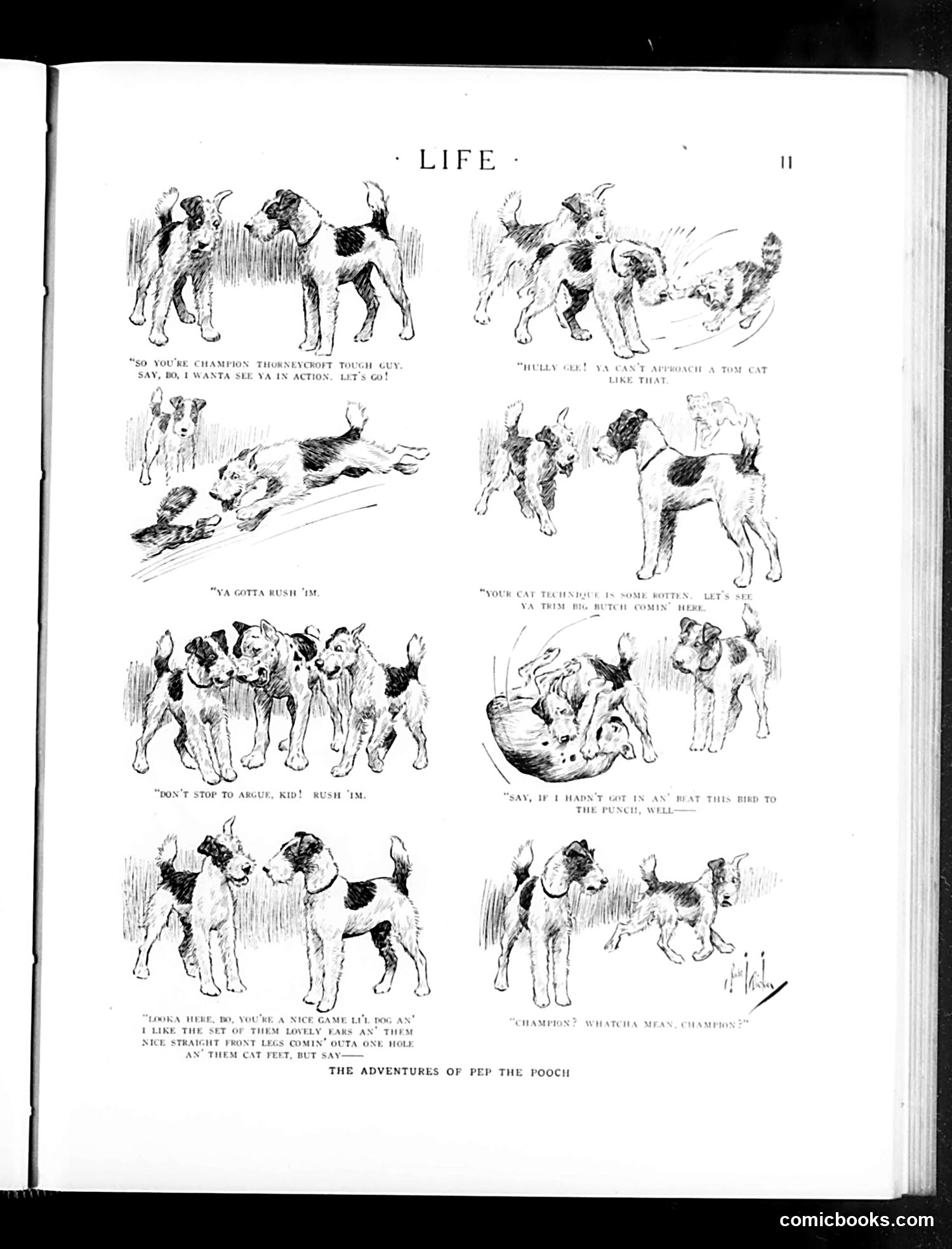
This is a humorous comic strip about dogs, not political satire. It depicts various scenes of a dog named "Pep" interacting with other dogs and a cat. The jokes are based on: - **Dog fighting/competitive behavior**: References to being a "champion" and challenges to fight ("rush 'im") - **Masculinity stereotypes**: Phrases like "big butch comin' here" and competitive posturing among male dogs - **Cat-dog antagonism**: The standard trope of dogs chasing or confronting cats - **Period slang**: Dialogue uses early 20th-century colloquialisms ("ya gotta rush 'im," "don't stop to argue, kid") The humor relies on anthropomorphizing dogs with human personality types—tough guys, braggarts, and fighters—common in entertainment of that era. There is no apparent political meaning; it's simply animal comedy.
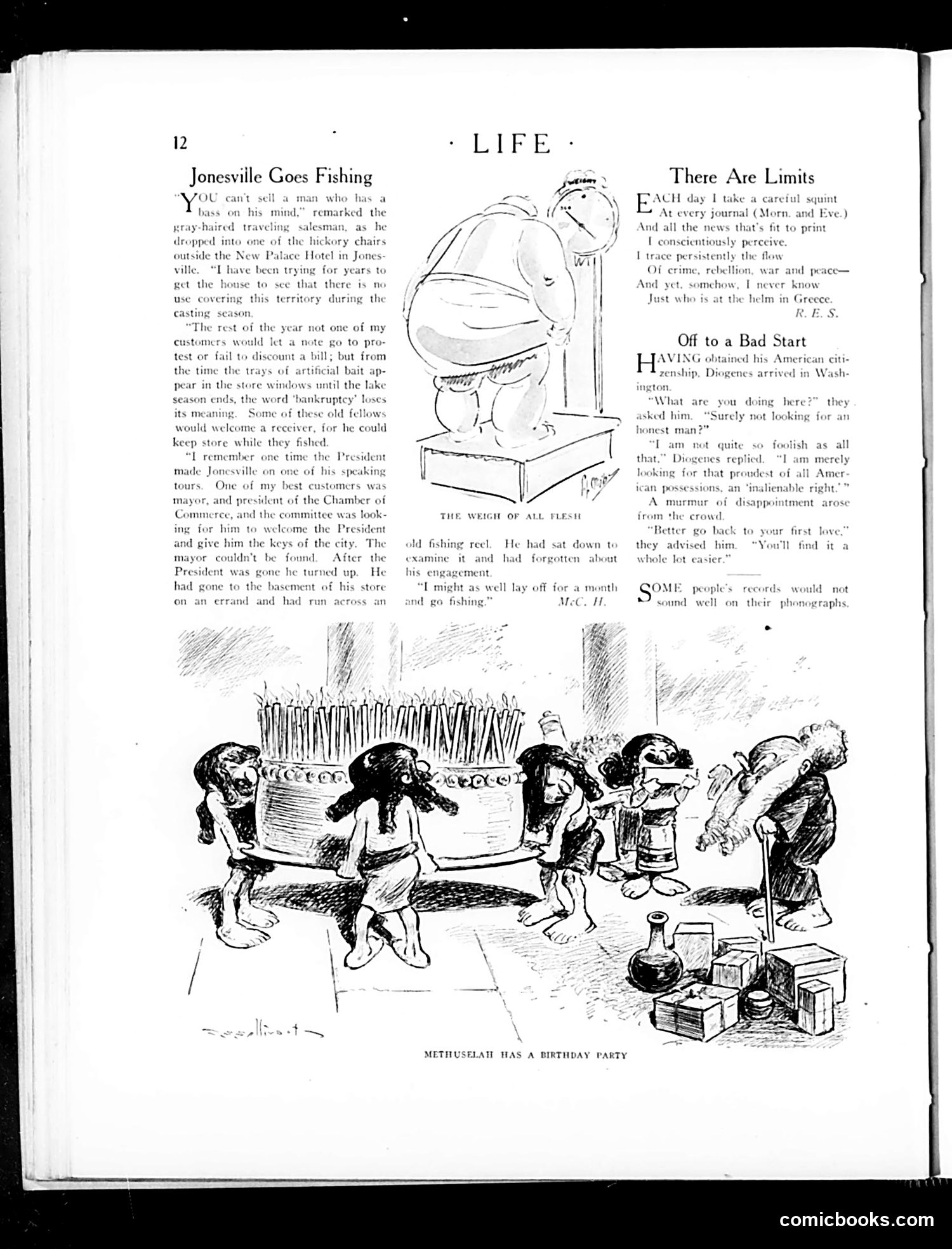
This page contains three separate pieces: 1. **"Jonesville Goes Fishing"** — A humorous story about a salesman trying to sell fishing gear during off-season, culminating in the mayor trying to recover lost merchandise from a basement. 2. **"There Are Limits"** — A short poem (attributed R.E.S.) about daily journalism and maintaining perspective amid crime and war coverage. 3. **"Off to a Bad Start"** — A brief anecdote about a newly naturalized American citizen arriving in Washington who is immediately asked if he's "looking for an honest man," sarcastically implying American dishonesty and disappointment with his new country. 4. **"Methuselah Has a Birthday Party"** — An illustration showing figures (possibly representing biblical longevity or old age) at a celebration, though the specific satirical target remains unclear.
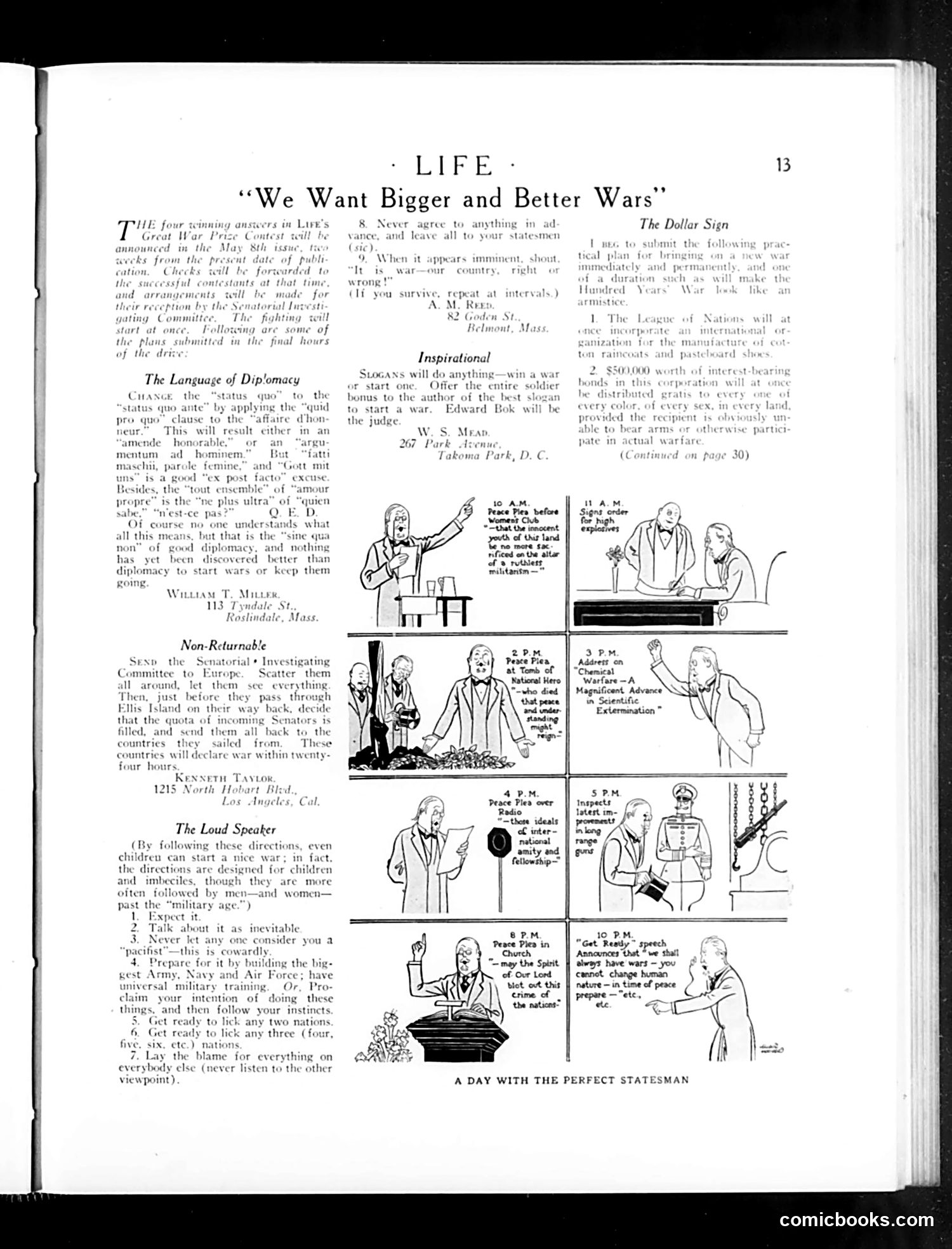
This multi-panel cartoon satirizes an idealized political figure through an absurdly packed daily schedule. The sequence shows a statesman delivering speeches and addresses throughout the day—appearing at 8 AM before Congress, 3 PM on scientific topics, 4 PM on military matters, 6 PM in church, and 10 PM on peace preparation—each time claiming to represent different constituencies or ideals. The satire suggests that a "perfect statesman" cannot genuinely serve all interests simultaneously; by attempting to address every group's priorities in a single day, the figure becomes ridiculous and hypocritical. This critiques politicians' tendency to present themselves as all things to all people, highlighting the inherent contradiction in such claims.
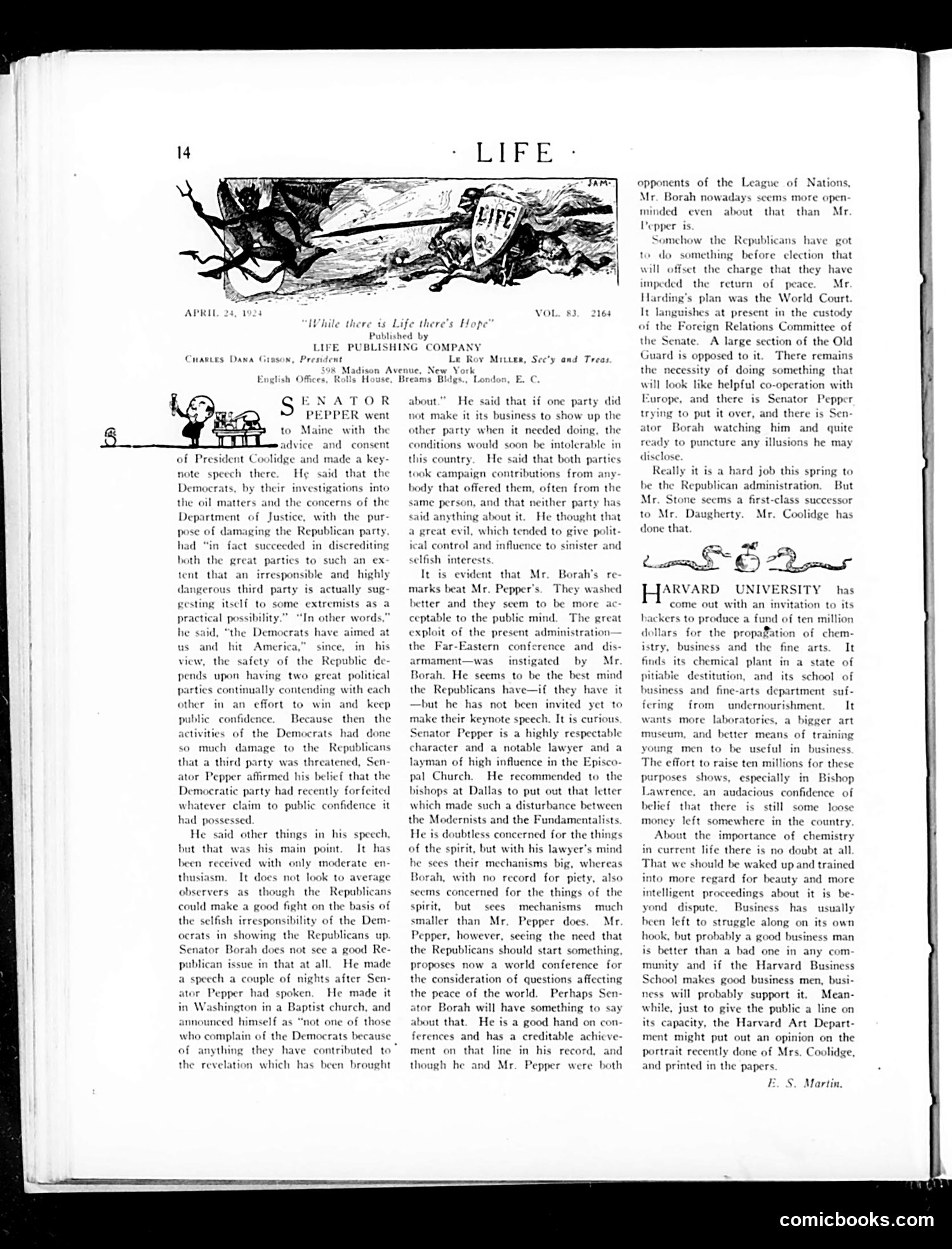
The cartoon depicts a figure labeled "LIFE" observing political turmoil. The accompanying article discusses Senator Pepper criticizing Senator Borah's recent activities. The text reveals internal Republican Party conflict: Borah is accused of damaging Republican unity by his statements about the League of Nations and foreign policy, while Pepper suggests Republicans need unified messaging before the election. The satire targets Republican disarray—particularly tension between the party establishment and Borah's independent faction. The article suggests both parties are divided, but emphasizes Republicans face electoral jeopardy from their internal divisions over international policy and campaign financing practices. The cartoon's "Hope" reference likely sarcastically questions whether unity is possible given these deep rifts.
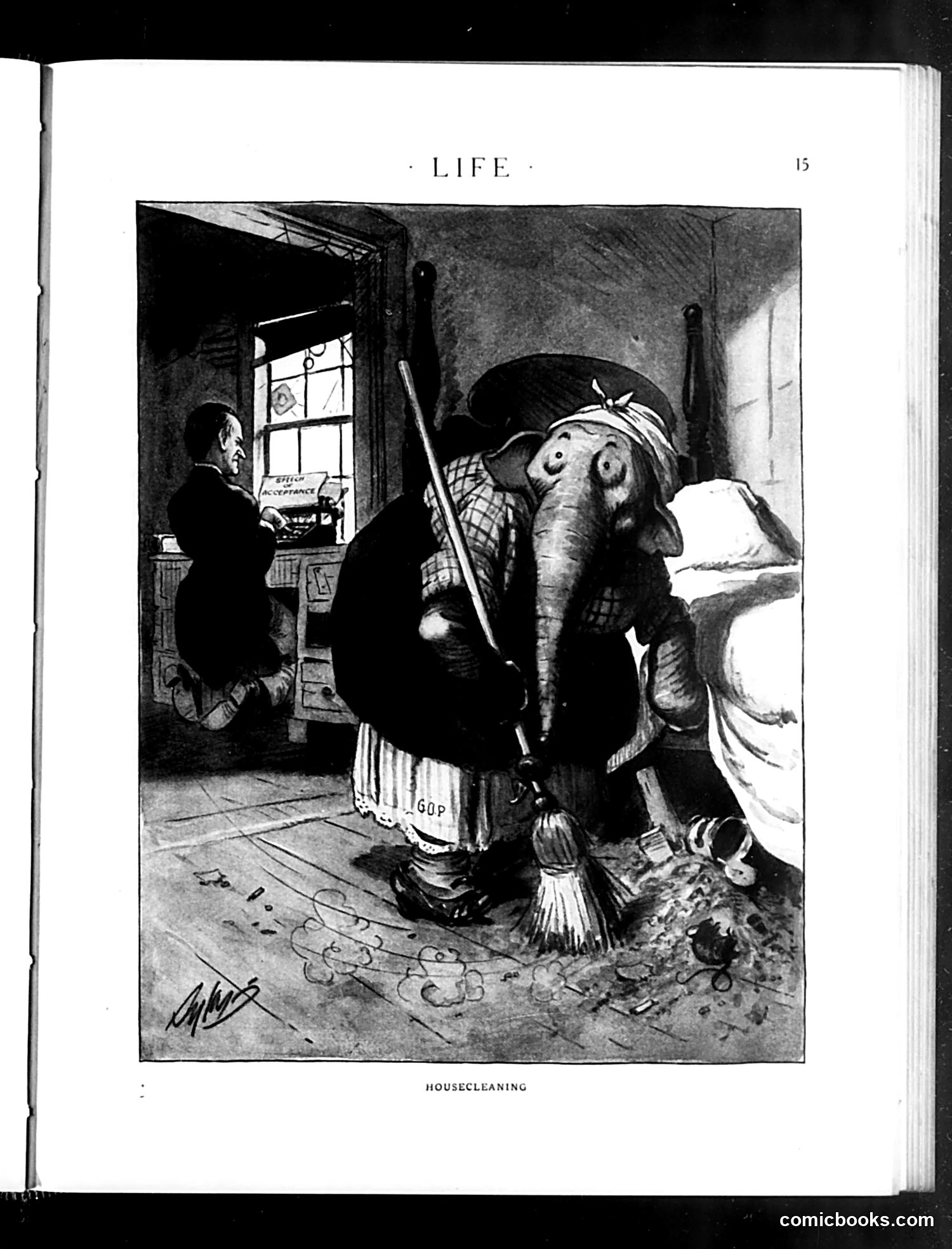
This satirical illustration from *Life* magazine depicts an anthropomorphized elephant engaged in housecleaning—sweeping dirt from a bedroom floor while a human figure sits at a desk in the background near a window. The elephant likely represents the Republican Party (the GOP elephant symbol), and the "housecleaning" appears to satirize a political party's effort to reform or purge itself of corruption or undesirable elements. The confined domestic setting suggests internal party matters. Without the publication date visible, the specific political scandal or reform effort cannot be definitively identified, but the cartoon satirizes partisan self-policing or the attempt to remove embarrassing "dirt" from party operations.
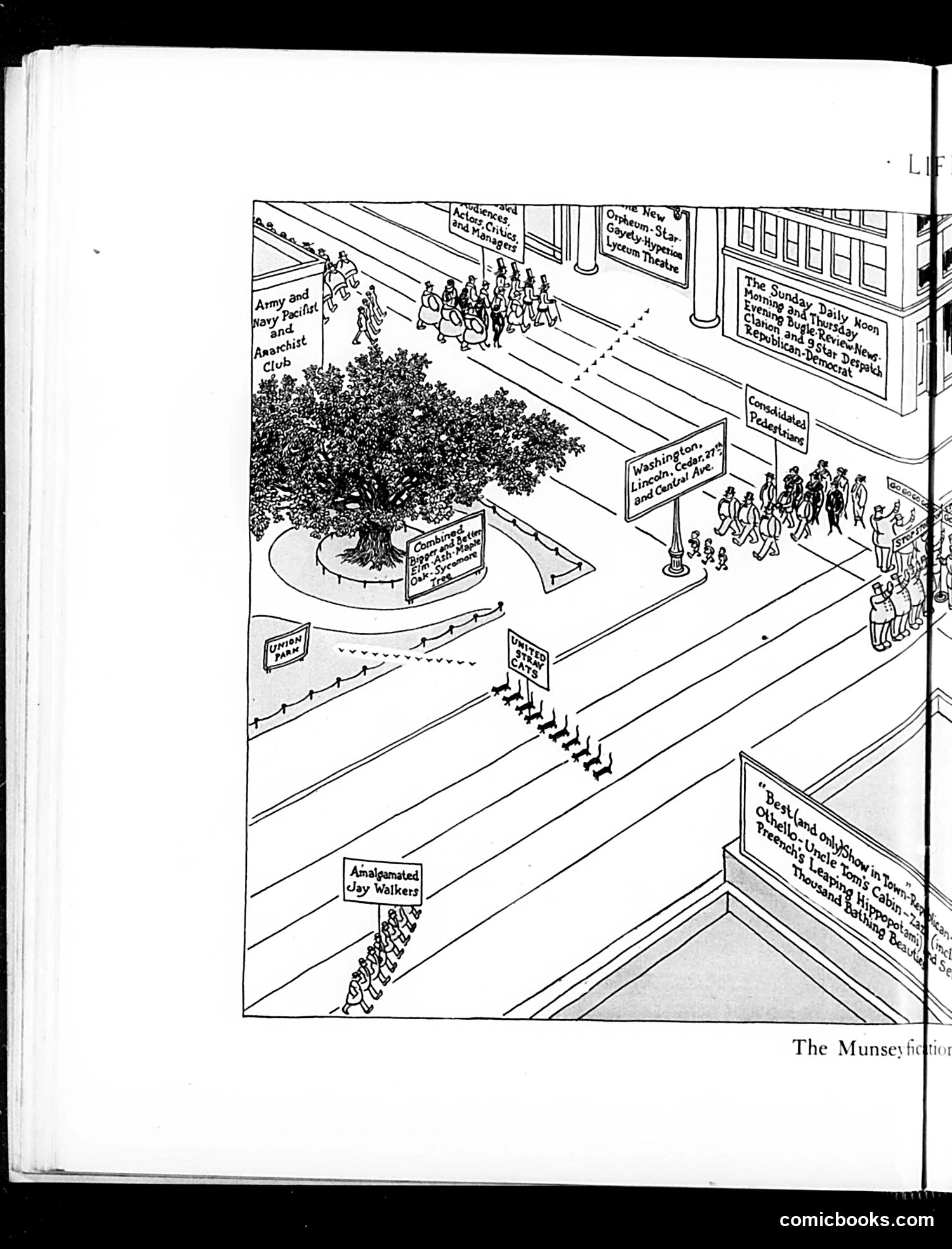
This is an isometric/bird's-eye-view illustration depicting a street scene with various political and labor organizations labeled. The cartoon shows: **Visible organizations/groups:** - Army and Navy Pacific Anarchist Club - Washington Linotype and Central Labor - Amalgamated Joy Walkers - Various theater and newspaper references The illustration appears to satirize early 20th-century American radical and labor movements gathering in an urban space. The "Joy Walkers" and anarchist clubs suggest mockery of progressive activist groups of that era. The overhead perspective shows multiple factions coexisting in the same civic space, likely commenting on the proliferation of competing political ideologies and labor organizations in American cities during the Progressive Era or 1920s. The OCR text is too degraded to provide precise dating or attribution, but this represents *Life* magazine's characteristic satirical commentary on contemporary social movements.
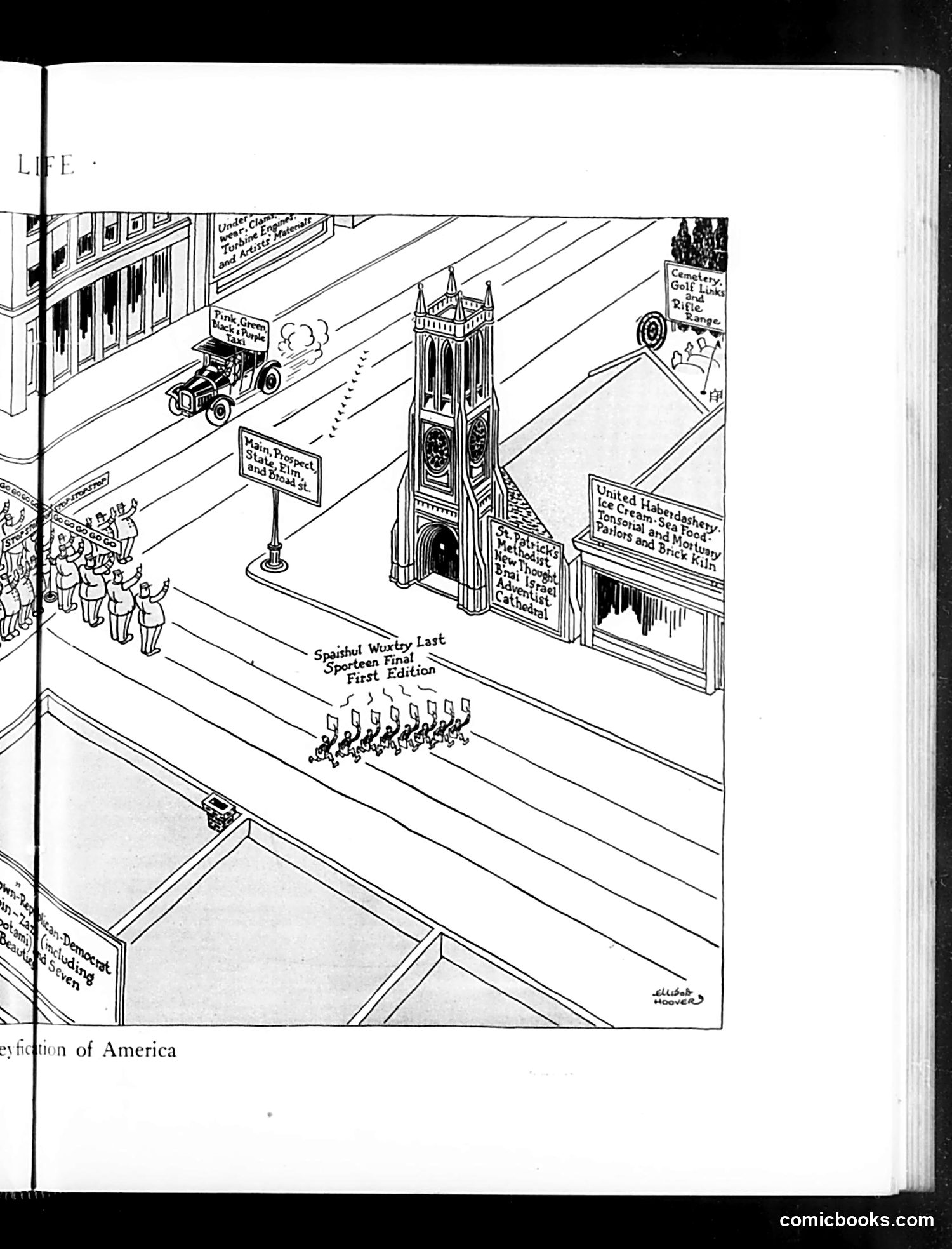
This is a satirical street scene depicting American consumer culture and commercialism. The central tower appears to be a church or cathedral, humorously surrounded by secular commercial establishments—visible signage includes references to golf links, a diner, and what appears to be a haberdashery or department store. The joke satirizes how commercial enterprises have come to dominate American public space, even overshadowing or replacing traditional institutions like churches. A vintage truck and pedestrians populate the street, emphasizing the everyday nature of this commercialization. Various shop signs with advertisements line the scene, reinforcing the theme that American life centers on consumption and retail rather than spiritual or civic values. The architectural contrast between the ornate church tower and surrounding modern storefronts emphasizes this cultural shift.
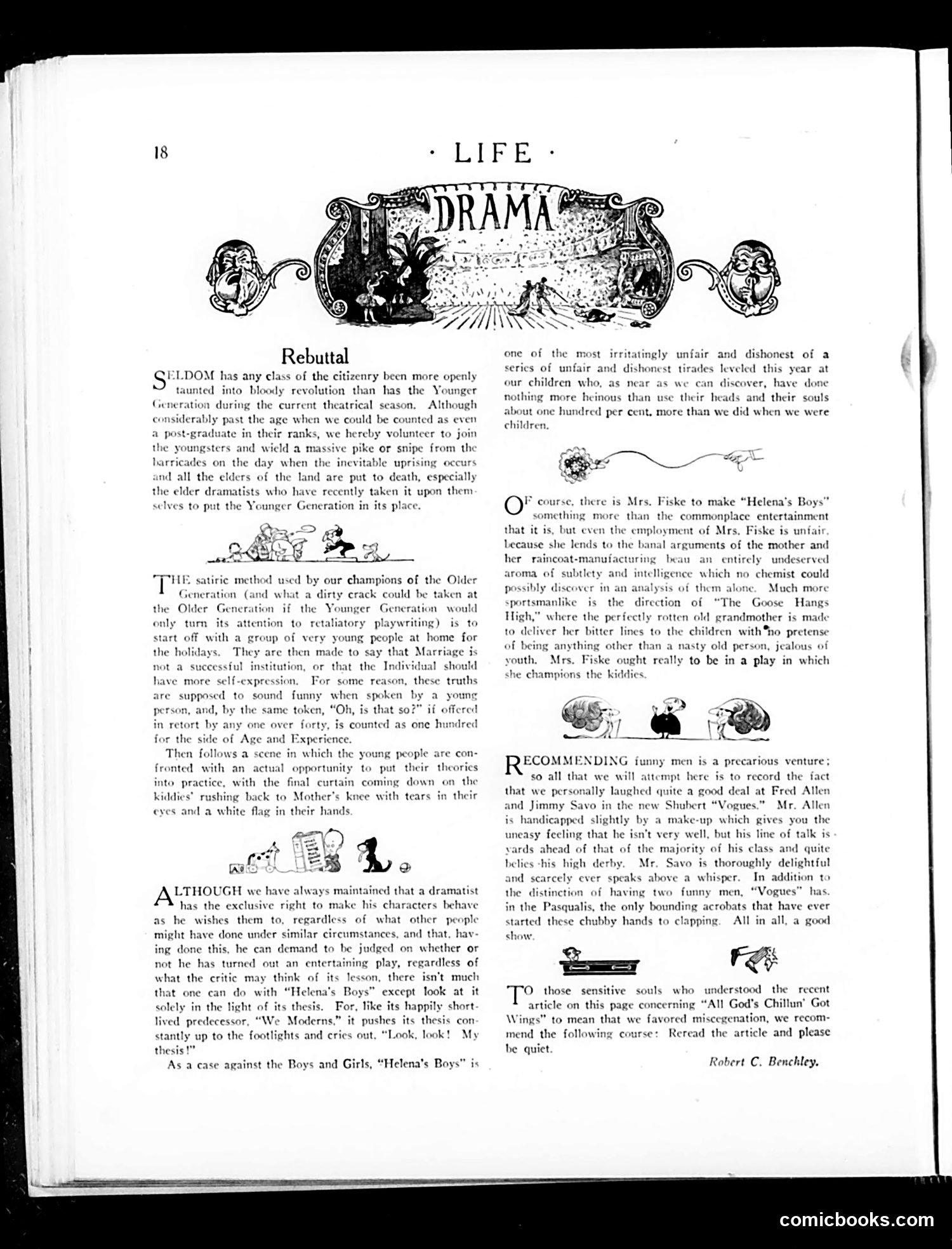
This is a theater review/critique of the play *Helena's Boys*, which the author uses to attack what he calls the "Younger Generation" plays—a popular theatrical genre of the 1920s. **The Satire's Target:** The author mocks plays that feature young people criticizing marriage, authority, and traditional values, only to have them "rush back to Mother's knee" by the final curtain. He considers this formula both dishonest and patronizing. **Specific Criticisms:** The review praises the direction of *The Goose Hangs High* (where an antagonistic grandmother is played straightforwardly) while criticizing *Helena's Boys*, where actress Mrs. Fiske lends undeserved sophistication to "banal arguments." The author argues the young people in these plays aren't actually doing anything wrong—they're thinking and using their "souls" more than previous generations did. **The Joke:** The opening paragraph ironically volunteers to join a violent revolution against "elder dramatists" for their unfair portrayal of youth—mocking both the plays' heavy-handed messaging and generational conflict discourse of the era.
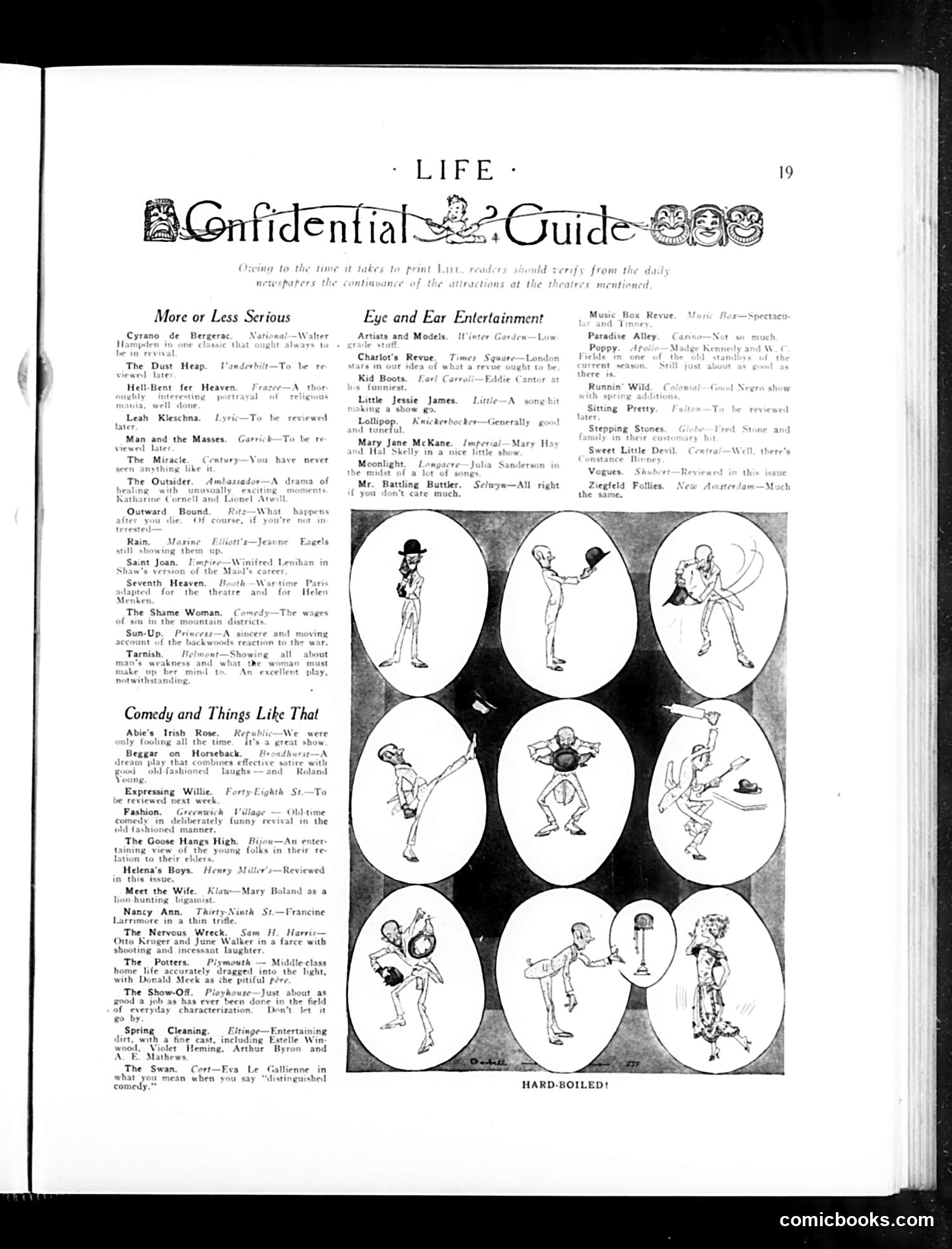
This page is a theatrical review section from Life magazine, not a political cartoon. It provides brief, witty critiques of current Broadway productions and touring shows—typical entertainment journalism of the era. The left column lists shows under categories: "More or Less Serious" (plays like *Rain* and *Saint Joan*) and "Comedy and Things Like That" (lighter fare like *Abie's Irish Rose*). Each entry includes the theater name, a one-line plot summary or critical comment, often sarcastically delivered. The large illustration on the right—labeled "HARD-BOILED!"—shows comedic vignettes of physical comedy and slapstick performance, likely representing the broad humor featured in contemporary revues and comedies. The oval frames depict exaggerated poses and pratfalls typical of vaudeville and musical-comedy entertainment of the 1920s era. This reflects Life's role as a cultural arbiter commenting on popular entertainment for educated readers.
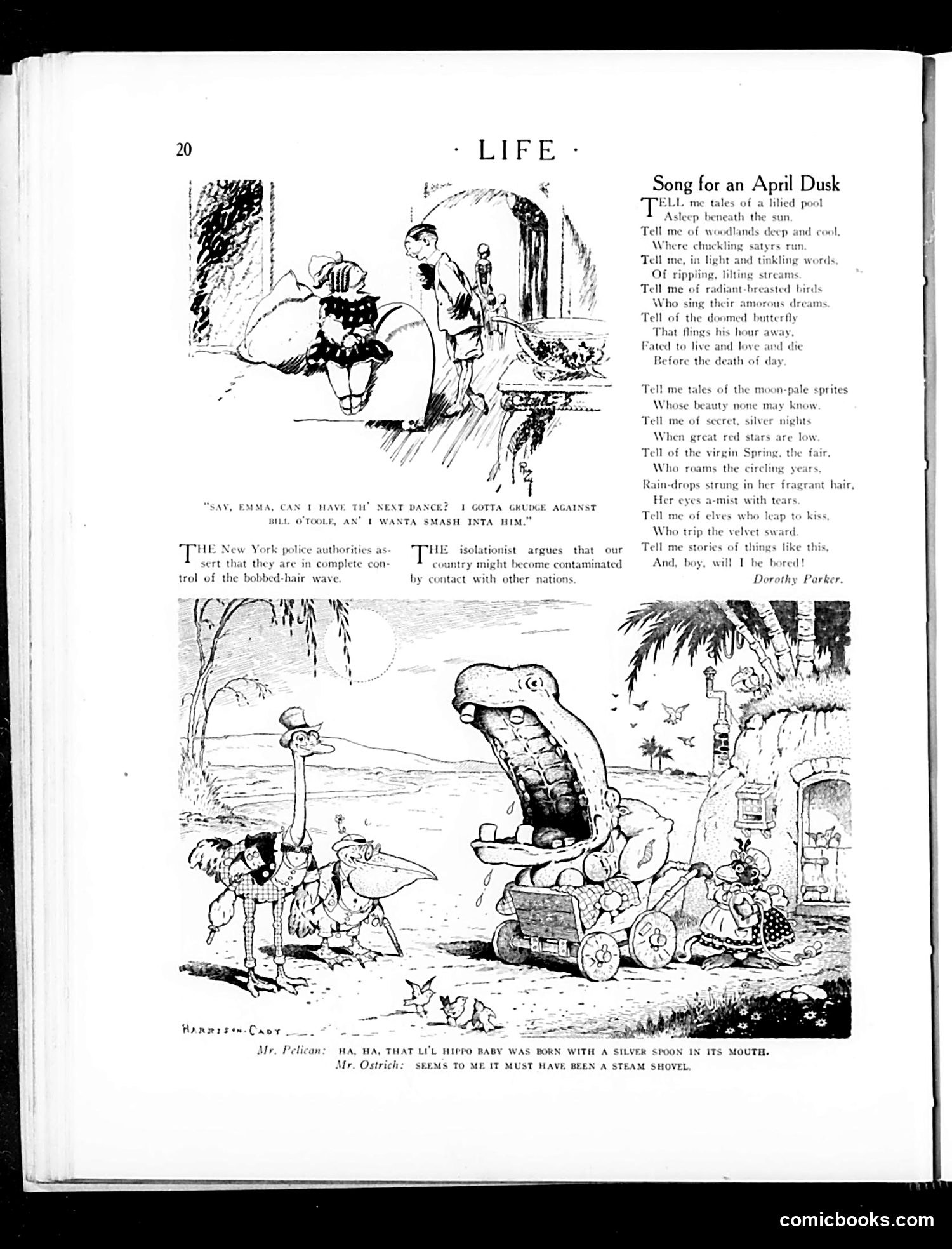
This page contains satirical commentary on 1920s American society: **Top Section:** A romantic poem "Song for an April Dusk" by Dorothy Parker contrasts idealistic nature imagery with her cynical closing: "And, boy, will I be bored!" This mocks sentimental literature through Parker's trademark wit. **Police/Bobbed Hair Reference:** A brief text snippet notes New York police claimed to "control of the bobbed-hair wave"—referencing 1920s moral panic over women's short hairstyles as symbols of female liberation and changing social norms. **Bottom Cartoon:** Two anthropomorphized animals (a pelican and ostrich) joke about a hippopotamus baby born "with a silver spoon in its mouth" (meaning wealthy privilege). The ostrich retorts it must have been "a steam shovel"—a working-class tool, implying the baby is actually crude or lowborn despite appearances. This satirizes either false pretense or class anxiety. **Top Illustration:** Shows people at what appears to be a social gathering, with one character (Emma) wanting to start a fight—capturing Jazz Age social disorder and violence.
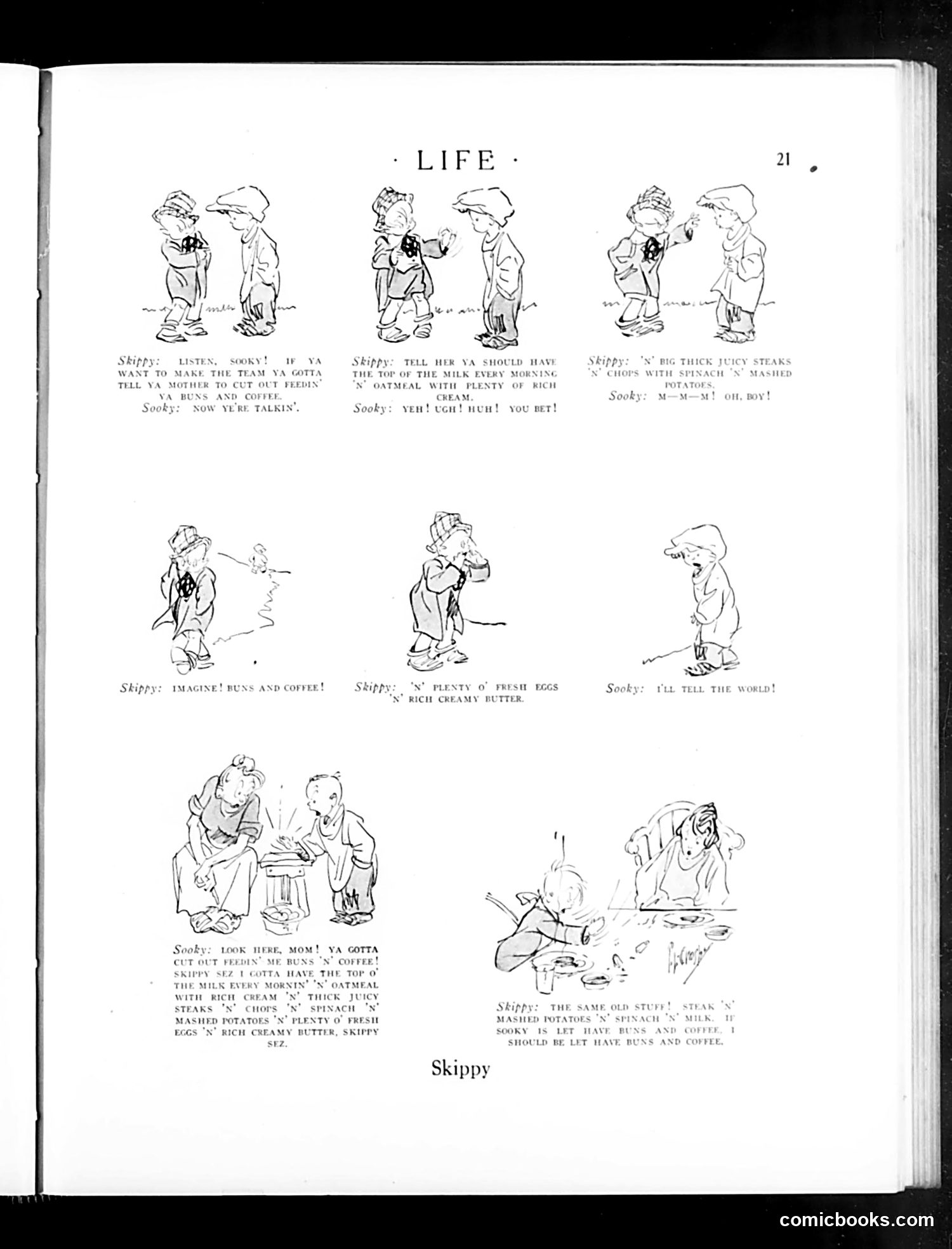
This page features "Skippy," a popular early-20th-century comic strip character. The humor centers on a child's persistent, comedic attempts to convince his mother (and other adults) to feed him an elaborate breakfast rather than simple, nutritious fare. In each panel, Skippy advocates for "buns and coffee" — adult indulgences — while adults counter with wholesome options: oatmeal, eggs, butter, spinach, and meat. The satire mocks both childhood food preferences and parental struggles around nutrition and discipline. The repeated dialogue format emphasizes how stubbornly children resist "good for you" foods. For modern readers, it reflects Depression-era or early-20th-century class anxieties: coffee and buns suggest poverty or indulgence, while the recommended foods represent proper nutrition and parental responsibility.
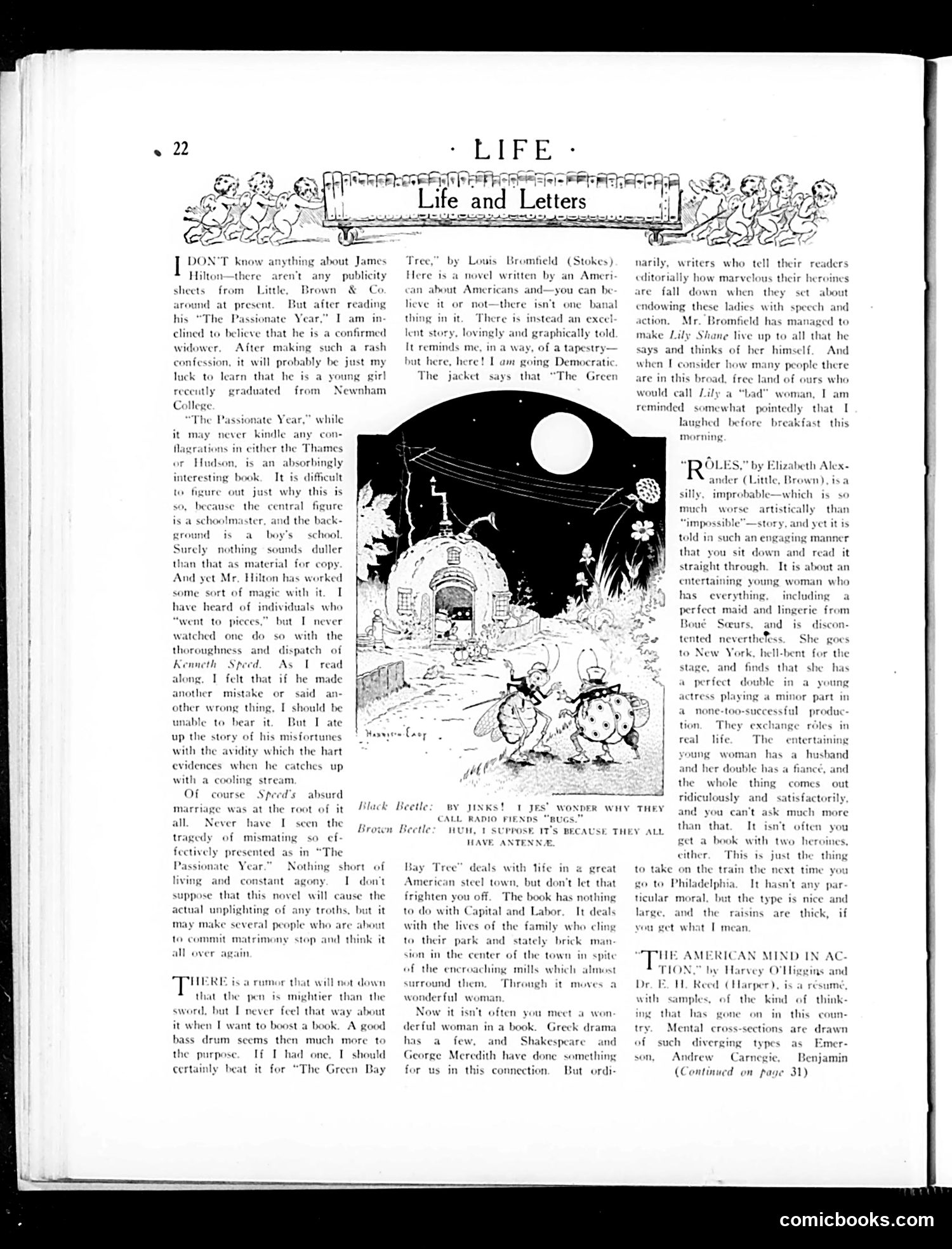
This page from *Life* magazine contains book reviews under the heading "Life and Letters." The main illustration shows a whimsical nighttime scene with insects or small creatures around what appears to be a mushroom house—likely accompanying a review of children's or fantastical literature. The reviews discuss three novels: "The Passionate Year" by James Hilton, "Bay Tree" by Louis Bromfield, and "Rôles" by Elizabeth Alexander. The critic praises Hilton's skillful portrayal of a tragic mismatch marriage, noting it may discourage hasty matrimony. Bromfield's novel about an American steel town family receives mixed commentary, while Alexander's work about an actress is criticized for featuring two heroines—considered excessive for a single book. The small cartoon at bottom-right, captioned about "bugs" and radio antennas, appears to be a separate humorous comment, though its exact reference is unclear from this excerpt.
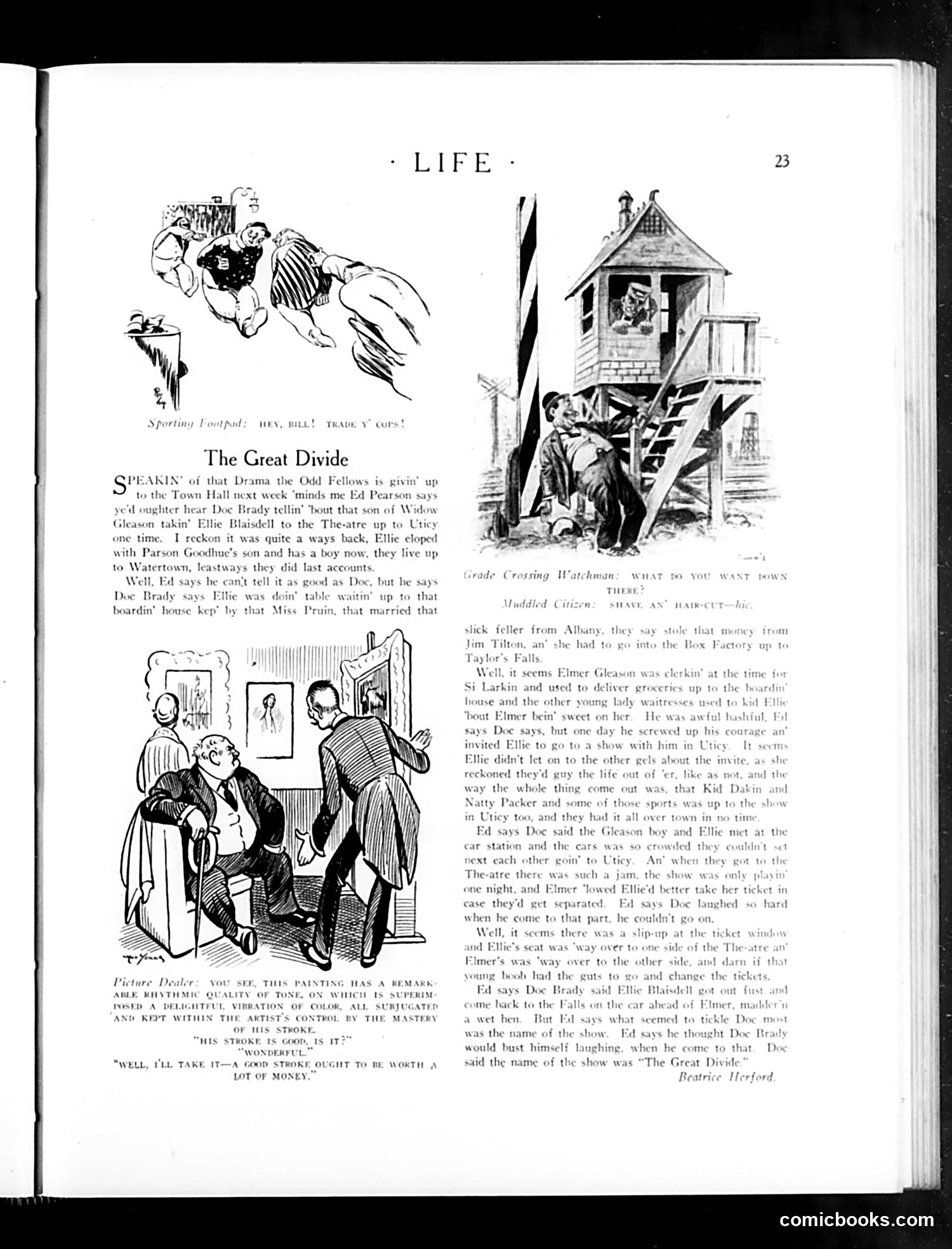
This page presents a humorous small-town gossip story about social class and scandal. The narrative concerns Ellie Blaisdell, who eloped with a minister's son but later encounters her former suitor, Elmer Gleason, at a theater in Utica. The drama unfolds when their assigned seats create awkward proximity, forcing them to confront their past relationship publicly. The accompanying cartoon satirizes art-world pretension: a pompous art dealer uses inflated critical language ("rhythmic quality of tone," "delightful vibration of color") to convince a customer that an mediocre painting merits high payment. The buyer, unmoved by aesthetic claims, agrees only because he believes a good artist's "stroke" (technique) should command money—reducing fine art to mere commercial transaction. Together, the pieces mock both rural gossip and urban cultural snobbery, suggesting human nature's universal tendency toward drama and materialism regardless of social standing.
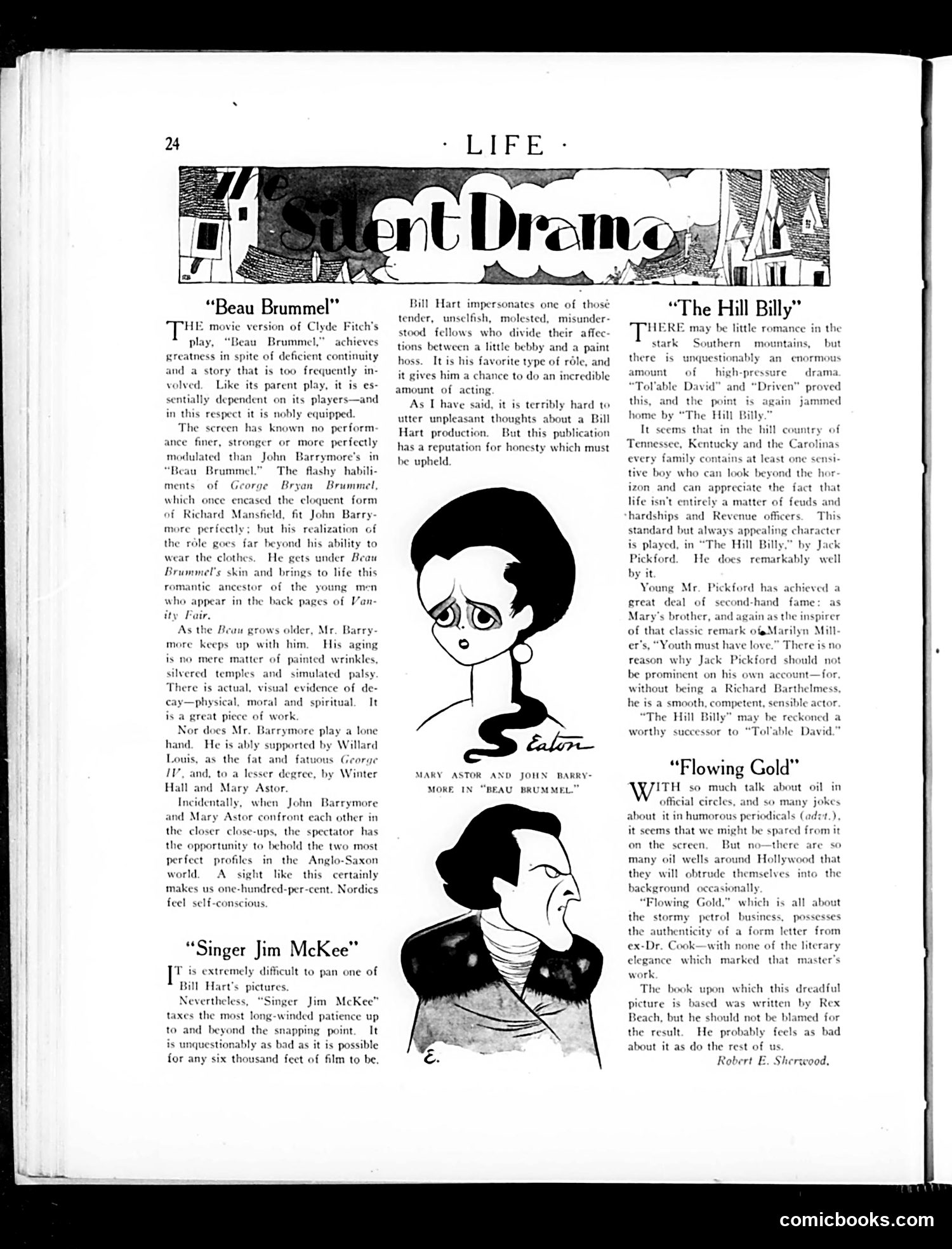
This page reviews four silent films. The cartoons are caricatures accompanying film critiques: **"Beau Brummel"** features actor John Barrymore playing the historical dandy. The reviewer praises Barrymore's performance as superior to the play itself, noting his skilled aging portrayal and "perfect profile." **"Singer Jim McKee"** stars Bill Hart in a western about a sentimental cowboy. The critic struggles to criticize Hart politely but ultimately calls it "as bad as it is possible for any six thousand feet of film to be"—a scathing assessment masked in reluctant language. **"The Hill Billy"** stars Jack Pickford (brother of Mary Pickford, a major star). The reviewer notes Pickford achieves "second-hand fame" through his sister but shows promise as a "sensible actor." **"Flowing Gold"** concerns oil drilling. The critic jokes that with Hollywood's oil wells constantly appearing on-screen, audiences might be "spared" from more oil-themed pictures. The drawings are simple character sketches identifying the films' subjects for readers.

This page is **not a cartoon or satirical content** — it's a **cosmetics advertisement** from Life magazine, circa 1924. The ad promotes Coty's "Compacte" powder compact, featuring product photography showing the opened compact with its mirror and powder. The advertising copy contrasts Victorian-era women who "powder in secret" with modern women who are "serenely unconscious of the throng," suggesting Coty's compact allows women to maintain beauty throughout the day without shame. The pitch emphasizes convenience ("puff and mirror") and social modernity — the compact supposedly represents progressive femininity. This reflects 1920s marketing that positioned cosmetics as markers of contemporary, liberated womanhood, though the message remains subtle about women's appearance-consciousness.
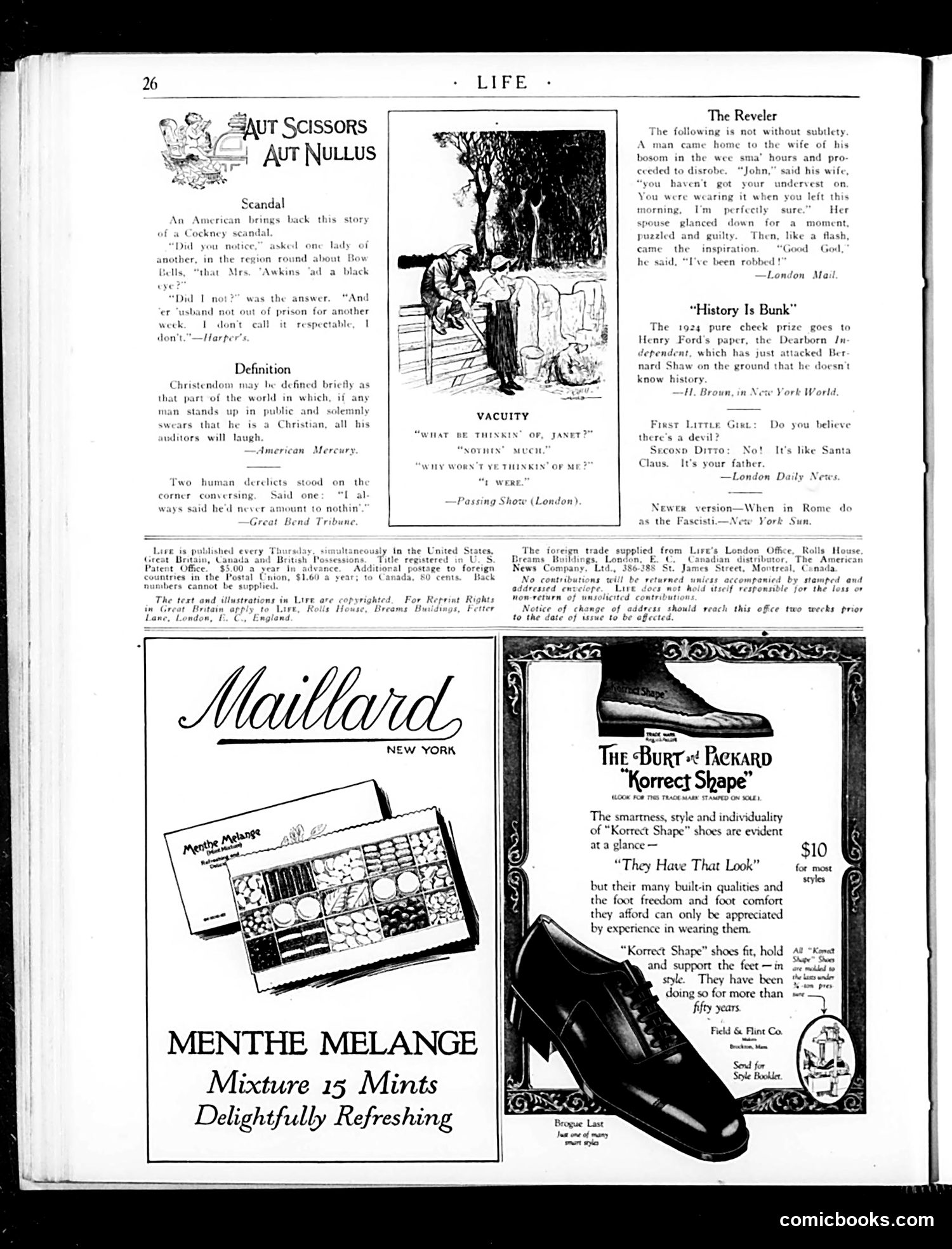
This page contains mostly **advertising and humor snippets** rather than political cartoons. The content includes: **"Scandal"** and **"Definition"**: Brief British humor anecdotes—the first about a Cockney wife discovering her husband's missing underwear (he claims robbery), the second a joke about two derelicts. These are lighthearted social humor, not satire. **"Vacuity"**: A cartoon showing a couple's domestic quarrel—the husband accused of not thinking of his wife. It's visual marital comedy without political content. **"History Is Bunk"**: A brief jab at Henry Ford's Dearborn Independent newspaper for attacking Bernard Shaw while claiming not to know history. **Miscellaneous quips**: Including a joke about Fascism in Rome. The page is primarily **advertisements** (Maillard candies, Burt & Packard shoes, Menthe Melange mints) with scattered light humor pieces. There's no significant political cartooning or social commentary—just period domestic humor and product placement typical of 1920s Life magazine.
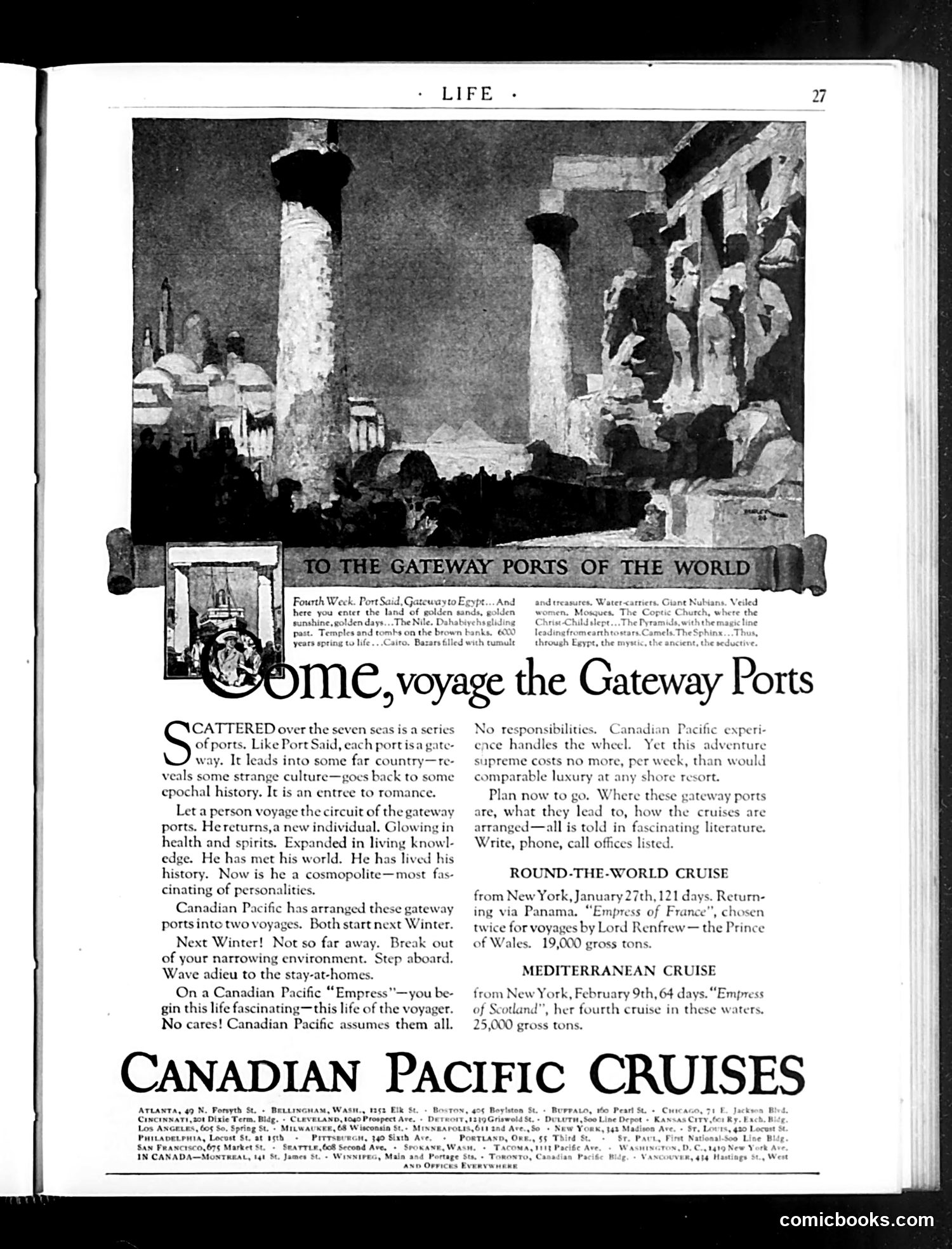
The upper image depicts an exotic Egyptian scene at Port Said—likely an artistic rendering showing classical ruins, columns, and crowds of people in period dress. It's meant to evoke romance and historical grandeur. The text and layout form a **Canadian Pacific cruise advertisement** promoting two luxury voyages: a 121-day round-the-world cruise departing January 27th, and a 64-day Mediterranean cruise departing February 9th. Both featured the company's "Empress" ships. The marketing pitch emphasizes transformation through travel—claiming voyagers return as "cosmopolites," expanded in knowledge and health. It promises adventure and exotic cultural encounters (Egypt, the Nile, etc.) at costs comparable to shore resorts, with "no cares" or responsibilities. The ad lists Canadian Pacific offices across major North American cities. This is **travel marketing**, not political satire—designed to appeal to wealthy early-20th-century readers seeking escapism and cultural refinement through luxury cruising.
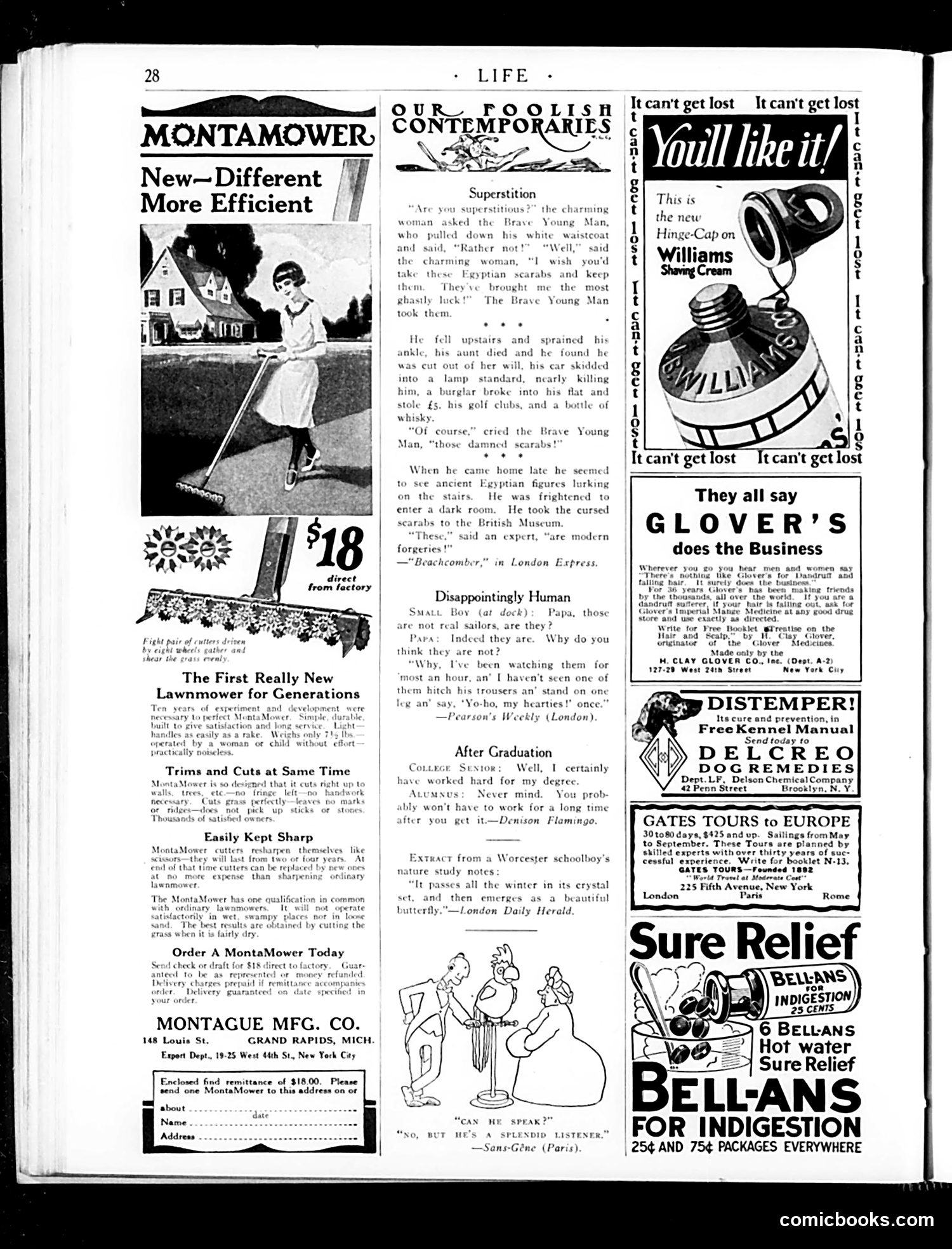
This page is primarily **advertisements and brief humor fillers** rather than political content. The cartoon at bottom-center, captioned "CAN HE SPEAK? NO, BUT HE'S A SPLENDID LISTENER," depicts a man and woman at a social gathering—a gentle joke about silent, attentive companions being ideal dinner guests or social partners. It's light domestic humor typical of the era. The text snippets are brief satirical observations: "Superstition" mocks the popular Egyptian curse craze (likely referencing King Tut's tomb discovery in 1922); "Disappointingly Human" jokes that dock workers aren't the romantic figures sailors are stereotyped to be; "After Graduation" quips that college graduates won't need to work long—possibly cynical commentary on post-WWI employment prospects or family wealth. The dominant content is **product advertising**: Montamower lawnmowers, Williams shaving cream, Glover's hair products, dog remedies, European tours, and Bellans indigestion medicine. This reflects Life's role as both satirical magazine and advertising vehicle.
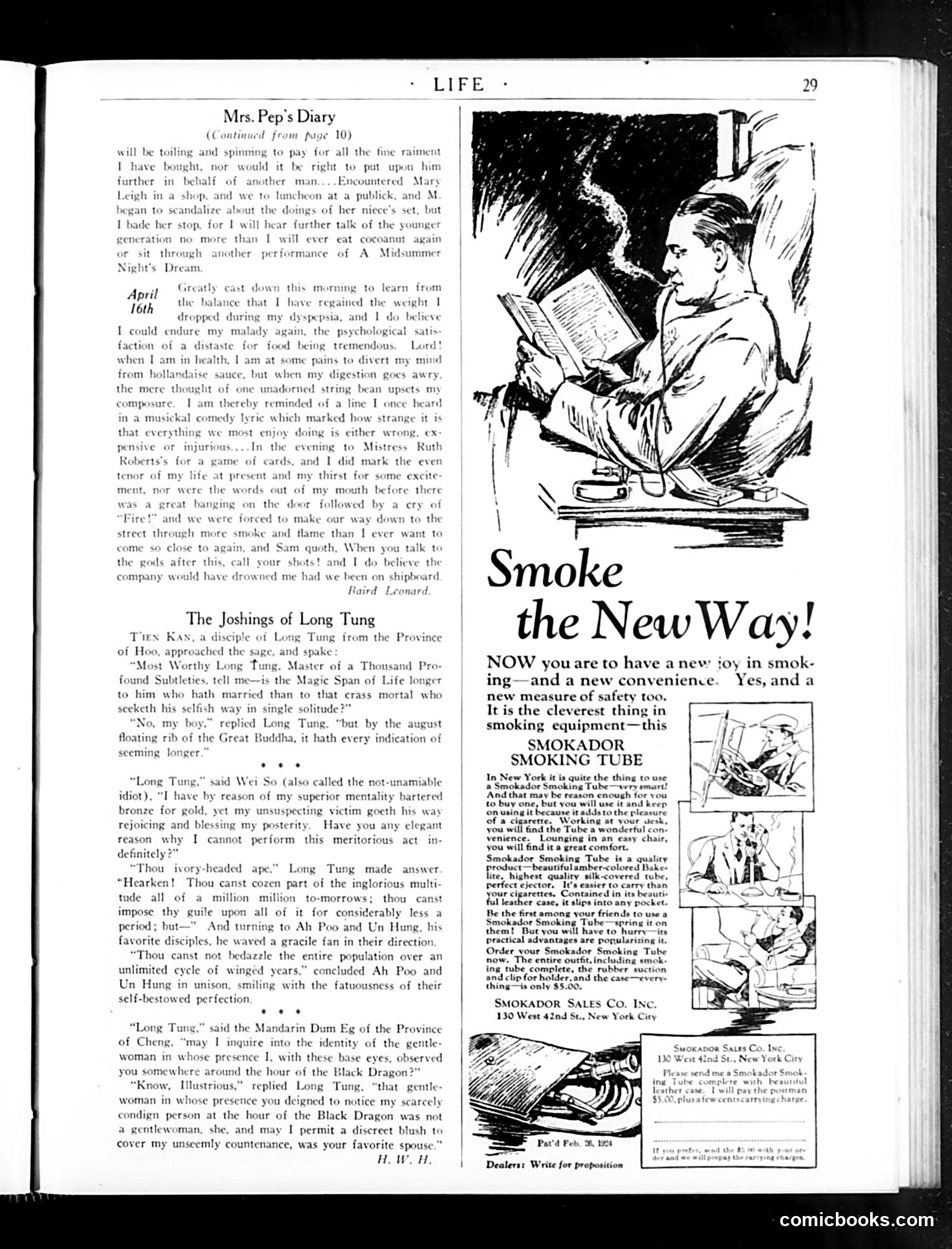
This page contains three distinct elements: **"Mrs. Pep's Diary"** (top left): A continuation of a humorous diary column depicting domestic life and social observations, including complaints about health and an evening theater incident. **"The Joshings of Long Tung"** (middle): A satirical philosophical dialogue featuring an apparent Chinese sage and his disciples. The humor appears to derive from mock-Oriental wisdom literature, with Long Tung dispensing paradoxical advice about marriage, deception, and human nature. The final anecdote delivers a punchline about mistaken identity regarding a gentleman's "favorite spouse." **Smokador Smoking Tube Advertisement** (right): A full advertisement for a new cigarette smoking device, promoted as offering "a new joy in smoking" and convenience. The ad emphasizes quality construction, portability in a leather case, and fashionable appeal among friends. The page reflects early 20th-century American magazine content mixing domestic humor, orientalist satire, and consumer goods marketing—typical of Life's satirical yet commercially-driven format.
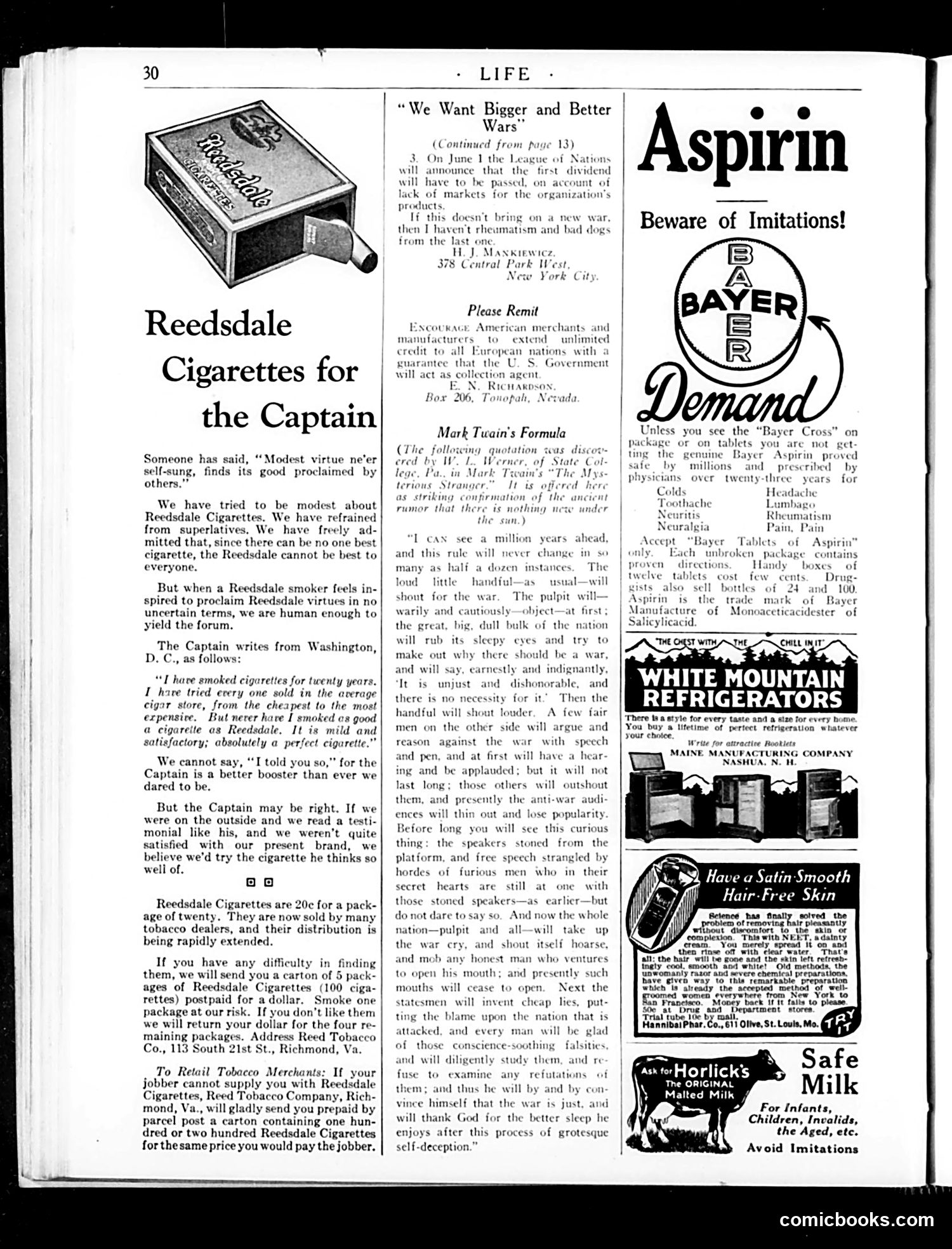
This page consists primarily of **advertisements**, not political cartoons. The main content is a cigarette advertisement for Reedsdale Cigarettes, featuring a testimonial from "the Captain" in Washington praising the product's quality. However, the page also includes **satirical editorial content** mocking war enthusiasm. A piece titled "We Want Bigger and Better Wars" (continued from page 13) presents cynical predictions about how a future war would unfold: the League of Nations would announce economic failure, the public would initially resist war, clergy would cautiously support it, the masses would eventually embrace it, and anti-war speakers would be silenced by mobs—yet those mobs would secretly sympathize with the silenced voices. The **satire attacks** the hypocrisy and inevitability of public sentiment shifting toward war despite underlying doubts. This likely reflects post-WWI disillusionment (early 1920s), when Americans grappled with that war's futility. The remaining advertisements (Aspirin, refrigerators, milk, hair products) are standard period marketing, though notably include warnings against imitations—reflecting contemporary consumer concerns about product authenticity.
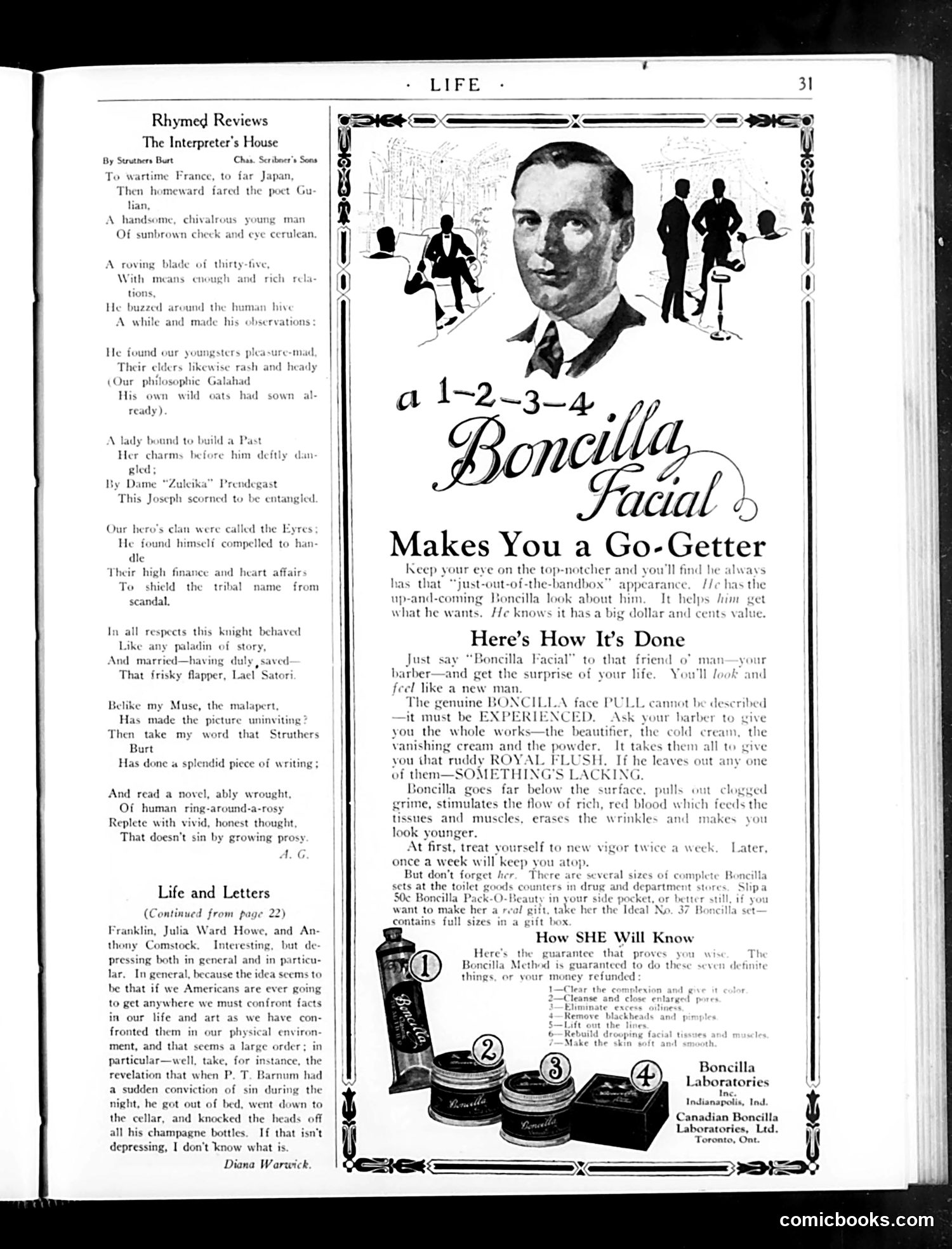
This page contains two distinct sections: **Left side**: A book review in verse of "The Interpreter's House" by Struthers Burt—a novel about a handsome, wealthy young man of 35 who travels to France and Japan, then returns home. He becomes entangled with a woman trying to "build a Past" and eventually marries "that frisky flapper, Lad Satori." The reviewer (J.G.) praises Burt's writing as honest and thoughtful. **Right side**: A full-page advertisement for Boncilla Facial treatments. The ad promises that using Boncilla will make you a "go-getter"—more attractive and successful in business and life. It claims the facial stimulates blood flow, removes wrinkles, and gives you a "ruddy ROYAL FLUSH." The product comes in multiple sizes available at drugstores for 50 cents. The ad reflects 1920s commercial optimism: self-improvement products promised social and economic advancement through better appearance.
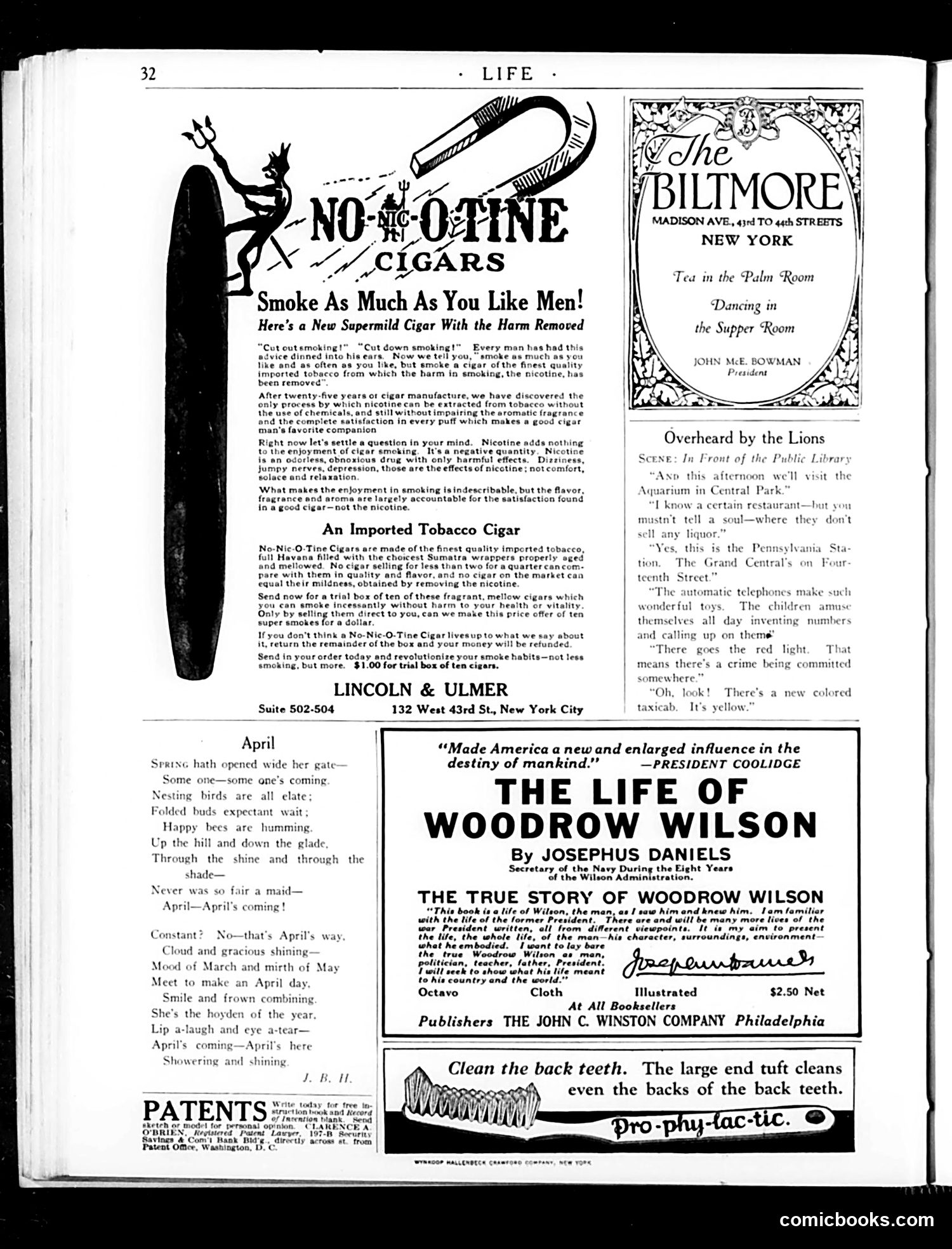
This page contains **primarily advertisements and literary promotion**, not political satire. The main cartoon is a **No-Nic-O-Tine Cigars advertisement** featuring a devil-like figure being expelled from a cigar. The ad's satire targets contemporary health concerns: it mocks the "Cut out smoking!" public health messaging of the era by proposing a solution—nicotine-free cigars—allowing men to "smoke as much as you like" without the drug's harmful effects. The joke assumes readers recognize nicotine as the dangerous component while flavor/aroma provide enjoyment. The page also advertises **The Biltmore Hotel** (luxury venue in NYC), a **biography of President Woodrow Wilson** by Josephus Daniels, and dental hygiene products. A brief **"April" poem** celebrates spring's arrival. The satirical elements are minimal—mainly the cigar ad's ironic position that smokers can indulge guilt-free with this product. The overall page reflects 1920s-era advertising and concerns about tobacco health effects.
This appears to be a **Life magazine advertisement or subscription page** rather than a political cartoon. The main content is a subscription pitch for "Life" magazine, located at 598 Madison Ave., New York. The accompanying image shows a textured, dramatic photograph of what appears to be **hands or fabric in close-up**, accompanying the slogan "Look on the Bright Side." The subscription cost listed is $1.00 (Canadian $1.20; Foreign $1.40) for a ten-week subscription. The tagline suggests this is inviting readers to subscribe to Life's "gloom-dispelling journal" to receive Travel, Convention and Commencement Numbers. This is fundamentally a **commercial page promoting magazine subscriptions**, not a satirical political cartoon. The "bright side" messaging appears designed to market Life as optimistic, entertaining reading during what may have been economically difficult times.
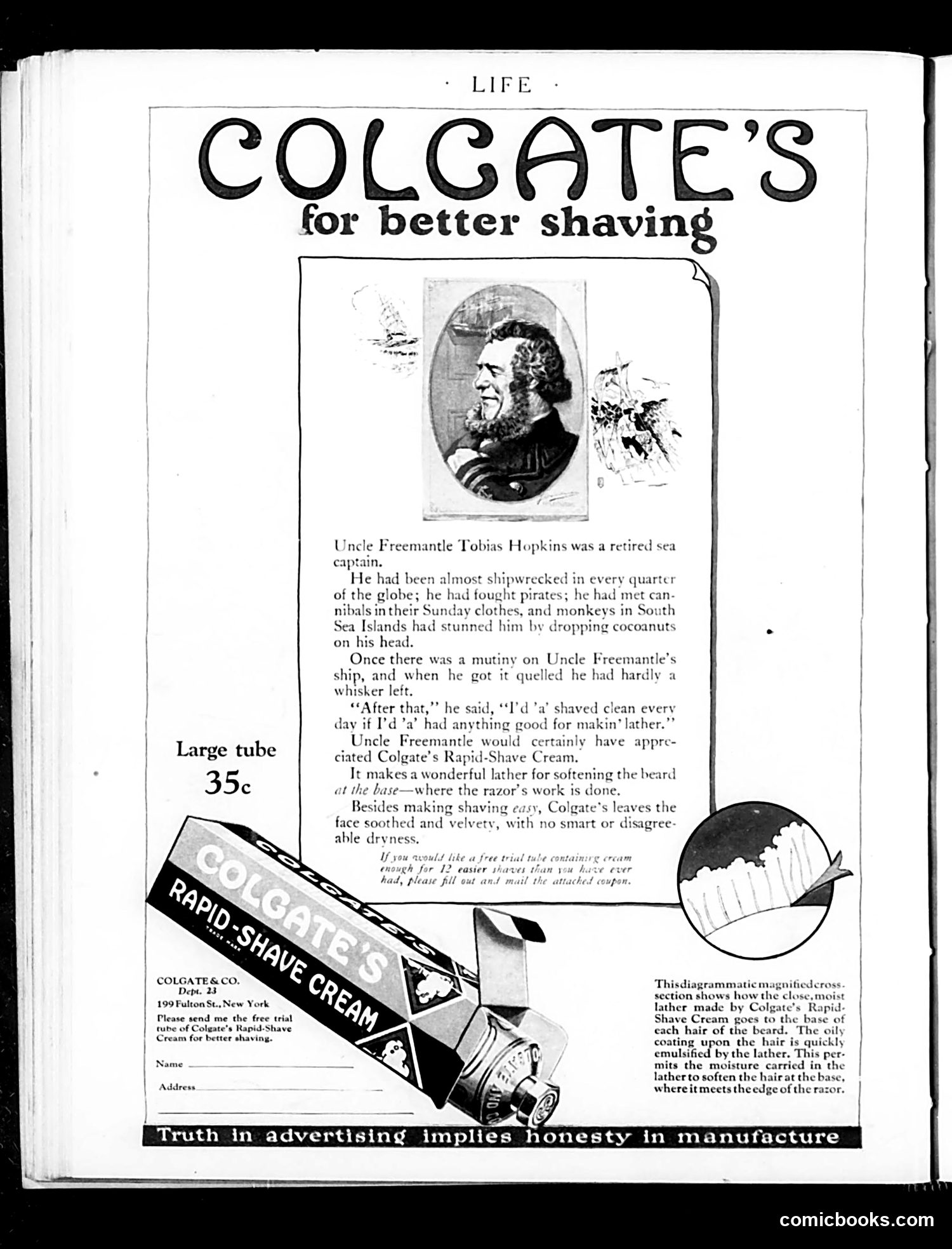
This is primarily a **product advertisement**, not a political cartoon. It features a fictional character, "Uncle Freemantle Tobias Hopkins," a retired sea captain with an exaggerated adventuring backstory (shipwrecks, pirates, cannibals, mutinies). The humor is gentle rather than satirical: his extreme life experiences are played for comic effect to establish him as a credible endorser of the shaving cream. The narrative suggests that even a hardened seafarer who lost his whiskers during a mutiny would appreciate Colgate's product. The ad includes a technical diagram explaining how the cream softens beard hair at its base, a mail-in coupon for a free trial, and closes with the slogan "Truth in advertising implies honesty in manufacture"—reflecting early 20th-century advertising standards emphasizing product benefits over pure salesmanship.