
Life, 1924-04-24 · page 20 of 36
Life — April 24, 1924 — page 20: what you’re looking at
What you’re looking at
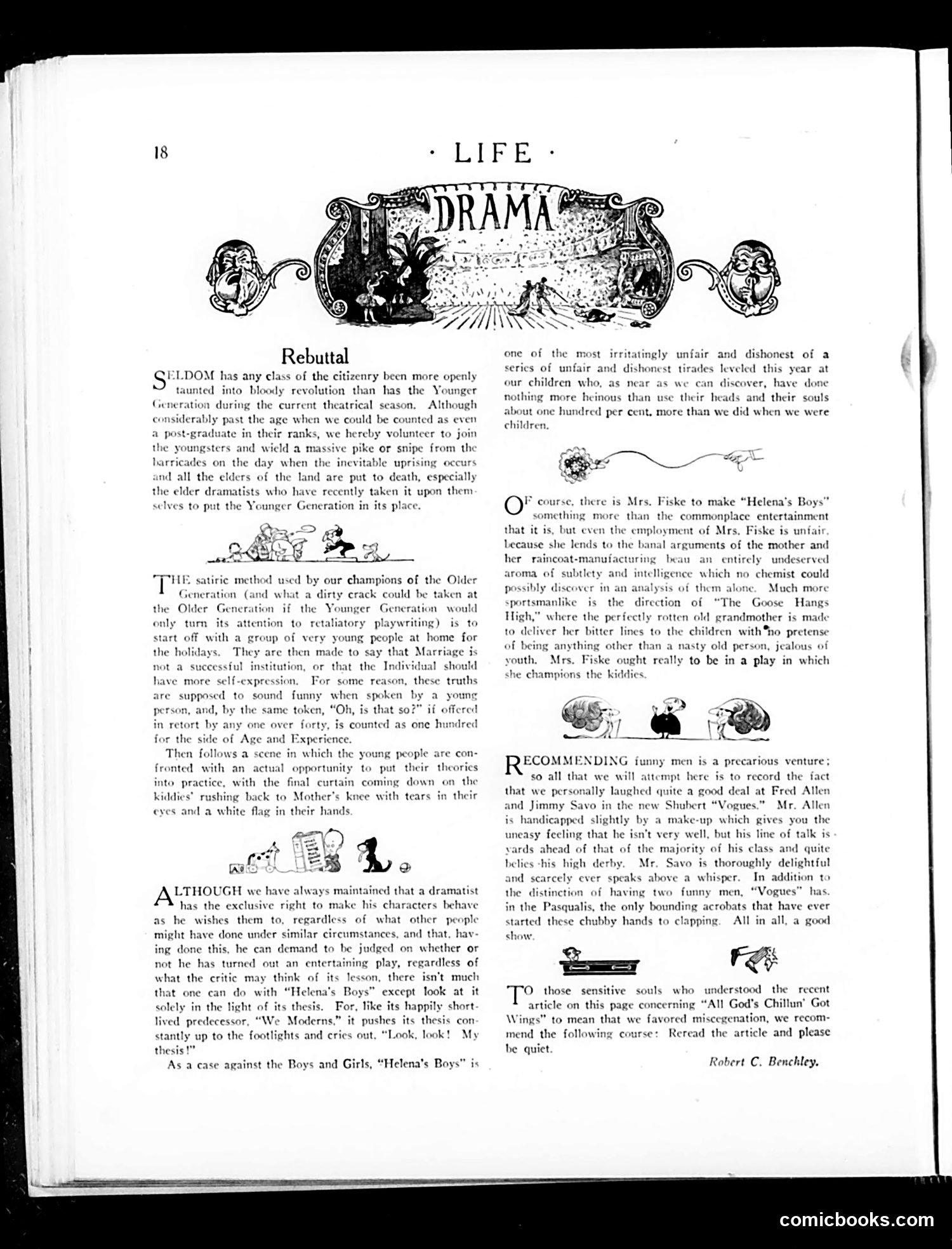
This is a theater review/critique of the play *Helena's Boys*, which the author uses to attack what he calls the "Younger Generation" plays—a popular theatrical genre of the 1920s. **The Satire's Target:** The author mocks plays that feature young people criticizing marriage, authority, and traditional values, only to have them "rush back to Mother's knee" by the final curtain. He considers this formula both dishonest and patronizing. **Specific Criticisms:** The review praises the direction of *The Goose Hangs High* (where an antagonistic grandmother is played straightforwardly) while criticizing *Helena's Boys*, where actress Mrs. Fiske lends undeserved sophistication to "banal arguments." The author argues the young people in these plays aren't actually doing anything wrong—they're thinking and using their "souls" more than previous generations did. **The Joke:** The opening paragraph ironically volunteers to join a violent revolution against "elder dramatists" for their unfair portrayal of youth—mocking both the plays' heavy-handed messaging and generational conflict discourse of the era.
📄 Transcribed text from this page (OCR, searchable)
Machine-transcribed from the original scan — historical spelling and the odd misread are preserved.
Ss L.DOM has any class of the citizenry been more openly taunted into bloody revolution than has the Younger Although considerably past the age when we could be counted as even a post-graduate in their ranks, we hereby volunteer to join the youngsters and wield a massive pike or snipe from the ble uprisin Generation during the current theatrical season. larricades on the day when the i occurs and all the elders of the land are put to death, especially the elder dramatists who have recently taken it upon the selves to put the Younger Generation in its place. [TE satiric: method used by our champions of the Older Generation ( a dirty crack could be taken at the Older Gener the You only tum its atte would m to retaliatory playwriting) is to start off with a group of very young people at home for the holidays. They are then made to say that Marriage is not a si sful institution, or that the Individual should . these truths are supposed to sound funny when spoken by a young person, and, by the same token, “Oh, is that so in retort by any one over forty, is counted as one hundred for the side of have more self-expression, For some rei if offered ¢ and Experience. Then follows a scene in which the young people are con- fronted with an actual opportunity to put their theories into practice, with the final curtain coming down on the kiddies’ rushing back to Mother's knee with tears in their eyes and a white flag in their hands e LTHOUGH we have always maintained that a dramatist has the exclusive right to make his characters be as he wishes them to, regardless of what other p might have done under similar circumstances, and that, hav- ing done this, he can demand to be judged on whether or not he has turned out an entertaining play, regardless of what the critic may think of its lesson, there isn't much that one can do with “Helena’s Boys” except look at it solely in the light For, like its happily short Moderns,” it pushes its thesis con hts and cries out, “Look, look! My its thes' lived predecessor, “We stantly up to the foot! thesis!” As a case against the Boys and Girls, “Helena’s Boys” is one of the most irritatingly unfair and dishonest of a serics of unfair and dishonest tirades leveled this year at our children who, as near as we can discover, have done noth more heinous than use their heads and their souls about one hundred per cent, more than we did when we were children, Or course, there is Mrs. Fiske to make “Helena’s Boys” something more than the commonplace entertainment that it is, but even the employment of Mrs, Fiske is unfaii Lecause she lends to the banal arguments of the mother and her raincoat-manufacturing beau an entirely undeserved aroma of subtlety and intelligence which no chemist could possibly discover in an analysis of them alone. Much more sportsmanlike is the direction of “The Goose Hangs High,” where the perfectly rotten old grandmother is made to deliver her bitter lines to the children with*ho pretense of being anything other than a nasty old person, jealous of youth, Mrs. Fiske ought really to be in a play in which she champions the kiddies RECOMMENDING funny: men is a precarious venture: so all that we will attempt here is to record the fact that we persc laughed quite a good deal at Fred Allen the new Shubert “Vogues.” Mr. Allen is handicapped slightly by a make-up which gives you the uneasy feeling that he isn’t very well, but his line of talk is yards ahead of that of the m belies his high derby. Mr and Jimmy Savo i ity of his class a avo is thoroughly delightful and scarcely ever speaks above a whisper. In additi the distinction of having two funny men, “Vogues” in the Pasqualis, the only bounding acrobats that have ever started these chubby hands to clapping. All in all, a good Fe T? those sensitive souls who understood the recent article on this page concerning “All God's Chillun’ Got Wings” to mean that we favored miscegenation, we recom- mend the following course: Reread the article and please be quiet Robert C. Benchley. comicbooks.com