
A complete issue · 36 pages · 1924
Life — March 27, 1924
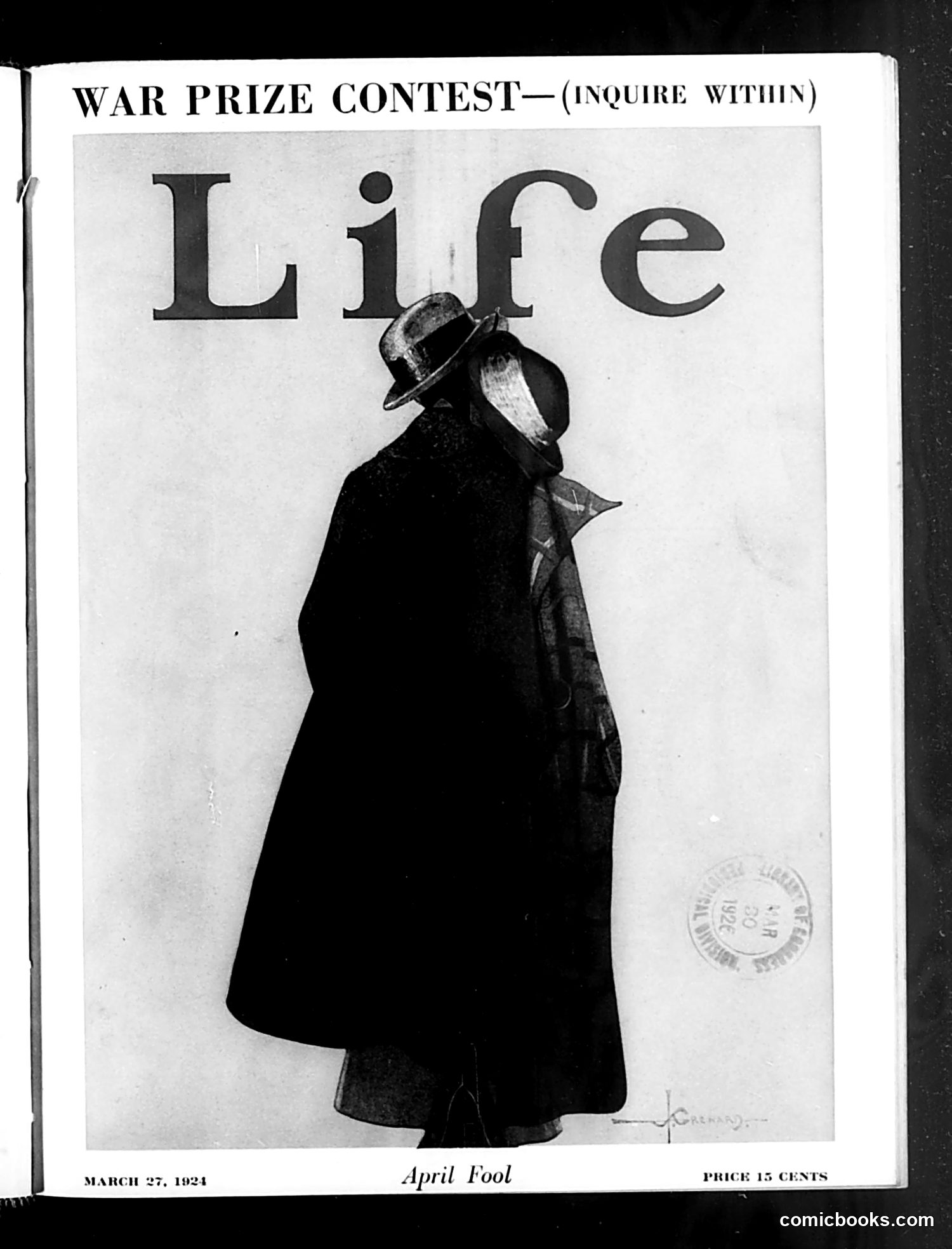
This is a **War Prize Contest** cover featuring the word "Life" with a silhouetted figure in a long coat and hat looking upward. The caption reads "April Fool," and the price is 15 cents. The satire appears to reference post-World War I disillusionment. The figure's posture—gazing upward with apparent hope or yearning—contrasts with the "April Fool" caption, suggesting that optimism about the war's aftermath or peace was foolish or misplaced. The "War Prize Contest" header indicates Life was soliciting reader submissions, likely asking people to submit their own satirical takes on what constituted a "war prize" given the war's devastating human and economic costs. This mocks the notion that anything valuable could be won from such destruction.
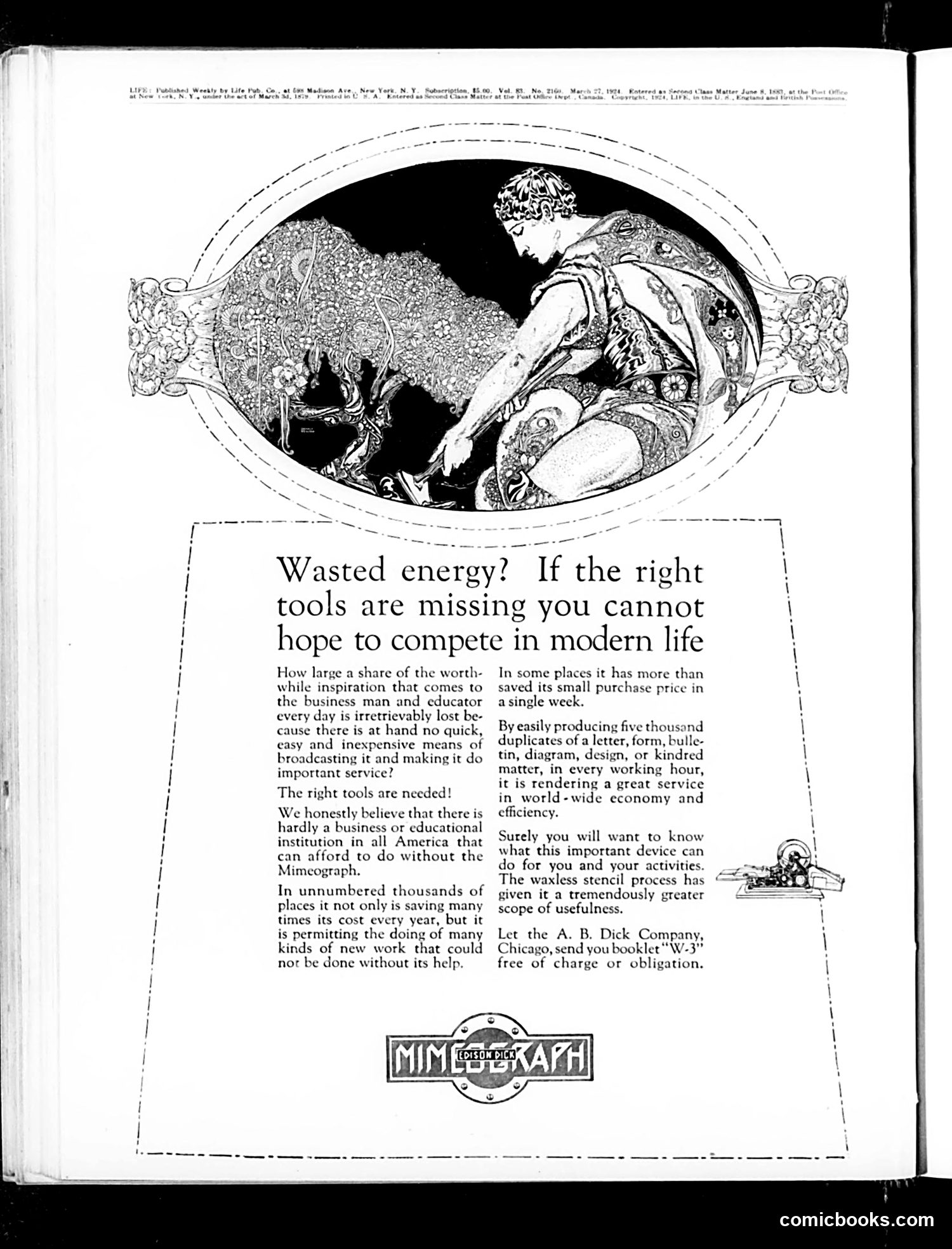
This is primarily an **advertisement for the Mimeograph machine** by the A.B. Dick Company, disguised as editorial content in *Life* magazine. The ornate illustration depicts a figure using a mimeograph device. The headline "Wasted energy?" warns businesses that without proper tools (specifically the mimeograph), they cannot compete in modern commerce. The sales pitch emphasizes the mimeograph's efficiency: it can produce 5,000 duplicates hourly of letters, forms, diagrams, and designs—work otherwise impossible without the device. This was genuinely transformative office technology in the early 20th century. The "Mimeograph" logo appears at bottom. Rather than satire or political commentary, this page represents *Life*'s practice of blending advertising with magazine content, a common format before strict advertising/editorial separation became standard.
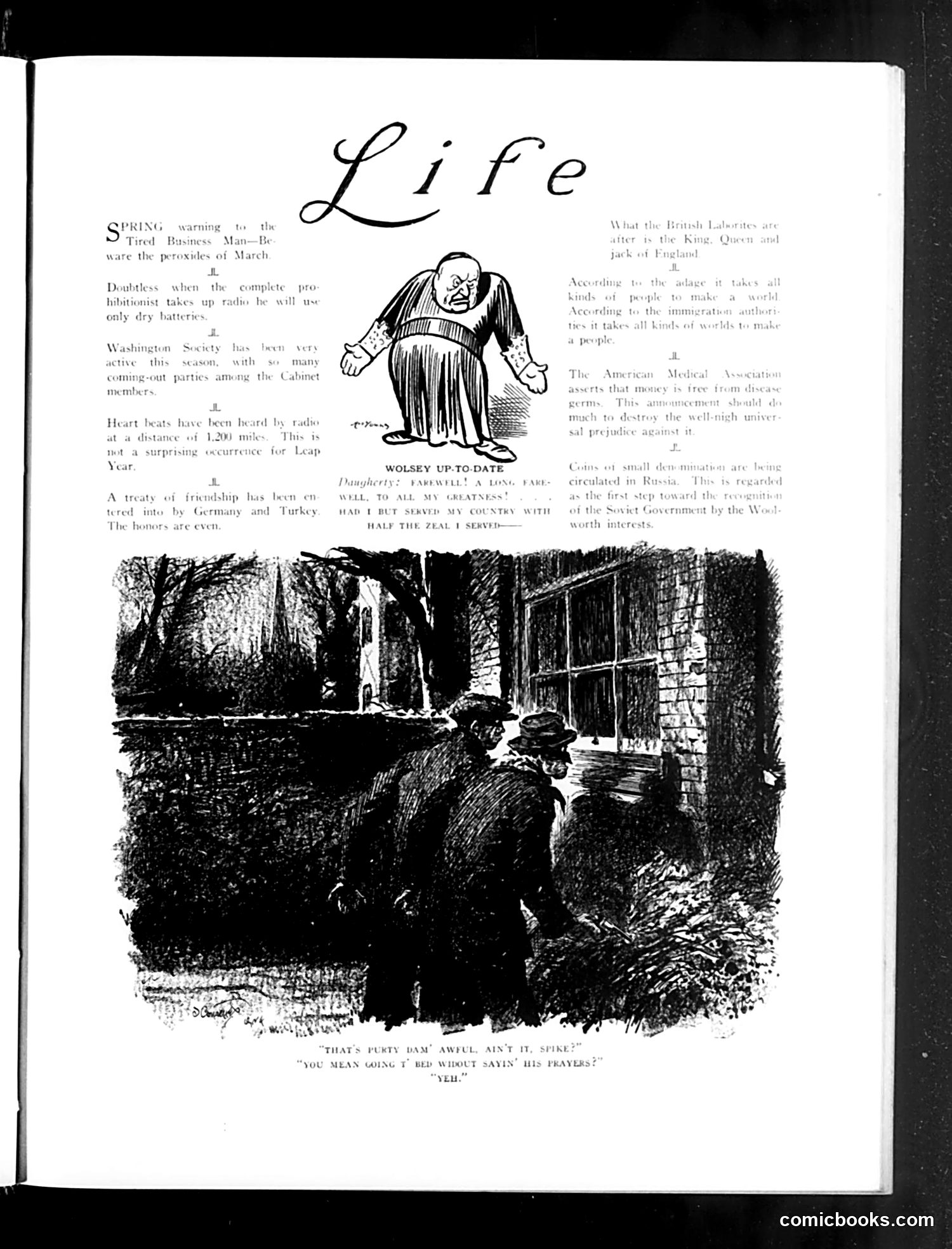
This page features two cartoons satirizing contemporary issues: **Top cartoon ("Wolsey Up-to-Date"):** Depicts a portly figure labeled as referencing Cardinal Wolsey, a historical English church official. The caption parodies Wolsey's famous farewell speech, suggesting the figure served his country poorly. This appears to mock a contemporary political figure through historical comparison—a common satirical technique. **Bottom illustration:** Shows two figures outside a house at night. The dialogue ("That's purty dam' awful, ain't it, Spike?" / "You mean goin' t' bed without sayin' his prayers?" / "Yeh.") satirizes religious hypocrisy or moral decline, likely reflecting post-WWI anxieties about changing American values and behavior. The surrounding text discusses spring preparations, radio technology, and international treaties.
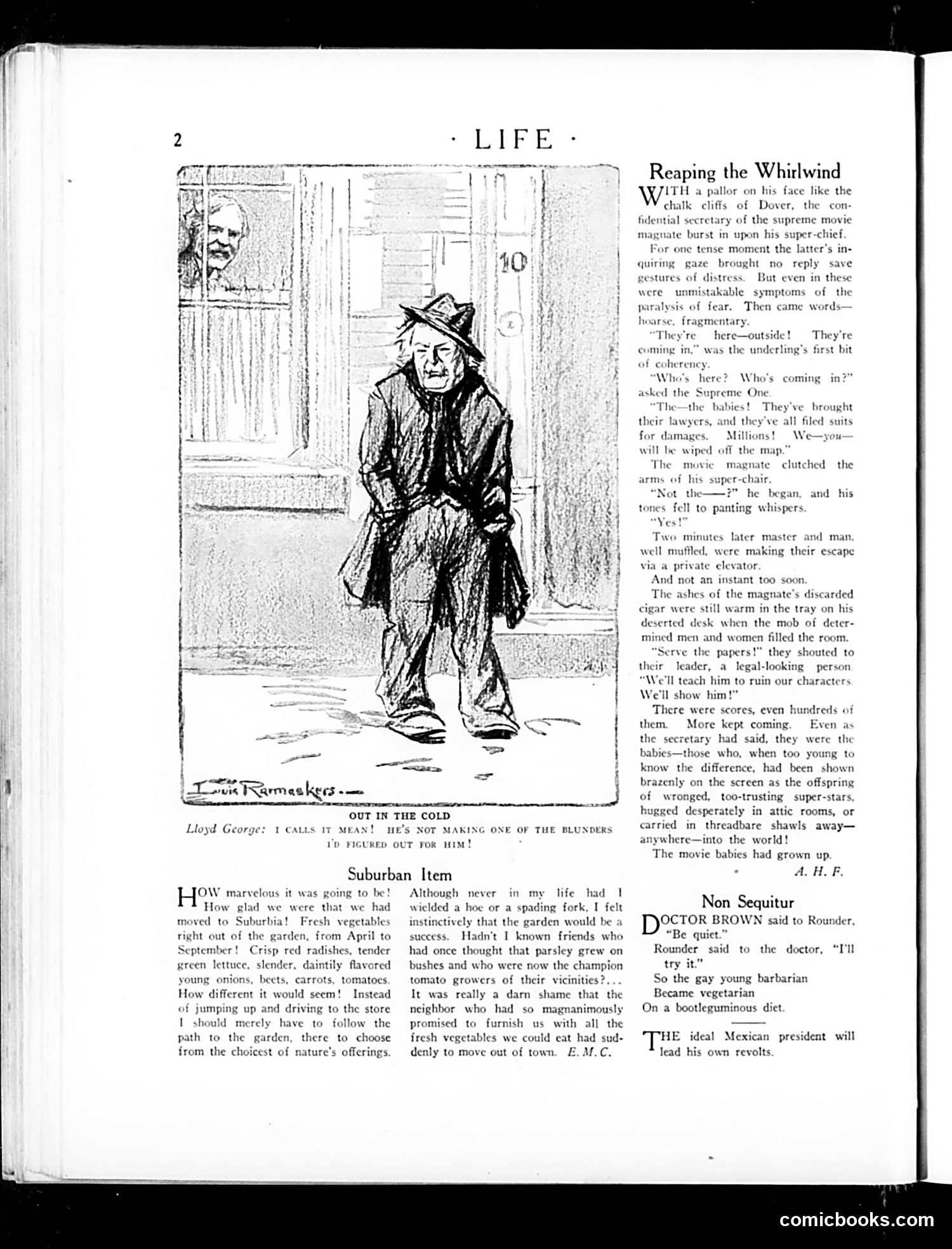
This cartoon depicts **Lloyd George**, the British Prime Minister, standing alone and shivering outside in winter conditions. The caption reads: "I CALLS IT MEAN—IT'S NOT MAKING ONE OF THE BLUNDERS I'D FIGURED OUT FOR HIM!" The satire criticizes Lloyd George for being unexpectedly competent or cautious, thereby denying his political opponents the opportunity to exploit his expected mistakes. The figure at the window appears to be a rival or critic who anticipated Lloyd George would blunder, leaving them "out in the cold"—both literally (the frozen setting) and figuratively (unable to capitalize on predicted failures). This reflects contemporary British political tensions, likely from the post-WWI period when Lloyd George remained a controversial, divisive figure among various political factions.
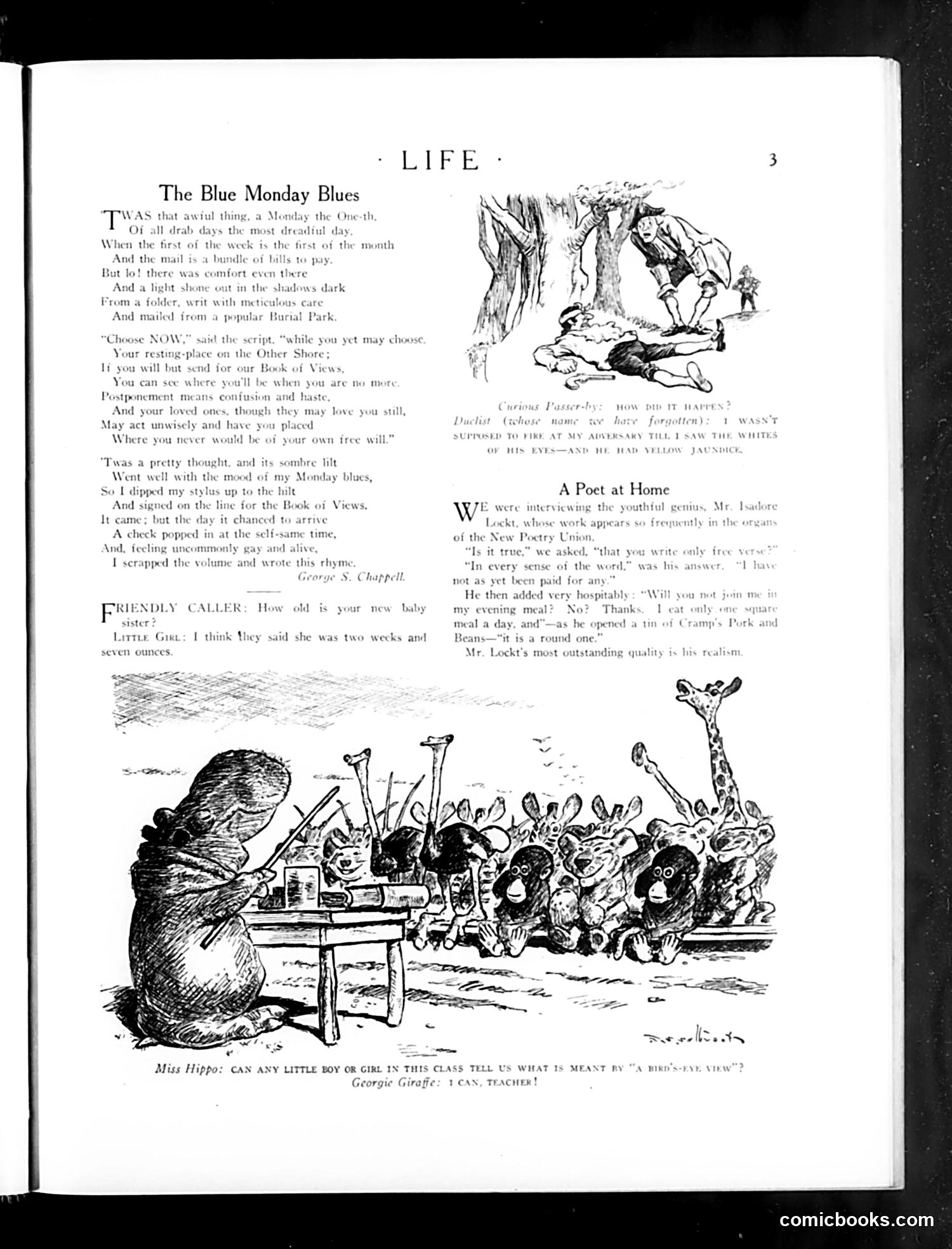
This page contains two distinct pieces of humor content: **"The Blue Monday Blues"** (top left) is a poem about the dread of Monday and bill-paying, using conventional early 20th-century sentiment—nothing specifically satirical emerges from the visible text. **"A Poet at Home"** (middle) interviews a young poet from the "New Poetry Union" about free verse. The satire mocks the pretentiousness of modernist poetry movements by portraying the poet as a hungry, unpaid idealist eating canned food while discussing artistic principles—contrasting high artistic ambition with mundane reality. **The bottom cartoon** shows a hippopotamus conducting an orchestra of animals, apparently illustrating a classroom lesson about "bird's-eye view." This appears to be whimsical rather than overtly political satire. The page broadly satirizes early-20th-century cultural pretension and economic struggles among artists.
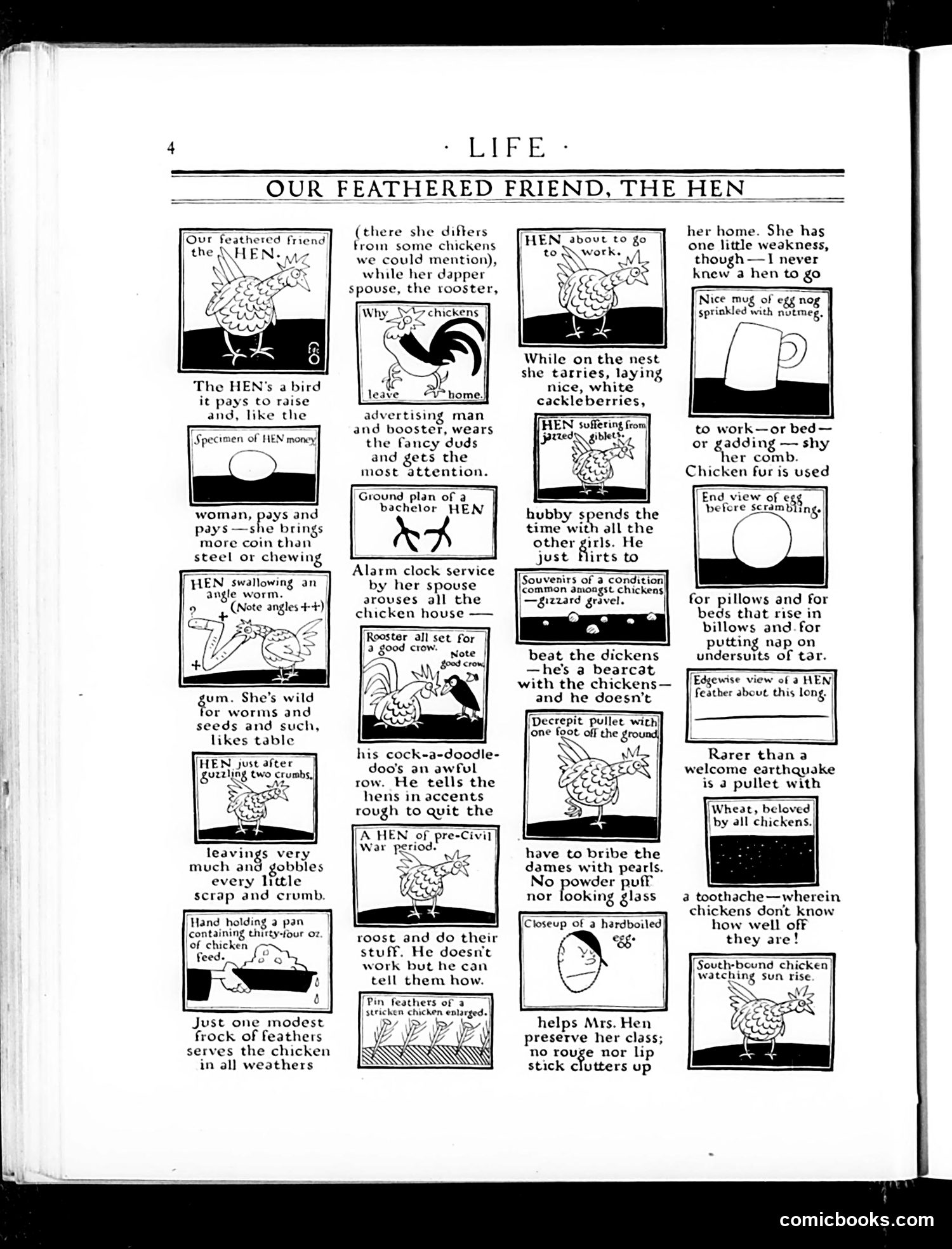
This is a humorous illustrated feature about hens, not political satire. The page uses comic panels to anthropomorphize chickens, attributing human characteristics and behaviors to them. The jokes play on Victorian-era gender stereotypes applied to hens: they're depicted as domesticated, productive creatures concerned with appearance (combs, feathers), gossip, and household duties. References like "Mrs. Hen" and comparisons to women's fashion ("powder puff," "looking glass," rouge) suggest the satire mocks both excessive femininity and women's domestic roles. The humor relies on observational comedy about actual hen behavior—laying eggs, scratching for food, dust-bathing—reframed through contemporary social commentary. The feature is light, domestic entertainment rather than hard political commentary, typical of *Life* magazine's general-audience humor content.
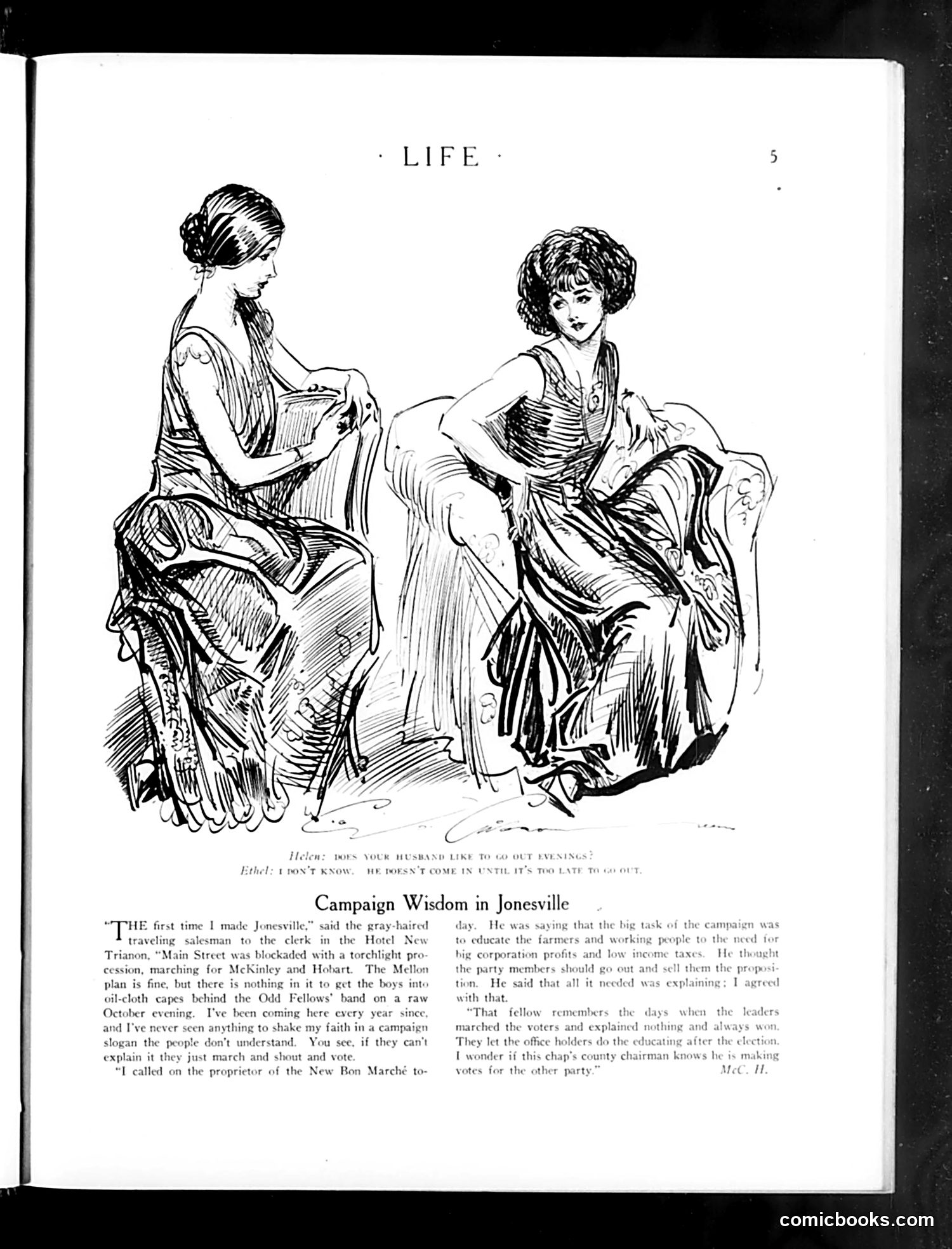
This satirical piece criticizes ineffective political campaigning in a small town called Jonesville. The illustration shows two women in conversation—one sitting, one reclining—apparently gossiping about campaign tactics. The accompanying text describes a traveling salesman's frustration with local political campaigns. He complains that campaign organizers fail to educate voters on actual issues, instead merely marching crowds around shouting slogans. The salesman argues that voters don't understand the real purpose of campaigns and suggests party leaders should explain policy rather than rely on spectacle. The satire targets the hollow nature of early 20th-century American political campaigning—the gap between theatrical electioneering and substantive civic engagement. The cartoon mocks how campaigns prioritize noise and momentum over genuine voter education.
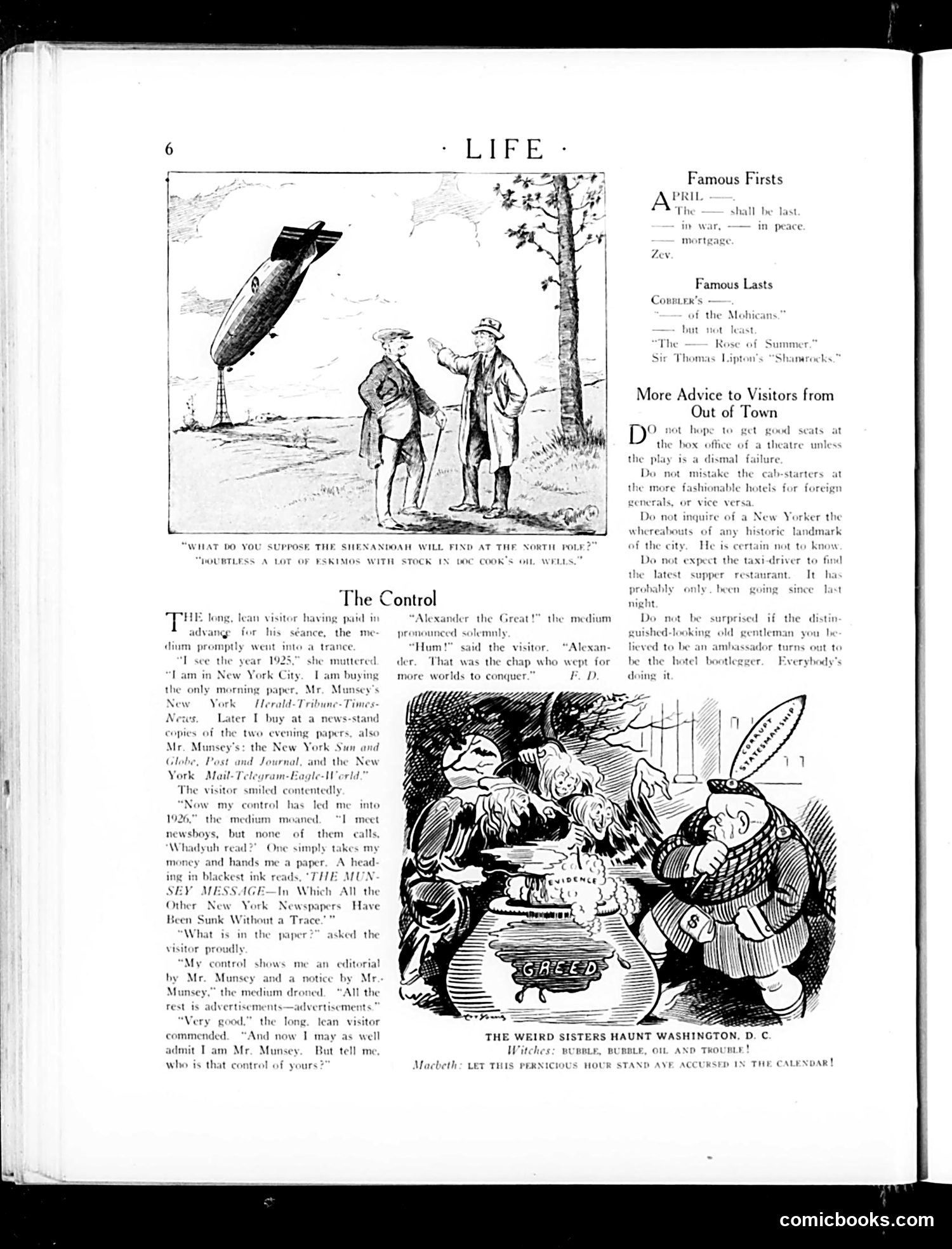
**Top Cartoon:** Shows two men observing a large bomb or aircraft nose-cone falling from the sky. The caption suggests they're discussing whether the Shenandoah (a real airship that crashed in 1925) will be found at the North Pole, with Eskimos involved. This references the contemporary mystery and tragedy surrounding the Shenandoah's disappearance—a major news story of the era. **"The Control" Article & Cartoon:** A satirical piece about a "long, lean visitor" discussing newspaper control with someone (possibly the editor). The accompanying cartoon depicts the "Weird Sisters" (likely referencing Macbeth) haunting Washington D.C., labeled with vices: "Bubble, Oil and Powder." This appears to critique corrupt influences or monopolies affecting American politics and media.
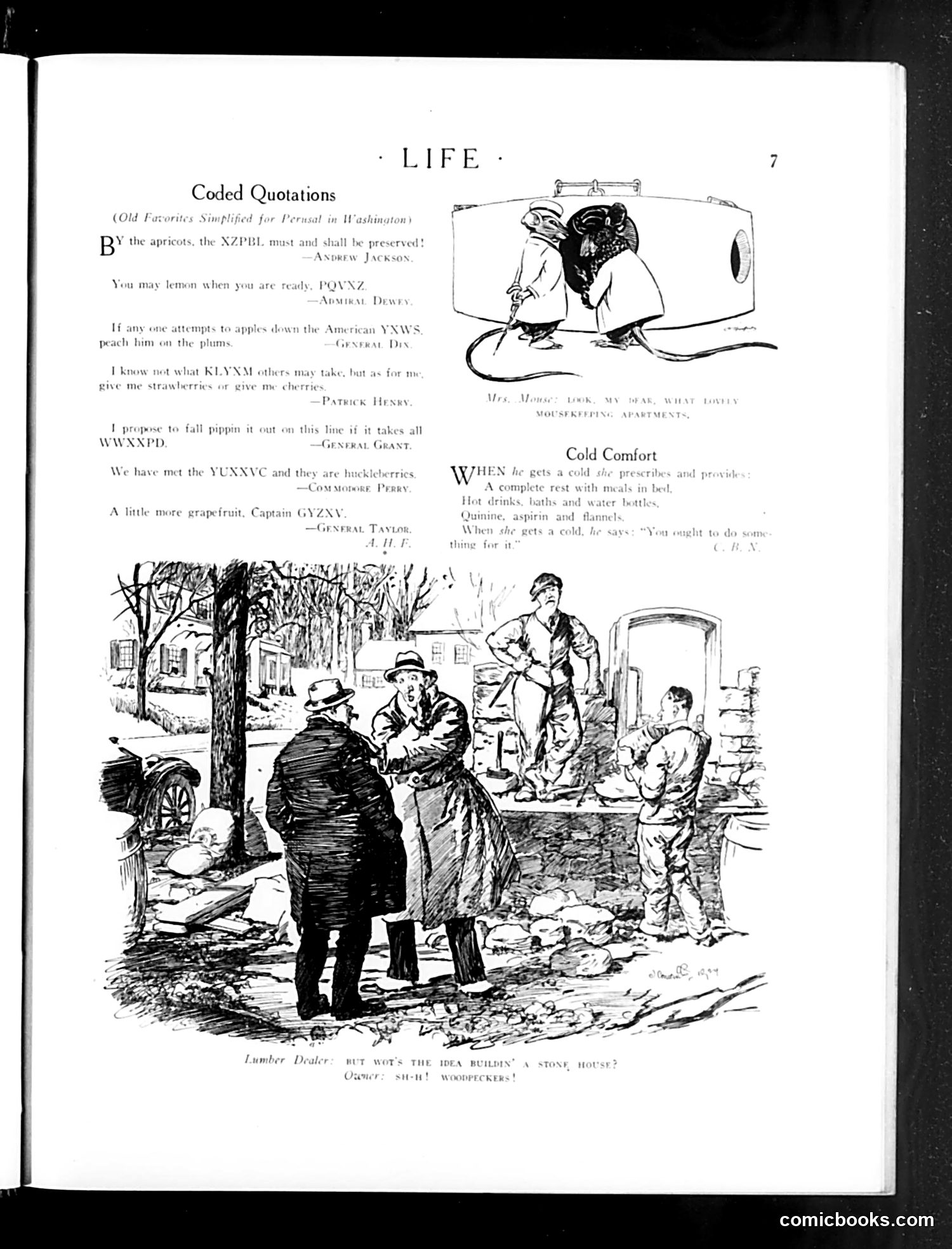
This page contains two distinct elements: **"Coded Quotations"** section features satirical attributions of famous quotes to made-up coded names (XZPBL, POVNZ, etc.) rather than real people. This appears to be a humorous game where readers would decode which actual historical figures the quotes belong to—a form of puzzle-humor popular in early 20th-century magazines. **"Cold Comfort"** sketch illustrates a domestic scene where a wife suggests remedies (rest, meals, hot drinks, baths) for her husband's cold, while he dismissively responds "You ought to do something for it"—satirizing male stubbornness and refusal to follow sensible advice during illness. The large cartoon below depicts a lumber dealer interaction, captioned with working-class dialogue about building stone houses, poking fun at working-men's casual conversation and aspirations.
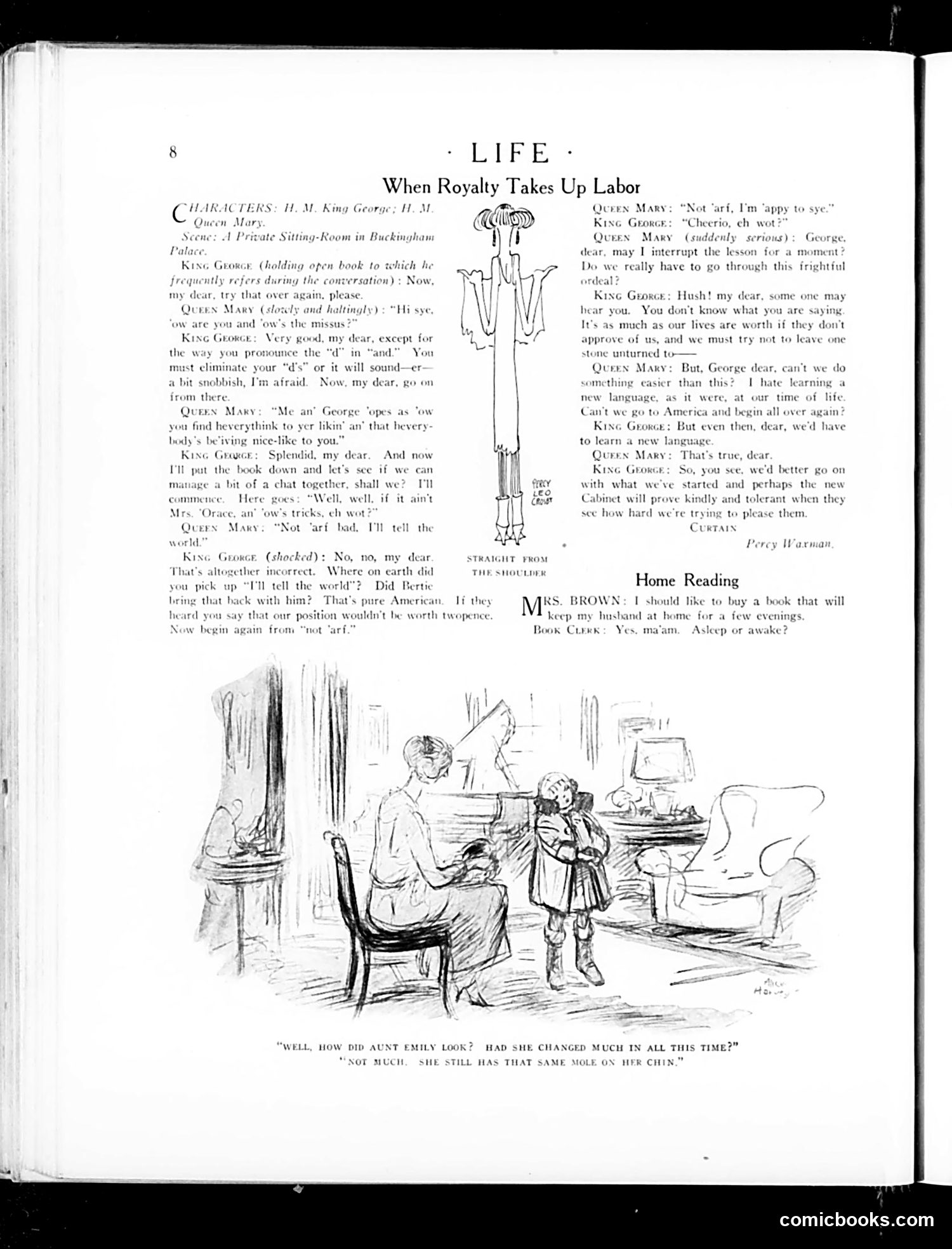
This satirical piece depicts **King George V** and **Queen Mary** in a domestic scene discussing their efforts to learn American English and customs. The humor centers on the royal couple attempting to understand working-class American speech and labor, presented as absurdly difficult for aristocrats accustomed to formality. The accompanying illustration shows a domestic interior where a man (presumably a father) speaks with a child, with a caption about "Aunt Emily's" appearance and a mule. This illustrates the class humor: royalty struggling with colloquial speech represents the broader cultural gap between British aristocracy and American democratic culture—a common satirical theme of the era. The overall joke mocks both pretensions of nobility and their unfamiliarity with common people's language.
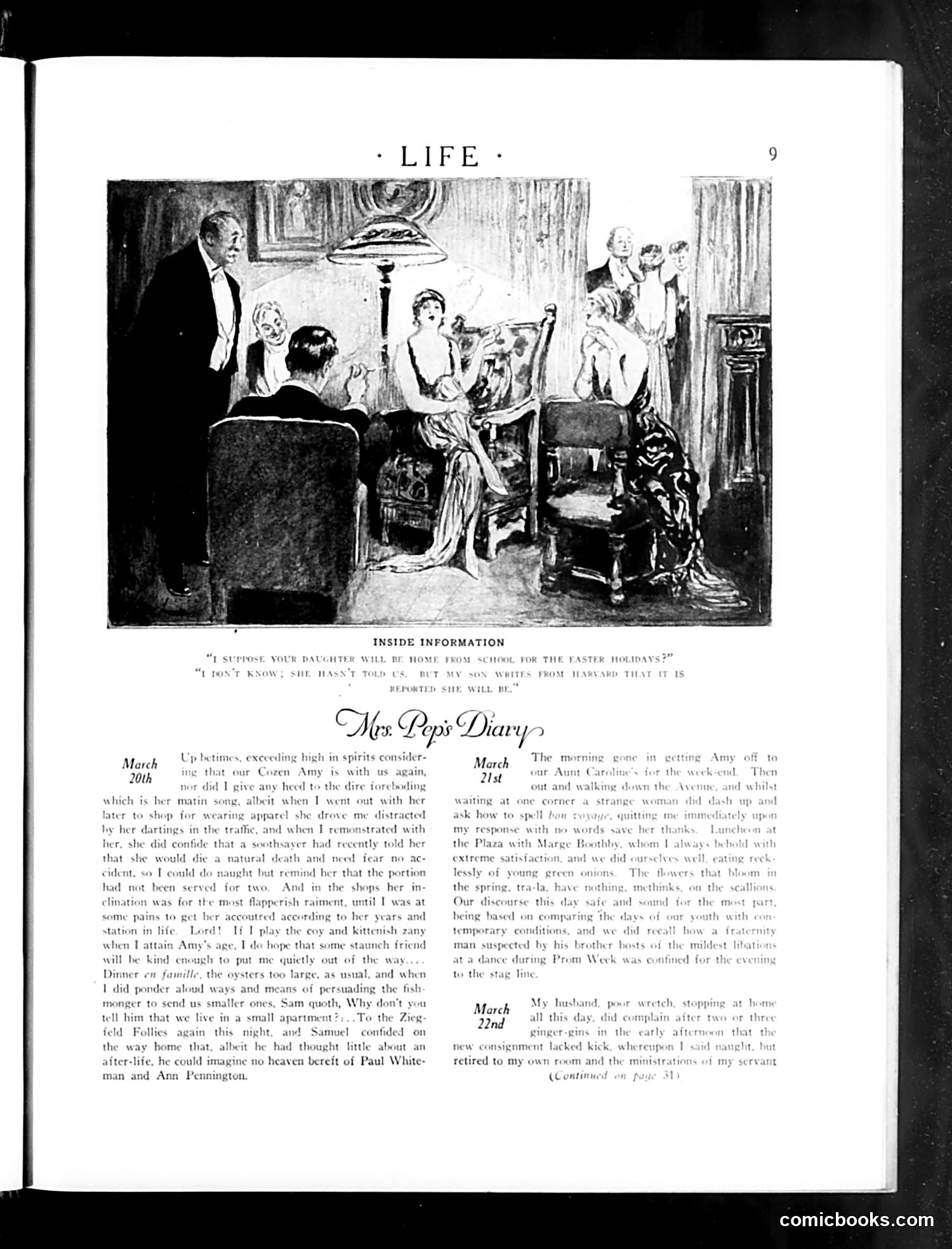
This page features "Mrs. Pops Diary," a serialized column mixing social commentary with domestic humor. The illustration shows a wealthy household scene with multiple guests in an elegant interior, depicting upper-class social life. The diary entries (dated March 21st and 22nd) describe mundane domestic concerns: arranging children's holiday returns from school, shopping, social encounters at the Plaza hotel, and marital frustrations over a servant's work and a husband's complaints about ginger-ales. The satire gently mocks the trivialities occupying wealthy women's attention—the contrast between serious life concerns and their focus on minor domestic irritations and social positioning. The "Inside Information" caption humorously frames gossip about children's schooling, typical of the magazine's satirization of upper-class preoccupations during this era.
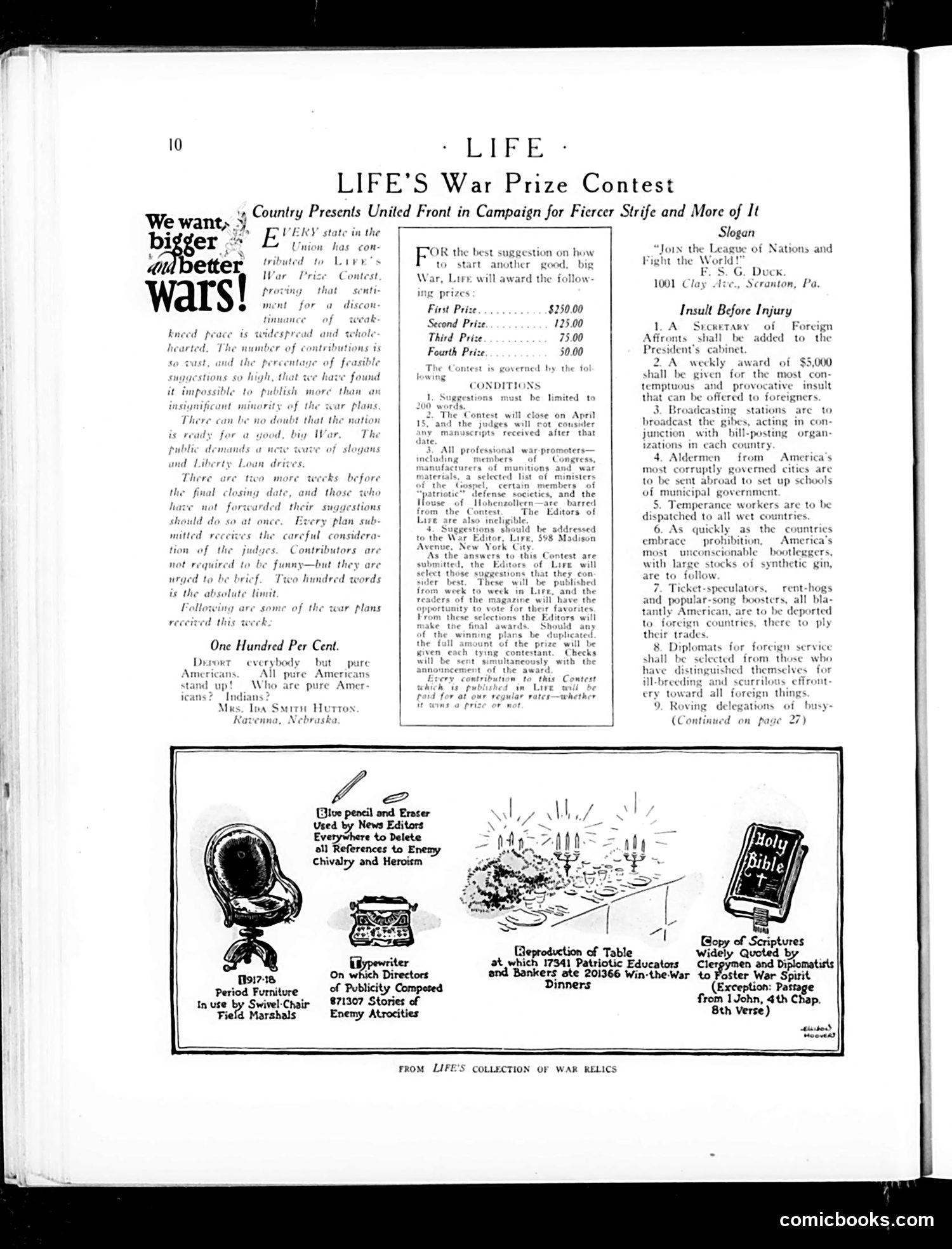
This page combines a war-related contest announcement with satirical illustrations about wartime censorship and propaganda. **The Contest:** LIFE's "War Prize Contest" solicits suggestions for "another good, big War" from readers, offering $250 for the best proposal. This is dark satire mocking the appetite for continued conflict. **The Illustrations:** The bottom panel ridicules American wartime information control through four caricatured items: - A chair (suggesting authority/control) - A typewriter (representing media gatekeeping) - A battlefield scene with candles (unclear reference) - A Bible (possibly satirizing religious justifications for war) Captions indicate editors were censoring references to "Enemy Chivalry and Heroism" and removing "Enemy Atrocities" from published stories—exposing how authorities shaped public perception by controlling what Americans could read about the enemy. The satire targets governmental propaganda management during wartime.
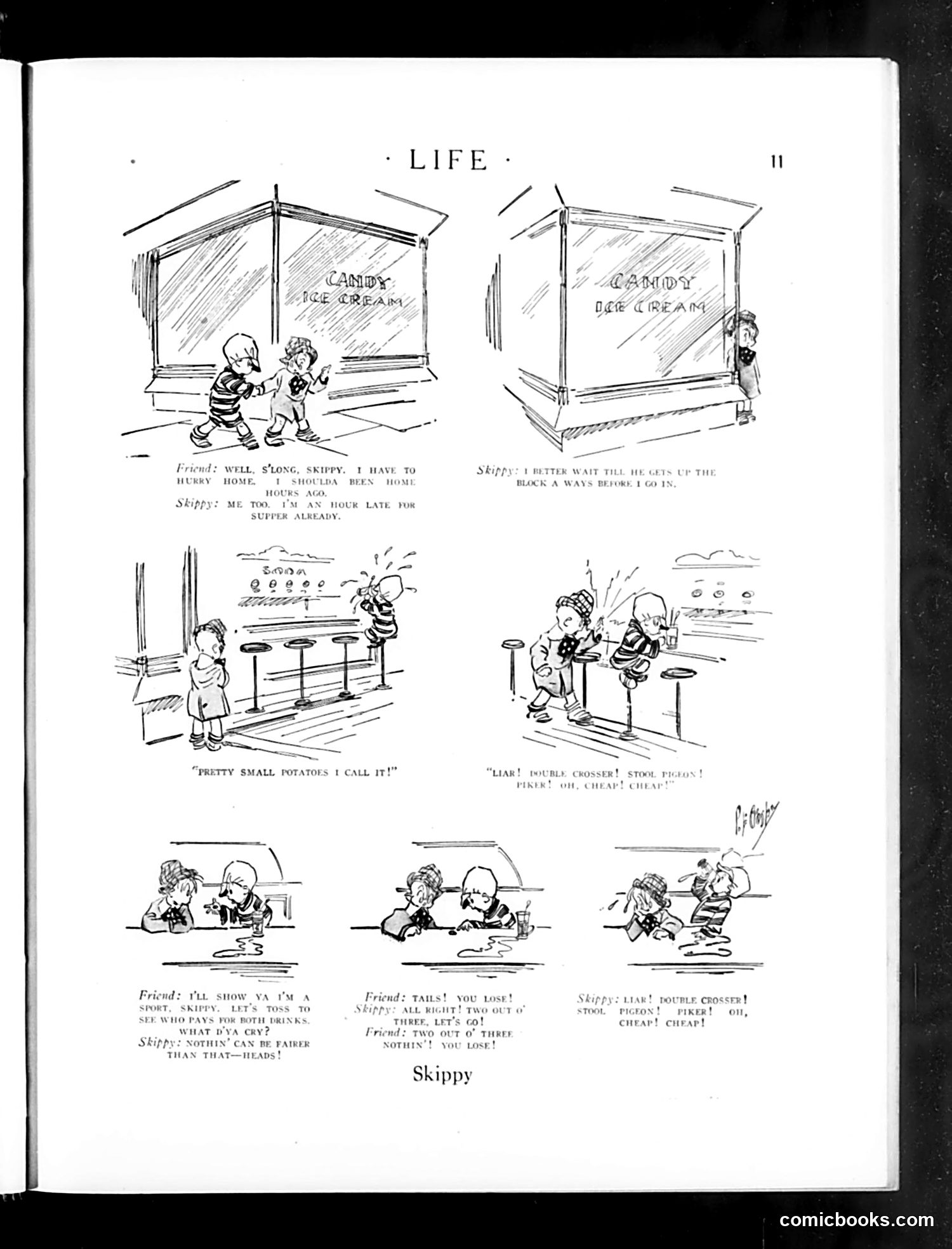
This page presents a comic strip titled "Skippy" showing interactions between two young boys. The humor centers on childhood games and competitive behavior: **The joke:** Skippy and a friend engage in typical schoolyard activities—visiting an ice cream stand, playing on playground equipment (stools/bars), and playing street games. The dialogue captures boys' boastful talk ("I'm a sport," "I call it pretty small potatoes") and competitive one-upmanship over games and possessions. **Social context:** The strip satirizes how children try to impress each other through exaggeration and status-claiming. References to "stool pigeons," "double crosser," and similar slang reflect period boys' culture and invented hierarchies. The strip represents early-to-mid-20th century urban childhood—ice cream vendors, street games, and the social dynamics of young boys navigating friendship and rivalry through boasting and competitive games.
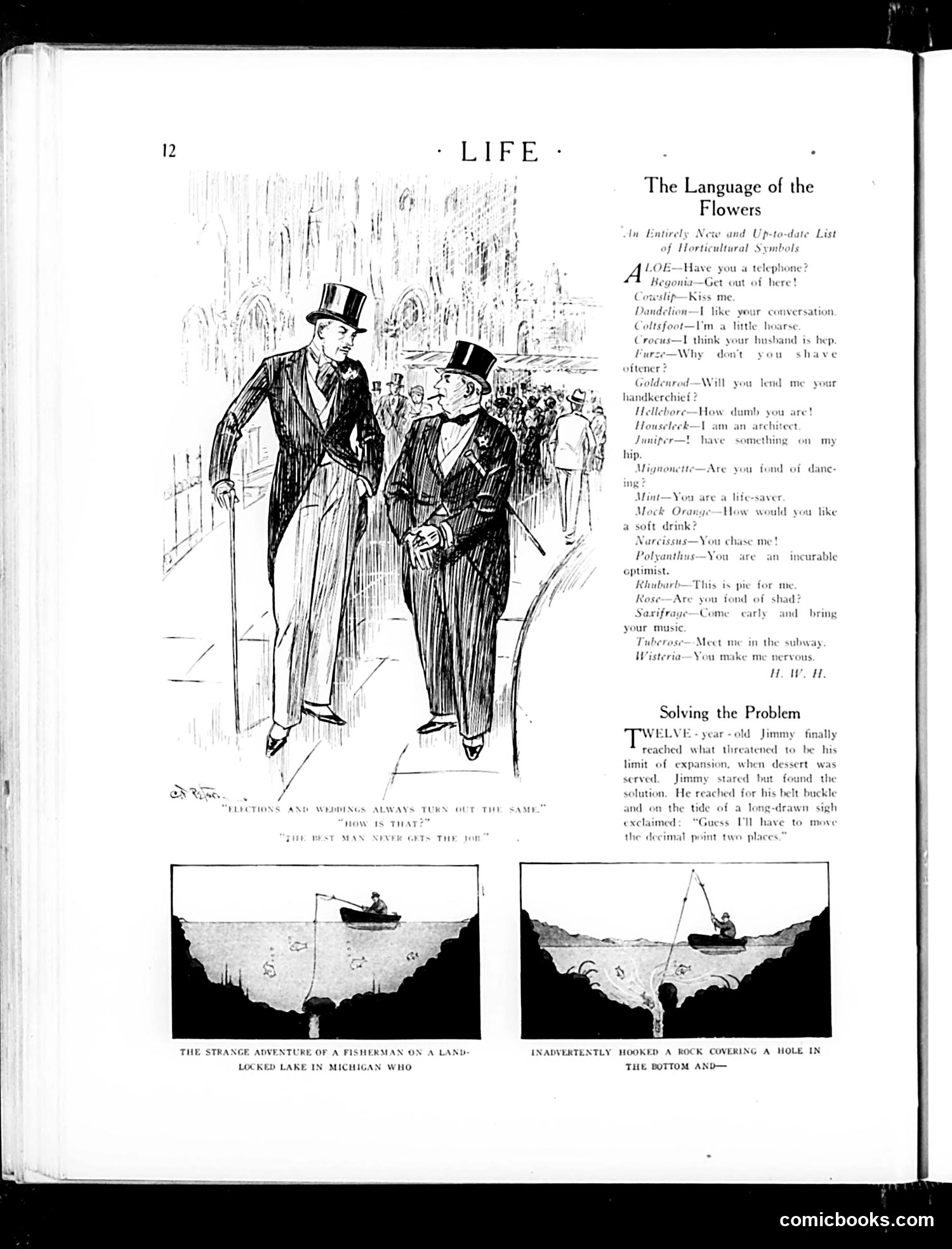
**Main Cartoon (top):** Two well-dressed gentlemen in top hats converse on a street. The caption reads: "ILLUSIONS AND WEDDINGS ALWAYS TURN OUT THE SAME — 'HOW IS THAT?' — 'THE BEST MAN NEVER GETS THE JOB.'" This is a cynical joke about weddings and illusions—the "best man" (traditionally a ceremonial role) never actually becomes the groom; similarly, illusions never match reality. The humor relies on wordplay and romantic disillusionment. **"Language of the Flowers":** A humorous list of flower meanings paired with modern, sarcastic interpretations (e.g., "Aloe—Have you a telephone?" "Crocus—I think your husband is hep"). **"Solving the Problem":** A brief anecdote about a twelve-year-old solving a math problem by moving a decimal point. **Bottom illustrations:** Two panels depicting a fisherman's strange adventure in a Michigan lake, appearing to be a humorous tall tale.
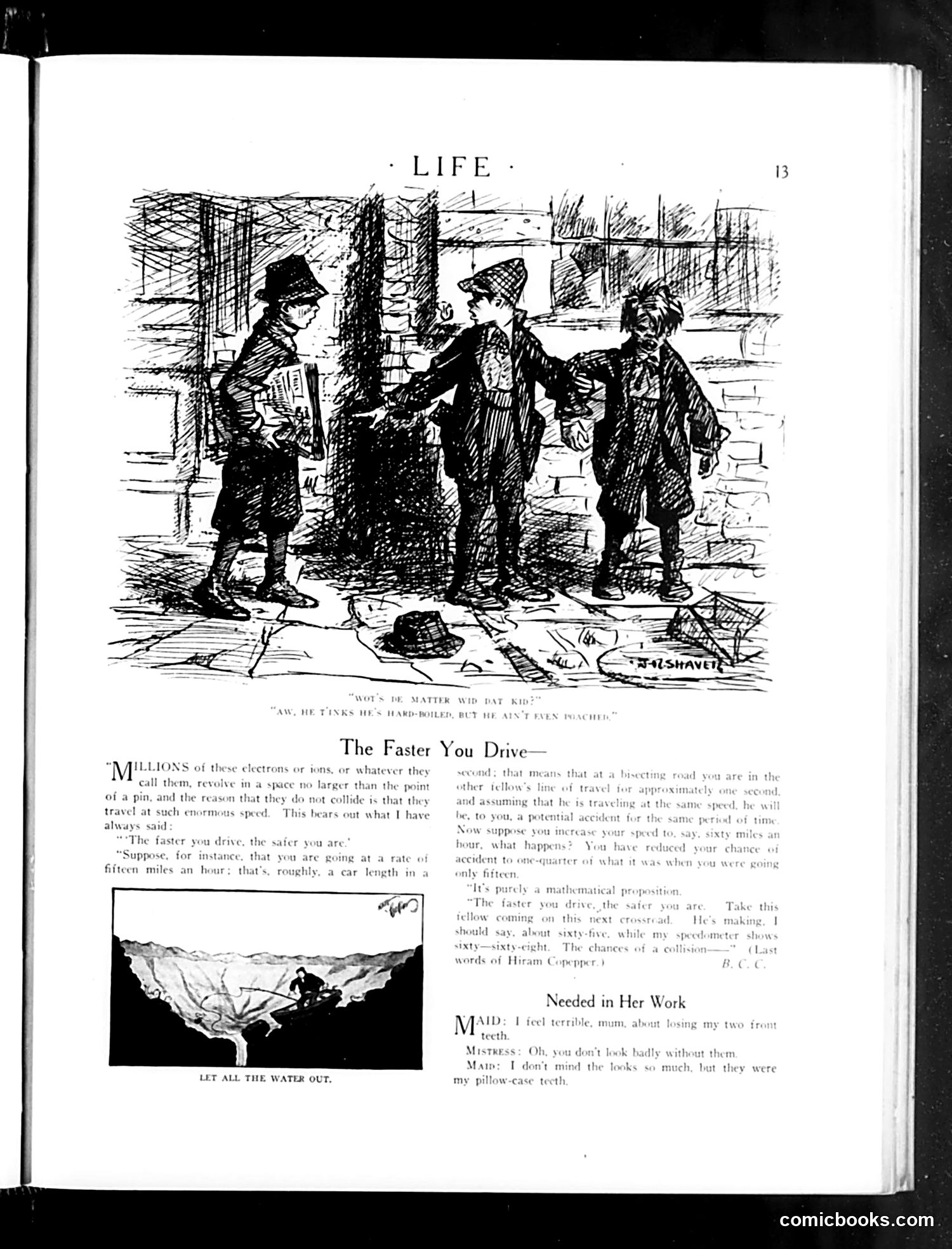
**Top Cartoon:** Titled "Says he thinks it's a hard-boiled egg, but he ain't even poached," this sketch depicts four street children in tattered clothing examining something on the ground. The humor appears to target urban poverty and child destitution—a boy has mistaken an object for food (a "hard-boiled egg"), but it's actually something worthless ("not even poached"/ruined). This satirizes the desperation of poor children in industrial cities. **"The Faster You Drive" Article:** This section discusses automobile safety, arguing paradoxically that faster driving reduces accident risk by shortening exposure time at intersections. The piece sarcastically presents flawed logic about speed and safety—likely mocking dangerous driving habits or foolish arguments drivers made to justify speeding. **Bottom Section:** A brief comedic dialogue about a maid losing her front teeth, with class-based humor about appearance and domestic service.
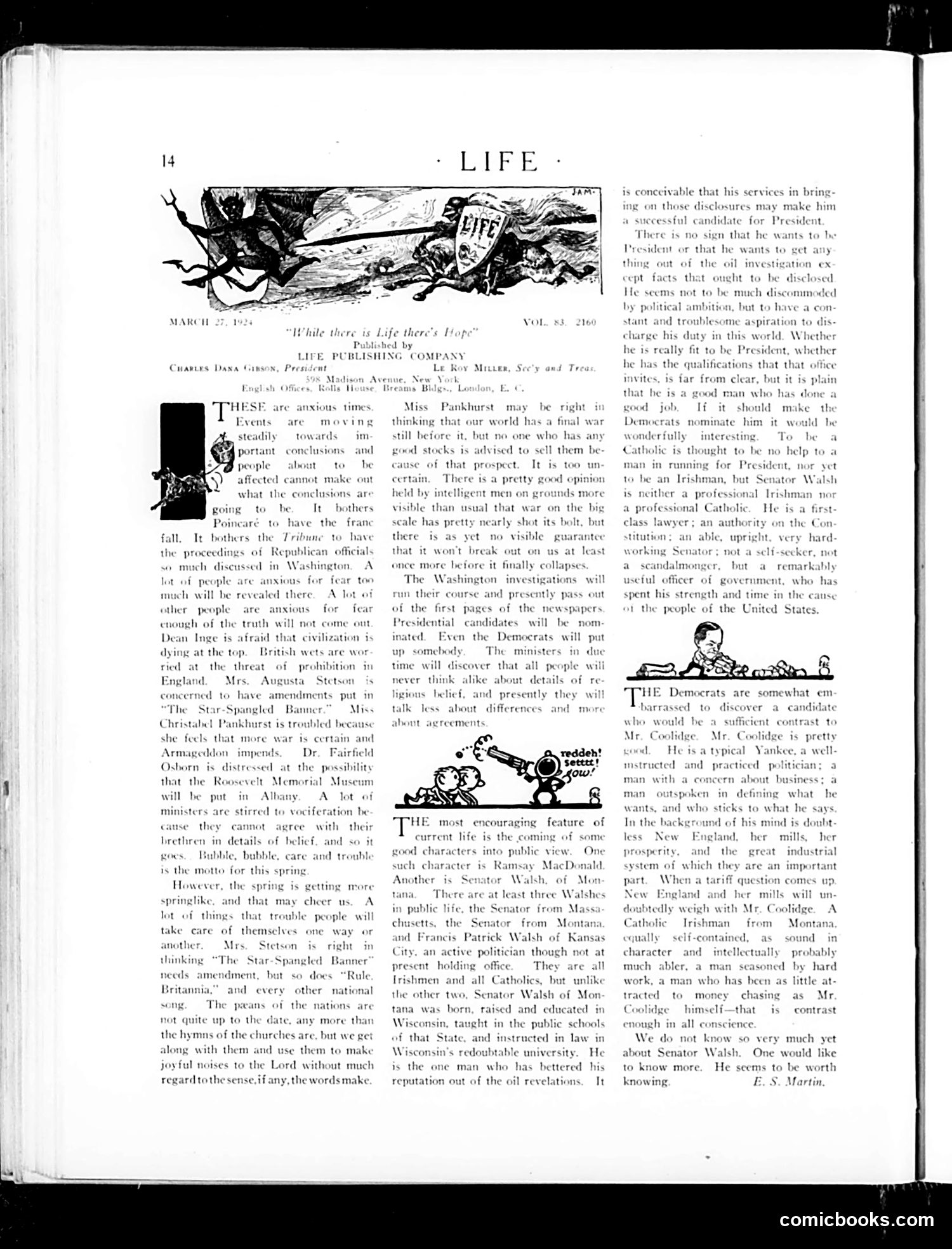
This page discusses anxious times and upcoming political events. The main cartoon depicts a figure labeled "Midas" in what appears to be a satirical comment on wealth and economic concerns during the 1920s. The text discusses potential candidates for President, mentions Senator Walsh of Montana (described as Catholic and Irish), and references Mr. Coolidge as "a typical Yankee" politician. The article appears critical of various political figures' qualifications and backgrounds. A second cartoon shows what appears to be a "Midas" figure with a speech bubble saying "Midas! Success! NOW!" — likely satirizing either blind pursuit of wealth or political ambitions during this pre-election period. The overall tone suggests satire about 1924 presidential politics, religious/ethnic divisions among candidates, and anxiety about America's economic and political direction.
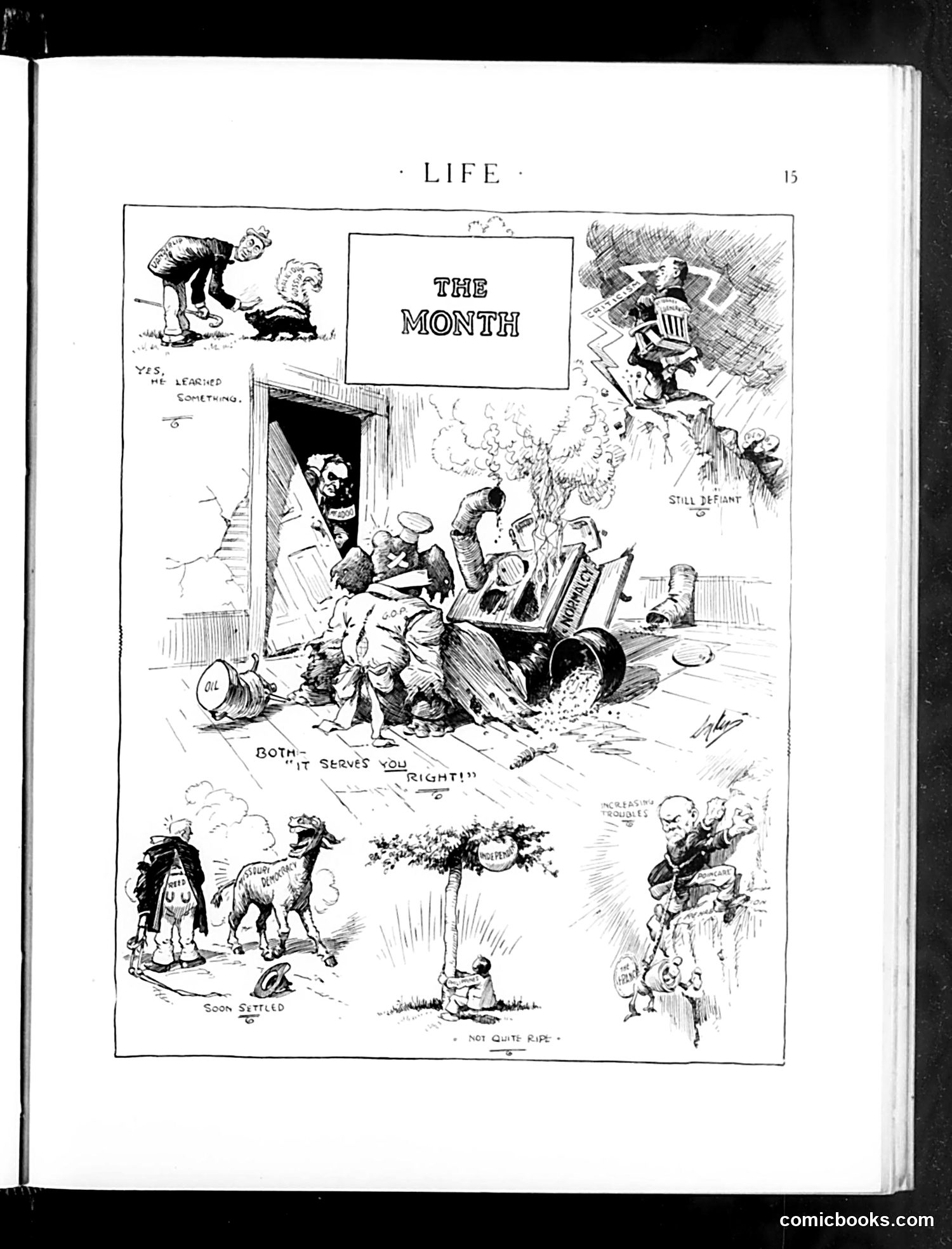
This page from *Life* magazine features several interconnected satirical vignettes under the heading "The Month." The central scene depicts domestic chaos, with the caption "Both it serves you right!!!" suggesting marital discord or household conflict—likely commentary on contemporary domestic strife or gender relations. The surrounding smaller cartoons include: a child learning "something"; a figure on a wall labeled "Still up!"; a couple labeled "Soon settled"; and another scene marked "Not quite ripe." The caricature style and fragmented narrative suggest this is social satire commenting on various aspects of American life—relationships, class dynamics, or social behaviors of the era. Without specific historical context, the exact references remain unclear, though the overall tone is one of humorous critique.
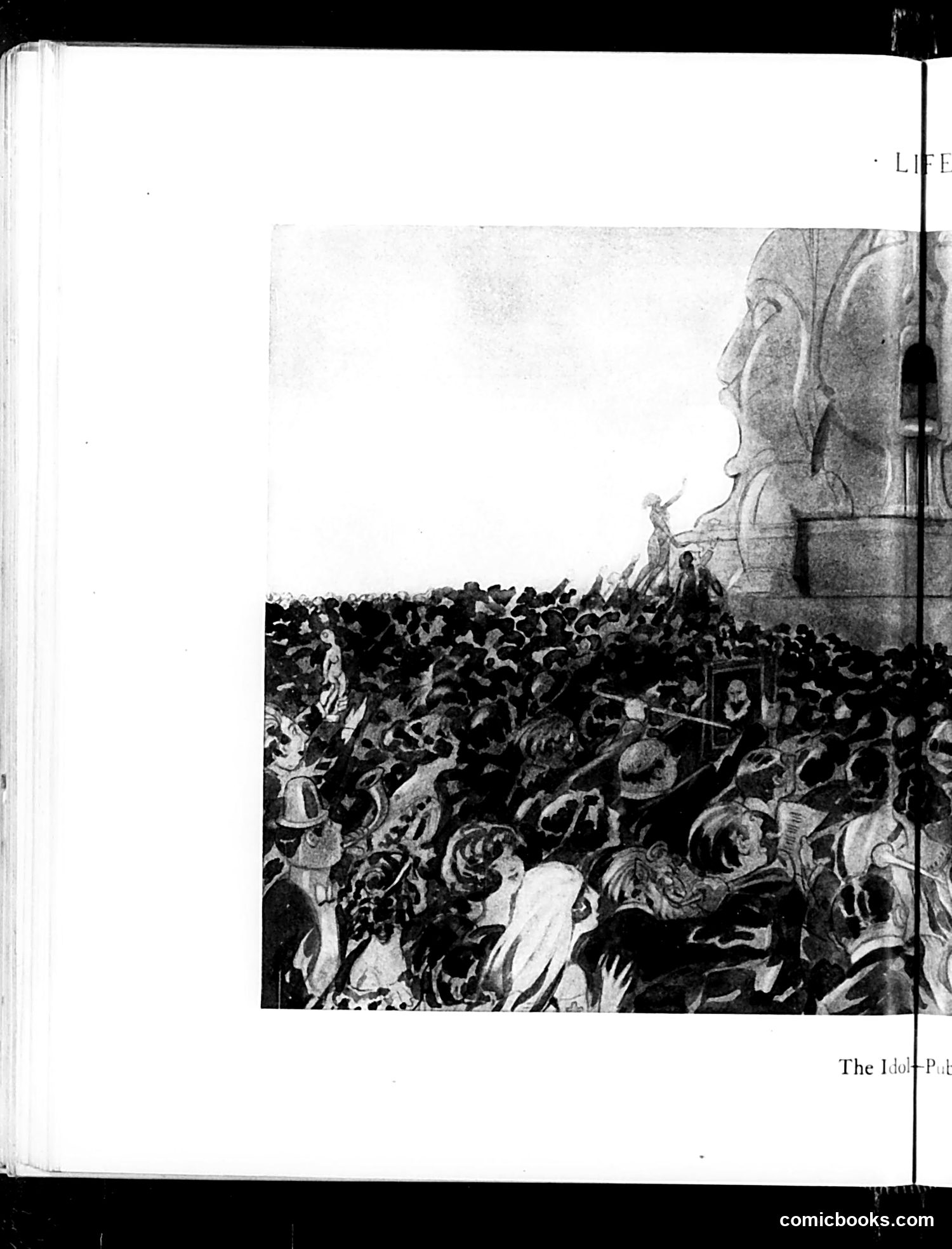
This page from *Life* magazine shows a large crowd scene gathered before a massive sculptural head or monument. The caption reads "The Idol—Pa[rtial]" (text is cut off). The image appears to be a satirical commentary on mass worship or idolatry—depicting crowds venerating an enormous carved head or statue. Without the complete caption or date visible, the specific figure or event being mocked cannot be determined with certainty. However, the composition suggests criticism of either political hero-worship, celebrity culture, or possibly commentary on authoritarian leader cults that were emerging in various nations during the early-to-mid 20th century. The contrast between the tiny individual figures and the colossal idol emphasizes the satire's point about masses surrendering individual judgment to collective reverence.
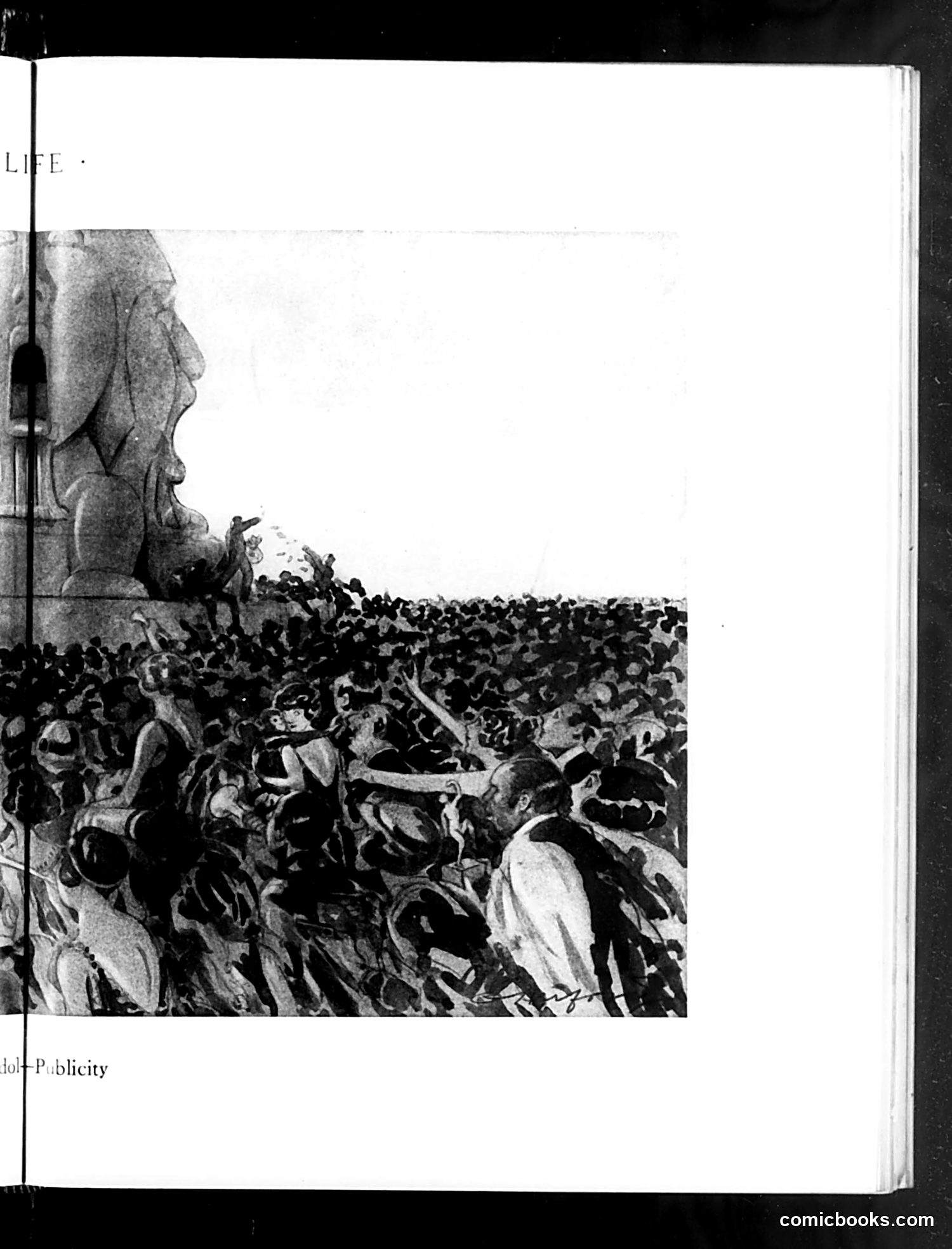
This appears to be a satirical illustration from Life magazine depicting a large crowd gathered before a massive sculptural head or monument. The image critiques "folk-publicity" — likely mocking populist political movements or leaders who cultivated mass appeal through orchestrated public spectacle. The enormous carved head dominates the composition, suggesting an authoritarian cult of personality. The densely packed crowd below, rendered in dark masses, appears somewhat chaotic and undifferentiated, emphasizing how such movements reduce individuals to anonymous followers. The satire targets the manufactured nature of "folk" movements — the contradiction between claims of grassroots authenticity and the calculated, monumental propaganda machinery required to create them. Without additional context or visible text identifying specific figures or dates, the precise political target remains unclear, though the style suggests early-to-mid 20th century concerns.
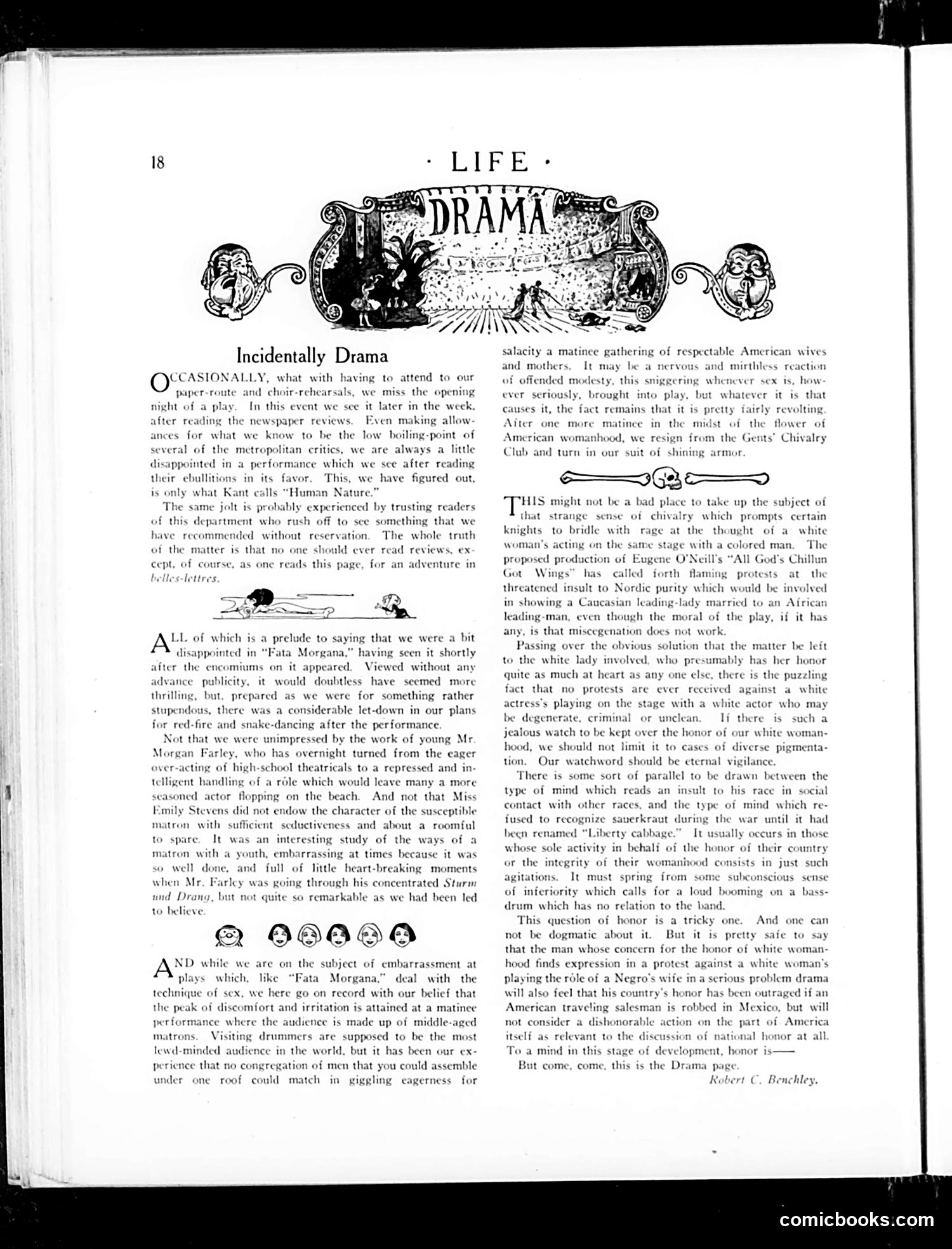
This page contains a theater criticism column by Robert C. Benchley discussing recent Broadway productions and audience behavior. The main satirical targets are: 1. **Theater critics and readers**: Benchley mocks how people read glowing reviews then feel disappointed seeing the actual play, noting this is just "Human Nature." 2. **"Fata Morgana"**: A recent play that received advance praise but underwhelmed in person. Benchley credits young actor Morgan Farley's understated performance and Emily Stevens' acting, but found it less remarkable than hyped. 3. **Matinee audiences**: The piece's sharpest satire targets middle-aged respectable American wives attending afternoon performances, claiming they giggle and react with more "salacity" (lustfulness) than any other demographic—a humorous jab at Victorian propriety masking actual interest in risqué content. 4. **"All God's Chilun Got Wings"**: Benchley criticizes protests against Eugene O'Neill's play featuring miscegenation, mocking the concept of "Nordic purity" and the performative chivalry that objects to such content. The decorative header and small portrait medallions are period magazine ornamentation typical of Life's design.
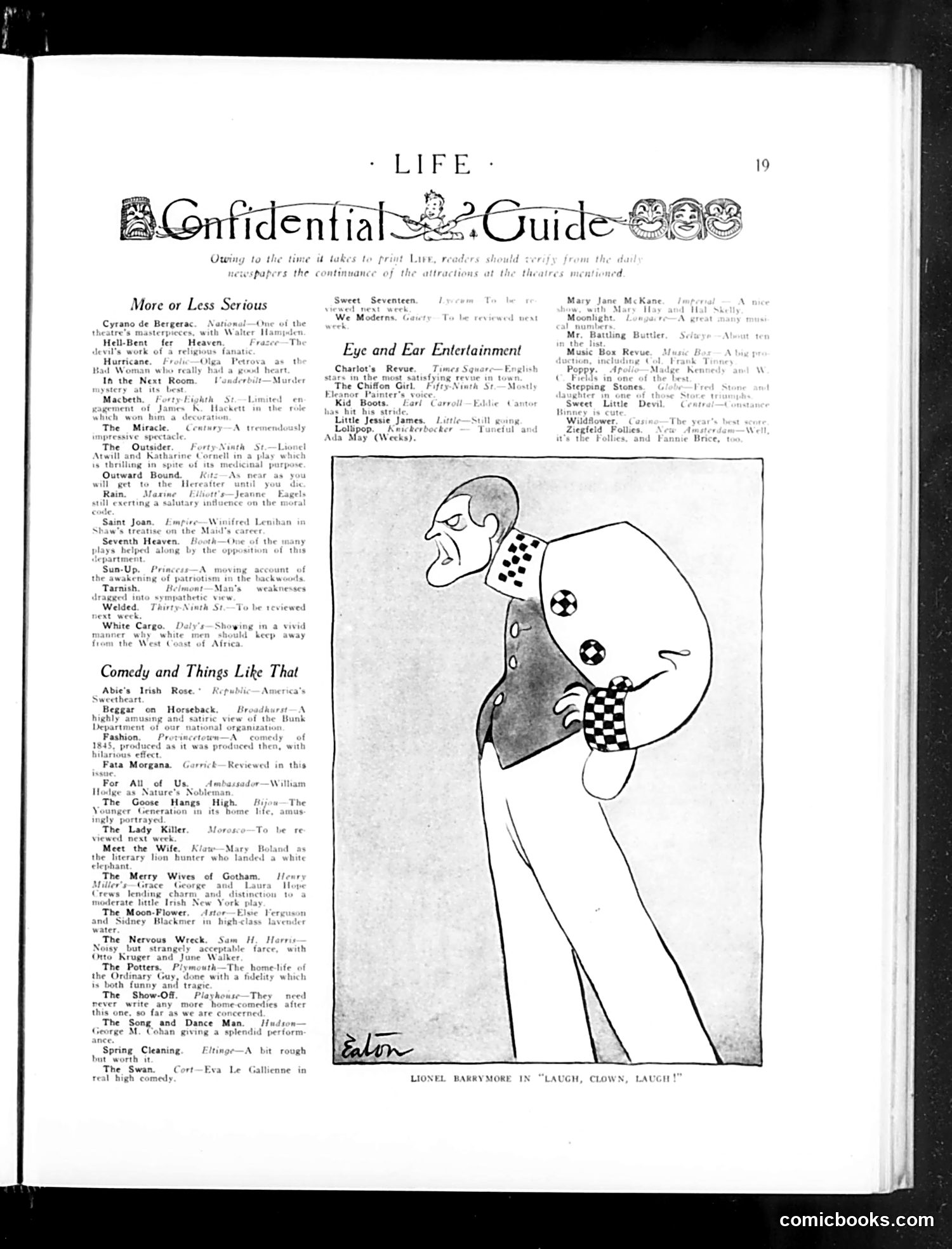
This page from *Life* magazine features a caricature by "Eaton" of actor Lionel Barrymore in the 1928 film *"Laugh, Clown, Laugh!"* The illustration depicts an exaggerated clown character—with an elongated, sad face and oversized costume decorated with checkered and spotted patterns—embodying the classic "sad clown" archetype. The satire reflects the film's central irony: a performer who entertains audiences while concealing personal tragedy. The caricature emphasizes the contrast between Barrymore's theatrical persona and inner melancholy—a common satirical subject in *Life* magazine's entertainment coverage of the 1920s. The page also reviews numerous contemporary Broadway plays and films, positioning this among other cultural commentary from the era.
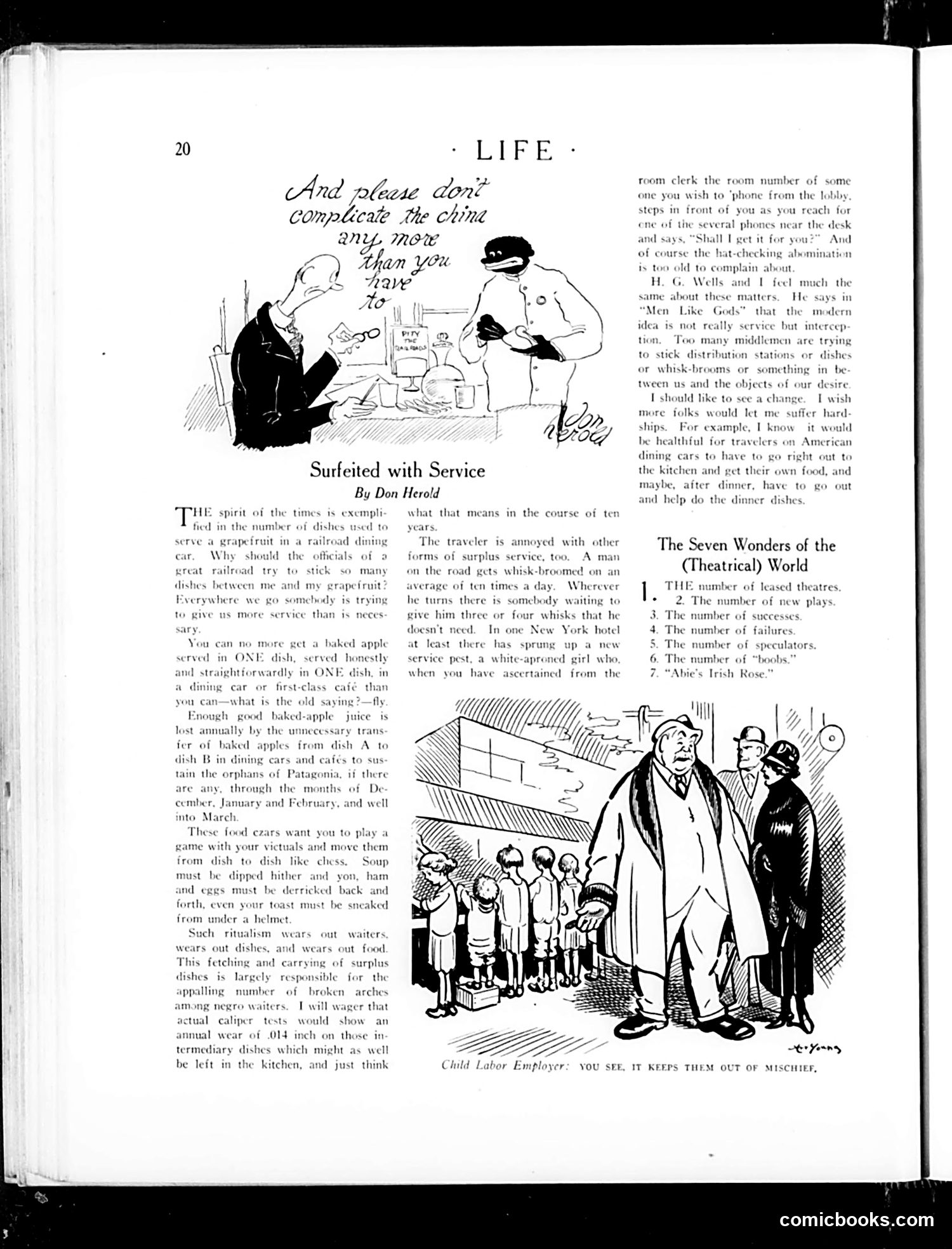
**"Surfeited with Service"** by Don Herold satirizes American service industry excess in the early 20th century. Herold mocks railroad dining cars and hotels for creating unnecessary complexity—using multiple dishes to serve simple foods like grapefruit or baked apples, requiring constant handling and transfers between waiters. He argues this "ritualism" wastes food, breaks dishes, wears out servers' feet, and annoys travelers who simply want efficient service. The cartoon illustrates the absurdity: a diner facing an elaborate multi-dish presentation. Herold references H.G. Wells approvingly, noting that modern service prioritizes performance over practicality—restaurants employ "distribution stations" and endless fussing to appear upscale rather than serve customers well. The bottom cartoon, captioned "Child Labor Employer," appears unrelated—depicting an adult with children, suggesting employment of minors "keeps them out of mischief." The "Seven Wonders of the Theatrical World" appears to be a separate humorous list about Broadway's mysteries.
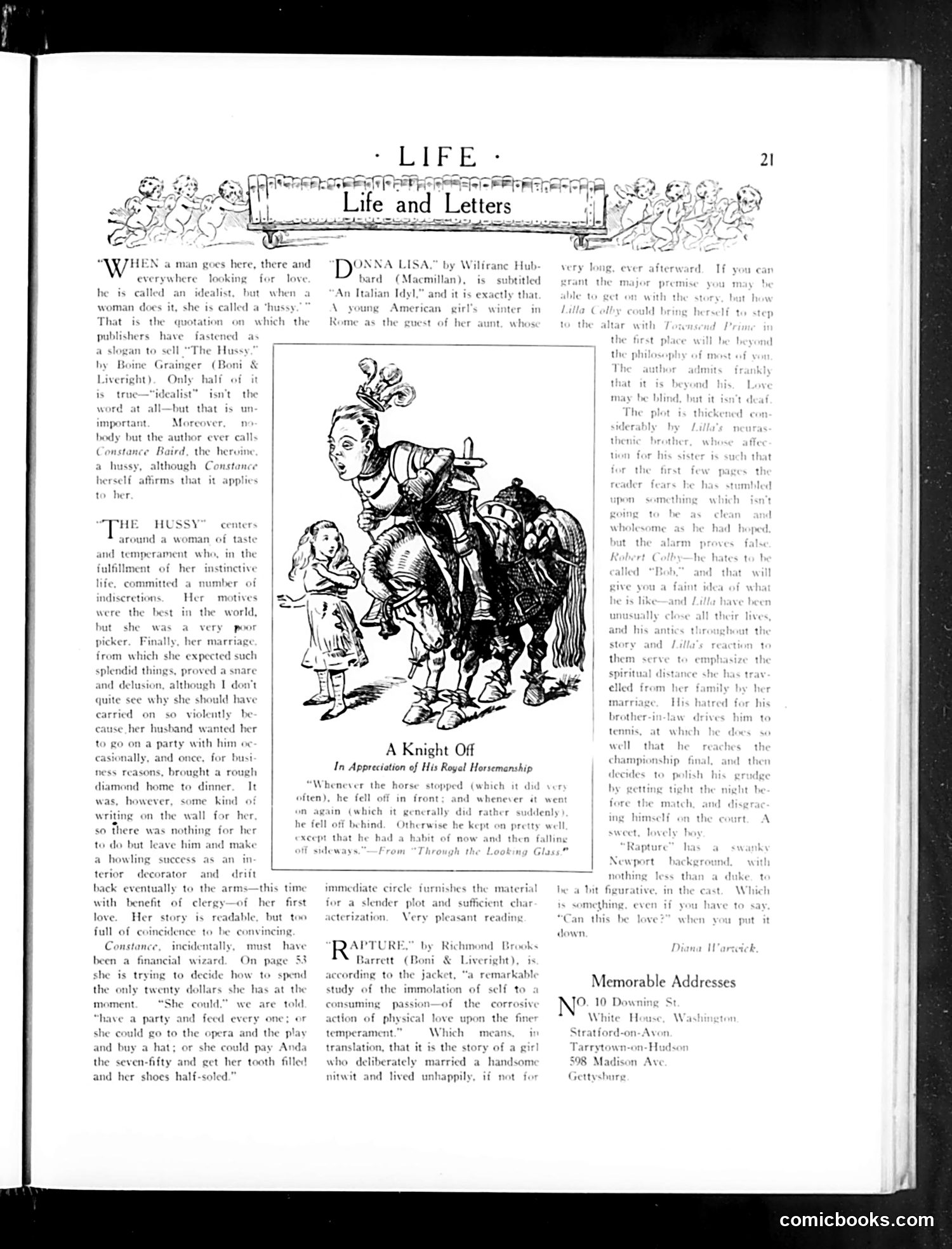
This page from *Life* magazine contains book reviews and literary commentary. The main illustrated piece, "A Knight Off," appears to be a humorous sketch depicting a mounted rider (likely aristocratic, given the formal dress) with accompanying children or attendants. The caption references "His Royal Horsemanship," suggesting satirical commentary on someone's equestrian pretensions or actual riding abilities. The page reviews several novels, including *Donna Lisa* (an Italian-set romance about an American girl) and *Rapture* (described as studying "the immolation of self to a consuming passion"). The reviews critique these works with *Life*'s characteristic blend of wit and skepticism about romantic idealism in literature. The overall tone mocks both the sentimental plots of contemporary fiction and the financial anxieties of modern women—one character must choose between attending the opera, buying a hat, getting dental work, or repairing shoes.
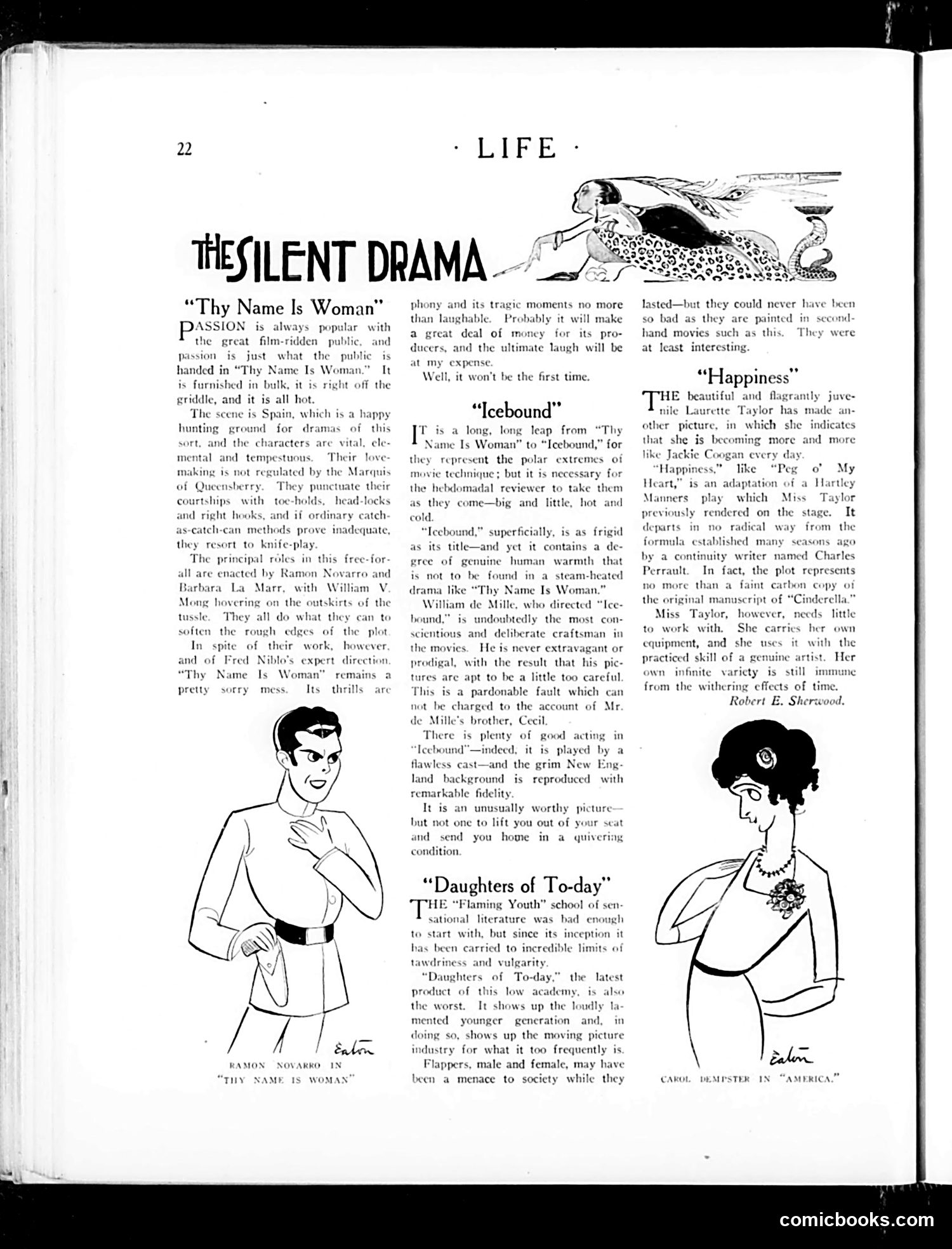
This page contains three film reviews from Life's cinema criticism section, circa the 1920s silent era. **"Thy Name Is Woman"** stars Ramon Novarro and Barbara La Marr in a Spanish passion drama. The reviewer dismisses it as a "sorry mess" despite competent acting—passionate but formulaic melodrama that relies on physical action (fights, "head-locks") rather than genuine drama. **"Icebound,"** directed by William de Mille, is praised as technically accomplished and carefully crafted, yet criticized as emotionally cold and derivative (a "faint carbon copy of Cinderella"). Laurette Taylor is noted as increasingly resembling child actor Jackie Coogan—likely a backhanded compliment about her youthful appearance. **"Daughters of To-day"** is harshly condemned as embodying the worst of "Flaming Youth" sensationalism, exploiting flappers and modern youth culture. The review criticizes both the film and the movie industry for pandering to vulgarity. The illustrations show glamorized female figures typical of 1920s art deco style.
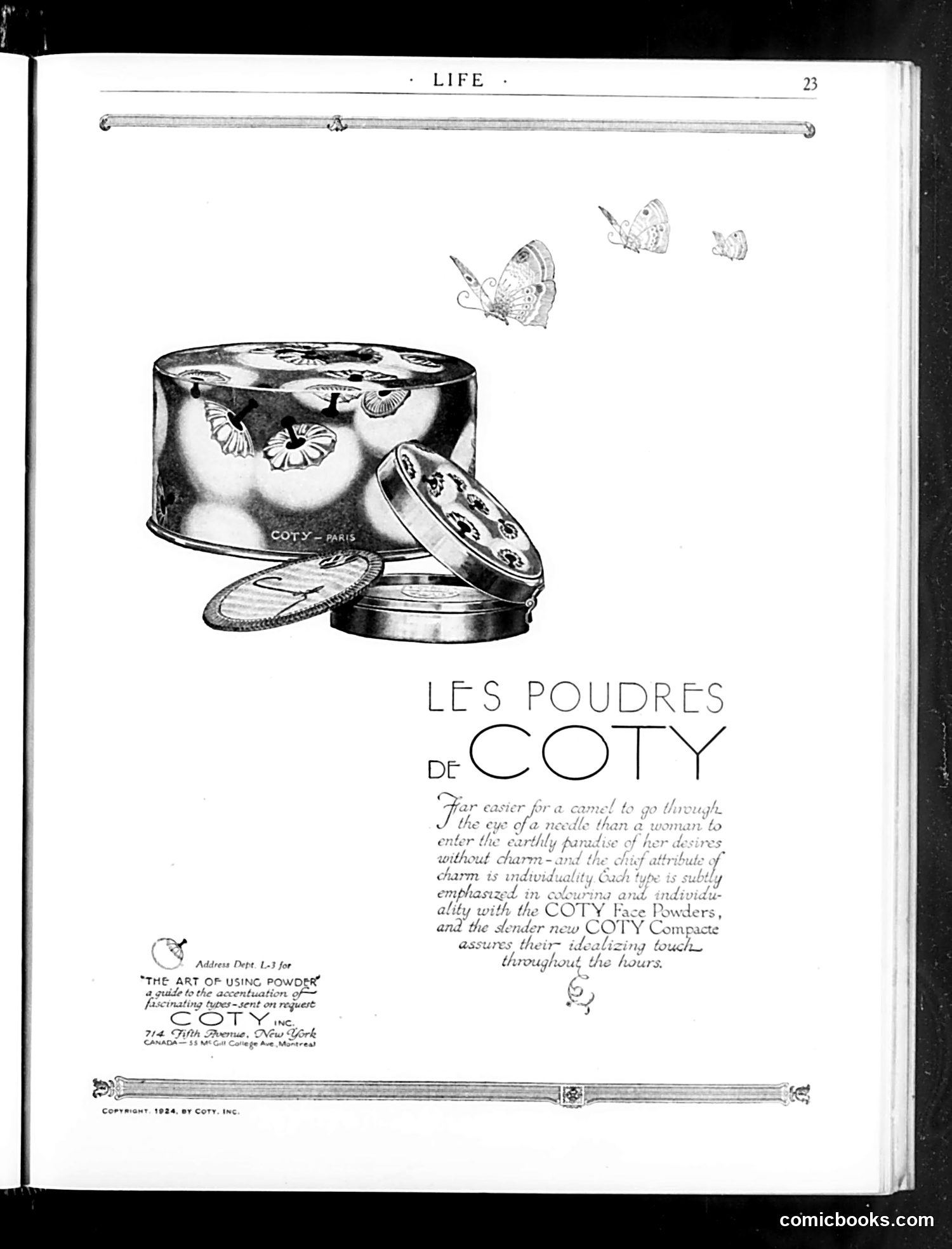
This is a **Coty cosmetics advertisement**, not a political cartoon. The page features "Les Poudres de Coty" (Coty Powders), a French beauty brand. The illustration shows decorative powder compacts with butterfly motifs, accompanied by poetic text emphasizing how Coty products help women achieve their "idealizing touch" throughout the day. The advertisement appeals to 1920s beauty standards, positioning powder as essential to feminine charm and appearance. There is no political satire or social commentary—this is straightforward commercial messaging from a luxury cosmetics company advertising in *Life* magazine's pages. The butterfly imagery suggests elegance and transformation.
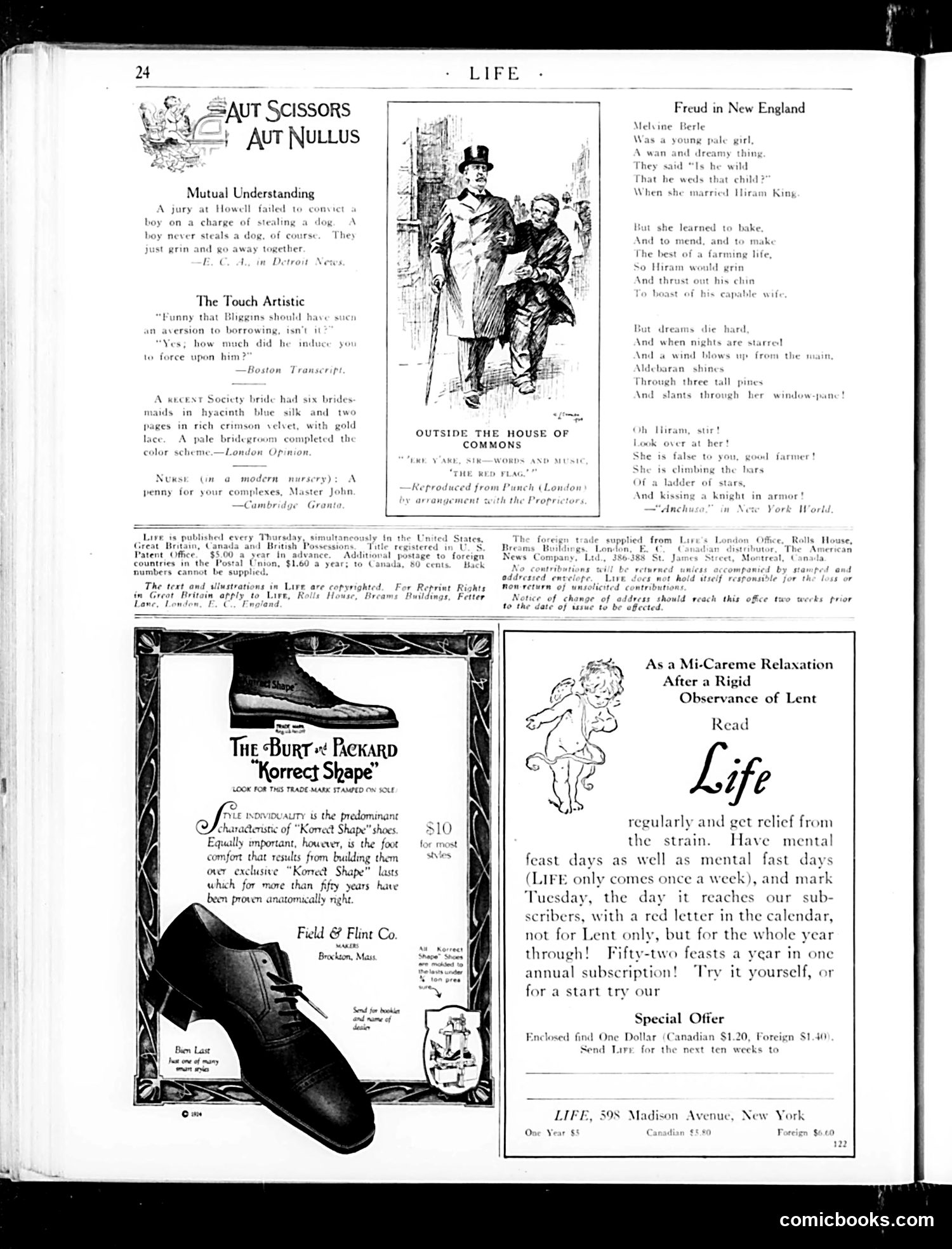
This is primarily an **advertising and promotional page** from Life magazine, with minimal satirical content. The main elements include: **"Aut Scissors Aut Nullus" section**: Brief humorous anecdotes ("Mutual Understanding," "The Touch Artistic") typical of Life's light comic filler—short jokes about human behavior and social awkwardness. **"Freud in New England"**: A poem satirizing Freudian psychology applied to New England rural life, mocking how psychological theories were being popularized. It follows a young woman's disappointed dreams of farming life with her husband Hiram. **"Outside the House of Commons"**: An illustration (likely political) credited to Punch, though details are unclear from the image. **Dominant content**: A large advertisement for Field & Flint Co.'s "Korrect Shape" shoes ($10) and a subscription promotion for Life magazine itself, framed as Lenten relief ("After a Rigid Observance of Lent"). The page reflects Life's function as both satirical magazine and commercial publication, blending social humor with advertising.
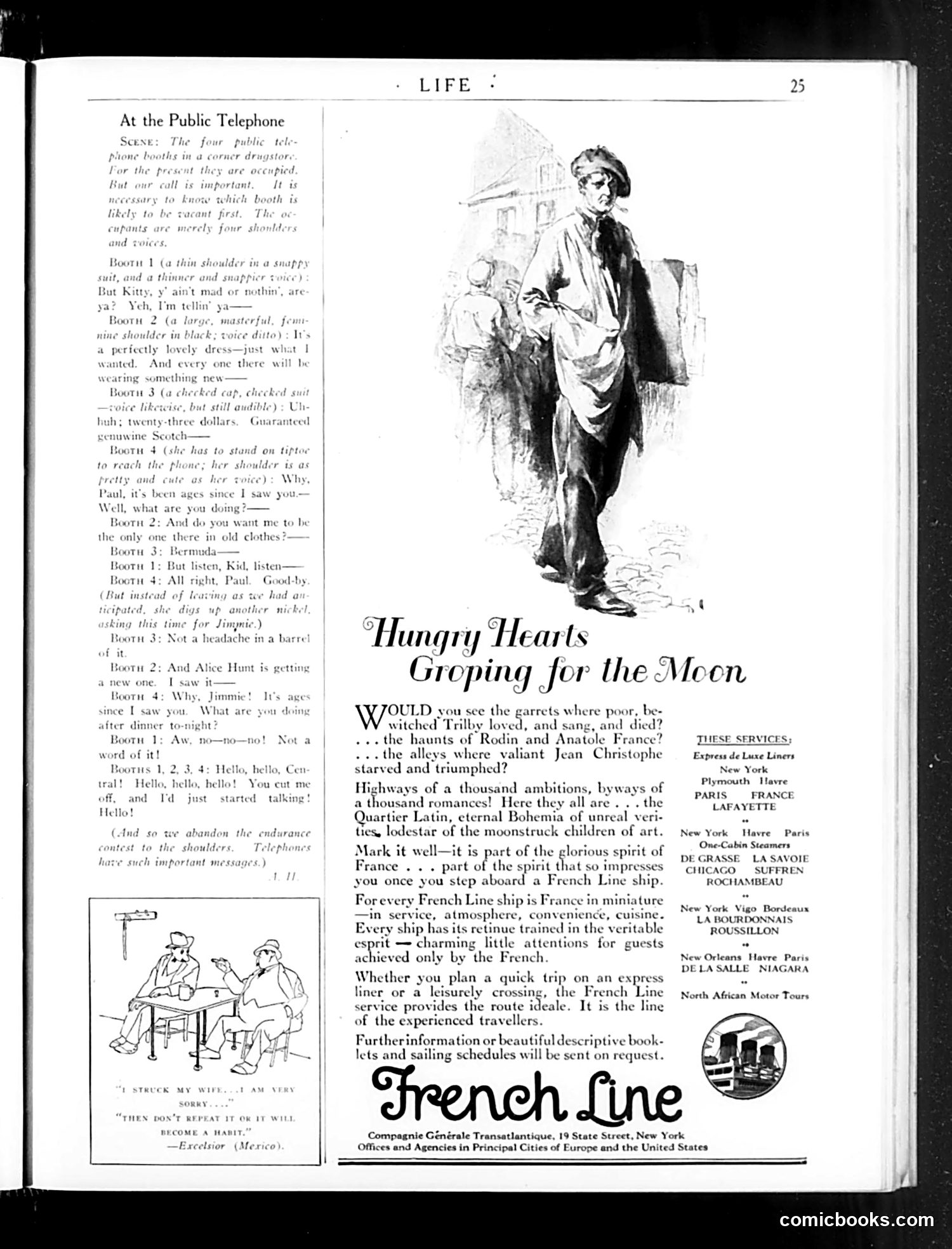
This page contains two distinct elements: **Upper Section - "At the Public Telephone":** A brief comedic sketch depicting four people in phone booths awkwardly trying to make calls while crowded together. The humor derives from the characters interrupting each other and the absurdity of the cramped public telephone setup—a relatable urban inconvenience for 1920s readers. **Lower Section - Advertisement:** A French Line cruise ship advertisement disguised as editorial content. It romanticizes Paris and bohemian life (referencing literary figures Trilby, Rodin, Anatole France, and Jean Christophe) to entice wealthy American travelers. The ad emphasizes French cultural superiority and hospitality. The page juxtaposes mundane American urban frustration with aspirational European travel—a common Life magazine strategy. The cartoon mocks ordinary American life while the advertisement sells escape to sophisticated European destinations.
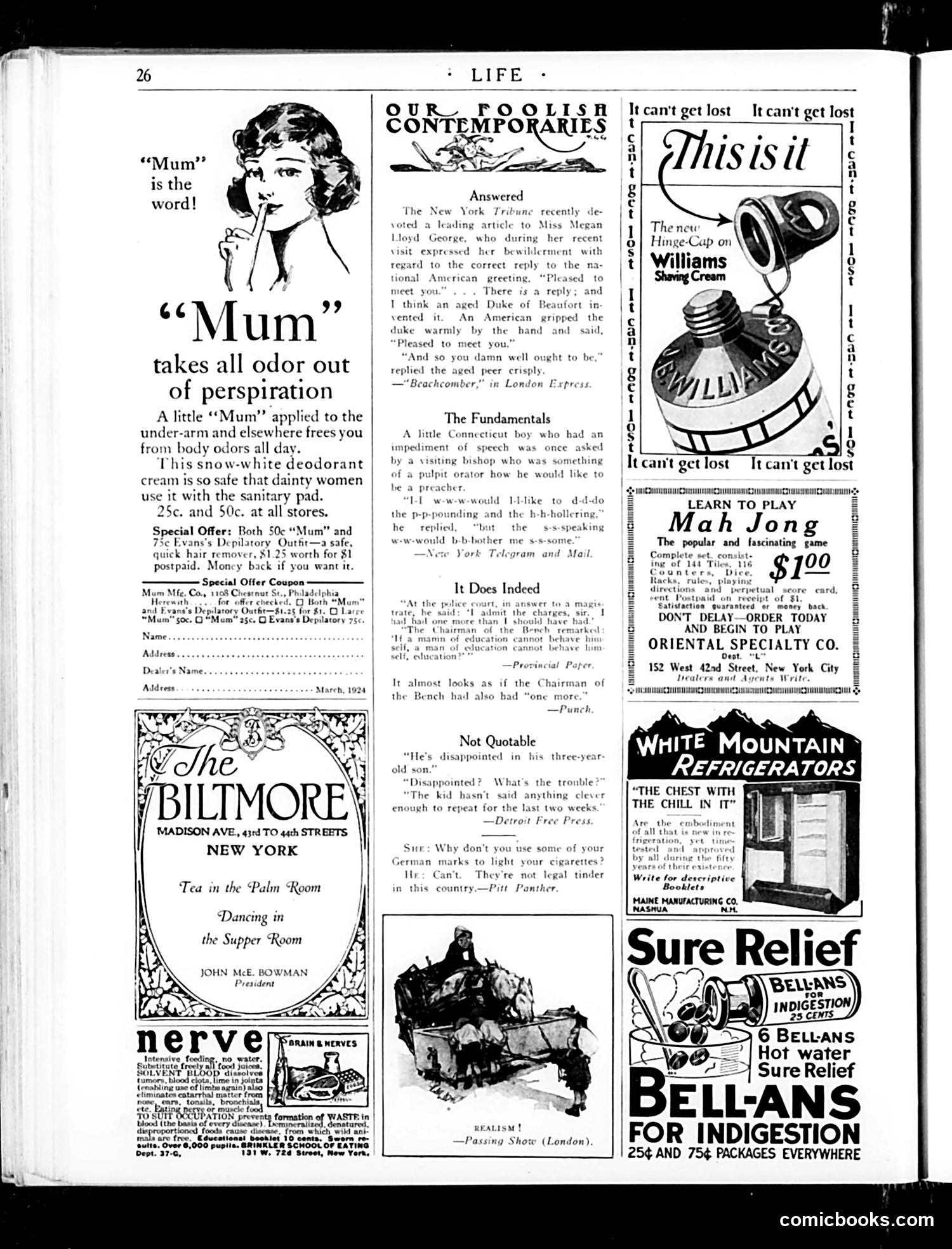
This page is primarily **advertising**, with several humor columns interspersed. The main content includes satirical pieces addressing contemporary social topics: **"Our Foolish Contemporaries"** features brief anecdotes mocking modern etiquette and behavior—including a piece about American greeting customs (the phrase "Pleased to meet you" versus British formality) and a joke about a stammering boy wanting to be a preacher. **The humor relies on observational comedy** about 1920s American life: speech impediments, generational gaps, and cultural differences between Americans and British aristocrats. The **advertisements reflect period concerns**: Mum deodorant (marketed to women concerned about body odor), nerve tonics, hair removal products, and indigestion remedies—suggesting anxieties about social propriety, health, and modernity. **Mah Jong** appears as a "popular and fascinating game," reflecting the 1920s craze for this Chinese import. The overall tone is lighthearted social satire aimed at middle-class readers navigating modern consumer culture and changing social conventions.
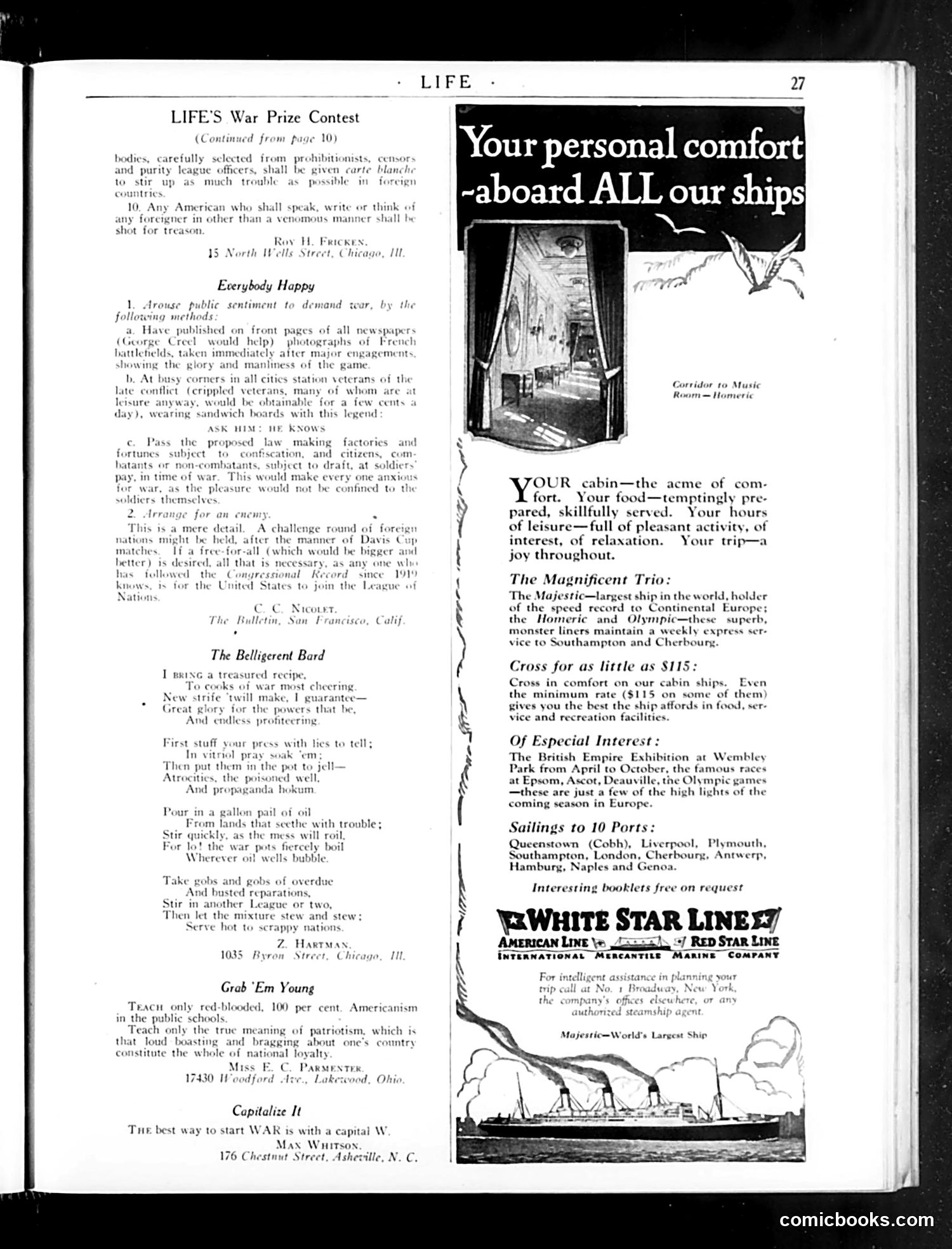
This page presents **satirical contest entries mocking jingoism and war propaganda** during or after World War I. Rather than single cartoons, it's a collection of bitter satirical "prize" submissions from readers proposing absurd policies. Key entries include: - **Roy Prickes' proposal**: Execute Americans who speak favorably of foreigners—mocking extreme xenophobia - **"Everybody Happy"**: Suggests using war photographs and disabled veterans as propaganda tools to maintain public enthusiasm for conflict - **"The Belligerent Bard"**: A poem recipes for manufacturing war through lies, atrocities, and inflammatory press coverage - **"Grab 'Em Young"**: Critiques jingoistic "100% Americanism" propaganda in schools - **"Capitalize It"**: A pun suggesting war-mongering should be formalized The satire targets **wartime hysteria, censorship (referencing George Creel's propaganda bureau), militarism, and the exploitation of veterans**—condemning how governments manufacture consent for warfare through manufactured patriotism and controlled media. The **White Star Line advertisement** appears incongruously placed, perhaps highlighting commercial opportunism amid war discourse.
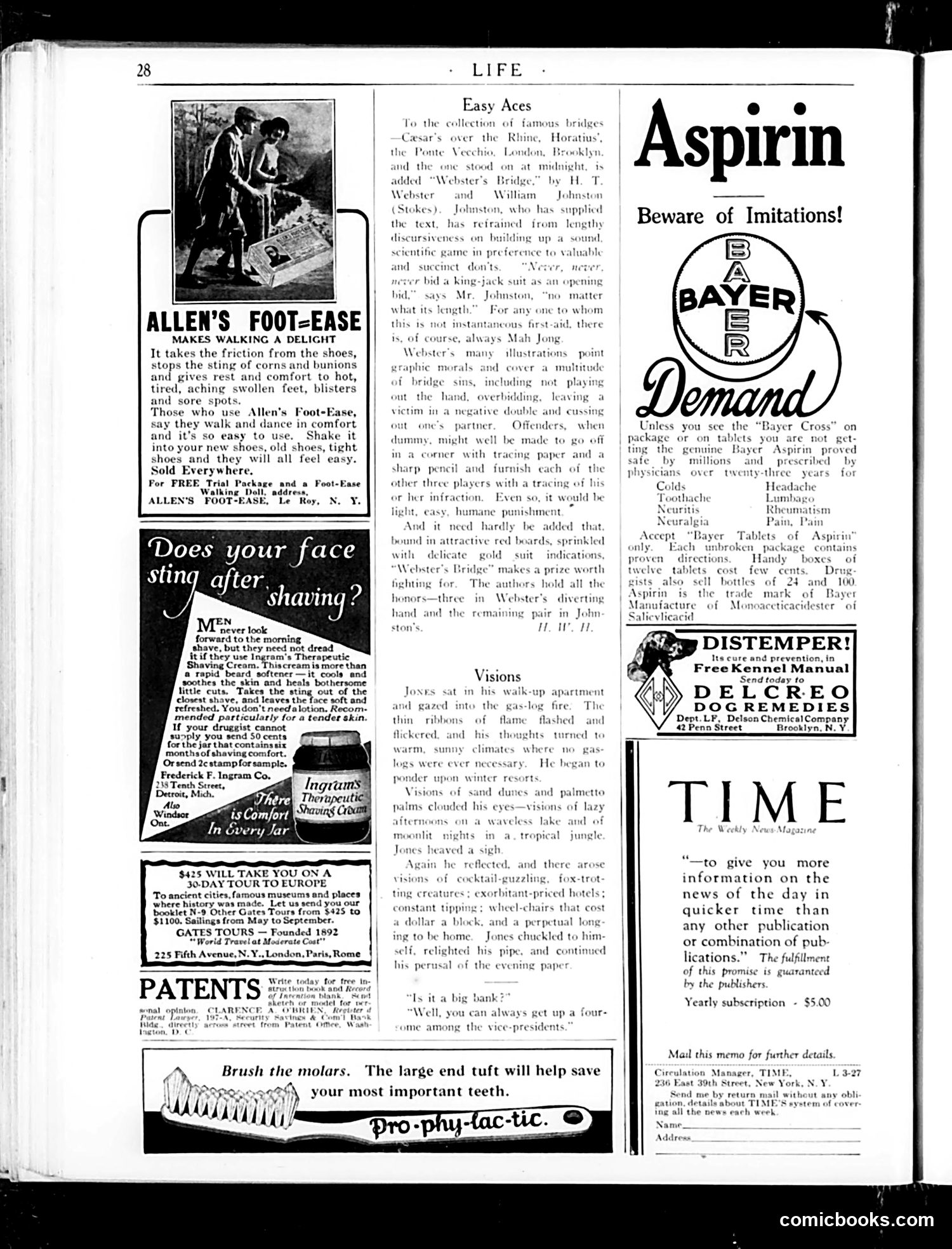
This page is primarily **advertising**, with one short humorous story excerpt ("Visions"). The ads promote consumer products common in the 1920s: foot powder, shaving cream, bridge instruction books, aspirin, dog remedies, and travel tours. The only narrative content is a brief tale where Jones, sitting by his fireplace, daydreams of tropical vacations—sand dunes, palmetto palms, lazy afternoons by lakes. The humor is gentle and relatable: the contrast between his cold, boring reality and his escapist fantasies. The page's satire is **implicit rather than explicit**—the ads surrounding this daydream ironically underscore how ordinary life's minor discomforts (sore feet, razor burn, pet illness) dominate people's concerns, making exotic escape fantasies appealing. The juxtaposition suggests both the appeal and impossibility of such dreams for average consumers.
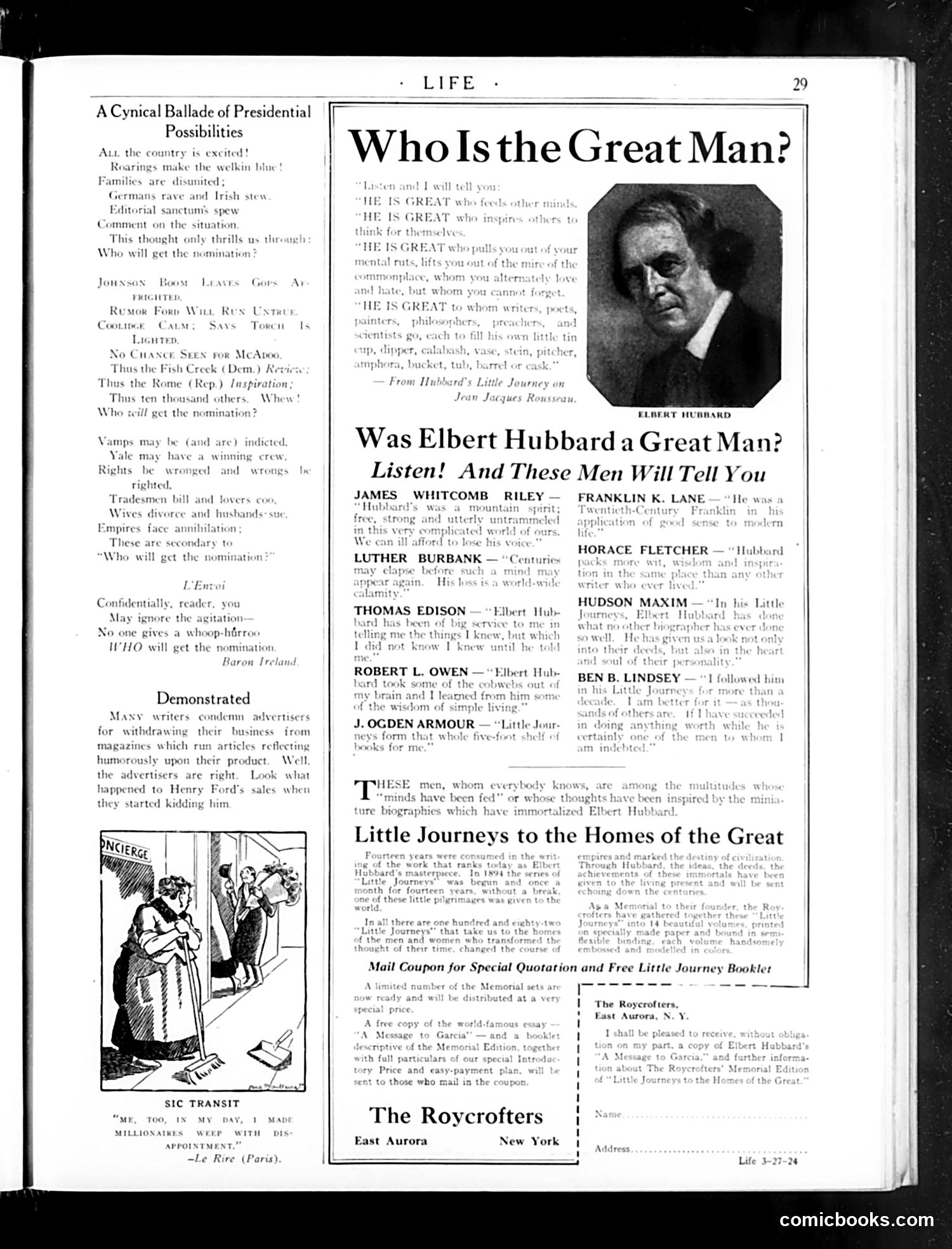
This page promotes **Elbert Hubbard**, a self-help author and businessman, by featuring testimonials from famous contemporaries (James Whitcomb Riley, Thomas Edison, Luther Burbank, Hudson Maxim, etc.) attesting to his greatness. The page's **satire** appears in the left column: a cynical poem mocking the 1924 presidential election cycle, where numerous candidates compete for the nomination. The opening lines mock public excitement and media circus around political possibilities—the joke being that everyone from various factions claims viability. Below this, a small cartoon labeled "Sic Transit" shows a woman at a door; the caption jokes that wealthy men now weep with disappointment (rather than joy) when disappointed—a swipe at how prosperity has changed even emotional responses. The **central irony**: while the left column cynically questions *who* deserves the presidency, the right aggressively markets Hubbard as unquestionably "great," using celebrity endorsements as proof. This juxtaposition suggests skepticism about how greatness is manufactured through publicity and testimonials.
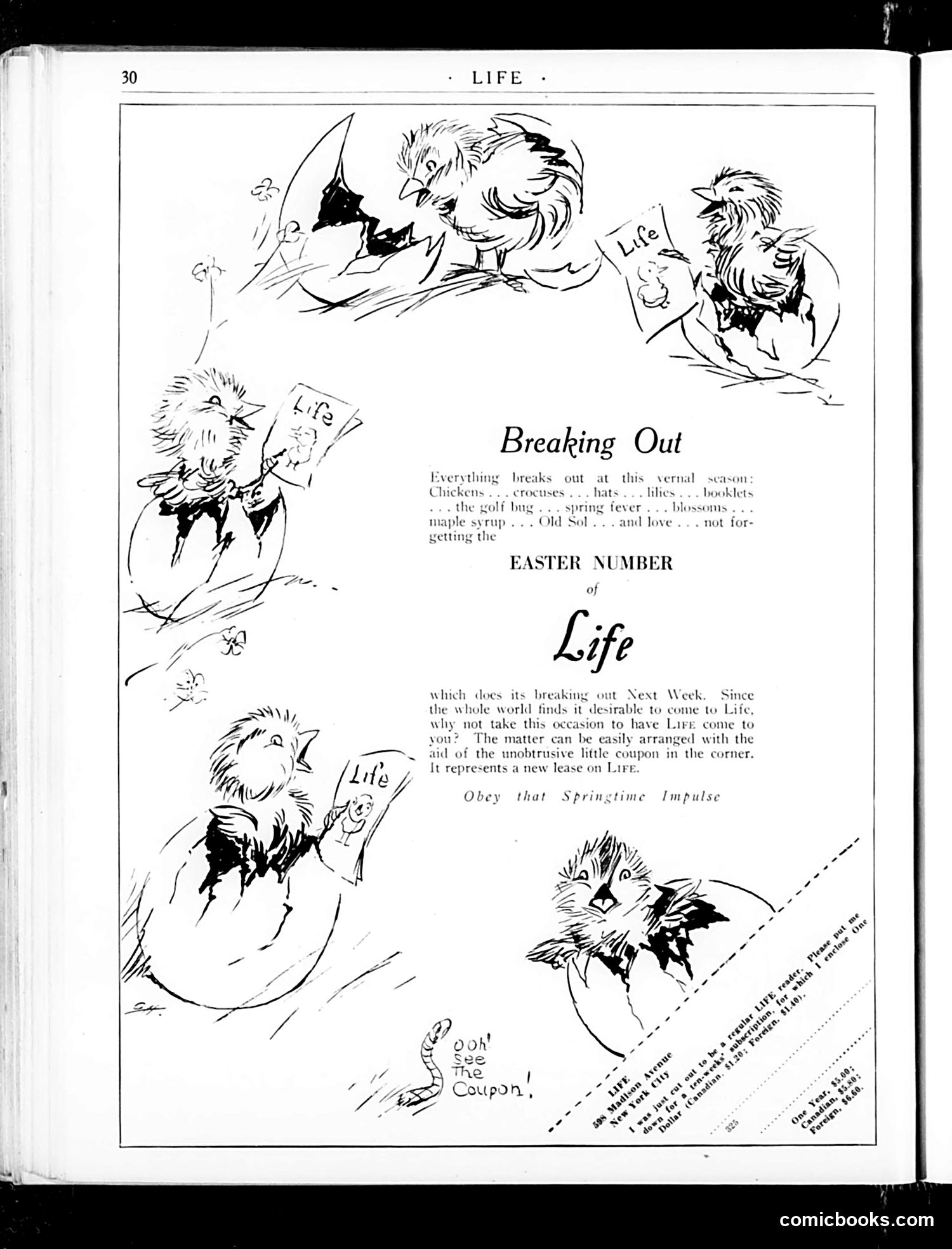
This is a promotional page for Life magazine's Easter issue, using springtime as its theme. The cartoons depict anthropomorphized animals—chicks hatching from eggs—"breaking out" to symbolize spring's renewal. The imagery plays on the phrase "breaking out," which the text explains refers to various springtime phenomena: chickens, flowers, new fashions, golf season, maple syrup harvest, and romantic love. The page functions as advertisement disguised as editorial content. It encourages readers to subscribe to Life by presenting the upcoming Easter number as desirable and urging them to "obey that springtime impulse." The coupon mentioned represents a "new lease on Life"—a pun on both the magazine's name and springtime rebirth. The overall tone is lighthearted seasonal humor typical of early 20th-century American periodical marketing.
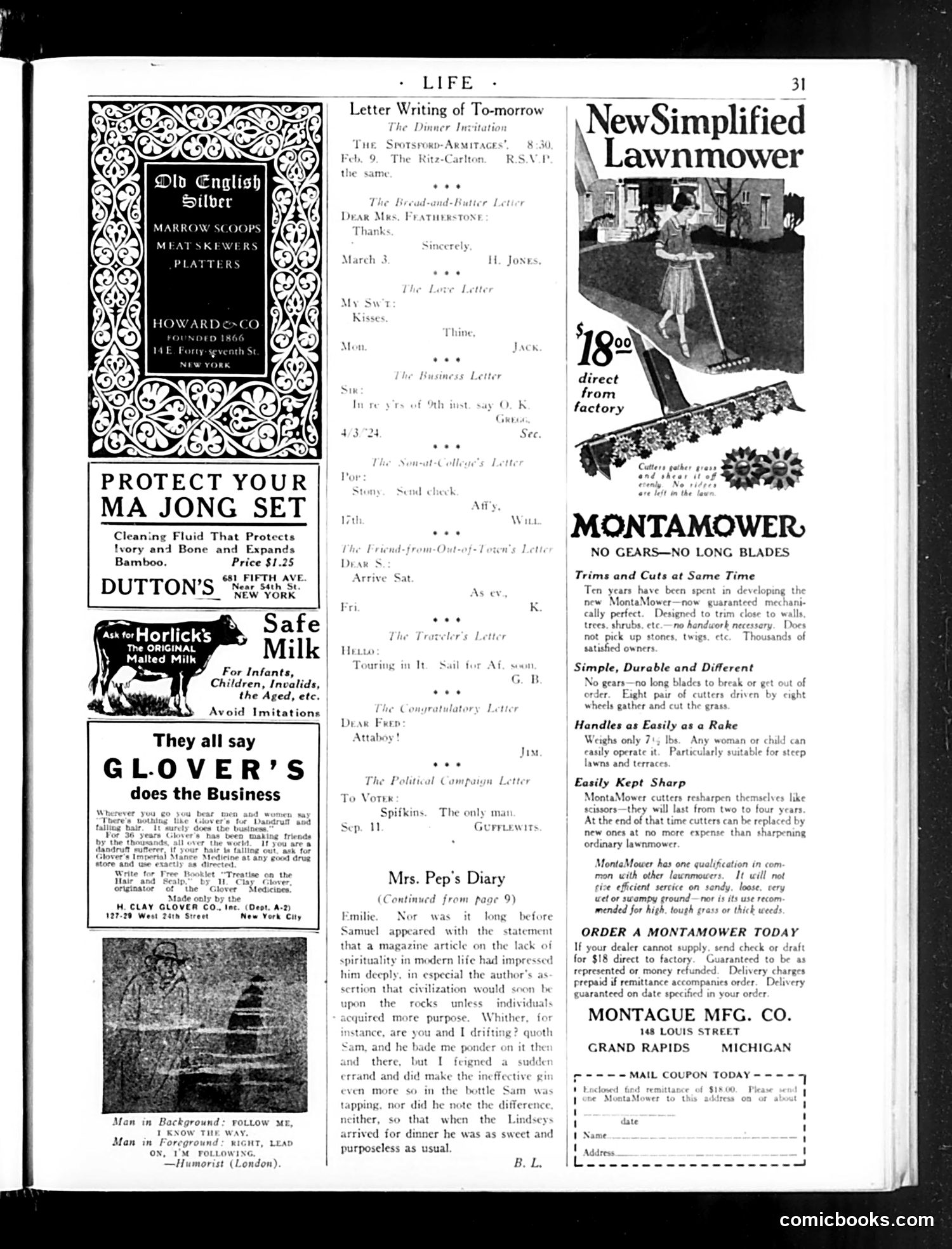
This Life magazine page is primarily **advertising-heavy** rather than satirical content. The main elements are: **Advertisements** dominate: Old English silver flatware, Ma Jong set cleaner, Horlick's malted milk, and Glover's (appears to be a medicinal/hygiene product). **"Letter Writing of To-morrow"** is a brief satirical section mocking formal letter conventions of the era—showing humorously abbreviated business and social correspondence ("Thanks. Sincerely"). **The cartoon at bottom left** shows two men, one following the other, with the caption "I KNOW THE WAY" / "WELL, ON, I'M FOLLOWING"—a mild visual gag about blind leading the blind or unquestioning obedience, attributed to a London humor publication. **"Mrs. Pep's Diary"** continues a serialized domestic humor column about a character named Emilie and her husband Samuel's philosophical musings. The **MontaMower advertisement** is the largest feature—promoting a new simplified lawnmower design ($18 direct from factory). Overall, this reflects 1920s-era Life magazine's mix of advertising revenue and light domestic satire.
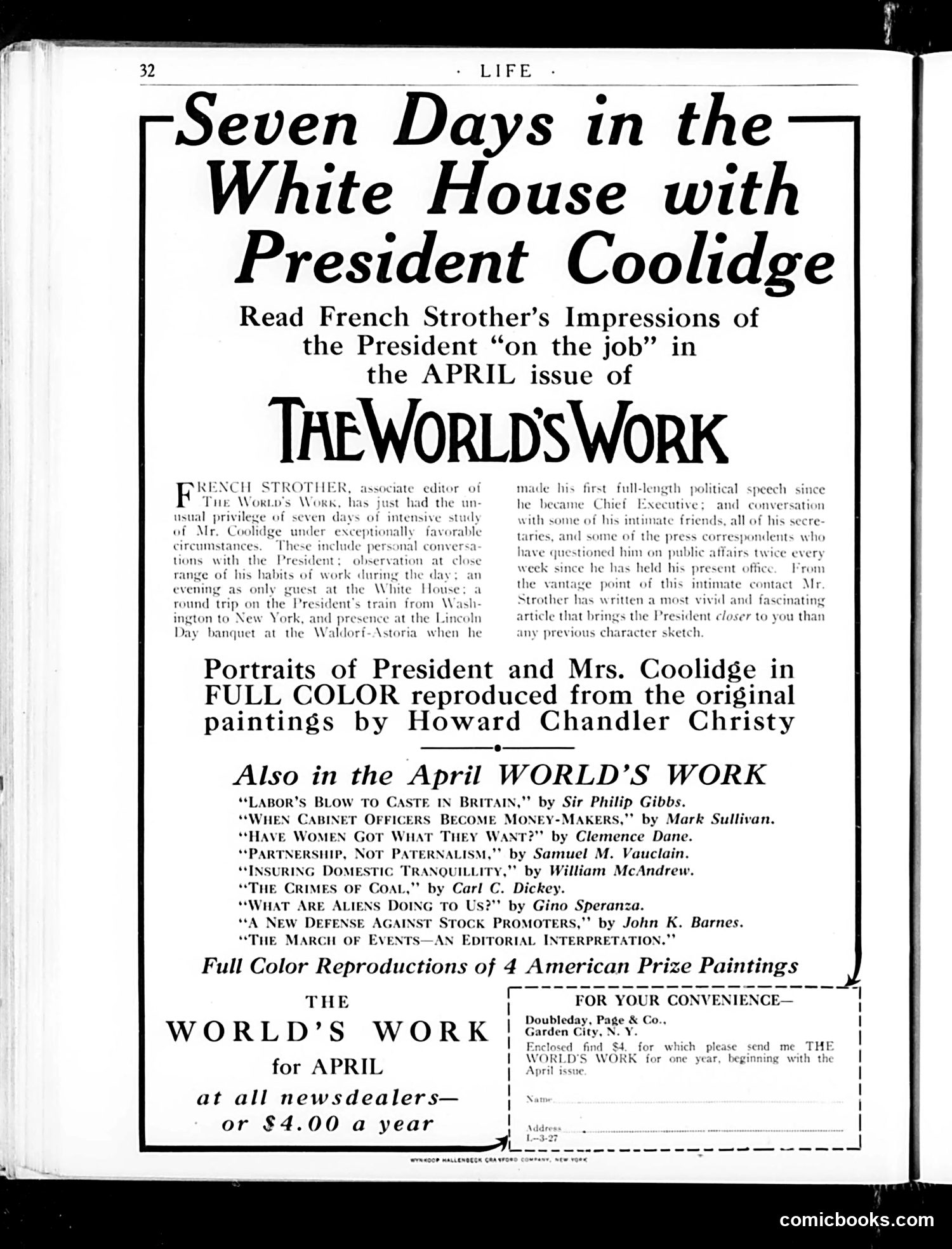
This is primarily a **magazine advertisement**, not a cartoon or satirical content. The page promotes an April issue of *The World's Work* magazine, featuring journalist French Strother's firsthand account of spending seven days observing President **Calvin Coolidge** at the White House. The piece emphasizes Coolidge "on the job"—depicting his daily habits, work routines, and private moments as an intimate portrait unavailable elsewhere. The advertisement highlights that the issue includes **full-color portraits** of Coolidge and his wife by famous painter Howard Chandler Christy, alongside other articles on labor issues, women's rights, coal industry crimes, and defense policy. **Historical context**: This appears to be from the 1920s, when Coolidge was president (1923-1929). The magazine marketed itself as serious political journalism, offering readers rare access to presidential life through celebrity reporting. The subscription offer ($4/year) appears at bottom.
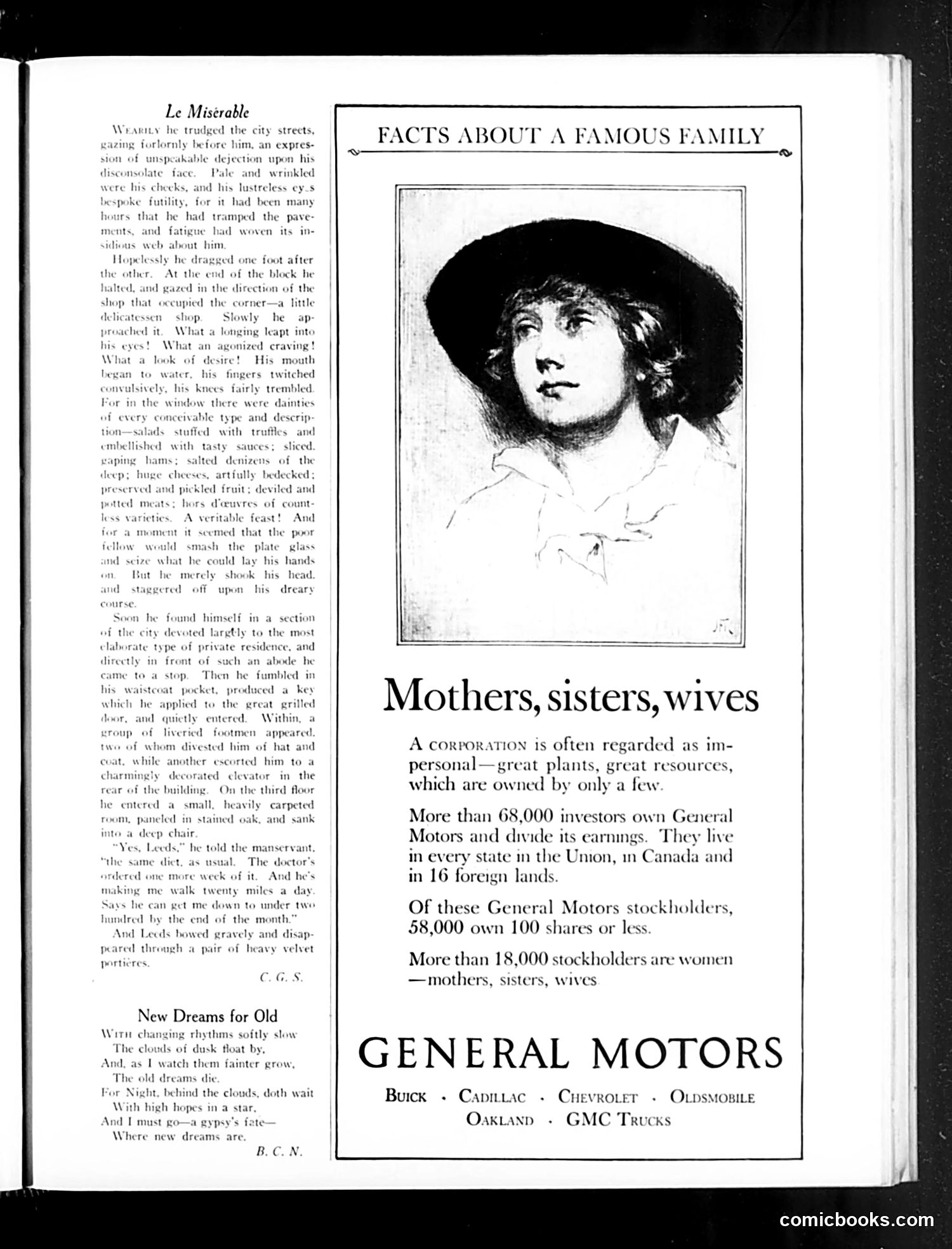
This page juxtaposes two satirical pieces. "Le Miserable" is a short story mocking wealth inequality: a starving vagrant gazes desperately at a delicatessen window laden with luxuries he cannot afford, then enters a grand mansion where he receives his doctor's prescribed diet—walking twenty miles daily to lose weight. The irony: the wealthy man suffers from *excess*, forced to exercise off his abundance, while the poor man starves before displays of food. The facing **General Motors advertisement** attempts to counter-satirize this class critique by promoting stock ownership as democratic wealth-sharing. It emphasizes that 68,000 ordinary Americans own GM stock, including 18,000 women ("mothers, sisters, wives"), with most owning modest amounts (100 shares or less). The ad implies capitalism benefits everyone, not just elites—a direct rebuttal to the story's indictment of economic disparity.
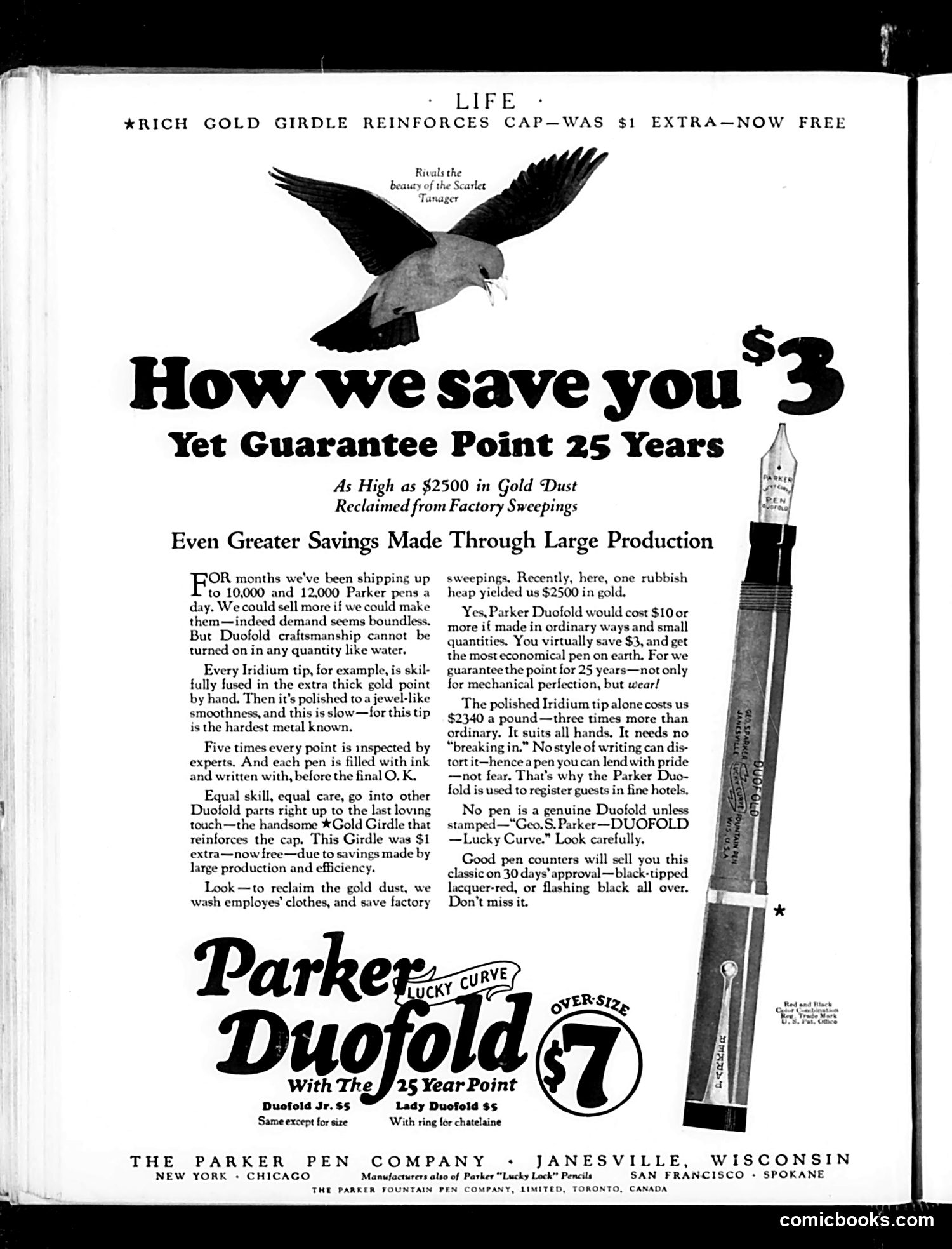
This is a full-page advertisement, not political satire. It promotes Parker's Duofold fountain pen, emphasizing luxury craftsmanship and value. The bird illustration (a Scarlet Tanager) serves as a decorative header, comparing the pen's beauty to nature. The ad's primary strategy is highlighting manufacturing efficiency: Parker claims to produce 10,000-12,000 pens daily, enabling cost savings passed to consumers. Key selling points include: a gold-reinforced cap (previously $1 extra, now free), a 25-year guarantee on the iridium writing point, and careful hand-inspection of each pen. The ad notes that reclaimed gold dust from factory sweepings yields significant value ($2,500 mentioned). For modern readers: this represents pre-Depression consumer marketing emphasizing both quality ("jewel-like smoothness") and affordability through mass production—a common advertising approach of the 1920s-30s era when fountain pens were essential luxury writing instruments.