
Life, 1924-03-27 · page 20 of 36
Life — March 27, 1924 — page 20: what you’re looking at
What you’re looking at
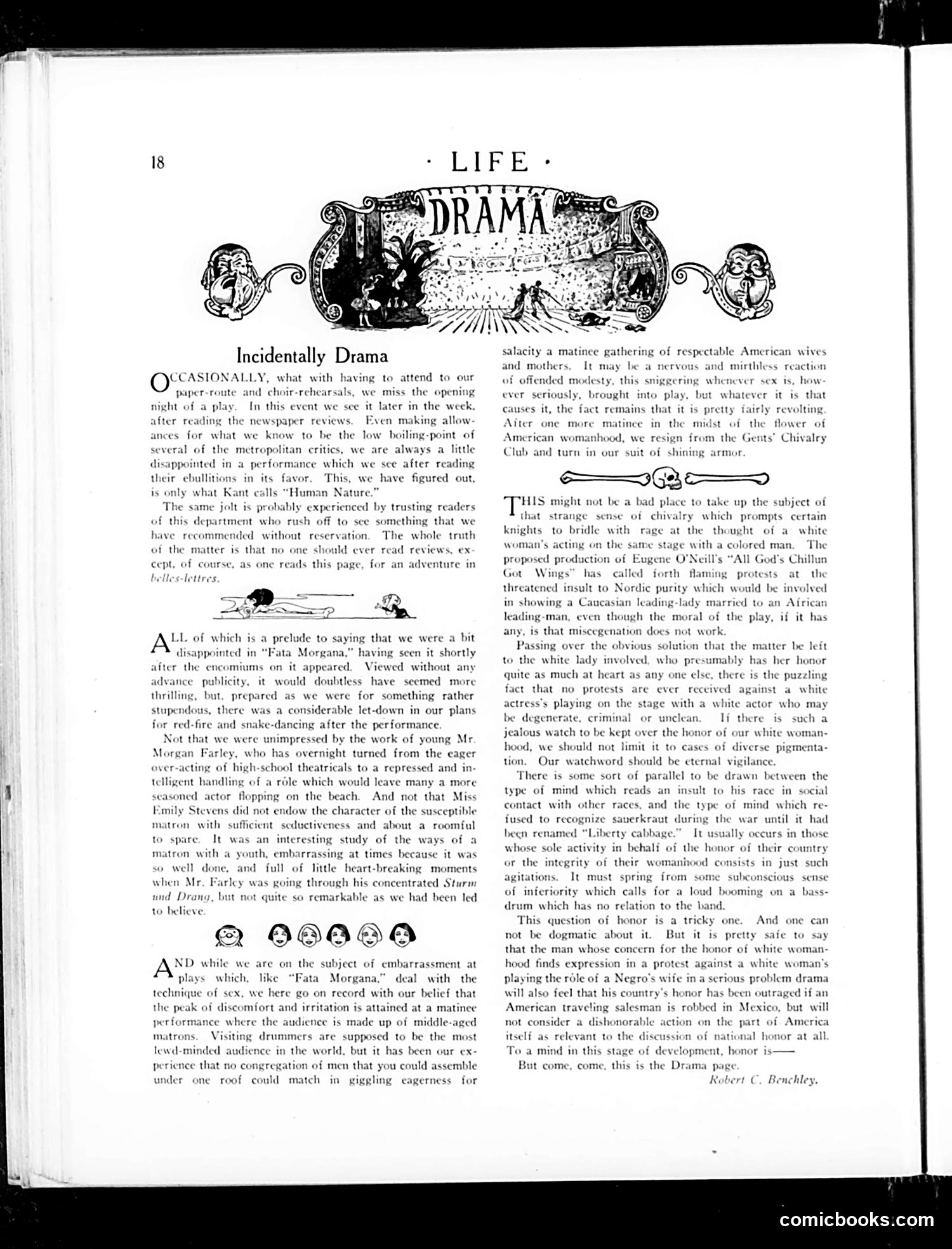
This page contains a theater criticism column by Robert C. Benchley discussing recent Broadway productions and audience behavior. The main satirical targets are: 1. **Theater critics and readers**: Benchley mocks how people read glowing reviews then feel disappointed seeing the actual play, noting this is just "Human Nature." 2. **"Fata Morgana"**: A recent play that received advance praise but underwhelmed in person. Benchley credits young actor Morgan Farley's understated performance and Emily Stevens' acting, but found it less remarkable than hyped. 3. **Matinee audiences**: The piece's sharpest satire targets middle-aged respectable American wives attending afternoon performances, claiming they giggle and react with more "salacity" (lustfulness) than any other demographic—a humorous jab at Victorian propriety masking actual interest in risqué content. 4. **"All God's Chilun Got Wings"**: Benchley criticizes protests against Eugene O'Neill's play featuring miscegenation, mocking the concept of "Nordic purity" and the performative chivalry that objects to such content. The decorative header and small portrait medallions are period magazine ornamentation typical of Life's design.
📄 Transcribed text from this page (OCR, searchable)
Machine-transcribed from the original scan — historical spelling and the odd misread are preserved.
Incidentally Drama OCCASIONALLY, what with having to attend to our paper-route and choir-rehearsals, we miss the opening night of a play In this event we see it later in the week, after reading the newspaper reviews ! Even making allow ances for what we know to be the low boiling-point of several of the metropolitan critics, we re always a little disappointed in a performance which we see their ebullitions in its favor. This, we have is only what Kant calls “Human Nature.” fter reading gured out, The same jolt is probably experienced by trusting readers this department who rush off sce something that we have recommended without reservation. T whole truth of the matter is that no one should ever read reviews, ex cept. of course, as one reads this page, for an adventure in belles-lettres. LL of which is a prelude to saying that we were a bit disappointed in “Fata Morgan: after the encomiums on it appeared advance having seen it shortly Viewed without any ‘e seemed more prepared as we were for something rather stupendous, there \ publicity, it would doubtless thrilling, but is a considerable let-down in our plans for red-fire and snake-dancing after the performance. Not that we were unimpressed by the work of young Mr Morgan rley, who has « ernight turned from the eager over-acting of high-school theatricals to a repressed and in- tellig nt handling of a role which would leave many a more seasoned actor flopping on the beach. And not that Miss Emily Stevens did not endow the character of the susceptible matron with sufficient seductiveness and a to spare. roomful the ways of a at times because it was so well done, and full of little heart-breaking moments when Mr. Farley was going through his concentrated Sturm { Drang, but not quite so remarkable as we had been led to believe. Q OHO — se ND while we are on the subject of embarrassment at A‘, s which, like “Fata techniqt about a It was an interesting study of matron with a youth, embarrassing Morgana,” deal with the @ of sex, we here go on record with our belief that the peak of discomfort and irritation is attained at a matinee performance where the audience is made up of middle-aged matrons. Visiting drummers are supposed to be the most lewd-minded audience in the world, but it has been our ex- perience that no ongregation of men that you could assemble one roof could match in giggling eagerness for salacity a matinee gathering of respectable American wives and mother of offended modesty, this. sni; It may be a nervous and mirthless reaction gering W henever sex is, how ever seriously, brought into play, causes it, the t whatever it is that fact remains that it is pretty fairly revolting Aiter one more matinee in the midst of the he Ger Club and turn in our suit of shining armor = 23638 HIS might not be a bad place to take up the subject of that strange sense of chiva knights to br flower of American womanhood, we resign from s’ Chivalry which prompts certain He with rage at the thought of a woman's acting on the same white lored man. The proposed production of Eugene O'Neill's “All God's Chillun Got Wings” has called forth flaming protests at the threatened insult to Nordic purity which would be involved in showing a Caucasian lea age with a g-lady married to an African leading-man, even though the moral of the play, if it has any, is that miscegenat does 1 a work, Passing over the obvious solution that the matter be left to the white lady involved, who amably has her honor quite as much at heart as any one else, there is the puzzling fact that no protests are ever received against a white actress's playing on the stage with a white be degener: ctor who may an. li there is such a jealous watch to be kept over the honor of our white woman- criminal or uncl hood, we should not limit it to cases of diverse pigmer tion. Our watchword should be eternal vigilance There is some sort of parallel to be drawn between the type of mind which reads an insult to his race in social t with other ra ces, and the type of mind which re- serkraut duris begn renamed “Liberty cabbage fused to recognize s:. the war until it had Tt usually oc those whose sole activity in behalf of the honor of their country or the integrity of their womanhood c sists in just such agitations, It must spring from some of inferiority which c subconscious sense ls for a loud booming on a bass- drum which has no relation to the band. This question of honor is a tricky one. And one can not be dogmatic about it. But it is pretty safe to say that the man whose concern for the honor of white woman hood finds expression in a protest against a white woman’s playing the réle of a Ne To's wife ina serious p will also feel that his country’s honor has been outraged if an American traveling salesn ‘oblem drama is robbed in Mexico, but will not consider a dishonorable action on the part of itself as relevant to the To a mind i But ¢ cussion of national this stage of development, honor is—— sme, come, this is the Drama pa Ri rt C. Benchley. comicbooks:com