
A complete issue · 36 pages · 1924
Life — February 28, 1924
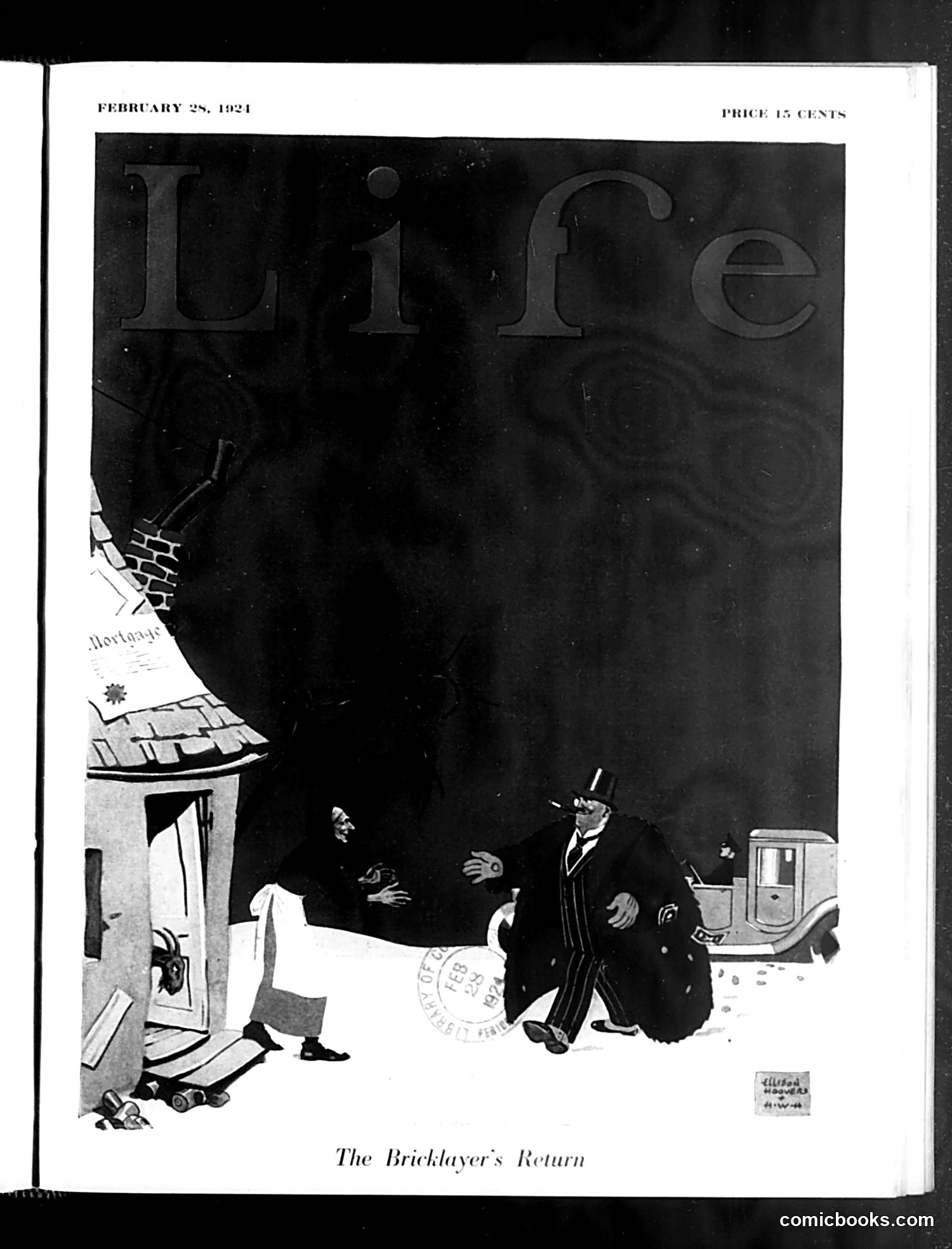
This cartoon satirizes the return of construction workers after a labor dispute or strike. The title "The Bricklayer's Return" suggests a worker coming back to his job, likely after negotiations or conflict with employers. The scene shows a well-dressed man (possibly representing management or authority) greeting or confronting a returning worker near construction equipment and a small building. The contrast between the formally-dressed figure and the worker, along with the somewhat awkward body language, suggests tension or an uncomfortable reunion. The large "Life" masthead dominates the page, indicating this was the magazine's main cover illustration. The specific labor dispute referenced appears tied to 1920s construction industry conflicts, though the exact event remains unclear without additional context.
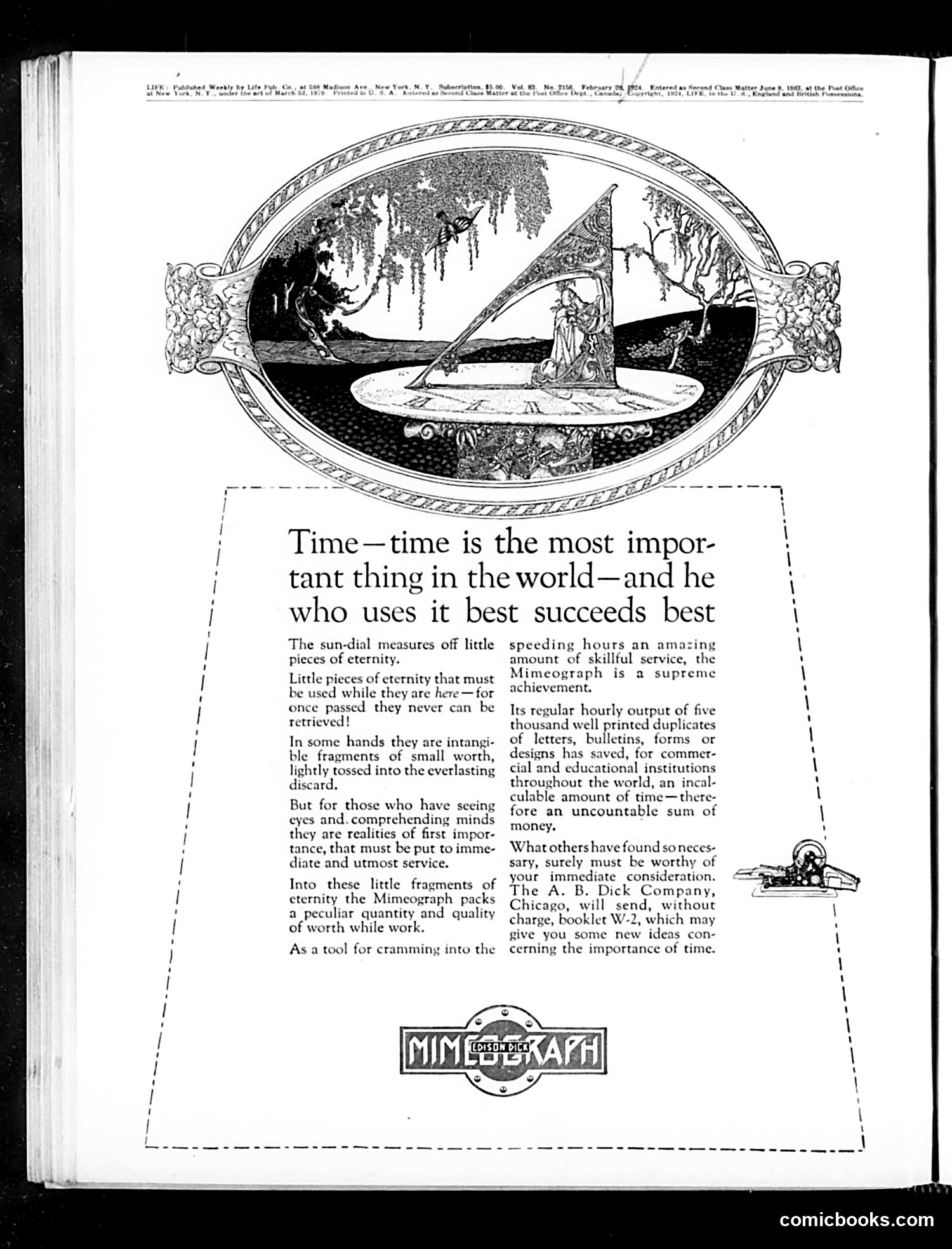
This is primarily a **Mimeograph advertisement**, not political satire. The ornate illustration depicts allegorical figures in a moonlit scene, likely representing time's passage and efficiency. The text's core message is commercial: "time is the most important thing in the world—and he who uses it best succeeds best." The ad argues that the Mimeograph machine—which produces multiple document copies quickly—helps organizations and businesses maximize productivity by "speeding hours an amazing amount of skilful service." The A.B. Dick Company (Chicago) positions their Mimeograph as a time-saving tool whose regular hourly output "has saved...an incalculable amount of money" for institutions worldwide. The satire, if present, is gentle: the grandiose artistic framing ironically contrasts with promoting a mundane office machine.
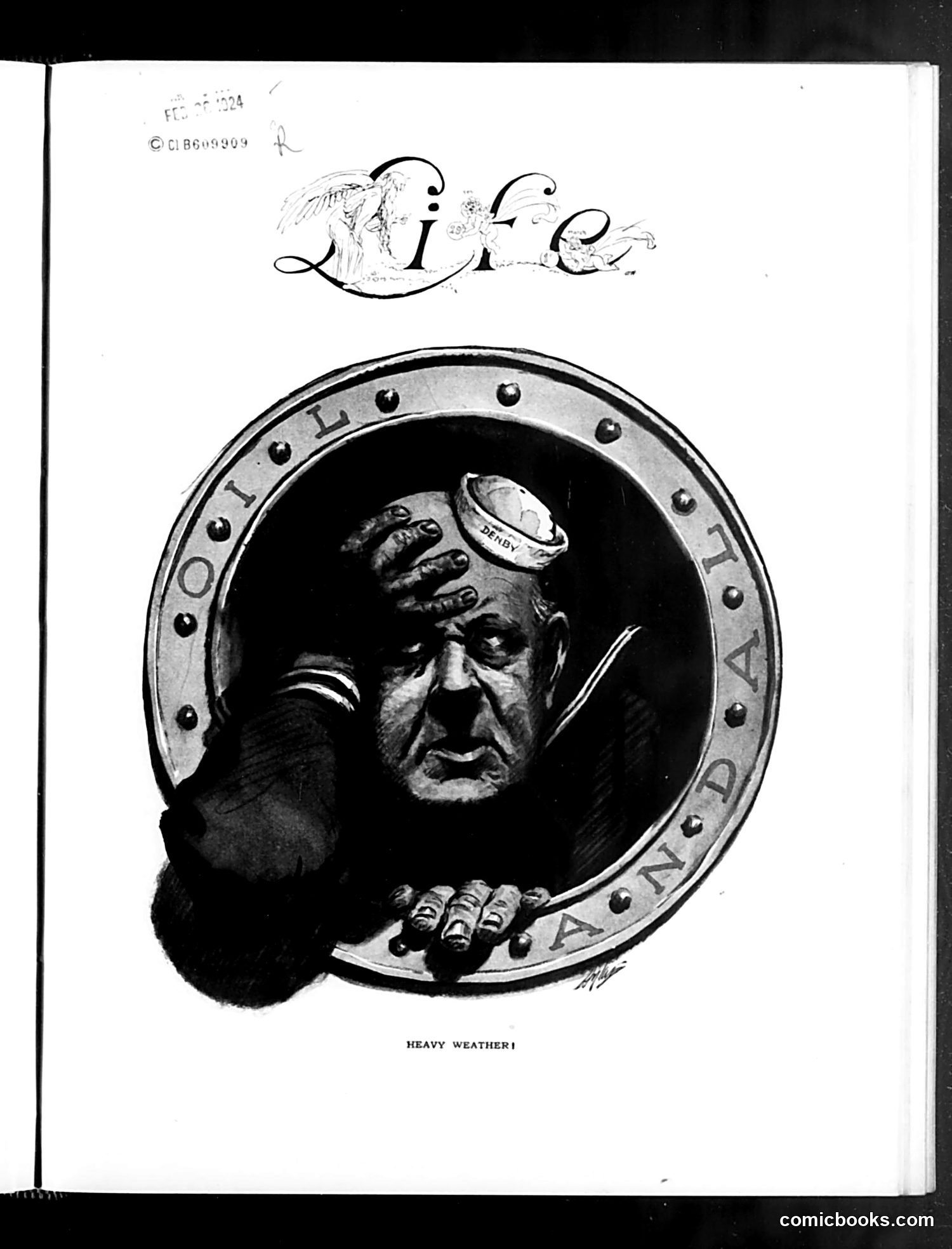
This page from *Life* magazine features a satirical illustration titled "Heavy Weather!" The image shows an elderly man's face framed within a porthole or circular opening marked "AND AT." The man appears rough and weathered, wearing what looks like a captain's or sailor's cap. The decorative header reads "Life" with an ornamental design. The porthole framing and nautical elements (rivets around the circular border) suggest a maritime context. The caption "Heavy Weather!" combined with the sailor imagery indicates this is likely political satire about a public figure facing turbulent circumstances or criticism. Without additional context or clearer identification, I cannot definitively name the figure depicted, though the caricature style and nautical metaphor suggest commentary on a political or public scandal during that era.
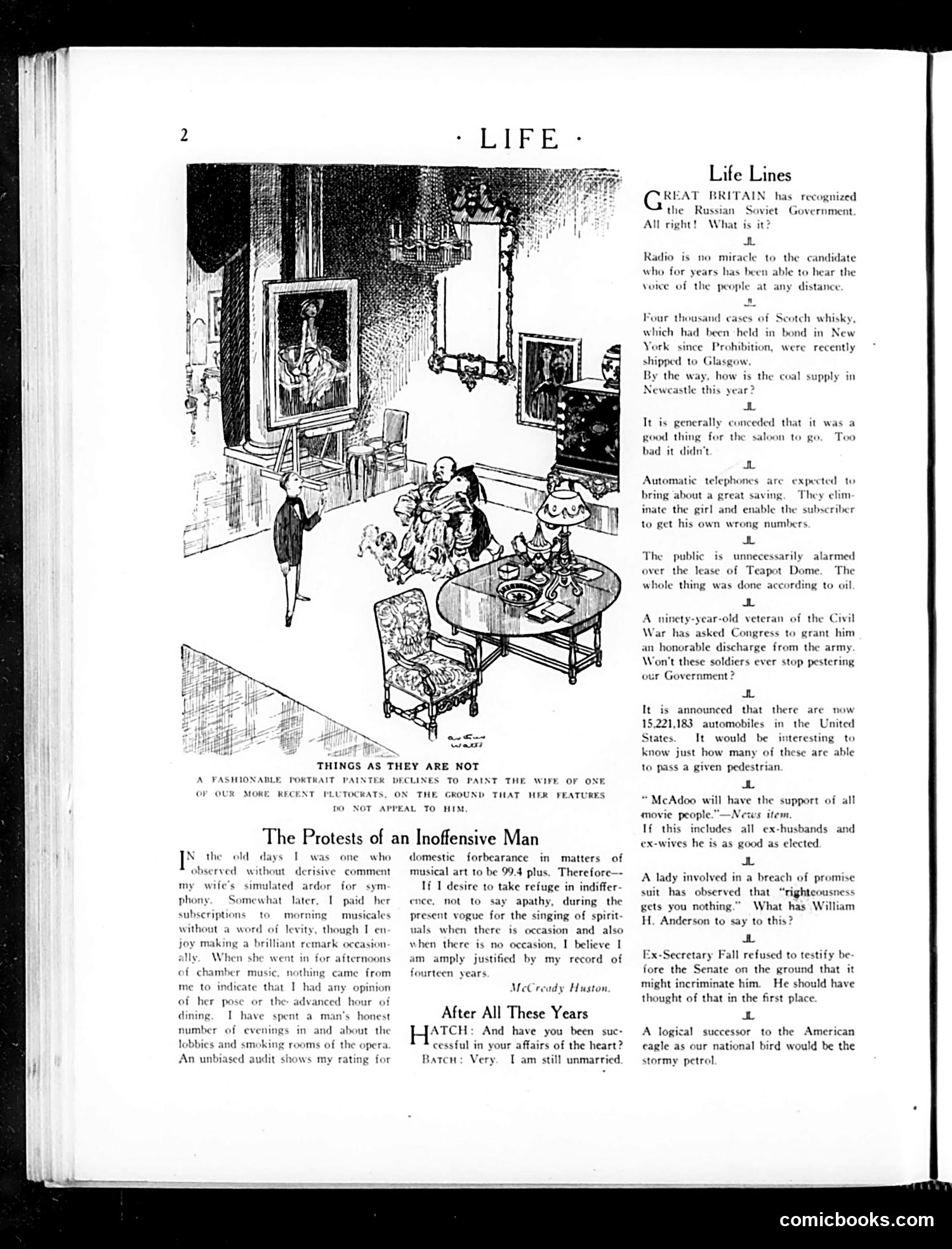
This cartoon satirizes fashionable portrait painters who flatter their wealthy subjects. The caption notes that a "portrait painter declines to paint the wife of one of our more recent plutocrats, on the ground that her features do not appeal to him"—a rare refusal in an era when wealthy patrons expected idealized depictions. The interior scene shows an elegant woman viewing framed portraits on the wall, suggesting the vanity market for commissioned society paintings. The satire targets both the pretensions of nouveau-riche clients demanding flattery and the complicity of artists in perpetuating false representations of wealthy subjects' appearances. It's a critique of the commercial art world's dishonesty and the culture of status-seeking among the newly wealthy.
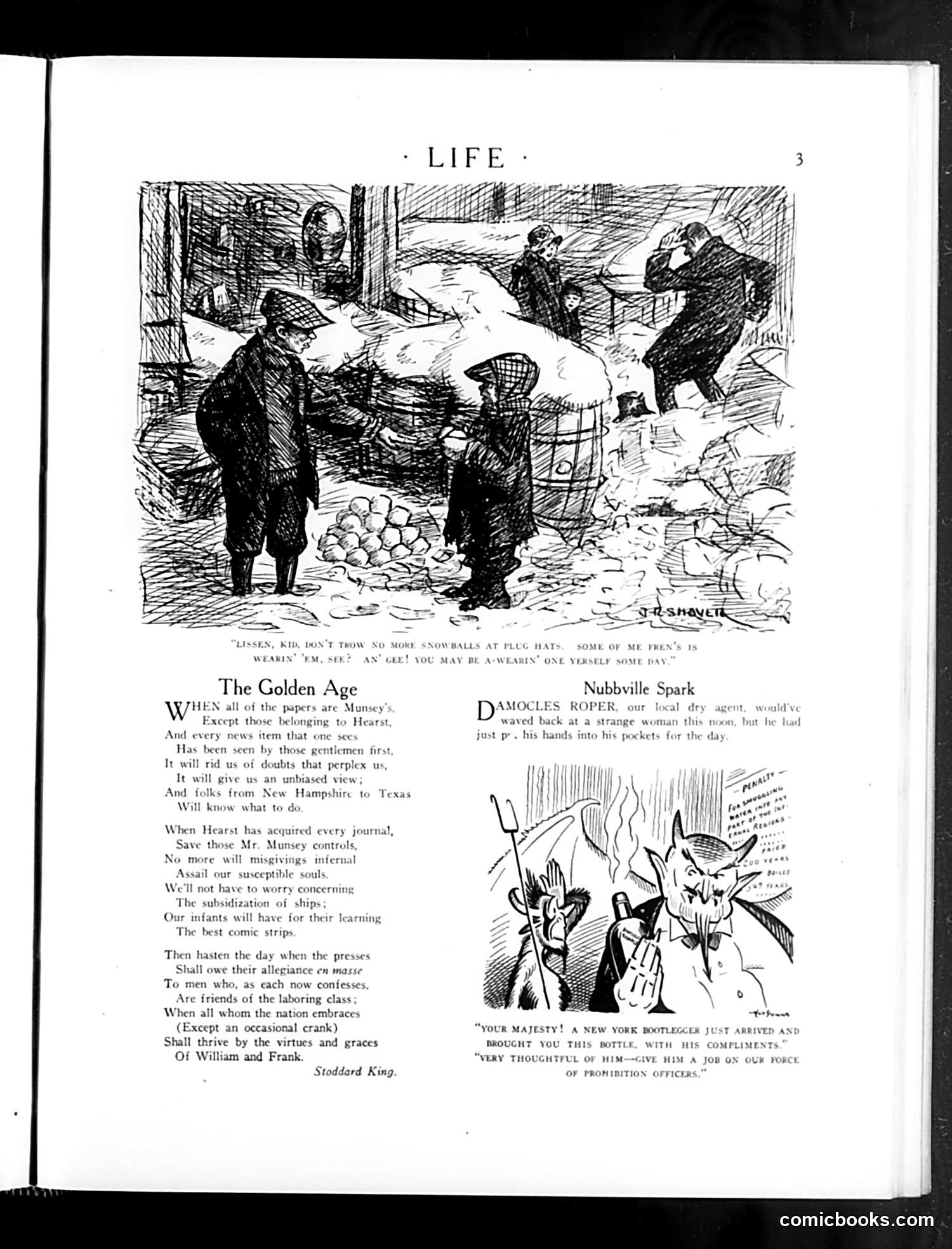
**Top Cartoon**: Shows children in snow with adults nearby. The caption references "Lisben, kid, isn't thou no more snowballs at Plug Hats—some of me fren's is wearin' 'em, see? An' gee! you may be a-wearin' one yerself some day." This appears to satirize class anxiety and childhood roughhousing, warning against throwing snowballs at expensive hats worn by the working poor. **"The Golden Age" (poem)**: Stoddard King's satirical verse criticizes media monopolization—specifically William Randolph Hearst's acquisition of newspapers. It warns that consolidated media control threatens democratic values and threatens freedom of the press. **"Nubbville Spark" (cartoon)**: Shows a rural bootlegger during Prohibition offering contraband liquor as a "gift" to dodge legal consequences. The humor lies in the obvious pretense that the alcohol is merely a courtesy gift, not a sale.
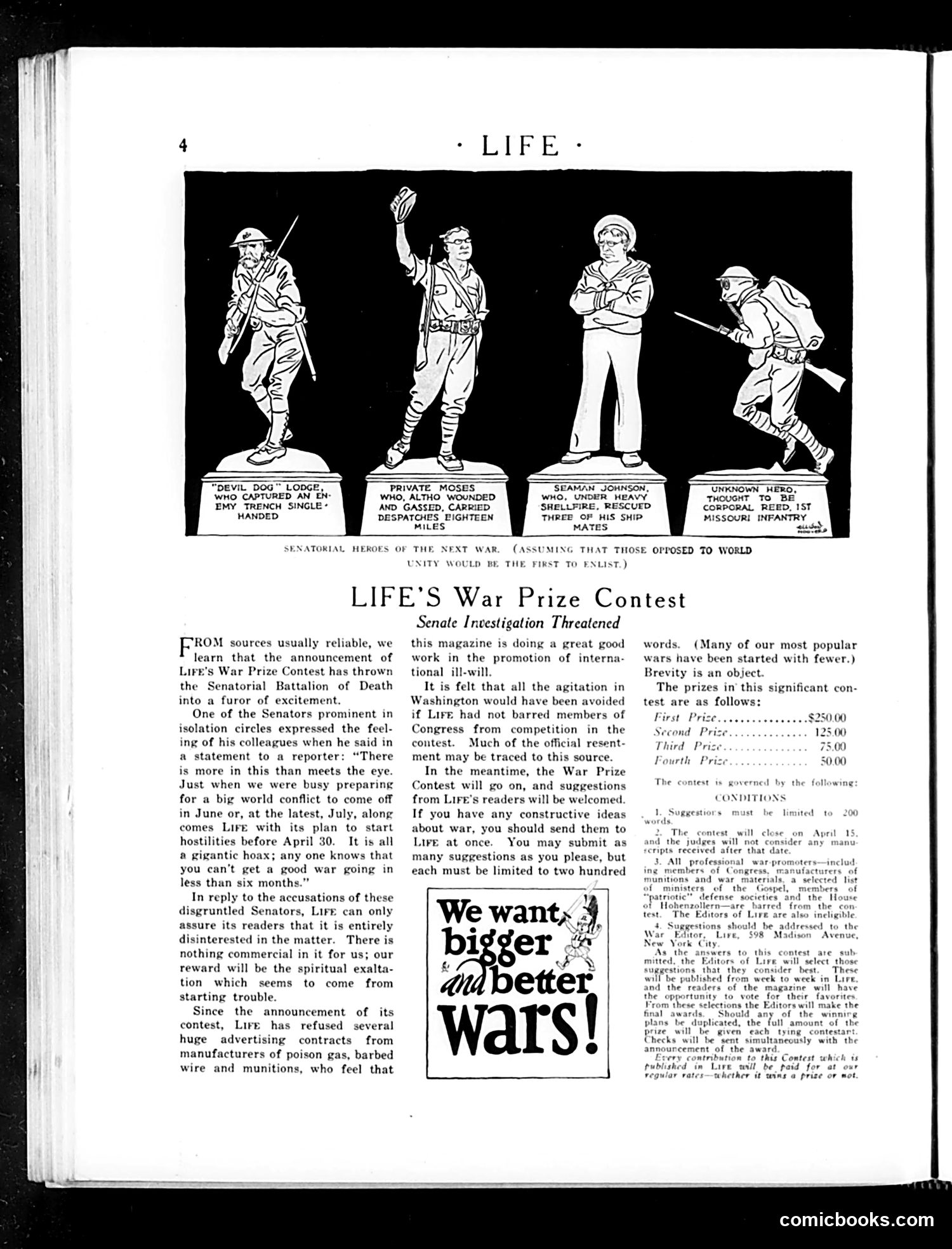
This page announces **Life's War Prize Contest**, inviting readers to submit suggestions for how to wage World War I more effectively. The four illustrated figures represent "Senatorial Heroes of the Next War"—satirizing U.S. senators who opposed American involvement in the war. The cartoon mocks isolationist congressmen by depicting them as absurd military figures with ridiculous credentials (e.g., "Devil Dog Lodge," "Unknown Hero"). The satire suggests these politicians, if forced to fight, would be comically incompetent. The accompanying text reveals the Senate threatened to investigate Life's contest, seeing it as promoting international conflict. Life defends itself, claiming editorial independence while denying commercial motives. The "We want bigger and better wars!" advertisement reinforces the satirical tone, clearly mocking pro-war sentiment rather than endorsing it.
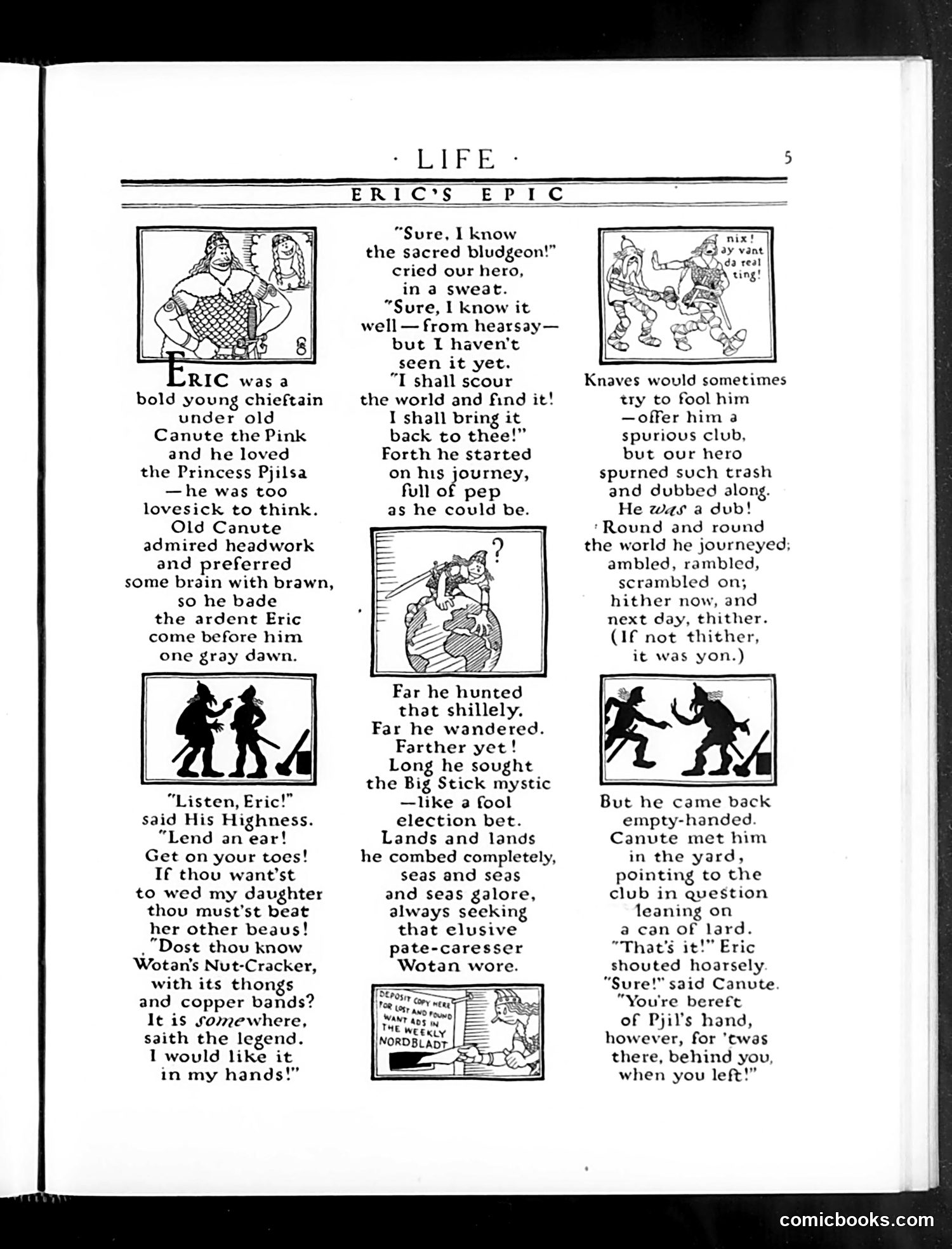
This is a mock-heroic poem parodying Norse sagas and adventure narratives. The story follows Eric, a young chieftain seeking the "sacred bludgeon" (mystic object) to win Princess Pjilsa's hand. His quest involves wandering lands and seas searching for "that elusive pate-caresser Wotan wore." The satire mocks both romantic adventure tales and their overwrought language. The illustrations show Eric's bumbling journey—he's repeatedly tricked by Knaves offering false objects, and returns empty-handed with only "a can of lard." The humor lies in deflating grand epic conventions: the "Big Stick mystic" search becomes absurd; the quest prize is ridiculous; the hero fails comically. This appears to be general literary satire rather than political commentary, ridiculing flowery saga-style storytelling popular in early 20th-century entertainment.
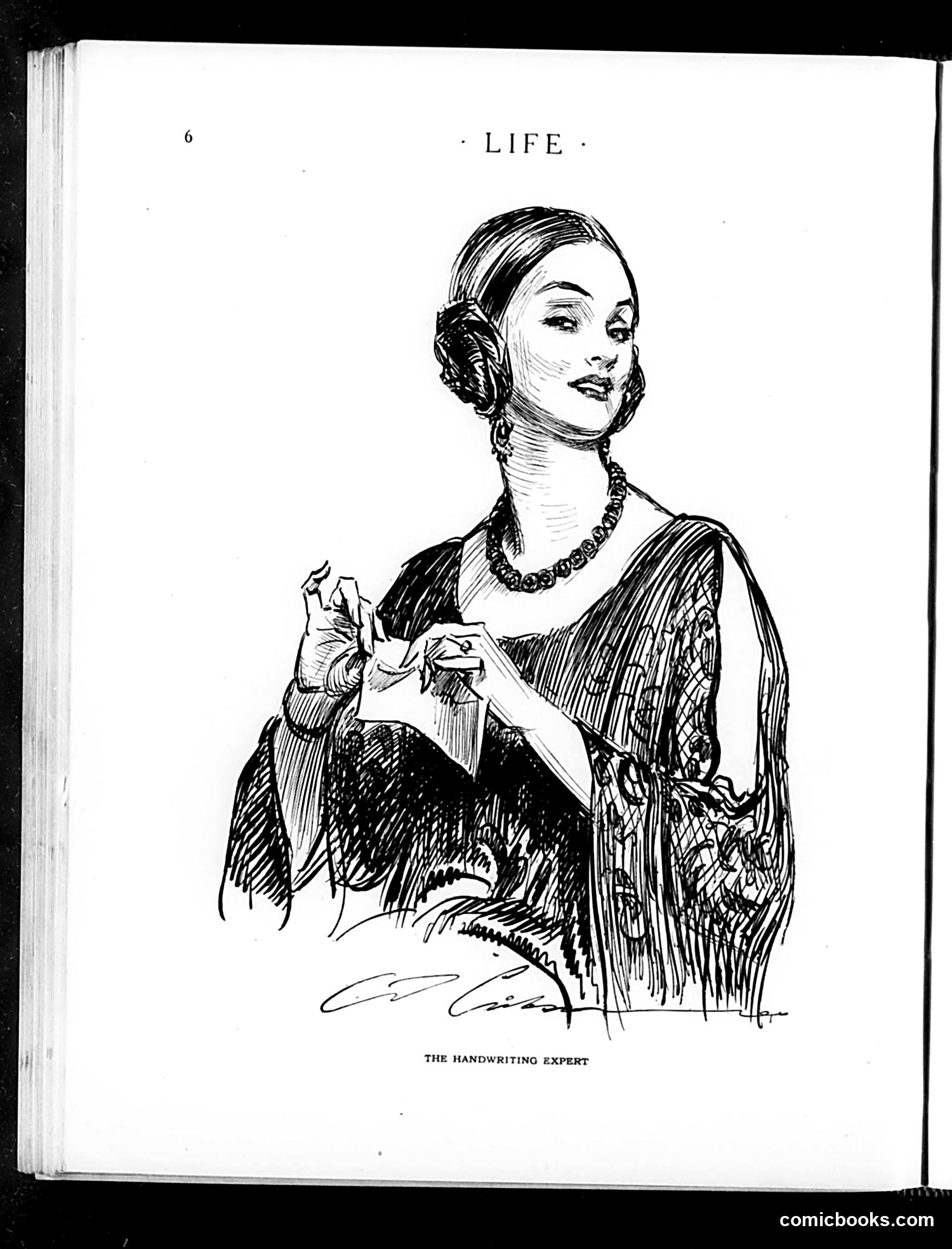
This page from *Life* magazine (page 6) features a sketch titled "The Handwriting Expert." The illustration shows a well-dressed woman with styled hair, jewelry, and elegant clothing, holding what appears to be a document or letter. The caption suggests the satirical subject is handwriting analysis—a pseudoscientific practice popular in the early-to-mid 20th century. The satire likely mocks the trend of "handwriting experts" who claimed to determine personality, character, or truthfulness from someone's penmanship. The woman's refined appearance and confident pose suggest she represents someone claiming expert authority in this dubious field. The humor targets the gullibility of those who believed such analyses held scientific validity.
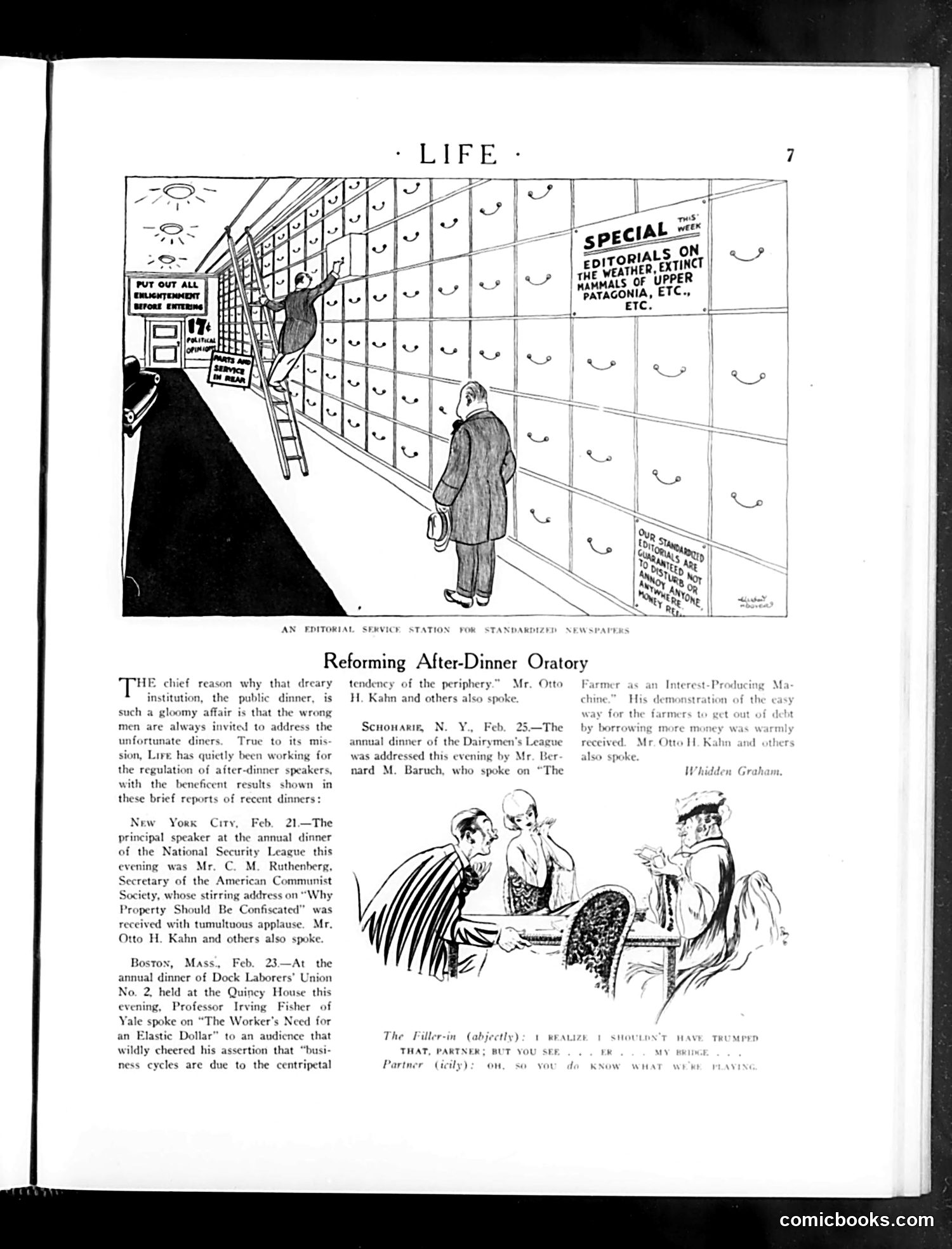
This page satirizes after-dinner speaking at formal events. The top cartoon shows "An Editorial Service Station for Standardized Newspapers"—a visual joke where a newspaper editor selects pre-written editorials about weather and extinct mammals from pigeonholes, much like ordering from a vending machine. This mocks the standardization and lack of originality in newspaper content. Below, the article "Reforming After-Dinner Oratory" reports on various dinners where speakers addressed topics like property education and workers' rights. The accompanying illustration depicts a tedious after-dinner speaker boring his audience—suggesting that formal dinner speeches were considered tiresome social obligations rather than genuinely engaging presentations. The satire targets both standardized media and the predictable conventions of formal dining etiquette.
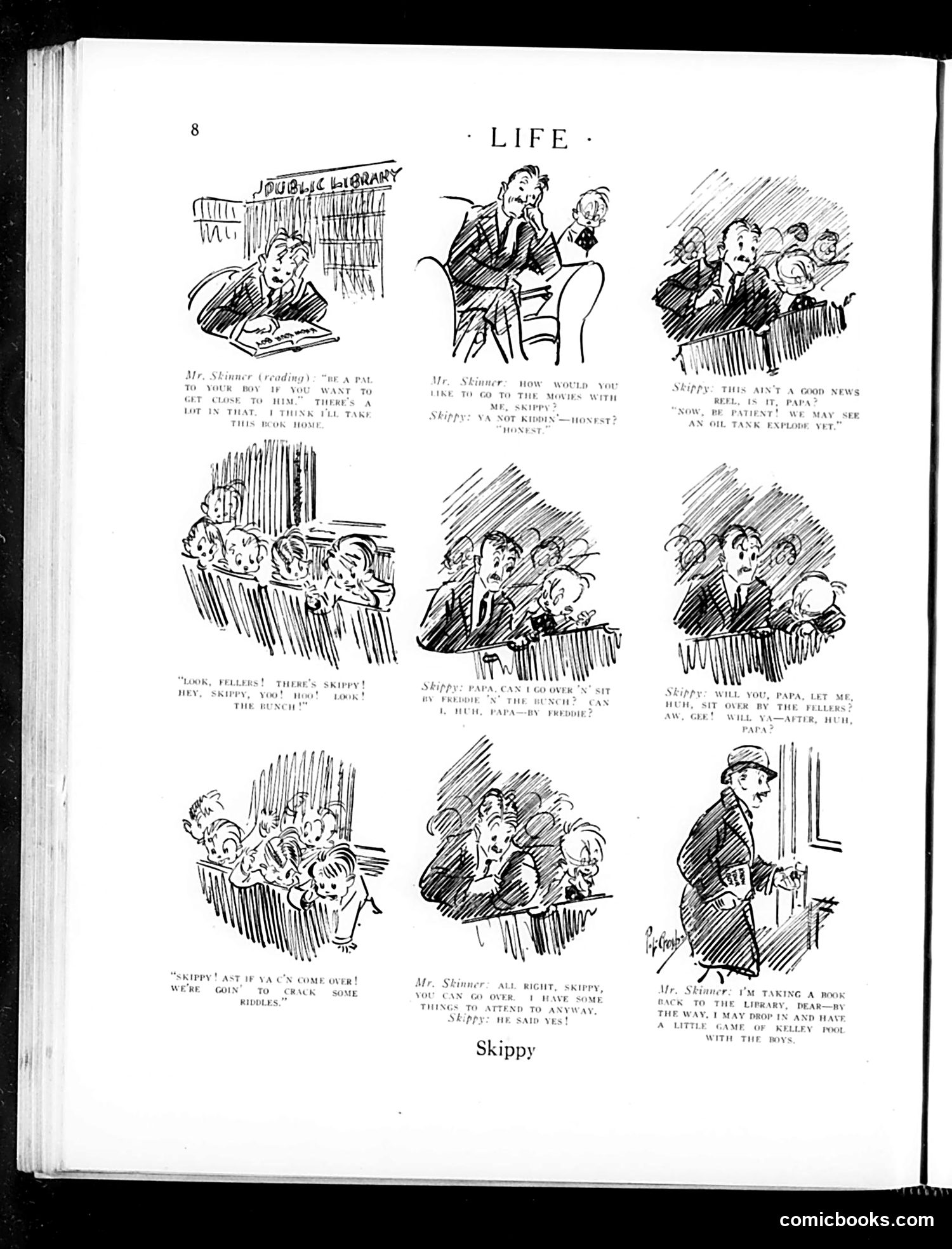
This is a humorous comic strip titled "Skippy" depicting a young boy named Skippy and an adult named Mr. Skinner. The narrative shows Skippy attempting to convince Mr. Skinner to take him to the movies, offering various inducements—including mentioning an oil tank explosion. Mr. Skinner repeatedly declines, citing reasons like needing to return a library book and having other obligations. The humor derives from Skippy's persistent, escalating attempts at persuasion and Mr. Skinner's bemused resistance. The strip satirizes the common childhood tactic of pestering adults for entertainment outings, portraying both the child's relentless negotiation skills and the adult's weary patience. It's a gentle domestic comedy about generational dynamics and the universal appeal of movies as entertainment.
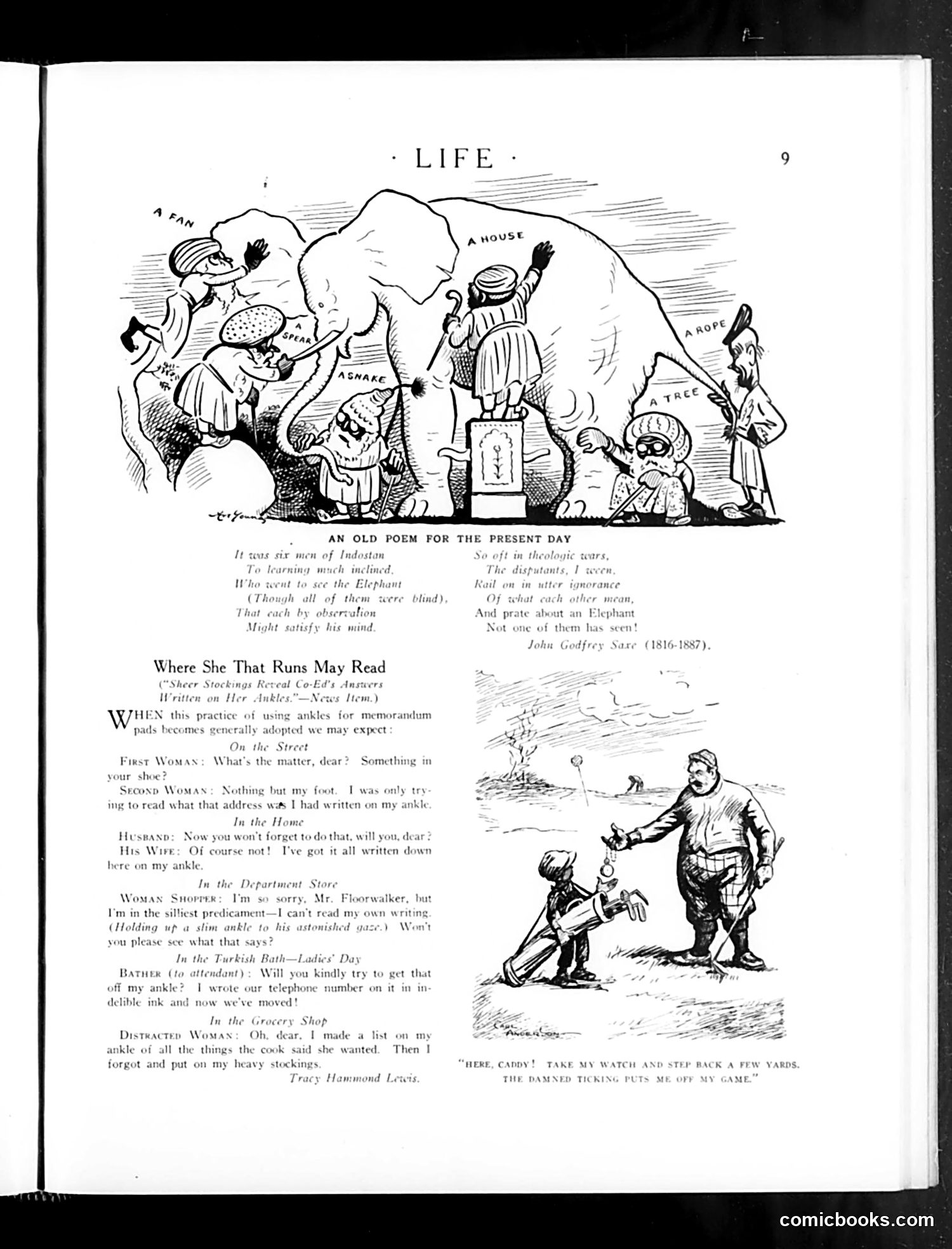
The top cartoon titled "An Old Poem for the Present Day" depicts blind men examining an elephant—a famous metaphor for how people with limited perspective misunderstand reality. Each figure labeled (fan, house, rope, tree) touches only one part, drawing incorrect conclusions. This satirizes how observers with incomplete information draw false judgments. Below, "Where She That Runs May Read" presents humorous vignettes of women using ankles as notepads—writing shopping lists and reminders on their skin since they have no pockets. This mocks both women's limited practical clothing options and the era's condescending attitude toward female organization and memory. The satire targets restrictive fashion and assumptions about women's capabilities.
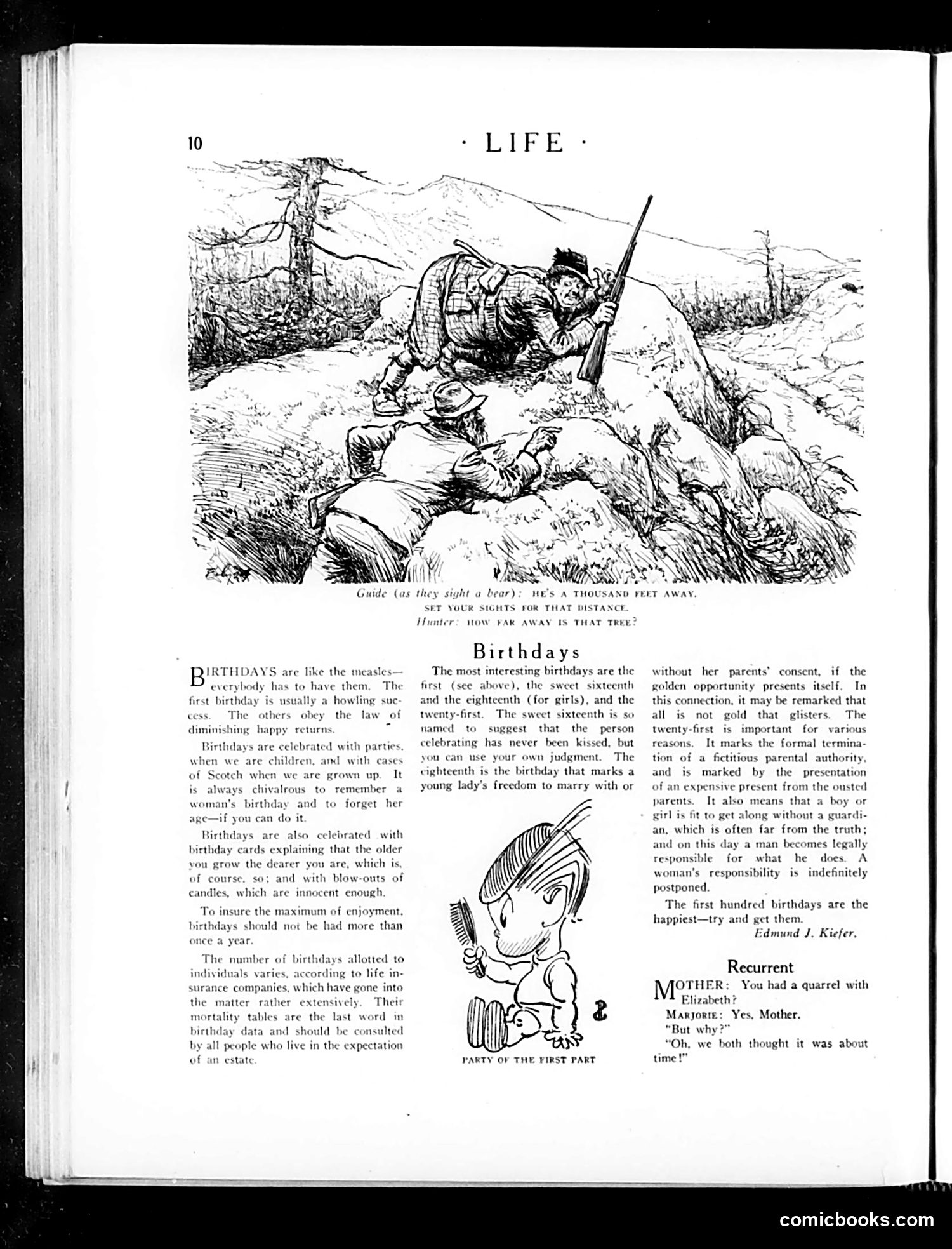
This page contains editorial content about birthdays rather than political satire. The main illustration shows two hunters in a wilderness setting, with one directing the other to aim at a distant target ("a thousand feet away"). The accompanying essay, "Birthdays," discusses milestone celebrations—particularly important ones like a girl's sixteenth or twenty-first birthday. The author (Edmund J. Kiefer) uses the hunting scene as a metaphor for life's trajectory and coming-of-age moments. A small cartoon labeled "Part of the First Part" depicts a baby with what appears to be hunting or sporting equipment, suggesting the theme of life's journey from infancy onward. The page concludes with a brief dialogue titled "Recurrent" about a domestic quarrel between a mother and daughter (Marjorie and Elizabeth), providing light comic relief.
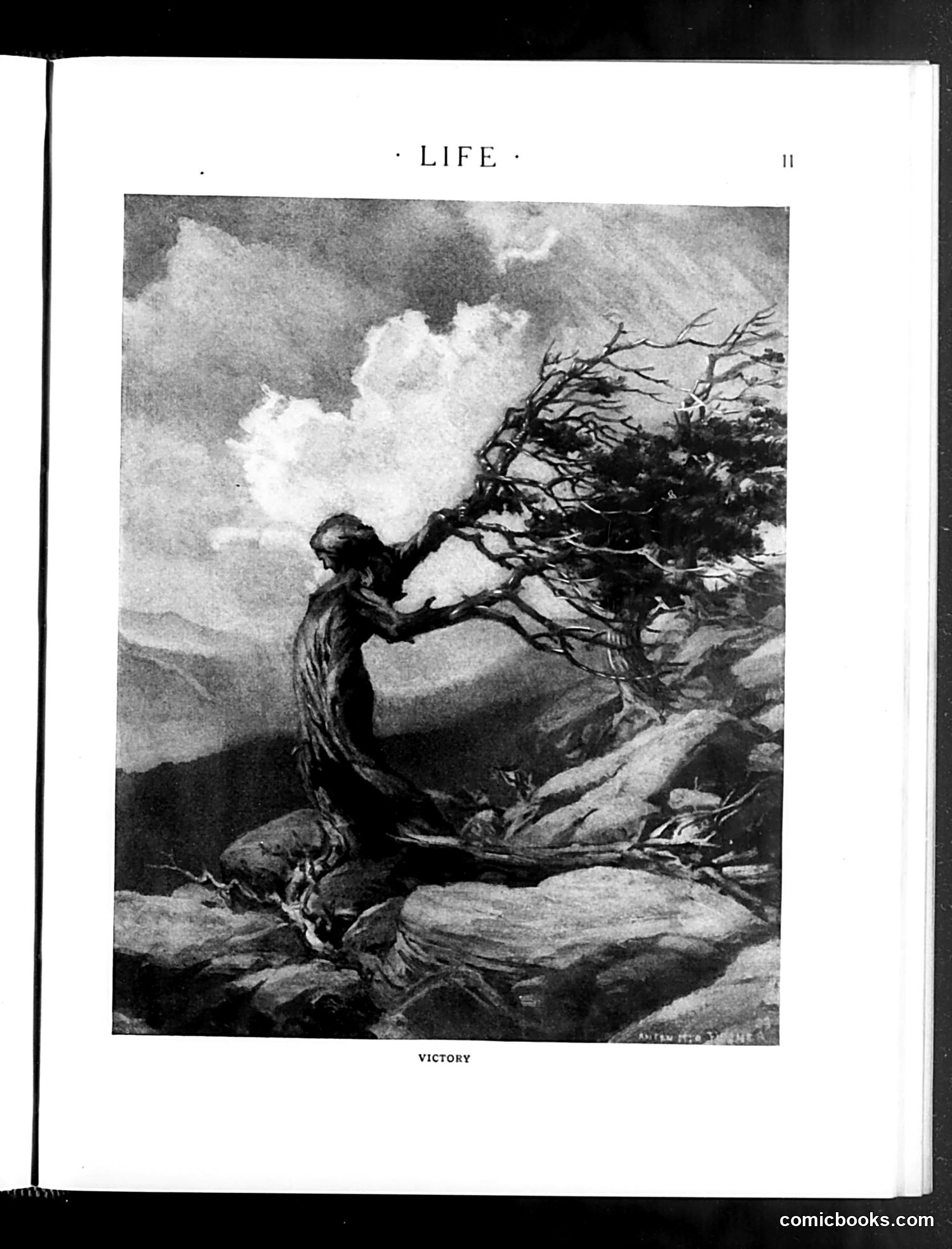
This allegorical illustration depicts a female figure (personifying Victory or triumph) straining to bend a gnarled, twisted tree. The figure appears windswept and determined, set against a dramatic cloudy sky and rocky landscape. The image likely represents a struggle against adversity or resistance—the stubborn tree symbolizing some obstacle or opposing force that requires great effort to overcome. The classical allegorical style, common to early-to-mid 20th century American editorial illustration, suggests this commentary on a contemporary conflict or challenge. Without additional context about the publication date, the specific political or social issue being referenced remains unclear, though the symbolism of heroic struggle against natural/figurative resistance is evident.
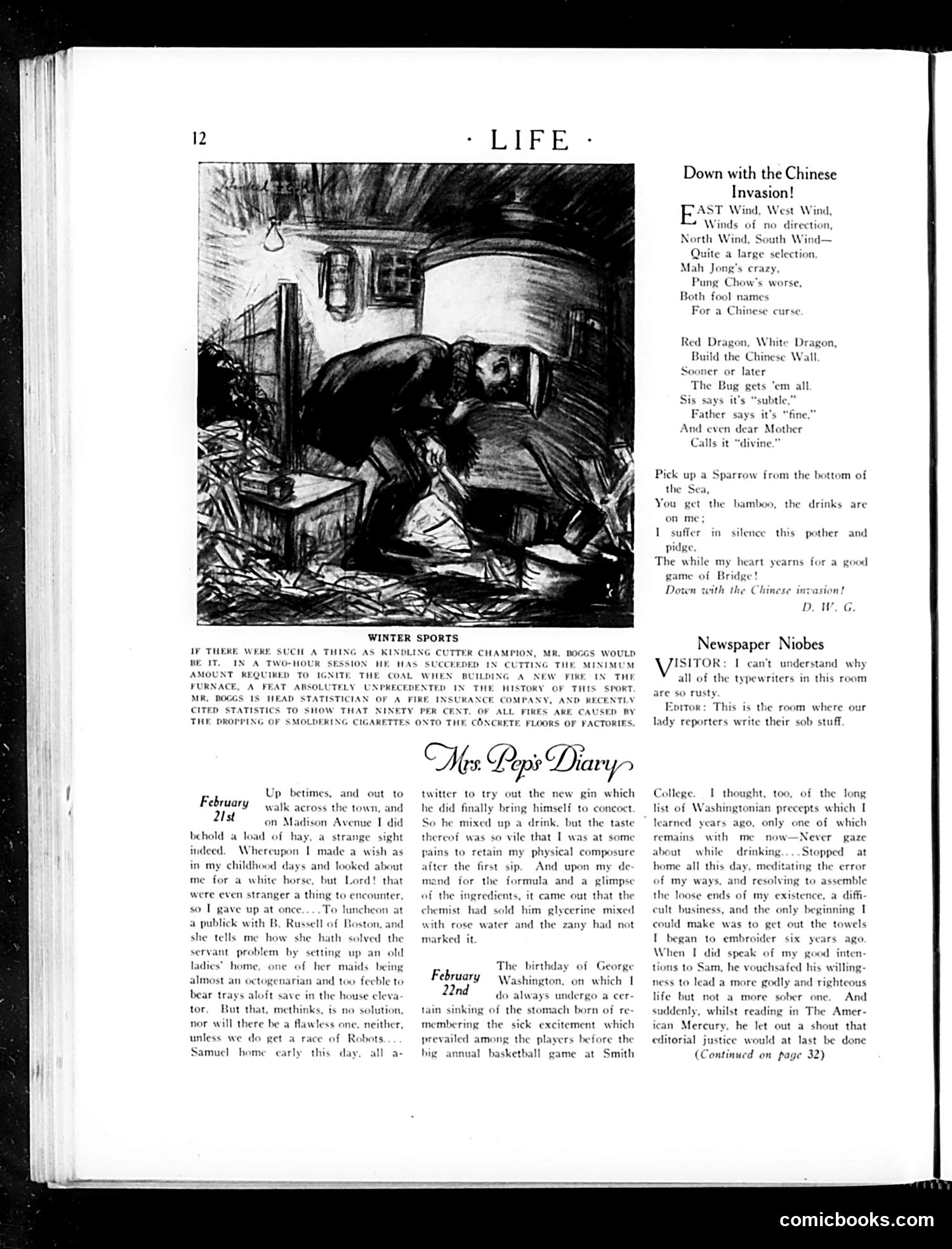
The main illustration titled "WINTER SPORTS" depicts two figures in a cramped, primitive interior space with a hanging light bulb. The caption below indicates this is about "kindling cutter champions" and discusses fire statistics—specifically that 90% of fires are caused by cigarette smoking on factory floors. The accompanying text, "Down with the Chinese Invasion!" is a humorous poem complaining about Chinese curses, mahjong games, and general frustration, suggesting Chinese cultural influences were novel or exotic to American readers at this time. "Mrs. Peps Diary" is a satirical column about mundane domestic life, featuring dated entries (February 21st and 22nd) discussing trivial concerns like gin-tasting and social anxieties. The page combines social commentary on industrial safety with light satirical humor about contemporary American life and cultural attitudes circa the 1920s-1930s.
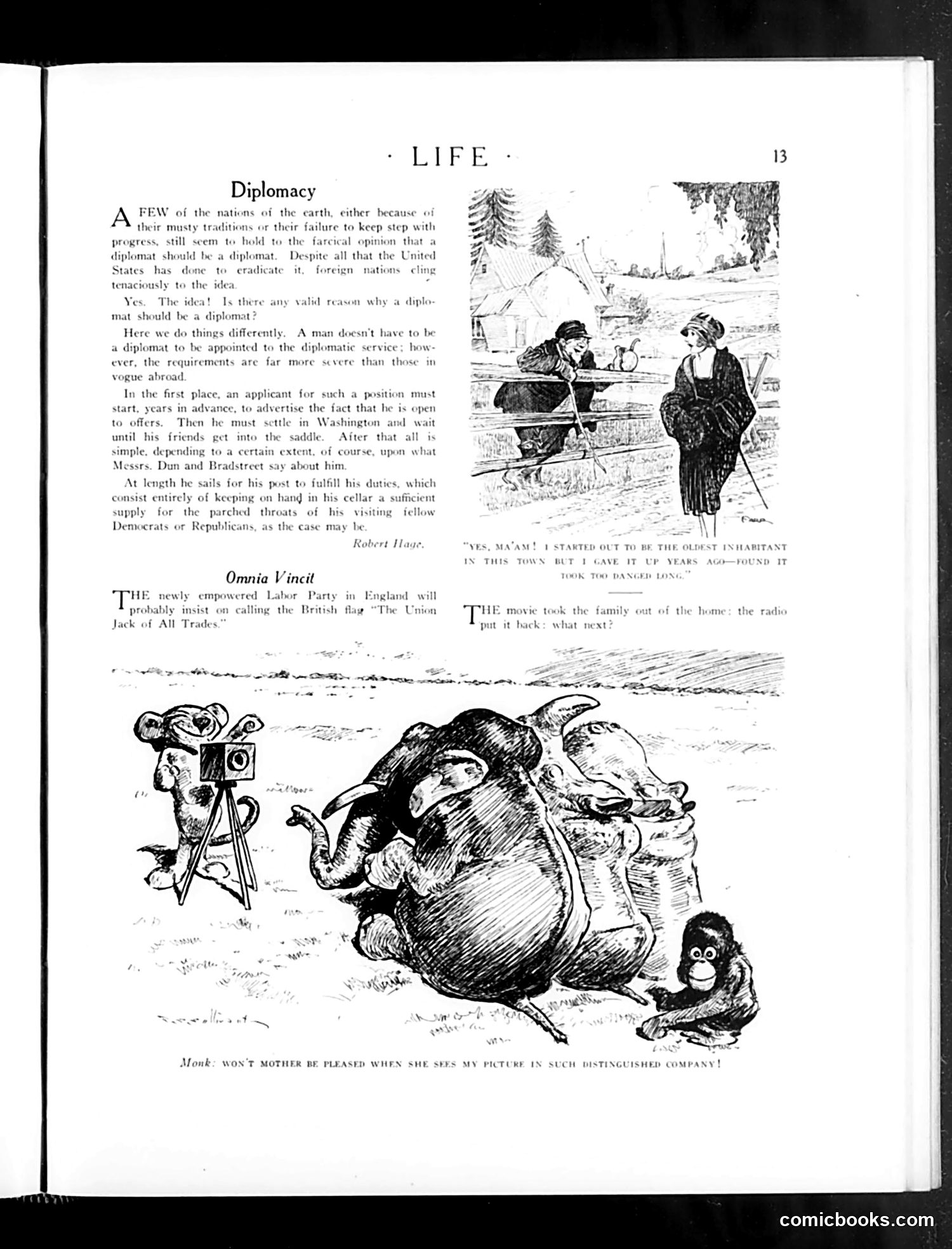
**Top Section - "Diplomacy":** This article discusses diplomat qualifications and career requirements, accompanied by a sketch of two men by a waterside. The illustration shows practical diplomacy—one man appears to be fishing while conducting business. **Bottom Section - "Omnia Vincit" (Love Conquers All):** The cartoon depicts a rotund woman (labeled "Monk") with a movie camera and tripod, accompanied by a small chimpanzee. The joke plays on her unfortunate appearance: the monkey worries his mother will see his picture "in such distinguished company," implying the woman resembles an ape. This relies on cruel physical humor typical of early 20th-century satire, mocking both her weight and appearance through unflattering animal comparison.
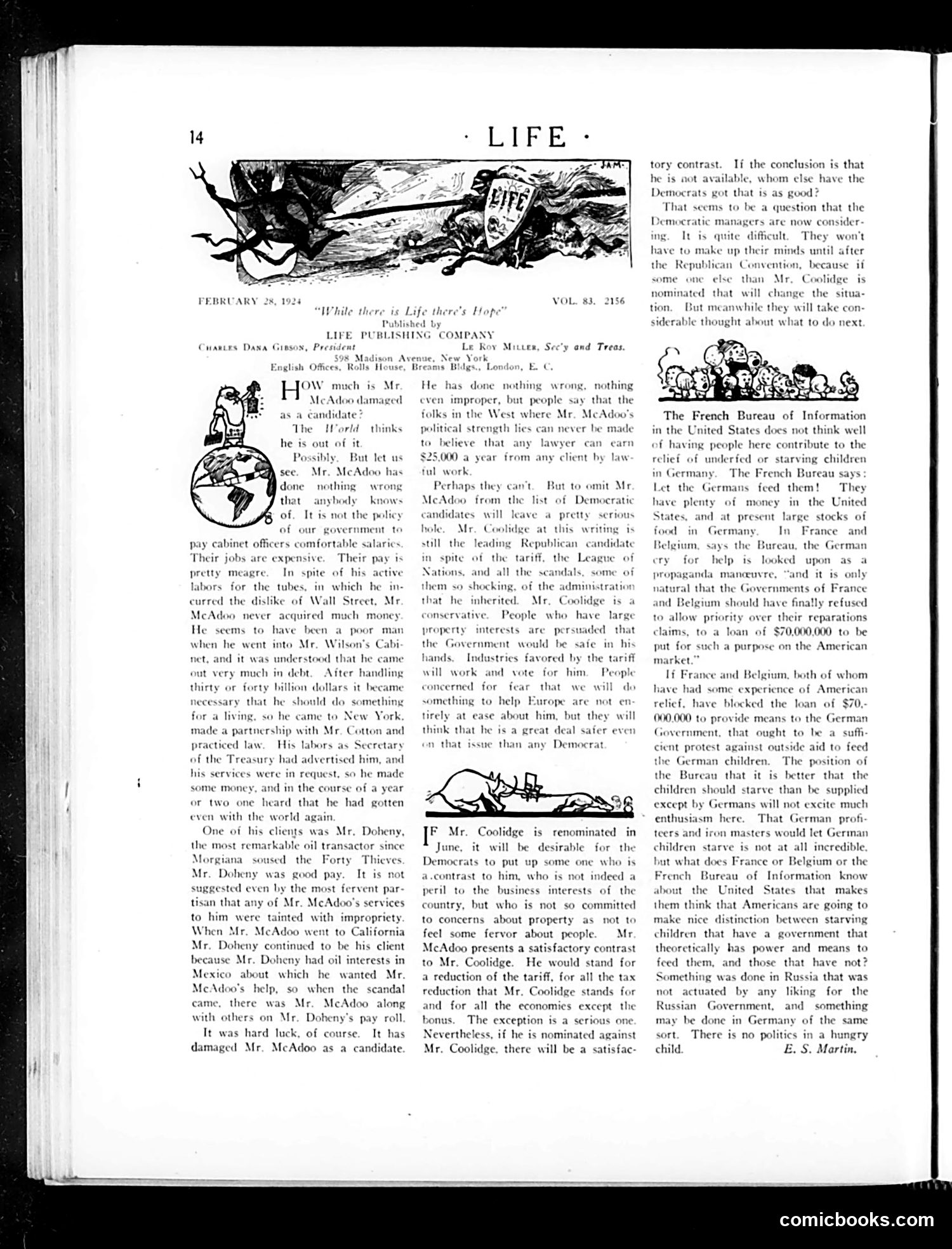
The main cartoon depicts a figure labeled "LIFE" as a shield or protective emblem, appearing to defend against dark, chaotic forces—likely representing threats to American democracy or stability during the early 1920s. The accompanying article discusses Mr. McAdoo as a presidential candidate, debating whether Democrats should nominate him. The text references concerns about McAdoo's financial interests (earning $25,000 yearly from clients), his connections to various business figures, and questions about his commitment to Democratic principles versus property interests. The article ultimately argues that hungry children should not be used as political tools in European relief debates—a reference to post-WWI humanitarian concerns. The satire critiques how politicians and donors exploit humanitarian crises for political advantage.
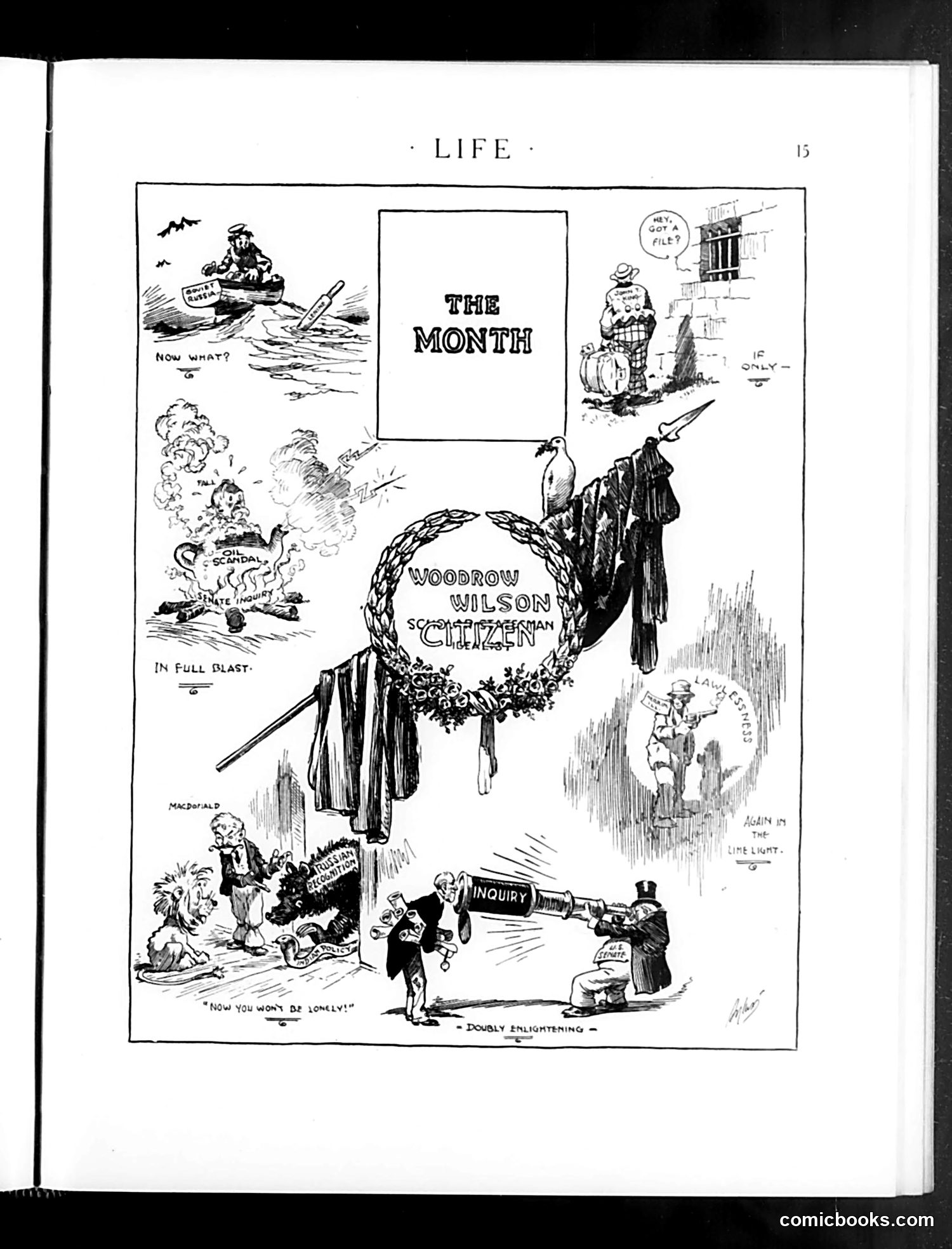
This satirical page from *Life* magazine centers on President Woodrow Wilson, whose name and face appear prominently in a wreath at the page's center, labeled "Scuttleman Citizen." The surrounding vignettes mock Wilson's administration and policies: - Top left: Naval/military comedy ("Now what?") - Top right: A prisoner or jailed figure ("If only—") - Bottom: An "Inquiry" telescope pointed at Wilson, labeled "Doubtly Enlightening" - Various domestic scenes suggesting social discord ("Now you won't be lonely!") The overall tone is critical—suggesting Wilson's leadership creates confusion, imprisonment of freedoms, and failed enlightenment. The wreath ironically frames him as a honored "citizen" while the cartoons undermine that dignity. This likely references WWI-era policies, including conscription or civil liberties concerns.
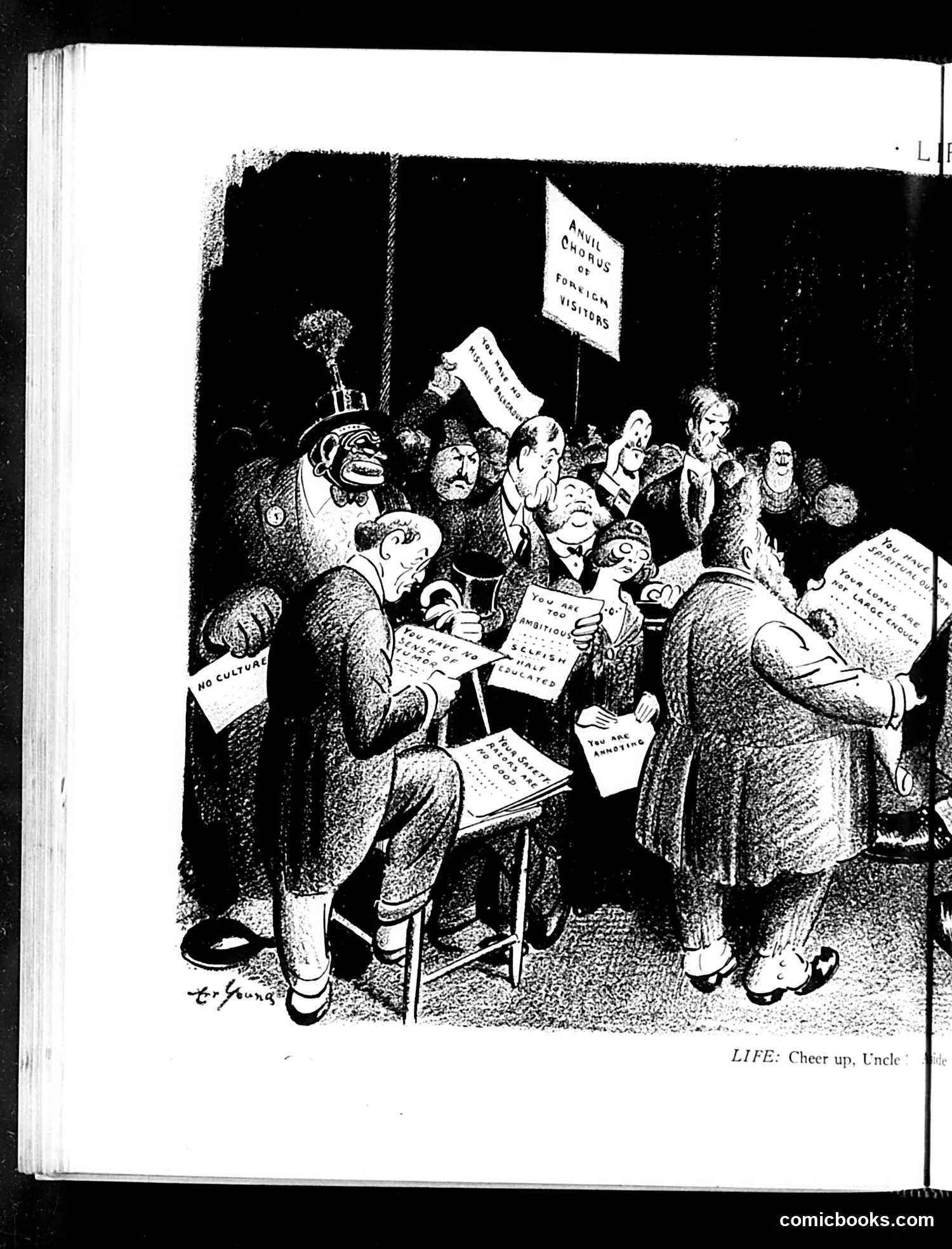
This satirical cartoon depicts a group of caricatured foreign visitors being lectured by what appears to be an American official or tour guide. The visitors hold signs reading phrases like "No Culture," "You Are Anarchists," and "You Are Agitators." Signs overhead read "Annual Chorus of Foreign Visitors" and similar labels. The cartoon appears to satirize American attitudes toward immigrants or foreign nationals during a period of social anxiety—likely early 20th century, given Life magazine's timeframe. The joke critiques how Americans stereotype and dismiss foreign visitors, assigning them negative characteristics (lack of culture, radical politics) regardless of individual merit. The caption begins "Cheer up, Uncle..." suggesting this targets American xenophobia and prejudice against outsiders during a time of significant immigration and labor unrest.
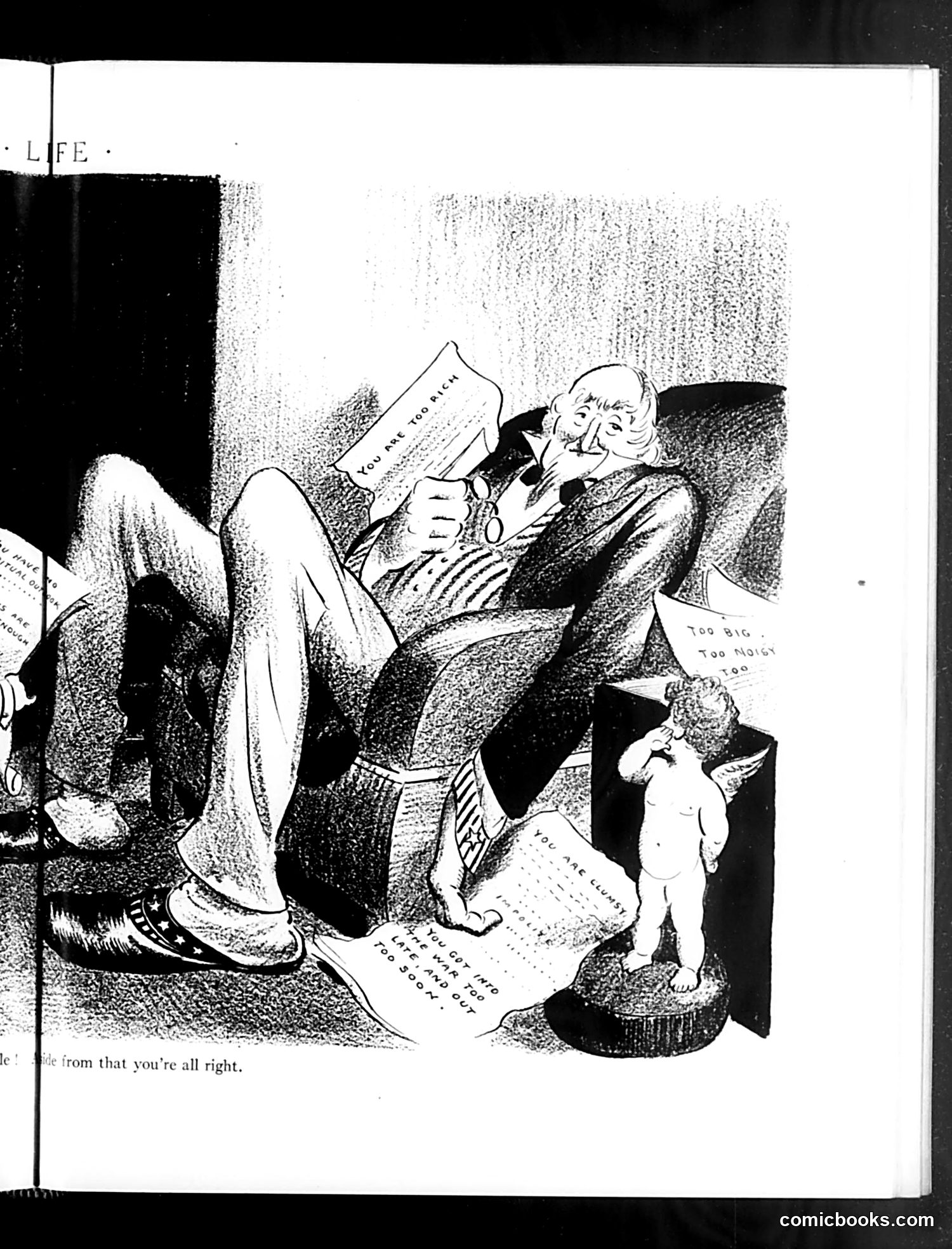
This appears to be a satirical cartoon depicting a portly, well-dressed man reclining in a chair, reading what looks like a bill or document labeled "YOU'RE TOO BIG" (visible text). A cherub or cupid figure stands nearby, also holding similar papers with text that appears to reference size or weight concerns. The satire likely critiques either: - A wealthy businessman or politician facing criticism about excess/greed - Someone receiving unwanted advice about their physical appearance or spending habits - Possible commentary on financial excess during a particular era The specific identity of the figure and the exact historical context remain unclear without additional caption information or date verification. The "too big" theme suggests commentary on someone perceived as oversized in influence, wealth, or physical stature.
This page reviews Broadway theatrical productions with characteristic satirical commentary. The author critiques how actors' performances deteriorate after opening night—initially nervous and controlled, they later resort to "mugging" and vaudeville-style antics once comfortable with their roles. The piece praises the "Charlot Revue" from London, specifically highlighting performances by **Beatrice Lillie** and **Gertrude Lawrence**, and notes composer **Noel Coward's** superior lyrics compared to American theater standards. The review suggests Broadway producers (Ziegfeld, Berlin, Anderson, Shubert) could learn from the British production's efficient use of "team-work" over elaborate scenery. Walter Hampden's production of **"Cyrano de Bergerac"** receives high praise, with the reviewer attributing its emotional power to Brian Hooker's dramatic translation rather than the artificial sword-fighting. The satire mocks theater criticism itself—acknowledging reviewers' initial judgments are wrong about 70% of the time.
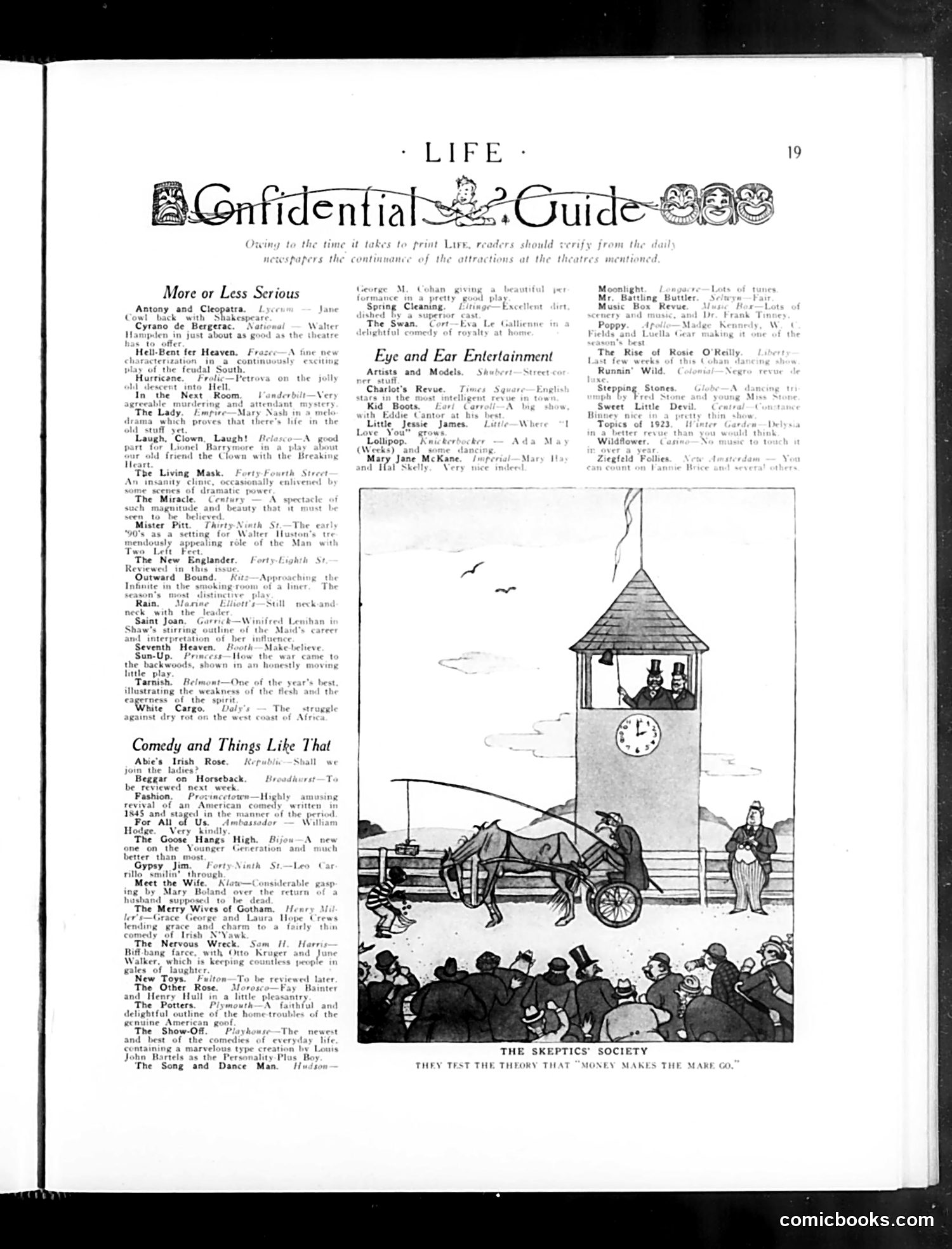
This cartoon illustrates a satirical commentary on economic theory, specifically the proverb "money makes the mare go." The image depicts a literal test of this saying: a horse stands before a suspended platform containing figures (appearing to be scientists or "skeptics"), with money dangling above the horse as bait on a pulley system. Below, a crowd of onlookers watches the experiment. The satire targets both economic determinism—the idea that money is the primary motivator of all action—and the pseudo-scientific approach to testing social theories. By literalizing the figurative expression, the cartoonist mocks those who reduce human and economic behavior to simplistic cause-and-effect relationships. The "Skeptics Society" framing suggests ironic doubt about whether this crude materialist theory actually explains complex social phenomena, reflecting early-20th-century debates about economics, science, and human motivation.
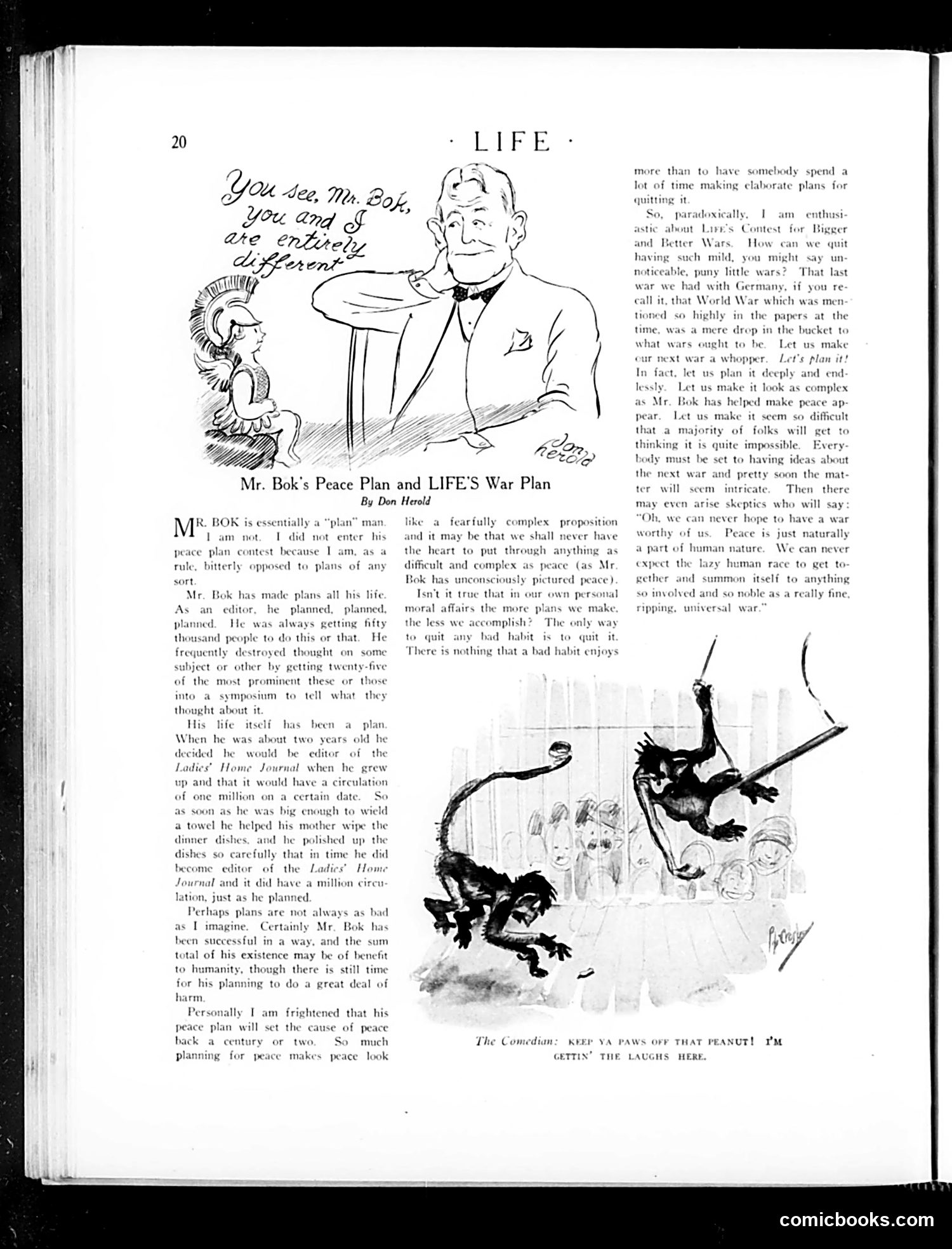
This satirical piece mocks **Edward Bok**, a prominent editor and peace advocate, by attributing his elaborate "peace plan" to his compulsive over-planning nature. The article's author, Don Herold, suggests that Bok's tendency to plan everything obsessively since childhood—from the *Ladies' Home Journal*'s circulation targets to minor household tasks—makes his peace initiatives counterproductive. The satire's central joke: **planning for peace is self-defeating**. Herold argues that excessive planning for something as naturally occurring as peace makes it seem unnecessarily complicated, deterring ordinary people from supporting it. He sardonically proposes "LIFE's War Plan"—the inverse strategy of planning war so thoroughly and making it seem so complex that people will reject it as impossible. The bottom cartoon shows comedic figures fighting over a peanut, illustrating the article's underlying theme: human conflict is petty and inevitable, regardless of elaborate schemes. The satire reflects early 20th-century American skepticism about intellectualized solutions to fundamental human problems.
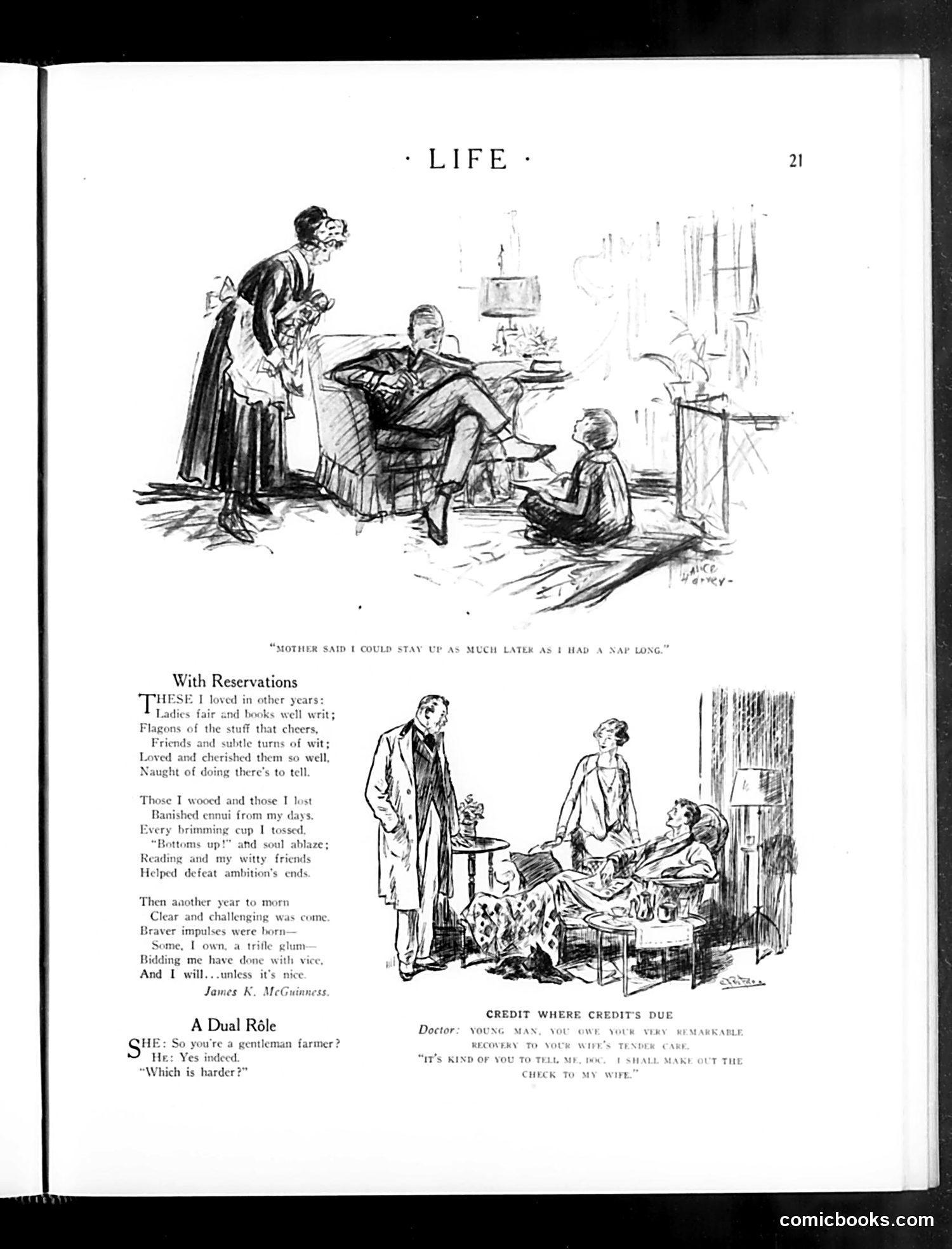
This page contains three separate pieces of social humor: **Top cartoon**: A child negotiates bedtime with parents, claiming mother said he could stay up as late as he naps long—a child's clever (but flawed) logic for extending bedtime. **"With Reservations"**: A poem by James K. McGinness reflecting on past romantic interests lost and gained, presenting a nostalgic, somewhat melancholic view of aging and romantic regret. **"A Dual Rôle"**: A brief joke where a woman asks a man if he's a gentleman farmer, then inquires "Which is harder?"—implying gentlemen farmers struggle with both roles, or that being a "gentleman" and a "farmer" are contradictory. **"Credit Where Credit's Due"**: A doctor tells a young man he owes his recovery to his wife's tender care, then instructs him to make out the check to the doctor—satirizing medical billing and the irony of crediting spouses while paying physicians. These pieces represent typical early 20th-century Life magazine humor: domestic comedy, romantic nostalgia, wordplay, and professional satire aimed at middle-class readers.
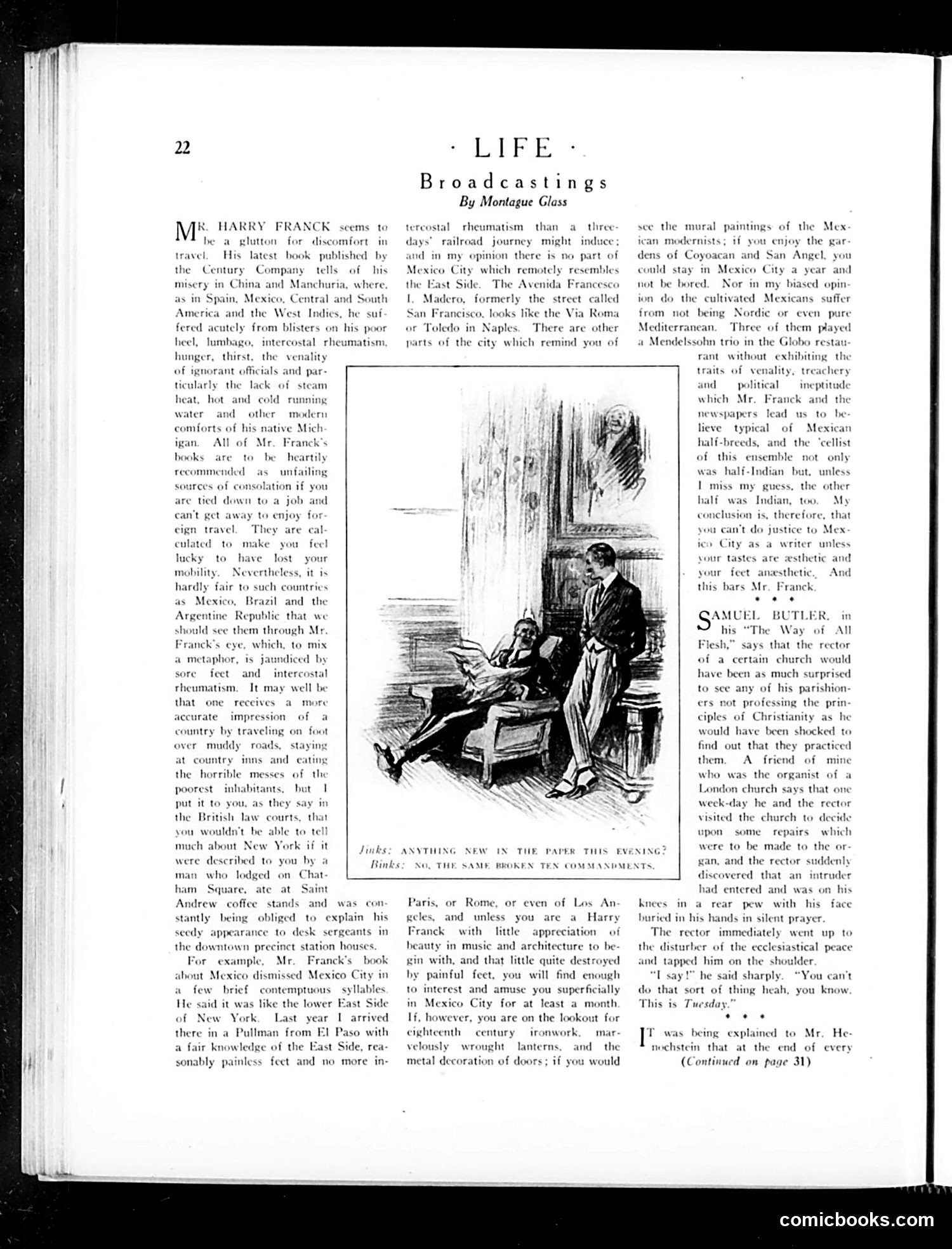
This page contains a sketch accompanying an essay by Montague Glass critiquing travel writer Harry Franck's book about Mexico. The **cartoon** shows two figures in conversation—one seated, one standing—with the caption: "Binks: Anything new in the paper this evening? / Banks: No, the same broken ten commandments." This is a **cynical social commentary** about moral stagnation. The joke suggests that human behavior and ethical standards never actually change; people continue breaking the same moral rules repeatedly, making newspaper reports perpetually repetitive. It's a critique of human nature rather than topical satire. The accompanying text criticizes Franck's Mexico travel narrative as distorted by his personal discomforts (rheumatism, blisters). Glass argues that Franck, jaundiced by physical suffering, unfairly presents Mexican society through a lens of complaint rather than objective observation—essentially that you cannot judge a country fairly when traveling in pain.
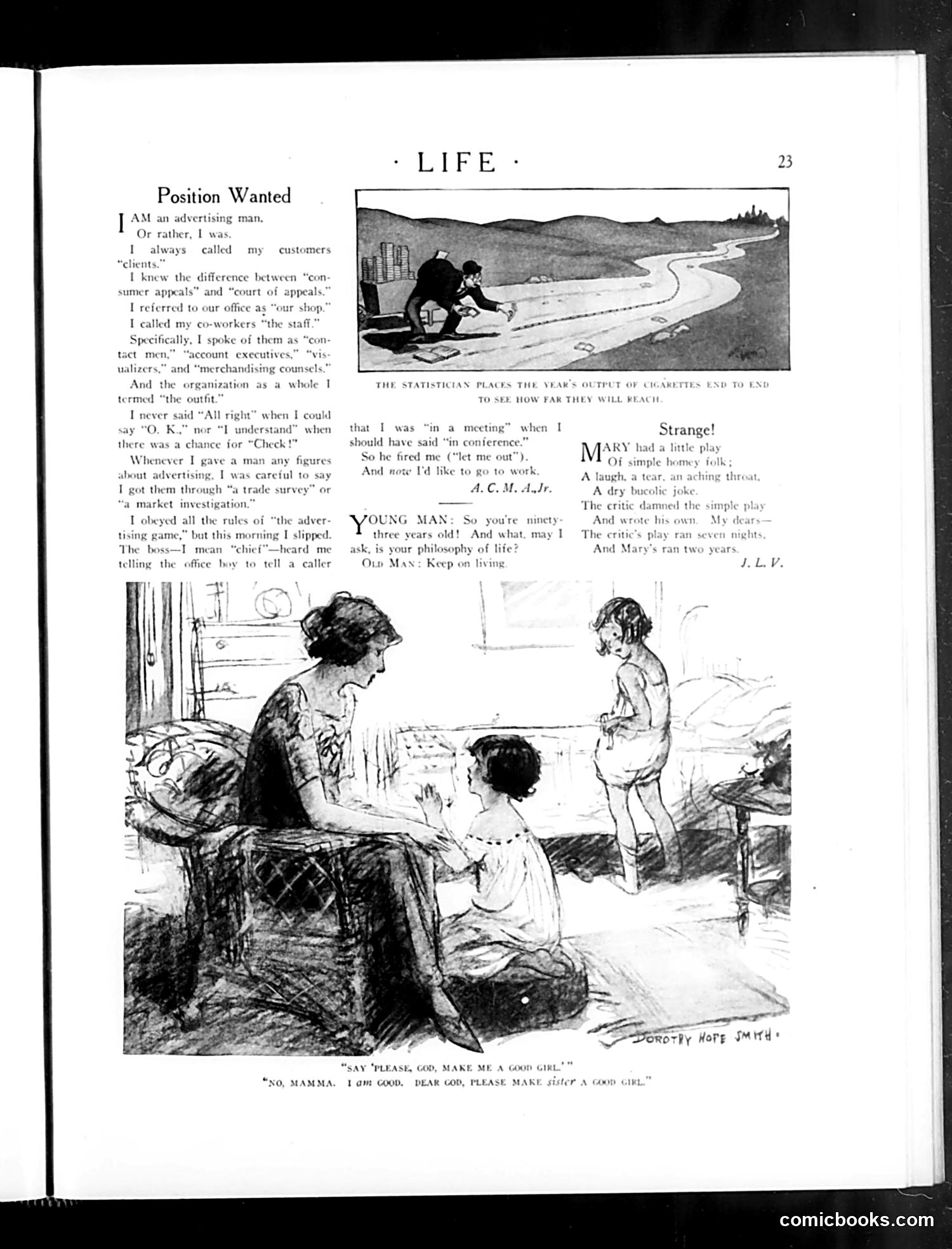
**"Position Wanted"** satirizes advertising industry jargon. An unemployed ad man complains he followed all the unwritten rules—calling clients "clients," offices "shops," coworkers "staff," and using corporate buzzwords like "account executives" and "market investigation." He was fired for one slip: saying "chief" instead of the approved term. The joke mocks how rigid corporate language has become, and how a single verbal misstep can cost a job—exposing the pretentiousness and fragility of white-collar professionalism. The lower cartoon titled **"Strange!"** depicts a mother teaching children prayers. One child asks God to make her a "good girl," while another requests God make her "sister a good girl"—the humor lying in sibling rivalry disguised as piety. This gentle domestic satire reflects period attitudes about children, morality, and family dynamics.
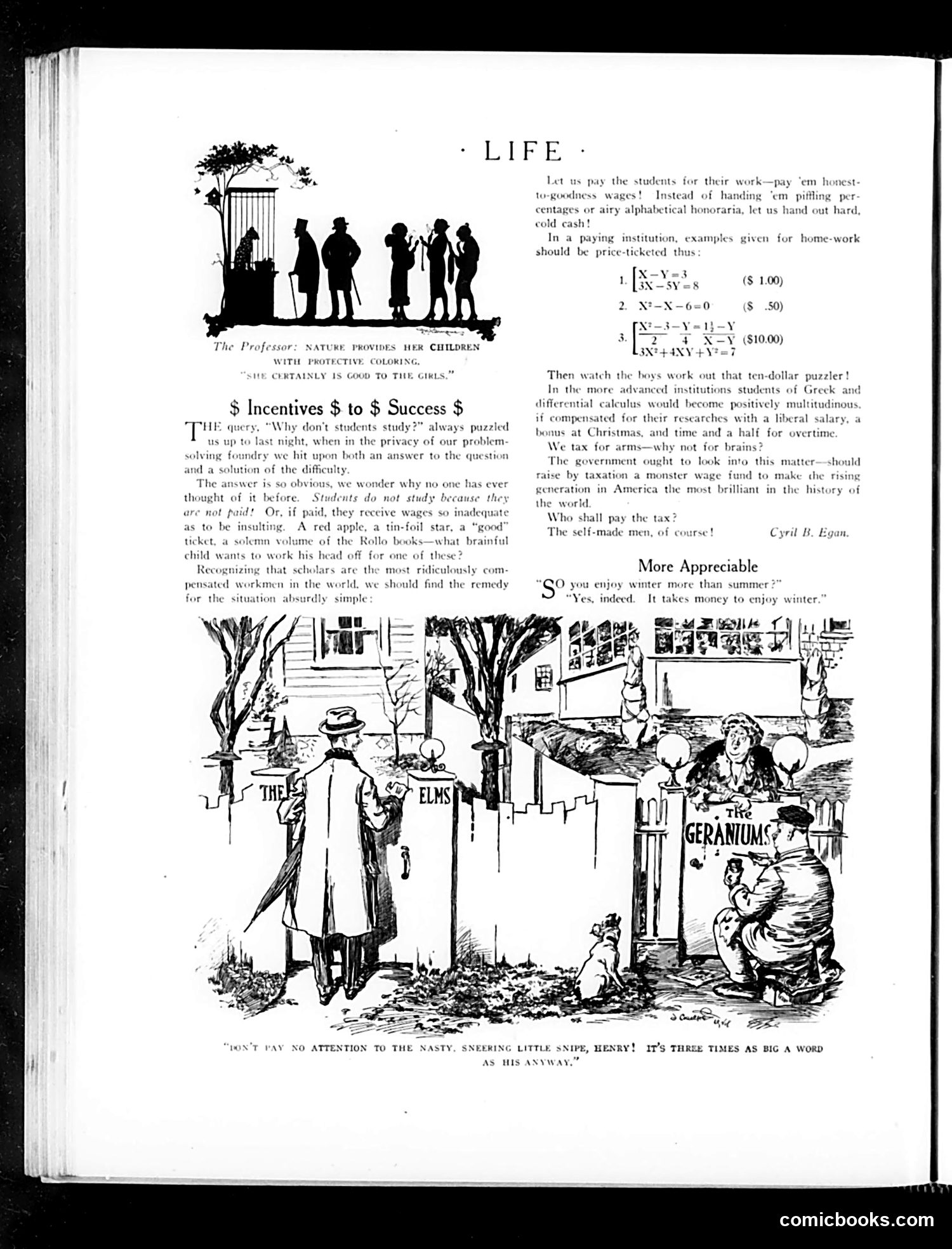
This page satirizes early 20th-century educational debates through two main pieces: **"Incentives to Success"** (top): The article argues students don't study because compensation is inadequate—they receive vague rewards like "alphabetical honoraria" instead of cash wages. It proposes paying students directly for schoolwork with price-tagged problems ($1.00 for algebra, $10.00 for calculus). The satire mocks both the idea that monetary incentives drive learning AND the notion that complex intellectual work should be commodified like manual labor. The accompanying illustration shows a professor teaching about "protective coloring," with the ironic caption about it being "good to the girls." **"More Appreciable"** (bottom): A brief joke where two people discuss winter costing more money to enjoy, implying wealth determines happiness—a modest social commentary on economic inequality. The writer (Cyril H. Egan) suggests instead that "self-made men" should pay taxes to fund education and brain development. The overall message critiques both misguided educational reform proposals and economic inequality of the era.
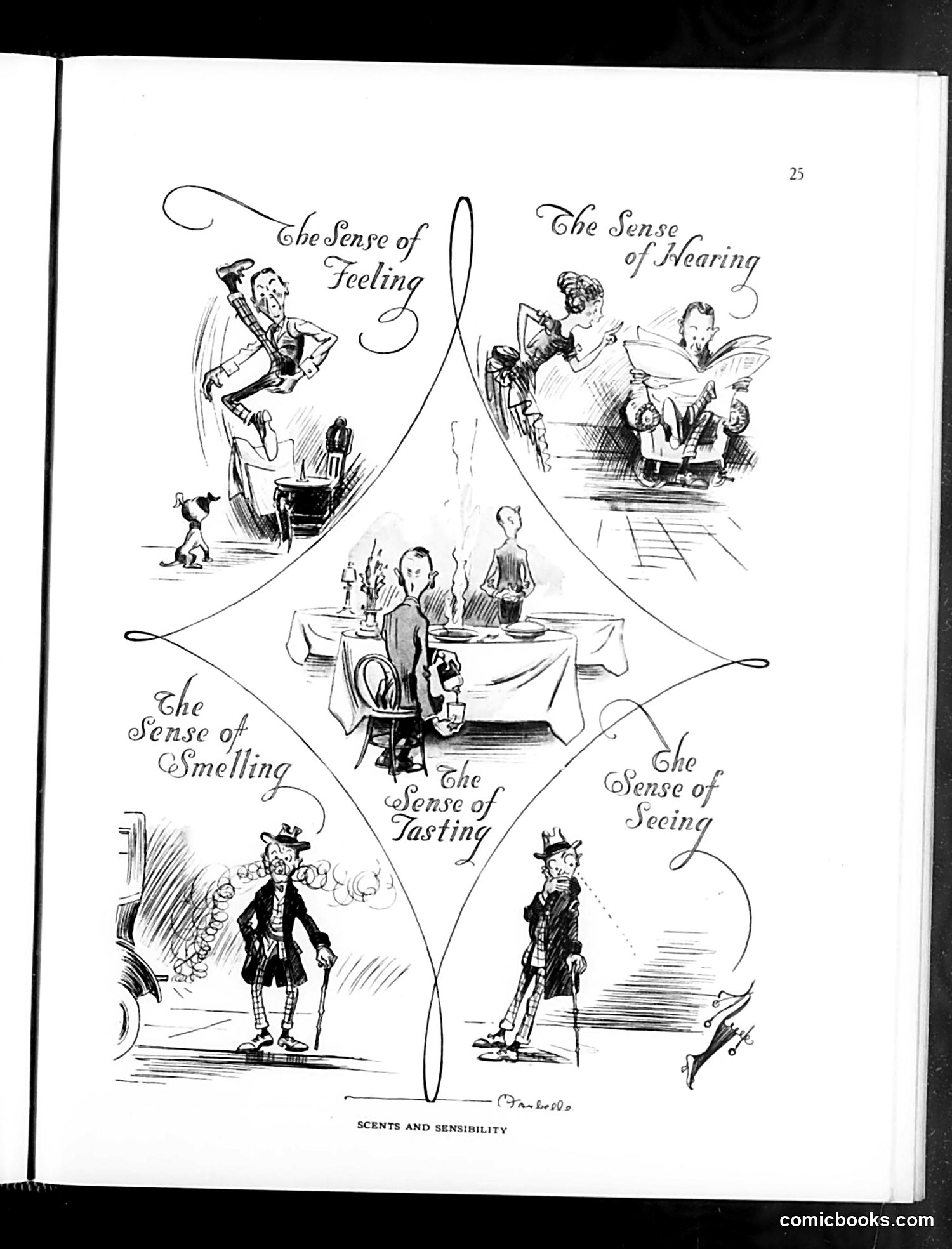
This satirical illustration parodies the five senses through exaggerated character sketches. Each sense is depicted in a separate vignette arranged around a central diamond shape: - **Feeling**: A man recoils dramatically from what appears to be a hot surface - **Hearing**: Musicians perform for an audience - **Smelling**: A figure reacts to strong odors - **Tasting**: A diner samples food - **Seeing**: A character observes something The title "Scents and Sensibility" is a pun on Jane Austen's novel "Sense and Sensibility," suggesting the piece mocks exaggerated emotional responses to sensory experiences. The caricatured figures with their theatrical poses ridicule people who overreact or are overly theatrical about everyday sensations—a common satirical target in early 20th-century humor about mannered society.
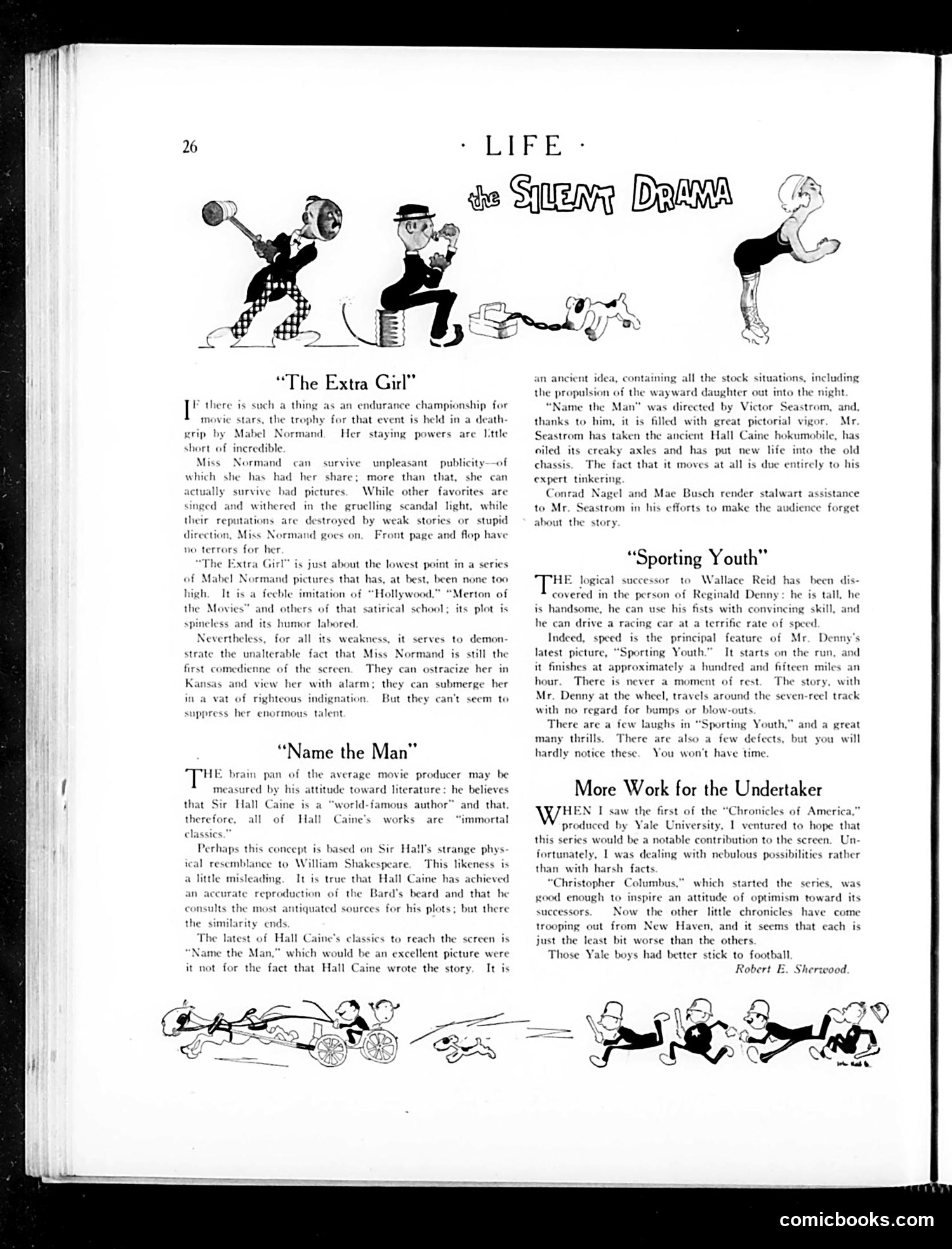
This page contains film reviews satirizing both movies and their stars. Key points: **"The Extra Girl"** reviews Mabel Normand's latest picture, noting she's survived multiple scandals that destroyed other actresses' careers—yet this film itself is weak ("feeble imitation"), proving her talent transcends poor material. **"Name the Man"** mocks producers' reverence for Sir Hall Caine, comparing his beard to Shakespeare's while dismissing his plots as hackneyed ("hokumobile"). Director Victor Seastrom salvages the film through technical skill despite Caine's dated story. **"Sporting Youth"** praises Reginald Denny as Wallace Reid's successor, emphasizing the film's relentless pace and thrills over plot substance—"you won't have time" to notice defects. **"More Work for the Undertaker"** dismisses Yale University's educational film series, particularly "Christopher Columbus," as disappointing despite initial optimism. The satire targets both studio mediocrity and audiences' tolerance for weak stories carried by stars' charisma or technical spectacle.
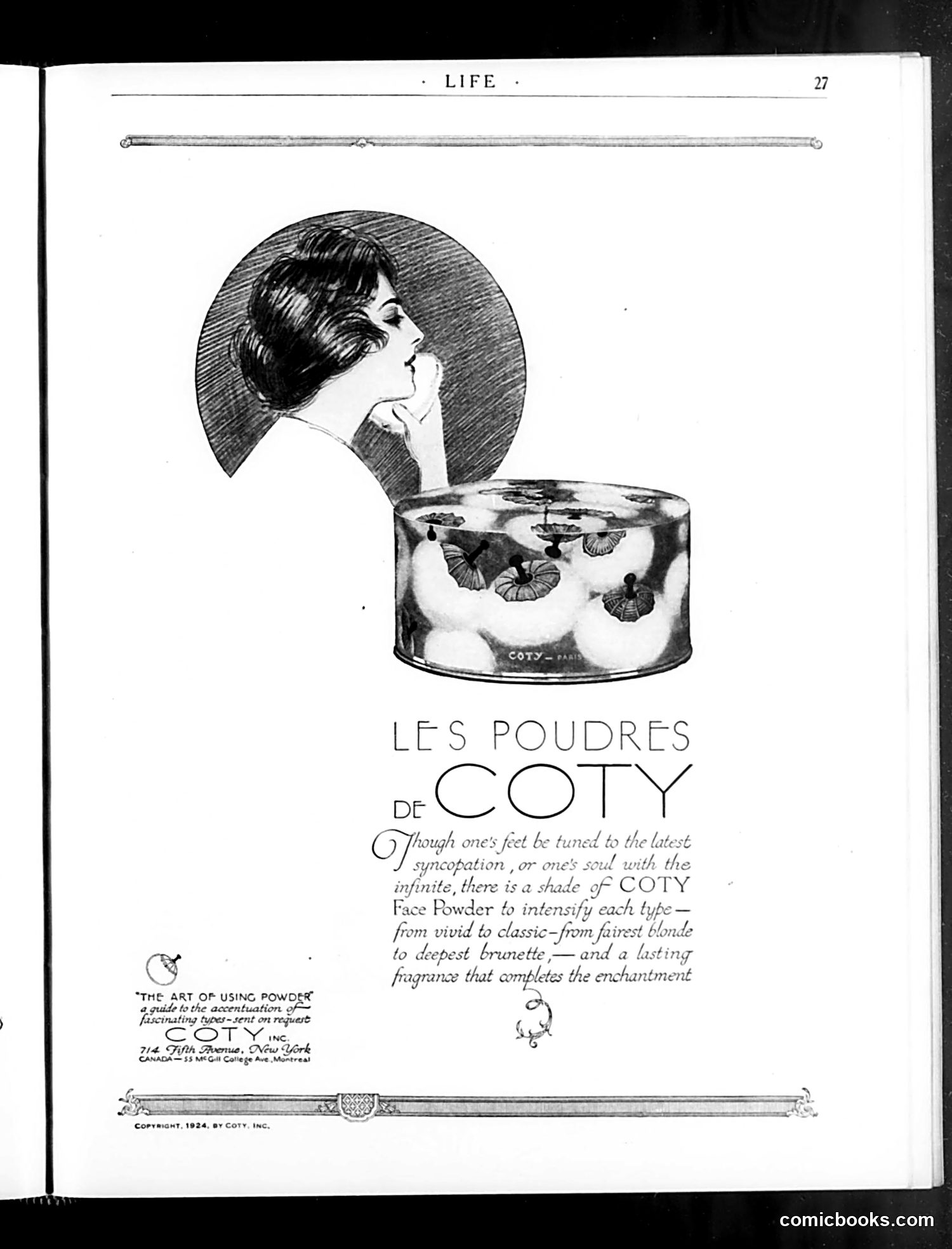
This is primarily a **beauty product advertisement**, not political satire. The page advertises Coty face powder, a major cosmetics brand of the 1920s. The illustration depicts a stylized woman's profile emerging from or associated with a decorative powder box labeled "COTY-PARIS." The art deco styling is typical of 1920s advertising design. The text emphasizes that Coty offers multiple powder shades to suit different complexions and types ("from vivid to classic—from fairest blonde to deepest brunette"), plus lasting fragrance. A sidebar references "The Art of Using Powder," apparently a guide available upon request. **No satire or political content is present.** This is straightforward commercial advertising from the Jazz Age, targeting women consumers interested in cosmetics and beauty enhancement—reflecting the era's growing accessibility of makeup to middle-class women, a social shift from earlier decades when cosmetics were associated primarily with theater or disreputable women.
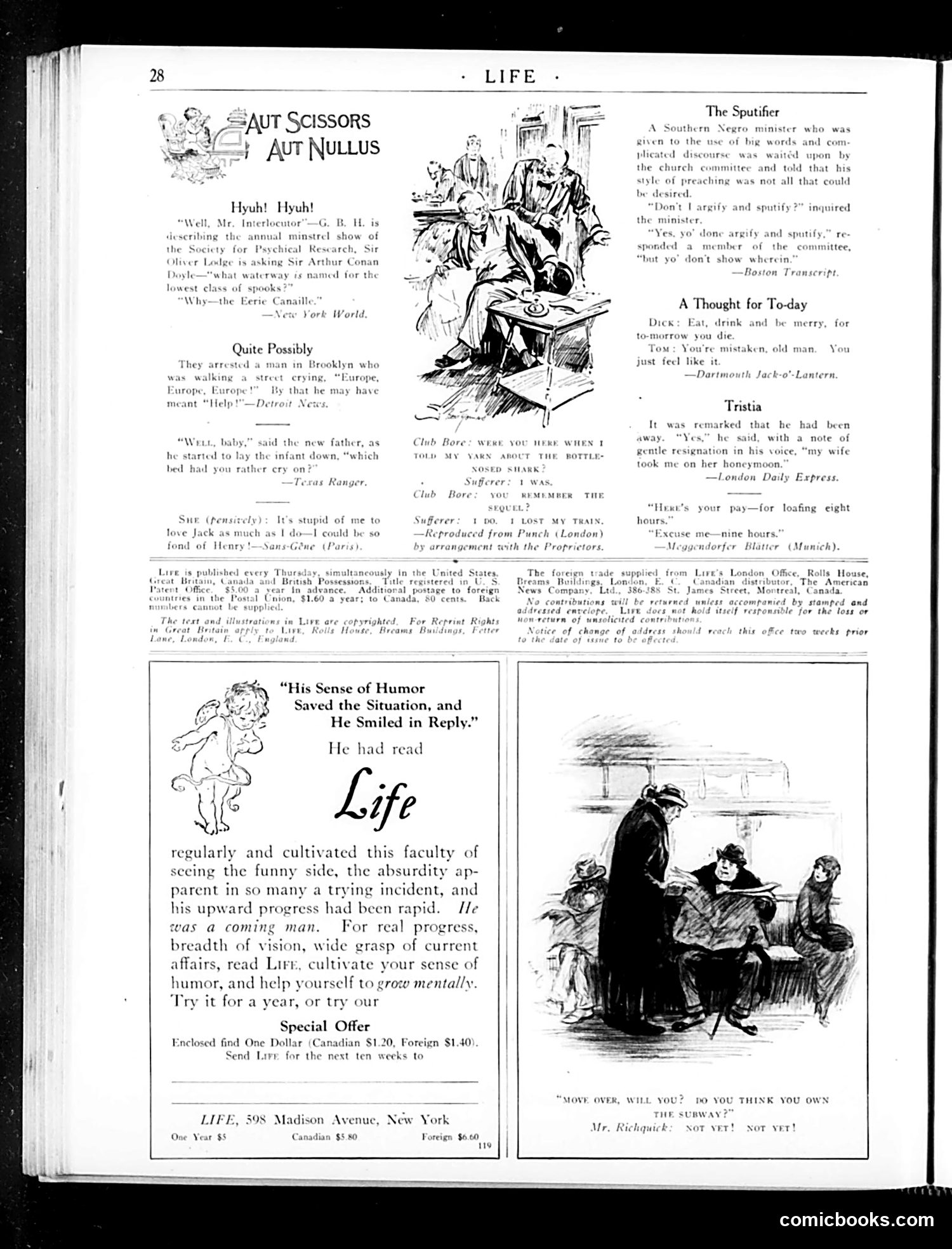
This page contains several brief satirical pieces typical of early 20th-century Life magazine humor: **"The Sputifier"** mocks verbose preaching—a Southern minister is criticized for using "big words" like "argify and sputify" (nonsense terms). The church committee suggests his grandiose style obscures meaning rather than clarifies it. **"Quite Possibly"** jokes about a Brooklyn man arrested for vagrancy who claimed he meant to say "Help!" instead of "Europe"—absurdist humor about miscommunication. **The subway cartoon** depicts a crowded scene where a man tells someone to move, and "Mr. Richquick" responds dismissively ("Not yet! Not yet!")—satirizing urban rudeness and entitlement. The page primarily advertises *Life* magazine itself, emphasizing that humor and perspective aid success and mental growth. The overall message: cultivating humor helps navigate life's absurdities and social friction. This reflects *Life*'s positioning as intelligent, irreverent satire for educated readers.
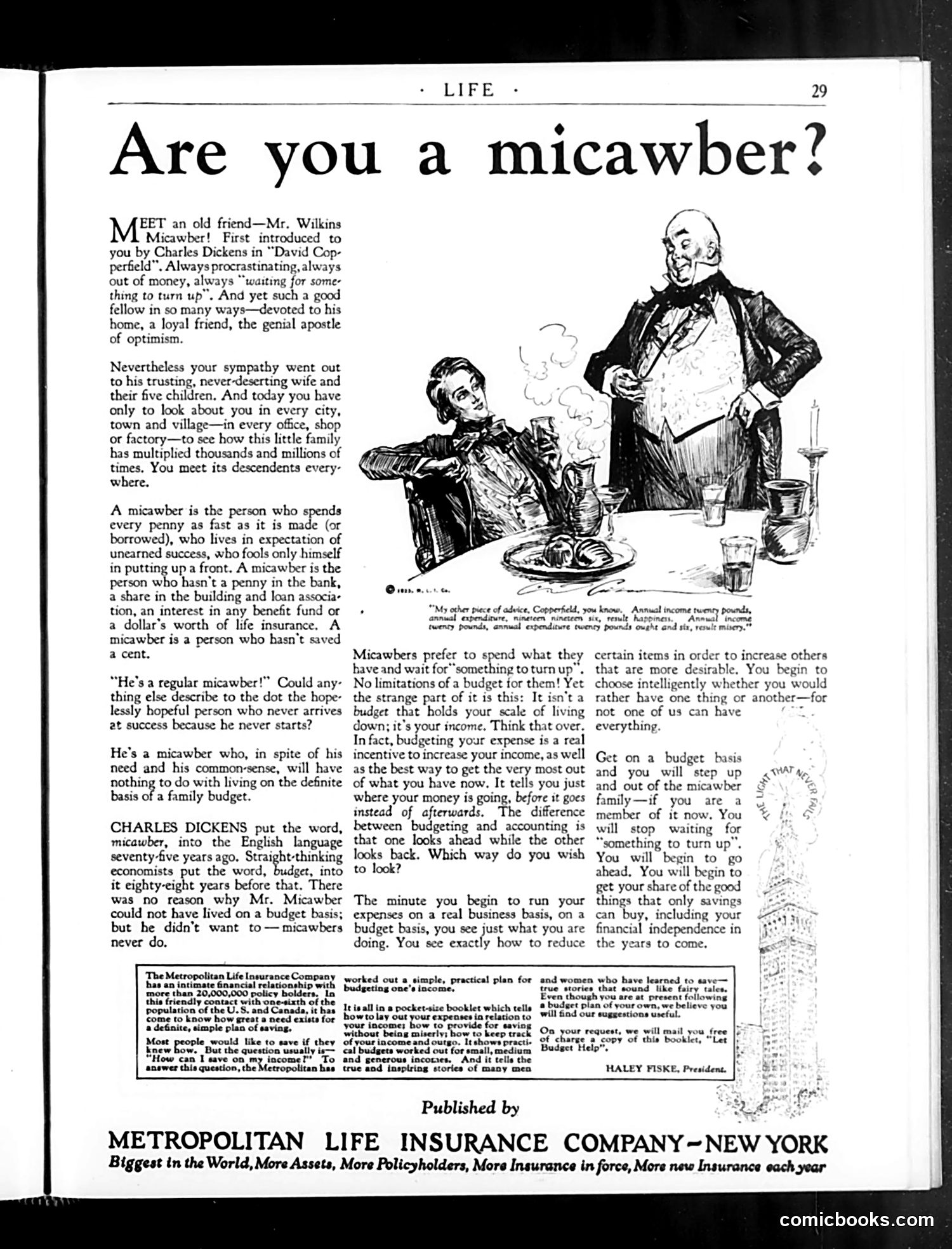
This is a Metropolitan Life Insurance advertisement disguised as social commentary. It uses Charles Dickens's famous character Mr. Micawber—a perpetually broke, optimistic procrastinator from *David Copperfield*—as a cautionary figure. The page argues that many modern people are "micawbers": they spend money as fast as they earn it, avoid budgeting, and wait for unearned success rather than planning financially. The accompanying illustration shows a well-dressed man advising a younger, shabbily-dressed version of Micawber. The advertisement's actual pitch: adopt a budget system (which the insurance company promotes) to escape financial recklessness. Budgeting forces you to see where money goes, resist frivolous spending, and build savings—ultimately achieving financial independence. The satire targets not the poor, but the financially self-deluded middle-class who spend beyond their means while maintaining appearances.
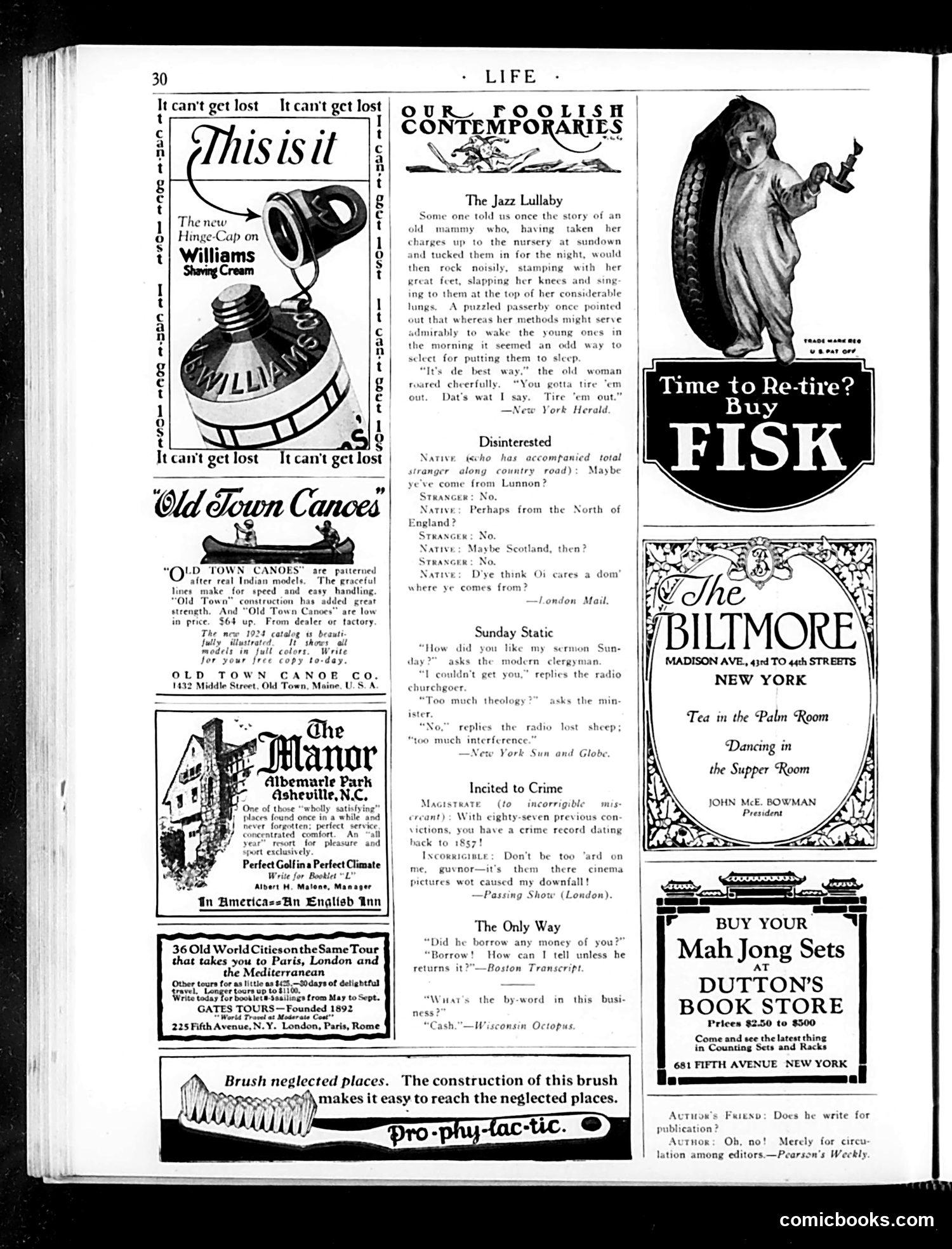
This page from *Life* magazine (likely 1920s based on styling) is primarily **advertising and humor columns**, not political satire. **The humor pieces** mock contemporary absurdities: - **"The Jazz Lullaby"**: Satirizes a mammy who rocks babies noisily to tire them out—illogical but defended as "de best way." The joke is the contradictory logic. - **"Disinterested"**: A traveler persistently asks a stranger where he's from (Lunnon? North of England? Scotland?) only to be told the stranger doesn't care where he comes from—mocking invasive small talk. - **"Sunday Static"**: Radio interference prevents a clergyman from hearing his own sermon on the radio—mocking new radio technology's unreliability. - **"Incited to Crime"**: A criminal blames cinema pictures for his 87 prior convictions—satirizing contemporaneous concerns about movies corrupting morality. The **advertisements** promote luxury travel, sporting goods, hotels, and Mah Jong sets—reflecting 1920s leisure and consumer culture. No specific political figures or events appear to be targeted.
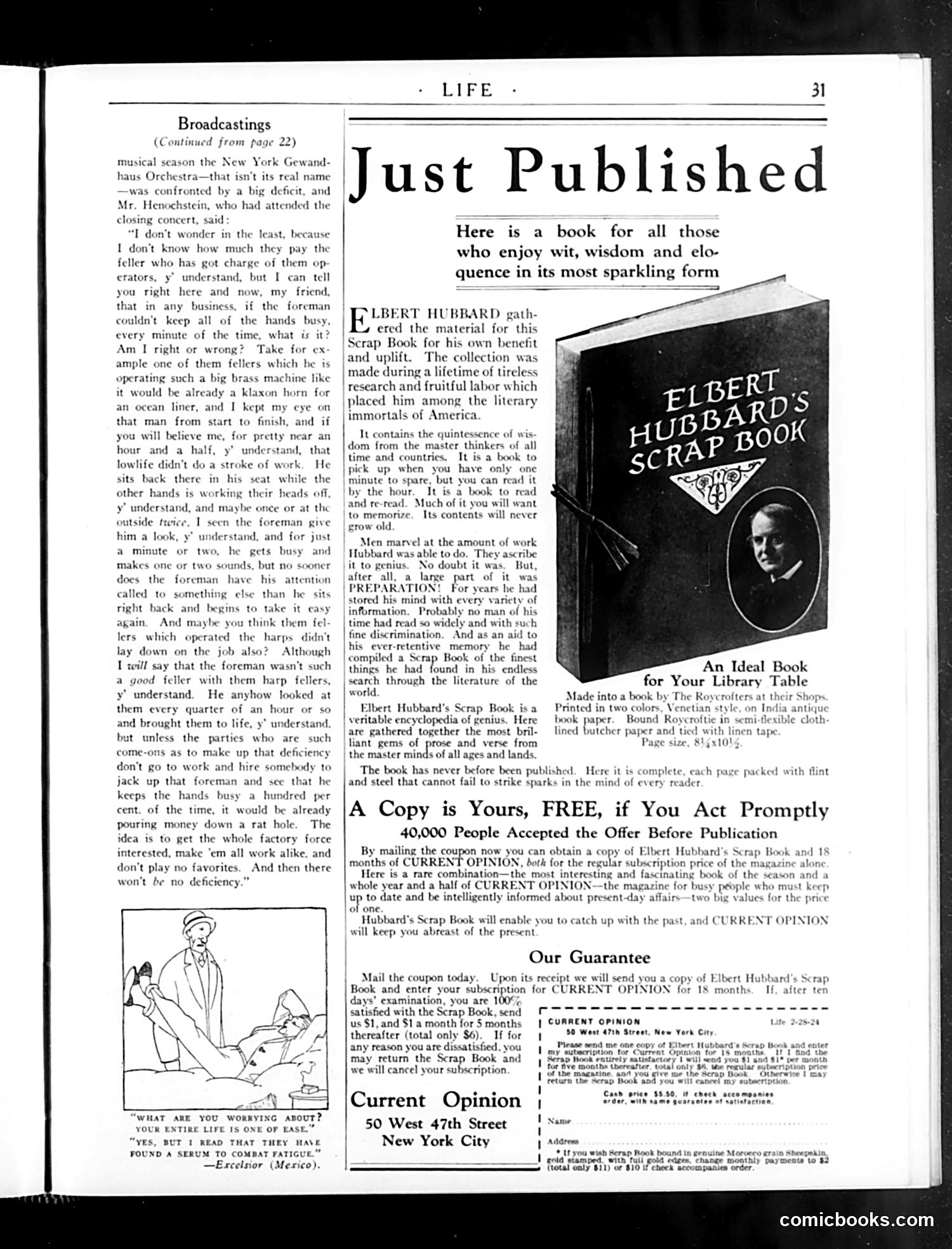
This page is primarily **advertising**, not political satire. The main content is a full-page advertisement for Elbert Hubbard's *Scrap Book*, a collection of quotations and literary excerpts. The only cartoon appears at bottom left—a Mexican cartoon (credited to *Excelsior*) showing two figures. One says they worry despite living "a life of ease," while the other responds that scientists have discovered a serum to combat fatigue. This is **social commentary on modern anxiety**: even privileged people experience exhaustion and worry, and society seeks technological solutions to human conditions. The "Broadcastings" text above discusses a New York orchestra's financial deficit, with a speaker complaining that orchestra operators aren't kept busy enough—a mundane labor-management observation rather than satire. The page reflects 1920s concerns: labor efficiency, the anxiety of leisure class, and the marketing of self-improvement literature (Hubbard was a famous contemporary author/publisher).
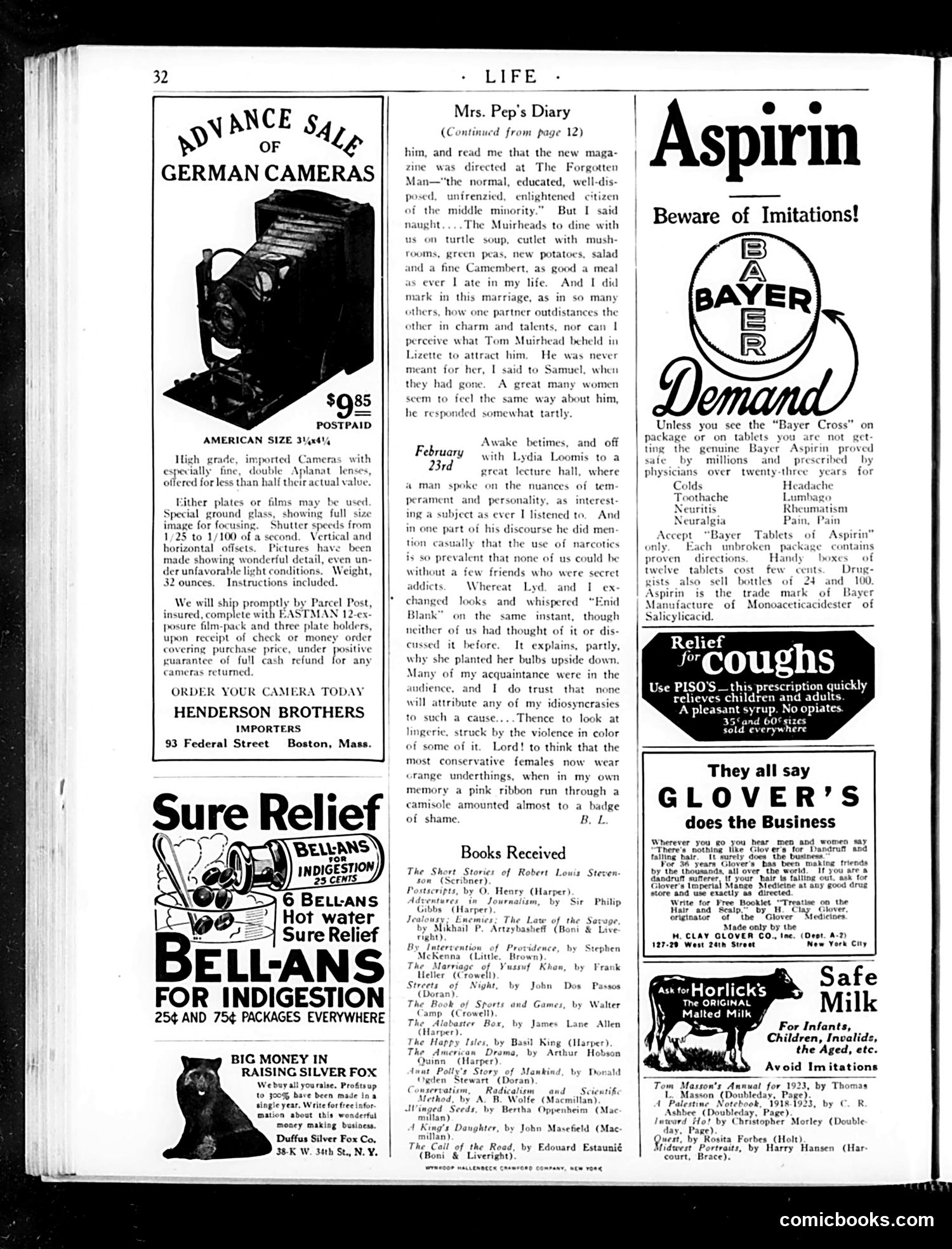
This page is primarily **advertising**, not satire or editorial content. It contains several product advertisements typical of 1920s magazines: **Key advertisements:** - German cameras (Henderson Brothers importers) - Bellans antacid for indigestion - Silver fox raising opportunity - Bayer Aspirin (with warning against counterfeits) - Horlick's Malted Milk - Glover's products **Notable context:** The Bayer Aspirin ad is historically significant—it warns "Beware of Imitations!" because Bayer's aspirin trademark had recently become genericized in the U.S. (post-WWI), allowing competitors to use the name. **Mrs. Pep's Diary** (continuing from page 12) is a serialized column discussing social observations—a dinner party, discussion of narcotics use, and commentary on women's undergarments. It reflects early 1920s attitudes and concerns. The page reflects nothing particularly satirical; it's a straightforward magazine layout mixing serialized fiction with period product advertisements.
This is a subscription advertisement for *Life* magazine, not a political cartoon. The illustrated character—a cheerful, anthropomorphic figure wearing a hat and holding a *Life* magazine—is the magazine's mascot or personification, designed to charm readers into subscribing. The humor relies on playful language: the letter addresses readers as "Dear Sir or Madam, or vice versa" (a casual joke about gender), and uses phrases like "Obey That Impulse and Coupon" and "you can be disappointed in love, or the effect of raisins in ginger ale, but never in Life"—suggesting the magazine is more reliable than romance or dubious digestive remedies. The pitch promotes upcoming themed issues (St. Patrick's, Easter, Baseball) and mentions arrangements with the U.S. Treasury and Post Office to deliver *Life* regularly for one dollar over ten weeks. This was a standard subscription solicitation typical of early 20th-century magazine marketing.
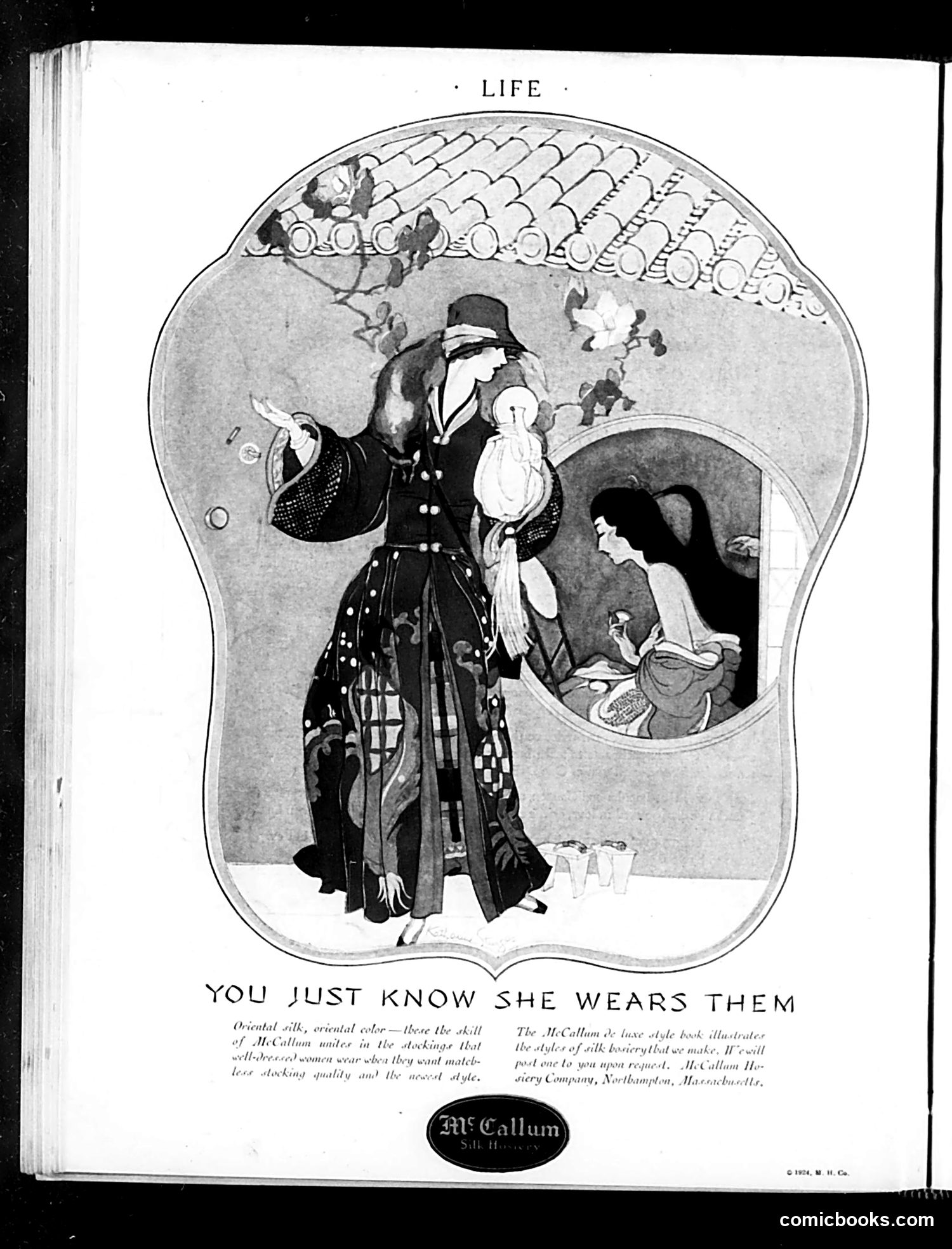
This is primarily a **McCallum Silk Hosiery advertisement** rather than political satire. The page features an elegantly dressed woman in 1920s fashion (cloche hat, ornate coat) showing off silk stockings to another woman. The accompanying vignettes at top depict various social scenes—appears to be showing where/how women wear these stockings in fashionable settings. The tagline "You Just Know She Wears Them" suggests the advertisement's appeal: quality hosiery signals social status and sophistication. The text emphasizes "Oriental silk" and superior craftsmanship from McCallum's Massachusetts factory. This reflects early 20th-century consumer advertising targeting women, using aspirational lifestyle imagery rather than explicit product demonstration—a common advertising strategy of the era.