
Life, 1924-02-28 · page 20 of 36
Life — February 28, 1924 — page 20: what you’re looking at
What you’re looking at
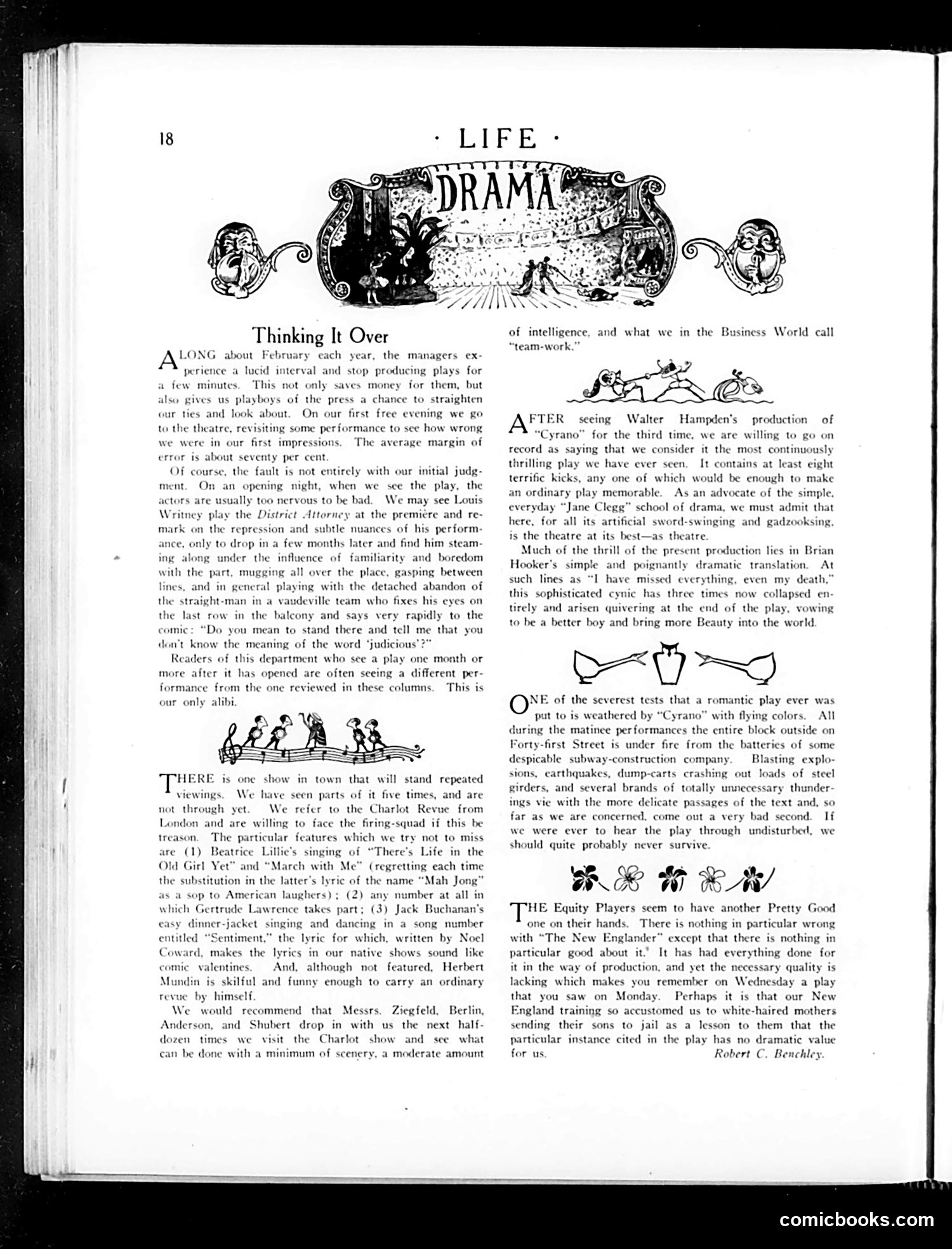
This page reviews Broadway theatrical productions with characteristic satirical commentary. The author critiques how actors' performances deteriorate after opening night—initially nervous and controlled, they later resort to "mugging" and vaudeville-style antics once comfortable with their roles. The piece praises the "Charlot Revue" from London, specifically highlighting performances by **Beatrice Lillie** and **Gertrude Lawrence**, and notes composer **Noel Coward's** superior lyrics compared to American theater standards. The review suggests Broadway producers (Ziegfeld, Berlin, Anderson, Shubert) could learn from the British production's efficient use of "team-work" over elaborate scenery. Walter Hampden's production of **"Cyrano de Bergerac"** receives high praise, with the reviewer attributing its emotional power to Brian Hooker's dramatic translation rather than the artificial sword-fighting. The satire mocks theater criticism itself—acknowledging reviewers' initial judgments are wrong about 70% of the time.
📄 Transcribed text from this page (OCR, searchable)
Machine-transcribed from the original scan — historical spelling and the odd misread are preserved.
Thinking It Over LONG about February each year, the managers ex perience a lucid interval and stop producing plays for few minutes. This not only saves money for them, but also gives us playboys of the press a chance to straighten our ties and look about. On our first free evening we go to the theatre, revisiting some performance to see how wrong we were in our first impressions. The average margin of error is about seventy per cent Of course, the fault is not entirely with our initial judg- nent. On an opening night, when we see the play, the We may see Louis Attorney at the premiere and re- actors are usually too nervous to be bad. Writney play the District mark on the repression and subtle nuances of his perform- ance, y to drop in a few months later and find him steam- ing along under the influence of familiarity and boredom with the part, mugging all over the place, gasping between lines, and in general playing with the detached abandon of the straight-man in a vaudeville team who fixes his eyes on the last row in the balcony and says very rapidly to the comic: “Do you mean to stand there and tell me that you don't know the meaning of the word ‘judicious’ ?” Readers of this department who see a play one month or more after it has opened are often seeing a different per- formance from the one reviewed in these columns. This is our only alibi. HERE is one show in town that will stand repeated viewings. We have seen parts of it five times, and are not through yet We refer to the Charlot Revue from London and are willing to face the firing-squad if this be treason. The particular features which we try not to miss are (1) Beatrice Lillie’s singing of “There's Life in the Old Girl Yet” and “March with Me” (regretting each time the substitution in the latter's lyric of the name “Mah Jong” as a sop to American laughers) ; (2) any number at all in which Gertrude Lawrence takes part; (3) Jack Buchanan's easy dinner-jacket. singing and dancing in a song number entitled “Sentiment,” the lyric for which, written by Noel Coward, makes the lyrics in our native shows sound like valentines. And, although not featured, Herbert Mundin is skilful and funny enough to carry an ordinary revue by himself We would recommend that Messrs. Ziegfeld, Berlin, Anderson, and Shubert drop in with us the next half- dozen times we visit the Charlot show and see what can be done with a minimum of scenery, a moderate amount of intelligence, and what we in the Business World call “team-work FTER seeing Walter Cyrano” for the third Hampden’s me, we are willing to go on record as saying that we consider it the most continuously thrilling play we have ever seen. It contains at least eight terrific kicks, any production of one of which would be enough to make an ordinary play memorable. As an advocate of the simple, everyday “Jane Clegg” school of drama, we must admit that here, for all its artificial sword-swinging and gadzooksing. is the theatre at its best—as theatre Much of the thrill of the present production lies in Brian Hooker's simple and poignantly dramatic translation. At such lines as “I have missed everything, even my death, this sophisticated cynic has three times now collapsed en tirely and arisen quivering at the end of the play, vowing to be a better boy and bring more Beauty into the world. SAW = NE of the severest tests that a romantic play ever was put to is weathered by “Cyrano” with flying colors. All during the matinee performances the entire block outside on Forty-first Street is under fire from the batteries of some despicable subway-construction company, Blasting explo: sions, earthquakes, dump-carts crashing out loads of steel girders, and several brands of totally unnecessary thunder- ings vie with the more delicate passages of the text and, so far as we are concerned, come out a very bad second. If we were ever to hear the play through undisturbed, we should quite probably never survive: VW FA YL 4 ri a A THe Equity Players seem to hav ne on their hands. another Pretty Good There is nothing in particular wrong with “The New Englander” except that there is nothing in It has had everything done for it in the way of production, and yet the necessary quality is lacking which makes you remember on Wednesday a play that you saw on Monday sngland training so accustomed us to white-haired mothers sending their sons to jail as a lesson to them that the particular good about it Perhaps it is that our New particular instance cited in the play has no dramatic value for us Robert C. Benchley comicbooks.com