
Life, 1924-02-28 · page 31 of 36
Life — February 28, 1924 — page 31: what you’re looking at
What you’re looking at
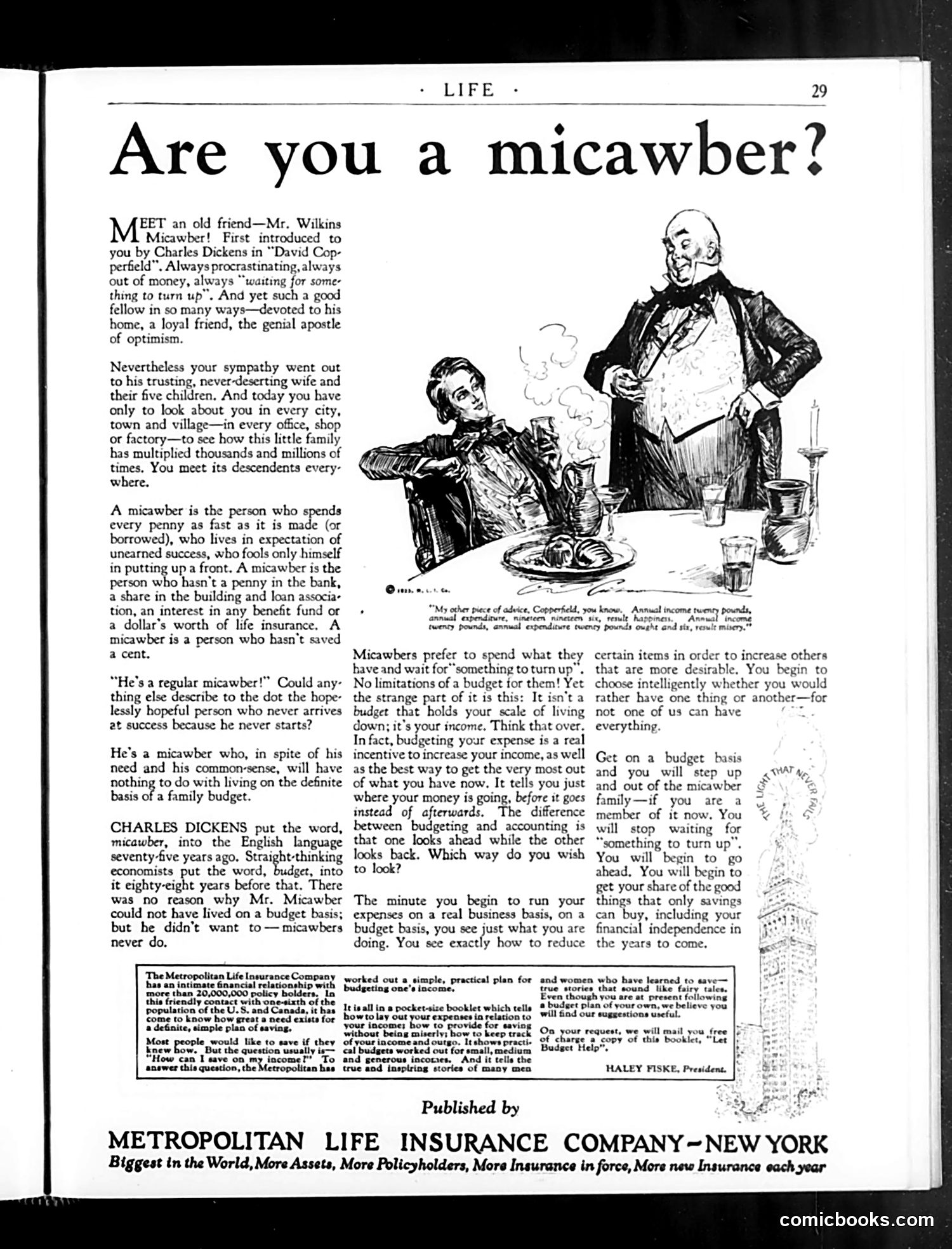
This is a Metropolitan Life Insurance advertisement disguised as social commentary. It uses Charles Dickens's famous character Mr. Micawber—a perpetually broke, optimistic procrastinator from *David Copperfield*—as a cautionary figure. The page argues that many modern people are "micawbers": they spend money as fast as they earn it, avoid budgeting, and wait for unearned success rather than planning financially. The accompanying illustration shows a well-dressed man advising a younger, shabbily-dressed version of Micawber. The advertisement's actual pitch: adopt a budget system (which the insurance company promotes) to escape financial recklessness. Budgeting forces you to see where money goes, resist frivolous spending, and build savings—ultimately achieving financial independence. The satire targets not the poor, but the financially self-deluded middle-class who spend beyond their means while maintaining appearances.
📄 Transcribed text from this page (OCR, searchable)
Machine-transcribed from the original scan — historical spelling and the odd misread are preserved.
LIFE 29 Are you a micawber? EET an old friend—Mr. Wilkins Micawber! First introduced to you by Charles Dickens in “David Cop- perfield”. Always procrastinating, always out of money, always “waiting for some- thing to turn up”. And yet such a good fellow in so many ways—devoted to his home, a loyal friend, the genial apostle of optimism. Nevertheless your sympathy went out to his trusting, never-deserting wife and their five children, And today you have only to look about you in every city, town and village—in every office, shop or factory—to see how this little family has multiplied thousands and millions of times. You meet its descendents every- where. A micawber is the person who spends every penny as fast as it is made (or borrowed), who lives in expectation of unearned success, who fools only himself in putting up a front. A micawber is the person who hasn’t a penny in the bank, a share in the building and loan associa tion, an interest in any benefit fund or a dollar's worth of life insurance. A micawber is a person who hasn't saved a cent. “He's a regular micawber!” Could any- thing else describe to the dot the hope- lessly hopeful person who never arrives at success because he never starts? He's a micawber who, in spite of his need and his common-sense, will have nothing to do with living on the definite basis of a family budget. CHARLES DICKENS put the word, micawber, into the English language seventy-five years ago. Straight-thinking economists put the word, iget, into it eighty-eight years before that. There was no reason why Mr. Micawber could not have lived on a budget basis; but he didn’t want to— micawbers ‘The Metropolitan Life Insurance Company has an intimate financial relationship with more t ders. In this friendly contact with one-sixth ot che would like if the knew Moe porte the question usually is “How can save onvmy income!” Ti answer this question, the Metropolitan bas “My other piece of advice, Copperfield, you know. Annual income twenty pounds, annual expenditure, nineteen muneicen six, renult ‘happinens Aneual income twenty pounds, annual expendicure twenty pounds ought and sie, result misery.” Micawhers prefer to spend what they have and wait for’*something to turn up”. No limitations of a budget for them! Yet the strange part of it is this: It isn’t a budget that holds your scale of living down; it’s your income. Think that over. In fact, budgeting your expense is a real incentive to increase your income, as well as the best way to get the very most out of what you have now. It tells you just where your money is going, before it goes instead of afterwards, The difference between budgeting and accounting is that one looks ahead while the other looks back. Which way do you wish to look? The minute you begin to run your expenses on a real business basis, on a budget basis, you see just what you are doing. You see exactly how to reduce worked out a simple, practical plan for budgeting one’s income, true certain items in order to increase others that are more desirable. You begin to choose intelligently whether you would rather have one thing or another—for not one of us can have everything. Get on a budget basis and you will step up and out of the micawber family—if you are a member of it now. You vill stop waiting for “something to turn up”. You will begin to go ahead, You will begin to get your share of the good things that only savings can buy, including your financial independence in the years to come, and women who have learned to save— ies that sound like fairy tales. ugh you are at present following It isall in a pocket-size booklet which tells howto lay out your expenses in relation to your income; bow to provide for savin without being miserly; how to keep track of your income and outgo. It shows practi- cal budgets worked out for small, medium and generous incomes. And it tells the true and inspiring stories of many men Published by On your request, we will mail of charge a copy of this book! Budget Help”, plan of your own, we believe you twill Sind our sagaestions useful. HALEY FISKE, President. METROPOLITAN LIFE INSURANCE COMPANY~ NEW YORK Biggest in the World, More Assets, More Policyholders, More Insurance in force, More new Insurance each year comicbooks.com