
Life, 1924-02-28 · page 28 of 36
Life — February 28, 1924 — page 28: what you’re looking at
What you’re looking at
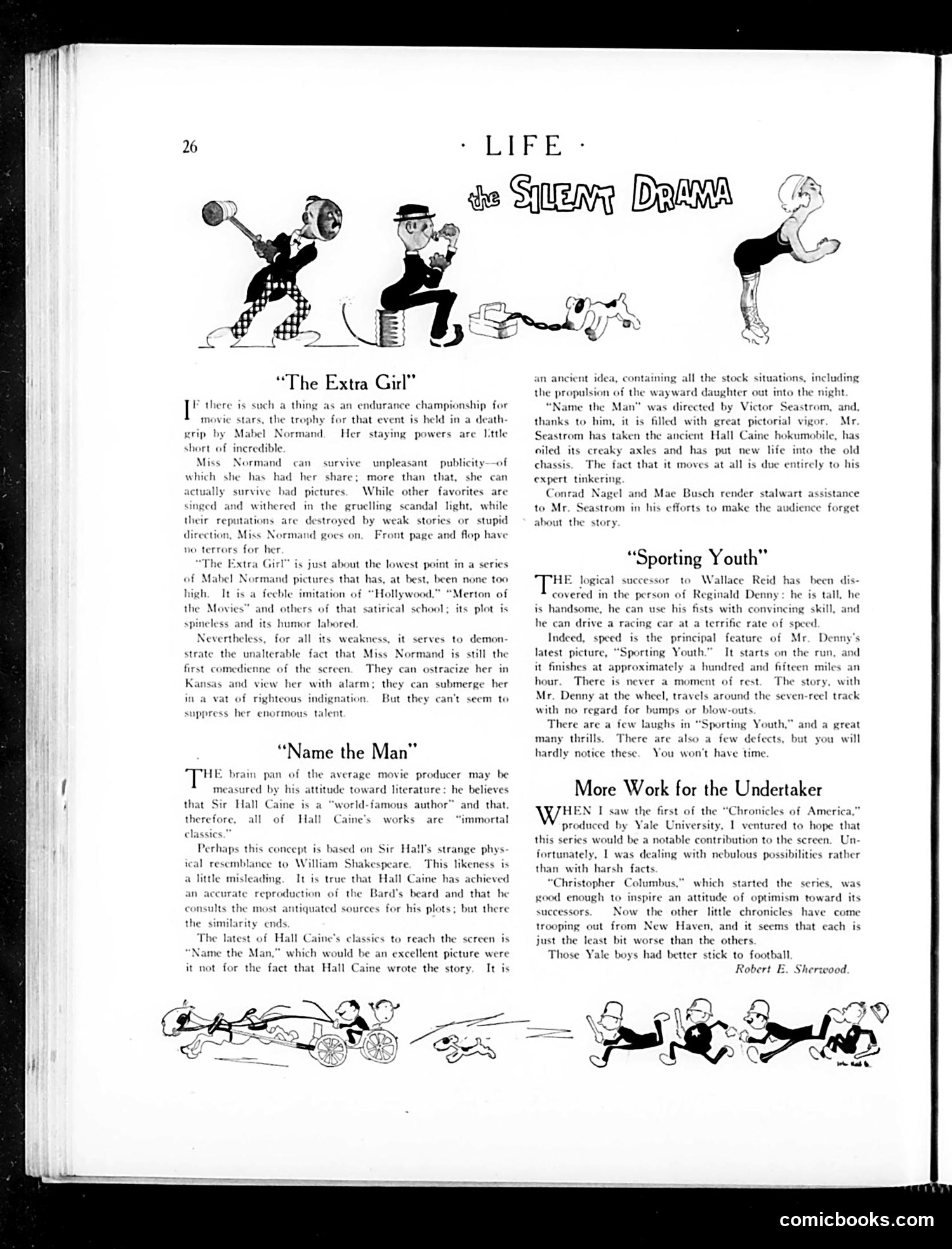
This page contains film reviews satirizing both movies and their stars. Key points: **"The Extra Girl"** reviews Mabel Normand's latest picture, noting she's survived multiple scandals that destroyed other actresses' careers—yet this film itself is weak ("feeble imitation"), proving her talent transcends poor material. **"Name the Man"** mocks producers' reverence for Sir Hall Caine, comparing his beard to Shakespeare's while dismissing his plots as hackneyed ("hokumobile"). Director Victor Seastrom salvages the film through technical skill despite Caine's dated story. **"Sporting Youth"** praises Reginald Denny as Wallace Reid's successor, emphasizing the film's relentless pace and thrills over plot substance—"you won't have time" to notice defects. **"More Work for the Undertaker"** dismisses Yale University's educational film series, particularly "Christopher Columbus," as disappointing despite initial optimism. The satire targets both studio mediocrity and audiences' tolerance for weak stories carried by stars' charisma or technical spectacle.
📄 Transcribed text from this page (OCR, searchable)
Machine-transcribed from the original scan — historical spelling and the odd misread are preserved.
“The Extra Girl” ' there is such a thin) movie stars, the trophy for that event is held in a death by Mabel Normand. Her staying powers are Ittle short of incredible Miss Normand can an endurance championship for grip survive unpleasant publicity—of more than that, she can While other favorites are nd withered in the gruelling scandal light, while their reputation which has had her share; survive bad_ pictures are destroyed by weak stories or stupid ction, Miss Normand goes on. Front page and flop have ho terrors for her The Extra Girl” is just about the lowest point in a series of Mabel Normand pictures that has, at best, been none too Hollywood f that satirical school; its plot is high. It is a feeble imitation of Merton of the Movies” and other spineless and its humor labored Nevertheless, for all its weakness, it serves to demon Iterable fact that Miss Norman strate the ui is still the first comedienne of the screen. They can ostracize her in sas and view her with alarm; they can submerge her in a vat of righteous indignation. But they can’t seem to oress her enormous talent “Name the Man” Tre brain pan of the average movie producer may measured by his attitude toward literature: he believes that Sir Hall Caine is a “world-famous author there . all of Hall 1 and that Caine’s works are “immortal Perhaps this concept is based on Sir Hall's strange phys ical resemblance to William Shakespeare. This likeness is a little misleading. It is true that Hall Caine has achieved an accurate reproduction of the Bard's beard and that he consults the most antiquated sources for his plots; but there the s ty ¢ The late Hall Caine’s classics to reach the screen is “Name the Man,” which would be an excellent picture were it not for the fact that Hall Caine wrote the story. It is a Lh NY = all the stock situations, including the propulsion of the wayward daughter out into the night Jame the Man” was directed by Victor Seastrom, and, thanks to him, it is filled with great pictorial vigor. Mr Seastrom has taken the ancient Hall Caine hokumobile, has oiled its creaky axles and has put new life into the old chassis. The fact that it moves at all is due entirely to his expert tinkering Conrad Nagel and Mae Busch render stalwart assistance to Mr. Seastrom in his efforts to make the audience forget about the story “Sporting Youth” ogical successor to Wallace Reid has been dis- he is tall, he ts with convincing skill, and covered in the person of Reginald Denny is handsome, he can use his he can drive a racing car at a terrific rate of speed Indeed, speed is the principal feature of Mr latest picture, “Sporting Youth.” It starts on the run, and it finishes at approximately a hundred and fifteen miles an hour. There is never a moment of rest. The story, with Mr. Denny at the wheel, travels around the seven-reel track with no regard for bumps or blow-outs Denny's There are a few laughs in “Sporting Youth,” and a great many thrills. There are also a few defects, but you will hardly notice these. You won't have time More Work for the Undertaker HEN I saw the first of the “Chronicles of America,” produced by Yale University, 1 ventured to hope that this series would be a notable contribution to the screen. Un fortunately, | was dealing with nebulous possibilities rather than with harsh facts. “Christopher Columbus,” good enough to inspire an attitude of optimism toward its successors. Now the other little chronicles have come trooping which started the series, was ut from New Haven, and it seems that each is just the least bit worse than the others Those Yale boys had better stick to football. Robert E. Sherwood. ae on 5) ~ BX DO mo comicbooks.com