
A complete issue · 44 pages · 1919
Life — March 27, 1919
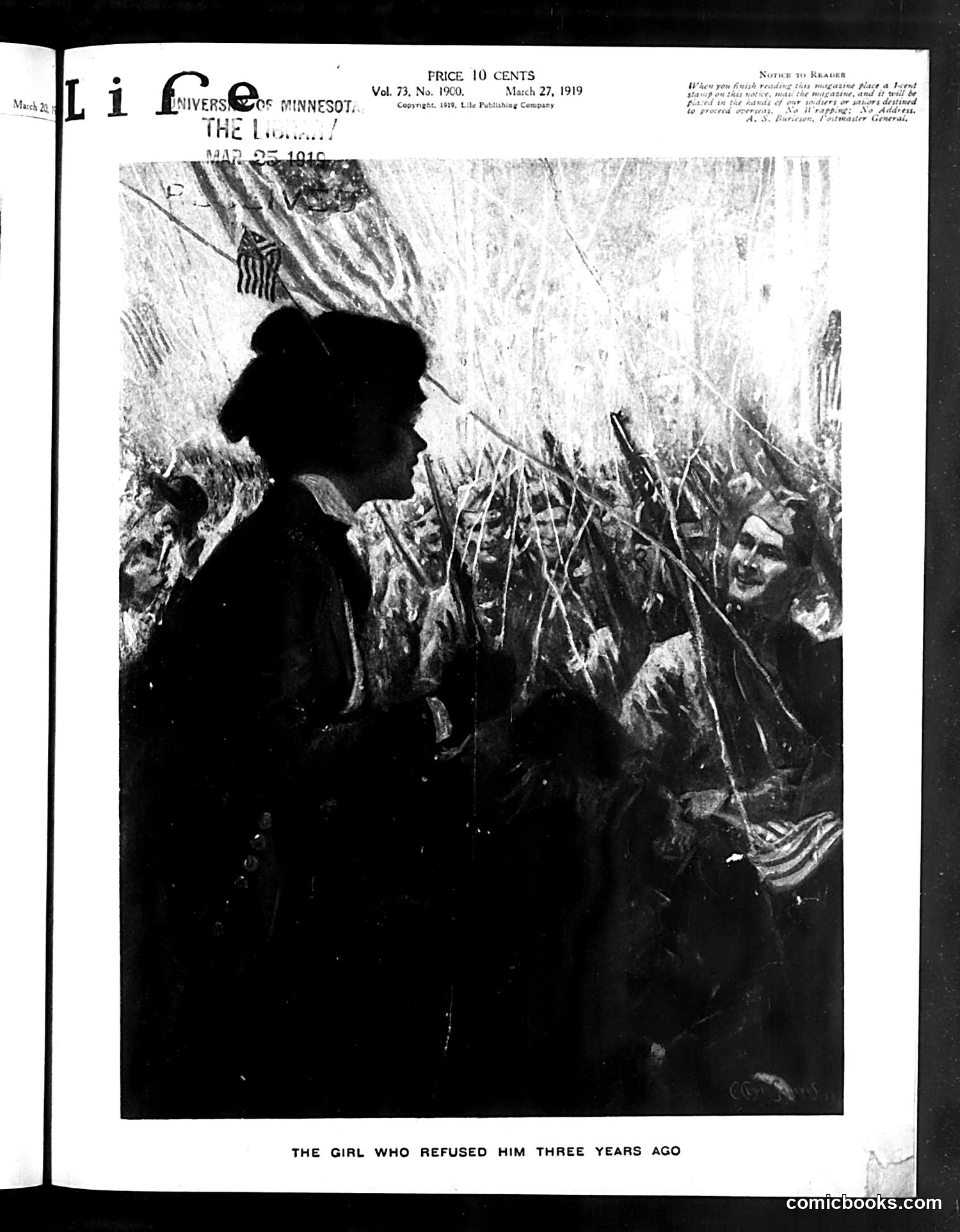
This image shows a silhouetted figure in profile standing before what appears to be a crowd with an American flag in the background. The caption reads "THE GIRL WHO REFUSED HIM THREE YEARS AGO." The image likely illustrates a romantic or comedic narrative—possibly referencing a now-successful or prominent man being observed by a woman who previously rejected him. Given the 1919 publication date and patriotic imagery (American flag), this could reference a WWI veteran or returning soldier encountering someone from his past. However, without additional context or visible text identifying the specific individuals or narrative, I cannot definitively explain what particular public figure or event this references. The silhouette technique obscures identifying details, suggesting the satire relies on contemporary readers' familiarity with a specific story or scandal.
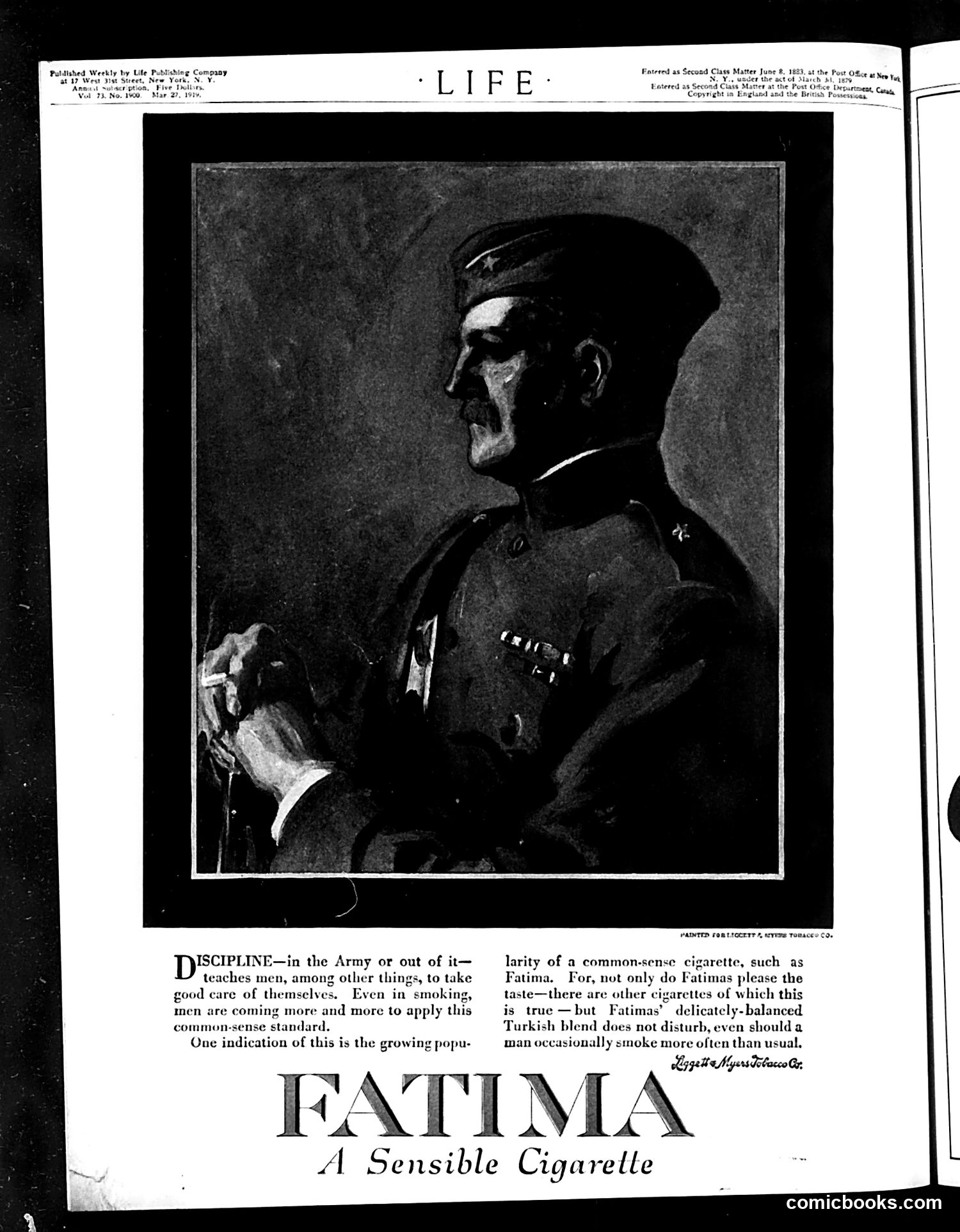
This page is primarily a **cigarette advertisement**, not political satire. It features a portrait of a military officer in profile wearing a uniform with medals and insignia, alongside an advertisement for Fatima cigarettes. The ad's text appeals to discipline and "common-sense" smoking habits, claiming Fatima's "delicately-balanced Turkish blend does not disturb, even should a man occasionally smoke more often than usual." The military figure appears to represent authority and respectability—using a uniformed officer to lend credibility to the product. This was a common advertising strategy of the early 20th century: associating consumer goods with trusted institutions and masculine virtue. The satirical *Life* magazine context likely adds irony by featuring a disciplined military figure endorsing a luxury consumer product.
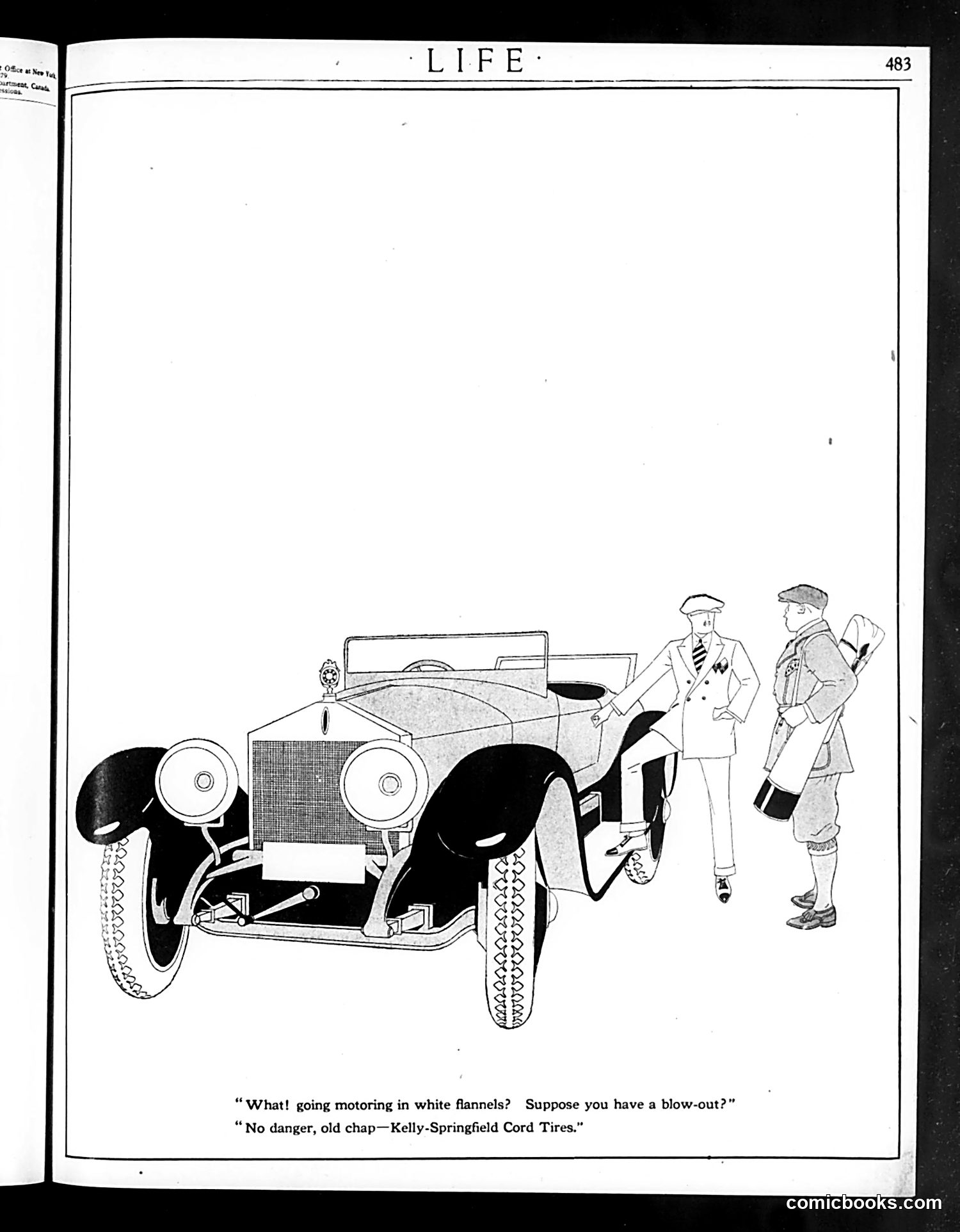
This is a **vintage advertisement disguised as humor** from Life magazine (page 483). The cartoon shows two well-dressed men in 1920s attire examining a luxury automobile, with one man in a white suit prominently featured. The joke plays on the contrast between casual elegance ("white flannels"—summer clothing) and practical car maintenance. One man expresses concern about tire blow-outs while motoring in fancy dress. The other dismissively responds that Kelly-Springfield Cord Tires present "no danger." This is fundamentally an **advertisement for Kelly-Springfield tires**, using humor and social aspiration to sell the product. The "old chap" dialogue and refined characters appeal to affluent readers, suggesting that quality tires allow worry-free leisure driving. The satire is mild—essentially mocking the anxiety of early motorists while promoting brand reliability.
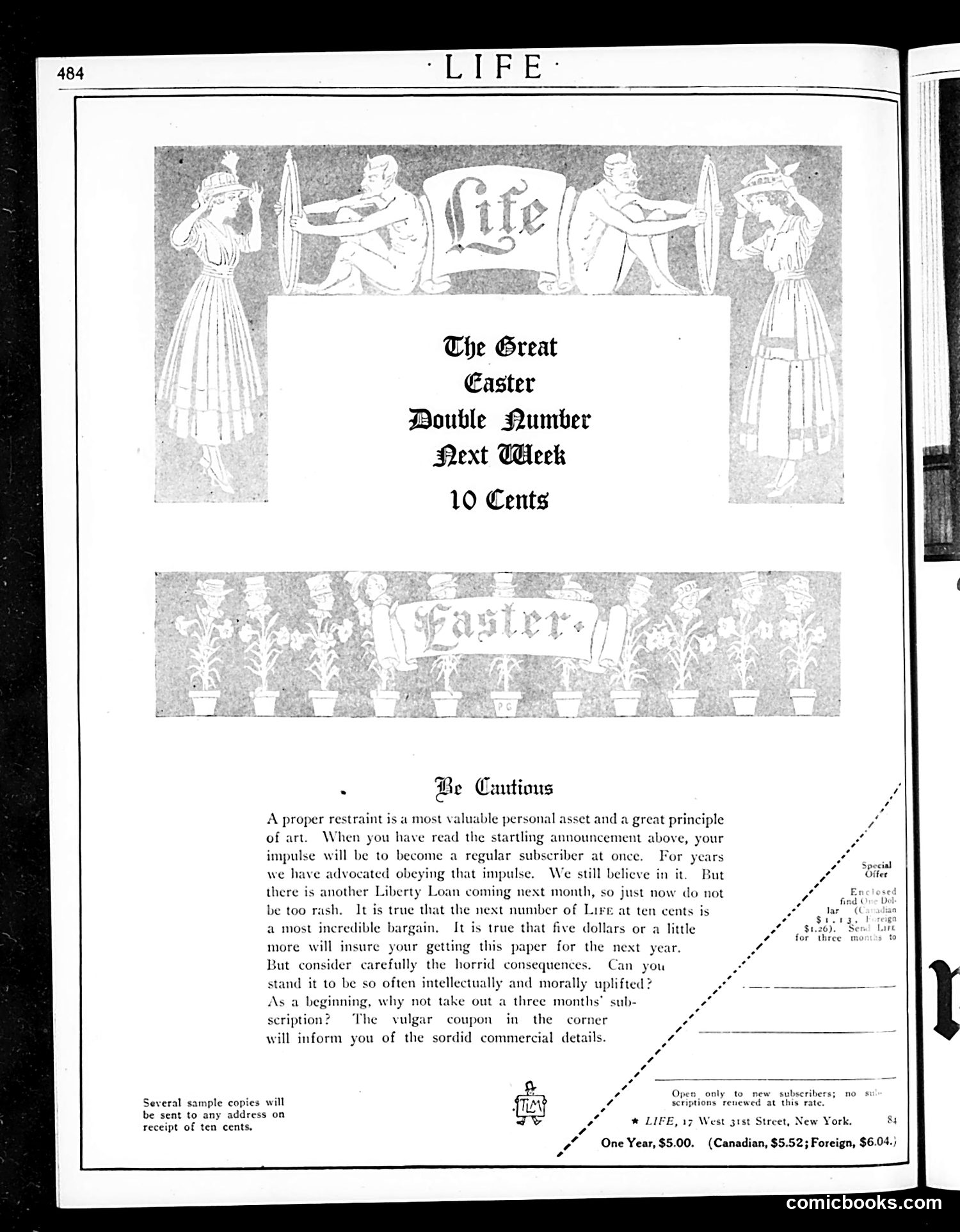
This page is primarily **advertising for Life magazine itself**, not political satire. The decorative header shows classical figures and the "Life" masthead. The central announcement promotes "The Great Easter Double Number Next Week" for 10 cents. The text section titled "Be Cautious" addresses potential subscribers, cautioning against impulse subscription decisions. It acknowledges Life's appeal but urges readers to consider the financial commitment carefully before subscribing for a year. The tone is self-aware—almost satirizing the magazine's own hard-sell tactics. The modest advertisement at bottom offers sample copies for ten cents. This page functions as promotional material rather than editorial content with political or social commentary.
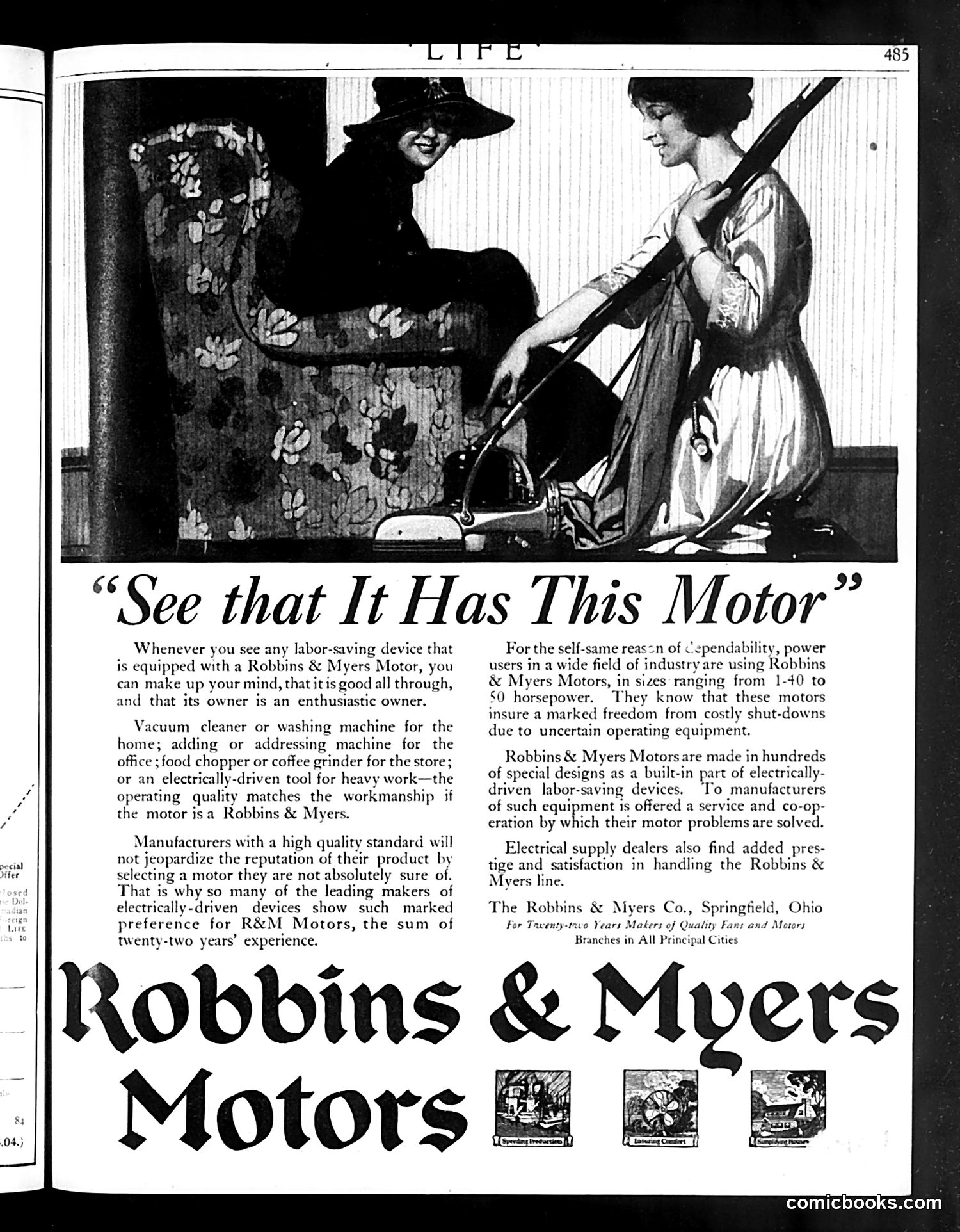
This is primarily a **advertisement**, not satirical content. It promotes Robbins & Myers Motors, manufactured in Springfield, Ohio. The image shows two women in early 1900s dress examining a motor or mechanical device. The ad argues that quality motors—specifically R&M Motors—indicate a manufacturer's standards and reliability. The text emphasizes that leading makers of electrically-driven devices consistently choose Robbins & Myers Motors (ranging 1-50 horsepower) because they ensure "freedom from costly shut-downs due to uncertain operating equipment." The headline "See that It Has This Motor" suggests consumers should verify their household appliances and industrial equipment use this brand as a mark of quality. This reflects the early industrial era when electric motors were becoming standard in home and commercial applications, and brand reputation signaled dependable engineering.
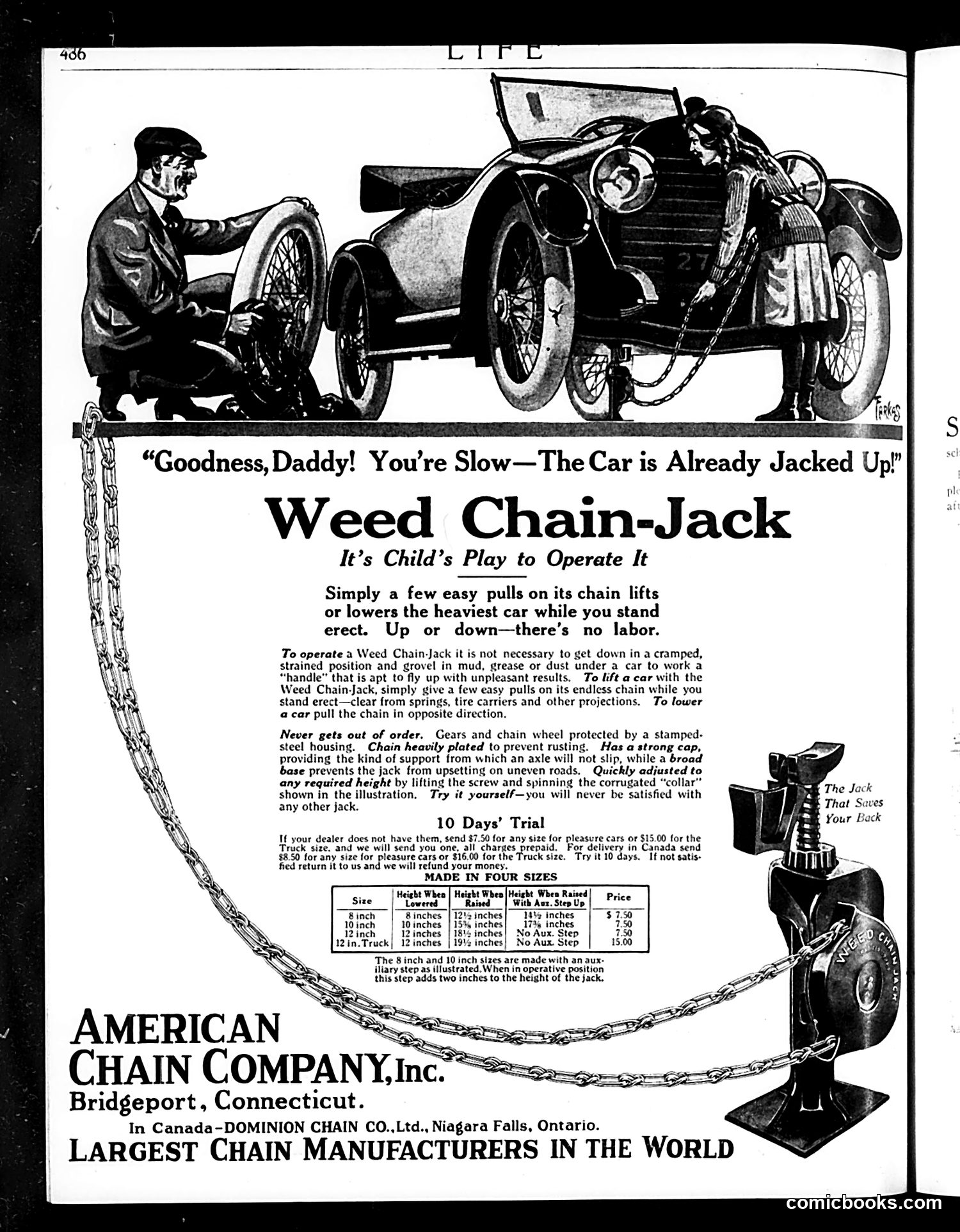
This is primarily a **product advertisement**, not political satire. The page promotes the "Weed Chain-Jack," a mechanical lifting device manufactured by American Chain Company of Bridgeport, Connecticut. The cartoon illustrates the product's ease of use: a child operates the jack while an adult works on a car wheel, with the caption "Goodness, Daddy! You're Slow—The Car is Already Jacked Up!" The humor targets fathers, suggesting even children can operate this device more efficiently than adults. The ad emphasizes the jack's advantages: no need to crawl under cars or strain in cramped positions. It came in four sizes and cost $2.50–$15.00. The "10 Days' Trial" offer and detailed specifications indicate this is straightforward commercial marketing from the early automobile era.
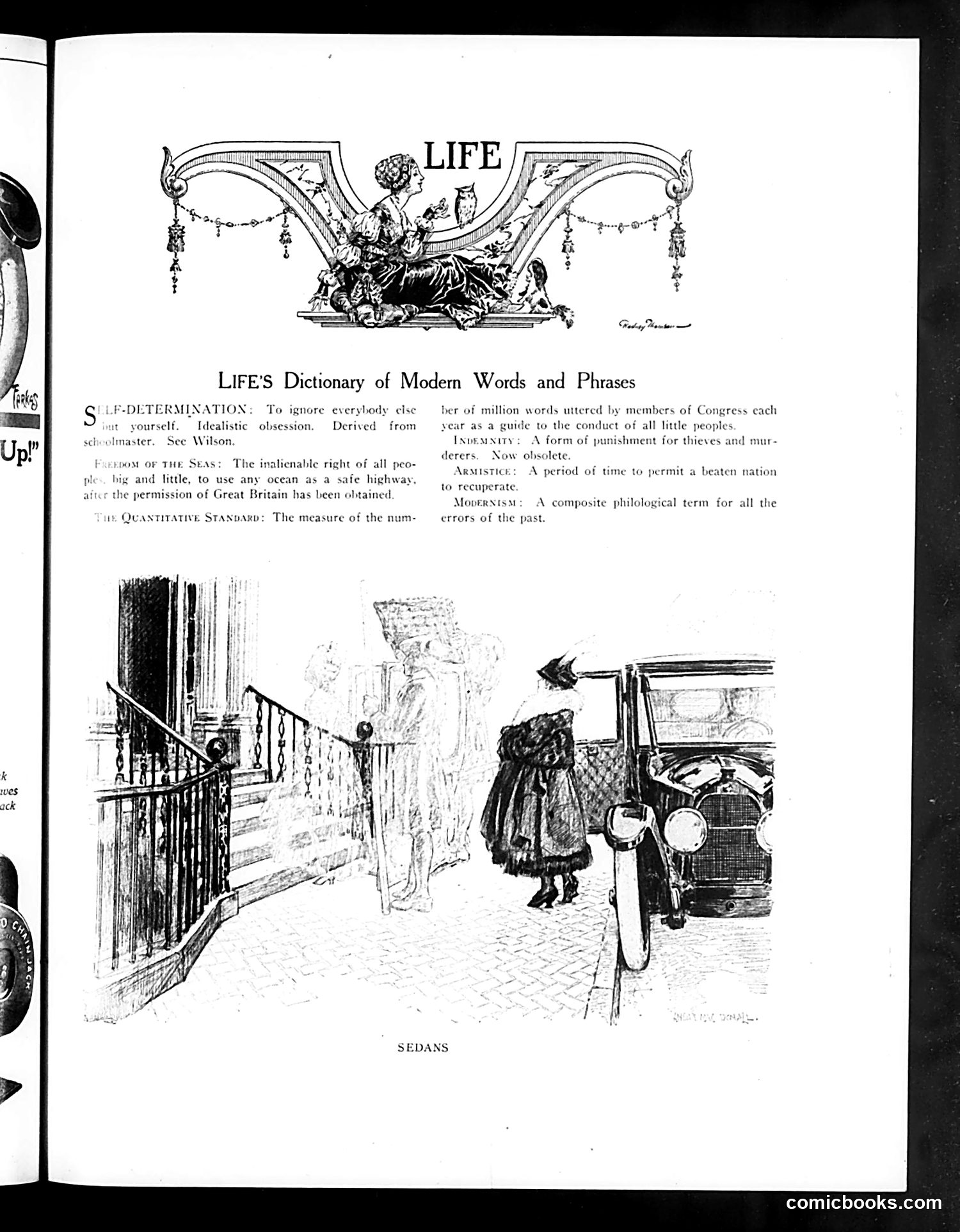
This page presents satirical definitions of contemporary terms, likely from the early 20th century. The definitions mock modern concepts: - **Self-Determination**: Ignoring everyone else (attributed to "See Wilson")—a jab at President Woodrow Wilson's famous political principle - **Freedom of the Seas**: Britain's claimed right to use any ocean as a highway - **The Quantitative Standard**: Measuring progress by congressional output The illustration labeled "SEDANS" shows a street scene with automobiles and pedestrians, likely satirizing how sedans (then-new enclosed cars) had become status symbols or were changing modern urban life. The overall page mocks contemporary political rhetoric and social pretensions through humorous redefinitions.
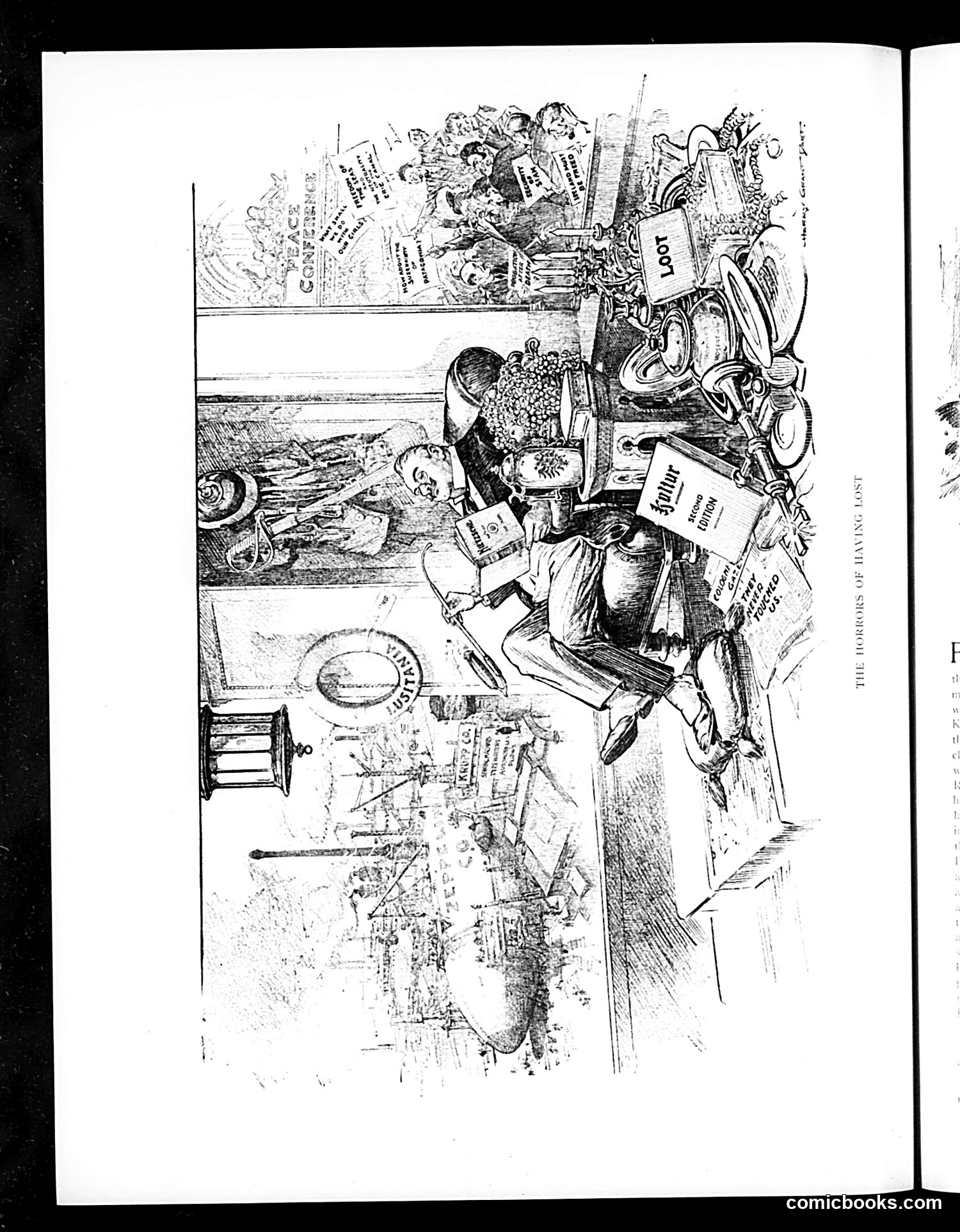
This appears to be a satirical cartoon from Life magazine, though the image quality and orientation make definitive interpretation challenging. The cartoon depicts a figure surrounded by various objects and publications, suggesting commentary on consumerism, materialism, or cultural excess. Visible text includes what appear to be product names and labels scattered throughout the composition. The style is characteristic of early-to-mid 20th century American political cartooning. The central figure seems overwhelmed or burdened by consumer goods and commercial items, likely satirizing American consumer culture or the commercialization of some aspect of public life. However, without clearer legibility of the specific text labels and publication date, I cannot identify the precise target of the satire or which contemporary figure or issue is being critiqued. The overall message appears critical of commercialism or consumer excess.
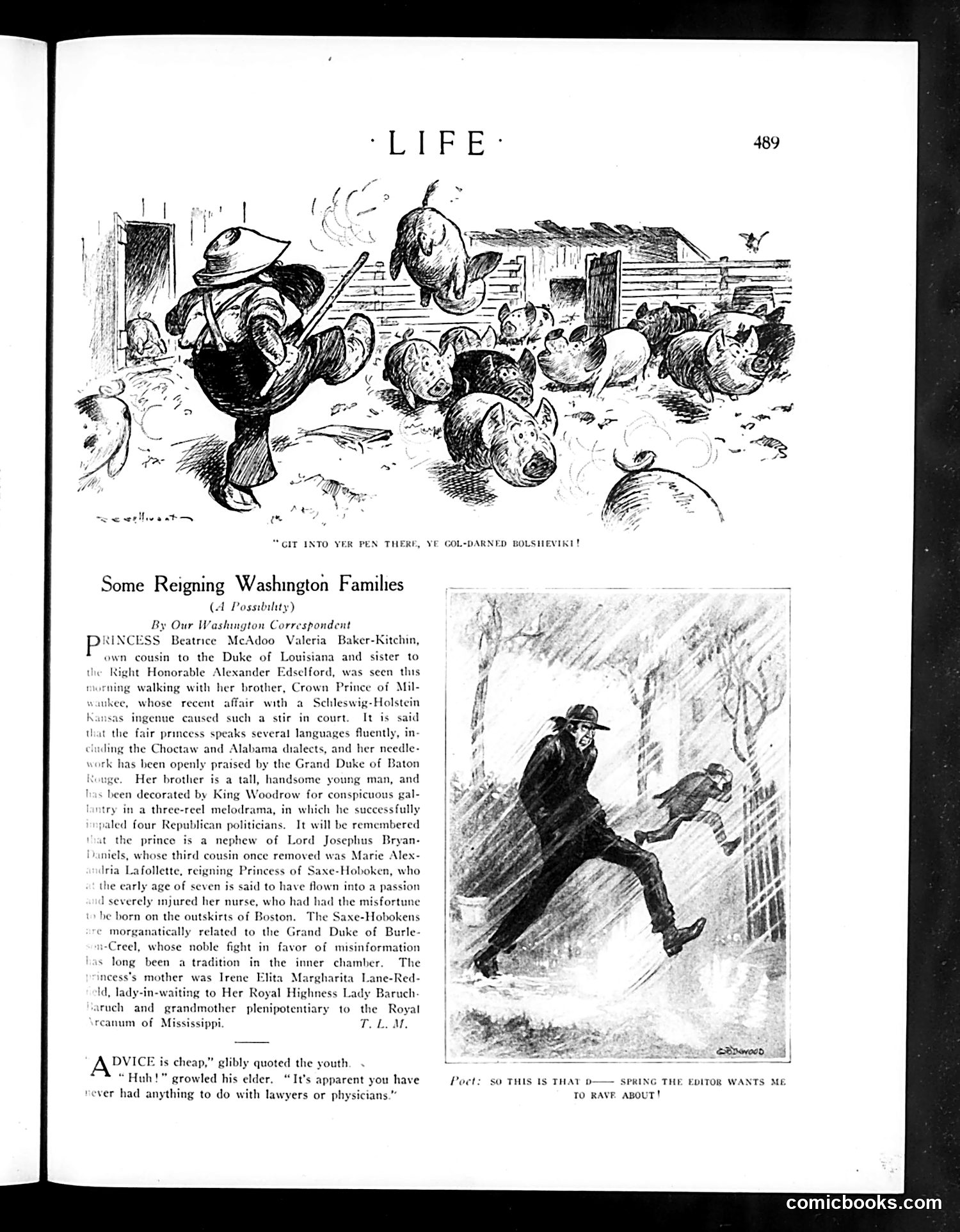
The top cartoon satirizes Russian Bolshevism. A figure in a Russian-style hat kicks pigs labeled with dollar signs, while commanding them in a Russian accent: "Git into yer pen there, ye god-darned bolsheviki!" This depicts anti-communist sentiment common in post-WWI America, portraying Bolsheviks as threats to capitalism and American values. The lower section, "Some Reigning Washington Families," appears to be satirical gossip about prominent political families, discussing Princess Beatrice McAlpin, various aristocratic connections, and social scandals. The accompanying cartoon shows figures in what appears to be a winter scene, likely mocking Washington society or politicians. Both sections use caricature and exaggeration to ridicule their subjects through humor typical of early 20th-century American satire.
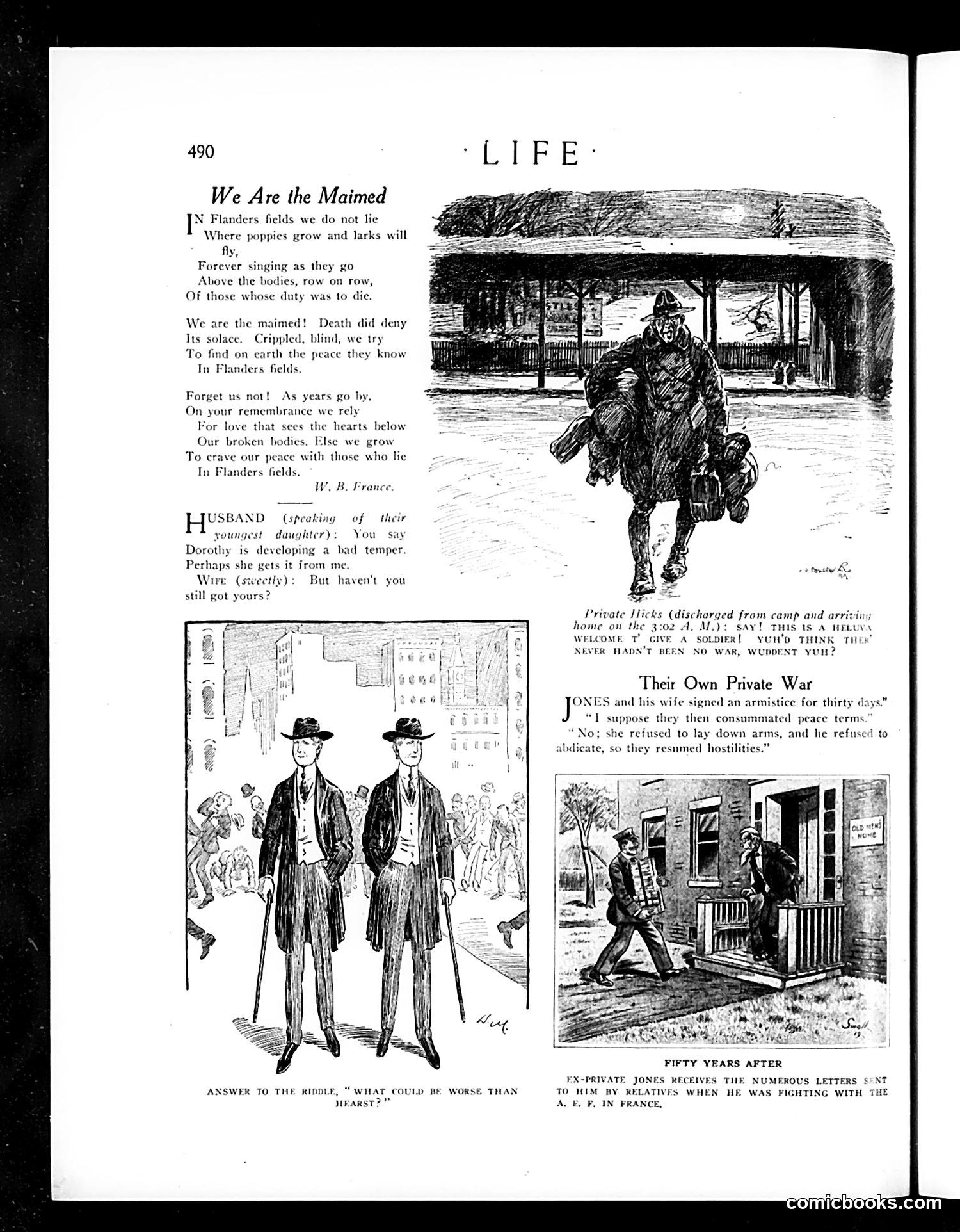
This page combines WWI commentary with domestic humor: **"We Are the Maimed"** (top left) is a poem by W.B. France memorializing disabled soldiers from the Flanders Fields battles, calling for remembrance of those who sacrificed their lives and bodies. **"Their Own Private War"** (center-right) is a humorous domestic sketch about marital conflict. A couple named Jones signed a 30-day armistice agreement but the wife "refused to lay down arms," continuing their hostilities. The cartoon depicts their ongoing domestic dispute as an ironic parallel to actual wartime conflict. The page juxtaposes serious WWI sacrifice with lighthearted commentary on marriage, creating satirical contrast between soldiers' real struggles and civilians' petty quarrels—a common Life magazine technique of the era.
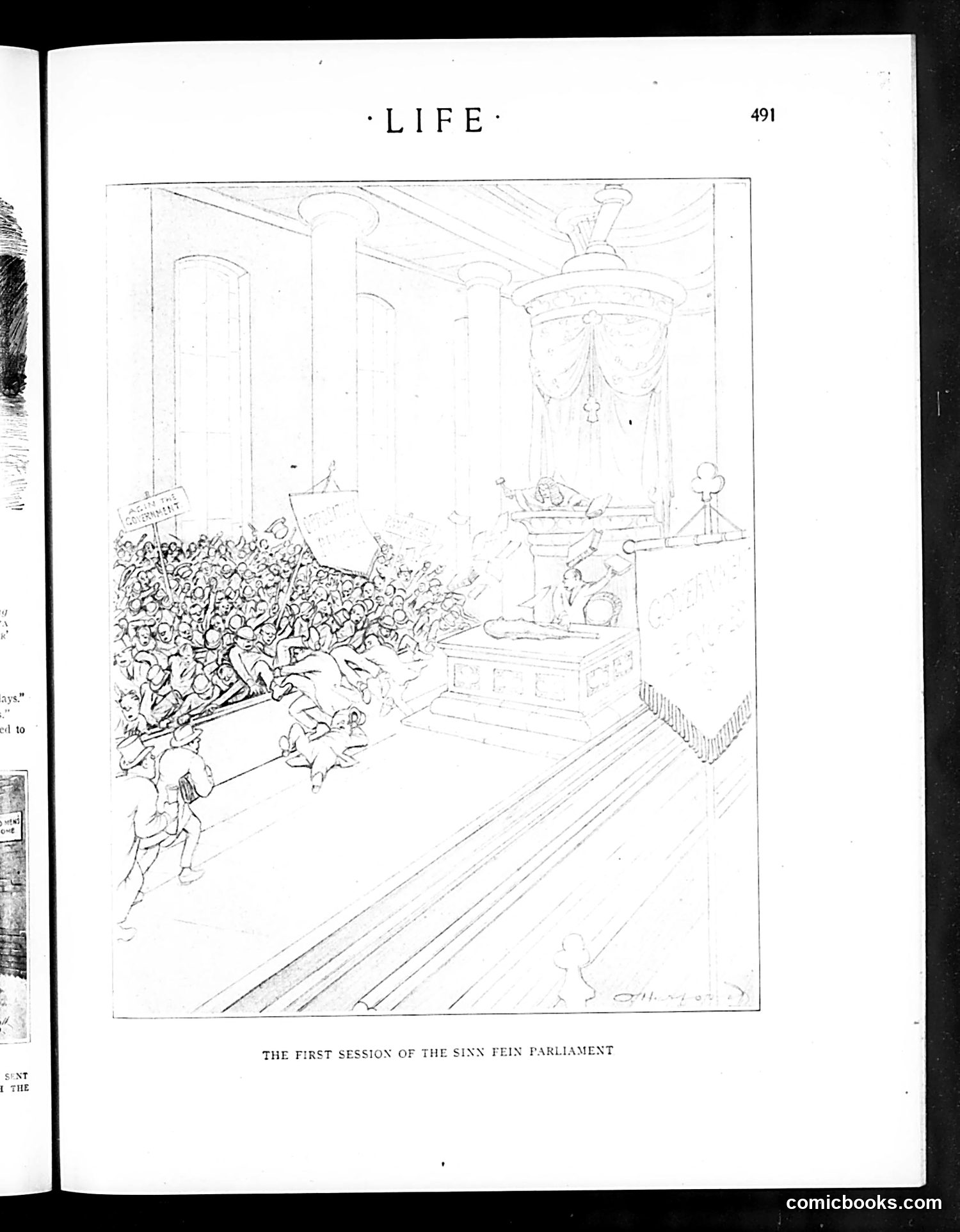
This page from *Life* magazine features a satirical illustration titled "The First Session of the Sinn Féin Parliament." The cartoon depicts a chaotic, crowded scene of numerous figures packed into what appears to be a grand parliamentary chamber with classical columns and an ornate chandelier. The satire mocks the Irish political movement Sinn Féin and their newly established parliament. The densely packed, disorderly crowd suggests incompetence, chaos, or lack of proper parliamentary decorum. The exaggerated, caricatured figures emphasize the satirist's dismissive view of the proceedings. Without knowing the specific publication date, this likely references early 1920s Irish independence politics, when Sinn Féin gained prominence. The illustration ridicules Irish nationalist aspirations through visual disorder and overcrowding, reflecting contemporary American or British editorial skepticism toward Irish self-governance.
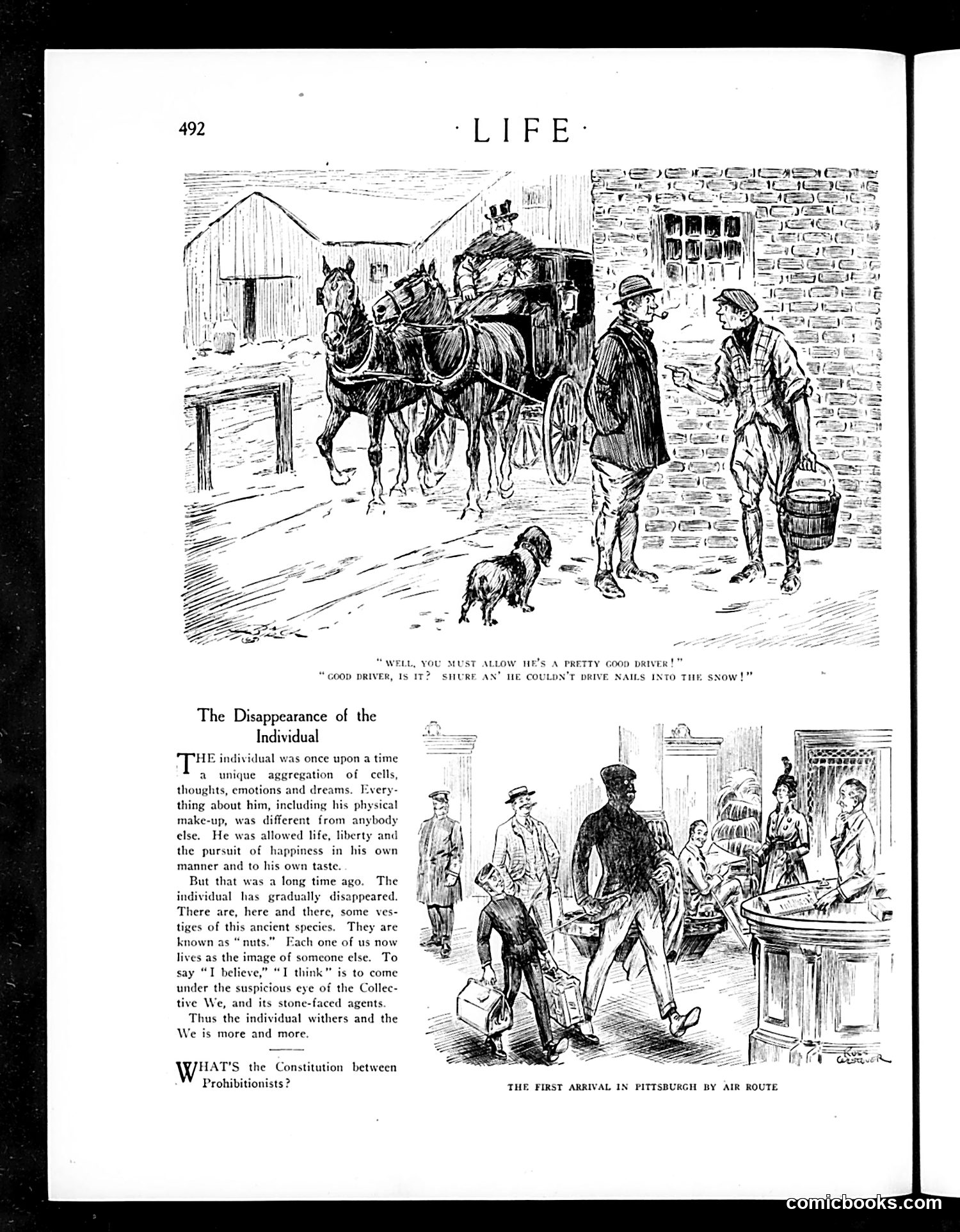
**Top Cartoon:** Shows a horse-drawn wagon with two men discussing a driver. One says the driver deserves credit for good driving; the other jokes he "couldn't drive nails into the snow"—a pun suggesting poor driving ability despite claims otherwise. **Article: "The Disappearance of the Individual"** argues that individualism once defined American life, but people increasingly conform to collective standards. The piece contrasts past personal uniqueness with modern conformity, noting individuals are now "rusts" (vestiges) of an ancient species. **Bottom Cartoon:** Titled "The First Arrival in Pittsburgh by Air Route," depicts an airplane passenger arriving in an urban setting, likely satirizing early aviation's novelty and Pittsburgh's industrial character. Both pieces reflect early 20th-century anxieties about modernization, conformity, and technological change.
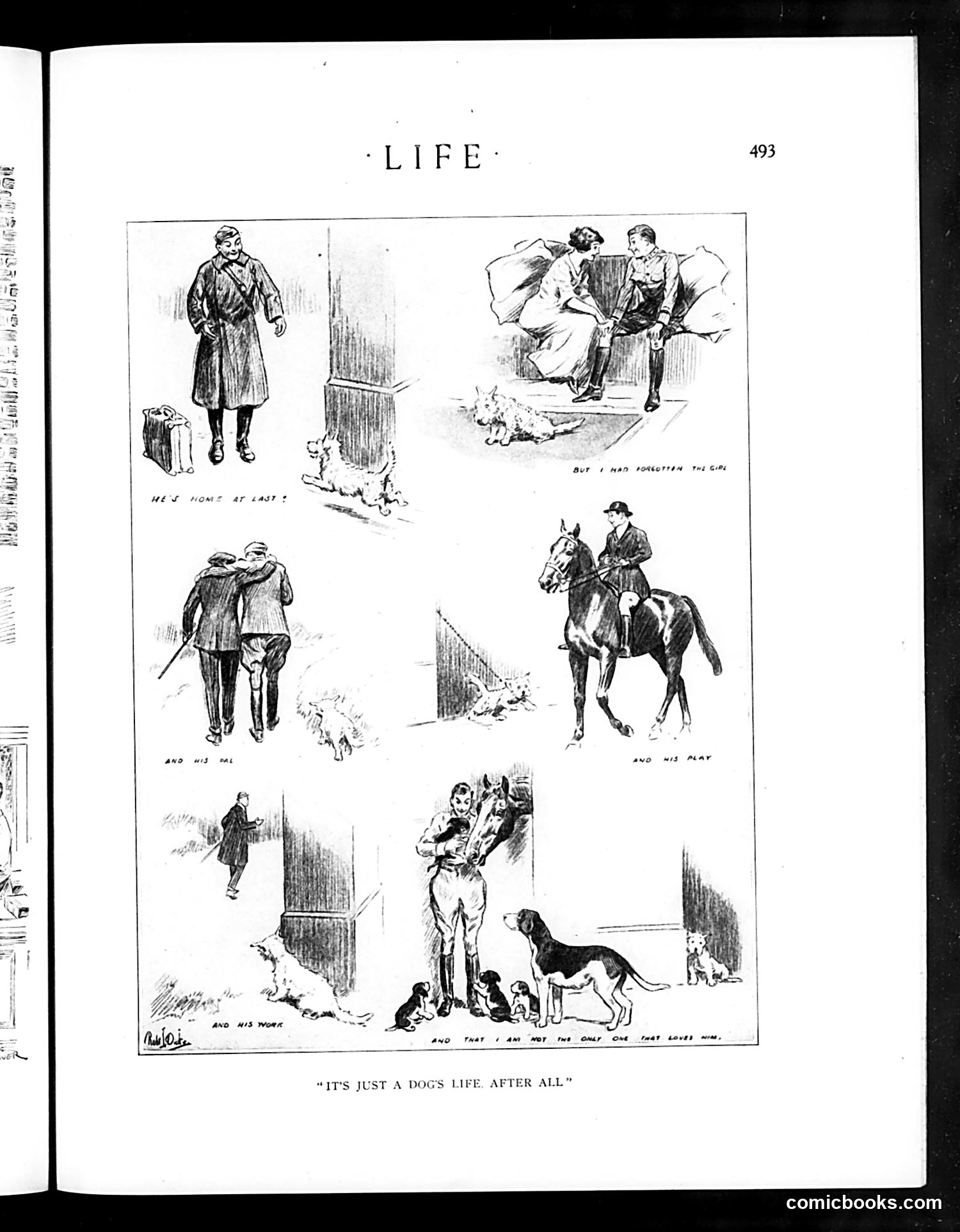
This single-panel comic depicts a man's life progression through seven vignettes, each paralleled with a dog's corresponding experience. The title suggests a satirical comparison between human and canine existence. The scenes show: a man arriving home (dog at door), a man forgetting his umbrella (dog waiting), a man with a woman (dog playing), a man on horseback (dog running), a man at work (dog working), a man being scolded (dogs being disciplined), and finally a man in old age surrounded by children (dog surrounded by puppies). The joke critiques the mundane, repetitive nature of ordinary life—suggesting that human existence, stripped of pretension, mirrors a dog's simple cycle of daily activities and experiences. It's a humorous commentary on the lack of distinction between human and animal routines.
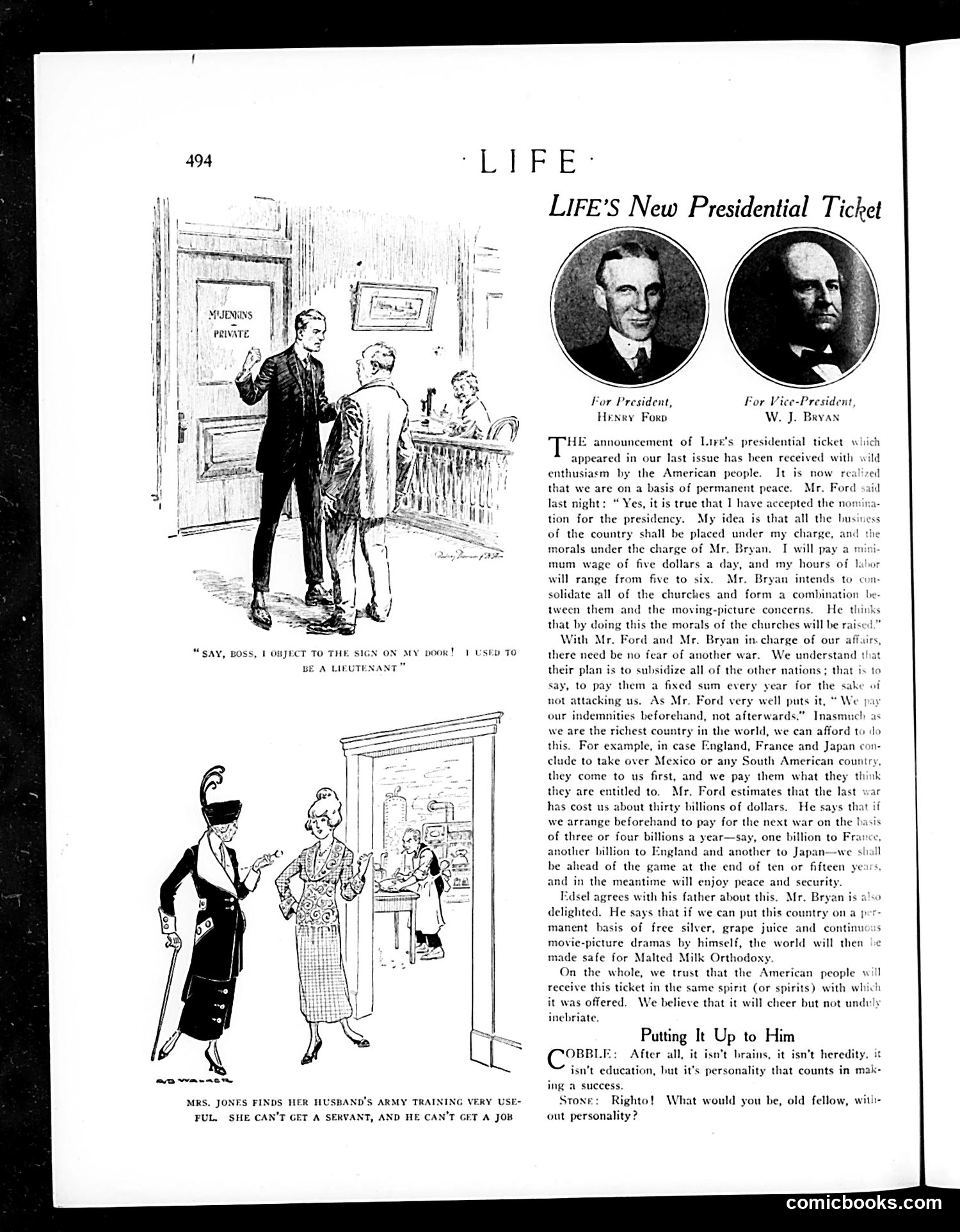
This page satirizes Henry Ford's announcement as a 1924 presidential candidate (with W.J. Bryan as vice president). The text mocks Ford's grandiose campaign promises—a $5/day minimum wage, church consolidation, and plans to prevent future wars through economic dominance and subsidizing other nations. The cartoons ridicule Ford's anti-labor contradictions: one shows a man objecting to a "Munitions Private" sign, joking he "used to be a lieutenant"; another depicts Mrs. Jones discovering her husband's army training is "useful"—he can't get a servant and can't find a job. The satire suggests Ford's wage promises ring hollow given widespread unemployment and labor exploitation, exposing the gap between his philanthropic rhetoric and actual worker conditions.
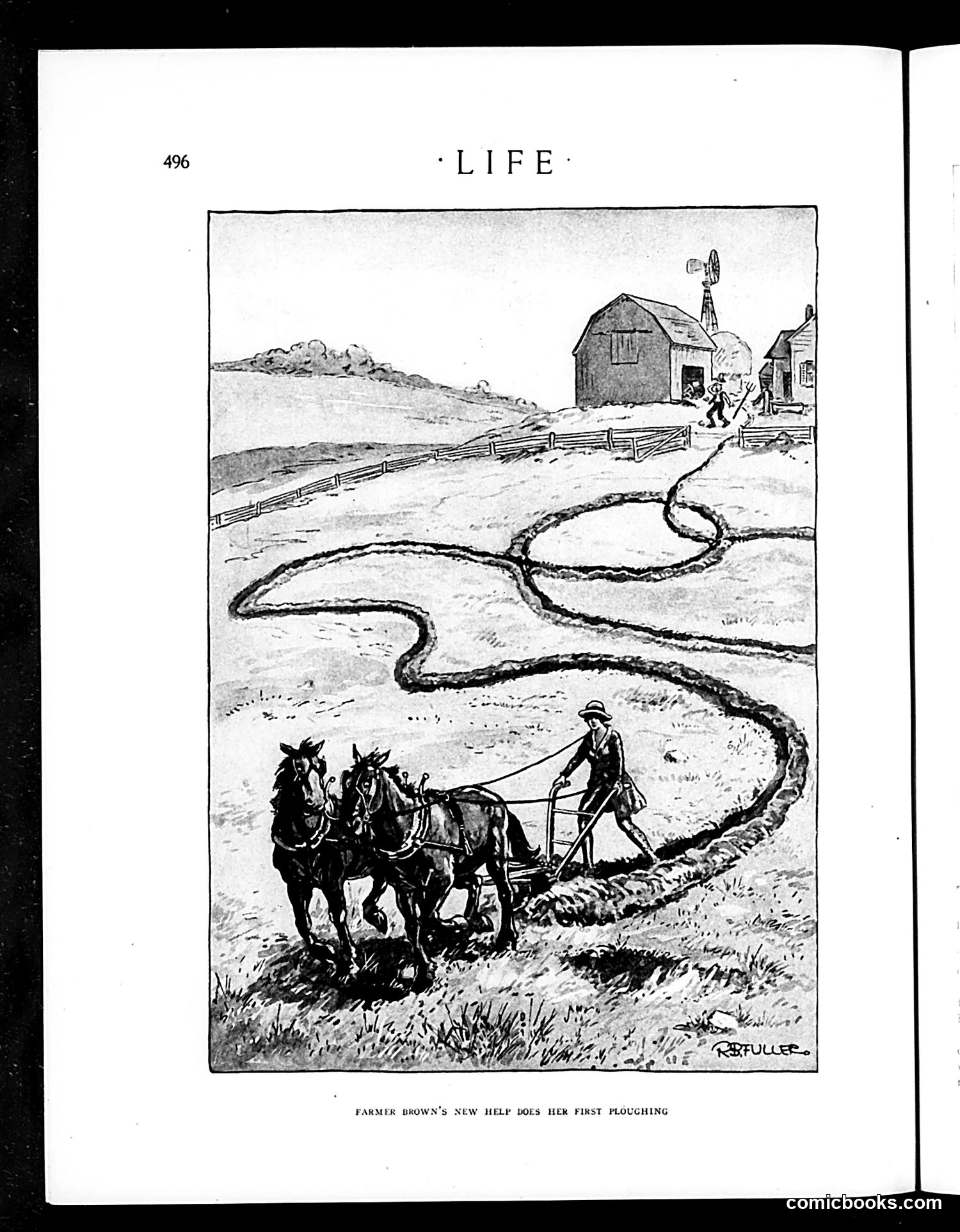
This is a satirical illustration captioned "Farmer Brown's New Help Does Her First Ploughing." The cartoon depicts a woman operating a plow drawn by two horses, while farm buildings and a windmill appear in the background. The satire likely addresses **women entering agricultural labor**, presumably during World War I when male farmers enlisted, forcing farms to rely on female workers. The "new help" represents women taking on traditionally male farm work. The humor derives from the period's assumptions about women's unsuitability for such labor—the illustration seems to playfully mock both the awkwardness of the situation and contemporary gender expectations. The image celebrates women's agricultural contribution during wartime labor shortages, though with a gentle, humorous tone typical of *Life* magazine's satirical approach to social change.
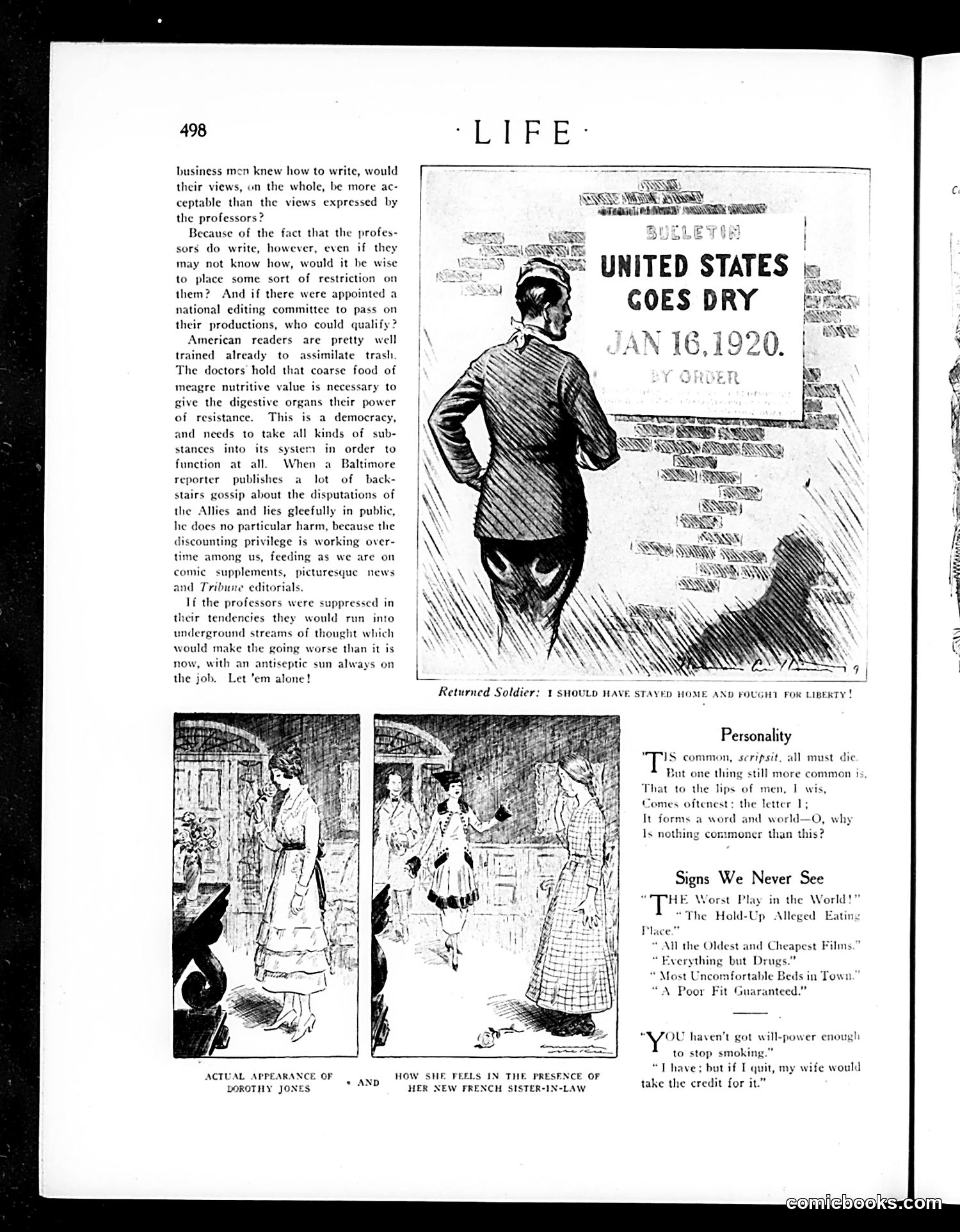
This page contains two main satirical elements: **The "United States Goes Dry" Cartoon (January 16, 1920):** The central image shows a returning soldier viewing a sign announcing Prohibition's implementation. The caption reads "I SHOULD HAVE STAYED HOME AND FOUGHT FOR LIBERTY!" This mocks the irony that American soldiers fought abroad for freedom, only to return to their country imposing a ban on alcohol—a loss of personal liberty they view as absurd. **"Signs We Never See":** This section lists humorous fake advertising slogans that would never appear in real life—such as "Everything but Drugs" (implying drugstores sold everything *including* drugs), and the smoking joke contrasting male pride with marital dynamics. **Context:** This 1920 piece satirizes Prohibition's unpopularity, particularly among working-class and military men, and uses dry humor about American consumerism and social hypocrisy.
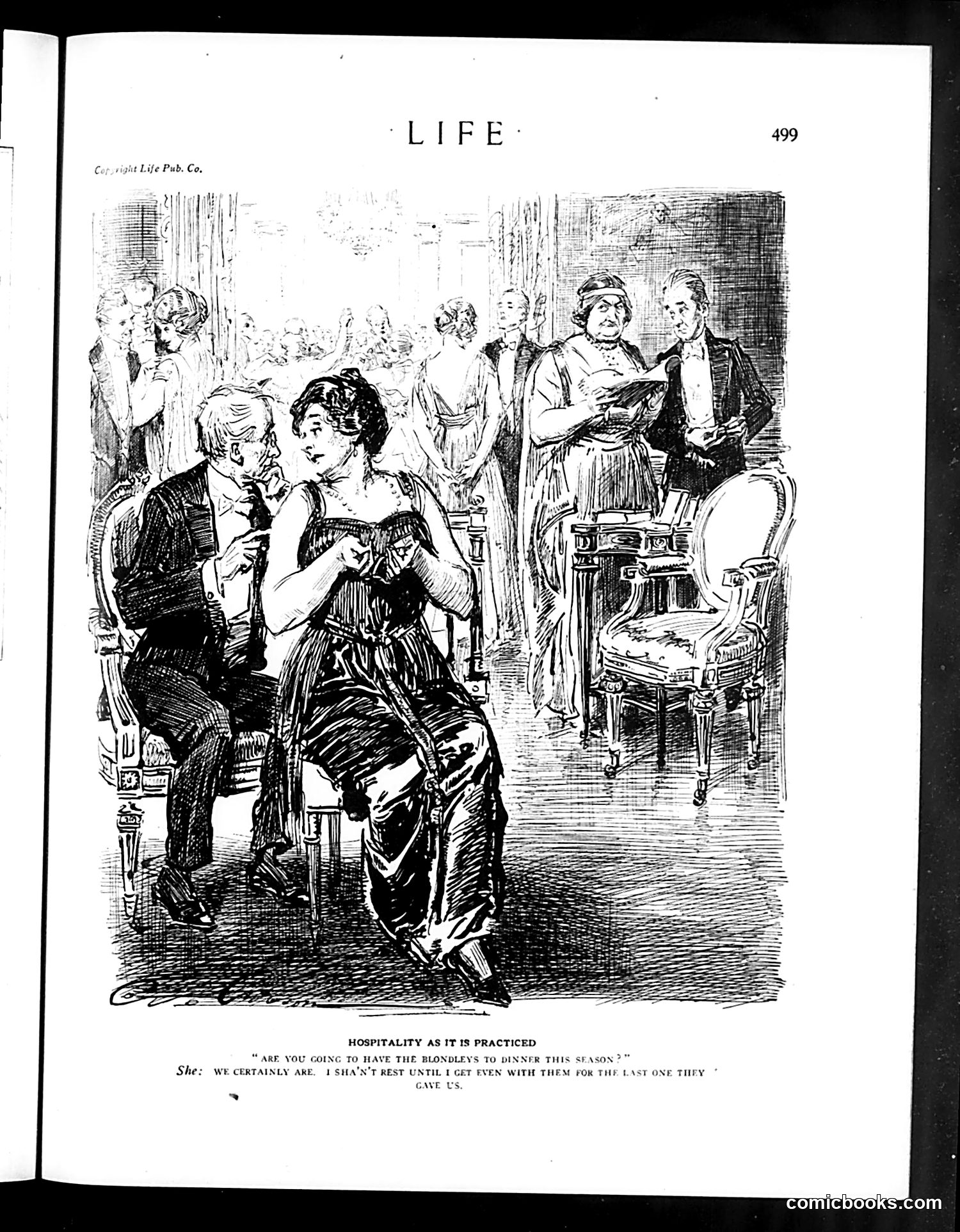
This is a satirical cartoon about social obligation and competitive entertaining among the upper classes. Two well-dressed figures converse at what appears to be a formal party; the woman expresses determination to "get even" with the Blondleys by hosting them to dinner. The joke critiques how hospitality has become transactional rather than genuine—dinner invitations are treated as debts requiring repayment, a social arms race of entertaining rather than acts of kindness. The cartoon mocks the performative nature of upper-class socializing, where hosts calculate whether they've adequately reciprocated previous invitations. The title "Hospitality as It Is Practiced" emphasizes the gap between the ideal of gracious hospitality and the petty social accounting actually occurring.
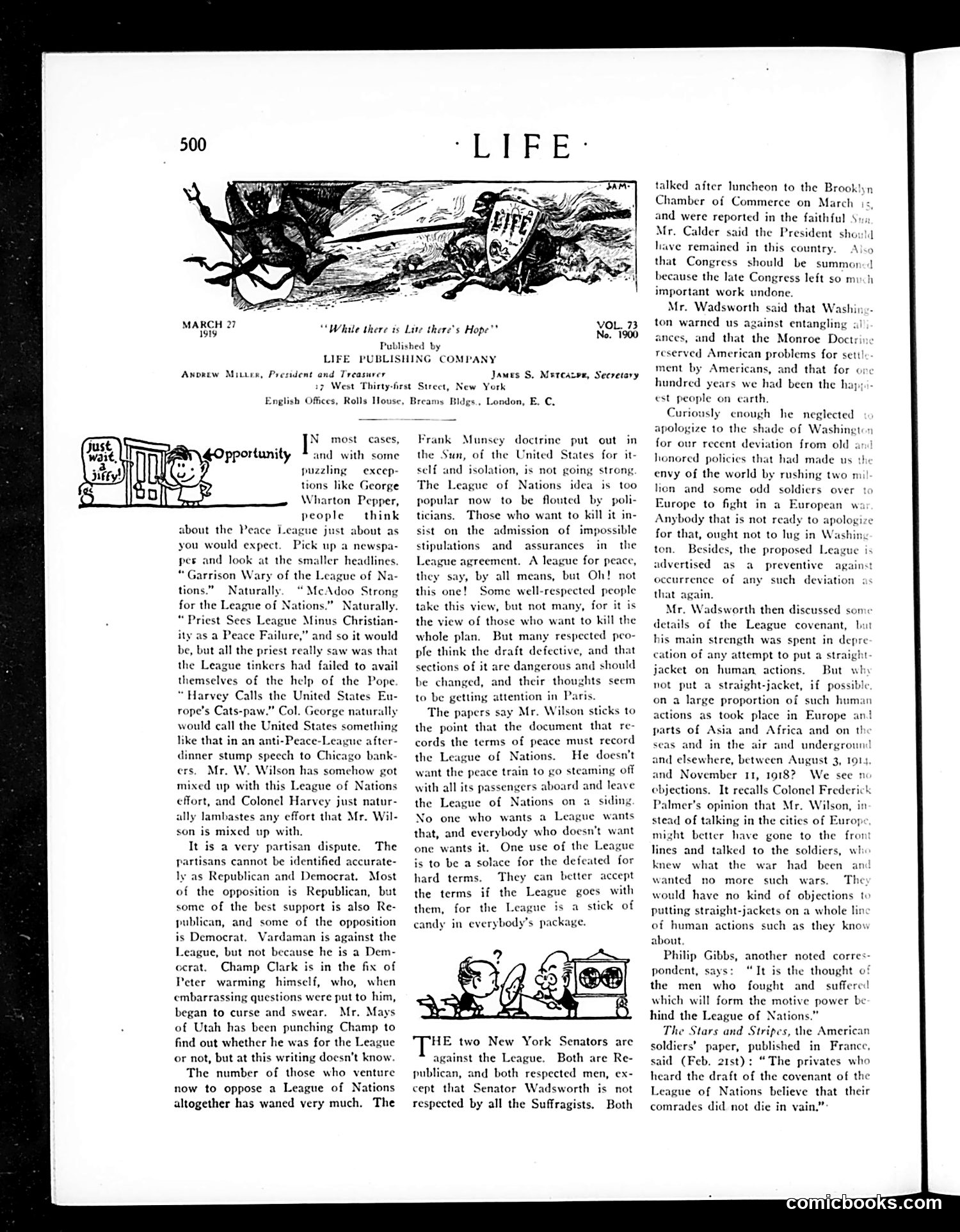
This Life magazine page satirizes the contentious American debate over President Wilson's proposed League of Nations, just after World War I ended. The cartoon "While there is Life there's Hope" depicts a dying or struggling figure—likely representing the League itself or peace efforts—suggesting the League's precarious survival amid political opposition. The article mocks the partisan confusion surrounding the League. It notes that opposition isn't cleanly divided along Republican/Democrat lines, citing figures like Senator Vardaman and Representative Champ Clark who awkwardly oppose it despite party alignment. The piece ridicules Colonel George Harvey's inflammatory rhetoric calling the U.S. Europe's "cat's-paw." The satire also targets New York Senators Calder and Wadsworth, who oppose the League. The cartoonist suggests their concerns (about presidential overreach, undone congressional work, entangling alliances) are pretexts masking their actual goal: killing the League entirely by attaching impossible conditions to it.
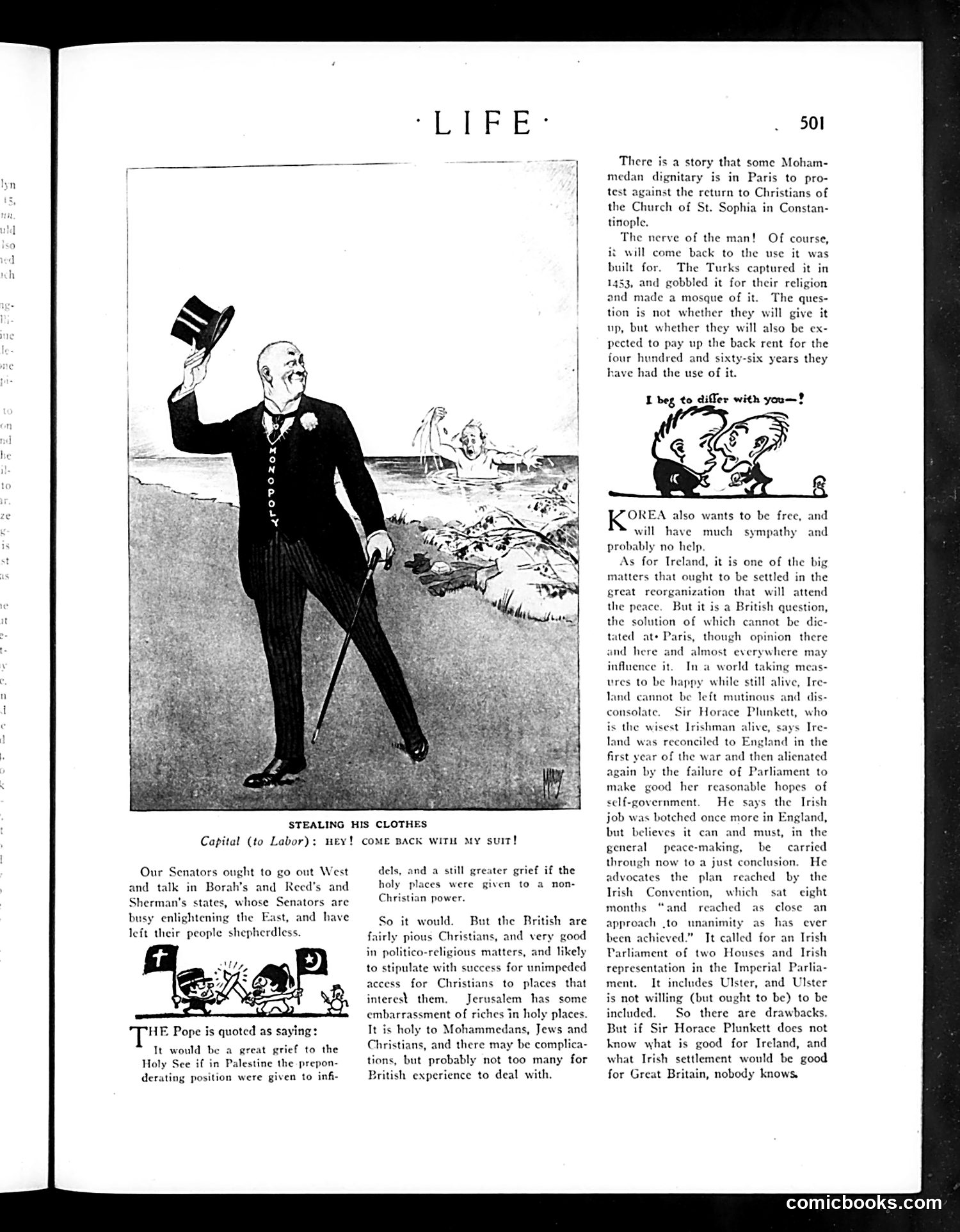
The main cartoon depicts a wealthy gentleman (labeled "Capital") chasing a fleeing worker (labeled "Labor"), demanding the return of his suit. This is post-WWI class-struggle satire: the cartoon suggests that labor, empowered during wartime production, has symbolically "stolen" capital's dominance and refuses to surrender it. The surrounding text addresses post-war geopolitical issues: Palestine's future (the Pope's concerns about Christian vs. non-Christian control), the Church of St. Sophia in Constantinople (captured by Turks in 1453, now being restored to Christians), Korea's independence aspirations, and Irish self-government. The small cartoon labeled "I beg to differ with you" appears to show two figures in disagreement, likely reflecting contemporary political disputes. The article advocates for just settlements of these colonial and national questions during peace negotiations, citing Sir Horace Plunkett's Irish Convention proposals as a model for compromise—though Ulster's resistance complicates matters.
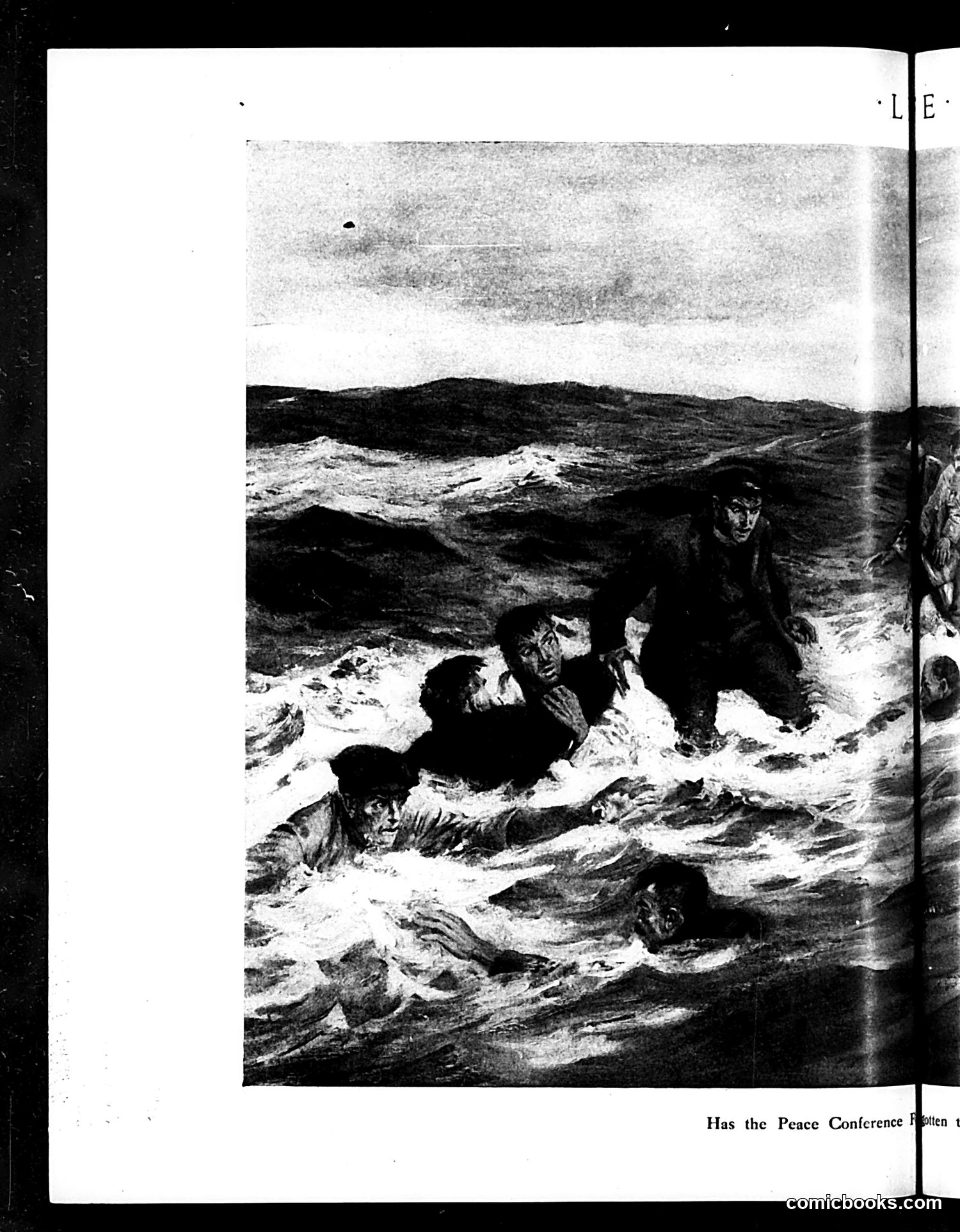
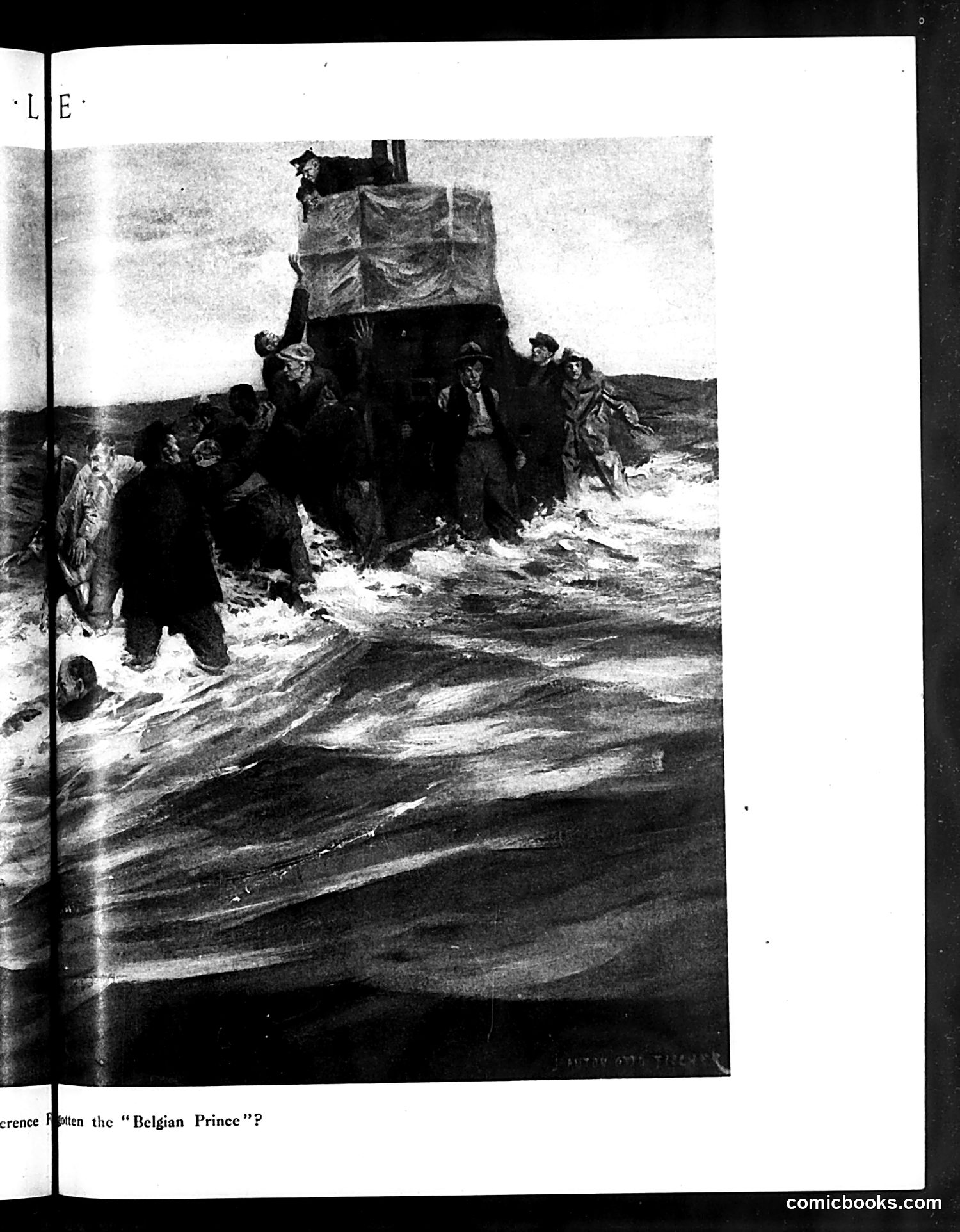
This page shows a historical photograph of a group of people gathered around what appears to be a wooden structure or platform near water, with snow visible on the ground. The partial caption at bottom reads "bitten the 'Belgian Prince'?"—suggesting a satirical reference to a Belgian royal figure or ship. Without the complete caption and context, the exact reference remains unclear. This appears to be from *Life* magazine's satirical content, likely commenting on a contemporary political or social event involving Belgium. The photograph's documentary quality suggests it may be referencing actual news events rather than being an illustration. More complete text would be needed to identify the specific "Belgian Prince" being mocked and the satire's point.
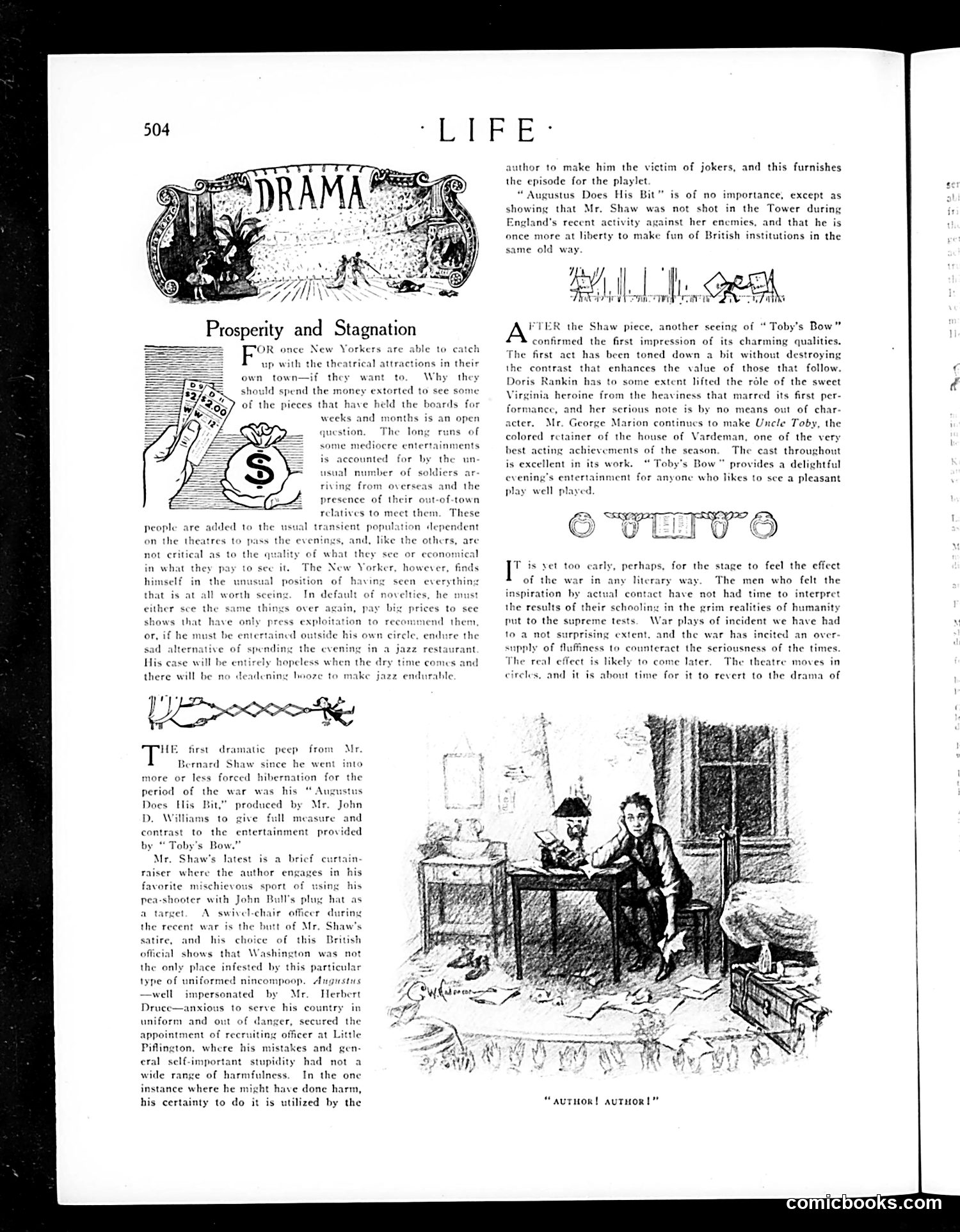
This page reviews two theatrical productions. The main satire concerns **Bernard Shaw's "Augustus Does His Bit,"** a wartime one-act play. The article notes Shaw's piece satirizes a bumbling military officer—specifically a "swivel-chair officer" who mishandles recruitment duties at Little Piddington. The joke is that Shaw uses this character to mock both British military incompetence and institutional pomposity, suggesting Washington wasn't uniquely afflicted with such foolish uniformed bureaucrats. The accompanying illustration titled **"Author! Author!"** depicts what appears to be a domestic scene, likely illustrating a scene from the reviewed plays. The text also reviews **"Toby's Bow,"** praising its performances, particularly George Marion's portrayal of Uncle Toby (a Black servant character). The larger article discusses New York theater's economic challenges: soldiers on leave and out-of-town visitors sustain mediocre productions, while sophisticated New Yorkers face limited quality entertainment options—hence they resort to jazz restaurants for evening amusement.
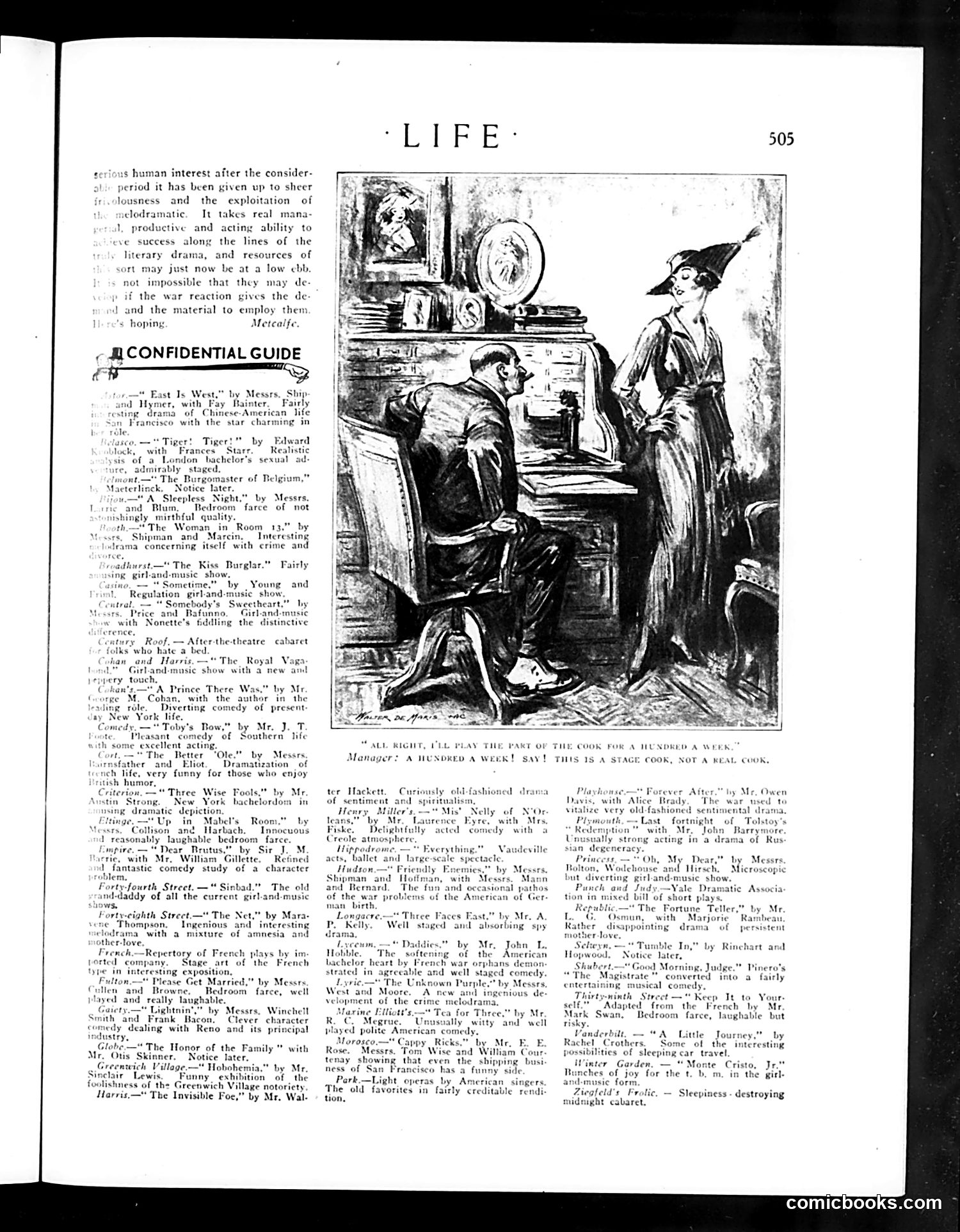
This page is primarily a **theatre review section** listing Broadway productions, not a political cartoon. The single illustration shows a comedic stage scene with the caption: "ALL RIGHT, I'LL PLAY THE PART OF THE COOK FOR A HUNDRED A WEEK." The manager responds: "THIS IS A STAGE COOK, NOT A REAL COOK." **The Joke:** An actor agrees to play a theatrical role of a cook for $100 weekly, but the manager clarifies this is pretend cooking for stage purposes—not actual cooking work. It's a pun playing on the actor's apparent misunderstanding of what the job entails. The surrounding text consists of brief reviews of current theatrical productions, including comedies, dramas, and musical shows performing in New York. The page reflects early 20th-century theatre culture and advertising practices typical of *Life* magazine during this era.
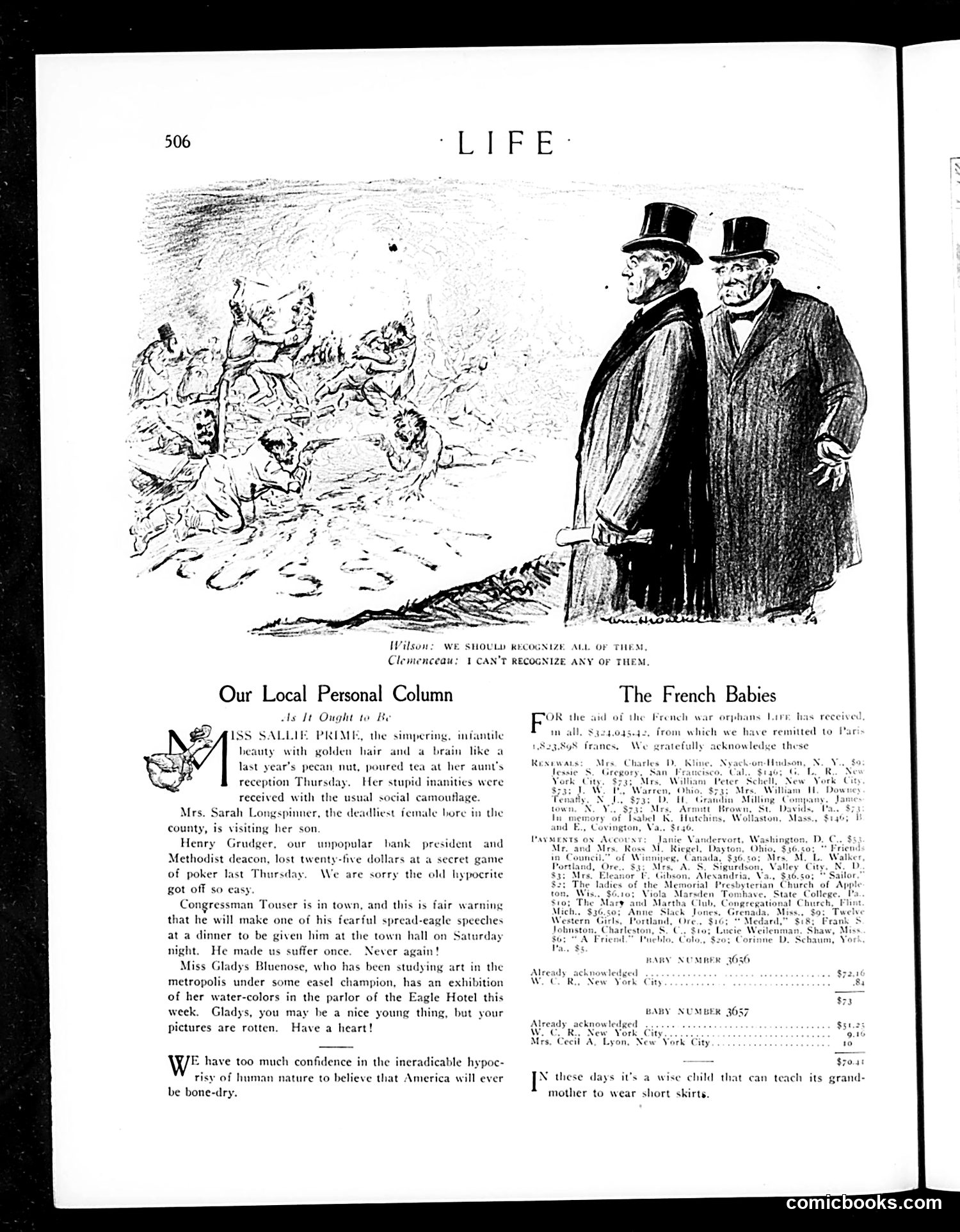
The main cartoon depicts a post-World War I diplomatic scene. Two gentlemen in top hats (identified by caption as Wilson and Clemenceau—U.S. President Woodrow Wilson and French Premier Georges Clemenceau) observe a chaotic battlefield scene with numerous casualties. Wilson says they "should recognize all of them," while Clemenceau responds "I can't recognize any of them." The satire criticizes the peace negotiations and their aftermath: the carnage of WWI has been so devastating that the fallen are unrecognizable, yet diplomats discuss recognizing (legitimizing) the war's outcome. This mocks the disconnect between those negotiating peace terms and the human cost of the war they're settling. The page also contains a gossipy "local column" satirizing small-town society figures—their pretensions, hypocrisy, and foolishness—plus a notice about French war orphan relief donations and a quip about modern women's fashion.
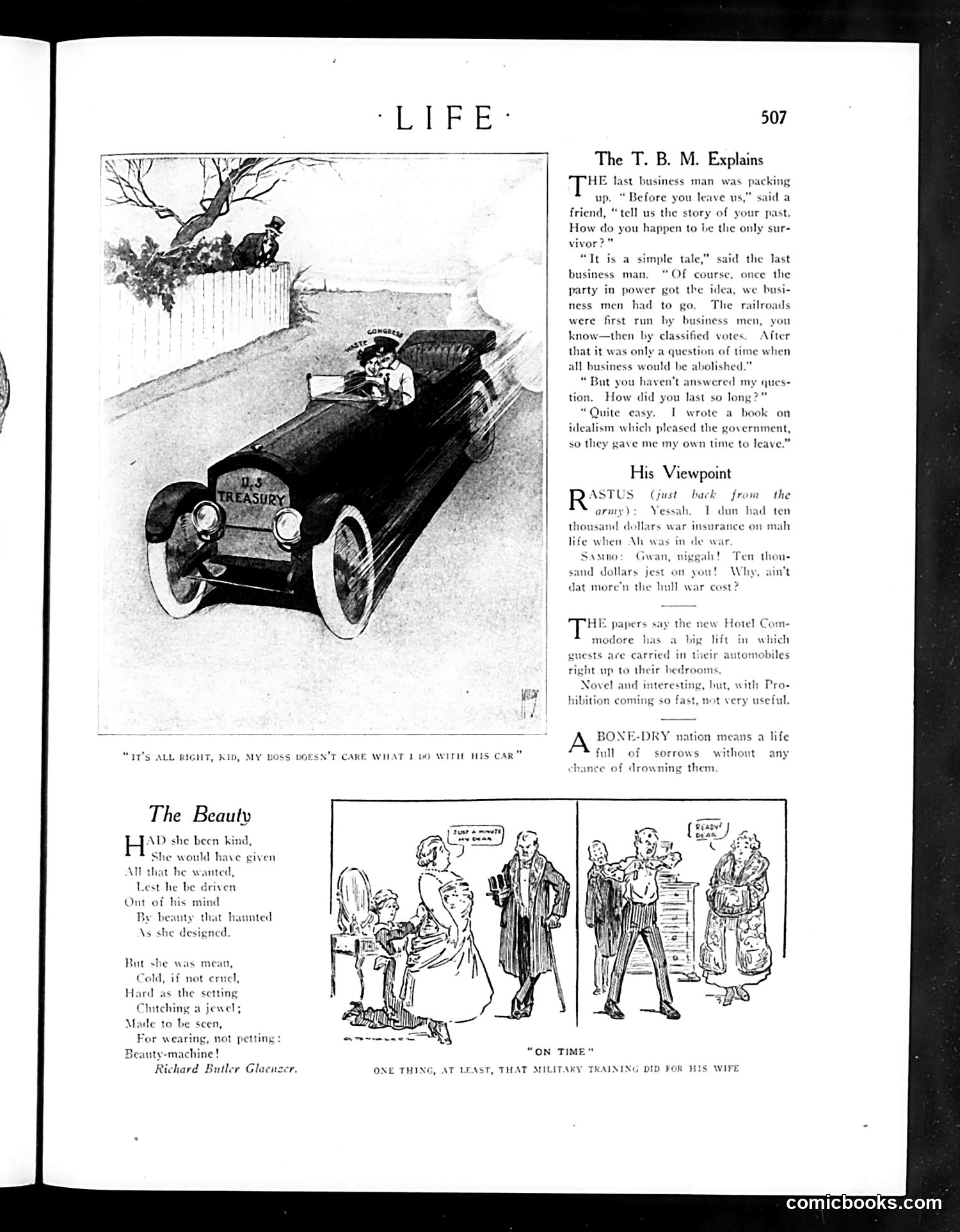
This page contains multiple satirical pieces reflecting post-WWI anxieties: **Top cartoon**: "The T.B.M. Explains" depicts the "last business man"—a dystopian scenario where government has abolished private business. The satire warns against government overreach, suggesting that ideological movements could eliminate capitalism entirely. The businessman's survival through writing pro-government propaganda mocks both bureaucratic control and intellectual compromise. **"His Viewpoint"**: A brief dialogue between a returning soldier (rendered in stereotypical dialect) and a civilian. The soldier ironically notes his life insurance exceeded the war's total cost—dark satire on war's economic absurdity. **Bottom cartoon "On Time"**: Shows a military-trained husband arriving punctually, captioned that military training's sole benefit was teaching him punctuality for his wife. It satirizes the limited civilian applications of military discipline. **"The Beauty"**: A poem mocking women as beautiful but emotionally cold—representative of the era's misogynistic attitudes dressed as artistic commentary. Overall, the page reflects 1920s concerns: government expansion, post-war disillusionment, and traditional gender roles.
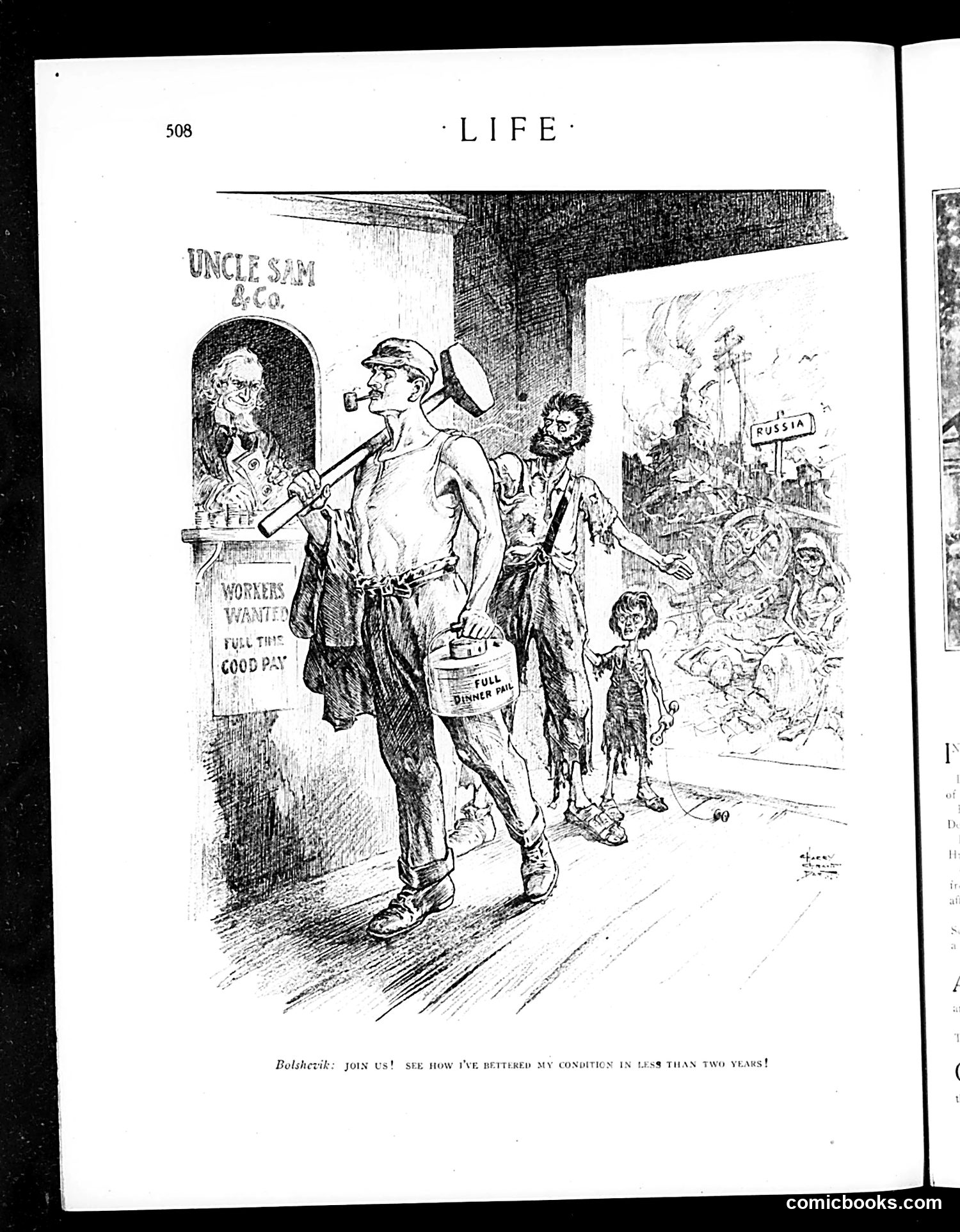
This is anti-Bolshevik propaganda from Life magazine. A figure labeled "Bolshevik" (identifiable by the "UNCLE SAM & CO." storefront and "RUSSIA" sign) recruits workers, showing them a sign reading "WORKERS WANTED - FULL TIME - GOOD PAY." The cartoon's satire claims the Bolshevik promises improved conditions ("bettered my condition in less than two years"), but the visual evidence contradicts this: the recruited workers appear gaunt, poorly clothed, and struggling. The backdrop shows industrial chaos and decay labeled "RUSSIA." The joke attacks Communist recruitment propaganda as deceptive—the Bolsheviks claim to offer prosperity and employment, but their actual system produces poverty and hardship. This reflects American anti-communist sentiment during the Russian Revolution period (approximately 1917-1920s), when fears of Bolshevism spreading to America were widespread.
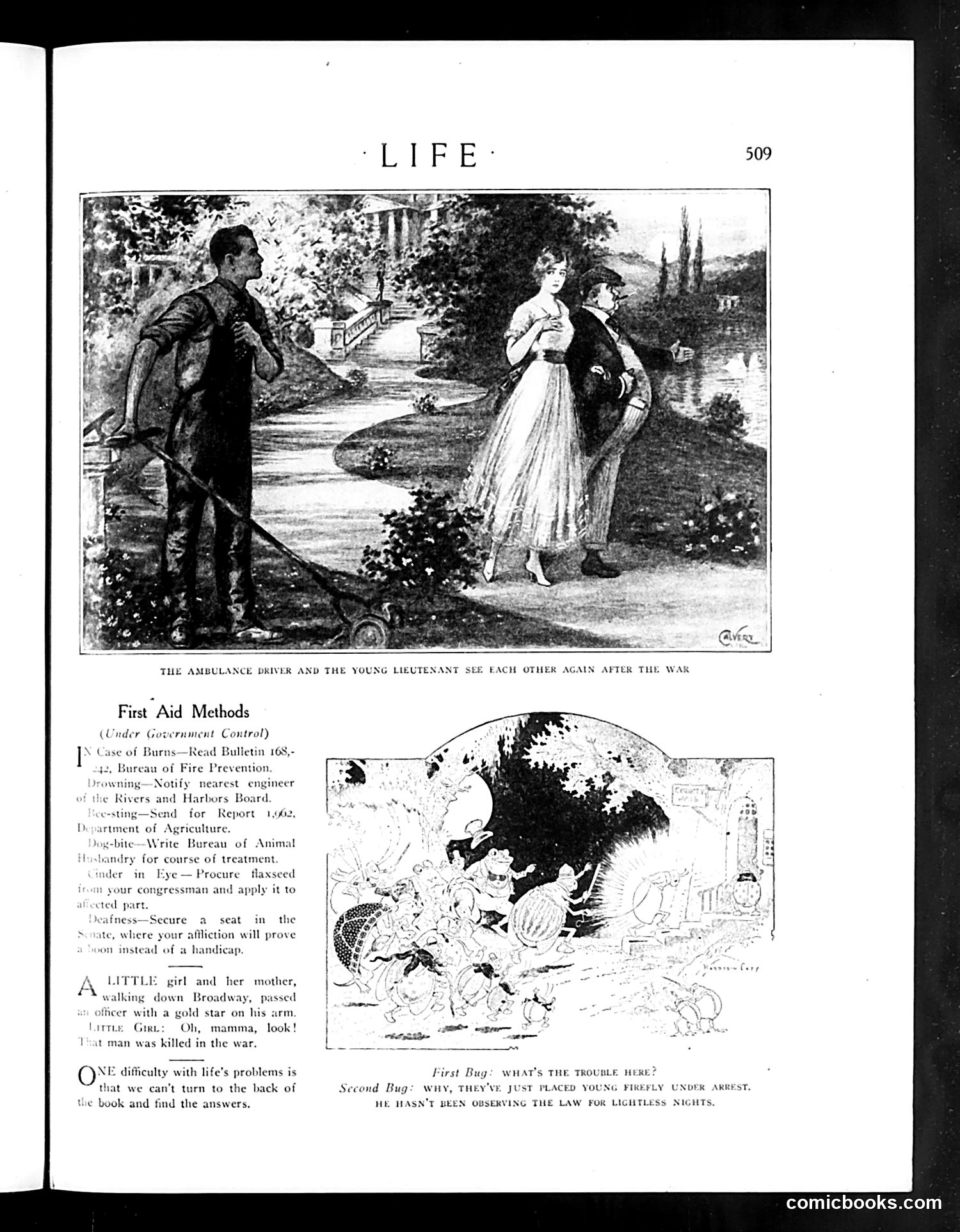
**Top illustration**: A sentimental romantic scene showing an ambulance driver and young officer reuniting in a garden after WWI—a nostalgic post-war romance narrative common to the era. **"First Aid Methods"**: A satirical list mocking government bureaucracy's absurd over-regulation. Each injury requires contacting a different federal agency (Fire Prevention, Rivers and Harbors Board, Agriculture Department, etc.), poking fun at post-war governmental expansion and red tape. The joke about "Deafness" suggests seeking a Senate seat as compensation—mocking corruption and disabled veterans' plight. **"Little Girl" anecdote**: A child sees a man wearing a gold star (indicating a son killed in combat) and assumes *he* was killed—dark wartime humor about the ubiquity of death and confusion about mourning symbols. **Bug cartoon**: Two insects discuss fireflies under arrest for violating "lichtless nights" (blackout regulations). This likely references WWI's wartime blackout laws, now humorously applied to nature. The page overall satirizes post-war adjustment, government overreach, and the absurdities of wartime regulations lingering in peacetime.
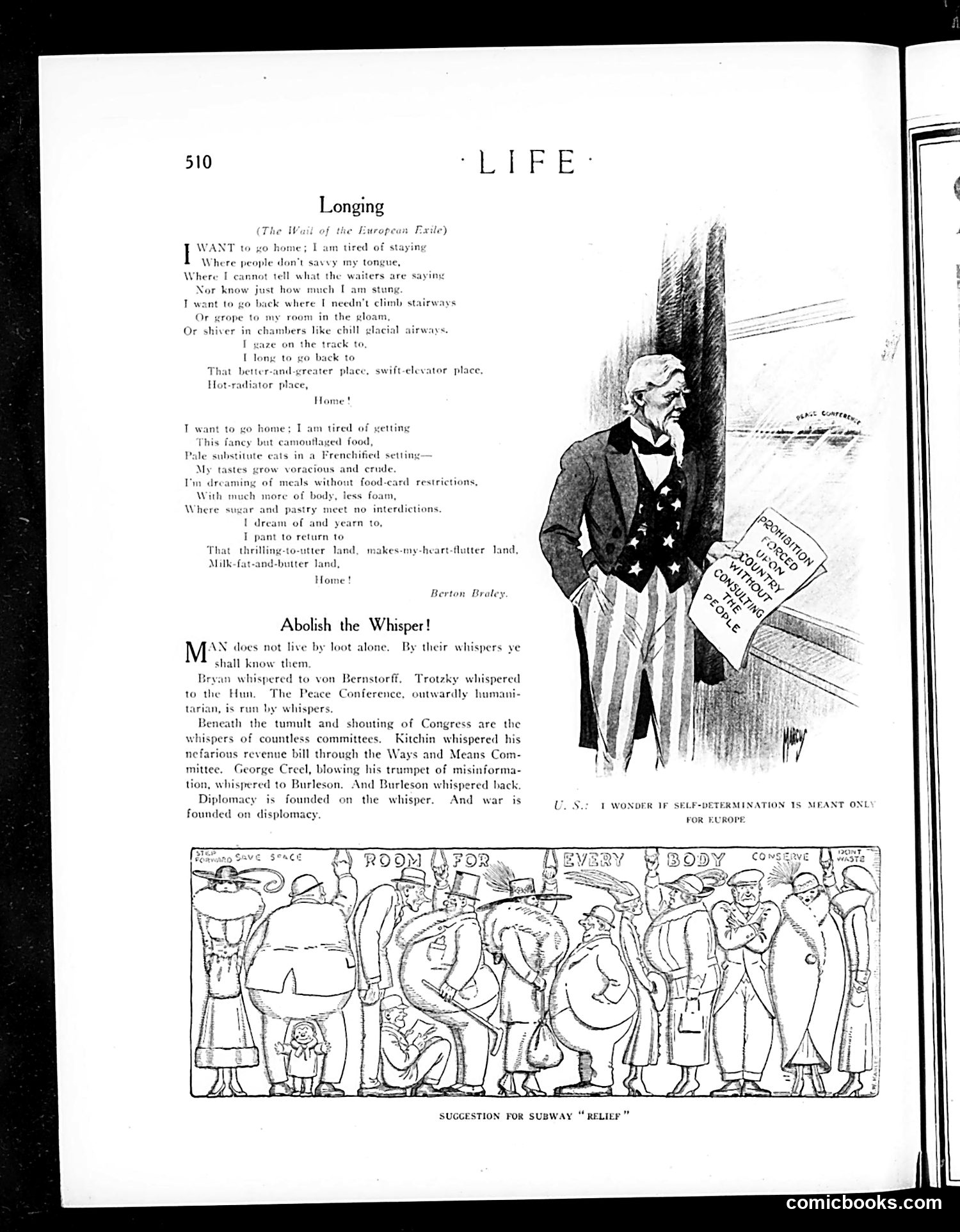
This page contains two distinct pieces of anti-European sentiment from the post-WWI era: **"Longing"** (poem by Berton Braley): A satirical portrayal of American soldiers or expatriates in Europe complaining about European conditions—lack of familiar food, poor heating, rationing—and yearning to return home to American comfort and abundance. It mocks homesickness while subtly asserting American superiority. **"Abolish the Whisper!"**: A political commentary criticizing backroom diplomacy and secret negotiations, referencing figures like Kitchin (likely Representative Claude Kitchin) and George Creel (WWI propagandist). The piece argues that wars and poor policies result from hidden wheeling-and-dealing rather than public debate. **"Suggestion for Subway Relief"**: A crowded cartoon proposing sardonic "relief" by physically compressing subway passengers together—dark humor about urban overcrowding. The overall message reflects post-war American isolationism and skepticism toward both European conditions and secretive government dealings.
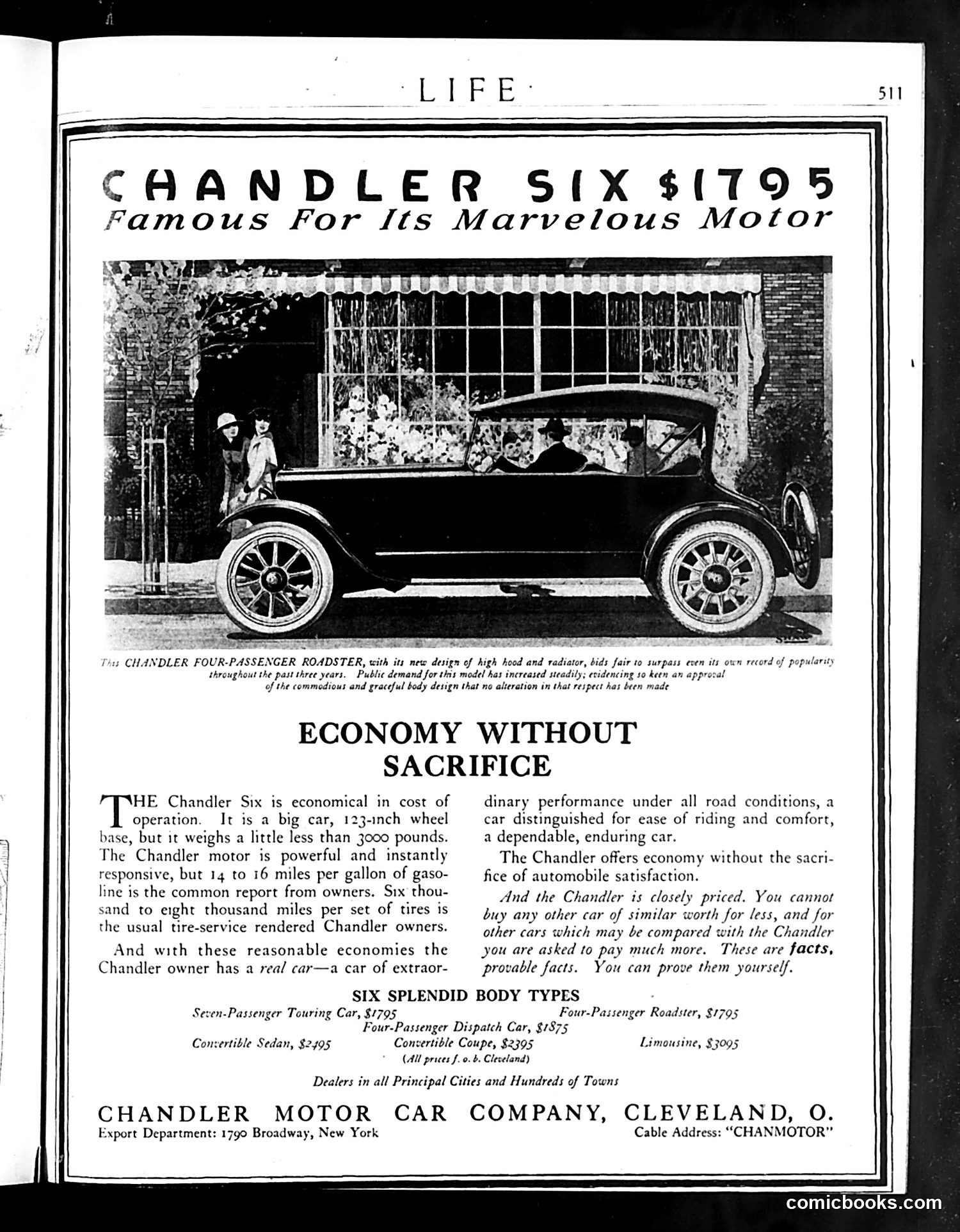
This is **not a cartoon or satire**—it's a straightforward automobile advertisement from *Life* magazine's advertising section (page 511). The Chandler Motor Car Company of Cleveland is promoting their Six model priced at $1,795. The ad emphasizes practical selling points for 1920s car buyers: fuel economy (14-16 miles per gallon), durability (tire longevity), a powerful motor, comfort, and affordability relative to competitors. The photograph shows a four-passenger roadster with passengers posed outside a brick building, demonstrating the vehicle's appeal to middle-class consumers. The headline "Economy Without Sacrifice" captures the era's marketing strategy—promising modern luxury without excess expense, addressing post-WWI consumers seeking reliability and value. Six different body styles are offered, from touring cars to limousines, reflecting the period's customizable automobile market. There is no political content or satirical intent visible on this page.
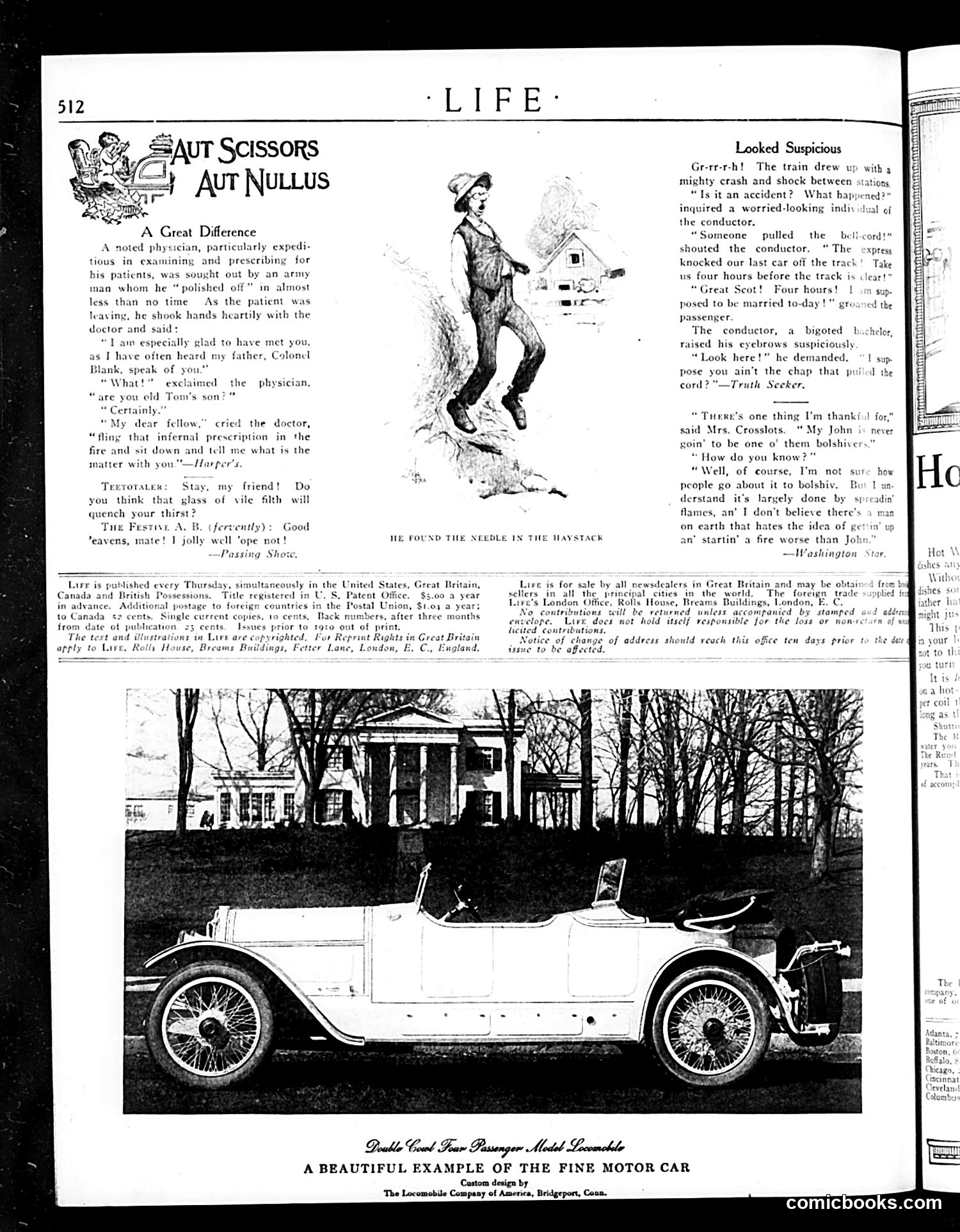
This page contains **two distinct satirical pieces** plus advertising: ## "A Great Difference" A brief joke contrasting a physician's bedside manner. A doctor efficiently dismisses a patient with a prescription, but when the patient thanks him for kindly remembering his father Colonel Blank, the doctor suddenly becomes warm and chatty—revealing his politeness depends entirely on the patient's social status, not medical concern. ## "Looked Suspicious" A train emergency sequence mocking prejudice. After an accident, a conductor becomes suspicious of a passenger pulled from the wreckage, assuming he sabotaged the train. Mrs. Crosslots then jokes that her husband John couldn't be a Bolshevik (communist) because he hates fire—a satirical jab at 1920s anti-communist hysteria, where any accident or disruption was reflexively blamed on radical agitators. ## Advertisement The page concludes with an advertisement for a Locomobile automobile, a luxury vehicle. The humor targets class snobbery and the era's paranoid anti-communist sentiment.
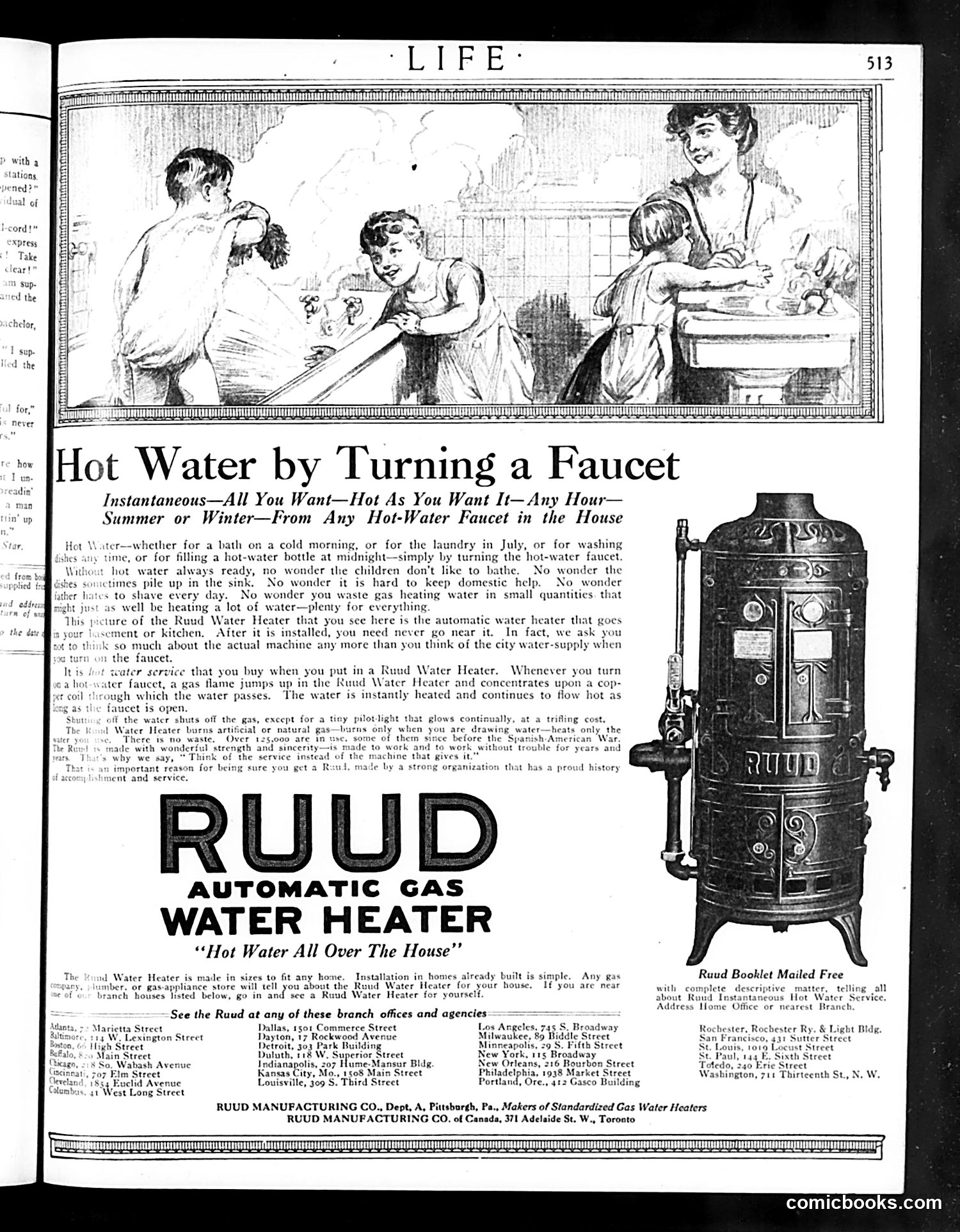
This page is primarily a **product advertisement** for the Ruud Automatic Gas Water Heater, not political satire. The illustration at top shows a domestic scene—a mother with children at a sink and bathtub—depicting the convenience of instant hot water. The "satire" is **commercial rather than political**: the text humorously lists common domestic complaints (children avoiding baths, dishes piling up, difficulty keeping household help, wasted gas heating) and presents the Ruud heater as solving all these problems. It's gentle, lifestyle-based humor typical of early 20th-century advertising. The advertisement emphasizes that the automated heater requires no user maintenance—you simply turn a faucet and hot water appears instantly, day or night. This was genuinely innovative plumbing technology at the time. The page lists numerous branch offices across major American and Canadian cities, indicating Ruud's national distribution network circa the 1910s-1920s.
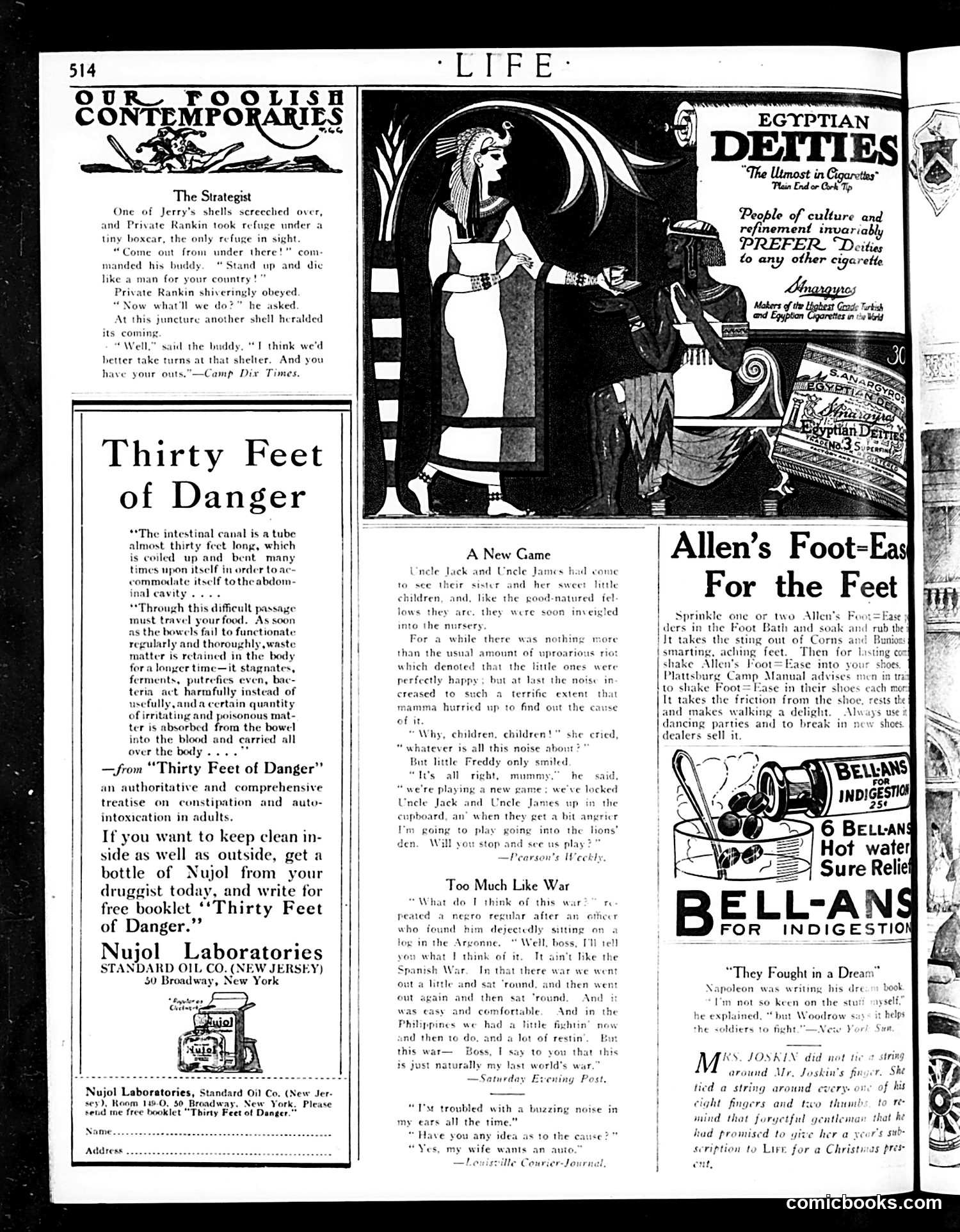
This page mixes satirical content with period advertisements, typical of Life magazine's format. **"The Strategist"** depicts World War I trench warfare absurdity: a soldier seeks shelter from artillery fire, but his buddy insists he "die like a man for your country"—only to reverse position when the next shell arrives. The satire critiques the gap between patriotic rhetoric and survival instinct, mocking both military orders and cowardice. **"A New Game"** shows children locking uncles in a cupboard, then threatening a "lions' den" game—innocent childhood cruelty that darkly parallels wartime danger. **"Too Much Like War"** has a soldier complain that modern warfare lacks the old pattern of fighting, resting, and comfort—he's "naturally" done with world wars. The satire suggests even soldiers find this war's intensity unbearable. The advertisements (Nujol laxative, Egyptian Deities cigarettes, Allen's Foot-Ease) represent contemporary consumer products marketed with health/social-status claims typical of the era.
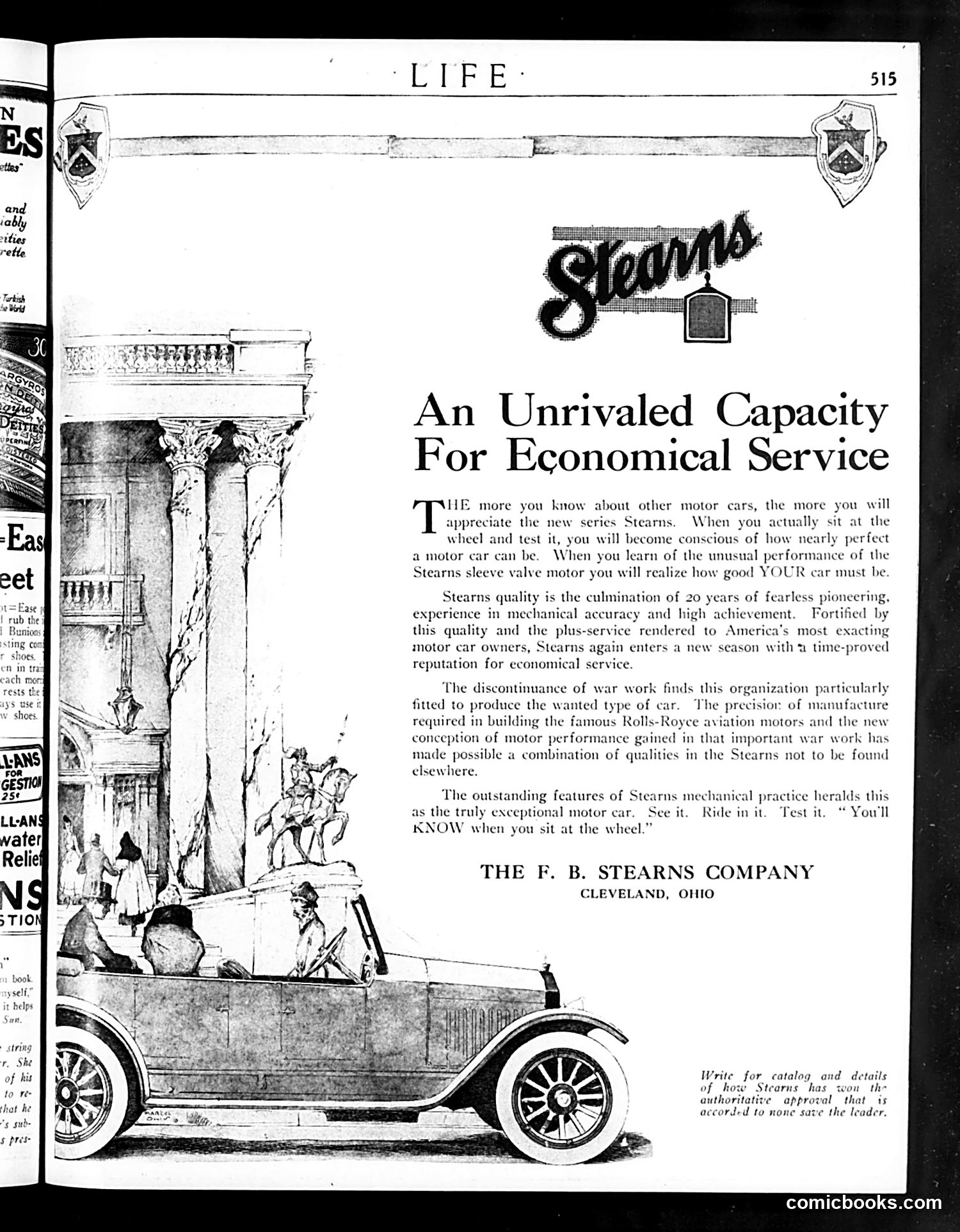
This is **not a cartoon or satire**—it's a straightforward automobile advertisement for the F.B. Stearns Company of Cleveland, Ohio. The page features an illustration of an early 1920s open-air touring car carrying passengers past classical architecture. The ad emphasizes the Stearns' quality, precision engineering, and economical performance. The text notably references the company's **wartime manufacturing experience**—"the discontinuance of war work" and expertise gained building aircraft motors—positioning this as proof of superior mechanical precision now applied to civilian automobiles. This is a typical post-WWI advertisement strategy: leveraging military-industrial credibility to sell consumer products. The "sleeve valve motor" mentioned was a contemporary technical feature highlighting mechanical sophistication. The page appears from **Life magazine's advertising section**, not its editorial/satirical content.
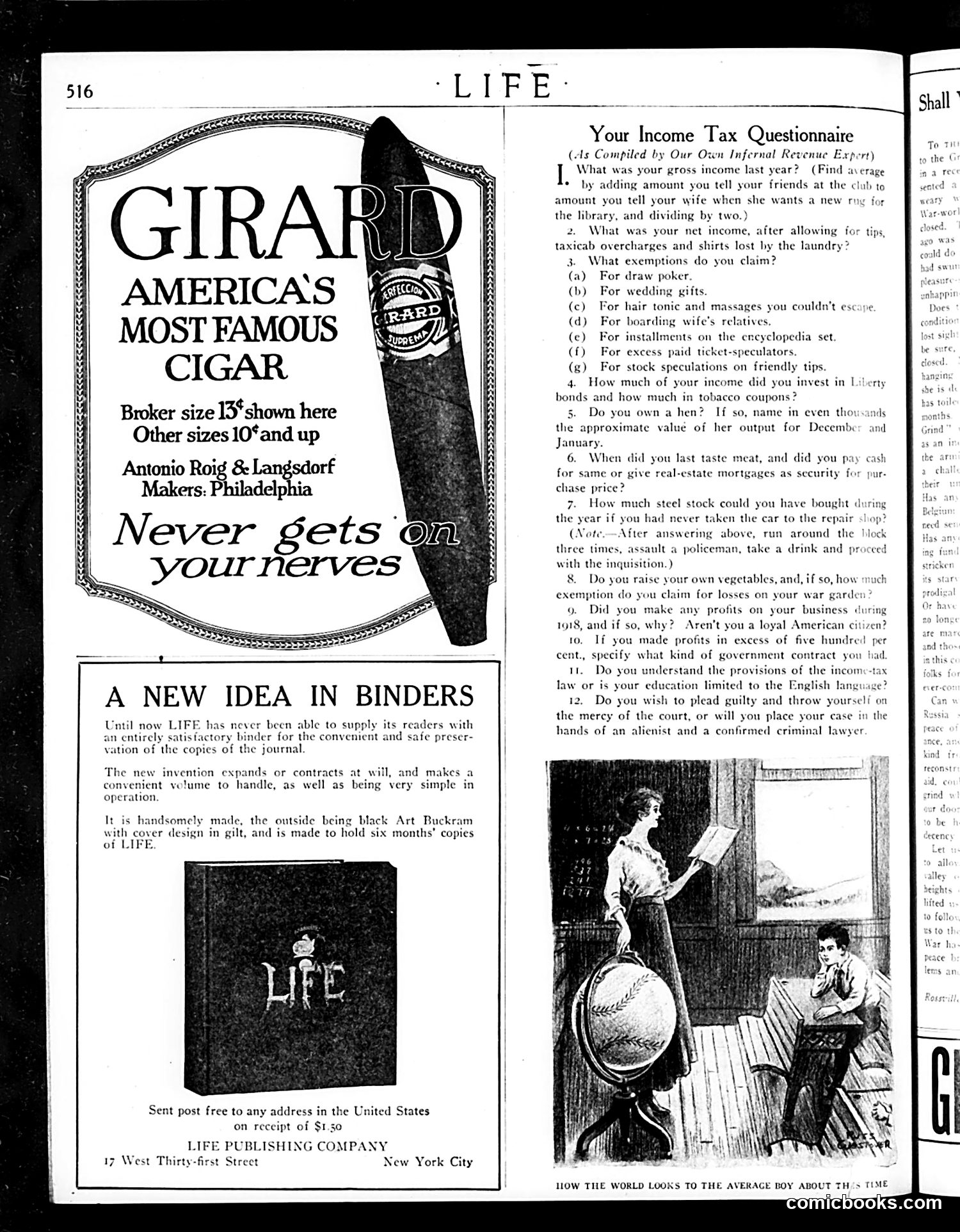
This page contains two distinct elements: **GIRARD CIGAR ADVERTISEMENT** (left): A straightforward commercial ad for "America's Most Famous Cigar" by Philadelphia makers Antonio Roig & Langsdorf, using the slogan "Never gets on your nerves." Below it advertises a new LIFE magazine binder—a practical product innovation allowing readers to bind six months of issues together for $1.50. **"YOUR INCOME TAX QUESTIONNAIRE" (right)**: A satirical humor piece mocking the newly-implemented federal income tax system. The joke lies in its deliberately absurd questions that expose common tax evasion and dishonesty: inflating income claims to friends while underreporting to wives, claiming dubious exemptions (poker losses, hair tonics), and questions sarcastically acknowledging wartime profiteering on government contracts. The final questions suggest despair—advising readers to "assault a policeman" or hire a "confirmed criminal lawyer." The satire reflects post-WWI frustration with income tax compliance and suggests widespread public skepticism about honest tax reporting.
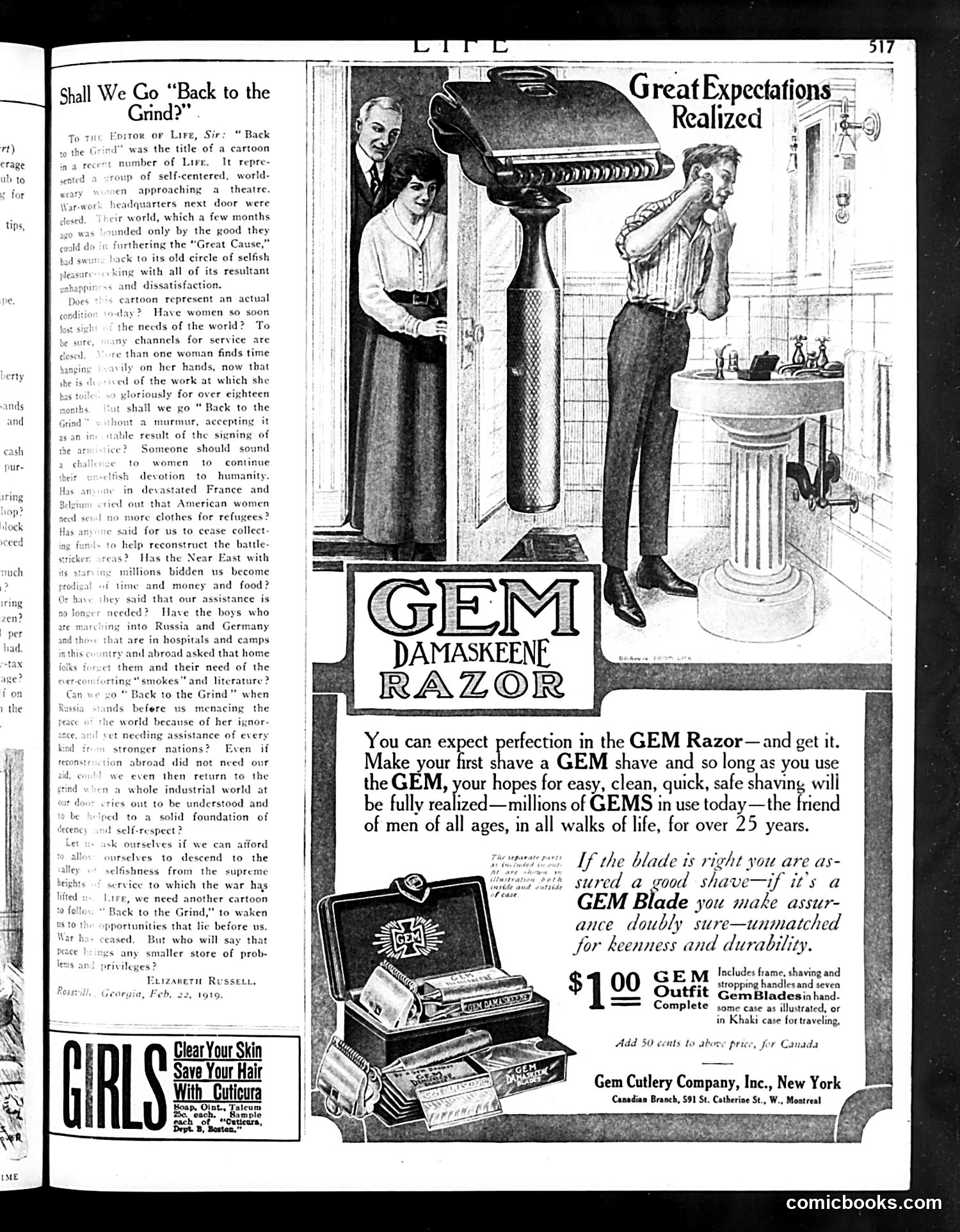
This page presents a letter-to-the-editor debate about whether women should return to domestic life after World War I. The writer (Elizabeth Russell) criticizes the earlier *Life* cartoon suggesting women abandon their wartime service roles and return to "the Grind" of home and leisure. Russell argues this is shortsighted: women have proven capable of meaningful work—collecting aid, supporting refugees, helping reconstruct war-torn regions, and supporting troops. She contends that asking them to retreat into selfishness and idle domesticity ignores ongoing global humanitarian needs and the contributions women demonstrated during the war. The satire targets post-war complacency: the assumption that because the fighting ended, social obligations ended. Russell advocates for continued female civic engagement rather than a return to pre-war domesticity. The page is primarily editorial content with an unrelated GEM Razor advertisement below.
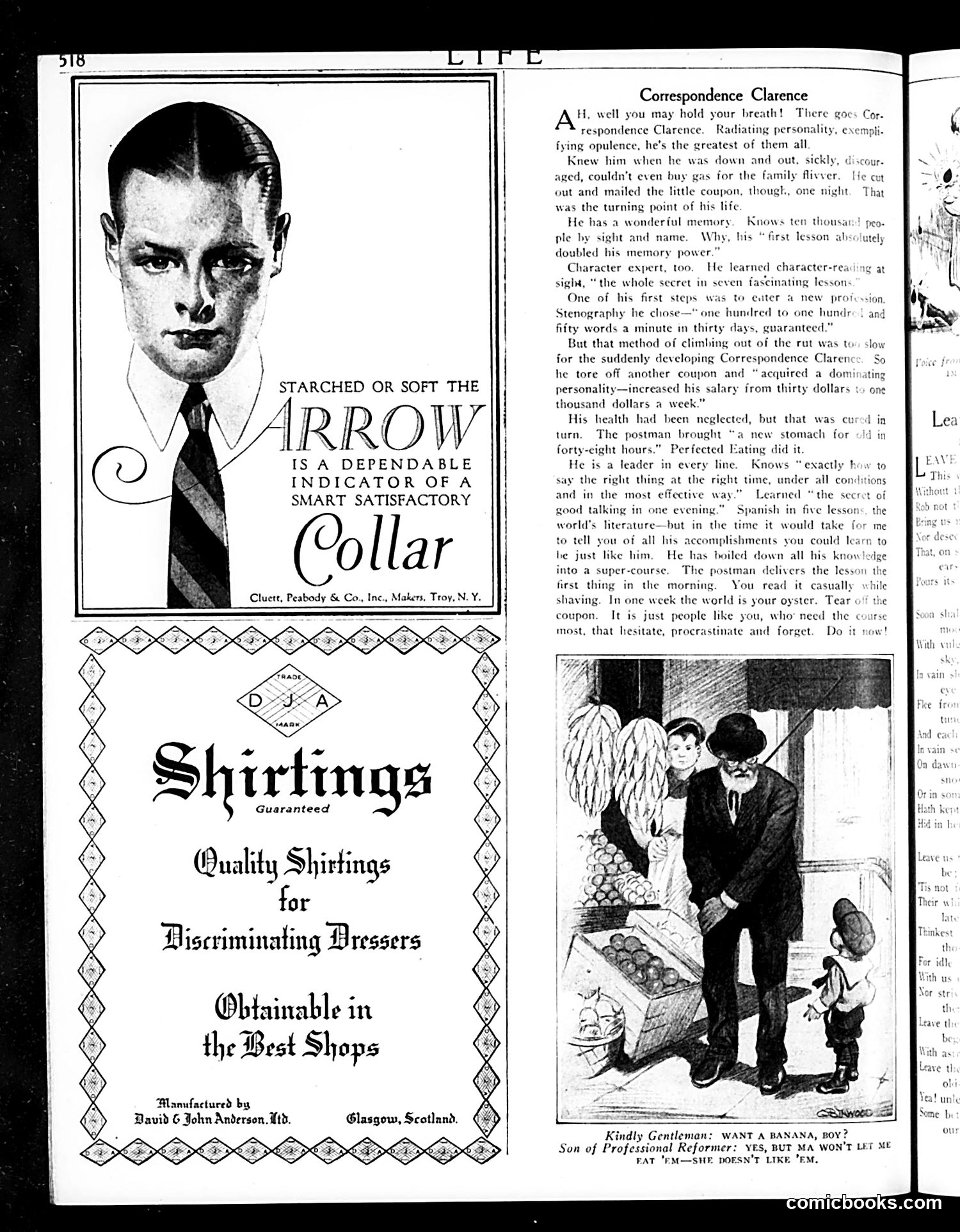
This page satirizes the mail-order self-improvement industry popular in early 20th-century America. "Correspondence Clarence" is a fictional character who epitomizes the "rags-to-riches through mail coupons" fantasy. The satire depicts him transforming from a broke, sickly failure into a wealthy, accomplished man simply by ordering various correspondence courses—stenography, memory training, personality development, public speaking, and even digestive health ("Perfect Eating"). The joke mocks both the unrealistic promises of these mail courses (learning Spanish in five lessons, acquiring a "dominating personality" for salary increases) and the desperation of people who bought them, hoping personal transformation arrived by postman. The cartoon below shows an adult and child at a fruit stand; the reformer's son wants bananas but his mother forbids it—a gentler joke about children's appetites versus parental control.
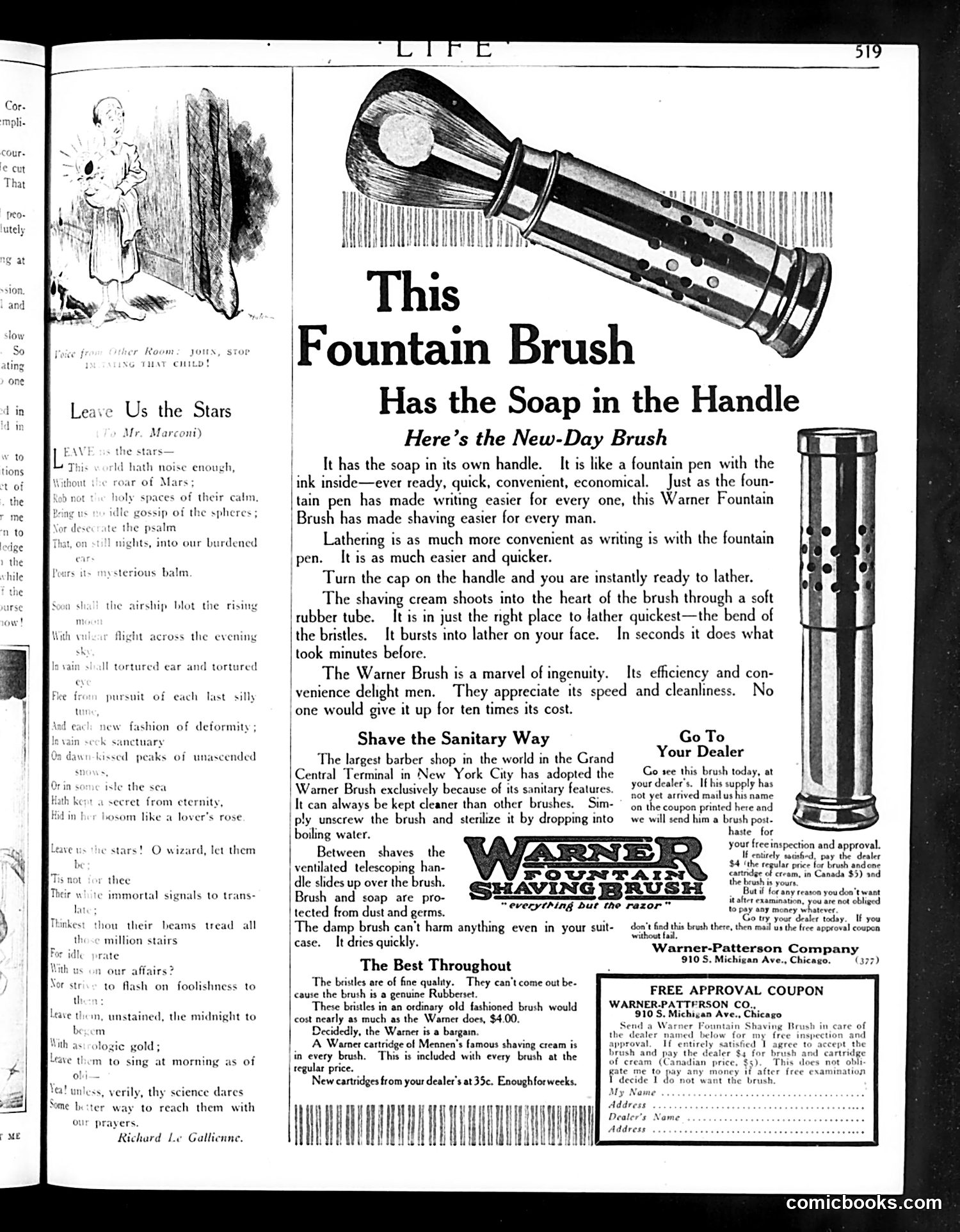
This page is primarily a **product advertisement**, not political satire. It occupies most of the right side of the page, promoting the Warner Fountain Brush—an innovative shaving brush with soap built into the handle. The advertisement uses a **novelty-product appeal**: comparing the brush to a fountain pen to suggest modern convenience and efficiency. Key selling points emphasized include sanitary features (sterilizable, protected from dust between uses), speed (lathering in seconds), and the inclusion of Mennen's shaving cream. The copy highlights that the Grand Central Terminal's barber shop—claimed as "the largest in the world"—adopted it exclusively. The left side contains a **poem** titled "Leave Us the Stars" by Richard Le Gallienne, unrelated to the advertisement. **For modern readers**: This represents early 20th-century consumer marketing—positioning a product as scientifically advanced by comparing it to other innovative technologies (fountain pens), emphasizing hygiene (a growing concern of the era), and using testimonial-style endorsements (the Grand Central barber shop).
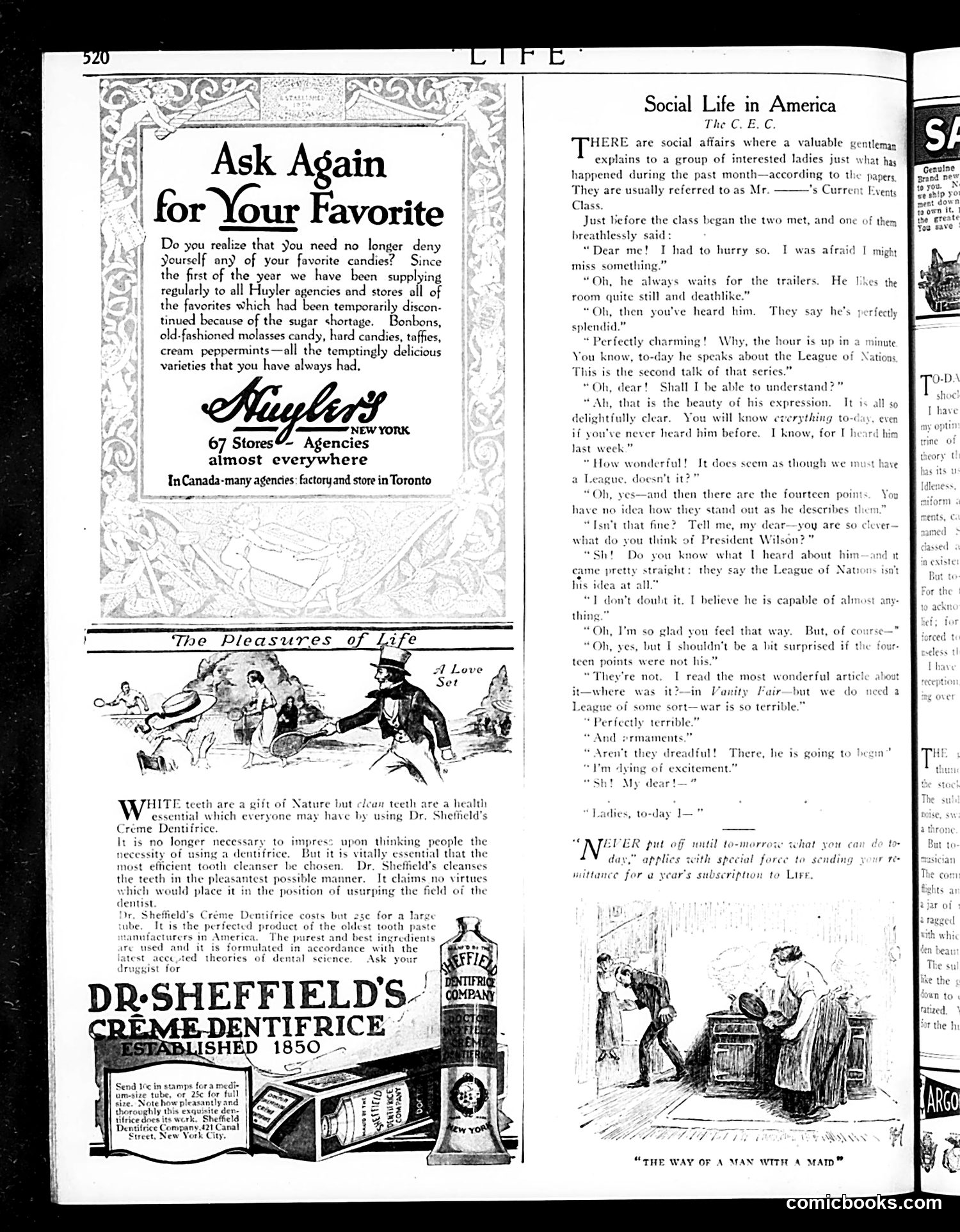
This page satirizes post-WWI American social pretension, particularly among women interested in current events. The main cartoon, "Social Life in America: The C.E.C." depicts two society ladies gossiping before a lecture on the League of Nations. The satire mocks their superficial engagement with serious politics: they discuss President Wilson and the League of Nations while demonstrating they understand neither the subject nor Wilson's actual role in creating it. One admits she read about it in *Vanity Fair* rather than serious sources. The humor lies in the contrast between their assumption of intellectual sophistication and their actual ignorance—they attend lectures to appear cultured while barely absorbing content. The smaller cartoon, "The Way of a Man with a Maid," depicts domestic comedy (unclear specifics from the image). The page is primarily **advertising** for Huyler candies, Dr. Sheffield's toothpaste, and Life magazine subscriptions, with the satirical content serving as editorial framing.
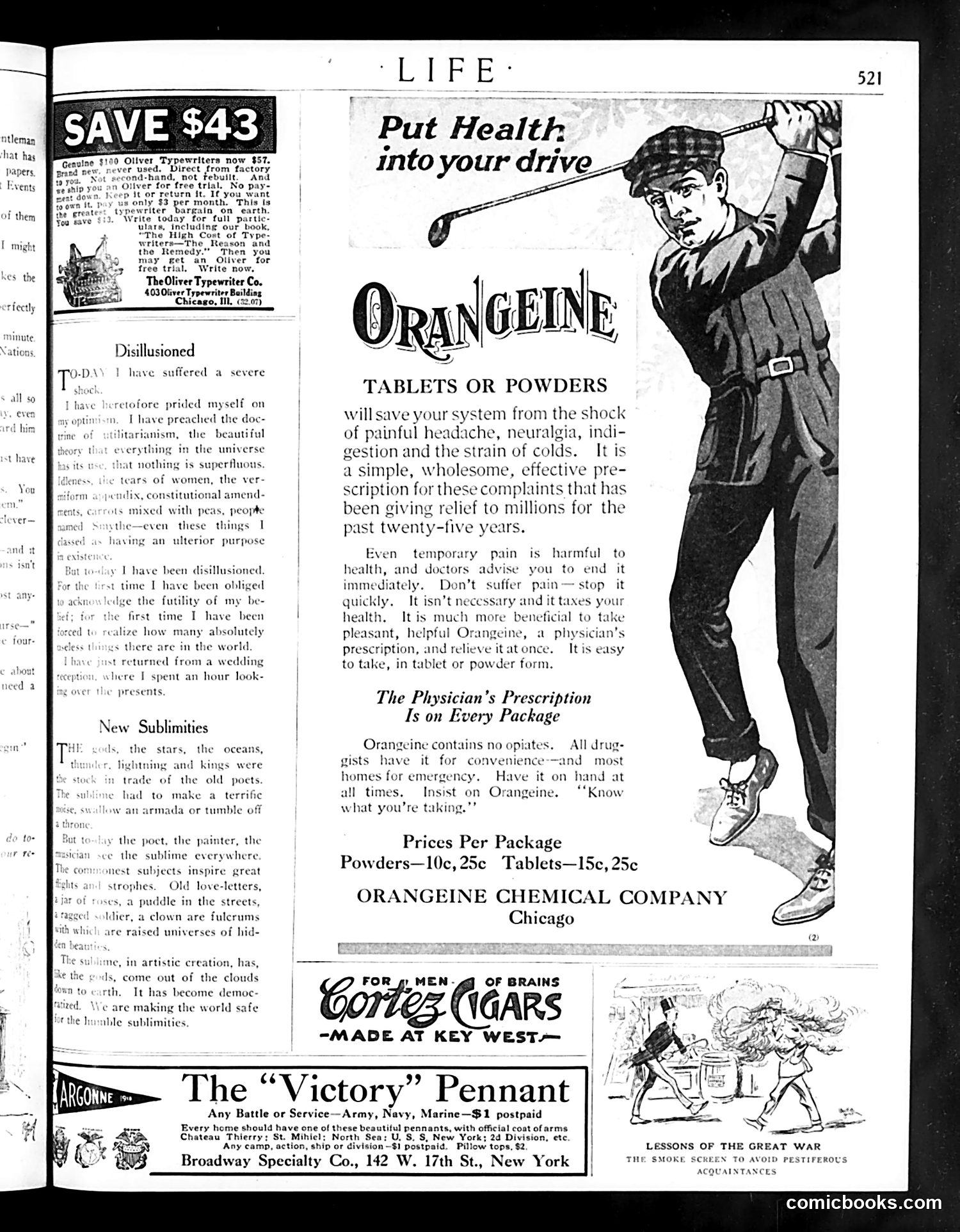
This page is primarily **advertising**, not satire or political commentary. The dominant content is a large advertisement for **Orangeine**, a patent medicine (tablets or powders) claiming to treat headaches, neuralgia, indigestion, and colds. The ad features a golfer mid-swing, using the sports imagery to suggest health and vitality. The copy emphasizes that Orangeine contains "no opiates" and claims doctors recommend it—standard marketing language for early 20th-century patent medicines, before modern FDA regulations. The physician's prescription endorsement on the package was a common advertising claim of the era. The page also includes minor ads for an Oliver typewriter, Cortez cigars, and a "Victory" pennant (likely WWI-era, referencing battles like Chateau Thierry). There is an opinion column titled "Disillusioned" discussing philosophical themes, but no political cartoons or satirical imagery requiring historical context.
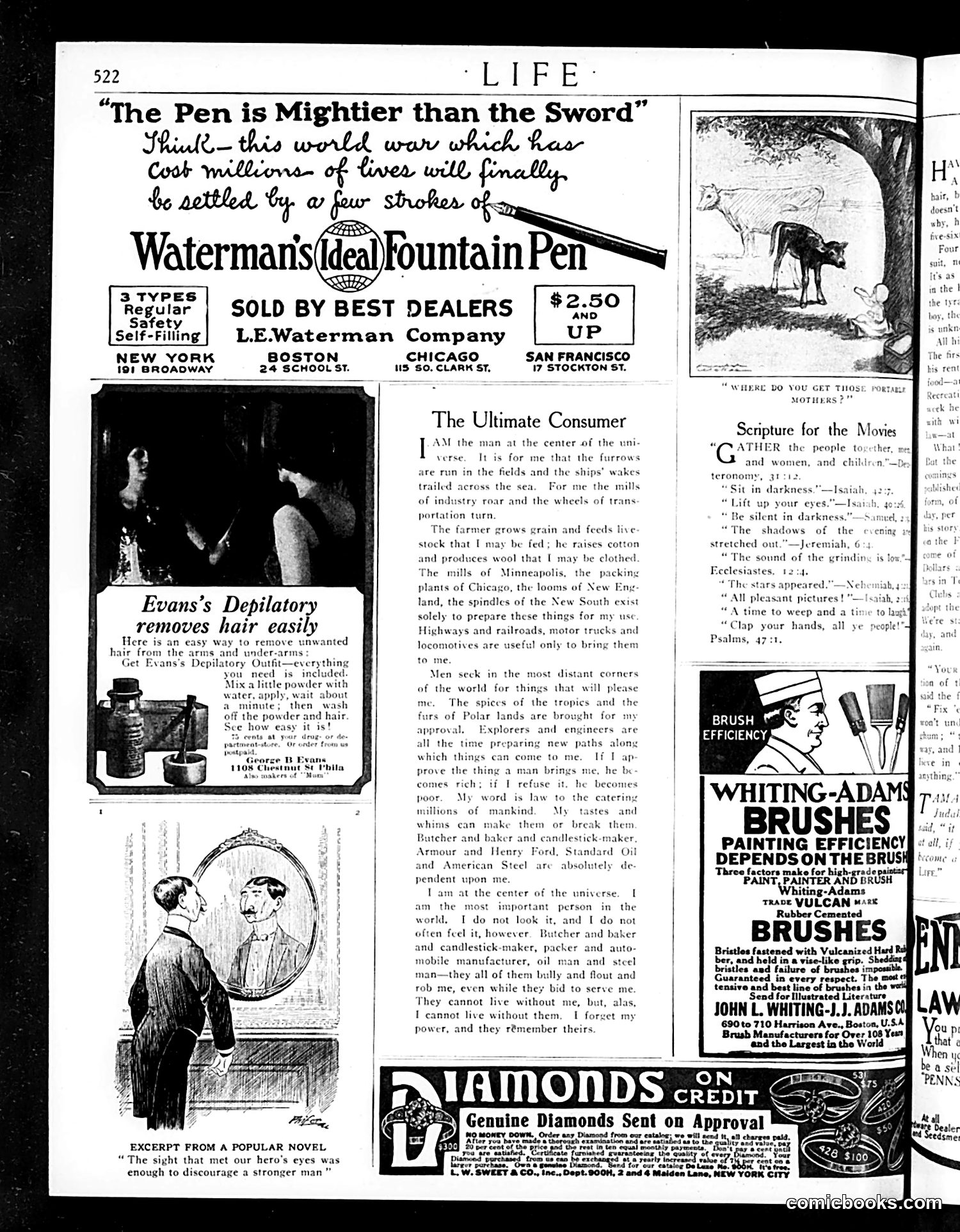
This page is primarily **advertising**, not political satire. The dominant content includes: 1. **Waterman's Fountain Pen ad** (top): Uses the phrase "The Pen is Mightier than the Sword" to reference World War I, suggesting written communication will settle the conflict that military force cannot. 2. **"The Ultimate Consumer" essay** (center): A sardonic piece describing an ordinary person as the center of the universe—ironically celebrating how farmers, industrialists, and corporations all exist to serve this supposedly humble individual. The satire lies in the disconnect: the consumer feels powerless despite theoretically controlling markets through demand. 3. **Supporting advertisements**: Evans's Depilatory, Whiting-Adams Brushes, and Diamonds on Credit fill the remaining space. The page reflects early 20th-century consumer culture commentary, mocking both consumer self-importance and the economic reality where ordinary people remain dependent on and exploited by larger forces they nominally control.
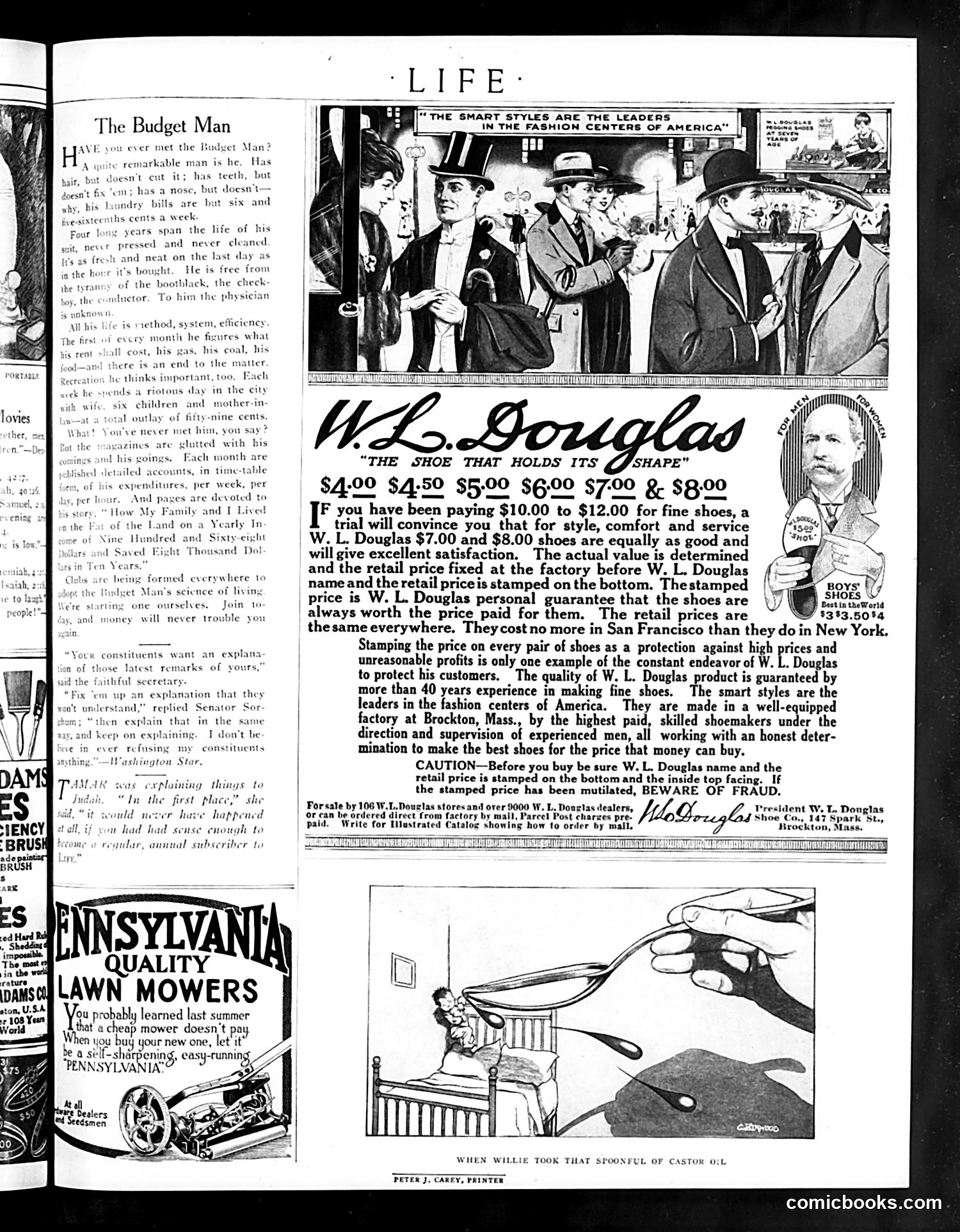
This page mixes editorial content with advertisements typical of early 20th-century Life magazine. **"The Budget Man" article** (left): Satirizes a specific type of middle-class figure—the obsessive record-keeper who meticulously tracks every household expense down to "teenths of a cent." The joke targets his joyless, bean-counting approach to family life, portraying budgeting as tyrannical rather than practical. It's social satire on American anxiety about financial management and the emerging "science of living." **W.L. Douglas shoe advertisement** (center): A major commercial section claiming shoes at $7–$8 offer equal quality to $10–$12 competitors. The ad emphasizes factory price-stamping as consumer protection against fraud and price-gouging—reflecting Progressive Era concerns about business transparency and fair pricing. **Pennsylvania lawn mower ad** and **"When Willie Took That Spoonful of Castor Oil"** (bottom): A brief humorous domestic scene about a child's reluctant medicine-taking. The page is primarily advertising-driven, with the satirical article as filler content.
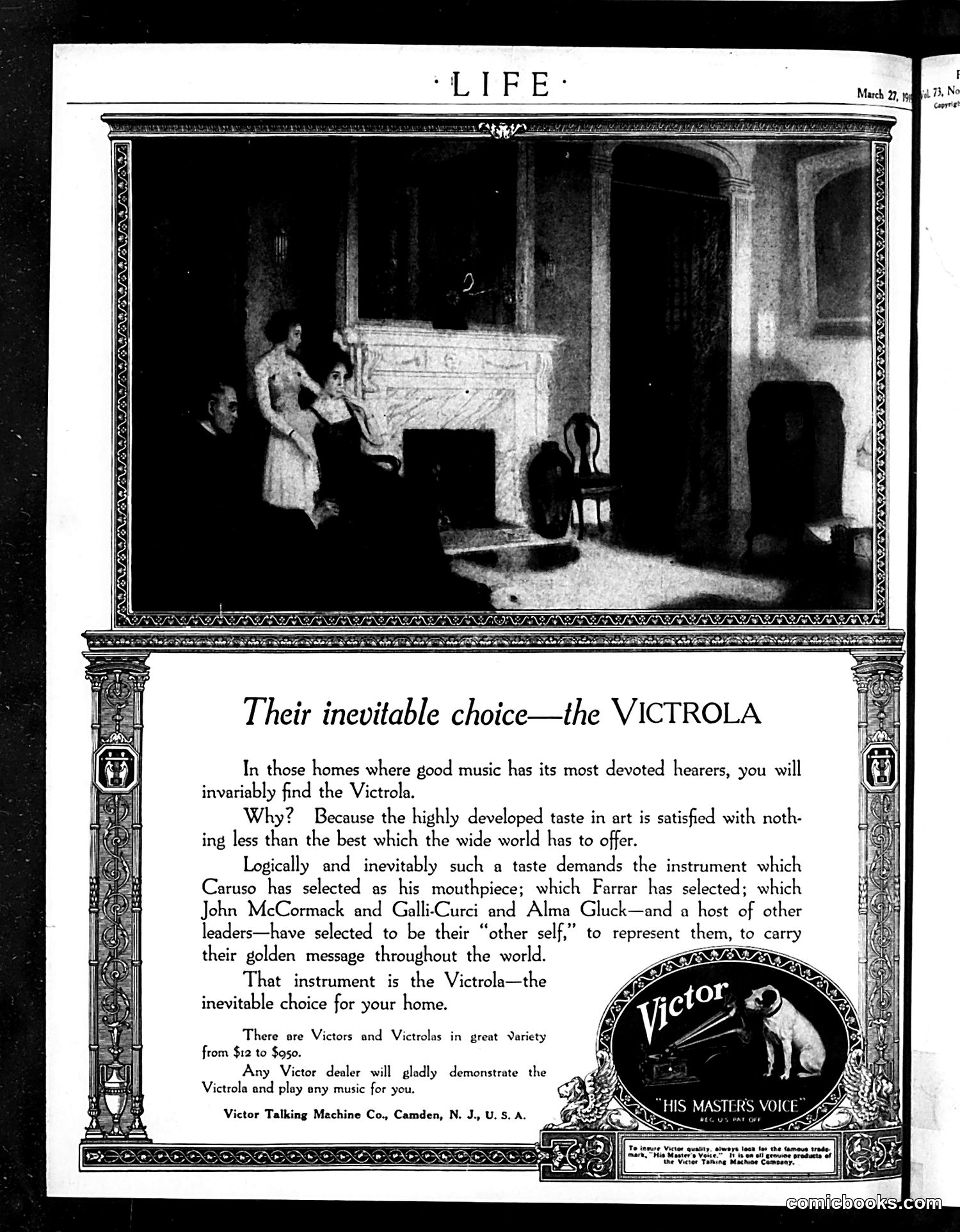
This is a **Victrola phonograph advertisement**, not a political cartoon. The page shows a domestic scene of an elegant family gathering around a fireplace, presumably listening to recorded music. The ad uses celebrity endorsement as its primary appeal, naming famous opera singers of the era (Caruso, Galli-Curci, John McCormack, Alma Gluck) who allegedly chose the Victrola as their preferred playback device. The copy frames owning a Victrola as an "inevitable choice" for homes with refined musical taste. The humor—subtle by modern standards—lies in the exaggeration: the ad suggests that sophisticated music lovers will *invariably* own this product, positioning it as both a status symbol and a moral imperative for cultured households. The pricing range ($12–$950) indicates models for different economic classes, though the advertising targets the aspirational middle and upper classes. The famous "His Master's Voice" Victor Talking Machine Company logo appears in the lower right corner.