
Life, 1919-03-27 · page 20 of 44
Life — March 27, 1919 — page 20: what you’re looking at
What you’re looking at
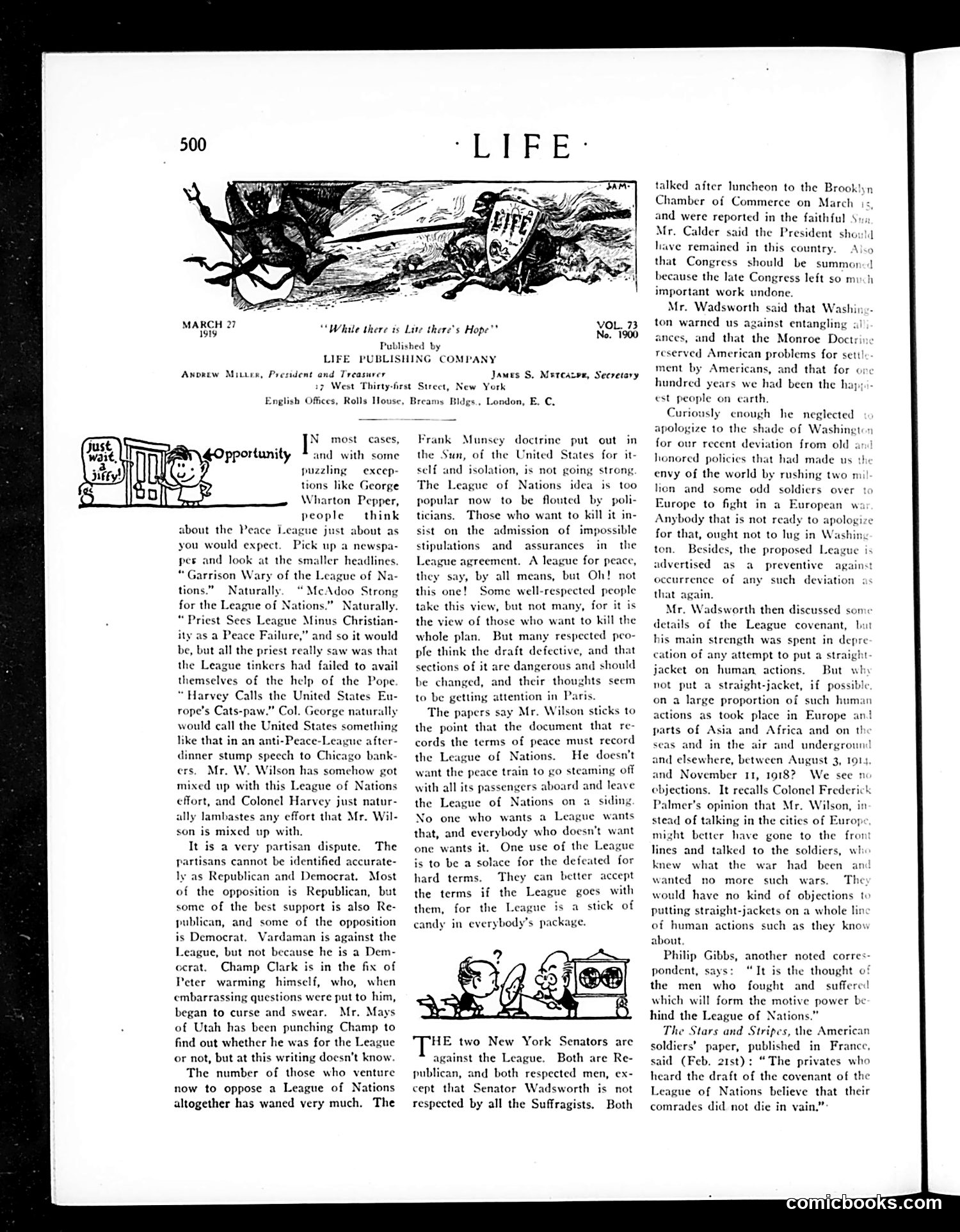
This Life magazine page satirizes the contentious American debate over President Wilson's proposed League of Nations, just after World War I ended. The cartoon "While there is Life there's Hope" depicts a dying or struggling figure—likely representing the League itself or peace efforts—suggesting the League's precarious survival amid political opposition. The article mocks the partisan confusion surrounding the League. It notes that opposition isn't cleanly divided along Republican/Democrat lines, citing figures like Senator Vardaman and Representative Champ Clark who awkwardly oppose it despite party alignment. The piece ridicules Colonel George Harvey's inflammatory rhetoric calling the U.S. Europe's "cat's-paw." The satire also targets New York Senators Calder and Wadsworth, who oppose the League. The cartoonist suggests their concerns (about presidential overreach, undone congressional work, entangling alliances) are pretexts masking their actual goal: killing the League entirely by attaching impossible conditions to it.
📄 Transcribed text from this page (OCR, searchable)
Machine-transcribed from the original scan — historical spelling and the odd misread are preserved.
MARCH 27 1919 “Whale there ts Lite there's Hope" Published by LIFE Anprew Mitter, President and Treasurer PUBLISHING COMPANY James S. Mercazvn, Secretary 17 West Thirty-first Street, New York English Offices, Rolls House, Breams Bldgs, London, E. C. N- most and with some puzzling — excep- tions like George Wharton Pepper, people think about the Peace League just about as you would expect. Pick up a newspa- pes and look at the sms “Garrison Wary of the L tions.” Naturally. “Me for the League of Nations.” cases, pportunity ler headlines. gue of Na- doo Strong Naturally, “Priest Sees League Minus Christian- i and so it would saw was that the League tinkers had failed to avail themselves of the help of the Pope. “Harvey Calls the United States Eu- rope’s Cats-paw.” Col. George naturally would call the United States something like that in an anti-Peace-League after- dinner stump speech to Chicago bank- ers. Mr. W. Wilson has somehow got mixed up with this League of Nations effort, and Colonel Harvey just natur- ally lambastes any effort that Mr. Wi son is mixed up with. It is a very partisan dispute. The partisans cannot be identified accurate- ly as Republican and Democrat. Most of the opposition is Republican, but some of the best support is also Re- publican, and some of the opposition is Democrat. Vardaman is against the League, but not because he is a Dem- ocrat. Champ Clark is in the fix of Peter warming himself, who, when embarrassing questions were put to him, began to curse and swear. Mr. May of Utah has been punching Champ to find out whether he was for the League or not, but at this writing docsn’t know The number of those who venture now to oppose a League of Nations altogether has waned very much, The Frank Munsey doctrine put out in the Sun, of the United States for it- self and isolation, is not going strong. The League of Nations idea is too popular now to be flouted by poli- ticians. Those who want to kill it in- sist on the admission of impossible stipulations and. the League agreement. A league for peace, they say, by all means, but Oh! not this one! Some well-respected people take this view, but not many, for it is the view of those who want to kill the whole plan. But many respected peo- ple think the draft defective, and that sections of it are dangerous and should be changed, and their thoughts seem to be getting attention in is. The papers say Mr. Wilson sticks to the point that the document that re- cords the terms of peace must record the League of Nations. He doesn’t in to go steaming off assurances in want the peace tr: with all its passengers aboard and | the League of Nations on a siding. No one who wants a League wants that, and everybody who doesn’t want one wants it. One use of the League is to be a solace for the defeated for hard term: They can better accept the terms if the League goes with them, for the League is a stick of andy in everybody's package. HE two New York Senators are inst the League. Both are Re- publican, and both respected men, ex- cept that Senator Wadsworth is not respected by all the Suffragists. Both talked after luncheon to the Brooklyn Chamber of Commerce on March and were reported in the faithful § Mr. Calder said the President shov!d lave remained in this country. Also that Congress should be summon: because the late Congress left so mich important work undone. Mr. Wadsworth said that Washine- ton warned us against entangling ai ances, and that the Monroe Doct: reserved American problems for sett ment by Americans, and that for onc hundred years we had been the hay est people on earth, Curiously cnough he neglected apologize to the shade of Washingt for our recent deviation from old a honored policies that had made us the envy of the world by rushing two m lion and some odd soldiers over Zurope to fight in a European wa’ Anybody that is not ready te for that, ought not to lug in Washing ton. Besides, the proposed League is pologize advertised as a preventive occurrence of any such deviation ; that again. Mr. Wadsworth then discussed some details of the League covenant, but his main strength was spent in depre cation of any attempt to put a stra jacket on human actions. But why not put a straight-jacket, if possible on a large proportion of such humar ctions as took place in Europe an! parts of Asia and Africa and on 1) seas and in the air and underground and elsewhere, between August 3, 1914. and November 11, 1918? We see n ebjections. It recalls Colonel Frederick Palmer's opinion that Mr. Wilson, in stead of talking in the cities of Euroy might better have gone to the fror lines and talked to the soldiers, wi knew what the war had been and wanted no more such The would have no kind of objections to putting straight-jackets on a whole lin of human actions such as they know about Philip Gibbs, another noted corre pondent, says: “It is the thought of the men who fought and suffered which will form the motive power be hind the League of Nations.” The Stars and Stripes, the Ameri soldiers’ paper, published in France, said (Feb. 21st): “The privates who heard the draft of the covenant of the League of Nations believe that their comrades did not die in vain.” wars. comicbooks.com