
Life, 1919-03-27 · page 21 of 44
Life — March 27, 1919 — page 21: what you’re looking at
What you’re looking at
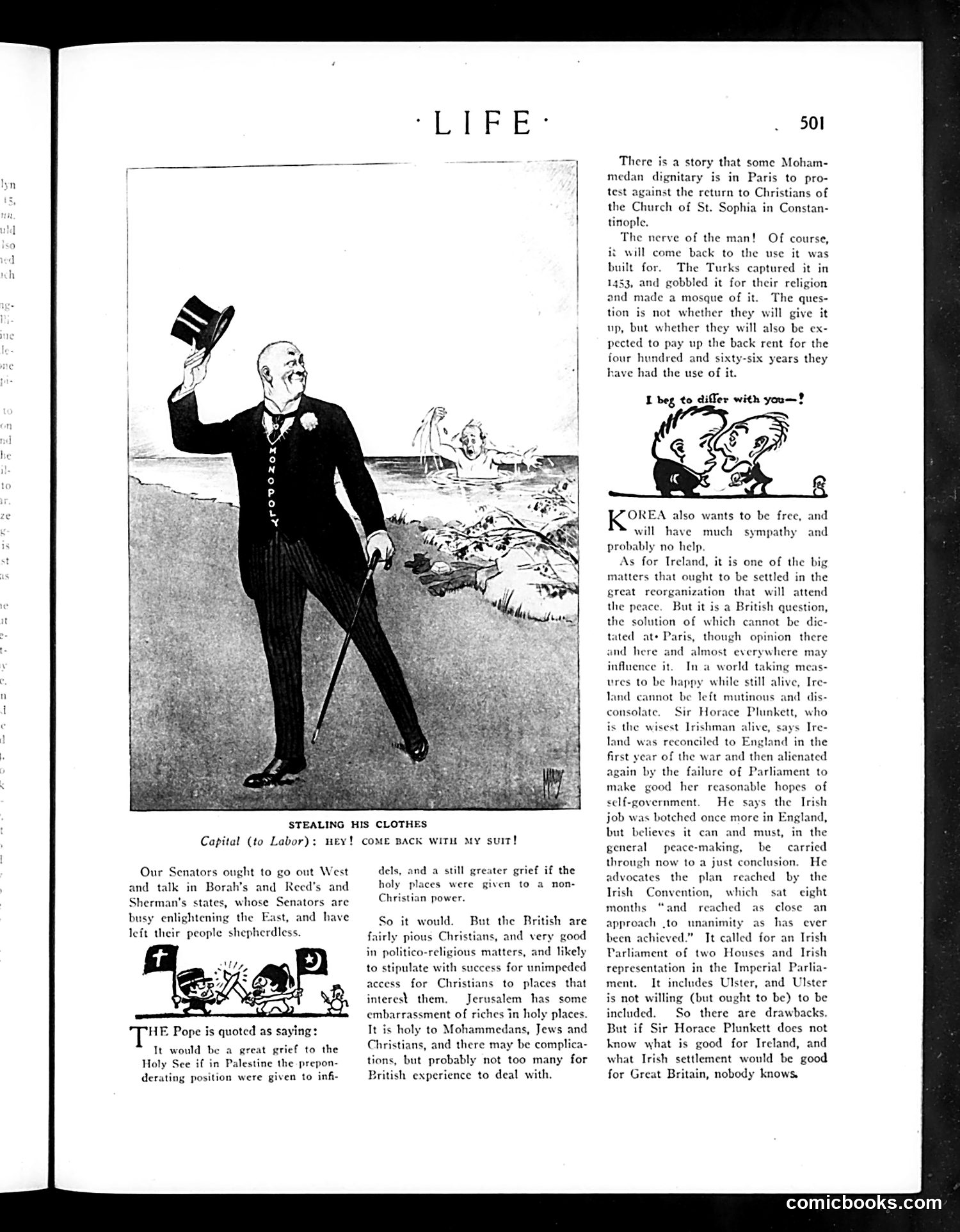
The main cartoon depicts a wealthy gentleman (labeled "Capital") chasing a fleeing worker (labeled "Labor"), demanding the return of his suit. This is post-WWI class-struggle satire: the cartoon suggests that labor, empowered during wartime production, has symbolically "stolen" capital's dominance and refuses to surrender it. The surrounding text addresses post-war geopolitical issues: Palestine's future (the Pope's concerns about Christian vs. non-Christian control), the Church of St. Sophia in Constantinople (captured by Turks in 1453, now being restored to Christians), Korea's independence aspirations, and Irish self-government. The small cartoon labeled "I beg to differ with you" appears to show two figures in disagreement, likely reflecting contemporary political disputes. The article advocates for just settlements of these colonial and national questions during peace negotiations, citing Sir Horace Plunkett's Irish Convention proposals as a model for compromise—though Ulster's resistance complicates matters.
📄 Transcribed text from this page (OCR, searchable)
Machine-transcribed from the original scan — historical spelling and the odd misread are preserved.
STEALING HIS CLOTHES Capital (to Labor): wey! coME BACK WiTH My suit! Our Senators ought to go out West and talk in Borah’s and Reed’s and Sherman's states, whose Senators are busy enlightening the East, and have left their people shepherdless. HE Pope is quoted as saying: It would be a great grief to the Holy Sce if in Palestine the prepon- derating position were given to infi- dels, and a still greater grief if the holy places were given to a non- Christian power. So it would. But the British are fairly pious Christians, and very good in politico-religious matters, and likely to stipulate with success for unimpeded access for Christians to places that interest them, Jerusalem has some embarrassment of riches in holy places. It is holy to Mohammedans, Jews and Christians, and there may be complica- tions, but probably not too many for British experience to deal with. 501 There is a story that some Moham- medan dignitary is in Paris to pro- test against the return to Christians of the Church of St. Sophia in Constan- tinople. The nerve of the man! Of course, ig will come back to the use it was built for. The Turks captured it in 1453, and gobbled it for their religion nd made a mosque of it. The ques- tion is not whether they will give it up, but whether they will also be ex- pected to pay up the back rent for the four hundred and sixty-six years they have had the use of it. I beg to differ with you—!? OREA also wants to be free, and will have probably no help As for Ireland, it is one of the big matters that ought to be settled in the great reorganization that will attend the peace. But it is a British question, the solution of which cannot be dic- tated ate Paris, though opinion there nd here y much sympathy and nd almost everywhere m: influence In a world taking meas- ures to be happy while still alive, Ir land cannot be left mutinous and dis- Sir Horace Plunkett, who is the wisest Irishman consolate. ive, says Ire- ngland in the first year of the war and then alienated again by the failure of Parliament to make good her reasonable hopes of self-government. He says the Irish job was botched once more in England, but believes it can and must, in the general peace-making, be — carried through now to a just conclusion. He advocates the plan reached by the Irish Convention, which sat eight months “and close an approach .to unanimity as has ever been achieved.” It called for an Irish Parliament of two Houses and Irish representation in the Imperial Parlia- ment. It includes Ulster, and Ulster is not willing (but ought to be) to be included. So there are drawbacks. But if Sir Horace Plunkett does not know what good for Ireland, and what Irish settlement would be good for Great Britain, nobody knows. land was reconciled to reached as comicbooks.com