
A complete issue · 34 pages · 1919
Life — January 2, 1919
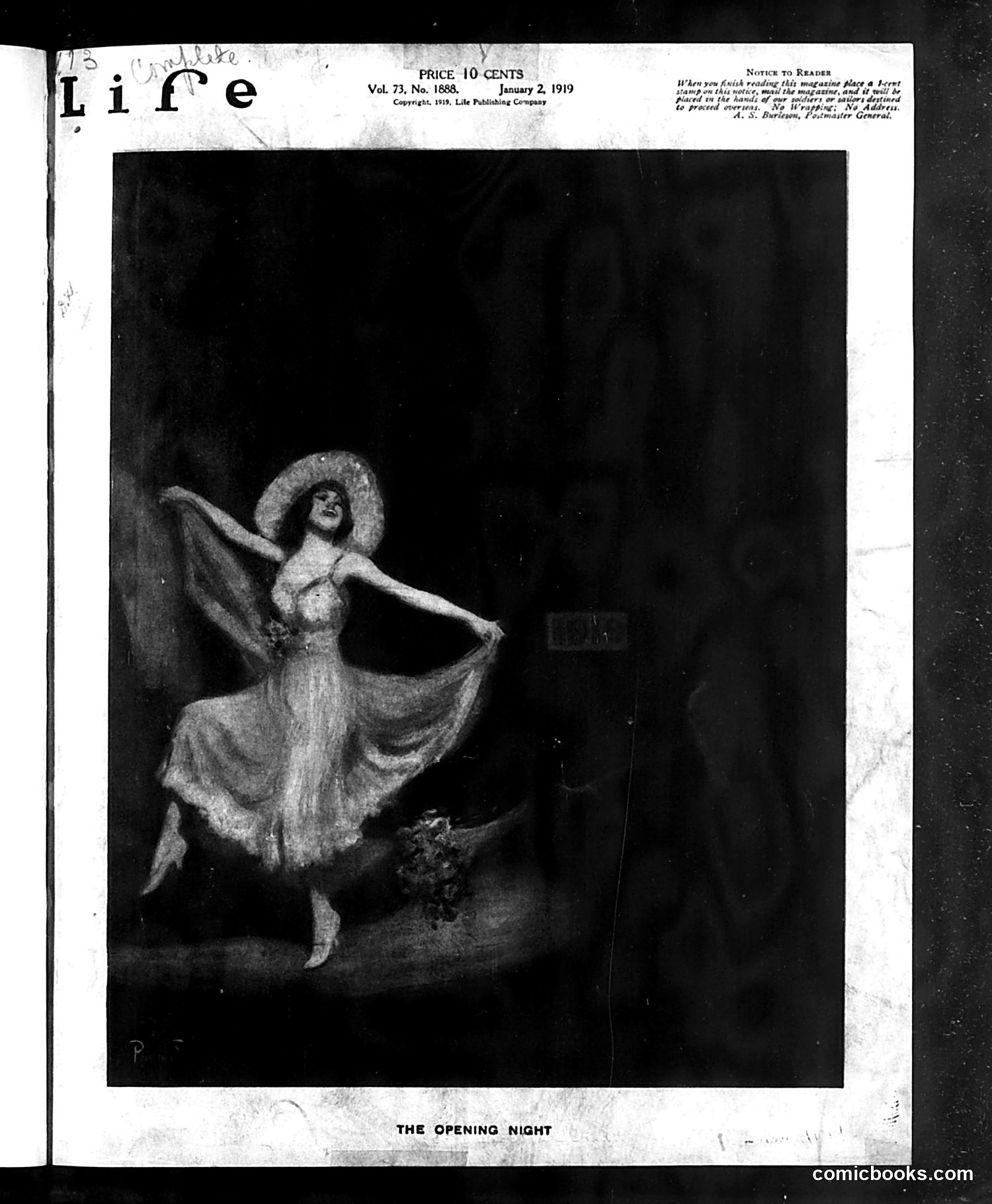
This illustration depicts a woman in an elegant gown and wide-brimmed hat, posed dramatically against a dark background. The caption reads "THE OPENING NIGHT," suggesting a theatrical or social premiere event. Given the January 1919 date—just after World War I's armistice—this likely celebrates the reopening of American entertainment venues (theaters, nightclubs) that had been restricted during wartime. The woman's glamorous, liberated pose and exposed legs reflect the emerging "flapper" aesthetic of the 1920s, symbolizing post-war freedom and the loosening of Victorian social constraints. The image captures optimism about returning to civilian pleasures and modern femininity after years of wartime austerity. The satirical commentary appears celebratory rather than critical of these social changes.
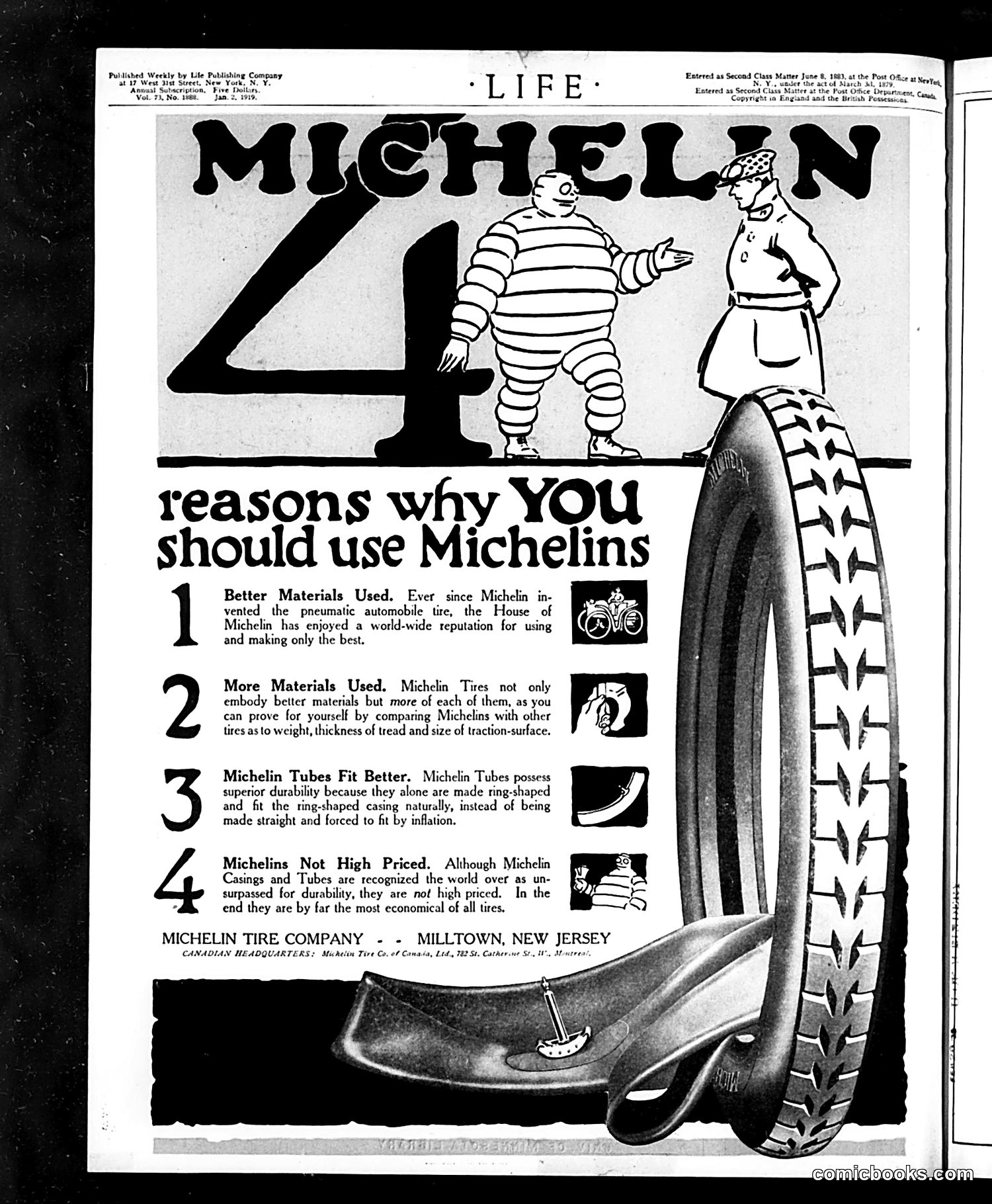
This is primarily a **Michelin Tire advertisement**, not satirical content. The page promotes four reasons to buy Michelin tires: better materials, more materials used, superior tube design, and competitive pricing. The cartoon illustration features the **Michelin Man** (Bibendum), the company's iconic mascot—a rotund, cheerful figure made of tire treads—conversing with another character. This mascot was created to personify the tire brand and make advertising more memorable and friendly. The detailed product photography on the right showcases actual Michelin tires and tubes. There is **no political satire** on this page; it's straightforward early-20th-century product marketing using humor and distinctive branding to appeal to automobile owners considering tire purchases.
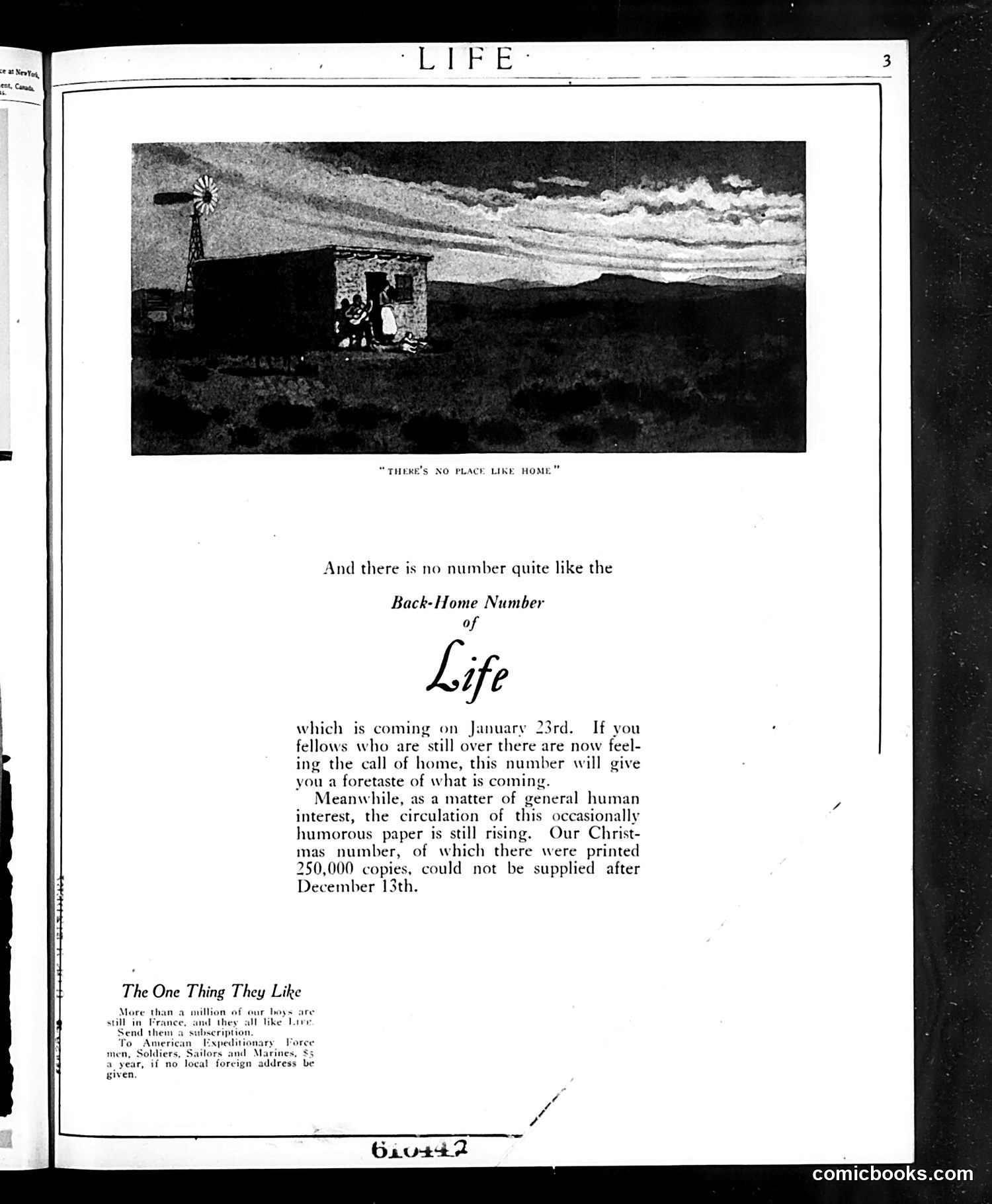
This page promotes an upcoming "Back-Home Number" of Life magazine scheduled for January 23rd, targeting American servicemen stationed abroad during what appears to be World War I (given references to "France" and military personnel). The photograph captioned "There's No Place Like Home" shows a sparse prairie homestead with a windmill and small building—an iconic American rural scene meant to evoke homesickness among deployed troops. The text emphasizes the magazine's circulation success (250,000 copies of a Christmas issue) and notes that soldiers, sailors, and marines appreciate Life's humor. The issue aims to provide emotional comfort ("foretaste of what is coming") to homesick servicemen by celebrating American domestic life and values. This reflects wartime morale-boosting efforts through popular media.
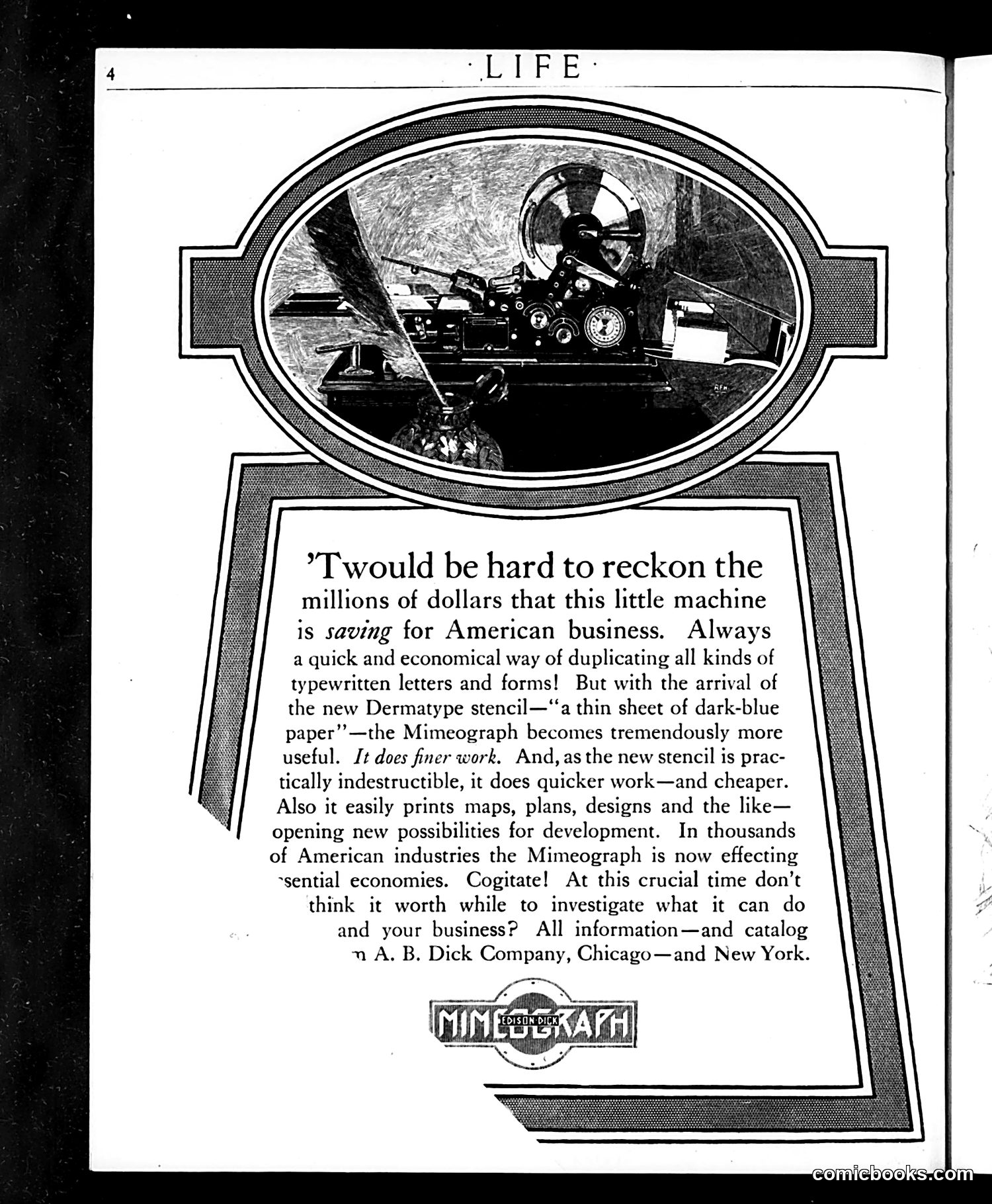
This page is primarily **advertising, not satire or political content**. It's a vintage advertisement for the Mimeograph machine, manufactured by A.B. Dick Company (Chicago and New York). The ad claims the mimeograph saves "millions of dollars" for American businesses by duplicating typewritten letters and forms efficiently. It highlights a new innovation: the "Dermatype stencil"—a thin dark-blue paper that allegedly allows finer, faster, cheaper printing while opening new possibilities for industries. The oval photograph shows the mimeograph machine itself. The ad uses urgent language ("At this crucial time") to encourage businesses to investigate the device's capabilities, offering to send information and catalogs upon request. This represents early-20th-century office technology marketing.
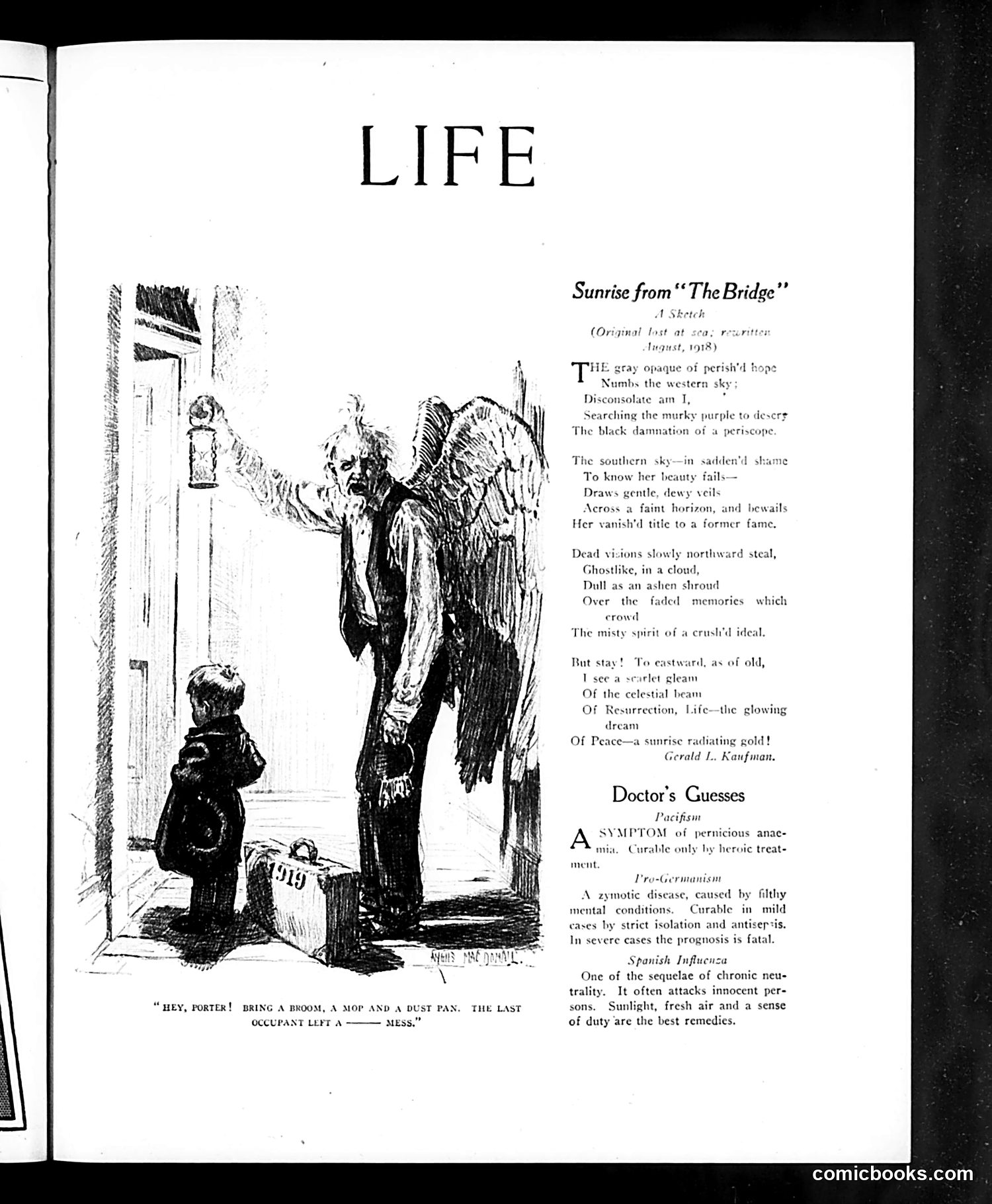
This page contains a literary/artistic section rather than political satire. The main illustration depicts an adult and child in a doorway, with a caption referencing a porter needing "a broom, a mop and a dust pan"—suggesting domestic servitude or poverty conditions. The featured poem "Sunrise from 'The Bridge'" by Gerald L. Kaufman uses metaphorical language about dawn and spiritual renewal, likely reflecting early 20th-century Romantic sensibilities. Below, "Doctor's Guesses" lists three medical conditions (Anaemia, Prostatism, Spanish Influenza) with brief clinical descriptions. The Spanish Influenza reference suggests this page dates from the 1918 pandemic period, making this a public health information feature rather than satirical commentary. The content appears educational and literary rather than politically charged.
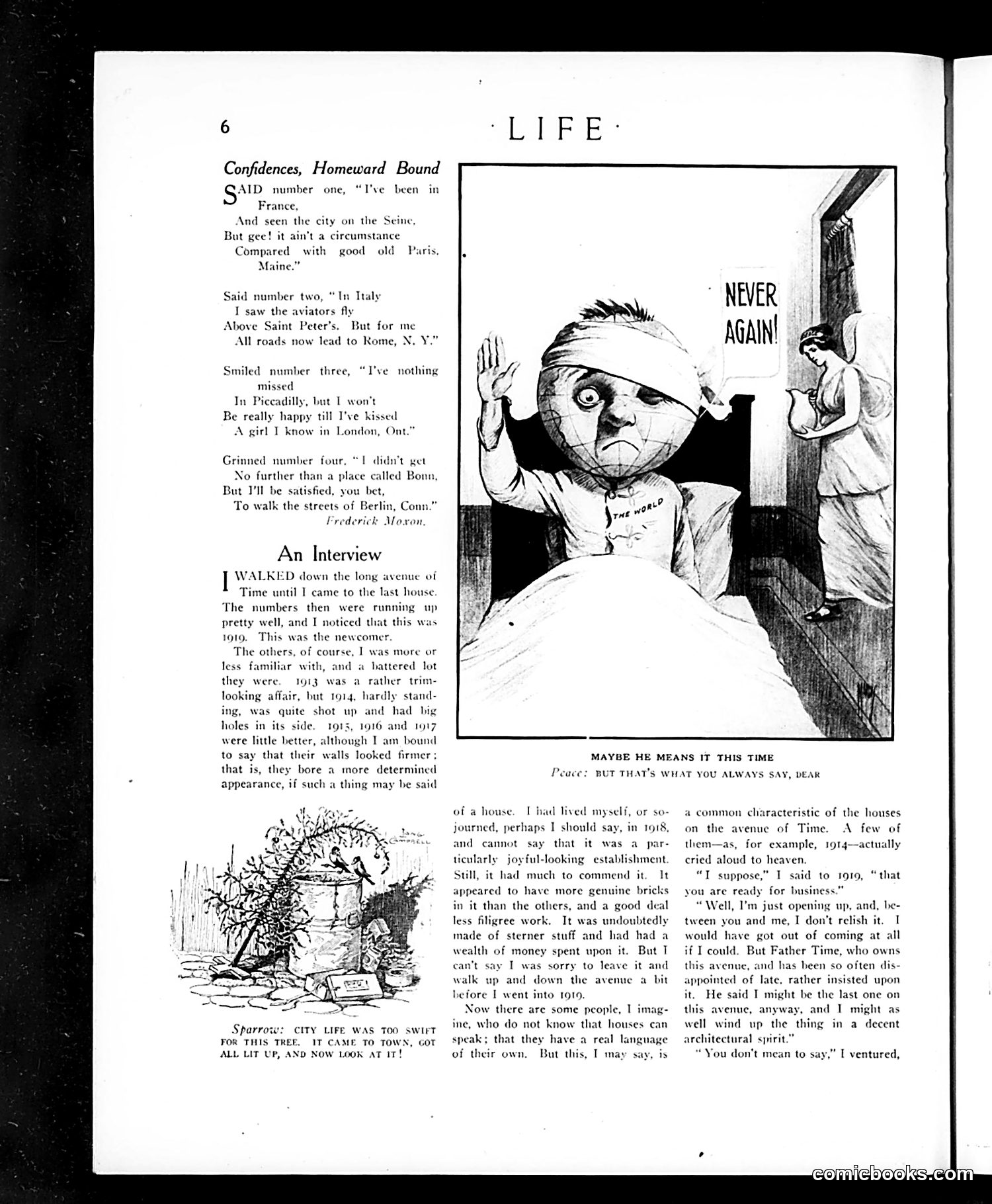
The main cartoon shows a bandaged baby figure labeled "THE WORLD" saying "NEVER AGAIN!" while being held by what appears to be a weary or exhausted figure (likely representing humanity or a nation). The caption reads "MAYBE HE MEANS IT THIS TIME / Peace; BUT THAT'S WHAT YOU ALWAYS SAY, DEAR." This is post-World War I satire (the article references 1918-1919). The joke expresses cynical skepticism about peace promises following the war's devastation. The baby "world" is wounded and traumatized, swearing never to repeat such destruction—but the weary caregiver doubts this resolve will hold, implying that nations will inevitably return to conflict. The accompanying text discusses houses on an avenue and their wartime damage, contextualizing the cartoon's commentary on war's destructive aftermath.
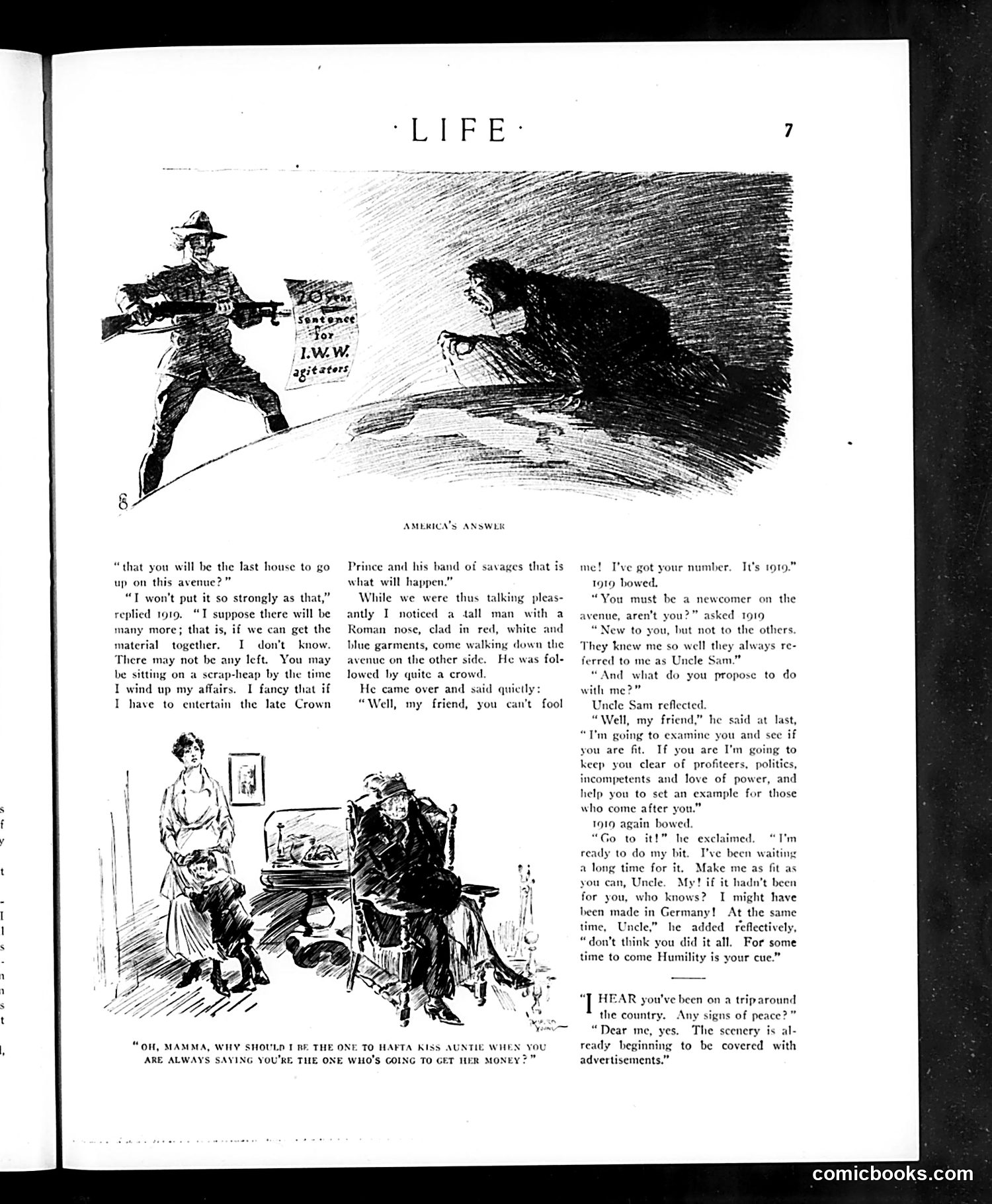
This is a World War I-era cartoon titled "America's Answer." The top panel shows an American soldier with a rifle confronting a menacing, dark figure labeled as representing German aggression or "the enemy." The lower panel depicts Uncle Sam (identifiable by traditional dress) speaking with a young man, discussing the man's fitness for military service. Uncle Sam examines whether the recruit is "fit" and warns him to avoid "profiteers, politics, incompetents and love of power." The satire addresses American recruitment and mobilization for WWI, presenting the conflict as a moral test. The "answer" to German militarism is American military strength combined with moral integrity—the cartoon suggests that defeating enemies requires not just soldiers but ethically sound ones, free from corruption.
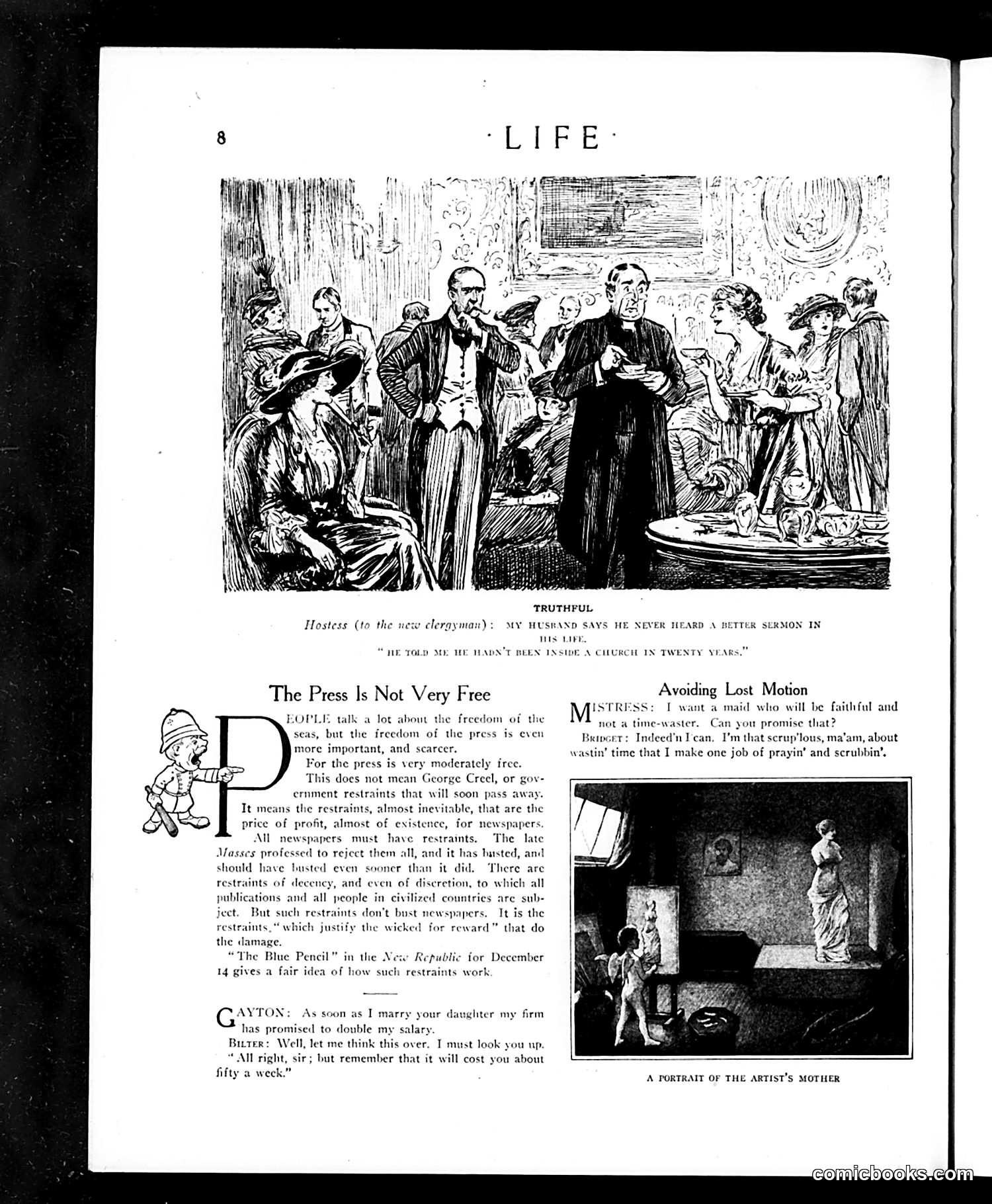
**Top Cartoon ("Truthful"):** A hostess at a social gathering quotes her husband's compliment to a visiting clergyman, saying he never heard a better sermon in his life—though he hasn't been inside a church in twenty years. This satirizes social dishonesty and empty flattery in polite society. **"The Press Is Not Very Free":** This article argues that despite claims of press freedom, newspapers face practical restraints (profit pressures, decency standards) that limit their independence. It references specific examples from publications like the *New Republic*. **"Avoiding Lost Motion":** A humorous domestic exchange where a servant negotiates wages with her employer, haggling over household labor costs. **Right image:** "A Portrait of the Artist's Mother" appears to be a visual joke, though its specific reference remains unclear.
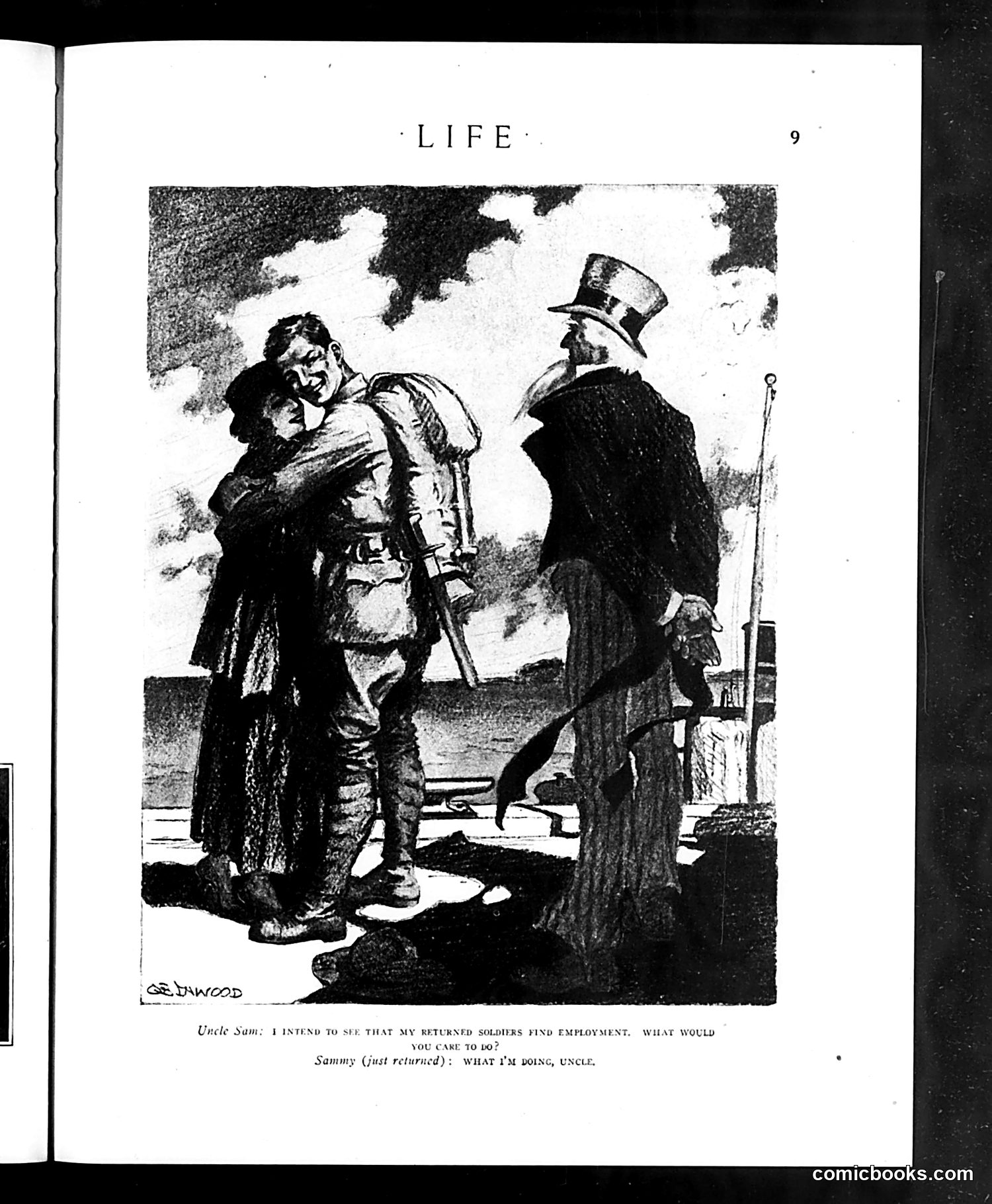
This Life magazine cartoon addresses post-WWI veteran employment. Uncle Sam (identifiable by his top hat and formal dress) tells a returned soldier he intends to find employment for war veterans. The soldier's response—"What I'm being, Uncle"—suggests bitter sarcasm, implying that despite Uncle Sam's promises, returning soldiers faced actual unemployment or underemployment after the war. The cartoon satirizes the disconnect between government rhetoric about supporting veterans and the harsh reality many faced reintegrating into civilian life. The soldier's stance and tone convey frustration at being patronized while struggling economically. The artist is signed "C.E. Duwood" (or similar). This reflects genuine post-WWI anxieties about veteran welfare that became a significant political issue in the 1920s.
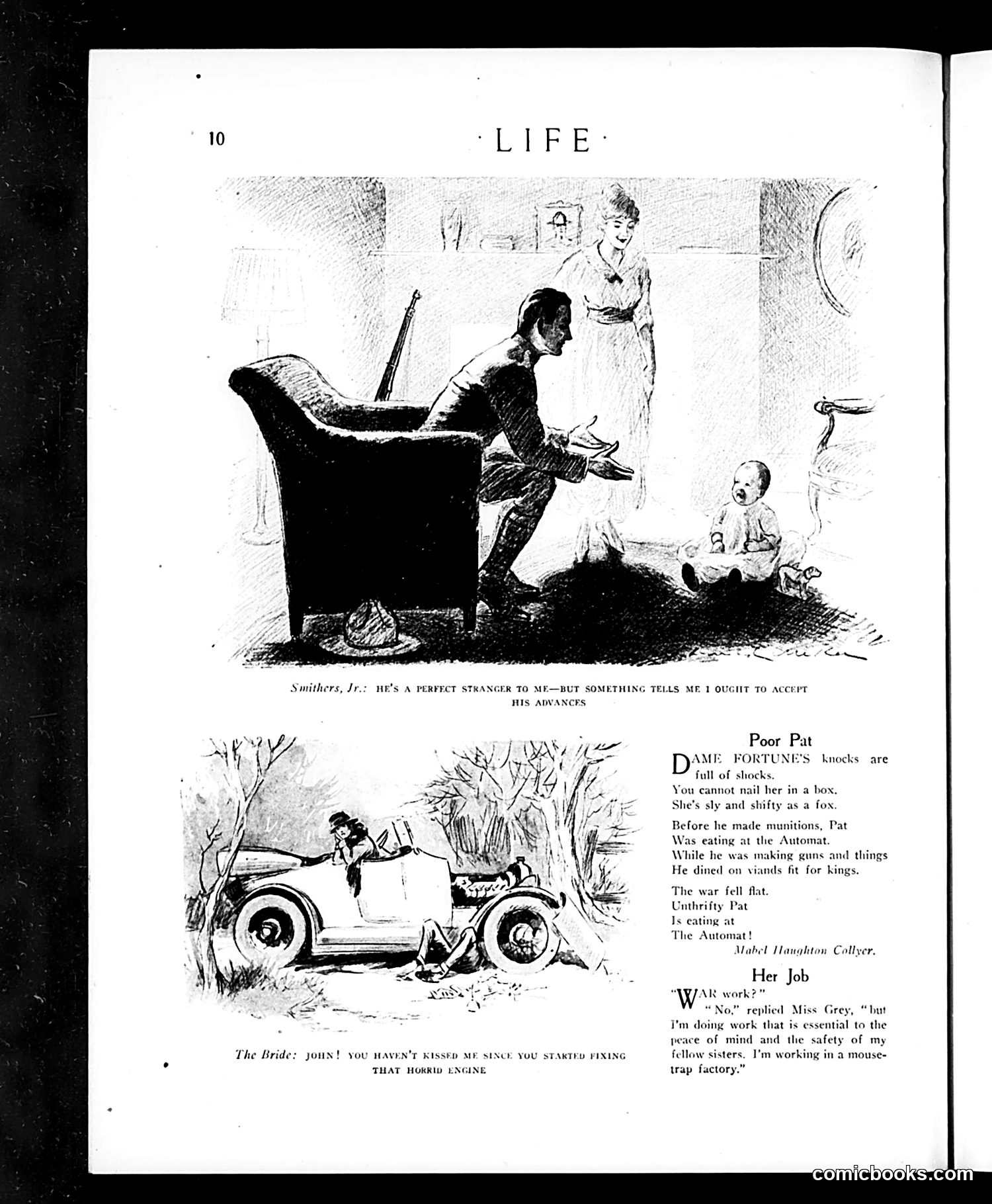
**Top Cartoon:** A man at a desk with papers encounters a stranger offering advances. The caption reads "He's a perfect stranger to me—but something tells me I ought to accept his advances," satirizing wartime financial schemes or con artists exploiting people's desperation during this period. **Bottom Cartoon:** Shows a couple in a broken-down car during wartime. The bride complains her husband hasn't kissed her since fixing "that horrid engine," mocking how automotive repair—likely necessitated by wartime rationing and resource scarcity—has consumed couples' attention and romance. **Text Section:** Three short humorous pieces ("Poor Pat," "Her Job") reference wartime conditions: food rationing (the Automat), women's factory work in mousetrap production, and concerns about national security.
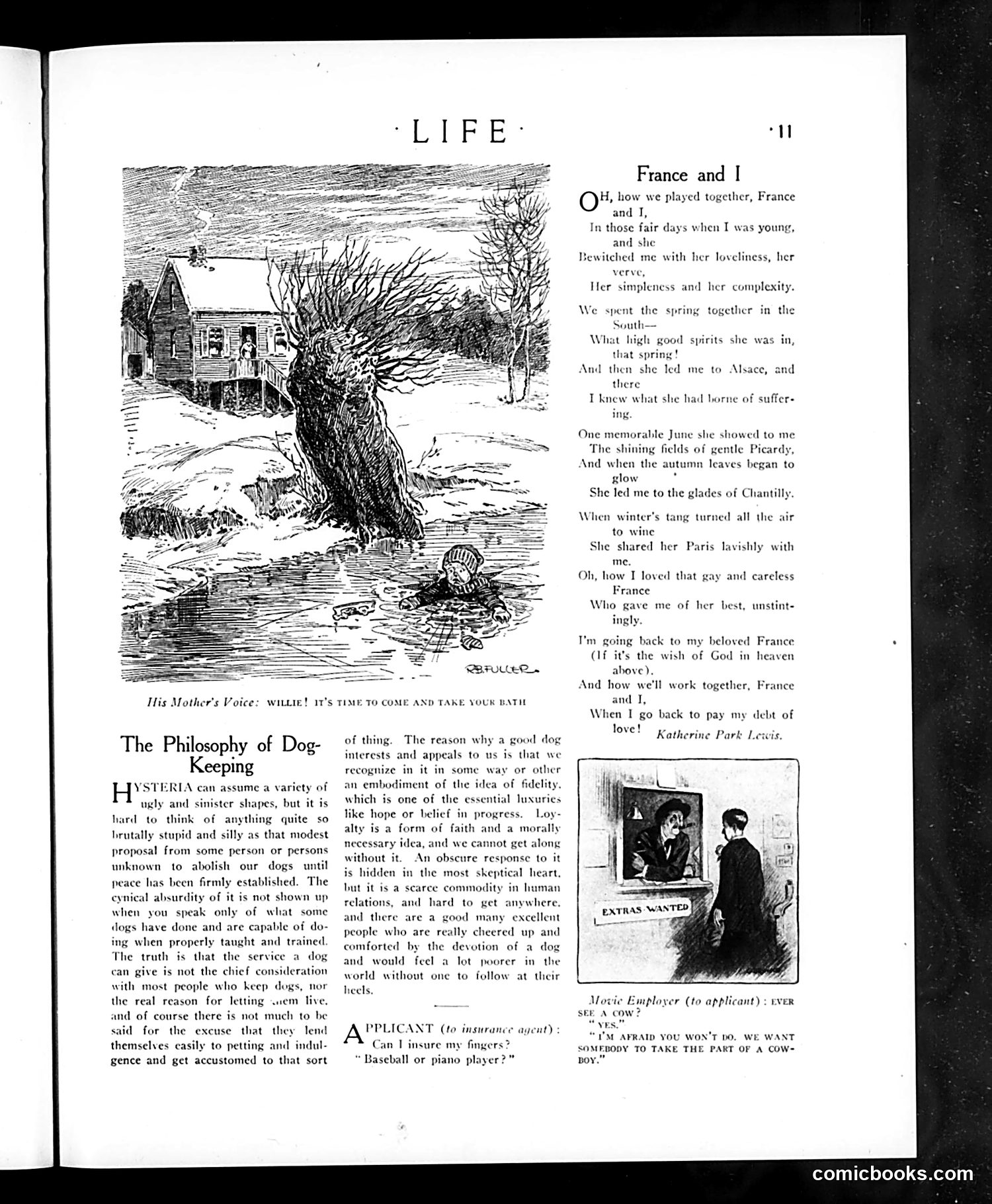
This page contains three distinct items: 1. **"France and I"** — A sentimental poem by Katherine Park Lewis about a romantic relationship with a French woman, accompanied by an illustration of two figures by a tree and water. 2. **"The Philosophy of Dog-Keeping"** — An essay arguing that dogs provide emotional value through loyalty and faithfulness, qualities humans need but rarely find. It defends dog ownership against criticism. 3. **"Extras Wanted"** — A single-panel cartoon showing a movie employer interviewing an applicant, asking if they can insure their fingers for baseball or piano. The applicant responds they're afraid the employer won't want them to take part of a cow-boy (likely meaning they appear unsuitable for the film role being cast). The page appears primarily literary and humorous rather than explicitly political.
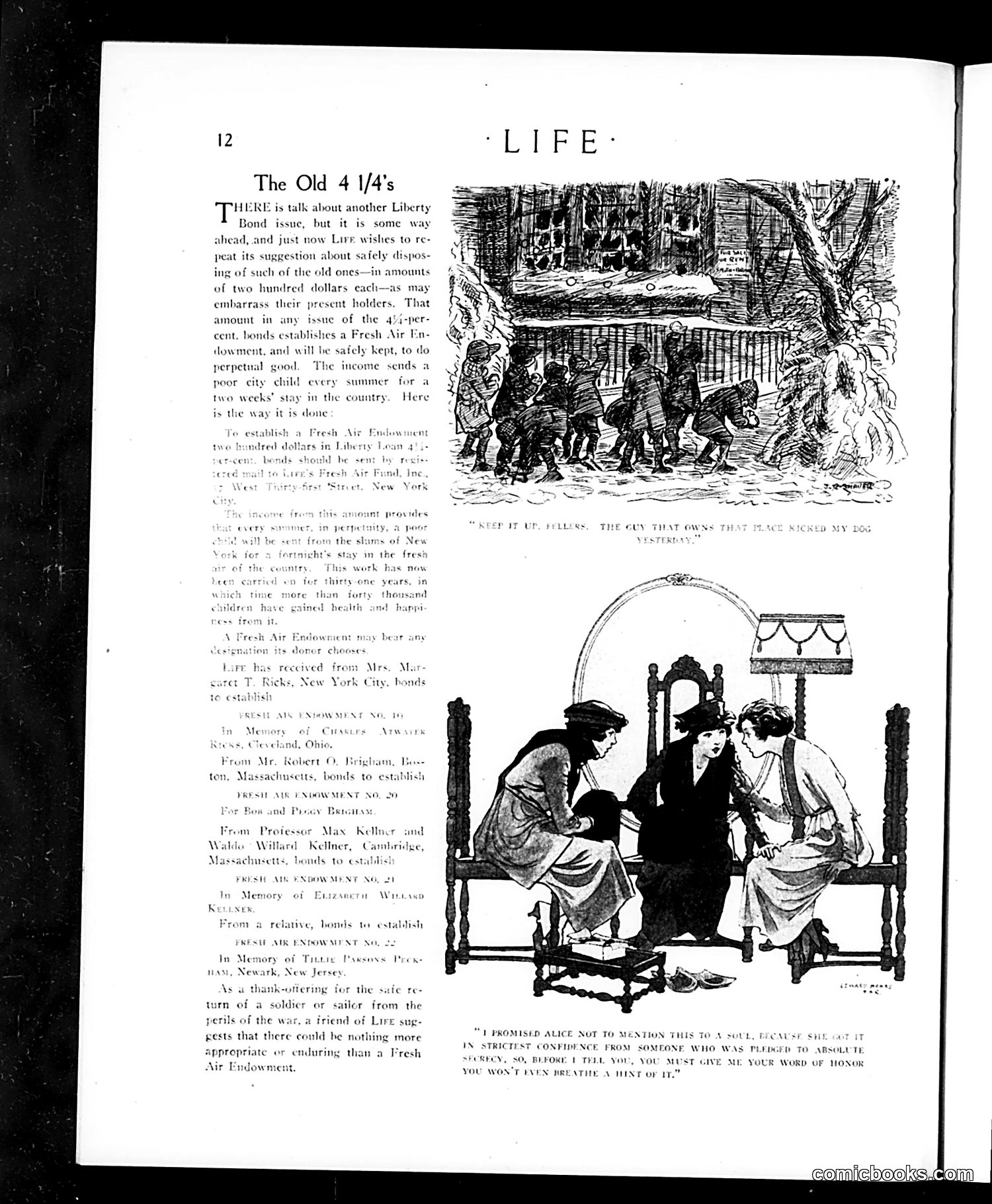
This page discusses "The Old 4 1/4's"—Liberty Bond issues—and proposes establishing a "Fresh Air Endowment" to send poor city children to the countryside for summer stays. The **upper illustration** shows children playing outdoors in a rural/forest setting, depicting the health benefits of fresh air exposure. The **lower illustration** depicts what appears to be a social interaction, with a caption about someone promising Alice not to tell others about a sensitive matter, emphasizing confidentiality and honor. The page advocates for charitable action to improve children's welfare during the post-WWI period. The Fresh Air Endowment concept reflects Progressive-era concern for urban poverty and child health. The satirical tone critiques those who might benefit from such charity while maintaining social discretion.
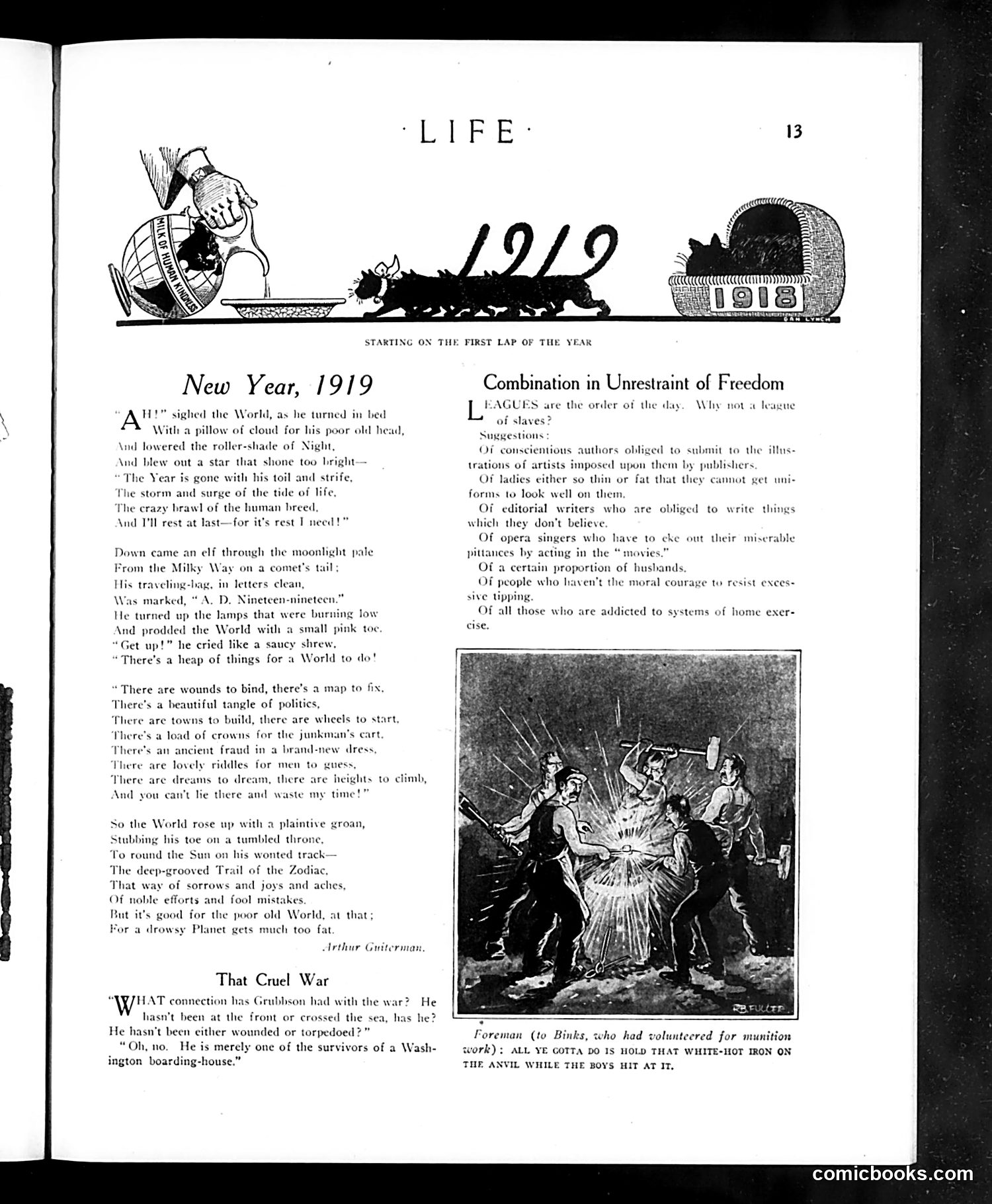
The top cartoon depicts 1919 as a chaotic year: a disheveled figure labeled "1919" pulls a heavily-laden cart toward "1918" (depicted as a basket/container), suggesting the new year inherits all of the previous year's burdens and problems. The accompanying poem "New Year, 1919" by Arthur Guiterman reflects post-WWI disillusionment. It mocks optimistic resolutions while cataloging remaining social problems: "wounds to bind," political troubles, unfinished construction, social inequality. The lower section "That Cruel War" presents a satirical list of "Leagues"—humorous suggestions for organizing people into restrictive groups (slaves obliged to submit to illustrations, opera singers forced into movies, etc.). The accompanying photograph shows what appears to be a wartime scene. The overall message: 1919 brings hope for peace, but substantial societal problems and absurdities persist.
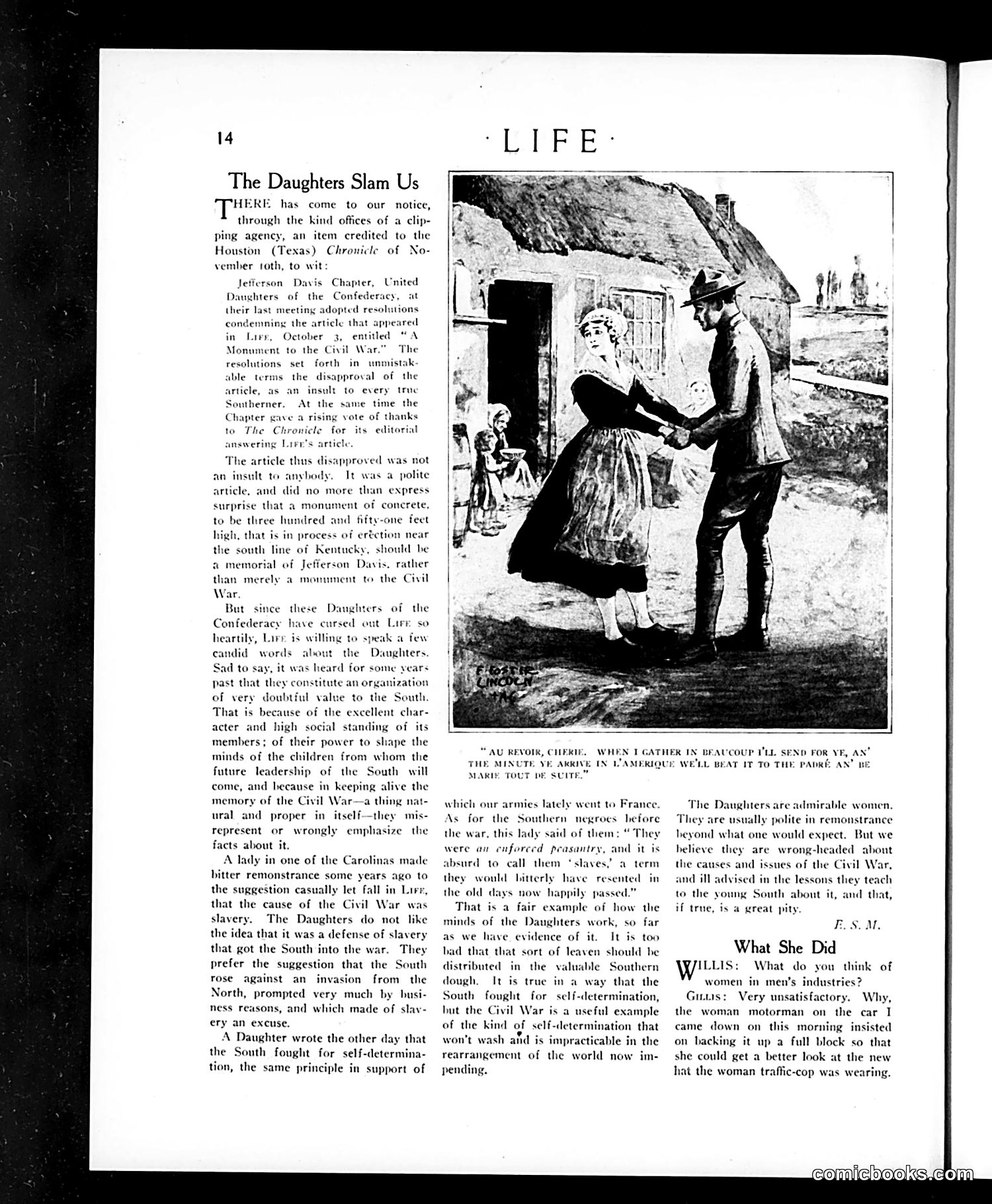
This page critiques the **United Daughters of the Confederacy** for attacking *Life* magazine's editorial opposing a proposed Civil War monument to Jefferson Davis in Kentucky. The article defends *Life*'s position as polite criticism, not insult. It then satirizes the Daughters' organization itself—praising their "excellent character and high social standing" while mocking their actual arguments about the Civil War. The illustration shows a woman (representing the Daughters) confronting a man, likely depicting the organization's angry response to the magazine's editorial challenge. The article's tone is patronizing: it acknowledges the Daughters' social prominence but dismisses their historical revisionism, particularly their defense of slavery and characterization of enslaved people as "enforced peasantry" rather than slaves—revealing contemporary Lost Cause mythology.
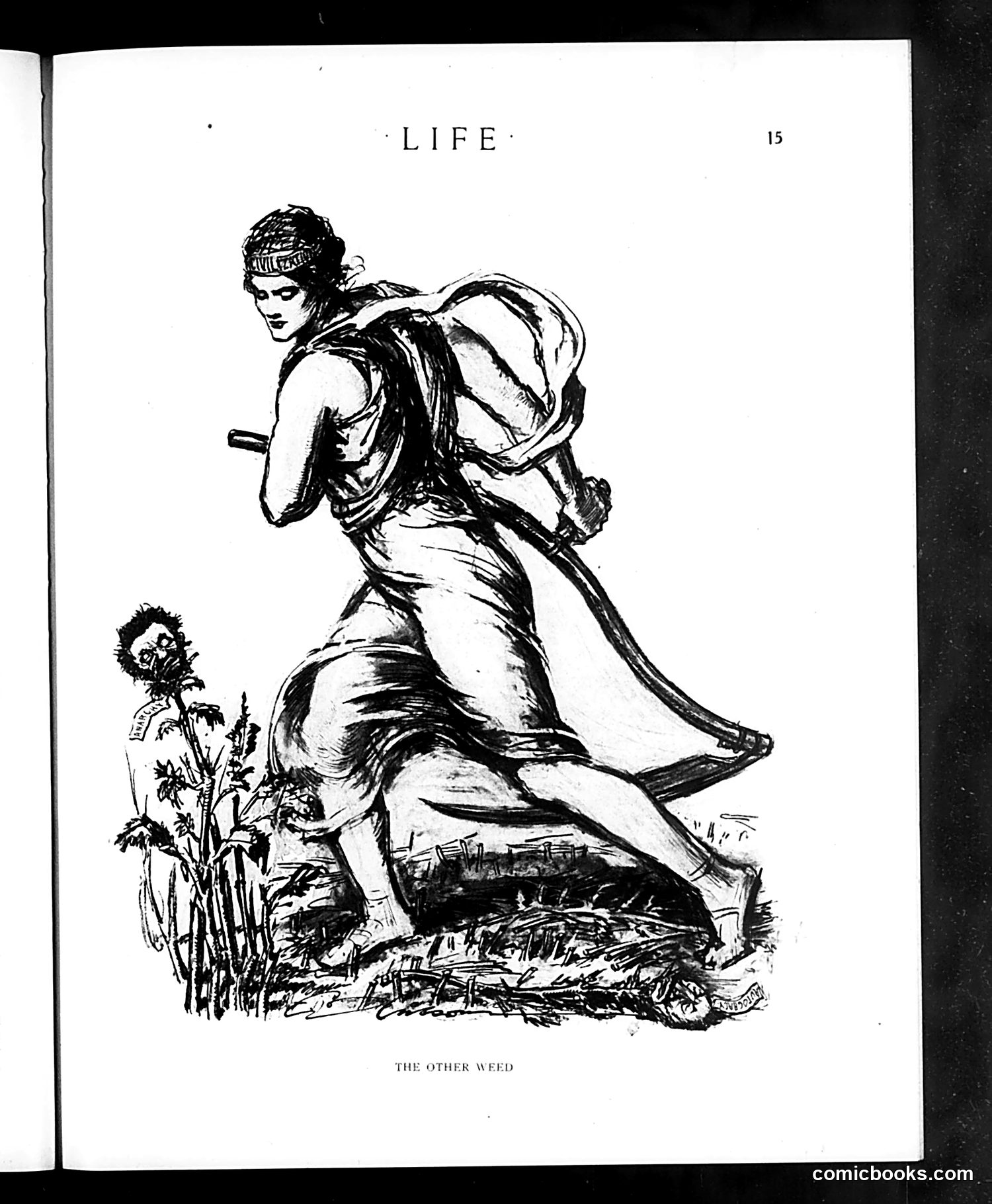
This illustration from *Life* magazine (page 15) depicts a woman in classical dress carrying a large bundle of sticks or branches on her back, striding past a small, dejected figure among weeds and plants. The title "The Other Weed" suggests social commentary. The woman appears to represent virtue, industriousness, or progress—depicted in an idealized, allegorical style common to the era. The small figure she passes likely represents some social problem or vice being neglected or trampled. Without additional context about the publication date and specific contemporary issues, the exact target of satire is unclear, though it likely critiques selective social priorities or the displacement of certain concerns by mainstream society.
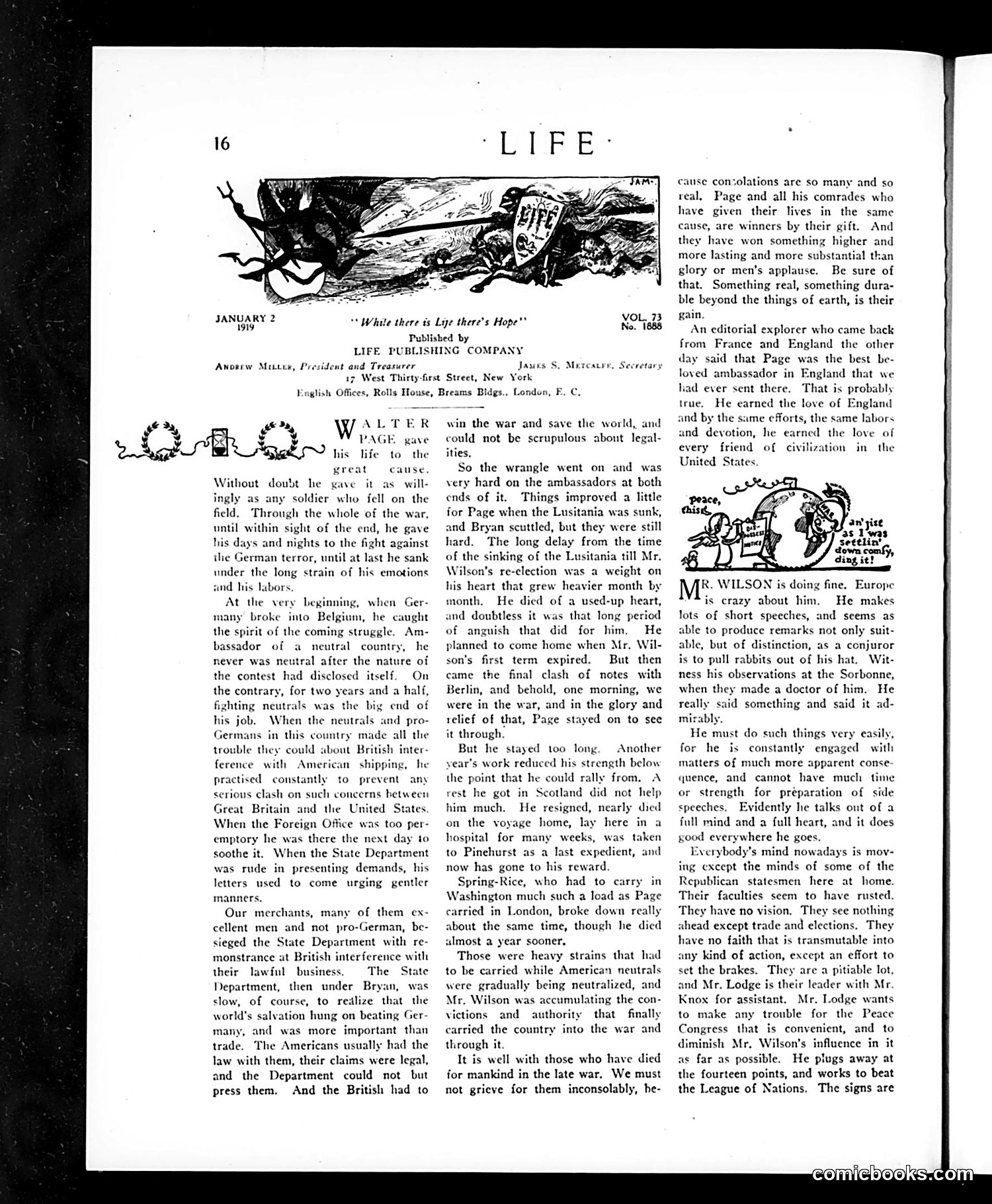
This is an obituary-essay honoring **Walter Hale Page**, America's ambassador to Britain who died recently. The text describes Page's exhausting diplomatic role during WWI, serving as intermediary between the British government and the American State Department while America remained officially neutral. The article explains how Page struggled to prevent conflicts over British interference with American shipping while sympathizing with Britain's war effort against Germany. He allegedly died from the stress of this impossible position—particularly the anguish during the long period between the 1915 Lusitania sinking and America's 1917 entry into the war. The piece also mentions **Spring-Rice**, the British ambassador in Washington who faced similar strains and died around the same time. The cartoon at top-left (unclear in detail) likely depicts this tension between duty and survival. The overall message: Page sacrificed his health for the Allied cause, earning him a hero's remembrance.
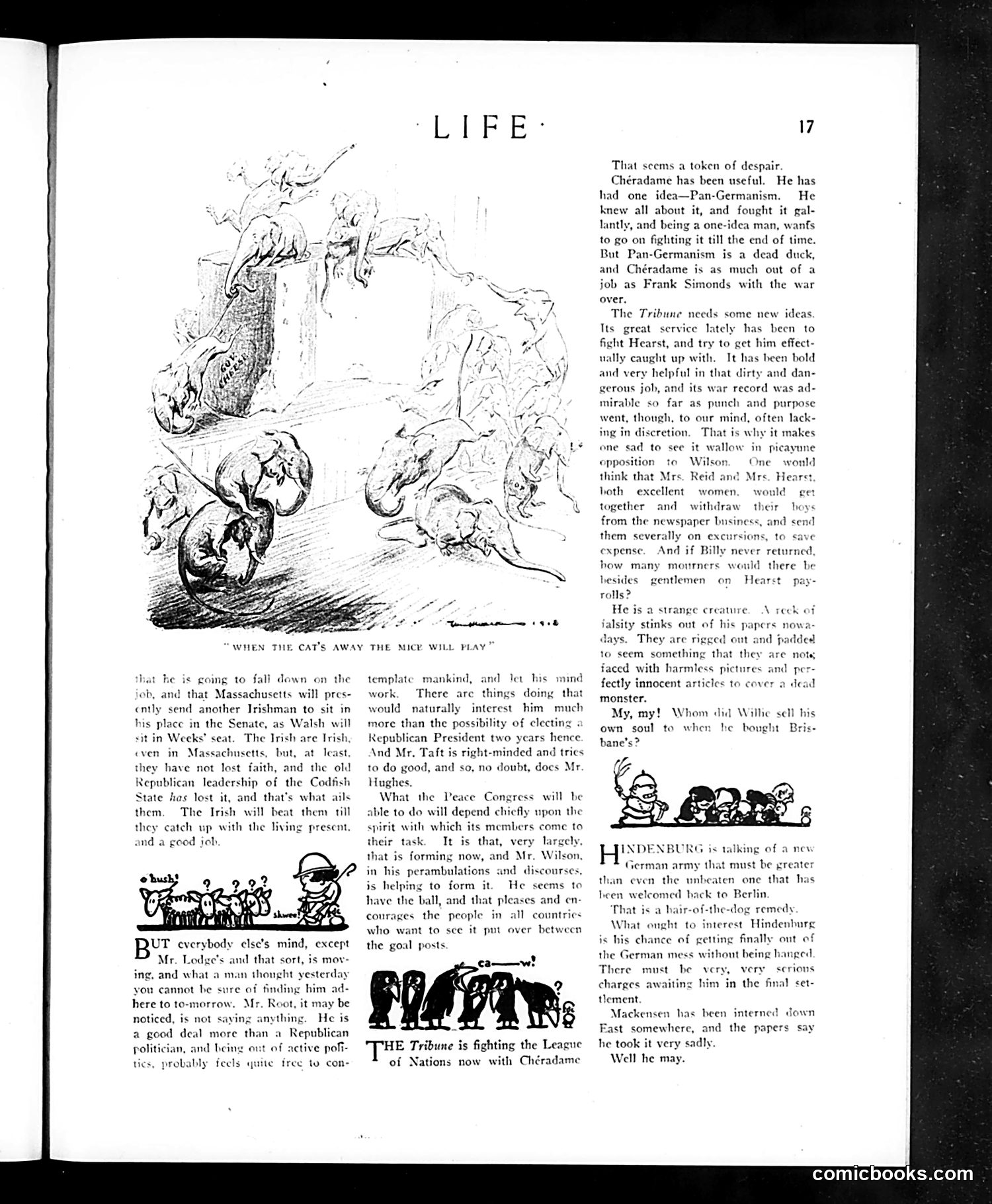
This page satirizes American political and journalistic figures in the aftermath of World War I. **Main targets:** The *Chicago Tribune* is criticized for fighting the League of Nations using outdated arguments about Pan-Germanism (associated with French writer Chéradame). The satire suggests the Tribune has lost its purpose now that the war is over and needs "new ideas." **William Randolph Hearst** receives sharp criticism for his sensationalist newspaper practices—described as "rigged out and padded" with falsity and deception. **Post-war references** include commentary on German military figures (Hindenburg, Mackensen) facing potential prosecution or internment, and speculation about President Wilson's role in forming the League of Nations. The cartoon "When the Cat's Away the Mice Will Play" (top) visually reinforces themes of chaos and disorder when leadership is absent—likely referencing political instability during the peace negotiations.
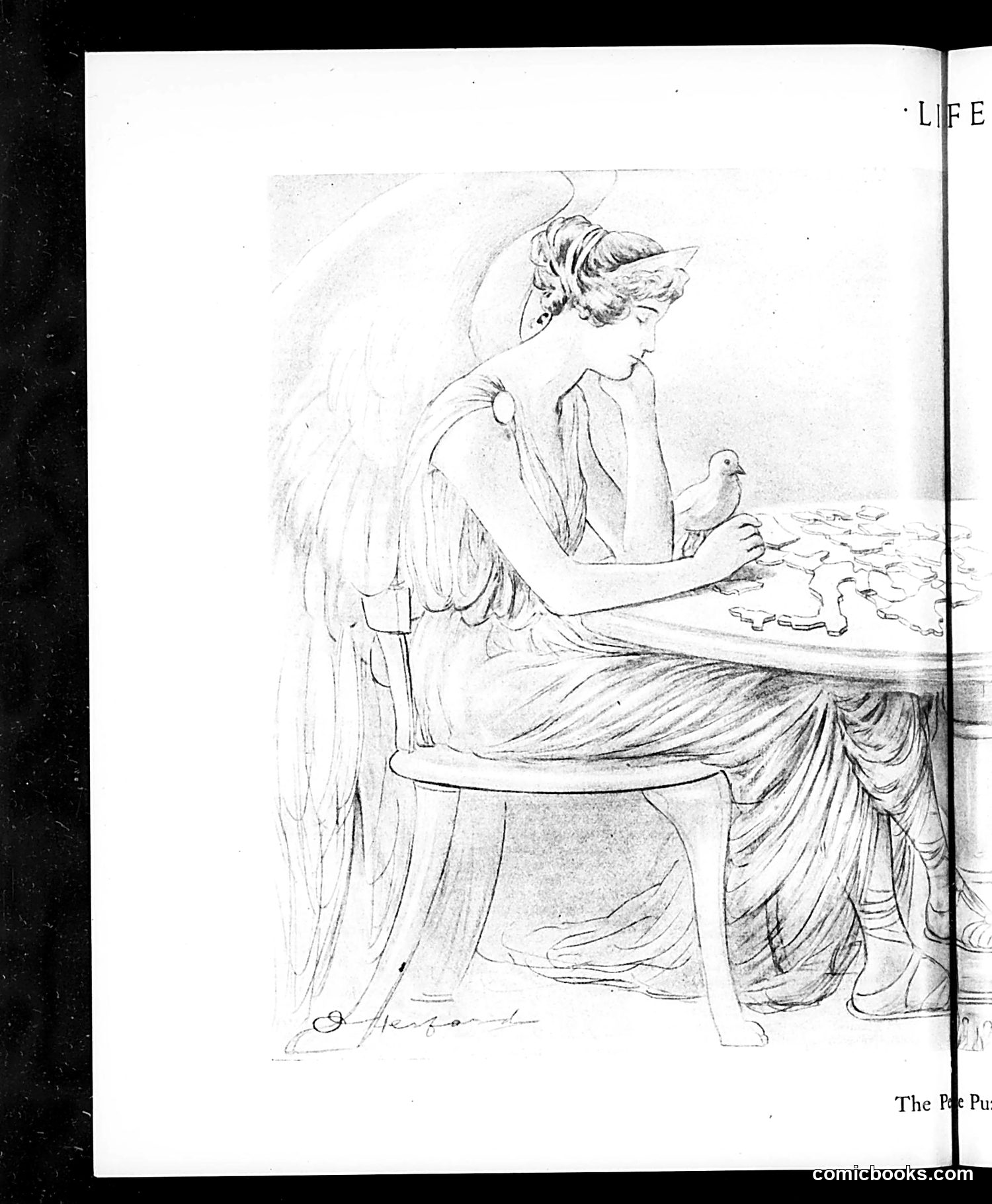
This is a sketch from *Life* magazine showing a winged female figure (likely representing Peace or an allegorical virtue) seated at a table, holding a small bird and scattering what appears to be bread or seeds. The classical drapery and wings suggest a classical or mythological reference. The artwork appears to be illustrative rather than explicitly satirical—it depicts a serene, idealized scene of a benevolent female figure feeding or nurturing a dove, which traditionally symbolizes peace. Without additional context or caption text visible on this page, the precise satirical point remains unclear. It may comment on peace efforts, charitable work, or wishful thinking about international relations, but the specific target of any satire cannot be determined from the image and available text alone.
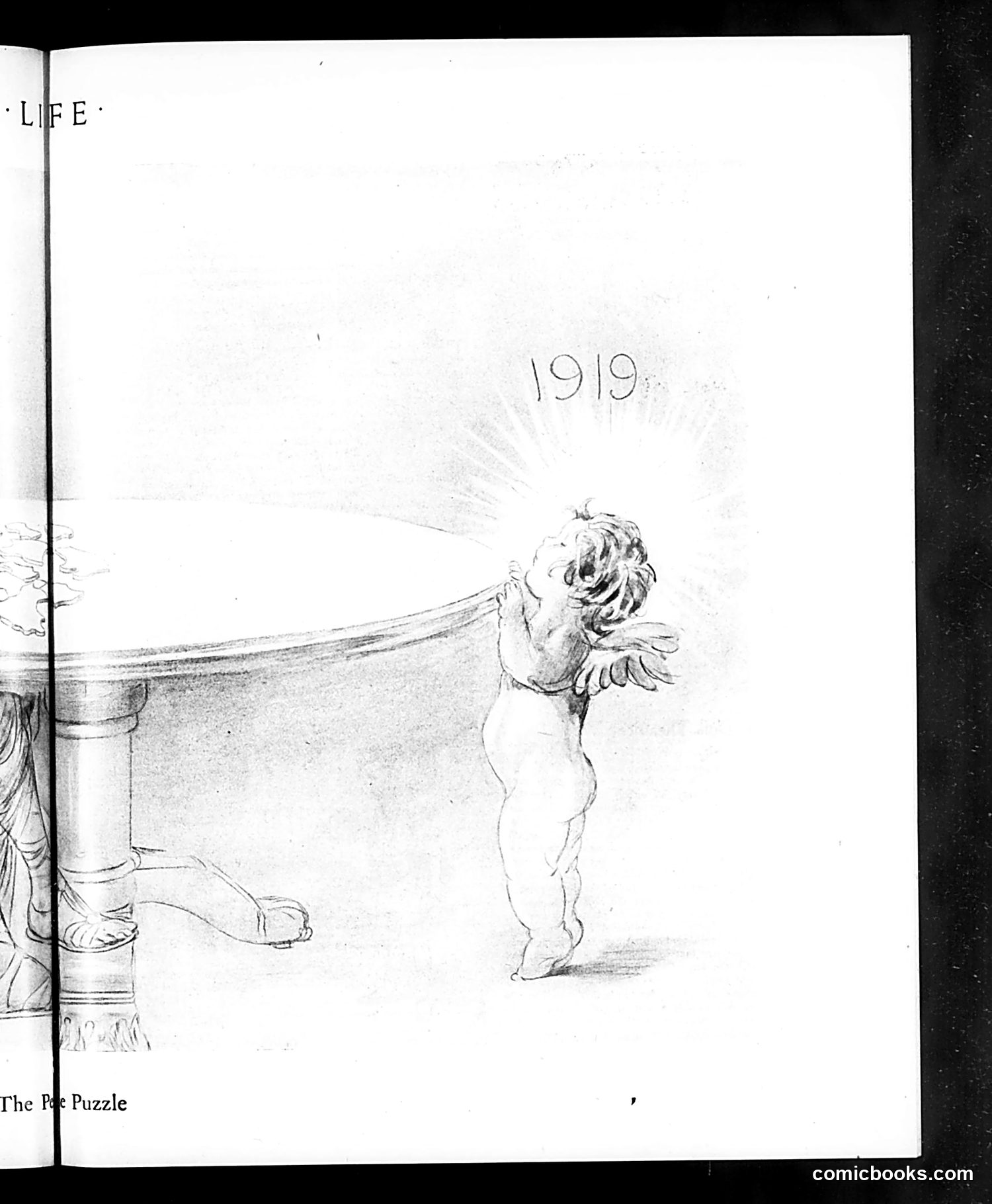
This appears to be a page title from *Life* magazine dated 1919, showing an illustration of a cherub or putto (winged baby figure) struggling to hold up or support a large cylindrical column or structure. The image likely references post-World War I challenges—the year 1919 marks the Treaty of Versailles and the beginning of American debate over League of Nations membership. The cherub straining under an architectural weight probably symbolizes America or its leadership grappling with weighty postwar political and economic responsibilities. The OCR text is too corrupted to confirm specific details, but the visual metaphor suggests contemporary anxiety about whether the nation could bear the burden of new international obligations.
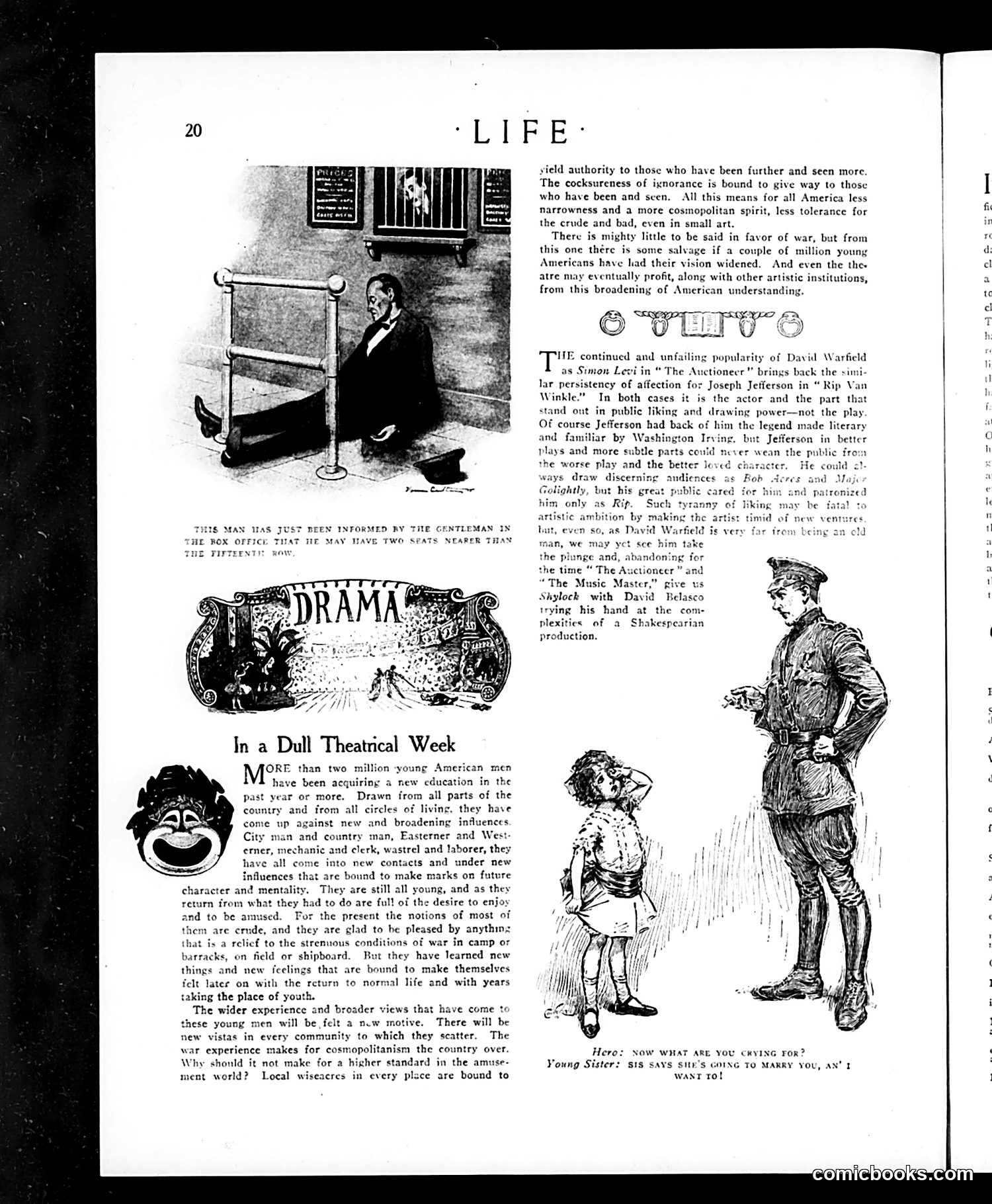
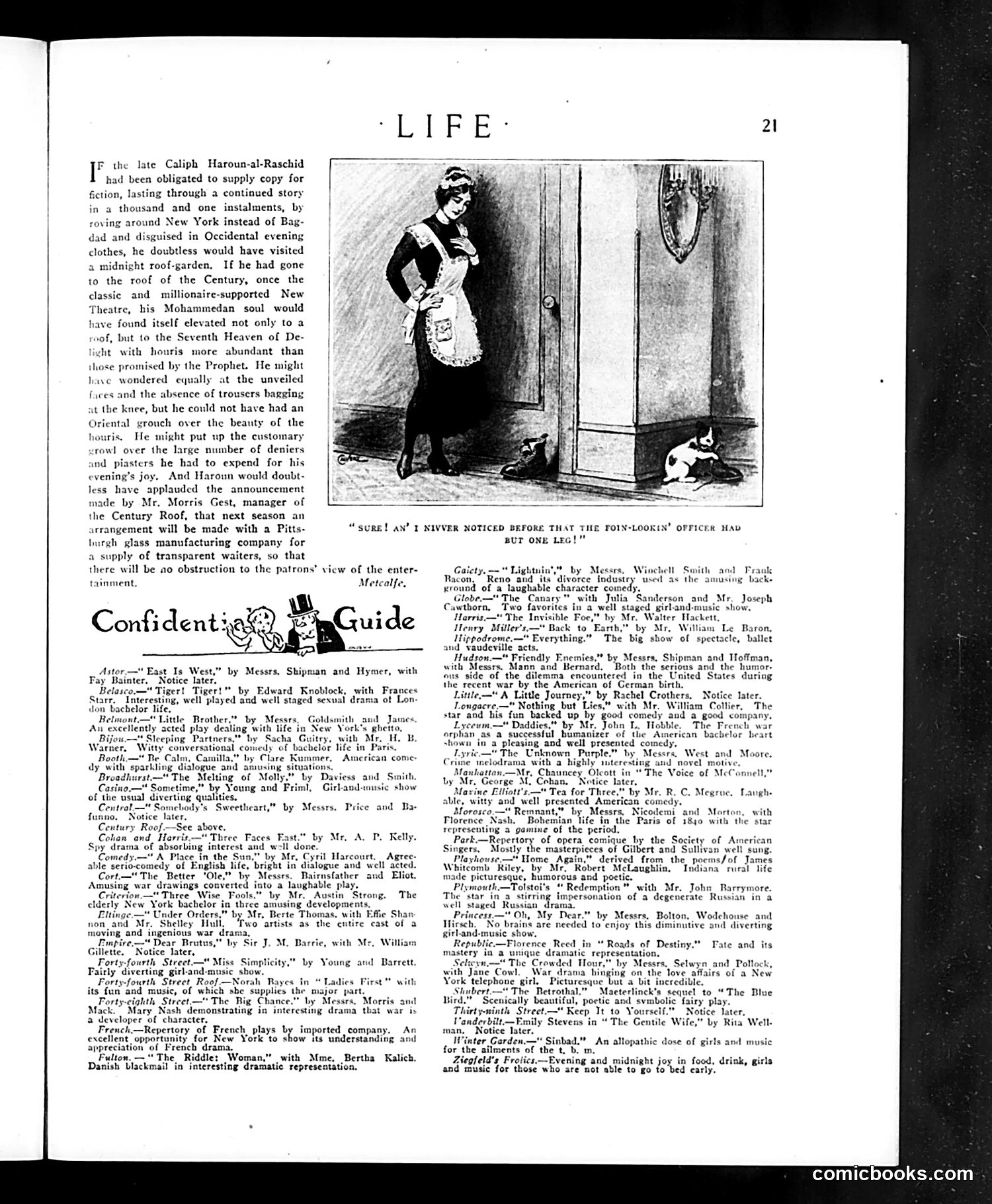
This page discusses theatrical entertainment during what appears to be the World War I era, when millions of American servicemen gained broader cultural exposure through military service. **The Top Cartoon:** Shows a man at a box office being told he may have two seats closer than the fifteenth row—a joke about theater seating accessibility during high demand. **Main Content:** The article argues that returning soldiers' expanded worldviews will elevate American cultural standards, including theater. It specifically praises actor David Warfield's continued popularity in "The Auctioneer," comparing his appeal to Joseph Jefferson's long run in "Rip Van Winkle." **The Bottom Illustration:** A military officer and young girl with dialogue: she's crying because her older sister says she'll marry him. This appears to be satirizing wartime romance or separation anxiety among civilians. The page's central argument: war experience, while harsh, could modernize American taste and reduce provincial attitudes toward the arts.
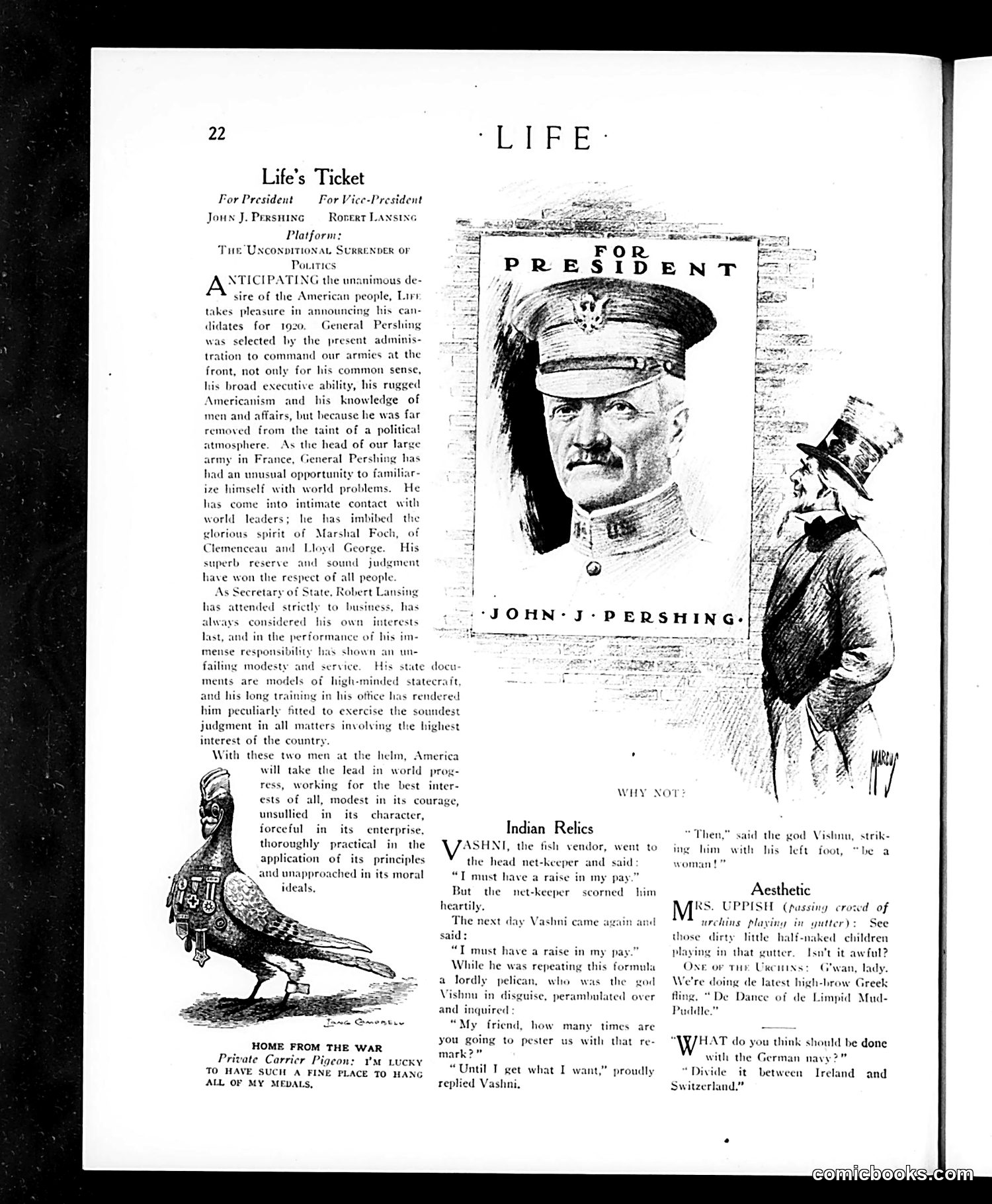
This page promotes **General John J. Pershing** and **Robert Lansing** as 1920 presidential and vice-presidential candidates on a platform of "unconditional surrender of politics"—satirizing the desire for non-partisan leadership after World War I. The main cartoon shows Pershing in military dress, framed as "For President." The text praises him as removed from political corruption, having commanded U.S. armies in France and learned from European leaders like Marshal Foch and Lloyd George. The bottom left cartoon depicts a carrier pigeon returning from war, humorously hanging its military medals on a wall—likely mocking the proliferation of decorations or the contrast between battlefield service and civilian life. The remaining humor pieces ("Indian Relics," "Aesthetic," and "Why Not?") are unrelated satirical sketches typical of Life's miscellaneous comic content. The "Why Not?" section jokes about dividing the German navy between Ireland and Switzerland—postwar political humor.
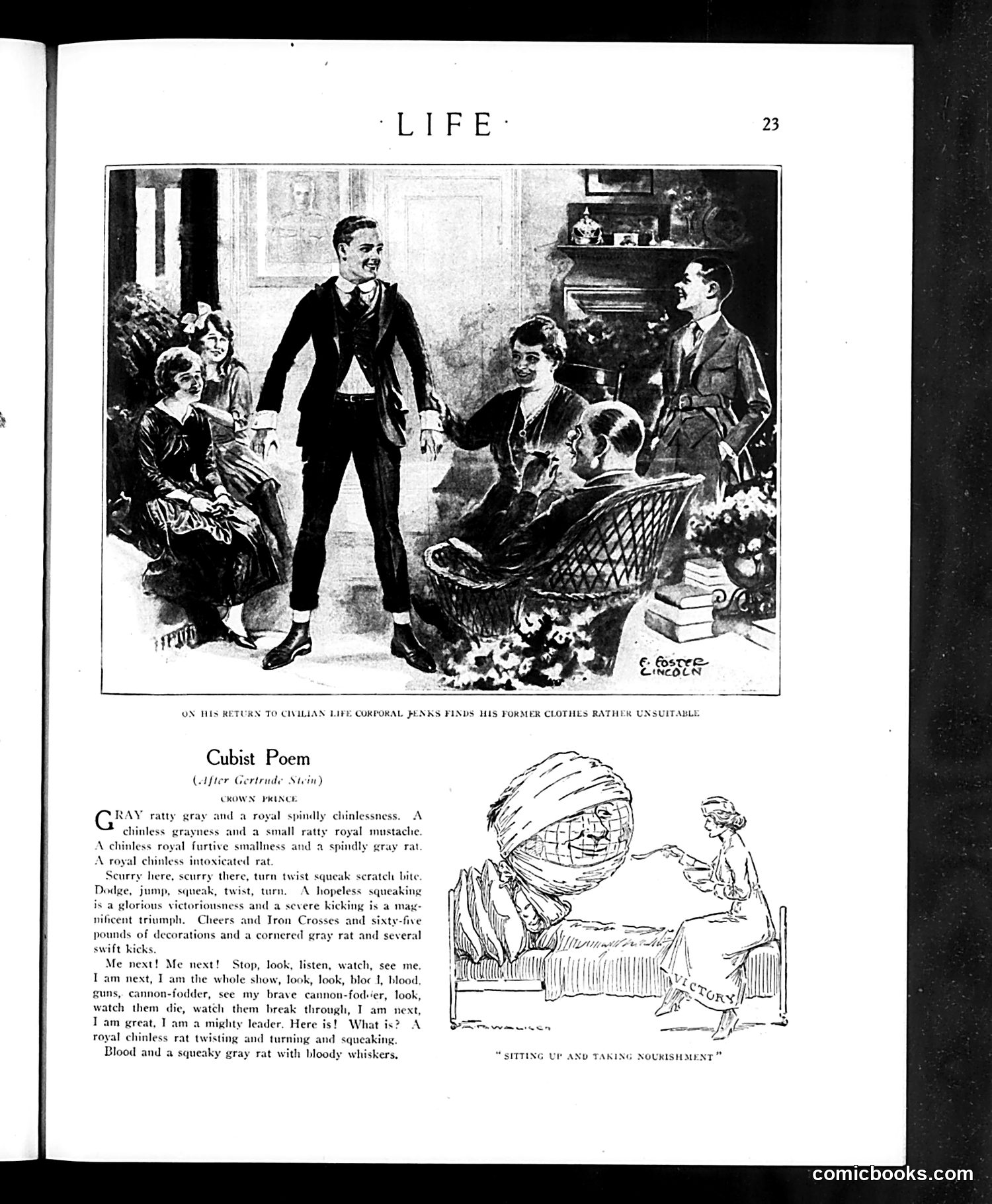
**Top cartoon:** A returning WWI soldier (Corporal Jenks) discovers his pre-war civilian clothes no longer fit after military service—a common post-war joke about how soldiers' bodies and lives had been transformed by combat. **"Cubist Poem":** This satirizes both Cubism (the avant-garde art movement) and the German Crown Prince. The poem mimics Gertrude Stein's fragmented, repetitive style while describing a "royal chinless rat"—likely caricaturing the Crown Prince as cowardly and rat-like. References to "Tron Crosses" (Iron Crosses, German military medals) and "cannon-fodder" mock his role sending soldiers to die. The final section—"Me next! Me next!"—suggests the Crown Prince's narcissistic delusions of grandeur. **Bottom cartoon:** "Sitting Up and Taking Nourishment" shows someone force-feeding a wrapped figure, appearing to reference post-war recovery or possibly mocking German defeat and forced compliance with peace terms. The page blends WWI commentary with artistic modernism mockery—typical of *Life* magazine's satirical approach.
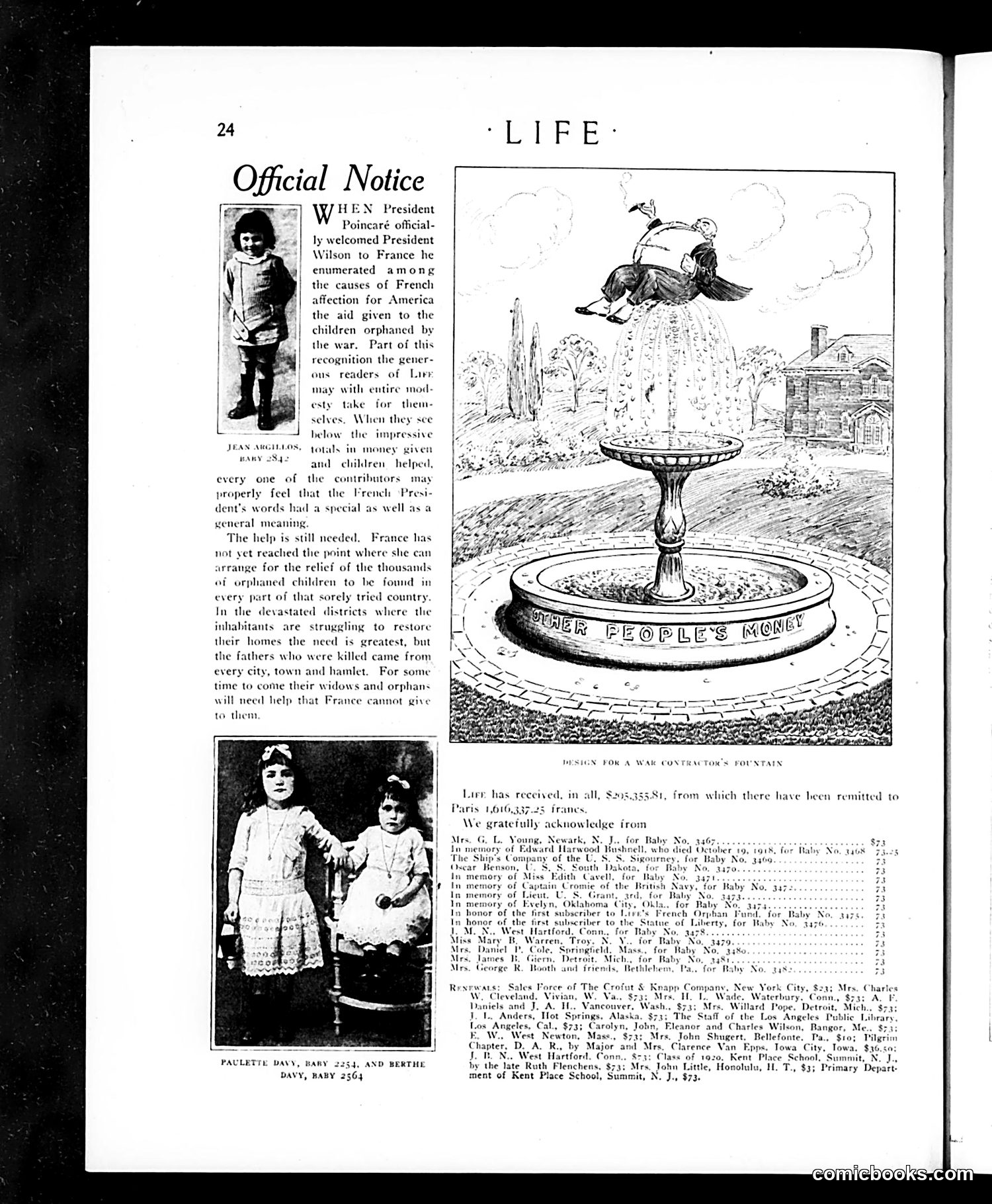
This page combines two distinct elements: an "Official Notice" about fundraising for French war orphans, and a satirical illustration. The cartoon depicts a fountain labeled "OTHER PEOPLE'S MONEY"—the satire's target. A figure (likely representing a war contractor or profiteer) stands atop the fountain, showering money down while orphaned French children wait below to collect it. The implicit criticism is that resources supposedly meant for orphans are being diverted through contractors and middlemen who enrich themselves. The accompanying text discusses President Wilson's official visit to France and Poincaré's praise for American aid to war orphans. However, the cartoon sarcastically questions whether these contributions actually reach the children, suggesting the charitable money becomes a source of profit for those managing its distribution rather than genuinely helping vulnerable children orphaned by World War I.
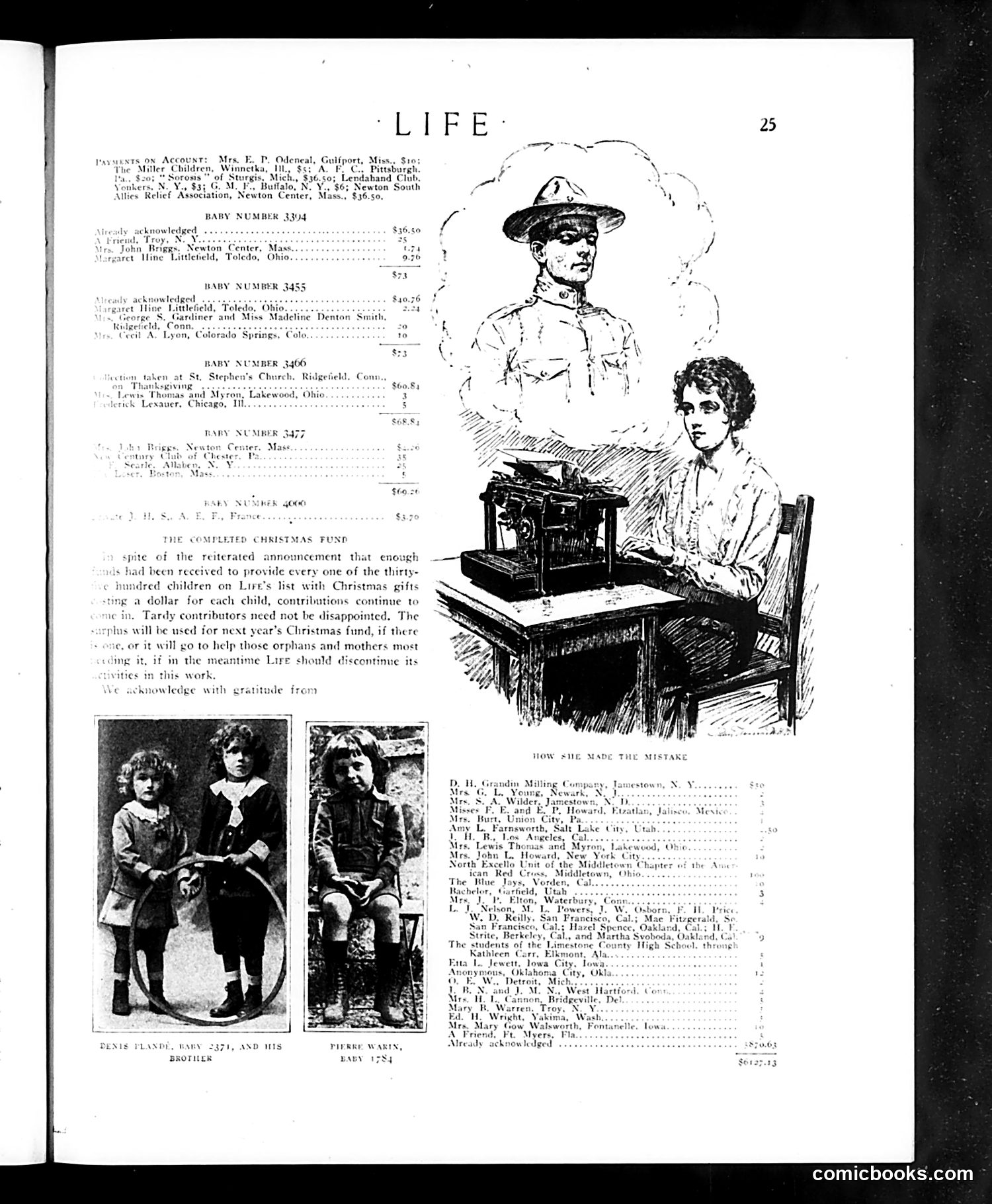
This page documents Life magazine's charitable Christmas fund for orphans and poor children. The main illustration shows a woman at a desk with a dollhouse, likely depicting the process of distributing or organizing gifts. The caption "How She Made the Mistake" suggests a story about charitable giving gone wrong—the illustration appears to show someone involved in the Christmas gift distribution effort, though the specific "mistake" isn't fully explained on this visible portion of the page. The text acknowledges donors who contributed to provide Christmas presents for approximately 300 children on Life's charitable list. It notes that surplus funds would support future years' efforts or help orphans and mothers if the magazine discontinued this charitable work. The page includes photographs of two children (Denis Plande and Pierre Warin) who apparently benefited from previous charitable efforts, personalizing the magazine's relief work for readers.
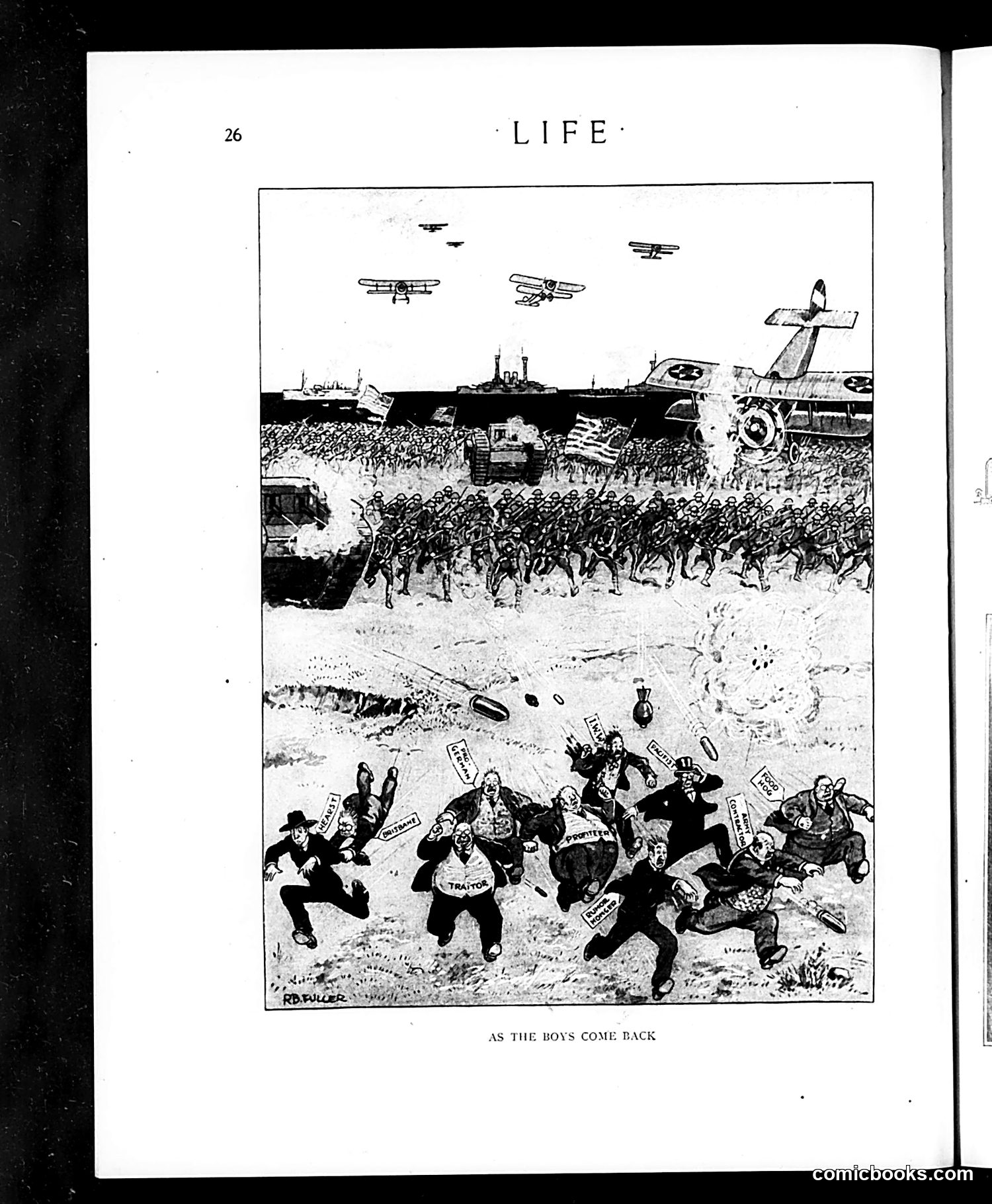
This cartoon depicts the return of soldiers from World War I. The image shows a massive crowd of troops landing on a beach, with transport ships, planes, and military vehicles supporting the operation. In the foreground, several figures in civilian clothes appear distressed or chaotic—likely representing politicians, profiteers, or other non-combatants. One figure wears a label reading "TRAITOR." The satire suggests anxiety about soldiers' homecoming and appears to critique those perceived as having betrayed the war effort or exploited it for profit. The contrast between the organized military forces and the panicked civilians below implies the cartoon questions how the home front will handle reintegration or face accountability for wartime conduct.
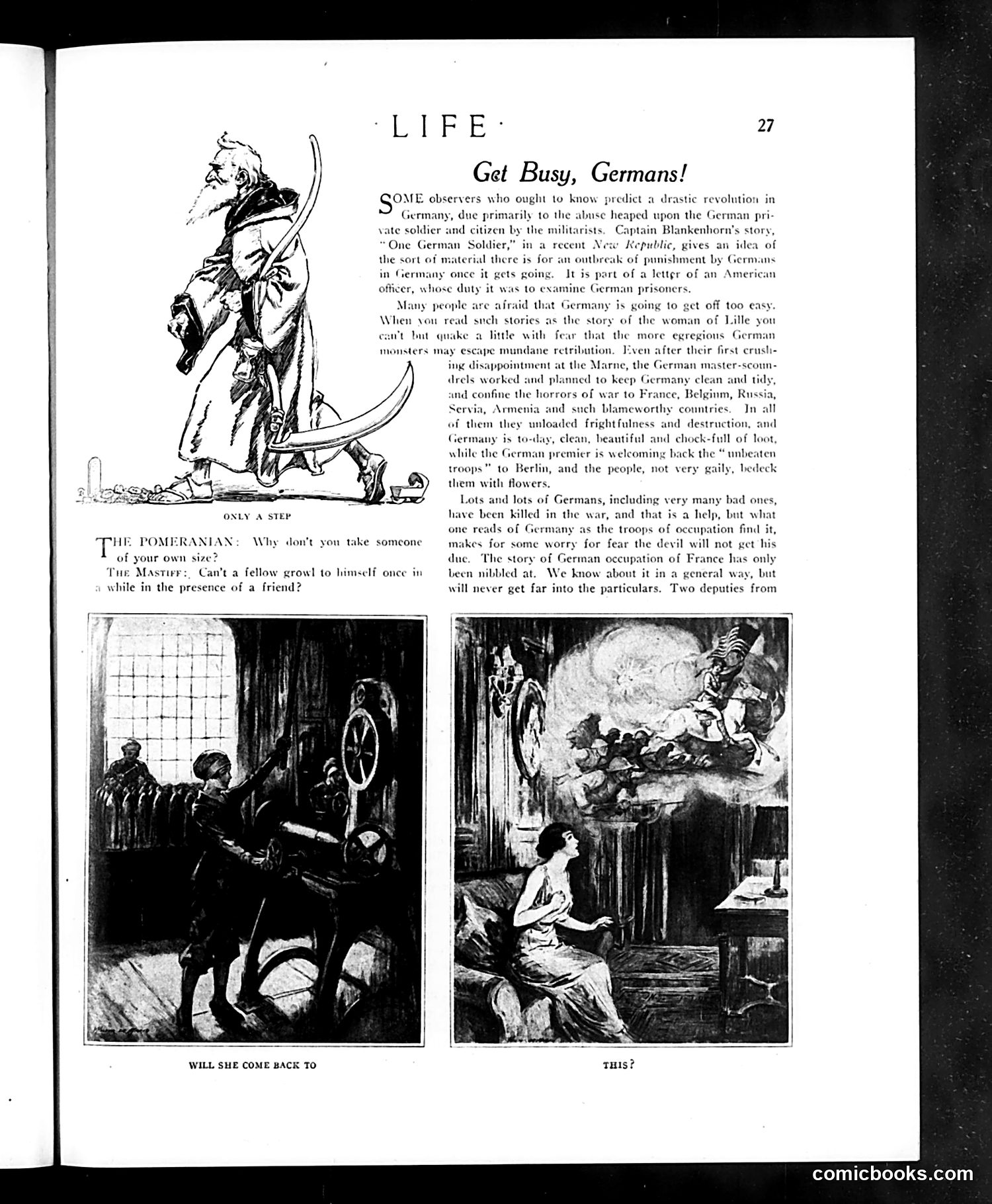
This article expresses American concern that Germany will escape sufficient punishment for World War I atrocities. The text references Captain Blankenhorn's account of German prisoner abuses and fears Germany is "going to get off too easy." The cartoon "Only a Step" uses the Pomeranian dog (representing Germany) as a caricature. A small dog growls aggressively while a larger figure (likely representing Allied forces or justice) confronts it. The "Pomeranian" label sarcastically reduces Germany to an insignificant, yapping creature—despite its wartime aggression, it's now merely a nuisance rather than a genuine threat. The accompanying illustrations show civilian suffering: a woman at a window and another witnessing destruction—depicting German occupation's horrors in France and Belgium. The satire's point: Germans are receiving hero's welcomes at home despite committing serious war crimes, and the article worries perpetrators won't face adequate retribution.
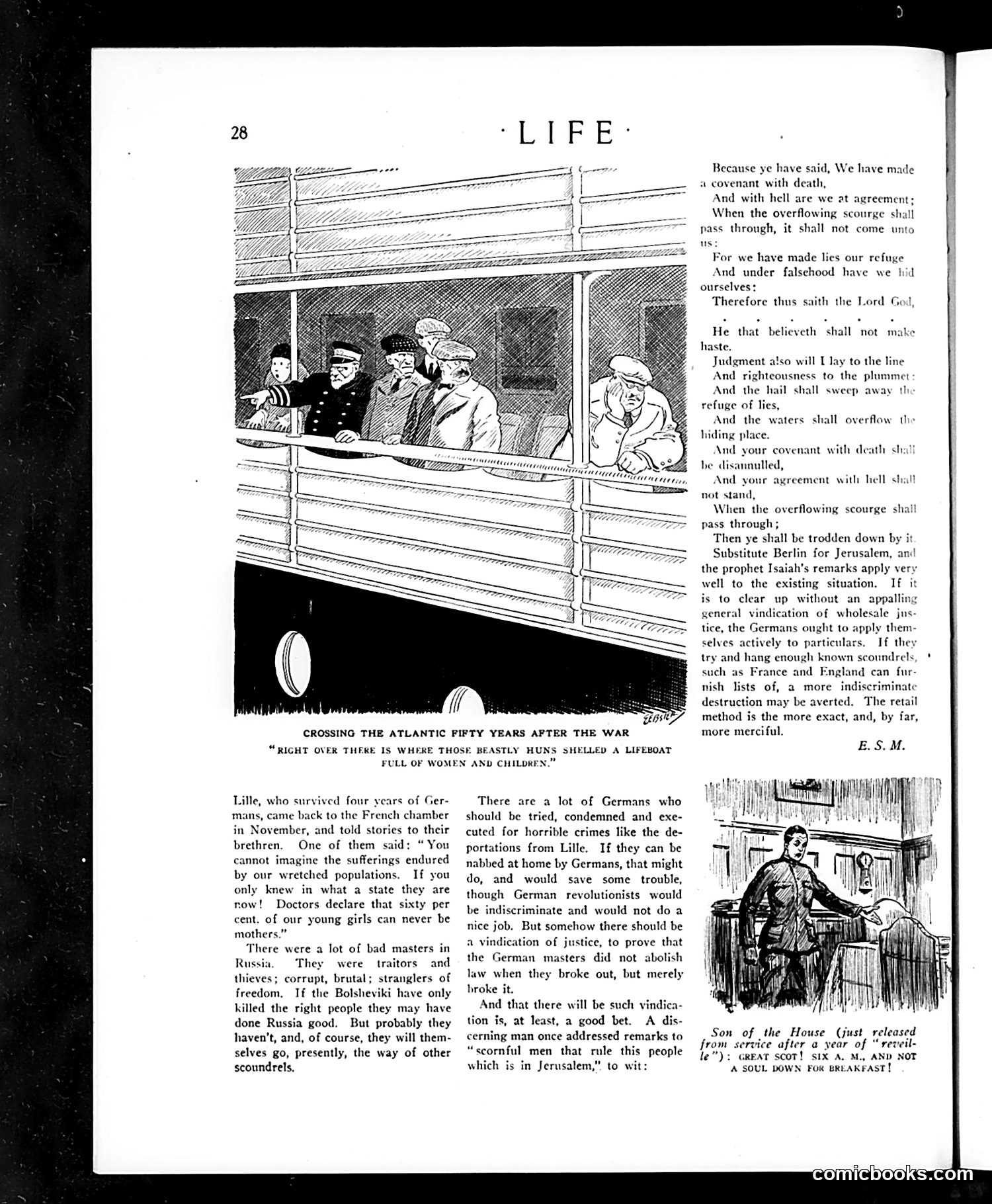
This 1920s *Life* magazine page contains two distinct elements: **Main Cartoon:** Shows a man aboard a ship pointing out to passengers where Germans supposedly attacked a lifeboat with women and children during WWI. This references actual German submarine warfare, particularly the sinking of the Lusitania (1915) and similar incidents that killed civilians—a major cause of American outrage during the war. **Text Commentary:** The editorial argues that German war criminals should face justice trials (referencing post-war calls for prosecutions). It invokes the Biblical prophet Isaiah to suggest Germans made immoral "covenants" and must face accountability, substituting "Berlin for Jerusalem." **The Satire's Point:** The cartoon captures a bitter post-war sentiment: survivors reliving trauma while crossing the Atlantic decades later. The accompanying text wrestles with whether organized trials or revolutionary German justice would be more appropriate—reflecting real post-WWI debates about war crimes accountability. **Right Sidebar:** An unrelated domestic humor comic about an American household scene.
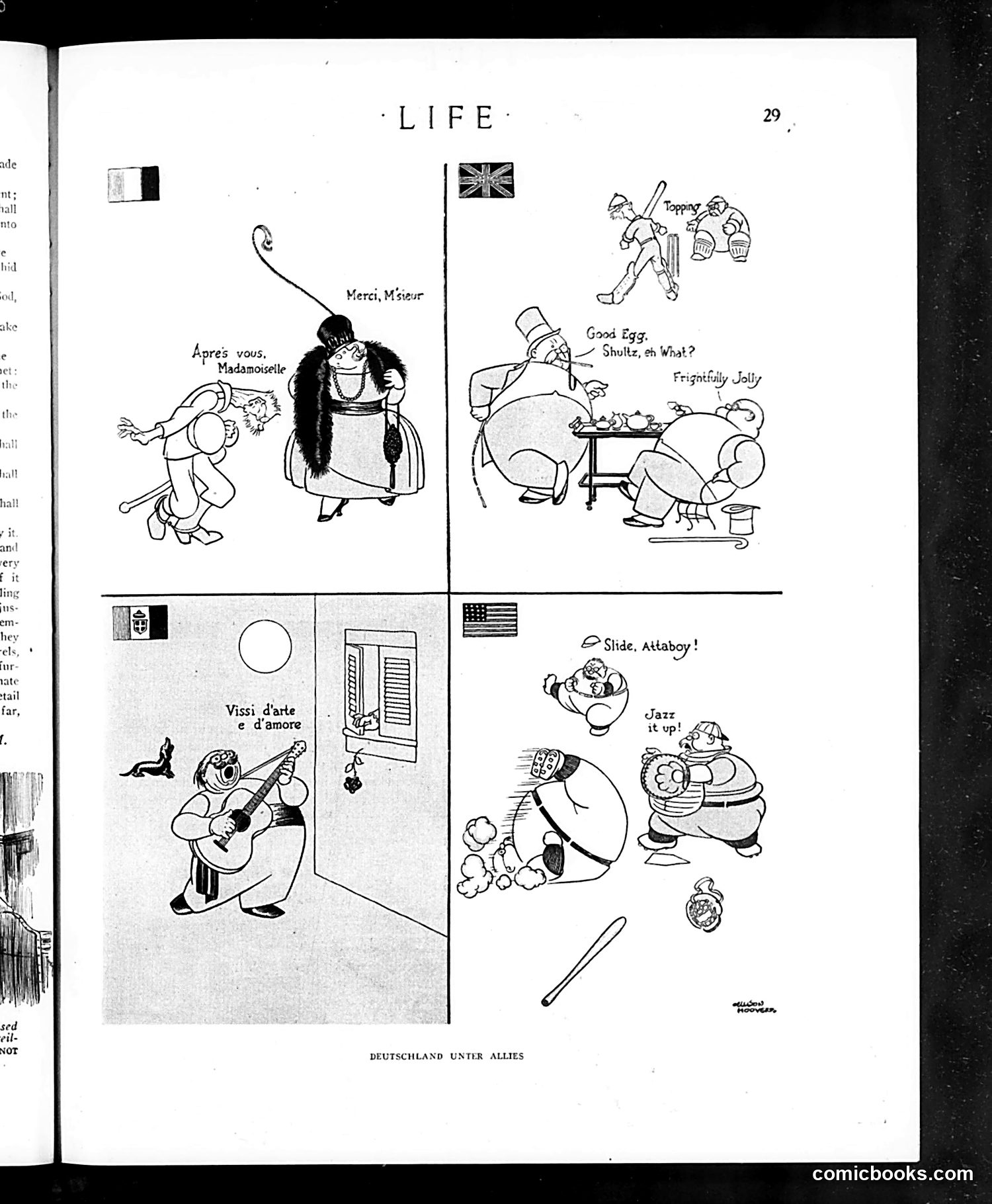
This page from *Life* magazine contains multiple cartoons satirizing post-WWI international relations, particularly involving Germany and the Allied powers. The top section shows French and American figures in social situations with captions in French and English, suggesting cultural tensions or awkward diplomacy between the Allies. The bottom section, titled "Deutschland Unter Allies" (Germany Under the Allies), depicts German figures in various undignified situations—playing guitar, sliding around, and "jazzing it up"—under the watchful flags of France, Britain, and America. The satire suggests Germany is now subordinate and humiliated under Allied control following the war, while the Allies mock or control German behavior and culture. The overall tone is triumphalist regarding Allied victory and dismissive of Germany's new status.
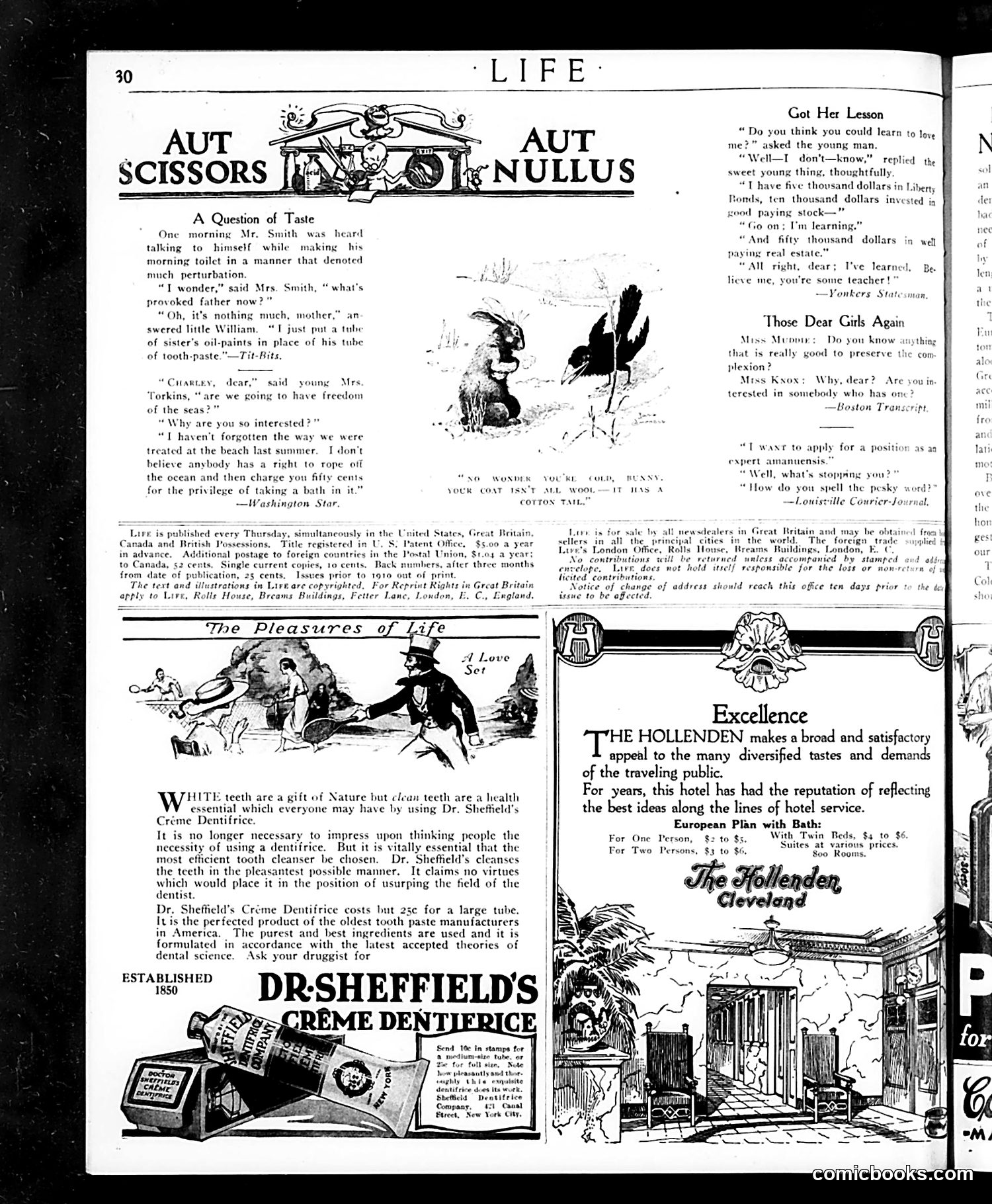
This page contains three separate humor pieces: **"A Question of Taste"** features domestic comedies. One anecdote involves a child placing his sister's oil paints in a toothpaste tube—a literal misunderstanding of "taste." Another depicts Mrs. Torkins complaining about beach access fees, referencing a real controversy over privatized ocean access—a Progressive Era concern about public versus private rights to natural resources. **"Got Her Lesson"** is a courtship joke where a young woman admits she's "learning" to love the man only as he reveals increasing wealth (five thousand dollars, ten thousand in bonds, fifty thousand in real estate). The satire targets mercenary marriage attitudes. **"Those Dear Girls Again"** presents brief quips about young women's romantic and professional aspirations, with mild mockery of their goals and linguistic pretensions. The page also includes advertisements for Dr. Sheffield's toothpaste and The Hollenden hotel in Cleveland, typical of Life's revenue model.

This page contains **editorial commentary and advertisements** rather than a political cartoon. The main article, "It May Become a Habit," discusses President Roosevelt's broken tradition by visiting Europe during his term. The author argues this sets a precedent that future presidents may follow, potentially benefiting American foreign relations. However, he raises a concern: when American soldiers who died in Europe are repatriated and redistributed among the U.S. population, Europeans will seem less foreign to Americans—fundamentally changing how citizens view international involvement. The page also includes a brief dialogue joke about women: a daughter mentions taking oratory (public speaking) in school, and her mother sarcastically responds that a "back talk" course would be more useful for marriage—a period-typical jab at wives' supposed argumentative nature. The remaining content consists entirely of **product advertisements** (Piso's cough remedy, Cortez cigars, Resinol Soap) and investment services—typical magazine filler of the era.
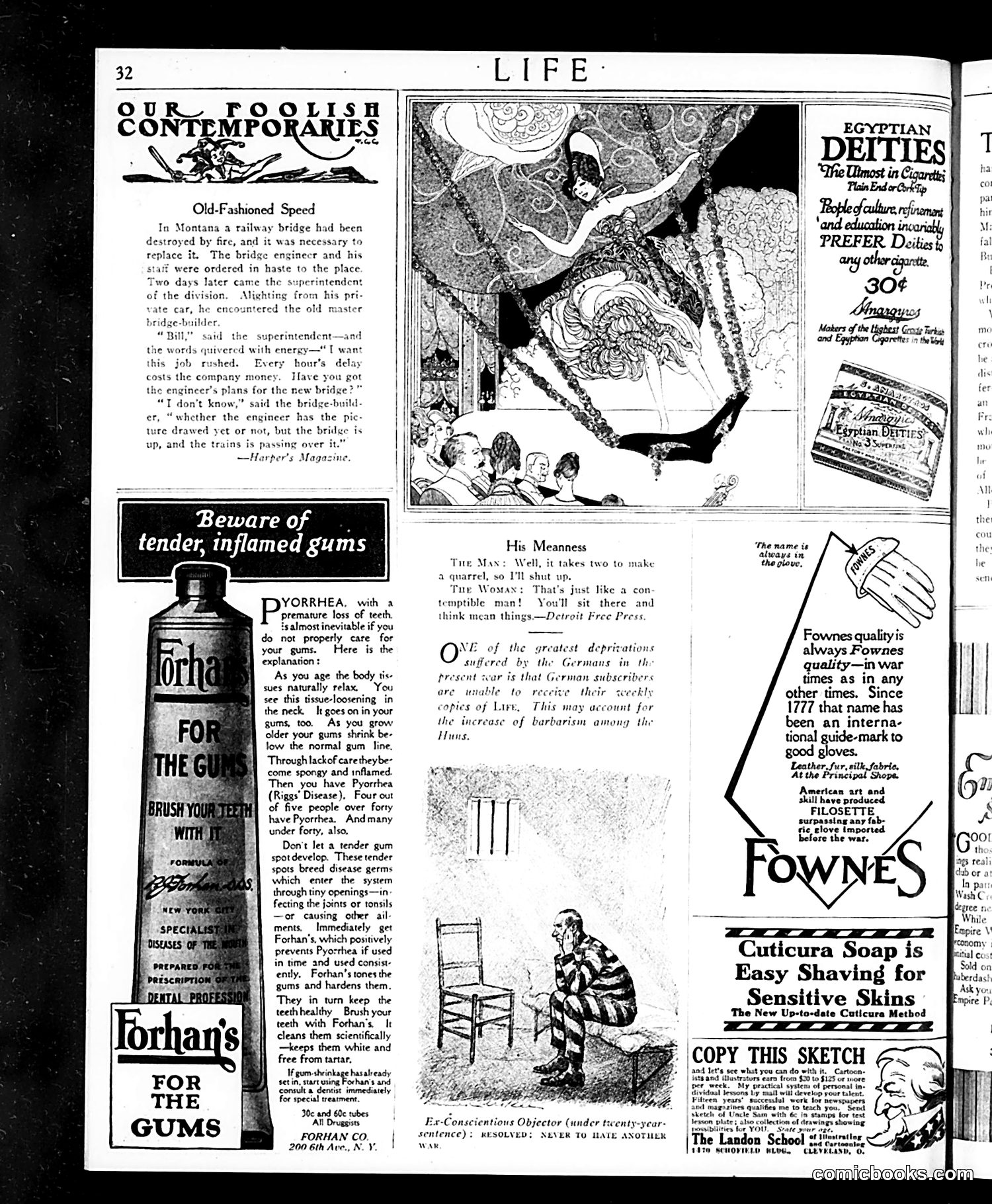
This page contains two main pieces: **"Old-Fashioned Speed"** is a short humorous anecdote about railroad efficiency. A Montana bridge destroyed by fire needs replacement, but when the division superintendent arrives expecting delays, the master bridge-builder reveals the bridge is already completed and trains are running over it—accomplished through practical action rather than bureaucratic planning. The joke satirizes the contrast between old-fashioned, efficient workers and modern supervisors who rely on paperwork and drawn plans. **"His Meanness"** is a brief comic dialogue showing a married couple's petty conflict: when the husband agrees to end their quarrel, the wife resents his silent, judgmental attitude. The satire targets domestic discord and the inability of couples to resolve disputes genuinely. The page primarily consists of **period advertisements** (Forhan's toothpaste, Egyptian Deities cigarettes, Fownes gloves, Cuticura soap) typical of early 20th-century magazines. A small cartoon about a conscientious objector appears at the bottom, likely referencing World War I draft resistance.
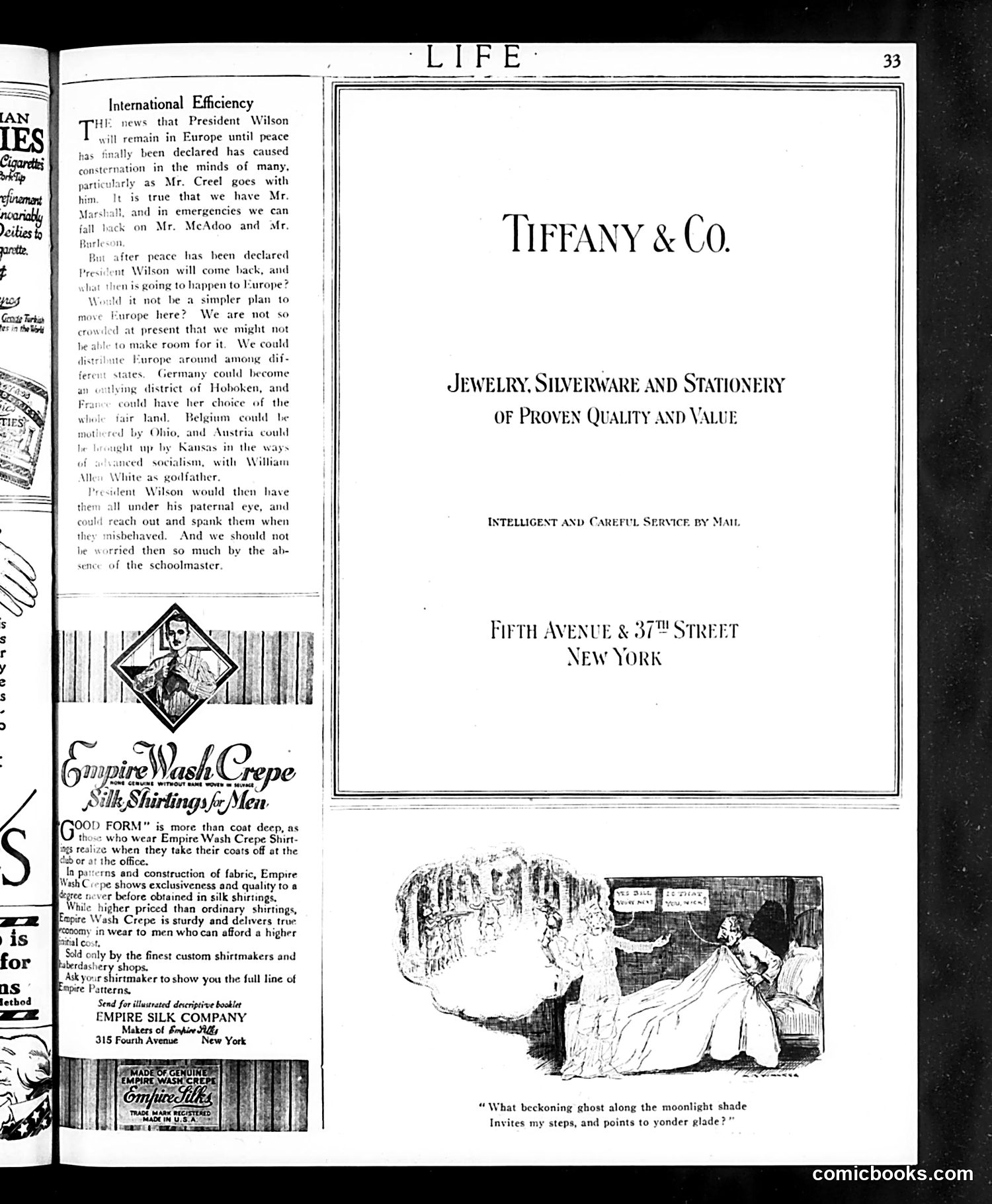
**The Political Satire:** The "International Efficiency" column mocks President Wilson's decision to remain in Europe after World War I peace negotiations rather than return to govern America. The satirist suggests an absurdist alternative: instead of Wilson staying abroad, simply relocate all of Europe to America. Germany would become "an outlying district of Hoboken," France could pick any U.S. state, Belgium would be "mothered by Ohio," and Austria taught "advanced socialism" by Kansas, with William Allen White as "godfather." **The Joke:** The satire criticizes Wilson's extended absence from domestic governance by proposing an obviously ridiculous solution. It reflects anxiety about executive power concentrated elsewhere while the country needs leadership—particularly mocking the idea that subordinates (Marshall, McAdoo) could adequately manage during his absence. The "schoolmaster" reference suggests Wilson should be home disciplining the nation like a parent. **Context:** This reflects 1919 concerns about Wilson's European commitment versus domestic needs. The rest of the page contains advertisements (Tiffany & Co., Empire Wash Crepe shirts) unrelated to the satire.
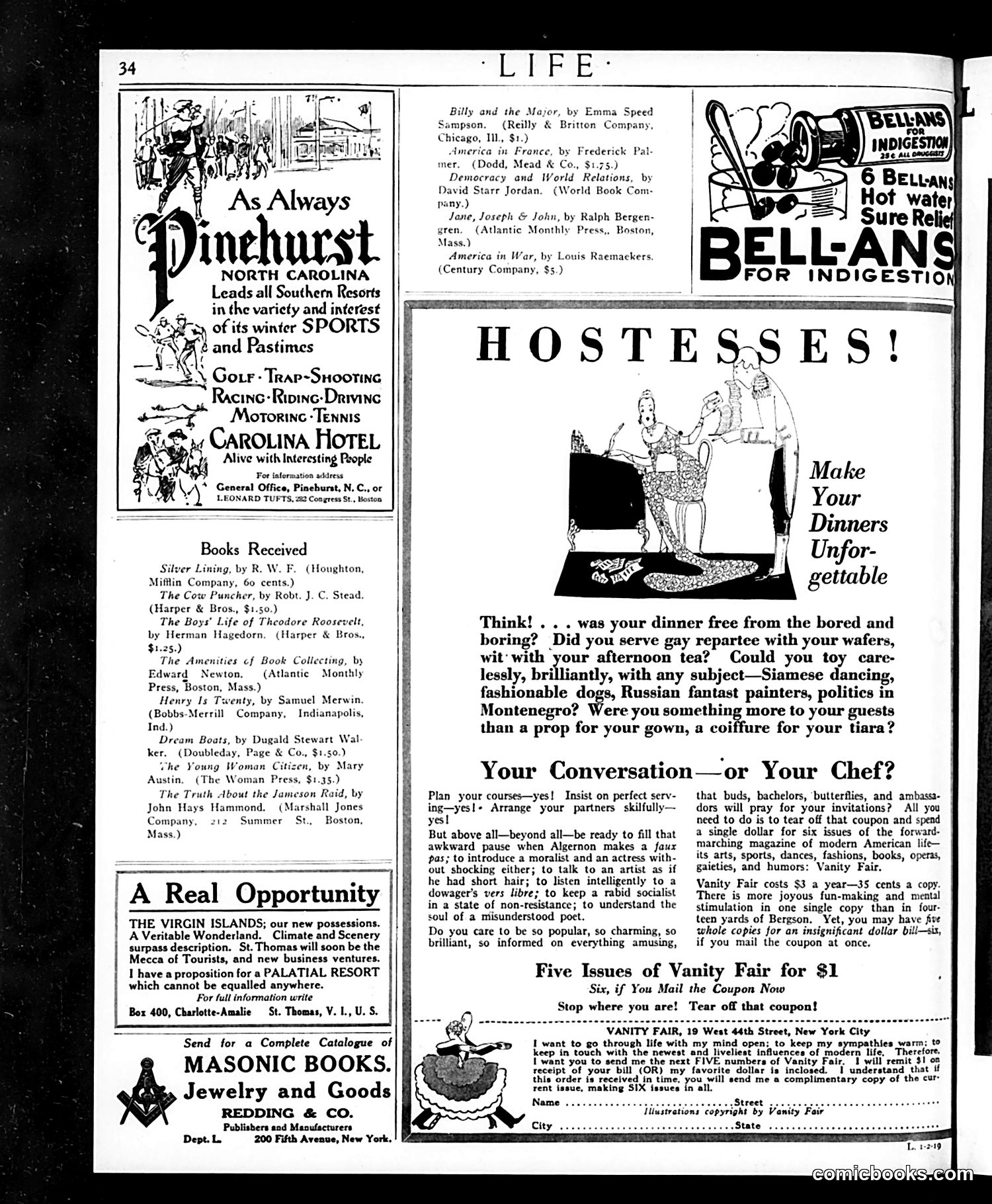
This page is primarily **advertising and book listings**, not political satire. The main content consists of: **Book Reviews Section**: Lists newly published books, mostly on serious topics—WWI-related works ("America in France," "America in War"), political philosophy ("Democracy and World Relations"), and biography. **Advertisements**: The largest feature is a **Vanity Fair magazine ad** satirizing upper-class dinner party etiquette. It mocks wealthy hostesses obsessed with appearing sophisticated—worrying whether their conversation rivals their chef's cooking, whether guests will find them charming enough. The satire targets vanity and superficiality among the social elite: can you discuss Siamese dancing and Russian painters brilliantly enough to distract from your gown? **Other ads** promote the Carolina Hotel (winter sports resort), Bellans digestive tablets, and the Virgin Islands as a resort destination. The page reflects early 20th-century concerns: post-WWI America, leisure culture among the wealthy, and consumer magazines marketing sophistication to aspiring elites.