
Life, 1919-01-02 · page 6 of 34
Life — January 2, 1919 — page 6: what you’re looking at
What you’re looking at
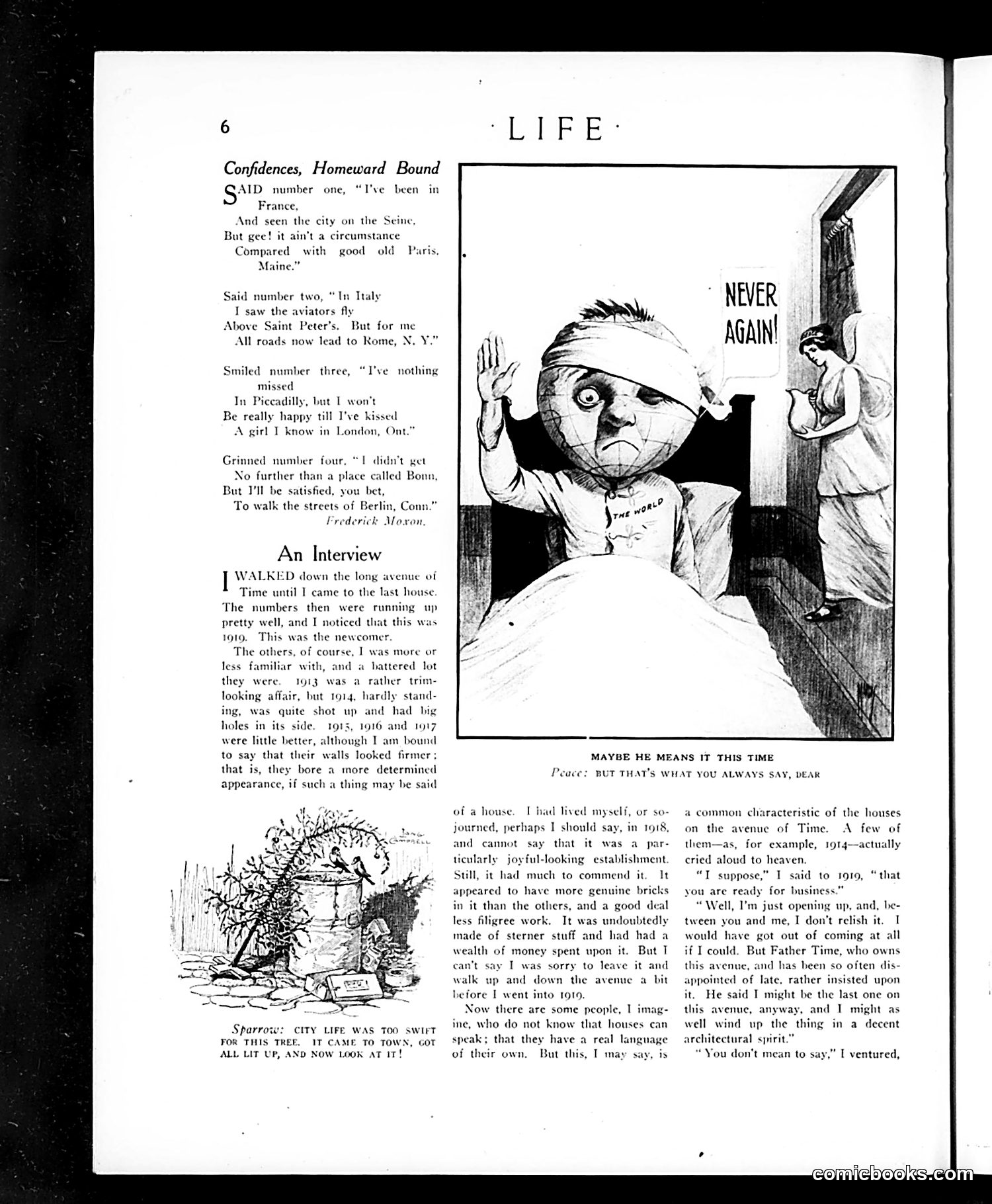
The main cartoon shows a bandaged baby figure labeled "THE WORLD" saying "NEVER AGAIN!" while being held by what appears to be a weary or exhausted figure (likely representing humanity or a nation). The caption reads "MAYBE HE MEANS IT THIS TIME / Peace; BUT THAT'S WHAT YOU ALWAYS SAY, DEAR." This is post-World War I satire (the article references 1918-1919). The joke expresses cynical skepticism about peace promises following the war's devastation. The baby "world" is wounded and traumatized, swearing never to repeat such destruction—but the weary caregiver doubts this resolve will hold, implying that nations will inevitably return to conflict. The accompanying text discusses houses on an avenue and their wartime damage, contextualizing the cartoon's commentary on war's destructive aftermath.
📄 Transcribed text from this page (OCR, searchable)
Machine-transcribed from the original scan — historical spelling and the odd misread are preserved.
6 Confidences, Homeward Bound AID France, number one, “I've been in And seen the city on the Seine, Compared with good old Paris, Said number two, “In Ttaly I saw the aviators fly Above Saint Peter's. But for me All roads now lead to Rome, N.Y.” Smiled missed In Piccadilly, but 1 won't Be really happy till I've kissed A girl I know in London, Ont.” number three, “I've nothing Grinned number four, “1 didn’t get No further than a place called Bonn, But I'll be satisfied, you bet, To walk the streets of Berlin, Conn.” Frederick Moxon. An Interview WALKED down the long avenue of Time until I came to the last house. The numbers then were running up pretty well, and I noticed that this was 1919. This was the newcomer. The others, of course, I was more or less familiar with, and a battered lot they were. 1913 rather trim- looking affair, but 101g, hardly stand- ing, was quite shot up and had big holes in its side. 1913, 1916 and 1917 were little better, although I am bound to say that their walls looked firmer; that is, they bore a more determined appearance, if such a thing may be said was a CITY LIFE WAS TOO SWIFT IT CAME TO TOWN, GOT ‘D NOW LOOK AT IT! FOR THIS TR ALL LIT U MAYBE HE MEANS IT THIS TIME Peace: BUT THAT'S WHAT YOU ALWAYS SAY, DEAR of a house. [had lived myself, or so- journed, perhaps I should say, in 1918, and cannot say that it was a ticularly joyful-looking establishment. Still, it had much to commend it. It appeared to have more genuine bricks in it than the others, and a good deal less filigree work. It was undoubtedly made of sterner stuff and had had a wealth of money spent upon it. But T can't say I was sorry to leave it and walk up and down the avenue a bit hefore I went into 1910. Now there are some people, 1 ima: ine, who do not know that houses speak; that they have a real language of their own, But this, T may say, is a common characteristic of the houses on the avenue of Time. A few of them—as, for example, 191g—actually cried aloud to heaven. “T suppose,” I said to 1910, “that you are ready for business.” “Well, I'm just opening up, and, be- tween you and me, I don’t relish it. I would have got out of coming at all if I could. But Father Time, who owns this avenue, and heen so often dis- appointed of late, rather insisted upon it. He said T might be the last one on this avenue, anyway, and I might as well wind up the thing in a decent architectural spirit.” “You don't mean to say,” I ventured,