
Life, 1919-01-02 · page 16 of 34
Life — January 2, 1919 — page 16: what you’re looking at
What you’re looking at
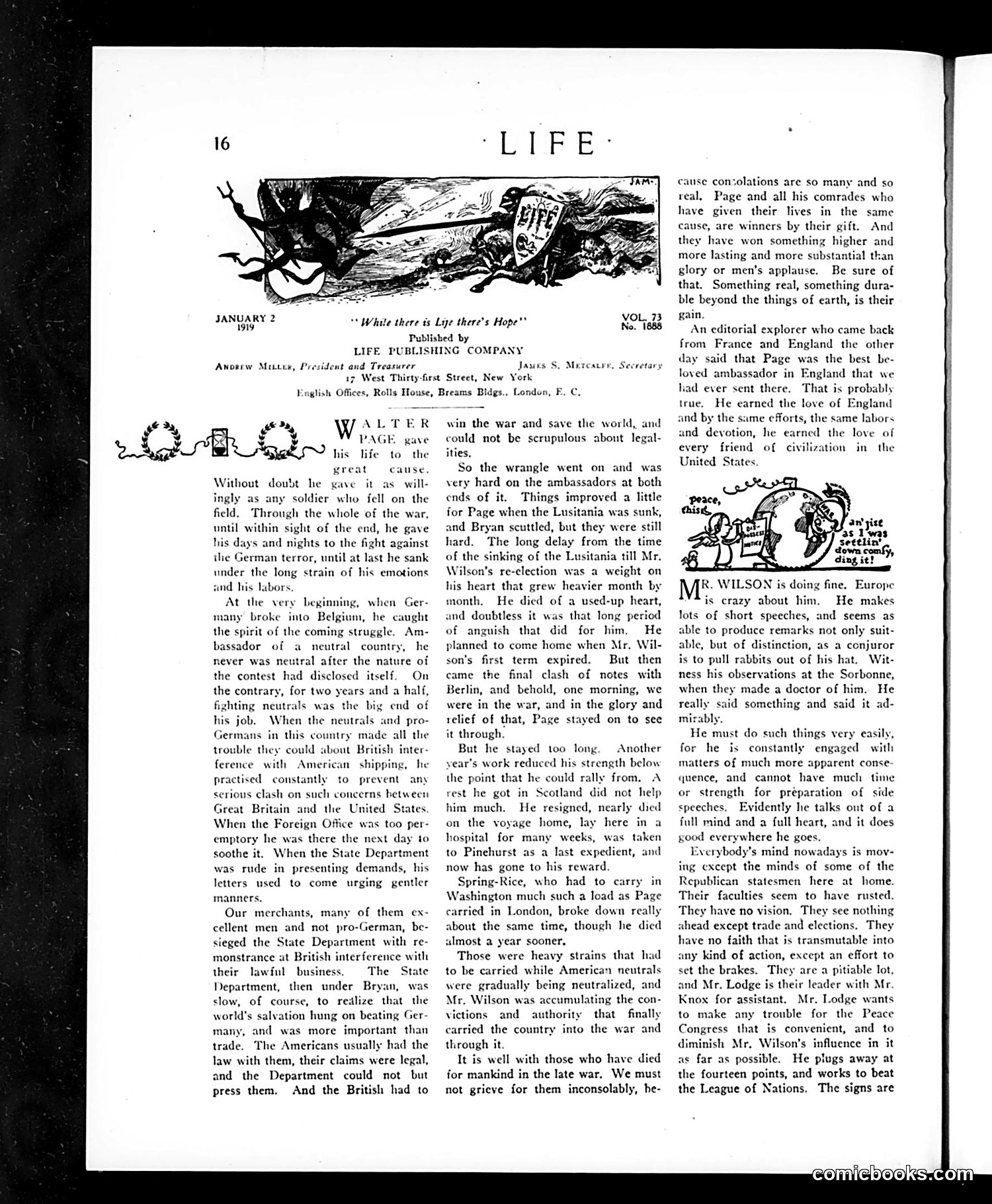
This is an obituary-essay honoring **Walter Hale Page**, America's ambassador to Britain who died recently. The text describes Page's exhausting diplomatic role during WWI, serving as intermediary between the British government and the American State Department while America remained officially neutral. The article explains how Page struggled to prevent conflicts over British interference with American shipping while sympathizing with Britain's war effort against Germany. He allegedly died from the stress of this impossible position—particularly the anguish during the long period between the 1915 Lusitania sinking and America's 1917 entry into the war. The piece also mentions **Spring-Rice**, the British ambassador in Washington who faced similar strains and died around the same time. The cartoon at top-left (unclear in detail) likely depicts this tension between duty and survival. The overall message: Page sacrificed his health for the Allied cause, earning him a hero's remembrance.
📄 Transcribed text from this page (OCR, searchable)
Machine-transcribed from the original scan — historical spelling and the odd misread are preserved.
JANUARY 2 1919 “* While there ts Liye there's Hope’* Published by LIFE PUBLISHING COMPANY Aworrw Mites, President and Treasurer Jaurs S. Murcatre, Secretary 17 West Thirty-first Street, New York English Offices, Rolls House, Breams Bldgs., London, F. C, ALTER PAGE. gave life to the great cause Without doubt he gave it as will- ingly as any soldier who fell on the field. Through the whole of the war, until within sight of the end, he gave his days and nights to the fight against the German terror, until at last he sank under the long strain of his emotions and his labors. At the very beginning, when Ge many broke into Belgium, he caught the spirit of the coming struggle. Am- assador of a neutral country, he never was neutral after the nature of the contest had disclosed itself. On the contrary, for two years and a half, fighting neutrals was the big end of his job. When the neutrals and pro- Germans in this country made all the trouble they could about British inter- ference with American shipping, he practised constantly to prevent any serious clash on such concerns betweet Great Britain and the United States. When the Foreign Office was too per- emptory he was there the next day to soothe it. When the State Department was rude in presenting demands, his letters used to come urging gentler manners. Our merchants, many of them ex- cellent men and not pro-German, be- sieged the State Department with re- monstrance at British interference with their lawful business. The State Department, then under Bryan, was slow, of course, to realize that the world’s salvation hung on beating Ger- many, and was more important than trade. The Americans usually had the law with them, their claims were legal, and the Department could not but press them. And the British had to win the war and save the world, and could not be scrupulous about legal- ities. So the wrangle went on and was very hard on the ambassadors at both ends of it. Things improved a little for Page when the Lusitania was sunk, and Bryan scuttled, but they were still hard. The long delay from the time of the sinking of the Lusitania till Mr, Wilson's re-election was a weight on his heart that grew heavier month by month, He died of a used-up heart, and doubtless it was that long period of anguish that did for him. He planned to come home when Mr. Wil- son's first term expired. But then came the final clash of notes with Berlin, and behold, one morning, we were in the war, and in the glory and relief of that, Page stayed on to see it through. But he stayed too long. Another year's work reduced his strength below the point that he could rally from. A rest he got in Scotland did not help him much. He resigned, nearly died on the voyage home, lay here in hospital for many weeks, was taken to Pinehurst as a last expedient, and now has gone to his reward. Spring-Rice, who had to carry in Washington much such a load Page carried in London, broke down really about the same time, though he died almost a year sooner, Those were hi strains that had to be carried while American neutrals were gradually being neutralized, and Mr. Wilson was accumulating the con- victions and authority that finally carried the country into the war and through it, It is well with those who have died for mankind in the late war. We must not gricve for them inconsolably, he- ise consolations are so many and so real, Page and all his comrades who have given their lives in the same cause, are winners by their gift, And they have won something higher and more lasting and more substantial than glory or men’s applause. Be sure of that. Something real, something dura- ble beyond the things of earth, is their gain. An editorial explorer who came back from France and England the other day said that Page was the best be- loved ambassador in England that we liad ever sent there. That is probably He earned the love of England and by the same efforts, the same labors and devotion, he earned the love of every friend of civilization in’ the United States. true. Mk WILSON is doing fine. is crazy about him. He makes lots of short speeches, and seems as able to produce remarks not only suit- able, but of distinction, as a conjuror is to pull rabbits out of his hat. Wit- ness his observations at the Sorbonne, when they made a doctor of him. He really said something and said it ad- mirably, He must do such things very easily, for he is constantly engaged with matters of much more apparent conse- quence, and cannot have much time or strength for préparation of speeches. Evidently he full mind and a full heart, and it does good everywhere he goes. Everybody’s mind nowadays is mov- ing cxcept the minds of some of the Republican statesmen here at home. Their faculties seem to have rusted. They have no vision, They see nothing ahead except trade and elections. They have no faith that is transmutable into any kind of action, except an effort to set the brakes. They are a pitiable lot, and Mr. Lodge is their leader with Mr, Knox for assistant. Mr. Lodge wants to make any trouble for the Peace Congress that is convenient, and to diminish Mr, Wilson’s influence in it as far as possible. He plugs away at the fourteen points, and works to beat the League of Nations. The signs are