
A complete issue · 34 pages · 1918
Life — December 19, 1918
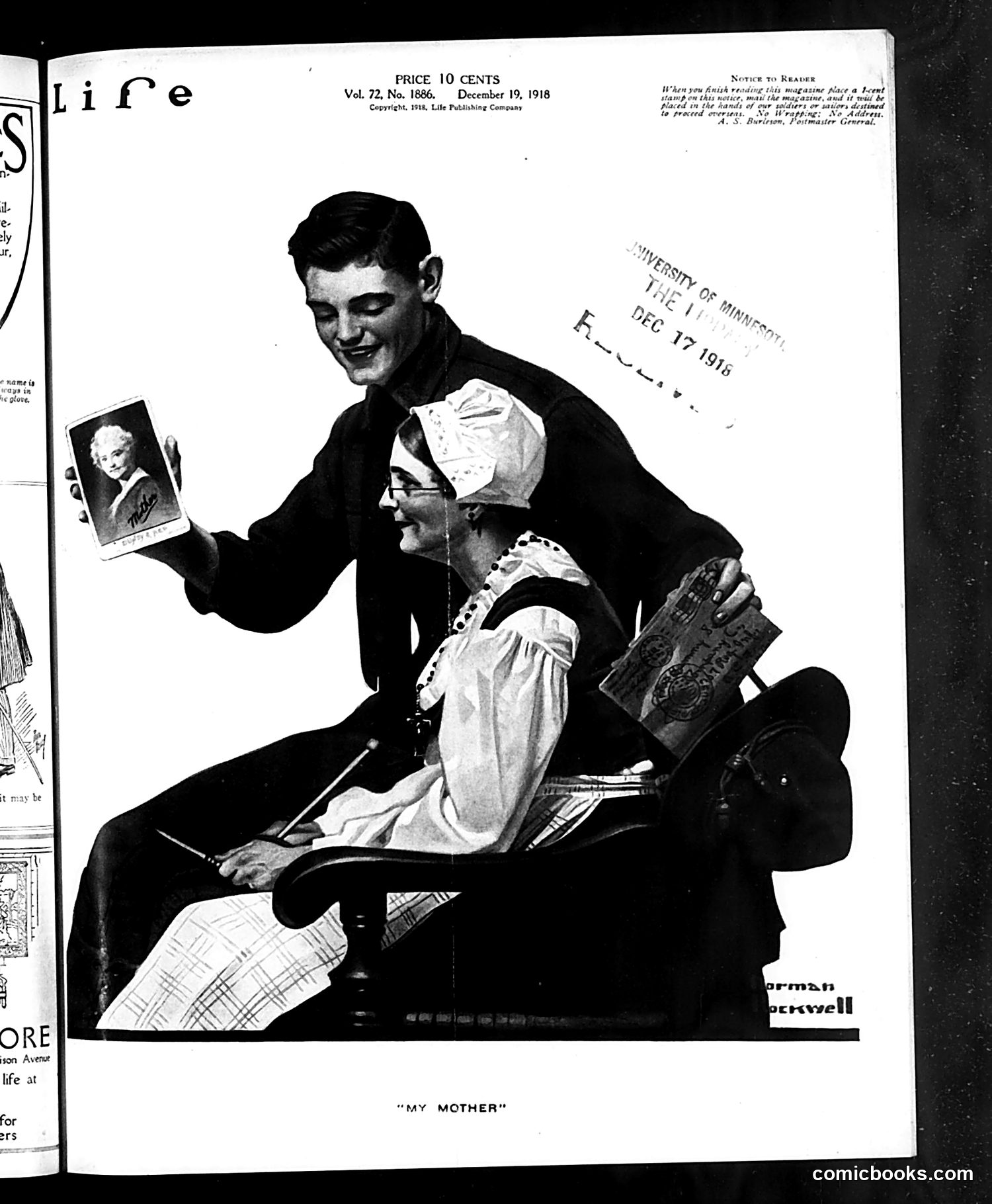
This Norman Rockwell illustration depicts a young soldier showing his mother a photograph, likely of a sweetheart or romantic interest. The soldier sits contentedly while his elderly mother, wearing traditional Old World clothing and head covering, examines the portrait with interest. The satire appears gentle rather than biting: it plays on the familiar dynamic of a soldier eager to share news of his romantic life with his mother—a timeless generational moment. Published shortly after World War I's November 1918 armistice, it captures the homecoming theme of soldiers reconnecting with family. The humor likely derives from the soldier's enthusiasm and the mother's characteristic maternal interest, reflecting sentimental post-war sentiment about family bonds and domestic life resuming after wartime separation.
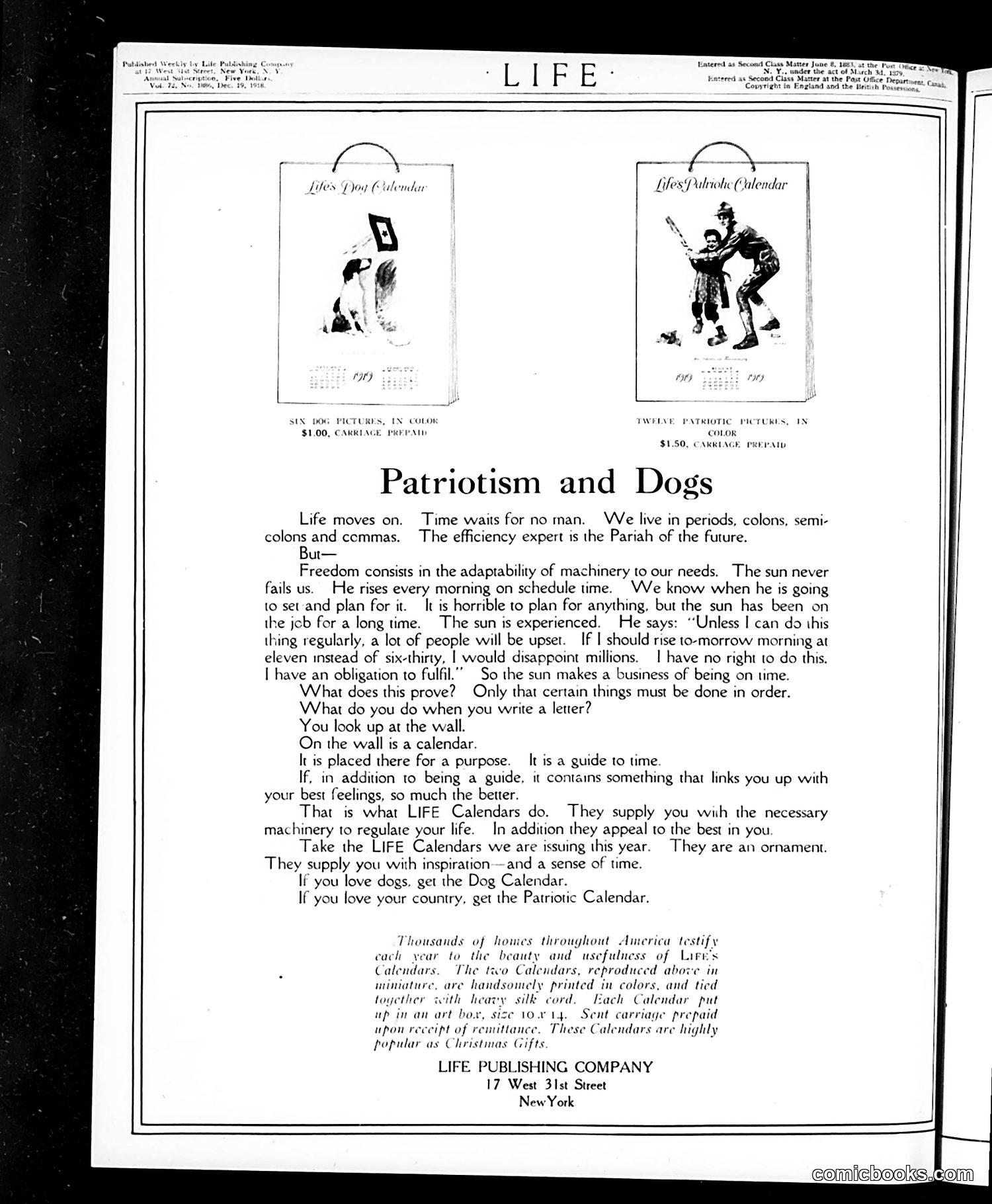
This page is primarily **advertising**, not satire or political commentary. It promotes two "Life's Mood Calendars" — decorative wall calendars sold by Life Publishing Company. The left calendar features **six dog pictures in color** ($1.00, carriage prepaid). The right shows **twelve patriotic pictures in color** ($1.50, carriage prepaid), depicting what appears to be a military or uniformed figure. The accompanying essay titled "Patriotism and Dogs" uses philosophical language about time, freedom, and duty to frame these calendars as tools for organizing life and inspiring citizens. The sales pitch suggests calendars appeal to "best feelings" and serve as Christmas gifts. The satirical title pairs patriotism and dogs—seemingly unrelated—though the text treats both seriously as worthy subjects for calendar art and contemplation.
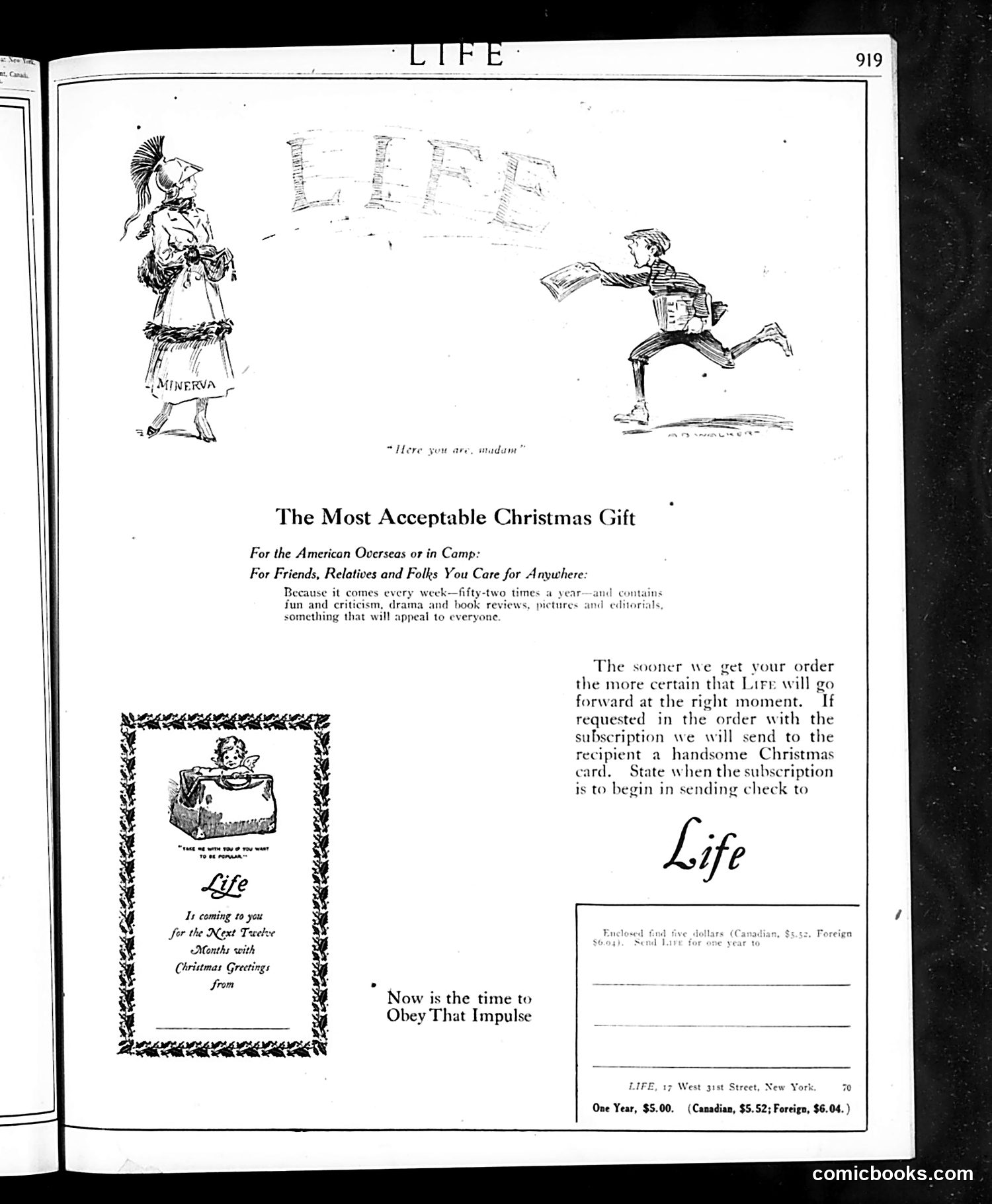
This page is primarily a **Christmas gift advertisement** for Life magazine subscriptions (priced at $5.00 yearly). The top cartoon shows two figures labeled "MINERVA" (goddess of wisdom) and an unnamed male recipient, with the caption "Here you are, madam." This appears to be visual wordplay—presenting Life magazine as a wise, valuable gift. The lower section features a **Christmas greeting card design** promising Life will arrive "for the Next Twelve Months with Christmas Greetings from" the subscriber. The ad targets American soldiers overseas and in camps, emphasizing that Life's "fun and criticism, drama and book reviews, pictures and editorials" appeal to everyone. The satire is subtle: positioning a humor magazine as the most "acceptable" Christmas gift reflects mid-century American consumer culture and gift-giving conventions.
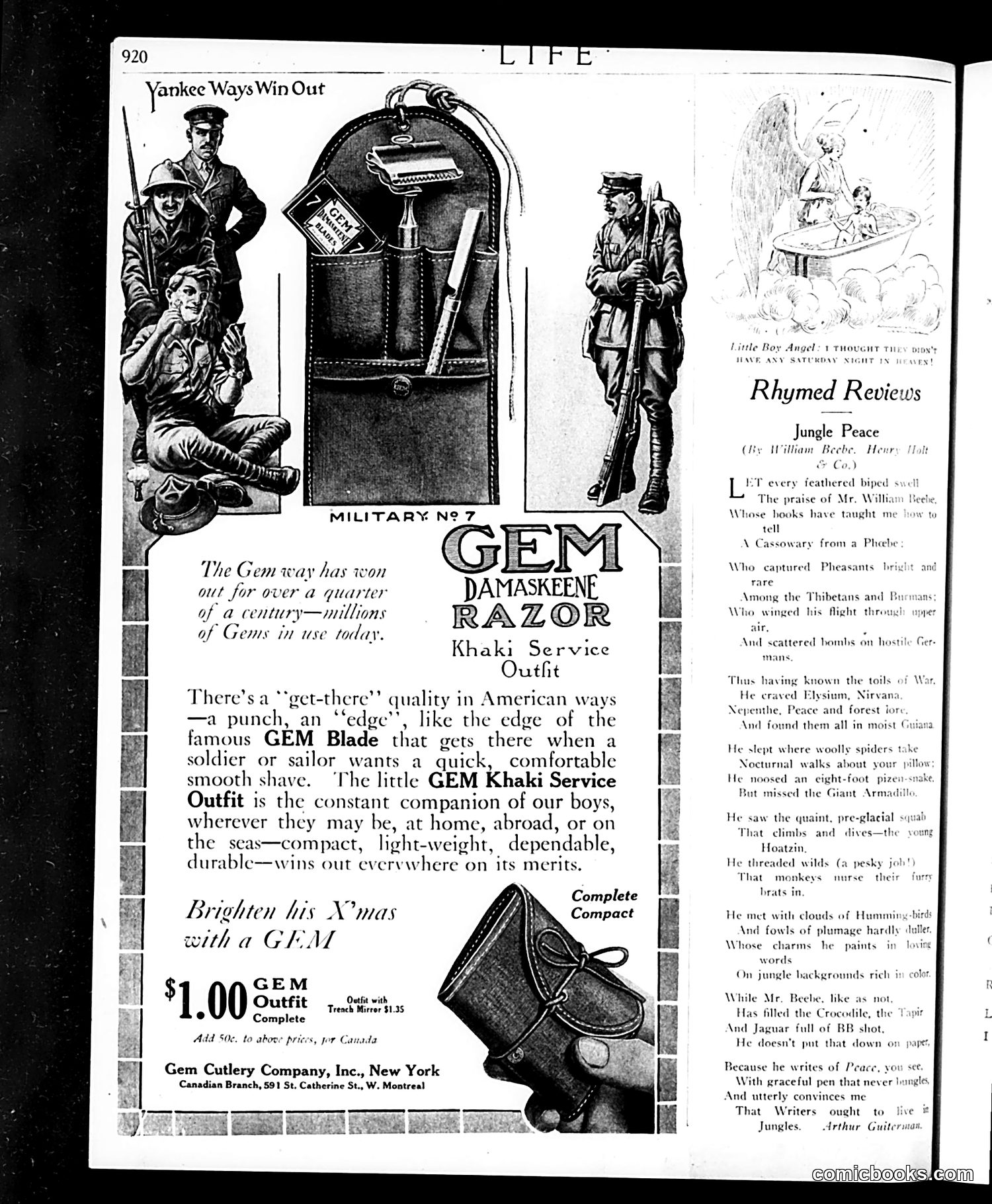
This page is primarily **advertising**, not political satire. The dominant feature is a full-page ad for GEM Damaskeene Razor's "Khaki Service Outfit" — a shaving kit marketed to soldiers and sailors during wartime (likely WWI era, given the military context). The left side shows illustrations of soldiers/sailors with shaving equipment. The ad's appeal emphasizes "American ways" and practicality for military personnel "at home, abroad, or on the seas." The right side contains "Rhymed Reviews," a literary column reviewing William Beebe's "Jungle Peace." This is editorial content, not satire. The page number "920" and "LIFE" masthead confirm this is from Life magazine's advertising-heavy format. No significant political cartoon or satire appears here.
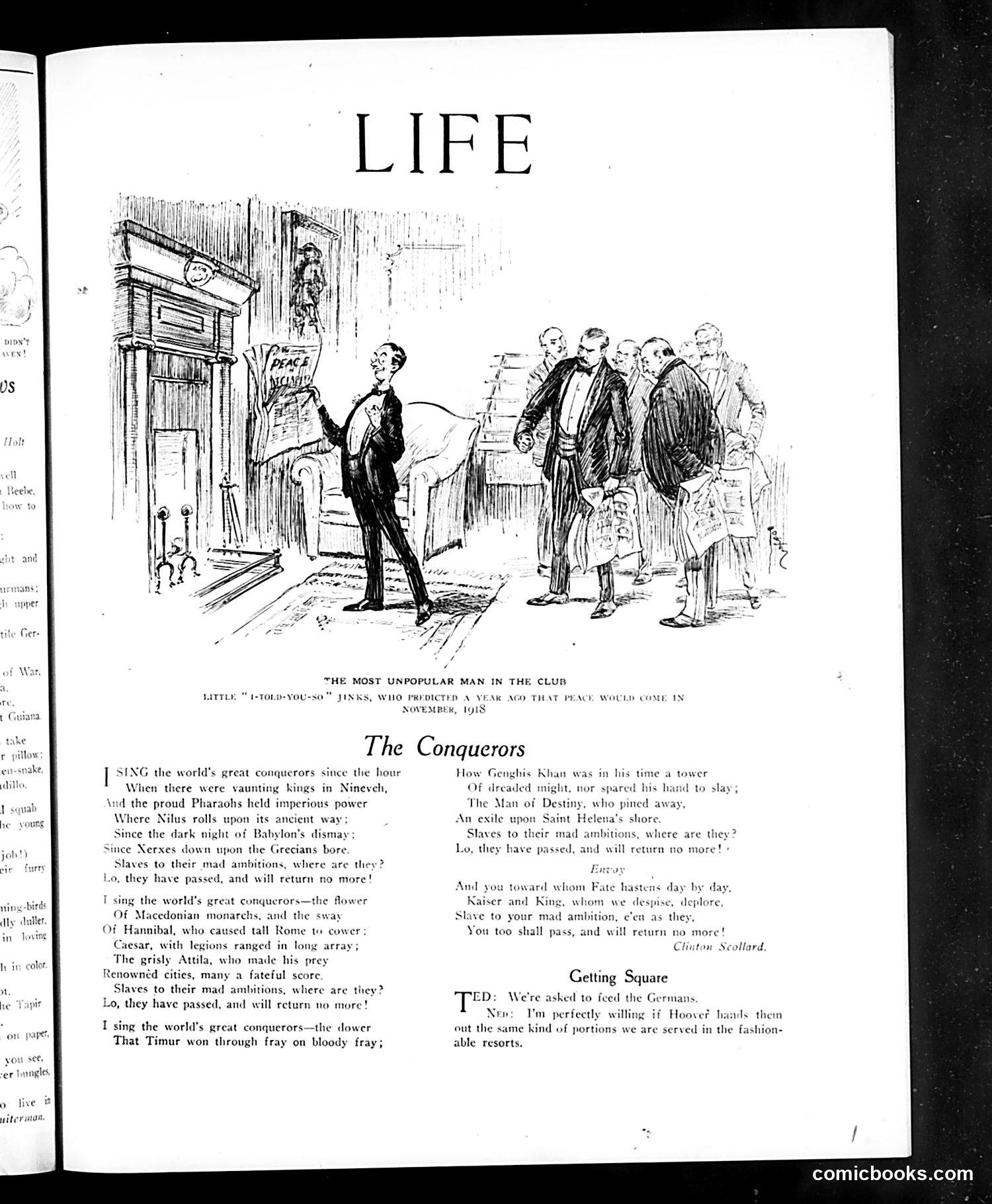
The page shows a satirical cartoon titled "The Most Unpopular Man in the Club," depicting a well-dressed man standing alone while others gather behind him. The caption references "Little 'I-Told-You-So' Jinx," suggesting someone who had predicted peace would come in November 1918 but was proven wrong. The accompanying poem "The Conquerors" ironically contrasts great historical conquerors (Genghis Khan, Caesar, Hannibal, Timur) with their ultimate downfall, reinforcing themes of impermanence and defeat. The "Getting Square" dialogue below appears unrelated—a brief exchange about feeding Germans and fashionable resorts. This likely satirizes someone who made inaccurate predictions about WWI's end date, now socially ostracized for their failed prognostication.
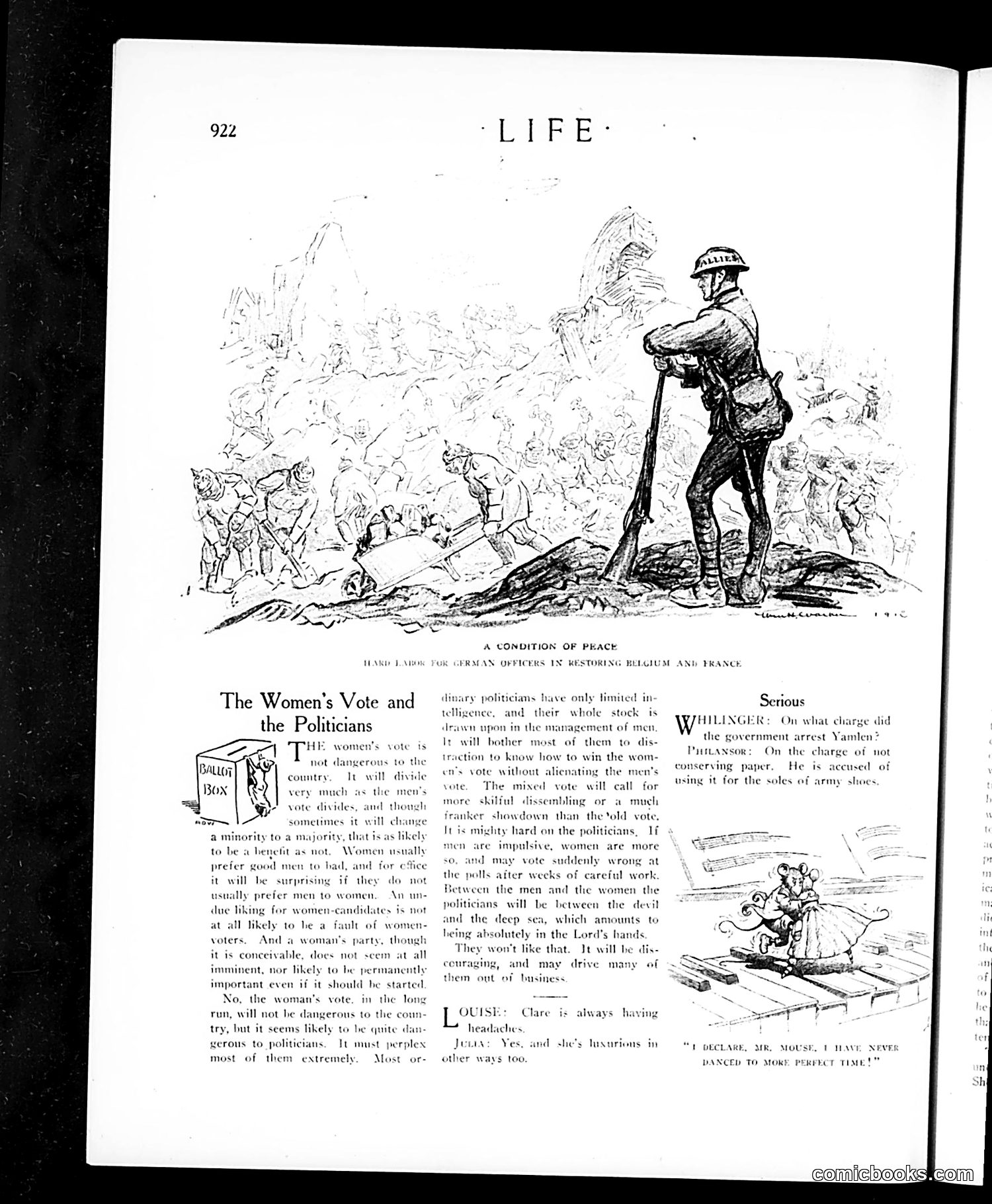
**Main Cartoon:** "A Condition of Peace" depicts a British soldier supervising German officers restoring Belgium and France—visual commentary on post-WWI occupation and reparations. **"The Women's Vote and the Politicians":** This article-cartoon critiques male politicians' anxieties about newly enfranchised women voters. The text argues that while politicians fear women voters will be unpredictable, women are actually more thoughtful than men and may vote "suddenly wrong." The satire suggests politicians are overreacting to female suffrage—the real danger isn't to the country but to politicians' comfortable control. **Right Panel:** A brief dialogue between characters (Louise, Clare, Julia) making light of women's social activities—likely contrasting frivolous gossip with serious voting concerns. The page reflects early-20th-century debates surrounding women's political participation.
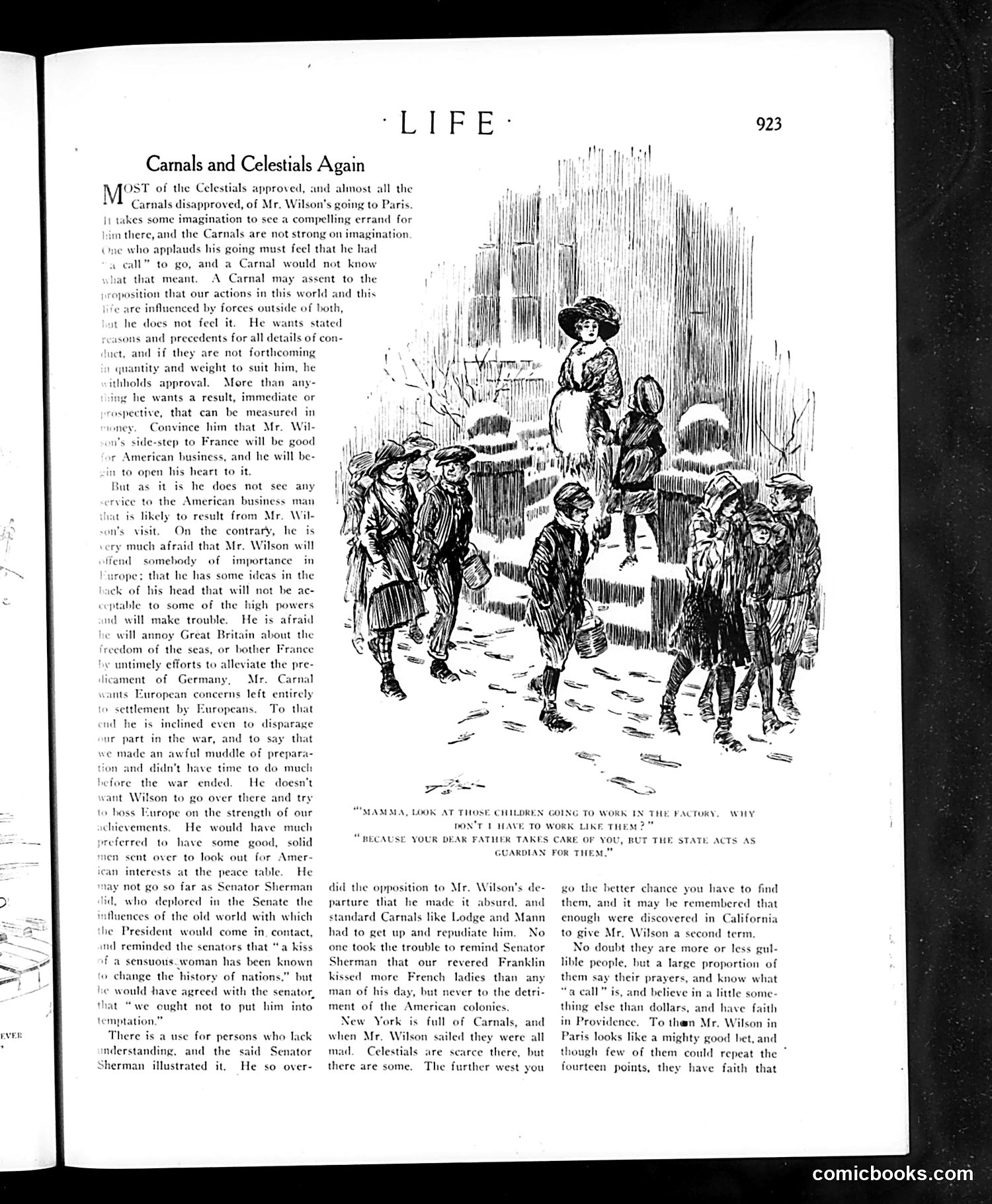
This page satirizes American attitudes toward Chinese immigration and labor. The illustration shows a woman (labeled "Mamma") confronting children working in a factory, questioning why her "dear father" doesn't care for them—implying the state acts as guardian instead. The accompanying text discusses Mr. Wilson's diplomatic mission to Paris and Carnal politicians' concerns about European settlement. However, the cartoon's caption references Chinese workers ("Celestials"), mocking middle-class American anxiety about Asian labor undercutting American jobs and family welfare systems. The satire criticizes both factory labor exploitation and xenophobic attitudes toward Chinese immigrants, presenting the issue as hypocrisy: Americans claim to value family protection while accepting child labor and resisting immigrant workers who might compete economically.
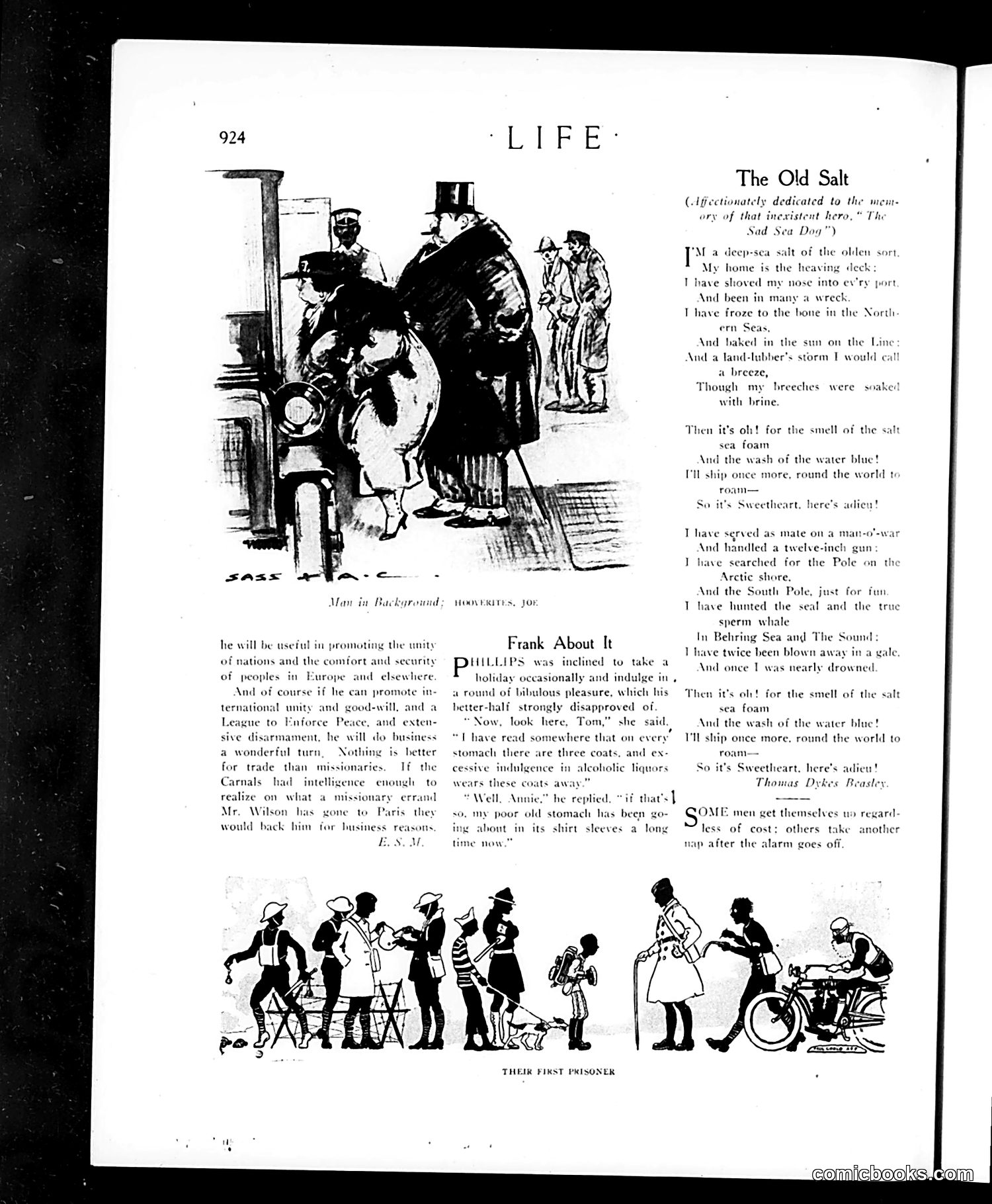
This page features two satirical pieces about seafaring life. "The Old Salt" is a nostalgic poem by Thomas Dykes Boadby celebrating a weathered sailor's experiences—Arctic exploration, whaling, naval service—with romantic language about maritime adventure. "Frank About It" appears to be a short satirical piece by Phillips about vacation indulgence. A woman criticizes her husband's expensive leisure habits, particularly his drinking ("coats and excessive indulgence in alcoholic liquors"). He deflects by claiming his stomach troubles justify the behavior—a typical domestic satire mocking male excuses for overindulgence and the gap between husbands' and wives' perspectives on household spending. The accompanying illustrations show period scenes of social interaction and leisure activities.
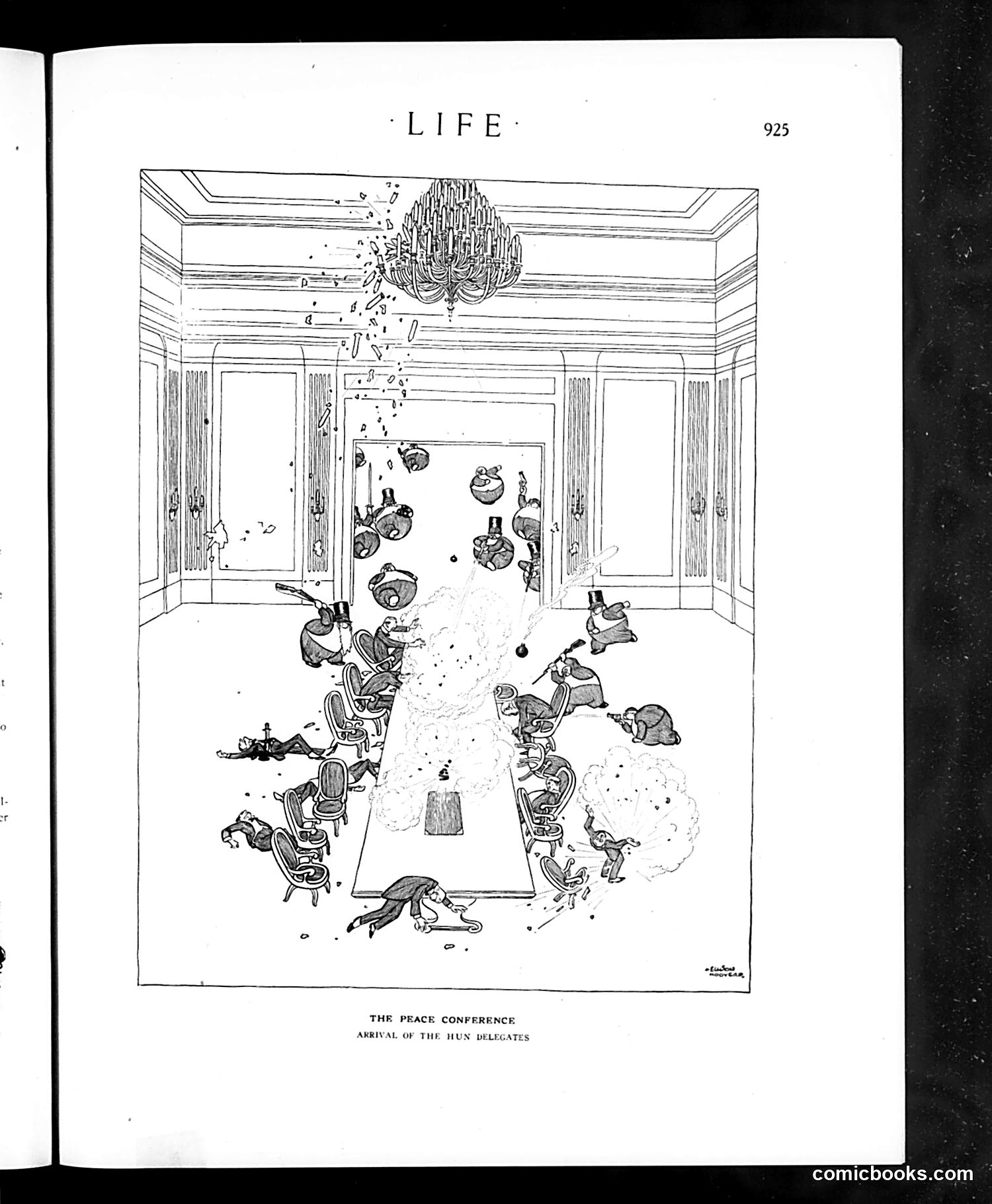
This satirical cartoon depicts a formal peace conference room where delegates are arriving. The title references "Hun delegates," using the dehumanizing WWI-era slur for German representatives. The cartoon shows what appears to be chaos—figures in formal dress tumbling and colliding, with objects falling from above, suggesting the German delegation's arrival creates mayhem and disorder. The satire mocks German peace negotiations, likely from the post-WWI period (possibly Treaty of Versailles era). By depicting their arrival as literally disruptive and chaotic, the cartoonist suggests Germans cannot participate in civilized diplomacy and represent disorder rather than peaceful intentions. This reflects the intense anti-German sentiment and distrust prevalent in American political commentary immediately following World War I.
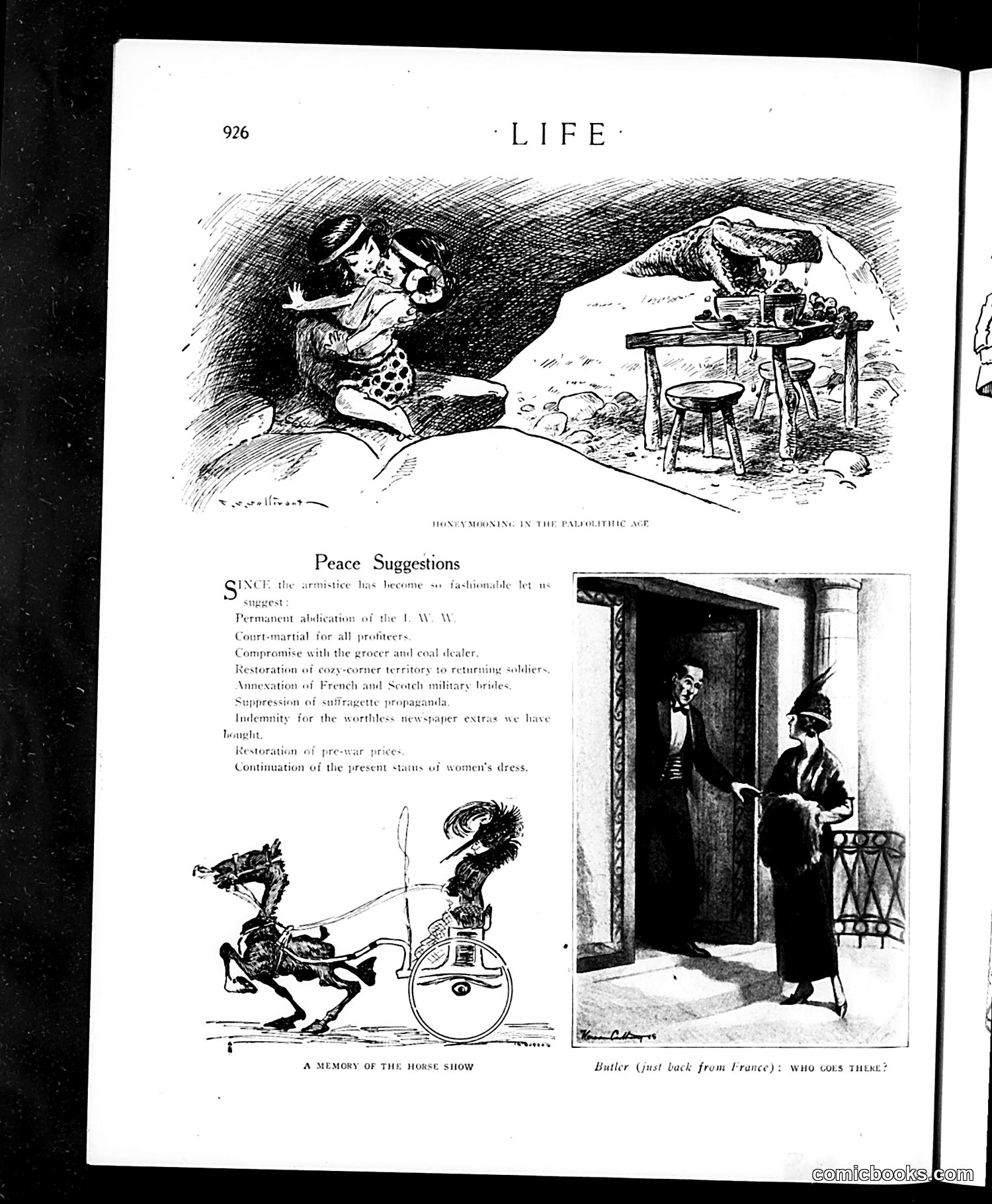
This is a satirical page from *Life* magazine featuring post-World War I political commentary. The top cartoon, "Honeymoon in the Paleolithic Age," depicts a couple in a primitive cave setting, sarcastically contrasting romantic ideals with harsh reality. The main section, "Peace Suggestions," lists tongue-in-cheek proposals for post-war peace, including abolishing the I.W.W. (International Workers of the World), compromising with grocers and coal dealers, and restoring pre-war prices—mocking both radical labor groups and economic concerns of the era. The lower cartoons satirize post-war adjustments: "A Memory of the Horse Show" references the displaced leisure class, while "Butler (just back from France): Who Goes There?" shows a servant confronting social disruption, likely commenting on class tensions and the changed social order after WWI.
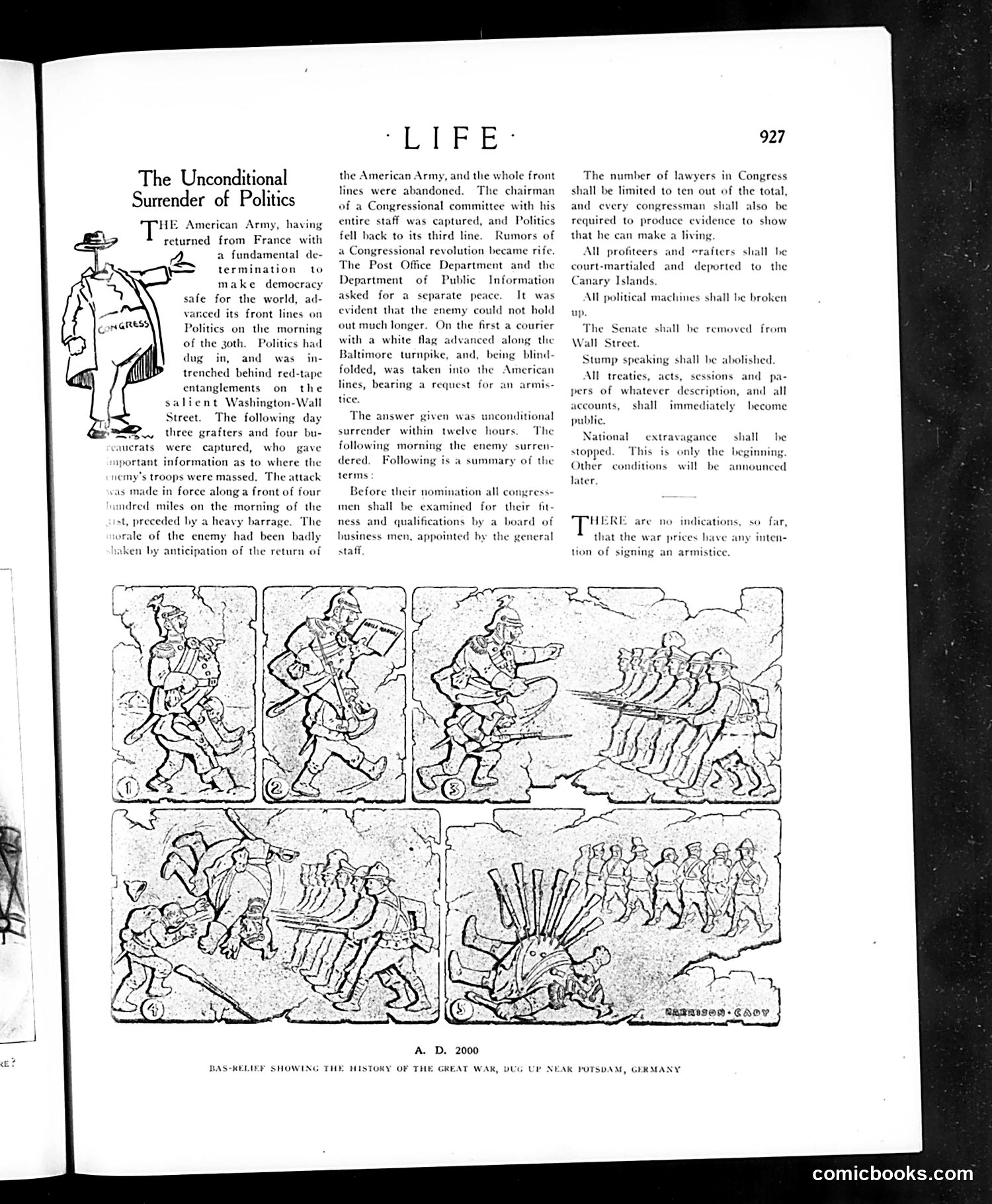
This page satirizes the end of World War I. The headline "The Unconditional Surrender of Politics" announces that the American Army has returned from France with a fundamental demand: politics must be safe and democracy preserved. The accompanying cartoon (top left) shows a thin, distressed figure labeled "Politics" being stabbed or run through—depicting politics as wounded or defeated. The bas-relief strip at bottom, captioned "A.D. 2000" and "Bas-Relief Showing the History of the Great War, Dug Up Near Potsdam, Germany," presents six sequential panels in mock-ancient style showing soldiers fighting, advancing, and surrendering. This imagines future archaeologists discovering visual records of WWI. The satire mocks both politics' vulnerability and suggests the war's historical significance will outlast current political turmoil.
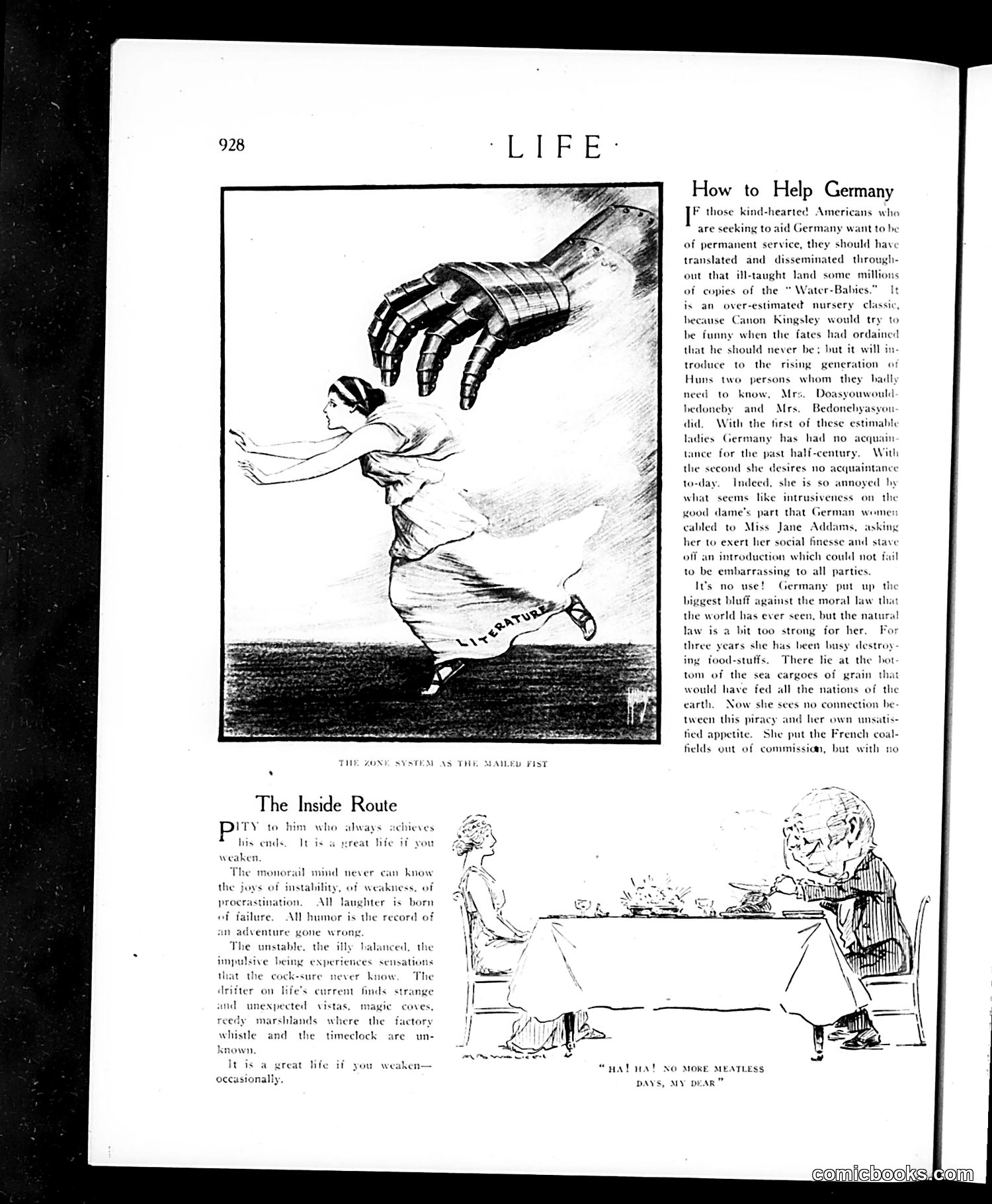
The main cartoon, titled "The Zone System as the Nabob Fist," depicts a large mechanical fist (labeled "Literature") crushing a small female figure. The accompanying article, "How to Help Germany," criticizes American relief efforts toward post-war Germany. The satire mocks the irony that while Americans claim humanitarian intentions, Germany has been economically starved through the "Zone System" (Allied occupation and trade restrictions). The female figure personifies Germany or its literature/culture. The "Literature" label suggests the piece critiques how even intellectual and cultural aspects have been crushed. The lower section, "The Inside Route," contains unrelated aphoristic humor about life's disappointments and an illustration of two figures dining, with the caption about meatless days—likely referencing post-war food rationing affecting both Germany and America.
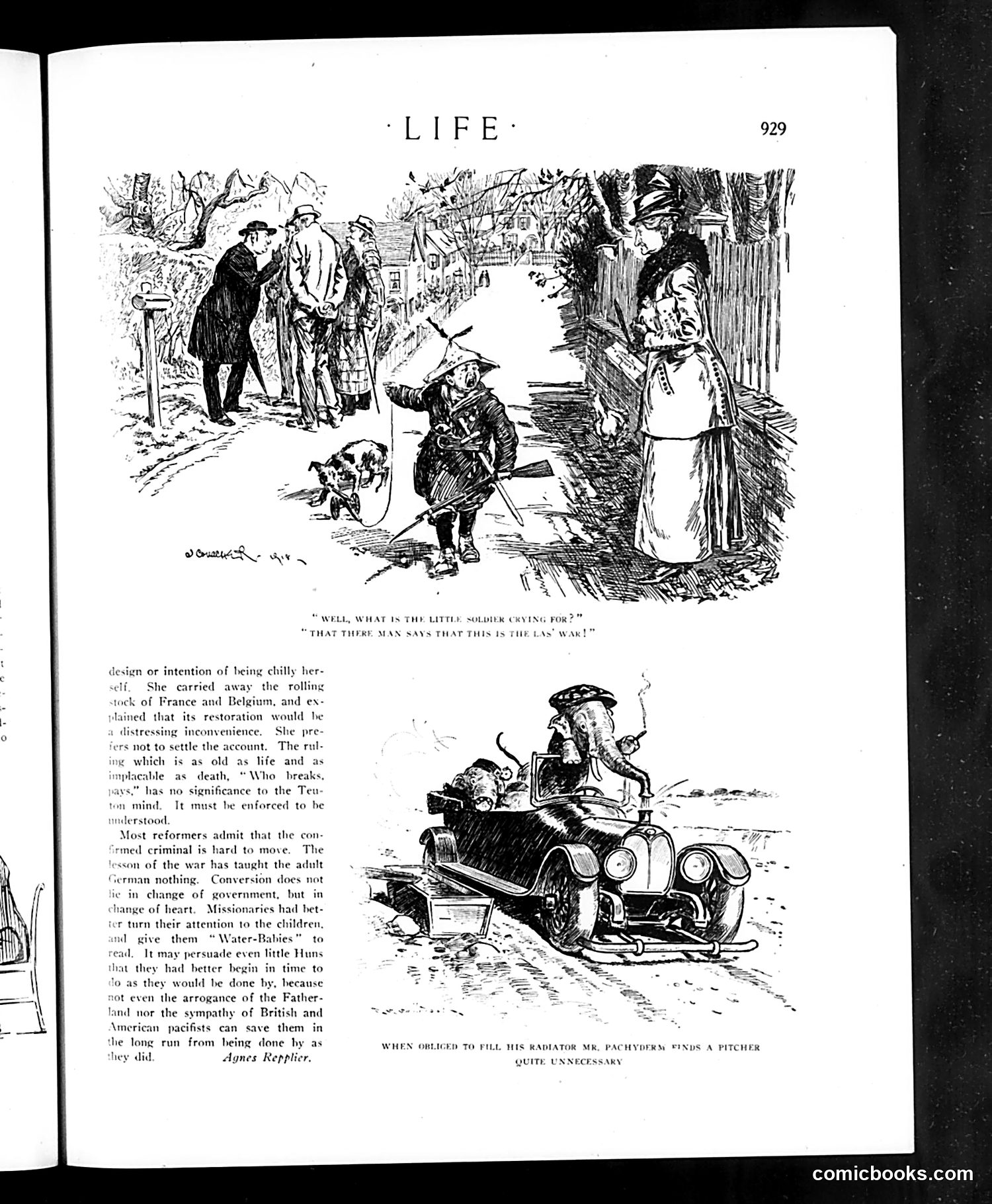
The page contains two editorial cartoons critiquing World War I and post-war policy. **Top cartoon:** Shows a small soldier crying while adults discuss him, with caption "Well, what is the little soldier crying for?" / "That there man says that this is the last war!" This mocks political promises that WWI would be "the war to end all wars"—suggesting cynicism about whether peace will actually last. **Bottom cartoon:** Depicts a caricatured military officer in an oversized car labeled "WHEN OBLIGED TO FILL HIS RADIATOR MR. PACHYDERM FINDS A PITCHER QUITE UNNECESSARY." This appears to satirize military leadership's wasteful or absurd behavior, possibly critiquing military bureaucracy or resource mismanagement during wartime. The accompanying text discusses post-war reconstruction challenges and reformers' debates about governmental change versus moral conversion.
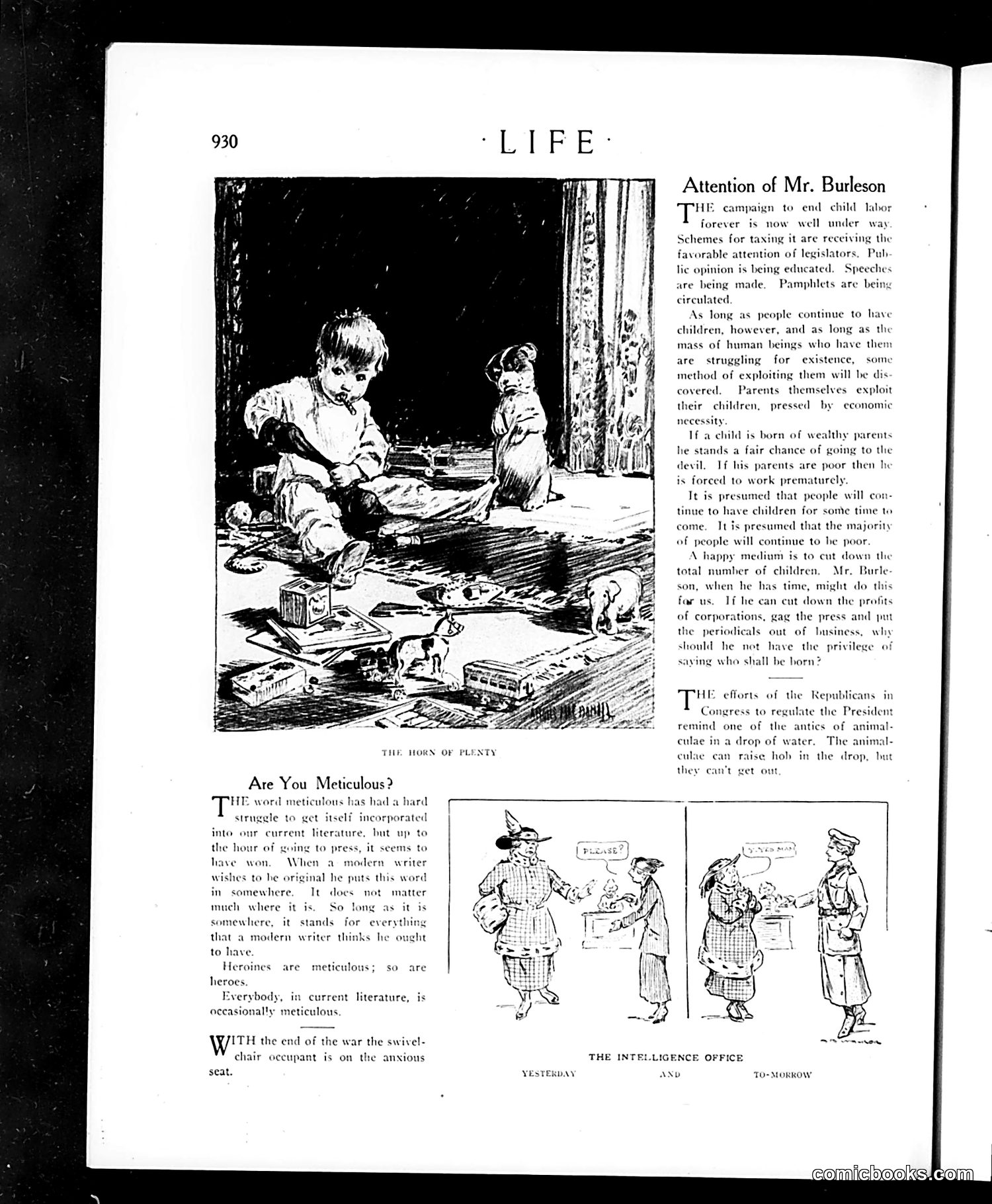
**"Attention of Mr. Burleson"** (top article): This addresses a campaign to end child labor, noting that Mr. Burleson (likely Postmaster General Albert Burleson) should consider taxing corporations to fund this effort rather than allowing exploitation to continue. **"Are You Meticulous?"** (middle section): A commentary on the word "meticulous" entering literature, noting its rarity but value in describing careful attention to detail—relevant to both heroes and heroines. **"The Intelligence Office" (bottom cartoons)**: A three-panel satirical strip showing government bureaucratic confusion "Yesterday and To-Morrow," likely mocking post-WWI administrative inefficiency or Republican congressional efforts to regulate presidential power (referenced in the text). The large illustration at top shows children playing, relating to the child labor discussion.
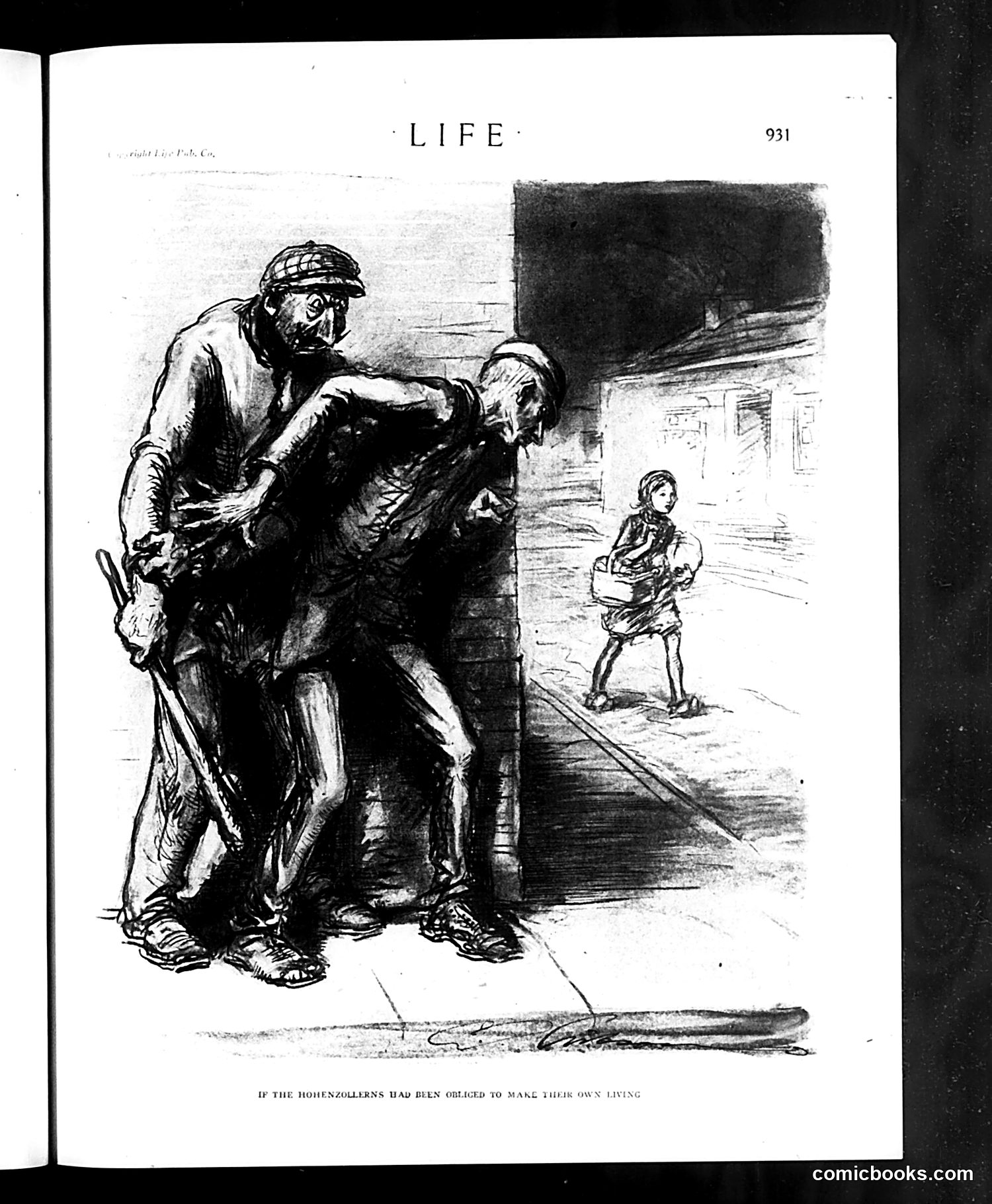
This single cartoon depicts two ragged men handling a third person roughly in a street setting, while a child watches from the distance. The caption reads: "IF THE HOBENZOLLERNS HAD BEEN OBLIGED TO MAKE THEIR OWN LIVING." The satire targets the German royal Hohenzollern family (who ruled Prussia and the German Empire). The joke suggests that if they'd been forced to work for survival like ordinary people—implying they were parasitic aristocrats living off others' labor—they would resort to crime or brutish behavior. This likely reflects post-WWI American sentiment, when Germany was widely blamed for the war and its ruling class was viewed with contempt. The cartoon mocks Prussian nobility as inherently unfit for honest work.
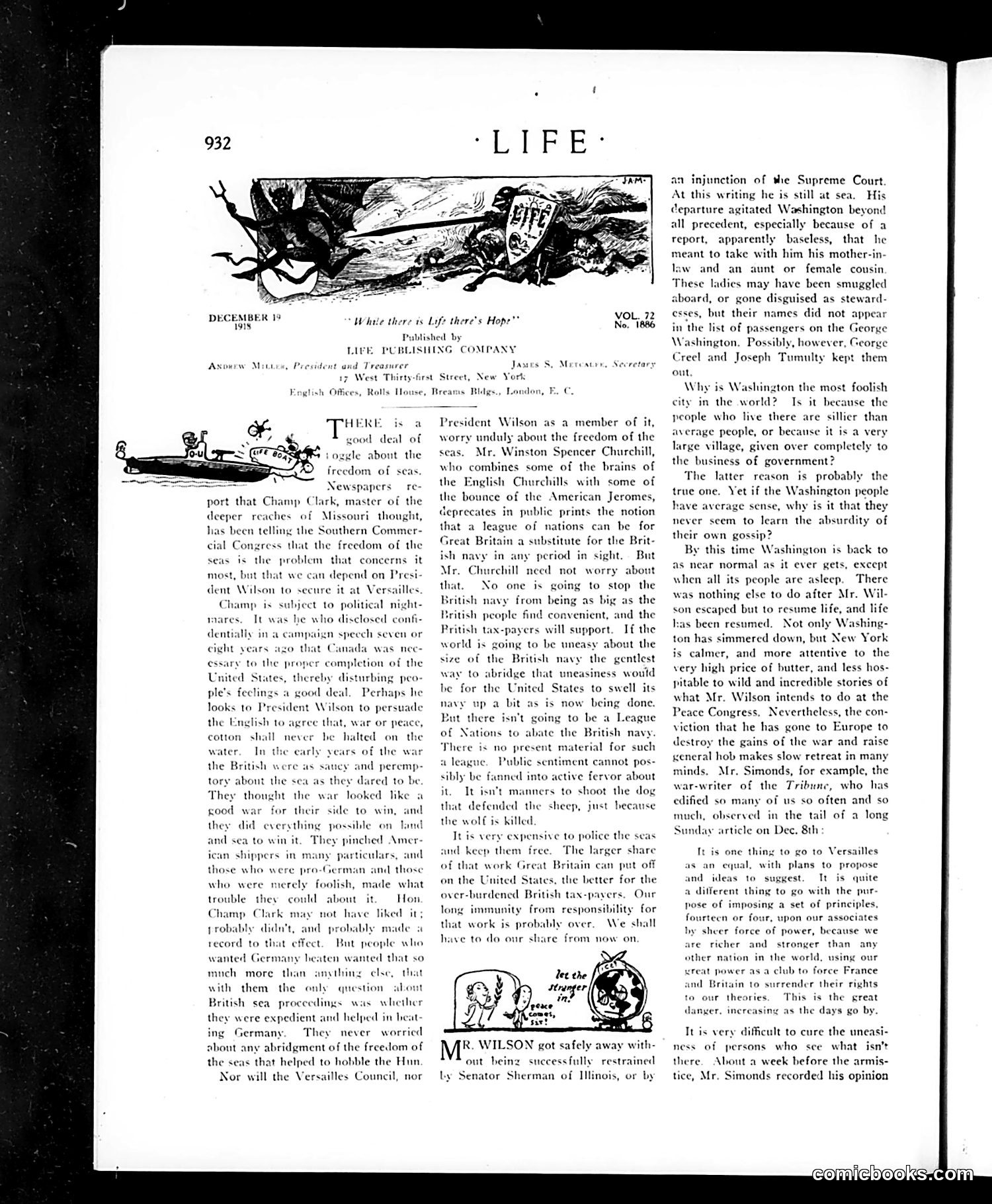
This post-WWI editorial page satirizes political figures debating naval power and the League of Nations at the Versailles Peace Conference. **The Main Targets:** - **Champ Clark** (Missouri congressman): Mocked for spreading worry about "freedom of the seas" while being prone to political paranoia and indiscreet revelations - **President Wilson**: Criticized for supposedly allowing Britain to dominate naval policy discussions **The Satire's Point:** Life argues that wartime complaints about British naval interference were hypocritical—Americans supported British sea power when it hurt Germany. Now, claiming a League of Nations will replace navies is naive; Britain will maintain its fleet regardless, and America should simply match it rather than pretend international agreements will solve the problem. **The Joke about Wilson's Departure:** A humorous aside mocks Washington gossip that Wilson planned to smuggle his mother-in-law to Versailles—presented as baseless but typical of the city's rumor-mongering. The overall tone: pragmatic cynicism about post-war idealism.
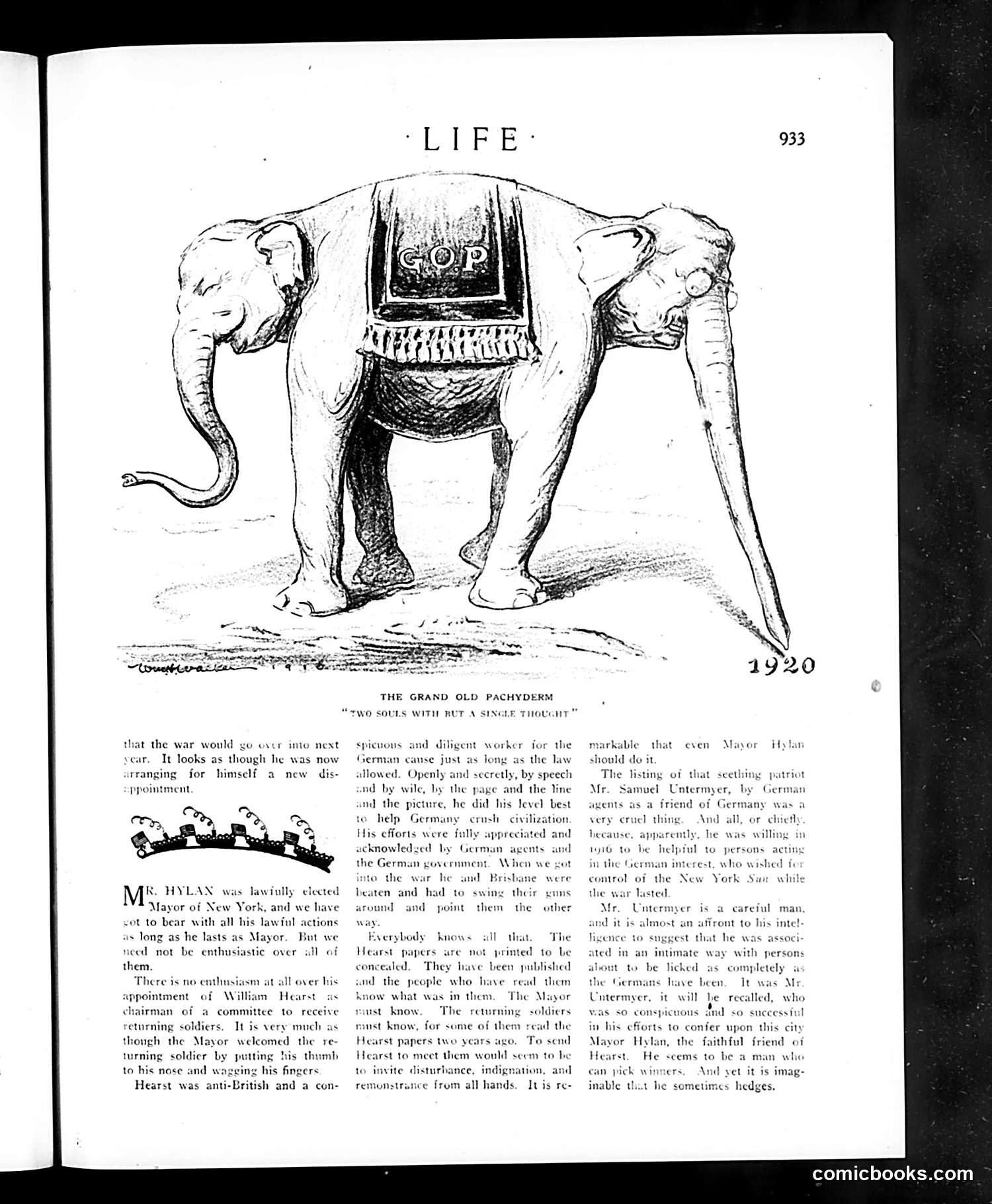
This 1920 *Life* cartoon satirizes Mayor John Hylan's appointment of William Randolph Hearst to chair a committee welcoming returning WWI soldiers. The drawing shows an elephant labeled "GOP" (Republican Party) carrying two figures as cargo—a visual metaphor for the absurdity of this pairing. The text explains the joke: Hearst was notoriously **pro-German during the war**, secretly aiding German interests through his publications and influence. Appointing him to greet soldiers who fought *against* Germany is insulting—like "putting his thumb to his nose and wagging his fingers" at them. The caption "Two Souls with But a Single Thought" sarcastically suggests Hylan and Hearst are ideological partners. The article also criticizes Samuel Untermyer, a lawyer who supported Hylan despite Untermyer's own German sympathies being documented by enemy agents. The satire: rewarding a wartime enemy sympathizer with a patriotic honor mocks both Hylan's judgment and the supposed values of the returning soldiers.
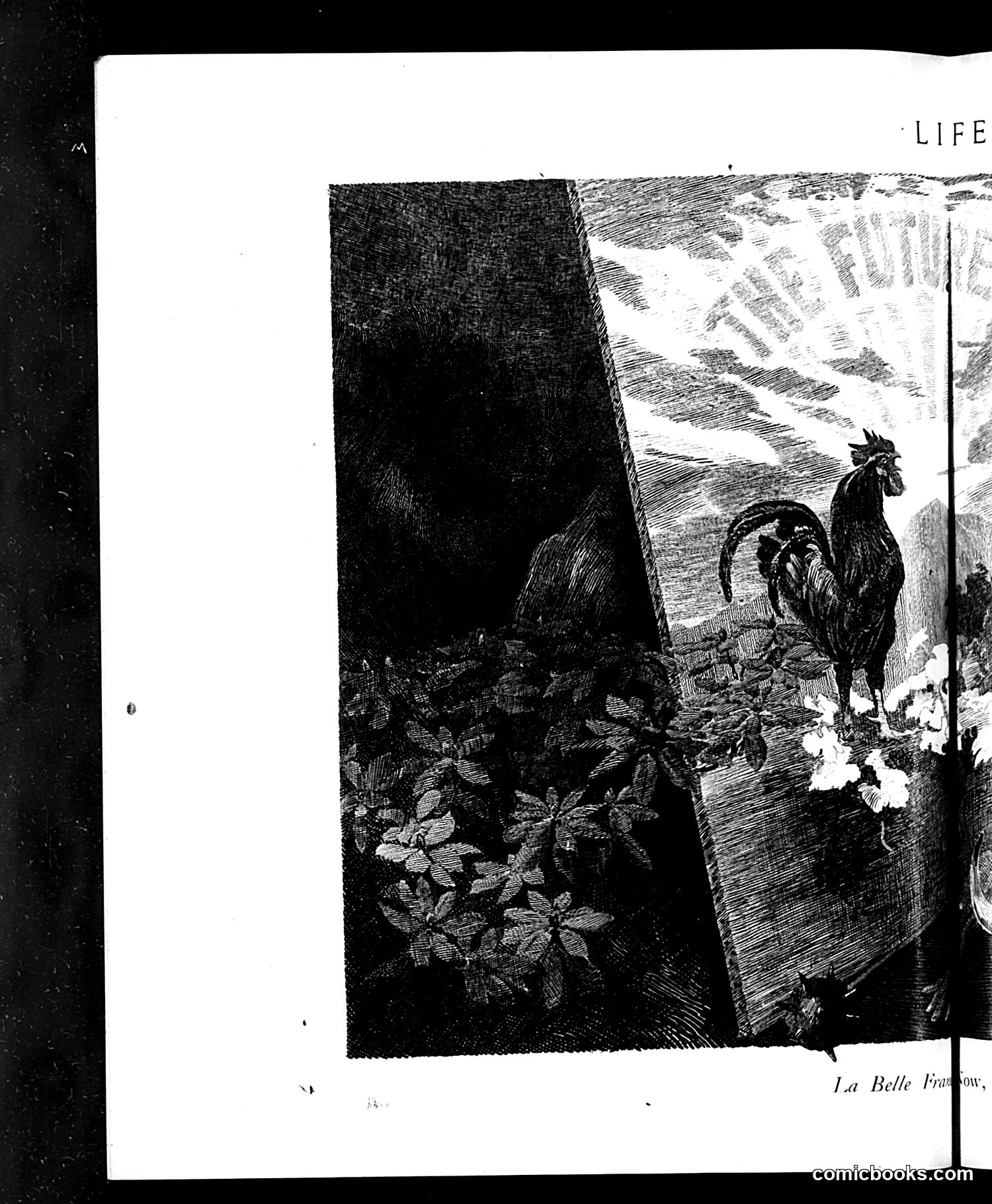
This page from *Life* magazine features an engraving titled "La Belle [Frangow]" (likely "La Belle France"—Beautiful France). The image shows a rooster standing in a pastoral landscape with a cottage, garden, and distant hills. The rooster was a traditional symbol of France in political imagery. Given *Life*'s satirical nature, this appears to be commentary on France, though the specific historical moment is unclear from the image alone. The rooster—a symbol of French national pride—positioned in an idealized rural setting may either celebrate French pastoral virtue or ironically comment on France's situation (agricultural focus, political posturing, or international standing). The OCR text is too corrupted to provide additional context. Without dating information visible, the exact satirical point remains ambiguous to modern readers.
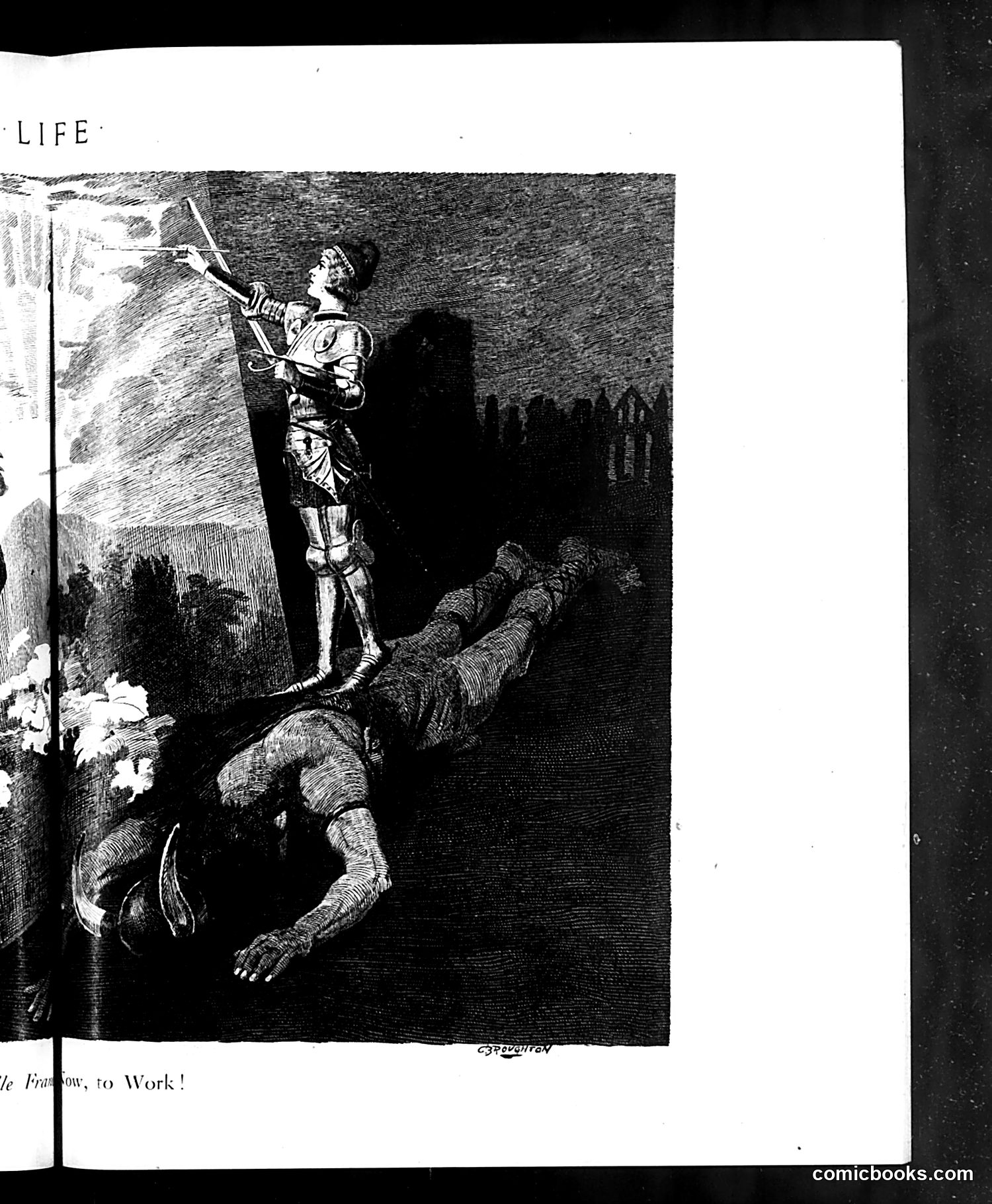
This appears to be a satirical illustration from *Life* magazine titled "To Work!" The image shows a standing figure in classical or medieval armor holding an axe, looking upward, while a prone figure lies below. The caption suggests a call to action or labor. Without being able to clearly identify the specific historical moment or the figures depicted, I cannot confidently explain which political event or social issue this cartoon references. The armor and classical styling suggest it may reference historical or mythological themes to comment on contemporary politics, but I cannot determine the precise target of the satire or identify the individuals represented based solely on what's visible here. A date would help contextualize this significantly.
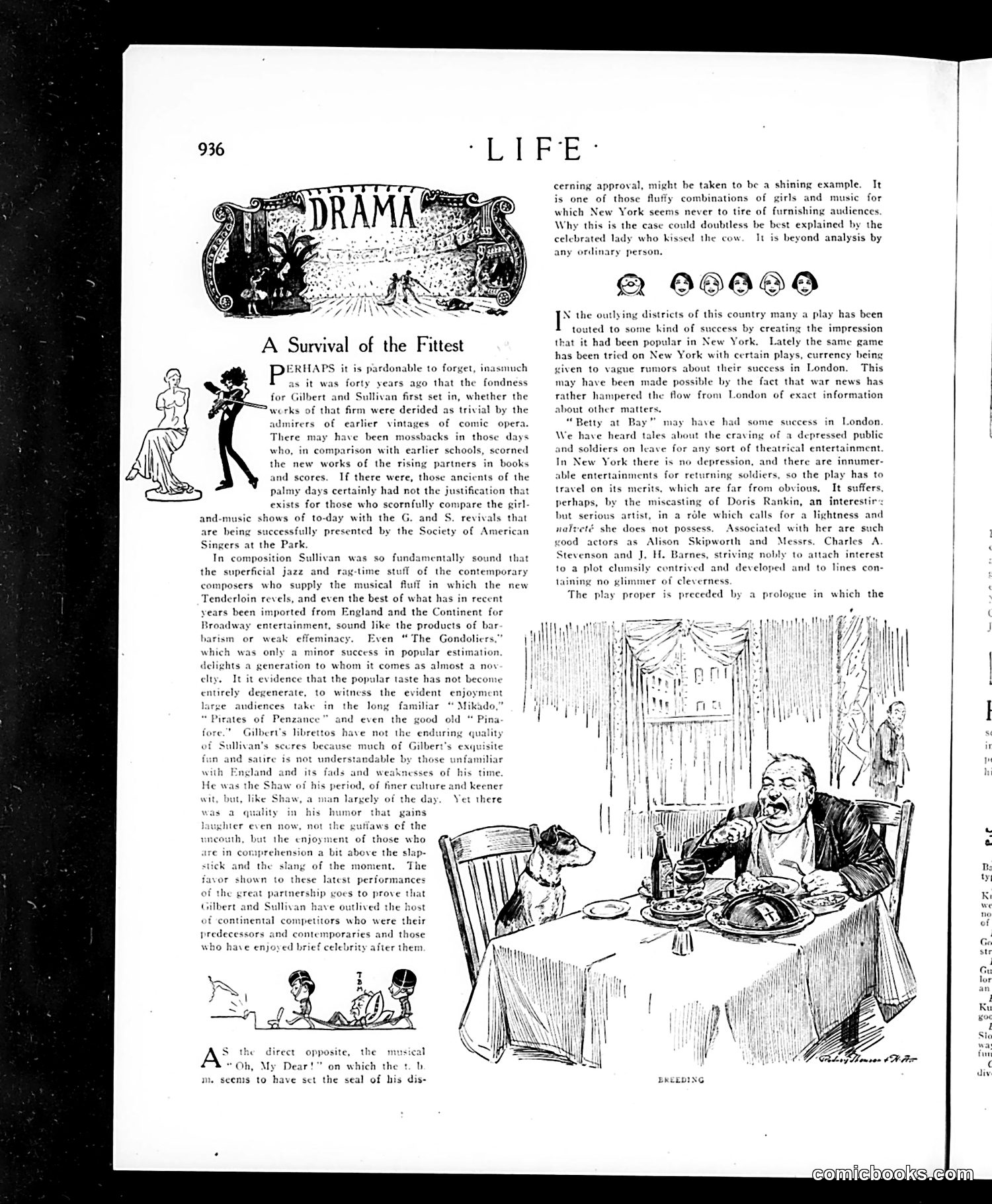
This article critiques contemporary theatrical productions, specifically plays being marketed as London successes to American audiences during wartime. The author argues that Gilbert and Sullivan operettas from forty years prior maintain superior quality compared to modern "jazz and rag-time" compositions being imported from Broadway. The piece reviews "Betty at Bay," a play featuring actress Doris Rankin (apparently miscast in a role requiring lightness she lacks), alongside accomplished actors like Alison Skipworth. The author contends that despite featuring talented performers, the play's "clumsily contrived" plot and "vague rumors" about London success cannot overcome fundamental weaknesses. The central satire targets how producers exploit unverified claims of British theatrical success to promote mediocre American plays—a wartime phenomenon made possible because accurate information from London is disrupted. The headline suggests only the "fittest" entertainment survives scrutiny; this play apparently doesn't qualify.
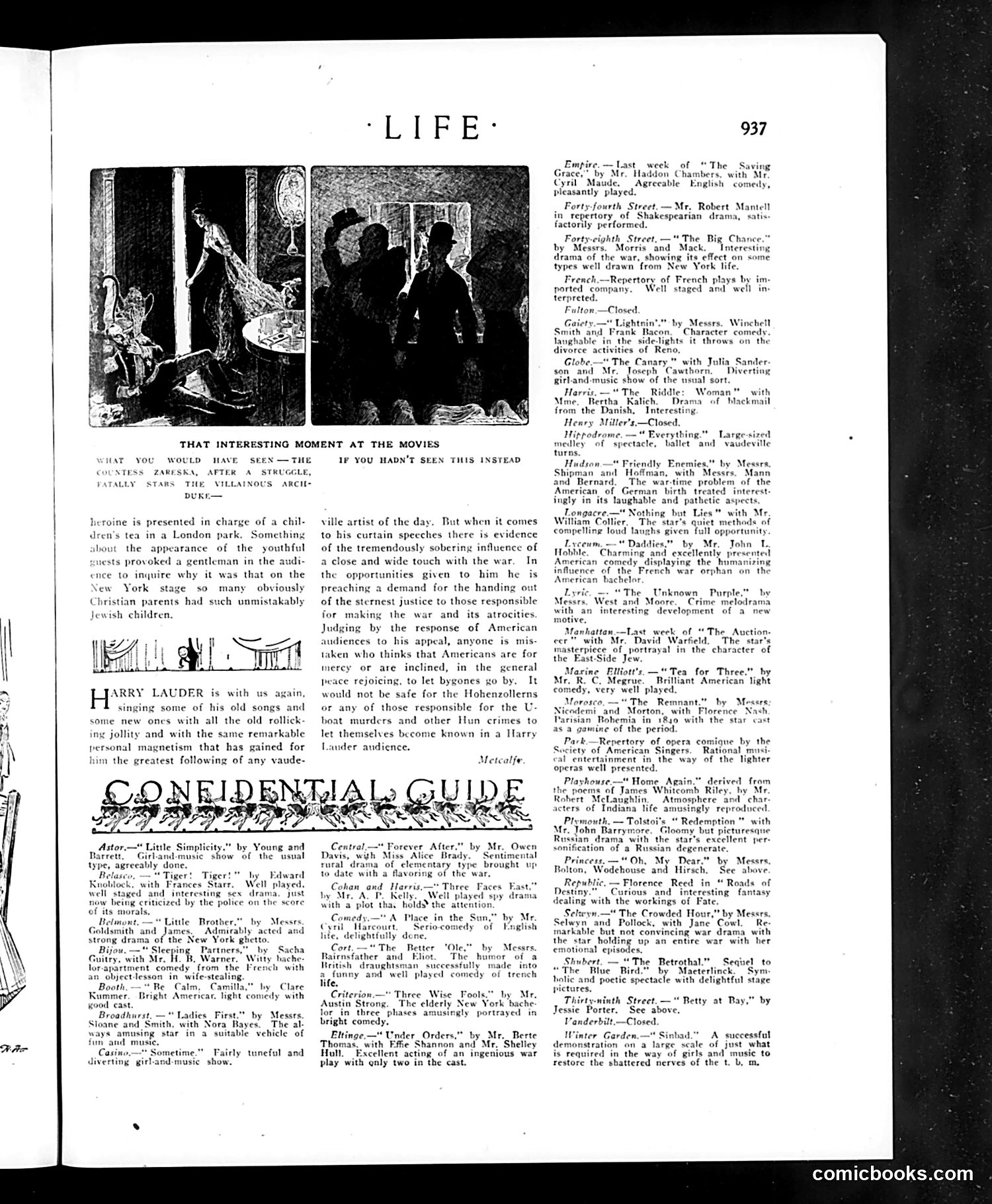
This page from *Life* magazine (page 937) contains theater reviews and one satirical cartoon titled "That Interesting Moment at the Movies." **The Cartoon's Satire:** The cartoon depicts a scene where an audience member questions why a London park children's tea scene features an obviously Christian-appearing heroine with visibly Jewish children. The satire targets **casting incongruity and social prejudice**: the joke assumes audiences would notice and care about religious/ethnic "mismatch" in theatrical productions. This reflects early 20th-century attitudes about religious segregation in entertainment and society. **Context:** The page mostly consists of theater reviews. A separate section notes **Harry Lauder's** changed curtain speeches, reflecting his serious demands for justice against those responsible for WWI atrocities and "Hun crimes"—indicating how the war had sobered even vaudeville entertainers' humor. The reviews reference multiple war-themed plays, showing WWI dominated theatrical content of this period.
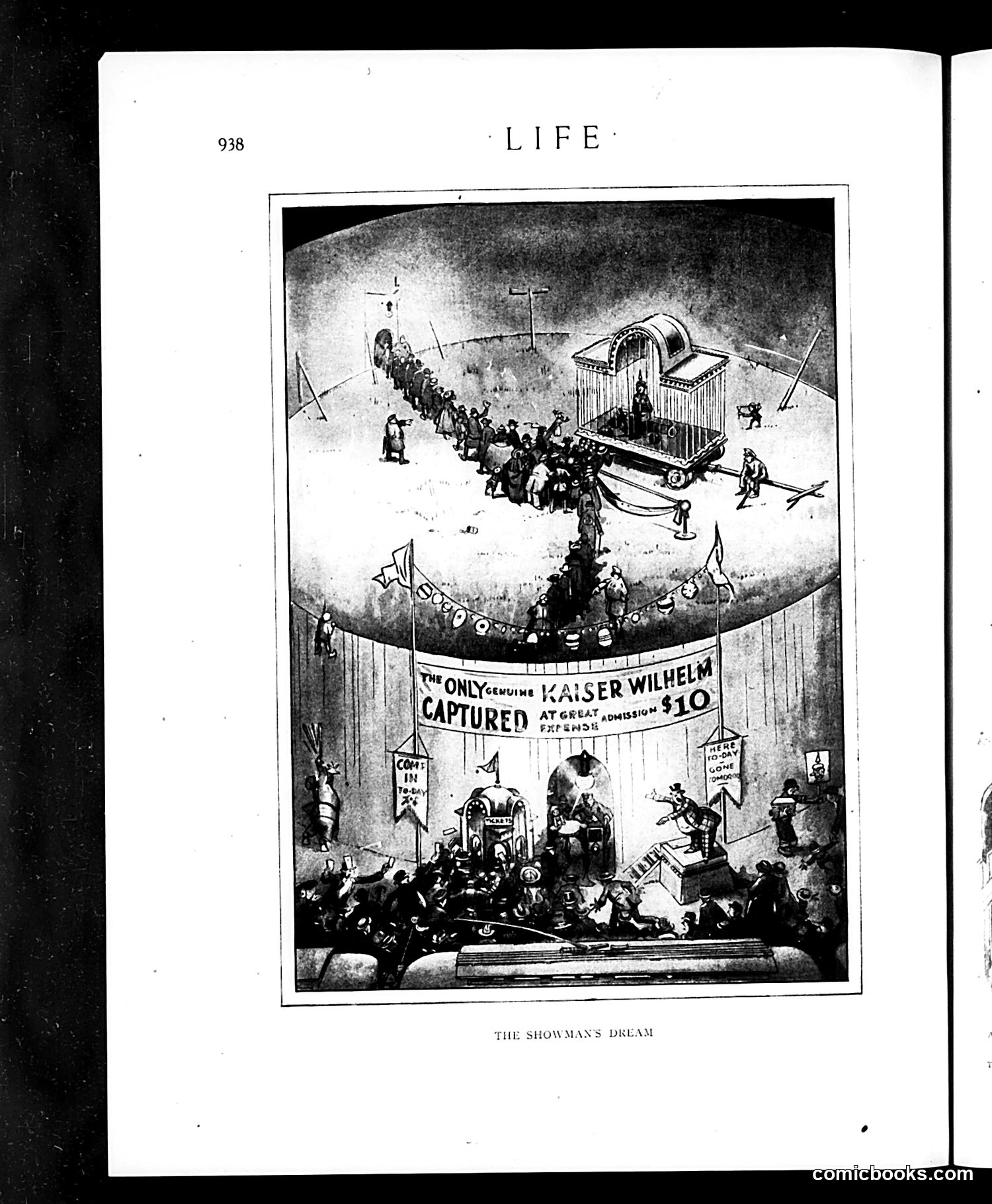
This satirical cartoon depicts a circus-like exhibition advertising "The Only Genuine Kaiser Wilhelm Captured at Great Admission $1.10 Per Admission." The image shows a carnival or fairground setting with crowds gathered below a stage, while above them is an elaborate display featuring what appears to be Kaiser Wilhelm II (German emperor during WWI) presented as a captured exhibit—literally caged like an exotic animal. The satire mocks both the public's fascination with the German leader and the commercial exploitation of wartime sentiment. By portraying Wilhelm as a sideshow attraction, the cartoon expresses American anti-German sentiment prevalent during or after World War I, while simultaneously satirizing the American showman's eagerness to profit from public curiosity about the enemy. The absurdity of presenting a world leader as carnival merchandise underscores contempt for both the Kaiser and greedy promoters.
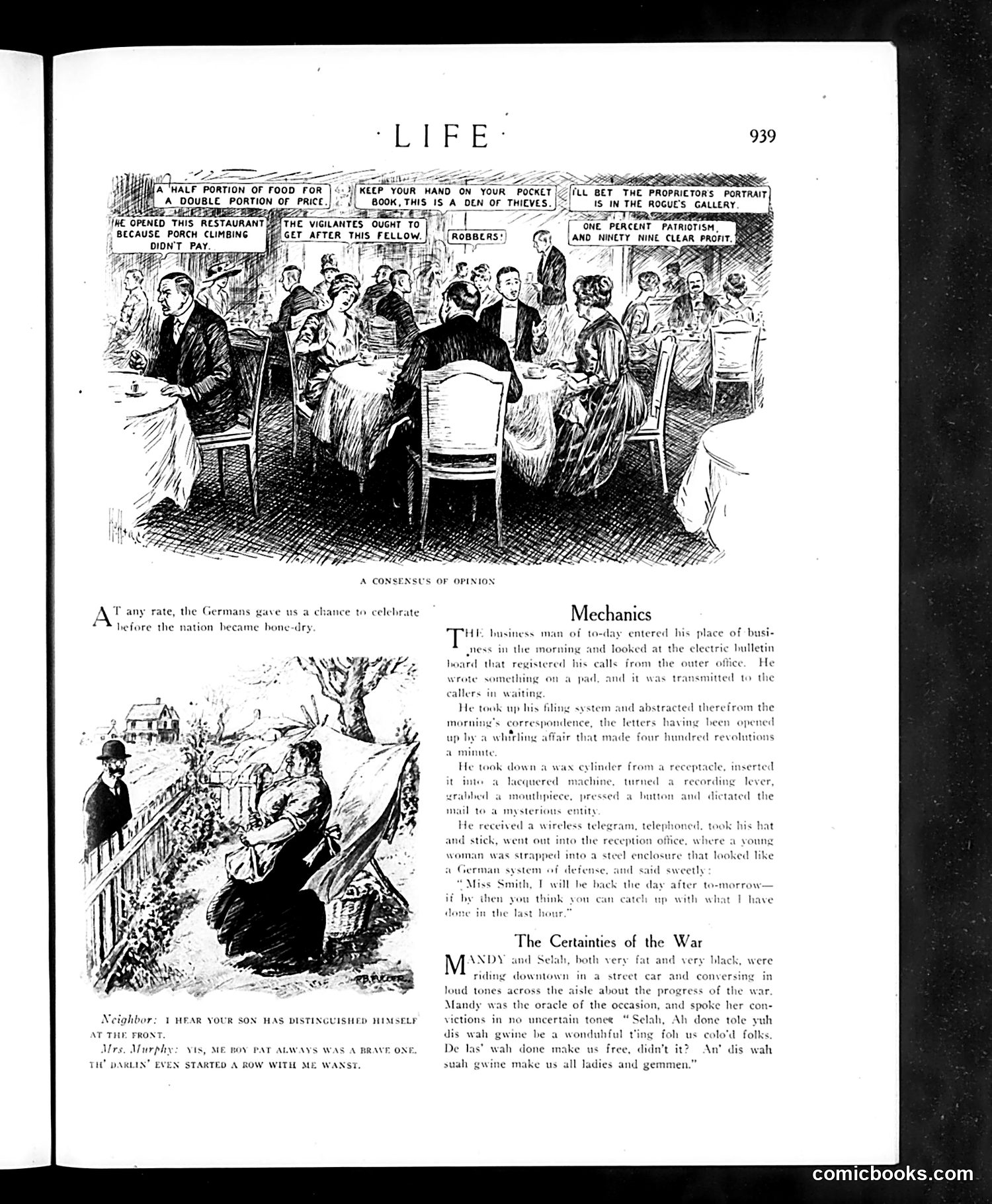
The page contains three satirical pieces: **Top cartoon** ("A Consensus of Opinion"): Depicts a restaurant scene where patrons discuss various wartime grievances. The jokes mock profiteering—one sign advertises "half a portion of food for a double portion of price," while another criticizes the proprietor as a thief who should be in a "rogue's gallery." A final quip attacks "one percent patriotism and ninety nine clear profit," skewering businesses exploiting wartime conditions for financial gain. **Middle section** ("Mechanics"): Describes a modern businessman's day using cutting-edge 1910s technology—electric bulletin boards, filing systems, wax cylinder dictation, wireless telegrams. The satire targets efficiency obsession and dehumanization of office work, particularly the image of a secretary "strapped into a steel enclosure." **Bottom piece** ("The Certainties of the War"): A dialect joke featuring Black characters (Mandy and Selah) discussing war benefits. Mandy predicts the current war will "make us all ladies and gemmen," paralleling claims that the previous war granted freedom. The humor appears to mock both naive optimism and broken promises to Black Americans.
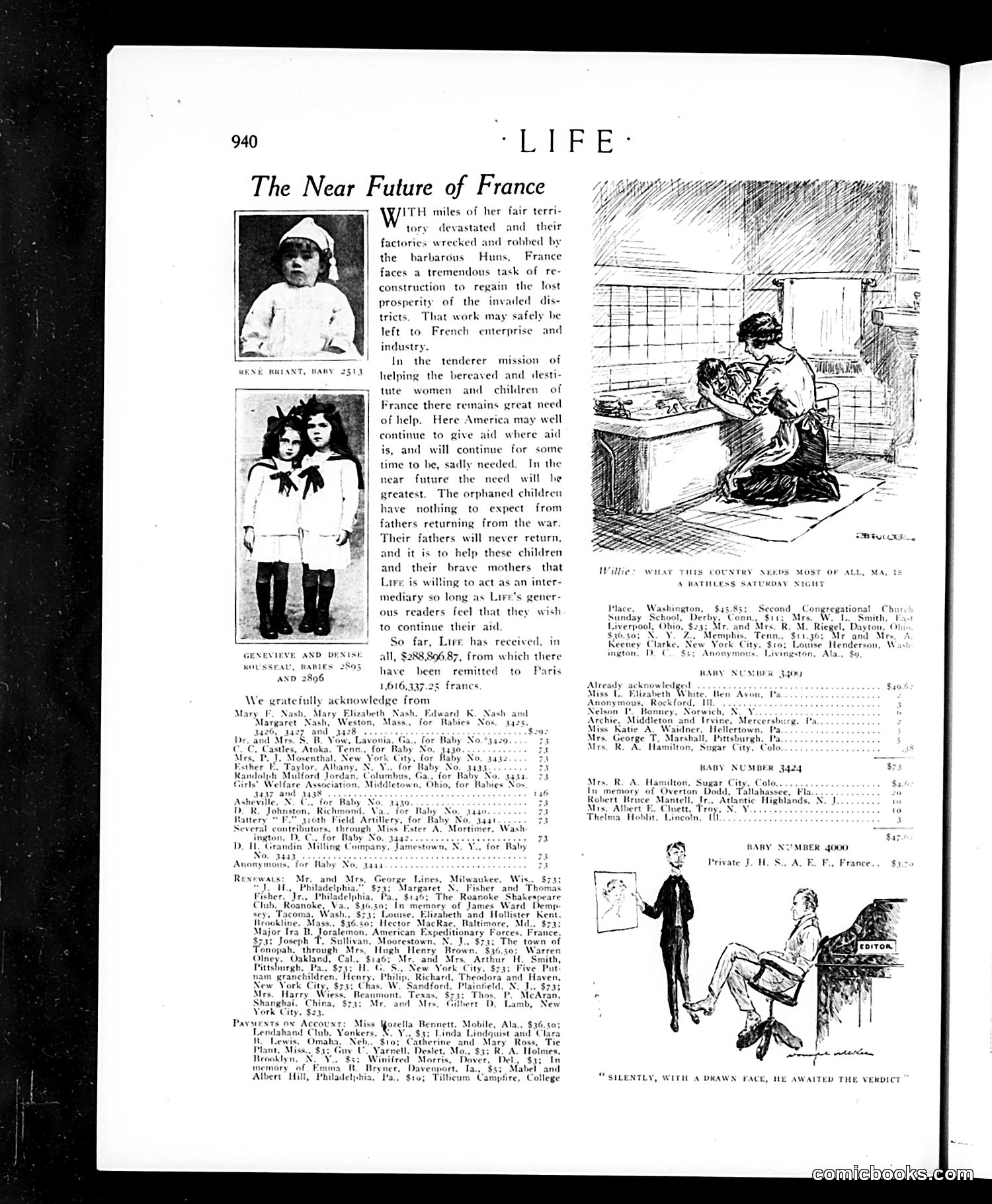
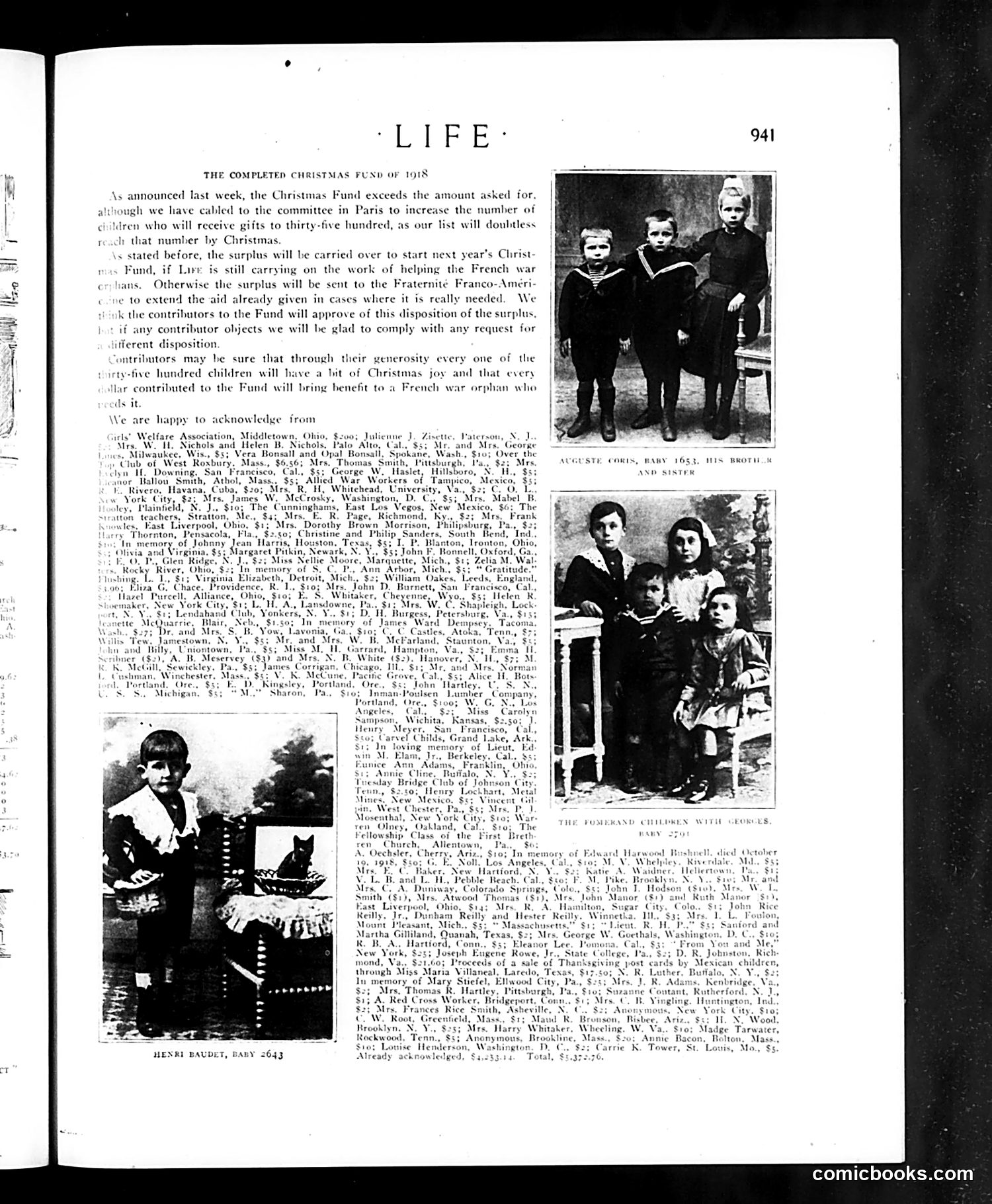
This page documents Life magazine's successful **Christmas Fund of 1918**, a charitable drive to provide gifts to French war orphans following World War I. The text announces that donations exceeded the goal, allowing them to expand from the initial target to 3,500 children. The three photographs show beneficiary children: - **Henri Baudet, Baby 2643** (lower left): a French orphan receiving aid - **Auguste Cormis, Baby 1653, His Brother and Sister** (upper right): orphaned siblings - **The Fosterand Children with Groceries** (lower right): recipients with provisions The bulk of the page lists hundreds of donors and their contributions—typical of Life's approach to publicizing charitable giving. The message is clear: American generosity helps French war victims. The surplus will either fund next year's Christmas effort or support the Franco-American Fraternity's ongoing relief work in France. This reflects post-WWI American involvement in European humanitarian aid and the magazine's role in mobilizing middle and upper-class donors.
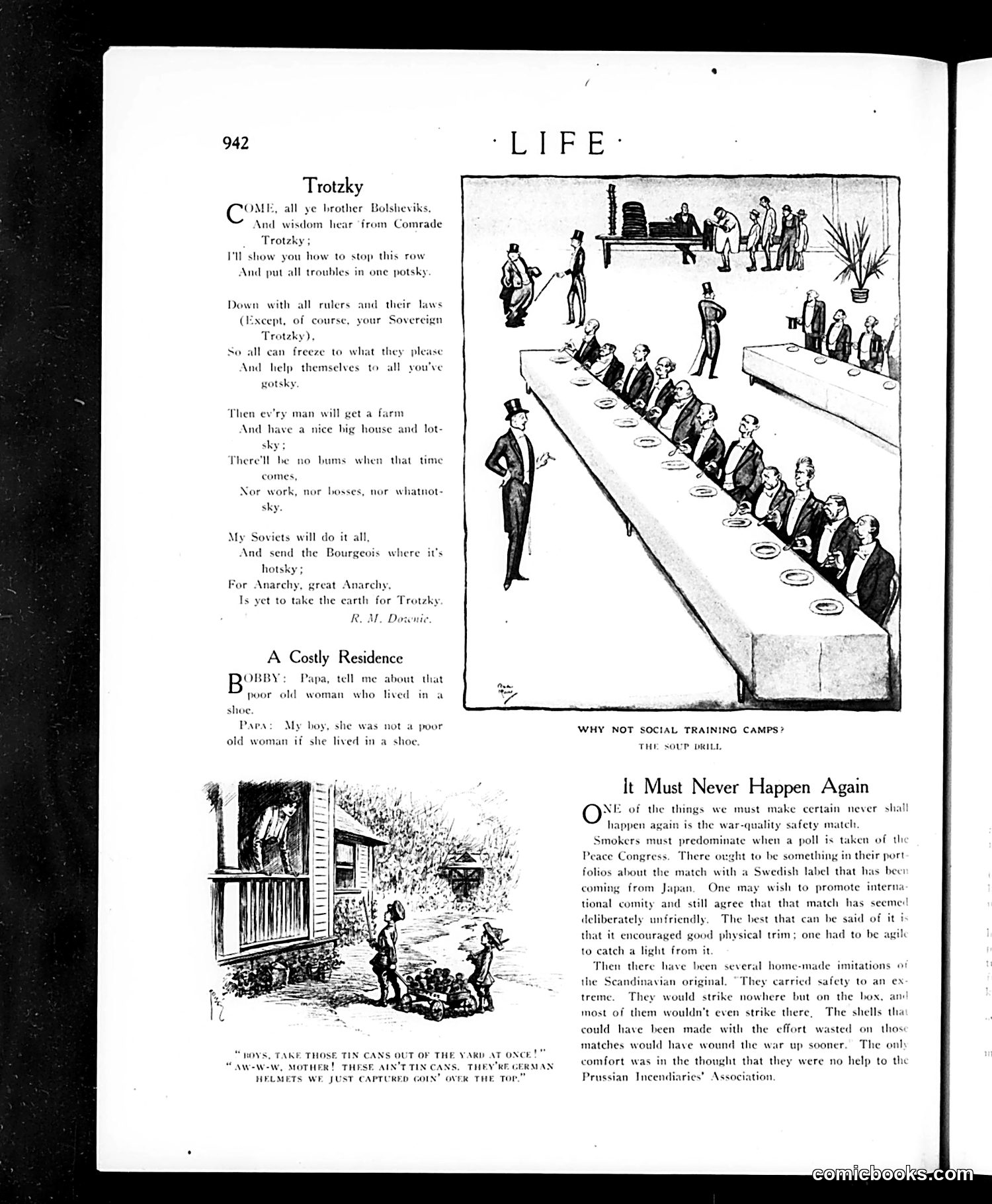
This page contains three satirical pieces from Life magazine, likely from the World War I era: **"Trotzky"** (top left): A mocking poem parodying Leon Trotsky's revolutionary promises to Bolsheviks—free farms, no work, no bosses. The satire emphasizes the unrealistic nature of communist ideology by exaggerating the "-sky" suffix and mocking Trotsky's authority, suggesting such promises were fantastical propaganda. **"A Costly Residence"** (middle): A brief joke reversing the nursery rhyme "Old Woman Who Lived in a Shoe"—the father clarifies she wasn't actually poor, since she could afford a shoe as housing, mocking the original rhyme's absurdity. **"It Must Never Happen Again"** (right): Discusses safety matches as a wartime concern, arguing that Swedish-made matches were superior to imitations. The piece satirizes military procurement, suggesting poor-quality home-made matches were wasteful, while noting the irony that the "Prussian Incendiaries' Association" might have welcomed inferior matches.
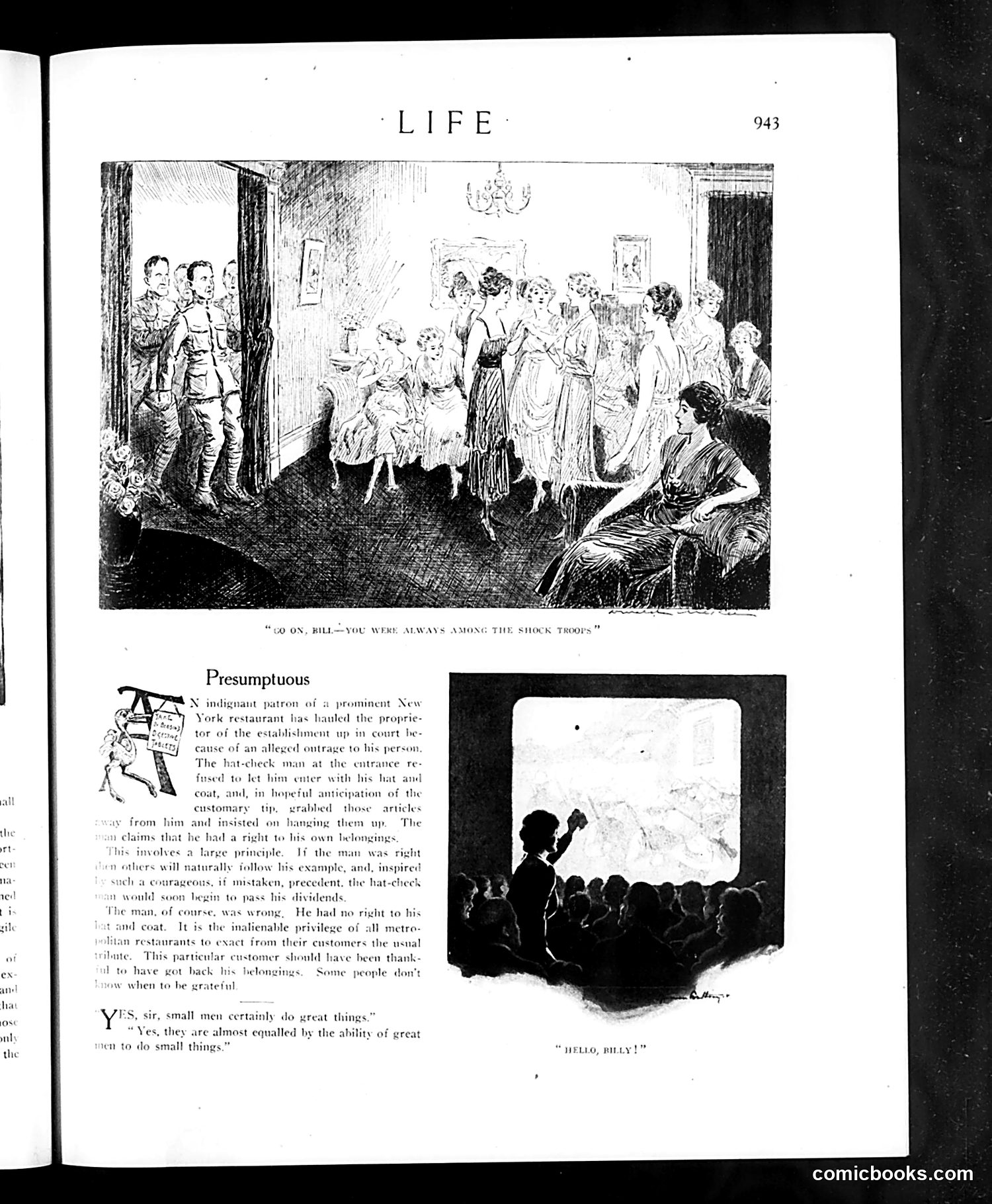
This page satirizes a petty legal dispute between a restaurant patron and its hat-check attendant. An indignant customer sued the establishment after the hat-check man refused to let him enter wearing his own hat and coat, insisting on hanging them up (presumably to secure a tip). The article mocks the customer's presumption in bringing such a trivial matter to court. It argues that metropolitan restaurants have an "inalienable privilege" to require customers to check their belongings—a standard practice of the era. The satire suggests the customer should be grateful to receive his items back at all, not litigious over the principle. The accompanying illustrations show a formal party scene and a small figure greeting someone named "Billy," though the connection between image and text isn't entirely clear. The final quoted exchange—about small men doing great things and great men doing small things—reinforces the mockery of this petty legal action.
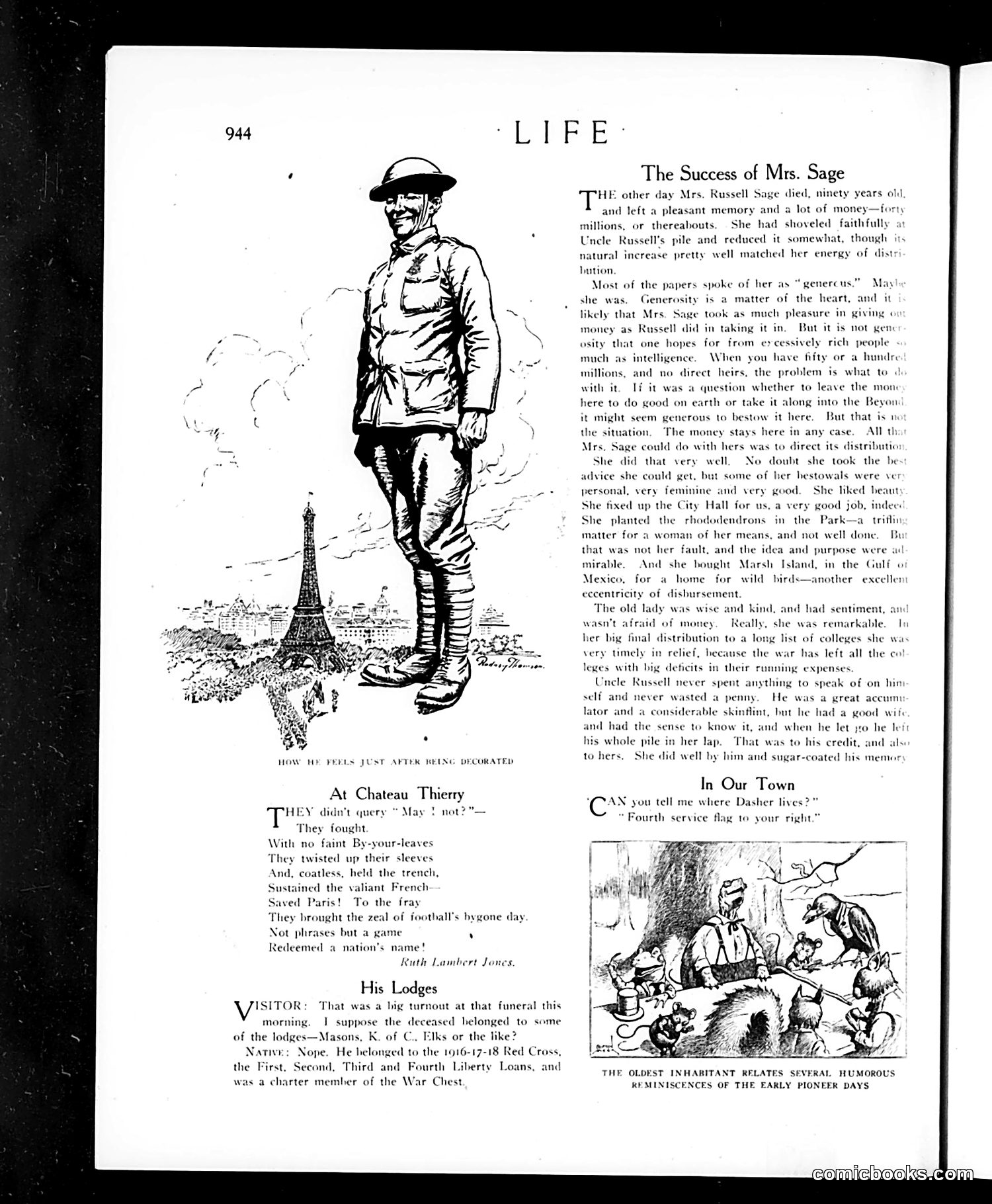
This page contains WWI-era content celebrating American soldiers and philanthropy: **Main Illustration**: A decorated soldier standing at Chateau Thierry (a major 1918 WWI battle). The caption "How he feels just after being decorated" shows pride in military service. The poem by Ruth Lambert Jones celebrates American soldiers' courage and sacrifice in France, contrasting their selfless action ("not phrases but a game") with European formality. **"His Lodges"**: A humorous exchange where a visitor assumes a deceased man belonged to fraternal organizations (Masons, Elks, K. of C.), but learns he actually belonged to wartime civic organizations—Red Cross, Liberty Loans, War Chest. This satirizes how WWI service and charitable war contributions had replaced traditional fraternal lodge membership as markers of community standing. **"The Success of Mrs. Sage"**: An obituary essay praising the widow of industrialist Russell Sage for distributing her $40 million fortune intelligently, funding colleges and conservation efforts, particularly during wartime economic strain on institutions. The page reflects 1918 American values: military heroism, patriotic giving, and women's philanthropic roles.
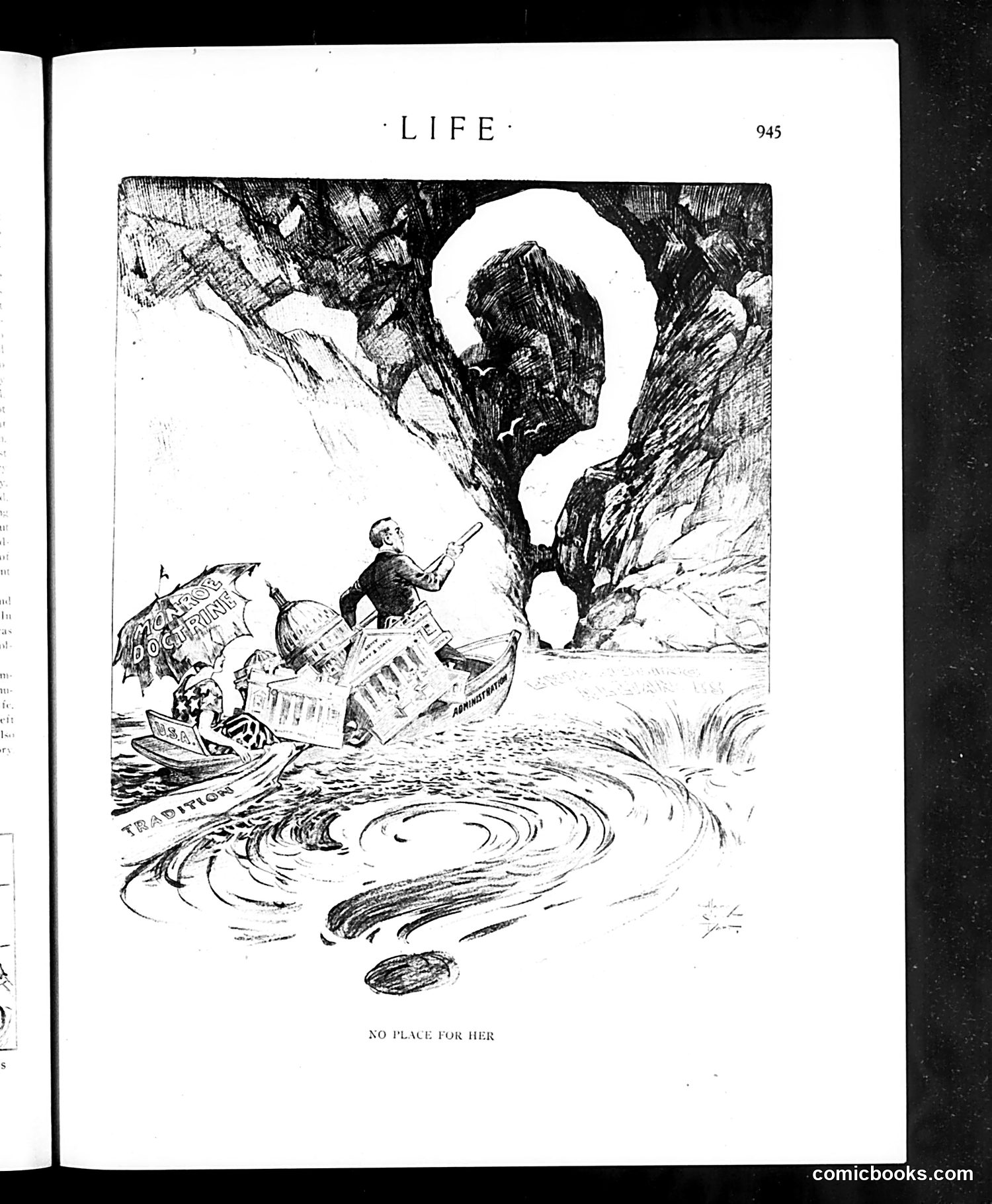
This satirical cartoon depicts a woman being driven away from a rocky, inhospitable landscape by a man wielding a gun. The man carries items labeled "TRADITION" and "AMBITION," while a boat nearby displays "TRADITION" as well. The caption "No Place for Her" suggests commentary on women's exclusion from certain spheres—likely professional, political, or social spaces dominated by tradition and male ambition. The hostile terrain and armed figure represent barriers preventing women's entry or participation. The cartoon appears to critique how societal traditions are weaponized to exclude women from opportunities, portraying these exclusions as actively hostile rather than neutral. Without specific dating, the exact historical context remains unclear, though this reflects early-to-mid 20th century feminist concerns about institutional gatekeeping.
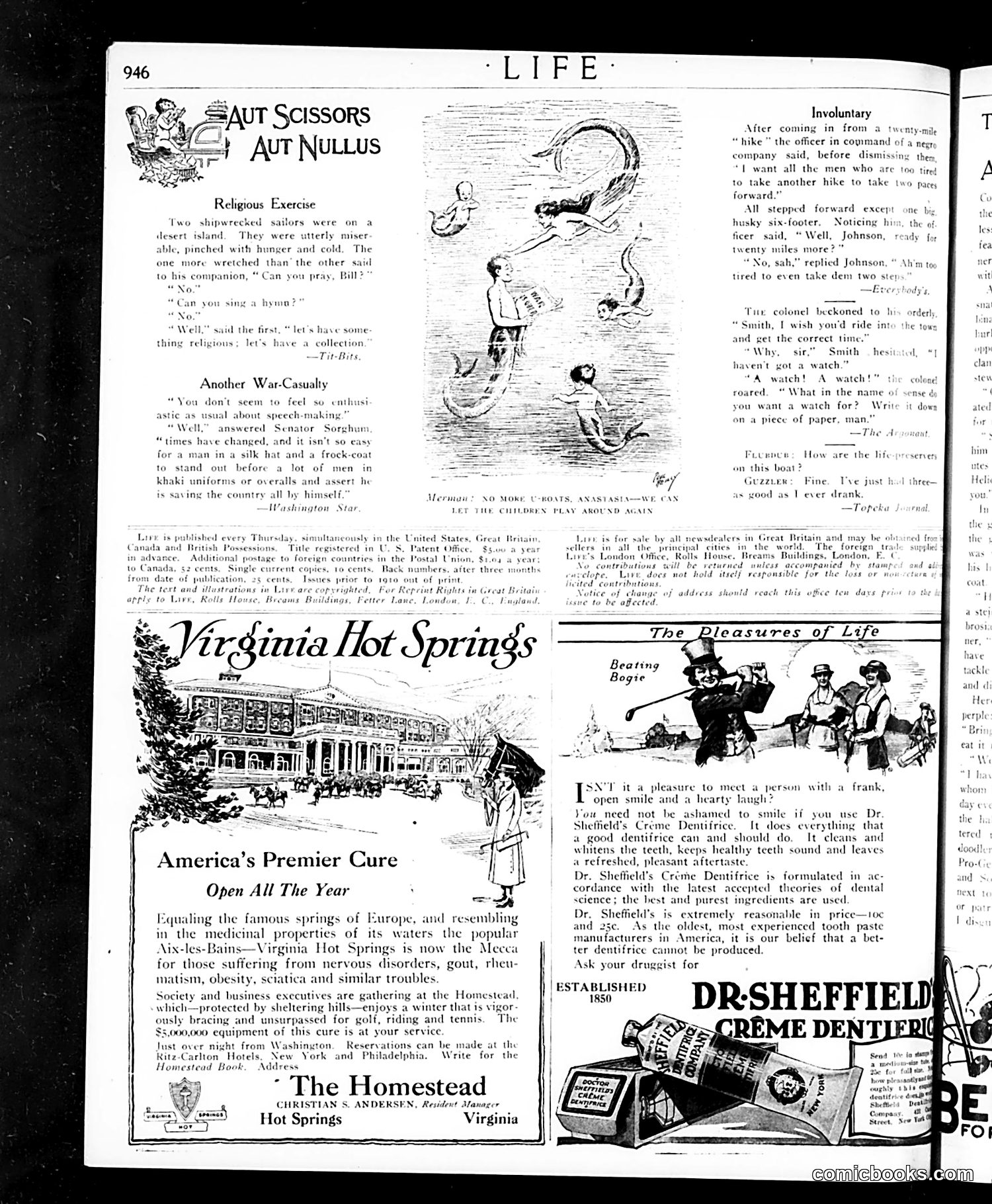
This page contains several short humorous pieces typical of Life's satirical format: **"Religious Exercise"** depicts two shipwrecked sailors so desperate they resort to holding a "collection" (taking up money) as their idea of religious observance—satirizing both religious hypocrisy and financial desperation. **"Another War-Casualty"** critiques wartime rhetoric. A politician in formal dress claims to be "saving the country" while working men in khaki uniforms do actual labor—mocking wealthy officials' self-aggrandizement during wartime while soldiers bear real burdens. **"Involuntary"** and related military anecdotes mock military absurdity: officers issuing illogical orders and soldiers' deadpan responses to bureaucratic nonsense. The page is primarily **advertising**: Virginia Hot Springs resort, The Homestead hotel, and Dr. Sheffield's Creme Dentifrice dominate the layout. The cartoons serve as editorial content framing commercial messages—typical of Life's mixed format. The humor targets class pretension, military inefficiency, and wartime contradictions, reflecting early-20th-century American satirical concerns.
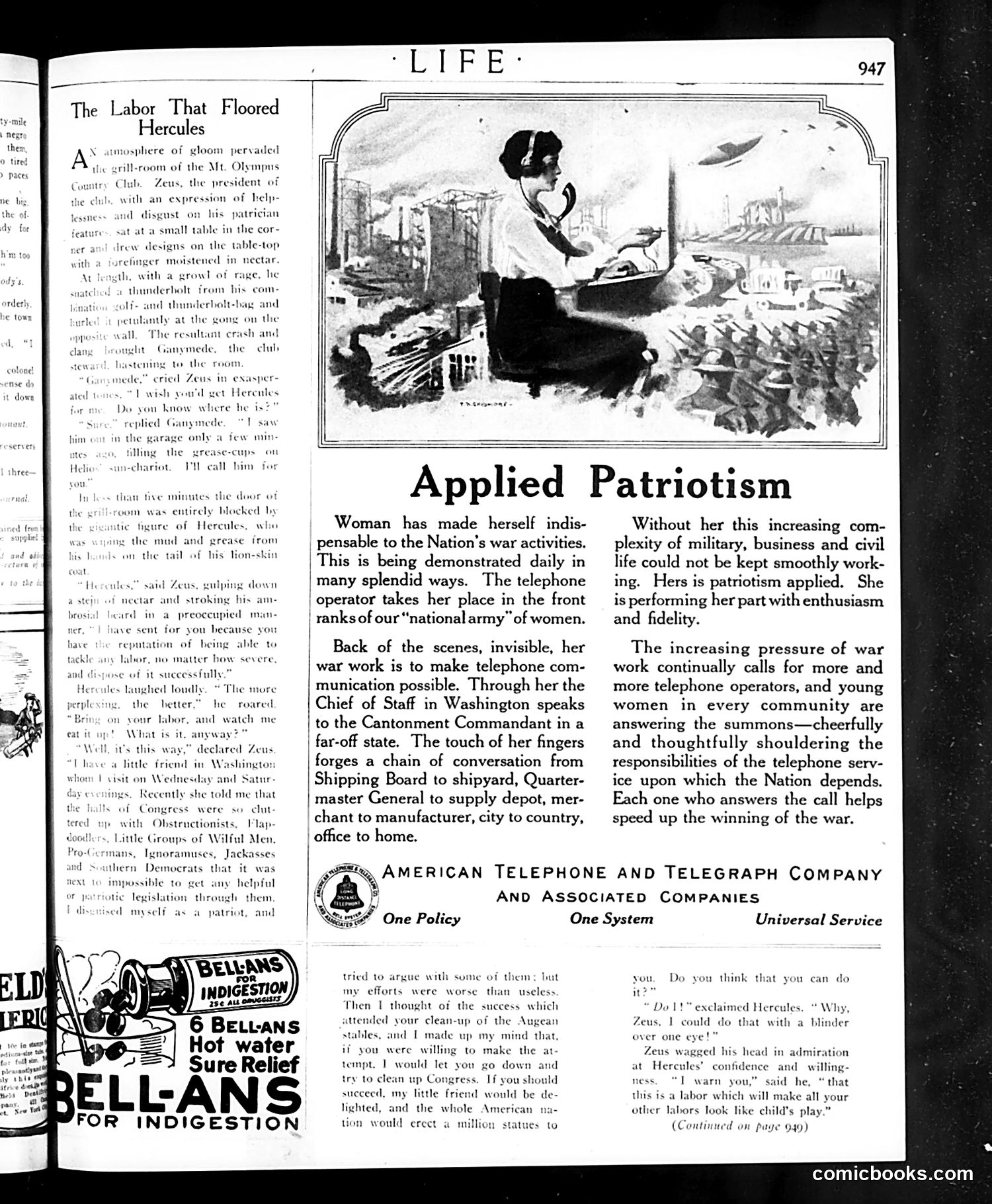
This is a satirical short story (continued from a previous page) using classical mythology to critique U.S. Congress. Zeus tasks the mythological hero Hercules with "cleaning up Congress"—framed as his most difficult labor yet, harder than his famous Twelve Labors. The satire targets Congressional dysfunction: Zeus complains that Congress is "cluttered" with "Obstructionists, Flappers, Little Groups of Wilful Men, Ignoramuses, Jackasses and Southern Democrats" blocking helpful legislation. The accompanying **"Applied Patriotism" advertisement** (by AT&T) uses wartime messaging to promote female telephone operators as essential war workers, showing how women were recruited into the workforce during WWI while maintaining patriotic rhetoric about their "duty." Both pieces reflect early-20th-century frustrations: political gridlock in Congress and the mobilization of women's labor for wartime needs.
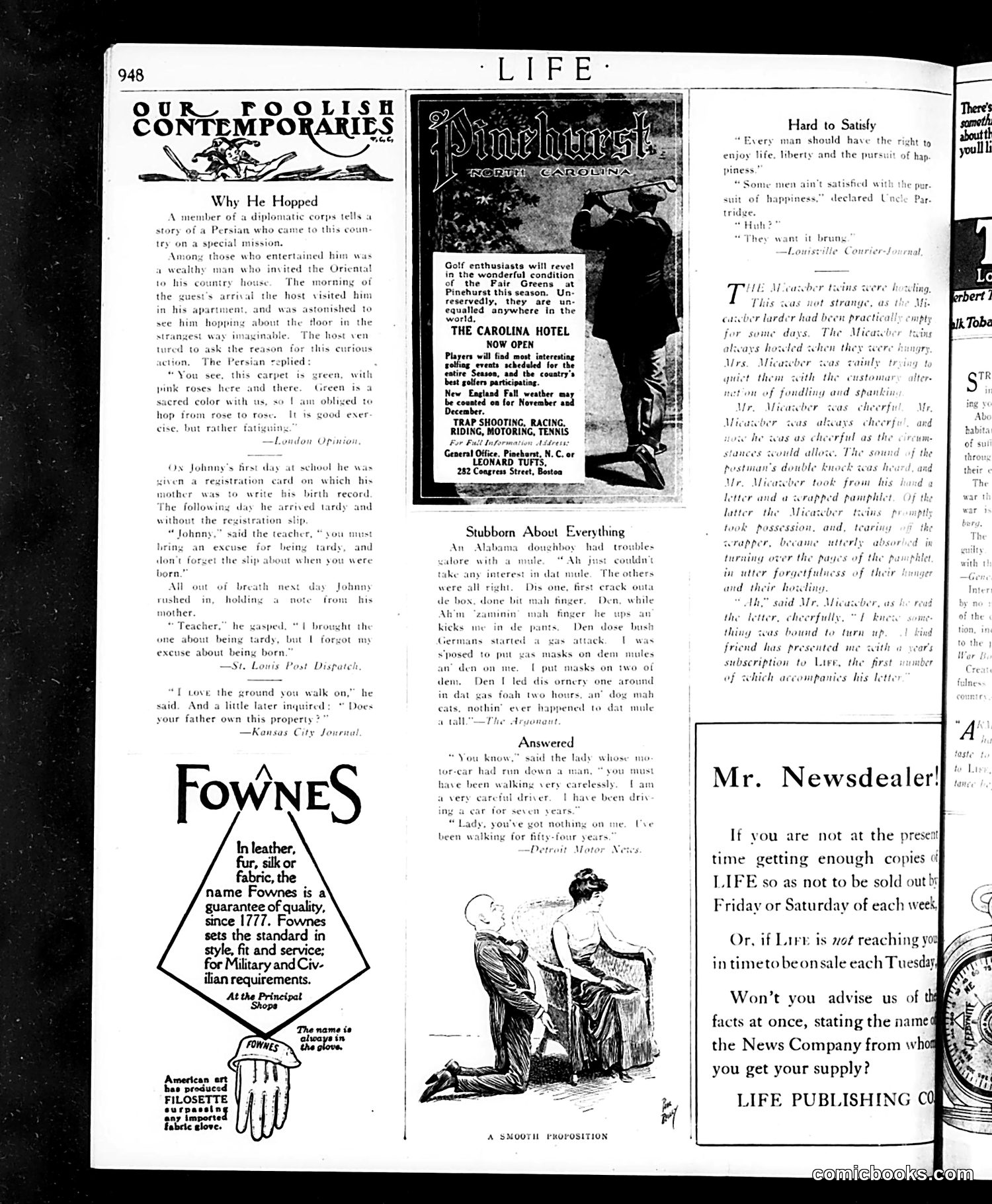
This page from *Life* magazine (page 948) contains three humorous anecdotes in the "Our Foolish Contemporaries" section, plus advertisements. The first story mocks a Persian diplomat who obsessively hops on a green carpet, believing it "good exercise." The satire targets foreign visitors' peculiar habits and misunderstandings of Western customs. The second anecdote ridicules a schoolteacher's literal-minded bureaucracy: when a tardy boy Johnny cannot produce his birth registration, the exasperated teacher demands he bring an "excuse about being born"—absurdist humor highlighting administrative rigidity. The third piece ("Stubborn About Everything") presents a humorous Alabama soldier's dialect-heavy account of a mule that refuses cooperation despite various coercive attempts. The humor derives from the animal's stubborn personality mirroring human obstinacy. The remaining content includes advertisements for Fownes gloves, the Carolina Hotel at Pinehurst (golf resort), and a notice from *Life* Publishing seeking newsdealer feedback about distribution.
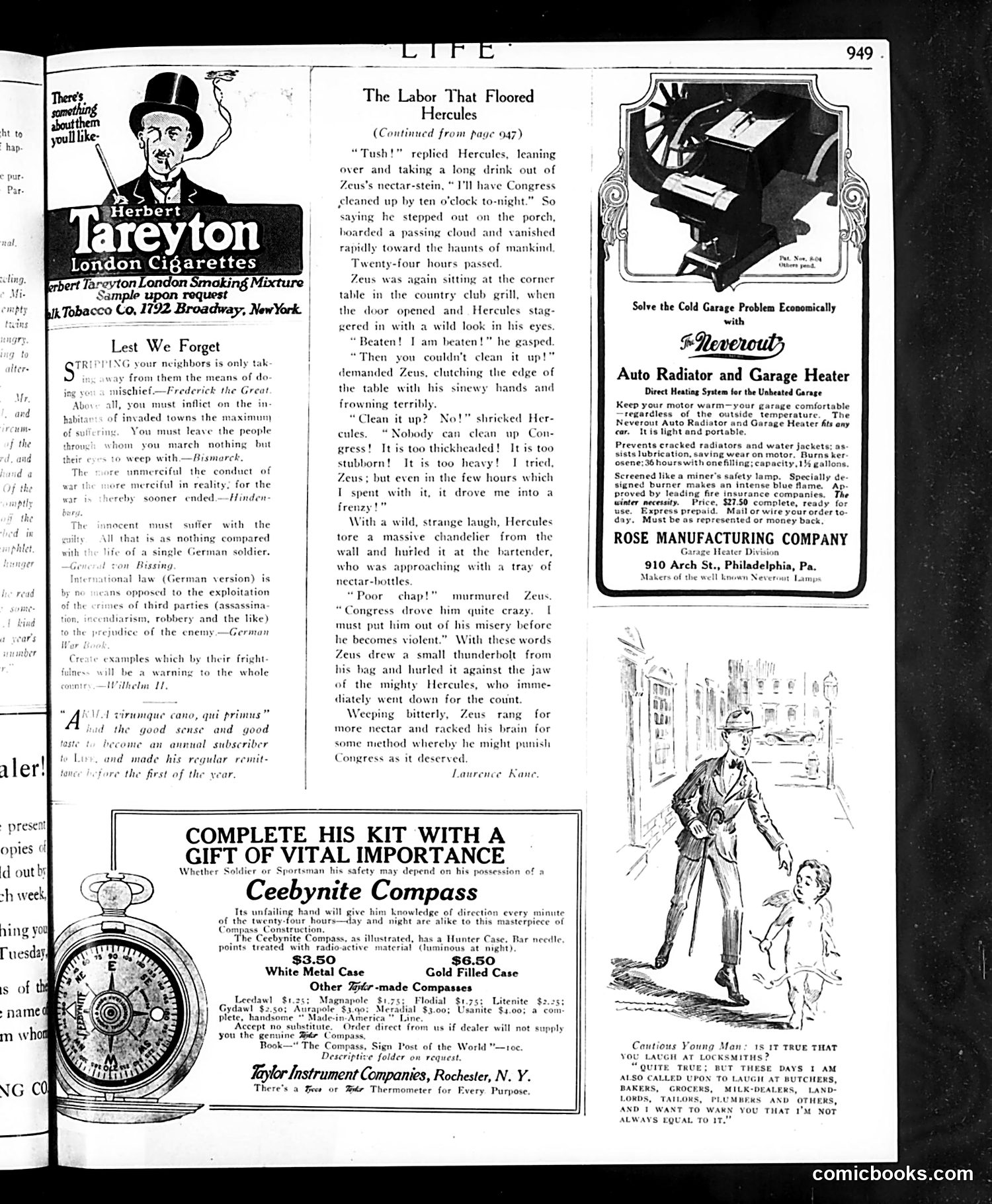
This page features a satirical story titled "The Labor That Floored Hercules," a political allegory mocking Congress. **The Satire:** Hercules, the mythological strongman, accepts Zeus's challenge to clean up Congress by "ten o'clock to-night." After 24 hours, Hercules returns defeated, declaring Congress impossible to clean—"too thickheaded," "too stubborn," "too heavy." He descends into violent madness, ultimately forcing Zeus to kill him with a thunderbolt to end his misery. **The Point:** Congress is presented as an insurmountable labor—even more impossible than Hercules's famous Twelve Labors. The satire suggests Congress is fundamentally unreformable, too obstinate and incompetent to be fixed by any force, no matter how powerful. **Context:** This likely reflects post-World War I American frustration with congressional inefficiency and partisanship during the 1920s. The dark ending (Hercules's death) emphasizes the hopelessness of expecting congressional reform. The page also contains period advertisements for cigarettes, compasses, and automotive heaters.
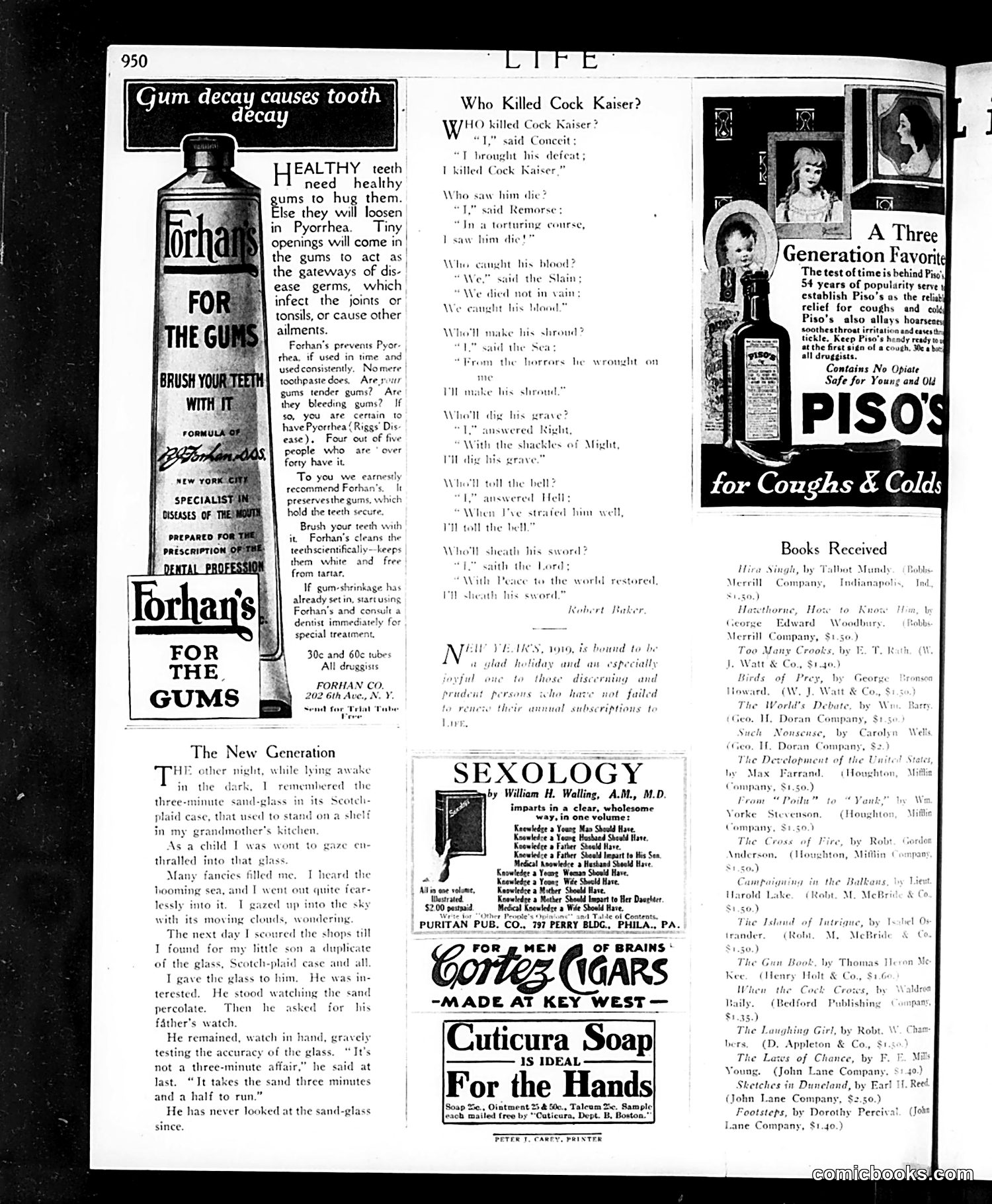
This is primarily an **advertising page** from Life magazine (circa 1919, based on "New Years, 1919" reference). The content includes: **Main Features:** - A poem titled "Who Killed Cock Kaiser?" — a nursery-rhyme parody about Kaiser Wilhelm II's defeat in World War I, presenting his death as collective justice ("Remorse" saw him die, "Hell" tolls the bell, "Peace" sheathes his sword) - A short story, "The New Generation," contrasting old and new attitudes toward time and measurement - Multiple advertisements (Forhan's toothpaste, Piso's cough medicine, Cuticura Soap, Cortez Cigars) - A "Books Received" section listing newly published titles **Historical Context:** The Kaiser poem reflects post-WWI American sentiment celebrating Germany's military defeat. The advertisements reflect early 20th-century medical claims (Forhan's preventing pyorrhea, Piso's cough remedy), typical of an era before strict FDA regulation. The page reflects Life's format: mixing serious literary content with commercial messaging and topical humor.