
Life, 1918-12-19 · page 21 of 34
Life — December 19, 1918 — page 21: what you’re looking at
What you’re looking at
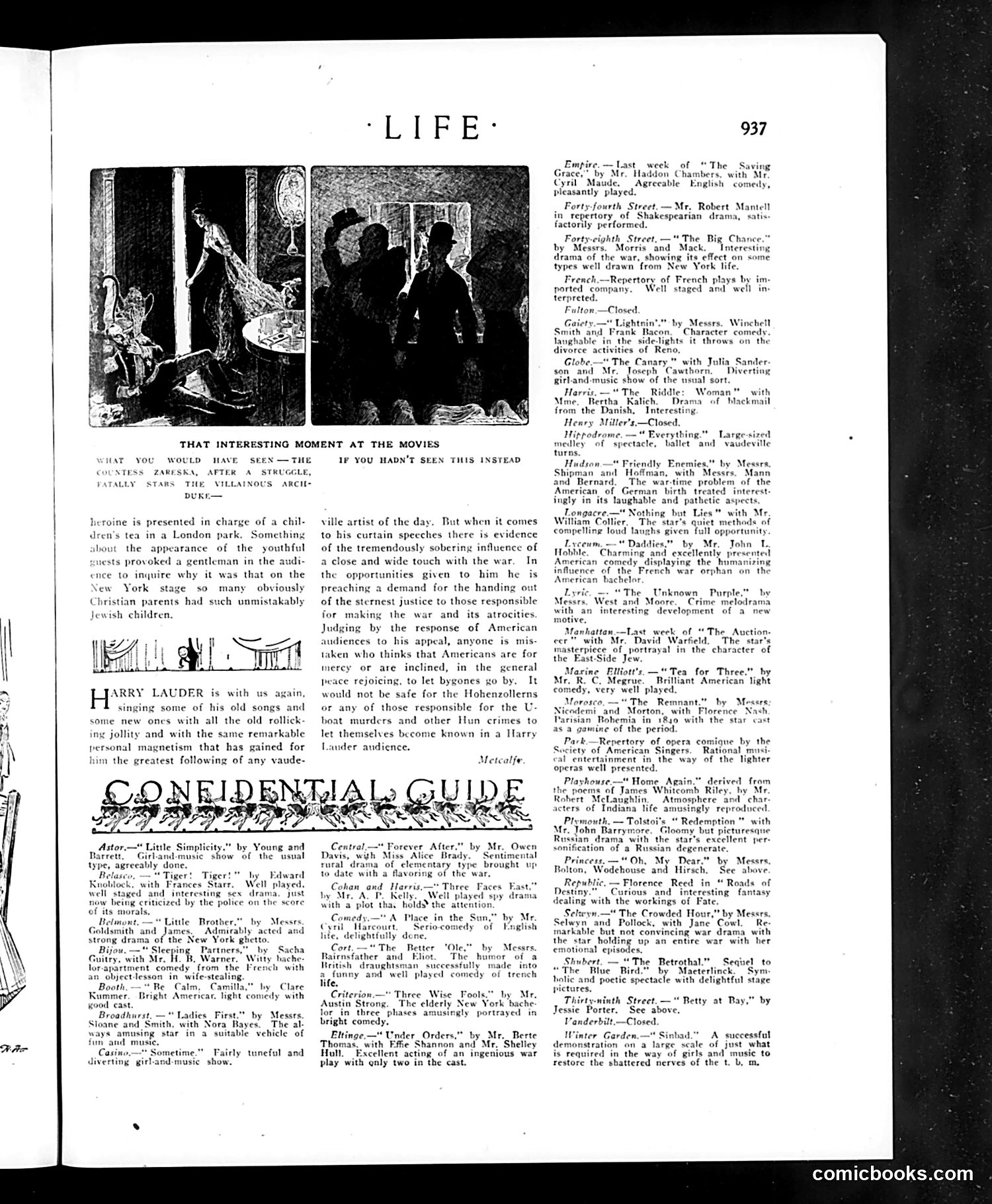
This page from *Life* magazine (page 937) contains theater reviews and one satirical cartoon titled "That Interesting Moment at the Movies." **The Cartoon's Satire:** The cartoon depicts a scene where an audience member questions why a London park children's tea scene features an obviously Christian-appearing heroine with visibly Jewish children. The satire targets **casting incongruity and social prejudice**: the joke assumes audiences would notice and care about religious/ethnic "mismatch" in theatrical productions. This reflects early 20th-century attitudes about religious segregation in entertainment and society. **Context:** The page mostly consists of theater reviews. A separate section notes **Harry Lauder's** changed curtain speeches, reflecting his serious demands for justice against those responsible for WWI atrocities and "Hun crimes"—indicating how the war had sobered even vaudeville entertainers' humor. The reviews reference multiple war-themed plays, showing WWI dominated theatrical content of this period.
📄 Transcribed text from this page (OCR, searchable)
Machine-transcribed from the original scan — historical spelling and the odd misread are preserved.
Ram THAT INTERESTING MOMENT AT THE MOVIES MAT YOU WOULD HAVE SEEN — THE COUNTESS ZARESKA, APTER A STRUGGLE, FATALLY STARS THE VILLAINOUS ARCH DUKE— heroine is presented in charge of a chil- dren's tea ina London park. Something abe ests provoked a gentleman in the audi- the appearance of the youthful ence to inquire why it was that on the New York stage so many obviously Christian parents had such unmistakably Jewish children. WELZ, 3 | Wii Nw ARRY LAUDER is with us again, singing some of his old songs and some new ones with all the old rollick- ing jollity and with the same remarkable personal magnetism that has gained for him the greatest following of any vaude- 1F YOU HADN'T SEEN THIS INSTEAD rtist of the day, But when it comes to his curtain speeches there is evidence of the tremendously sobering influence of a close and wide touch with the war. In the opportunities given to him he is preaching a demand for the handing out of the sternest justice to those responsible for making the war and its atrocities. Judging by the response of American audiences to his appeal, anyone is mis- taken who thinks that Americans are for y or are inclined, in the general ¢ rejoicing, to let bygones yo by. It b would not be safe for the Hohenzollerns a boat murders and other Hun crimes to let themselves become known in a Harry Lander audience. ny of those responsible for the U Metcalfe Astor.—“ Little Simplicity.” by Young and Barrett, irland-music show of the usual type, agreeably done. Belasco. —"* Tiger! Tiger!" hy Knobloch, with Frances Starr. Well played. well staged and interesting sex drama, just w being criticized by the police on the score ‘of its morals, =" Little Brother,” by Messrs. Goldsmith and James, Admirably acted and strong drama of the New York ghetto Bijou. —" Sleeping Partners," by Sacha Guitry, with Me. H.B, Warner. Witty hace lor-ap ‘nt comedy from the French with an aujectlcsson in, wilc-stealivg, oth, “Re Ca er. Bright Amer ast Broadhurst, —* Ladies. First." by Messrs Sloane and Smith, with Nora Hayes. The al ways amusing star ina suitable vehicle of fun and must Casino, Sometime.” Fairly tuneful and diverting girland-music show. hy Edward * hy Clare comedy with Central,—" Forever After. Davis, wih Miss Alice Brady. Sentimental 1a of clementary type brought up with a flavoring of the war, Cohan and } Three Faces East,” hy Mr. ALP. Kelly.” Weil played spy drama with a’ plot tha, holds the attention Comedy.—* A Place in the Su Harcourt. — Serio-con lightfully dene. rt. —" The Better "Ole," by Messrs, Rairnsfather and Eliot. The humor of a Rritish draughtsman successfully made into a funny and well played comedy of trench life, Criterion Austin Stron lor in three. ph bright comedy. ” hy Mr. English Three Wise Fools. by Mr. The elderly New York bache ases amusingly portrayed in Ettinge, nder_ Orders,” by Mr._ Berte Thomas. with Effie Shannon and Mr, Shelley Holl, Excellent acting of an ingenious war play with only two in the cast. 937 npire.—Last week of “The Saving Grace," by Mf. Haddon Chambers, with Mr Cyril’ Maude. Agreeable English comedy, pleasantly played. _ Forty-fourth Street. — Mr, Robert Mantel! in repertory of Shakespearian dram factorily performed. Forty-eighth Street, —“ The Big Chance by Messrs, Morris and Mack. Interesting drama of the war, showin: effect on some types well drawn from New York life. satis French,—Repertory of French plays by im ported company. Well staged and well in: terpreted. Fulton. —Closed. Gaicty.—" Lightnin’. by Messrs. Winchell Smith and Frank Bacon. Character comedy Ianghable in the side-lights it throws on_ the divorce activities of Reno. Globe." The Canary" with Julia Sander. son and Mr. Joseph Cawthorn. — Diverting girl.and-music show of the usual Sort. Harris. —“The Riddle: Woman" wit Mme. Rertha. Kalich, Drama of Mackmail from the Danish, Interesting Henry Miller’s—Closed. Nippodrome. —“ Everything.” Large-sized medley of spectacte, ballet and vaudeville turns. Hudson — Friendly Enemies.” by Messrs Shipman and Hoffman, with Messrs. Mann and Bernard, The war-time problem of the American of German birth treated interest: ingly in its laughable and pathetic aspects Tongacre—" Nothing but Lies" with Mr William Collier. The star's quiet methods of compelling loud laughs given full opportunity Lyceum. —“ Daddies,” by Mr. John 1. Hobble. Charming and excellently presented American comedy displaying the humanizing influence of the French war orphan on the American bachelor Lyric. = “The Unknown Purple” by Messrs. West and Moore. Crime melodrama with an interesting development of a new motive, Manhatten.—Last week, of “The Auction: cer” with Mr. David Warfield. The star's masterpiece of portrayal in the character of the East-Side Jew Marine Elliott's. “Tea for Three.” by Mr. ROC, Megrue. Brilliant American’ light comedy, very well played, Morosco. "The Remnant.” by Messrs i and Morton, with Florence Nash risian Rohemia in 180 with the star cast as a gamine of the period Park.—Repertory of opera comique by the Society of American Singers. Rational musi cal entertainment in the way of the lighter operas well presented house.—" Home Again.” derived from ems of James Whitcomb Riley, hy Mr. Robert McLaughlin. Atmosphere and char acters of Indiana life amusingly reproduced. Plymouth, — Tolstoi’s “ Redemption ™ with Mr. John Barrymore. Gloomy but picturesar Russian drama with the star's excellent per- sonification of a Russian degenerate. Princess. —“ Oh, My Dear." by Messrs Iton, Wodehouse and Hirsch, See above. — Florence Reed in “Roads of aa and interesting fantasy dealing with the workings of Fate. Selteyn.—" The Crowded Hour," by Messrs, Selwyn and Pollock, with Jane Cowl. Re inarkable but not convincing war drama with the star holding up an entire war with her emotional episodes, Shubert. — “The Betrothal.” Sequel to “The Blue Bird.” by Maeterlinck. Sym: holic and poetic spectacle with delightful stage pictures, Thirtyeninth Street. — Jessie Porter. “See abov Vanderbilt. —Closed Winter Garden.—" Sinbad.” A successful demonstration on a large scale of just what is required in the way of girls and music to restore the shattered nerves of the t. b, m, Retty at Tay,” by comicbooks.com