
Life, 1918-12-19 · page 16 of 34
Life — December 19, 1918 — page 16: what you’re looking at
What you’re looking at
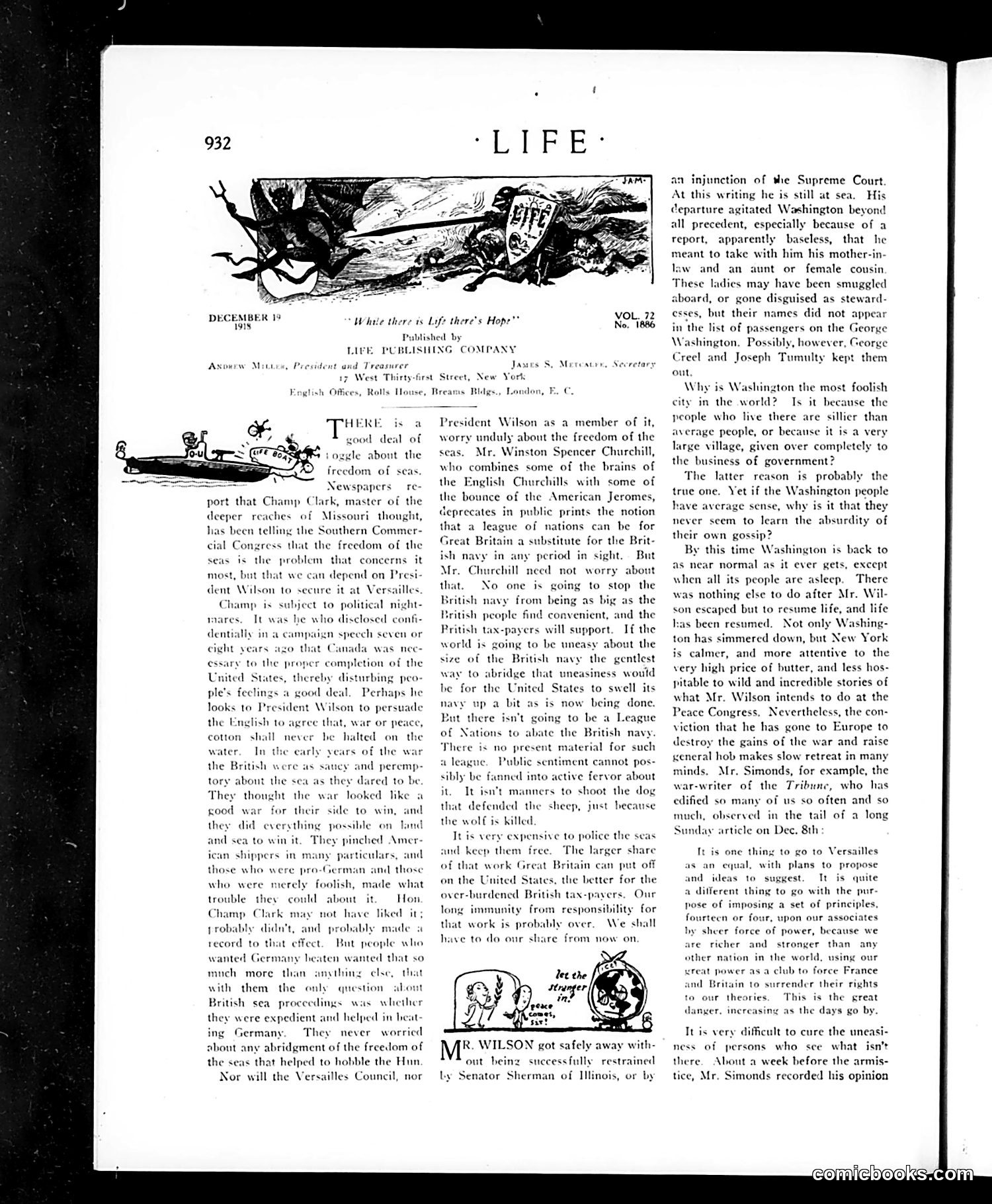
This post-WWI editorial page satirizes political figures debating naval power and the League of Nations at the Versailles Peace Conference. **The Main Targets:** - **Champ Clark** (Missouri congressman): Mocked for spreading worry about "freedom of the seas" while being prone to political paranoia and indiscreet revelations - **President Wilson**: Criticized for supposedly allowing Britain to dominate naval policy discussions **The Satire's Point:** Life argues that wartime complaints about British naval interference were hypocritical—Americans supported British sea power when it hurt Germany. Now, claiming a League of Nations will replace navies is naive; Britain will maintain its fleet regardless, and America should simply match it rather than pretend international agreements will solve the problem. **The Joke about Wilson's Departure:** A humorous aside mocks Washington gossip that Wilson planned to smuggle his mother-in-law to Versailles—presented as baseless but typical of the city's rumor-mongering. The overall tone: pragmatic cynicism about post-war idealism.
📄 Transcribed text from this page (OCR, searchable)
Machine-transcribed from the original scan — historical spelling and the odd misread are preserved.
DECEMBER 19 i918 White there is Life there's Hope Published by LIrE Axoarw Mittin, ident and Treasurer PUBLISHING COMPANY, Jaues S. Mrvestrns 17 West Thirty-first Street, New Yorks English Offices, Rolls House, Rreams Bl HERE is a deal of about the wspapers —re- port that Champ Clark, master of the Missouri. thought, has been telling the Southern Commer- cial Congress that the freedom of the deeper reaches of seas is the problem that concerns it most, but that we can depend on Presi- dent Wilson to secure it at Versailles Champ is subject to political night- mares. It was he who disclosed confi- dentialiy in a campaign speech seven » that € essary to the proper completion of the United States, thereby disturbing peo- cight years nada was nec- looks to President Wilson to persuade the English to a cotton shall water. In the early ye ree that, war or peace, halted on the rs of tl the British were as saucy and peremp- never he war s they dared to be. They thought the war looked like a good war for tory abont the sea their side to win, and they did everything possible on and sea to win it. They pinched Amer- ican shippers in many particulars, and those who were pro-German and those foolish, made what Hon liked it made i who were merely they could about it Champ Clark may not have frobably didn't, and probably effect. But people who any heaten wanted that so more than that them the about British sea proceedings was whether trouble record to t wanted Gert much anything else, with only question they were expedient and helped in heat- ing Germany, They about any abridgment of the freedom of the seas that helped to hobble the Hun. Nor will the Versailles Council, nor never worried President Wilson as a member of it, worry unduly about the freedom of the Mr. Winston Spencer Churchill, who combines some of the brains of the English Churchills with some of the bounce of the American Jeromes, seas. deprecates in public prints the notion that a league of nations can be for Great Britain a substitute for the Brit- ish navy in any period in sight. But Mr. Churchill need not worry about that. No one is going to stop the British navy from being as big as the British people find convenient, and the Pritish tax-payers will support. If the world is going to be uneasy about the size of the British navy the gentlest way to abridge that uneasiness would be for the United States to swell its navy up a bit as is now being done. Eut there isn't going to be a League of Nations to abate the British navy There is no present material for such a league sibly be f vor about it. It isn’t manners to shoot the dog that defended the sheep, just because fis killed. It is very expensive to police the seas Public sentiment cannot pos- ned into active f the we and keep them free. The larger share of that work Great Britain can put ¢ on the United States, the better for the over-burdened British tax Our n responsibility for We shall have to do our share from now on. wers long immunity fre that work is probably over ME: WILSON got safely away with- out being Ly Senator Sherman of Mlinois, or by successfully restrained an injunction of the Supreme Court. At this writing he is still at sea. His departure agitated Washington beyond all precedent, especially because of a report, apparently baseless, that he meant to take with him his mother-in- law and an aunt or female cousin These ladies may have been smuggled aboard, or gone disguised as steward- esses, but their names did not appear in the list of passengers on the George Washington. Possibly, however, George Creel and Joseph Tumulty kept them out Why is Washington the most foolish in the world? Is it because the people who live there are sillier than city average people, or because it is a very large village, given over completely to the business of government? The latter reason is probably the true one, Yet if the Washington people have average sense, why is it that they never scem to learn the absurdity of their own gossip? By this time Washington is back to as near norm; it ever gets, except when all its people are asleep. There was nothing else to do after Mr. Wil- son escaped but to resume life, and life has been resumed. Not only Washing- ton has simmered down, but New York is calmer, and more attentive to the very high price of butter, and less hos- pitable to wild and incredible stories of what Mr. Wilson intends to do at the Peace Congress, Nevertheless, the con- viction that he has gone to Europe to destroy the gains of the war and raise general hob makes slow retreat in many minds. Mr. Simonds, for example, the war-writer of the Tribune, who has edified so many of us so often and so much, observed in the tail of a long Sunday article on Dee. 8th It is one thing to go to Versailles equal, with plans to propose ideas to suggest. It is quite a different thing to go with the pur: pose of imposing a set of principles, fourtecn or four, upon our associates by sheer force of power, because we ure richer and. stronger than any other nation in the world, using our xreat power asa club to force France and Britain to surrender their rights This is the great days go by. to our theories. danger, increasing as It is very difficult to cure the uneasi- ness of who sce what isn’t there. About a week before the armis- tice, Mr. Simonds recorded his opinion persons