
Life, 1918-12-19 · page 20 of 34
Life — December 19, 1918 — page 20: what you’re looking at
What you’re looking at
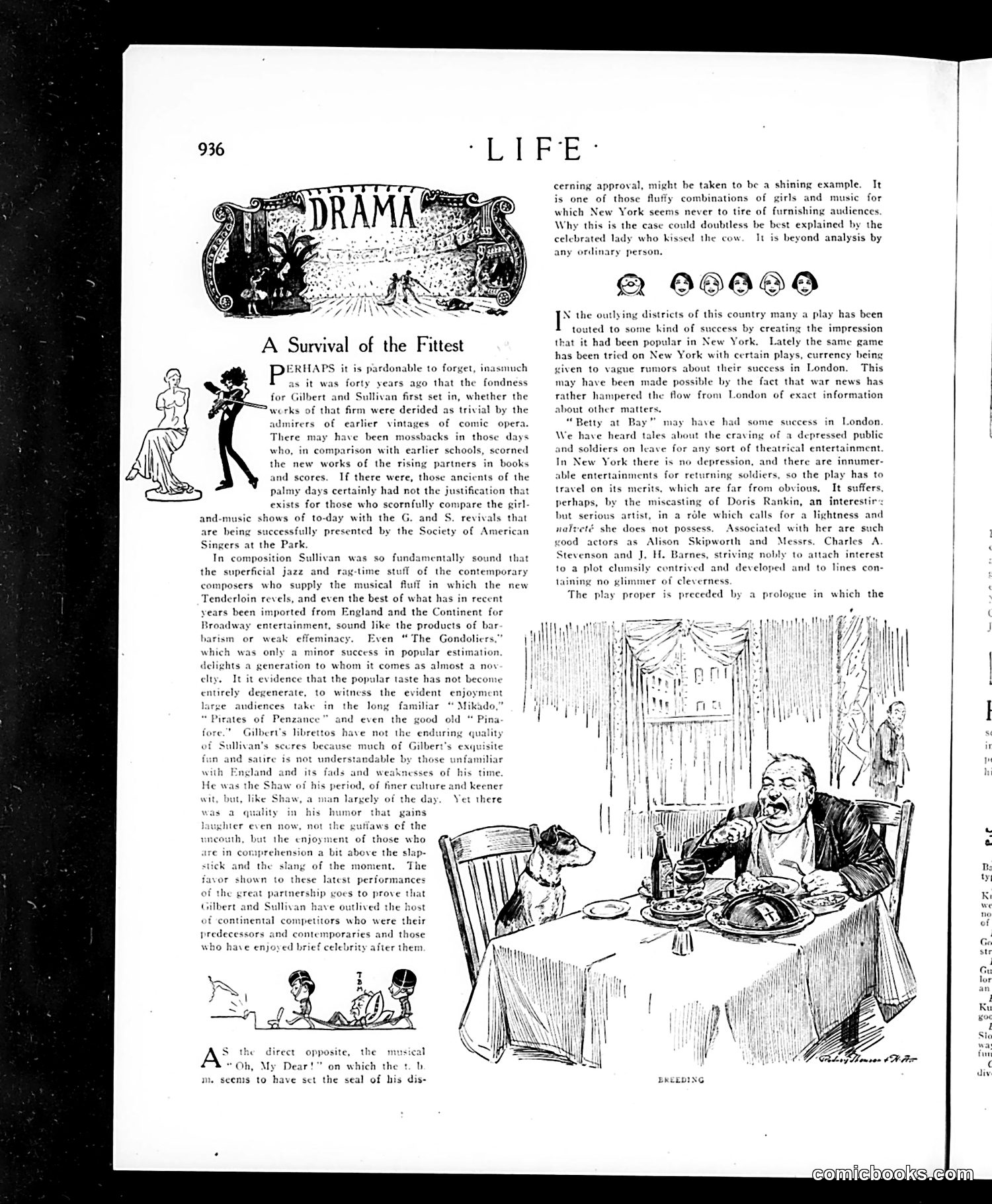
This article critiques contemporary theatrical productions, specifically plays being marketed as London successes to American audiences during wartime. The author argues that Gilbert and Sullivan operettas from forty years prior maintain superior quality compared to modern "jazz and rag-time" compositions being imported from Broadway. The piece reviews "Betty at Bay," a play featuring actress Doris Rankin (apparently miscast in a role requiring lightness she lacks), alongside accomplished actors like Alison Skipworth. The author contends that despite featuring talented performers, the play's "clumsily contrived" plot and "vague rumors" about London success cannot overcome fundamental weaknesses. The central satire targets how producers exploit unverified claims of British theatrical success to promote mediocre American plays—a wartime phenomenon made possible because accurate information from London is disrupted. The headline suggests only the "fittest" entertainment survives scrutiny; this play apparently doesn't qualify.
📄 Transcribed text from this page (OCR, searchable)
Machine-transcribed from the original scan — historical spelling and the odd misread are preserved.
cerning approval, might be taken to be a shining example. It is one of those fluffy combinations of girls and music for which New York seems never to tire of furnishing audiences Why this is the case could doubtless be best explained by the celebrated lady who kissed the cow. It is beyond analysis by ABB | N the try many a play has been touted to some kind of success by cr the impression A Survival of the Fittest that it had been popular in New York, Lately the same game has been tried on New York with certain plays, currency being any ordinary person. EQ & , tlying districts of this cou ERHAPS it is pardonable to forget, inasmuch given to vague rumors about their success in London. This as it was forty years ago that the fondness may have been made possible by the fact that war news has for Gilbert and Sullivan first set in, whether the rather hampered the flow from London of exact information by the about other matters, “Betty at Bay” may have had s tthe craving ks of that firm were derided as trivi: rers of earlier vint have been mossbacks in those days We have heard tales abc f w ¢ success in London. s of comic oper: fa depressed public There may . in comparison with earlier schools, scorned —_ and soldiers on Ie any sort of theatrical entertainment rtners in books In New York there is nd there are innumer- nts for returning soldiers, so the play has to 0 depression, 3 the new works of the rising and scores. If there were, those ancients of the able entert palmy days certainly had not the justification that travel on its merits, which exists for those who scornfully compare the perhaps, by the miscasting of Doris Rankin, an interesti re far from obvious, It suffers, and-music shows of to-day with the G. and S. revivals that but serious artist, in a rdle which calls for a lightness and are being successfully presented by the Society of American nal she does not possess. Associated with her are such | Singers at the Park. ood actors as Alison Skipworth and Messrs. Charles A | on Sullivan was so fundamentally sound that Stevenson and J, H. Barnes, striving nobly to attach interest to a plot clumsily contrived and developed and to lines con- In com the superficial jazz and rag-time stuff of the contemporary composers who supply the musical full in which the new Tenderloin revels, and even the best of what ha years been ir Broadway entertainment, sound like the products of bar barism or weak effeminacy. Even “The Gondoliers.” laining no g) mer of cleverness. i} The play proper is preceded by a prologue in which the | in recent ported from England and the Continent for which was only a inor success in popular esti delights a generation to whom it comes as almost a nov clty. It it evidence that the popular taste has not become entirely degener. ness the ev 1 . tow ent enjoyment iar“ Mikado,” even the good old “ Pina: © audiences take in long irates of Penzance ™ fore.” Gilbert's librettos have not the endurir of Sullivan's sceres be se much of Gilbert's exquisite fun and satire is not understandable those unfamiliar nd weaknesses of nd keener Yet there hier even tiaws ef the th are in comprehension a bit above the slap- of those who the enjoyn ck and the slang of the m iavor shown to these latest performances f the great partner D Koes to prove that Gilbert and Sullivan have outlived the host of continental competitors who were their predecessors and contemporaries and those who have enjoyed brief celebrity after th the direct opposite, the Oh, My Dear!” on which the 1. b. seenis to have set the seal of his dis- BREEDING