
A complete issue · 34 pages · 1918
Life — September 19, 1918
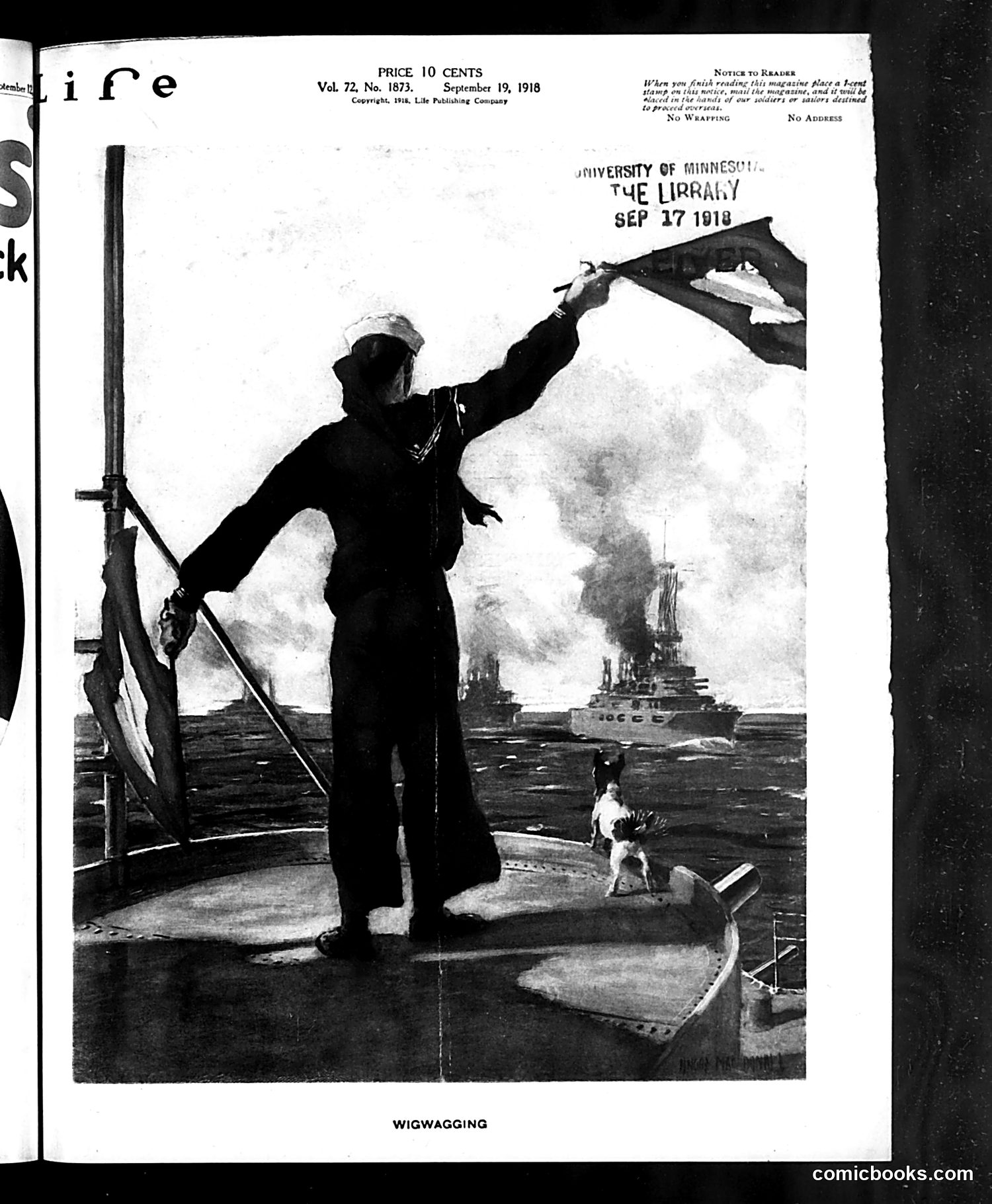
This image depicts a naval officer using signal flags ("wigwagging"—a method of maritime communication) while standing aboard a warship. A small dog watches from the deck as another naval vessel steams in the background, emitting smoke. The caption simply reads "WIGWAGGING," suggesting this is a straightforward illustration of naval signaling practice rather than political satire. Published during World War I (note the date), it likely celebrates American naval operations and military preparedness. The inclusion of the small dog appears to be a humorous touch—possibly suggesting even the mascot watches the important work of wartime communication. This reflects Life's contemporary patriotic content during America's WWI involvement.
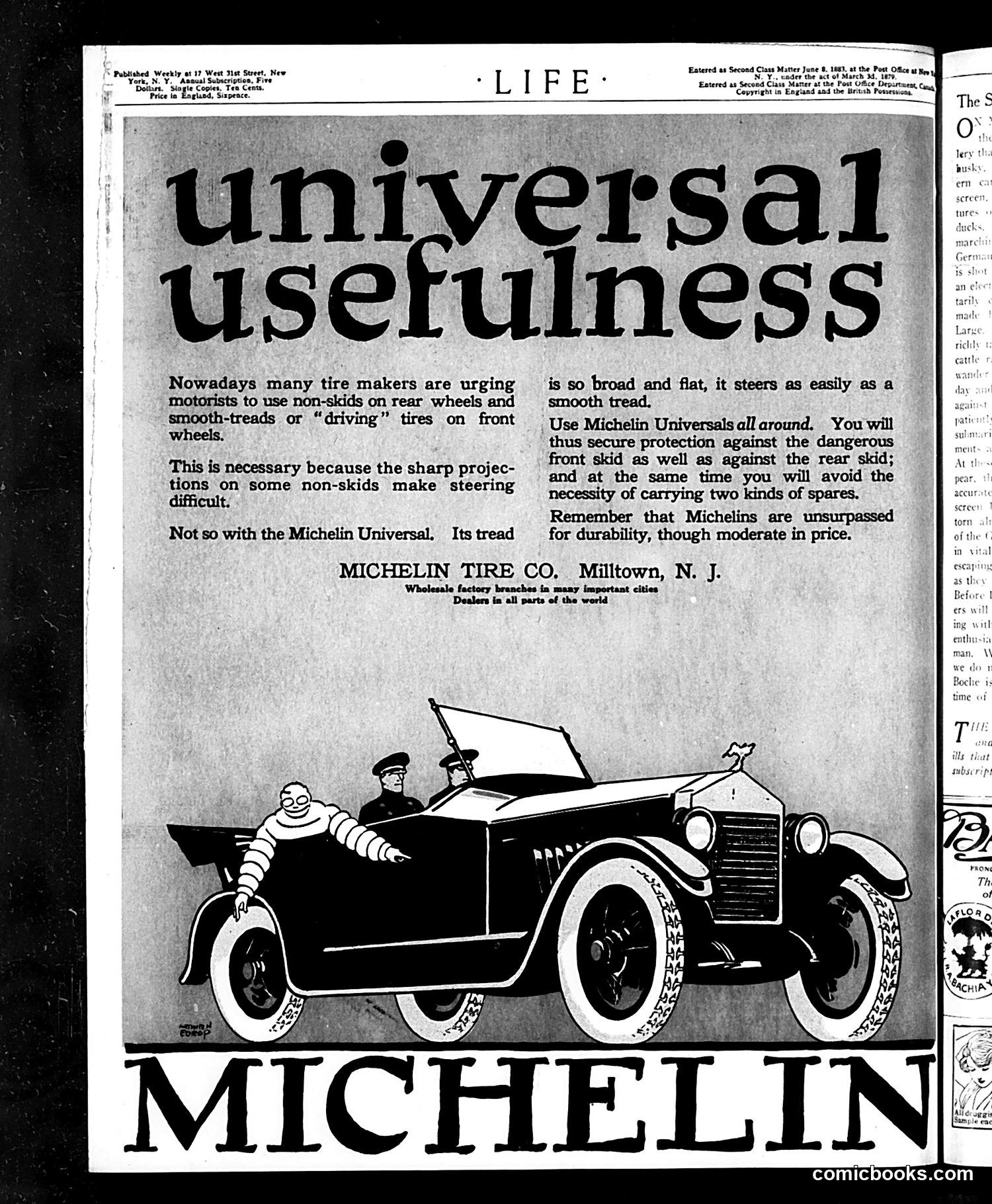
This is a **straightforward Michelin tire advertisement**, not political satire. The page promotes Michelin Universal tires for automobiles, addressing a practical automotive concern of the era. The ad explains that some tire makers recommend non-skid rear tires and smooth "driving" tires for front wheels because non-skid projections make steering difficult. Michelin counters this by touting their Universal tire's broad, flat tread as a solution that steers easily while providing protection against both front and rear skids. The illustration shows an open-air touring car with two figures (driver and passenger) from the early 20th century. The ad emphasizes Michelin tires' durability and "unsurpassed" quality at moderate price. The company was based in Milltown, New Jersey.
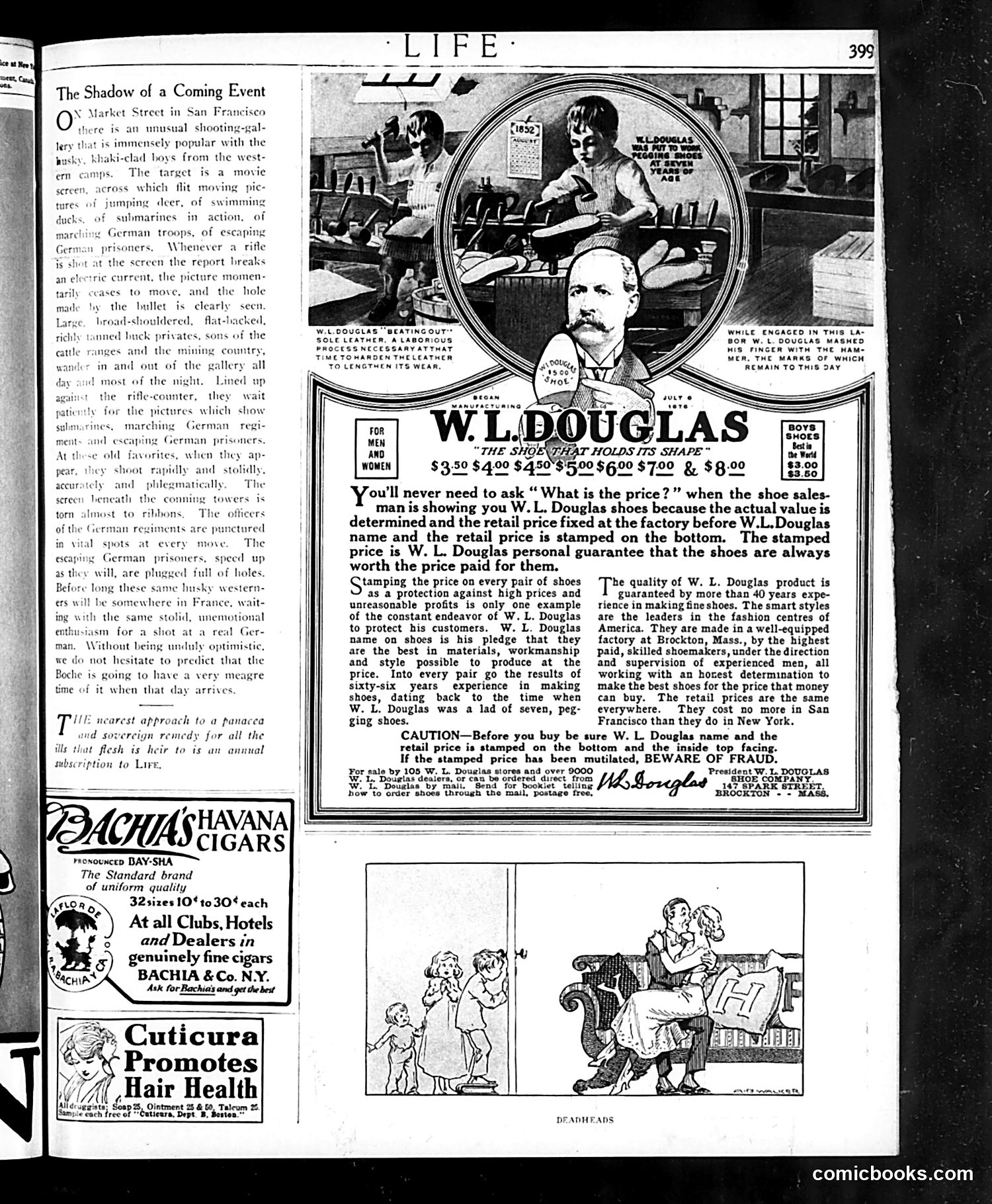
This page is primarily **advertising**, not satire or political commentary. The dominant content is a large W.L. Douglas shoe advertisement (circa 1910s-1920s based on styling), featuring photographs of the company's founder and product details. The small cartoon at bottom—labeled "DEADHEADS"—appears to be unrelated filler humor showing children and an adult, likely a joke about freeloaders or people avoiding payment (the term "deadhead" had that meaning). The page also includes advertisements for Bachas Havana Cigars and Cuticura hair products. **The main point**: This is a commercial magazine page designed to generate revenue through advertising rather than editorial commentary. The W.L. Douglas ad emphasizes price transparency and quality guarantees to build consumer trust.
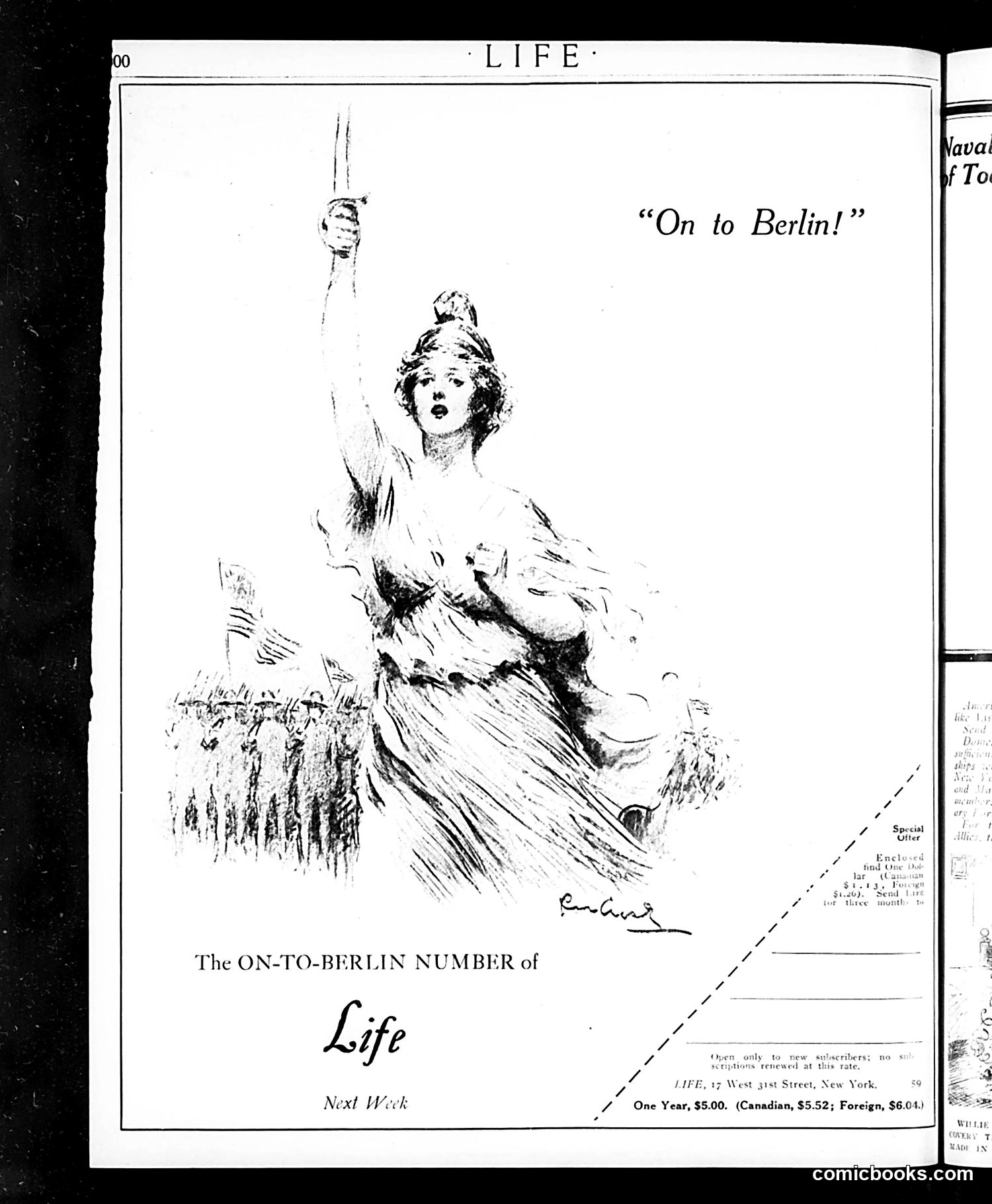
This is a **cover advertisement** for Life magazine's upcoming "On-to-Berlin" issue, scheduled for next week. The illustration depicts a woman in classical allegorical style—likely representing Liberty or America—with raised arm holding what appears to be a torch or standard, gazing determinedly toward Berlin. The martial imagery and the phrase "On to Berlin" indicate this was published during **World War I**, when American forces were engaged in the European theater. The cover uses patriotic symbolism to promote the special issue, appealing to American wartime sentiment. The elegant sketch style and the classical female figure were typical visual conventions for stirring patriotic fervor during this period. The subscription pricing ($5.00 domestically) and address confirm this as genuine period advertising.
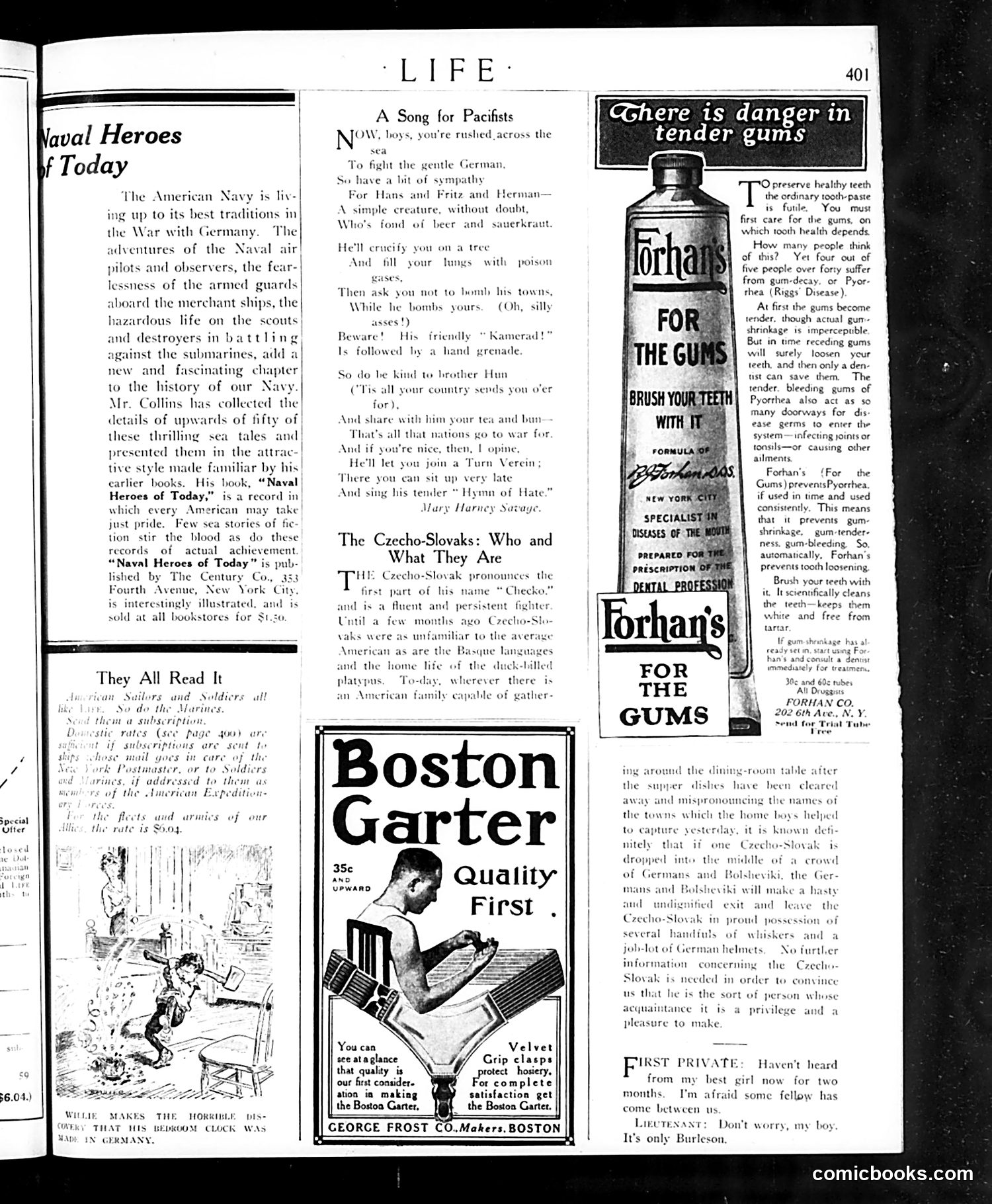
This page is primarily **advertising and editorial content** rather than political satire. The layout includes: **Left side:** "Naval Heroes of Today" - a book advertisement promoting stories of American Navy pilots and naval air operations during WWI, presented as thrilling historical narratives. **Center:** "A Song for Pacifists" - appears to be anti-war poetry mocking pacifist sentiment, and an article on "The Czecho-Slovaks: Who and What They Are," explaining the Czech and Slovak peoples to American readers. **Right side:** Two Forhan's toothpaste advertisements with health claims about gum disease prevention. **Bottom center:** Boston Garter advertisement for men's suspenders. The page reflects WWI-era American concerns—military heroism, emerging European nations, and consumer goods—rather than containing pointed political cartoons or satire.
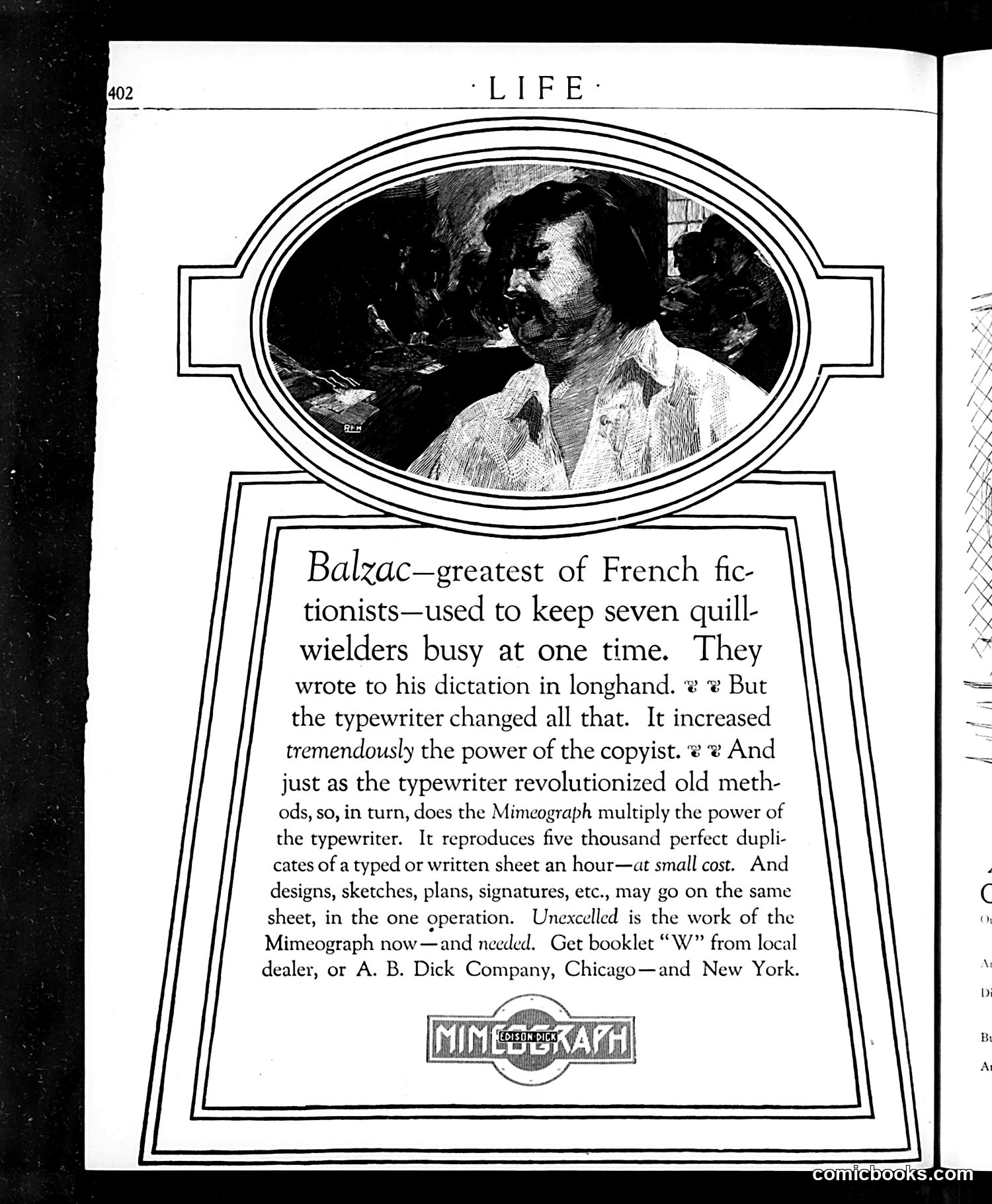
This page is primarily a **commercial advertisement** for the Mimeograph machine, placed in Life magazine. The ad uses Balzac, the famous 19th-century French novelist, as its hook—noting he employed seven stenographers writing his dictation simultaneously. The advertisement's argument is straightforward: the typewriter increased copyists' productivity, and the Mimeograph will do the same by reproducing "five thousand perfect duplicates of a typed or written sheet an hour—at small cost." There is **no political satire or cartoon** on this page. It's a product pitch emphasizing technological efficiency and labor economics—how machines amplify human output. The Balzac reference simply establishes a prestigious historical precedent for recognizing the value of clerical support.
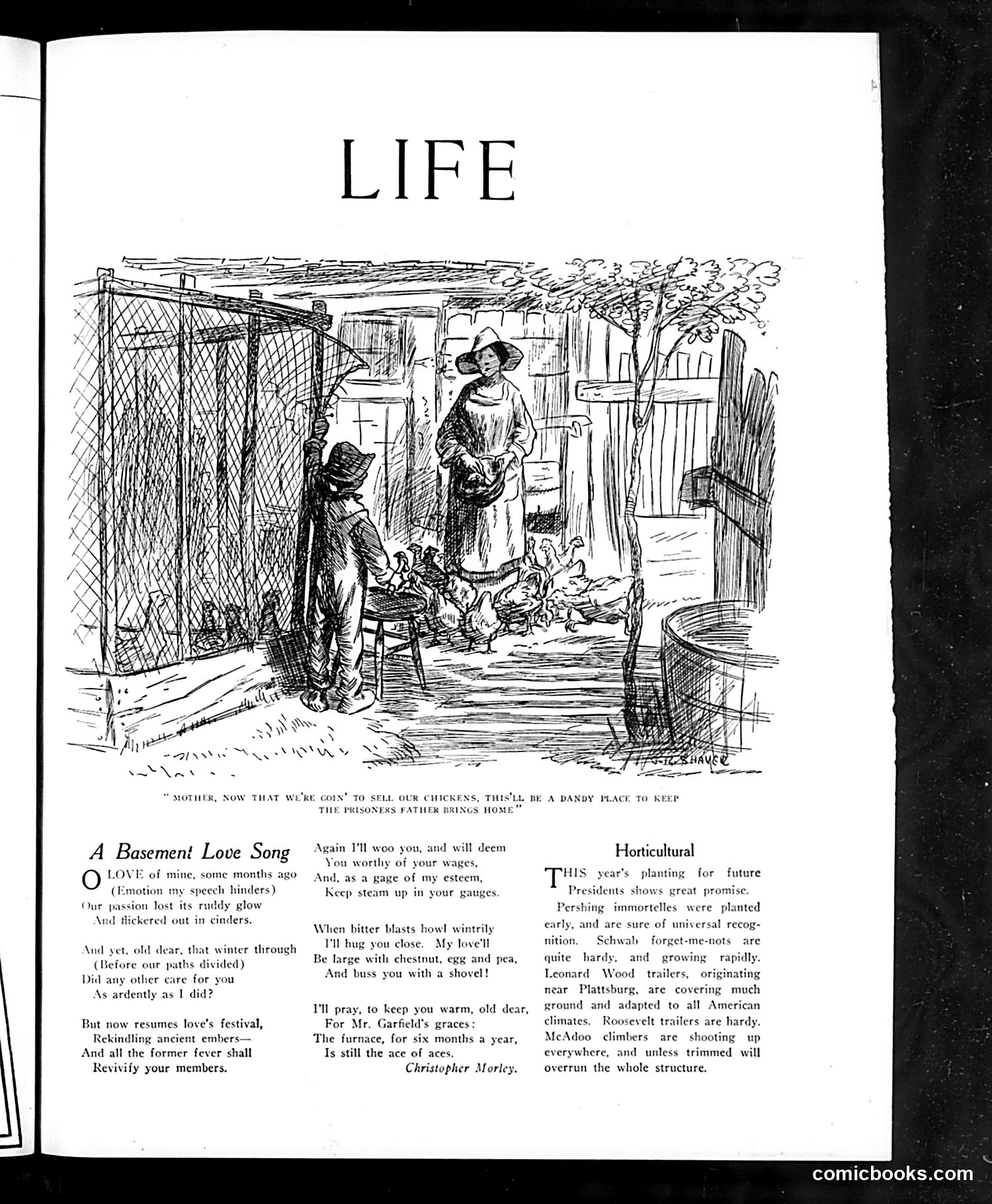
The main cartoon depicts a farmyard scene where a woman tells a man: "Mother, now that we're goin' to sell our chickens, this'll be a dandy place to keep the prisoners father brings home." This appears to be **wartime satire**, likely from WWI era based on the reference to prisoners. The joke works on multiple levels: it satirizes both the practicality of rural Americans (repurposing chicken coops for prisoners) and, more pointedly, critiques someone called "father" who is apparently profiting from or collecting prisoners during wartime—suggesting war profiteering or dubious military dealings. The page also contains a poem titled "A Basement Love Song" and a "Horticultural" section discussing plant cultivation, suggesting this is a complete Life magazine page mixing humor, poetry, and practical household content typical of the era.
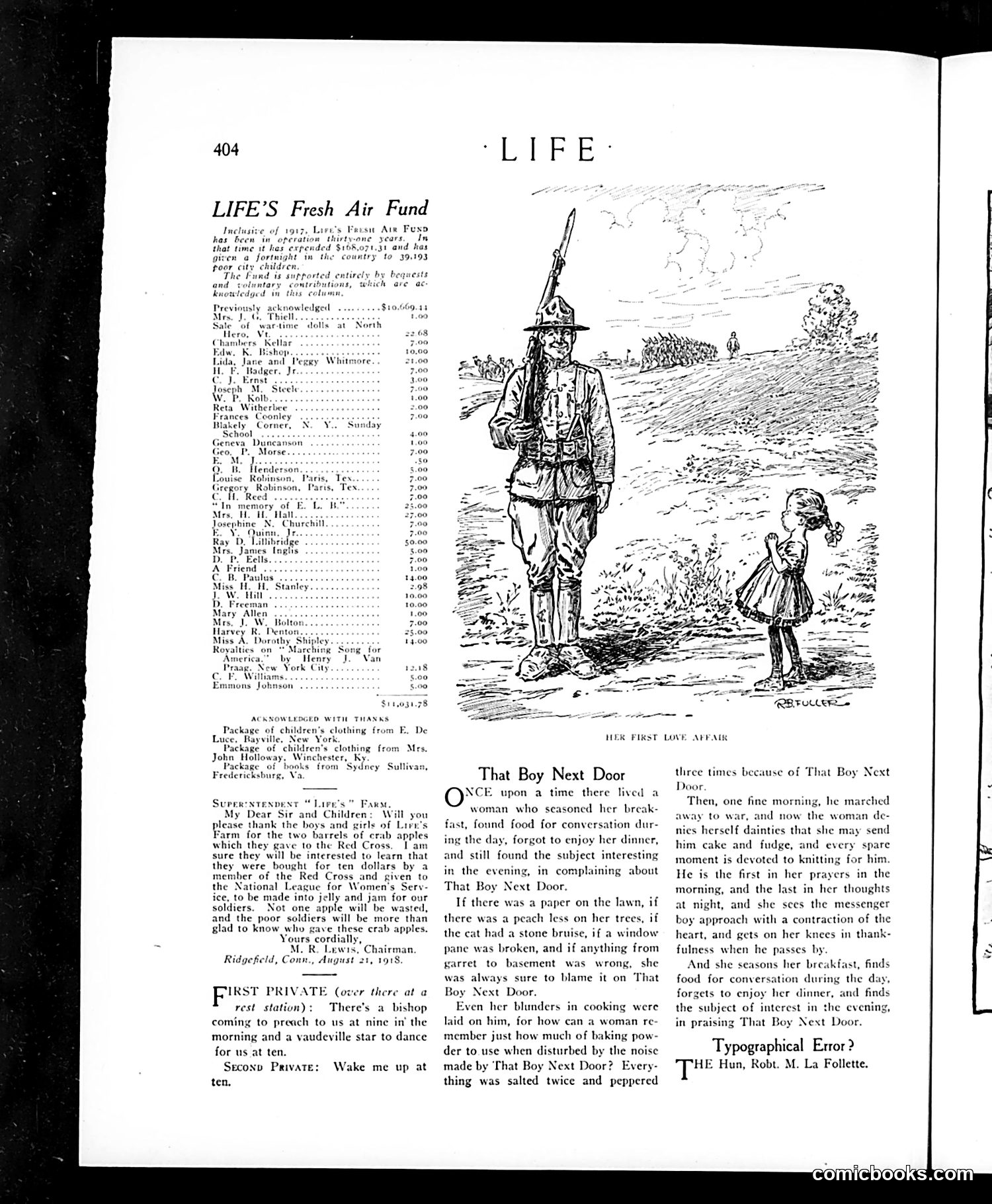
This page contains a sketch titled "Her First Love Affair" depicting a soldier and young girl in a rural landscape. The accompanying story "That Boy Next Door" is a humorous domestic narrative about a woman whose complaints about her neighbor are endless—blaming him for everything from papers on the lawn to a cat's bruise to broken windows. The joke is that she obsessively fixates on this neighbor as the source of all her household mishaps and cooking disasters, even when logic suggests otherwise. The page also includes "Life's Fresh Air Fund" listing donations to send poor city children to the countryside—a genuine charitable cause. A separate humor section features "First Private" jokes about military life. This reflects early 20th-century American magazine content mixing satire, domestic comedy, and philanthropic appeals.
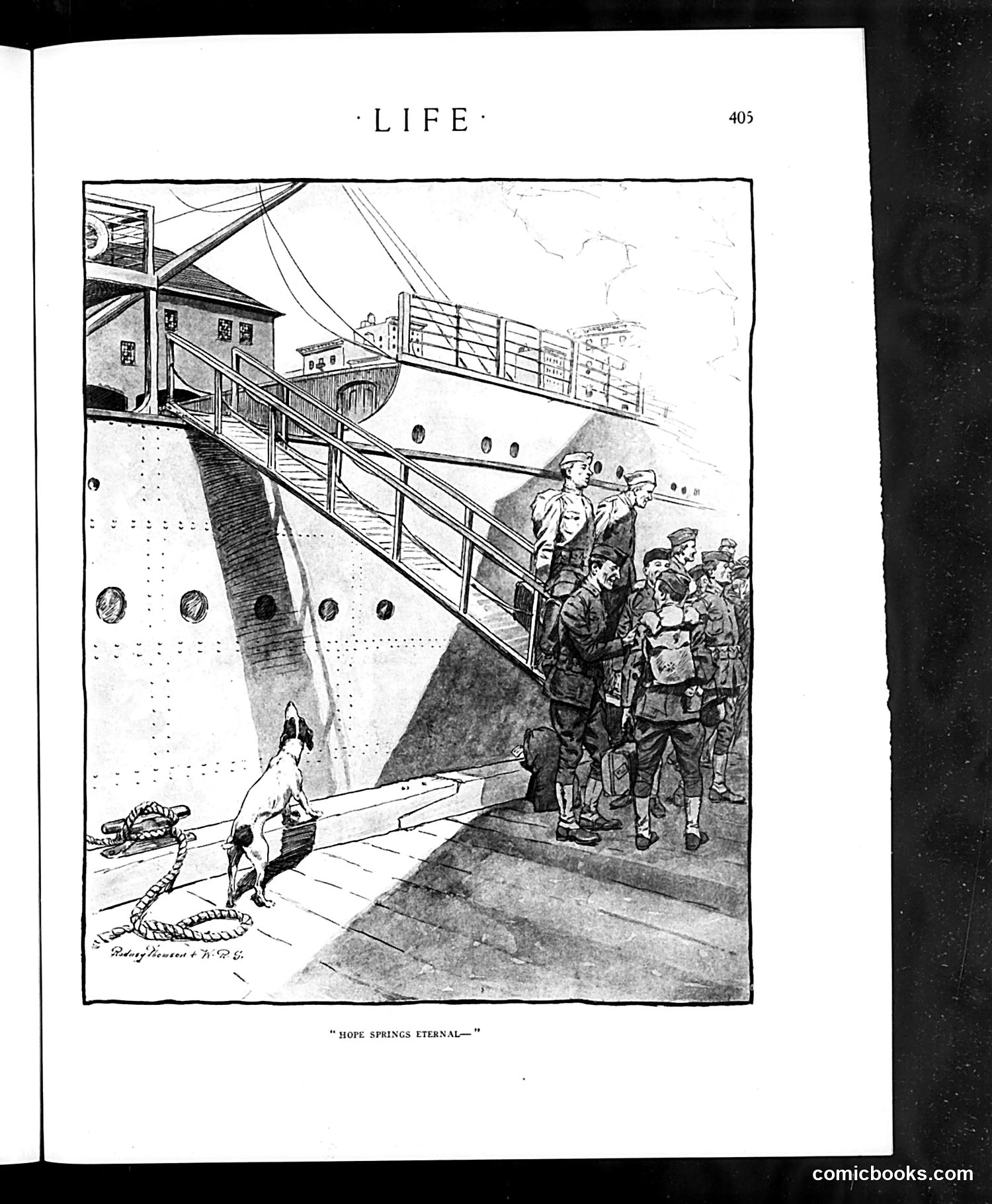
This political cartoon depicts soldiers boarding a military transport ship. The title "Hope Springs Eternal" appears to be ironic commentary on military deployment, likely from the World War I era based on the soldiers' uniforms and the ship's design. The cartoon satirizes the optimism or naive hope soldiers and civilians maintain about war, even in the face of danger and uncertainty. The soldiers boarding the vessel represent young men heading toward an unknown fate, while the ship itself—a transport vessel—suggests the industrial machinery of warfare. The dog in the foreground appears to be an incidental detail or may represent loyalty/companionship amid the grim reality being depicted. The satire lies in the contrast between the title's hopeful sentiment and the visual reality of military mobilization and war.
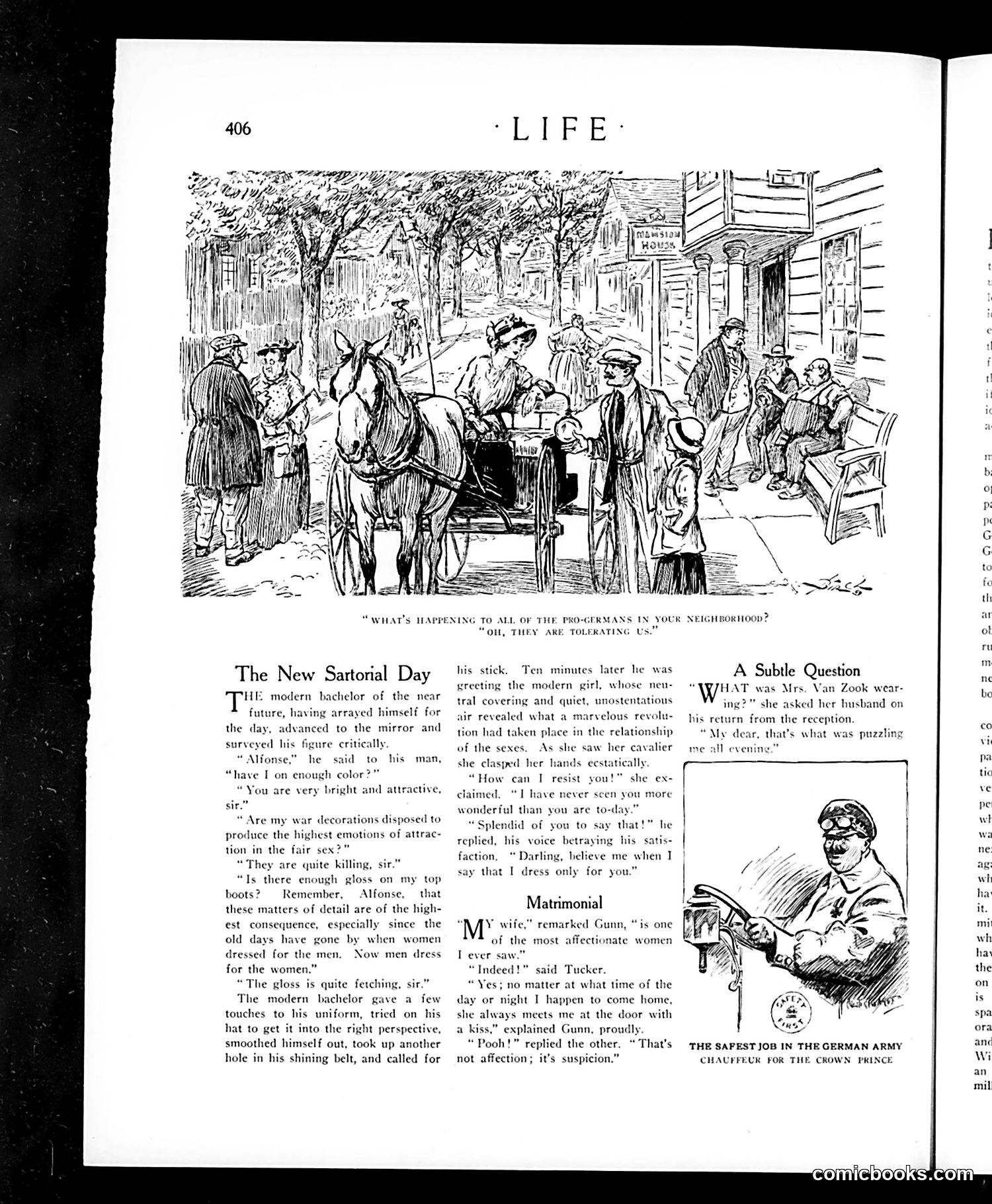
**The Cartoon:** The illustration depicts a street scene with a horse-drawn cart and various pedestrians. The caption reads: "What's happening to all of the pro-Germans in your neighborhood? 'Oh, they are tolerating us.'" This is anti-German satire, likely from World War I era. The joke targets German-Americans or pro-German sympathizers in America, suggesting they've become so unpopular that native Americans are merely "tolerating" their presence rather than actively persecuting them—implying this tolerance is grudging and conditional. **The Stories Below** appear to be unrelated humorous vignettes about courtship and marriage, not political commentary. The satire reflects wartime tensions when German-Americans faced suspicion and social ostracism in the United States.
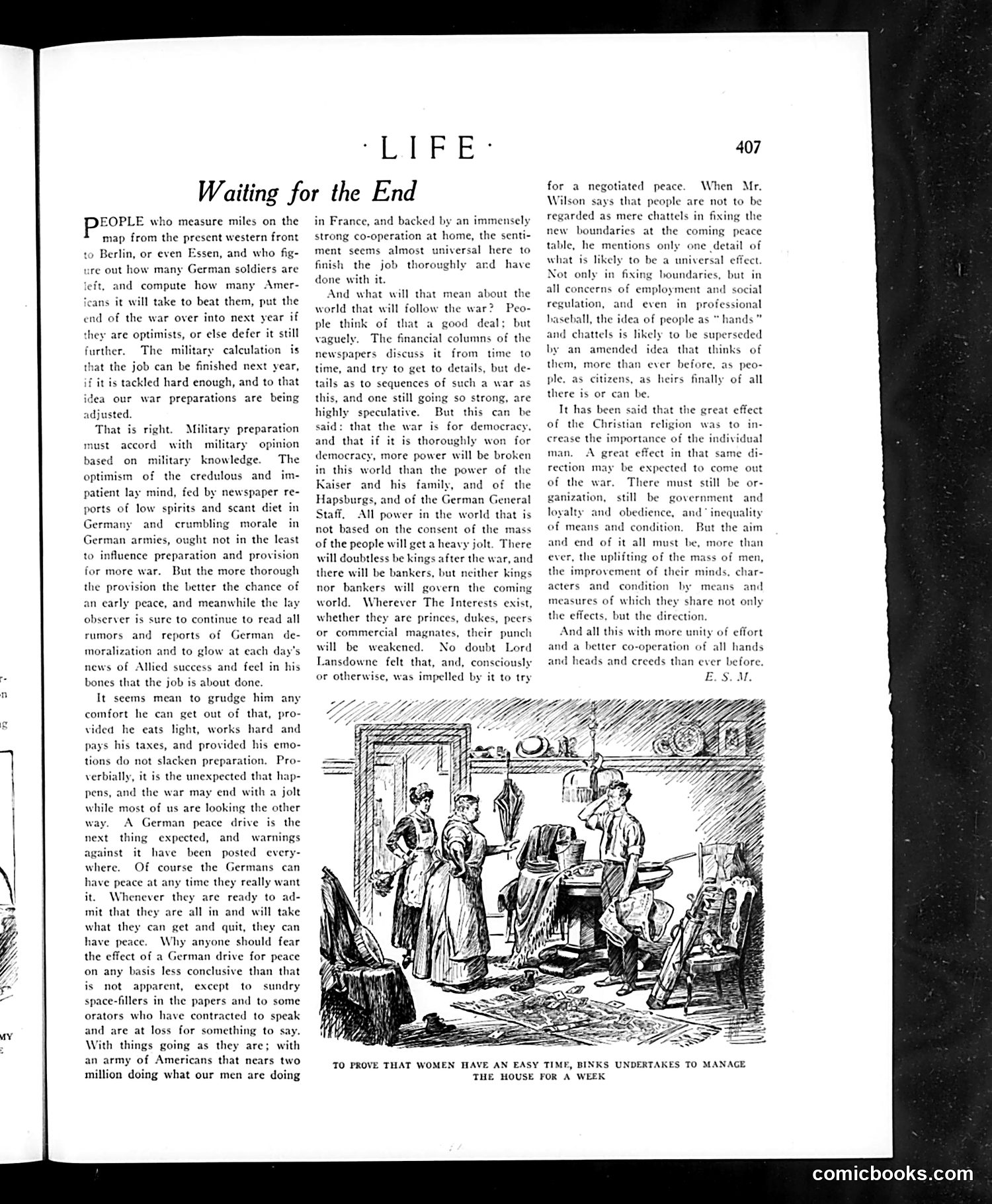
This page contains an article titled "Waiting for the End" discussing post-WWI peace prospects and social reorganization. The accompanying illustration satirizes domestic labor by showing women managing a household while men are away at war. The cartoon's caption reads: "TO PROVE THAT WOMEN HAVE AN EASY TIME, RINKS UNDERTAKES TO MANAGE THE HOUSE FOR A WEEK" — suggesting someone named Rinks (likely a public figure) volunteered to run a household to demonstrate women's work is simple. The sketch shows multiple women directing the bewildered man, satirizing the complexity of domestic management that was typically underestimated or dismissed. The broader article discusses post-war peace negotiations, democratic reorganization, and the need for improved social conditions and cooperation among nations.
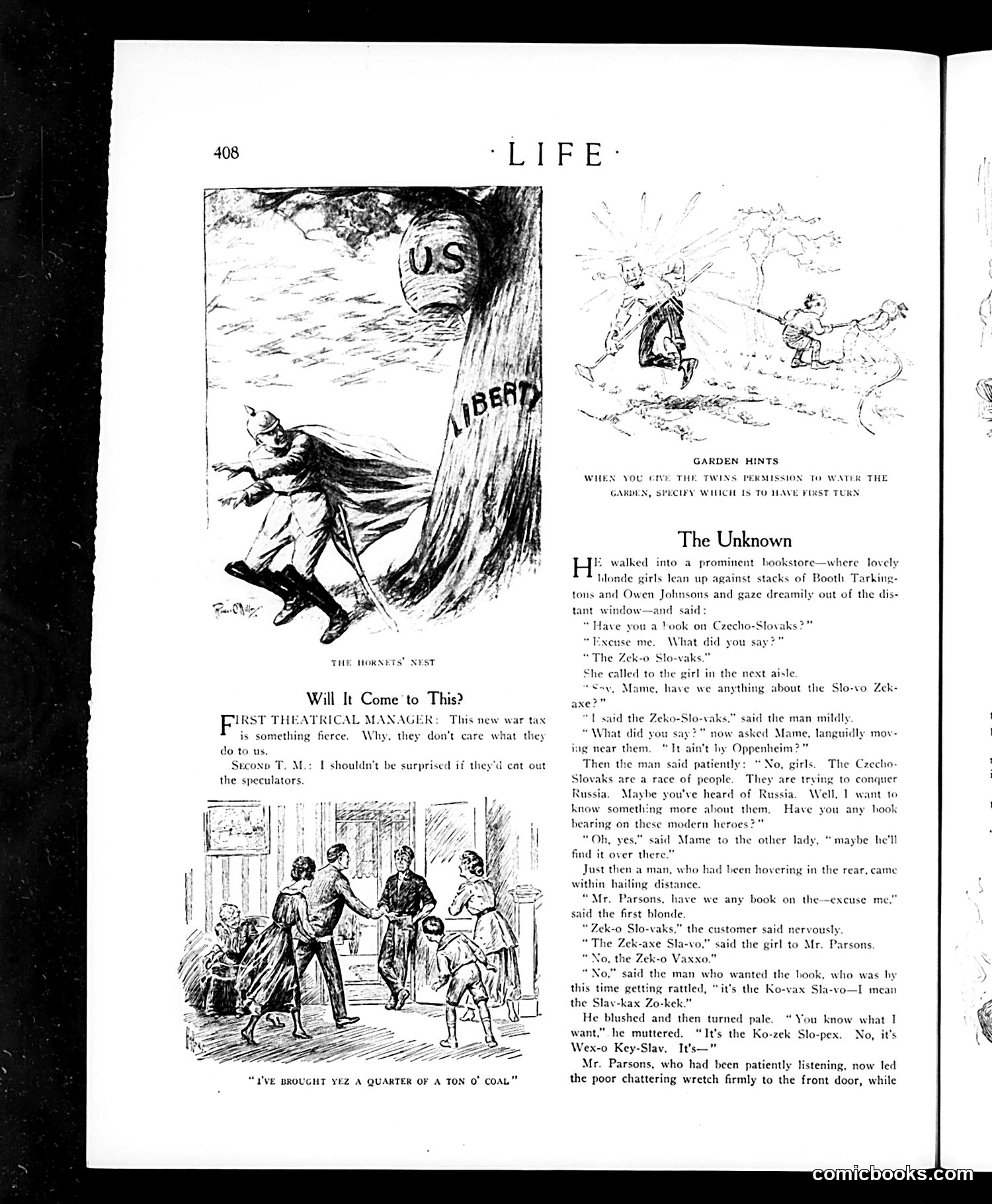
This page contains two distinct satirical pieces from Life magazine: **"Will It Come to This?"** depicts a wartime scene with civilians discussing a "new war tax." The theater manager character worries the government will tax "the speculators," reflecting anxiety about profiteering during wartime (likely WWI-era, given the reference to "this new war tax"). **"The Unknown"** is a longer story about a bookstore scene where customers repeatedly mispronounce "Czecho-Slovaks," mangling the name into absurd variations ("Zek-o Slo-vaks," "Ko-vax Sla-vex," etc.). This satirizes American unfamiliarity with newly-emerged Eastern European nations and the public's indifference to international affairs—poking fun at Americans' casual ignorance of important geopolitical changes.
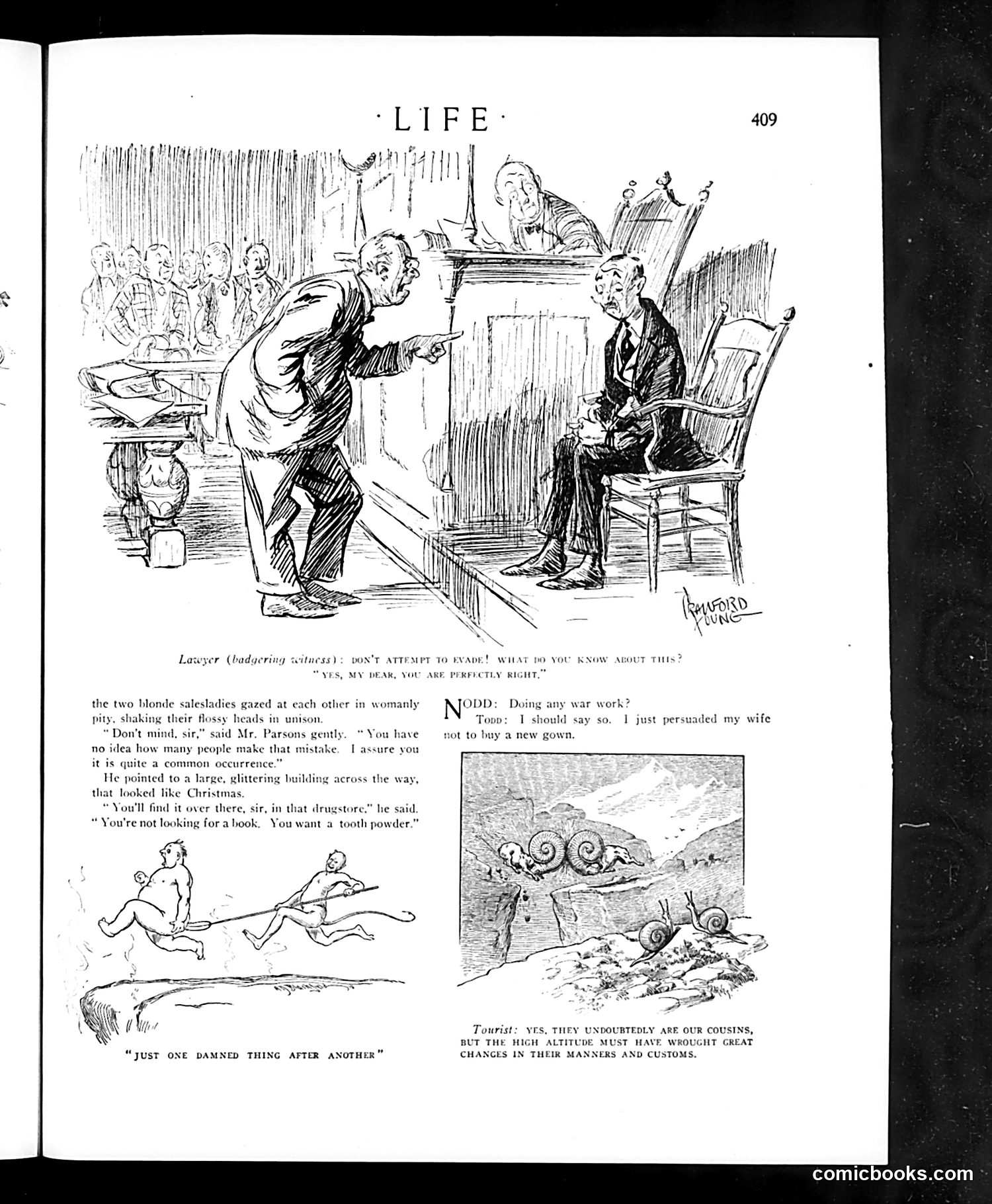
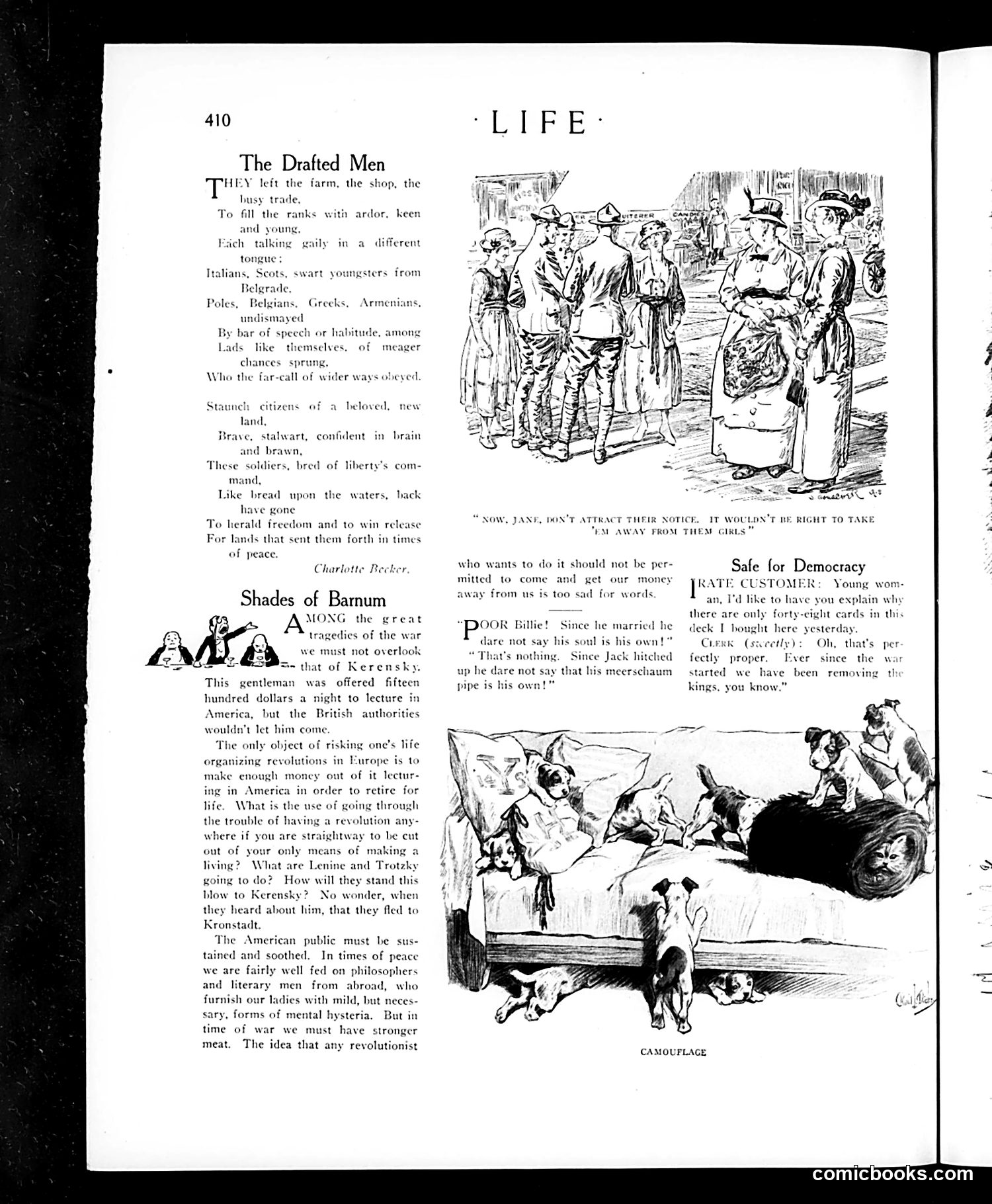
This page contains three separate pieces of satirical content: **"The Drafted Men"** (poem by Charlotte Perkins Gilman): A patriotic poem celebrating soldiers drafted into military service, praising their diverse ethnic backgrounds and commitment to liberty. **"Shades of Barnum"**: A prose piece criticizing a British gentleman who refused a lucrative American lecture offer. The author argues that revolutionaries like Lenin and Trotsky understand the practical necessity of earning money, suggesting that ideological purity divorced from financial reality is foolish. **Two cartoons**: - Top illustration shows soldiers being told not to attract women's notice - Bottom illustration titled "Camouflage" depicts civilians (likely children) hiding under bedding, apparently satirizing civilian preparedness or air-raid precautions during wartime The page reflects WWI-era American attitudes toward military service, international politics, and home-front preparations.
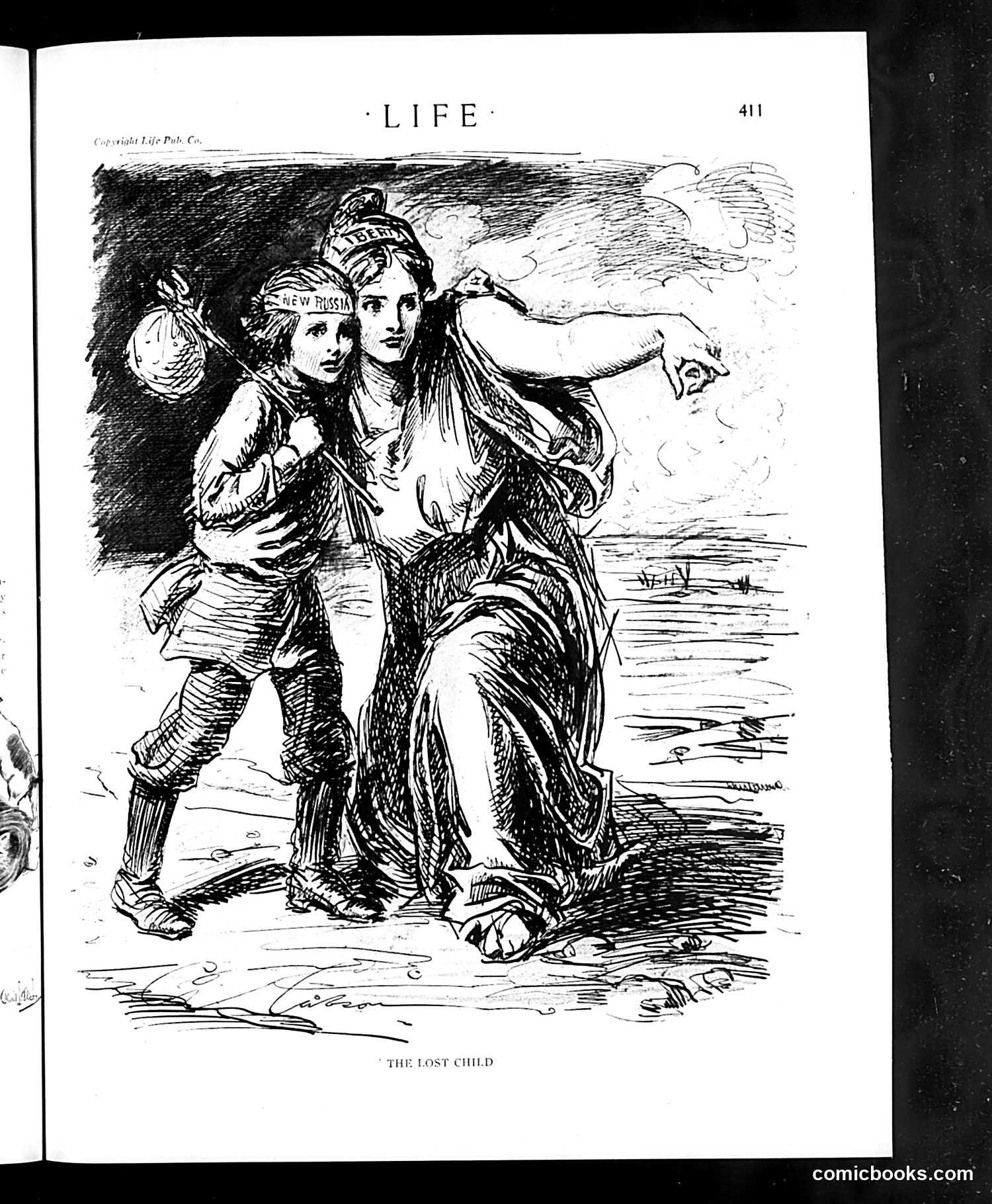
This sketch depicts a woman and child in classical or allegorical style, with the woman pointing outward toward a distant landscape. The child wears a headband labeled "NEW RUSSIA," indicating this is a political allegory about post-revolutionary Russia. The title "The Lost Child" suggests the satire concerns Russia's uncertain fate following the 1917 revolution. The woman—likely representing Russia itself or a classical figure symbolizing the nation—appears to be gesturing toward an unknown future, while the child labeled as the "new" Russia appears vulnerable and directionless. This reflects early 20th-century American anxieties about Russia's political trajectory and the fate of its people during the turbulent post-revolutionary period.
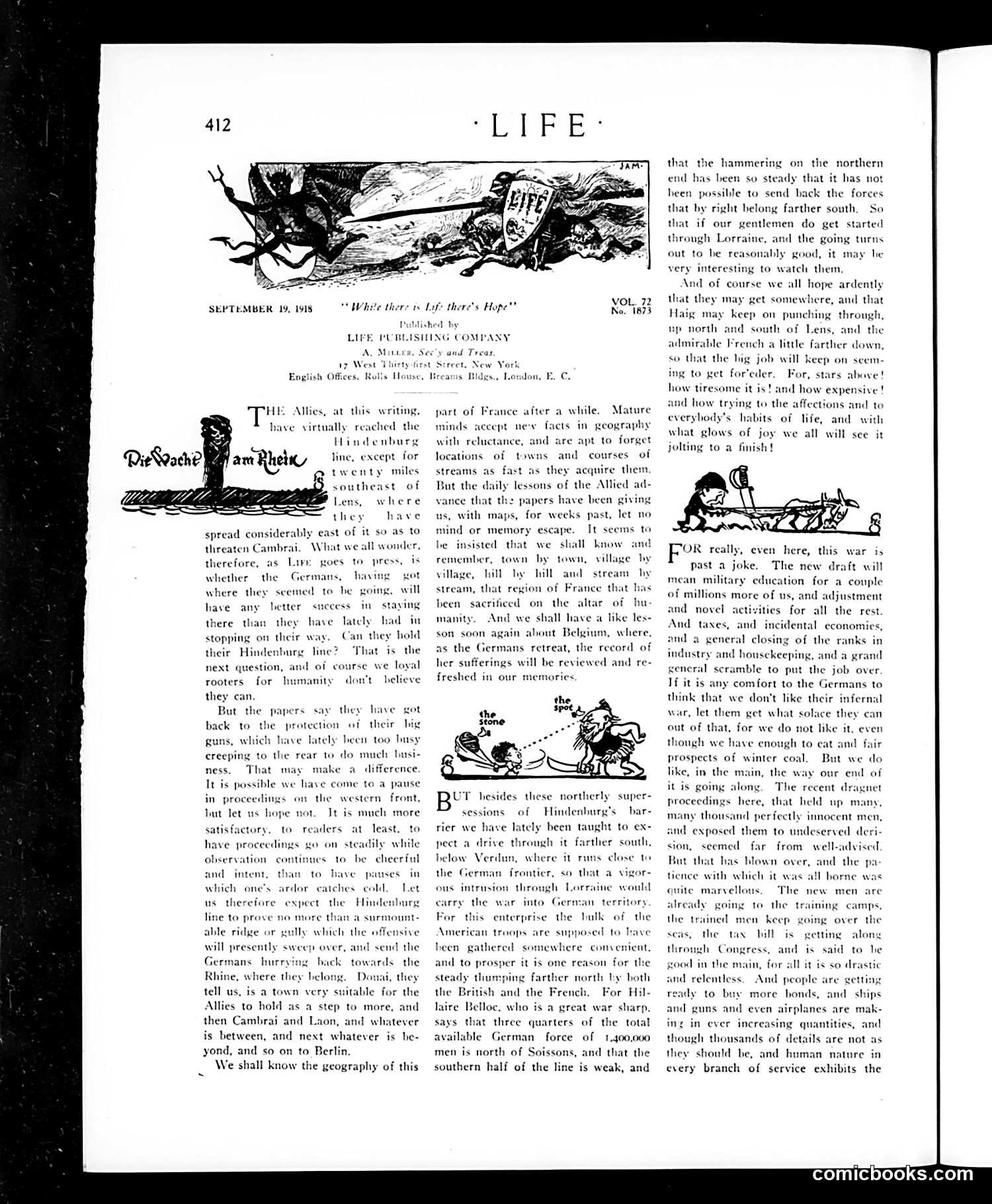
This page discusses World War I's Western Front, specifically the Hindenburg Line and Allied military strategy in France. The text references General Hindenburg, the Germans' defensive positions near Lens and Verdun, and debates whether the Allies can breakthrough. The top cartoon depicts "Where there is Life there's Hope"—a play on the magazine's title. It shows what appears to be a skeletal or death-like figure (likely representing German military prospects) alongside the Life Publishing Company masthead, suggesting darkly humorous optimism about eventual Allied victory. The lower cartoon titled "the stone" and "the stone" (unclear reference) shows abstract figures, possibly representing the grinding difficulty of trench warfare or the weight of military operations. The text expresses hope that recent Allied advances—particularly British forces under Haig and French forces—will continue pushing German forces back toward Berlin, while acknowledging the war's enormous human and economic costs.
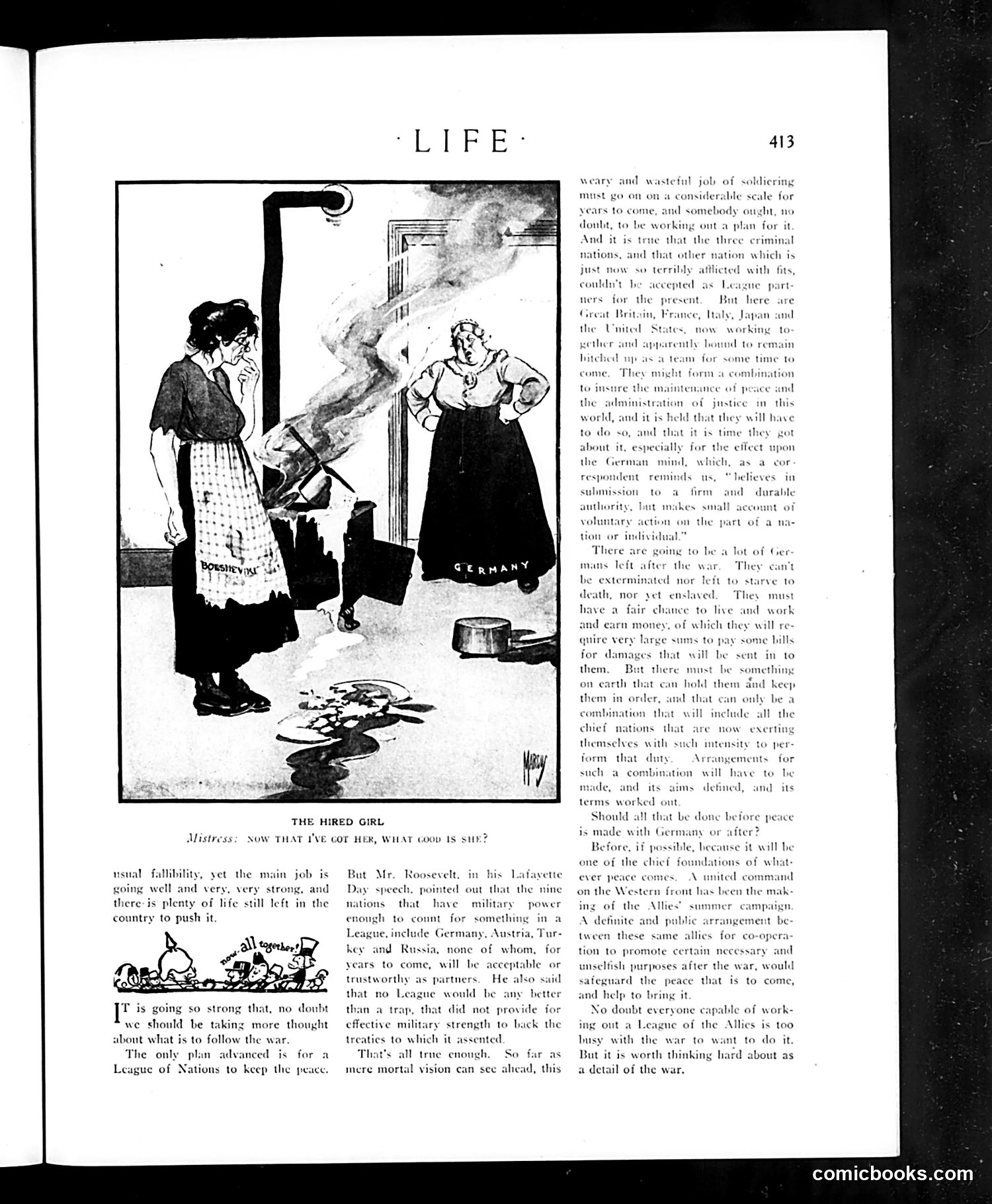
The cartoon depicts a European housewife (labeled "Mistress") questioning a new maid labeled "Germany" about her qualifications. The satire criticizes post-war planning for a League of Nations. **The Point:** After WWI's conclusion, the U.S. and Allied powers faced the problem of what to do with defeated Germany. The accompanying text references Roosevelt's Lafayette Day speech warning that a League lacking military enforcement would be "a trap." The cartoon suggests the uncomfortable reality: Germany—like an untrustworthy hired servant—cannot simply be discarded, enslaved, or starved, yet remains fundamentally unreliable as a partner in maintaining postwar peace. **The Satire:** The cartoon's grim humor lies in the predicament: the Allies need some mechanism to control Germany and ensure reparations payments, but Germany itself cannot be trusted as a League partner. The "mistress" asking "what good is she?" captures the dilemma—Germany must participate in the peace structure, yet her trustworthiness is precisely in question.
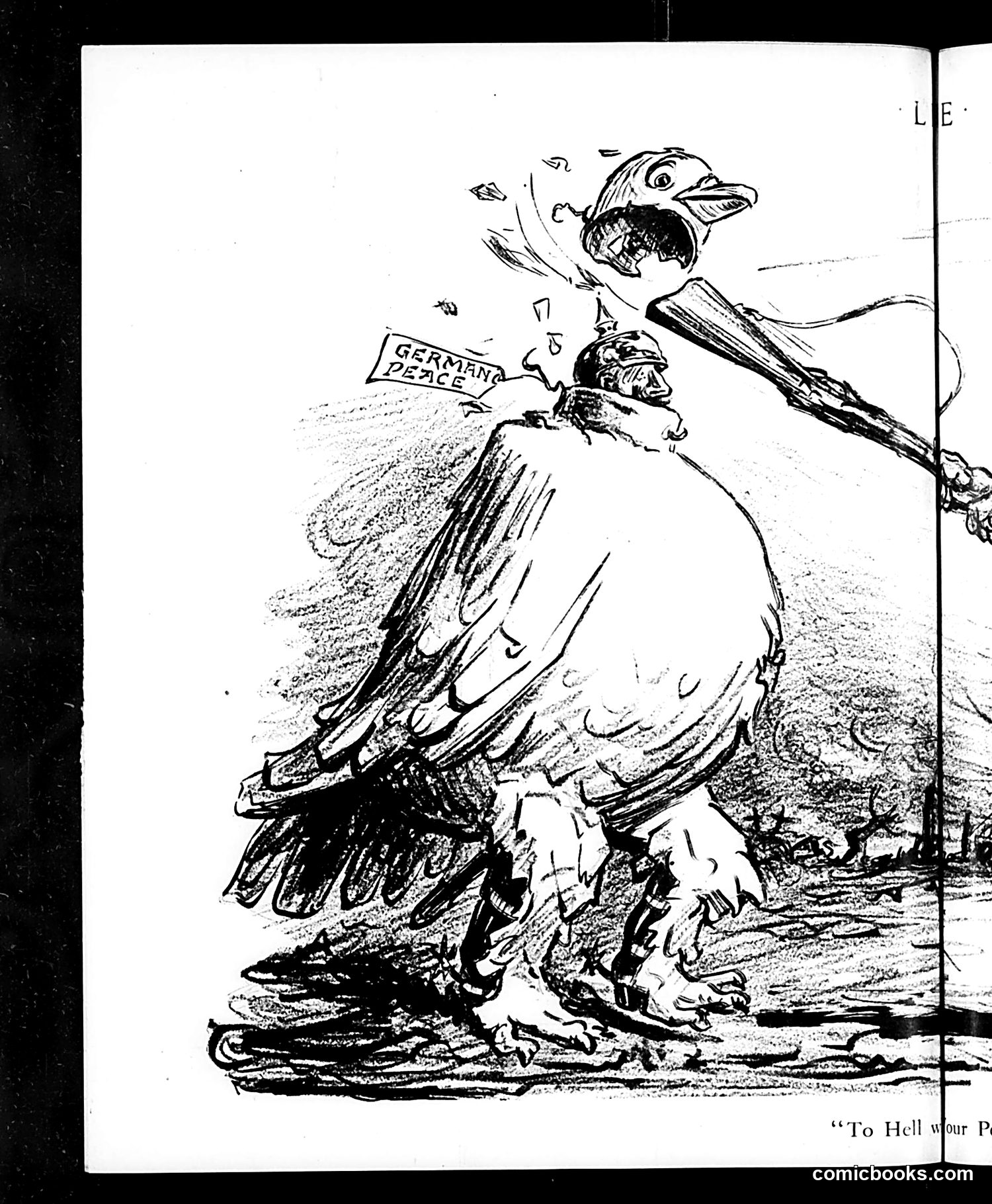
This is a satirical cartoon depicting an eagle—representing America or American power—carrying what appears to be a small human figure (possibly a political leader or soldier) while clutching a document labeled "GERMANA PEACE" (likely "German Peace"). The eagle appears aggressive and dominant, suggesting American military might imposing peace terms. The phrase "To Hell w[ith] our P[eace]" (partially visible at bottom) indicates criticism of American peace negotiations, likely referencing post-World War I peace settlements or diplomatic disagreements. The cartoon satirizes American foreign policy by portraying the U.S. as forcefully imposing its will, with the small human figure suggesting either powerlessness or reluctant compliance. Without a specific date visible, the exact historical moment remains unclear, though the German peace reference suggests early 20th-century context.
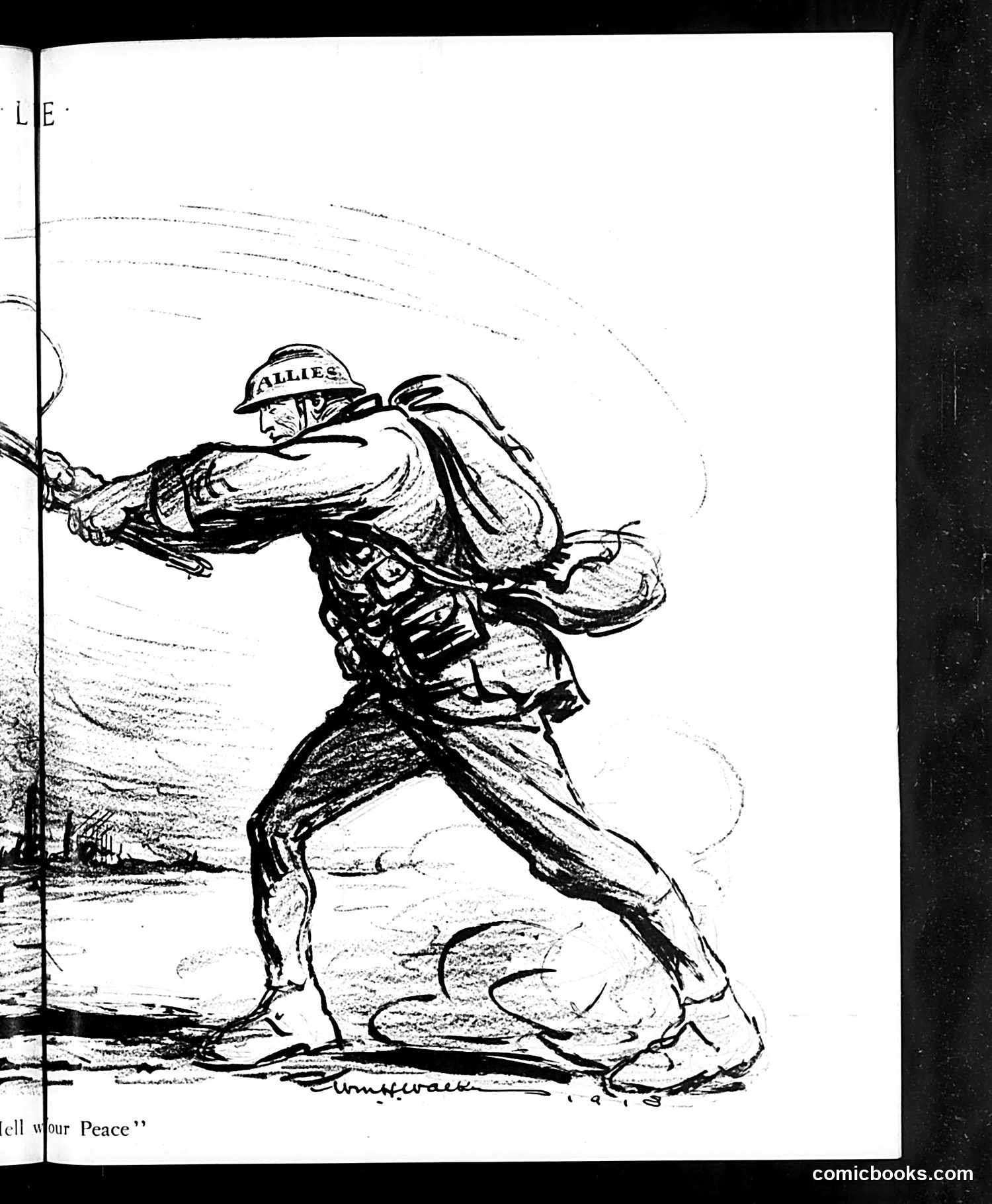
This appears to be a World War I-era satirical cartoon from *Life* magazine. It depicts an Allied soldier (identified by the "ALLIES" helmet marking) in a dynamic throwing or combat pose, with what looks like a grenade or explosive device. The soldier is muscular and aggressive, shown mid-action against an enemy position. The partially visible caption reads "...ll w[our] Peace," suggesting the full text likely refers to "all our peace" or similar—implying that Allied military force is necessary to achieve peace. The cartoon satirizes the paradox of wartime messaging: that victory through violence is the path to peace. The artistic style and subject matter are consistent with WWI-era propaganda and patriotic imagery meant to justify or encourage military action.
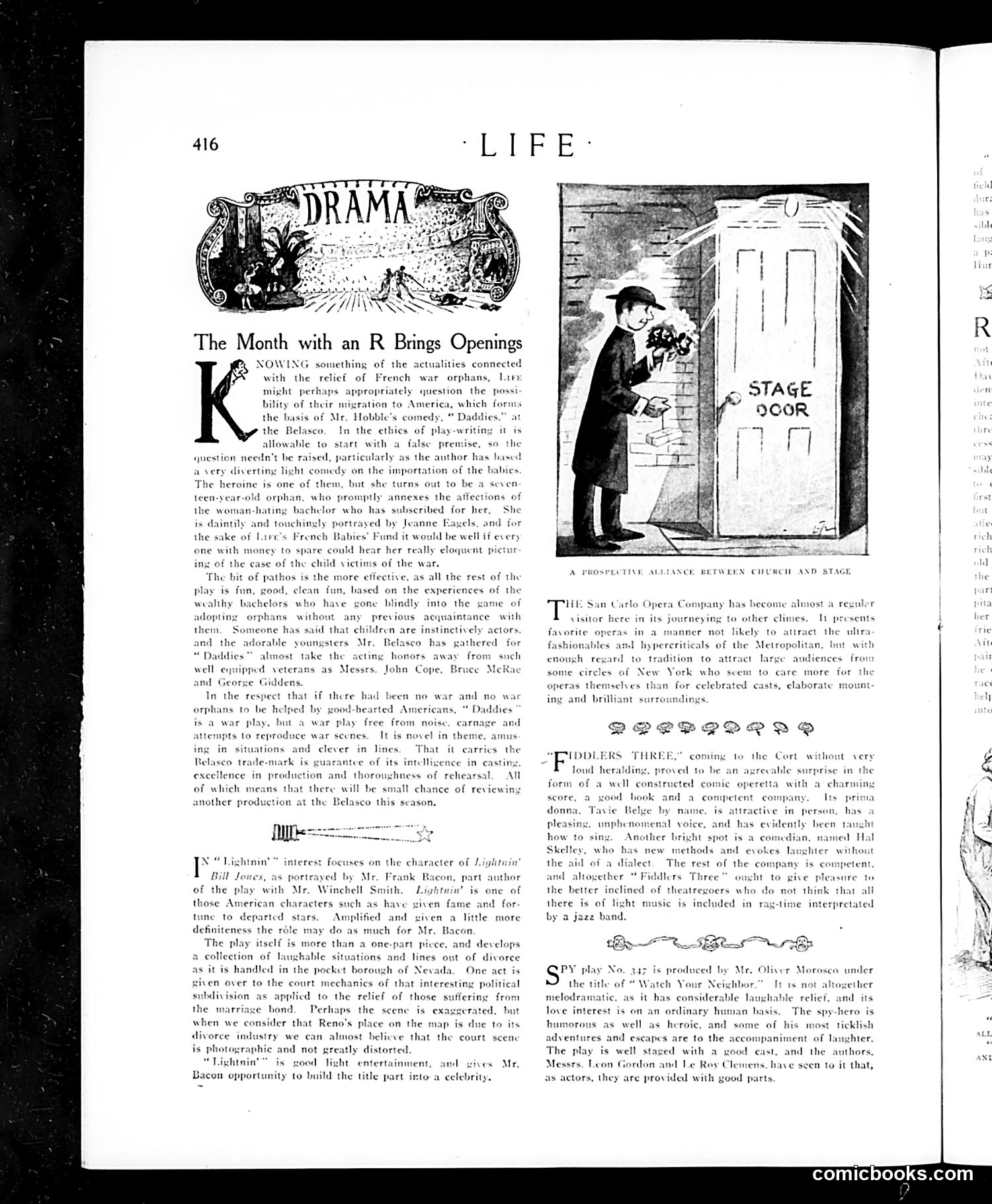
This page reviews three theatrical productions opening in a month with an "R" (likely September): **"Daddies"** at the Belasco Theatre concerns French war orphans being adopted by wealthy American bachelors. The accompanying illustration shows a man at a stage door, captioned "A Prospective Alliance Between Church and Stage"—suggesting the morally questionable premise of the play. The reviewer questions whether importing foreign orphans to America is ethically sound, though he praises the production's entertainment value and the performance by Jeanne Eagels. **"Lightnin'"** features Frank Bacon as the American character Bill Jones, showcasing "one-part" comedy through humorous situations and clever dialogue rather than war spectacle. **"Fiddlers Three"** is a comic operetta with charming score and good performances, notably comedian Hal Skelley, though the reviewer notes it includes jazzy ragtime interpretations. The overall tone is typical Life satire—critiquing theatrical choices while acknowledging entertainment merit.
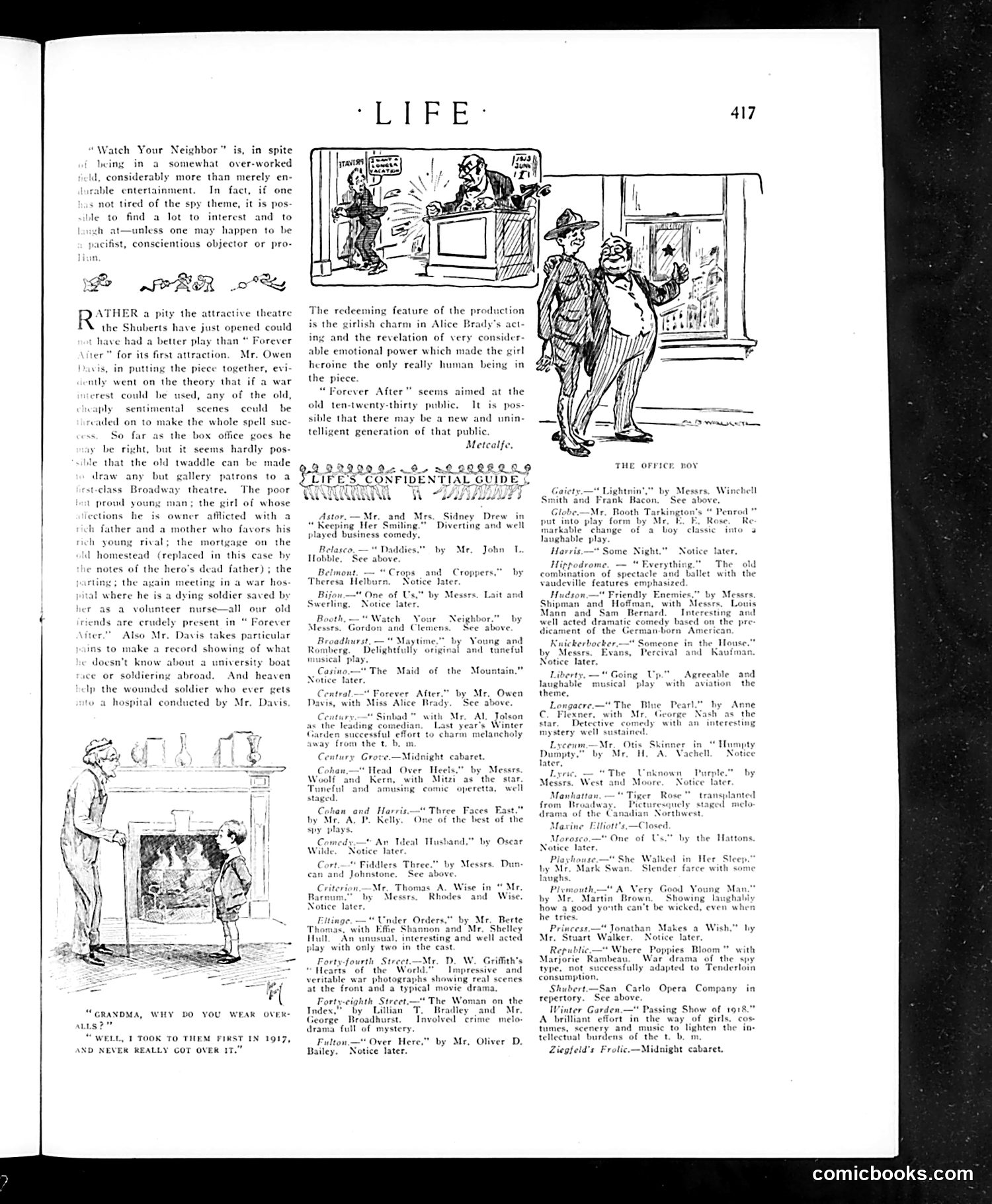
This page is primarily a **theatre review column** rather than political satire. It critiques Broadway productions currently playing, with particular focus on "Forever After," a new play at the Central Theatre starring Alice Brady. The **cartoons** illustrate the reviewer's complaints: the top cartoon shows someone pitching a tired plot to producers; the bottom shows a grandmother explaining she adopted overalls in 1917 and never stopped—a visual joke about outdated fashions persisting. The **main satire** targets the play "Forever After" for recycling exhausted wartime melodrama tropes: the poor proud young man, the girl of questionable parentage, the predatory rival, the mortgage, and the climactic hospital reunion where the hero dies. The reviewer argues this "old twaddle" appeals only to gallery (cheapest seat) patrons and shouldn't headline a quality Shubert theatre. **The only redeeming element**: Alice Brady's genuine emotional performance, which briefly elevates the clichéd material. This reflects post-WWI fatigue with war-themed entertainment and changing theatrical tastes.
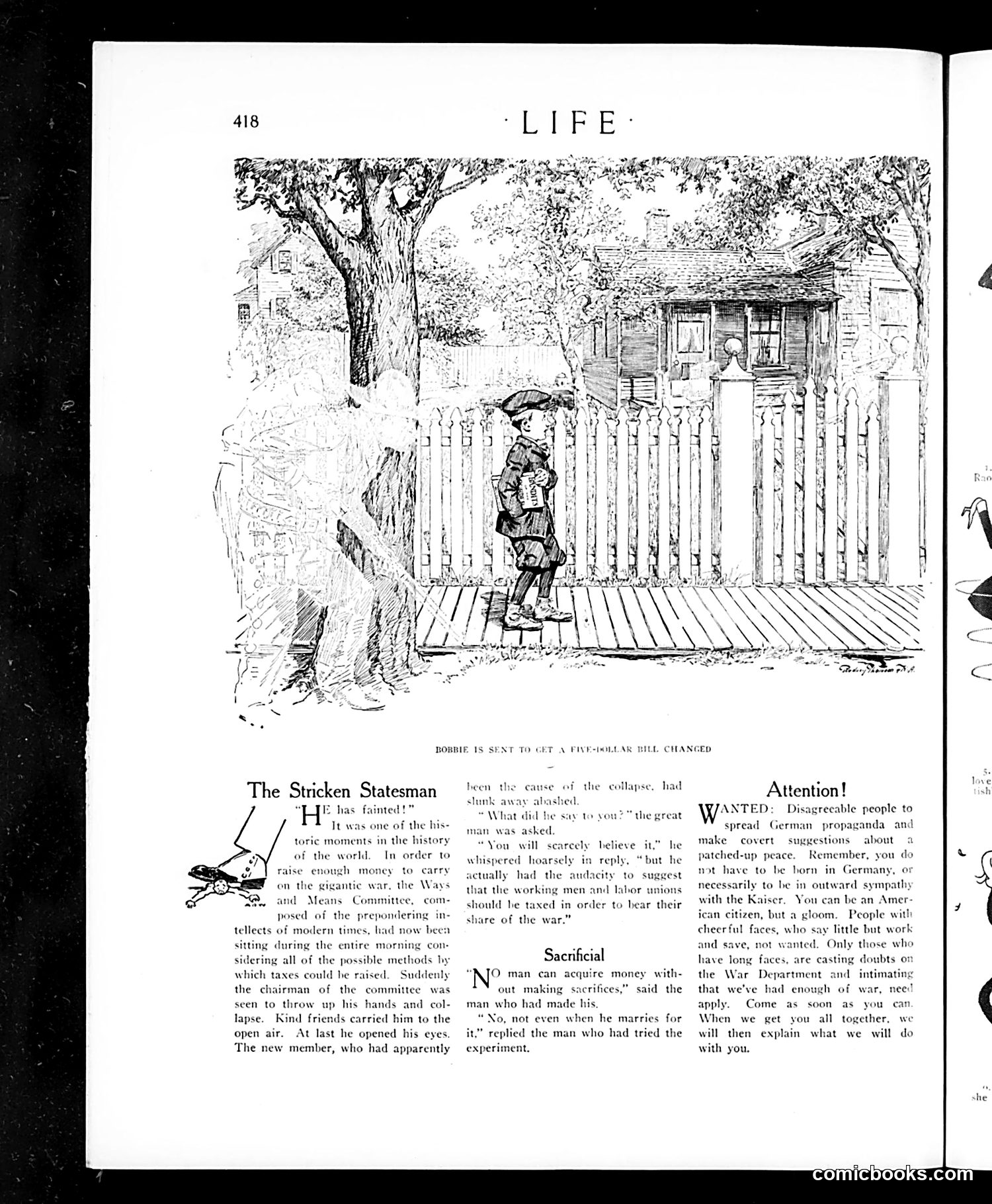
This page contains two satirical pieces about wartime taxation and propaganda, likely from WWI. **"The Stricken Statesman"**: A committee chairman literally faints when a new congressman suggests taxing working men and labor unions to finance the war. The satire mocks the political elite's shock at any proposal to burden the working class—implying such taxation would be obviously unpopular, yet necessary sacrifices are expected elsewhere. **"Sacrificial"**: A brief dialogue where one character claims "no man can acquire money without making sacrifices," while another counters with personal experience that even marriage requires sacrifice. The satire appears to critique wealthy or privileged figures preaching sacrifice to others while avoiding it themselves. **"Attention!"**: A recruitment notice for propagandists willing to promote war optimism and suppress peace talk. It sarcastically targets "disagreeable people" with "long faces" casting doubt on war effort, suggesting the government actively seeks yes-men and censors dissent. Together, these pieces critique wartime hypocrisy: unequal taxation burdens, selective demands for sacrifice, and suppression of skeptical voices.
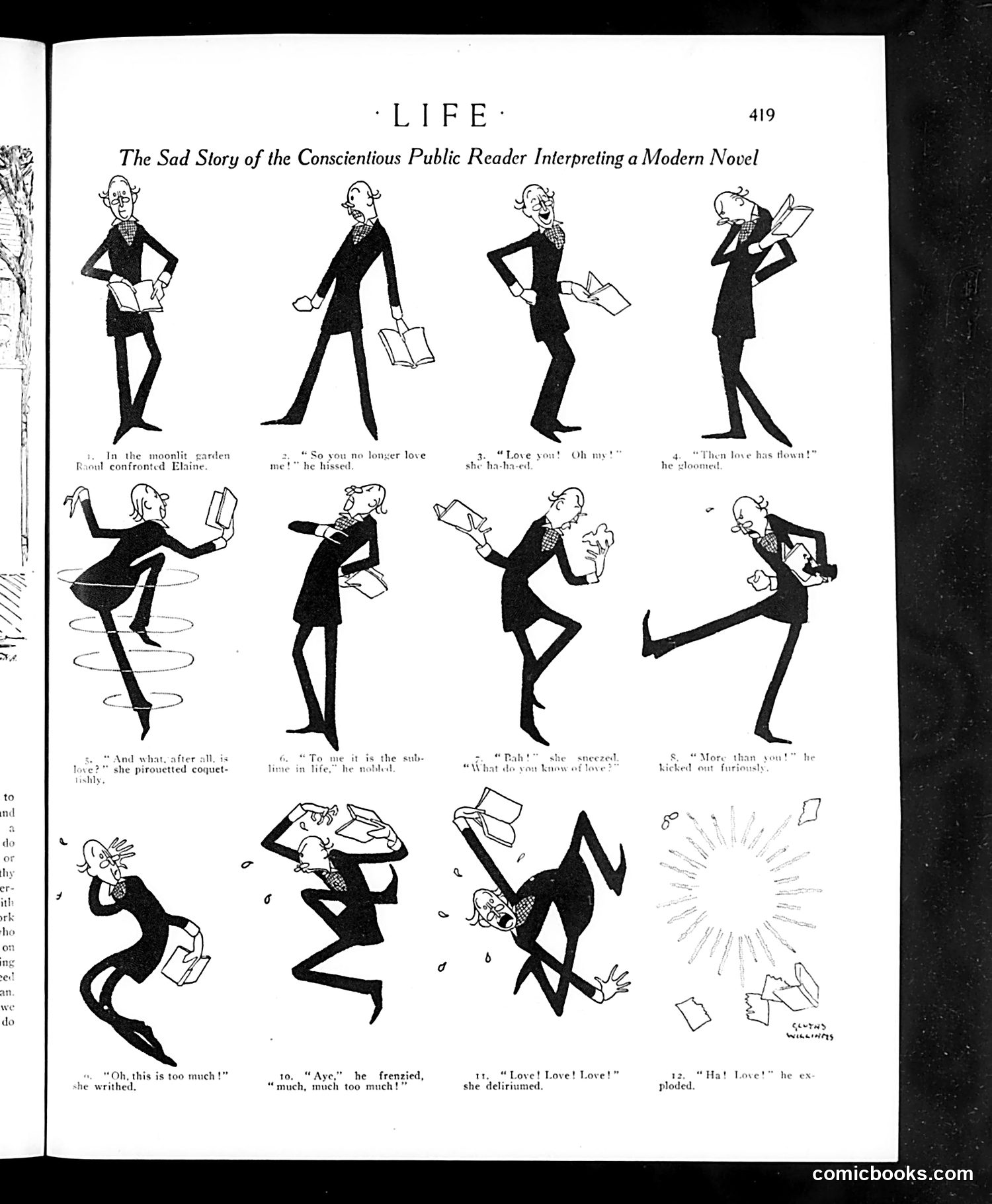
This satirical comic mocks readers struggling to parse modernist literature—likely works by authors like James Joyce or Gertrude Stein, known for experimental prose and fragmented narratives. The sequence shows a woman reader physically contorting herself through twelve panels, her body becoming increasingly distorted as she attempts to interpret a romantic scene between characters "Raoul" and "Elaine." Simple plot points ("love," "kissing") trigger exaggerated emotional responses—writhing, pirouetting, kicking—suggesting the reader is overanalyzing or misinterpreting avant-garde fiction's intentional obscurity. The humor targets educated readers earnestly wrestling with "difficult" modern novels, implying their interpretive gymnastics are as absurd as the experimental texts themselves. It's satire of both pretentious modernism and its conscientious audience.
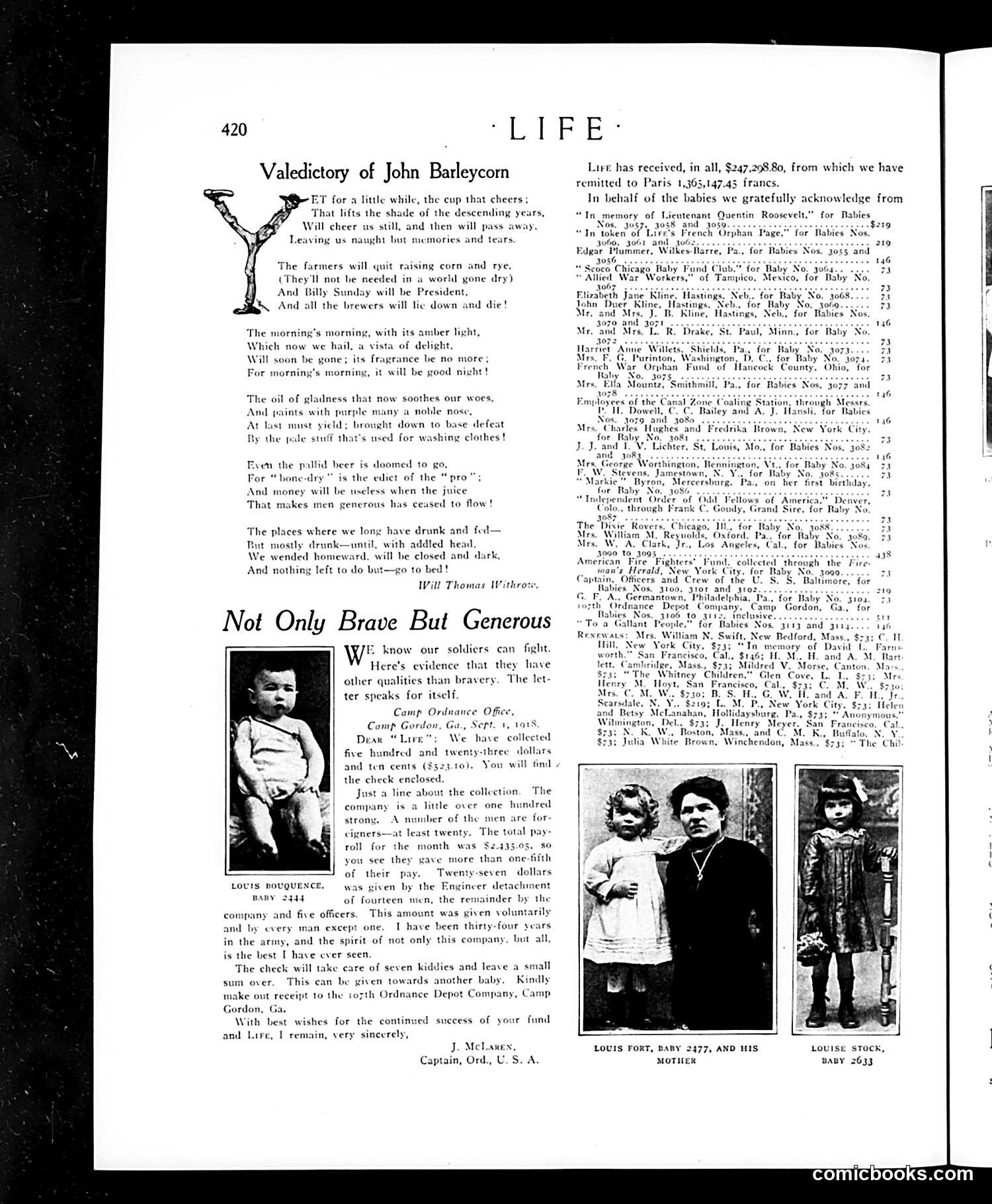
This page satirizes Prohibition's imminent arrival in America. The "Valedictory of John Barleycorn"—a personification of alcohol—is a mock-elegiac poem mourning booze's death. It references Billy Sunday (a famous temperance evangelist who supported Prohibition) becoming President, predicts breweries will "lie down and die," and laments that "bone-dry" laws will end the "juice that makes men generous." The satire mocks Prohibitionist ideology by suggesting alcohol was the sole source of human generosity and that without it, society will collapse into joyless tedium ("go to bed"). Below this, "Not Only Brave But Generous" presents a genuine letter from a WWI Army officer describing soldiers' charitable contributions to an orphan fund—apparently presented as counterargument to the satirical poem above, proving soldiers *are* generous without alcohol. The page also contains acknowledgments of donations to "Life's French Orphan Page," including one honoring Lieutenant Quentin Roosevelt (Theodore Roosevelt's son, killed in WWI).
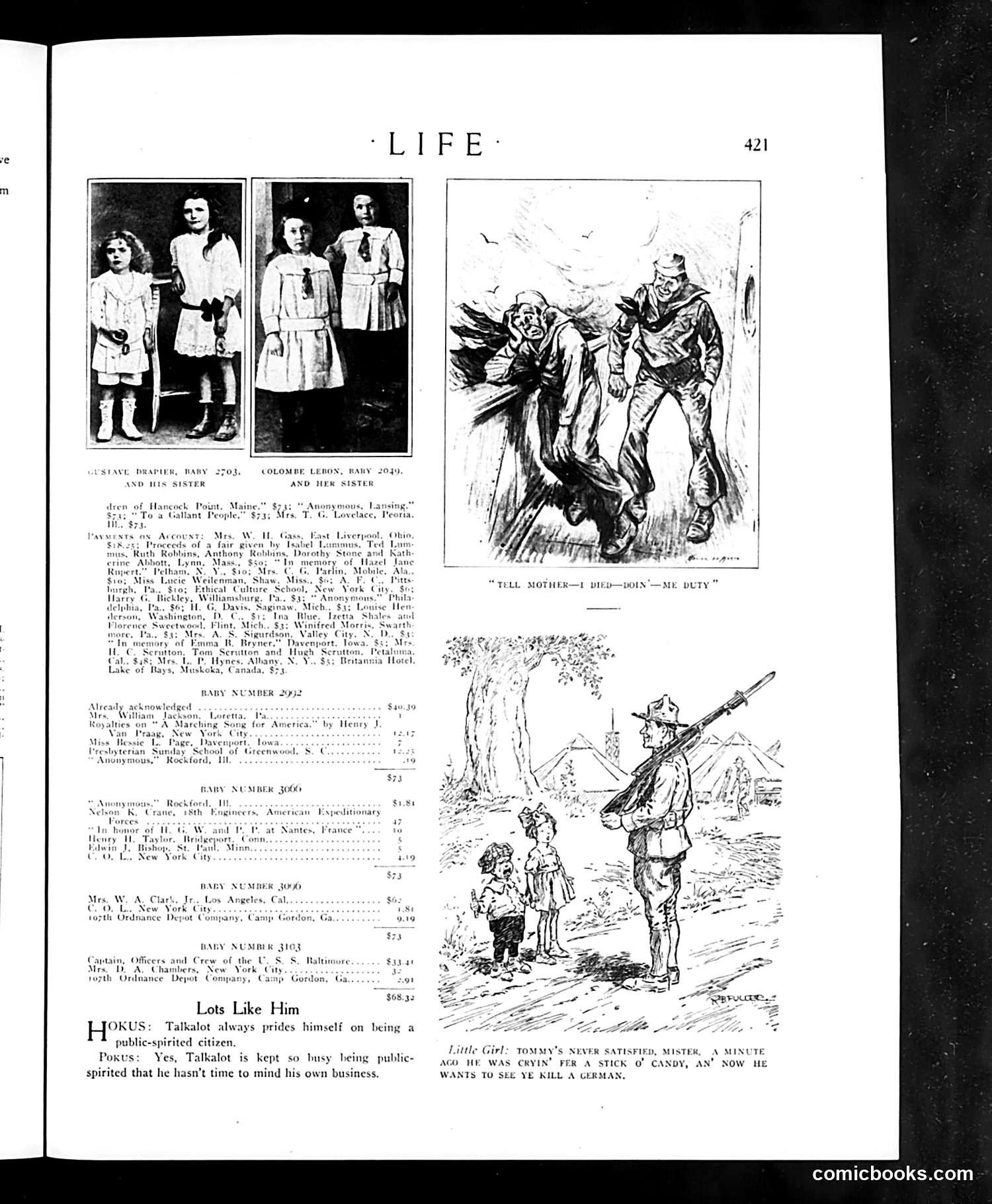
This page from *Life* magazine contains two distinct pieces of satire: **"Lots Like Him"** (bottom): A two-panel joke satirizing performative patriotism. "Talkalot" is a public-spirited citizen so consumed with appearing patriotic that he neglects his actual responsibilities. The humor targets those who loudly champion causes while failing at basic personal duties—a timeless critique of hypocrisy. **"Little Girl" cartoon** (right): A wartime illustration, likely from WWI era (based on references to German soldiers). A child, initially wanting candy, now demands to see her neighbor kill a German soldier—darkly satirizing how war propaganda infiltrates even childhood innocence. The cartoon critiques how military fever corrupts normal values and desires. The page also lists donors to "Baby" charitable funds, suggesting *Life* published both satire and public-interest content simultaneously.
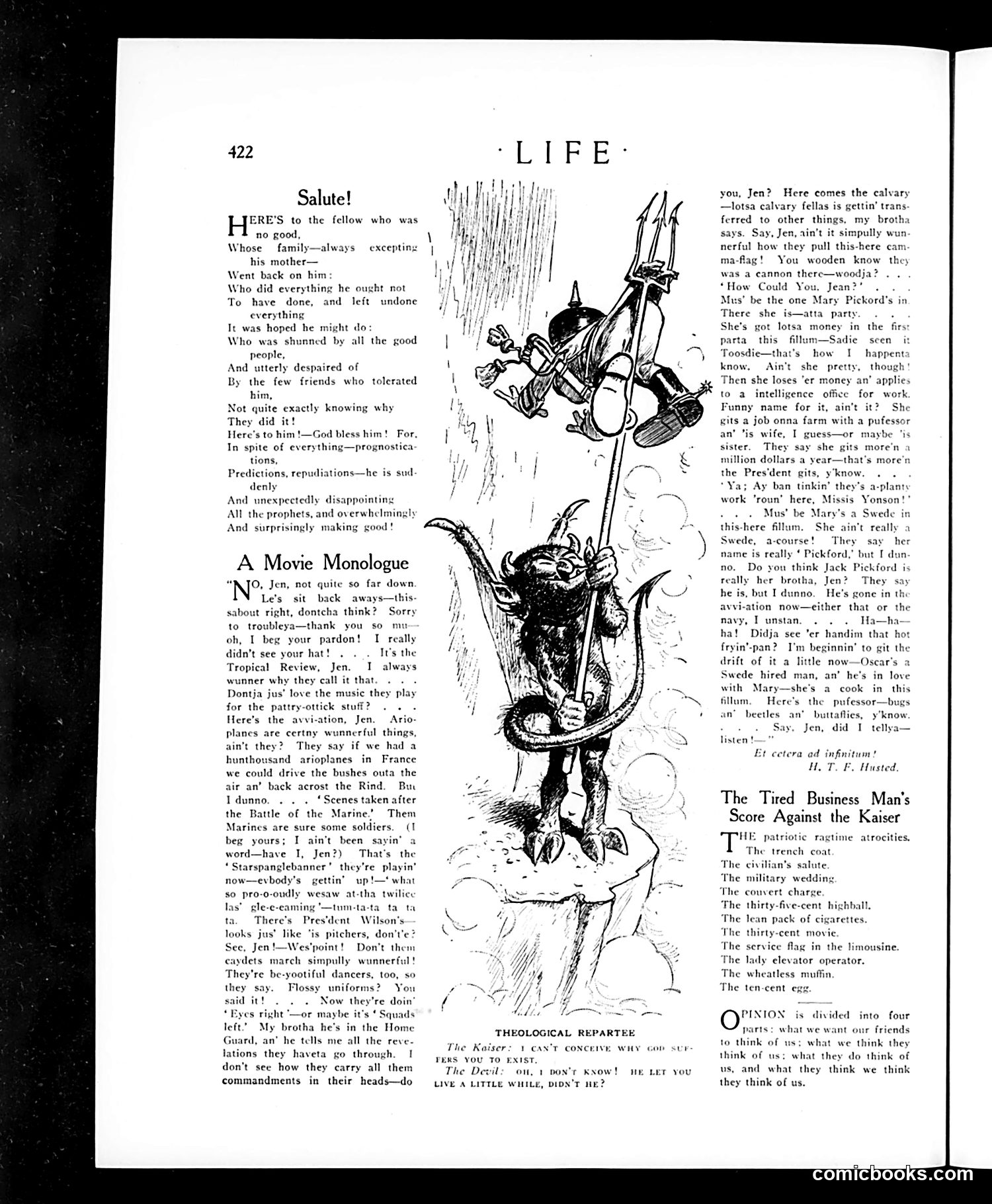
This page contains satirical commentary on American society during World War I era. **"Salute!"** is a poem celebrating an underdog—someone from a disreputable family, shunned and written off by respectable society, who unexpectedly succeeds. It's a feel-good tribute to redemption despite grim predictions. **"A Movie Monologue"** satirizes the stereotypical chatty moviegoer. The character provides running commentary during a war film, discussing Mary Pickford (the era's biggest film star), military service, and aviation—mixing genuine patriotism with vapid gossip and malapropisms ("Starspanglebanner," confusion about celebrities' families). It mocks both audience behavior and the public's obsessive interest in movie stars' private lives. **"Theological Repartee"** is a brief joke playing on WWI tensions: the Kaiser claims God doesn't permit the Devil to exist; the Devil responds he's managed to "live a little while"—implying the Kaiser himself is devilish. **"The Tired Business Man's Score Against the Kaiser"** appears to be a humorous list comparing wartime irritations (rationing, military weddings) to the Kaiser's threat level—domestic annoyances scored against an enemy.
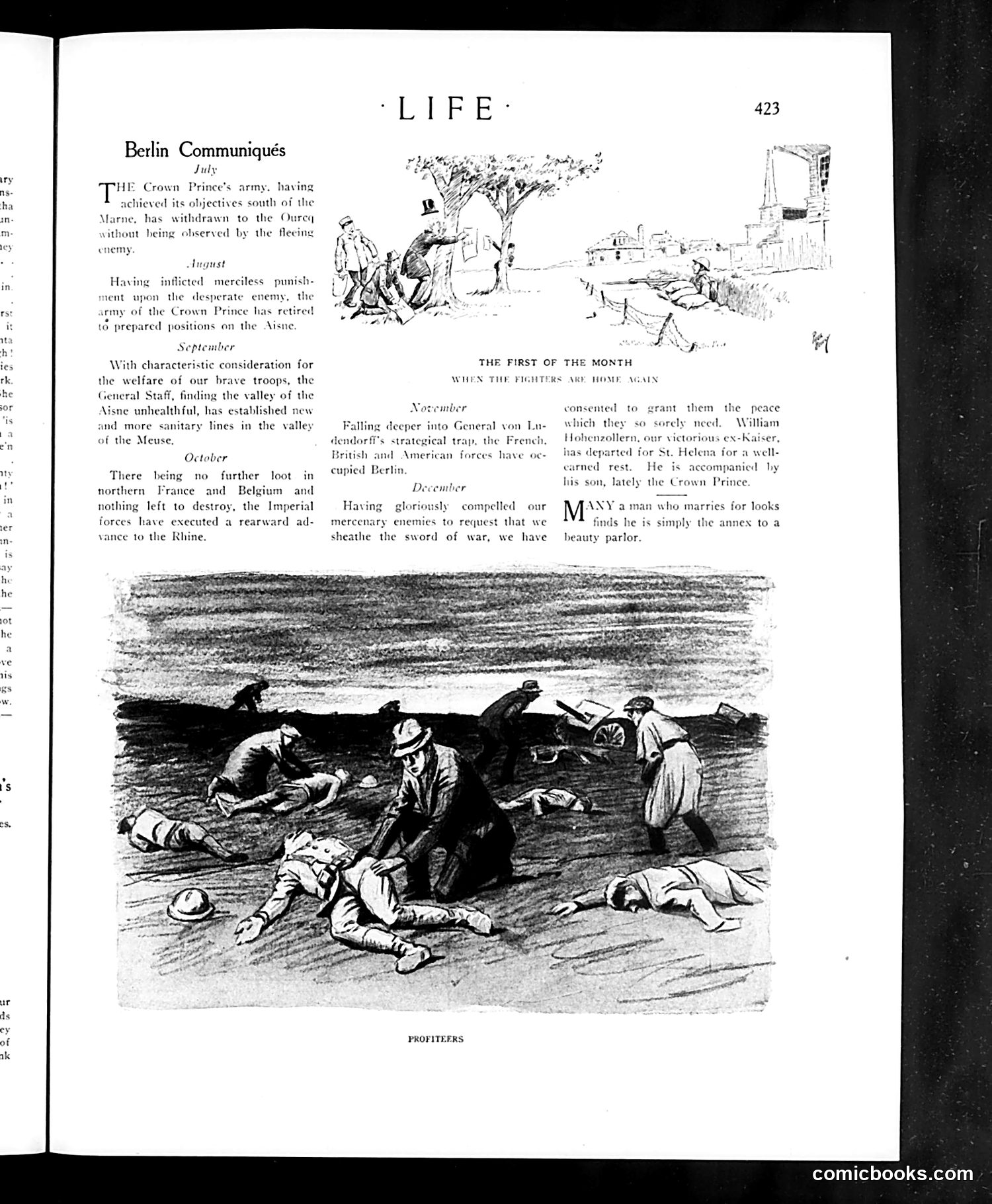
This page mocks German military propaganda and post-WWI profiteering. The "Berlin Communiqués" section parodies official German army bulletins from 1918, using euphemistic language to describe military defeats as strategic "withdrawals" and "rearward advances." Phrases like the Crown Prince's army "retiring to prepared positions" actually describe retreat; describing the Rhine as a destination masks fleeing toward Germany's border. The accompanying illustration titled "Profiteers" depicts scavengers looting corpses and wreckage on a battlefield—a darker commentary on those profiting from war's carnage while soldiers die. The final paragraph mocks Wilhelm II (the Kaiser) being exiled to St. Helena, comparing his departure to Napoleon's. The magazine's satirical intent: expose how military establishments distort language to hide military failure, and criticize war profiteers who exploit human suffering for gain.
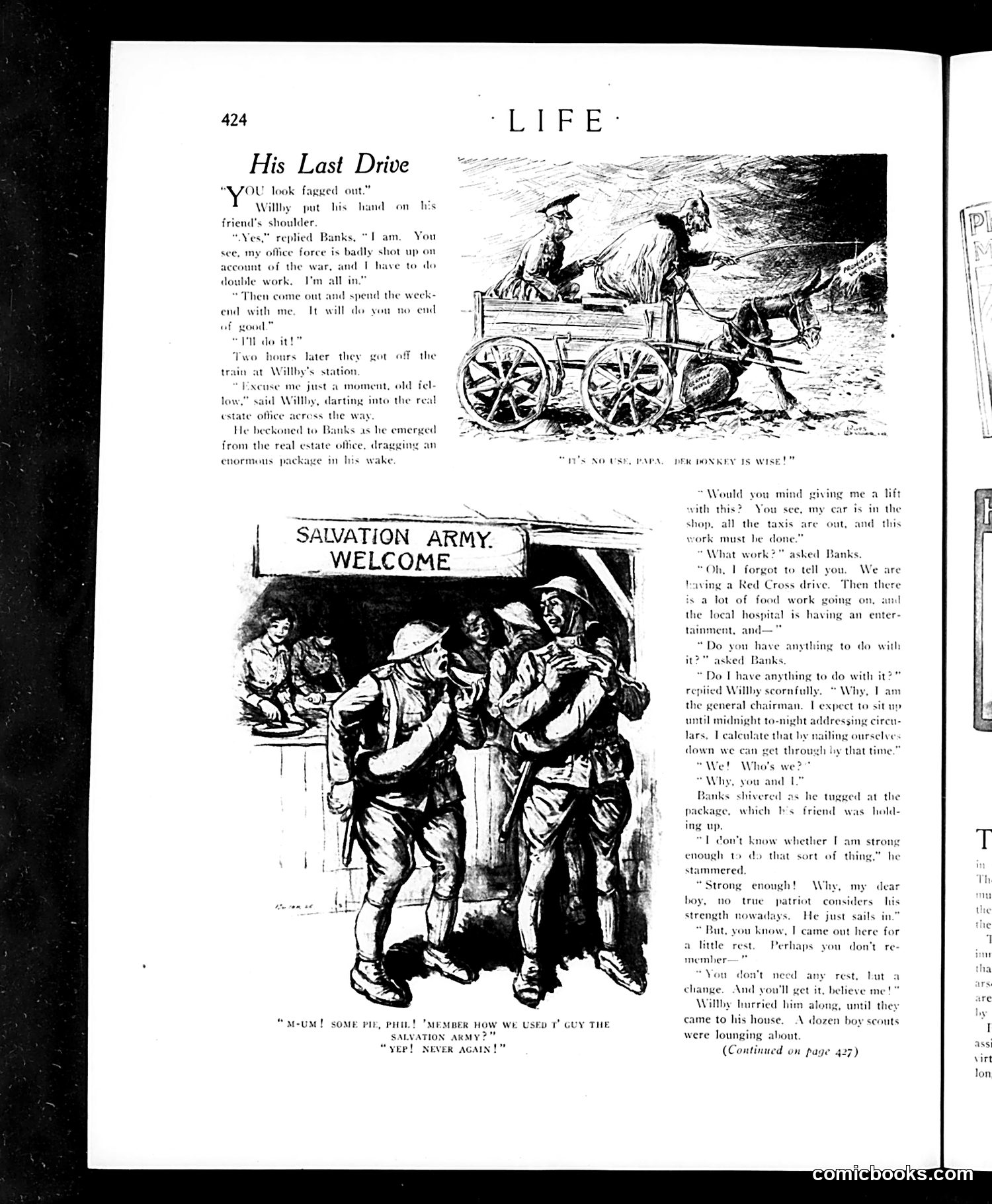
This page presents a satirical story about a character named Willby and his friend Banks during wartime. The narrative depicts Willby recruiting Banks for some unspecified "work" related to a Red Cross drive at a local hospital, claiming his "office force is badly shot up on account of the war." The accompanying illustrations show soldiers and military personnel, including a "Salvation Army Welcome" scene featuring servicemen. The satire appears to target patriotic appeals and volunteer recruitment during wartime—specifically mocking how civilians were pressured to contribute to war-related charitable causes while euphemistically avoiding details about the actual work involved. The page continues on page 427, suggesting this is part of a longer story critiquing wartime volunteerism and social obligation.
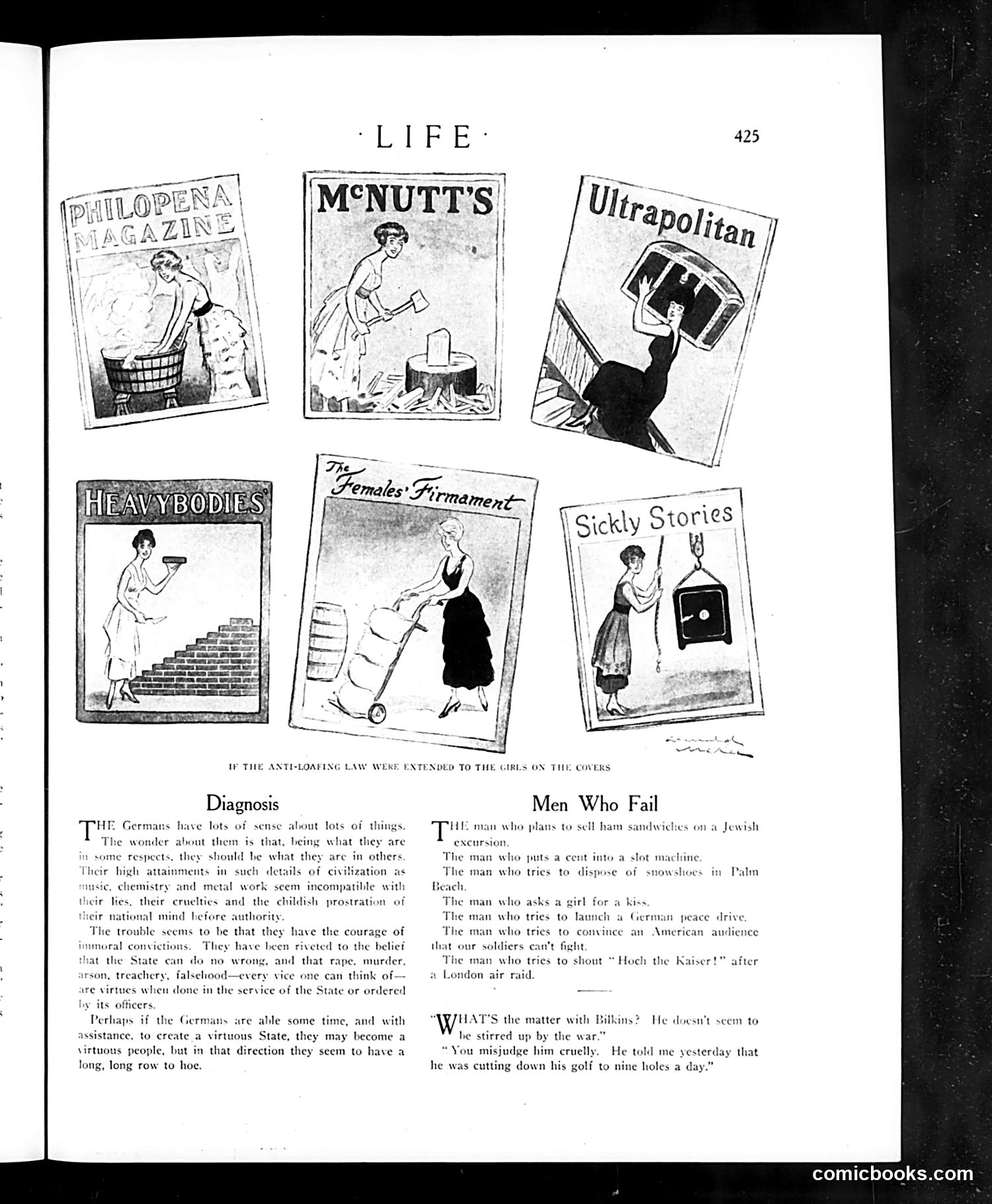
This page contains satirical commentary on World War I-era themes: **Top Section:** Six magazine cover parodies ("If the Anti-Loafing Law Were Extended to the Girls on the Covers") mock women's idleness during wartime by imagining covers titled *Philopena Magazine*, *McNutt's*, *Ultrapolitan*, *Heavybodies*, *The Females' Firmament*, and *Sickly Stories*—suggesting women should be working rather than lounging. **"Diagnosis":** A harsh critique of German national character, blaming their militarism on blind obedience to state authority. The author argues Germans conflate state service with morality. **"Men Who Fail":** A humorous list of futile wartime endeavors, including selling ham to Jews, launching German peace initiatives (impossible during WWI), and convincing Americans soldiers can't fight. **"What's the Matter with Bilkins?":** Final joke mocks a man's minimal war sacrifice—reducing golf from 18 to 9 holes—suggesting superficial patriotism among the wealthy. The page's overall tone criticizes both German militarism and American complacency during WWI.
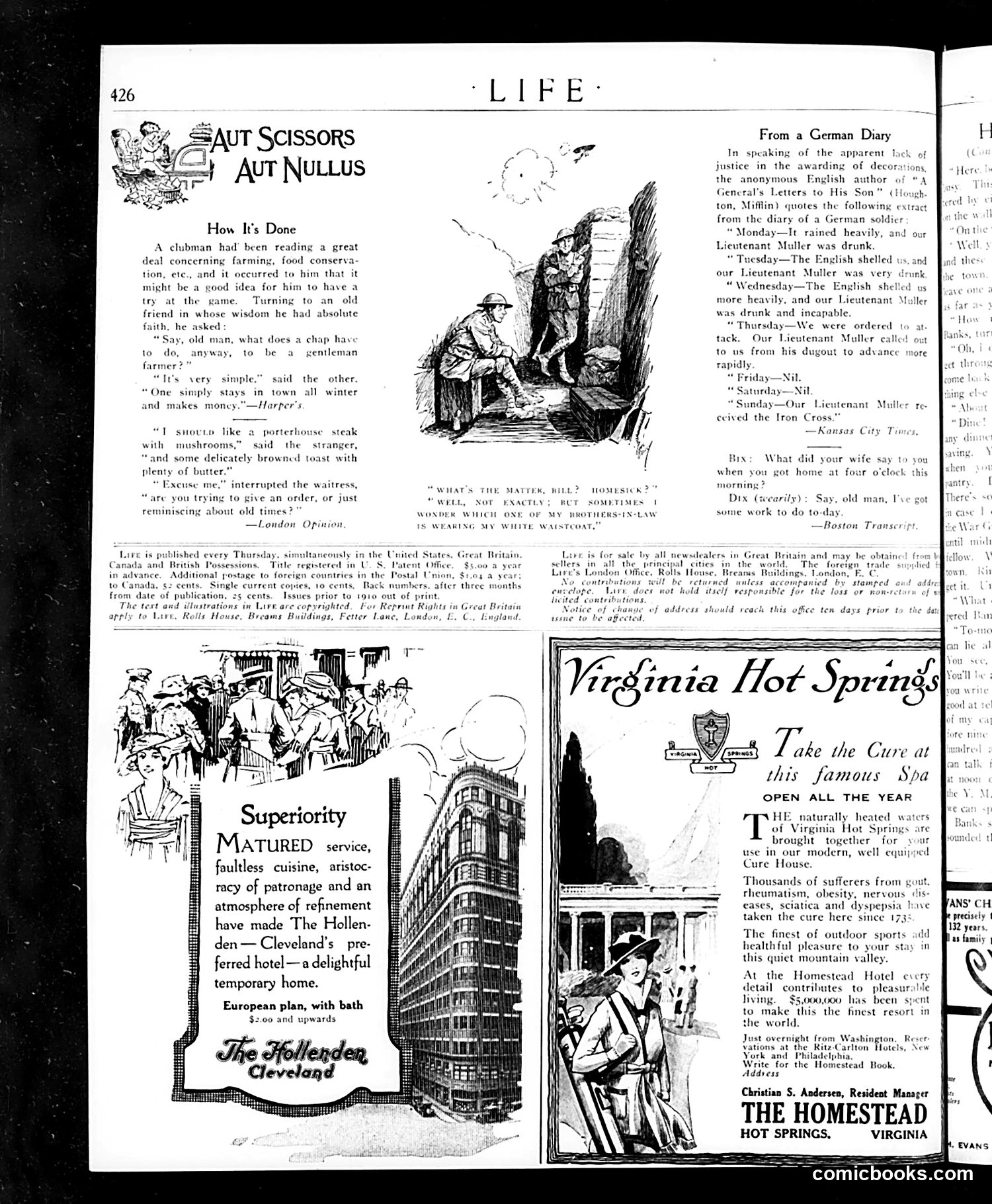
This page contains three distinct pieces of satire: **"How It's Done"** (top): A humorous dialogue between clubmen debating what makes a "gentleman farmer." The joke plays on class pretension—one suggests gentleman farming requires staying in town all winter while making money, implying the lifestyle is purely performative rather than involving actual farm work. **"What's the Matter, Bill?"** (center): A brief comic about a man who is seasick, clarifying he's not actually ill but distressed about which brother-in-law will inherit his white waistcoat. The humor mocks anxiety over petty material possessions. **"From a German Diary"** (right): A satirical take on military decoration awarding, presented as entries from a German soldier's diary. The running joke: Lieutenant Müller receives the Iron Cross despite being drunk every single day of the week, mocking the arbitrary or absurd criteria for military honors during WWI. The page is primarily **advertising** (Hollenden Hotel, Virginia Hot Springs resort) with scattered humorous filler content typical of *Life* magazine's format.
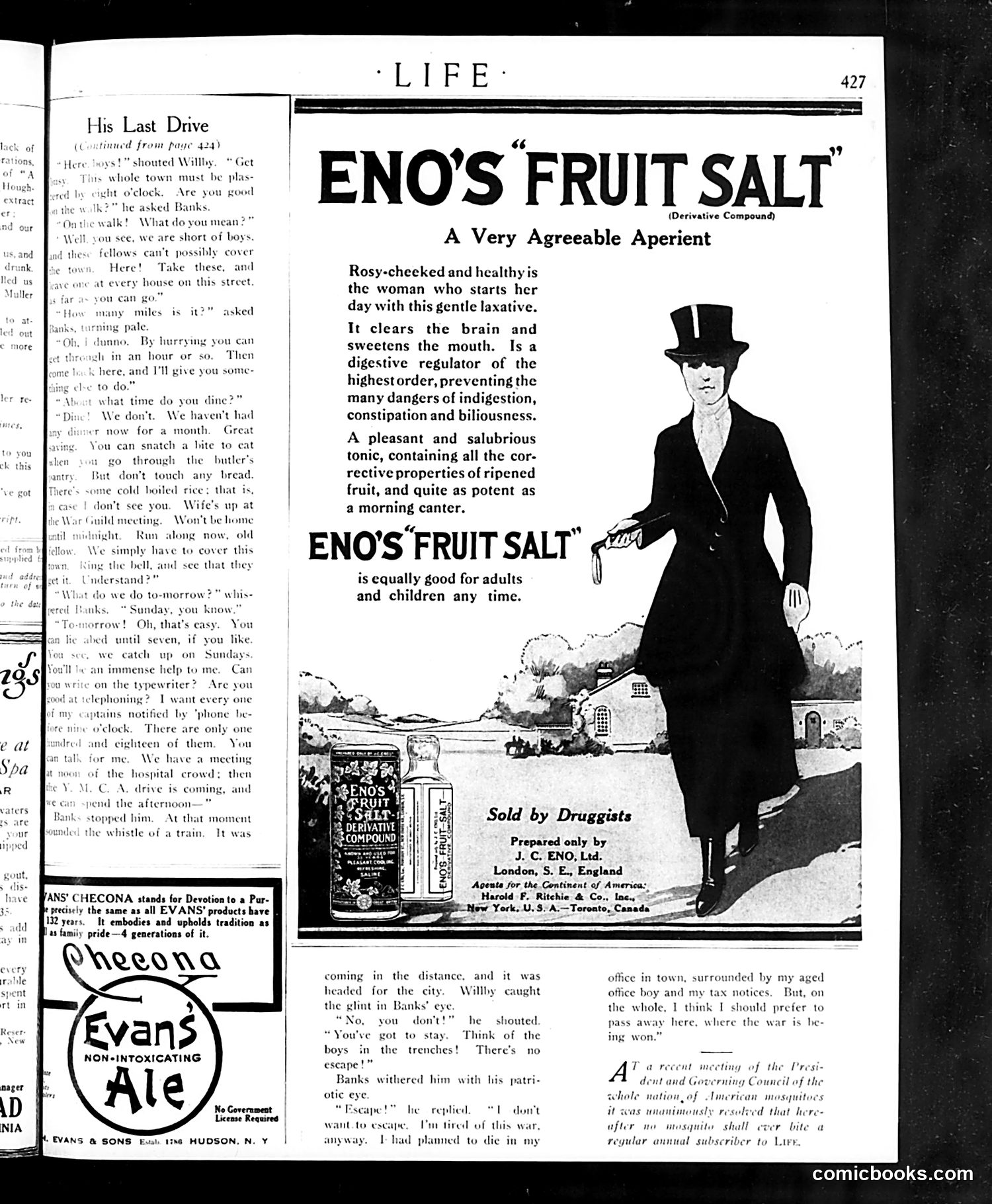
This page contains two distinct elements: **Main Content:** A serialized story titled "His Last Drive" (continued from page 424), depicting a dialogue between characters named Willby and Banks. The narrative appears set during World War I, with references to "boys in the trenches." Banks, apparently a military or civic leader, is organizing volunteers for some wartime effort, while resisting Willby's attempts to convince him to escape or take leave. The satirical point seems to be Banks' stubborn commitment to duty despite personal hardship (his wife is away, he hasn't dined properly in a month). **Advertisement:** The dominant visual is a full advertisement for "Eno's Fruit Salt," a laxative product marketed as a gentle digestive aid. The ad features an elegant woman in Edwardian dress and promises the product "clears the brain and sweetens the mouth" while preventing indigestion and constipation. The juxtaposition is typical of *Life* magazine's format—serious serialized fiction alongside period advertising, with no particular satirical connection between them.
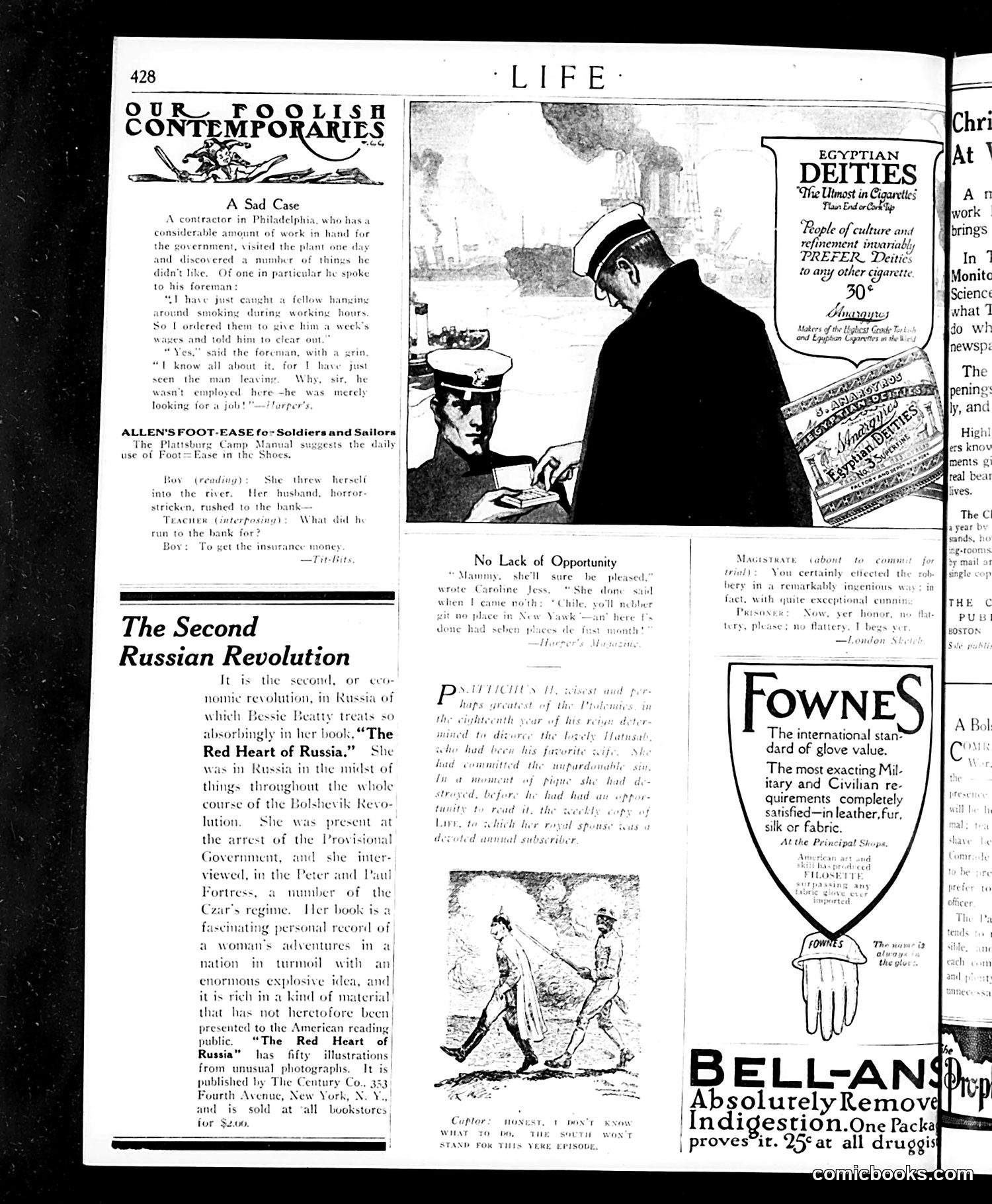
This page from *Life* magazine contains three brief satirical anecdotes mocking human foolishness: 1. **"A Sad Case"**: A Philadelphia contractor catches a man smoking during work hours and fires him—only to learn from his foreman that the man wasn't even employed there; he was simply job-hunting on the premises. The joke: the contractor's hasty judgment and wasted effort. 2. **"Allen's Foot-Ease"**: A boy reading a dramatic story asks why a drowning woman's "husband" rushed to the bank—expecting a rescue. The boy misunderstands, thinking she needs insurance money. The joke: childish literalism about "bank" and financial priorities over human life. 3. **"The Second Russian Revolution"**: Advertises Bessie Beatty's book about witnessing the Russian Revolution firsthand, including the arrest of the Provisional Government. This is genuine editorial content, not satire. The remaining content is primarily **advertisements** for cigarettes, gloves, and digestive remedies—typical period advertising.
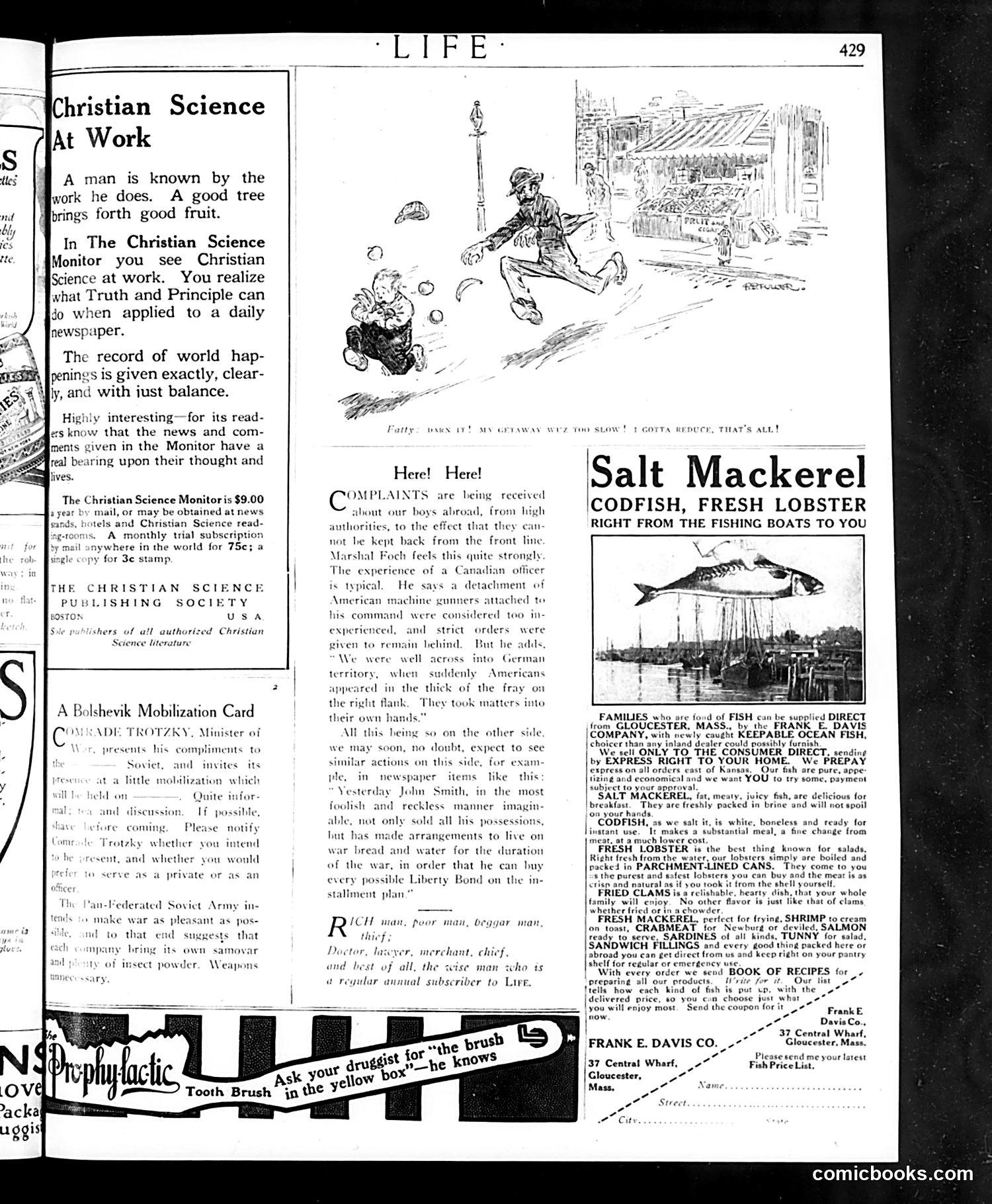
This page combines several distinct elements: **The Main Cartoon** depicts a child playing marbles while an adult jumps away in exaggerated panic, with the caption suggesting the child is a threat ("Gotta reduce, that's all!"). This appears to satirize American anxiety about children or youth during wartime—likely referencing post-WWI concerns about juvenile delinquency or social disruption. **"Here! Here!" Article** mocks American soldiers' eagerness to fight in WWI, contrasting complaints from French commanders (Marshal Foch) that American troops couldn't be kept from the front lines with expectations that American civilians should similarly sacrifice through Liberty Bond purchases. It satirizes both military enthusiasm and civilian war-finance propaganda. **Advertisement Content** dominates the lower half—promoting Christian Science Monitor, a Bolshevik "mobilization card" (anti-communist satire), and Frank E. Davis fish products. The page reflects post-WWI American attitudes: skepticism toward wartime sacrifice claims, anti-communist sentiment, and commercial messaging disguised as editorial content. The cartoons use humor to critique both military valor and home-front expectations.
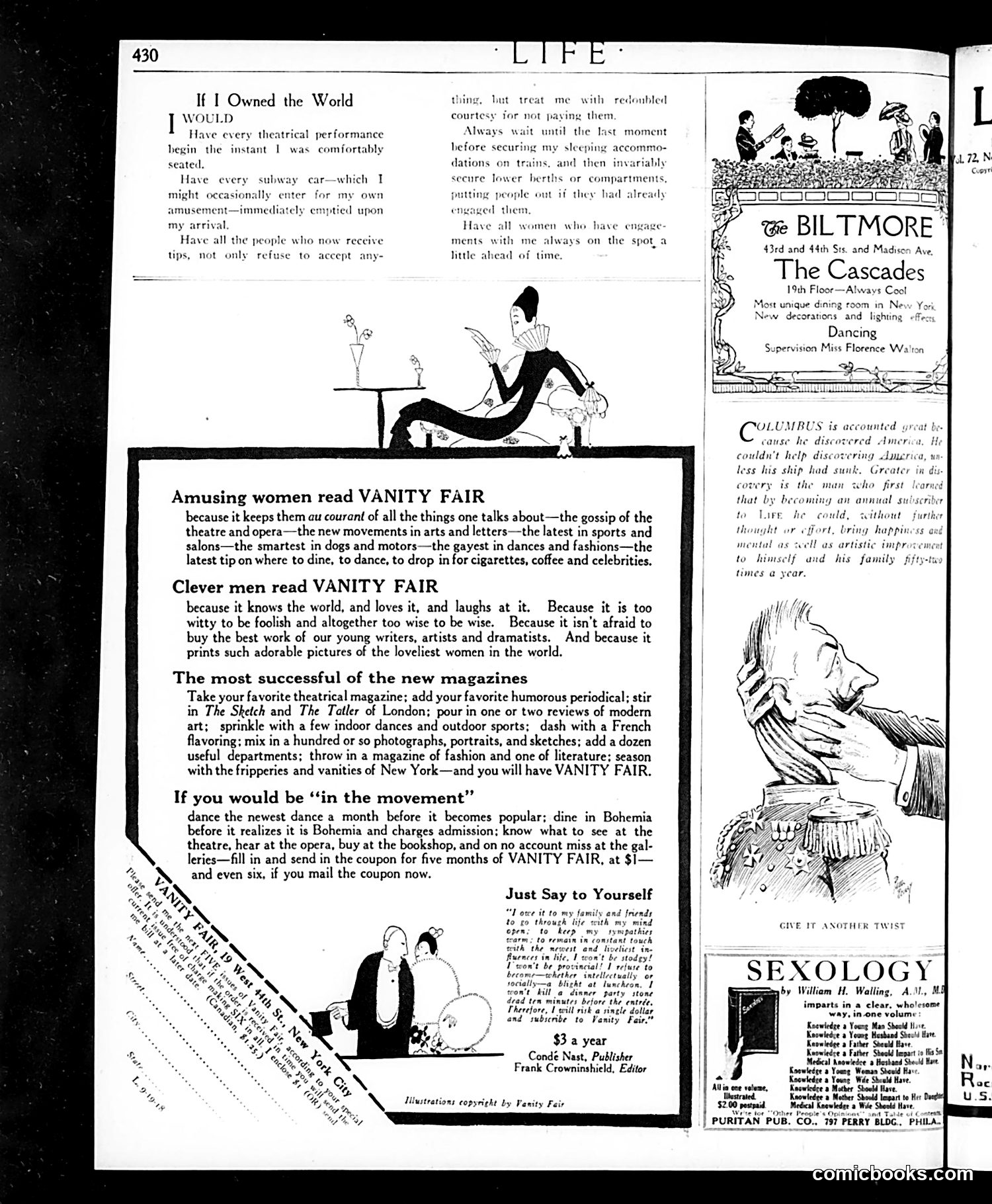
This is primarily a **Vanity Fair magazine advertisement** disguised as editorial content, with satirical commentary about modern urban life and social pretension. The top section, "If I Owned the World," satirizes **wealthy people's entitled expectations**—demanding theaters start on schedule for their arrival, refusing tips to service workers, and insisting train berths be available last-minute. The illustration shows an aristocratic woman lounging luxuriously, embodying this self-centered attitude. The main advertisement uses humor to market Vanity Fair to two audiences: "amusing women" interested in theater gossip and fashion, and "clever men" who appreciate wit and modern art. The copy implies that reading Vanity Fair signals sophistication and cultural awareness—you'll know what's fashionable "a month before it becomes popular." The "Just Say to Yourself" section mocks social anxiety, suggesting subscribers avoid being "provincial" or "a blight at luncheon." At $3 yearly, the magazine promises intellectual and social improvement. The sidebar advertisements (Biltmore Hotel, Sexology book) target similar affluent, status-conscious readers.